







Abstract
Breast gangrene is rare in surgical practice. Its aetiology is variable and multifactorial. Debridement and appropriate antibiotic treatment are the mainstay of management. Two such cases presented one early and the other desperately late. We report these two cases to emphasise the potential fatality of this condition.
Case Report
Case 1
A 30-year-old lactating woman presented with pain and swelling of the right breast associated with blistering and blackening of the skin surface over a period of four days. There was no history of trauma (such as infant bite), nor local application of any substance. She had no history of diabetes, hypertension or tuberculosis. She had not taken any medications, herbal or otherwise. There had been no previous surgical intervention on the breast.
On examination, she was febrile (38.3℃) with a pulse of 90 beats per minute and normotensive (138/78 mm Hg). The right breast was erythematous with necrotic changes involving almost all quadrants with purulent discharge (Figure 1(a)). The nipple and areola complex were spared. There were no axillary or other lymphadenopathy, and contralateral breast examination was normal. The rest of the systemic examination was normal.
Case 1: (a) initial presentation (right breast gangrene), (b) after surgical debridement, (c) topical negative pressure dressing (TNP), (d) after TNP dressing and (e) two weeks post-operative.
Laboratory investigations revealed anaemia (Hb 93 g/L), leucocytosis (25.2 × 10⁹/L), predominantly neutrophils (80%), with a normal platelet count (139 × 109/L), normal renal and hepatic function, negative HIV and hepatitis screen. She had a metabolic acidosis (pH = 7.20). Subsequent culture demonstrated Enterococcus spp.
After initial resuscitation with intravenous fluids and antibiotics (third-generation cephalosporin and clindamycin), an extensive debridement of involved skin and subcutaneous fat was carried out, excepting the nipple and areola complex (Figure 1(b)). Post-operative negative pressure dressings were applied for four days with subsequent good healing (Figure 1(c) to (e)). Histopathology showed only acute inflammation and necrosis with absence of any granulomatous inflammation.
After three weeks, successful skin grafting could cover the breast. This took well and our patient was discharged on the 26th day of her admission.
Case 2
A 34-year-old non-lactating woman presented with painful blackening of her left breast rapidly progressing to involve her left upper limb over a period of six days. There were no pre-disposing factors and co-morbidities. She had sought medical advice from local ‘Bengali’ doctor, had then visited a local Ayurvedic practitioner, and had then gone to a ‘mohalla’ clinic (local small health centre) and each time had received some unidentified oral medications. She had not been counselled about the urgency of her condition, nor advised to visit a proper medical facility. On arrival she was in septic shock, with depressed level of consciousness, a tachycardia. The patient was drowsy with pulse rate of 140 bpm, hypotensive (60/40 mmHg) and tachypnoeic (40 breaths/min). Blood gases showed severe metabolic acidosis (pH = 6.9) and raised lactate level (5.2 mmol/L).
Gangrene extended from her entire left breast to the left arm and forearm with purulent discharge and crepitation (Figure 2). A clinical impression of gas gangrene was made. Despite aggressive fluid resuscitation including mechanical ventilation and broad spectrum antibiotics, she could not be saved. The necessary extensive debridement could not be carried out before she demised.
Case 2: initial presentation (left breast gangrene spreading to left upper limb).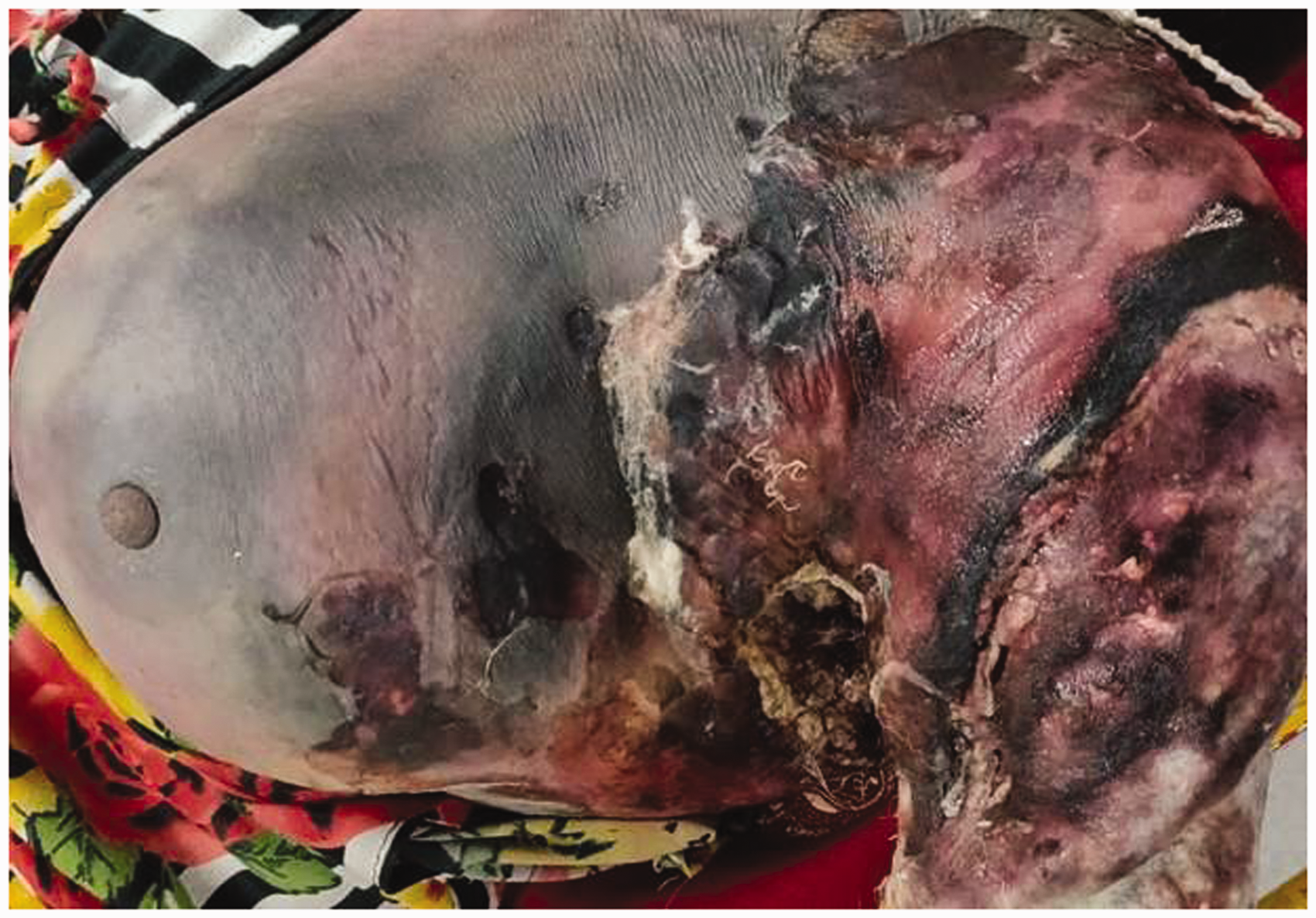
Discussion
Gangrene of the breast is mostly unilateral. 1 Whilst, trauma or infection at the nipple may spread to the breast tissue, this rarely involves the whole breast. The nipple-areola complex has a separate blood supply and may be spared. 2 Important aggravating factors are diabetes mellitus, anticoagulant therapy and immune suppression.3–5 Classically tuberculosis, but also necrotising infection in the breast may give an orange skin appearance, mimicking cancer.6,7 Gas gangrene of the breast has more dramatic and deleterious effects. 8 Spread of necrosis is fast and relentless, and needs early radical amputation to save the patient.
Footnotes
Declaration of conflicting interests
The author(s) declared no potential conflicts of interest with respect to the research, authorship, and/or publication of this article.
Funding
The author(s) received no financial support for the research, authorship, and/or publication of this article.
