







Abstract
There is still no organised national screening programme for colorectal cancer in Jamaica. We sought to evaluate the detection of colorectal cancer precursor lesions in patients who underwent opportunistic screening over three years. Patients with colorectal polyps were selected for further study. In 431 procedures, there were 84 (19.5%) patients with colorectal polyps identified at screening colonoscopy, which gave a 19.5% sensitivity to identify patients with polyps at risk of developing colorectal cancer, 9.5% being <50 years of age. At the time of examination, 16.7% had already developed invasive adenocarcinoma. We conclude that it is time for policy makers to develop a national colorectal cancer screening programme to diagnose patients early and improve their therapeutic outcomes.
Introduction
It is important to identify and remove neoplastic polyps as early as possible to prevent their transformation to colorectal cancer (CRC). This is the basic principle of screening. Our study sought to evaluate the yield of screen-detected polyps in a Jamaican population.
Methods
Up to the year 2021, there were no national screening programmes for CRC in Jamaica. Persons were generally sent for faecal occult blood testing and/or colonoscopies when they became symptomatic and occasionally when heath care providers recommended opportunistic screening for persons they deemed to be high-risk ad hoc. We secured IRB approval to audit hospital records at one facility in Kingston to identify patients who had opportunistic screening colonoscopies between 1 January 2015 and 30 December 2018.
We included all consecutive patients who had polyps detected on screening colonoscopies. We excluded patients who were already symptomatic and those with incomplete records. Patients’ records were retrieved and following data were retrospectively extracted: polyp location, histology and synchronicity. Descriptive statistical analyses were generated using SPSS version 21.0.
Results
A total of 431 screening colonoscopies were performed over the study period and there were polyps detected in 84 (19.5%) patients. There were 44 males at a mean age of 64.18 years (range 26–82; median 65.5; mode 64; SD ± 11.44) and 40 females at a mean age of 65.03 years (range 41–93; median 63; mode 78; SD ± 13.12). Eight (9.5%) patients with polyps were <50 years of age.
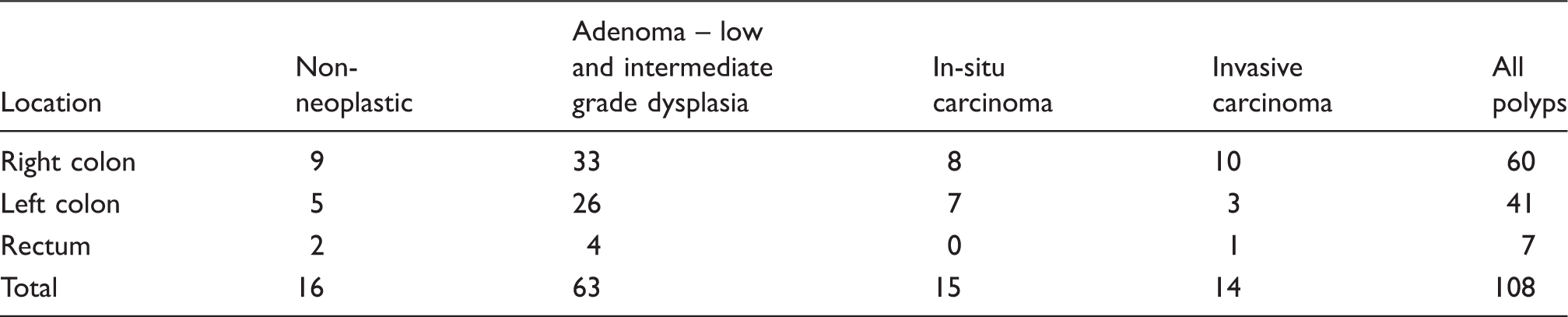
A total of 59 patients had a solitary polyp, two with pan-colonic polyps as a part of a polyposis syndrome and 23 with synchronous lesions (two polyps in 20 and three polyps in 3). Excluding the two patients with polyposis syndromes in whom the polyp number could not be accurately counted, there were a total of 108 polyps included in our study. Most of the polyps were located in the right side of the colon (55.6%) as demonstrated in Figure 1.
Distribution of polyps throughout the colon and rectum.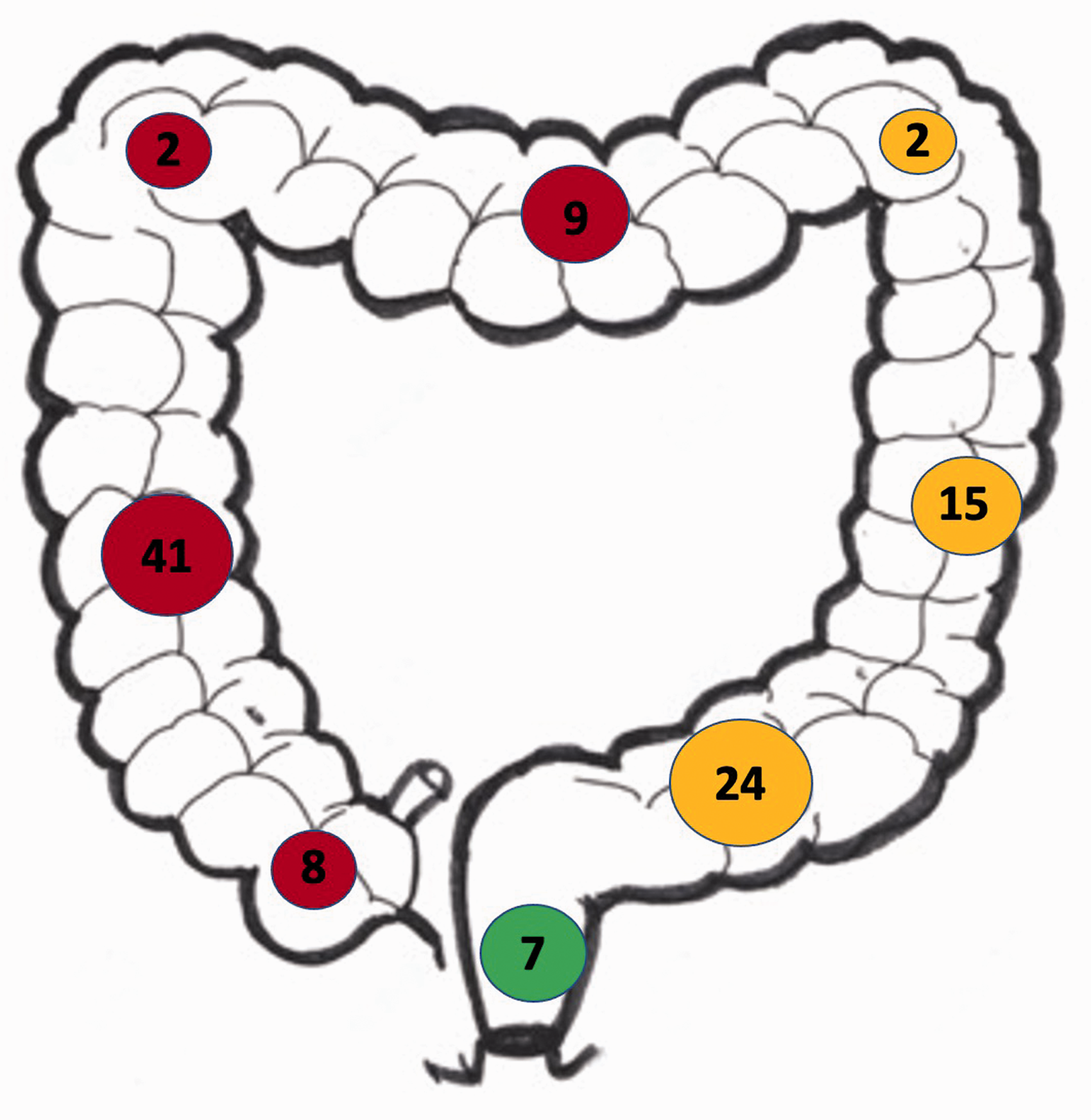
Distribution of polyps by histopathology and location.
Discussion
The principle behind CRC screening is to detect disease early, when there is still an opportunity for complete cure by polypectomy. Most authorities recommend CRC screening,1,2 but policy makers have not prioritised screening in Caribbean countries. With 12 Jamaicans per 100,000 population 3 being diagnosed with CRC each year, screening ought to be prioritised. We carried out this study to evaluate the yield of one CRC screening programme.
It is important to note that 9.5% of patients with polyps were <50 years of age. When young patients go on to develop CRC, they have worse clinical outcomes and a greater proportion of poor prognosticators (high tumour grade, lympho-vascular invasion, perineural invasion, elevated CEA levels). 4 While it is uncommon for young persons to have polyps, it is an important public health message that 1 in every 10 Jamaicans with screen detected polyps will be <50 years of age.
Most international studies report a predilection for CRC to occur in males. 5 Therefore, it was expected that the polyp distribution in our study population mirrored this male predilection. The polyp distribution was also expected as similar right-side dominant patterns have been documented in publications from the Caribbean region.6–8
In our study, when screening colonoscopy found CRC, it was still in the early stages, which have a greater probability of cure and better 5-year survival compared to those with locally advanced disease, 9 and more likely to benefit from less invasive laparoscopic colectomy. 10
Most importantly, screening colonoscopy in just under 1 in 4 patients screened that identified neoplastic polyps which could be completely removed to interrupt the adenoma-carcinoma sequence.
Our important data are presented to shape public health policies and guide screening protocols in Jamaica. Ultimately, such tailored protocols would increase early diagnosis and improve therapeutic outcomes in our population.
Footnotes
Declaration of conflicting interests
The author(s) declared no potential conflicts of interest with respect to the research, authorship, and/or publication of this article.
Funding
The author(s) received no financial support for the research, authorship, and/or publication of this article.
