






Abstract
Scrub typhus, which is prevalent in the Asia Pacific region is most feared owing to its life-threatening neurological complications. We present four cases of scrub typhus with acute encephalitis, including one with multiorgan failure and another serologically proven co-infection with Hepatitis C. Treatment of scrub typhus is not, however, so difficult, so its early diagnosis is paramount.
Keywords
Introduction
Rickettsial diseases are caused by two pathogenic genera, Orientia and Rickettsia. Orientia tsutsugamushi, an obligate intracellular organism, is the cause of scrub typhus which has now spread far beyond the so-called tsutsugamushi triangle,1,2,3 with 4185 cases recorded between 2007 and 2016 in Japan.
4
Eschar formation, the result of the bite by a chigger, the larval stage of the trombiculid mite, is characteristic but seen only in 40–50% of cases.
5
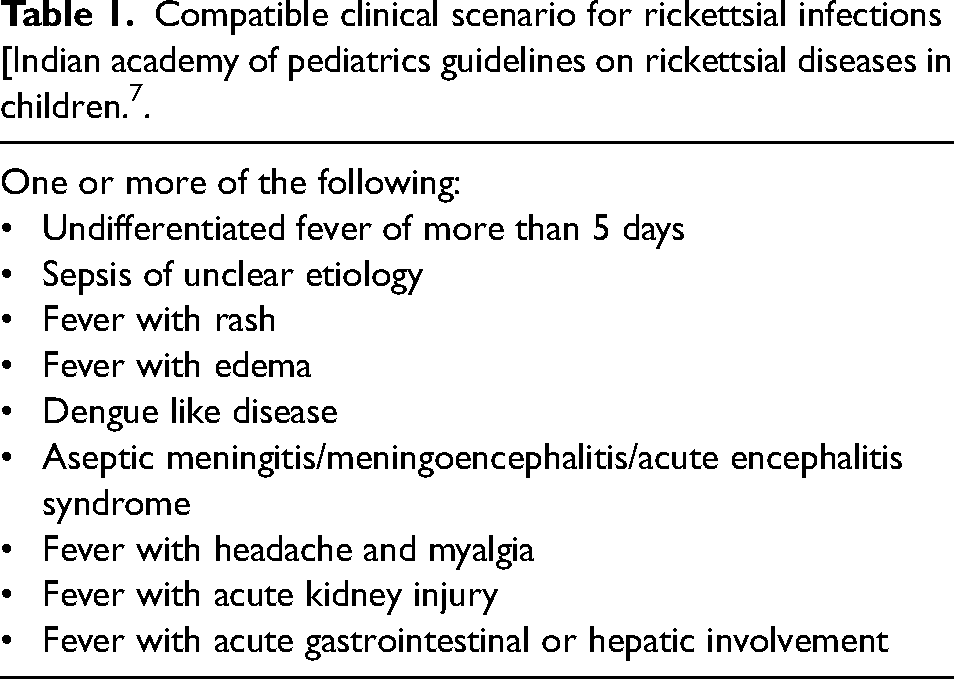
Complications include Acute Encephalitis, Acute Respiratory distress syndrome (ARDS), Septicemia, and Multiorgan failure.5,6 Rickettsial infections can have vivid presentations, especially in children as depicted in
Compatible clinical scenario for rickettsial infections [Indian academy of pediatrics guidelines on rickettsial diseases in children. 7 .
Case 1
A 4-year-old child was admitted to our Paediatric Intensive Care Unit in Lucknow, Uttar Pradesh, India with a 5-day history of fever (intermittent, mild to moderate, neither associated with chills nor rigors), dyspnoea for the previous 2 days, and altered mentation for 1 day following a single episode of a generalized tonic-clonic seizure. There was no history of headache, skin rash, trauma, jaundice, cough, or coryza.
On examination, the child was febrile (38.3 oC), with bilateral extensor plantar responses, but no sign of meningeal irritation. His Glasgow coma scale (GCS) score was measured as E3V3M4 on eye-verbal-motor response. Acute myocarditis was suggested by the presence of a gallop rhythm, and raised pro-B type natriuretic peptide and troponin T levels. Difficulty in breathing, tachypnoea, bilateral crackles, and wheeze was suggestive of acute pneumonitis. Laboratory parameters revealed anaemia (Hb: 68 g/L), thrombocytopenia (35 × 109/L), and leucocyte count as 17.5 × 10⁹/L. Cerebrospinal fluid (CSF) analysis showed protein to be 2.3 g/L, glucose 3.55 mmol/L, nucleated cell count 0.005 × 10⁹/L with a differential count of 90% lymphocytes and 10% neutrophils. Anti-Scrub typhus IgM Antibody test, as an Enzyme-Linked Immunosorbent Assay (ELISA) (InBios International USA) was positive while tests for Japanese Encephalitis virus IgM antibody in CSF, anti Dengue virus IgM antibody in serum, real-time Polymerase Chain Reaction (PCR) for Herpes Simplex Virus-1 in CSF, malaria detection by microscopy (thick and thin smears) and OptiMAL-IT-parasite lactate dehydrogenase for Plasmodium spp. were all negative.
Our patient received oxygen inhalation, mannitol, paracetamol, phenytoin and doxycycline (5 mg/kg/day for 7 days), and responded well to this regime with subsidence of fever and other co-morbidity, and hence was discharged after 21 days.
Case 2
A 5-year-old boy was admitted with a high-grade fever for 5 days (neither associated with chills nor rigors), headache and irritability for 2 days, and three episodes of generalized tonic-clonic seizures lasting 1-2 min. There was no history of vomiting, rash, ear discharge, or head injury. There was no significant past birth or medical history. The child was fully immunized according to his age.
On general examination, he was febrile (39.4 oC), drowsy and irritable, with positive Kernig and Brudzinski signs of meningeal irritation, GCS score of E3V4M5, with exaggerated deep tendon reflexes and bilateral extensor plantar responses. He had a squint, and conjunctival congestion was present. A working diagnosis of acute encephalitis syndrome was made. On further investigation, he was found to have a Hb level of 103 g/L, total leucocyte count of 16.7 × 10⁹/L, with a differential of 50%, 40%, 3%, and 7% for neutrophils, lymphocytes, eosinophils, and monocytes, respectively. CSF analysis showed the protein level to be 1.9 g/L, glucose 2.9 mmol/L, and nucleated cell count 0.006 × 10⁹/L with differential count of neutrophils at 20% and lymphocytes at 80%. Renal function tests and coagulation profile were normal. Fundal examination was normal. Microbiological investigations for dengue, chikungunya, Japanese Encephalitis, Herpes Simplex Virus Encephalitis were negative and only anti-Scrub Typhus IgM antibody positive.
Doxycycline (5 mg/kg/day) was added to his treatment regime consisting of mannitol, paracetamol, ceftriaxone, and phenytoin, on which he improved clinically and could hence be discharged in a satisfactory condition.
Case 3
A 4-year-old boy, native of Rampur, Uttar Pradesh presented with a history of mild to moderate grade fever (intermittent, neither associated with chills nor rigor) for 7 days associated with seizure-like activity involving the left side of the body for the previous day, whole body swelling for 5 days and altered sensorium for 1 day. There was no history of rash, bleeding from any site, ear discharge, nor trauma.
On examination, he was febrile (38.3 oC), with hepatomegaly present but a normal spleen. The GCS score was E3V3M4. Plantar responses were extensor bilaterally. He was anaemic (Hb: 79 g/L) with a leucocytosis (22.4 × 10⁹/L). Renal function was normal but liver function tests deranged [total serum bilirubin 0.04 mmol/L, direct bilirubin 0.02 mmol/L, glutamic oxaloacetic transaminase (SGOT) 213 IU/L, glutamic pyruvic transaminase (SGPT)120 IU/L, alkaline phosphatase 1677 IU/L]. The anti-Scrub Typhus IgM antibody test was positive while anti-Dengue IgM and anti-Chikungunya IgM were negative. The child was found to be reactive for anti-Hepatitis C virus antibody by rapid immunochromatographic assay (confirmed by ELISA) but non-reactive for Hepatitis B surface Antigen (HBsAg) and HIV.
Treatment with doxycycline (5 mg/kg/day for 7 days), paracetamol, ceftriaxone, acyclovir, and phenytoin allowed his condition to improve gradually, allowing discharge.
Case 4
A 10-year-old boy from Bahraich, Uttar Pradesh presented with intermittent fever, mostly frontal headache for 10 days and, altered sensorium for the last 3 days, with vomiting for 2 days, and two episodes of generalized tonic-clonic seizure followed by frothing at the mouth. There was no history of rash or bleeding from any site. The child was immunized according to his age.
On general examination he was febrile (38.3 oC), with respiratory rate of 20 breaths/min. Left-sided axillary and bilateral submandibular lymphadenopathy were present. Pupils were normal-sized but sluggish in response. Nuchal rigidity was present. His GCS score was E1V1M1. Plantar responses were bilaterally extensor. The liver was palpable 2.5 cm below the right costal margin. Complete blood count revealed Hb 86 g/L and total leucocyte count 13.03 × 10⁹/L. CSF analysis showed protein 1.7 g/L, glucose 3 mmol/L, nucleated cell count 0.005 × 10⁹/L, with differential count of neutrophils 20% and lymphocytes 80%. Renal function tests were normal. A CT brain scan revealed attenuation of gray–white differentiation in both cerebral hemispheres with ill-defined hypodensity in both upper parieto-occipital regions (correlated with hypoxic or infective insult). CSF culture was sterile and anti-Hepatitis C Virus (HCV) antibody test (ELISA) was negative. Only the anti-Scrub Typhus IgM antibody test turned out to be positive.
Our patient received oxygen by mask, intravenous fluids, paracetamol, antiepileptics, and oral doxycycline (5 mg/kg/day) for 7 days, though initially ceftriaxone was also given. He gradually improved, started feeding orally well, and hence could be discharged once fully conscious without motor deficit. Some behavioral changes such as emotional lability and aggression remained, however.
Discussion
Despite its well-known endemicity in Asia, scrub typhus is still under-reported. 8 The disease has been implicated as a cause of Acute Encephalitis Syndrome (AES) in children in India quite recently. 9 Approximately 1500–2000 AES patients were admitted to the Baba Raghav Das Medical College, Gorakhpur every year between 2004 and 2013.10,11 According to AES surveillance data (January 2011 to June 2012) from Kushinagar District, Uttar Pradesh, India, the AES incidence was found to be highest among boys <6 years old, and most cases occurred during the monsoon season when vector density is at its highest. 12 During 2016 AES outbreak in Gorakhpur district, Uttar Pradesh, it was observed that 65% of cases had serological and/or molecular evidence of scrub typhus, while JE and dengue virus contributed 10% and 7% respectively. 13 In a retrospective study of 75 children from West Bengal who were found to be IgM positive to Orientia tsutsugamushi, meningoencephalitis was present in 10.7%. Headache (16%), altered sensorium (8%), and convulsions (10.7%) were the most common symptoms of the central nervous system. 14
Eschar, although pathognomic is variably present. Scrub typhus can be diagnosed by the Weil Felix reaction, Immunofluorescence antibody test, ELISA, PCR, and loop-mediated isothermal amplification (LAMP). The first, though, is still used at many diagnostic centers, but is neither sensitive nor specific. 15 The second requires expertise and specialized equipment.15,16 ELISA is thus the current modality of choice. 16 LAMP (a PCR variant), is based on isothermal DNA amplification utilizing polymerase and set of primer pairs that produce a hairpin DNA template. The test is considered to be highly sensitive and specific which can detect the DNA concentration of 1 mg/mL within 60 to 90 min. 17 We still however lack rapid, point-of-care tests which can reliably detect scrub typhus. For scrub encephalitis, neuro-imaging findings are not pathognomonic.
Doxycycline is the drug of choice though tetracycline, chloramphenicol, and azithromycin have also been used with good results in adults.18–21 In a case series of eight children with scrub encephalitis, seven patients responded well to doxycycline treatment, and recovered completely while one patient died because of refractory shock. 22 However, drug-resistant strains are now emerging; this is a matter of concern.
Footnotes
Declaration of conflicting interests
The author(s) declared no potential conflicts of interest with respect to the research, authorship, and/or publication of this article.
Funding
The author(s) received no financial support for the research, authorship, and/or publication of this article.
Financial support and sponsorship
Nil.
