







Abstract
This brief article delves into the erotic sculptures of Khajuraho that have attracted the interest of laypersons and researchers across various fields. Khajuraho is perhaps unique because, as a site, it amalgamates religion, eroticism and culture. Erotic displays possess significant aesthetic value and, from this perspective, should be considered independently from their religious contexts. However, since the erotic depictions at Khajuraho are located within a sacred frame, the influence of religion on sexuality cannot be sidelined. The blending of Victorian morality with upper-caste values, however, can easily overshadow the erotic significance of these depictions, which often shifts the focus from interpreting Khajuraho’s sculptures as embodiments of pleasure and aesthetics.
I Introduction
My theoretical frame for this article draws on Michel Foucault’s writings, which assert that discussions surrounding sex must be conducted openly and free from the constraints of ‘Christian morality’ and ‘Victorian prudishness’ (Foucault 1978: 3). In examining the sculptures of Khajuraho, I found an alignment with the Foucauldian perspective on sexuality. Foucault remarks, ‘Sexuality is often kept hidden and concealed by a new sense of decency’ (ibid.: 77). This view is also relevant to India, a country that is rich in both literary and visual texts that explore themes of eroticism and sexuality. Nair and John (2000: 1) contend that ‘sex in India starts from Kamasutra (the text) and ends with Kamasutra (the condom); in between lies an intervening period of darkness and a nuanced understanding of this concept’ referring to an unexplored area that concerns ancient and medieval Indian perspectives on sex.
The central focus of studies on the Khajuraho temples has consistently revolved around the socio-religious dynamics of this site. An aura of a socio-religious milieu was always kept alive within the garbhagriha (sanctum sanctorum) of the Hindu sanctum. For instance, Punja (1992) writes that a prominent theme depicted by the Chandellas was that of the commemoration of the wedding of Shiva and Parvati. This divine wedding, which is found constructed on the walls of Khajuraho, was dedicated to the ‘earthly wife or the symbolic spiritual marriage’ (228). While the line between religion and eroticism can be both delicate and profound, the Khajuraho temples, I argue, embody more than just religious significance. The art of Khajuraho highlights its erotic aspects and underplays its divine origins.
II The background
Khajuraho’s temples, built during medieval times, demonstrate that sexuality in that era was far more flexible and open than it is in contemporary Indian society (Vanita and Kidwai 2000). In India, same-sex relations, for instance, have not been uncommon. In Urdu poetry, chapti, meaning clinging or sticking together, was used to denote sex between women. Vanita and Kidwai note, ‘We have also come across creative use of words to indicate same-sex emotions that include and transcend friendship, for instance, swayamvara sakhi in the 11th century Kathasaritsagara’. Non-normative sexual postures echo the themes found in texts such as Ananga Ranga and Rati Rahasya, which speak of the Hindu art of love (2000: xxi).
The sexual postures depicted on the walls of Khajuraho are commented upon by Pandit Kokkoka, who draws attention to several sexual positions found depicted at the site: for instance, uttana, or lying on the back; tiryag, or lying on the side; asitaka, or sitting and; anata, or bending on all fours, like animals (Upadhyaya 1965: 55). Kokkoka does not just limit the text to the different postures adopted during a sexual act; he also points out that oral sex was an integral aspect of such depictions, in ancient India. The temples of Khajuraho are renowned for their vivid depictions of gods and mortals engaged in the celebration of passionate and erotic activities. Many of Khajuraho’s erotic sculptures are aesthetically refined and elegant, while others are rough-hewn or grotesque. Some are subtle, while others are bold and unabashed. Together, they create a vibrant display of sexual acts, including fondling, seduction, orgies and even bestiality, along with acrobatic coupling.
Allen (1999) remarks that erotic sculptures make up about 10 per cent of all the carvings on the Khajuraho temples; yet, they are the ones that have garnered Khajuraho its fame and infamy. Historically, Bose (1956) argues that the Chandellas engaged in temple construction as a means of gaining prestige and religious merit. In addition, they patronised the creation of Sanskrit plays that reflected the cultivated cultural traditions shared by both Hindu and Jain communities.
III Method and data analysis
My method included visiting the Khajuraho temple site and combining field observations with insights from historical archives and secondary sources, including popular blogs. This approach facilitated an understanding of the historical and social context of the temples. In addition to textual analysis, visual discourse analysis was employed to interpret the visual imagery. In studies that address historical ideas, images serve as documents that are critical to gain insights into the social and cultural context of a particular era. Visual discourse analysis reveals how images communicate themes and power relations, shaping perception and embedding cultural meanings. Semiotics becomes a valuable tool for examining the messages communicated through visual texts (Chandler 2007). In this essay, I analyse the photographs of the Khajuraho sculptures through the signs and symbols conveyed through their postures. The six main themes that emerged from the data concern the historical myth of the Chandellas, Hindu worship at the Khajuraho temple along with the Chandella dynasty’s evolving beliefs, the erotic sculptures of Khajuraho, access to the visual pleasures with reference to the caste system prevalent at Khajuraho, the critical and conditional operations of power at Khajuraho and the caste of the sculptors.
IV The historical myth of the Chandellas
The mythological origins of the Chandella dynasty provide an insight into the motivations behind the construction of the erotic sculptures found on Khajuraho’s walls. This narrative pertains to the relationship between the Moon God and Hemavati, embodying an ‘illicit sexual norm’ that becomes apparent in the context of this medieval sculptural site. But why was this historical myth produced? What purpose did this myth serve for the Chandella dynasty? Several kingdoms are said to have divine origins, such as the Paramara dynasty of the western central Malwa region, for instance, which ruled from the 9th to the 14th centuries
Historically, it is believed that the Chandellas may have originated from the tribal groups of the Gonds and Bhars in Madhya Pradesh. However, the Chandellas emphasised the divinity of their lineage, claiming descent from Chandravarman, the son of Hemavati and the Moon God. Desai (2000: 8) recounts the myth:
A Local Bundelkhandi legend romantically traces the descent of the Chandellas directly from the Chandra, the Moon God. According to the story, a beautiful young Brahmin maiden, Hemavati, had an affair with the Moon God. Out of this relationship was born a handsome boy named Chandravarman. Hemavati was worried about the future of the child born out of wedlock…. He should build eighty-five temples at Khajuraho, carved with erotic figures. This would free his mother from the blemish of extramarital affairs.
A popular drama that was performed in the court of Raja Kirttivarman of the Chandella dynasty, named Prabodhachandrodaya (Taylor 1893), also alludes to this sexual relationship between the Moon God and Hemavati. However, the drama does not cite the names of the two characters. Since Hemavati was a Brahmin from Varanasi and the Moon God belonged to the Kshatriya caste, Mitra (1958) points out that the illicit wedlock and caste intermixing, which led to a ‘Brahmo-Kshatriya origin’ (Lal 1967), may help to explain the non-normative sexual postures found on the outer walls of this sanctum.
V Hindu worship at the Khajuraho temple— The Chandella dynasty’s evolving beliefs
The religious aspect of the Khajuraho temples, however, highlights the grand celebration of Shiva’s union with Parvati, which takes place annually within the premises of this sacred site.
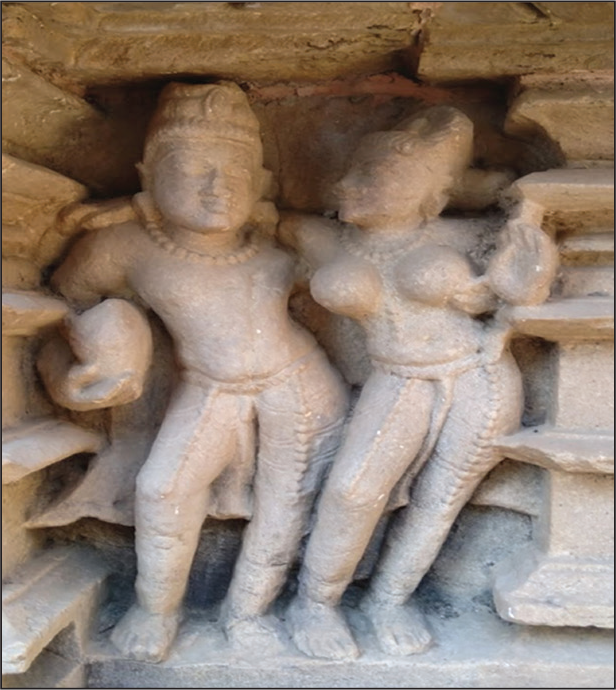
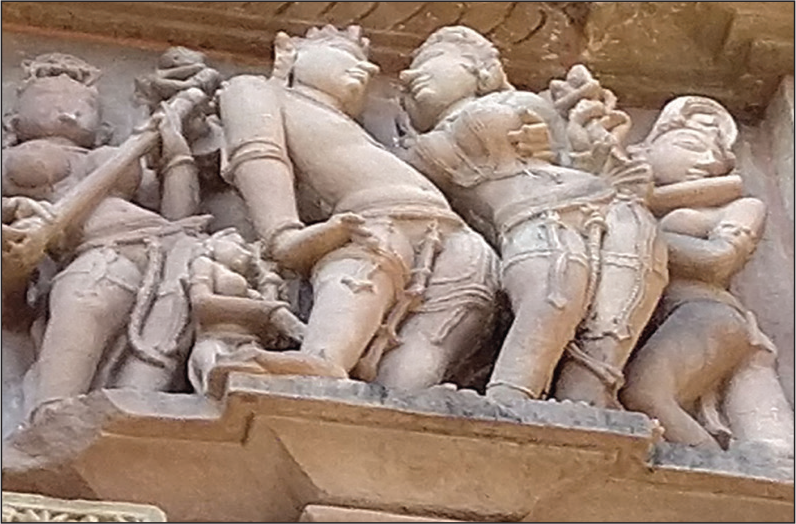
Bose (1956) and Mitra (1958) bring out the evolving religious beliefs of the Chandella dynasty’s rulers. Raja Yashovarman was a staunch Vaishnavite, whereas Raja Kirttivarman followed Shaivism. Despite belonging to different sects of Hinduism, there was no evidence of a clash among these sects in the depiction of the Khajuraho sculptures (Mitra 1958). On the one hand, within the sanctum, in the Lakshmana, Varaha and Chaturbhuj temples, several sculptures of Lord Vishnu are discernible and, on the other hand, the depiction of Shiva is more prominent in sculptures that represent the union with Parvati as depicted in Figures 1 and 2, or within the garbhagriha of the Kandariya Mahadeva temple where Shiva is worshipped in the form of a linga (the phallic symbol of Shiva). Although many visitors come to this shrine primarily for worship, in modern times, tourists view Khajuraho as both a place of Hindu worship and as a heritage site.
VI The erotic sculptures of Khajuraho
India has a rich history of emphasising pleasure in intimate relationships. The Kama Sutra (Burton and Foster 1883: 16–17) notes:
Kama is the enjoyment of appropriate objects by the five senses of hearing, feeling, seeing, tasting, and smelling, assisted by the mind together with the soul. The ingredient in this is a peculiar contact between the organ of sense and its object, and the consciousness of pleasure which arises from that contact is called Kama. Kama is to be learnt from the Kama Sutra and the practice of citizens.
The aspect of pleasure which has been emphasised in the Kama Sutra is also evident in the erotic depictions of Khajuraho. Several sculptures found on the outer walls of Khajuraho depict how pleasure is passed on from one person to another. A reference to Foucault’s concept of ‘ars erotica’ versus ‘scientia sexualis’, where the former refers to pleasure as the key to producing knowledge, and the latter refers to the production of knowledge through scientific and medical terms (Foucault 1978 may be useful here). Foucault does not discuss ars erotica extensively; however, Gautam (2016: 57–58) traces a line of similarity between the ideology of ars erotica and the Kama Sutra: ‘Since Foucault grounds Ars erotica in the notion of pleasure, its continuity with the Kama Sutra as “a treatise on pleasure” is immediately evident’. For Foucault, Gautam writes:
Ars erotica was still an unexplored domain of experience and discourse because he thought that the notion of pleasure was incapable of having content in the form of either experience or discourse…. It was a way for Foucault to point toward a historical-cultural archive of ars erotica grounded in pleasure. Since Foucault himself never had the opportunity to access this archive, it was a project yet to be executed. (2016: 21, emphasis in original)
He argues that ancient Indian texts, the Kama Sutra and medieval India’s erotic temple sculptures depicted ars erotica long before Foucault invented this concept. Looking past the aesthetics of art and religion, pleasure is vividly captured in the erotic depictions found at Khajuraho.
India has a heritage that celebrates sex in diverse forms, including homosexuality. This is highlighted in the Kama Sutra, where homosexuality is referred to as the ‘third nature’ or a third sex (tritiya prakriti). While exploring the socio-sexual dynamics depicted in the Khajuraho sculptures, non-normative sexual postures, including oral sex, anal sex, bestiality and orgies, become apparent. This aspect of Khajuraho’s erotic friezes closely aligns with the Kama Sutra. Punja remarks, ‘The erotic sculptures are a visual illustration of the Kama Sutra, the ancient text on the art of lovemaking’ (Punja 1999: 94). Lal (1967), too, notes that Khajuraho is the abode of Kama, the God of Love.
Figures 3–6 depict different non-normative sexual postures. Krishan (1972: 336) brings out how certain coital positions from the Kama Sutra are depicted on the walls of Khajuraho:
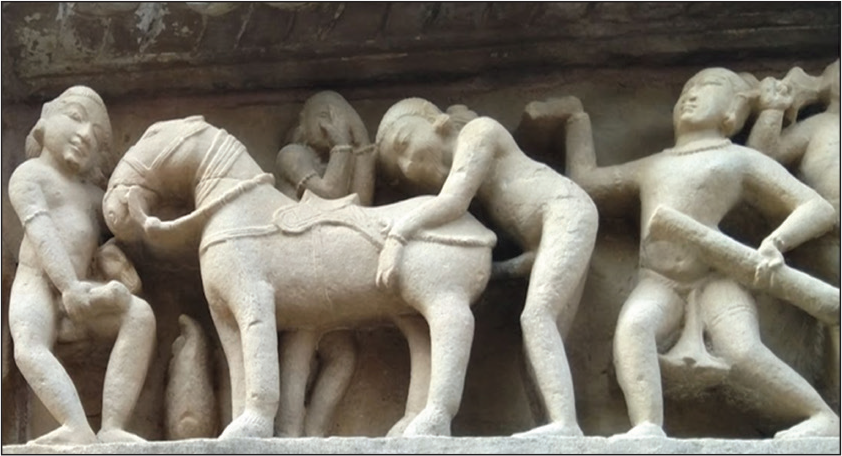
The Kama Sutra says that in the sexual union, a man can adopt the postures peculiar to animals like the hog, monkey, tiger, horse, etc., and human-animal coitus scenes have been traditionally considered to be virile and hence animal postures might be adopted in these acts.
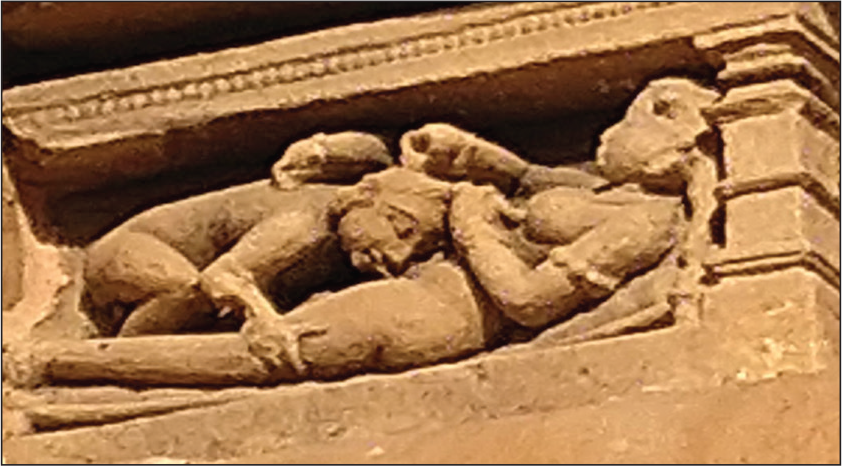
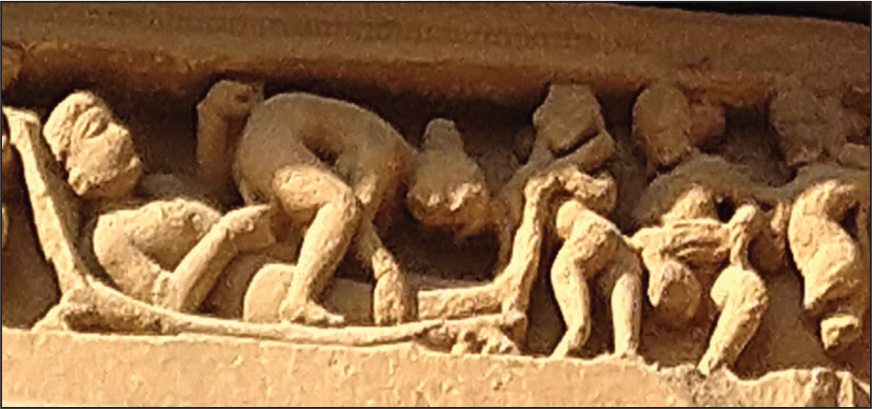
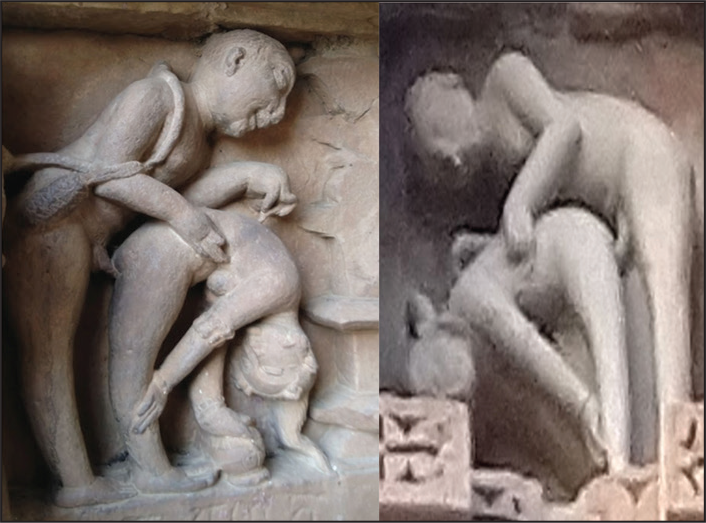
Figure 7 symbolises a human copulating with a horse. Krishan maintains that the ‘human-animal coitus scenes have been traditionally considered to be virile’ (ibid.), such that it is not uncommon to find this portrayal. However, although such depictions are common in medieval Indian contexts, it is unusual to see them within a Hindu sanctum.
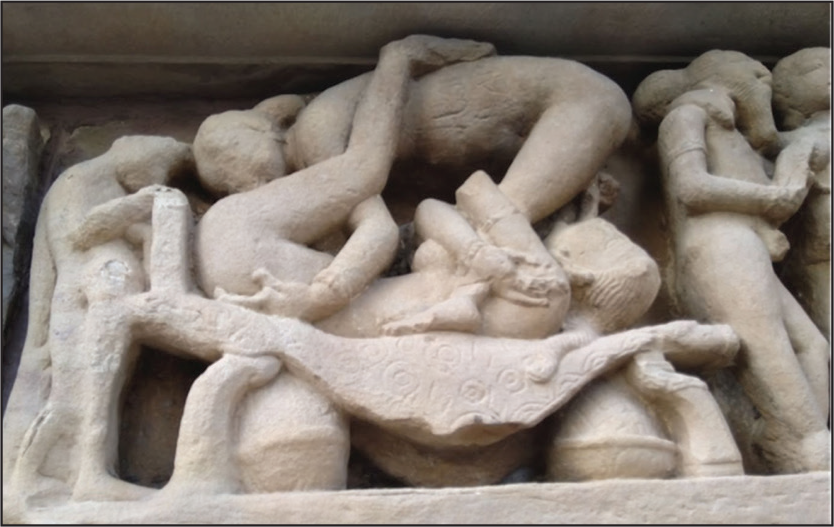
Other writers argue against the claim that the sexual postures on the walls of Khajuraho are reflections of sexual poses adapted from the Kama Sutra. On the contrary, Desai (2000) holds that the Kama Sutra has no connection with the sexual depictions at Khajuraho. People tend to imagine that the erotic sculptures of Khajuraho, which depict the art of lovemaking, are adapted from Vatsyayana’s Kama Sutra. Hence, Khajuraho can be described as the ‘temple of Kama Sutra’. The Kama Sutra, however, was written in Sanskrit and was a part of the corpus of India’s elite culture, whereas the depiction of erotic figures on the walls of religious sanctums at Khajuraho does not seem to have originated from a secular interest in sex manuals (Desai 2000: 35).
Writing on Europe, Taylor (2016) observes that the influence of Christian morality and Victorian values had repressed sexuality between the 17th and 19th centuries. In The History of Sexuality (1978), Foucault draws attention to this ‘repressive hypothesis’, noting that ‘sex was once free, but twilight soon fell upon this bright day’ (quoted in Taylor 2016: 113). In the Western context at that time, sex was regarded as something undesirable—an issue that should not be spoken about, enjoyed or even acknowledged. This repression was linked to the rise of the bourgeoisie, who perceived sex as a waste of valuable energy that should instead be directed towards more productive endeavours. The repressive hypothesis ultimately suggests that we should free ourselves from this oppression by becoming more open about sex—by discussing it, engaging in it and finding joy in it.
In contrast to environments where diverse forms of power actively repressed sexuality, sites like Khajuraho unequivocally portray the celebration of the erotic. Despite significant differences in timelines and contexts between Foucault’s repressive hypothesis and the celebration embodied at Khajuraho, they are fundamentally interlinked by shared ideological frameworks that reveal the intricate dynamics of sexuality’s representation and repression within society.
VII Access to visual pleasures with reference to the caste system at Khajuraho
In this section, I briefly examine the interplay between access to visual pleasure and the caste system that prevailed during the medieval period in Khajuraho. I examine the socio-cultural hierarchies that influenced the experience and dissemination of visual aesthetics within that historical context.
Mitra (1958) notes that the inscriptional records during the reign of the Chandellas allude to the caste system: ‘The Brahmana, Kshatriya, Vaisya, and Sudra, occur in the Chandella records. The position of the Brahmana in society was highest, and life was to be in accord with the “Dharma” or the sacred laws of the Hindus’ (169). Given the prevalence of the caste system, access to the shrine was not open to all castes in medieval Indian society.
Textual data indicate that the Chandella dynasty wished to gain social and political status, and building temples was a prominent method of rising in the status hierarchy (Sastri 1958).
The Chandellas are known to have patronised the Sanskrit play, Prabodhachandrodaya and granted lands to the Brahmins to please them and maintained close associations with this caste (Punja 1999). During the medieval period, the Brahmins performed the rituals inside the Kandariya Mahadeva temple and had primary access to the shrine (Deva 2002). In contrast, although the Chandellas had access to the shrine, they did not carry out the rituals in the sanctum sanctorum (Mitra 1958).
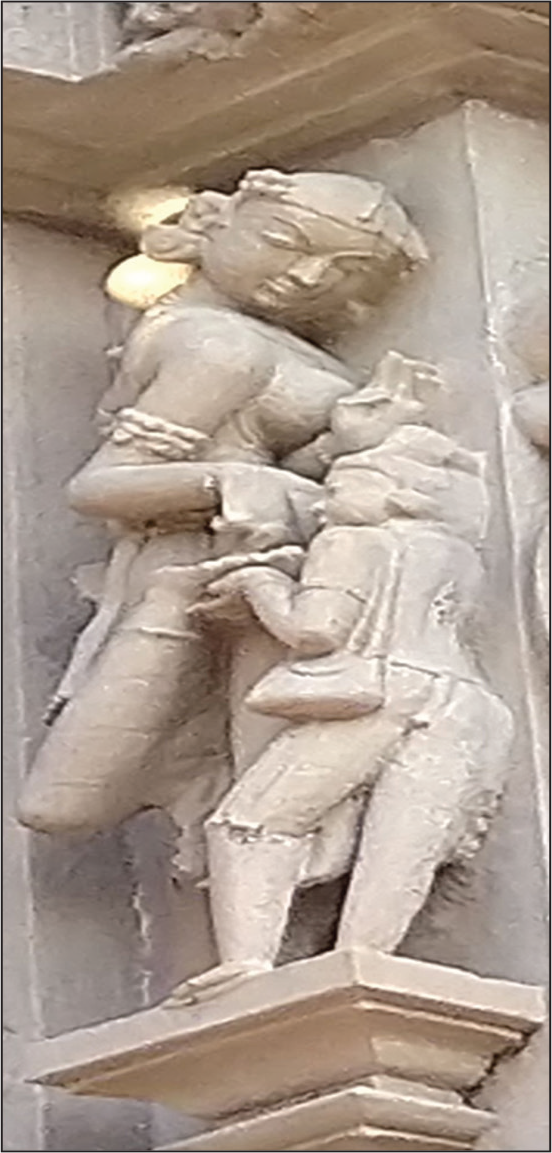
The eminent historian, Nilakanta Sastri, observes that temples were not just places of worship; they served a much larger purpose. Their construction and maintenance offered employment to several architects and craftsmen who were engaged in planning and skilfully executing these shrines (Sastri 1958: 314). But who had the right to view the sculptures and partake of their visual pleasure at that period in history is not definitely known. Ali (2006) notes that access to courtly pleasure was available only to the upper castes of society. This segment primarily referred to the Brahmins and the kings. Certain pleasures were reserved for the higher classes of society in medieval India. The Kama Sutra, for instance, was not accessible to the general masses. Yet, aspects of social life during that time can be read into the sculptures found on the temple walls at Khajuraho. Figure 8, for instance, depicts a woman applying kumkum (red powder) in the mid-parting of her hair, while the woman on the left is looking into the mirror. Figure 9 portrays a shorter woman picking out a thorn from the taller woman’s foot.
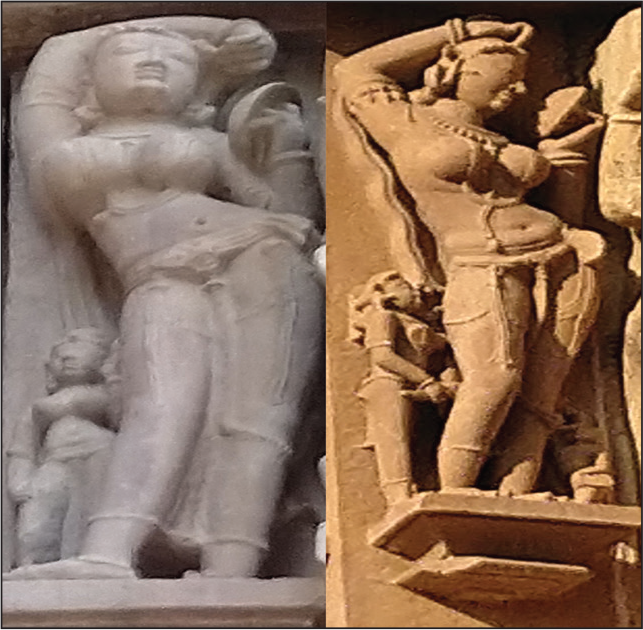
Close attention turns the focus away from the tall woman here who grabs the attention at first glance, to the smaller woman standing beside her in Figure 9. It is reasonable to infer that the short-statured woman represents a lower caste of dasis or women attendants to the queens of the dynasty. Again, another sculpture depicts a Brahmin priest teaching children just as ordained by the caste system, which vested the authority to impart education to the Brahmins. It is very likely that access to the Khajuraho temples followed the dictates of the caste system that were prevalent at that time, such that the visual experience was not open to the public at large. Access to visual pleasure could not have escaped the impact of the caste system of the medieval period.
VIII Caste of the sculptors in Khajuraho
The caste of the sculptors who carved the erotic sculptures in Khajuraho is not documented, and historical records from that time are either scarce or unable to answer the question. During the Chandella dynasty’s rule in the region, artists and craftsmen likely came from various backgrounds and were not strictly categorised by caste as we understand it today (Lal 1967). Although artisans and sculptors in ancient India were often organised into guilds or communities based on their craft, these groups could have included individuals from different social backgrounds. Due to insufficient information about the castes of the sculptors at Khajuraho, we cannot conclude that they had a significant impact on the portrayals at the temples.
IX Conclusion
While chronology separates the 5th-century Kama Sutra from the 11th-century sculptures of Khajuraho, the two—Khajuraho and the Kama Sutra—have now come to be increasingly linked in the nation’s and the world’s historical imagination, jointly signifying a unique fount of ancient Indian erotica (Guha-Thakurta 2004: 262).
Here, I have introduced the aspect of ‘pleasure’ as an analytical tool with reference to Foucault’s concept of ars erotica versus scientia sexualis in the context of Khajuraho’s erotic sculptures. I have tried to bring out the pleasure and aesthetic associated with the erotic depictions that can be separated from religion per se and are even today celebrated for their artistic beauty and cultural significance. However, the social context of this study makes caste a relevant issue, as access to Hindu temples was hindered due to caste-based stratification in society. Although the sculptures do not directly represent the caste system, the narratives and texts suggest that the visual pleasures of the medieval sculptural site were not accessible to all groups.
Yet the Khajuraho sculptures cast a look beyond the religious norms and dogmas and mark the ‘celebration of sex’ with glamour and splendour without suppression. This unique blend of history and art invites readers and visitors alike to ponder its significance and make their own interpretations in the future.
Footnotes
Declaration of Conflicting Interests
The author declared no potential conflicts of interest with respect to the research, authorship and/or publication of this article.
Funding
The author received no financial support for the research, authorship and/or publication of this article.