







Abstract
Chhatris or cenotaphs, commonly associated with the Rajput nobility, were extensively commissioned by merchants in the Shekhawati region of Rajasthan from around 1830 to 1950. A study of these chhatris allows an insight into how the chhatri, as a mortuary monument, along with other painted buildings from the region, reflected and consolidated the identity of the merchant community after their engagement and prosperity in the colonial economy. This article discusses one of the most celebrated merchant chhatris from the Shekhawati region, the Ram Gopal Poddar Chhatri (1872
I Introduction: The chhatri in a quintessential merchant town
Chhatris are funerary monuments usually constructed to honour a deceased patriarch. Initially, these were symbols of kingship in Rajasthan, traditionally commissioned by the heir of a ruler to legitimise a successor’s claim to the throne. Among the Rajput nobility, the construction of chhatris was an ‘invented tradition’, in an imitation of the Mughal tomb as a symbol of royal authority. 1 The merchant chhatris of Shekhawati extended this appropriation, although without any claims of the associated political succession. When commissioned by a merchant in the Shekhawati region, these commemorative structures were linked with prestige and a conspicuous display of success. 2
The Ram Gopal Poddar Chhatri in Ramgarh—a town in the Sikar district of Rajasthan’s Shekhawati region—dated 1872
Part of the significance of the Ram Gopal Poddar Chhatri comes from the fact that it is situated in Ramgarh. Ramgarh can be considered a quintessential merchant town from the region, and a brief insight into its history allows us to understand how several towns of Shekhawati were spaces where the merchant community had both political clout and significant social status. The town was settled by Rao of Sikar, Devi Singh, in 1790
Ramgarh was settled after the influential Poddars of Churu moved to the territory of Sikar following a dispute with Shiv Singh, the Thakur of Churu.
7
The Poddar merchant, Chaturbhuj Poddar’s business interests were in Bhatinda and involved bringing Pashmina from Baluchistan and sending it to different places, including Churu. This trade was taxed heavily by the Thakur, causing a rift; Chaturbhuj agreed to move at the behest of Devi Singh, the ruler of Sikar (Bharadwaj 2003: 51). Several incentives and protections were given to the merchants to settle in Ramgarh. As the historian Jhabarmall Sharma has noted, the Poddar merchants that settled in Ramgarh were respected; this is why it was called Ramgarh of the Seths, that is, Ramgarh Sethan (2015 [1922]: 56).
8
Lt A. H. E. Boileau, an engineer for the Great Trigonometrical Survey, who visited the region for the second time in 1835 …neatly fortified and filled with the mansions of wealthy bankers, whose fleeces have as yet suffered little from the generally unsparing shears of the Shekhawuts. The Seekur authorities seem to have found out, that levying heavy fines upon the merchants of Ramgurh, would cause them speedily to vacate that place, and thus kill the goose which laid the golden eggs in their country. (1837: 10)
The merchants were not unduly harassed by the Rajput overlords for money given that they could leave and settle elsewhere, leading to a complete loss of revenue. Boileau also mentions that these merchants held the title of ‘Foujdar, a singular appellation…’ (1837: 10). In the same vein, Lockett, writing in 1831, mentioned that the merchants enjoyed certain privileges, like using the name of the Rao Raja when needed during negotiations. 9
The merchants not only settled in Ramgarh, but in the process, also settled Ramgarh. It is possibly because of this reason that the built environment is linked to merchant identity here in far more prominent ways than in a town like Churu. In fact, although the links between the built environment and merchant identity are evident throughout Shekhawati, they are particularly prominent in Ramgarh. The status of a merchant family here was measured through the number of painted structures they had commissioned in the 19th and 20th centuries. In Ramgarh, for a family to be acknowledged as the household of a seth— that is, a merchant of established renown and wealth, the patriarch and the family were expected to have financed the building of a haveli (mansion), a well, a temple, a dharamshala (guest house) and a cenotaph dedicated to the merchant patriarch’s father (Cooper 2013: 33). To be acknowledged as a seth was a matter of some prestige for the merchants. 10 This also meant that not all merchants were considered seths, and this distinction was significant. Paintings and painted buildings, thus, became important markers of success. 11 From an interview with the matriarch of the Oonthwalia family in Ramgarh, who was around 85 years old at the time of the conversation, I gained a sense of what Ramgarh was like before the 1950s. While she herself belonged to a merchant family and lived in a painted haveli, she was clear about who the seths were, and how her family, though Banias, were not seths. The seths, for her, were the Poddars and the Ruias primarily as they built grand structures, elaborately painted houses and had close connections with the rulers of Sikar. 12
The settling of Ramgarh as a merchant town, though, did not immediately lead to the commissioning of elaborately painted buildings. Ilay Cooper links the commissioning of painted buildings in Shekhawati to the relative safety which the region experienced once marauding was brought under control in the 1830s (2009: 36). It was also linked to the immense wealth that the merchants made from their involvement in colonial trading activities outside Shekhawati (ibid.: 36, 48). During this period, the balance of power between the merchants and the Rajput nobility shifted, and the merchants became an even more formidable influence in the region. This shift, I argue, allowed the merchant community to take on the symbols associated with Rajput nobility, such as commissioning the chhatri as a mortuary monument.
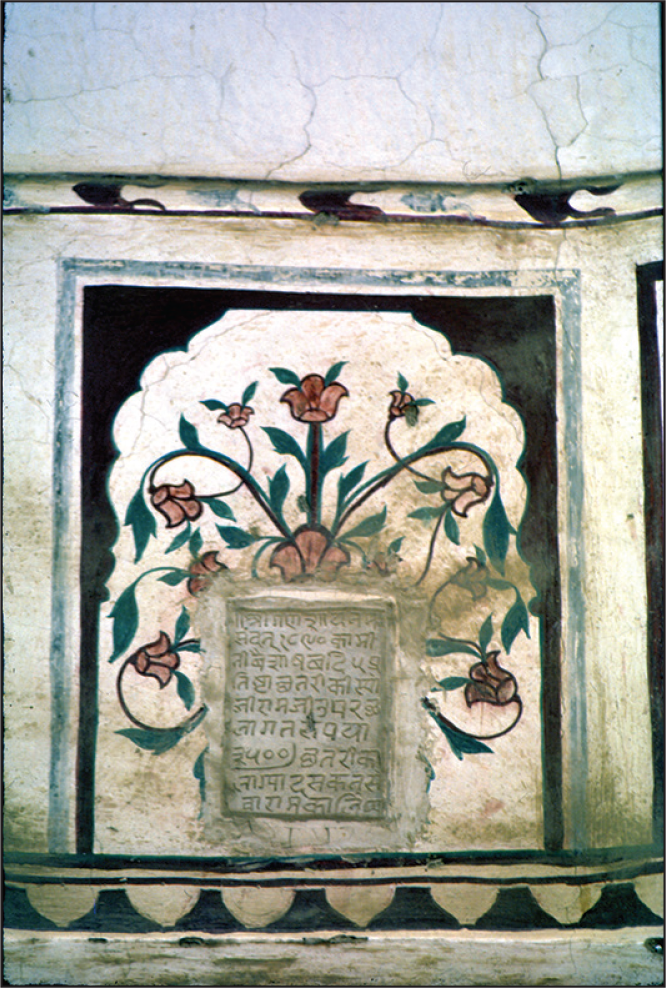
Some of the oldest chhatris in Ramgarh are the Poddar Chhatris. The earliest recorded example of a chhatri in Ramgarh, according to Ilay Cooper’s survey, is a triple-domed Poddar chhatri with a date of c.1827 (Cooper 1987: R 91). 13 In 1833, a chhatri was built for Syoji Ramji Poddar (ibid.: R 85). 14 The inscription on this chhatri, though now removed, is accessible through an old photograph taken by Cooper (Figure 2).
Following these early chhatris, the Poddar and other merchants in Shekhawati began commissioning mortuary monuments to memorialise deceased patriarchs. Studying chhatris in this context provides an interesting insight into how these memorialising monuments became markers of these towns as merchant spaces.
II Merchant chhatris as mortuary monuments
As commemorative structures, merchant chhatris were linked with prestige and not political succession. A new trend amongst the merchant community in the 19th century, these nonetheless had elements in common with existing practices of memorialisation in Rajasthan. While the domed cupola chhatris and the idea of mortuary monuments might have been a result of Indo-Islamic interactions, practices of memorialisation are widespread in Rajasthan. 15 For instance, memorial shrines (deval) and stone steles (devali) are found all over the state. Small memorial shrines to fallen warriors are particularly popular. One cannot immediately correlate this practice to the building of elaborate mortuary monuments for ancestors, though this may be significant to understand the changes in the ways in which the Islamicate tomb was adopted by the Rajputs and the merchants.
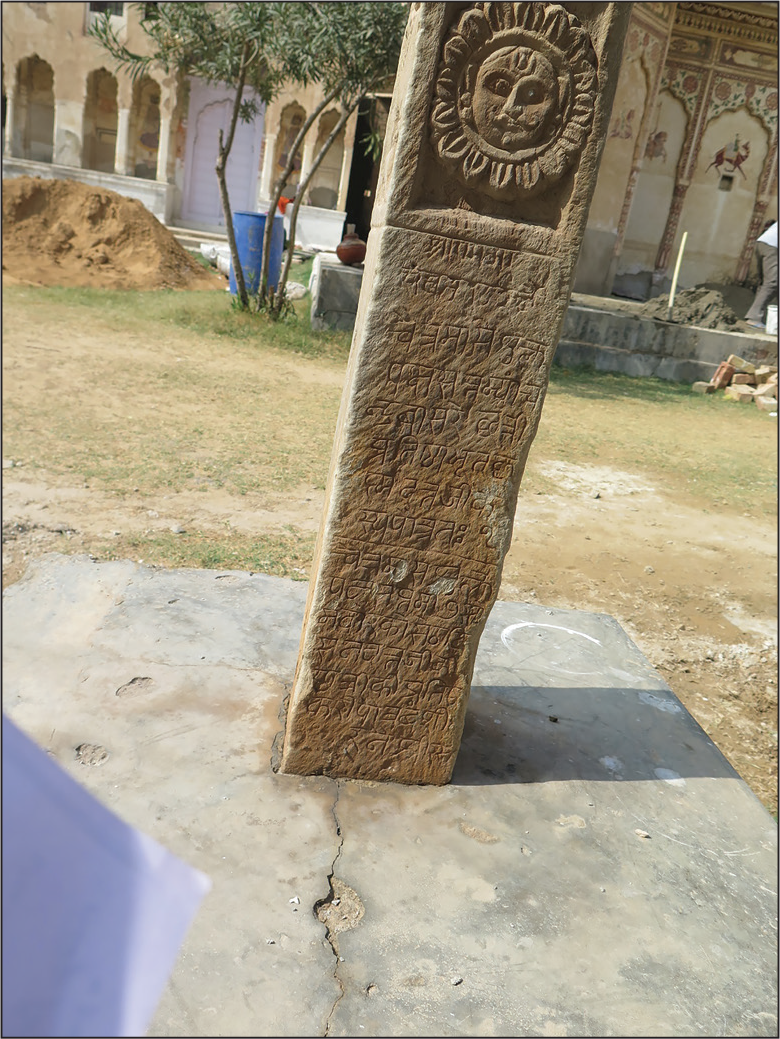
The ritual significance of the chhatri is evident from the fact that they were constructed in a cluster in the designated cremation ground, usually marking the space where the deceased had been cremated. 16 However, this was not always the case; in several instances, chhatris were constructed where space was available. Quite often, there would be a Shiva temple underneath the chhatri. In the case of the Poddar chhatris particularly, the devali/kirti stambh/stone stele seems to be an important feature carrying inscriptional information about the building of the chhatri and the person being memorialised. The iconography of this is, though, markedly different from the kind of devali constructed for Rajputs who were killed in battle.
Another point to note is that this materialisation of memory through chhatris was significantly different from the rituals through which ancestors were, and still are, honoured in most households in the region. Apart from the appointed time of shradh, a period which is marked for honouring the ancestors through donations and abstinences, there are other distinctive local practices. In the design of most havelis, a narrow room known as the parinda is constructed next to the kitchen. Various offerings of food and water are kept in this room to honour the ancestors collectively. In some homes, there is a niche in the walls of the inner courtyard; this is also a dedicated space for the worship of ancestors.
The merchants of Shekhawati started commissioning chhatris from the 1830s onwards and did so till the middle of the 20th century. This corresponds with the painted building trend in Shekhawati in general, post the involvement of the merchants in the colonial economy. 17 The commissioning of the chhatri can be understood as an agentive marking of the region as a homeland by creating a strong sense of the past through ancestor worship and ideas of the sacred. 18 The paintings in these chhatris are integral to the larger dynamics by which the merchants’ powerful status in these towns was established. For instance, the mythological themes painted on the chhatris served to apotheosise the ancestor. The sonic and celebratory elements of the ragamala and the rasamandala imagery in the chhatri, and their association with mortuary monuments, are explored further through the decorative paradigm of the Ram Gopal Poddar Chhatri. These motifs are common to the Rajput and the merchant chhatris and, as I will argue, are linked to the merchant community appropriating markers associated with Rajasthani nobility.
The merchants appropriated not only structural and iconographic markers associated with Rajput nobility but also the idea of philanthropy, when they began commissioning the building and painting activity. While commemorative chhatris were built to honour patriarchs, they served multiple purposes. Melia Belli Bose has described the elaborate surroundings of the Ram Gopal Poddar Chhatri, which include a garden, a dharamshala and a well. Belli Bose links this to the sense of philanthropy associated with the commissioning of built forms by the merchant community (2015: 131–34). Furthermore, the commissioning of elaborate paintings on these structures also became a form of supporting the arts. Such patronage was often linked to the idea of the ideal ruler in Rajasthan (Haynes 1994).
III The Ram Gopal Poddar Chhatri
The name of the chhatri, ‘Ram Gopal Poddar Chhatri’, gives us interesting insights into its history. A general trend I have found is that the merchant chhatris, even as they memorialise a patriarch, were named after the merchant who commissioned the chhatri. This has much to do with the fact that the very act of such memorialisation was linked to displaying the success of the merchant commissioning the structure. However, with the Ram Gopal Poddar Chhatri, this is more complicated. The chhatri was commissioned by Ram Gopal Poddar’s father, Bansidhar Poddar, for his father, Ram Vilas Poddar.
19
While the inscription on the stele at the Ram Gopal Poddar Chhatri has faded, one can corroborate some of this information from the kirti stambh of another Poddar chhatri, also dated 1872
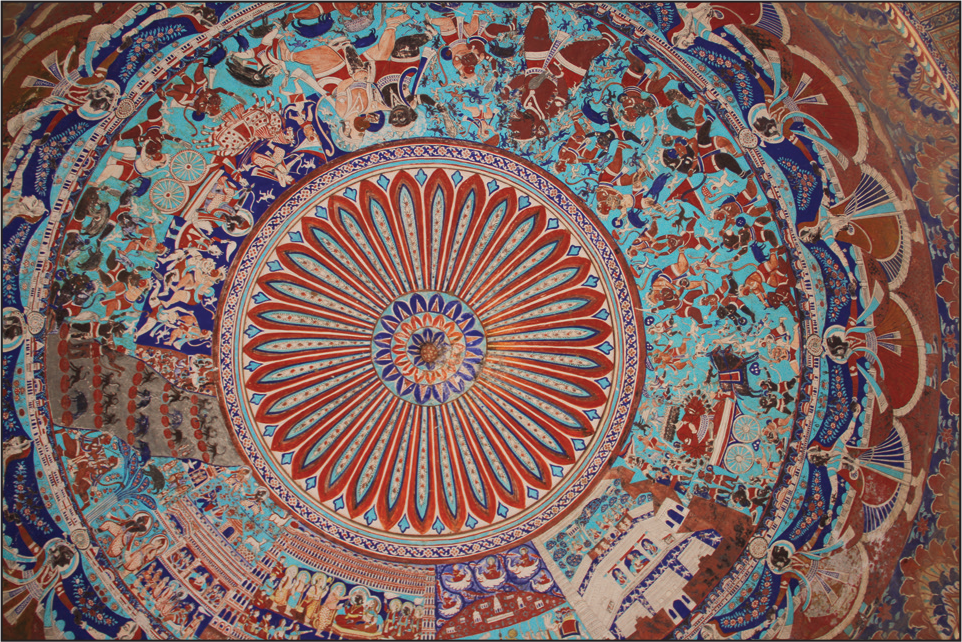
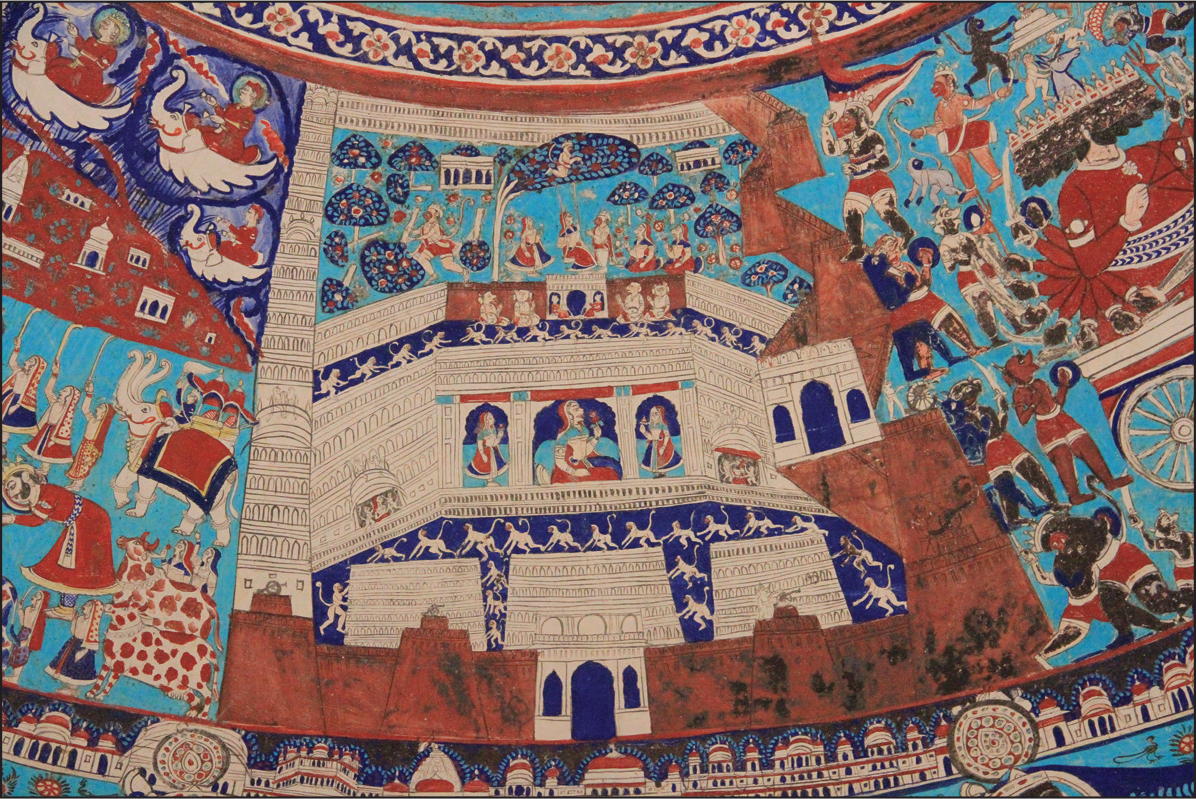
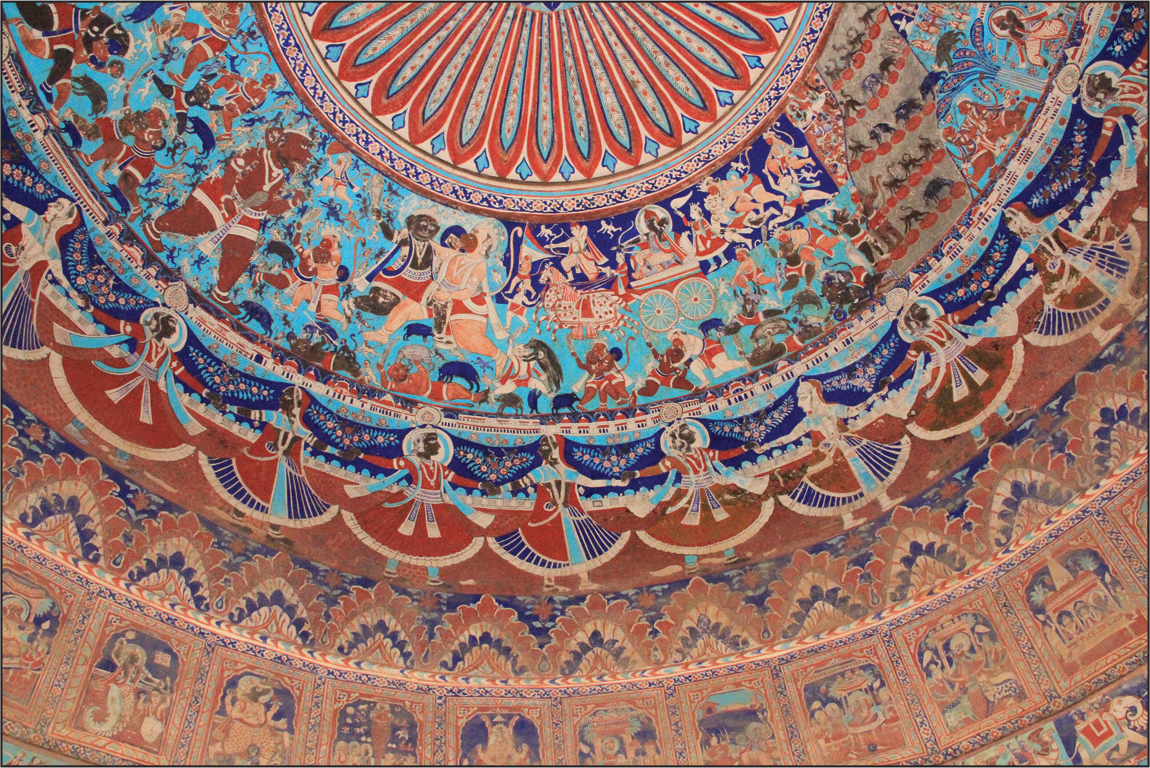
In the Ram Gopal Poddar Chhatri, the main dome has a lotus motif in the centre, with a circular ring around it which is decorated with floral arabesque patterns. Below this starts the first band of figural paintings, which primarily depict scenes from the Ramayana (Figure 1). A large part of the circular space is taken up by the depiction of the battle scene between Rama and Ravana’s armies. This would correspond with the Yuddhakanda of Valmiki’s Ramayana, and has several scenes from the battle, including a depiction of Kumbhkaran devouring the monkey soldiers from Rama and Sugriva’s army (Vanar Sena). One end of the battle scene is marked by the waterbody which the army had to cross to reach Lanka. The depiction of Rama on his chariot is closer to this end of the scene. The other end is demarcated through the walled palace/city of Lanka (Figure 5). This has a red boundary wall around it, with roughly delineated canons on the ramparts. This would suggest a fortified city, which is in keeping with literary descriptions of Lanka as well. The architecture within is depicted as predominantly white. Here, Ravana is not shown as presiding over his court. He is on the battlefield, on his chariot, outside the walls of Lanka, while his palace is under siege with the monkeys invading the zenana (women’s part of the palace) (Figure 5). This space also shows the Ashok Vatika, where Sita is kept prisoner and is meeting Rama’s messenger, Hanuman. The figure of Hanuman is repeated, in a synoptic narrative fashion, to show him observing Sita from the tree, giving Sita Rama’s message and destroying the Ashok Vatika. The space between the palace and the Ashok Vatika has been demarcated with the use of two different shades of blue—a lighter shade and another darker, ultramarine shade. 20 The negotiations between these two types of blues help to demarcate several spaces in the chhatri.
In the circular dome of the chhatri, Ravana’s palace is separated from Rama’s court through a depiction of Krishna holding aloft on his finger, Mount Govardhan, to protect the inhabitants of Braj from the rains—a manifestation of Indra’s wrath. Apart from this scene from the Krishna narrative, the murals on the central dome comprise only depictions from the Ramayana. The insertion of the Krishna scene almost protects the space of Ayodhya from proximity to the depiction of Lanka. A proximity between these two spaces might be inimical to the order represented by Ayodhya at the time of Rama’s coronation (Figure 4). This is in direct contrast to the chaos in Lanka, with the Vanar Sena invading and the king, Ravana, not being in his court.
The murals in the central dome seem to be arranged according to geographical space, more than narrative sequencing. 21 The spaces depicted include Ayodhya at the moment of Rama’s coronation after his return from Lanka (Figure 4). This would be from the end of the Yudhakanda of Valmiki’s Ramayana. 22 This is a flattened view of a four-walled palace with multiple arched windows, domes and bangaldar eaves (curved roof above a window). Ayodhya appears markedly different from the palace at Lanka, since there is no fortification around Ayodhya. The tibari, that is, triple-arched spaces, also seem to be a mix of red, blue and white, while Lanka is depicted as predominantly white. The view into the palace at Ayodhya focuses on the court with Rama and Sita sitting on a raised throne with a gaddi; Rama is being anointed by Sage Vashistha, while demigods and other sages are in attendance. Also attending are important personages from the Vanar Sena, including Hanuman. Sitting in front of Hanuman is a person who is not quite painted like a sage. There are several mentions of the merchants of Ayodhya as being part of the retinue to welcome and consecrate Rama in the Yudhakanda (Lefeber 1984: 491, 483). In that sense, it is possible that this figure is a stand-in for a Poddar merchant, though this is speculative. 23 Another, more significant reference to merchants, though, is incorporated in the river running beneath Ayodhya (Figure 4). 24 Since this river is filled with aquatic creatures and multiple boats, with some being steered by men wearing exotic head gears, which could be akin to ‘firangis’, 25 this stretch of water could then represent the prosperous transcontinental trade under an ideal state (Ram Rajya), thus a reference to the mercantile interests of the Poddars, as well as a possible reference to rulers of Jaipur and Sikar who must maintain the peace for trade to flourish.
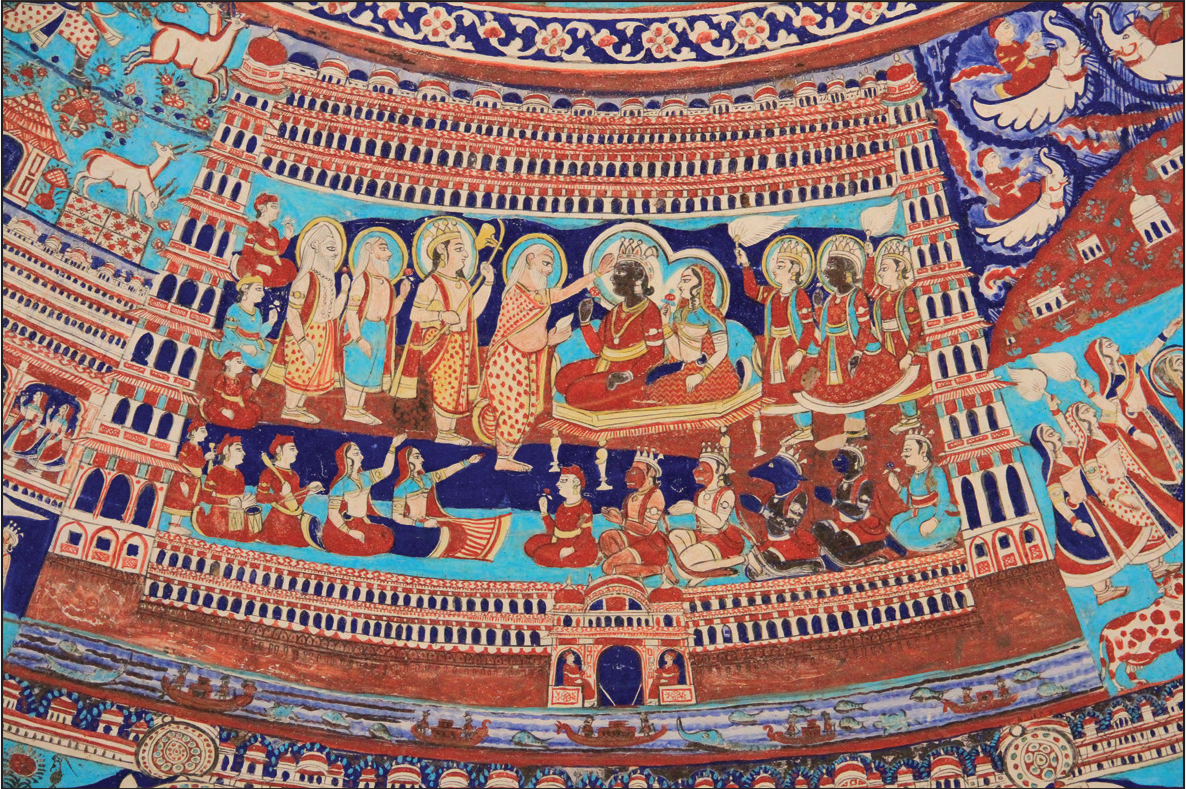
The painting from the chhatri could also be showing the restoration of order in Ayodhya after Rama has been anointed as the ruler. Since Ram Gopal Poddar Chhatri is a merchant’s chhatri, the ships signify the prosperous overseas trade that flourished in times of peace. This stands in contrast with the chaos depicted in Ravana’s court. As art historian Cathleen Cummings has pointed out, the artist Sahibdin from the court of Jagat Singh of Udaipur employs the idea of Ayodhya representing social stability and cosmic balance in his illustrations in the Ayodhyakanda in a 1649 illustrated manuscript of the Ramayana (2011: 166–67). 26 Furthermore, the depiction of Ayodhya at the banks of a river can also be found in other paintings of the city. This is evident in the miniature paintings illustrating the Kanchana Chitra Ramayana, or the golden illustrated Ramayana of Tulsidas’ Ramcharitmanas, which was patronised by the royal court of Banaras between 1796 and 1814. 27 In the Kanchana Chitra Ramayana’s illustrations from the Uttarakanda, one sees vistas of Rama’s court, with the river in the foreground. This might have much to do with the nature of Banaras itself, being a city where ghats (riverbanks) play a prominent role. There are, however, no ‘foreign ships’ in the river depicted in the Kanchana Chitra Ramayana.
The other court depicted in the chhatri is Sugriva’s court. This could be a reference to the section of the palace that Rama had allocated to Sugriva at the end of the Yudhakanda. It could also be Sugriva’s court in Kishkinda. Here, Rama is depicted anointing Sugriva. This could work as an allegory for the hierarchies between Jaipur and Sikar, though this is mostly speculation.
This realm of paintings of the Ramayana is separated from the next band of rasamandala by a strip of diminutive architectural forms. This band depicts white buildings interspersed with red. These could be a depiction of marble and red sandstone structures. Such use of buildings as decorative motifs is novel. The rasamandala depicts the figure of Krishna multiplied numerous times, dancing with each of the gopis in a circular formation (Figure 6).
Below the rasamandala is a band of arabesque decorative patterning, beneath which is a thin strip of horizontal chevron patterning,
28
followed by another set of mural decorations. These are niches created through painted decorative patterns, rather than architectonic elements. These are 32 in number, corresponding to the architrave created by the lintels of the 16 pillars. One can begin reading these from the figure of Ganesh, which serves as the starting point from which to view the mural programme painted in circular structures like the chhatris. The imagery in these painted niches includes 24 avatars of Vishnu,
29
along with eight other images. If one moves clockwise from the image of Ganesh, we get the following framed images:
Ganesh Matsya avatar Varaha avatar Kurma avatar Narsingh avatar Vaman avatar Parsuram avatar Rama avatar Krishna avatar The three main deities of Jagannath Puri Temple Kalki avatar Ved Vyasa, also considered a part of the 24 avatars of Vishnu Prithu chasing Dharti Gajendra Moksh (The salvation of the elephant Gajendra through an intervention by Garuda and Vishnu) Hamsa avatar, that is, the swan/goose avatar This is an image of a bearded Rajput, sitting on a throne with a halo encircling his head. He seems to be giving injunctions to two other men in front of him. I have been unable to recognise which avatar this could be. Yagna avatar Rishabha Nath or Buddha avatar. Both figures are part of the 24 avatars of Vishnu and share certain iconographic details, thus making it difficult to ascertain which one is depicted here. Hayagriva avatar Dhruv avatar Dhanvantri avatar Pilgrims at a shrine, possibly Badrinath Dattatreya avatar Kapila avatar Four Kumaras are sages who roam the earth as children. In the Ramacharitmanas, the four visit Rama along with Hanuman. This is what is depicted in the chhatri. Next to this is another shrine, with three goddesses. These could be ancestral guardian deities. Shiva Family Dadu Dayal with followers (Figure 7). Krishna’s Daan Leela, where he playfully collects toll from the milkmaids of Vrindavan. Durga on a lion with her two attendants, Kala and Gora Bhairav. Rajput on a well-decorated horse, with his retinue made up of British soldiers and holding his sigel. This could be a historical figure from the region, possibly the Rao Raja of Sikar. Krishna stealing the clothes of the gopis, that is, cheerharan.
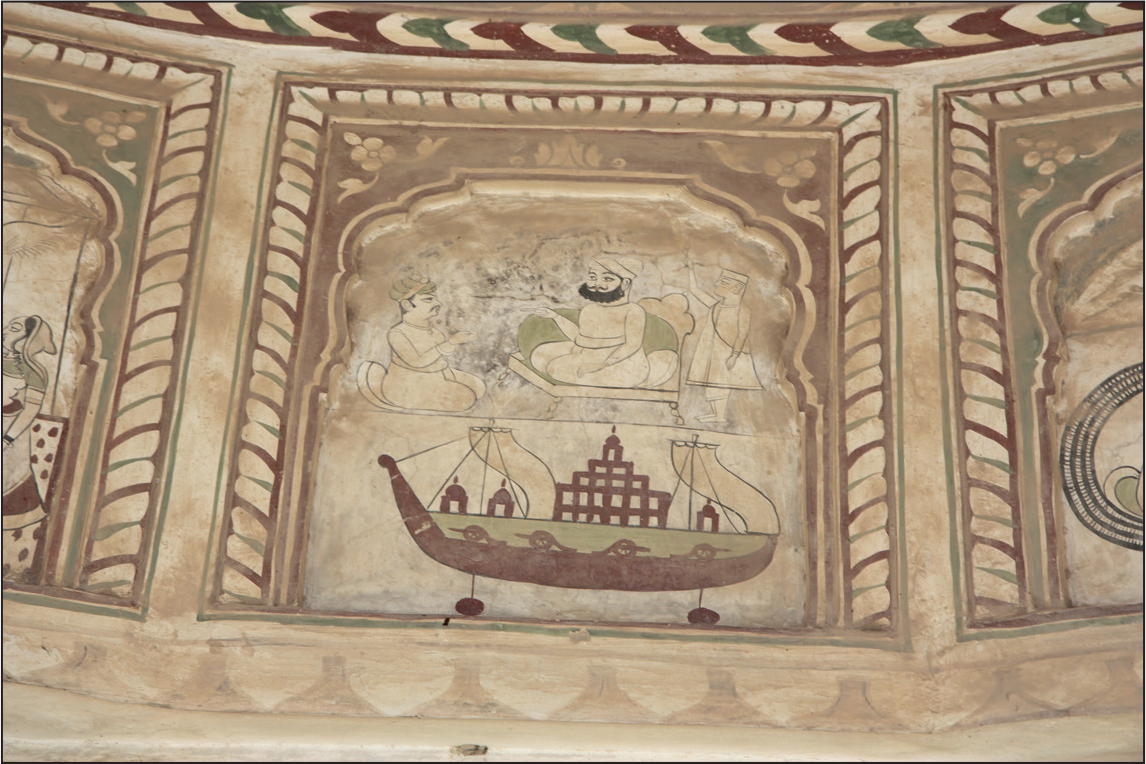
The painted frames seem to be a mix of mythological and historical personages, including saints. Amongst these, there are some figures that are more linked to the merchant community. In Figure 7, the white clothes and the cap appear to correspond to images commonly associated with Dadu Dayal (1544–1603), who becomes an important link between the Bhakti traditions of the long 19th century and merchant identity. 30 According to Tyler Williams (2022), hagiographic works on Dadu Dayal establish a connection between him and the merchant community. Praying to Dadu Dayal in moments when a merchant’s cargo on a ship is about to be lost was believed to lead to a miraculous rescue. Such instances allow Dadu Dayal to almost become a patron saint who can provide miraculous protection for the goods of merchants, particularly on boats (Williams 2022: 310). 31
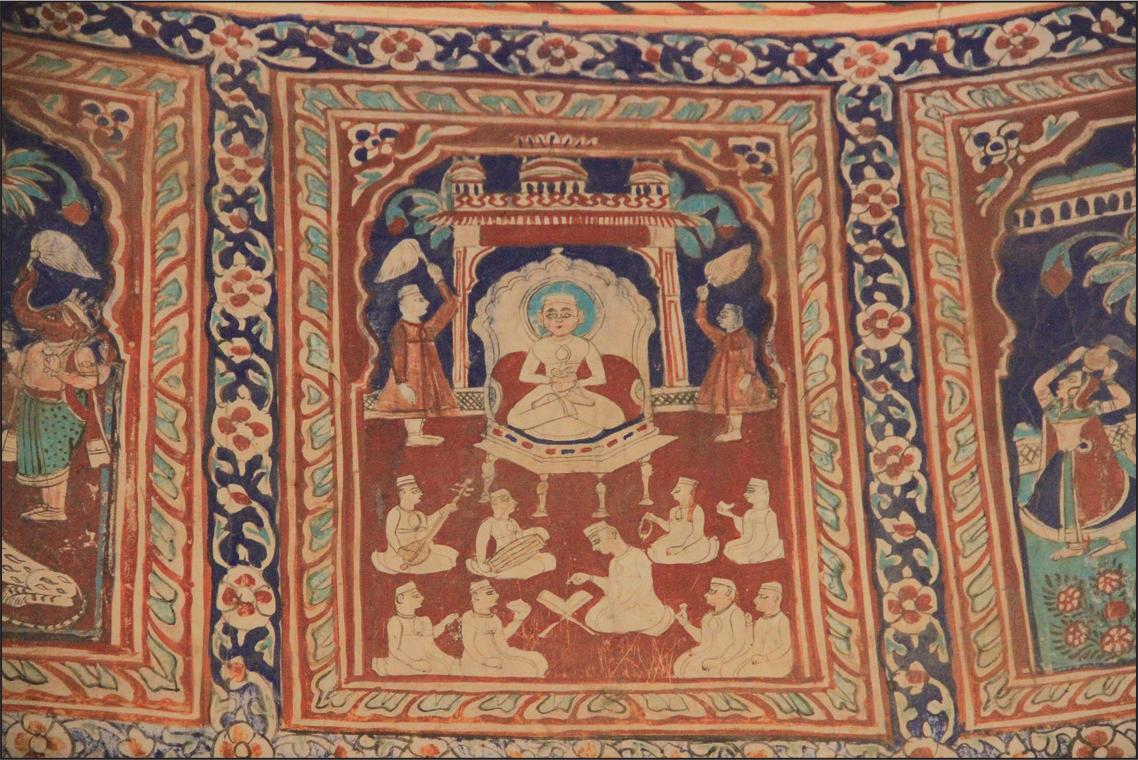
There are images of Dadu Dayal in earlier Poddar chhatris as well (Figure 8), 32 which link him directly with the protection of ships. 33 Figure 8 shows him sitting on a gaddi, giving injunctions to a merchant. A ship is painted in the same frame, suggesting that the interaction is a blessing for overseas trade. However, this motif is conspicuously absent from the mural programme of the Ram Gopal Poddar Chhatri. Instead, here, Dadu Dayal is portrayed as a saint occupying his gaddi (Figure 7). It is possible that by the 1870s, the focus had shifted, and he was associated more with his Durbar in Naraina. As Tyler Williams highlights, while Dadu Dayal himself had been peripatetic, his son Garib Das directed the monastic order from his ‘gaddi’ in Naraina (2022: 314). Such a depiction of Dadu Dayal sitting on a gaddi could be a reference to the monastic complex. In that sense, the scribe painted prominently in the image could be a reference to Mohandas Daftari, Dadu’s scribe, or Sundar Das, a prominent disciple (Figure 7). Sundar Das had established a monastery of Dadupanthi saints in the town of Fatehpur, which was also part of the Sikar district (Williams 2022: 322). However, while Dadu Dayal may have been acknowledged in the Ram Gopal Poddar Chhatri, the task of protecting the ships is also linked to the Vaishnav God Rama. Similar to the depiction of the river beneath Rama’s court at Ayodhya, in the band of images below the painted niches, one of the depictions shows Rama and Lakshman protecting a yagna (ritual chanting around a sacred fire) from demons, under the supervision of Guru Vishwamitra (Figure 9). On one end of this scene, there is a river which has a ship/boat that seems similar to the ones in the water below the Ayodhya scene. The figures of Rama and Lakshman are repeated here, and it would seem that they are protecting not only the sage’s yagna but also the merchant’s trade interests (Figure 9).
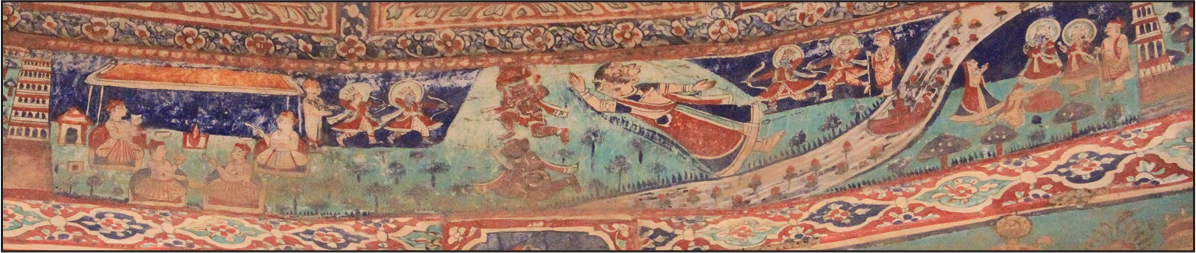
The next sequence presents 16 sunken niches and 16 protruding niches. This is the lowest band; the protruding niches are populated by generic figures holding flowers. This includes firangi paintings. The fact that these have been incorporated in the lowest bands might suggest a similarity with the paintings in the Badal Mahal in Bundi, as well as the more profane character of such generic portraits of men and women. 34 The sunken niches, on the other hand, are also decorated with narrative depictions. The most compelling amongst these is that of Bhishma from the Mahabharata, lying on a bed of arrows, as Arjun creates a fountain of water with his arrow to quench the former’s thirst.
IV Ragamala and rasamandala iconography
Another aspect of the Ram Gopal Poddar Chhatri shows the opulence of the Poddar merchants who commissioned it. Two sets of pillars in the chhatri create 16 subsidiary domes, which could be a more ornate reference to the panchratna dome style of Mughal tombs with subsidiary domes arranged around the central dome. These subsidiary domes in the Ram Gopal Poddar Chhatri contain labelled ragamala imagery (Figure 10), along with other paintings like the barahmasa (12 months/moods of the seasons) and love stories popular in the region.
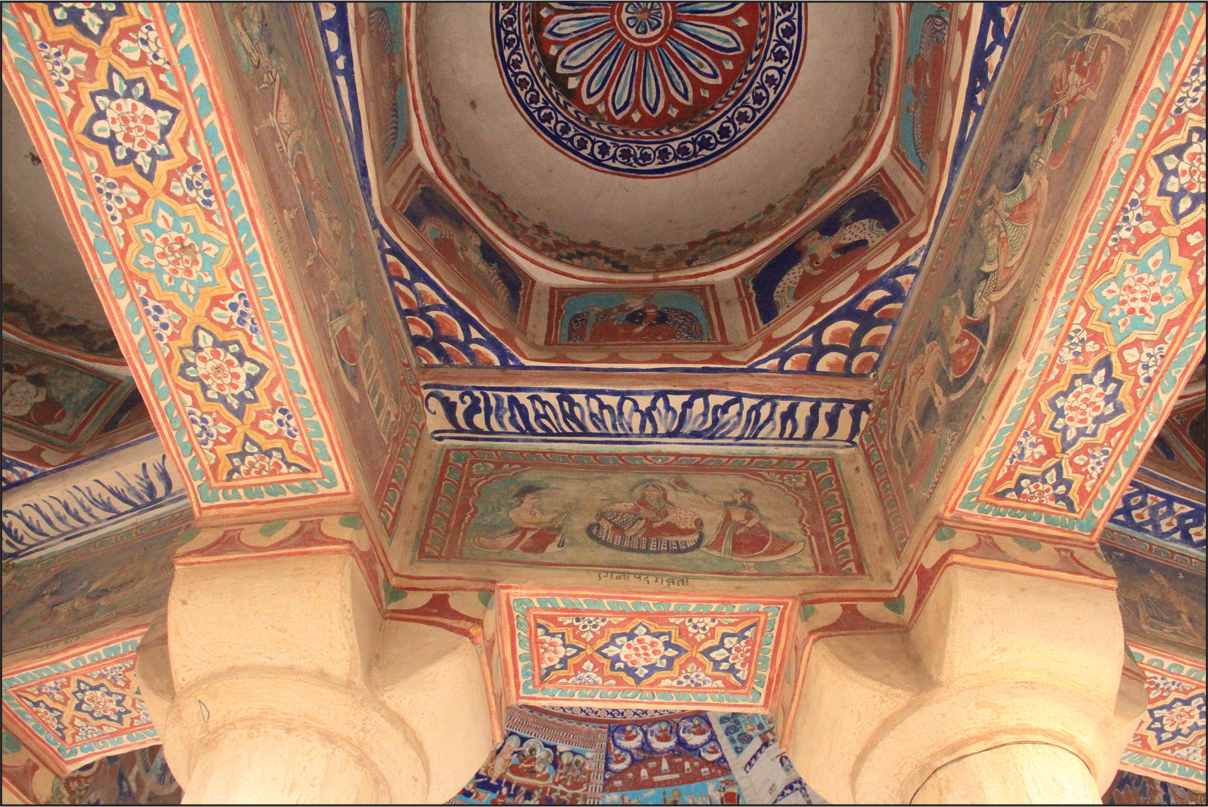
The presence of the ragamala paintings and the rasamandala, along with the use of the chhatri to memorialise an ancestor, firmly places the merchants in a framework that allowed them to appropriate the structures and iconography of the Rajput nobility. In the case of the ragamala paintings, it is the idea of ‘taste’ as a marker of class and refinement which gets evoked. As art historian Molly Emma Aitken states, by the mid-16th century, when the ragamala paintings were being extensively illustrated, these were not so much about musicians referencing these to perform music. Rather, ‘the Ragamala’s poetic and pictorial dimensions may have been valued, instead, primarily as a form of elite knowledge, a sign of the courtier’s taste for music, and an attribute of the gentleman patron’ (2013: 37). The ragamala, as per Ed Rothfarb, is ‘arguably the most distinctive aspect of Rajput iconography…associated with Rajput as well as elite Hindu patrons’ (2012: 137).
An early example of imagery from the ragamala being used in a Rajput cenotaph comes from Raja Man Singh Kachwaha’s cenotaph at Amber (c. 1614). 35 The only inclusion here, though, seems to be of Todi Ragini, evinced from the presence of the two deer along with a woman (Cimino 2001: 24). A similar figure, that may be associated with the Todi Ragini, is also present in Sardul Singh Chhatri (1750) in Parsurampura. In the central dome of the chhatri in Parsurampura, there are multiple winged figures in a circular formation, holding musical instruments. Some of these figures hold stringed instruments such as a double-chested fiddle, also known as a surando. There are deer painted next to such figures, which could be a reference to the Todi Ragini, while the wings make them celestial beings such as angels. As per Cimino, such flying creatures are associated with the myth of Solomon, and the Mughal emperors, particularly Jahangir, were keen on comparing themselves with this mythical king (ibid.: 16). 36 This established motif of kingship was widely adopted by the Rajput kings. Discussing the depiction of dancing figures and musicians in chhatris of the Kachwaha rulers of Jaipur, the art historian Melia Belli Bose notes that these refer to the traditional responsibilities of kings, which included supporting the arts such as ‘music, dancing, acting and the courtesan’s craft’ (2015: 58–59). 37 In the merchant chhatris of Shekhawati, this imagery, thus, references the cenotaphs of Rajput nobility, as well as the acquisition of royal responsibilities by the merchant community, in the context of the towns of Shekhawati.
Another set of ‘musical’ motifs in the Ram Gopal Poddar Chhatri is the rasamandala, which features painted figures of Krishna and the gopis in side-profile (Figure 6). Here, Krishna has been painted multiple times so that he is seen dancing with each gopi. The gopis are dressed in the fashion of Rajasthani miniatures, while Krishna wears a flared jama (upper garment) tied around his waist. The backdrop includes a carpeted surface and a boundary, giving it the appearance of a circumscribed garden. It provides a foreground and a background for the figures in the rasamandala, creating a sense of depth and recession as if the rasamandala were projecting outwards towards the viewer standing below.
The art historian Ed Rothfarb (2012) observes that one of the earliest extant architectural representations of the rasamandala in relief in a Rajput building is the 17th-century depiction on the ceiling of a suite in Govind Mahal in Datia, patronised by the ruler Bir Singh Dev. Rothfarb traces the adoption of Vaishnavite imagery in Rajput architecture and the translation of such image from paper to the decorative framework of walls to the growth of the Vaishnav Bhakti movement at the turn of the 15th century (ibid.: 134–35). Both the ragamala and the rasamandala are common as palatine decorations. The most prominent example of both these motifs in the context of wall paintings comes from Bundi. Some of the earliest murals on these themes are evident in the Badal Mahal. 38 The two rasamandalas at Bundi, one from c.1620 in the Badal Mahal and another from c.1630 in the Ratan Mahal, provide interesting insights about these motifs within palatine decorative mural schemes. While there is some disagreement about whether the Badal Mahal was indeed a bedchamber or not, 39 if indeed it was, it would give a particular meaning to the rasamandala motif. The evocation of the night in the Badal Mahal rasamandala is distinctive. The lotus in its centre becomes a moon, and the dancers are in a lush outdoor setting. The scene is illuminated by painted winged figures depicted as holding candles. It is watched by the deities and avatars of Vishnu, painted in parts of the squinch net that surround the rasamandala. Ed Rothfarb notes that this theme from the Bhagavatapurana was well established as a palatine decoration by this time (2012: 135).
The meanings of the rasamandala and ragamala are constituted by the kind of architectural spaces they decorate. 40 In the context of the chhatri, while the appropriation of motifs and decorative art associated with royalty reifies the status of the merchants in the same way as the structure of the chhatri does, the rasamandala and ragamala are also connected to the sonics of apotheosising the ancestor. The figural paintings in the 17th- and 18th-century tombs of Larkana district in Sindh, constructed during the rule of the Kalhoro rulers, become important sources in this regard and yield insights into the significance of images of dance, music and folk tales in sepulchral architecture. The ethno-musicologist Zulfiqar Ali Kalhoro associates the presence of such images with the traditions of performance in the Sindh region, highlighting how such imagery is commonly found in the Mughal, Rajput, Pahari and Deccani paintings as well (2010: 202). 41
The meanings produced of and by paintings in a manuscript or palatine architecture, vis-à-vis wall paintings in a merchant haveli or mortuary monument, might be linked but remain significantly different. For instance, the rasamandala motif, when depicted in the inner courtyard of a haveli, in conjunction with a motif of mobility such as the train, creates a narrative of separation and reunion (Agarwal 2025: 14–18). This motif might have a slightly different significance in memorialising architectural spaces. For instance, it could represent a celebratory tone for the person memorialised ascending to a heavenly realm, while also evoking ideas of separation from those left behind, again evoking ideas of separation (from the earthly) and union (with the divine). This is closely linked to the rasamandala imagery and Bhakti traditions. The rasamandala is a popular motif in the chhatris of Shekhawati, 42 possibly also because of how it lends itself well, aesthetically, to the circular structure of the dome.
V Conclusion
This brief examination of the mural programme of the Ramgopal Poddar Chhatri highlights how patronage of the arts and the commissioning of painted structures were linked to the wealth and importance of the merchant community in the Shekhawati region in the 19th century. Much of this conspicuous display of wealth was premised upon appropriating structures and iconography associated with the Rajput nobility of the region. Nonetheless, an exploration of motifs such as ships and Dadupanthi saints allows one to read an incorporation of imagery associated with the merchant community into this framework as well. The 1872
There is also a political import to this investigation into the history and iconography of the Ram Gopal Poddar Chhatri. Recently, there have been attempts to rename the chhatri as ‘Ramayan Chhatri’. I have been doing fieldwork in the Shekhawati region since 2013. It was only around 2018 that I began hearing about the Ramayan Chhatri in Ramgarh. On checking with Ilay Cooper, who surveyed the region in the 1980s, naming each building as it was known then, he also found this renaming incorrect. 43 In Cooper’s survey, the chhatri is named as Ram Gopal Poddar Chhatri. I can confidently say that Ramayan Chhatri is a new name being used for the Ram Gopal Poddar Chhatri, linked to a simplification that sometimes accompanies tourism and heritage practices. While the central dome of the chhatri indeed has several scenes from the Ramayana, the chhatri itself has several other paintings, such as the ragamala, rasamandala, barahmasa, scenes from the Mahabharata, as well as the avatars of Vishnu, as has been discussed in this article. Furthermore, 19th-century sketches and stencils collected from Shekhawati—presently in the collection of MAP Museum in Bengaluru—establish that paintings depicting episodes from the Ramayana were a common theme among chhatri murals. 44 Renaming a specific chhatri as the Ramayan Chhatri breaks the historical links that the Ram Gopal Poddar Chhatri has with the other Poddar chhatris, as well as reducing its complex paintings to one subject. I am hopeful that further research into the wall paintings of Shekhawati will counter such trends, which can hardly be considered politically neutral.
Footnotes
Acknowledgements
I would like to thank Ilay Cooper and the anonymous reviewers for reading and commenting on earlier versions of this article. I would also like to thank Dalpat Raj Purohit for the inputs regarding the iconography of Dadu Dayal.
Declaration of Conflicting Interests
The author declared no potential conflicts of interest with respect to the research, authorship and/or publication of this article.
Funding
The author received no financial support for the research, authorship and/or publication of this article.