







Abstract
The figure of Hanuman has long occupied a central place in Hindu visual traditions as the protector and devoted servant of Ram. This article examines the emergence and proliferation of a distinctly angry Hanuman in the visual ‘everyday’, on stickers, flags and temple exteriors. Through close readings of its formal features, genealogy and circulation, it analyses how contemporary regimes of image production generate a dense field of divine prints marked by recursive repetition. Drawing on visual anthropology, sociology and affect studies, the article argues that the aesthetic labour performed by musculature enables anger to become a legible affect in this latest iteration. Building on scholarship centred around ‘seeing as knowing’, and ‘interocularity’, it places the ubiquity of angry Hanuman in the processes of Hindu identity formation and examines the force of its gaze in the public sphere. The article highlights technologies that expand religious patronage and the current ordering of the religio-political sensorium. Here, anger is theorised as an affective force circulating across surfaces and spaces, contributing to the structuring of affective publics, and not merely as an attribute of the deity.
‘No images ever die, they all remain alive, on stand-by, mitigating endlessly, cutting back and forth across new times and contexts’. (Pinney 2004: 206)
I Introduction
Susan Buck-Morss writes that ‘Aisthitikos is an ancient Greek word for that which is perceptive by feeling, and aisthisis is the sensory experience of perception, which reiterates that the original field of aesthetics is not art, but reality’ (1992: 6). Post the visual turn in the social sciences, there was a move towards looking at visual modernity as having its own temporal potential (Moxey 2013: 1). It marked the arrival of an understanding that modernity and time are not understood in the same chronological or teleological sense across the world, thereby surpassing the examination of modernity as defined through a binary. In the context of popular production of chromolithographs and poster art in India, the encounter with colonialism and enlightenment modernity paved the way for the thriving of a bazaar (drawing here on Jain 2007), 1 which saw a circulation of a brand of nationalism that departed from European secular-modern conceptions.
In an ever-growing digital world, where spectacles, performance and the image not only saturate but also govern the human senses, it remains relevant to theorise its ever-presence through a form of ‘picturing’ (Mitchell 1994: 9). This theorisation is not concerned with the electronic reproduction of paintings. Rather, it examines how newer forms of visual stimulation and circulation are produced through the internet, particularly in relation to the ubiquitous nature of divine anger and muscularity in India. This article uses the example of the angry Hanuman, a creation of the graphic designer Karan Acharya, who first generated this image ‘playfully and free for his friends’. 2 The objective here is to situate this image within an interocular field (Appadurai and Breckenridge 1998: 12), focusing on its formal features, affective nature and increasing popularity. Furthermore, this study places the emergence and popularity of the image in the long line of what Kajri Jain terms ‘the unfinished business between art and religion’ (Jain 2022: 92) that reimagines the contours of traditional art history, particularly through the examination of a ‘recursive archive’ (Pinney 2004: 201) of divine art that does not restrict the work to its horizon of creation. The article also takes into account the plasticity and mimetic possibilities of this image, as it not only slips between mediums (T-shirts, stickers, posters) with ease, but also leads to the emergence of a distinct way of visualising the divine in India through the affective register of muscularity laced with anger. The visual illustrations in this article focus on this viral iteration of Hanuman, while also bringing into focus some of the earlier poster/bazaar art that paved the way for the visual transformation of the deity into a muscular, angry deity. The article emphasises the continuing presence and role of divine images in shaping the public sphere, as bazaar art that emerged from within, and apart from the structures of colonialism, finds new, everyday ways of reproduction.
An understanding of ‘visuality’ as regimes of seeing and being seen (Ramaswamy 2003a: xiv) becomes important to examine the continuing work of the image in performing politics in contemporary India, while also taking care not to limit an image to just that. It is the nature of this latest iteration of the ‘divine-popular’ that I examine here in order to better understand what the picture wants, along with conceptualising the relationship between this work of art, anger as its affect, and its role in the public sphere. The charged image of the angry Hanuman stands as an example of the long line of narrative practices that make use of new, evolving media in identity formation. This includes the circulation of commoditised divine images that posed an alternative to an espoused secular modernity (Jain 2007: 200).
II Methods and timeline
The article grew out of field work conducted over a two-year period (2024–25) in Delhi, Hyderabad, Ahmedabad and Chennai. The collected material includes photographs of angry deities, particularly Hanuman, found on rickshaws, flags and posters. Archival material, which primarily comprises divine posters and calendar art, was photographed from the personal collection of Professor Christopher Pinney at Cambridge, and the Asia reading room, British Museum. There is no dearth of innovative divine vehicle stickers on the roads of Hyderabad, with most focusing on an exaggerated muscular physique or angry physiognomic features. The everyday nature of these interactions is what spurred my interest in the subject, along with a sustained engagement with the visual anthropologists that I cite here. The article also draws on interviews conducted with rickshaw drivers, including one from an online source.
III Background literature
While this latest image of the deity is ubiquitous, it does not imply exclusivity; other images of the deity remain in circulation. Though Philip Lutgendorf uses the word ‘evolution’ in his essay (Lutgendorf 2003: 74), he is quick to point out that evolution does not mean a linear development from one iteration to another, stating that newer technologies and the images that come with it, do not completely supplant older/traditional iterations. The article attempts to build on this argument to explore the various vehicle art in circulation, where the vehicle transforms into the owner’s personal canvas. Despite multiple iterations of Hanuman being in circulation, the angry Hanuman has gained enough prominence to have caught the attention of the Prime Minister of the country. 3 The use of newer technologies for the creation and reproduction of digital art has allowed for the emergence of multiple representations and offshoots of the angry Hanuman, becoming, in turn, a template to represent divine rage in popular art. Historical figures like the Maratha ruler Shivaji have also been harnessed in this orange-hued, angry avatar, another indicator of the popularity of this new style. This development must be placed alongside the earlier development of cheap and mass-produced art (as an alternative to high art) where the divine spilt out from within the confines of the temples onto the walls of houses and the commercial streets of everyday life, expanding the religio-political public. Kajri Jain emphasises that the establishment of offset presses around ‘the 1960s, led to a near- universal access to printed icons’ (Jain 2021: 85) calling this the ‘unfinished business between art and religion’ (Jain 2022: 92). An argument can be made for this unfinished business forming the bedrock of a ‘community of sense’ 4 (Rancière 2009: 31) called India. Affectively charged visual registers continue to play a role in shaping the public sphere in India, particularly through the everyday nature of images like the angry Hanuman.
Newer audiovisual technologies continue to make active use of calendar art, particularly those with a frontal vision of the deity, achieving a darshanic encounter between the deity and devotee. The concept of darshan 5 remains pertinent in exploring the proliferation and continued reverence of divine poster art in India. But its relevance to the angry Hanuman stickers remains ambiguous, and yet to be explored, because the outward gaze of the deity does not necessarily perform the same function as the soft and benign physiognomy of divine representation in calendar art. Darshan is important to understand the advent of visual modernity through popular chromolithographs in India, particularly with regard to the construction of the postcolonial subject. Vision, as a historical construct, had largely focused on Western forms of spectatorship and lacked an examination of how the Indian spectator’s vision was constructed. Darshan can be understood in the Hindu ritual tradition as ‘religious seeing, or the visual perception of the sacred’ (Eck 1998: 3) and remains central to understanding the visual interaction between deity and devotee within and outside the confines of temples.
Post the visual turn in the social sciences, scholars (Brosius 2012; Freitag 2001; Jain 2001; Mitter 2003; Pinney 2003) have sought to delineate the role of the colonial encounter in the construction of an Indian eye/vision. The visual turn is best described by W. J. T. Mitchell as not a return to mimesis, but a complex interplay between visuality, apparatus, institutions, discourses, bodies and figurality (Mitchell 1994: 16). Here, visuality is best understood as an arena of knowledge production that is actively involved in ‘regimes of seeing and being seen’ (Ramaswamy 2003a: xiv) where, through the consumption of these popular prints, citizens participated in the public sphere and the emerging nation. Freitag places the onus of this on the courtly culture in South Asia, where processions were taken out by royalty with subjects lining up the streets to witness this (Freitag 2001: 41). This inevitably added further power to vision/gaze, where the idea of seeing moves into the realm of darshan, with the beholder and the object/person being gazed at sharing a mutual gaze. It is this form of seeing as knowing that finds its way into the nation-building/nationalism process. This visual vocabulary was harnessed—particularly with regard to the Hindu divine—in attributing sacrality to the Indian nation that was trying to emerge from the clutches of colonial occupation. The reawakening of a hyper-masculine Hindu nationalism (through muscular depictions of the divine) provided further impetus for a renewed examination of popular divine art in India, particularly with regard to its political efficacy.
IV Colonial modernity, visuality and the public sphere
Modern colonial institutions, like art schools, asserted a colonial notion of vision— described as the ‘visual equivalent of the English language’ (Pinney 2003: 114)—that attempted to sever the visual connection that the native beholder had with the deity. ‘Colonial perspectivalism’ that was taught through art schools had artists representing deities with their vision gazing away/beyond the beholder—a brand of aesthetics that was unfamiliar to the local populace. This promoted an anaesthetics (sensory alienation), as it greatly differed from the bodily aesthetics of worship among Hindus. A few examples can be found in the works of the Calcutta Press and the Chore Bagan Art Studio; in these, the divine gaze is not centred on the devotee/viewer, in an attempt to move from the darshanic efficacy of the sacred to that of a disembodied aesthetic. The advent of mass production through the printing press enabled chromolithographs to represent deities in their frontal form, thereby reinstating a corpothetical devotional connection that colonial aesthetics had previously disrupted.
Labelling the widespread presence of religious images in an emerging nation as non-modern is perhaps a pitfall of trying to define the modern in terms of a binary. With regard to calendar/bazaar art in India, it would be impossible to place it in a chronological sequence, thus making it differ from the Western conception of modern time as linear. The idea of a ‘recursive archive’ remains essential to understanding the terrain of popular divine art in India; such an approach rejects a teleological colonial modernity and instead embraces an alternative modernity that has a landscape of dense semiotic layers. Pinney points out that most commercial artists maintained an extensive archive, making a neat progression from one historical moment to the next, difficult, and hence recursive (Pinney 2004: 206). This way, these images become part of trajectories where repetition and pastiche make them unpredictable, compressed performances resistant to any particular moment. The image squires an anachronistic quality, escaping linear temporality and becoming available to ‘all times’. This recursivity makes it difficult to pin down the image to a single historical moment, producing a temporal blur. Later, when we discuss anger as ‘affect’ and the various trajectories that popular representations of Hanuman have taken, it becomes clear that images are constantly cutting back and forth across time and being reworked fluidly, evading singular authorship. This is evident in how representations of divine muscularity, especially in the Janmabhoomi Ram, have done the labour of associating bodily strength with a violent Hindu nationalism, laying the groundwork for the representation of anger without the explicit use of a muscular body.
The following example supports the argument for a recursive archive that defies chronological arrangement. The poster displayed in Figure 1 depicts a scene from the Ramayana—the killing of Ahiravana—a theme that is vastly in circulation, rudderless, departing from the idea of a single, original artist. This moment from the Ramayana has been recreated by numerous publishers, most notably by the Sharma Picture Publication, depicting a bulky version of Hanuman, which is closer to an anthropomorphic representation. The colours used by the publisher are brighter than usual; there are halos around the heads of Rama and Lakshmana, who are seated on Hanuman’s shoulders. Hem Chander Bhargava’s press was one of India’s oldest picture publishers, established eight years after the Ravi Varma Press, which was established in 1894 (Pinney 2004: 74). In their depiction of the same scene, we find Hanuman to possess more simian qualities, with a more prominent maw; the colours are duller and the entire representation has an unpolished look. The poster in Figure 1 was obtained from a street vendor in Prayagraj, Uttar Pradesh, who, when asked about the continuing relevance of these posters in an age of digital reproducibility, was quick to point out that his customers were mostly students from nearby colleges who adorned their walls with these posters. The poster uses embellishments such as glitter to spruce up the otherwise mass-produced image, an act similar to the use of paint on photographs, increasing the sense of tactility, a quality that distinguishes it from digitally reproduced images. Interestingly, Ahiravana is absent from this poster, indicating the circulation of the image as a separate entity from the context, another defining feature of the recursivity of divine poster art.

The depiction by Sharma Picture Publication has additional details; in the distance, on a hilltop, there is a white shrine with a saffron flag, a detail that is absent in the poster in Figure 1 and Bhargava’s rendition. 6 The symbol of the halo also became a feature in later calendar art with national political figures such as M. K. Gandhi and Bhagat Singh sharing space with divine Hindu figures, particularly Bharat Mata (Mother India). The recursive nature and idea of replication in calendar art emerge as a conspicuous feature of modernity with regard to divine images. This recursivity is captured in Pinney’s phrasing of images being ‘half-seen in advance’ (ibid.: 206).
The popularity of bazaar prints also played a key role in its influence on the shaping of the public sphere. These prints were an integral part of religious processions and festivals, and proved to be a means of rejecting the colonial clampdown on political gatherings. Holly Shaffer takes up the example of Shivaji portraiture and its harnessing by leaders such as Bal Gangadhar Tilak during the emergence of the Ganesh festival as a field for anti-colonial mobilisation (Shaffer 2022: 230). The Ganesh festivals became a part of iconographic circuits where representations of deities were combined with those of national leaders and reformers, shaping the public sphere of an emerging country along specific religious lines. The festivals also provided a visual vocabulary for the same as these spaces and their makeshift pandals (temporary structures of worship) became sites of ‘interocularity’, a term that Appadurai and Breckenridge coined to explain an ‘interweaving of ocular experiences’ (Appadurai and Breckenridge 1992: 52). The idea of interocularity remains key to understanding the shaping of the public sphere in India, with museums, religious sites and other sites of national importance all making use of mass media and spectacular visual forms to establish newer ways of seeing.
The gaze of the Indian spectators and viewers is caught up in an interocular field. This interocular field is structured so that each site or setting for the socialising and regulating of the public gaze is to some degree affected by the experience of the other sites. (Appadurai and Breckenridge 1998: 12)
This interocularity is evident in emerging contemporary spaces like the Prime Ministers’ Museum (Pradhanmantri Sangrahalaya) in Delhi, the Ekta Nagar/Statue of Unity campus in Gujarat and the Kashi Vishwanath corridor in Varanasi, where we find an amalgamation of newer ways of dissemination with traditional ways of seeing. Festival spaces such as the pandals for the Ganesh festivals are large and elaborately decorated; they are designed around particular themes (such as the Ayodhya Ram temple), 7 and contain visual representations of different deities alongside Ganesh. These have been examined as ‘active political arenas where reason and devotional affect come together’ (Jain 2007: 273). Recent pandals have traditional elements blending with modern ones, as deities and digital screens come together as one; deities (particularly Hanuman) most often being represented with a muscular torso, while the screens displayed the Indian Tricolour. The presence of multimedia technology, such as digital screens where the images can be in flux, does not diminish its sacrality; this is evidenced by the popularity of the digitally produced and circulated ‘viral’ iteration of the angry Hanuman that is discussed here. The phrase ‘prismatic structures of modernity’ (Appadurai and Breckenridge 1998: 15) best describes the complexity of these sites, as new visual technologies shape a ‘citizen-devotee’, centred around the consumption of the experiential fields that modernity has to offer. Going further back, with the use of religious myths as allegories in popular lithographs, one could make the argument that the natives used colonial modernity as a site for resistance against colonial forces. Numerous examples of calendar art use iconographic markers from popular Hindu myths and national leaders, often with the figure of the Bharat Mata being the intermediary between the two, occupying both the national and religious worlds. Scholarly work on Bharat Mata includes the gendered cartographic representation of India’s geo-body 8 (Ramaswamy 2003b: 151) and the figure’s emergence from the cow protection movement (Pinney 2004: 112). Despite the widespread prevalence of newer imaginations of the divine nation, which centre anger, masculinity and muscularity, representations of the Bharat Mata, Tricolour in hand, and with the relief map of India serving as the background, still find a place in emerging modern spaces of worship like the Kashi Vishwanath corridor, albeit in the form of a fixed-permanent statue. The confluence of digital screens and older forms of representing the divine, alongside symbols of the nation here, is in line with what Brosius terms ‘techno-visions of the nation’ (2012: 101), where personal worship effortlessly permeates into the political. This way, the modernising of the sacred is a two-way path, with the sacred also becoming modern.
The emergence of new forms of worship and religious practices, such as the aforementioned pandals and stickers, brings canonical and new forms into fluid circuits that lend authenticity to one another. This can also be seen in the case of the Toyota van that was decorated to resemble a mythical chariot in 1990, as it performed the role of a rath (chariot) which made its way to the disputed site at Ayodhya, as part of the Ram Janmabhoomi (Birthplace of Ram) movement. Richard Davis describes this further as a ‘van redecorated as a strange-looking chariot, where the overall design was based on Arjuna’s chariot from the widely popular Mahabharatha series’ (Davis 2011: 28). This drives home the point of the interocular nature of the Indian darshanic experience as newer media technologies tap into the recursive nature of calendar art (in this case television and video technologies) that remains ‘corpothetic’ 9 to this day. Here, the infusion of newer ways of seeing was done through the addition of recognisable televisual symbols that were a part of the popular consciousness, like the chariot from the popular Mahabharata show on Doordarshan, amalgamated onto a Toyota van, both products of ‘modernity’. The coming together of sacral modes of engagement and newer modern technologies of creation and consumption is also evident in the work of Christiane Brosius as she delineates the role of Jain Studios in manufacturing videos that had at its centre, the staging of Hindutva ideology. The video in question, ‘God Manifests Himself’, uses a montage of different calendar prints of Lord Ram, making a reference to darshanic iconography, but with an emphasis on the benign, and gentle expressions of the divine (Brosius 2012: 95). This is similar to the calendar art discussed earlier and starkly different from angry physiognomy represented in Acharya’s angry Hanuman.
The aspect of darshan that comes with the frontal vision of the deity is highlighted here in order to better understand the affective nature of divine stickers on vehicles. The printing of Hindu gods on calendars, posters and even as a ‘commodity image’ 10 from the postcolony paved the way for transforming the public sphere into a sarvajanik (meant for all) space. The presence of the image of a deity on the exterior of goods from the postcolony acted as a mark of authenticity for consumers from where they were exported to. Colourful representations of Hindu deities not only made their way into the inner shrines and walls of houses, not just as decorative objects, but also served the purpose of fulfilling the religious darshanic requirements of the consumer. In Sumathi Ramaswamy’s The Goddess and the Nation (2011), we find an inquiry into the reworking of the scientific maps with the figure of the Bharat Mata, and the entwining of sentiment with the geo-body of India. In this imagination of Goddess as a map, we find representations in which national leaders, and the citizens of the emerging nation become children of the Goddess, through which ‘religious dogma becomes political rhetoric’ (Gupta 2001: 4293), showing how a national community was imagined through the visual, and how religion played a crucial role in imagining the nation as sacred, in distinctly Hindu iconography. This concurs with Jain’s statement on how popular divine art has been a constant repository and archive for understanding how the Indian nation strengthened the transcendental effect of sacrality and loyalty by sharing divine sources of power and authority (Jain 2007: 276). Rather than relegating religion to a non-secular, non-modern past, the continuing entwining of religion with the sacred nation is discernible in this visual material. Religiosity finds itself at home in this modernity, as newer ways of representing and seeing the divine have emerged in the form of religious theme parks and neospiritual organisations that shape the consumer-devotee/citizen. The angry Hanuman and its ubiquitous presence are one such example.
V Anger as affect
The exercise of gaze, as described so far, is a two-way street, as it both shapes and reflects. The process of consumption and interaction with the object becomes a part of the individual’s effort to construct a narrative of the self. According to Sandria Freitag, this narrative of building an identity also links the individual to a group that shares similar values and worldviews (Freitag 2025: 60). How then can we think about a novel form such as the angry Hanuman and its popularity among the masses, particularly as stickers on vehicles? This image has led to the proliferation of a visual trope in which anger is the dominant expressive mode, a common theme in minimalist divine iconography. The imaginaries of an angry and muscular Hindu nationalism are compressed into a charged facial expression, rendering the depiction of the divine body in its entirety unnecessary. Jain locates the efficacy of earlier divine posters in a trans-subjective realm, where mimetic reproductions of these prints could ‘call forth replications, or actualisations of violence in the public realm’ (Jain 2007: 271). This was in the context of an artist, S. M. Pandit, who believed that his painting of the Mahabharata mimetically produced episodes of violence in the real world. I use this as an example to demonstrate how the emotional affect that posters depicting gods possess, facilitates the alignment of individuals into collectives.
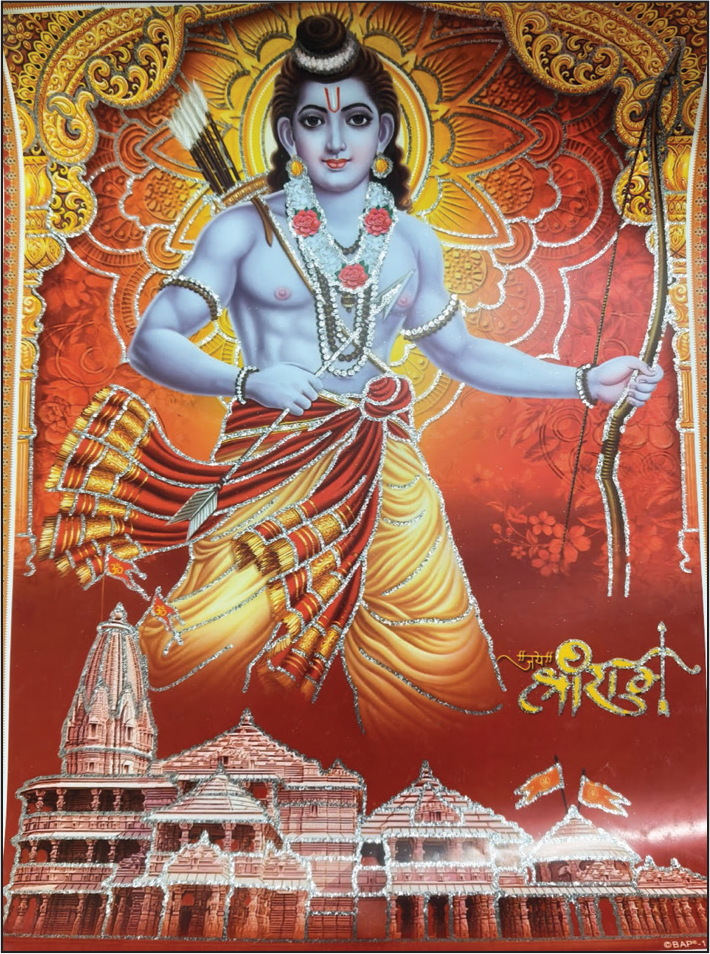
In this regard, the muscular and angry iteration of Ram that emerged alongside the Ram Janmabhoomi movement was a different depiction of the divine compared to the benign physiognomy of previous iterations in calendar and poster art. Anuradha Kapur, after her extensive reading of representations of Ram in different mediums, including drama and poetry, concludes that certain commonalities of representation exist, that depict Ram as ‘ever-serene, ever-forgiving, youthful, and boyish with a lack of masculine power’ (Kapur 1993: 76). The Janmabhoomi Ram, on the other hand, is a combative figure, as is evident from Figure 3, where the bow and arrow are highlighted as weapons. The deity’s gaze is front-facing, and though the emotion is one of tranquillity, the most common reproductions have an enraged, muscular Ram, towering over the then-imagined temple in the foreground, with his weapons drawn, a distinct depiction compared to earlier representations of the deity. In stark contrast to the depictions of angry Hanuman discussed later, that highlights facial close-ups saturated with the ‘affect’ of anger, is Ravi Varma’s print titled ‘Sri Rama Vanquishing the Ocean’, at the Dakshinachitra Heritage Museum, Chennai (Figure 4). Here, the body of Ram is articulated fully, with his bow drawn, and the similarities of the depicted scene to the Janmabhoomi Ram are not lost on the viewer. Ravi Varma prints have continued to possess an afterlife in spaces that index authenticity, heritage and historicity and not just as decorative pieces. As stated by Pinney, these prints have appealed to the viewing public since the days of early cultural nationalists (2004: 70). Their continued presence in curated heritage sites such as the one referred to here indicates the continued use of mythological imagery to indicate a shared visual vocabulary of cultural nationalism.
The poster in Figure 2 depicts a child-like Rama (an iconographic mode most commonly associated with Krishna), seated on a lotus, holding a bow and arrow, with an imaginative rendering of the temple in the foreground. The infantilised form softens the martial undertones of the weaponry, producing an image that is at once intimate and anchored to a specific, charged, political and sacred site (unlike the poster in Figure 1) with the use of the temple. This depiction is in line with the central theme of the Ram Janmabhoomi movement, centred around reclaiming the birthplace of the deity. Significantly, the idol installed in the temple is also that of Ram Lalla, indicating that this poster does not only reflect a devotional choice, but also participates in the affective registers invoked by the Janmabhoomi movement’s larger visual and ideological alignment. Alongside this poster, there are also photographic reproductions focusing on the facial features of the central temple idol, circulating as posters.
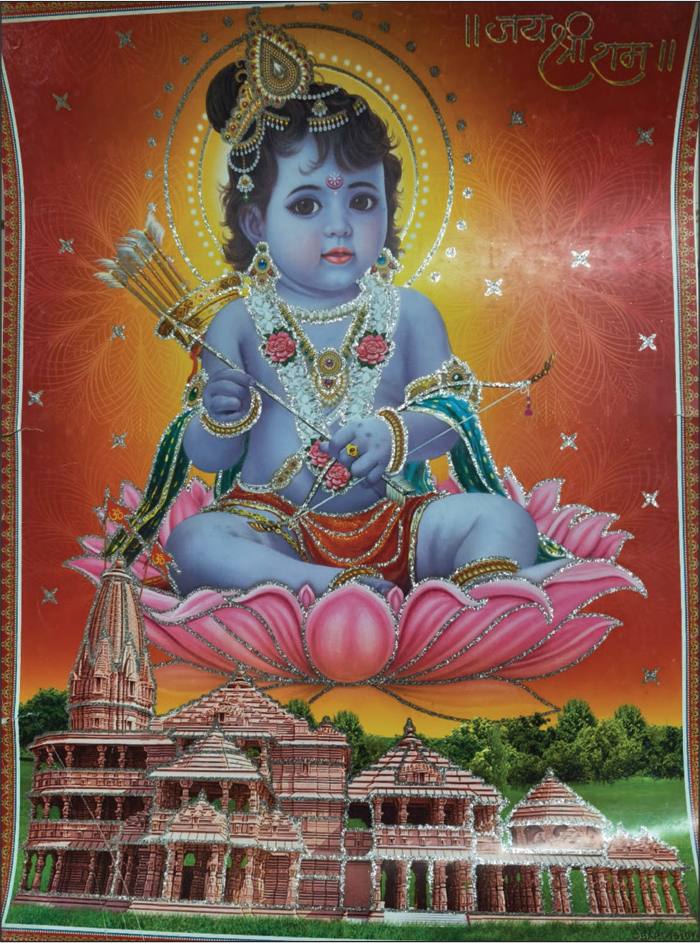
In another depiction of the vanquishing of the ocean by Ram, Kalyan, a magazine by the Gita Press since 1927, has a visibly angry Ram on its cover, but the muscular physique is not a part of the deity’s representation. The recursive nature of posters depicting gods is evident in these examples, with both Ravi Varma’s and the Gita Press’s Ram, devoid of musculature, paving the way for the Janmabhoomi Ram, who is rooted in a particular (then) imagined space, that of the Ram Temple at Ayodhya. The more popular Janmabhoomi Ram, Ravi Varma’s Ram and the Gita Press’s Ram share a side-on representation of the deity, with frontal features or the darshanic gaze not being the primary emphasis. The Janmabhoomi Ram in Figure 3, with a defined musculature, replicates this martial pose of Ram, in a different setting, that of protecting the then-imagined space in Ayodhya. This is a charged image in comparison to Ravi Varma’s rendition.
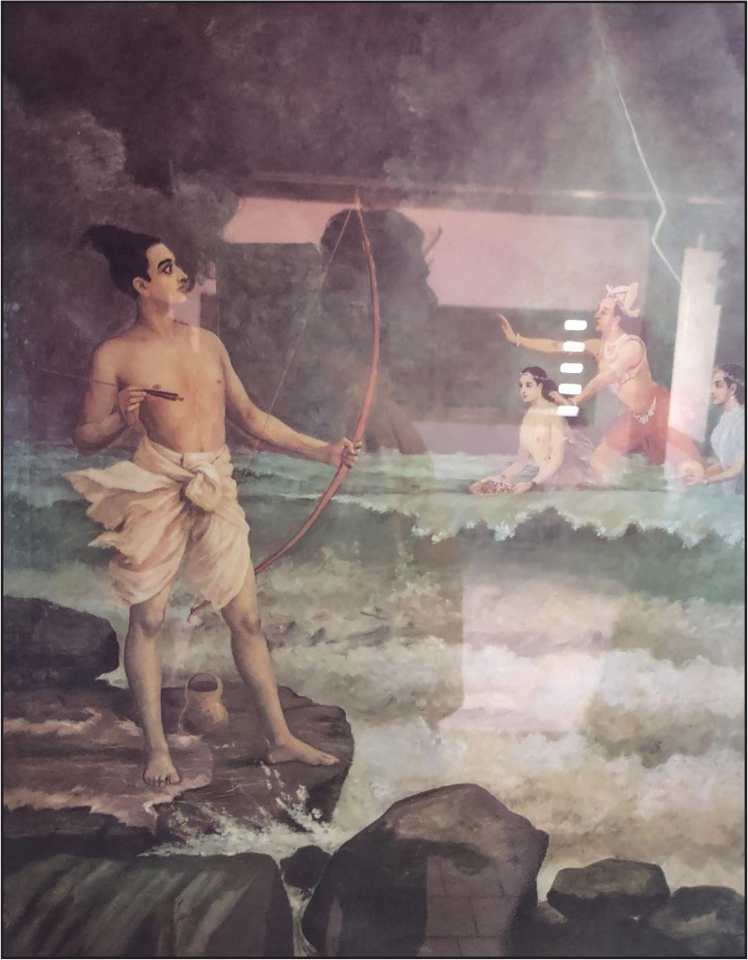
The Ravi Varma print also depicts the theme of Ram’s anger at the Sea God not making way for Ram, but the deity is not represented in a hyper-masculine manner. The emphasis does not lie on his physiognomy, body or weapons. Though the moment represented is one before an arrow is let loose, we do not find a devotional excess in the image with regard to musculature or expressions of rage. On the other hand, the Gita Press makes use of anger as a defining sentiment, with the weapons amplified. In a similar fashion, representations of the Janmabhoomi Ram
11
stress on the bow and arrow as weapons rather than mere iconographic markers (Jain 2001: 199). There is a devotional excess at play here, like in the example of S. M. Pandit cited earlier, where the display of anger, through the martial Ram, in the context of the Janmabhoomi movement, seeps past the confines of the image into the lives of the devotee, also playing the role of a pedagogical tool to mobilise identity. Here, the libidinal effect and an abundance of affect (Pinney 2004: 11) come along with the idea of a darshanic encounter, quite similar to what is at play with current representations of Hanuman. The muscular and ugra (angry) Ram towers over a then imaginary, now concrete, temple in the foreground, mobilising and repurposing Ram into an agent of revolution and warfare. In her examination of the video ‘God Manifests Himself’, Brosius highlights the use of close-up shots that feature Ram (calendar art) centrally, dissolving into one another, with the flow being interrupted by digital animations of the imagined temple (Brosius 2012: 95). This interocular presence opens up a space for devotional and political performance, where the viewer is reconstructed into a ‘sacred role of a devout but stern warrior for Ram’s divine nation’ (ibid.: 103). The representation of anger in the otherwise established benign physiognomy of the divine performs a similar function among devotees. In other words, this becomes a ‘spatial strategy’ (Deshpande 2004: 75), in which a mental/imagined conception of space (temple) is connected to a concrete/physical one (Ayodhya). It is in this affective impact on the beholder that the ideological effect of an image comes through. Kapur (1993) makes an important distinction between the pre and post-Janmabhoomi representations of the divine, where serenity and tranquillity are replaced with anger and hyper-masculinity to regain the Janmabhoomi (Kapur 1993: 104). This is a body that is bound to a certain goal—that of reclaiming hallowed ground. Through the Janmabhoomi movement, we find the figure of Ram occupying both religious and national roles, evidenced by this passage from Gyanendra Pandey’s ‘Hindus and Others’ (1991: 3005):
The movement for the Rama temple, it was argued, was more than a religious movement: it was only a national movement. Rama was not only a Hindu deity, he was a great national hero. It was not necessary that every Indian, Hindu or non-Hindu, worship Rama: but to revere his memory as part of the great cultural heritage of India-that was a condition of Indian citizenship.
VI Vehicles as canvas
Adornment on vehicles in South Asia is not a feature unique to India. Further, as is evident from the examples discussed here, vehicles carry various other pictorial adornments alongside that of Hanuman. The exteriors of rickshaws in particular transform into a canvas of personal embellishments, with, in recent times, one image having garnered attention—that of the angry Hanuman. The name of the creator of this image, Karan Acharya, is not mentioned on the art work, but in a recent post on X (formerly Twitter), the artist commemorated 10 years of his creation (Figure 5) with the words ‘the artwork was no longer mine alone, it became a symbol for millions’, 12 indicating the lives that the image has taken, freeing itself from the idea of a single artist. The post contains graphically designed images by him, one of which is of a large mass of people carrying flags bearing this image of Hanuman, indicating its use by ‘millions’. The features of the angry Hanuman do not depict the deity in his entirety, and the focus is solely on the facial features. The figure is half-shrouded in darkness, with a furrowed brow, and the gaze that meets the beholder’s eye adds to its menacing nature. Overall, the image is awash in the colour orange, and the representation is a lot closer to being human than simian. The presence of divinity in the form of stickers, flags, plastic car hangings or as idols on dashboards stems from a belief that divine presence can avert untoward accidents, particularly with Hanuman acting as a protector. In this light, the angry Hanuman, most often found on the exterior of vehicles, has a watchful gaze that protects the vehicle.
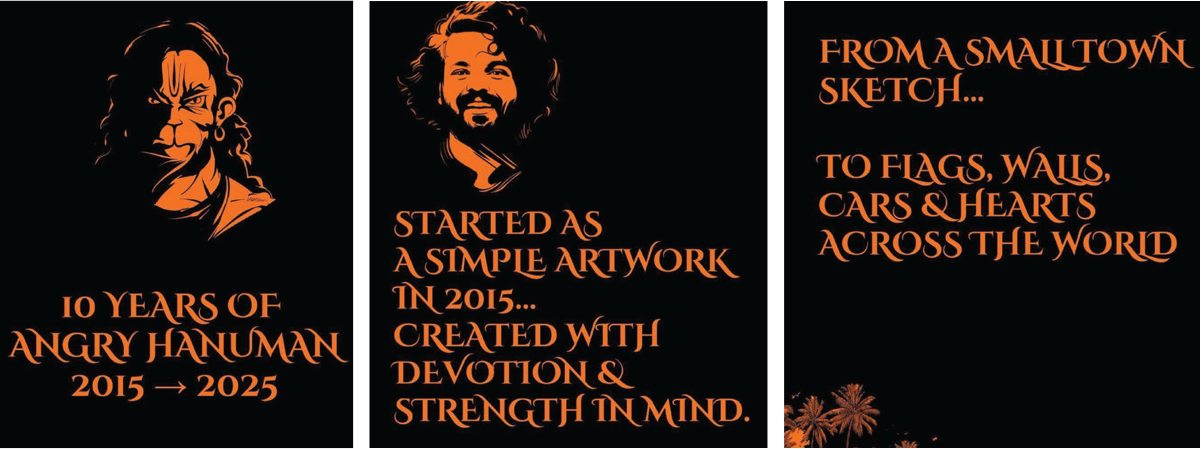
The representations of Hanuman in popular calendar art have moved from those that feature the deity in a subservient pose alongside the trio of Ram, Lakshman and Sita, to singular representations that focus on Hanuman as the perfect devotee of Ram. Lutgendorf draws our attention to the mace as the most common iconographic marker of the deity, and the representation of him carrying the mountain in one hand with the mace in the other, as the most ubiquitous image in calendar art (Lutgendorf 2003: 78)—also sparsely found as vehicle stickers. The latest iteration departs from all of these markers, with the cleft lip being the sole identifying marker of Hanuman. The creator, Acharya, clarifies 13 that his Hanuman is not angry or oppressive, but finds power in his role as a humble bhakt (devotee). This is akin to how the muscular representation of Hanuman does not threaten the divine affect of Ram, as the body of the former is devoted to the service of the latter. But, attributing ideological underpinnings to this Hanuman would not be too difficult, considering how its creator has received praise from political quarters, as well as its role in political and religious processions—on flags—in marking spaces as Hindu.
Earlier popular representations of the deity had shied away from using musculature to depict the divine, since ‘divine musculature’ was an oxymoron (Jain 2001: 203). Deities obtained their power from a transcendental affect which did not lie in a muscular body, but in the serene, calm and gentle expression on their faces, where they were represented as smooth-bodied. Over the years, particularly post the 1970s, we have witnessed the growing link of masculinity and muscularity to popular representations of the divine, particularly that of Ram (discussed here). Hanuman too began being depicted in a muscular framework akin to that of a bodybuilder, emphasising the deity’s physical prowess. Lutgendorf calls this evolution of Hanuman—while emphasising its non-linear nature—an ‘airbrushing of the visceral features from the myth’ (Lutgendorf 2003: 86), and links this display of the buff torso to the rise in consumerism (ibid.: 97). Deities like Hanuman have been associated with physical prowess and strength in devout service of Ram, but this turn towards a highly developed musculature is perhaps in the same line of the ugra Ram, meant to protect and fight for the Hindu cause.
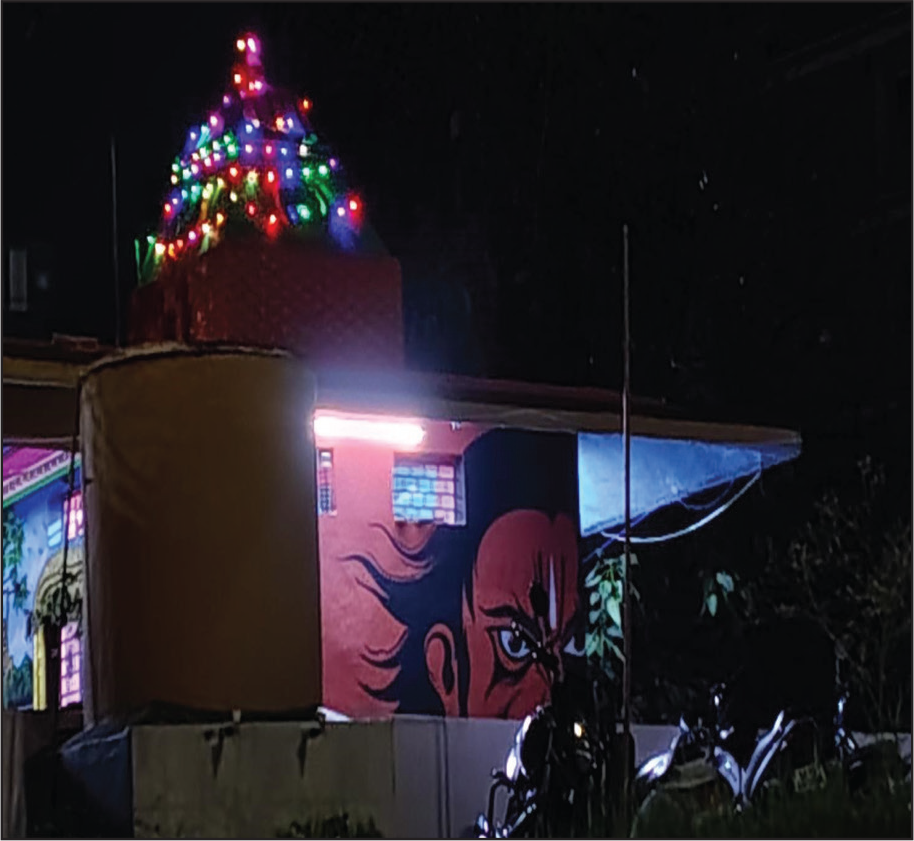
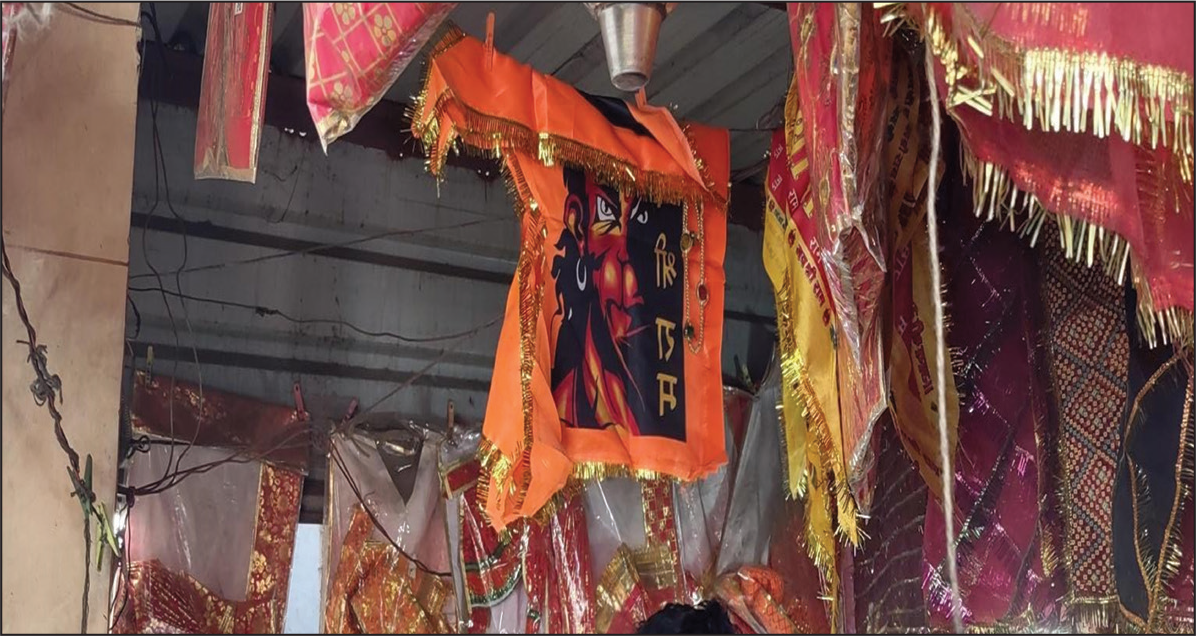
With enough popular prints in circulation continuing to represent Hanuman in the muscular framework, the work of associating masculinity and muscularity with this deity has already been done. In fact, the musculature and iconographic markers of the mace as a weapon have done their work long enough for the angry Hanuman to emerge, which fulfils the same function with merely facial features and colours. This iteration is malleable and fluid as it flits seamlessly between different surfaces. The fluidity is also a marker of the nature of the sacred that emerges from modern urban spaces. While representations of the deity have ‘spilled out’ from within exclusionary spaces like temples onto pieces of paper as calendars/posters, we also see a reversal of this as newer, digitally created iterations go the other way, into temple spaces. The angry Hanuman painted on the external walls of a temple/shrine on the outskirts of Hyderabad (Figure 6), or the sale of flags carrying this image outside the famous Hanuman temple at Karol Bagh, Delhi (Figure 7), is indicative of the same. Flags bearing the image of the angry Hanuman set against an orange background have also been a feature of Hindu festivals like Ram Navami, 14 an indication of its role in aligning individuals with a collective through mimetic consumption. Here, the simplicity of the vector—the digital image of the angry Hanuman and a lack of the artist’s signature on the image makes it easily malleable, contributing to its ever-changing nature. These images are prone to endless circuits of mimesis and reproduction, and unlike earlier calendar art, there is no new addition to the work of art as it goes through each cycle. Mimesis here creates a visual vocabulary of standardisation in relation to the divine, wherein the same images are constantly reproduced, with the expectation of partaking in the anger and/or muscularity of the divine.
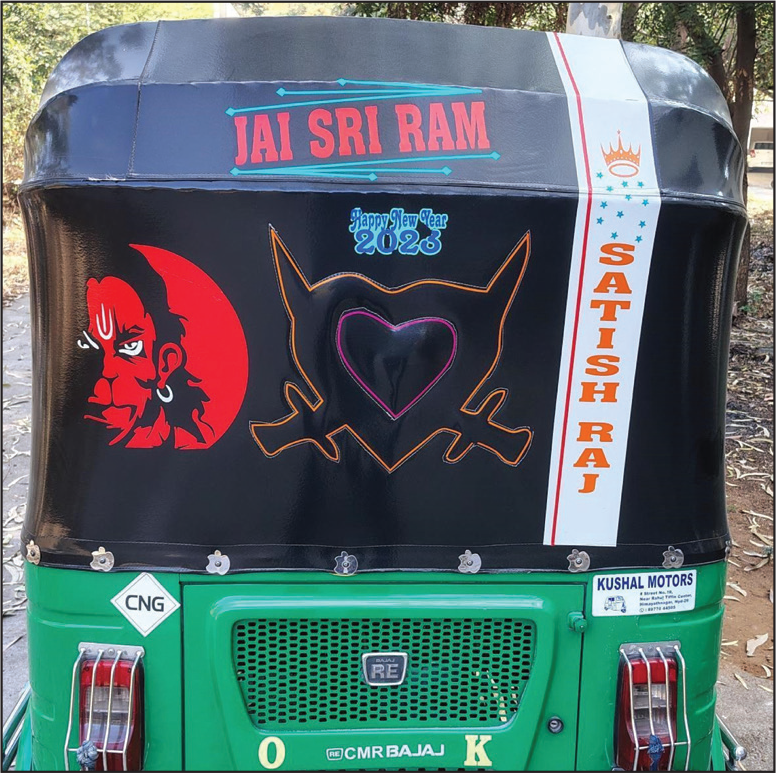
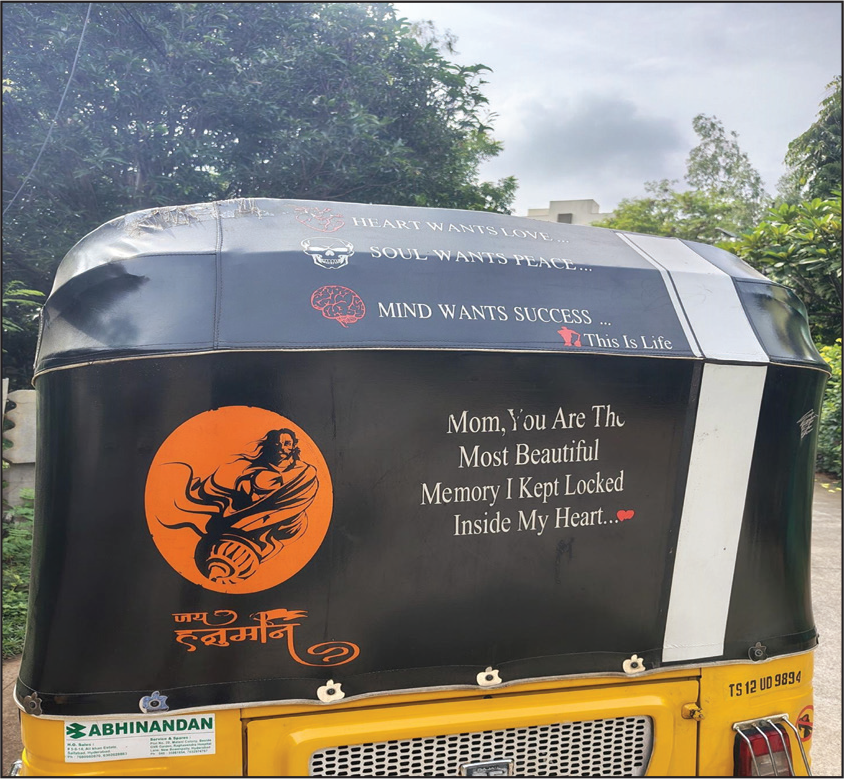
Conversations with rickshaw drivers in Hyderabad who had these stickers pasted on their vehicles revealed an array of reasons for the widespread consumption of the image. Sandria Freitag refers to a mediating process that goes beyond the initial creation of the image, where meaning is mediated between the one intended by the creator and that brought to the image by the consumer (Freitag 2025: 30). Referring to the act of personal enhancements through the use of a combination of pictures, she calls this a dialogic process which is also an exercise of memory through acts of devotion. The rickshaw in Figure 8 is a typical example of the various personal embellishments that these vehicles are decked with, where an angry Hanuman sticker in orange, is accompanied by the slogan Jai Sri Ram (Glory be to Ram); on the right is the name of the vehicle’s owner while the centre is occupied by a heart crossed with two swords. The canvas also has a ‘Happy New Year 2023’ message, which perhaps indicates that the rickshaw is decked with stickers that are in vogue at a given time. In Figure 9, we find a completed iteration of the angry Hanuman, with a muscular torso and the words Jai Hanuman (Glory be to Hanuman) below it, all doused in orange. Alongside this image are words of endearment—a personal message to a mother. It would not be off the mark to call the presence of divinity on windshields and exteriors of vehicles the (auto)mobile divine, thanks to the ever-changing nature of its surroundings. Unlike a fixed idol or divine art on a wall, these stickers force an engagement with the viewer; in particular, the ubiquitous angry Hanuman with his furrowed gaze gazes outwardly at passers-by from the exteriors of vehicles. The gaze of the Hanuman is not quite inviting, but rather, makes one look away, thanks to its vexed nature, putting its darshanic role in jeopardy. But, darshan also includes being in the presence of the divine, going beyond the notion of an eye as the sole marker of gaze. The affective register of anger and the meaning-making associated with the act of consumption also fit into a larger collective and public frame. In the context of personalised messages accompanying images of Hanuman, Freitag’s observation becomes relevant, where localised viewpoints become embedded within broader value systems that together form a collective frame, one recognised by the individual as ideals worth dying for (Freitag 2025: 93). The presence of personal embellishments such as expressions of endearment towards a loved one, alongside a common, popular image, indicates the creation of a personal identity-narrative that is on display, alongside the collective of the angry Hanuman.
Most rickshaw drivers, when spoken to about the presence of the sticker, revealed that Hanuman was their favourite deity. They were also quick to point out the catchy but cheap nature of these stickers. In a video by Newslaundry, 15 rickshaw and cab drivers in New Delhi were asked the reasons for putting up the sticker and what the image means to them. The most common answer remained the affinity and devotion to the deity and the easy availability of the stickers—with numerous images available on the internet. For one driver, it was a way of showing loyalty to the Bajrang Dal, the youth wing of the Vishwa Hindu Parishad, an organisation that was created in 1984 to mobilise support in favour of the Ram Temple at Ayodhya. 16 This reference to the Bajrang Dal is noteworthy, 17 as the organisation’s logo 18 (Figure 10) contains multiple visual elements that are a mainstay as vehicle stickers today. Most prominent among them is the side-profile of Hanuman with his mace-wielding arm raised above his head, poised to strike, similar to the Janmabhoomi Ram. Interestingly, for a deity who does not need a vahana (vehicle), the logo contains the image of a roaring lion right beneath Hanuman; below this, exists a cartographic representation of India. Stickers and embellishments featuring roaring lions are common on Indian roads as vehicle stickers. Parallels can be drawn between this and the popular representation of Bharat Mata with a lion, as well as the map of India. The logo, through this combination of representations, becomes an exercise of memory and results in the creation of identity-narratives to both the observer and the user when displayed publicly. It also contains the words ‘seva, suraksha, sanskar’ that translate to service, protection and culture, as the primary objectives of the organisation. In some instances, despite the amalgamation of different markers, the logo speaks to the viewer directly with the words ‘Yes, I too am a Bajrang Dal karyakarta’ (worker of the army of Hanuman). Considering these elements, it is not surprising that some of the interviewees in the video cited here associate the angry Hanuman with the Bajrang Dal.
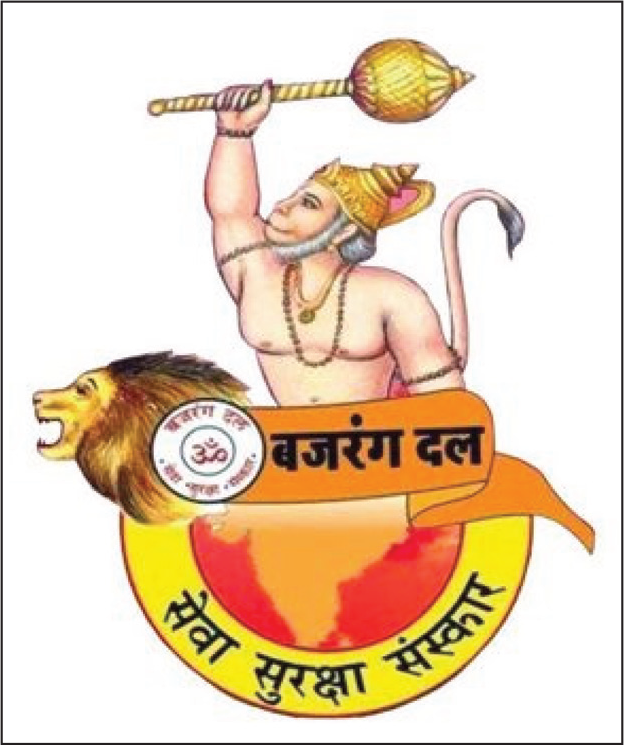
The representation of Hanuman in both these cases mobilises people—one representation literally spelling it out (Figure 10), while the other uses gaze to urge the viewer on (Figure 8). For some of the users in the cited video, who associate the angry Hanuman with the Bajrang Dal, perhaps the ideas of seva, suraksha and sanskar come together in the furrowed brow and pointed gaze of the angry Hanuman. The origin of the Bajrang Dal lies in an attempt to expand the base of the Vishwa Hindu Parishad to the masses and mobilise cadres for purposes like the Ram Janmabhoomi, cow protection or ‘national integration’ (Katju 2005: 335). The ferocious nature of the angry Hanuman corresponds with the activities of the Bajrang Dal, who are notorious for the use of physical force and aggression in conducting their groundwork to protect Hindu interests.
In the interview referred to here, when questioned about the meaning of the angry Hanuman image, all of the interviewees were in agreement that Hanuman is angry, with one even interpreting his own angry self as a reflection of the image. This is the ‘devotional excess’ that Jain refers to in which the libidinal and bodily relationship of the devotee goes beyond a mere visual interaction (Jain 2001: 208). The strength and emotive power of these stickers lies in their outward angry gaze from the surface of the vehicle. The frontal gaze also contributes to an aesthetic that is darshanic, stirring a corporeal engagement beyond a mere visual one. The (auto)mobile divine, in this case, also marks the space as Hindu; the widespread presence of such stickers perhaps explains its role in creating an ‘affective public’ that is largely formed through this act of consumption. Newer technology and the ubiquity of colourful calendar art continue to address the changing desires of consumers, as evidenced by these stickers. Interestingly, loud colours that transcend the real and temporal do not find takers in the current climate, at least not in the case of stickers on automobiles. Hanuman ceases to be represented in different hues and is largely depicted against an orange background. The presence of this image on different objects also becomes a means of participation in the society, where consumption becomes an act of identity formation, paving the way for consumers to indulge in political and religious performativity ‘without having to enter into any complex ideological negotiation’ (Papacharissi 2014: 117). It could also explain the wide presence of flags atop houses and stickers on vehicles, and the flag’s continuing presence in the surroundings as it hangs limp off flagpoles.
Lutgendorf (2003: 97) highlights how the rise of a muscular Hanuman is also a reflection of the desire among the upwardly mobile to discipline their body in lithe and muscular terms as ‘an emblem of vitality, virility, and disciplined leisure’. A muscular Hanuman, then, is a departure from the earlier servile and subaltern representations; perhaps this widespread popularity of the angry iteration is a reclaiming of this status by the labouring classes. While Hanuman remains a labouring body in the sense of serving Ram, the celebration and focus of the muscular iteration moves away from the labouring body to a display of a buff torso disciplined by labouring in a gymnasium. Vehicles, much like a lot of other objects that provide daily economic sustenance to its owner/user, are considered sacred to Hindus.
Scaled-up statues and swanky devotional complexes are redefining the sacral-commercial nexus as their public visibility and size produce spectacles of scale. An affective public is constantly created through ritual enactments of community participation in these newer circuits that are centred on consumerism, catering to a public much larger than that of the idols in temples. These new forms of religious iconography establish circuits with older canonical forms, similar to the work being done by the stickers. While scaling up in size is a feature largely visible in temple structures and statues—seen as embodying progress and modernity—the argument here is that the mimetic reproduction and homogeneity of these stickers is also a form of ‘scaling up’. While the former is in terms of size with respect to its surroundings, this scaling up is in terms of numbers. The iconography of Hanuman employs specific markers that make the deity recognisable to the beholder. These markers were earlier his cleft lip and weapon (mace); of late, it has been his musculature and angry physiognomy. With the image of the angry Hanuman, we see an amalgamation of the familiar and the modern, thanks to its sleek and minimalist nature. The power of this image lies not solely in its ability to invoke devotion but also in the attribution of muscularity and anger to divine agency. Spectatorship here involves a complex interplay between visuality, body and figurality, with one argument being that representations of this kind undermine the religious authority that lies within the sanctity of temples, making it accessible for all. The calendar art of yesteryear had the allure of the use of various bright colours that also served the function of sprucing up the walls of homes into which they were taken. This is a trait that is largely missing from newer iterations, whose allure, according to their users, lies in the emotion that they communicate and their style of depicting the divine. Calendar art in the past also possessed a heterogeneity that was embodied through various vernacular styles rooted in regional iconographic traditions.
Like the libidinal stimulation that came with the muscular images of Ram, we find an affective devotional excess that binds together a large group of people, whose only association with one another is the consumption of these images. This is also evidenced by the creator’s social media posts showing the coming together of a large mass of people around this image—a collective in which urbanism and religion come together to shape what Sanjay Srivastava calls the ‘ordinary citizen’ of India, who is largely defined in Hindu terms (Srivastava 2023: 11). The ubiquity of angry Hanuman offers food for thought in examining the nature of religion in urban spaces, which were earlier imagined as post-religious modern spaces. While the calendar art of yesteryears was mostly within the confines of one’s home, the mobile gaze of the new Hanuman is atop buildings and vehicles, dotting the outside and the urban landscape. This changes the relationship between religion, the idea of the urban and also our understanding of the private and public in India. Unlike the Ganesh Chaturthi pandals and idols that are temporary fixtures, the newer iteration takes permanent forms; their presence becomes a part of the ordinary with their widespread consumption. This takes place alongside the creation of a public—a collective that is centred on religious fervour and emotion, particularly one of anger.
With popular art that moves further away from the idea of the benign but powerful divine, we find these stickers possessing a life of their own as they are cut off in some ways from the heterogeneous histories of calendar art. In all of this, what this study focuses on is the everyday lives of people; the popularity of these stickers on rickshaws enables a move away from elite sources of art history, to a scrutiny of the material everyday life. This helps us move away from an image arrested by the present moment and to look at it as part of a recursive archive that reemerges in different forms across epochs. This work finds the heterogeneity and abundant replicability of images replaced with the homogeneity of the orange hue and the expression of anger.
Sara Ahmed, in her work on ‘collective feelings’ (2015: 26), highlights the role of emotions in the surfacing of individual and collective bodies, which in turn also aligns a bodily space with a social one. This narrative also works in aligning collectives against an ‘other’. The use of angry Hanuman to decorate the exterior of vehicles is not just an act of sprucing up the vehicle, or a marker of ‘style’. The presence and hypervisibility of the image in the public are also an act of marking the space as one that aligns itself with a specific religious collective. For instance, the Uncle Sam image (a personification of the United States) has both its gaze and finger locked onto the viewer, generally with the phrase ‘Uncle Sam wants You’, beckoning the beholder to a collective, recruiting individuals to serve the nation.
While calendar art that mostly features in the sacral private realm carries a larger sense of divinity alongside personal meaning-making, the stickers in question here, and their homogenous nature, point to a shared underlying set of values and beliefs. These align individuals with a collective, not because of the nature of the sticker but through the feeling that it invokes through its corporeal aesthetics. The efficacy of these images also lies in the idea that their multiple reproductions and widespread use also call for an actualisation of the sentiment in the image in the public realm. If we understand spatiality as ‘the cultural and social product of human action upon the physical environment’ (Srivastava 2023: 4), then the ubiquitous presence and consumption of these images on flags and as stickers highlight the work of both the material and symbolic nature of these icons in spatial relations. The divine in these cases does not take the shape of the deity of a particular temple or region but becomes a nation-wide representation of Hindu-ness.
VII Conclusion
Examining visuals of the deity Hanuman, this article illustrates how contemporary media has given rise to newer forms of visual stimulation and reproduction that emphasise divine muscularity and anger. This article examines the emergence and proliferation of a distinctly angry Hanuman in the visual ‘everyday’, on stickers, flags and temple exteriors and examines the force of its gaze in the public sphere. Through close readings of its formal features, genealogy and circulation, it analyses how contemporary regimes of image production generate a dense field of divine prints marked by recursive repetition.
The article interprets the ubiquity of images of the angry Hanuman as an embodied shift from devotional intimacy and affect to the affective mobilisation of anger. Contemporary image production and digital replicability have produced a charged visual form of anger in which nationalism, muscularity and Hindu identity are compressed into a singular image. The affect of anger fits into a frame where the expectations of the viewer from the image get homogenised in public space. The argument is not one of linear progression nor does it suggest a rupture in tradition; rather, it traces newer modalities of representing, seeing and consuming the divine that render force and faith indistinguishable for the cause of the nation.
Footnotes
Acknowledgements
I extend my sincere thanks to the Department of Comparative Literature and India Studies, EFLU, for supporting and facilitating my research. The arguments developed in this essay draw on sustained conversations with Sherin BS, Srinivas Lankala, Uma Bhrugubanda, Sumathi Ramaswamy, Hugo Gorringe and Greeshma CP. This work would not have been possible without the generosity, constant encouragement and guidance of Professor Christopher Pinney. I extend a special thanks to the Charles Wallace India Trust for affording me access to a substantial archival collection in the United Kingdom. I gratefully acknowledge the reviewers and editors at CIS for their insightful comments on earlier drafts.
Declaration of Conflicting Interests
The author declared no potential conflicts of interest with respect to the research, authorship and/or publication of this article.
Funding
The author received no financial support for the research, authorship and/or publication of this article.