







Abstract
In Turkey, the period after the establishment of the Republic saw archeological representations play an active role in defining the ancient past and producing new disciplinary knowledge. Visual practices emerged as important sites for the formation of a new conception of the ancient past in the larger context of the political and cultural discourse over the modernization of the country. Based on museum guidebooks, official publications, and archival documents, this paper focuses on the İzmir region after the establishment of the Turkish Republic in 1923 and explores how the ancient past was perceived and displayed in relation to the historical and cultural transformations that occurred in Turkey after the Greco-Turkish War.
The past plays a central role in the construction of modern identities, and our understanding of the past is profoundly affected by the political ideologies of the present. In recent years, research into cultural heritage and the history of archeology and museums has grown rapidly and there is a now a strong and widespread desire to understand the nature of the past, the role it plays in the construction of national, regional, and other identities, and what the past means and includes. What memories does the past express? Which communities does it reflect? Whose identities does the past represent? This paper attends to these and other, related questions while taking into account changes in the way that the past connects to discussions of the nation and its place in the world.
For some time now there has been a recognition of the importance of archeological heritage in creating and forging national feelings and identities. 1 As several publications have shown, nationalism has contributed to the shaping of archeological practice, and continues to do so. It has influenced the choice of excavation sites, and the subsequent interpretation of discovered artifacts. Too often, archeologists influenced by nationalistic ideologies have interpreted history with the aim of validating and supporting a nation-state’s claims over territories. Meanwhile, the importance of the links between museums and national identity has been widely explored. 2 Museums are examples par excellence of the history and the identity of a nation materializing in a physical collection of objects. A museum represents the ‘gate’ to the past of a particular country, where visitors can journey through the history of a nation. After their discovery in the heart of the nation, ancient artifacts are taken from the ground and transformed into modern possessions that symbolize a nation’s ancient history. It is the task of experts such as archeologists, museum curators, and historians to interpret the meaning and role of each object and to locate it within various other historical narratives in museums and exhibitions. Since their establishment in the eighteenth and nineteenth centuries, it has become clear that museums have shaped and transformed the national heritage of a country into a collective view of the state, with its values and ideas.
This well-established scenario has, however, recently been disturbed by a transnational perspective. A first critique raised the issue of a mere culturalist approach in terms of national identity. While museum studies have tended to focus on processes of visibility, capitalization, and accumulation with regard to understandings of archeological material in national context, historians tended to put forward the idea of national indifference. A second critique from within the history of science focuses on the solidity or fragility, failure, and reversibility of these processes of nationalization in a wider context (empires or globalization). Archeological objects are not speechless, and they do not speak in a unilateral way. Such objects gain meaning through controversy, and help to constitute archeological museums as a battlefield of culture war. 3
This article attends to such insights while discussing the relationship between the post-First World War Turkish Republic, the representation of the archeological work that took place within it, and practices of museum display connected to excavated material. It differs from existing scholarship on the past in Turkey, which focuses primarily on central museums in Ankara and Istanbul and analyzes their developments and displays in relation to dominant historical narratives promoted by the Turkish government. 4 Instead, the article draws attention to practices of representation and display undertaken at the somewhat peripheral İzmir Museum; these practices helped to constitute a place that conveyed memories omitted from dominant accounts. Additionally, the article discusses photographs of archeological work carried out in the İzmir area by Aziz Ogan, the local inspector of antiquities, illustrating how such representations complemented and constituted work at the museum. How was knowledge of the ancient Greek past of the İzmir region perceived and displayed to the public in the early years of the Turkish Republic? How was ancient Greek culture inscribed within a new Republican narrative that aimed to promote autochthonous Anatolian cultures? This article addresses these questions at the same time as making use of neglected items like museum guidebooks, official publications, and archival documents, discussing the images contained within them in order to provide a novel, visual means of understanding the constitution of the Turkish past.
In the process of understanding work in İzmir and its surrounds, meanwhile, the article pays particular attention to the words of Michael Shankland. Shankland has observed how the relationship between archeology and nationalism in the Turkish Republic can be considered as “tolerant” and “dynamic,” in the sense that instead of searching for a single and dominant past culture, Turkey favored a discourse of a multi-faceted and multi-period past. 5 Whether in practices of display or in processes of archeological photography, it is evident that work in and around the İzmir Museum helped this discourse to take visual forms in ways specific to narratives of the past connected to the area. By doing so (and as emphasized elsewhere in this special issue by William Carruthers and Stéphane Van Damme), the practices of archeology and museum-work constituted an efficient ‘boundary object’ around which multiple claims and interests could gather, 6 illustrating how particular ways of making a national past could also prove an effective means of bringing together conflicting and controversial ideas about what that past might be in a time of major political change. What follows explains this process, emphasizing the importance of understanding work relating to the past in a neglected example like İzmir, at the same time as using visual sources to do so. First, though, it is necessary to discuss the history of the pasts connected to İzmir in order to suggest what made the constitution of such a boundary object useful in the first place.
The Greek past: a controversial period of Turkish national history
The province of İzmir has long been of crucial relevance. Known in antiquity as Ionia, it was conquered by the Greeks during the tenth century BC and included such important cities as Ephesus and Miletus. As Greaves affirmed, the Ionian identity in antiquity presented itself as the balanced result of Anatolian and Greek influences. 7 Famous as the homeland of famous Greek philosophers and artists, Ionia was later occupied by the Achaemenid and Roman empires. In modern times, the city of İzmir and the entire surrounding area became the arena for the contestation between Turkey and Greece and their claims over the land. 8
During the Ottoman Empire, cosmopolitan Smyrna (İzmir) constituted the second most populated city of the country, possessing Levantine, Jewish, Greek, Armenian, and Turkish communities. After the end of the First World War, the European powers granted administrative control of the province to Greece and subsequently the Greek High Commissioner established a civilian administration in the area with a police force, local authorities, and a university. The Greek authorities occupying İzmir followed the dream of unifying all the assumed Hellenic territories within one nation, with Constantinople as the permanent capital of the kingdom. This idea would be known in the second half of the nineteenth century as Megali Idea (the Great Idea) and it dominated Greek policy for over a century. 9 When Turkish troops under Atatürk entered İzmir in 1922 the Greek Megali Idea crumbled, the temporary administration was immediately terminated and the city of İzmir caught fire, completely destroying the majority of the buildings, especially in the Armenian and Greek quarters. This episode marked a symbolic break that created a fracture in the history of the city. 10 The Turkish War of Independence ended with the victory of the Turkish troops, ending foreign control over Anatolia, Istanbul, and eastern Thrace; in 1923, with the signing of the Treaty of Lausanne, the Republic of Turkey was established. Turkey and Greece agreed to an exchange of populations between the two states, and the Greek Orthodox minority in the area of İzmir was resettled in Greece. 11
After the establishment of the Republic, the new Turkish government started an extensive program of reforms aimed at creating new Republican citizens. These reforms disassociated people from their previous relationship to the Ottoman Empire, administering a new way of life inspired by ideals of westernization and secularization. 12 This program of modernization also included a radical change in the urban planning of several cities. 13 In İzmir, after the destruction of entire parts of the city caused both by the Greco-Turkish War and the subsequent fire, the Republican government began a program of reconstruction aimed at removing all the signs of a multiethnic city. 14 The new town had to be a symbolic representation of the new modern Republic and its Kemalist government. As Kolluoğlu-Kırlı notes, the newly built spaces in the city were transformed into “acts of forgetting and creating new memories.” 15 The urban plan of İzmir was commissioned in 1924 and was the first one developed under the Republic. 16 Under this plan, the urban structure of the city underwent a profound transformation: the metropolitan area was redesigned, especially the burned districts, and the traces of multi-ethnic spatial patterns vanished, transforming İzmir into an “ethnically homogeneous city.” 17 It was in this contentious context that archeological work in the region – and the establishment of the İzmir Museum itself – now took place. The multiple and contested forms that this work took further illustrate the extent to which the ‘cosmopolitics’ of archeological knowledge production in İzmir made generating such homogeneity in terms of the past difficult.
The development of archeology in the İzmir region
During both the Ottoman Empire and the Turkish Republic, İzmir Province constituted a major locus for exploration. From the late sixteenth century, antiquarians and explorers seeking material vestiges of the Classical past conducted research in the region. Europeans looking for the mythical origins of Western civilization directed their attention toward the exploration of sites such as Miletus and Pergamum. During the nineteenth century, several excavations were carried out at the Classical sites of Ephesus, Pergamum, Didyma, Teos, Klaros, Kyme, Larisa, Notion, and Phokaia. In 1919, with the beginning of the Greek occupation, archeology took on a fundamental role for the new administration, and an active program of excavations began immediately. As Davis illustrates in his two articles on Greek and American archeology in the İzmir area between 1919 and 1922, the Greek administration founded a service for the preservation and conservation of monuments and for the study of ancient Greek cities in Asia. 18 A regional superintendent of antiquities and a curator of antiquities were appointed to organize archeological and museological activities. New Greek and foreign excavations started in numerous ancient Greek sites in the province, such as Ephesus, Kolophon, Sardis, and Klazomenai. 19 Foreign missions were strongly encouraged to work in this area, even though the situation was not completely under control. Archeologists were supposed to find ancient remains of Greek culture in order to prove that these territories were part of the Hellenic realm and could not be included in the Ottoman Empire. Furthermore, by uncovering the Greek past, “the Archaeological Service took pains to project a responsible image as defender of European cultural patrimony previously neglected by Turks.” 20
Publications in these years lamented the mismanagement of cultural heritage during the Ottoman Empire and defined the previous administration as unable to take care of monuments and foreign missions. 21 To solve these problems, the temporary Greek government founded new provisional museums on the sites of Ephesus and Sardis and ordered a systematic inventory of antiquities. Furthermore, a so-called “Asia Minor Museum” was founded in İzmir in the Greek Evangelic School with the help of the Greek community. 22 As Davis argues, this intense archeological program and the creation of the Asia Minor Museum were intended to help Greece be seen as the defender of a European patrimony that had previously been neglected by the Turks, and to legitimize the country’s governance of the province by demonstrating that Greek presence on the land could be traced back to ancient times. 23 Furthermore, under the temporary Greek administration, the 1906 Ottoman Antiquities Law was abrogated, foreign archeological missions were able to export antiquities outside the country once again, and the Turkish inspector of antiquities was relieved of his post.
After the Greco-Turkish War and the establishment of the Turkish Republic, the new Turkish government regained control over archeological activities undertaken in İzmir and completely revised the policies governing them: the Ottoman Antiquities Law was reinstated and a new and stricter control on foreign archeological missions was established in order to avoid the export of more antiquities. 24 All foreign missions needed official authorization from the government to proceed with their excavations. The authorization needed to be renewed every year, and archeologists had to collaborate very closely with the Turkish inspector of antiquities to ensure that all procedures were respected. The sites being excavated at this time included Ephesus, excavated from 1920 to 1925 by the Austrian Josef Keil and the Germans Hermann Wetters and Gustav Adolf Deissmann, and Pergamum, excavated from 1927 to 1936 by the German Theodor Wiegand. 25 Wiegand also worked with Martin Schede in Didyma from 1924 until 1926. 26 Finally, the ruins of Teos were excavated in 1924–5 by the French archeologist Yves Bequignon under the French Institute in Athens. 27
In 1922, Aziz Ogan, the Turkish inspector of antiquities, who had worked in the area before the Greco-Turkish War, came back to İzmir and resumed his job. 28 His archive, held at the Museum of Boğaziçi University in Istanbul, contains the correspondence he maintained with foreign archeologists working in the area. These letters allow us to observe the nature of the relationship between Turkish authorities and foreign institutions at this time, and in particular the ways in which this relationship was now regulated: archeologists had to inform the inspector about all their plans, from their travel arrangements to the tools needed for their excavations. Meanwhile, it is clear from Ogan’s correspondence that some archeologists encountered problems with the local police. In a letter dated November 7, 1924, for example, Theodor Wiegand complained about the constant police presence at the Didyma site. From his perspective, he had “worked in Turkey and for Turkey” for a long time and thus felt that he did not deserve such treatment. He continued to lament this situation, as it did not allow the team to work together in a harmonious atmosphere. 29 The police presence is also mentioned in another letter, in which Ogan informs Martin Schede that the renewal of his research permit to dig in Didyma is conditional on the presence of police at the site. 30
Such disciplinary practices met with occasional dissent. For example, some archeologists asked Ogan to intercede with Turkish authorities on their behalf to obtain permissions of different kinds. In a letter dated July 8, 1925, Martin Schede asked Ogan how he could obtain permission for a scientific expedition of scholars from the University of Vienna to go to the Silifke region near Mersin. The Turkish government refused the permission for “political and military” reasons but Schede asked Ogan to look into it, and to persuade the government of the pure scientific interest of the Austrian expedition. 31 In another letter sent to Ogan from an unknown correspondent in Athens in 1925, the author asks for special permission to export some objects from the excavation site, even though this act was forbidden by the Antiquities Law. 32 Furthermore, Ogan received numerous other letters from several scholars in Europe, writing to request general information about the archeological excavations carried out in the area, to acquire specific publications, or to ask about specific objects that would be of interest to them. Given these requests – and despite the ways in which Ogan and the Turkish Republic attempted to police the archeological work that took place in İzmir Province – the correspondence sent to Ogan suggests that archeological work in the region remained remarkably open to perceptions of its malleability. One way to police this perception, though, was through the practice of archeological photography.
Reaching the public: photography and archeology
Aziz Ogan was an active and passionate amateur photographer and throughout his life he took hundreds of pictures that today constitute the largest part of his archive’s holdings. Photographs of objects, excavations, museum displays, and landscapes have been collected and preserved to portray different aspects of Turkish heritage. These photographs and the cultures they represent allow us to comprehend the practice of archeology and museology during Ogan’s lifetime and how these practices contributed to the construction of a Turkish national culture. Ogan’s photographic archive contains several envelopes with images related to many aspects of archeological excavations in Ionia/İzmir. These images depict not only scenes from ‘everyday life’ such as images of excavation teams and the tents where those teams lived, but also more ‘scientific’ images that can help understand excavation techniques used at that time, such as the removal of a sarcophagus from the ground with the help of a specific machine, the construction of a small railway and trolley that was presumably used to transport heavy objects, the measuring and cutting of trenches, and pictures of people standing near a monument in specific poses to indicate the size of a building. 33 His pictures show how a professional archeologist and museologist like Ogan made use of photography to develop and attempt to police the way antiquities were perceived in this period of Turkish history.
Analyzing these pictures, we can see how a gradual development of archeological imagery is evident throughout this period. The Ottoman-era ‘Orientalist eye’, which emphasized exoticism through pictures of the Bedouin and ‘typical’ costumes, disappeared. Meanwhile, a clear shift in power occurred not only between Western and local archeologists but also between archeologists and the public. 34 While pictures taken during the Ottoman Empire had always highlighted the distance between Western and Ottoman archeologists and local workmen, the pictures taken in the Republic reflected a change in these actors’ relationship. Several pictures in the archive represent amicable relationships existing on the site between archaeologists and workers. For example, in a couple of photographs depicting the excavation of houses in Teos we can observe several foreign and local professionals sharing the same space (Figure 1). Photographs made archeological practices a boundary object around which the different interests operating in the Turkish Republic might coalesce.
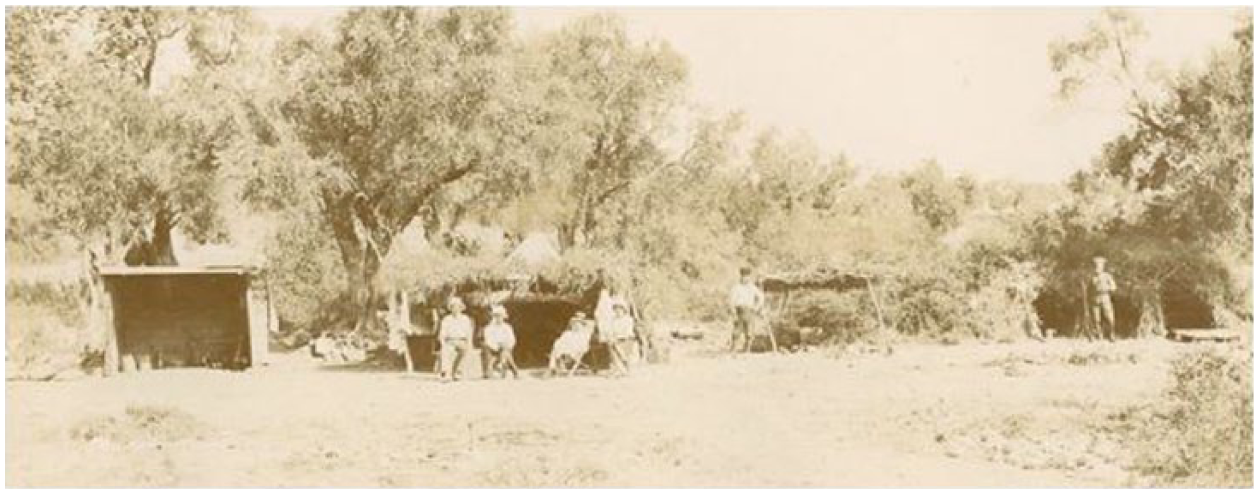
Dig house in Teos. Source: Aziz Ogan Archive.
This analysis is supported by images from the site of Pergamum that show the involvement of the whole community in archeological and museological activities. In one picture (Figure 2) a very large crowd composed of women, men, and children, all dressed in European clothes, stand in front of monuments, the symbols of Turkish culture. 35 As is evident from such an image, archeology was no longer a discipline for a few educated gentlemen as during the Ottoman Empire, but began to be seen as a way to bring to light a Turkish national heritage that belonged to all the citizens of the state; a boundary object, in other words. These images represent an attempt by the government to make antiquities accessible to everyone, increasing public perception about the importance of cultural heritage. When archeologists had been present in the earlier pictures, they were usually distinguished from the crowd, in order to create a distance between the intellectual elite and others. 36 In this case, Aziz Ogan instead stands in the crowd, proud and happy to show the monuments of the ancient site of Pergamum to the public. Through its photographic constitution as a boundary object, archeology could serve many different constituencies, eliding the field’s potential contentious aspects.
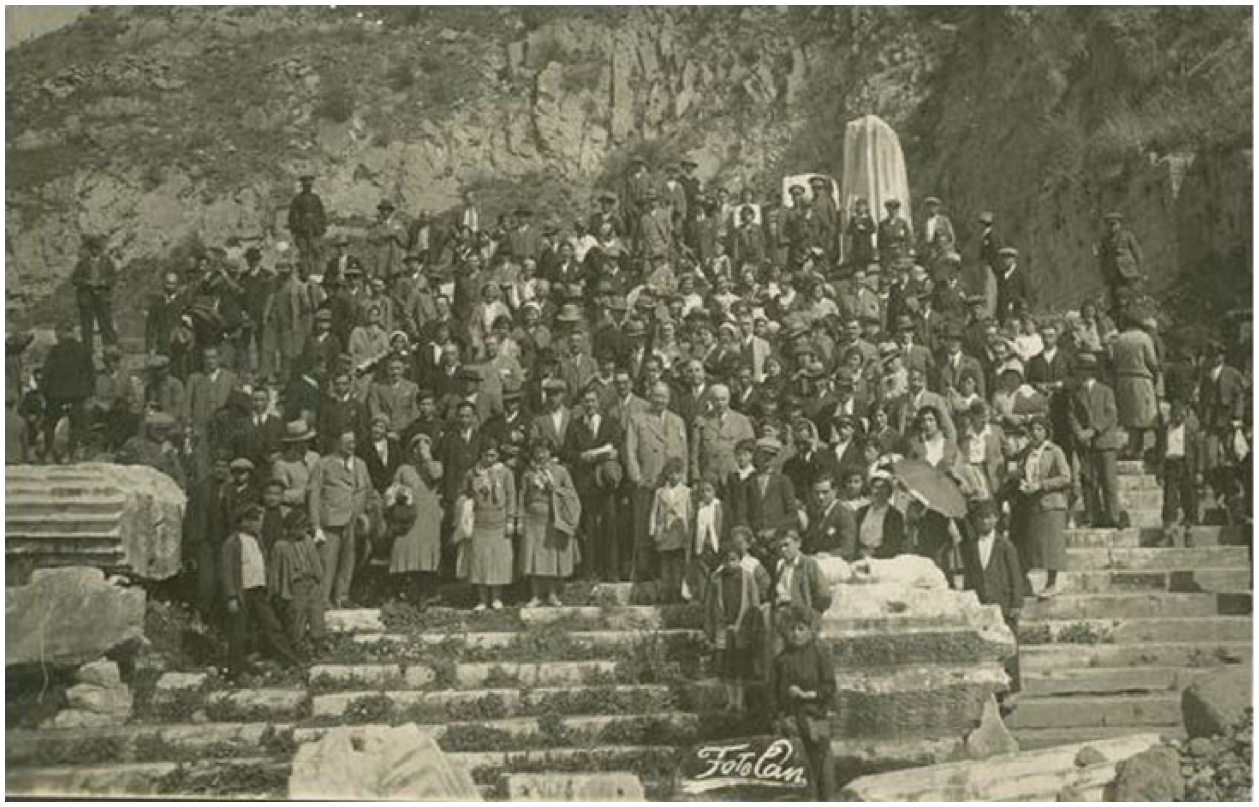
Crowd standing on the ruins of the ancient site of Pergamum. Source: Aziz Ogan Archive.
Ogan’s photographs, meanwhile, mirror changes which occurred to the discipline of archeology in Turkey at this time. From the early Republican years, the Turkish Ministry of Education started to intensify efforts to enhance the appreciation of national heritage among both foreign and local publics. Archeology, which entered the country as a discipline mainly conducted by foreigners, became, during the Republican age, one of the main fields of government investment aimed at creating a Turkish national identity and legitimizing the new Republic of Turkey. To institutionalize the discipline, the government established new offices at the Ministry of Education and new departments at the newly founded universities of Istanbul and Ankara. 37 A new institution, the Turkish History Society (Türk Tarih Kurumu), was founded with the aim to explore and protect the Turkish past. Meanwhile, Turkish archeologists, who had often been educated in Europe, started to be responsible for their own excavations. This work brought to light an impressive number of antiquities belonging to various periods and cultures. Mainly, though, these antiquities dated from the Greek Archaic era. After having been used by the Greek government to prove that there had been a continuous Hellenic presence in Asia Minor since prehistoric times, Greek artifacts now had to be transformed into Turkish national symbols, becoming part of the new Republican narrative. In İzmir, this process took place through their display at a new local museum established by the Turkish authorities. Once again, representing archeology as a potential boundary object was of key importance in undertaking this work.
The İzmir Museum as a symbol of forgetfulness
Given its region’s complex and ambivalent past, İzmir’s new museum assumed a significant role in defining the ancient past of the area, which was mainly associated with images of Classical Greece. As already stated, the new Republican government did not interrupt the region’s archeological excavations, which continued after 1923 at the Classical sites of Ephesus, Pergamum, Didyma, and Teos. As a result, a new museum depot was created in 1923 to preserve the artifacts discovered at these sites. In a letter sent to Aziz Ogan, dated September 4, 1923, the delegate of the Red Cross in Smyrna addressed Ogan not only as the inspector of antiquities, but also as the director of the museum in the city. 38 In another letter, dated March 4, 1926, the Austrian archeologist Keil congratulated Ogan on his new position as the director of the museum in Smyrna. 39 On the basis of this correspondence, we know that a depot was created immediately after the end of the Greek occupation, but it was not opened as an official institution until a few years later, at which point the task of representing the museum as a boundary object began in earnest.
The Museum of Antiquities (Asar-i Atika Müzesi) was officially opened on February 15, 1927, in the former Greek Orthodox Church of Agios Voukolos (Ayavukla in Turkish). The church had been built in the nineteenth century and was situated in the Basmane area, the former Armenian district of the city. 40 This church was the only religious orthodox building not destroyed by the İzmir fire in 1922. In a unique image from the Aziz Ogan Archive we can observe the inner part of the Church before the renovations (Figure 3). The restoration project was funded by the general governor of İzmir and the Minister of Public Education. The urban and religious context of the new museum indicated its role in the new civic life of İzmir: located in the center of the city, the institution occupied a site that had been of crucial religious importance during the previous century for the Orthodox Greek community. In this role, the museum appropriated the religious building and erased its sacred function, transforming it into a ‘temple of Turkish national culture’. The edifice chosen by the Ministry of Education provided an arena where conflicts between the different minorities who previously lived in İzmir could be nullified in favor of the Turkish population.
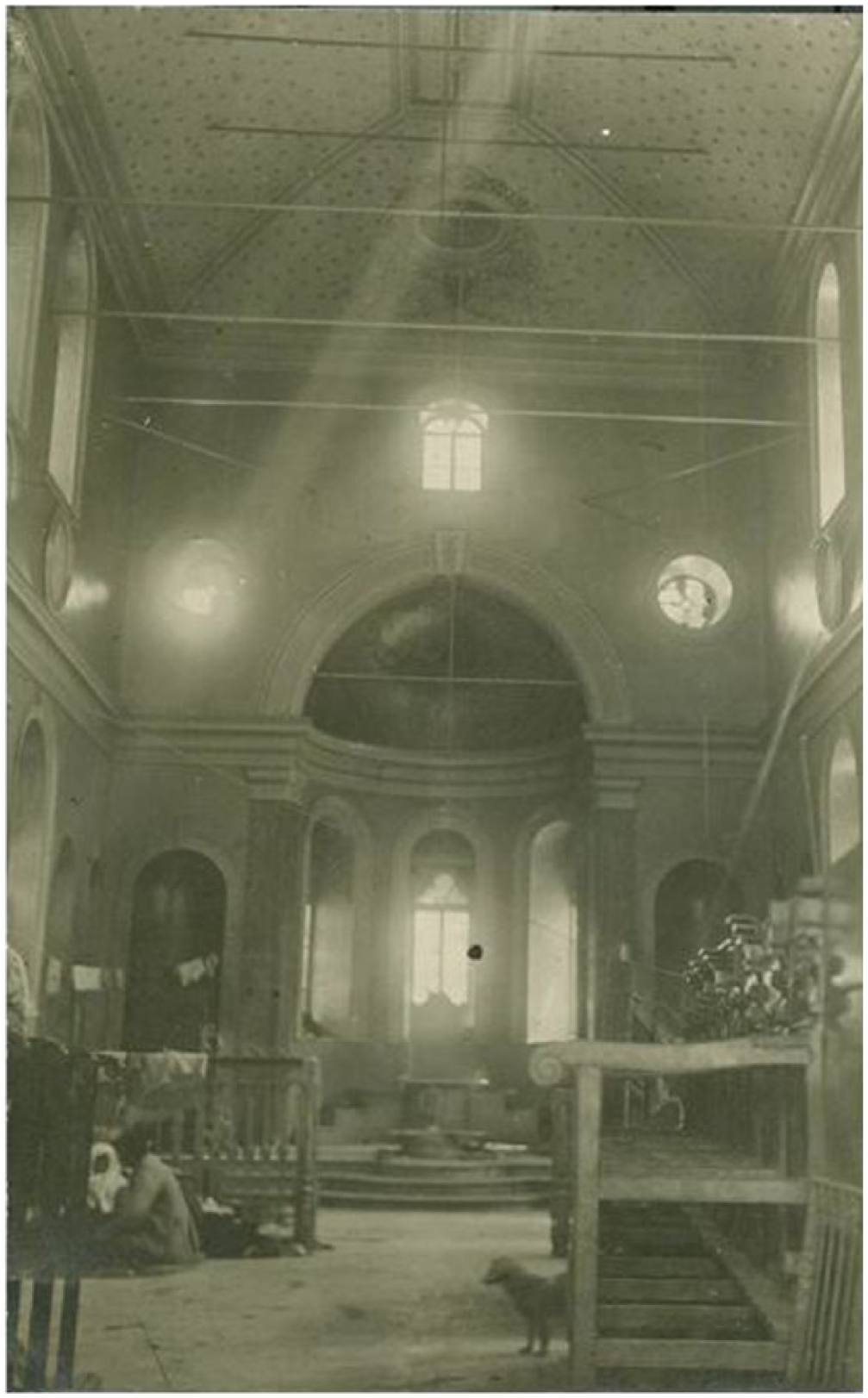
The Ayavukla Church before renovation. Source: Aziz Ogan Archive, EN0044–3.
In the same year as the establishment of the museum, a guide written by Ogan was published both in Turkish and French. 41 This act is notable because at that time no Turkish museum, apart from the one in Istanbul, had an official guide. 42 According to the guide, at the outset the collection was very limited and occupied only one floor of the building and its garden. 43 Initially the collection was composed of objects from the excavations of Didyma, Priene, Sardis, Miletus, Pergamum, Kyme, and Laodicea. 44 In general, the significant artifacts discovered at these sites were transported to the museum and placed on public display. As Aziz wrote, these objects were to constitute the nucleus of the museum’s subsequent collection, which was planned to include more artifacts. 45 As repeatedly stated, however, despite the institution being in a very embryonic stage in 1927, it was still opened to the public.
The significance of the museum’s first collection of antiquities, and the hurried opening and publication of the first guide, must be understood in relation to the interest that the Greek community had shown in excavating and managing the cultural heritage of the İzmir area during the years it was occupied. In allowing foreign missions to continue their work with the support of the local inspector of antiquities, Turkey asserted its dominion over an area which was not only part of its modern, but also part of its perceived ancient boundaries. The remains of the ancient Greek past displayed in the museum therefore had the aim of showing the heterogeneity of the Turkish past, presenting the new Republic as the legitimate inheritor of all the cultures which had inhabited the region since prehistoric times. Turkey used the İzmir Museum and the objects displayed within it as boundary objects around which diverse interests could once again gather.
The contents of a second catalogue, published a few years later in Turkish and French and also written by Ogan, who at that time was no longer working in the city, are therefore quite telling. 46 The museum was by now no longer called the Museum of Antiquities but the Museum of İzmir. According to the guide, a large number of new objects had been added to the museum displays, including Islamic, Byzantine, and Hittite artifacts and modern paintings. The majority of the objects continued to come from excavations and surveys of the area surrounding İzmir, including the new sites of Aphrodisias, Ephesus, and Klazomenai. Most significant, an important Hittite collection, mostly pottery, was sent to İzmir from the Ministry of Public Education. 47 The new museum also included a library and laboratories for the conservation and restoration of objects.
The collection was located on two different floors inside the building and in the garden (Figures 4 and 5). The levels symbolically separated different types of artifact: the upper floor was dedicated to coins, modern paintings, Turkish carpets, and the Hittite artifacts, while the ground floor and the garden were devoted to Classical, Byzantine, and a few Islamic antiquities. In the museum as a whole, the objects were arranged by typology. Archeological remains of substantial size, such as reliefs, funerary and votive stelae, sculptures of bigger dimensions, sarcophagi, capitals, and other architectural pieces were placed in the garden, where they were divided by provenance. Although the majority of the reliefs and funerary stelae were of Classical or Byzantine origin, a few Islamic reliefs were also included.
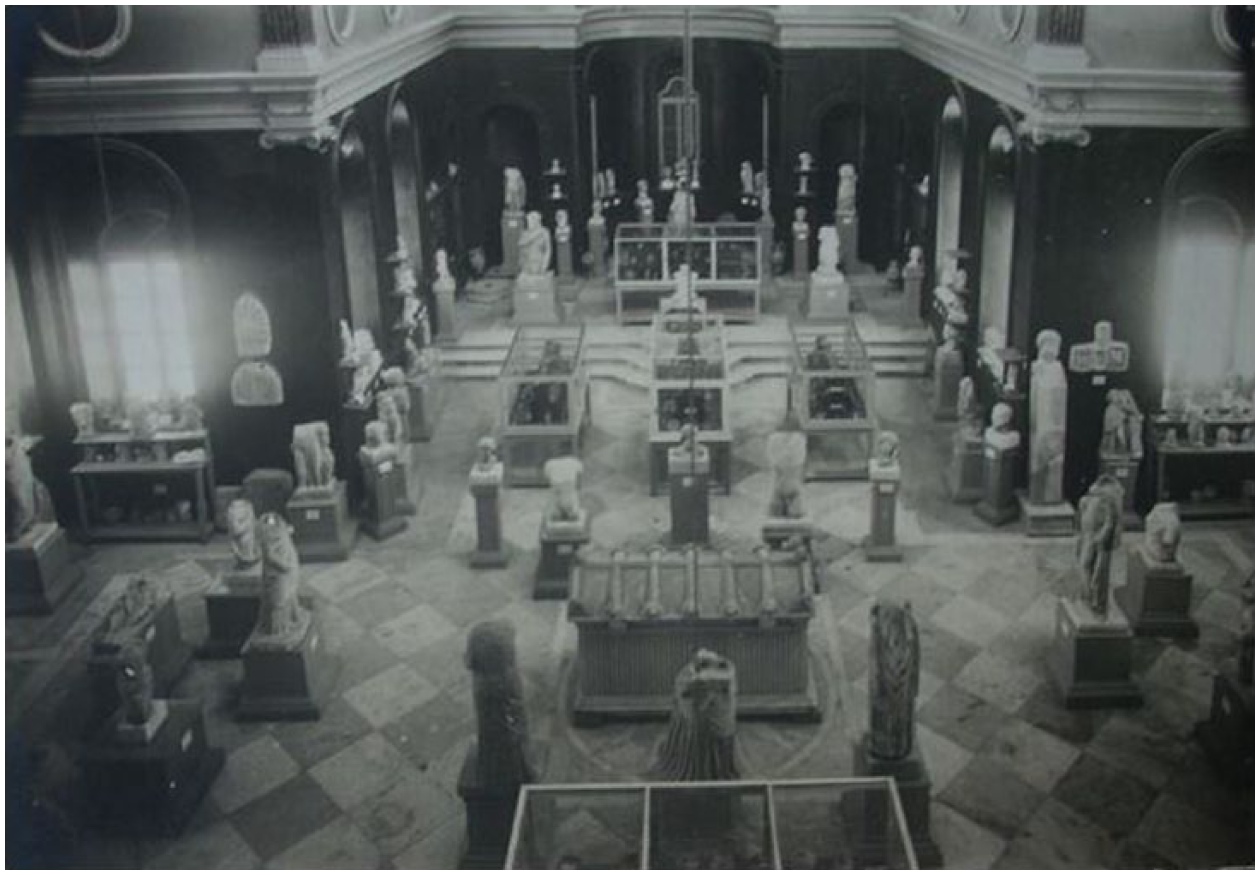
The first floor of the İzmir Museum. Source: Aziz Ogan Archive.
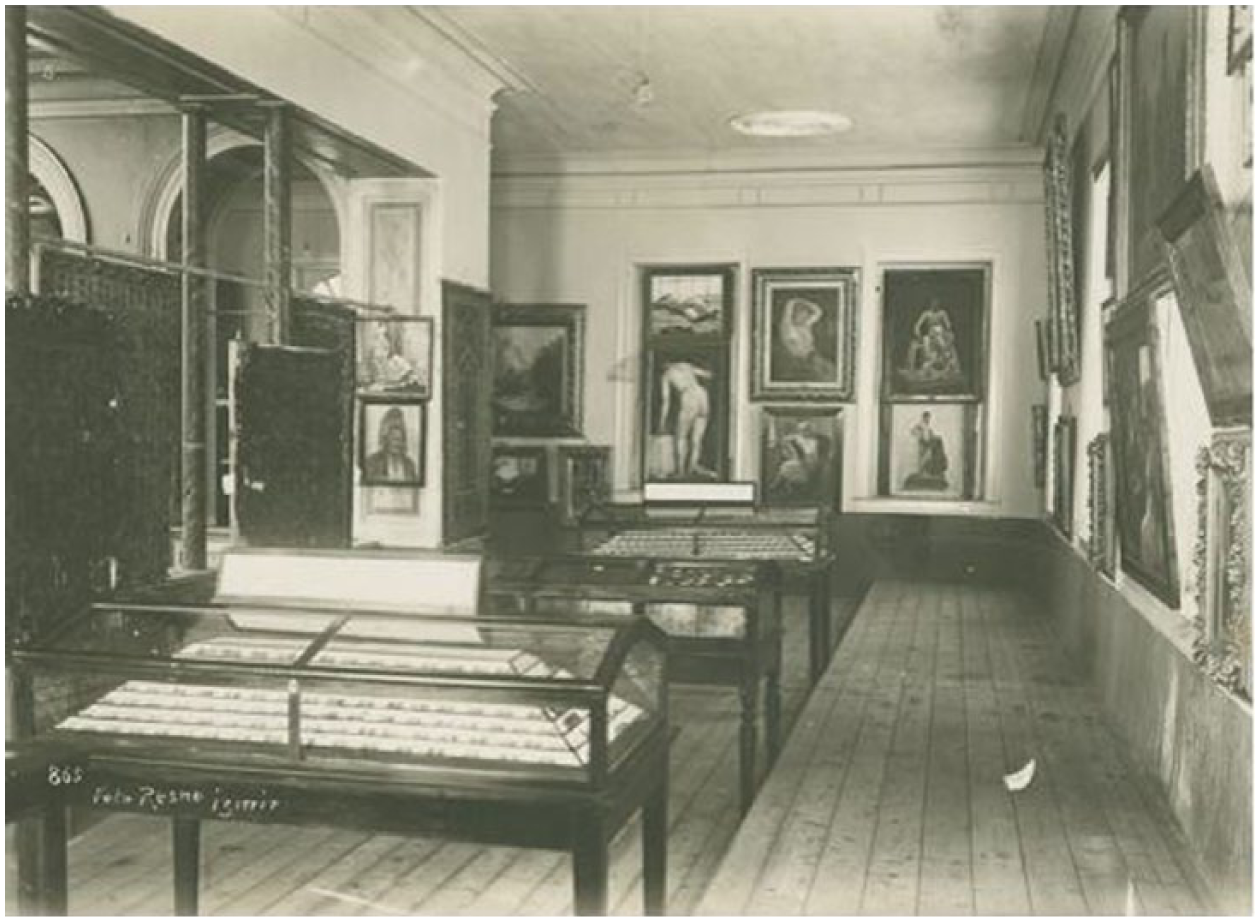
The second floor of the İzmir Museum. Source: Aziz Ogan Archive.
As photographs attest, the museum’s main building, located in the center of the garden, was completely renovated (Figures 3 and 4). Its lower walls were painted a dark color, and the upper walls had a lighter tone. This new style of decoration in the main room was significant in attributing a new meaning to the building. The arrangement of the objects, the dark walls, and the half-columns each contributed to the creation of a museological environment which attempted to erase any possible association between the site and the church which it had previously been. The apse, with a typical semicircular shape normally associated with churches, was not taken into particular consideration, and the arrangement of the artifacts followed the general patterns of the main room. The dark walls, and their sharp contrast with the white marble of the sculptures, were central to the room’s impressive appearance.
At the entrance, the porch of the church was completely altered; large full-length windows made of glass and wood were put in place between the columns in order to modify the religious architecture. Once in the main room, the visitor would find the section reserved for Islamic art; funerary stelae and reliefs were positioned on the floor, while smaller objects were displayed in a showcase dedicated to Seljuk ornaments. 48 Beyond this initial area, the space was entirely dedicated to Greek and Roman antiquities. A large sarcophagus from Sardis from the third century BC was placed in the center of the room, surrounded by several rows of statues and showcases (Figure 4). 49
We can suppose that locating the sarcophagus in such an important position meant assigning it particular emphasis. The significance probably lies in the provenance of the artifact. A few years before the opening of the İzmir Museum, the so-called ‘Sardis affair’ had shaken the relationship between Turkish and American authorities in the field of archeology. 50 The site of the ancient city of Sardis was excavated between 1910 and 1914 by an American team under the direction of Howard Crosby Butler, a professor at Princeton University. During these four years the excavation was incredibly successful in bringing to light numerous artifacts and buildings. As previously explained, according to the 1906 Antiquities Law, all the objects found by such expeditions had to be sent to Istanbul, and nothing could be exported. During this period, Butler was on good terms with the Ottoman authorities, who had granted him permission to work on several sites in its territories. 51 He also wrote in favor of the Antiquities Law, defending the Ottomans’ right to keep all the objects from excavations in the Empire. 52
After 1914, however, the outbreak of the First World War made it impossible for the American excavation team to return to the site. When the İzmir area passed into Greek control, foreign archeologists could once again travel to the country, and the team went back to work in Sardis, but this time under a different agreement with the temporary Greek administration. The foreign mission now gained permission to export the excavated objects to the US, and in two years most of the finds from the site were shipped to New York, where they were added to the collection of the Metropolitan Museum of Art. 53 After the Treaty of Lausanne, the Turkish authorities asked for the objects to be returned and, following long negotiations, by June 1924 the Sardis treasure was once again in Istanbul. Yet as a consequence of the agreement reached with the American government, only a part of the collection was returned to Turkey. Therefore, displaying the Sardis sarcophagus as the core of the İzmir Museum only a few years after the end of the ‘Sardis affair’ was meant to deny the legitimacy of the Greek temporary administration and to cancel its memory. Placing this object at the heart of the building embodied the pride of the new Turkish administration and highlighted the sarcophagus not only as a Turkish possession, but also as accessible to an international public. The sarcophagus in particular represented what the Museum of İzmir represented in general: a boundary object around which the Turkish Republic could rearrange different, contentious interests.
Going up to the second floor of the museum, meanwhile, the visitor entered a different environment. In this much smaller room, the visitor could contemplate works of art of a very different nature, without the sense of monumentality experienced in the Classical room. These works were arranged according to object type and subject matter. For instance, modern paintings by Turkish and European artists hung on the two long sides of the room (Figure 5). 54 Displaying modern art was rather new in Turkey, and the first art museum established in the country was the Istanbul Museum of Painting and Sculpture in 1937. 55 This section therefore constituted an innovation in the museological panorama of the country. Next to the paintings hanging from the wall were a few Turkish carpets that came from mosques and former royal houses in the İzmir area. The center of the room was occupied by several showcases, four of which were dedicated to Hittite coins, the subject of a special catalogue prepared by the Deutsche Orient-Bank.
Finally, the last showcase displayed 116 fragments of Hittite pottery from Alacahöyük (Figure 6). As previously noted, this group of items was part of a larger collection in Ankara, and was specially sent to İzmir by the Ministry of Education. 56 In addition to viewing Classical artifacts, visitors were encouraged to examine Hittite objects that came from the excavations of the area, but which were also of fundamental importance to the ideology of the early Republic. Because Hittitology was not established to the same degree as Greek and Roman archeology, and because the İzmir area was one of the most touristic regions of the country, the display served to disseminate knowledge of Hittite culture among tourists, and thus the area could be understood as being more than simply Classical Ionia. Here the Hittites, interpreted in the early Republic as the real ancestors of modern Turks, were given the symbolic function of establishing a link between the ancient past and the present nation, ‘marking’ the territory as a Turkish possession since ancient times at the same time as emphasizing the multiplicity of the region’s pasts. 57
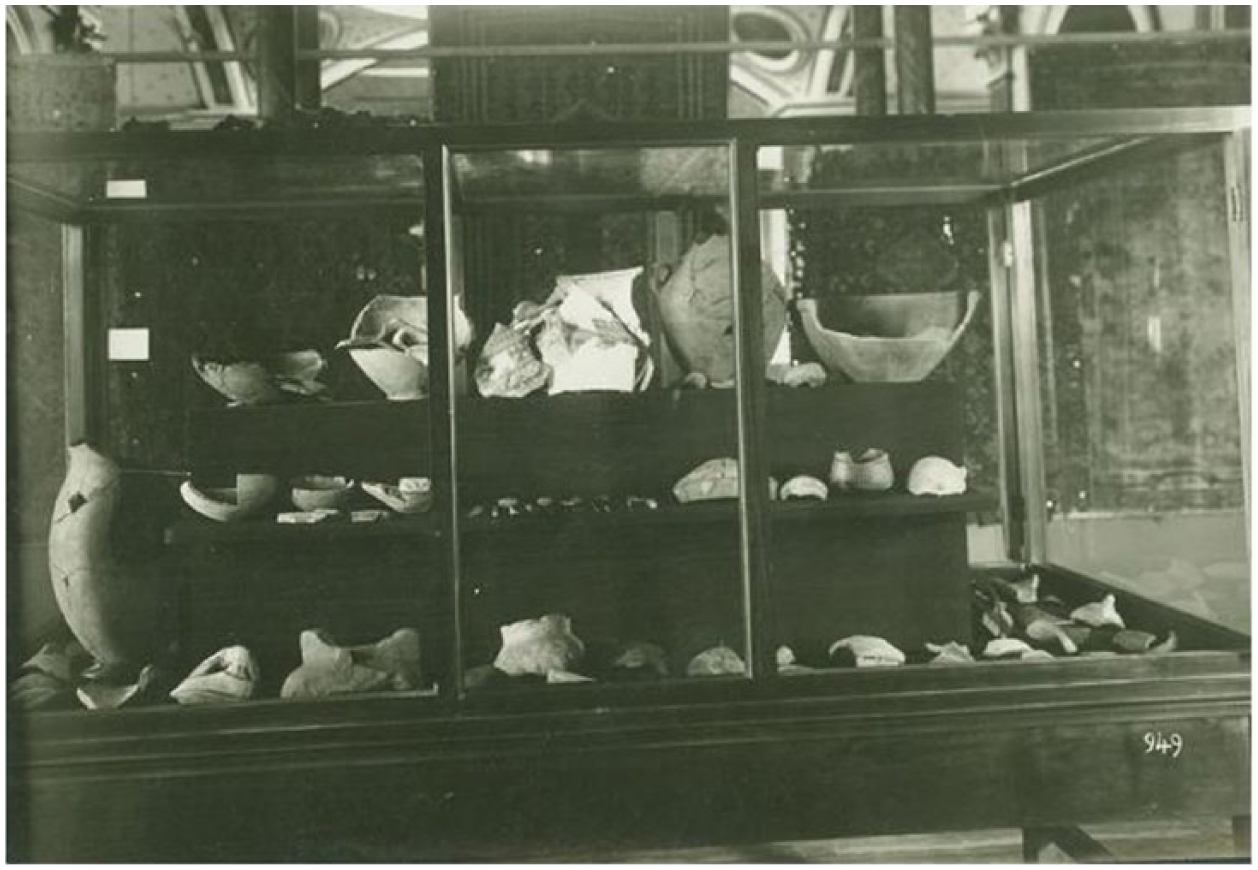
Showcase with Hittite pottery, second floor of the Izmir Museum. Source: Aziz Ogan Archive, EN0044–04.
As is evident, the museum’s spatial arrangement produced a substantial struggle between the narratives on the two floors: on the first floor, the spectator would enter the Classical world and enjoy what would be expected from the archeology of this region: the Greek and Roman artifacts typical of the İzmir area. On the second floor, the visitor would experience a combination of objects that were symbols of the ‘new and modern’ Turkey. Hittite pottery anchored the İzmir Museum to the perceived ‘real ancestors of modern Turks’, while modern art was a bridge to a new discipline, not yet very well developed in the country, but strongly supported by the new government as an ideological tool. 58 Although the image of Ionia as an area associated with Classical civilization was encouraged by the arrangement of the ground floor and the garden, where Islamic artifacts occupied only a minor space, the presentation on the upper floor provided another dimension for the appreciation of this region. On the second floor, tourists were not only given the opportunity to admire the richness of the Classical antiquities of Ionia but were presented also with an ‘alternative’ Turkish art that added a completely new dimension to the culture of the area. The İzmir Museum constituted a boundary object around which concern with these various dimensions might gather.
In 1934 the government issued an interesting tourist guide entitled Guide d’İzmir, with the aim of enhancing the cultural heritage of the area through images and texts. 59 Published entirely in French by l’Association des Amis des antiquités d’İzmir et ses environs, the volume was aimed at publicizing Turkish heritage and attracting foreign tourists to İzmir and its surrounding area. It also gave touristic information on archeological sites, the archeological museum, art, and cultural activities, as well as practical advice about transport. The city was portrayed as modern and dynamic, and its museum in particular was presented as unique in its genre since it displayed “Greek objects that were not normally present in Anatolia.” 60 Readers were invited to admire the variety of objects coming from all periods, from the Hittites to the Islamic era. According to the Guide, archeological sites of the area highlighted the antiquities of all periods, and the Ionian area was revealed as the “cradle of civilization,” showing to a local and international public the richness of its heritage. 61 At least in printed form, the İzmir Museum’s constitution as a boundary object was complete.
Conclusion
Archeological heritage in Turkey has always been a contested resource, subject to a variety of readings and interpretations, and connected to several, often conflicting, cultural and political claims. Since the beginning of archeological practice in the country, antiquities have held contested roles and conflicting values. In particular, throughout the modern history of the province of İzmir, they have become a symbolic and meaningful resource. At the same time, however, their role has been the subject of continuous discussions and negotiations by different groups: Europeans looking for the mythical origins of Western civilization; Greek authorities claiming rights to the territory; and Turkish officials looking for a new identity. The relationship between archeological representations and political hegemony has been neither determined nor stable.
As illustrated in this article, archeological excavations in ancient Ionia were carried out on different Classical sites and, contrary to common belief, Classical antiquities were not disregarded. Instead, they were promoted as an important part of national heritage through their integration into a visual language of boundary objects. As noted earlier, Shankland observed that the relationship between archeology and nationalism during the Turkish Republic was “tolerant” and “dynamic” in the sense that instead of searching for a single and dominant past culture, Turkey favored a discourse of a multifaceted and multiperiod past at the same time as encouraging widespread national and transnational interest in it. 62 The variety of representational media focusing on İzmir Province and the İzmir Museum illustrate how this situation came to pass. Aziz Ogan’s photographs constituted new and diverse archeological publics in the İzmir region. Meanwhile, in İzmir itself, the memory of conflict with Greece, both in ancient and modern times, was erased by using the city’s new museum as an institution of forgetfulness: an old orthodox church was transformed to host the antiquities which came from the excavations of the area. Yet, at the same time, ancient Classical artifacts were integrated with Hittite, Byzantine, and Islamic objects in order to create a unique flow of time, where all these cultures could find their own place in Turkey’s history. If Turkey’s history was indeed bounded and ‘national’, events and images from in and around İzmir emphasize that it was also a history whose boundaries could accommodate multiple interests and interpretations.
Footnotes
1.
Many studies have been written on this topic, among others Peter Gathercole and David Lowenthal (eds.), The Politics of the Past (London and New York, NY: Unwin Hyman, 1990); George Clement Bond and Angela Gilliam (eds.), Social Construction of the Past: Representation as Power (London and New York, NY: Routledge, 1994); Philip L. Kohl and Clare Fawcett (eds.), Nationalism, Politics and the Practice of Archaeology (Cambridge: Cambridge University Press, 1995); Paul Graves-Brown, Siân Jones and Clive Gamble (eds.), Cultural Identity and Archaeology: The Construction of European Communities (London and New York, NY: Routledge, 1996); Margarita Díaz-Andreu and Timothy Champion (eds.), Nationalism and Archaeology in Europe (London: UCL Press, 1996); and Philip L. Kohl, Mara Kozelsky and Nachman Ben-Yehuda (eds.), Selective Remembrances: Archaeology in the Construction, Commemoration, and Consecration of National Pasts (Chicago and London: University of Chicago Press, 2008).
2.
Flora Kaplan (ed.), Museums and the Making of “Ourselves”: The Role of Objects in National Identity (London and New York, NY: Leicester University Press, 1994); Claire Norton (ed.), Nationalism, Historiography and the (Re)construction of the Past (Washington, DC: New Academia Publishing, 2007); and Simon J. Knell et al., National Museums: New Studies from Around the World (London and New York, NY: Routledge, 2010).
3.
The first critique follows Pieter Judson, The Habsburg Empire, a New History (Cambridge, MA: Harvard University Press, 2016). For the second critique, see e.g. Elliott Colla, Conflicted Antiquities: Egyptology, Egyptomania, Egyptian Modernity (Durham, NC, 2007) and more broadly Clare Bishop, Radical Museology, or, What’s Contemporary in Museums of Contemporary Art? (London: Koenig Books, Duke University Press, 2013).
4.
For the study of the development of these museums’ displays see Wendy Shaw, “Museums and Narratives of Display from the Late Ottoman Empire to the Turkish Republic,” Muqarnas 24 (2007): 253–79 and Wendy Shaw, “National Museums in the Republic of Turkey: Palimpsests within a Centralized State,” in Peter Aronsson and Gabriella Elgenius (eds.), Building National Museums in Europe 1750-2010 (Linköping: Linköping University Press, 2011), pp.925–51. For a study of the Museum of Anatolian Civilizations in Ankara see Aslı Gür, “Stories in Three Dimensions. Narratives of Nation and the Anatolian Civilizations Museum,” in Esra Özyürek (ed.), The Politics of Public Memory in Turkey (Syracuse, NY: Syracuse University Press, 2007), pp.40–69.
5.
David Shankland, “Afterword: Heritage, Nationalism and Archaeology in the Republic of Turkey,” in Scott Redford and Nina Ergin (eds.), Perceptions of the Past in the Turkish Republic: Classical and Byzantine Periods (Leuven: Peeters, 2010), pp.226–7.
6.
The ‘classic’ work on boundary objects is Susan Leigh Star and James Griesemer, “Institutional Ecology, ‘Translations’ and Boundary Objects: Amateurs and Professionals in Berkeley’s Museum of Vertebrate Zoology, 1907–39,” Social Studies of Science 19 (1989): 387–420.
7.
Alan Greaves, The Land of Ionia: Society and Economy in the Archaic Period (Malden, MA: Wiley Blackwell, 2010).
8.
For a study on the use of heritage in the legitimation of territorial claims in Ionia see Naoíse MacSweeney, “A Land without Autochthons: Anatolian Archaeology in the Early 20th Century,” in Roger Matthews et al. (eds.), Proceedings of the International Congress on the Archaeology of the Ancient Near East. Band 7. Proceedings of the 7th ICAANE 12 April – 16 April 2010, British Museum and UCL, London (Harrassowitz: Wiesbaden, 2012), pp.63–72.
9.
Umut Özkırımlı and Spyros A. Sofos, Tormented by History: Nationalism in Greece and Turkey (London: Hurst and Company, 2007), pp.104–22.
10.
Kolluoğlu-Kırlı Biray, “The Play of Memory, Counter-Memory: Building İzmir on Smyrna’s Ashes,” New Perspectives on Turkey 26 (2002): 1–28, 4.
11.
For a discussion about the consequences of the population exchange see Renée Hirschon (ed.), Crossing the Aegean: An Appraisal of the 1923 Compulsory Population Exchange between Greece and Turkey (New York, NY and Oxford: Berghahn, 2003).
12.
For a discussion of the reforms undertaken by the Kemalist government, see Feroz Ahmad, The Making of Modern Turkey (London and New York, NY: Routledge, 1993), pp.78–93; M. Şükrü Hanioğlu, Atatürk: An Intellectual Biography (Princeton, NJ and Oxford, 2011), pp.157–80; and Erik Jan Zürcher, Turkey: A Modern History (London, 1993), pp.172–3.
13.
Sibel Bozdoğan, Modernism and Nation Building: Turkish Architectural Culture in the Early Republic (Seattle, WA: University of Washington Press, 2001).
14.
Kolluoğlu-Kırlı Biray, “Cityscapes and Modernity: Smyrna Morphing into İzmir,” in Anna Frangoudaki and Çağlar Keyder (eds.), Ways to Modernity in Greece and Turkey: Encounters with Europe, 1850-1950 (London and New York, NY: I. B. Tauris, 2007), pp.217–35, and Vilma Hastaoglou-Matinidis, “Urban Aesthetics and National Identity: The Refashioning of Eastern Mediterranean Cities between 1900 and 1940,” Planning Perspectives 26 (2011): 153–82, 170.
15.
Kolluoğlu-Kırlı, “The Play of Memory” (note 10), 7.
16.
The initial planning formulated in 1924 by the French experts René and Raymond Danger and Henri Prost was never implemented due to financial problems. The French architect Le Corbusier was commissioned to carry out the subsequent plan in the late 1930s. See F. Cana Bilsel, “Ideology and Urbanism during the Early Republican Period: Two Master Plans for İzmír and Scenarios of Modernization,” METU Journal of Faculty of Architecture 16 (1996): 13–30, 21–6.
17.
Hastaoglou-Martinidis, “Urban Aesthetics and National Identity” (note 14), 174.
18.
Jack L. Davis, “Warriors for the Fatherland: National Consciousness and Archaeology in ‘Barbarian’ Epirus and ‘Verdant’ Ionia, 1912–22,” Journal of Mediterranean Archaeology 13.1 (2000): 76–98, and Jack L. Davis, “A Foreign School of Archaeology and the Politics of Archaeological Practice: Anatolia, 1922,” Journal of Mediterranean Archaeology 16 (2003): 145–72.
19.
MacSweeney, “A Land without Autochthons” (note 8), p.66.
20.
Davis, “Warriors for the Fatherland” (note 18), 88.
21.
Davis, “Warriors for the Fatherland” (note 18), 85. Davis cites the example of the Austrian excavation of Ephesus, where several artifacts were looted and used as construction material for government buildings in İzmir.
22.
Davis, “Warriors for the Fatherland” (note 18), 87. When Turkish troops under Mustafa Kemal regained possession of İzmir, the city caught fire, and the Museum of Asia Minor was destroyed.
23.
Davis, “Warriors for the Fatherland” (note 18), 89.
24.
On the Antiquities Law see Alev Koçak, The Ottoman Empire and Archaeological Excavations: Ottoman Policy from 1840-1906, Foreign Archaeologists and the Formation of the Ottoman Museum (Istanbul: Isis Press, 2010), and Wendy Shaw, Possessors and Possessed: Museums, Archaeology, and the Visualization of History in the late Ottoman Empire (Berkeley, CA, Los Angeles, CA and London: University of California Press, 2003), pp.108–30.
25.
Theodor Wiegand, Bericht über die Ausgrabungen in Pergamon 1927 (Berlin: Abhandlungen der Preussischen Akademie der Wissenschaften, 1928).
26.
Theodor Wiegand, Achter vorläufiger Bericht über die von den staatlichen Museen in Milet und Didyma unternommenen Ausgrabungen (Berlin: Abhandlungen der Preussischen Akademie der Wissenschaften, 1924).
27.
Yves Béquignon and Alfred Laumonier, “Fouilles de Téos (1924),” Bulletin de correspondance hellénique 49 (1925): 281–321.
28.
Jale İnan, “Aziz Ogan,” Istanbul Enstitüsü Dergisi 3 (1957): 173–76, 173.
29.
Wiegand’s letter to Ogan, November 7, 1924. Aziz Ogan Archive, Box 5, Folder 6.
30.
Ogan’s letter to Schede, April 26, 1925. Aziz Ogan Archive, Box 5, Folder 6.
31.
Schede’s letter to Ogan, July 8, 1925. Aziz Ogan Archive, Folder 6.
32.
Letter to Ogan dated 1925 from Athens. Aziz Ogan Archive, Box 5, Folder 6. Both the date and signature are illegible.
33.
Images related to Ionia in the Aziz Ogan Archive: EN0031 (Teos hafriyatına ait 1940), EN0261 (Bergama), EN0276 (Random pictures) and BX004 (Efes 1928).
34.
For a discussion about photography and archeology in the Ottoman Empire see Robert G. Ousterhout, John Henry Haynes, a Photographer and Archaeologist in the Ottoman Empire 1881–1900 (London and Istanbul: Cornucopia Books/Caique, 2011); Shaw, Possessors and Possessed (note 24), 139–49; Zeynep Çelik, “Defining Empire’s Patrimony: Late Ottoman Perceptions of Antiquities,” in Zainab Bahrani, Zeynep Çelik and Edhem Eldem (eds.), Scramble for the Past: A Story of Archaeology in the Ottoman Empire, 1753–1914 (Istanbul: SALT, 2011), 443–77; and Francis Terpak and Peter Bonfitto, “Transferring Antiquity to Ink: Ruins from the Americas to Asia Minor and the Development of Photolithography,” in Zeynep Çelik and Edhem Eldem (eds.), Camera Ottomana: Photography and Modernity in the Ottoman Empire 1840–1914 (Istanbul: Koç University Publications, 2015), pp.20–65.
35.
Due to the lack of a more specific label associated with this photograph, we do not know the specific event during which this picture was taken, but we can assume it was on the occasion of an organized tour of the famous archeological site.
36.
Frederick N. Bohrer, Photography and Archaeology (London: Reaktion, 2011), p.73.
37.
For the foundation of the new universities see Murat Ergin, “Cultural Encounters in the Social Sciences and Humanities: Western Émigré Scholars in Turkey,” History of the Human Sciences 22.2 (2009): 105–30 and Muazzez Çığ, “Atatürk and the Beginnings of Cuneiform Studies in Turkey,” Journal of Cuneiform Studies 40.2 (1988): 211–16.
38.
Schatzmann’s letter to Ogan, September 4, 1923. Aziz Ogan Archive, Box 5, Folder 6. The signature on the letter is almost illegible; therefore, I am not completely sure of the spelling of this name. Schatzmann was a delegate of the Red Cross in Smyrna.
39.
Keil’s letter to Ogan, March 4, 1926. Aziz Ogan Archive, Box 5, Folder 6.
40.
Aziz Ogan, Guide du Musée de Smyrne (Smyrne Resimli Ay 1927), p.3.
41.
French version: Ogan, Guide du Musée de Smyrne (note 40). Turkish version: İzmir asar-i atika müzesi rehberi (İzmir: Hafız Ali, 1927).
42.
Even in the case of Istanbul only a comprehensive guide had been published at that time: Halil Edhem, Das Osmanische Antikenmuseum in Konstantinopel (Leipzig: Hinrichs, 1909). Subsequently, only guides of single collections were published until 1973, when a new museum guide came out: Necati Dolunay, İstanbul Arkeoloji Müzeleri (İstanbul: Ak Yayınları, 1973).
43.
Ogan, Guide du Musée de Smyrne (note 40), p.4.
44.
Noted in Ogan’s letter to Theodor Wiegand, unknown date, 1927. Aziz Ogan Archive, Box 5, Folder 6.
45.
Ogan, Guide du Musée de Smyrne (note 40), pp.4–5.
46.
French version: Aziz Ogan, Guide du Musée de Smyrne (Istanbul: Resimli Ay, 1933). Turkish version: İzmir müzesi rehberi (Istanbul: Resimli Ay, 1932).
47.
Ogan, Guide du Musée de Smyrne (note 46), pp.8–9.
48.
Ogan, Guide du Musée de Smyrne (note 46), pp.41–4.
49.
Ogan, Guide du Musée de Smyrne (note 46), p.44.
50.
James M. Goode, Negotiating for the Past: Archaeology, Nationalism, and Diplomacy in the Middle East, 1919–1941 (Austin: University of Texas Press, 2007), pp.31–42 and Fikret K. Yegül, “From the Lofty Halls of Academia to the Dusty Hills of Anatolia: Howard Crosby Butler and the First Sardis Expedition through Peace and War, 1909–1926,” in Redford and Ergin, Perceptions of the Past (note 5), pp.57–100.
51.
Yegül, “From the Lofty Halls” (note 50), p.63.
52.
Yegül, “From the Lofty Halls” (note 50), p.70.
53.
Yegül, “From the Lofty Halls” (note 50), p.82.
54.
One of the paintings, called “Nus,” was by Ogan himself.
55.
Ayşe H. Köksal, “National Art Museums and the ‘Modernization’ of Turkey,” in Simon Knell et al. (eds.), National Museums: New Studies from around the World (London and New York, NY, 2011), pp.163–79.
56.
Ogan, Guide du Musée de Smyrne (note 46), p.8.
57.
This act followed the theory that dominated Turkish archaeology at the time, the so-called Turkish Historical Thesis, which stated that modern Turks were the direct descendants of the Hittites who migrated from Central Asia to Anatolia during prehistory. After their migration during the Neolithic period, caused by adverse environmental conditions, Hittites were said to have settled in Anatolia, where they established the Hittite kingdom. From Turkey, the thesis stated that they would later migrate to other Mediterranean civilizations such as Etruria (Italy), Greece, Mesopotamia, and Egypt. For a discussion of the Turkish Historical Thesis see Can Erimtan, “Hittites, Ottomans and Turks: Ağaoğlu Ahmed Bey and the Kemalist Construction of Turkish Nationhood in Anatolia,” Anatolian Studies 58 (2008): 141–71; Çiğdem Atakuman, “Cradle or Crucible. Anatolia and Archaeology in the Early Years of the Republic (1923–1938),” Journal of Social Archaeology 8 (2008): 217–20; and Tugba Tanyeri-Erdemir, “Archaeology as a Source of National Pride in the Early Years of the Turkish Republic,” Journal of Field Archaeology 31 (2006): 382–4.
58.
For the development of art in the early Turkish Republic see Wendy Shaw, Ottoman Painting: Reflections of Western Art from the Ottoman Empire to the Turkish Republic (London and New York, NY: I.B. Tauris, 2010).
59.
L’Association des Amis des antiquités d’İzmir et ses environs, Guide d’İzmir (Istanbul: Universum, 1934).
60.
L’Association, Guide d’İzmir (note 59), p.184.
61.
L’Association, Guide d’İzmir (note 59), pp.216–21.
62.
David Shankland, “Afterword: Heritage, Nationalism and Archaeology in the Republic of Turkey,” Scott Redford and Nina Ergin (eds.), Redford and Ergin, Perceptions of the Past (note 5), pp.226–7.