







Abstract
This article looks into mining in central Germany in the late eighteenth century as one area of highly charged exchange between (specific manifestations of early modern) science and the (early modern) state. It describes bureaucratic knowledge as socially distributed cognition by following the steps of a high-ranking official that led him to discover a rich silver ore deposit. Although this involved hybridization of practical/artisanal and theoretical/scientific knowledge, and knowers, the focus of this article is on purification or boundary work that took place when actors in and around the mines consciously contributed to different circuits of knowledge production. For the sake of analysis, the article suggests a way of opposing bureaucratic versus scientific knowledge production, even when the sites, actors involved in, and practices of that knowledge production were the same or similar. Whereas the science of the time invoked consensus among equals to conflate competing knowledge claims, bureaucracies did so by applying a hierarchy among ranked individuals.
Introduction
The knowledge production that is specific to state bureaucracies is slowly coming into the focus of historians. 1 This trend, I argue here, is directly relevant to historians of science. In her contribution to a recently launched journal for the emerging field of the history of knowledge, Lorraine Daston pointed out a paradoxical development in the history of science. 2 As a discipline, it has developed clear edges, with its own methodologies, landmark studies, university departments, conferences, journals, and so forth. However, as its tools and identity became sharper, its subject matter became fuzzier. Just a glance at any major outlet in the field testifies to how wide the umbrella of the term “science” has become. It now seems to routinely cover knowledge production before the scientific revolution, 3 in non-Western contexts with very different knowledge ecologies, 4 and in sites previously thought of as not being conducive to methodical inquiry, such as courts, 5 arsenals, 6 artisanal workshops, 7 and kitchens. 8 Government bureaus, too, have been identified as sites of knowledge production that call for the attention of historians of science. 9 In particular, Andre Wakefield has argued that the administrations of the middling and smaller states of the Holy Roman Empire were “a hothouse for certain kinds of knowledge”: scientific forestry, alchemy/chemistry, technology and technical sciences, and the science of cameralism that sought to integrate these diverse knowledges to the benefit of the treasury. 10
Many of these studies rely on ideas of hybrid personae, shared spaces, overlapping interests, interaction, and networks. “Following the trail of practices has intertwined science with its ambient cultural context in tangled ways. There is no way of unweaving this web, of excising science cleanly from other ways of knowing and doing.” 11 The emphasis on connectivity has shifted the focus away from boundary work that parceled off some areas of actors’ activities and thought from others and explored linkages instead. This move has been extremely important to expand the scope and sharpen the analytical power of the history of science. Yet, I argue, what makes the idea of hybrids interesting is precisely the assumption that there is a difference between different domains of human endeavor. 12 If “science” is not simply to dissolve into its ambience, historians of science will need a clearer sense of how knowledge was structured in other domains, and how these structures might be different from the science that inhabits their field of inquiry – especially if they find that many spaces, people, practices, and objects connected them. State bureaucracies, with their ostentatious emphasis on written proof, reasonable argument, and authority will be a strangely familiar field to explore, and one in which the tried and tested apparatus of the history of science will find a worthy object of inquiry.
This article looks into mining in central Germany in the late eighteenth century as one area of highly charged exchange between (specific manifestations of early modern) science and the (early modern) state. My present aim is threefold. I want to describe as plainly as possible how knowledge ‘worked’ in the particular bureaucracy under investigation, the Saxon Bergstaat. More concretely, I will follow the steps of a high-ranking mining official in the district of Marienberg that led him to discover a rich silver ore deposit, which involved messy “linkage work” between practical/artisanal, theoretical/scientific, and administrative knowledge. Second, I want to show how actors in and around the mines sometimes engaged in “boundary work” 13 by contributing consciously to different circuits of knowledge production. And third, I want to suggest a way of opposing bureaucratic versus scientific knowledge production for the sake of analysis, even if the sites and practices of that knowledge production in the present case were the same or similar.
Marienberg, 1768: A fateful find
Eighteenth-century Marienberg was a small mining town sitting squarely on the deforested slopes of the Ore Mountains, close to the border of Bohemia. As in other Saxon mining towns, Marienberg’s history can be traced on a graph showing its output of silver (Figure 1). It leaped into being in 1519 when great deposits were found close to the village of Wüstenschletta, and then it flourished feverishly. Silver production peaked in 1541 but then entered a long, secular decline, which in the literature is called the Tiefbaukrise, a crisis caused by having to mine deeper because surface deposits were depleted. 14 The Thirty Years’ War caused a dip, a government intervention in the early eighteenth century caused a little jump. Mostly, however, as with other mining towns in the region, Marienberg diversified its economy and plodded along at a slow but steady pace. Yet then – just when it is tempting to think that the silver output had finally hit the baseline and the miners had disbanded to earn their bread in other ways – there is a phenomenal surge in the 1770s. What had happened?
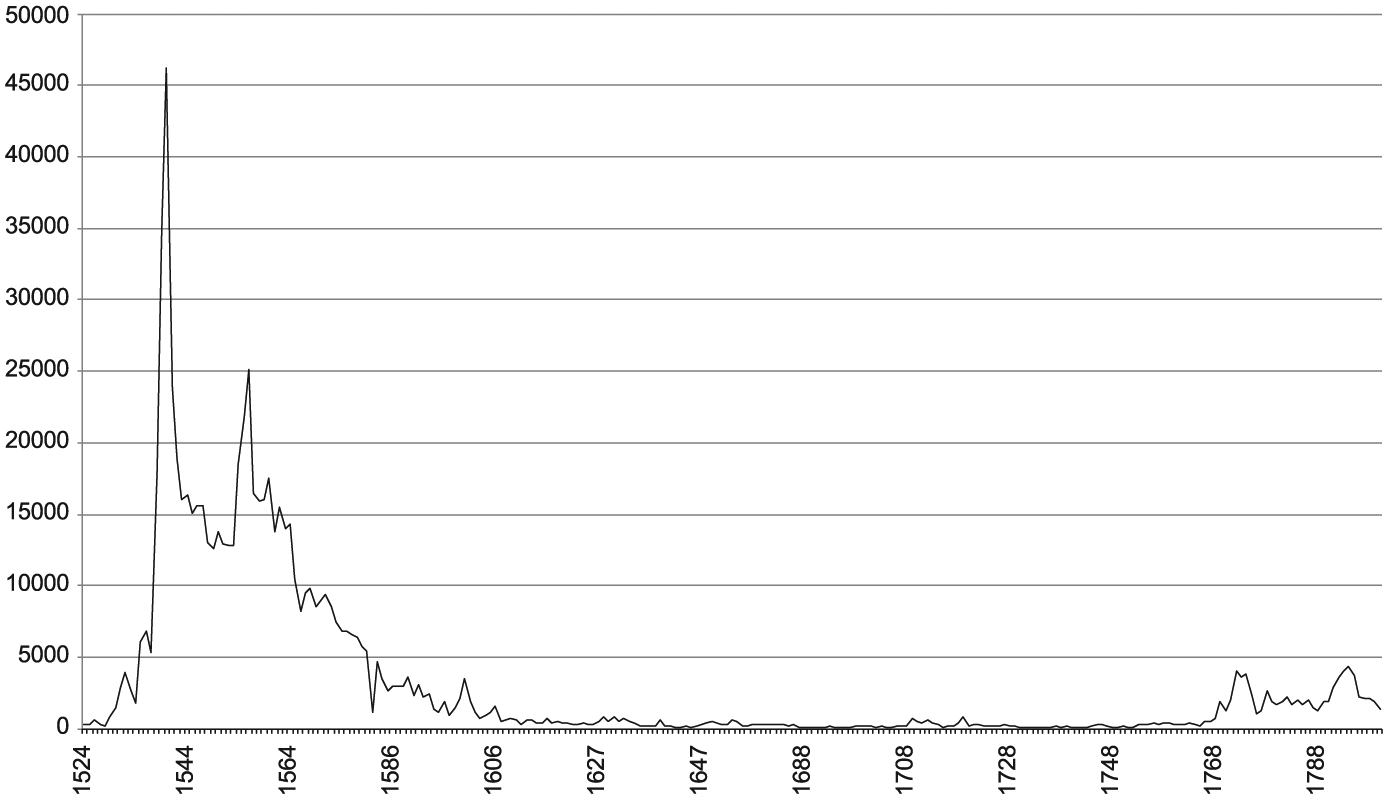
Silver output of the Marienberg district in Mark (ca. 234 g), 1524–1800.
People in early modern mining towns did not trace their history on a modern graph but, nonetheless, they were appreciative of the numbers behind it. Chronists used output figures to shape or punctuate their narrative, giving their present both a sense of deep time and comparability. Unusually large outputs were a thing to remark upon. 15 The most vivid account of what happened in the 1770s is found in Bergmeister-Leben und Wirken in Marienberg (1818), the memoirs of Heinrich von Trebra (1740–1819), covering the twelve years of his service in that town. 16 The Seven Years’ War (1756–63) had left Saxony with large debts, destroyed its cities, and upset the mines. 17 This situation gave cameralist discourse much traction, given this body of administrative practices and texts was a “development economics” whose origins lay in the aftermath of the Thirty Years’ War. 18 Politicians in the trading city of Leipzig and the princely residence city of Dresden soon initiated a suite of reforms that are summarily referred to as rétablissement. 19 There was a heightened sense in the state’s financial government that dwindling mining revenue – a concern that had always been central to the cameralist project – was a problem that could be fixed. 20 The man sent to fix it in Marienberg was Heinrich von Trebra. When he arrived in the town in 1767, the goal was to find ores quickly. “Everybody was waiting to see whether the new Bergmeister had a lucky hand in this, as he later found out.” 21 A turning point in the narrative is the discovery of a very rich deposit while inspecting a mine, as it shocked Marienberg’s productive cycle into a quicker pace.
I discovered two almost imperceptible, small veins; one extending vertically, the other one horizontally. I took a small sample of the quartzy vein material and discovered on it a small speck of argentite. “They should stop extraction works elsewhere and dig into this ceiling.” This was the extraction work from which came forth the fortune of the whole district. Only a few weeks after the inspection, this ceiling provided the most exquisite ores.
22
What is the best way of explaining this feat of prospecting? What had led Trebra, considering all the possible mines in the district, and all possible spots in that particular mine, to the one that yielded the ores needed to get Marienberg back on track? He was not a maverick miner who would roam the countryside with his eyes glued to the ground for “natural clues” until he got lucky. 23 Instead, he was a member of an extensive Bergstaat, or mining bureaucracy, which was responsible for organizing the extraction of metals in Saxony. To trace, as minutely as possible, the steps that led Trebra to this fateful find can tell us much about how knowledge was typically produced and used in this particular early modern bureaucracy.
Historians of the early modern state have emphasized the role of technical experts who were able to bridge (and sometimes profit from) the gap between abstract knowledge that was needed to run large endeavors centrally, and the practical knowledge that was needed to run them on the ground. These people often acquired special training and a carefully crafted persona to be, or appear to be, fit for the job. 24 This perspective would be in line with Trebra’s training at the mining academy in Freiberg, which involved undertaking a mining apprenticeship in the morning and attending lectures on useful sciences in the afternoon. Here, he picked up a particularly fruitful mix of practical and theoretical knowledge that helped him discover the vein: geognosy (today: geology), oryctognosy (mineral recognition), and underground surveying. 25
Although the expertise of individuals is important and is often emphasized by actors in a particular situation and scholars alike, it cannot by itself determine the success of administrative action. Trebra, for example, admitted that in 1768 he had not yet had the chance to acquire all the skills he needed for his new job. 26 More fundamentally, bureaucracies often concern themselves with tasks that exceed the mental and physical scope of individuals. Therefore, they rely on big (archives, libraries, collections) and “little tools of knowledge” 27 (stylus, ink pot, jade seals) to ensure their operations continue beyond the limited capacities and lifespans of individuals. This perspective would be in line with the mining maps Trebra consulted, the archives that told him about the mine’s past, and the memoranda and reports that he exchanged with his colleagues to form an opinion. 28 Arndt Brendecke suggests that such rich working environments could be described as an “epistemic setting,” in which bureaucrats could act, know, and communicate. 29
Yet, what is remarkable about bureaucracies is not that they employ people with different levels and kinds of knowledge, or that they provide unique material settings for such individuals to do knowledge work. What is remarkable, and arguably the key to their success or failure, is their ability to link people and “tools of knowledge” and to reproduce these links over time. 30 In this article, I want to bring out this feature more clearly than is currently the case in the debate among historians.
The art of prospecting
During the silver rush around 1500, the sky was high and the horizon wide. Standing on a summit in the Ore Mountains, a miner’s hopeful glance may have roamed over hilltops and valleys and skipped from villages to tree tops. “The miners at this stage were individualists and opportunists. They were untrammeled by the conventions of stationary society,” they “huddled under trees and in caves and bought or stole food from the peasants.” 31 For them, the Ore Mountains were a land of opportunity, and mining lore has many stories about serendipitous finds in that early period, when silver grew out of the soil to prick a monk in his behind when he sat down to rest, or to be cut like grass by a puzzled farmhand. 32 Riches in those days came unasked for.
Most of the stories, however, seem to date from a later period, when owners and workers were growing apart socially, and many miners found themselves underpaid, pushed around, and on the margin of their society. 33 Knowledge of veins now came as a blessing for people who were desperately looking for them as they knew that they could not survive long without income. In one of the tales, a miner had come with his family from the large town of Freiberg to look for ores near Bärenstein further up in the mountains, but he could not find any. “His worries troubled him even at night. He was often plagued by bad dreams.” However, one night, he dreamed of an angel who showed him a blue flower. He was told to pluck it and to hold it against the precipitous rock face on the south side of Bärenstein. In his dream, it cracked open, and a gnome climbed out to show him stacks of pure silver inside but said not to tell anyone about the treasure. Awake, he mined the designated spot, found rich ores, and his family was restored to happiness. 34
Such stories capture the despair of miners when the rock yielded nothing. Staking their livelihoods on an unpredictable environment, miners had to expect extremes, both long hardship and sudden wealth. However, although miners acknowledged that it was God, angels (and sometimes the moody Berggeist), who “locked and unlocked” the mountains, they also knew that there were ways to force their luck. 35 Miners were not usually as hapless as in the stories. If labor was the limited resource, one had to eliminate spots where it would be wasted.
Collective experience could guide a seeker’s step and eye as it suggested that ores were hiding in some spots but not in others. Rushing streams, toppled trees, and landslides were sought out as their force may have revealed veins. Springs pointed to ore in their proximity if their water had a telltale taste. When the hoarfrost settled, the grass went wet in some spots as veins emitted warm exhalations. For the same reason, trees whose foliage turned black or discolored held a clue, as did certain herbs or fungi that thrived above the ores. The rod, which many believed to be naturally attracted to metalliferous veins, was used to determine where to sink the spade first. 36 With these tools and techniques, knowledge about specific ores in specific places was consolidated. The once-wide horizon – I now use the word metaphorically, as a horizon of options – had shrunk. 37
The collected clues helped miners decide which spot was worth their labor. For the prospecting miner, veins sprang into being by inference, each with its own degree of certainty. But their existence would remain spectral, like the dotted lines that projected their course in mining manuals, unless the shovel and the pick were grasped; the proof of these imaginary veins was in the digging. 38 A prospecter could only be sure when the silver came pouring out of the furnace. 39 Acting on this kind of knowledge – expectations with different degrees of certainty that veins existed – required a leap of faith. This, too, was the stuff of stories. Three brothers were despairing about their unprofitable mine. “The Berggeist appeared in their dreams and told them to give up their futile attempts and walk north; they would find rich ores there. […] When they had walked for some hours, they found, in the midst of thick forest, some Zwitter ores. They began to quarrel whether this was the right spot or whether they should keep walking.” The Berggeist appeared again and abused them until they sank their mine. 40
When a mine was dug to follow a vein underground, the horizon moved with the miners. The wide horizon above was no longer visible. The virtue now was not swift judgment but perseverance. “A true miner must not be discouraged by a failed attempt. If he is not lucky the first time, he must try again.” 41 With great reluctance, the three brothers gave up their mine. If it had not been for the Berggeist, they would have kept working in their unprofitable mine. This, too, could be wise. Drilling through the bowels of the earth, miners could see the rock change with every fathom. Veins, they knew, were gregarious, they came in groups. Following one, miners often came upon others. 42 Plentiful cues appeared as they dug along – glittering specks, telltale colored rock, smells, the twitching of the rod – and, again, a decision had to be made as to whether to follow them.
In one story, miners in the Sankt Georg mine in Schneeberg hesitate before they act on uncertain knowledge. The Berggeist, this time dressed as a monk, appears on the wall of the mine. “The miners who worked there saw a cave full of silver.” Should they carry on with their tunnel, or get sidetracked by the demon’s cue? They decide against it. “Had they thrown their picks or other tools into the cave, they would have won the treasure. But for ignorance they did not, and the treasure disappeared.” 43 Wasting scarce labor on the wrong spot was dangerous, but wasting a good spot by not working it was foolish.
When Trebra ordered that “they should dig into this ceiling” in the Jung Fabian Sebastian mine, he seems so confident. The question is not how Trebra knew that there was ore behind that rock – he could not – but why he would so confidently allot scarce labor time to this particular spot. This was risky because, at that point, neither he nor anyone else could know for certain that the hoped-for riches would be there. One of Trebra’s successors, Jobst Christoph von Römer (1769–1838) explained to his superiors in 1796 why such an approach was, in fact, unwise. In an area where ore deposits were as scarce and scattered as in Marienberg, officials were inclined to choose the vein that looked the most expedient (zweckmäßig) for the execution of their plan. However, if the chosen spot turns out to be “not the most advantageous field, they will have lost time and forces on deceptive explorations, and the whole mine might find itself without the funds to continue.” 44 It was, therefore, wiser to spread the risk. Trebra was aware that ultimately, “I would held be liable for my actions; any failure certainly, but also any success, would only be mine.” 45 What made him confident that the labor would pay off? By retracing the steps that led him to this precise spot, much can be learned about how the Saxon mining bureaucracy formed knowledge about the underground deposits.
Heinrich von Trebra: Bureaucrat/geognost/mining scientist
In the mine, darkness reigned. However, when the miners shone their tallow lamps, the walls and ceilings lit up. “I discovered two almost imperceptible, small veins; one extending vertically, the other one horizontally. I took a small sample of the quartzy vein material and discovered on it a small speck [Flämmchen] of argentite.” 46 The gneiss, the most common rock in the Ore Mountains, glistened in the dark, and the “flame” of ore in the midst of this subtle play of light was auspicious. The sight of a fresh vein, Trebra wrote, was “the only friendly glance that smiled at me through this hotchpotch of confusions; I considered it a proof of my calling.” 47
Identifying a vein from the surrounding rock was not a matter of luck but one of experience. Trebra wrote elsewhere that he learned this art from simple miners. They “led me first, and showed me: this is the being that we call a vein, this is what we call a seam, this is what we call a stockwork.” 48 He valued the teaching of practitioners more than the lectures at the Freiberg academy (established in 1765) that was still not fully operative when he attended it in 1767. “Metallurgy with Gellert was the only thing I heard, and I had great expectations. As in his textbook, he covered mineralogy as well, which he taught using his sample cabinet, with comments that were hardly instructive.” 49 Learning from men “who were practically very informed about mining, who did not know about theory, which did not exist at that time,” 50 felt more effective to him. In one telling scene in Bergmeister-Leben, “professor Zeier in Wittenberg” stalks around the machine that he was paid to fix, uttering platitudes, while the local mechanic silently solves the problem. 51
Yet, Trebra did not dismiss scientific/theoretical knowledge or see it in opposition to artisanal/practical experience. Like his teacher, Christlieb Ehregott Gellert (1713–95), he collected minerals throughout his career. In addition, he shared geognost Abraham Gottlob Werner’s (1749–1817) measured optimism about the utility of the emerging earth sciences: if geognosts collect and systematize practical experience, they could improve traditional theories about veins, which in the future might help predict their “behavior” in the mines. 52 So, when he removed a piece of material from the ceiling of the Jung Fabian Sebastian mine and examined it in his hands, he used a scientific observational technique that was taught and developed in mineral collections at the academy in Freiberg, but that was also very much rooted in the collective practical experience of generations of miners. The “I” that discovered the silver ore in this episode, thus, offered a new template for mining officials. Bergmeister-Leben told the story of Trebra, the person and, at the same time, it outlined a new persona. These new bureaucrats married theory and practice, head and hand, Leder (the leather apron on which miners slid down the shafts) and Feder (the pen). Armed with grounded theory, hybrid experts like Trebra would not dither when they had to make difficult, technical decisions “vor Ort,” in soaked uniforms and muddy boots with only a flickering lamp to see by. 53
Trebra’s education and outlook – his persona – were “hybrid,” in Ursula Klein’s sense of the word. In choosing this word to characterize the technical experts that populated state-run enterprises such as mining, she emphasized that they bridged various fields of knowledge. They were neither mere savants, let alone natural philosophers, nor mere administrators and engineers. At meetings of academies and in their publications they reported what they had experienced at mundane sites, unfamiliar to most academicians. Inversely, they used their knowledge about plant species, materials, the chemical analysis, rock formations, mathematics and so on for the cultivation of exotic plants, chemical analysis of materials and various kinds of technical projects.
54
In the following, I want to emphasize the second part of this quotation, which describes the flipside of Klein’s concept: a crucial aspect of this hybrid expertise was to distinguish between the different ‘hats’ these hybrid experts wore. Put differently, hybrid experts were able to feed observations into various circuits of knowledge production and these were not mixed in the process. Arguably, their doing so created even clearer boundaries between those circuits rather than dissolved them. In Erfahrungen vom Innern der Gebirge (1785), Trebra contributed to debates among early earth scientists of his time on the role of water in shaping underground features and on the geology and mineralogy of central Germany. “I do not force my opinion onto anyone. I only present what I found, what I saw with my own eyes. […] I leave it to my readers to draw general conclusions from them; and when I did so myself, I wish that they be scrutinized as well.” 55 He offered his observations up in “friendly letters,” originally in private to the mineralogist and mining official August von Veltheim (1741–1801), but now in print to all “friends” who took an interest in his work. By 1785, Trebra was a member of the Akademie der Wissenschaften in Göttingen, the Deutsche Gesellschaft in Jena, the Ökonomische Gesellschaft in Leipzig, and the Gesellschaft Naturforschender Freunde in Berlin. 56 In particular, the latter may have encouraged him to employ the idiom of friendship when sharing his observations. The statutes of the latter organization envisaged a discourse among equals in the pursuit of knowledge: “A general equality among all members, in their vote and their rights in the Society, without consideration of birth, rank and standing, during our meetings or in matters of the Society.” 57
He did not hide in any way that he had made most of his observations during his service as a mining official. In 1776, Trebra eased his way into the Society with the fruits and windfall from his administrative labor. To “prove my high esteem to the Society,” he donated a copy of a report on Marienberg, which he had made for his superiors, to the library. He also donated a collection of “remarkable” mineral samples, such as a piece of cobalt with arsenic, which, he assured his new friends, gave his workers a “sore throat, corroded noses, noxious yellow blisters and similar damage, especially in the softest parts of their groins.” 58 In one chapter of Erfahrungen, he inserted verbatim the report of an official inspection of the Drey Weiber Fundgrube near Marienberg, which took place on 18 June 1777. Framed as it was as an appendix to the chapter, the report allowed for a very specific reading. Details that would have been of great importance to the Central Mining Office (Oberbergamt) could be left aside. For example, the water-column machine – an invention that was met with great expectations among mining officials, especially by Trebra, who had the mechanic Johann Friedrich Mende (1743–98) build one in Marienberg when the technology was still in its infancy – was of no interest here. 59 Instead, Trebra highlighted in the chapter that the inspection party had encountered what they took to be freshly “grown” ores that served him as proof that ores were, indeed, in constant formation. This piece of evidence was one step in the argument of the chapter, which was that the most important process shaping the underground deposits was fermentation (Gärung). 60 In other words, details that would have been important for the running of the mine, such as the position and condition of machines or the adit, were laid aside, whereas details that were of lesser importance for the management received full attention.
Calling Trebra a hybrid persona emphasizes connectivity and shows how diverse fields of knowledge (practical, theoretical, scientific, administrative) could be conflated into one single biography. The focus of this article, however, is the boundary work that makes hybrids interesting and, in fact, logically possible. Paying attention to Trebra’s different roles as administrator and Naturforscher helps in understanding how the fields of knowledge and social action were kept apart. Abraham Gottlob Werner, recently described by Ursula Klein as a prototypical hybrid expert because he straddled mining practice and natural science, 61 purified the emerging field of mineralogy by excluding many fields of knowledge of whose value he was convinced in other situations: “Anyone will see that there is no place in a mineralogy for an assaying manual, descriptions of mines, smelting procedures etc.” 62 Werner, the mineralogist (especially one who had to devise curricula for the new mining academy), and Werner, the mining official, contributed to different conversations – continually to both, but not simultaneously in every action or utterance. A hybrid expert is, thus, a bundle of different social roles who is able to fit into different contexts without losing a sense of self-identity.
What, then, about Klein’s “useful sciences” – an actor’s category that she turned into an analytical term – in which hybrid personae like Trebra were naturally at home? Trebra did contribute to the hybrid field of “mining science,” which combined practical and theoretical insights, especially by founding the Societät der Bergbaukunde (1786) and by editing their journal Bergbaukunde. 63 The Society invited both “savants and practical mining and smelting experts” (Gelehrte, und praktische Berg- und Hütten-Verständige) as well as “theoreticians who work in the said sciences for the utility of mining” (Theoretiker, die die vorbenannten Wissenschaften zum Nutzen des Bergwesen bearbeiten). These “sciences” ranged widely, from geography through metallurgy to mining history, “everything done in a practical fashion, to increase mining.” 64 Contributions to this diverse body of knowledge were welcome from members of the Society but, here, again, limits were quickly staked off: “political and financial secrets are not to be included.” 65 These “secrets” – financial data, government budgets, general economic policy – were crucial for managing the mines, but for both political and epistemological reasons, this information had no place in the open, consensus-based scientific discourse that was to coalesce around the new journal.
The circuits of earth–scientific knowledge production that Trebra inhabited are readily available to historians of science, as a number of meticulous studies have been devoted to early geology, emerging, as it were, from the mines of Saxony. 66 They can now also learn more about the scope and impact of “useful sciences,” such as Bergbaukunde, in Ursula Klein’s excellent recent work. 67 Less known, however, will be that other side: the bureaucratic knowledge production that was running in parallel with the earth sciences and the useful sciences and with which both intersected in so many ways. To follow that story, we have to return to the fateful find in the Jung Fabian Sebastian mine in 1768.
Distributed cognition in the mines
Trebra used his skills of mineral recognition in one particular spot. How did he locate that spot, in all the tunnels of the mine? The fateful find was made during a Generalbefahrung, or official inspection of a mine, which was carried out in a group. The report, dated 15 January 1768 and now kept in the Bergarchiv in Freiberg, tells us who else was a member of that group: “I, Bergmeister Trebra,” the assessor Martin Hoppensack, assessor Christian Gottfried Täuscher, and the manager and foreman of the mine. 68 Sometimes, individuals were fused into an inspection party by elaborate ritual. In these cases, they ate breakfast together, said prayers, sang, and enjoyed the music of a brass band, and only then made their descent into the mine. 69 In our case, however, this is not mentioned in the documents.
During their visit, the party made sense of the architecture of the mine, its rocks and minerals, machinery, and ongoing works. The report of 1768 follows the rules with regard to the writing of such reports and is, therefore, narrowly concerned with the results of the visit. We have to rely on Trebra’s memoirs for a richer description of how the interaction with local staff may have unfolded.
Where did you last have the rich ore? Trebra [sic!] asked the foreman, thus following the principle of “ore points to ore,” which he had heard many times from experienced foremen in Freiberg, and which he had seen, every now and then, to be a successful approach […] . Upon my question, the foreman showed me the point in the ceiling, exactly vertically above the adit, from which they had taken the last rich ore.
70
[This is where he then discovered the speck of argentite, author.]
Such reliance of higher-ranking officials on local informants was typical, and reflective of the great degree of division of labor in Saxon mining. Workers carried out highly specialized tasks and were supervised by a large managerial group of officials. These again were divided, albeit not strictly, into officials “of the pen,” who carried out mostly clerical work, and officials “of the leather apron,” such as surveyors, assayers, managers, and foremen, who busied themselves with technical tasks. 71 August Beyer (1677–1753), a surveyor and high official at the Central Mining Office in Freiberg, called it a custom that “when officials, managers, and foremen gather for an inspection, the latter explain to the former what the mine is like and what works had been done; then they deliberate together.” 72 Reports of Beyer’s own visits to Marienberg in the decades before Trebra’s arrival show how visiting officials and local staff discussed problems and decided on solutions by vote in the mine. 73
It is useful to analyze the knowledge work performed during an inspection as socially distributed cognition. I am not the first historian to propose this framework for contexts of epistemic collaboration. Pamela Smith encouraged her readers to imagine a much more inclusive history of “techno-medico-science,” in which “distributed cognition and collaborative working methods are the norm, in contrast to conventional models of cultural production.” 74 Chandra Mukerji used the framework brilliantly to study the epistemic and manual labor that went into the construction of the Canal du Midi across the jarring social divides of seventeenth-century French society. 75 Francesca Bray, in a book on clothmaking and farming in Imperial China, merges distributed cognition with actor–network theory to exorcise the term “technology” from male and Western bias. 76
Distributed cognition is only one among several ways of understanding the mind “as embodied, indeed as extended beyond the body, and beyond the individual, and as interacting with the things of the material world.” 77 Other “postclassical” approaches to the mind focus on tricky issues of agency and intentionality, the body, and material objects. 78 Distributed cognition, however, is mainly concerned with how groups form shared “interpretations of reality.” 79 The cognitive anthropologist Edwin Hutchins developed this model to explain highly labor-divided situations such as cockpits or the bridge of a ship. His 1995 book, Cognition in the Wild, described taking his model out of the psychology labs to explain how people solve real-world tasks. However, all his empirical work took place in the very domesticated setting of a U.S. navy vessel. Hutchins portrays the bureaucratic hurdles that he had to overcome to get access to the ship and, once aboard, how he moved through a dense network of rules, not all of which even registered with him. Organization scholars consider Hutchins one of their theorists as he is published and cited in their flagship journals. 80 In other words, his is an off-the-shelf model of how knowledge was produced and used in bureaucracies. This is what commends him to the history of bureaucratic knowledge.
Such an analysis typically employs detailed observation data, which is missing in our present case. The cognitive back and forth during the visit in January 1768 is no longer accessible. There is no record of how individual rocks were discussed and investigated, how members of the group voiced their impressions and expressed their doubts, and how they adjusted their expectations. The report records only ore veins that were identified as such, and mentions ore that was being, or had been, taken out. Even the dense archival record of the Saxon mining state only gets us so far in observing how ideas about the location of ores were formed socially.
One episode in Bergmeister-Leben, however, sheds light on this process. It turns out that one of Trebra’s decisions in the Jung Fabian Sebastian mine was challenged by a foreman.
[He] was old, used the rod and really looked like a sorcerer, because he had been seduced by his fantastical divining rod to disobey the second instruction that was earnestly given to him during the first inspection. He was supposed to dig on the Frischglückter Flachen vein towards the Kaiser Heinricher Stehender vein in a northern direction, as many rich ores had been discovered here on the southern side, which gave hope for the northern side too. But his rod would not bend there, so he did not allot labor to that extraction point.
81
The day-to-day allocation of labor was in the hands of the foremen (Steiger), whose office had a dualist character. They represented the interests of the prince as much as those of the shareholders. In fact, they were the only officials over whom the shareholders, as the actual owners of the mines, had any influence. 82 During his long professional life, the foreman of Jung Fabian Sebastian might have learned that wrong managerial decisions wasted labor, and perhaps he had reservations about the judgment of an inexperienced bureaucrat. To protect the interests of the mine, he chose to do another test on the vein that Trebra expected to bear ores, which turned out to be negative. At this point, he developed a different knowledge claim (or “interpretation of reality,” to use Hutchins’ term). His expectation of ore hiding behind the rock was not firm enough to justify the labor. 83 Trebra punished the man by withholding one week’s wage and forced him to have the vein dug out. This made it clear on whose knowledge claims the mining work was to be based. Trebra’s punishment shows what it meant to enforce a view in the Saxon mining state: the foreman worked five eight-hour shifts without pay.
Counsel and obedience
Distributed cognition, thus, does not imply that interactions take place between equals. In fact, it is more often than not observed in hierarchical settings: Pamela Smith used it for workshops with masters, journeymen, and apprentices, and Chandra Mukerji to bridge the social abyss between peasant women, who had locally adapted hydro-engineering skills, and gentlemen engineers, who lacked them, but wanted to build a canal. 84 Hutchins’ primary cases are a military navy vessel and the cockpit of airplanes. He also studied hierarchy in computer models and described its effect on groups in functional terms: the group’s leader chooses one among the emerging knowledge claims so that the group can act effectively. 85
As the episode of the rod-using foreman shows, different members of the cognitive system could arrive at very different knowledge claims, but for the work to continue, these claims were conflated into one. The way in which officials such as Trebra conceptualized this process was counsel, by which a superior gathers different knowledge claims to make a decision, and obedience, by which one claim is enforced across the group. The authority that enforces a knowledge claim in the Saxon mining bureaucracy is very different from the authority that does so in the scientific discourse prevalent at the time. 86 Whereas science relies on consensus among equals, bureaucracy relies on hierarchy. 87
Trebra, who was an exemplar of a new class of mining officials that he helped to define by writing his memoirs, did not shy away from granting autonomy to his subordinates; he fully endorsed it. He preferred foremen whose knowledge, experience, and education (schöne Kenntnisse, Erfahrungen, und auch wohl Bildung) enabled them to track down rich deposits in Marienberg’s “stark, mysterious mountains.” He wanted mine managers to engage their foremen in “useful deliberations about where to have a new extraction point, and about how the existing ones could be worked more advantageously. Everybody in the Saxon Ore Mountains must speculate about these questions constantly.” 88 This emphasis on autonomous thought is resonant with a shift from a Wolffian conception of “common man [as] inadequate to judge what is useful or harmful” to “a new anthropology, in which the interaction of free human beings exercising their reason created order, not the statesman.” 89 Like other enlightened administrators he wanted the people he worked with to form their own knowledge claims.
This autonomy, however, was embedded in a strict hierarchical structure in which he was at the top. A mining director, Trebra wrote, must study the strengths and flaws of those he enlists. He must learn “to replace one by another, to control one with the other, and to entangle the whole in such a way that imperfection and weakness is avoided, and everyone’s strength and perfection is applied solely for the whole, for reaching the given goal.” Thus set up, the Geschäfftsmaschine will run even during his absence. 90 This, too, is typical of the intellectual context that he inhabited. Although embracing the idea of autonomous individuals, cameralist thinkers stressed that “institutions of the greater civil society could be purposively arranged to meet the common good of the individual members, [which meant that] a way back to the older conception of economic order remained open.” 91 More concretely, Trebra’s watchmaker fantasy of a bureaucratic machine echoed the ideology of the Saxon rétablissement, “The essence of the state is the union of many individuals and families to foster their common good. […] Its essential form consists of unifying the willpowers and powers of its individual members in one direction for the common good.” The government of a country required “the greatest individual skill and indefatigable diligence of the prince” but also a great number of people to carry out “manifold business.” It is important “to get to know those people” and “to choose for each one a place in which one can be certain that they are most useful.” 92
These instructions were written down by the jurist, mayor of Leipzig, and tutor to the prince Christian Gotthelf Gutschmid (1721–98) in a manuscript that was to prepare the young Friedrich August for government and provide him with the cameralist role model of an absolute ruler who listens to counsel. 93 Trebra, the prince’s representative in Marienberg mining, approached authority in a similar way: “I sought out others when I had a raw idea about a great thing; I listened to everybody. Big and small, old and young, friend and foe (as the latter is often more useful), distinguished and mean (as the naked truth that I wanted was easier to get from the latter).” 94 When he had heard the counsel, he decided which interpretation of the facts was most suitable for the problem at hand. “When I had asked around for truth, and listened to all, then I acted upon that which I had perceived through all judgements as true and useful.” This decision was his, and only his: “I did not follow anyone but myself, as I would be held liable for my actions; any failure certainly, but also any success, would only be mine.” 95 In other words, he formed a knowledge claim based on his own observations and on the counsel of others. Once this claim was declared as guiding his decision, it became binding for his subordinates, some of whom helped him form his impressions.
Whenever necessary, he enforced the primacy of his claim, as in the case of the foreman who used the rod. For Trebra, obedience was key for the smooth running of the Geschäftsmaschine. In a revealing passage in his memoirs, Trebra describes in detail how he humiliates (verdiente Erniedrigung) a foreman by stripping him of his status and forcing him to work as a wrenchman in front of his workers for having disobeyed his orders. 96 The connection between counsel and obedience is summed up by Gutschmid in concise terms: “To further the happiness of the State it is necessary that decisions, which could be useful or harmful to the State, are not taken without prior contemplation and counsel.” Once a decision is made, however, “it has to be ordered in the most obedience-provoking way.” 97 Knowledge claims were, thus, propagated across groups; this was shown not by expressions of intellectual assent but by certain tasks being done. Aligning human behavior to an external reality by order/obedience rather than persuasion/assent sets bureaucratic knowledge production apart from the ideals of the sciences that Trebra participated in.
Bureaucratic knowledge at work
As Gutschmid’s statements suggest, binding knowledge claims were not only formed, propagated, and sometimes enforced during the inspection of a mine but across the entire hierarchy of the mining state. This is important if we want to understand why Trebra chose to visit this mine, of all the mines in the district, and perhaps also why he was sent to Marienberg in the first place. Directors were obliged to leave their local Mining Office at least once a week for inspections, so that all mines in their district would be examined within the course of a year. 98 Following this protocol, Trebra would have come across Jung Fabian Sebastian sooner or later. However, it was not during the inspection on 15 January 1768 that the mine’s great potential was first noticed.
First, there was a diffuse kind of collective empiricism that originated outside the bureaucracy itself. “Much lore was being passed around in town, both by word of mouth and in writing, about the richness of these mines,” as Trebra explained their particular allure. 99 This stretch of land, some three kilometers northwest of the town, near the village of Lauta, was one of oldest mining sites in the district, whose early finds had in fact triggered the silver rush in 1519 and the founding of Marienberg shortly thereafter. Trebra actively gathered this “lore,” expanding a collection that had been started by his predecessor. 100 The resulting seven large volumes, he wrote, should be kept as “sacred objects” (Heiligtümer) in the archive of the Mining Office in Marienberg. 101 By collecting this information, and using it in decision making about the allocation of labor time, the Mining Office tapped into the “intelligence of the region,” to use Mukerji’s phrase. 102 This was distributed cognition that far exceeds the hedged, technical situations described by Hutchins. Knowledge about the location of ores was settling in a diffuse way. It accreted over time, along with the mining landscape that it helped to transform. 103
However, there was also a collective empiricism that took place within the bureaucracy. The Saxon mining state had, over the centuries, developed into four tiers, in each of which decision making took place. So far, we have dwelled at the lowest level of sworn-in managers (Schichtmeister) and foremen (Steiger), who organized the everyday exploration and extraction in individual mines. We have also – in Gutschmid’s programmatic writing – heard about the top of the hierarchy in Dresden, where a mining department ‘counseled’ the prince (in 1782, the Bergkollegium merged into the Geheimes Finanzkollegium). Plying back and forth between the reality at court and the reality in the mines, the Central Mining Office in Freiberg and a number of district offices (Bergämter) made most of the technical decisions about local and regional infrastructures and developed long-term goals for the entire mining sector. 104
In this four-tiered system, the Central Mining Office served to relay and transform information that it received from the local offices or its own inspectors. This information comprised reports of all sorts: yield figures, budgets of the local offices, wage lists, accounts about contribution payments, inventories, “and especially the annual conspectus about the economic and physical etc. state of the whole district.” 105 Senior officials registered incoming reports and letters and distributed them internally among their councilors and assessors. As incoming reports still contained “too much to know,” 106 the main work consisted in sifting through the many Nachrichten or notitiae and flagging those that were worthy of attention; they were then brought up in the meetings. This process involved a decision about what was information in the first place. Only some parts of the incoming paperwork were copied into a subdocument and informed further action. The rest was discarded, commended to the archive and, thus, “forgotten.” 107
In the case of Jung Fabian Sebastian, it was a pattern in the financial data (high yields, then a sudden drop) that had flagged the mine for inspection: This mine had just been claimed on a fresh field and sold to shareholders, and the first deliveries of newly found ores had come in (the first one of 16 marks, 4 loths, and 3 quints in the spring quarter of 1766, and, until the winter quarter of 1767, 201 marks, 10 loths, 0 quints in total). […] Then they had stopped finding ores, so the goal was now to find them again.
108
Yield figures like these, casually added to Trebra’s narrative, were laborious to produce. When ores reached the surface, they were brought into a sorting house, where boys removed the minerals in which they were embedded. The separated ore was washed by the river and then brought to the furnace. Here, it was assayed to make sure that its silver content was rich enough to be smelted. The delivered ore, the assaying results, and the amount of the extracted silver were recorded by an overseer, both in the books of the furnace and on a slip that was handed to the representative of the mine. The homogeneous formatting of these records was conducive to aggregation. The yields of individual loads could be listed, which allowed for the easy calculation of totals and, thus, statements about the long-term performance of a mine. 109
Twelve months before Trebra made his fateful find it was thought that Jung Fabian Sebastian was worth a closer look based on information that was presented in a meeting at the Central Mining Office in Freiberg. In January 1767, Carl Eugen Pabst von Ohain (1718–84) reported on the state of affairs in Marienberg. To make it easier for his colleagues to turn knowledge into action, he had arranged the names of Marienberg’s mines in a list containing three sections: the first section noted mines of “great importance”; in the second section he added those that were “less important but still of good hope”; and in the third section were those that were “not digworthy” and flagged for liquidation. 110 When Pabst von Ohain told his colleagues what he had learned about Marienberg, he related personal observations but he also condensed the conspectus of the Mining Office in Marienberg to a succinct list of “digworthy” mines. The list was sent to the government in Dresden but, more importantly, communicated to the Mining Office in Marienberg, expressly to guide how they allocated funds and efforts: investments into the third category should be prohibited and diverted into those mines that were “more important and had a greater probability [Wahrscheinlichkeit]” of producing yields. Jung Fabian Sebastian came second on the first list and, hence, deserved full attention and support.
Trebra himself had been part of a commission that in 1767 had surveyed all mining districts with the exception of Marienberg itself, which was how his protector Friedrich Anton von Heynitz (1725–1802) had prepared him for his office. He underwent a sort of apprenticeship and learned by doing how to conduct inspections, take part in meetings, and process files.
111
In October 1767, he was suddenly sent to Marienberg to write a comprehensive report on the state of its mining. This was a proof of his abilities that Heynitz needed in order to convince the government in Dresden that Trebra was a suitable candidate, although he lacked experience and although the office of a Bergmeister had never been held by an aristocrat.
112
I studied as many maps as I could; I walked over those mountains, whose gentle slopes were the most promising surroundings of the impoverished mining town; I inspected mines, to make more lively and correct the ideas that occurred to me during the perusal of maps and my walks above ground; I talked to miners of all stations, as many as could be intelligently interrogated.
113
When he found a speck of ore in the Jung Fabian Sebastian mine some two months later, he was probably not surprised. It was just one more piece of information that made the silver less dreamlike and more real. The “intelligence of the region” had already located it there; previous inspections in the mines had gathered more clues to its existence, as had the reports that were examined at the Marienberg Mining Office and the Central Mining Office. The product that eventually flowed from the furnaces was only the last step in a slow, distributed process of making silver a reality on which everybody could agree. At the end of his memoirs and his life, Trebra took stock: in the ninety-three years before his arrival, the mines of Marienberg had yielded but 213 Mark silver per annum, whereas in the twelve years of his service it had been 2,213 Mark per annum. “Who would not like to have sacrificed the best twelve years of one’s professional life to such a flourishing of the mines!!” 114
Conclusion
The journey is complete, from a mere “cameralist dream” 115 of reestablished mines in Marienberg to real silver jingling in the coffers of the Bergamt, the government, and the mine owners. All along the way you might have wondered about my definition of knowledge, what it covered, and what not. In this article, I take knowledge to be what Hutchins describes as a coherent and accepted interpretation of reality that was produced in a socially distributed way. In other words, I am less concerned with the propositional knowledge of individuals, which is difficult to recover in retrospect, and more with knowledge as it was communicated in and shaped by social interaction. For the sake of argument, I am also less interested in tacit knowledge embodied in people or objects because this would emphasize the hybrid nature of the working practice of miners and mining officials, which has been demonstrated elsewhere and which serves as the starting point of my argument. 116 From this foundation, I explored the purification or boundary work that hybrid practitioners were engaged in.
By education and outlook, the bureaucrat/geognost/mining scientist Trebra was a hybrid expert. This enabled him to wear different ‘hats,’ and to feed his observations and judgments into both scientific and bureaucratic circuits of communication. These circuits were kept apart by their respective attention economies, in which ‘irrelevant’ details were bracketed and ‘relevant’ details were highlighted. For the mining official, the position of a silver ore deposit in relation to the next extraction point had a high information value, whereas its position in a specific kind of rock layer was, at best, of secondary interest; for the geognost, it was vice versa. When Trebra put forward one or the other aspect, he strengthened the boundaries that his hybrid persona bridged.
Although the scientific discourse in which Trebra participated is readily available to historians of science thanks to excellent work on the topic, the bureaucratic knowledge production of the time is less so. In this first foray, I detected a number of interesting features. Understood as a nested system of socially distributed cognition, the Saxon mining state continually produced competing knowledge claims. In my case, these claims were about the location of ores in the rock. Each claim came with its own horizon of options as to where the scarce labor time could be best used. As the work in the mines was done in teams, a decision regularly reduced the variety of claims to the one that would be binding for the team. When the miners worked their way through the rock, they hit upon new clues that would confirm or reject their working hypothesis.
Expressed in such terms, the process resembles scientific research as it was carried out in the fields of mineralogy, geognosy, and useful sciences. However, more concretely than the science of the time, the Saxon mining bureaucracy relied on hierarchy to determine which knowledge claim would be binding for the group. Officials such as Trebra expected their subordinates to make observations and propose knowledge claims of their own (counsel). Then, however, the highest-ranking member in a given context made a decision about which claim would inform the allocation of labor (obedience).
Counsel and obedience can be interpreted in functional terms. Mining officials had to coordinate labor. This means that they had to plan the allocation of labor within a mine or across a number of interconnected mines. Mining, however, was an intensely local activity, especially deep-rock mining in the convoluted geology of the Ore Mountains. The only truly general rule that Trebra was prepared to impart to apprentice officials was to “adapt yourself to the circumstances!” 117 So, how could officials devise abstract plans that would work in concrete situations? Counsel, here, provided a way to capture realities on the ground and, thus, introduced variation into the interpretations of reality, or knowledge claims, that were globally available in the administration (“I listened to everybody”). The authority vested in rank provided a way to select one claim (“I did not follow anyone but myself”). Order and obedience were ways in which to propagate this selection and to make it binding for the whole group. Members of the group who based their actions on a different knowledge claim (such as the rod-bearing foreman) could be sanctioned because they had violated their duty to obey. Because counsel and obedience were iterative, a currently binding knowledge claim could be challenged and altered in the next round of decision making. 118
This process combined flexibility and stability and may be one of the explanations for the remarkable resilience of the Saxon mining state in the face of both internal crises (Tiefbaukrise ) and external ones (Thirty Years’ War and Seven Years’ War). In the eighteenth century, this robust mode of nonscientific knowledge production occasioned and incorporated scientific endeavors. If German states were a “hothouse for certain kinds of [technical and scientific] knowledge” 119 as is undoubtedly true, can their bureaucracies perhaps be thought of as the iron cage and the glass panes of that hothouse? Sometimes, types such as Trebra, somewhere between an itinerant projector and a sedentary civil servant, used existing structure to further the ‘happiness’ of the state, and their own careers, at a breakneck speed (Figure 1). 120 More remarkable, however, is that certain modes of producing and conflating knowledge claims proved resilient to war, epidemics, and self-serving officials – long enough for cameralist and enlightened reformers to pick up the thread (Figure 1). Under their hands, the Saxon mining state was becoming more refined than ever before in the first half of the nineteenth century, only to be dismantled around 1850 under the pressure of liberal ideology. 121 It may be worthwhile, however, to investigate how much of state–bureaucratic knowledge production was actually adopted by capitalist companies in the following years. Mining academies across Europe and South America likely preserved and developed Saxon modes of knowledge production, sending graduates around the globe who would inject state–bureaucratic information techniques, reporting genres, role models, and organizational blueprints into an increasingly privatized world of mining. 122
Another line of future research should involve more comparative work between bureaucracies. Spanish America and Imperial China had hierarchical structures just like the Saxon mining state. However, the vastness of these empires created variations of hierarchical communication (“vigilance” in Spain and “layered quotations” in China) that were quite different from little Saxony, where managers and managed often met face to face. 123 Only careful comparison with other bureaucracies will show whether or not some form of counsel and obedience is a general feature of bureaucratic knowledge production and, if so, how this manifested itself in particular cases. Historians of science are in a good position to engage in that line of research as they now have at their disposal a tried and tested apparatus for dealing with complex questions of historical epistemology. By doing so, they will once more expand the scope and depth of their field, but they may also gain a clearer and much needed sense of what science was not.
Footnotes
Acknowledgements
A draft of this article was presented at the colloquium of Dept. 2 at the MPIWG Berlin and at the 2016 meeting of the History of Science Society. I am grateful to Christine von Oertzen, Elaine Leong, Ursula Klein, Andrew Mendelsohn, and two anonymous referees for reading and commenting on later versions.
Declaration of conflicting interests
The author(s) declared no potential conflicts of interest with respect to the research, authorship, and/or publication of this article.
Funding
The author(s) received no financial support for the research, authorship, and/or publication of this article.
