







Abstract
In the eighteenth century, the sciences and their applications adopted a new attitude based on quantification and, increasingly, on a notion of precision. Within this process, instruments played a significant role. However, while new devices such as the micrometer, telescope, and pendulum clock embodied a formerly unknown potential of precision, this could only be realized by defining a set of practices regulating their application and control. The paper picks up the case of pendulum clocks used in eighteenth-century observatories in order to show the process of learning in the course of which the pendulum clock first became a precision instrument. By examining the results of an especially developed statistical analysis, conducted to compare the performance of eighteenth-century clocks, it highlights the diversity of conditions, attitudes, and manners of handling that are characteristic for the epoch. In this way, it underlines the necessity of standardization of timekeeping practices rather than exclusively focusing on the technological development of clocks. Ultimately, the paper discusses the role of makers and users in order to show the evolution of a “precision instrument.”
Introduction
In the eighteenth century, the sciences and their applications moved from the “world of the ‘approximate’ to the universe of precision.” 1 This universe has long attracted scholarship, which has explored its many facets from multiple angles. Historians examined the move from geometry to analysis and algebra in the mathematical method underlying contemporary philosophy, and studied the growing systematization and quantification in a large number of fields that went hand in hand with it. They called attention to the fact that subjects as diverse as forestry, botany, economy, and meteorology, plus the so-called Baconian sciences (chemistry and the study of electricity, heat, and magnetism), fell under the spell of the “quantifying spirit.” 2 The changes perceived to have been brought about by the application of a quantitative rather than a qualitative approach, particularly for the natural physical sciences, were such that Thomas Kuhn referred to the process of its implementation as a “second scientific revolution.” 3 Within this wide landscape depicting a developing concern for numbers, measurement, and the quality of the obtained data, the present paper concentrates on one particular landmark: the astronomical observatory.
While astronomy’s intimate connection to quantification goes back millennia, it was in the observatories in Paris and Greenwich, founded in 1667 and 1675 respectively, that a new concept of precision developed that shaped not just astronomy but all the sciences united under the roof of the observatory, especially cartography and geodesy. 4 This culture substantially rested on newly invented instruments such as the filar micrometer, the telescope (or application of telescopic sights to measuring instruments), and the pendulum clock. The combined use of these instruments was to “revolutionize both the methods and the standards of observational astronomy,” with the new clocks playing an essential part in, among other things, the determination of terrestrial longitude, the movements of Jupiter’s satellites, and the right ascension of stars. 5 Altogether, an “entirely new standard of accuracy and refinement became possible,” as John Olmsted commented. 6
That instruments played a significant role in the emerging “universe of precision” has been unanimously acknowledged in the secondary literature, but the contours, agents, and effects of this role are less clear. 7 As this paper shows, precision embedded in instruments is a promise that can only be fulfilled with the help of the user. For this reason, a defined set of practices had to be created around the instrument that prescribed appropriate modes of handling, use, and control. 8 This process in turn affected the whole of scientific practice and scientific thought. Taking up the case of pendulum clocks used in observatories, this paper describes the evolution of a concept of precision, referring to its uniform going, as distinct from related notions such as accuracy, describing the agreement of the clock with astronomical time. By exploring this development, the article adds to the history of the “universe of precision” in general and the history of the clock in particular. It first discusses the meaning of the terms “accuracy” and “precision” in relation to pendulum clocks used for observation purposes in the seventeenth and eighteenth century. In doing so, it will draw attention to the wide range of opinions and knowledge circulating among astronomers as well as to the variety of clock types present in observatories. In this manner, the article supplements the story of increasing technical perfection, which is popular in the horological literature. 9 To widen our understanding of what constitutes precision in clocks, the paper also evaluates the performance of clocks in a number of European observatories, especially the ones of Saint Petersburg, Prague, and Greenwich. Here, it presents the results of a statistical analysis of historical performance data, derived from published and unpublished clock registers, which were compiled by astronomers to examine the performance of their timepieces and retrieved by us from archives, contemporary journals, ephemerides, and other publications as well as correspondences. 10 With the help of modern statistics, we generated parameters that facilitate the numerical comparison of the degree of precision reached by eighteenth-century observatory clocks. It is even more important, however, that the results of our analysis constitute a means for further investigations. Our parameters direct attention to the diversity of conditions as well as timekeeping and control practices in these places, thereby transferring the question of precision from a merely technical level – which has dominated studies on clock precision so far – to the more complex one of methods and handling. 11
The importance of the latter will be demonstrated by an in-depth analysis of the clocks and timekeeping practices in the Berlin Observatory. Founded in 1700 under the roof of the Kurfürstlich-Brandenburgische Societät der Wissenschaften (Electoral Brandenburg Society of the Sciences), according to the plans of Gottfried Wilhelm Leibniz, it had a high formal standing as a state and academic institution. It thus serves very well for comparison with its counterpart in Greenwich, which, however, has received decidedly more scholarly attention, resulting in a one-sided image of contemporary observatory practices, with Greenwich appearing as a generally applicable example. 12 The paper counteracts this image by underlining the characteristic diversity of the epoch’s attitude toward clocks even in the observatory and showing the process of learning that accompanied their use. The results of this process can be seen in several studies on the performance of clocks published toward the end of the eighteenth century, in which the concept of the precision clock clearly transpires. However, while these studies were conducted by astronomers, it was the joint effort of a particular group of makers and scientific users that distinguished the pendulum clock as an instrument of “the universe of precision.”
Precision in clocks: No matter of course
Unsurprisingly, the correct or incorrect going of mechanical clocks was the subject of comments almost from their first use for scientific purposes. Tycho Brahe and Jan Hevelius both famously reported on the difficulties caused by the unreliable performance of their timepieces. 13 As is commonplace, matters improved considerably after the application of the pendulum, but, as regards detailed information, contemporary comments typically remained staggeringly vague. Either astronomers simply assured each other of the correct going of their clocks, as, for example, Joseph-Nicolas Delisle, who merely told the Duke of Solferino that his four great pendulum clocks in the Saint Petersburg Observatory went “very accurately,” coinciding to the second, or they gave isolated values of a clock’s performance without detailing methods of evaluation or proving the result. 14 So did Jean Picard, who claimed that one of the clocks that he used during his sojourn near Tycho Brahe’s old observatory Uraniborg in 1672 varied by less than one second in more than two months. 15 At first glance, Picard’s value seems straightforward enough; however, this ostensibly unambiguous number does not reveal whether it denotes divergence from rate, the known and ideally constant daily error of the clock, or momentous divergence from mean solar time. Hence, its relations to precision as denoting the uniform going of the machine, and accuracy as signifying the proximity of clock-time to astronomical time, are not entirely clear.
This finding is not altogether surprising as the changing understanding of both terms, accuracy and precision, over the course of history has been studied extensively. 16 Clocks, however, often seem to elude these discussions as their uniform going is regarded as a history-defying desideratum pursued, at least, since the first days of the application of the pendulum. Indeed, as the emergence of the pendulum clock was tightly linked to pressing scientific and practical problems such as finding longitude at sea, the issue of precision was close at hand. 17 The successful deployment of clocks for finding longitude on a ship voyage across the ocean depended on the clock’s regular going, that is, a uniform rate. Having said this much, the earliest instructions for the use of sea clocks nonetheless show that the notion of rate was still in its infancy. 18 Christiaan Huygen’s directions, in the original Dutch as well as in the enlarged English translation, speak of the error of the clock, but rather in passing than by enumerating its determination. Even though the English text offers guidelines for a “Journal for the Watches,” no rules were set down regarding the monitoring of the timepieces in advance of the voyage. Rather, the clocks seem to have been set to time before departure; their rate, therefore, would have been unknown. Moreover, Huygens’ instructions do not outline a defined procedure for an actual evaluation of the timekeepers during the voyage. While the issue of precision shines through the advice given on the set-up of the clocks, their daily readings, and, particularly, the determination of local time, the timekeepers nonetheless were hoped to be accurate, that is, true to astronomical time, rather than precise. 19 Matters were further complicated by lack of discipline on the side of the observers, which obscured the actual performance of the clocks. 20 All in all, the suitability of marine clocks depended on an appropriate technological layout, but reliability and precision could only be achieved by defining a whole complex of practices regarding their handling, use, and evaluation. While the diuturnity of this process can be seen in the eighteenth-century quarrels surrounding the testing of John Harrison’s lastly successful sea clocks, its importance is stressed by the meticulous instructions for nineteenth-century naval officers on the utilization of chronometers during sea voyages. 21
Where the marine environment held particular challenges for clocks, such as the movement of the vessel, humidity, and quickly changing temperatures, the observatory provided a much more stable, and therefore easier-to-manage, background. Nevertheless, accuracy and precision equally depended on a defined set of practices as well as on the machine. Just as practices gradually evolved on board ships, so too did practices in the observatory develop over an extended period of time. As will be seen in the next two chapters by using the examples of Saint Petersburg, Greenwich, and Berlin, the handling and monitoring of clocks differed from one observatory to the next. In fact, fixation of rules was of minor consequence as, unlike seagoing clocks, observatory clocks could be checked according to the preferences of the individual astronomer. The person in charge could choose the frequency and method, with only the weather potentially interfering. Incidentally, clocks were habitually controlled immediately before, and at times also after, observations. 22 Hence, knowing clock rates, which is equivalent to knowing the clocks’ precision, must have appeared less important than knowing their momentous error, that is to say their accuracy. Such notions help to explain the disastrous-looking clock registers of the Saint Petersburg Observatory from 1733–4, with their noted frequent stopping of all timepieces involved (Figure 1), and Delisle’s slightly earlier positive remark about their performance cited above. 23
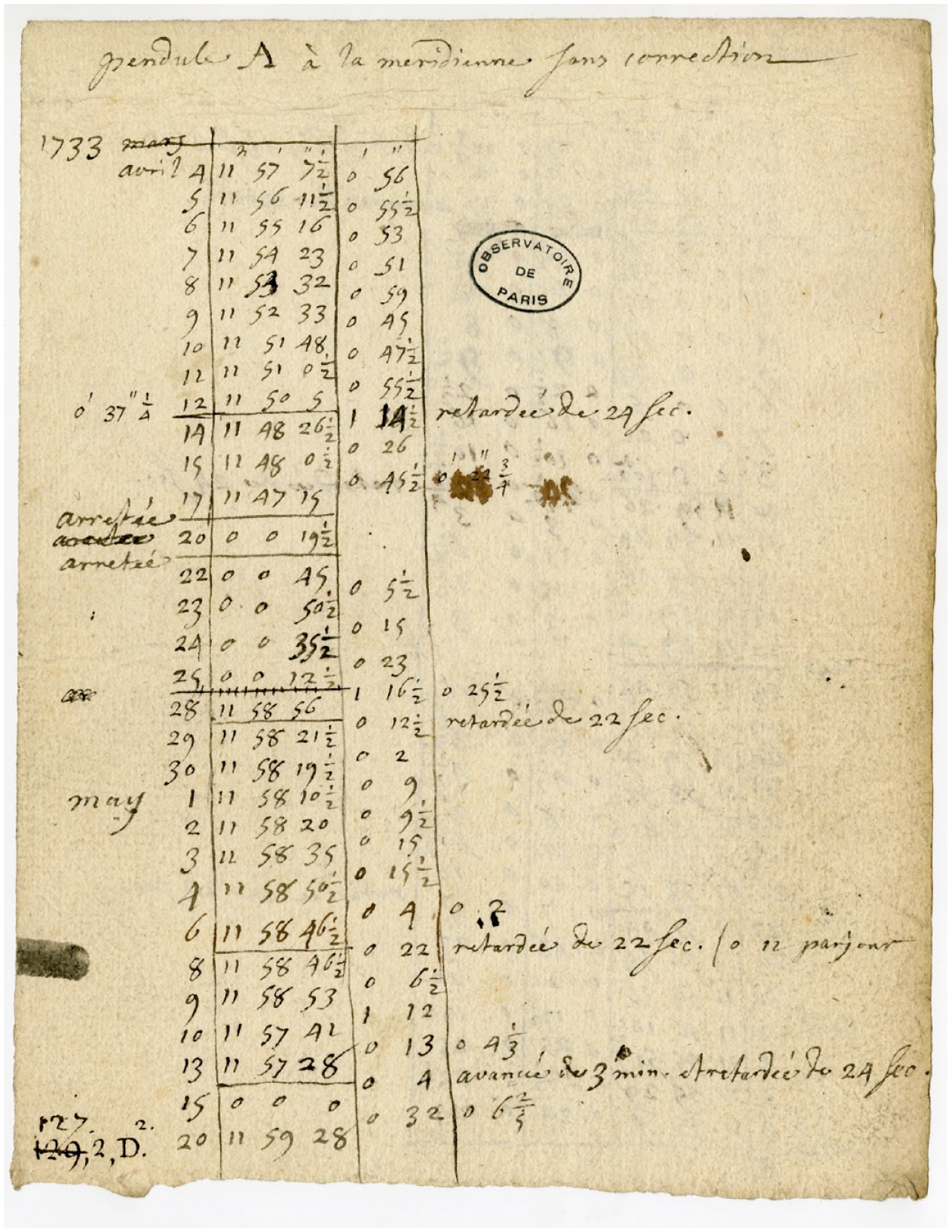
Clock register of the Saint Petersburg Observatory for 1733–4, showing the first page of clock A.
The perception and interpretation of clock performance necessarily depended on personal handling experiences and the particular tasks astronomers sought to accomplish with the help of clocks. Thus, the first Astronomer Royal, John Flamsteed, attempting to prove experimentally the isochronous rotation of the earth using clocks, monitored them attentively with a clear understanding that he needed to know the clocks’ rates, because he relied on their long-time stability. 24 Delisle, on the other hand, though working about two generations later, monitored his clocks, but admitted that he did not reduce or analyze the data. 25 Therefore, he could not know the clocks’ rates, which is synonymous with not having a clear idea of their precision. This circumstance, however, did not prevent Delisle’s work on celestial mechanics, meteorology, and geography. 26 Nor was this work affected by Delisle’s preference for Huygens’-style pendulum clocks with their recoil verge escapement long after the introduction of the more favorable deadbeat escapement. 27 Despite the evident advantages of the latter, in particular the significantly reduced interference with the uniform oscillation of the pendulum, Delisle hung on to the older construction, at least until 1748. 28 Johan Lulofs, astronomer in Leiden, also preferred his old clock “made in Paris by Thuret under the supervision of Mr. Huigens [sic]” to a newer one in the observatory on the grounds of its “accuracy” (“naauwkeurigheid”), although Lulofs had to concede that the Thuret-clock might err up to 20 or 30 seconds. 29 The quality of a clock, therefore, was not just a question of numbers, but also of individual perception. As a result, the technical developments taking place from the first appearance of the pendulum clock to the end of the eighteenth century and beyond did neither immediately nor straightforwardly translate into notions of precision. Rather, the period is characterized by different attitudes toward clocks that existed simultaneously and necessarily affected the practices of timekeeping in the seemingly self-explanatory environment of the observatory. 30
In fact, conditions in eighteenth-century observatories differed widely, beginning with the number and kind of clocks present, and including their set-up as well as handling methods. Looking only at the three state institutions of Greenwich, Berlin, and Saint Petersburg exposes large disparities. In the 1730s, for instance, the observatory in Berlin owned a single pendulum clock, the one in Greenwich held three, and the one in Saint Petersburg six, with six more to arrive by the end of the decade. Among these timepieces were clocks in the manner of Huygens, that is, pendulum clocks of the very first construction (Berlin and Saint Petersburg), ordinary English anchor clocks, which were usually sold in great numbers to private households (Saint Petersburg), and George Graham’s high-end precision clocks (Greenwich). As will be explicated in more detail in the following sections, practices of control varied from almost daily checks in Greenwich and Saint Petersburg to more haphazard ones with apparent gaps of more than a month’s length between inspections in Berlin. All these factors inevitably affected the exactness of timekeeping in the observatories in question, as can be seen in the following evaluation of historic performance data.
Clock performances in eighteenth-century observatories
Finding concrete values in order to express the precision reached by historical clocks has long intrigued scholars of horology. 31 However, this is a task that is difficult to accomplish. It does not help to have a clock running and observe it now, because the conditions under which it originally operated – the state of the mechanism, environmental conditions, and lubricants – cannot be reproduced. 32 Hence, data assembled in a modern experimental set-up give little indication of the clock’s original performance. Moreover, such data cannot be compared with sets generated in an eighteenth-century observatory. The analysis presented here breaks new ground in several ways. First, it exclusively rests on historical data from the eighteenth and nineteenth centuries that show the performance of the clocks under the actual conditions in the individual observatory. Second, we have decided to use a regression analysis based on the error of the clock rather than its rate. 33 This method copes well with the inhomogeneity of the raw data due to observation gaps and irregular measurement intervals, which impair the results of other mathematical methods such as standard deviation and Allen variance that have been applied to the task. 34 Third, the main objective of the analysis is to relate the statistical parameters obtained with the actual conditions in the observatories and to assess the habits of use and control.
Our main parameters resulting from the statistical analysis are: mean total variation, span, and short-term variation. 35 The mean total variation, given in seconds per day, indicates the stability of a clock’s performance in the observation interval under examination. It is the most robust and significant of our parameters and facilitates comparisons of clock performances despite measurement gaps and non-uniform observation intervals, though the length of the latter should be kept in mind. The span, given in seconds, points to the long-term change of a clock’s rate, that is, the differences between its consecutive time errors. It can only be conditionally used to compare clocks with different measurement intervals and data points. Our last parameter, the short-term variation, given in seconds, serves as indicative of observation errors. For all three parameters, lower values signify better results. It has to be pointed out that our analysis, like any statistics, contains a certain subjective element. For example, apparent “outliers” had to be identified by individual assessment of the data sets in order to be discarded. 36 Generally, measurement intervals were considered continuous as long as the clock was not stopped or its going affected in a manner deemed uncharacteristic, as suggested, for instance, by a sudden substantial alteration of its performance. Intervals with less than ten data points were discarded as insufficient for meaningful analysis. In any case, our results are not intended to be read as absolute numbers. Rather, they are meant to provide an overall picture of the range of performance of eighteenth-century pendulum clocks in the setting of an astronomical observatory.
Perhaps contrary to expectation, the extant material is not abundant. Particularly the records of smaller or relatively short-lived observatories such as the ones in Celle, Danzig, Ingolstadt, Remplin, and Würzburg are often lost. But even nationally important institutions such as the observatory in Paris did not leave reams of paper with clock data. Their journals and registers, as far as they existed, vanished over time, and one might arguably assume that in many cases they were not deemed worth keeping in view of the immense amount of paperwork that any such observatory produced. All in all, we retrieved data for fifteen observation sites with altogether about forty clocks by approximately thirty different makers. 37 These registers vary substantially in length as well as in the frequency and regularity of control. In what follows, special attention will be given to the observatories in Berlin, Greenwich, and Saint Petersburg, which, by their connections to the state and scientific bodies, equaled each other in their affiliations within their intellectual environment. 38 Furthermore, the astronomers attached to these places were well reputed and respected within the astronomical world. At times, however, additional observatories will be used as examples to stress and substantiate the point already made, which is the diversity of timekeeping practices in the various, often small-scale observatories of the eighteenth century. 39
Parameters of precision and handling principles
It goes without saying that from their invention in the seventeenth century to their technological prime in the late nineteenth century, the general degree of precision that could be reached by pendulum clocks increased considerably. However, such generalization reveals little about the actual conditions in the individual observatory, which did not necessarily depend on the age of the timepieces used. The performance of a clock was influenced by multiple factors; for example, by its exposure to varying temperatures, or strong winds and passing carriages that shook the building, as well as changing lubricants clogging its movement. In addition, winding and setting potentially upset its going, while observation errors of the astronomer, for instance, when checking its going by observing the transit of stars, might obscure its rate. 40 In any case, within our survey, the oldest clocks are not inevitably bottom of range, but neither does any one clock constantly produce the same results. Regarding the total variation, values range from a maximum of almost two minutes per day to a minimum of mere fractions of seconds. 41 One of the worst results of 97.72 seconds per day is produced by clock M of the Saint Petersburg Observatory, which is likely to have been an ordinary English anchor clock with striking mechanism. 42 The same clock, however, also obtained a total variation of only 4.18 seconds per day in a longer observation interval as well as a total variation of 17.91 seconds per day in an interval of similar length and number of data points. Altogether, in the ten usable measurement intervals retrieved for this clock, the total variation values vary by up to more than ten, twenty, or even forty seconds per day. Thus, clock M not only constantly and substantially deviated from a stable rate, but did so in a markedly erratic way, which made predictions regarding the magnitude of its error extremely difficult, if not impossible (Table 1). This overall picture holds true for all clocks of the Saint Petersburg Observatory, notwithstanding their design and makers, and as such calls attention to the actual conditions in the observatory. We know little about the positions of the clocks and nothing about their exposure to changing temperatures and other influences; however, the fluctuation of our results suggest that the performance of the clocks was significantly affected by handling practices. As a matter of fact, the Saint Petersburg registers display a striking trail of interference. Clock hands were constantly moved forward or backward by seconds and/or minutes, and clocks were frequently stopped. Hence, the clocks hardly had the chance to settle to a proper rate. In addition, monitoring was likely to be conducted by the numerous volunteers assisting the astronomer, Delisle, in his observations. 43 This factor certainly enhanced the danger of inconsistent procedures. Despite the great variety of clocks present in the observatory from the late 1730s onward, which included by then old-fashioned Huygens-style clocks as well as newly acquired ones of highly respected contemporary makers such as Antoine Thiout and Pierre Le Roy, the registers of the Saint Petersburg Observatory do not allow the singling-out of particular clocks for notably better performances. Rather, the continuous erratic behavior of all clocks over a timespan of more than ten years is a constant in this observatory’s records.
Performance results achieved by Clocks M and C of the Saint Petersburg Observatory in 1733/34 and 1737.
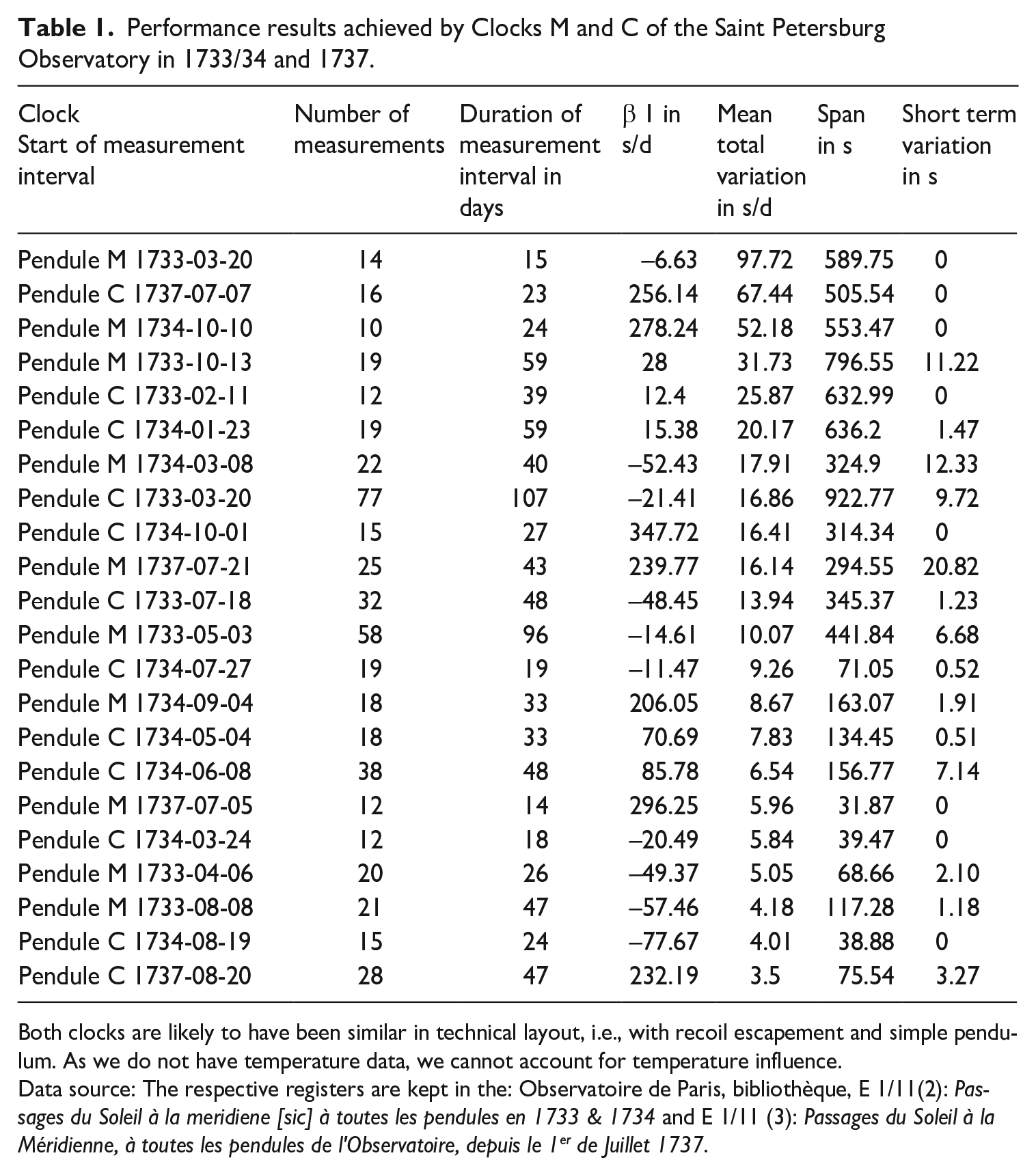
Both clocks are likely to have been similar in technical layout, i.e., with recoil escapement and simple pendulum. As we do not have temperature data, we cannot account for temperature influence.
Data source: The respective registers are kept in the: Observatoire de Paris, bibliothèque, E 1/11(2): Passages du Soleil à la meridiene [sic] à toutes les pendules en 1733 & 1734 and E 1/11 (3): Passages du Soleil à la Méridienne, à toutes les pendules de l'Observatoire, depuis le 1er de Juillet 1737.
As we lack immediately comparable registers, we cannot directly contrast the Saint Petersburg clocks to other timepieces by the same makers used in different locations. However, we do have extensive registers from the observatory in Prague that can serve to further examine the point in question. Since 1758, the Clementinum Observatory had owned two clocks by the Viennese maker Johann Philipp Vötter, modeled after regulators by George Graham. 44 Later, a third copy was produced by an unknown local maker in Prague. After some years of use, around 1765, the observatory purchased a new clock with a compensated pendulum by the Paris maker Jean-André Lepaute. Given the standing and skill of this maker, it is not surprising that the new clock performed significantly better than the older ones, but it is important to note that the analysis produced results for the Prague clocks that are far more consistent than those of Saint Petersburg (Table 2). In general, the values of the total variation of the individual measurement intervals rarely deviate from each other by more than two or three seconds, and in many cases the divergence is less. Thus, the Prague clocks achieve better (that is, smaller) and more uniform values than the Saint Petersburg clocks. This cannot be due to technology alone. As a matter of fact, the Clementinum registers show considerably less interference with the clocks than the Saint Petersburg ones. In the course of one and a quarter years, from March 1787 onward, the astronomers in Prague noted on three occasions that either one of the clocks had stopped, or that they had adjusted the length of the pendulum or moved one of the hands. In Saint Petersburg, on the other hand, hardly a month, at times not even a week, went by without the clocks being advanced, retarded, or stopped. We might therefore assume that the handling practices in Saint Petersburg prevented a better performance of the observatories’ timepieces at least as much as their technological deficiencies.
Extract of the performance results of the clocks in the Clementinum observatory in Prague from 1787 to 1791.
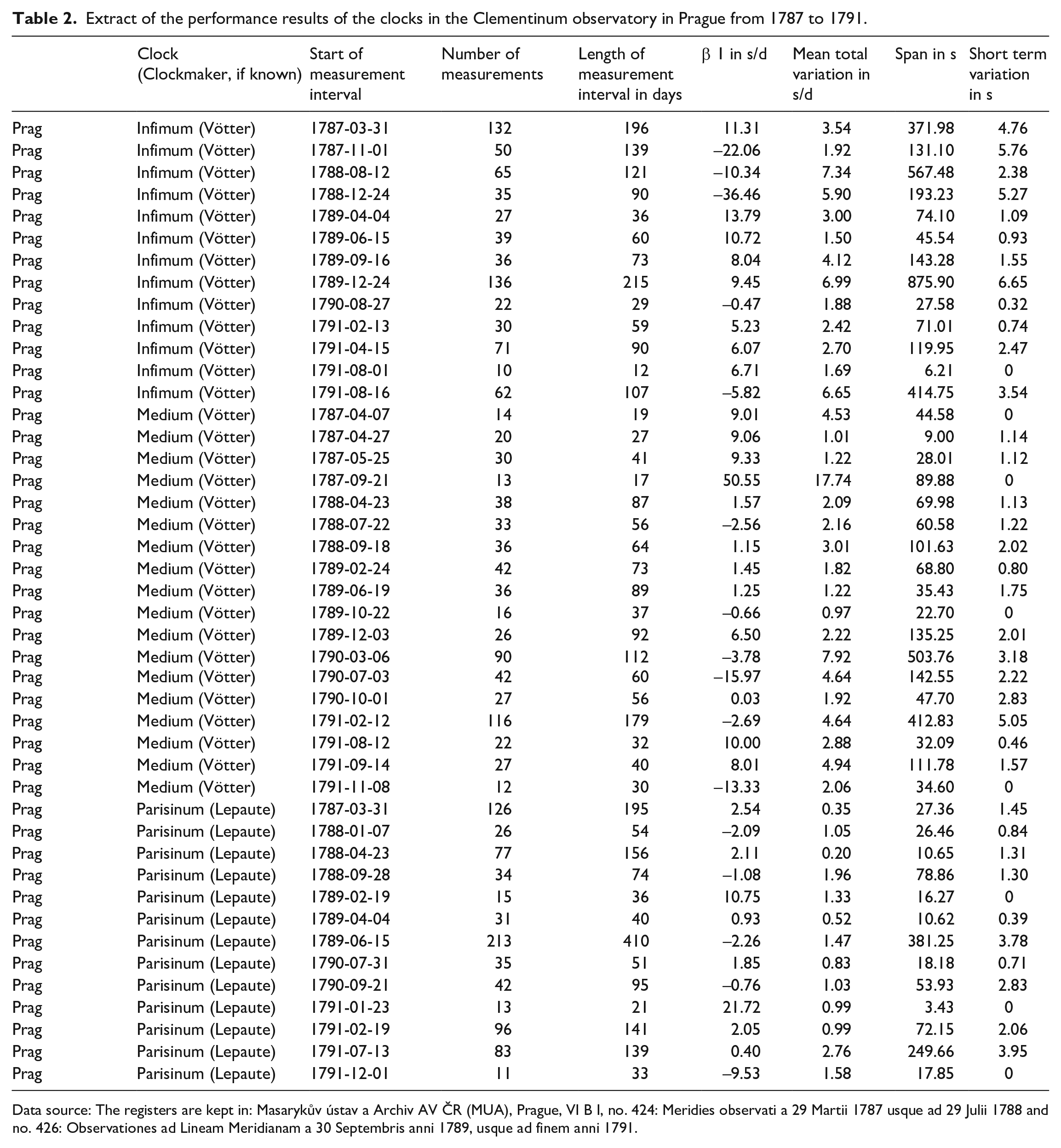
Data source: The registers are kept in: Masarykův ústav a Archiv AV ČR (MUA), Prague, VI B I, no. 424: Meridies observati a 29 Martii 1787 usque ad 29 Julii 1788 and no. 426: Observationes ad Lineam Meridianam a 30 Septembris anni 1789, usque ad finem anni 1791.
On the other hand, an excellently functioning interplay of practices and technology can be found in the Greenwich Observatory. From the days of its foundation in 1675, the consecutive Astronomers Royal could rely on the excellent workshops in nearby London. Flamsteed had contracted Thomas Tompion to produce the first of the observatory’s timepieces. Since these clocks were removed from the observatory after Flamsteed’s death, the second Astronomer Royal, Edmond Halley, commissioned two new clocks from Tompion’s partner and successor George Graham. In the 1740s, the originally simple pendulums of these clocks were replaced by compensated ones. In 1750, the astronomer then in charge, James Bradley, eventually bought a new clock, again produced by the Graham workshop. 45 It had a gridiron pendulum and deadbeat escapement with the pallets originally made of steel, but replaced by rubies in mid-1771. This clock was set up in the so-called Great Room, at the south wall, next to the transit instrument, and was used as the observatory’s main timepiece.
The data we retrieved concerns the going of this last-mentioned clock, the transit clock. It was compiled under the direction of James Bradley and Nevil Maskelyne and covers all in all seventeen years, with the last two data series coming somewhat surprisingly from Milan. 46 There, Barnaba Oriani in the 1780s, and thus some centuries before us, evaluated the going of the clocks in his own observatory at Brera as well as others such as the Greenwich clock, for which purpose he had obtained the necessary data from the Royal Society – in a certain sense, his comparative approach is a precursor to the present study. As can be seen from the values of the total variation, the clock performed exceptionally well over the entire period of time. Moreover, the results are remarkably consistent, with differences in total variation that mostly do not exceed fractions of a second. Only in 1766, after sixteen years of use, did the clock deviate from a uniform going by as much as a second per day. This result is still extremely good compared with other timepieces of the period, but the increased error it indicates is likely to have led to the replacement of the steel pallets in 1771.
Regarding the performance of the Greenwich transit clock, it is only fair to acknowledge the superb craftsmanship of the Graham workshop. However, the clock would arguably not have done so well if it had not been treated appropriately. Noticeably, the clock ran undisturbed for long periods of time with the longest phase comprising 1,002 days or roughly thirty-three months. Although the length of the measurement intervals varies substantially, we find several spells of about a year’s duration with no interference. The clock’s mean rate is indicated by the regression parameter β1. 47 It is consistently low and rarely reaches more than one second per day, which testifies to the clock’s excellent regulation. In addition, the consistency and quality of the monitoring process itself is corroborated by the low values of the short-term variation, which serves as an indicator of outliers. Compared to data series of other clocks that are similar in scope, the Greenwich data scores remarkably well, pointing, not least, to the regularity and discipline adhered to in the checking procedures.
Greenwich certainly was the eighteenth-century “Mecca” of time-measurement. Beginning with Flamsteed’s clock experiments to prove the uniformity of the earth’s rotation, and continuing with the involvement of his successors in assessing and testing different methods, including the use of chronometers, in order to finally solve the longitude problem, the consecutive Astronomers Royal developed a particular awareness as well as a particular regime regarding the handling of their timekeeping instruments. 48 The importance of such skillful operation of the clocks was noted half a century later by the German astronomer Bernhard von Lindenau, who attested to James Bradley’s particular aptitude in this respect. Lindenau conceived that the technological perfection of clocks had increased since Bradley’s time, which meant that the extraordinarily uniform rate of the transit clock was predominantly achieved by Bradley’s masterly treatment of it. Accordingly, the clock’s rate declined after the less-skilled Nathaniel Bliss had taken over office. 49 Even with such temporary declines in the quality of handling practices, the Greenwich Observatory was an exceptional place, but not the standard model. The bulk of small observatories on the continent neither owned clocks of the quality of the Graham workshop, nor did the astronomers working there necessarily follow the same strict protocols. Instead, the period is characterized by experimentation, as astronomers strove to equip their observatories with the available resources at hand. Many of those astronomical stations thus saw successive acquisitions of different clocks, which had to be handled, manipulated, and maintained by astronomers, assistants, and local clockmakers. Alongside this process of learning, clock precision developed as the result of improved technology and as the result of improved operating practices, as will be seen in the example of the observatory in Berlin.
Clocks and clock handling in the Berlin Observatory
As a state institution, the status of the Berlin Observatory, founded in 1700 in conjunction with the Kurfürstlich-Brandenburgische Societät der Wissenschaften (nowadays the Berlin-Brandenburg Academy of Sciences and Humanities), was equivalent to the one in Greenwich. For this reason, it seems very suitable for an in-depth comparison. Unlike Greenwich, the Berlin Observatory was notoriously poorly equipped. Its first astronomer, Gottfried Kirch, could only wish for a good pendulum clock, and the situation encountered by his son, Christfried Kirch, who followed his father into the position after the death of the intermediate postholder, Johann Heinrich Hoffmann, was not much better. 50 During Christfried Kirch’s term of office, the observatory possessed only two functioning timepieces: a pendulum clock and a bracket clock. In addition, Kirch privately owned another pendulum clock, which he kept in his study at home opposite the observatory. We know very little about these timepieces. Kirch referred to them as the “observatory clock” and “my good pendulum clock,” obviously judging the latter of better quality. An observatory inventory from 1722 mentions a clock with “a long pendulum,” while Kirch, in one of his observation journals, noted that he had to move the observatory clock to one side so to have the pendulum beating the seconds equally. 51 Hence, the clock had a seconds pendulum and was probably hung on the wall. The journals also reveal that both the observatory clock and Kirch’s private one stopped when being wound, and they also provide information on monitoring routines.
Kirch habitually took corresponding altitudes of the sun to check his clocks, and, from about 1721 onward, also used a meridian line in the fashion of Joseph-Nicolas Delise to observe true noon. 52 He then compared his clocks with true and mean time, noted the differences between them, and examined how much the results of both methods diverged from each other. His home clock was usually controlled by either signaling through the observatory window, so that his mother or sister might record a particular instant of time, which could then be compared to the time the observatory clock had shown at the same moment, or by using a portable clock to transport the correct time from the observatory to his home. 53 Despite all this effort – Kirch took up to ten corresponding altitudes in succession – the diaries hardly contain any data usable for a modern statistical analysis. The problem becomes explicit when looking at Kirch’s diary for 1734, which contains a table headed “Examen meiner guten Uhr” (“Examination of my good clock”) and altogether lists the period from January 11, 1734, to February 9, 1735. 54 There are interruptions on May 22 and October 24, when the clock was found to have stopped. The entries from July 7 to August 27 are missing: Kirch noted the dates, but not the time of the clock.
The point in question, however, concerns the length of the measurement intervals. These vary considerably, as Kirch examined his clocks only haphazardly, with gaps of up to fifty-two days between consecutive controls. In this manner, his numbers hardly say anything about the real going of his clocks, particularly when considering that especially the observatory clock posed problems such as the repeated disagreement between minute and second hand as well as stopping. 55 The diaries studied cover the years 1728, 1729, 1732, 1734, and 1738: none of these shows any alteration in this random method of control, which, in turn, impairs the statistical analysis. 56 While intervals with fewer than seven data points had to be altogether excluded from our analysis, even those with seven or eight data points are hardly conclusive, and our method tends to present the clocks better than they most likely were. 57 This becomes evident in the total variation values for the two early Berlin clocks, which range from 1.15 to 3.4 seconds per day. The “observatory clock” and the “good pendulum clock” thus outshine a sizable number of clocks from other observatories as well as some of the clocks of more recent manufacture that were used in Berlin in later years. Thereby, the “observatory clock,” which Kirch deemed worse than his own, scores the best result, yet in a measurement interval of only 24 days. The remaining intervals are considerably longer, with 67, 127, 203, and even 354 days, but include only 7, 8, and, at most, 37 measurement points. Therefore, Kirch rechecked his clocks at the earliest after 9.6 days – a fact that significantly smoothes the statistical results. In reality, he and his fellow Berlin astronomers were far from satisfied with its performance, and persistently and finally effectively campaigned for better timepieces. Yet not only the clocks changed, but also the monitoring practices.
Already the earliest exemplifications of the skills and knowledge expected from the academy’s astronomers mention the daily examination of the clocks, in particular by measuring corresponding heights of the sun. However, whereas the specifications for meteorological observations, to be undertaken at three defined times a day, include the subsequent notation of the results in specific tables, there are no such instructions regarding the clocks. 58 In consequence, we find the previously mentioned erratic entries on the performance of the clocks, but long-running and uninterrupted daily data concerning, for instance, temperature. Furthermore, the surviving observation journals do not show that astronomers up to at least Christfried Kirch attempted to correlate temperature with clock data. In 1768, under the academy president Pierre-Louis Moreau de Maupertuis, new regulations were drafted that explicitly required the astronomers to know the going of their clocks. Maupertuis considered it essential that a special journal be kept containing the observations of the fixed stars and the sun as well as the subsequent calculations that determined the clocks’ performance. The stipulations required a minimum of one observation per month only, yet Johann III. Bernoulli, responsible for the observatory from 1764 to 1787, claimed in 1776 to check the going of the clocks daily. 59 However, none of his registers survive, and Johann Elert Bode, who succeeded Bernoulli in the post, noted that the latter’s travels and increasing sickliness prevented him from regular observations. 60 For this very reason, in 1773, Bernoulli took in the young Johann Karl Schulze, who developed a particular interest in clocks. In 1777, Schulze made an extensive study of two of the clocks by then owned by the Berlin Observatory to be discussed shortly. Nonetheless, he soon abandoned astronomy in favor of architecture, thus regular monitoring only came with Bode, who checked the clocks not daily but diligently, and reported his findings semi-annually to the Berlin Academy. 61 On balance, it took the Berlin astronomers almost a century to develop stable patterns of clock control. This development went hand in hand with improvements regarding the range of clocks.
In 1754–5, the long-standing demand for a better timepiece was finally met by a clock bought from the Paris maker Charost. Apart from having a simple, that is, non-compensated pendulum rod made of stone (slate), we know next to nothing about its construction. 62 In the 1790s, it was situated in the observatory’s southward facing room near the transit instrument, where it already may well have been long before. 63 In 1769, three large longcase clocks especially made for the observatory by the Swiss-born Abraham-Louis Huguenin, who was then based in Berlin, were set up: one in the southern hall, where it accompanied the Charost clock, and the other two in the northern hall, at the northern and eastern walls respectively. In the registers, the clocks are designated as H (southern hall), N (northern hall, north wall), and O (northern hall, east wall). All clocks were supposed to run for eight days, though that proved problematic. They might all have had anchor, and thus recoil escapements, since for clock N the journals note an “imperfection” consisting, among other things, in the backstroke of the second hand, which was hoped to be amended by its conversion to deadbeat in the manner of Graham in 1788. 64 All clocks had simple iron pendulums, whereby clock H had been given an exceptionally heavy bob of 98 Berlin pounds (≈ 45.86 kilograms). The bob of clock N, in comparison, weighed 53.25 Berlin pounds (≈ 25 kilograms). 65 The pendulums of these two clocks, H and N, were suspended by a knife-edge. With the exception of clock N, all clocks were set to mean solar time. In 1791, after visiting the Seeberg Observatory in Gotha, Bode recognized the usefulness of sidereal time for a wide range of astronomical observations and adapted the Charost clock accordingly. As he noted, the observatory now had one clock for sidereal and one for mean solar time in both rooms. 66 These four clocks served as the observatory’s main timepieces until 1801–2, when it received two new clocks, each with a compensated pendulum, made by the London firm of Bullock and the Dresden amateur clockmaker Johann Heinrich Seyffert.
Opinions among the Berlin astronomers about the quality of their eighteenth-century timekeeping apparatus differed. According to Bernoulli, the Charost clock had never been a “chef d’oeuvre,” and, as was to be expected, deteriorated with time. Similarly, clock H by Huguenin appeared to him “of little use.” In a memorandum on the poor conditions in the observatory, presented to his fellow academicians on August 31, 1775, Bernoulli reported on the several problems posed by this clock, be it the rope breaking or the movement stopping for no apparent reason. 67 While Bernoulli did not comment on the two other timepieces, he altogether wished for a new pendulum clock “on which one could rely,” preferably with a compensated pendulum and made by John Shelton. 68 Johann Karl Schulze, on the other hand, referred to clocks H and N as “les deux belles pendules” (“the two fine pendulum clocks”) in a meticulous study of their performance, undertaken in 1777. 69 For Schulze, clock H, previously scorned by Bernoulli, was “a good piece that had been worked with great care.” 70 However, in 1800, Bernoulli was posthumously backed by the renowned clockmaker Christian Möllinger, regularly called upon by Bode, who judged all three Huguenin clocks “of mediocre work,” unfit for performing “astronomically correctly.” 71 Bode, in turn, considered the Charost clock to be the best of the observatory’s timepieces, but also remarked repeatedly on the uniform going of the third Huguenin clock, designated O, which at times exceeded the performance of the former. 72 All in all, we are confronted with four men working with the same timepieces, who all made different assertions. So, which one was right?
The question as it stands cannot be answered fully as we do not have continuous data running over the period from Bernoulli’s to Bode’s days. We can have a partial glimpse, however, by using data of the Charost clock, assembled by Bode in 1787, and Schulze’s study from 1777 of the Huguenin clocks H and N, designated 1 and 2 by him. 73 These data sets are not entirely equivalent. Bode’s journal, for instance, covers a period of five-odd months and contains seventy-six data points. As the clock stopped on the evening of August 25th, and had to be re-started on the 26th, we had to consider the periods before and after this as two separate series of data. Schulze, on the other hand, monitored the Huguenin clocks for an entire year. He reduced more than 800 of his observations to 144 data points. For all these differences, the density of data points is roughly similar, with intervals between registered measurements of about 2 days in Bode’s and 2.5 days in Schulze’s register. As can be seen, Huguenin 1 (=clock H), the clock with the heavy bob, comes off worst in our analysis. Our parameter ß 1, describing its rate, reaches 2.3 seconds per day compared to only 0.95 seconds per day for Huguenin 2 (=clock N) and 1.15 and −1.94 seconds per day for the two sequences of the Charost clock. The difference between the latter two clocks does not seem that big, and, generally, the rate is not the criterion to condemn any timepiece. What is important is the stability of rate, as Schulze clearly understood. He wrote: “the uniformity of the going of a clock does not depend on the difference between the time it indicates and mean time, but solely on the regular augmentation or diminishment of this difference.” 74 This stability of rate is described by the total variation, where the Charost clock achieves noticeably better results than both clocks by Huguenin. Of the latter two, clock 2 (=clock N), in turn, outshines clock 1 (=clock H), which scores poorly in all parameters involved. Bernoulli’s and Möllinger’s judgment, therefore, was quite correct, at least as regards Huguenin 1. The question is why this clock posed such problems while its sister, Huguenin 2, performed in a relatively reliable manner (Table 3).
Berlin Observatory: performance results for the clocks by Charost, Huguenin, Bullock, and Seyffert.
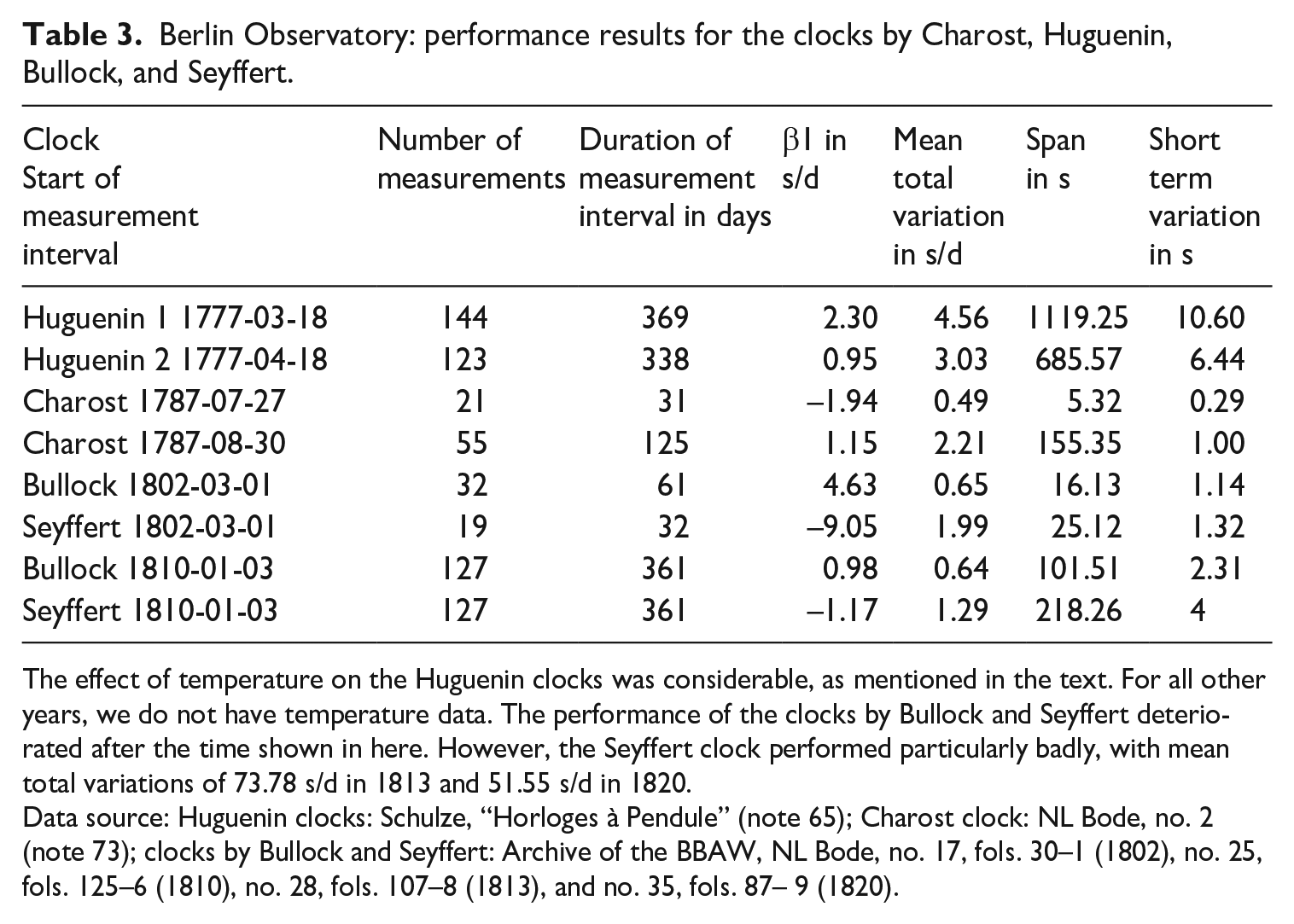
The effect of temperature on the Huguenin clocks was considerable, as mentioned in the text. For all other years, we do not have temperature data. The performance of the clocks by Bullock and Seyffert deteriorated after the time shown in here. However, the Seyffert clock performed particularly badly, with mean total variations of 73.78 s/d in 1813 and 51.55 s/d in 1820.
Data source: Huguenin clocks: Schulze, “Horloges à Pendule” (note 65); Charost clock: NL Bode, no. 2 (note 73); clocks by Bullock and Seyffert: Archive of the BBAW, NL Bode, no. 17, fols. 30–1 (1802), no. 25, fols. 125–6 (1810), no. 28, fols. 107–8 (1813), and no. 35, fols. 87– 9 (1820).
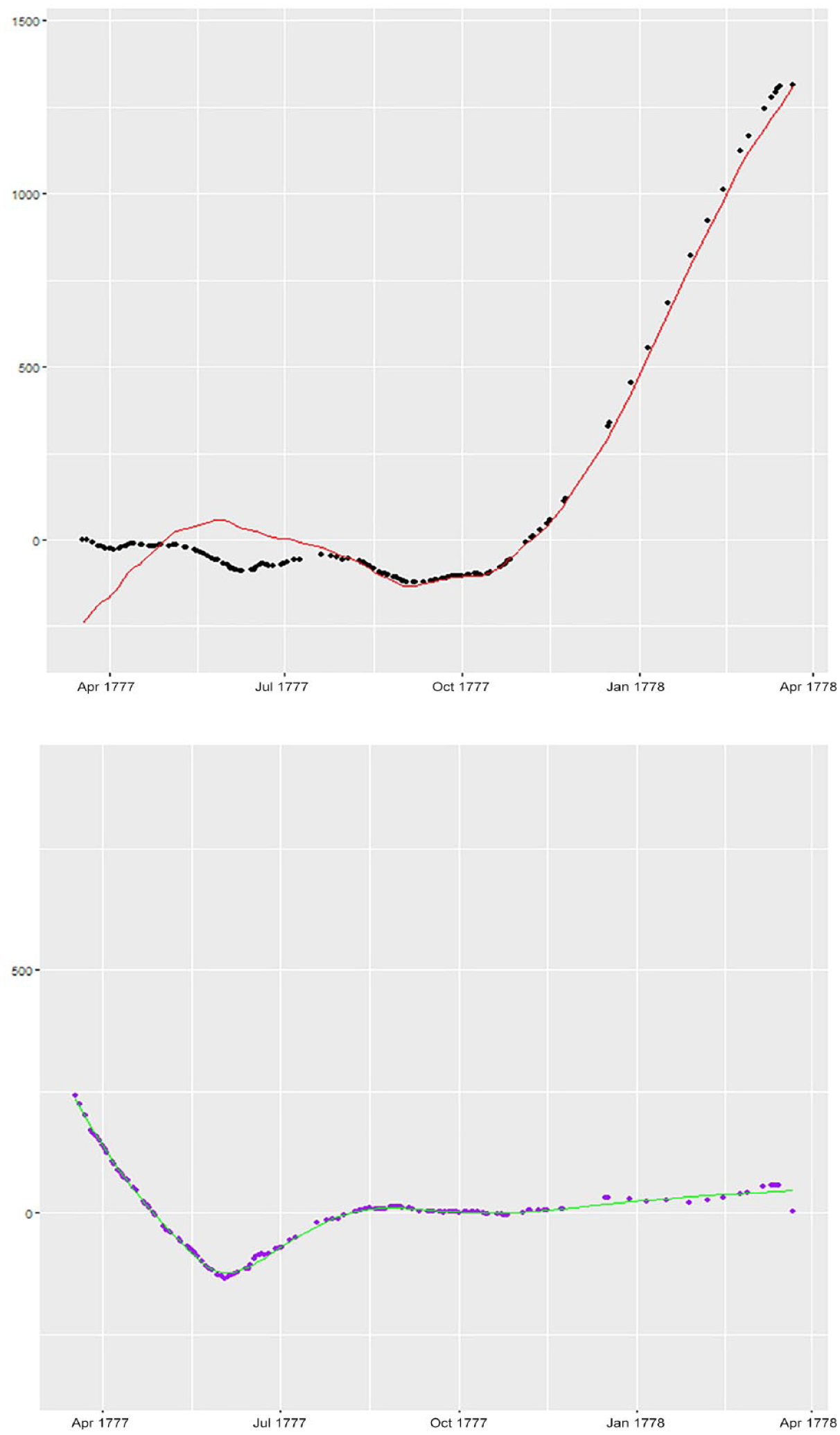
It seems reasonable to assume that the movements of both clocks were similar. As Huguenin 2 had a recoil escapement, altered only after Schulze’s study, Huguenin 1 will likely have had one too. Its most distinctive feature was the exceptionally heavy pendulum bob, which likely caused problems in terms of friction and stability. Furthermore, Huguenin 1 was subjected to strong temperature influences, being placed against a south-facing wall exposed to the sun all day during summer. 75 The graph, based on temperature data measured by Schulze, clearly shows the effects of rising temperatures from July 1777 onward (Figure 2). In fact, from here to the end of the monitoring period, temperature was the determinant for the clock’s performance. If its influence is considered, the total variation decreases significantly, from 4.56 seconds per day to a mere 1.49 seconds per day. The same applies to Huguenin 2. 76 Despite it being placed at a north-facing wall, temperature had a strong impact on its going. Considering its influence, the total variation drops from 3.03 seconds per day to 0.72 seconds per day. However, while the graph for Huguenin 2 shows the overall dependency between the behavior of the clock and the thermometer, the graph for Huguenin 1 reveals the existence of further variables affecting the going of the clock during the first quarter of the monitoring period. Unfortunately, we are left to speculation as to the exact nature of these disturbances. Bode, for example, repeatedly mentioned the instability of the transit instrument, which was placed near Huguenin 1. 77 Schulze did not detail which instruments he used for his transit observations in order to determine time, but it might have been the same instrument as it was close at hand. Its unsteadiness would have affected the reliability of the data thus obtained, although one might expect systematic rather than random errors as a result. Furthermore, only two years before Schulze’s study, Bernoulli had reported on problems with Huguenin 1, ultimately caused by the clock standing in a continuously damp recess in the wall. 78 What had originally been thought to protect the clock from dust had led to severe corrosion of its movement, which upon inspection had been found covered in rust. As both Huguenin clocks were cleaned before Schulze commenced his study, there is no direct connection to the figures of 1777. But even so, the episode shows the imponderables that observatory clocks were at times subjected to, and which necessarily made an impact on their functioning.
Clock Huguenin 1 of the Berlin Observatory.
Shortly after the turn of the century, Bode succeeded in obtaining new clocks for the Berlin Observatory that he hoped would raise the level of precision. Until then, he tried to improve the performance of his existing timepieces by several measures. He monitored their going with an orderliness not documented for the Berlin Observatory before, observed the amplitude of pendulum swings, ensured regular winding every Saturday as well as the clocks’ regular maintenance by the clockmaker Möllinger, and, in cooperation with the latter, saw to technical alterations and improvements. Furthermore, Bode adopted their use according to their performance. For example, Huguenin 2 (clock N) performed poorly from 1790 onward, despite its newly fitted Graham escapement. Bode therefore used it for the “incidental tracking of the culminating stars” only, but not for continuous observations by sidereal time. 79 Similarly, the later clock by Seyffert served solely for comparative transit observations, so that its irregular going could not effect considerable errors, while the better clock by Bullock was used for the determination of eclipses and occultations, and observations of Jupiter’s satellites. 80 However, despite its undisputed significance, precision was not the sole factor that determined the deployment of a clock. Criteria such as practicability also played a role. Thus, Bode used the Charost clock for years as the observatory’s main timepiece, simply “for convenience,” although the going of the third clock by Huguenin often pleased him better. 81
The situation in Berlin was not uncommon. On the contrary, its basic outlines are to be found in many astronomical sites on the continent. Observatories such as the ones in Göttingen, Gotha, Kremsmünster, Mailand, Mannheim, Prague, and Saint Petersburg, though not always as financially strapped as the one in Berlin, all acquired a succession of timepieces by different makers. Many observatories resorted to locally based makers, who often copied models by reputed colleagues, before being willing or able to obtain the considerably more expensive originals. Thus, the observatory in Göttingen purchased a clock by Franz Lebrecht Kampe, senator and “Bauherr” (responsible for the town’s buildings), who based his work on a clock by Graham as described in Marinoni’s De astronomica specula domestica of 1745. 82 In Prague, the astronomer in charge, Joseph Stepling, purchased two pendulum clocks by the Viennese maker Johann Philipp Vötter, equally based on Graham’s design. 83 In later years, the observatory in Prague purchased a clock by the prominent Parisian clockmaker Jean-André Lepaute, while the observatory in Göttingen received one by the equally distinguished John Shelton, both with compensated pendulums. Franz Xaver von Zach in Gotha, on the other hand, had the Göttingen maker Johann Andreas Klindworth replicate an already existing clock by Arnold, while the observatories in Kremsmünster and Mailand purchased locally manufactured clocks in addition to instruments from the French clockmakers Passemant and Lepaute. 84 The observatory in Mailand later reverted to a clock by Arnold, as did the observatory in Mannheim.
All in all, the situation regarding the observatories’ timekeeping apparatus was not as stable as in Greenwich, where the successive Astronomers Royal could revert to a trusted pool of London workshops, which sometimes, as with Tompion, Graham, and Shelton, were, moreover, closely linked to each other. 85 Furthermore, expertise, both in terms of technology and of practices of handling and maintenance, could only develop over time with more and more clocks coming into reach. Hence, it is no surprise that the level of precision as regards the performance of clocks is not as high in the continental observatories as in the one in Greenwich. Reverting to the Berlin Observatory now, it is to be found midfield with a range of total variations from just under two seconds per day to almost five seconds per day. Despite its often-emphasized poor instrumentation, Berlin can thus justifiably serve as an overall illustration of the timekeeping situation in continental observatories of the period. In a similar manner, Schulze’s study of the Huguenin clocks belongs to a group of related texts that together indicate a changing attitude toward precision in timekeeping.
Searching laws of clock precision
Treatises on clocks in the form of books and essays appeared in great numbers from the seventeenth century onward, but makers and users alike concentrated on technical details, while referring to the actual quality of performance in general manners. 86 In the second half of the eighteenth century, clock performance, for the first time, became the object of autonomous studies, which sought to investigate the clocks’ behavior, particularly in view of its dependency on varying temperatures. The studies thus intended to fill perceived gaps in the existing knowledge about clocks, “(h)aving heard it often lamented,” wrote Francis Wollaston, “that very few registers of the going of clocks have been communicated to the public.” 87
As might be expected, the individual texts are not uniform in scope. While their authors are united in their astronomical interests, they recruit from the disparate scene of Enlightenment science, and include the already mentioned Francis Wollaston, clergyman and fellow of the Royal Society, the polymath Johann Heinrich Lambert, the professor of mathematics and later “Oberbaurat,” Johann Karl Schulze, as well as the officially employed astronomers, Abraham Gotthelf Kästner in Göttingen, Christian Mayer in Mannheim, and Barnaba Oriani in Milan. 88 Wollaston published the longest registers with clock data for four subsequent years, Schulze and Oriani both for one year, and Mayer for not quite five months. Kästner contented himself with conveying only five data points resulting from observations of about one and a half years. While most reported on clocks they owned or used, Lambert sought to present Wollaston’s data to the German-speaking world by publishing a commented version in the Berlin-based Astronomisches Jahrbuch. Similarly, Oriani followed up his first report on the clocks in his home institution with a second one on the clocks in Greenwich and Mannheim, using data received from the Royal Society for the former and Mayer’s publication for the latter. Intervals of data points – obtained by observing the meridian passage of the Sun, the fixed stars, or both – differ from one study to the other. However, all authors, with the exception of Wollaston in his first study, smoothed their data in one way or the other before presenting it to the public, be it by the reduction of multiple daily observations to a mean, as in the case of Lambert and Schulze, or the presentation of values calculated from weekly (Oriani) or half-monthly (Mayer) intervals. 89 While the smoothing as such shows the authors’ sensitivity for error sources outside the clock, its degree served different purposes, hereby causing discussion. Mayer, for instance, mainly wanted to boast the excellence of the Arnold pendulum clock, newly acquired for his observatory, and successfully achieved his purpose by conveying only half-monthly values of its rate. Consequently, Oriani objected, saying that the uniformity of the clock’s performance within these intervals was not certain, while, generally, the combination of an overall short observation period with large observation intervals did not allow substantiated statements. 90 Despite this well-founded demur, his own evaluation of daily data, provided by Mayer’s successor, Karl König, supported Mayer’s claims as to the uniform going of the Mannheim clock, as can be seen in a comparison of the total variations resulting from both data sets (Table 4). 91 This point, however, leads to the question of what results the studies here discussed yielded.
Performance results for the Arnold clock in the Mannheim Observatory.

The data used was published by Christian Mayer in 1780 and Barnaba Oriani in 1785 (see for both note 88).
At first glance, these are of disappointingly little consequence. For the clocks in Milan, Oriani proved the ineffectiveness of thecompensation constructed by Joseph (Giuseppe) Megele, but most of the texts convey a sense of vagueness and indecision when attempting to detail conclusions. Thus, Wollaston’s summary, after four years of monitoring, is a cautious reflection on causes, which hardly surmounts the level of perhaps:
Having now completed my original design, and kept my clock going for a third year, without the least touch of the oil, or any alteration whatsoever, I presume the result of my observations to ascertain the rate of its going, may not be an unacceptable addition to the former papers on that subject, delivered to this Society. The regular difference between the summer and winter months, and some degree of similarity between those differences, seem to shew a regularity in the cause. What that may be, is not fully to be ascertained hereby; though it seems to have been difference of moisture, rather than of heat. By comparing these three last years with that which I first gave, when the clock was in some degree foul, it seems as if it were most affected when the work is clean. Yet is not that quite certain; for the differences, which decreasing gradually in the following table, would justify this conclusion, it may be observed, increase again in the last instance. 92
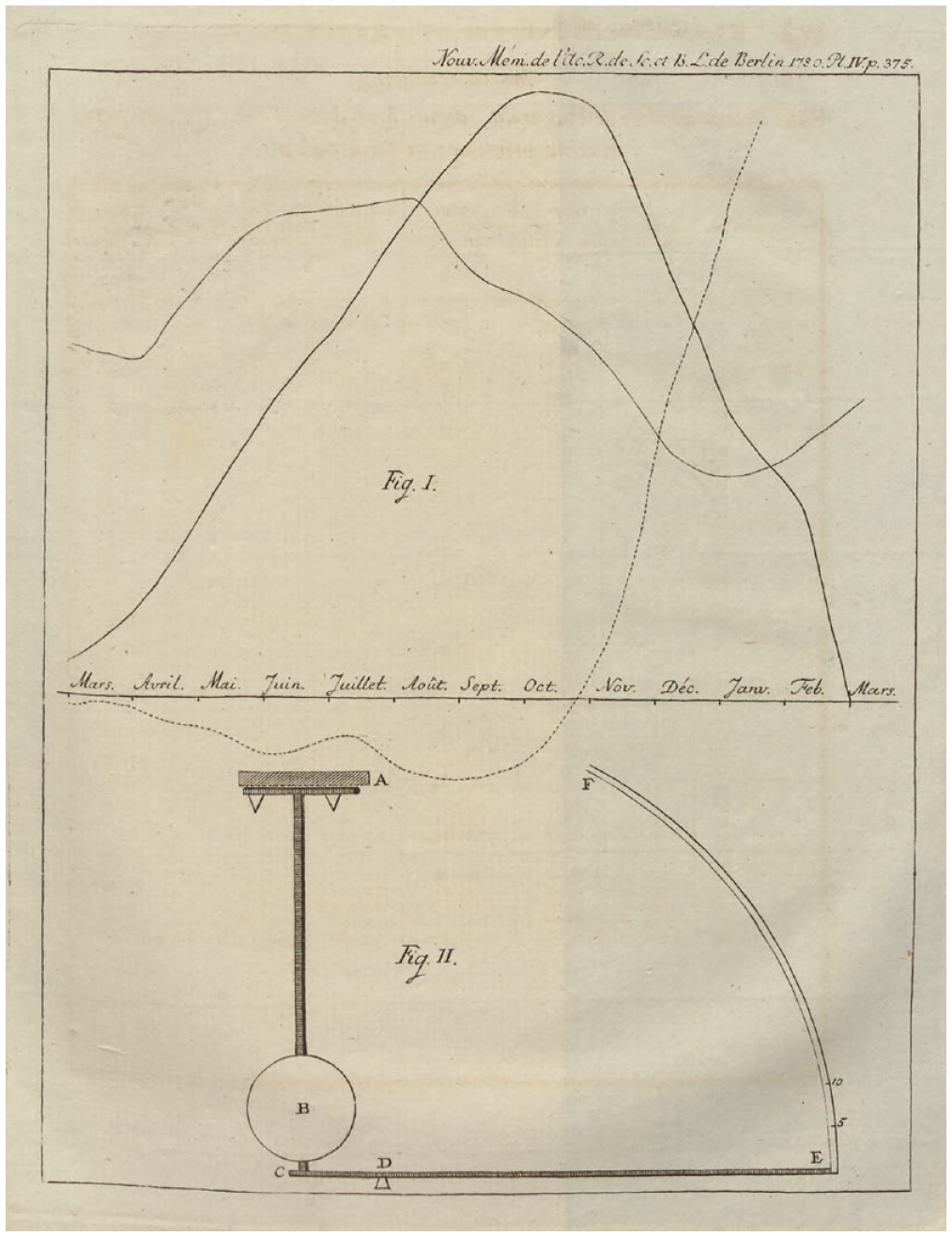
A similar uncertainty was felt by Mayer, who, almost poetically, compared the going of pendulum clocks to the course of the planets. Just as the latter were subject to innumerable disturbances, so were clocks, the sources of which Mayer believed to be mostly unknown. 93 Kästner, in turn, stuck to the subjunctive when reporting on the alterations in the rate of the Shelton clock in Göttingen, conceding that either he himself might have made mistakes in the monitoring process or that the clock had suffered random disturbances. 94 However, despite few tangible results, the studies served an important purpose as they furthered a complex notion of the causes and maintenance of precision in clocks. In addition to technical considerations regarding, for instance, bearings, pendulum suspension, and compensation, the authors also discussed details of set-up and monitoring processes as well as the influence of temperature, air resistance, lubrication, and jolting. In doing so, they joined forces with the clockmakers, who had long sought to enhance the precision of their machines by technical means such as the compensated pendulum, and equally to create an awareness of the complexity of the matter on the part of their customers. 95 What clockmakers had not done, however, was to publish registers of the going of their clocks, although renowned makers such as Graham and Berthoud checked their performance by astronomical means. 96 The studies by Wollaston, Lambert, Kästner, Schulze, Mayer, and Oriani thus filled an important gap by offering concrete numbers with which to judge the performance of a clock. At the same time, their studies would have had a more objective air than reports by the clockmakers themselves. For the scientific audience, the range of published rates provided an orientation of what to expect from clocks under certain conditions. Furthermore, Lambert’s, Schulze’s, and Oriani’s use of graphs as a tool to analyze their data was exceptional at the time and opened avenues for further investigations. 97 The difficulties that the process of correlating and interpreting the data entailed are illustrated by Schulze’s attempt to plot daily clock errors against daily temperatures. As Schulze could not find any correspondence between the resulting curves, he abandoned this construction, and reverted to monthly data points on the abscissa axis. 98 Even so, his graph did not reveal the dependency of the going of Huguenin 1 on temperature, because Schulze used daily temperatures, rather than accumulating them, as would have been necessary when using the error rather than the rate of the clock. This failure was recognized by Oriani, whose graph, as much as ours, clearly displayed the strong correlation between temperature and performance in Huguenin 1 (Figures 3 and 4). Consequently, Oriani ascertained the long-stated usefulness of the thermometer as a monitoring instrument for clocks, while Schulze declared it superfluous. 99 Yet misinterpretations such as Schulze’s only furthered discussion. Generally, the close bond between meteorology and horology was never seriously doubted. Authors such as Lambert and Mayer even hoped that the close study of the pendulum’s oscillations would allow insights into the density of air, thus turning the pendulum into a meteorological instrument. 100
Schulze’s graph for clock Huguenin 1 of the Berlin Observatory.
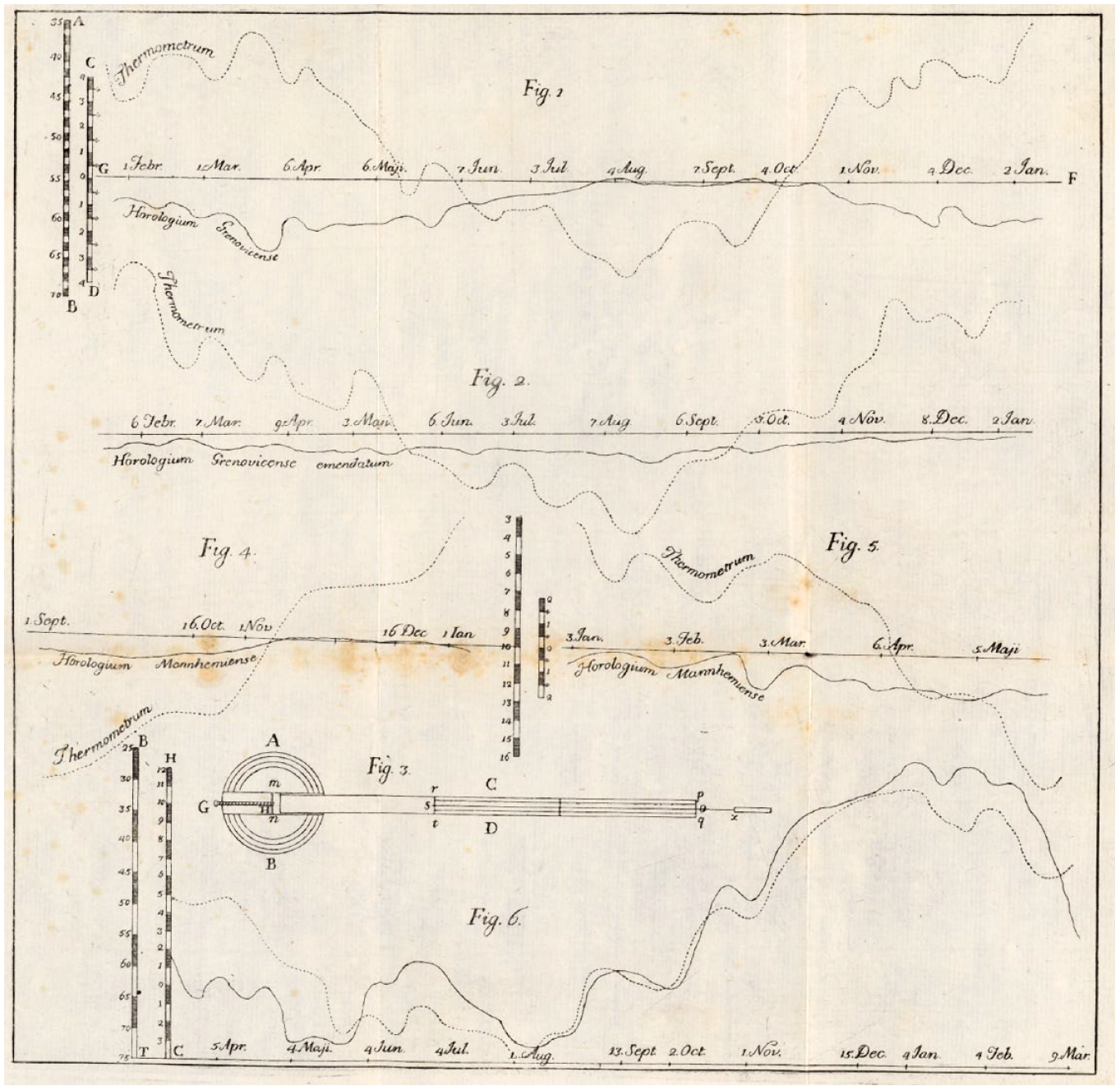
Oriani’s graph for clocks in the observatories in Berlin, Greenwich, and Mannheim.
Such ideas were fully in line with the ongoing gravity studies, which had commenced with Jean Richer in the seventeenth century. However, the focal point of the studies by Mayer, Lambert, Oriani, Schulze, Wollaston, and Kästner was the laws and rules underlying clock precision. As the authors examined the mathematical relation between varying temperature and the oscillation of the pendulum as well as the influence of set-up, handling, and control on the performance of clocks, the discourse around astronomically used timepieces moved away from the importance of momentous accuracy to a notion of precision, even if Kästner somewhat stubbornly emphasized the sufficiency of the former:
I, at least, only need to know what the clock has indicated the noon before a celestial event to be observed and the noon after it. How many minutes more or less it shows than several days before is of no importance to me, except for such a use as I have just made of it. Only if one cannot observe the two consecutive noons, one must wish the clock to run uniformly for a few days. 101
However, the published studies counteracted Kästner’s dismissive remarks by demonstrating that clocks could, indeed, be precision instruments. Authors such as Wollaston, Lambert, and Oriani, furthermore, clearly advocated long-term observance under set conditions and stipulated ways of evaluating the generated data. In this manner, timekeeping practices changed alongside the general attitudes and practices of science, which turned from “careful observations” to actual experiment conducted according to protocol and taking possible perturbations into account. 102 The essays studied here were as much an expression as a promotion of this development, in the course of which the clock turned from a supposedly accurate into a predictable machine.
In conclusion: Complexities of precision
As this study has shown, precision in clocks is more than the result of technical advances. Notwithstanding the undisputed significance of design and construction, the practices around the clocks – their set-up, handling, and control – were of equal importance. The history of precision in clocks is the history of both technology and use. 103 As such, the practices adopted in the individual observatory to ensure the reliability of the astronomical observations depended on the available instrumentation and the specific tasks to be accomplished. Thus, for most of the eighteenth century, the history of precision in astronomy is also local history with distinct conditions in different places. In timekeeping, standardization only increased toward the end of the period as the result of continuous communication between and among makers and users. While it is difficult to establish the role of the first pendulum clockmakers when it comes to the issue of precision, later generations loudly claimed their share. 104 Ferdinand Berthoud, for example, insisted that clockmakers partook in the glory of the invention itself because they had altered Huygens’ original design to an extent that the clocks of his time reached a perfection hitherto inconceivable. 105
Yet clockmakers not only contrived ever-new constructions to perfect the performance of their machines. Together with savants and scientific practitioners, they codified the differing technical layout of timepieces for various purposes in numerous publications, thus shaping the concept of the “precision clock.” French writers on horology included professional clockmakers such as Jean-André Lepaute and savants such as the Benedictine monk Jacques Alexandre, who both sought to define the “pendule à seconde,” the type of clock basically used in astronomy. 106 George Graham, in London, described his mercury compensated pendulum clock in the Philosophical Transactions, the journal of the Royal Society, thereby reaching a wide and learned audience. 107 After having read Graham’s paper, Joseph-Nicolas Delisle tried to order a clock of exactly this type. 108 However, the discourse about the suitable features of clocks used in astronomy was not closed by the end of the eighteenth century. In 1785, Johann Hieronymus Schroeter, in Lilienthal near Bremen, for instance, wrote to William Herschel in the hope of acquiring a “Regulator” for his observatory. Schroeter thought it necessary to explain that he looked for a clock “that shows merely hours, minutes and seconds, consists of 6 wheels only and has a Harrison or other compound pendulum” in order to distinguish it from other ones such as the two “quite good pendulum clocks adapted to astronomical use” that he already owned. 109 In this manner, agreement about the technical layout of clocks suitable for observatory purposes grew by means of communication within the astronomical community.
Significantly, this increasing standardization of the hardware was accompanied by a standardization of practices as the astronomical community, comprising clockmakers and users of timepieces, stipulated rules for the appropriate handling of clocks. Thus, instructions for set-up and treatment were sent out by makers or delivered on site. 110 In addition, astronomers advised each other on the matter. Delisle, for instance, repeatedly reprimanded German astronomers for using old-fashioned methods to control their clocks. 111 The culmination of this development can be seen in William Hardy’s paragraph in Pearson’s Practical Astronomy, published in 1829, which included explicit “Directions for Fitting Up The Clock.” 112 Within the process described, emphasis shifted from individual skills as a means to assure the accuracy of timekeeping to general principles. 113 While handling skills remained important, as seen in the case of the Greenwich Observatory, incipient standardization nonetheless enforced the validity of general guidelines rather than individual talent. This development would eventually lead to such intricate “operating chains” in timekeeping as in the Neuchâtel Observatory. 114 However, also the notion of the “precision clock,” as it emerged in the eighteenth century, did not simply refer to a particular type of object, but to a complex entity of object and associated practices, and as such was the result of “consensus among scientific practitioners.” 115
Footnotes
Acknowledgements
This article presents the results of a research project entitled “On the course of the stars and the going of clocks: Astronomy and precision horology in Germany around 1800,” based at the Mathematisch-Physikalischer Salon of the Staatliche Kunstsammlungen Dresden. The team comprised Dr. Sibylle Gluch, principal investigator, Johannes Eulitz, restorer at the Mathematisch-Physikalischer Salon and master watchmaker, and Alyoscha Jans, student assistant. The statistical analysis was developed by Prof. Alfred Müller and his team, Dr. Matthias Reuber and Franziska Wollny, from the Department of Mathematics at the University of Siegen, in collaboration with Dr. Michael Korey, senior curator at the Mathematisch-Physikalischer Salon. We used the program R to obtain our statistical parameters. The code was written by Franziska Wollny, while Johannes Eulitz accomplished the evaluation of our original Excel sheets. I would like to thank all of them most warmly for their work and engagement. In addition, I would like to thank Lissa Roberts and two anonymous referees for helpful comments on earlier versions of this paper, as well as Emily Akkermans for checking my English. All remaining errors are my own.
Declaration of conflicting interests
The author declared no potential conflicts of interest with respect to the research, authorship, and/or publication of this article.
Funding
The author disclosed receipt of the following financial support for the research, authorship, and/or publication of this article: This work was supported by the Deutsche Forschungsgemeinschaft (DFG) [project number 392130775].
