







Abstract
This article examines the Franco-Belgian Chooz A nuclear power plant as a transnational laboratory for nuclear knowledge-making in postwar Europe. Situated on the French–Belgian border, Chooz A was the first pressurized water reactor built in France and one of the earliest collaborations between the French utility EDF, Belgian companies, Westinghouse, and Euratom. We argue that Chooz A is an example of how nuclear knowledge was produced outside of scientific institutions through experimenting, testing, and tinkering. Previous scholarship has tended to analyze nuclear knowledge production from the perspective of “big science” and experiments at scientific institutions. By conceptualizing Chooz A as a laboratory, this article argues that nuclear power plants, often viewed merely as industrial installations, can also be understood as experimental arenas for producing more practical knowledge. Particularly in border settings, nuclear diplomacy was crucial in shaping knowledge production, and collaborative ideas for this knowledge production often coexisted with national interests. Drawing on unexplored archives from EDF, ASNR (the French Nuclear Safety and Radiation Protection Authority), Westinghouse, and the Belgian National Archives, as well as oral history interviews, we explore five examples that demonstrate Chooz A’s experimental nature: its unconventional cavern design, the operation of the plant as a social laboratory and arena for nuclear diplomacy, the 1968 thermal-shield incident, tritium contamination controversies, and early MOX (mixed-oxide) fuel experiments. In all these instances, not scientists but engineers, technicians, and regular workers produced practical knowledge that would prove crucial in France’s, Belgium’s, and arguably Europe’s energy transition toward nuclear in the postwar period. These examples all demonstrate, to a greater degree than scholars have previously recognized, that the boundary between laboratory experimentation and energy infrastructure was blurrier, as engineers, technicians, and regulators collectively generated tacit and practical knowledge that informed later postwar European nuclear programs.
Introduction
Both France and Belgium are among the most nuclear-reliant countries in the world. France derives around 70% of its electricity from nuclear power. 1 In Belgium, that number is around 40%. 2 Moreover, the ties between French and Belgian nuclear engineers and companies are strong. This tight connection has a history – a history that brings us to one specific place in a curious bulge of the French–Belgian border, near the village of Chooz. This article traces the history of the Chooz A nuclear power plant, located in a rock in the border region of the Ardennes. We argue that this reactor was an unusual project that acted for decades as a transnational laboratory in the broadest sense of the word. An incredibly varied group of organizations and individuals from different countries engaged in nuclear diplomacy there, by collaborating and testing out technologies and scientific principles. Yet, it had the specific aim of immediately materializing this knowledge for their own, national projects (Figures 1 and 2).
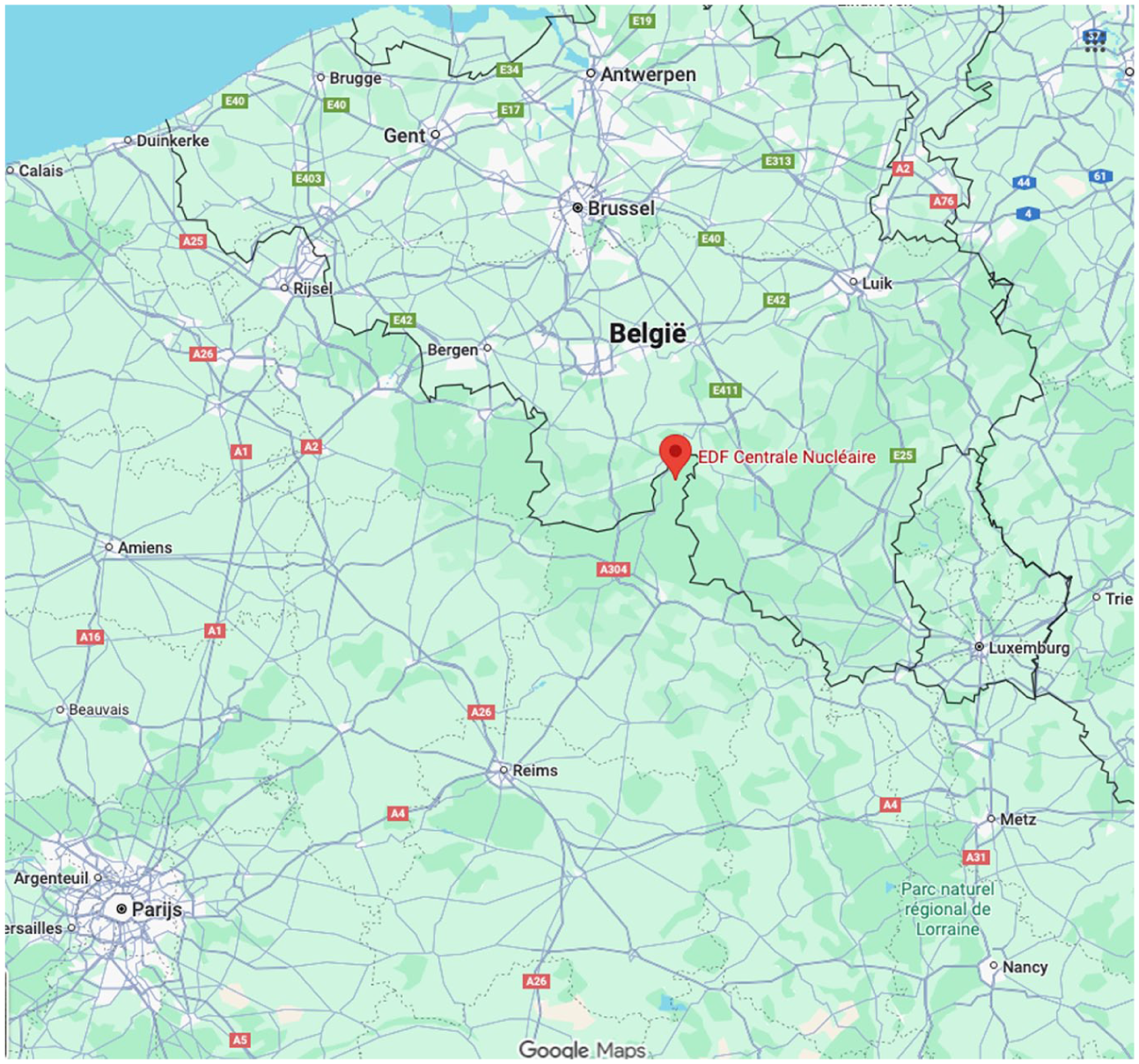
The Chooz A nuclear reactor is located in a border bulge on French territory, but surrounded by the Belgian border.
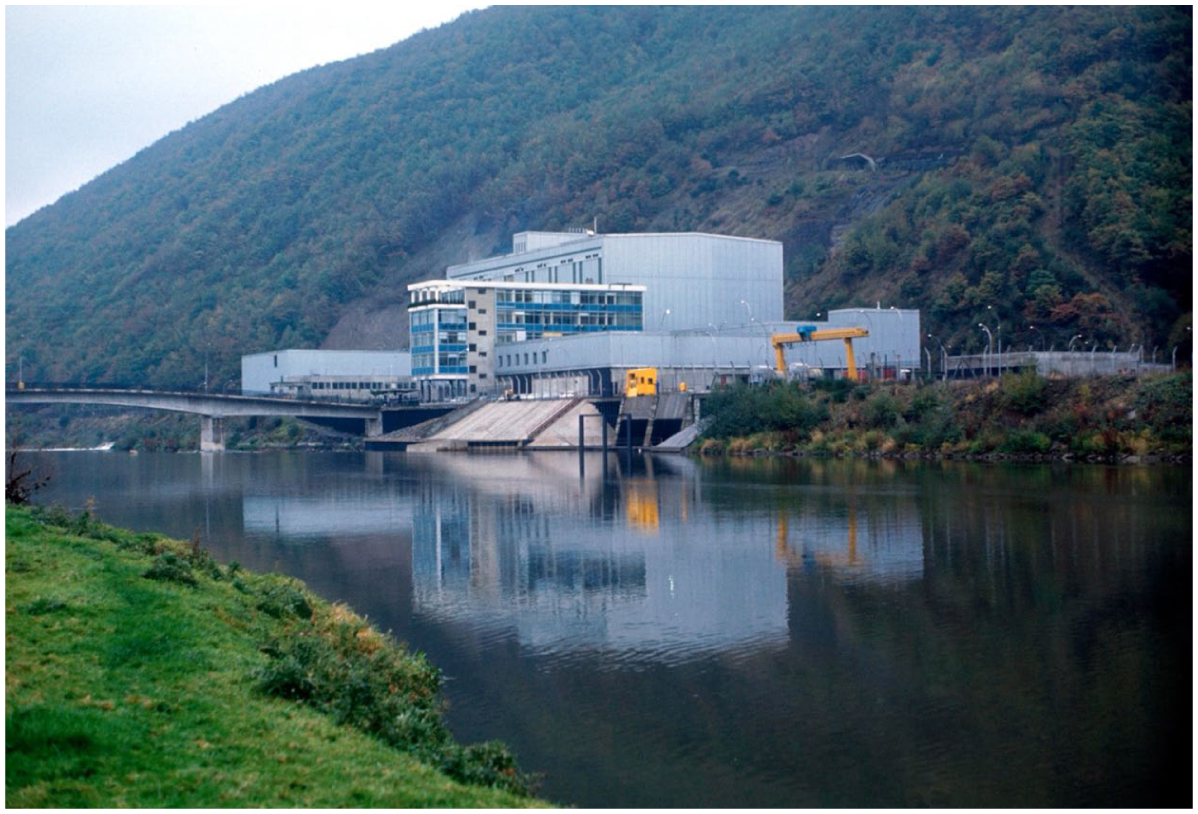
The Chooz A reactor by the Meuse River in 2014, before its decommissioning. The reactor itself is housed in the hill right behind the large white building (which houses the turbine hall).
Nuclear engineers in France mostly know Chooz A as a decommissioning project, the first of its kind. In Belgium, Chooz A is almost completely forgotten. And despite a renewal of historical scholarship on nuclear energy in France since the 2011 Fukushima accident in science and technology studies (STS), Chooz A has not been the subject of any dedicated research and remains largely overlooked. 3 Yet, we argue that the case of Chooz A teaches us that we need to expand current conceptions of knowledge-making in history and STS. Scholars in those fields have increasingly paid attention to transnational nuclear knowledge-making and the role that national interests and diplomacy play in that. However, ideas about where knowledge about nuclear things is created mostly revolve around laboratories in the narrowest sense of the word, where nuclear scientists do scientific experiments. This article shifts the focus more broadly to all places that acted as “laboratories.” This also includes, in our view, nuclear power plants. We challenge specifically the dominant analytical separation in historiography between scientific knowledge production about nuclear things and nuclear energy infrastructure. Instead, we emphasize the importance of combined local, spatial, and transnational processes of knowledge-making through tinkering and technology in use.
We do this by relying on previously unexplored archival collections from Électricité de France (EDF), the French Nuclear Safety and Radiation Protection Authority (ASNR), Westinghouse, and the Belgian National Archives. To account for the gaps in the archival material as well as to understand the experiences of designing and operating Chooz, we also rely on ten interviews with former personnel. In the first part of this article, we reflect more conceptually on the notions of laboratory and (trans) nationalism and discuss how the case of Chooz A can inform the broader literature in history and STS. The second part sketches how French and Belgian scientists and engineers began engaging with nuclear technologies and collaborating on the Chooz project. The third part focuses on the design process, preparations, and construction of the plant in the mid-1960s. While the design depended heavily on American knowledge, a range of very unique features served to test out new design practices. The fourth part of the article zooms in on the operational problems that emerged at the end of the 1960s, which prompted a crisis of expertise and exposed the laboratory nature of the project. In parts five and six, we demonstrate two other important learning moments at Chooz: the unanticipated contamination of the river with tritium and the introduction of MOX (mixed-oxide) fuel. Lastly, we conclude that Chooz A was a laboratory and demonstrate the different ways in which the project shaped later nuclear development in France, Belgium, and other parts of Europe.
A transnational laboratory
A laboratory – the word originating from Latin meaning “a place to work” – is today conventionally defined as a room or building with scientific equipment for doing scientific tests or for teaching science. But what if it can be more than that? 4 STS scholarship has demonstrated that a laboratory does not necessarily need to be located in a science department with scientists in white gowns. It is a place where people experiment and learn. Helen Tilley labeled nineteenth-century Africa a “living laboratory” where British scientists acquired new expertise about the environment, medicine, and people. 5 In a broader sense, a laboratory is not just a place for research or teaching. In Laboratory Life, Bruno Latour and Steve Woolgar demonstrated how laboratories are sites where scientific facts are socially constructed and shaped by cultural beliefs and practices. 6 The notion of the laboratory is particularly useful because it stresses the relationship between humans and technology, the practical work, locality, and playful creativity. In this sense, it is unsurprising that many university departments are also called “labs” today.
Laboratories or sites of nuclear knowledge-making are a dominant theme in the literature on nuclear science and technology in STS. But energy infrastructures are rarely considered as laboratories. An exception to this is perhaps scholarship on “prototypes” or “demonstrations.” Well-documented cases include the Clinch River reactor, 7 Shippingport, 8 or Superphénix. 9 While a prototype is generally designed to prove feasibility in view of a subsequent series, experimentation within energy infrastructures is often broader. It encompasses the earlier-mentioned aspects of knowledge production, practical work, and creativity. Moreover, not all power plants that were laboratories were prototypes or demonstrations. Chooz A, for instance, was conceived as a full-scale power reactor, the latest in an already established line, with no direct follow-on planned at the time of design or early operation. Previous conceptions of a “laboratory” within STS can thus be helpful to analyze this.
The role of knowledge in nuclear history is primarily interpreted through the lens of “big science,” particularly nuclear physics or chemistry. 10 An analytical separation in historiography persists between nuclear knowledge-making and nuclear power. Nuclear historians have often even created this separation through establishing causalities, for instance, by demonstrating how scientific insights from laboratories, particularly those working with physics and chemistry, feed right into nuclear engineering and power production. 11 But this is not the full story. In recent years, historians of science and technology more broadly have blurred the distinction between technology and knowledge, pointing to “know-how” and more tacit, practical, and procedural forms of knowledge. 12 In this context, historians like David Edgerton, Ruth Oldenziel, and Mikael Hård have emphasized the importance of tinkering and using, as opposed to scientific innovation, for creating technological change and knowledge production. 13 Although the histories of these scientific discoveries are important, we still lack scholarship that analyzes the transnational ways in which nuclear knowledge is created outside of scientific institutions by experimenting with a technology in more practical ways, through usage, tinkering, and testing.
Crucial to laboratories in this sense, we argue, is diplomacy – diplomacy between national actors, but more often than not transnational actors as well. In the past two decades, scholars in the nuclear humanities and social sciences have particularly focused on transnational exchanges as a reaction to predominantly national frameworks of analysis. 14 Kenji Ito and Maria Rentetzi have introduced the notion of nuclear diplomacy, emphasizing the role of diplomatic negotiations and national interests in nuclear knowledge-making. 15 Anna Åberg, for example, has shown how the International Thermonuclear Experimental Reactor (ITER) project in the South of France, the world’s largest nuclear fusion project, was the result of compromise, reciprocity, and complex technoscientific diplomacy. 16 International organizations were important venues for nuclear diplomacy, too, particularly the IAEA (International Atomic Energy Agency). 17
An often-underestimated organization in the study of nuclear diplomacy is Euratom. The historiography on Euratom almost unanimously labels the international organization as a failure. According to historian John Krige, Euratom never lived up to its expectations. 18 Andrew Barry and William Waters observed that the Euratom Treaty was never even fully implemented and was thus an “evident failure.” 19 However, we will show that Euratom, despite not achieving its initial goals and ambitions, did have a profound influence on nuclear development and knowledge production in Europe. It achieved this through soft power and diplomacy in specific nuclear projects – both through financing and coordinating expertise.
We argue that the Chooz A reactor is a good starting point to begin studying this in more depth. Just like the historiography on the Belgian and French nuclear industries in general, the historiography on Chooz has been dominated by engineering histories and publications from the nuclear industry itself. 20 A group of environmental historians recently studied transboundary connections around nuclear facilities, but the case of Chooz was not part of that project. 21 Yet, the experimentation, testing, and tinkering at Chooz proved to have far-reaching consequences for the industry, particularly for building light water reactors (LWRs), today the most prevalent reactor type in the world.
The French and Belgian nuclear programs
The French government turned to nuclear power in the 1950s, viewing it as a promising and economically viable solution for electricity generation. Following the Second World War, national independence became a key pillar of France’s energy policy. Lacking domestic energy resources but high on industrial ambitions, this strategic orientation was institutionalized through the five-year plans (plans quinquennaux). 22 The Commissariat à l’énergie atomique (CEA) initially developed experimental heavy-water reactors in the Paris suburbs (Fontenay-aux-Roses and Saclay) as well as numerous research reactors fueled with enriched uranium supplied by the United States. Although the design of enriched-uranium reactors was clearly inspired by American models, the United States did not assist in the construction of these reactors. The CEA’s first fully operational industrial site was established at Marcoule, in the Gard department, in the early 1960s. The three “G” reactors there produced the plutonium required for the French atomic bomb, the first test of which took place in the Algerian Sahara in 1960. These reactors belonged to the “natural uranium–graphite–gas” (UNGG) line, which formed the basis of a civil nuclear program, with Électricité de France (EDF), France’s nationalized utility, operating reactors at Chinon and Saint-Laurent-des-Eaux.
This dual-use (civil and military) technology was of major strategic interest to France. The use of natural uranium, sourced from mines in both metropolitan France and its colonies, obviated the need for enrichment facilities and thus avoided dependence on the United States. During the 1960s, a gradual transition took place, which historian Gabrielle Hecht has described as a shift from a “nationalist” technopolitical regime, driven by the CEA and its advocacy for French-designed technologies, to a “nationalized” regime led by EDF, whose approach to the nation was grounded in economic rationality and cost-efficiency. 23 However, critics of the UNGG line emerged and advocated instead for a transition to the American-designed LWR technology, which they deemed more technically mature and economically advantageous. After several years of debate, commonly referred to as the “war of the reactor lines” (guerre des filières), the French UNGG line was officially abandoned in 1969. 24 At that point, however, France had very limited experience with LWRs, and more specifically with the pressurized water reactor (PWR) line. Nonetheless, it could draw upon what, in the 1960s, had been regarded as something of an anomaly or a “five-legged sheep”: the Franco-Belgian Chooz A reactor. 25 A company that had remained relatively inconspicuous until then now entered the picture: Framatome. Established in 1958 by a consortium of companies from the Schneider, Merlin Gerin, and Westinghouse Electric Company groups, the company’s primary objective was to operate under the Westinghouse license to build PWRs.
The American light water technologies EDF was interested in had been part of Belgian nuclear development for a long time. During World War II, the Belgian mining company Union Minière had provided natural uranium, mined in Belgian Congo, for the Manhattan Project in the United States. Through agreements with the United States and the United Kingdom, Belgium gained privileged access to scientific and technological know-how. 26 This led in 1951 to the creation of the research center STK (Studiecentrum voor de Toepassingen van de Kernenergie), later SCK-CEN. 27 At this research institute, Westinghouse licensed its first pressurized reactor outside of the United States: BR3, finished in 1962. 28 By building BR3, the Belgian company Ateliers de constructions éléctriques de Charleroi (ACEC), partially a subsidiary of Westinghouse, acquired expertise in building LWRs, and a generation of Belgian technicians learned how to operate them. 29
Westinghouse’s engagement in the European market was made possible by the U.S.–Euratom agreement of 1958. Euratom had been established to create more political integration in Europe through nuclear development, which was very much seen as a science and technology of the future, in the same way as the European Coal and Steel Community had prompted integration in those sectors years earlier. 30 Euratom was also a crucial part of U.S. foreign policy and President Eisenhower’s Atoms for Peace Program, which aimed to promote the peaceful use of nuclear technologies (as opposed to nuclear weapons production), while at the same time binding its European allies together and securing American dominance in nuclear science and engineering. 31 In 1958, the United States and Euratom signed an international agreement that committed the United States to deliver enriched uranium to the Euratom countries, including France and Belgium, while Euratom would facilitate the construction of large-scale American-designed nuclear power plants. The United States and Euratom would also collaborate on research and development in a large Joint Program, allowing significant funds to be invested in nuclear research and infrastructure. 32 But Euratom was more than just research. Article 37 of the Euratom Treaty provides Member States with a right of scrutiny over neighboring countries’ installations, particularly with regard to releases of radioactive effluents. An expert group appointed under Euratom is tasked with delivering an opinion prior to the commissioning of each new nuclear installation in Member States. This gave Euratom (limited) regulatory power as well. 33
France and Belgium had very different attitudes toward Euratom. The Belgian government, along with the country’s nuclear scientists and engineers, was very enthusiastic. Internationalism, rather than independence, was a key driver of nuclear development for the small country seeking to exercise influence in the postwar period. The French government had a very different attitude. President Charles De Gaulle became notoriously opposed to Euratom. For De Gaulle and his political allies, assisting Euratom would further the interests of the United States and West Germany while compromising French independence. The French government preferred to move ahead alone with its own civil and military gas–graphite program. 34 France only complied minimally with Article 37, seeking to prevent Euratom experts from extending their attention to the safety of French reactors. 35 Still, the CEA and EDF partnered up with Euratom for several fringe projects, including nuclear fusion, breeders, and – at the time – LWRs from the United States.
Chooz A was thus a product of Euratom and the U.S.–Euratom Treaty. Yet, the origins of this French–Belgian–American–Euratom collaboration preceded the Treaty. The idea originated during a visit of European engineers to the United States in 1957, where both French and Belgian engineers toured the newest nuclear reactors. 36 The initiative came from the director of a major Belgian utility, Pierre Gosselin, who contacted EDF after the visit. Building a power plant with Belgian companies could enable EDF to free itself from the oversight of the CEA, which showed little willingness to explore technological pathways outside its own, particularly when they originated abroad. 37
However, Belgian utility companies and EDF had to face skeptical national governments and manufacturing companies. By this time, Charles De Gaulle had become the president of France again. The new government did not look favorably at international nuclear collaborations. Belgium’s pro-European Minister for Economic Affairs, Jean Rey, as well as Euratom, had to apply pressure. In November 1958, they agreed, on the condition that the plant would be built on French territory. 38 For the Belgian utilities, gaining experience from operating a plant that was not located in Belgium was the dream scenario. 39 But some Belgian politicians and manufacturing companies, especially in Wallonia, were skeptical of this. Investing in infrastructure located in France, in a time when the coal and steel industry in Wallonia was in decline, was politically sensitive. 40 Meanwhile, manufacturing companies, which had been competing with French companies for years, feared French dominance. The compromise, devised by Gosselin, was to build a second French–Belgian reactor in Wallonia at a later date. This reactor would become Tihange I. 41 Following the agreement, EDF and the Belgian utilities together created a new common utility: SENA (Société d'énergie nucléaire franco-belge des Ardennes).
Experimenting with PWRs: Designing Chooz
From the outset, it was clear that the French–Belgian reactor would be a unique project – not only in Europe but also compared to reactor projects in the United States. Its most unique design feature was its location: the reactor would be built in a cavern in a rock, located in the hilly Ardennes region. The sources are ambivalent about why it was decided to build the reactor underground. Yet, what is certain is that French and Belgian engineers made the decision as early as 1958, possibly even 1957, so before the project received approval or began planning. One explanation is security. In the context of the Cold War, its hidden location would protect the reactor from attacks or plane crashes. The site of the reactor is close to multiple national borders and the Belgian airbase of Florennes. 42 Another explanation is cost. American-designed reactors were usually protected by a containment building, which would contain radioactive particles in the event of an accident. However, these buildings were very expensive. In the middle of the 1960s, engineers in the United States became interested in the prospect of siting reactors underground. They were inspired by examples in Europe, such as the R1 research reactor in Stockholm, Sweden, and the Lucens reactor in Switzerland – both located in a cavern. Yet, these were small research reactors, not a scaled-up commercial nuclear power plant. 43 Even though few people really knew why, there was a clear determination to experiment with a cavern design (Figure 3 and Figure 4). 44
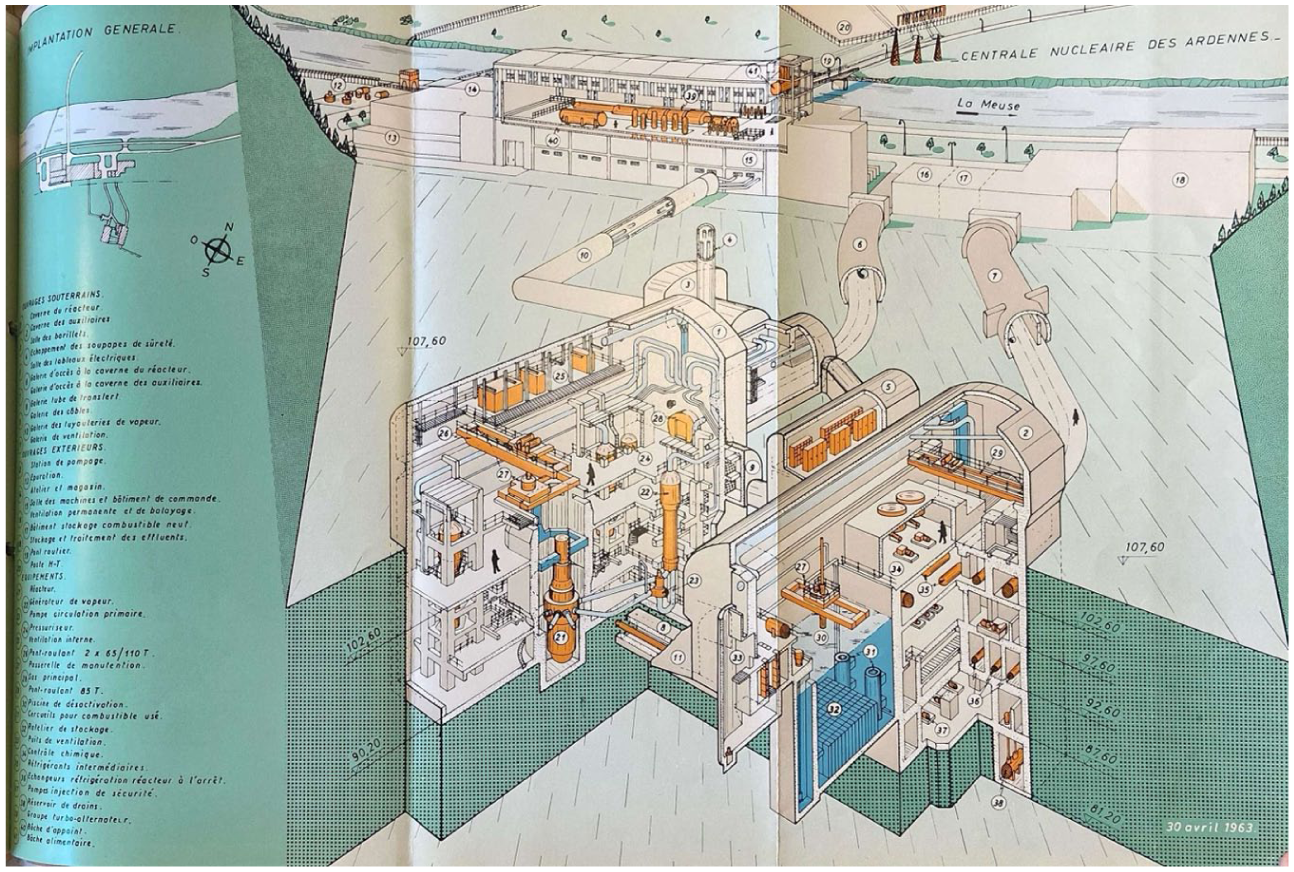
Visualization of the (largely underground) Chooz A reactor.
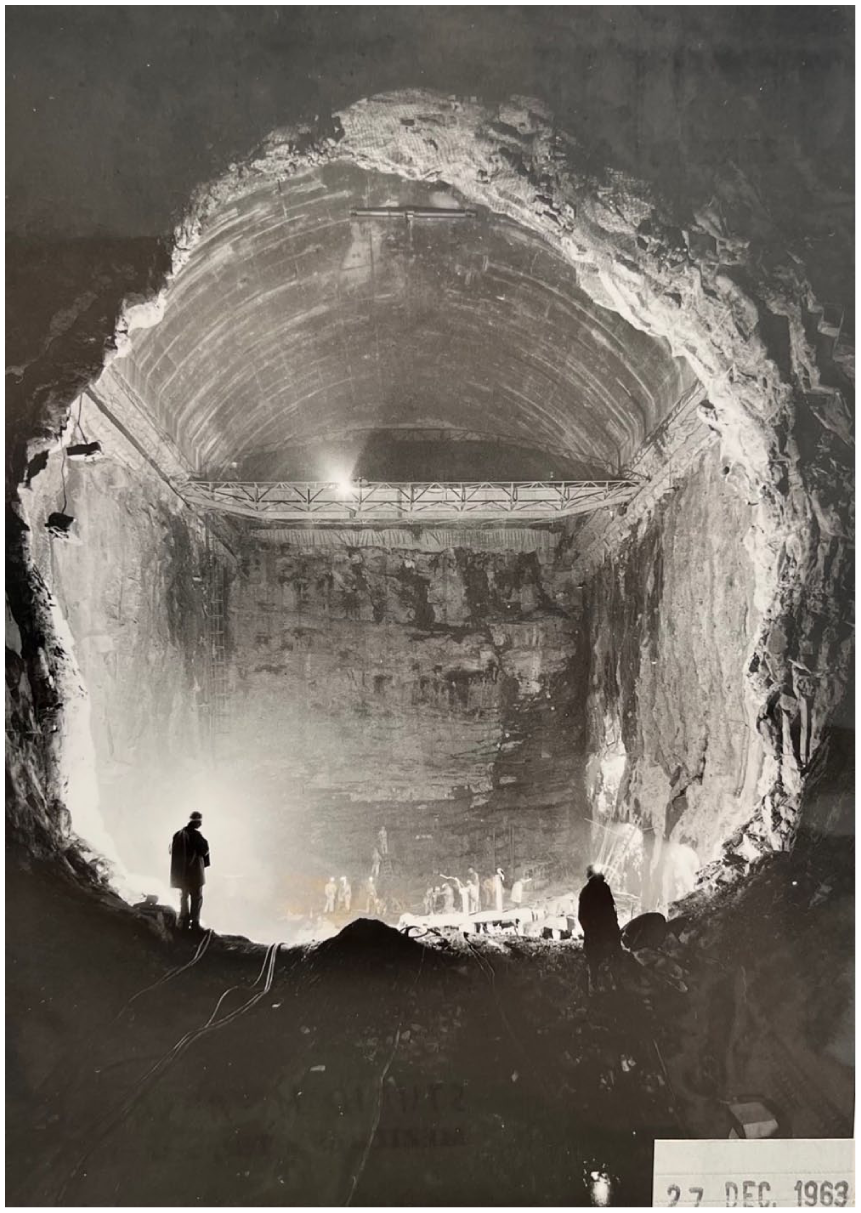
Construction work on the cavern.
Soon enough, however, the cavern design presented significant construction and safety problems. One was the quality and strength of the rock. With no in-house expertise on geology, in 1960 SENA contracted several French and Belgian civil engineering bureaus, including a laboratory from EDF, to take geological samples and identify any water leaks. 45 Civil engineers identified quite a few leaks in the rock. Moreover, as the caverns were dug, landslides of rocks threatened to hit workers working at the auxiliary building located at the edge of the hill, near the river. Planners had to move the building 35 m, and roofs were built by the entrance to protect from falling rocks. The problems with the rock stability even necessitated design changes to the cavern and eventually delayed the startup of the plant. 46
Perhaps the biggest uncertainty was whether the cavern was completely leak-tight. In the reactor containment, whether above ground or underground, the pressure needs to be maintained constantly, which requires the inside to be completely sealed off from the outside. By 1962, it had become clear to the civil engineers that a cavern reinforced by concrete walls and ceilings would not be leak-tight enough. There would be a high risk of water leaking through the concrete into the reactor building. An added risk was that a nuclear accident inside the cavern could create such high pressure that the rock could deform. 47 What followed was a series of experiments and tests, taking about a year, to study the water in the rock and construction materials. Engineers proposed to add a thin metal sheet on the outside, between the concrete and the rock, right where they predicted the water leaks would be. Yet, this did not prove safe enough either. SENA eventually decided to surround the entire concrete containment with a steel layer. 48 For these changes, it had to actively seek geological expertise abroad. It negotiated with Euratom to receive research funds in the framework of the U.S.–Euratom Treaty. French and Belgian engineers traveled to Pittsburgh to investigate the problem with engineers from Westinghouse and civil engineering consultants. SENA even relied on the expertise of Swedish engineers, who were experienced with using plastics to reinforce and tighten concrete. 49
In October of 1960, SENA decided, after considering multiple other designs, upon a PWR type, manufactured by a group of companies connected to Westinghouse – including the Belgian companies Ateliers de Charleroi and Cockerill-Ougrée, and the newly founded French company Framatome. 50 For Westinghouse, Chooz was a unique, experimental project and a milestone. 51 For the French nuclear industry, it was the first time that an industrial reactor with a non-French design would be built on French territory, and together with another country. It was also a reactor without any military purpose, being designed solely for electricity generation. To the Belgians, the BR-3 reactor project, although still under construction in 1958, had provided crucial expertise on PWR design – probably unrivaled anywhere outside of the United States at this point. 52
The design of the Chooz reactor core was equally marked by Westinghouse’s desire to experiment. Westinghouse had primarily developed the pressurized type through the nuclear navy program in the United States. By 1958, Westinghouse had also constructed multiple other full-scale nuclear power plants in the United States. 53 Particularly its latest project had acted as a laboratory: Yankee Rowe in Massachusetts. And it would now also act as a model for Chooz. For instance, both at Yankee and Chooz, the rods that held the uranium fuel were made from stainless steel, not zirconium, the custom material for those pellets at the time. The control rods were also in the shape of a cross instead of a cylinder. 54 But translating this design to the French–Belgian context proved to be a challenge. The pressure vessel was an example of that. In a PWR, the core is contained by a large steel pressure vessel. The steel mill of Le Creusot (in Bourgogne–Franche-Comté in eastern France) was tasked with building this vessel. France lacked prior experience in designing steel pressure vessels for this type of reactor. Moreover, French engineers had had bad experiences with using steel vessels to contain a reactor core. In 1959, when EDF opted for a steel pressure vessel for its reactor EDF-1 at Chinon, a crack several meters long developed during construction. This incident represented a serious setback for EDF engineers as they sought to break away from the techniques previously employed by the CEA. 55 Le Creusot was thus very dependent on American metallurgical expertise, particularly from the Atomic Energy Commission (AEC), the U.S. Navy, and the American Society of Mechanical Engineers (ASME).
Moreover, Chooz acted as a laboratory for finding solutions to the problem of irradiation embrittlement – a major uncertainty during the 1960s and 1970s. By the time SENA placed the order for a large steel nuclear pressure vessel with Le Creusot, research was beginning to show that steel was more vulnerable to rupturing when exposed to radiation. Scientists were therefore worried that a cool-down of the water in the reactor could potentially cause a vessel break. Initially, Le Creusot designed the vessel according to a code from the U.S. Navy. Starting in the 1960s, the ASME also published new design requirements that were subsequently followed by Le Creusot. 56 However, engineers at Framatome and Le Creusot did not wholeheartedly accept the ASME Boiler and Pressure Vessel Code. They found it too detailed. Eventually, a compromise was found, in which Le Creusot was allowed to deviate from the code for the dimensions of the vessel, calculation hypotheses, and calculated stresses. Westinghouse and the ASME would have to agree on the changes, taking over a year and involving American inspections in the French factories. 57 The uncertainty regarding the risk of embrittlement rendered American expertise controversial yet indispensable.
Westinghouse and Framatome added a number of additional safety components to the core in the hope of reducing the irradiation and acquiring more insight into the phenomenon. One of them was a thermal screen, a stainless-steel plate attached with bolts between the uranium fuel and the vessel that served to block the irradiation from hitting the vessel. Another solution was the system for neutron flux measurement or “aeroball,” which moves steel balls through the reactor to measure and map neutron flux. 58 The first reactor to use this system was Trino in Italy, but the system was tested further in Chooz. Yet, it performed poorly, as the balls frequently became blocked. 59 Pierre Schmitt, a former engineer at EDF’s Research and Development Division, recalls that maintenance personnel were regularly called upon to “unclog” the system when the spheres got stuck. 60 While French industry abandoned the system, it was recently reintroduced in the Franco-German European Pressurized Reactor (EPR) project.
The design of Chooz A was thus the result of extensive science diplomacy and negotiations between Westinghouse, Framatome, ACEC, Cockerill, EDF, the Belgian utilities, and many other companies and research institutes. But to get a license to operate on French territory, they also needed to negotiate with even more actors. To study the safety of the reactor, a new “joint committee” was founded that united experts from the CEA, Euratom, and the AEC; but also from Italy and West Germany. 61 In the end, however, a license was quickly granted, and Chooz A went online in 1967.
A French–Belgian social laboratory
The startup of the Chooz A reactor and its first months of operation were a special experience for engineers, technicians, and workers. For both the Belgian and French teams, it was their first time operating a water-cooled nuclear power plant in a uniquely international workplace set in a pristine landscape. Wild boar, numerous in the Ardennes forest, soon became the plant’s emblem (Figure 5). Early staff recall a warm atmosphere and camaraderie; management posts were split fifty-fifty, and conflicts were rare. 62
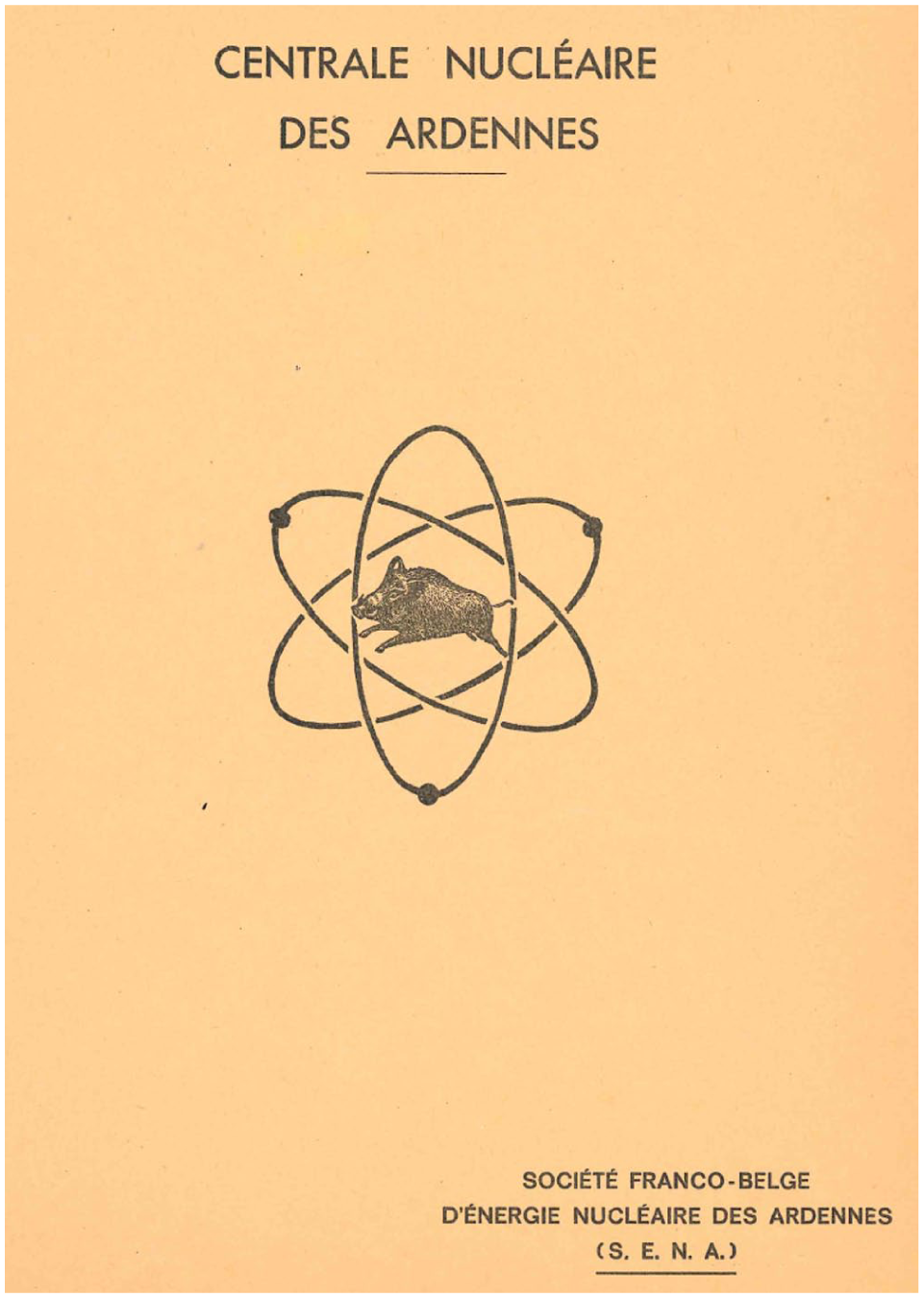
The “Sanglier des Ardennes,” here shown on the cover of a report of SENA, was the plant’s emblem.
At the same time, there were notable differences between the French and the Belgians, and nuclear diplomacy was also apparent in the social fabric and daily interactions at the plant. Jacques Daumas, who worked as an engineer at EDF and was sent to Chooz, remembers how his Belgian colleagues all knew each other already. They were very experienced with the reactor type, as they had all been working at the Westinghouse-designed BR-3 reactor in Mol. This had an impact on the language used in the plant. Although the working language was French, the Belgians introduced English jargon, which was otherwise rarely used in France. The Belgians also had an “ultraliberal” mindset, according to Jacques Daumas. 63 They were used to working in private companies. They addressed each other by their first names and were used to negotiating things informally, and often very tenaciously, with their superiors. 64 In this way, Chooz could not escape the traditions and cultures of a region strongly shaped by the coal mines and trade unions. 65
Meanwhile, at EDF, often described as a state within a state, everything was more formal and regulated. Daumas also recalls how the Belgian engineers and managers were more skilled and practically oriented. In case the operators went on strike, they were trained to take over the operation of the plant. 66 Many of the French staff at EDF, on the other hand, came from other coal or gas power plants, and did not know each other. 67 And just like the engineers at Framatome, they were a lot younger and inexperienced – for them particularly, Chooz was a learning space. 68 That is why a group of five French engineers also went for training in the United States. 69 Before being assigned to the Chooz reactor, Jacques Burtheret, for example, had spent a year in Pittsburgh and Saxton, in Pennsylvania, to learn about pressurized reactor operation and safety. 70 When the end of the gas–graphite reactor program in France was announced in favor of PWRs at the end of the 1960s, the staff at Chooz were emboldened to be working with the technology of the future. 71
Repairing and tinkering: The 1967 incident
The laboratory nature of Chooz also entailed repairing. After only six months of operation, on Christmas Eve of 1967, a control rod jammed after the startup. An initial inspection, including opening a steam generator, found no anomaly, and the plant restarted in early January 1968. By late January, two further rods malfunctioned, revealing a deeper fault. An emergency shutdown followed: inspection of the four steam generators showed severe damage to two, where metal debris had scarred tubes and tube sheets. 72 The debris proved to be bolts from the thermal shield inside the pressure vessel (see Figure 6), shaken loose by coolant-system vibrations. The event was classified not as a “nuclear safety” incident – there was no off-site contamination – but as an operational problem.
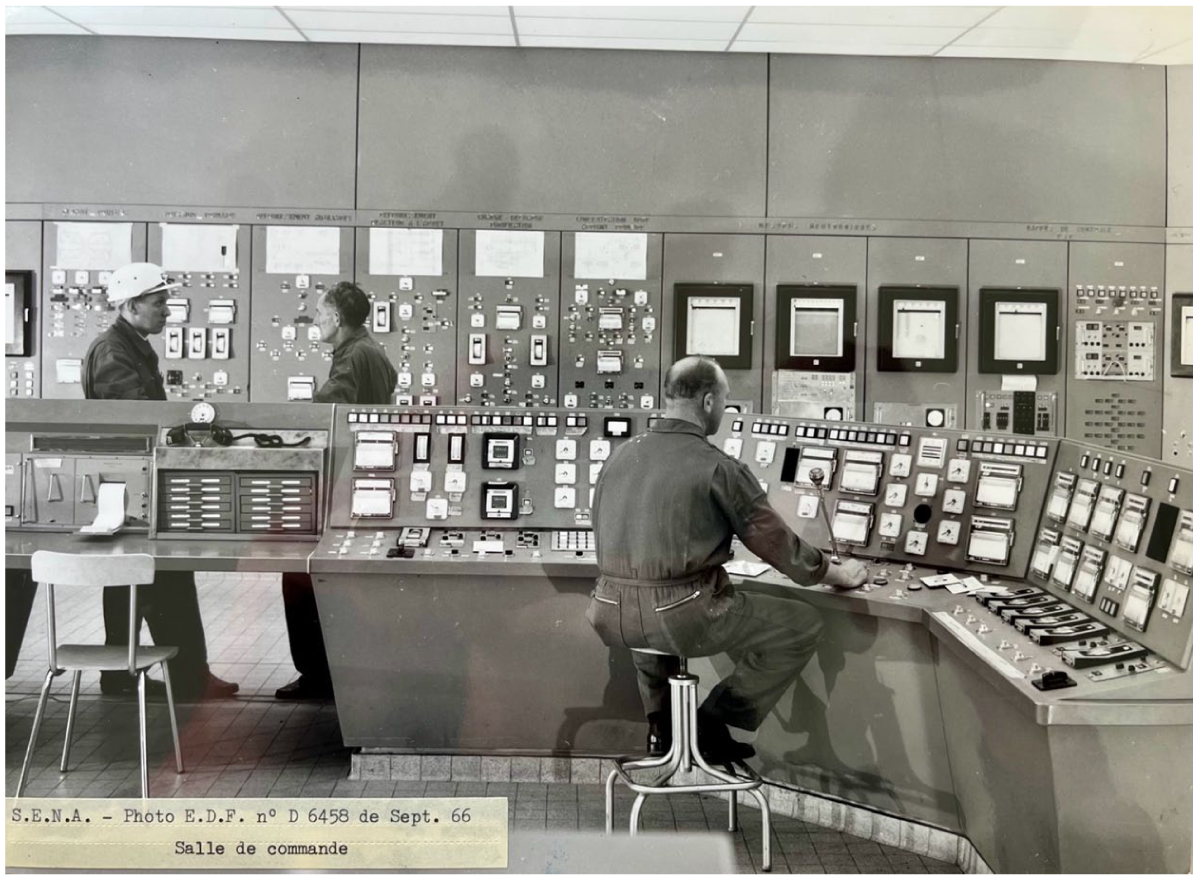
The control room of the Chooz A reactor during tests prior to startup in 1966. Most of the plant workers, particularly the French ones, were quite inexperienced.
According to EDF engineers, design flaws by Westinghouse were the cause of the incident. Indeed, very similar incidents, though less serious, had occurred at the Yankee Rowe and Trino nuclear power plants. Wear on the thermal shield was also observed at the Obrigheim nuclear reactor in West Germany. 73 As early as 1968, the working hypothesis was that vibrations in the cooling system were so strong that they affected the thermal shield. In the subsequent exchanges between SENA and Westinghouse, notable disagreements emerged regarding how to address the incident. According to SENA, Westinghouse failed to provide a formal and conclusive demonstration of the causes and sequence of events. SENA considered that the simple replacement of the thermal-shield bolts was insufficient and suggested that the reactor core itself might need to be replaced. 74
The repair process, which extended over two years (1968–70), was a haphazard process of constant troubleshooting, tinkering, and trial and error. It involved the delicate dismantling of internal structures and proved to be highly complex due to the radioactivity of the primary circuit affected by the incident. First, the reactor had to be flooded with water so that the staff could work on it without being irradiated. Then, it required developing innovations, including remote-handling tools, such as manipulators and cameras (see Figure 7). Other tools, used outside the nuclear field, were also employed: binoculars, an astronomical telescope, endoscopes, and fibroscopes. 75 Pierre Condou, instrumentation technician at EDF, recalls that cameras were mounted on a system allowing vertical movement to inspect each fuel element along its full height and on all four sides. When pieces of debris or metal were spotted, operators used mechanical hand-controlled pincers to remove them remotely. 76
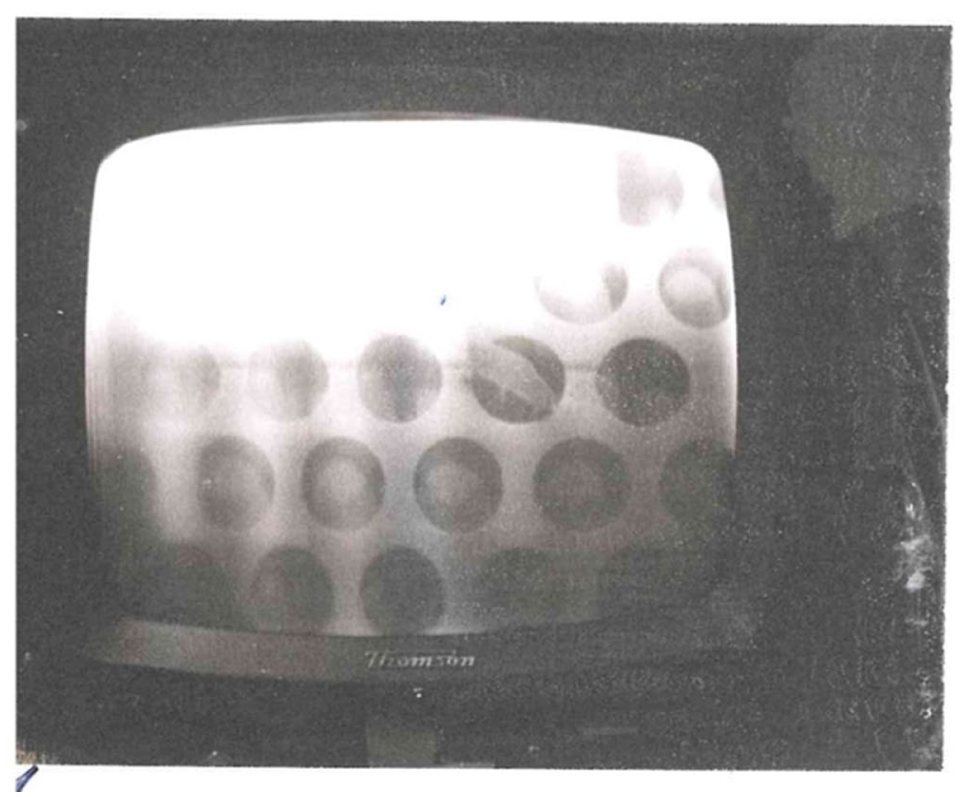
Television camera observation of a metallic fragment on the lateral face of a fuel element. Cameras and television technologies proved to be an unanticipated but crucial part of the repair process.
Lacking any expertise with managing such a serious incident in a large-scale PWR, the French and Belgian utilities relied tremendously on expertise from Westinghouse. Westinghouse specialists, stationed at the Trino nuclear plant in Italy, were summoned to Chooz to help with the repairs. 77 However, Pierre Schmitt, who worked as an operator for EDF, felt that the Westinghouse engineers were not very helpful: “[He] treated us like his laborers. Do this, do that, measure this, measure that. And then go on, be a good boy, go on. It was essentially that.” 78 Belgians from ACEC, a Westinghouse subsidiary, played a crucial role, too. Tudy Brognon, a Belgian chemical engineer who worked at ACEC, was one of them. Although very new to the nuclear field, his task was to make the water with which the reactor was flooded clearer so that it was easier to do the repairs. He remembers the work as involving a lot of trial and error. After failing multiple times, he and his team finally managed to make the water clearer by using a filter from a sugar factory. 79
Donald Berquez was a young engineer and reactor designer when faced with the incident. There were still many uncertainties. He and his colleagues, all very young and inexperienced, had to constantly check and double-check all calculations and information with each other. The engineers from Framatome had to collaborate closely with those from ACEC, a much larger and older company. Berquez often had to travel to Charleroi and remembers it as a “big machine” with its own traditions, and there were some rivalries. A lot of engineering diplomacy was thus required. According to Berquez, relations with Westinghouse were difficult at times: the company was reluctant to share documentation and was not particularly proactive. Indeed, Westinghouse held almost all of the essential know-how for designing PWRs. Many of those who worked on the Chooz A project still remember very well that “Westinghouse was God.” 80
Westinghouse and SENA held weekly meetings to address the incident. Despite lacking direct experience with this reactor type, the CEA assumed the role of expert and regulator. 81 The centrality of Westinghouse to the Chooz project reinforced the CEA’s uncompromising stance toward both SENA and Westinghouse. 75 “The CEA was the inquisition,” recalled Donald Berquez, who worked for Framatome and served as an intermediary between the CEA and Westinghouse. He remembered how different the organizational cultures were: the CEA, a hierarchical military–scientific institution, expected meticulous detail, especially for a reactor type it viewed skeptically, while Westinghouse, a large corporation, tended to offer the opposite and, at times, withheld calculations and documentation. Yet the CEA also lacked the technical depth needed to evaluate American designs. The cultural clash was palpable from the first joint meetings, held at the Château de Breteuil. The CEA scientists had hosted the proceedings in a grand setting and wearing formal attire, while the American and Belgian delegates, accustomed to first-name familiarity and a more relaxed business-style approach, felt out of place. According to Berquez, regarding Chooz’s safety, the CEA scientists were also on the back foot during the meetings, contributing little beyond asserting that gas–graphite reactors were inherently superior. 82
Euratom also intervened, creating a tripartite commission of experts from France, Belgium, and Euratom to assess the damage, determine the causes of the shutdown, and bring it to an end. 83 In addition, a consultative committee of European safety specialists, with representatives from Belgium, Germany, Italy, and the Netherlands, reviewed the manufacturers’ repair proposals and even solicited help from the U.S. AEC. 84 This European approach, which grossly exceeded the usual remit of Euratom’s Article 37, was unique in the French context. Euratom’s oversight, usually very contentious, seemed more acceptable to the French authorities because of the unprecedented nature of the incident and the specific characteristics of the Chooz A reactor, being an American design not intended to produce plutonium for French bombs. At the same time, the experts were not very transparent about the incident to the outside world. Members of the European Parliament were very much in the dark about how serious the repairs were. 85 Still, the moment was significant for Euratom: a year earlier, one of Euratom’s leading officials, Willem Vinck, had unsuccessfully tried to position the organization as a regulator by drafting European nuclear-safety standards. 86 At Chooz, Euratom saw another opportunity to play a meaningful role in nuclear safety and assert itself as a regulator.
Decisive meetings in Autumn 1968, nearly a year after the first problems appeared, brought together the CEA, Euratom, designers and manufacturers, and SENA. 87 Participants agreed that the incident did not call the PWR line into question and traced the failure not to on-site problems but to defects originating in Westinghouse’s Charleroi works and at Framatome. Westinghouse was then authorized to propose vessel repairs. It recommended permanent removal of the thermal shield. The lack of protection of the steel against irradiation was to be offset by removing fuel elements. Despite reservations, the CEA approved. On September 12, 1968, eight fuel elements and the shield were permanently removed – an unprecedented alteration of a reactor core. 88
Ultimately, the reactor restarted on March 18, 1970, after expensive repair works (paid by Westinghouse, ACEC, and Framatome) and an equally costly shutdown of two years. Indeed, the incident had turned Chooz into a laboratory to an even greater extent. For all the actors involved, the shutdown had been an arena for exchange, diplomacy, decision-making, and learning in an unprecedented situation. Westinghouse gained expertise about previously unknown risks across its fleet, and the CEA deepened its understanding of PWRs through inspections and by organizing conferences. 89 Belgian utilities and EDF likewise accrued operational experience. 90 At Chooz, operators had not been trained for accident management or nuclear safety. Lacking formal procedures, engineers and technicians had improvised solutions on the spot. Euratom, supported by the AEC, sought lessons to prevent similar events in operating or planned reactors. This difficult episode thus left a lasting mark. 91
Tritium: A laboratory and its problems in the public sphere
Chooz A experienced other unforeseen problems due to its laboratory nature. In the middle of the 1970s, it released larger amounts of tritium than expected into the river Meuse. Tritium is a radioactive isotope of hydrogen and a common by-product in nuclear reactors. All nuclear power plants release some quantity of tritium – albeit limited – into the environment. But the design of Chooz A brought about much larger releases for two reasons. Firstly, reactor designers had added boric acid to the cooling water. 92 Boric acid absorbs neutrons. It helps to control the nuclear chain reaction and prevents large fluctuations. Adding more boric acid enabled the operators to experiment with increasing the power output of the plant. But it came with a downside. The reaction between neutrons and boric acid occasionally produces tritium. 93 Yet, there was also a second reason for the high tritium releases. Tritium can permeate the fuel pellets that contain the uranium fuel. At Chooz A, these pellets were made from stainless steel as opposed to the more expensive zirconium alloy that was widely used elsewhere, allowing for much more tritium to leak away. 94 The reason for choosing these cheaper materials was to experiment and cut costs.
Although these preconditions caused tritium releases to be high from the outset, controversy only really ensued in the early 1970s when environmentalist movements, which were flourishing by this point, began to scrutinize these releases. This was the first time that experimentation at Chooz faced opposition from public actors. The first sounds of protest came from Belgium. A group of Dutch-speaking environmental activists published a book in 1972 called Zwart Milieu (Black Environment), which quoted research from the University of Leuven arguing that water in the Meuse was contaminated. These results concerned a group of Dutch socialist parliamentarians. Indeed, the Meuse flows through the Netherlands, downstream from Chooz. Meiny Epema-Brugman and Adriaan Oele interrogated the Dutch Minister of Transport and Water about the pollution. Oele, who was also a member of the European Parliament, appealed to the Euratom Treaty to compel the French government to control the pollution. 95
This did little to alleviate local concerns along the Meuse, particularly in Belgium. In Visé, a town close to Maastricht, panic ensued in January 1973 after someone saw dead fish in the Meuse. Civil protection authorities immediately proceeded to distribute water bottles, fearing that the drinking water supply may have been polluted. 96 The French local newspaper L'Ardennais covered the story for multiple days, much to the frustration of the French prefect of the Ardennes département, who called the newspaper “sensational.” 97 But in the Belgian part of the Ardennes, there were similar concerns. La Namuroise, for instance, complained how the region “produced all the water of the country but only the capital [Brussels] and Flanders profit from it.” Together with the construction of new dams in the region, the pressures on the water supply were becoming too high. 98 These water debates in Belgium were hardly unique. Across Western Europe, the arrival of nuclear power plants magnified existing struggles over water supply and pollution – up to the point that it became one of the first policy domains in which the European Communities began to engage with environmental policy. 99
The tritium levels were determined by the operational capacity of the plant, but also by the water level of the Meuse, river works further downstream, and droughts. 100 These external factors caused the situation to deteriorate in 1974, as one of the fuel pellets of the reactor ruptured. This caused the cooling water to become heavily contaminated by tritium. 101 Excessive releases of tritium continued throughout 1974. In September 1974, however, Pierre Pellerin, the leading figure of the French radiation protection agency SCPRI (Service central de protection contre les rayonnements ionisants), became concerned with the situation too, particularly because the water level of the already shallow Meuse River was very low. Pellerin kept in close contact with one of the directors of the plant, Jean Grangetas. 102 Pellerin was known for being very pragmatic. 103 He initially granted Grangetas the permission to release multiple times tritium-contaminated coolant water into the Meuse, exceeding the regulations. 104
However, by the end of the month, no more water could be released. The SCPRI, led by Pellerin, had granted a temporary exception to the normal release of tritium, but even that limit had been majorly surpassed. 105 Tritium-contaminated water had filled up all the storage tanks, and there was nowhere to go with it. SENA became desperate and warned that the plant would not be able to function properly anymore. Jean Kieffer from EDF complained to Pellerin that the Meuse did not contain a lot of tritium at all and that Chooz A was the only industrial installation releasing it into the Meuse. Kieffer proposed a number of radical solutions, including shipping the water away by truck, boiling and vaporizing it, or even changing the material of the fuel pellets. 106
The Belgian contingent was surprisingly inactive in this discussion, and there is significant evidence that this was because they were deliberately denied information. At various points in time, the SCPRI was hesitant to provide the Belgian authorities with details about the tritium leaks. Even though Belgian communities downstream would be hit much harder by this contamination than French ones, Belgian authorities were not immediately informed following the release of large amounts of tritium due to the ruptured fuel pellet. In Brussels, the IHE (Institut d'hygiène et d’épidémiologie) studied and supervised radioactive contamination. An SCPRI official noted that it would be “delicate . . . to keep the IHE informed.” SENA was not willing to keep Belgian authorities in the loop either, as they argued that tritium releases were not regulated by the French–Belgian deal that allowed Chooz A in the first place. 107 The collaboration, diplomatic exchange, and proximity with Belgium thus did not automatically entail a good knowledge exchange. Even more so, such cross-border production of ignorance about nuclear risks was certainly not unique and also took place, for instance, on the Danish–Swedish border. 108
By 1976, the tritium releases had decreased again. 109 However, SENA’s experimentations had pushed the boundaries of the regulatory regime governing radiation releases in water. Indeed, the use of cheaper fuel pellets entailed significant river contamination, as well as scientific and geopolitical consequences in the 1970s, aggravated by the border situation and official secrecy.
MOX: A Belgian testing ground
A final experiment that contributed to Chooz’s status as a laboratory was to add plutonium to the reactor fuel. In the 1960s, several laboratories and research reactors in the United States had begun experimenting with MOX fuel. This fuel is a mixture of uranium and plutonium oxides. When an LWR produces energy by nuclear fission, new radioactive isotopes are created as by-products. One of them is plutonium. By reprocessing this plutonium and using it in MOX fuel, some of it can be recycled, meaning less uranium needs to be used. By the late 1960s and 70s, as fears over the scarcity of uranium supplies were growing, scientists and engineers were increasingly taking an interest in MOX fuel. This was particularly the case in Belgium, which, after Congo gained independence, did not have any Belgian uranium or plutonium production. 110
Belgian scientists had been among the first to experiment with MOX fuels. Researchers of the STK (later SCK-CEN) began this as part of the research collaborations with the United States following the Euratom Treaty. To acquire expertise, Belgian nuclear companies funded internships at laboratories in the United States immediately after the Treaty was in effect. 111 The very first MOX fuel pellet was built at the STK and loaded into the BR-3 reactor in 1963, in collaboration with the company Belgonucléaire and the United Kingdom Atomic Energy Agency. 112 A few years later, Euratom built a new factory next to the STK, dubbed Eurochemic, where plutonium was produced. 113 By 1970, Belgian scientists had become eager to test out the MOX fuel produced in Mol in the Chooz A reactor. 114 Through SENA, the Belgian utilities involved EDF, and by extension, the French nuclear industry, in using MOX. 115 They could count on the enthusiastic support of Euratom, and particularly its Belgian top nuclear safety official, Willem Vinck.
However, the MOX experiments had not initially been taken into account when designing Chooz A. A safety review, therefore, had to be carried out for this experiment. Of particular concern was the potential radioactive contamination of the environment, with larger amounts of plutonium isotopes, in case an accident breached the containment. 116 Just as during the incident of 1968, the CEA, together with Euratom, acted as the nuclear regulator. However, there was a major issue. Both institutions had almost no in-house scientific expertise on fuel reprocessing and the related safety risks. Most expertise was centered in the group of companies involved in reprocessing at the STK and Eurochemic, spearheaded by Belgonucléaire. Gianpiero Santarossa, an expert working for the Commission of the European Communities, was concerned about how Belgonucléaire and the other organizations involved would be able to guarantee the quality of the fuel reprocessing. In essence, the concern here was regulatory independence. No one was able to completely verify whether the new MOX fuel was safe, not least the government agencies. 117 In addition, the CEA, as the main nuclear fuel producer in France, was also part of the group of organizations delivering the MOX fuel to Chooz. Again, the MOX experiment exposed the lack of independent regulatory control. This enabled the Euratom Commission to take a leading role in investigating the safety of the MOX fuel. Yet, complete independence remained difficult, as collaboration with the fuel producers, especially the CEA, remained essential for acquiring knowledge regarding the risks of plutonium handling. 118
Just as with the other safety issues at Chooz, the regulatory officials were very dependent on expertise from the United States. In 1974, Vinck traveled to the United States and brought back new information and publications about MOX experiments in the Idaho National Laboratory. 119 That same year, SENA inserted four test elements into the reactor core of Chooz A. 120 Two more followed in 1979, and eight more in 1987. 121 In 1988, SENA sought the approval of the French nuclear authorities, which by now had more extensive expertise in nuclear reprocessing, to recycle the plutonium from spent uranium fuel. 122 While the MOX experiment at Chooz, as opposed to some of the other experiments, was a success, MOX fuels never really took off globally. Ironically, despite having started as an American and Belgian project, France is today the only country in the world that still produces MOX fuels. Indeed, the experience at Chooz has proven crucial for fuel reprocessing science and technology in France.
Conclusion
This paper traced back the history of perhaps one of the world’s most curious pieces of nuclear infrastructure: the Chooz A reactor on the French–Belgian border. This unusual nuclear power plant was never simply built to generate electricity or “demonstrate” a certain technology. It also functioned as a laboratory, although not one revolving around scientific experiments but rather technical know-how. It was a place where technologies, expertise, and international collaborations were tested, tinkered with, and sometimes contested. From its cavern design and early experiments for countering irradiation embrittlement, to the crisis of expertise exposed by the thermal-shield incident, to the controversies around tritium pollution of the river Meuse and the pioneering use of MOX fuel, Chooz became a site of experimentation.
This laboratory was transnational in scope and is a prime example of how Kenji Ito and Maria Rentetzi have conceptualized nuclear diplomacy. French, Belgian, American, and European state and nonstate actors all invested in Chooz, seeing it as an opportunity to acquire knowledge that could serve their own national agendas. The Chooz A project demonstrates how transnational collaboration and national interest were never contradictory but deeply entangled in the nuclear industry. EDF had gained experience with designing and operating American reactor technology. Belgian companies had practiced building a reactor on a larger scale while reducing the financial risk. Westinghouse was able to test its reactor design outside of the United States. And for Euratom, Chooz was the first real product of its research and development program in collaboration with the United States, and a litmus test as Euratom stepped up for the first time as a nuclear regulatory agency. Although Euratom is generally described as a failure, knowledge gave the young organization power. Chooz A would very likely not have existed without it. But this transnationalism also had its limits and asymmetries. As historians have shown, transnational collaboration in the nuclear field was fused with national interests and border conflicts. This was clear during the tritium controversy, for example, when Belgian authorities were deliberately kept out of the loop.
As with any laboratory, Chooz’s experiments caused a lot of unintended events and even some problematic consequences. This succession of new problems and challenges made Chooz into a continuous training ground for engineers and other plant workers from France, Belgium, the United States, and elsewhere to learn how to design, operate, repair, and troubleshoot a water-cooled reactor. And how not to. For example, the incident with the thermal shield caused a shutdown of over two years, mostly because there were significant uncertainties as to how to solve the problem. Furthermore, the introduction of MOX fuels into Chooz exposed a lack of regulatory independence. And the particular design of the reactor core caused large quantities of tritium-contaminated water to be released into the Meuse, prompting international indignation. Indeed, this experimentation occurred in a context of mounting concerns about the environment, such as water quality, and growing antinuclear mobilization, which was particularly strong in border regions. Still, these environmental concerns seem to have had a relatively limited impact on the operation of Chooz A in the early years.
Is the case of Chooz A then unique or typical? We would argue it is both. On the one hand, the border location and number of organizations from different countries made Chooz a uniquely transnational laboratory and site for nuclear diplomacy. Other nuclear power plants around this time, like Yankee Rowe or Trino, were also sites of experimentation, but never to the degree of Chooz and in the same transnational context. Chooz should also be seen in a specific temporal context. It is perhaps unlikely that the same degree of experimentation and troubleshooting would have been possible or relatively uncontested a decade later, when antinuclear mobilization and scrutiny were a lot more prominent.
On the other hand, we argue that Chooz A as a laboratory allows us to understand better the role of knowledge-making in shaping worldwide nuclear trajectories, and arguably even energy transitions, more generally. There is a long historiographic tradition of separating nuclear knowledge production from the development of nuclear power generation technologies and facilities. The history of Chooz demonstrates that science, engineering, and practical know-how were much more entangled through the constant experimenting and testing of new technologies and practices within power-generating facilities by nonscientists, such as engineers, technicians, and workers. Power is not always generated according to plan, with solutions sometimes working and sometimes not, like in a laboratory. The picture becomes even more diverse when regulatory agencies and policymakers are brought into the picture, who rely on the same scientists, engineers, and operators involved in the nuclear projects for expertise, but also attempt to independently develop their own knowledge. Chooz, then, is a perhaps extreme but useful reminder – and a pointer for new research – that crucial knowledge production through experimentation does not only take place in scientific laboratories but also in all kinds of energy infrastructures.
Today, France and Belgium are some of the most nuclearized countries in the world. This history of Chooz A is the origin story of that dependence on nuclear power. In the early 1970s, many of Chooz A’s staff had already moved to new nuclear projects, such as Tihange in Belgium and Fessenheim in France, and transferred their knowledge to new groups of experts and applied it on a larger scale. 123 Gradually, the laboratory work at Chooz left a large imprint on postwar science and technology. Yet, in striking contrast to this lasting impact, Chooz A is today forgotten by many, although much more so in Belgium than in France. A decade after its startup, it was already considered by both the Belgian and French nuclear players, who had advanced to undertake larger projects, a technological backwater. 124 Today, Chooz A is a laboratory again, albeit as the first water-cooled nuclear reactor to be decommissioned in France, and one of the first in Europe.
Footnotes
Acknowledgements
We would like to thank Maël Goumri, Martin Kohlrausch, and the participants of the Stripe seminar at Linköping University for their useful comments and suggestions. We would also like to thank the archivists of EDF, the French Nuclear Safety and Radiation Protection Authority, Westinghouse, the Belgian National Archives, and all interviewees.
Funding
The authors disclosed receipt of the following financial support for the research, authorship, and/or publication of this article: This article was researched as part of the FWO-funded project (12AAC25N) “Atoms from Abroad: A Transnational History of Nuclear Energy in Belgium (1953–1985).” Some Nuclear Safety and Radiation Protection Authority (ASNR) archives were also used by Michaël Mangeon in an archive enhancement project funded by the ASNR.
Conflict of interest
The authors declared no potential conflicts of interest with respect to the research, authorship, and/or publication of this article.
Ethical approval
The FWO-funded project (12AAC25N) received ethical approval from the Social and Societal Ethics Committee of KU Leuven (approval number G-2025-9360-R3(MAR)). Interviews were conducted after oral or written informed consent, and the interviewees received the opportunity to review their quotes and confirm in written form their participation before publication.
1.
“Nuclear Power in France,” World Nuclear Association, May 21, 2024.
3.
This new wave of research resulted in a large number of new books and PhD theses, including Sophie Bretesché et al., eds., Enquêter dans le nucléaire (Presses universitaires de Rennes, 2021); Laura Barbier, “Une Entreprise Inaccessible? Faire La Preuve Des Pathologies Environnementales Par l’épidémiologie : L’exemple Du Nucléaire En Grande-Bretagne et En France” (These de doctorat, Université Paris Cité, 2019), https://theses.fr/2019UNIP5161; Julie Blanck, “Gouverner Par Le Temps : La Gestion Des Déchets Radioactifs En France, Entre Changements Organisationnels et Construction de Solutions Techniques Irréversibles (1950–2014),” no. 2017IEPP0024 (Theses, Institut d’études politiques de Paris – Sciences Po, 2017), https://theses.hal.science/tel-03436542; Mael Goumri, “Apprivoiser Le Cygne Noir. Construction et Circulation Des Savoirs et Des Ignorances Dans Le Gouvernement de l’accident Nucléaire Majeur.” (These en préparation, Université Paris Cité, 2015), https://theses.fr/s176742; Claire Le Renard, “Le Prototype Défait : Superphénix, Des Glissements de La Promesse Technoscientifique Aux Épreuves de La « démocratie Technique »” (These de doctorat, Paris Est, 2021), https://theses.fr/2021PESC0038; Michaël Mangeon, “Conception et évolution du régime français de régulation de la sûreté nucléaire (1945–2017) à la lumière de ses instruments: une approche par le travail de régulation” (Thesis, Université de recherche Paris Sciences et Lettres PSL Research University, 2018); Leny Patinaux, “Enfouir Des Déchets Nucléaires Dans Un Monde Conflictuel. Une Histoire de La Démonstration de Sûreté de Projets de Stockage Géologique, En France (1982-2013)” (Theses, EHESS, 2017), https://hal.science/tel-01974327; Ange Pottin, Le nucléaire imaginé: Le rêve du capitalisme sans la Terre (La Découverte, 2024); Mathias Roger, “Le Séisme, La Centrale et La Règle : Instaurer et Maintenir La Robustesse Des Installations Nucléaires En France” (These de doctorat, Université Paris Cité, 2020),  .
.
5.
Helen Tilley, Africa as a Living Laboratory: Empire, Development, and the Problem of Scientific Knowledge, 1870–1950 (Chicago, IL: University of Chicago Press, 2011).
6.
Bruno Latour and Steve Woolgar, Laboratory Life: The Construction of Scientific Facts, ed. Jonas Salk (Princeton, NJ: Princeton University Press, 1986).
7.
Michael Camp, “‘Wandering in the Desert’: The Clinch River Breeder Reactor Debate in the U.S. Congress, 1972–1983,” Technology and Culture 59, no. 1 (2018): 26–47.
8.
Richard G. Hewlett et al., Atoms for Peace and War, 1953–1961: Eisenhower and the Atomic Energy Commission, 1st ed. (Oakland, CA: University of California Press, 1989), pp.196–8.
9.
10.
Kenji Ito and Maria Rentetzi, “The Co-Production of Nuclear Science and Diplomacy: Towards a Transnational Understanding of Nuclear Things,” History and Technology 37, no. 1 (2021): 4–20, https://doi.org/10.1080/07341512.2021.1905462; Alexandros-Andreas Kyrtsis and Maria Rentetzi, “From Lobbyists to Backstage Diplomats: How Insurers in the Field of Third Party Liability Shaped Nuclear Diplomacy,” History and Technology 37, no. 1 (2021): 1–19, https://doi.org/10.1080/07341512.2021.1893999; Anna Åberg, “The Ways and Means of ITER: Reciprocity and Compromise in Fusion Science Diplomacy,” History and Technology 37, no. 1 (2021): 106–24, https://doi.org/10.1080/07341512.2021.1891851; Gisela Mateos and Edna Suárez-Díaz, “Atomic Ambassadors: The IAEA’s First Preliminary Assistance Mission (1958),” History and Technology 37, no. 1 (2021): 90–105, .
11.
For some examples of such general histories, see: Hewlett et al., Atoms for Peace and War, 1953–1961 (note 8); J. Samuel Walker, Containing the Atom: Nuclear Regulation in a Changing Environment, 1963–1971 (Oakland, CA: University of California Press, 1992); Sigfrid Leijonhufvud, Parentes?: en historia om svensk kärnkraft (Zurich: ABB Atom, 1994); Félix Torres and Véronique Lefebvre, Chooz de A à B: une histoire de la filière à eau pressurisée racontée par Electricité de France (Efil Communication pour la Direction de l’Équipement d’Électricité de France, 1996).
12.
See for instance John Krige, “Introduction: Writing the Transnational History of Science and Technology,” in How Knowledge Moves. Writing the Transnational History of Science and Technology (Chicago, IL: Chicago University Press, 2019), p.2. A group of scholars has now coined the term techniques to point to more tacit and practical forms of knowledge: Guillaume Carnino et al., Global History of Techniques (Turnhout: Brepols, 2024), .
13.
David L. Edgerton, The Shock of the Old: Technology and Global History since 1900 (London: Profile Books, 2008); Ruth Oldenziel and Mikael Hård, Consumers, Tinkerers, Rebels: The People Who Shaped Europe (New York, NY, 2013); Mikael Hård, Microhistories of Technology: Making the World (Cham: Springer Nature, 2023), .
14.
15.
Ito and Rentetzi, “The Co-Production” (note 10).
16.
Åberg, “The Ways and Means of ITER” (note 10).
17.
Maria Rentetzi, “The Global Experiment: How the International Atomic Energy Agency Proved Dosimetry to Be a Techno-Diplomatic Issue,” NTM Zeitschrift Für Geschichte Der Wissenschaften, Technik Und Medizin 30, no. 2 (2022): 167–95, https://doi.org/10.1007/s00048-022-00336-9; Maria Rentetzi, “With Strings Attached: Gift-Giving to the International Atomic Energy Agency and U.S. Foreign Policy,” Endeavour 45, no. 1 (2021): 100754, ; Elisabeth Roehrlich, Inspectors for Peace: A History of the International Atomic Energy Agency (Baltimore, MD: Johns Hopkins University Press, 2022).
18.
19.
Andrew Barry and William Walters, “From EURATOM to ‘Complex Systems’: Technology and European Government,” Alternatives: Global, Local, Political 28, no. 3 (2003): 305–29, 311.
20.
See, for instance, Pierre-Henri Floquet, Histoire de La Centrale Nucléaire Des Ardennes: Un Exemple Pionnier de Coopération Européenne Dans Un Secteur de Pointe (Association pour l’histoire de l’électricité en France, 1995), p.196; Torres and Lefebvre, Chooz de A à B (note 11).
21.
Arne Kaijser and Jan-Henrik Meyer, “Nuclear Installations at the Border. Transnational Connections and International Implications. An Introduction,” Journal for the History of Environment and Society 3 (2018): 1–32, https://doi.org/10.1484/J.JHES.5.116793; Le Renard, “The Superphénix Fast Breeder Nuclear Reactor” (note 9); Astrid Mignon Kirchhof, “East-West German Transborder Entanglements through the Nuclear Waste Sites in Gorleben and Morsleben,” Journal for the History of Environment and Society 3 (2018): 145–73, https://doi.org/10.1484/J.JHES.5.116797; M. d. Mar Rubio-Varas et al., “Siting (and Mining) at the Border: Spain-Portugal Nuclear Transboundary Issues,” Journal for the History of Environment and Society 3 (2018): 33–69, https://doi.org/10.1484/J.JHES.5.116794; Arne Kaijser and Jan-Henrik Meyer, “‘The World’s Worst Located Nuclear Power Plant’: Danish and Swedish Cross-Border Perspectives on the Barsebäck Nuclear Power Plant,” Journal for the History of Environment and Society 3 (2018): 71–105, .
22.
Troisième plan de modernisation et d’équipement (1958–1961), adopted in 1959 by the Commissariat au Plan.
23.
Gabrielle Hecht, The Radiance of France: Nuclear Power and National Identity after World War II (Cambridge, MA: MIT Press, 2009), p.453.
24.
Ibid., pp.271–323.
25.
Mangeon, “Conception et évolution,” p.137 (note 3).
26.
Pierre Buch and Ernest Mund, “Aux origines de l’effort du nucléaire belge,” in Un demi-siècle de nucléaire en Belgique: témoignages, ed. Pierre Govaerts et al. (Brussels: Presses Interuniversitaires Européennes, 1994).
27.
28.
Ibid., pp.82–3.
29.
Jacques Burtheret, Videoconference interview, March 19, 2025; Pierre Condou, Videoconference interview, 16 April 2025.
30.
Krige, “The Peaceful Atom as Political Weapon,” p.7 (note 18).
31.
32.
Krige, “The Peaceful Atom as Political Weapon,” pp.35–6 (note 18).
33.
34.
Hecht, The Radiance of France, p.144 (note 23).
35.
Georges Lamiral, Chronique de trente années d’équipement nucléaire à Electricité de France (Paris: Association pour l’histoire de l’electricite en France, 1988).
36.
“Mission Euratom aux États-Unis en juillet 1957 – Rapport de la délégation,” Tractionel, 5476, AGR, Brussels.
37.
Boris Dänzer-Kantof et al., L’énergie de la France: De Zoé aux EPR, une histoire du programme nucléaire français (François Bourin Editeur, 2011), p.703.
38.
Torres and Lefebvre, Chooz de A à B, 50 (note 11).
39.
“Centrale des Ardennes” (17 June 1959), Tractionel, 5477, AGR, Brussels.
40.
“Centrale nucléaire”, Tractionel, 5477, AGR, Brussels.
41.
M. De Merre and H. Robiliart, “Letter to P. Smits,” (9 June 1959) Tractionel, 5477, AGR, Brussels.
42.
“Chutes d’avions militaires belges” (11 October 1984), 309730, ASNR Archives.
43.
“Sixty-Seventh Meeting ACRS” (7–9 October 1965), NRC Documentation Center, 24; Anna Storm et al., “Urban Nuclear Reactors and the Security Theatre,” in Heike Oevermann and Eszter Gantner (eds.) Securing Urban Heritage: Agents, Access, and Securitization (Milton Park, AB: Taylor & Francis, 2019), ; Maja Fjæstad, Sveriges första kärnreaktor: från teknisk prototyp till vetenskapligt instrument, with Statens kärnkraftinspektion (SKI, 2000).
44.
“CR de mission” (May 18, 1966), 3105, ASNR Archives.
45.
“CR des réunions du groupe de travail génie civil du 13 décembre 1960” (27 December 1960) Tractionel, 4813, AGR, Brussels.
46.
“PV de la réunion du conseil d’administration du 4 octobre 1962 à 10h30” (4 October 1962) and ”PV de la réunion du conseil d’administration du 11 fevrier 1963 à 10h30” (11 February 1963), 6436, AGR, Brussels.
47.
“CR des réunions du groupe de travail génie civil du 13 décembre 1960” (27 December 1960) Tractionel, 4813, AGR, Brussels.
48.
“PV de la réunion du conseil d’administration du 13 decembre 1962 à 10h30” (13 December 1962), 6436, AGR, Brussels.
49.
Kurt Hellbrom, “Tätning av betong med plast,” Väg och Vattenbyggaren 6 (1958), 135–38.
50.
”PV de la réunion du conseil d’administration du 28 mars 1960,” Tractionel, 2096, AGR, Brussels; “PV de la réunion du conseil d’administration du 3 octobre 1960,” Tractionel, 2096, AGR, Brussels.
51.
“SENA Unique Among PWR Plants,” Nuclear Reactions 11 (3), Westinghouse Archives, Pittsburgh, PA.
52.
Jacques Planquart, “Histoire du Centre d’Etude de l’Energie Nucléaire – CEN/SCK,” in Un demi-siècle de nucléaire en Belgique: témoignages, ed. Pierre Govaerts et al. (Brussels: Presses Interuniversitaires Européennes, 1994); Vanpaemel, Op weg naar een duurzame toekomst, (note 27).
53.
Hewlett et al., Atoms for Peace and War, 1953–1961 (note 8).
54.
Donald Berquez, Videoconference interview, 28 March 2025.
55.
56.
57.
“Évaluation de la sécurité” (s.d.), 3106, ASNR Archives; Lamiral, Chronique de trente années, p.301 (note 35); Torres and Lefebvre, Chooz de A à B (note 11); Ibid.
58.
For more information about the Trino reactor system, see: G. P. Battista and S. Valenziani. Neutron Flux Distributions During First Operating Cycle of Trino Vercellese Reactor. EUR 3932 e. European Atomic Energy Community (Euratom), 1968; “The development of light water reactors in the community. Proceedings of the days organized by Euratom, Brussels, 23–24 November 1966.
59.
Jacques Daumas, Physical interview, 2 April 2025.
60.
Pierre Schmitt, Physical interview, 15 April 2025.
61.
“Evaluation technique de la sécurité de la centrale SENA: Rapport d’évaluation avant mise en marche” (26 May 1966) 3106, ASNR Archives.
62.
Daumas, Physical interview (note 59).
63.
Ibid.
64.
Ibid.
65.
Condou, Videoconference interview (note 29).
66.
Daumas, Physical interview (note 59).
67.
Burtheret, Videoconference interview (note 29); Condou, Videoconference interview (note 29).
68.
Condou, Videoconference interview (note 29).
69.
Burtheret, Videoconference interview (note 29).
70.
Ibid.
71.
Daumas, Physical interview (note 59).
72.
Torres and Lefebvre, Chooz de A à B, p.64 (note 11). Daumas, Physical interview (note 59).
73.
Daumas, Physical interview (note 59).
74.
SENA, “Management Committee, minutes of the meeting of 12 June 1968” (1968), EDF Archives, B0500420360.
75.
J. Kieffer, “Réparation du réacteur de Chooz.” Bulletin d’information de l’Association technique pour l’énergie nucléaire, no. 87 (1971).
76.
Condou, Videoconference interview (note 29).
77.
SENA, “Executive Committee, minutes of the meeting held on 5 February 1968 in Paris,” (1968), EDF Archives.
78.
Schmitt, Physical interview (note 60).
79.
Tudy Brognon, Physical interview, 25 April 2025.
80.
Berquez, Videoconference interview (note 54).
81.
Floquet, Histoire de La Centrale Nucléaire Des Ardennes, p.196 (note 20).
82.
Berquez, Videoconference interview (note 54).
83.
Floquet, Histoire de La Centrale Nucléaire Des Ardennes, p.196 (note 20).
84.
Dominique Larroque, Histoire du service de la production thermique d’électricité de France: 1973–1992 (Paris: Association pour l’histoire de l’électricité en France, 1997), p.462.
85.
“Schriftliche Anfrage Nr. 155/69” (17 June 1969), European Parliament Archives Dashboard, EU.HAEU/PE0.AP.QP.QE.1969//E-0081/69/0010.
86.
87.
Floquet, Histoire de La Centrale Nucléaire Des Ardennes, p.169 (note 20).
88.
SENA, “Rapport de sûreté de la centrale nucléaire des Ardennes, annexe1. Modifications importantes survenues depuis la rédaction initiale du rapport de sûreté” (1977), ASNR Archives.
89.
Ouillon, “Expérience acquise lors des examens et du nettoyage des assemblages combustibles de la centrale des Ardennes, Symposium de Stockholm “Expérience acquise sur le comportement des éléments combustibles d'un réacteur de puissance refroidi à l'eau” (21–22 October 1969), B3070_D3070, ASNR Archives.
90.
Daumas, Physical interview (note 59).
91.
Michel Depestel to Clement, “Telex No 1688 GV No 2 Avancement Des Travaux” (23 April 1979), Chooz INB 1 Sena Centrale nucléaire des Ardennes, ASNR Archives.
92.
“Fiche n°4 Controle chimique” (s.d.), 312684, CHOOZ SENA. – Examen, ASNR Archives.
93.
Taylor Loy, “Tritium Matters: Constructing Nuclearity & Navigating Ambivalence of a Unique Material” (Blacksburg, VI: Virginia Tech, 2024), p.62.
94.
Jean-Marie Barreda and Jacques Daumas, physical interview (28 April 2025); Jean Kieffer, “Effluents tritiés de la Centrale de CHOOZ” (29 September 1974), 222955, ASNR Archives.
95.
Aanvulsel tot het Verslag van de Handelingen der Tweede Kamer (Tweede Kamer, Den Haag, 1972), p.501.
96.
“Pollution de la Meuse: une fausse alerte. . .,” L’Ardennais (15 January 1973).
97.
“Pollution des eaux de la Meuse par la Centrale Nucléaire franco-belge de CHOOZ” (11 January 1973), 222955, ASNR Archives.
98.
“Le gouverneur de Namur lance un cri d'alarme à propos du problème de l'eau,” La Namuroise (s.d.).
99.
Jan-Henrik Meyer, “Pushing for a Greener Europe: The European Parliament and Environmental Policy in the 1970s and 1980s,” Journal of European Integration History 27, no. 1 (2021): 57–78.
100.
Société d’Énergie Nucléaire Franco-Belge des Ardennes (SENA). Centrale nucléaire des Ardennes: Rapport annuel 1974 (1976), Commission des Communautés Européennes.
101.
“SENA – CHOOZ” (8 February 1974), 222955, ASNR Archives.
102.
Jean Grangetas, “CHOOZ” (31 July 1974), 222955, ASNR Archives.
103.
Daumas, Physical interview (note 59).
104.
Grangetas, “CHOOZ” (note 102).
105.
Gahinet, “Entretiens téléphoniques avec M. Grangetas, Directeur de la Centrale de Chooz, au sujet du rejet exceptionnel autorisé depuis le 1/08/1974” (6 September 1974), 222955, ASNR Archives.
106.
Kieffer, “Effluents tritiés de la Centrale de CHOOZ” (note 94).
107.
“SENA – CHOOZ” (note 101).
108.
109.
Tritium liquid discharges amounted to only 1,929 Ci, a decrease relative to both 1974 and 1975. The plant explicitly attributed this reduction to the severe drought of that summer and to the ten-year inspection outage, which together led to lower electricity generation. The extreme low flow of the Meuse (down to 8 m3/s in August) and elevated river temperatures forced the plant to operate at reduced power, thereby directly limiting tritium production and discharge. SENA, “Centrale nucléaire des Ardennes: Rapport annuel 1976” (1978), Commission des Communautés Européennes.
110.
Ali Massih, Models for MOX Fuel Behaviour, SKI Report 2006:10 (SKI, 2006).
111.
“Masoin, Participation de la Fondation au financement d’un stage aux Etats-Unis . . .” (6 August 1958), Tractebel, 2077, AGR, Brussels.
112.
Henri Potdevin, “La fabrication du combustible UO2: FBFC International,” in Pierre Govaerts et al. (eds.) Un demi-siècle de nucléaire en Belgique: témoignages (Brussels: Presses Interuniversitaires Européennes, 1994), p.489. Emile Fossoul, “Belgonucléaire,” in Un demi-siècle de nucléaire en Belgique: témoignages, ed. Pierre Govaerts et al. (Brussels: Presses Interuniversitaires Européennes, 1994), pp.413–14.
113.
Planquart, “Histoire du Centre d’Etude de l’Energie Nucléaire – CEN/SCK,” p.279 (note 52).
114.
115.
Jean Grangetas and L. Maesen, “Introduction d'assemblages combustibles au plutonium” (21 January 1974), 309699, ASNR Archives, 1.
116.
P. Lespiaucq, “CR de la mission effectuée les 2 et 3 mai 1974 à la centrale nucléaire des Ardennes” (17 August 1972), 309699, ASNR Archives, pp.1–2.
117.
Ibid.
118.
Ibid.
119.
Ibid.
120.
122.
Charlier et al., “Physics Aspects of the Plutonium Recycle,” (note 120)
123.
Condou, Videoconference interview (note 29); Daumas, Physical interview (note 59).
124.
Berquez, Videoconference interview (note 54).