






Abstract
In argumentative text types, evidential markers serve to construct credibility, authority, and power. Informed by corpus-assisted discourse analysis, this paper investigates the development of adverbial, phrasal, and clausal inferential adverbials in the Corpus of US Supreme Court Opinions spanning the 1790s to the 2010s. The analysis reveals that therefore constitutes the most common adverbial form but shows a continuous decline throughout the entire time span, with consequently and hence being way less common and demonstrating only minor frequency changes. The prepositional phrases for . . . the reason(s) . . . show an interesting increase but at a lower level. The clausal constructions that is why, this is why, and that’s why represent a fairly recent and infrequent format since the 1940s, with that is why enjoying a steep increase until the 2010s. The qualitative analysis explores the collocations of therefore and for . . . the reasons . . . and examines the text components in which these formats as well as that is why/that’s why are typically found. The findings reveal patterned collocates, including verbs denoting legal agency (AFFIRM, REVERSE, DISSENT), cognitive verbs (CONCLUDE, HOLD, THINK), communicative verbs (PRAY), and the legal adverb void as well as point to striking developments in terms of the subjects which these collocates take. While therefore, for . . . the reasons . . ., and that is why serve as adverbials in the majority and minority opinions, the contracted form that’s why is only used in the transcripts of court trials. It is concluded that the court opinion continues to be an authoritative formal genre. However, there seems to be a shift to a less abstract and more transparent and accessible style. The changing polyphony of voices suggests colloquialization, increasing informality, and democratization of the genre which may be linked to a decreasing discursive authority of the majority opinion of the court.
Keywords
1. Introduction
Evidential practices are deployed to substantiate and authenticate speakers’ claims as well as lend authority to speakers’ stance-taking in processes of positioning across discourse contexts (Du Bois 1986; Fox 2001; Couper-Kuhlen 2007). Specifically, evidential practices are typical of argumentative discourse (Reber 2012, 2014a, 2014b, 2021), where they can be used to (de)construct speakers’ credibility, “voice of authority,” and power (Reber 2021). Against the backdrop of these considerations, court opinions represent a particularly rich environment for evidential practices to materialize. While past research has focused on stylistic features (e.g., Budziak, Hitt & Lempert 2018), noting a tendency from more oral to “ever more ‘literate’ styles” in legal texts such as court opinions (Biber & Finegan 1997:76), research on evidential practices in court opinions is scarce (but see Szczyrbak 2014 on data from the 1990s and 2000s). Classified as one type of evidentials, inferentials have been described as “the grammaticalized way of showing that the speaker makes his/her statement based on a deduction from facts, and not on a direct observation of the action itself” (De Haan 2001:193; see also Mortelmans’ 2012 discussion on the potential links between inferential, epistemic and evaluative meaning dimensions). Discourse relations can be left implicit (Fetzer & Speyer 2018; Szczyrbak 2025). If the authority of an utterance might be disputed or attacked, speakers use explicit evidential expressions to construct authority.
While the grammaticalization of evidentials in English is subject to debate (Reber 2021; Mélac 2022), this paper aims to show that inferentials constitute a routine evidential practice to mark discourse relations in the court opinions at the Supreme Court of the United States. Specifically, the study is concerned with inferential adverbial constructions and how their use has evolved over time between the 1790s and 2010s, with a particular focus on recent changes. The starting point of the study was based on the initial observation that in the disposition of court opinions, that is, a statement on “what action the Court is taking” (American Bar Association 2022) inferential meaning is explicitly expressed through adverbial constructions. Excerpts 1-2 illustrate the use of the adverb therefore and the prepositional phrase for the reasons stated in the disposition of the court opinion. The relevant expressions are highlighted in italics:
(1)
The judgment of the Florida Supreme Court is therefore affirmed. It is so ordered.
(2)
For the reasons stated the judgment is reversed, and the cause is remanded for further proceeding in conformity with this opinion. Reversed.
These uses of rather formal adverbial and prepositional expressions of inference in the dispositions would be expected. To investigate the spectrum of formality, I also tested the use of the clausal construction that is why. Excerpt 3, taken from a dissenting opinion by an individual justice (Justice Stevens), shows an instance of the clausal construction that is why in the disposition.
(3)
When the novel question of policy involves a balancing of the conflicting interests in the efficient operation of a massive governmental program and the protection of the rights of the individual–whether in the social welfare context, the civil service context, or the military procurement context–I feel very deeply that we should defer to the expertise of the Congress. That is the central message of the unanimous decision in Bush v. Lucas, 462 U.S. 367 (1983); that is why I joined the majority in Schweiker v. Chilicky, ante, p. 412, a case decided only three days ago; and that is why I am so distressed by the majority’s decision today.
Based on these initial observations, the study investigates a range of inferential adverbial constructions to provide a first insight into the evolution of inferential practices in court opinions, namely: adverbs (therefore, hence, and consequently), prepositional phrases (for . . . the reason(s) . . .), and clausal structures (that is why, this is why, and that’s why).
The study aims to address the following questions: how do these inferential expressions evolve in the court opinions of the Supreme Court of the United States between the 1790s and 2010s? Focusing on therefore, the prepositional phrase for . . . reasons . . . and the clausal construction that is why (and its possible variants) in more detail, the analysis examines recurrent patterns of usage. A focus was placed on the twenty-first and twentieth centuries due to noticeable change in evidential practices during this time span.
The paper is structured as follows: in Section 2, a literature review of relevant past research on inferential evidential markers, linking adverbials, and court opinions is provided. In the following Section 3, the data and methodology are described and the findings of the analysis are discussed (Section 4). The study ends with a summary and conclusions (Section 5).
2. Literature Review
This review centers on three areas of research which lay the groundwork for the present analysis: inferential evidential markers (Section 2.1), linking adverbials (Section 2.2), and court opinions (Section 2.3).
2.1. Inferential Evidential Markers
Inferential evidential markers have been analyzed in relation to epistemic modality (e.g., Altshuler & Michaelis 2020; Miecznikowski & Jacquin 2023; Ricciardi, Ryskin & Gibson 2023), as regards specific expressions (e.g., Mortelmans 2012; Fetzer 2014a; Aijmer 2026) and across discourse types (e.g., Buysse 2010; Reber 2012; González, Roseano, Borràs-Comes & Prieto 2017). Inferentials are characterized by ambiguous semantics in that the source of information indicated by inferentials may be “based on visible or tangible evidence, or result” (Aikhenvald 2004:63) and there might be fuzzy boundaries between evidential expressions of “inference” and “sensory perception” (Bednarek 2006:fn11).
2.2. Linking Adverbials
Linking adverbials represent a linguistic structure often deployed to evoke the discourse relations of result and inference. According to Biber, Johansson, Leech, Conrad, and Finegan (2021:869), “[l]inking adverbials in the result/inference category [e.g., therefore, consequently, thus, as a result, hence, in consequence] show that the second unit of discourse states the result or consequence – either logical or practical – of the preceding discourse.” Lenker (2010) offers the most comprehensive and authoritative source on the evolution of linking adverbials—or what she calls connectors—in the history of English to date. Having emerged during Early Middle English and classified as a lexicalized connector, therefore represents a highly frequent linking adverbial with rather opaque “resultive” semantics (Lenker 2010:79, 96-97). Her study excludes “fully transparent, i.e. non-lexicalized phrases” such as for . . . the reasons (Lenker 2010:10) or the clausal constructions that is why, this is why, and that’s why, which are characterized as “overt signals” (Lenker 2010:22).
Linking adverbials are highly constrained by style and/or genre. While Present-Day English adverbial connectors tend to be positioned in initial and medial position in written prose, spoken English is characterized by clause-initial adverbial connectors, with sentence-medial adverbial connectors being only marginal (Lenker 2010). So represents the most frequent linking adverbial in conversation (together with then; Lenker 2010:45) and is probably the most widely studied (Raymond 2004; Buysse 2010; Reber 2012; González, Roseano, Borràs-Comes & Prieto 2017; Koops & Lehmann 2022). The variation between the three near-synonymous adverbials therefore, hence, and thus has even been explained by idiosyncratic style differences (Biber, Johansson, Leech, Conrad & Finegan 2021:881). Then, so, and therefore have been found to be typical of Late Modern English science texts, a genre characterized by “argumentation, exemplification and drawing conclusions” (Grund & Smitterberg 2014:176). These findings are corroborated by past research on evidential markers more generally, which has shown that these are tightly connected to speaker stance and can be reflexive of speakers’ tacit considerations of ‘entitlement,’ ‘responsibility,’ or ‘authority’ over the knowledge displayed (Du Bois 1986; Fox 2001:176).
2.3. Court Opinions
The court opinions of the U.S. American Supreme Court have attracted considerable attention from various analytic angles. Court opinions represent a legal and, more importantly, legally binding text type in which the judge communicates their decision to a multilayered audience. To take American district courts as a case in point, the opinions are addressed to “the litigants, other courts, the public, and, ultimately, to the corresponding Court of Appeals, i.e., the reviewing court” (Hinkle, Martin, Shaub & Tiller 2012:410). Court opinions are characterized by intertextuality: in terms of content and final verdict, they are, for instance, related to the briefs by the counsels (Long & Christensen 2008; Hazelton, Hinkle & Spriggs 2019). Due to their communicative function, it is not only important what judges write but also how they write court opinions. Here clarity (i.e., comprehensibility), vagueness, and stance-taking have been identified as stylistic factors. To begin with clarity, the overall clarity with which court opinions are written, does not depend on the political ideology, but may depend on the idiosyncratic style of the authoring justice. Generally, majority opinions show more complexity, that is, are less understandable, than dissents (Owens & Wedeking 2011). Vagueness in expression, achieved by hedging and intensifiers, might be due to the textual function which a specific section of the court opinion may serve. Such vagueness may also depend on the status of a court within the hierarchy of the legal system and its potential audience (Hinkle, Martin, Shaub & Tiller 2012). Stance markers in court opinions of the Supreme Court of the United States serve to construct the identity and authority of the court and its justices as well as to convey a coherent and shared value and believe system (Szczyrbak 2014:117). Adverbials expressing attitude and emphasis to strengthen the argumentation represent a typical feature of court opinions of U.S. state and federal supreme courts (Finegan & Lee 2010; see also Mazzi 2010).
The literature demonstrates that linking adverbials represent conventional stance markers to express inferential evidential meaning in discourse, ranging from older, more lexicalized and opaque forms to more recent and transparent structures. Their usage patterns in court opinions, where stance markers serve to strengthen the argument of the court and to contribute to the normative construction of identity and authority of the judges, are thus likely to be subject to change, especially in recent times, when conceptualization of roles and subsequently discourse preferences have been shown to undergo changes in the course of democratization (see e.g., Reber 2021; Kranich, Bruns & Sabra 2025; Kranich & Knewitz 2025).
3. Data and Methodology
The study uses the Corpus of US Supreme Court Opinions compiled by Davies (2017), a midsized corpus containing almost 130 million words and more than 32,000 texts. The corpus comprises data from the 1790s to the 2010s, spanning part of Late Modern English and Present-Day English. The online interface of the corpus offers a convenient corpus linguistic tool to search the database in its entirety and per decade. Drawing on the collection of court opinions available at https://supreme.justia.com/cases/federal/us and https://caselaw.findlaw.com/court/us-supreme-court, the corpus also provides access to the complete sets of texts of the court opinions. My methodology follows the approach of corpus-assisted discourse analysis (Wright, Robson, Murray-Edwards & Braber 2022) which combines a corpus search of lexical items and expressions and their patterned usage in large quantities of data as well as qualitative analysis of their context-bound use in discourse. Thus, I analyzed the inferential adverbials not only in terms of their distribution and potential collocations, but also considered their context-specific use in the relevant text components of the court opinion, that is, the syllabus, which offers a summary of the case and the decision as well as some background information, the main opinion, and, possibly, the concurring and/or dissenting opinions (American Bar Association 2022). The relative frequencies were normalized per 1,000,000 words (pmw) per period to balance out the variation of words and texts per period (see Table 1).
Corpus of US Supreme Court Opinions: Word Count by Decade (Davies 2017)
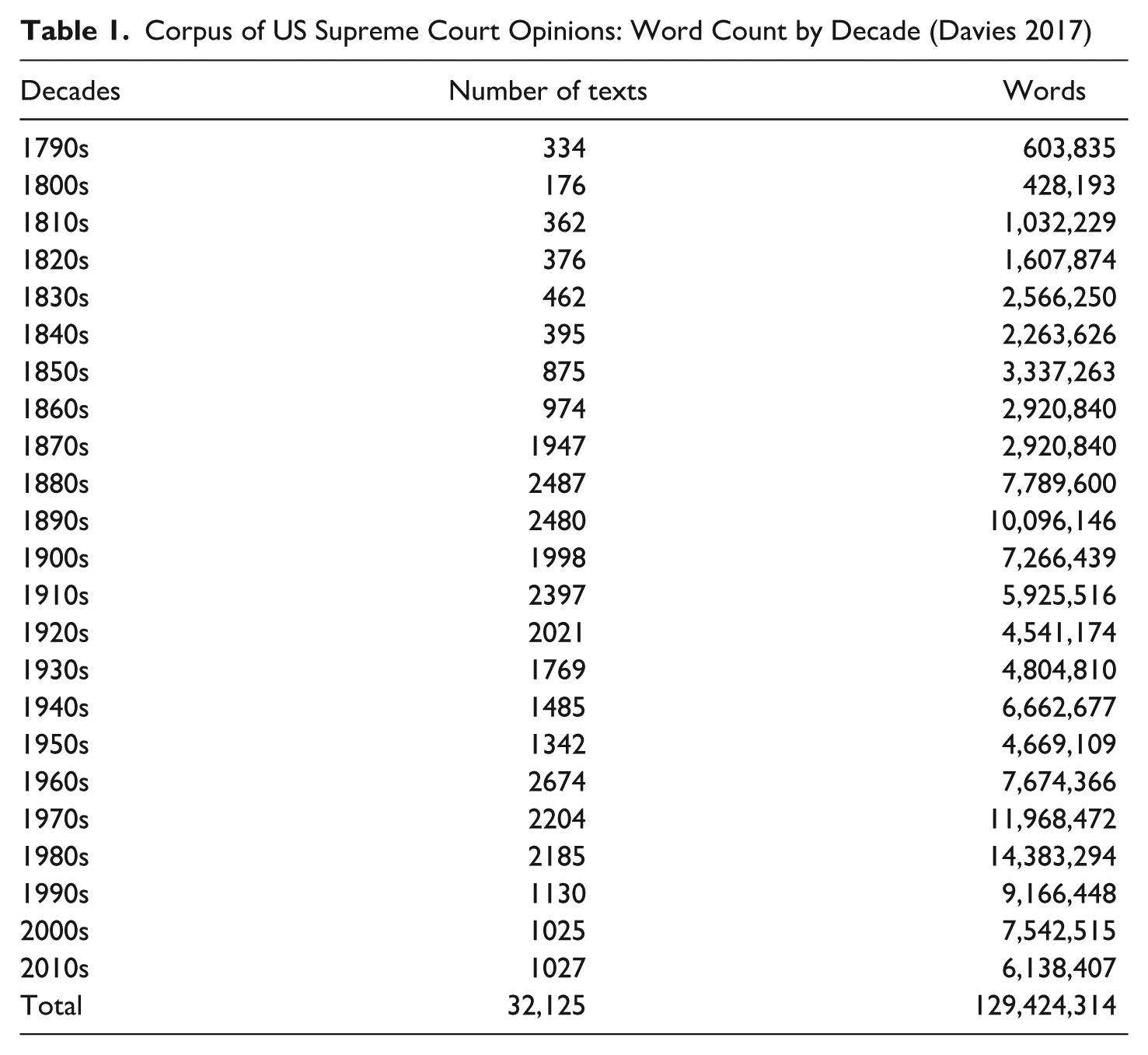
The methodological procedure followed these steps: following the initial observation that inference may be expressed through a variety of markers in the corpus, I analyzed the frequency development of the adverbs therefore, hence, and consequently, the prepositional phrases (for . . . the reason(s) . . .) and the clausal constructions (that is why, this is why, and that’s why). Next, I investigated the most frequent type of adverb (therefore) and the most frequent variant of the prepositional phrase, the plural (for . . . the reasons), as well as the range of clausal constructions in more qualitative detail, describing collocational patterns. This fine-grained analysis focused on syntactic patterns of the subject and verb phrase to investigate dimensions of voicing, that is, whose voices are referenced and represented, speaker stance, and communicative distance expressed by the inferential constructions, as well as the positioning of the evidential construction in the overall opinion.
4. Results
This section begins with an analysis of how the distribution of the inferential adverbs therefore (as well as hence and consequently), the prepositional phrases for . . . reason (s) . . . and the clausal constructions that is why, that’s why, and this is why have evolved over time (Section 4.1). The subsequent sections offer insights into noticeable discourse patterns which distinguish the uses of therefore, for . . . reasons . . ., and that is why as well as that’s why (Sections 4.2-4.4).
4.1. The Development of Inferential Adverbials in the Corpus of US Supreme Court Opinions Between the 1790s and 2010s
The use of inferential adverbs in court opinions can be observed since the 1790s, when they were authored under the first chief justice of the United States, John Jay (Supreme Court Historical Society n.d.). The search for the common English inferential linking adverbs therefore, hence, and consequently (Biber, Johansson, Leech, Conrad & Finegan 2021) revealed a preference for therefore (raw frequency 74,231/574 pmw) compared to hence (9458/73) and consequently (7349/57). 1 While therefore dominates across all periods in the corpus, the data shows its overall decline over time (Figure 1).
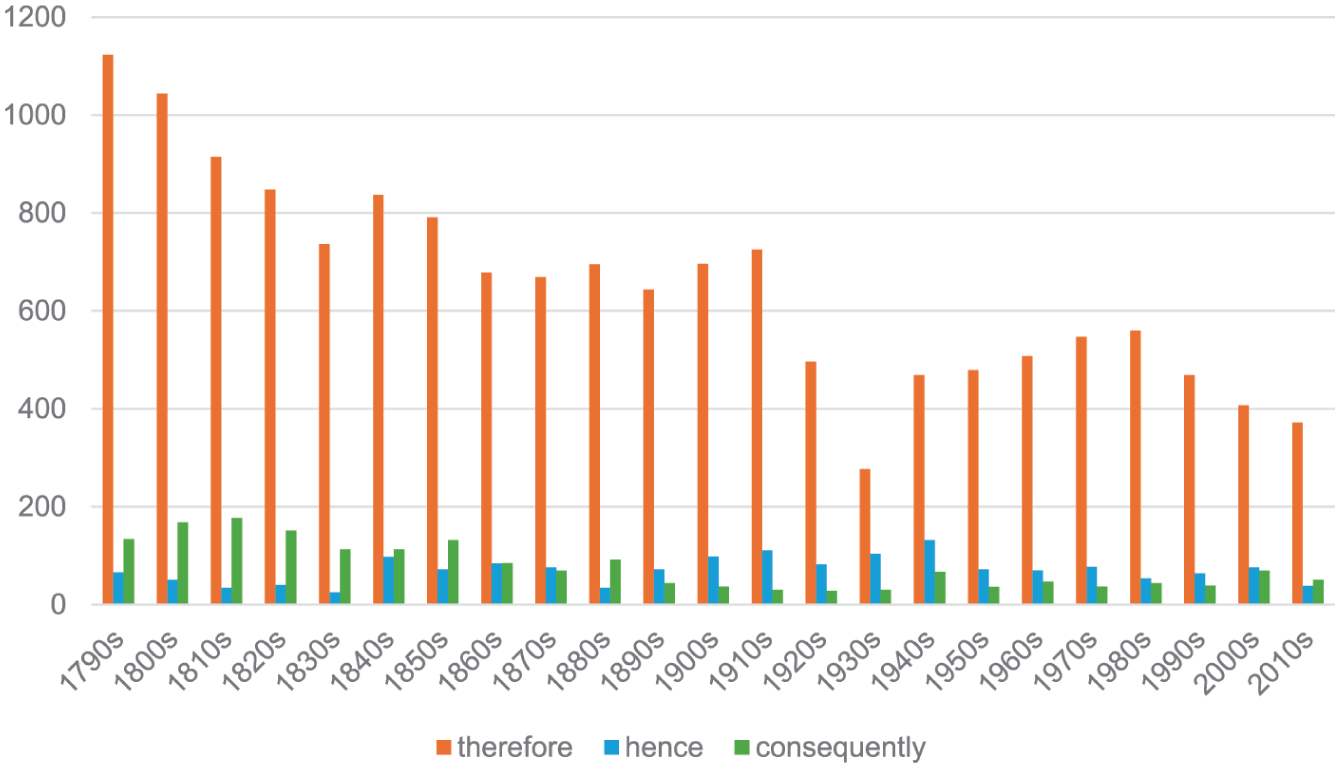
Relative Frequencies of therefore, hence, and consequently in the Corpus of US Supreme Court Opinions Between the 1790s and 2010s (pmw)
The steady decline of therefore is paralleled by consequently but at a lower level. During the 1790s, consequently starts out as the more popular choice than hence but after a drop in use during the 1890s, it lags behind hence. The evolution of hence is less straightforward, remaining on a relatively low level. Biber, Johansson, Leech, Conrad, and Finegan (2021:878-879) corroborates this finding: therefore is listed among the most frequent linking adverbials in English, being most commonly found in academic discourse.
There are fewer prepositional phrases than adverbs expressing inferential stance in the corpus. A search for the variants of for . . . reasons(s) . . . shows a relatively low frequency (for . . . reasons: raw frequency 7297/56 pmw; for . . . reason: 3636/30). These adverbials are attested throughout the entire span of the corpus (Figure 2).
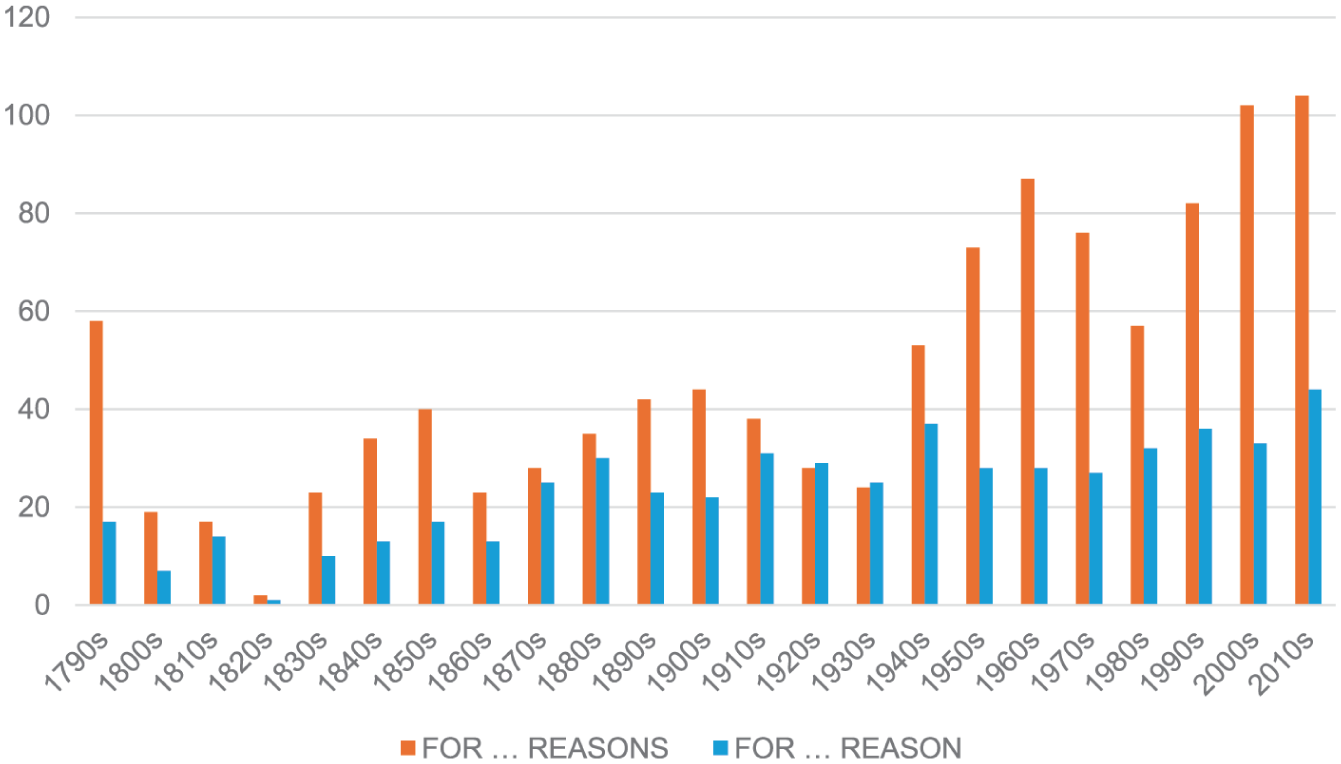
Relative Frequencies of the Inferential Propositional Phrases for . . . reasons . . . and for . . . reason . . . in the Corpus of US Supreme Court Opinions (1790s-2010s; pmw)
With respect to for . . . reasons . . ., the corpus reveals an interesting general increase from around the 1930s to the 2010s. This plural form is associated with a greater referential scope than its singular alternative. Due to its relative dominance in the corpus, it will be investigated in more detail in Section 4.3. Nevertheless, the frequencies of the prepositional phrases remain clearly behind the ones of the adverb therefore. Note, however, that the temporary rise of for . . . reasons . . . and for . . . reason . . . stands in stark contrast to the steady decline of the most common inferential linking adverbs therefore in the corpus.
Compared to the adverb and prepositional phrases, the frequencies of the clausal constructions that is why, this is why, and that’s why are marginal in the corpus. In terms of raw and normalized frequencies pmw, that is why dominates (129/3), followed by the variant this is why (52/0) and the contracted form that’s why (18/0; Figure 3).
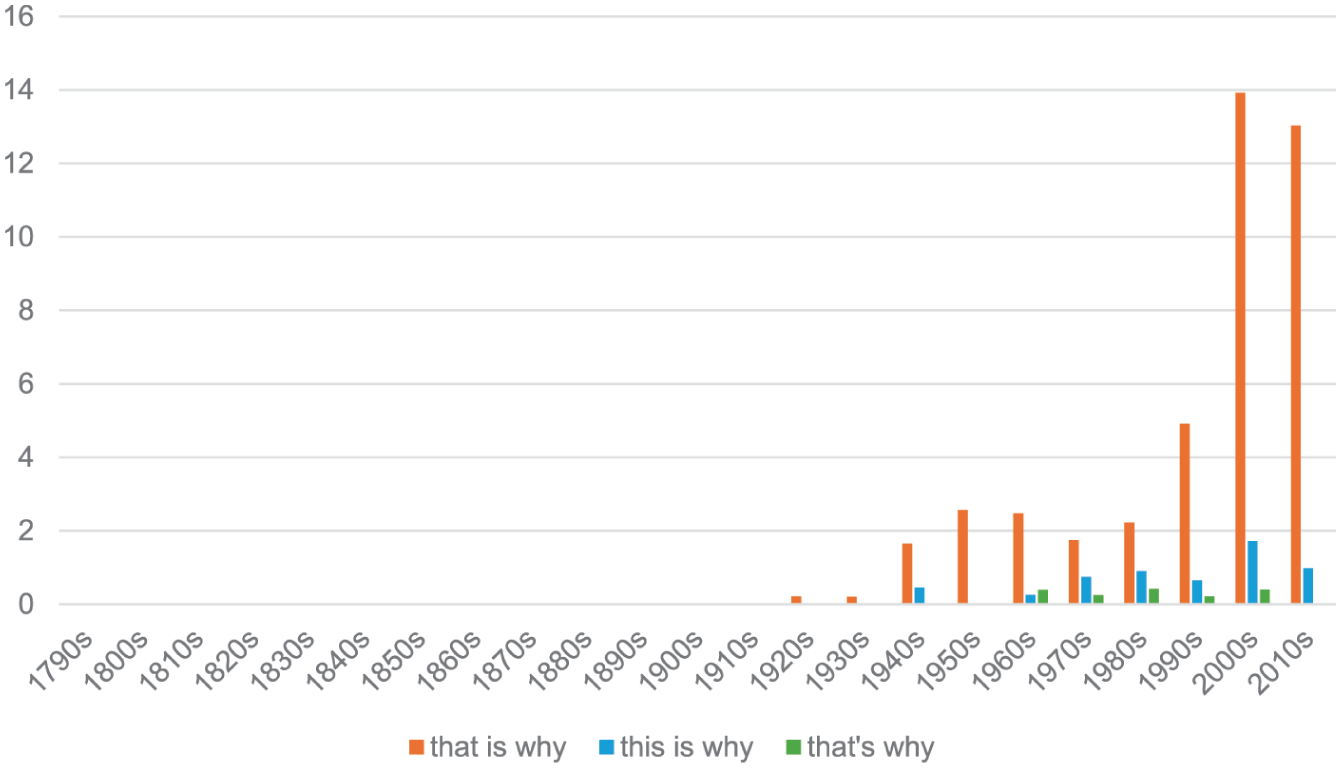
Relative Frequencies of the Inferential Clausal Constructions that is why, this is why, and that’s why in the Corpus of US Supreme Court Opinions (1790s-2010s; pmw)
The form that is why can be first observed in the early twentieth century. First instances of this is why and that’s why are deployed during the mid-twentieth century. The evolution of the variant that is why is noticeable, peaking in its frequency during the 2000s. Again, Biber, Johansson, Leech, Conrad, and Finegan (2021:876) serve as a first reference to interpret the results. They state that linking adverbials of formats other than adverbs and prepositional phrases are more common in academic prose than in conversation where they seem to be almost absent. Yet this does not explain the changes in use evident in court opinions, and the contracted form is clearly a marker of conversational style. To gain a better understanding of these changes in frequency, the usage of therefore, for . . . reasons . . ., and that is why/that’s why needs to be teased apart in more detail, especially as to how these constructions are functional for evidential stance-taking in the corpus.
4.2. Therefore
Strikingly, the linking adverbial therefore most commonly collocates with another inferential stance-marker, the cognitive verb
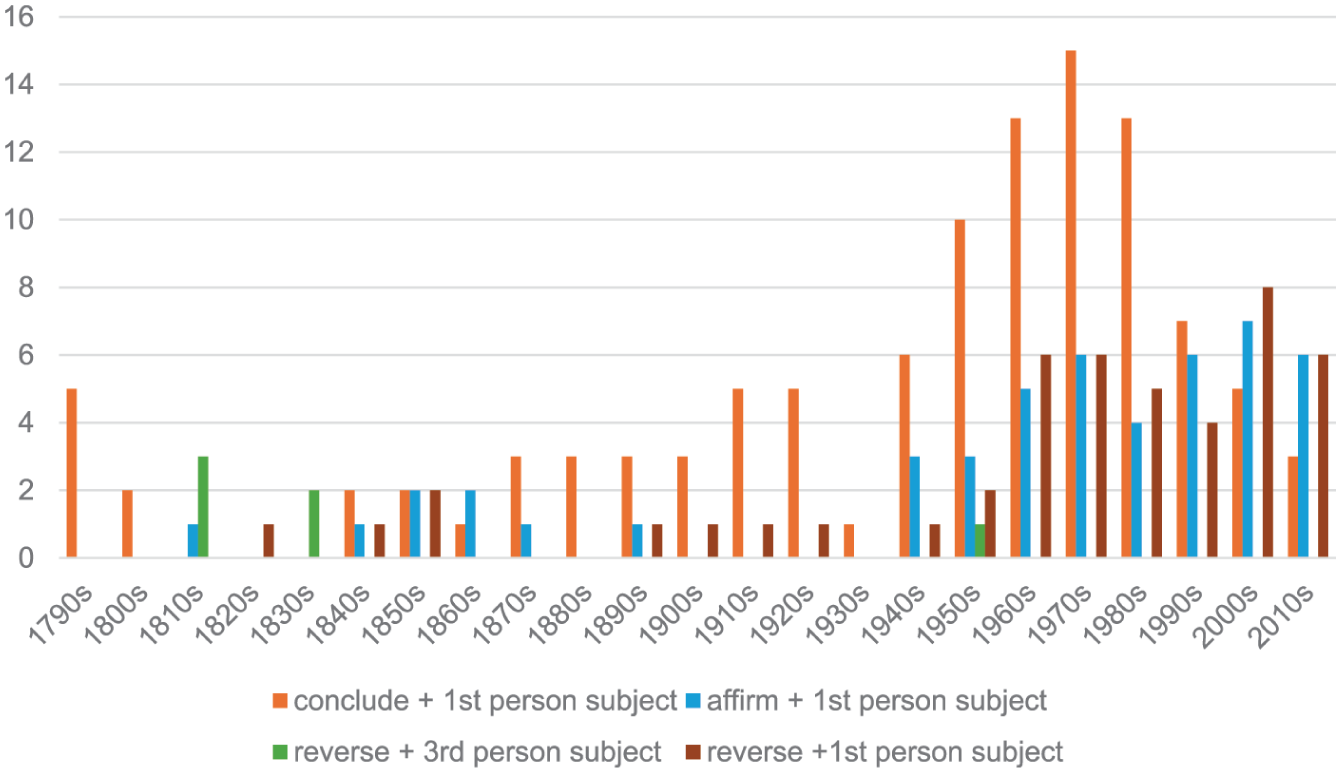
Collocations of therefore with a
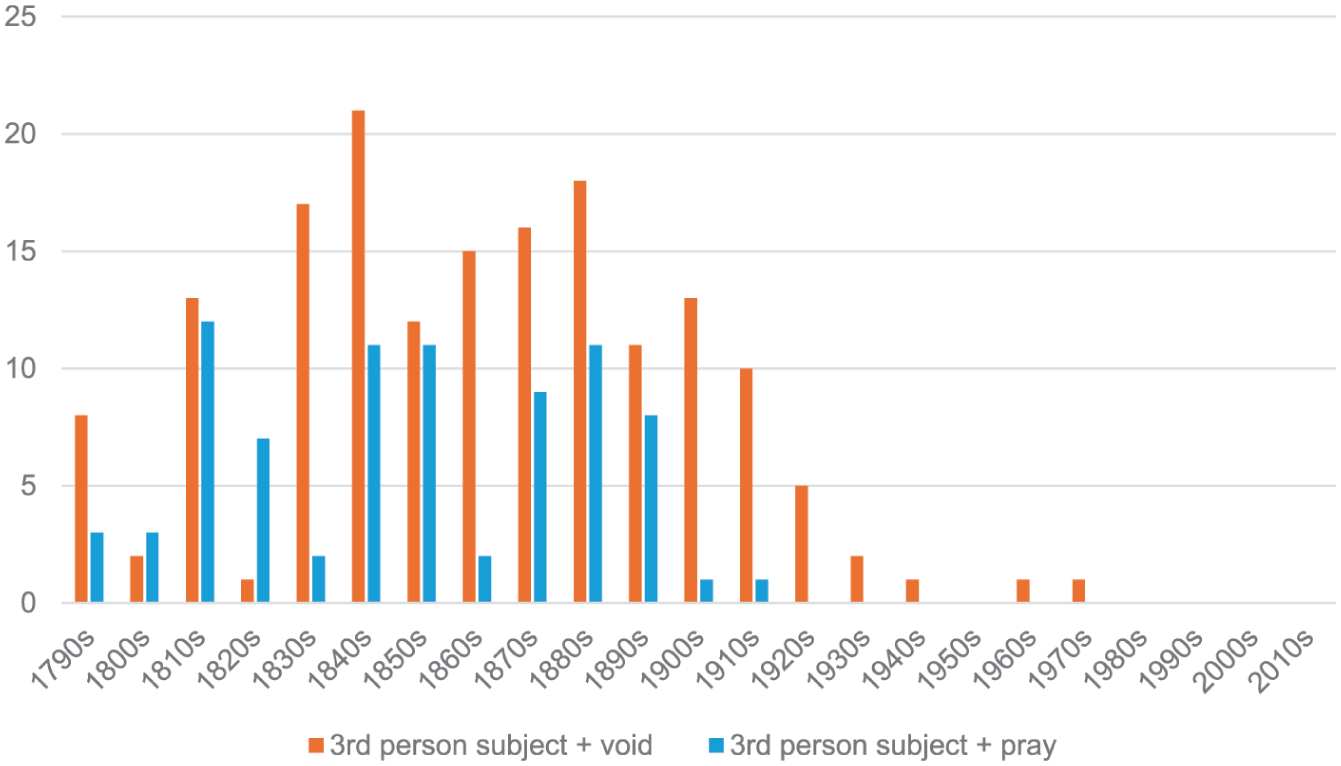
Collocations of therefore with void and
Beginning with the verb
(4)
Appellant has never alleged that the mere act of paying the tax, by itself, violates its sincere religious beliefs.
We therefore conclude that the collection and payment of the generally applicable tax in this case imposes no constitutionally significant burden on appellant’s religious practices or beliefs.
The example is taken from the main opinion which represents the vote of the majority of the court. The construction We therefore conclude that X frames what follows as a position which is based on inferences drawn from the previous sentence. The use of the linking adverbial makes this evidential relation between the assertions in the two sentences explicit, constructing the evidential authority of the voting majority of the court. At the same time, it functions as a wide-discourse-level discourse marker to mark the start of the conclusion, that is, signposting the decision as a result of all the foregoing.
According to the Oxford English Dictionary, the meaning of
(5)
The District Court rejected both the June 30, 1975, date and the September 12, 1974, date, and concluded that the limitations periods had commenced to run by June 26, 1974, when the President of the Board notified Ricks that he would be offered a “terminal” contract for the 1974-1975 school [449 U.S. 250, 262] year. We cannot say that this decision was erroneous. By June 26, the tenure committee had twice recommended that Ricks not receive tenure; the Faculty Senate had voted to support the tenure committee’s recommendation; and the Board of Trustees formally had voted to deny Ricks tenure. 16 In light of this unbroken array of negative decisions, the District Court was justified in concluding that the College had established its official position–and made that position apparent to Ricks–no later than June 26, 1974. 17
We therefore reverse the decision of the Court of Appeals and remand to that court so that it may reinstate the District Court’s order dismissing the complaint. Reversed and remanded.
The inferential adverbial frames the decision as based on the prior line of argument, lending evidential authority to the declaration backed by the court majority. Infrequent variants of the construction are we are therefore constrained to reverse X and we therefore decline to reverse.
Constructions with the verb
In contrast to first-person plural subjects, the singular form indexes the voice of an individual justice, concurring in and/or dissenting from the main opinion. Consider Excerpt 6 for a typical example:
(6)
The Court of Appeals may well so decide on remand. In my judgment, however, a remand is not necessary. The record before this Court is a full one, reflecting extensive discovery and eight weeks of trial. The District Court’s findings of fact are thorough and well supported. They clearly reveal that the challenged policy does have a significant adverse impact on competition. I would therefore affirm the judgment of the Court of Appeals.
Indexed by the first-person singular pronoun I, this format is not used in the main opinion which usually presents the majority opinion of the court but in a concurring or—in this case—a dissenting opinion. The disposition of the dissenting justice is presented as an inference based on his prior reasoning and judgment. Compare this to Excerpt 7, which illustrates the corresponding construction with a plural subject (we therefore affirm X).
(7)
In sum, we find nothing in the Cable Act which leads us to believe that the Commission’s decision to pre-empt local technical standards governing the quality of cable signals “is not one that Congress would have sanctioned.” Shimer, 367 [486 U.S. 57, 70] U.S., at 383. We therefore affirm the judgment of the Court of Appeals. It is so ordered.
Signaled by the inferential adverb therefore, the affirmatory verdict of the court is framed as being derived from the prior line of reasoning summed up in the previous sentence. Grounded in the collective voice of the voting majority of justices, the lack of modal qualification constructs the verdict as legally binding. This is also corroborated by the subsequent sentence (It is so ordered).
In a legal context, the adjective void means “Having no legal force; not binding in law; legally null, invalid, or ineffectual” (OED). Collocations of therefore with void are most frequently found until the 1880s and marked by third-person subjects. Excerpt 8, taken from a dissenting opinion, illustrates a typical case.
(8)
Whenever it is shown that any of these corporations have not complied with the requirements of the statute, they are forbidden to purchase or hold real estate. Any such purchase is therefore void.
The example begins with an assertion about the prohibition of corporations from purchasing real estate under certain circumstances. In the subsequent sentence, the linking adverbial therefore contextualizes the assessment of such purchases as being void, that is, not legally binding, as an inference from this assertion.
The verb
(9)
“your petitioner is in bad health, and from his physical infirmity is unable to give that attention to the management of said estate that he otherwise would and that he ought to give as administrator; [. . .] Your petitioner therefore prays that he be permitted to resign his office as administrator on the estate of said Lewis Tumlin upon a full and complete compliance with the law in such case made and provided”
Here the petitioner’s request for permission to resign from his office is presented as a consequence of the medical issues established in the first sentence. This discourse relation is made explicit by the use of the inferential adverbial therefore.
The adverb therefore expresses the discourse relation of result/inference between the prior sentence or stretch of discourse and the sentence in which therefore is used. The evidential marker serves to make resultative/inferential meaning explicit, which is implicitly indexed by the positioning within the discursive context of the disposition (where the final verdict is expected) and may be co-constructed by evidential expressions (the verb
4.3. For (. . .) The Reasons (. . .)
The prepositional phrase for (. . .) the reasons (. . .) is more versatile and specific in use than the linking adverbial therefore and the clausal constructions that is why/that’s why. The phrase may be forward-looking, that is, it may project the basis on which a result/inference is formed, pointing to the reason for the writer’s position. Consider Excerpt 10 for a typical example.
(10)
I concur in the judgment in this case, for the reasons following:--
By the Constitution of North Carolina of 1868, the personal property of any resident of the State, to the value of $500, is exempt from sale under execution; also, a homestead, the dwelling and buildings thereon, not exceeding in value $1,000.
Similar to the adverb and the clausal constructions, the prepositional phrase may also be backward-looking, indexing what follows to be the result of/inference from the prior stretches of discourse. Excerpt 11 shows a typical example.
(11)
For the reasons stated, the judgment of the Court of Appeals for the Ninth Circuit is Affirmed.
The phrasal expression may also be more specific and concrete than the adverb and the clausal constructions and may not be linking in a proper sense. This is exemplified by Excerpts 12 and 13:
(12)
For the reasons identified in Briscoe, supra, at 342-344, there is no reason to distinguish law enforcement witnesses from lay witnesses in §1983 actions.
The prepositional phrase For the reasons identified in Briscoe, supra, at 342-344 makes reference to a previous court opinion to point to the inferential basis on which the writer’s assertion is based. This also shows that such backward-looking constructions may create “intertextuality” (Bhatia 1998; Steel 1998; Witt, Huggins, Governatori & Buckley 2024) common to legal verdicts to authenticate and substantiate the claim made.
(13)
Like the Court, and substantially for the reasons it gives, I do not think this statute is unconstitutionally vague.
Establishing an intratextual relation (Steel 1998; Witt, Huggins, Governatori & Buckley 2024), the dissenting justice references the main opinion (and substantially for the reasons it gives) to construct the evidential basis of his position (I do not think this statute is unconstitutionally vague). Excerpt 14 illustrates that for (. . .) the reasons (. . .) constructions may be used in coordination with other prepositional phrases.
(14)
For the reasons we have stated, and upon the authorities we have cited, the judgments of both courts must be reversed.
Here, the two coordinated phrases (For the reasons we have stated, and upon the authorities we have cited) serve as an evidential basis, substantiating, and authorizing the following disposition of the court (the judgments of both courts must be reversed). Note that the semantics of the modal must are potentially fuzzy, a usage which can often be observed in the depositions in the data. Its use conveys “epistemic necessity” since the future legal action is inferred from the prior reasoning as well as “deontic obligation,” imposing an obligation on the recipient courts (Leech, Hundt, Mair & Smith 2009:87).
Let us now turn to the typical collocations in which the inferential prepositional phrase engages. For comparison with the analysis of therefore, the focus is on the five most frequent collocations. The construction for (. . .) the reasons (. . .) shows a recurrent use in conjunction with verbs typical of the legal language of court opinions:
Similar to the cognitive collocate of therefore and
(15)
For the reasons hereafter stated, we hold that the Fourteenth Amendment leaves Ohio free to take or decline jurisdiction over the corporation.
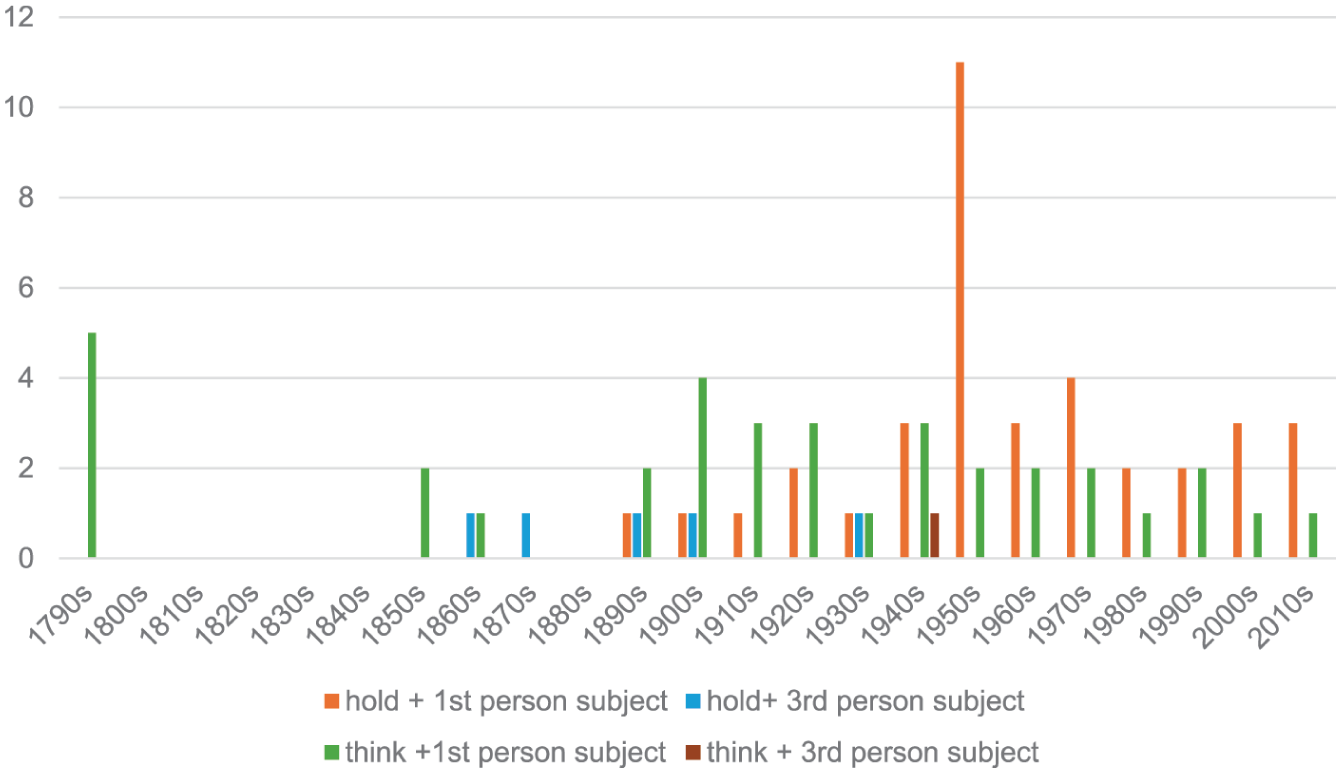
Collocations of for . . . the reasons with
The example is taken from the main opinion, which represents the opinion of the majority vote of the court. The collective pronoun we thus indexes the court as the authoritative source of the opinion presented. The verb
(16)
We are dealing here with an unexpired term of 969 years. But the claim allowed is for a term which does not cover that span. It covers only an unexpired term of 11 years. For the reasons stated in Kuehner v. Irving Trust Co., 299 U.S. 445, 57 S.Ct. 298, we think that if Congress had provided in 77 that lessors should not be allowed to prove for damages in excess of an 11 year unexpired term, the limitation would be constitutional.
The reference to a prior court opinion (For the reasons stated in Kuehner v. Irving Trust Co., 299 U.S. 445, 57 S.Ct. 298,) lends evidential authority to the subsequent position (we think that if Congress had provided . . .). The epistemic matrix clause we think frames the assertion in the subsequent that-clause as the individual position of the dissenting justices. Contrary to the findings with respect to therefore (Section 4.2), the verbs
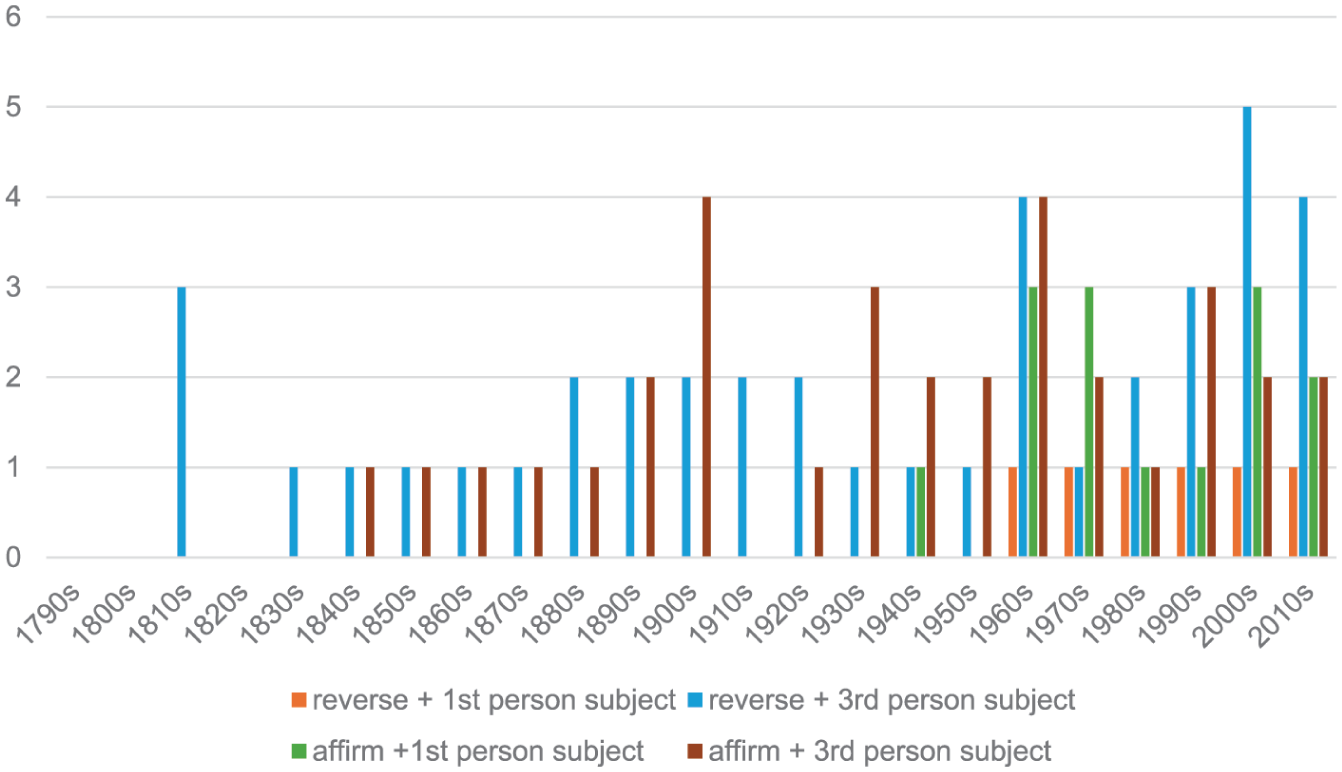
Collocations of for . . . the reasons . . . with
(17)
For the reasons stated, the judgment of the Court of Appeals for the Second Circuit is reversed, and the case is remanded for further proceedings consistent with this opinion.
It is so ordered.
The verb is used in the disposition of the court opinion and occurs in a typical collocation with the verb remand. The prepositional phrase for the reasons stated provides the evidential grounding of the legal action ordered by the court (the judgment of the Court of Appeals for the Second Circuit is reversed, and the case is remanded for further proceedings consistent with this opinion). Over the span of the 1840s to the 2010s, a continuous occurrence of the verb
(18) PENN REFINING CO v. WESTERN N Y & P R CO, 208 U.S. 208 (1908)
For the reasons already stated, the judgment of the Circuit Court of Appeals is affirmed.
The excerpt represents the disposition of the court opinion. The prepositional phrase For the reasons already stated provides the verdict the judgment of the Circuit Court of Appeals is affirmed with evidential authority. The meaning of the verb
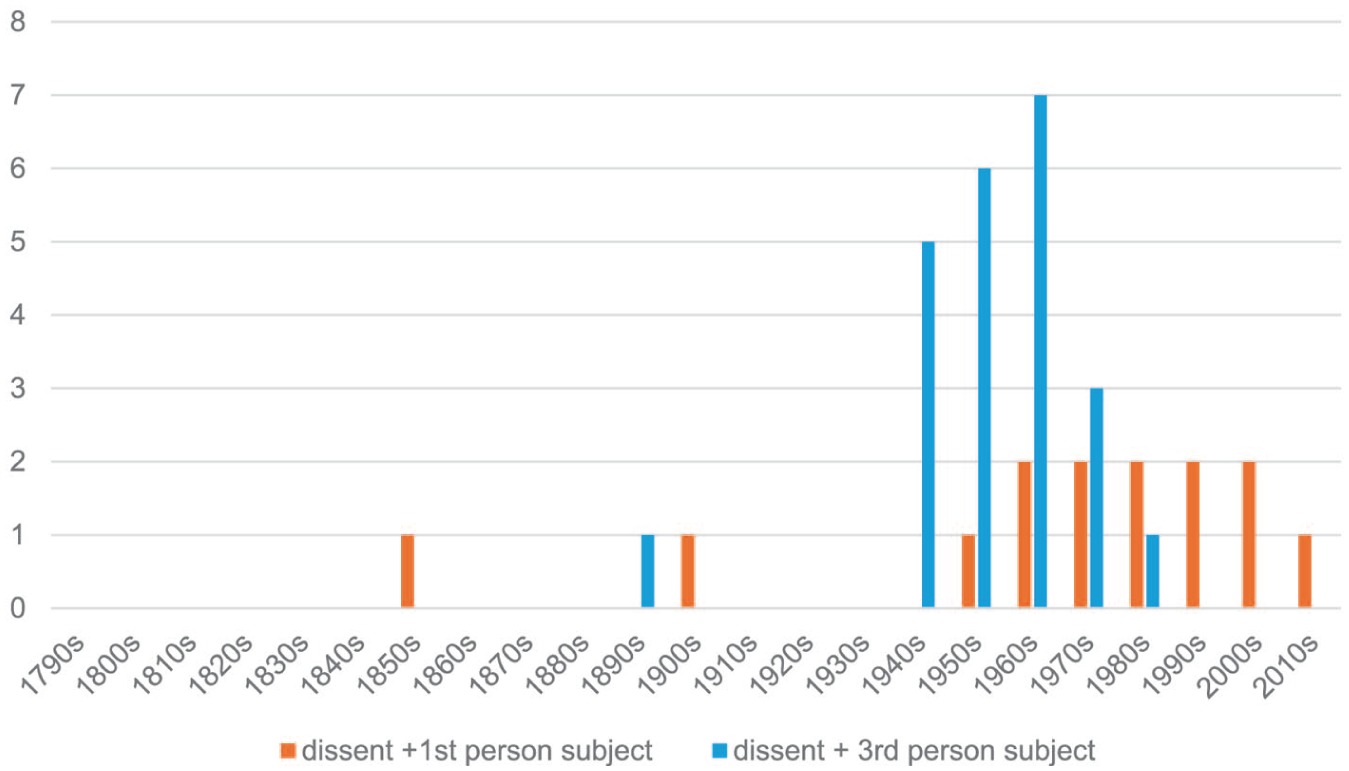
Collocations of for . . . the reasons . . . with
In total, there is clear preference for constructions with a third-person subject (raw 171/1 pmw) over these with a first-person subject (raw 120/1 pmw). Between the 1940s and 1960s,
(19)
MR. JUSTICE FRANKFURTER took no part in the consideration or decision of this case.
MR. JUSTICE WHITE took no part in the decision of this case.
MR. JUSTICE CLARK and MR. JUSTICE HARLAN dissent for the reasons stated in their dissenting opinions in Russell v. United States, 369 U.S. 749, 779, 781.
Constructions with third-person subjects are generally used by dissenting justices to claim their disagreement with the majority opinion. Here, the subject explicitly references the two dissenting justices who have not joined the majority vote. Constructions with a first-person subject, which is generally a singular pronoun (raw 118), are generally also deployed by dissenting justices to claim their disagreement with the majority opinion. A common routine found in the corpus includes the adverb respectfully as exemplified in Excerpt 20.
(20)
For all of the reasons discussed in this opinion, I respectfully dissent.
Using the previous discourse in the minority opinion as an evidential basis, the justice closes with a declaration of dissent. Note that the adverb respectfully has been treated as a “marker of disrespect” in legal discourse (Wright, Robson, Murray-Edwards & Braber 2022:3, italics in the original). The emergence of third-person formats with explicitly named individual justices and of first-person constructions, which index the individual voice of the authoring justice, might suggest a “distinction” of single justices, that is, an increased focus “on the identity relation of differentiation” (Bucholtz & Hall 2005:600) since the 1940s.
The analysis of for . . . the reasons . . . has demonstrated a greater deictic flexibility of the prepositional phrase than that of the adverb therefore. The phrase can be used as a resource to indicate specific and concrete anaphoric and cataphoric relations, as well as to create “referential intertextuality” (Devitt 1991) and quote other legal sources. The most common collocations include the epistemic verbs
4.4. That Is Why and That’s Why
The clausal construction that is why is used as an inferential marker across all portions of the court opinions. Both full and contracted forms can be observed in excerpts of court transcripts. Noticeably, the clausal construction is always positioned in a clause-initial (That is why all are appealable to the Courts of Appeals) or near-clause-initial slot (and that is why we oppose it). The subject of the subsequent clause is most often a first-person pronoun. Plural first-person pronouns tend to be used with verbs of communication or cognition. Consider Excerpts 21 and 22:
(21)
Yet registration, like licensing, may have aspects of harassment and burden. That is why we said in Thomas v. Collins, supra, 540: [direct quotation omitted]
In his dissenting opinion, the justice first makes an assertion (Yet registration, like licensing, may have aspects of harassment and burden.). Using the clausal construction That is why, he frames the subsequent quotation as an account to corroborate his assertion (cf. Couper-Kuhlen 2007). Using the plural first-person pronoun we, he self-identifies as part of the in-group (“us”) and marks the subsequent paragraph as a quotation. The verb of communication (
(22)
“Reasonableness” standards are not foreign to sentencing law. [. . .] Together, these cases account for about 16.7% of sentencing appeals. [. . ..] That is why we think it fair (and not, in Justice Scalia’s words, a “gross exaggeratio[n],” post, at 10 (dissenting opinion)), to assume judicial familiarity with a “reasonableness” standard.
Excerpt 22, taken from the main opinion, begins with an assertion (“Reasonableness” standards are not foreign to sentencing law) which is backed up by a reference to statistics (Together, these cases account for about 16.7% of sentencing appeals). In what follows, the position of the court is presented. It is framed as an inference made from the previous line of argument (That is why we think it fair to assume). Inferential stance-taking represents a resource to claim and maintain evidential authority, specifically in argumentative contexts. Excerpt 23 shows the case of a first-person singular pronoun in subject position.
(23)
In future preliminary hearings, competent counsel can be expected to make sure that they, or their clients, make a statement on the record that will obviate the consequences of today’s holding. That is why I think this decision will have little, if any, practical effect on police practices cases.
In this dissenting opinion, the justice presents his epistemic stance toward future court hearings (In future preliminary hearings, competent counsel can be expected to make sure. . .). He then delivers his assessment of the main opinion. The use of the inferential That is why frames the assessment as being based on the previous line of argument. In line with this, the first-person pronoun I and the epistemic verb
(24)
A statute that gives the President authority to act in respect to “any financial crisis that may happen during his term” can easily be interpreted to include crises that arise before, and continue during, that term. Perhaps that is why the Oxford English Dictionary defines “happen” in part as “chance to be,” rather than “chance to occur.” 6 OED 1096 (emphasis added); see also 19 OED 383 (defining “vacancy” as the “condition of an office or post being . . . vacant”).
In this excerpt, taken from the main opinion, first, an assessment is made (A statute [. . .] can be easily interpreted [. . .]). The epistemic adverbial perhaps hedges the subsequent inference as the epistemic stance of the author (Perhaps that is why the Oxford English Dictionary defines [. . .]).
The few instances of the contracted form that’s why are exclusively found in direct quotations of oral transcripts of past court proceedings which are referenced in the court opinion. The excerpts quoted from these transcripts are treated as relevant to the decision-making in the case at hand and may be presented as part of the main opinion or dissenting opinions to support the justice’s argument. Prosecutors and defendants are among the parties whose speech is quoted. This suggests that the contracted form represents conceptually spoken language use. Consider Excerpt 25 to illustrate this.
(25)
“‘But how did we get to right here? You got here because the district attorney, that’s me, as the agent of the State[,] made the decision to seek the death penalty in this case. Not any of you all but by law the only person who can do that. So you didn’t bring us here. No one else did. That was my decision and that’s why you can choose not to impose the death penalty if you want to, for any reason or no reason whatsoever. But that decision seeking the death penalty was already made. [. . .]’”
Here, the prosecutor addresses the jury in a murder trial, using that’s why to frame the rights and scope of decision-making of the jury as a consequence of the prosecuting attorney’s prior actions. Excerpt 26 exemplifies the use of that’s why in a story told in the confession by one of the defendants which is relevant to the decision of the case argued at the Supreme Court of the United States:
(26)
After Kareem took the lady upstairs I went upstairs and the lady was laying on the bed in the room to the left as you get up the stairs. The lady had already given us two bags full of money before we ever got upstairs. Kareem had thought she had more money and that’s why we had went upstairs.
That’s why is used by the defendant to stage an event in the story formatted in non-standard grammar (we had went upstairs) as a consequence of and being motivated by the epistemic stance of the second defendant in the court trial (Kareem had thought she had more money).
The qualitative analysis has shown that that is why can be found in all components of the court opinions. There is a slight preference for first-person pronouns in collocating subjects. That is why may cluster with epistemic adverbs which hedge (perhaps, presumably) or boost (indeed) the evidential semantics of the clausal construction, as well as collocate with evidential verbs (e.g.,
5. Summary and Conclusion
The analysis has provided a first insight into the development of inferential adverbials in the court opinions of the Supreme Court of the United States during the Late Modern English and Present-Day English periods. As a result of the study, the following conclusions may be drawn:
A shift in the style of the genre. It was shown that while the use of the adverb therefore is still dominant, it has steadily decreased. The prepositional variants for . . . reasons and for . . . reason have shown a modest upward trend, especially since the 1940s. This suggests that although the genre of court opinions continues to be characterized by a high degree of authoritative formality, the marking of inferential/resultative discourse relations has become more accessible for the reader since World War II, with the use of intertextual references making the consideration of external sources such as prior court opinion more transparent. This might also be due to extralinguistic developments, for example, ease of access to legal sources due to technical innovation. During the same period, frequent uses of the colloquial form that is why—and to a lesser extent that’s why—become visible. The use of that is why in main and minority opinions might point to an increasing “personalization” (Conboy 2003:47), that is, the adoption of colloquial features to play to and attract a wider audience, as well as “colloquialization” of court opinions (Mair 2006). 4
Despite the infrequent uses of other inferential adverbs (hence, consequently) and the rises of prepositional and clausal constructions in the corpus, the sharp decline of the adverb therefore has not been compensated. Depending on how other inferential markers, such as, for example, thus and so perform in the court opinions, this raises the fundamental question of whether overt inferentiality has dropped and a normative shift to a more conceptually spoken genre in Koch and Oesterreicher’s terms can be observed.
The collocational analysis suggested a degree of conventionalization of inferential markers and verbal patterns as well as stable and shifting patterns of usage. Noticeably, inferential markers seem to show a tight and stable connection to specific parts of the opinion. Therefore, for . . . the reasons . . ., and that is why serve as adverbials in the majority and minority opinions. The contracted form that’s why is only used in the transcripts of trials at the lower courts reproduced in court opinions. By contrast, the collocations visualize linguistic change and an evolution of the genre. Indicative of wider linguistic change, the collocation of therefore and
A changing “polyphony” of voices in the court opinions (Bakhtin 1981; see also Breeze 2018 on the polyphony of legal texts). Apart from void and
Footnotes
Declaration of Conflicting Interests
The author declared no potential conflicts of interest with respect to the research, authorship, and/or publication of this article.
Funding
The author received no financial support for the research, authorship, and/or publication of this article.
