







Abstract
The qualitative interview has been a core technique in the sociological methods toolkit for generations. Interviews provide essential insights into how participants experience the world around them. New opportunities have emerged to adapt traditional in-depth interview techniques through the use of evolving technologies available to interview participants. This article describes the integration of ecological momentary assessment techniques to augment qualitative in-depth interviews focused on specific events, which we term event-centered interviewing. By incorporating photo data captured systematically through smartphone apps designed for ecological momentary assessment, event-centered interviews can extend the strengths of traditional qualitative interviews. We describe the processes and procedures for conducting event-centered interviews, and we highlight how the approach may create opportunities for qualitative analysis and minimize certain limitations of traditional in-depth interviews. We also highlight the positive participant responses to the approach from a pilot study. Although traditional in-depth interviews may remain at the core of qualitative sociological inquiry, event-centered interviewing may be especially useful for interviews about behavior and experiences that occur during specific events.
The qualitative interview has remained a core component of the social science repertoire for many decades (Mishler 1991; Rubin and Rubin 1995). Through interviews, social scientists have developed insights into how individuals make meaning of their routines and activities, construct identities in reference to others, and understand the symbolic systems of the social worlds they inhabit (Gerson and Damaske 2020). In other words, qualitative interviews allow scholars to study how individuals make sense of their experiences of the world around them. As with other methodologies, the qualitative interview has evolved over time as new techniques and approaches have been integrated (see Kusenbach 2003; Wang and Burris 1997). For example, with photovoice data collection (which emerged in community participatory research with the advent of disposable cameras), study participants capture images that are meaningful to them within their communities and then give voice to those meanings through an interview about the photos (Wang and Burris 1997). Photos can be especially valuable in allowing researchers to observe the contexts of locations where they are unable to go and in “seeing” participants’ points of view. Digital technologies provide further opportunities to use photos and other visual data within sociological research (Hwang and Naik 2023; O’Hara and Higgins 2019).
Opportunities to leverage new technologies into qualitative social scientific research have expanded greatly in recent years and have helped sociologists enhance qualitative inquiry. Foremost, qualitative data analysis software programs have facilitated the organization, management, and sharing of qualitative data, and such programs have become a routine means for analyzing qualitative data (Deterding and Waters 2021). Advances in the development of visualization techniques, including the ethnoarray (Abramson and Dohan 2015) and network-based visualization (Hanson and Theis 2024), have further extended qualitative approaches. Yet, there remain opportunities to address challenges such as problems with recall or triangulating contexts and behaviors (Small and Cook 2021), and these issues may be addressed by leveraging mobile phones to augment qualitative interviews.
Here we describe the procedures and opportunities of a novel interviewing technique we term event-centered interviewing. This approach combines in-depth interviews with experience sampling 1 techniques to produce an interviewing style that incorporates systematic momentary photo data collection to extend qualitative interviews beyond traditional approaches. In so doing, event-centered interviewing is useful for enhancing recall, structuring sequences, and providing context ordinarily unobservable to the interviewer. In addition, the approach may enable the generation of unanticipated insights by facilitating interviewer preparation prior to the interview. More generally, event-centered interviewing can provide opportunities to extend and enhance existing methods of qualitative data collection within the context of specific events experienced by participants.
This article is organized as follows: First, we consider some of the strengths and challenges of traditional qualitative interviews. Next, we discuss ecological momentary assessment approaches and how their integration with qualitative interviews may help scholars move beyond some of the challenges associated with traditional in-depth interviews. We then detail the procedures for conducting qualitative interviews that incorporate systematic photo data collection in discrete moments—or what we term event-centered interviewing. After establishing procedures and processes, we describe study participant experiences with the method as a means to demonstrate the feasibility and acceptability of the approach. We conclude by noting the analytic versatility of the approach and highlighting some benefits of the approach along with examples from related research.
Strengths and Challenges of Qualitative Interviews
The strengths of qualitative interviewing are well documented (e.g., Gerson and Damaske 2020; Lamont and Swidler 2014; Rinaldo and Guhin 2022; Rubin and Rubin 1995). Using qualitative interviews, scholars can generate rich data on the lived experiences of individuals and understand how participants generate meaning out of those experiences. Interviews allow scholars to study how individuals make sense of their worlds. Importantly, interviews provide a participant’s perspective through open-ended questions (Seidman 2006). In addition, compared with studies with predefined response sets, qualitative interviews allow for greater opportunities to uncover unexpected findings (Timmermans and Tavory 2022). Yet, although qualitative interviewing methods have a range of strengths in capturing certain types of data, as with any method, there remain some limitations in what these methods can tell us about human behavior and what we can infer. We are unable to fully review all the strengths and challenges of qualitative interviewing, but we identify several of these that are relevant to our proposed methodologic approach.
Traditional approaches to qualitative interviewing typically involve asking participants a series of open-ended questions, often about their perspectives on behavior in a generalized sense or about specific past behavior rooted in particular experiences (Gerson and Damaske 2020). Both approaches typically involve a retrospective assessment that depends on the participant’s memory and therefore may be subject to recall and reporting biases. Recall may always be imperfect and driven by a participant’s subjectivity (Pugh 2013; Small and Cook 2021), and yet, for some scholars, the nature of memory and what constitutes “the truth” is itself a key aspect of inquiry (see Randall and Phoenix 2009). 2 Nonetheless, the ability to accurately recall past experiences or sequences of behavior, when pertinent for a study, affects qualitative research in a number of ways. Beyond selective recall that sanitizes prior behavior to be socially desirable (a concern common to many types of research; e.g., Kelly et al. 2013), recall issues may hamper the opportunity to generate information on topics that are not imminently salient during the interview. Whether consciously or subconsciously, participants may not deem certain behaviors or interactions worth retelling to an interviewer. Participants may leave out details simply because they do not seem important in the moment of the interview or even at the time the interaction/behavior occurred (see also Jiménez and Orozco 2021). Research has documented that attention in interactions and experiences is often directed to those who are most salient (e.g., by virtue of physical characteristics or notable actions), which can lead to misattributions during an event or render other details less salient despite their potential importance (McArthur and Ginsberg 1981). In some studies, such details may prove important to supply a cohesive whole regarding the participant’s experiences during that event. Photo data may assist with rendering such moments salient to the participant, both at the time of data collection and during the interview.
In addition, recall issues may be pertinent to assessments of the timing or sequence of activities when describing experiences or events. For instance, among people who use multiple drugs, the timing and sequence of drug use over the course of a night out at a club may shape risk exposure (Grov, Kelly, and Parsons 2009). As such, the specificity of these sequences may be of interest to medical sociologists or others studying experiences of risk. The lack of anchoring mechanisms within a traditional qualitative interview also can contribute to “missing data” that may have had analytic utility. Furthermore, participants are typically unfamiliar with the questions embedded within the interview guide at the time of the interview, and this lack of clarity about the nature and types of questions may contribute to issues with recall. Unfamiliarity also may increase the likelihood the interviewer unintentionally leads the participant, thus introducing other types of bias (see Jiménez and Orozco 2021).
Another challenge for interviewers in qualitative research is that they may lack a fuller sense of the contexts of the behaviors being discussed. This blind spot is inherent in nonethnographic qualitative research because interviewees can never describe contexts with the same level of precision as that of actual observation by a researcher (Duneier 2011; Kusenbach 2003). A lack of context may lead to the omission of key details or create missed opportunities for appropriate follow-up questions or probes, thus limiting the possibilities of inquiry during the interview or potentially increasing erroneous assumptions on the part of the interviewer. For example, details on the gender balance at a party may have relevance but may be assumed rather than queried within an interview. To address this, some researchers ask individuals to recall as many details as possible about the time and place the experience occurred, including sights, sounds, and sensations, among other contextual details (see Small and Cook 2021). Even so, this strategy still relies on participant recall of details that may not have seemed salient. Additional forms of data—such as those generated within event-centered interviewing—may help expand the scope of inquiry by providing additional context to participant experiences. These issues also may have later analytic relevance as data are evaluated and coded.
Another issue is what Jerolmack and Khan (2014) refer to as “attitudinal fallacy”—the discrepancy between what individuals do and what they say they do. For example, Jerolmack and Kahn recount the attitude–behavior consistency problem in LaPiere’s study of 1930s’ businesses’ regular service provision to Chinese guests despite their stated opposition to doing so. Traditional qualitative interviews often lack opportunities to triangulate other sources of data within individual participants’ descriptions of what they did or how they reacted. Jerolmack and Khan (2014) argue that ethnography attempts to explain the attitude–behavior problem in a way that qualitative interviews cannot, and they argue that qualitative interviews involving self-reports of attitudes and behaviors remain limited in their value to many foci of social scientific inquiry. Although such contentions may exaggerate the limits of qualitative interviews—social scientists are indeed often interested in attitudes or how individuals make sense of their experiences—focusing on behavior rooted in specific events or experiences that have such limitations remains a common strategy. Opportunities to triangulate attitudes and behaviors outside the context of ethnographic research may be a welcome approach for many qualitative scholars, particularly those for whom ethnography may not be feasible.
Reconsidering the tailoring of interviews offers the potential to enhance how qualitative interviews are often approached. An important strength of qualitative interviews is the ability to tailor the interview by adapting to the participant’s unique experiences and sentiments (Josselson 2013). Indeed, semi-structured interviews permit the reordering and rephrasing of questions as a deliberate approach to the interactional dynamic between interviewer and participant (Brinkmann 2014). This approach enhances rapport and increases the specificity of questions about participants’ experiences, but it is a tailoring process that is typically reactive rather than proactive. Decisions about such tailoring typically occur spontaneously during the interview as the interviewer adapts to participant reports rather than tailoring in a preplanned fashion. Although this skill develops as an interviewer becomes more experienced, even seasoned interviewers can leave interviews thinking, “Oh, I wish I would have asked this” or “I should have followed up about that.” Some of this regret has to do with the reactive nature of question framing and probing within interviews because the interviewer typically first receives information about the participant’s experiences only at that moment in the interview. Such reactive positions can lead not only to second guessing oneself at the completion of an interview but also to informational gaps in data stemming from an inability to begin proactively tailoring in advance of the interview.
We contend that some of these issues may be handled, at least in part, by augmenting the interview process with additional data sources on the contexts in which events experienced by participants play out in sequence. Sequences and timelines have proven important in other social scientific interview techniques, such as timeline follow-back interviews (Sobell and Sobell 1992). Extending this approach to qualitative inquiry may help create anchoring mechanisms within interviews. Although an ethnographic presence may not be feasible in all instances, new technologies provide opportunities to capture contextual data in advance of interviews. In particular, the integration of experience sampling technologies into the qualitative interview process may be one such solution.
Ecological Momentary Assessment/Experience Sampling
Ecological momentary assessment (EMA), also known as experience sampling, has received increasing attention within the social sciences over the past two decades (Roth 2024; Shiffman, Stone, and Hufford 2008). Although it is used primarily within the psychological sciences, it has received more recent consideration within sociology and political science because of the method’s ability to capture data in the moment, as individuals go through routine or ritual experiences. Experience sampling employs a diverse range of methods to capture data on behavior and experiences during discrete moments (Shiffman, Stone, and Hufford 2008). These methods capture information on participants’ behaviors, attitudes, and emotions in specific moments, either at random or in structured intervals, but the key element is that the data captured focus on participants’ specific state or experience at that time.
A crucial component of all EMA data is that they are captured as participants proceed through the course of experiences in real-world environments, and the approach often involves repeated measurements over time (Reis and Gable 2000; Shiffman, Stone, and Hufford 2008). For this reason, data capture for EMA tends to be brief so as to minimize disruptions. In other words, rather than asking participants to set aside time to complete lengthier data collection after an experience has occurred, individuals capture the data as they engage in their daily routines or unique events. By focusing data collection on rapid assessment and limiting disruptions, EMA methods allow for the capture of data over the course of an event as individuals’ experiences prospectively unfold (see Browning et al. 2017; Compernolle et al. 2021; Tyler, Olson, and Ray 2018). For example, Goldman and Compernolle (2023) used ecological momentary assessment to examine the association between feelings of loneliness and social interaction among older adults within a gendered network context. Specifically, at random points throughout each day, study participants were “pinged” (i.e., alerted to respond) on a smartphone to rate their experience of loneliness in that moment, along with identifying where they were and who they were with. The results provided a fine-grained analysis of the contexts of loneliness among older adults using precise measurement of experiences at specific moments.
Experience sampling data are typically captured quantitatively through the use of structured measures. Such an approach to data collection treats moments as observations over time in an individual’s life, which can be useful to structure data hierarchically (e.g., observations within days within individuals over time; Hedeker, Mermelstein, and Demirtas 2012). This type of data capture allows for assessments of variables such as the number of times a behavior occurred since the onset of assessment, an individual’s emotional state at that moment, and which tasks the individual is currently engaged in (among other measurements). Respondents are typically asked to rate these variables numerically, either through stating a number or rating on a scale (Shiffman, Stone, and Hufford 2008). Importantly, the sampling of such experiences can occur in either random or systematic intervals, and this can be determined by the needs of the specific study. Such approaches have been applied successfully to the study of the heterogeneity of experiences over the course of hours, days, and weeks.
EMA data collection provides several benefits. First, experience sampling helps minimize biases associated with recall (Berney and Blane 1997). Experience sampling also reduces the likelihood that participants will report on aggregate or average experiences versus experiences within specific moments (see Scollon, Kim-Prieto, and Diener 2003). Furthermore, experience sampling captures moments that may seem less salient in the aggregate. Although EMA approaches have been applied most commonly to quantitative research paradigms, many of these issues are highly relevant for qualitative research, and the use of experience sampling holds promise.
Advances in data-collection technologies have made experience sampling more feasible in recent years. Use of EMA methods greatly expanded when researchers began providing personal digital assistants to participants for data capture as they lived their lives. The introduction of smartphones further proliferated opportunities for experience sampling methods. Now, nearly everyone has a data-collection tool in their pocket (and many people pay considerable attention to notifications on their phones). Yet, as the proliferation of mobile phone–based technologies for data collection expanded over the past decade, their use for quantitative measurement has far outpaced that for qualitative research. There is great potential to integrate experience sampling using such technology with existing qualitative methods.
Event-Centered Interviewing: Perspectives and Procedures
Many human experiences can be concretized within discrete events, such as a day at school, an afternoon at work, a night out with friends, or the celebration of a ritual such as a wedding. As such, events can be routine or atypical. Our calendars thread together personal experiences as we move through tasks, events, and other discrete moments in our daily lives. Rather than abstracting attitudes, emotions, identities, and experiences through generalized forms, we can focus social scientific inquiries on these more specific instances as cases. Qualitative interviews have used events as key foci (Jackman et al. 2022); use of critical-incident measures in qualitative interviews is one means of doing so (Leonard and Ross 1997). By focusing on a key moment, such as the first time a person used a drug or the last time they had sex, these approaches can more directly define the parameters of the interview and move away from more abstract and idealized behaviors and experiences. Yet, such approaches remain fully retrospective, are subject to the vagaries of memory, and lack any check on or triangulation of behaviors/interactions or their sequence. We contend that the integration of EMA technologies can help minimize (albeit perhaps not fully eliminate) some of these issues with traditional qualitative interviews.
As noted earlier, new technologies have increasingly come into play for qualitative interviewing. For example, use of video conferencing, such as Skype or Zoom, rather than phone calls for conducting distanced in-depth interviews allows interviewers to pick up on nonverbal cues that are often critical to interview dynamics (Gray et al. 2020). The integration of mobile phone–based apps that facilitate ecological momentary assessments into qualitative interviews also can yield new benefits. Specifically, the random or systematic capture of photo data as people proceed through an event can (1) facilitate preparation for and tailoring of interviews, (2) structure and focus interviews while reducing recall and salience biases, and (3) serve as an additional form of data to better understand events, their sequences, and their contexts.
Below, we describe the implementation of event-centered interviewing (ECI), which integrates photo data from an ecological momentary assessment app directly into the qualitative interview. We piloted this method during a study of romantic decision making among young women in alcohol-related environments. As such, in addition to describing the procedures involved in ECI, we also present an assessment of its feasibility and acceptability from this pilot study. The process is outlined in Figure 1.
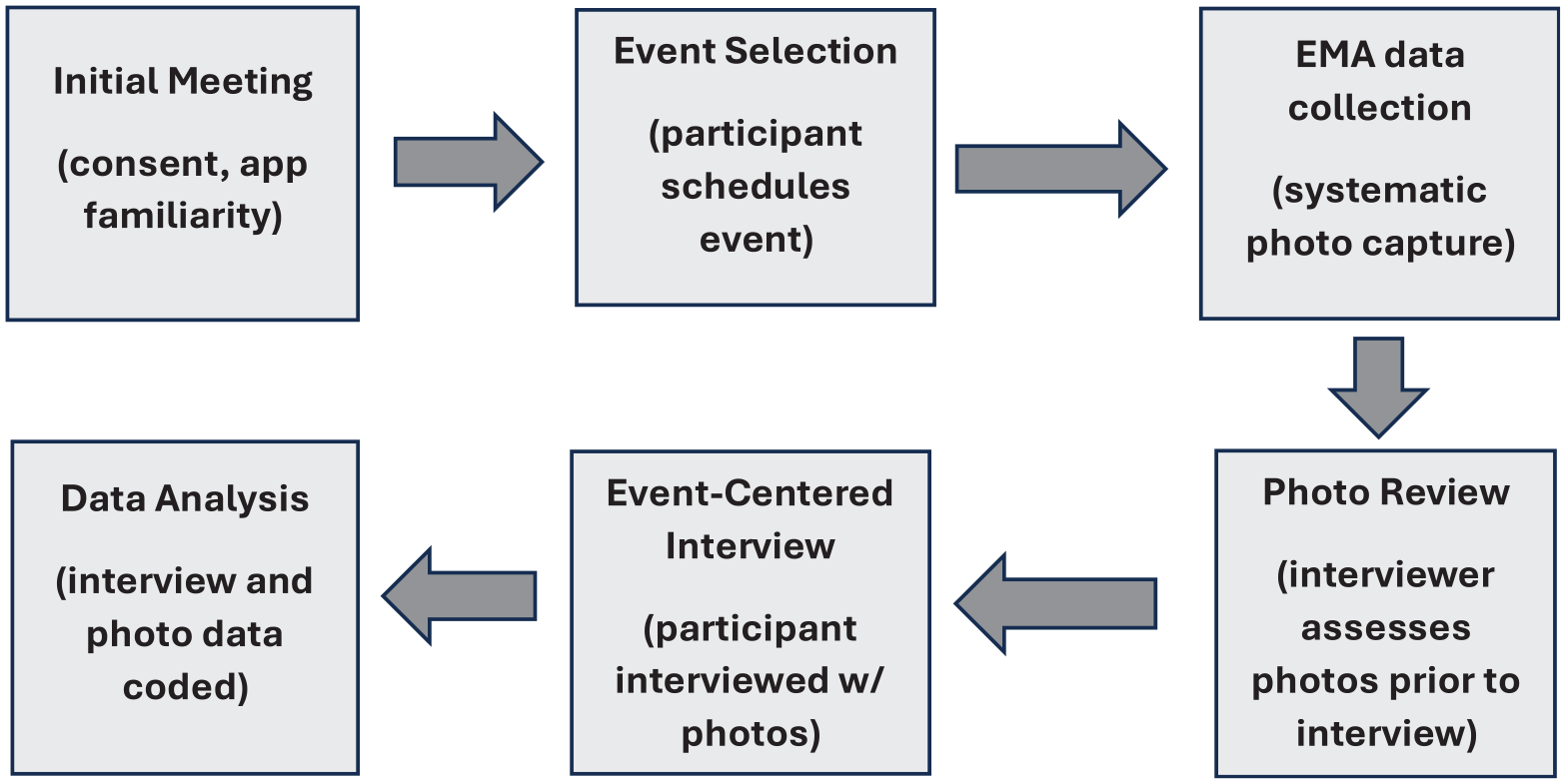
Depiction of ECI process.
A key feature of event-centered interviews is that the participant collects data prospectively through documentation of the event as it unfolds. As such, participants must be recruited in advance of the event to capture data for the purpose of the interview. Brief advance meetings can be held with participants to orient them to the study. Such meetings not only permit participants to provide consent prior to data collection, but they also allow participants to become familiar with the data-collection app prior to the event at which they collect data. In briefly meeting with participants, we were able to gain informed consent, assist with downloading the app to their phones, and explain the study procedures. At that time, participants were assigned numeric identifiers and given written descriptions of study procedures.
At the outset of our study, participants received a copy of the informed consent form and were provided the opportunity to read it and ask questions. During the consent process, we provided detailed information about study procedures and the photos to be captured during the event to ensure that consent was truly informed. Unique ethical considerations arise when asking participants to take photos (for a more detailed discussion, see O’Hara and Higgins 2019). As such, participants were assured that the photos would be used confidentially for interview and analytic purposes only and would not be used in published work or shown to anyone outside the research team (this was specified in our institutional review board protocol). Such precautions are especially important given that the photos were taken in public places and therefore may include others. 3
Participants were informed that they may drop out of the study at any time, including after they completed photo data capture. After having all their questions about the procedures, risks, and benefits of the study answered, participants signed the consent form and received further information about scheduling the specific tasks involved in the data collection. Study participants then downloaded the app to their phone (i.e., Expimetrics, 4 a secure EMA data-collection app) and learned how to use it for data capture. Finally, participants were given an advance appraisal of the types of photo data they would be capturing over the course of the event (the types of photos are specific to study needs).
In terms of data collection, participants were instructed during the meeting that they would receive an alert via the app on their phone each time they needed to collect photo data. The EMA app can be programmed to alert participants at either random or systematic intervals over the course of a specified period of observation (i.e., the event). The length of the observation period and whether the photo data are gathered at random or at systematic times depend on the needs of the specific study. In capturing photo data through an EMA app, participants should be prompted to the specifics of the photos they should capture with their phone. Such photos should be relevant for the purpose of the study; this might include photos of the tasks they are engaged in, their location, their social surroundings, themselves, their companions, or other relevant objects of interest to the study. EMA apps can cue the specifics of the photos taken on each occasion of data capture.
In our case, we asked participants at structured hourly intervals to take a photo of themselves (i.e., a selfie) and a photo of their social surroundings during an evening out socializing at parties, bars, or other events where alcohol was present and where they might meet a romantic partner. Thus, participants were asked each hour on the hour to capture two photos that provided a context and sequence of their night out. Participants received the alerts hourly between 7 p.m. and 3 a.m.; they did not need to continue taking photos if their night ended prior to 3 a.m. Each participant received $25 as an incentive.
Expimetrics facilitated the structuring of the photo data collection. When the app alerted participants to take photos, they had a window of time (in our case, 15 minutes) to complete the photo capture. A timestamp provides an indicator of the lag from alert to capture (if such information is useful for a particular study). Through the EMA app, photo data were uploaded directly to the secure database as they were taken and thus made available to interviewers for analysis without additional effort on the part of the participant (thus reducing participant burden). Participants needed access to a network or Wi-Fi for the photos to be uploaded to the data platform; should the participant be in an area where such access was unavailable, the app saved the photos until the participant entered an area with access and then uploaded them automatically.
After the photos were uploaded to the database, interviewers could review and evaluate them to develop and refine questions for the subsequent qualitative interview. By reviewing these photos in advance of the actual interview, interviewers could better tailor the interview guide to the experiences of each individual. Additionally, interviewers will have a rudimentary “outsider’s” understanding of the event prior to the interview. This creates some advantages for interviewers because they may be more aware of, and better prepared for, relevant lines of questioning.
After the interviewer has evaluated the photo data, the participant is then interviewed about the evening’s activities using the photos. For our study, we required that all interviews were scheduled within one week of photo collection. We recommend interviews be conducted as soon as feasible, but this window may vary depending on the needs of a given study. During the interview, the photos are presented to the interviewee via a tablet and structured in the order in which they were taken. Accordingly, both the interviewer and interviewee are considering the photos as the interview proceeds through the semi-structured interview guide. Along with being organized by the interview guide, the line of questioning should proceed in a manner that coheres with the photo array to conform to the arc of the event. Importantly, the photos not only provide opportunities for eliciting vivid descriptions during the qualitative interviews, but they also help anchor a timeline of the evening’s events and activities. In this manner, the photos provide a structure for discussing the process and experience of the events.
Consideration of why participants took photos of certain things (or left them out) at certain times can be points of discussion (pertinent for some studies more so than others). As noted earlier, the photos are timestamped. Our participants often discussed not only why they may have waited to take a picture after getting the alert but also why they may have missed a photo at a particular time; although infrequent, participants recounted the activities that kept them too busy to capture a photo. The questions for each interview may differ depending on the range of variation in activities experienced by each participant during the event and the photos captured, but domains for the interviews include an overarching rubric within the interview guide. In our case, the rubric focused on the process of getting ready to go out, experiences with friends, interactions with others during the night out, what makes desirable romantic partners, and decision-making processes during the evening’s events. The line of questions delivered through the viewing of photos can help create analytic contrasts, clear up misunderstandings, and align participants’ descriptions with the behaviors and events depicted in the photos.
After the interview with the photo data has been completed, the interviews may be transcribed the same way qualitative interviews are typically transcribed. Yet, in addition to coding and analyzing the transcripts using common analytic techniques for qualitative textual analysis (see below), the photos also can be retained for analysis, and they can even be aligned within the transcripts in the structured order of their capture. In this manner, the event-centered interview provides an additional source of data for analysis, and importantly, the photos can be used for purposes of triangulation within the analysis, thus creating two points of triangulation for this type of qualitative data—within the interview and during data coding.
Participant Experiences with the Method
We completed a pilot test of the method during a study of romantic decision making among single young women in environments where alcohol was present. The pilot included a final sample of 22 young single women (22 of 25 recruited participants completed the process; 1 withdrew prior to photo data collection, and 2 could not schedule the interview within one week of photo data capture). The interviews ranged in duration from 36 to 87 minutes, with an average of 60 minutes. Participant ages ranged from 19 to 24 years, with an average age of 21.4 years. The sample was relatively racially diverse: 50 percent white, 13.6 percent black, 13.6 percent Latino, 18.2 percent Asian, and 4.5 percent other (not a U.S. citizen). Among those who reported a sexual identity, 88.2 percent identified as heterosexual, and 11.8 percent identified as bisexual. Participants indicated that they went out to socialize in spaces where alcohol might be served an average of 1.87 days per week.
We qualitatively coded the resulting interview data to identify how the use of structured photo capture shaped the interview as well as the broader experience of participation in the study. We identified specific a priori themes of feasibility and acceptability, and we coded the data openly to identify other aspects of the interview style that made a difference for participants. These emerging themes included recall (with subthemes of memory trigger and context elaboration), structuring/organization, and some other minor themes (e.g., norms and anticipating photos) that were reincorporated into the primary themes identified earlier. Each author coded the interviews independently and then conferred on coding to examine agreement between coders, discuss discrepant cases, and reach consensus. Below we discuss each of the themes in turn.
Feasibility encompassed the extent to which the interview modality was user-friendly. Participants described the EMA app as easy to use to capture photos at structured intervals. Overall, participants routinely supported the ease of use and described the app favorably. For example, when the interviewer asked Quinn, “Was it an inconvenience?” she replied, “Not at all. Yeah, it was so easy.” Elynora mirrored these sentiments: “I wouldn’t say it’s annoying. It’s just like, I got a reminder, I need to take a selfie, and then my friend, he didn’t mind at all.” Some participants indicated that the time lag between receiving the alert and capturing the photo was a bigger issue than taking the selfie itself, but the app helped with reminders. As Renee explained: “When I saw it said ‘survey,’ I thought, ‘I’m going to have to answer questions tonight,’ but it just asked me to take a picture. So yeah, it wasn’t that bad. It was easy to use, definitely. And I like that it notifies you again 10 minutes later because I’d waited so long to take my first picture . . . so it was good.”
Beyond ease of use, participants expressed a great deal of enthusiasm for the approach. For instance, Allie stated, “I was excited to do it. Like, I told everyone that I was doing this selfie study, so whenever I’d get the notification, I was like, ‘Guys! Time to take a picture!’ [Laughs].” Overall, participants expressed a high degree of comfort. As Ama said, “It wasn’t weird or anything. People were on their phones; people had their phones out and stuff. It was a pretty casual environment.” Similarly, Becca highlighted the normativity of the behavior: “It’s just one of those things where I feel like that’s pretty common now. Like even if I’ll go to take a picture, if someone’s behind me and they see that, they’ll pop their head in or something. So it wasn’t hard to get pictures with other people.” As shown through these responses, participants were generally enthusiastic about the photo data capture.
With respect to recall, participants frequently mentioned that the photos facilitated their memories during the interview. For instance, Serene stated, “I think we really hit on some things from that night, and it’s coming back to me, like stuff that I forgot about, by looking at the pictures. Like the selfie of Anna and I, like I completely forgot the fire alarm went off.” Similarly, Renee volunteered, “I can fill in some holes [by looking at the photos]. That is the advantage to me even if I do get drunk, I remember everything [with the photos].” Alice said, “I was definitely forgetting what I looked like, so it was funny to see.” The photos also allowed participants to provide more detail about the context. For instance, Meredith reacted to seeing the look on her face in a photo by saying that she was searching for a friend at that time: “I had no idea where she went. I was just trying to find people. So that’s why I look quite confused.” Quinn spoke of her presentation of self when seeing one photo: “I did take my hair down for the party, so I guess I switched that. My hair definitely does give me a lot of confidence.” On being shown her photo from 11 p.m., Briana started describing what she was doing when she exclaimed, “Oh my god! My ex-boyfriend’s in the photo! On the right. He does not look good in that pic. But yeah, he was still watching the game with us.” In addition to providing greater context, the photos delivered a structuring mechanism for describing the ordering of events. When prompted by the interviewer with “Let’s go to your 2 a.m. selfie,” Stacey responded by saying, “I’m excited! Oh . . . okay . . . so a lot happened between 1 and 2!” and she began to fill in the details. The photos allowed the interviewers to co-organize the order of events with participants. In one example, the interviewer looked at a photo and said, “Okay, at this point, the fire alarm had already gone off?” and Serene replied, “It went off after this picture. And then that’s when we left,” which allowed for clarity on the order of events.
Overall, participants indicated that the approach was feasible and acceptable, and they volunteered that the photos helped with enhancing recall and increasing contextualization during the interview. In addition to this qualitative evidence, we also collected survey data from participants at two time points to assess the methodologic approach. After the interview was completed, participants were sent a brief online follow-up survey that was not directly tied to their interview. In this way, they could provide feedback about the interview experience without the potential social desirability pressure of the interview setting. They were informed that this follow-up survey, collected via Qualtrics, was anonymous, and they were instructed that their interviewer would not see their responses and comments. The brief survey asked participants to rate their experiences with various dimensions of the ECI method, capturing quantitative data, and to provide qualitative textual comments on what they liked and did not like about the interview process. This anonymous survey allowed us to capture information on participant experiences, feasibility, and acceptability of the method that were separate from the interview process itself.
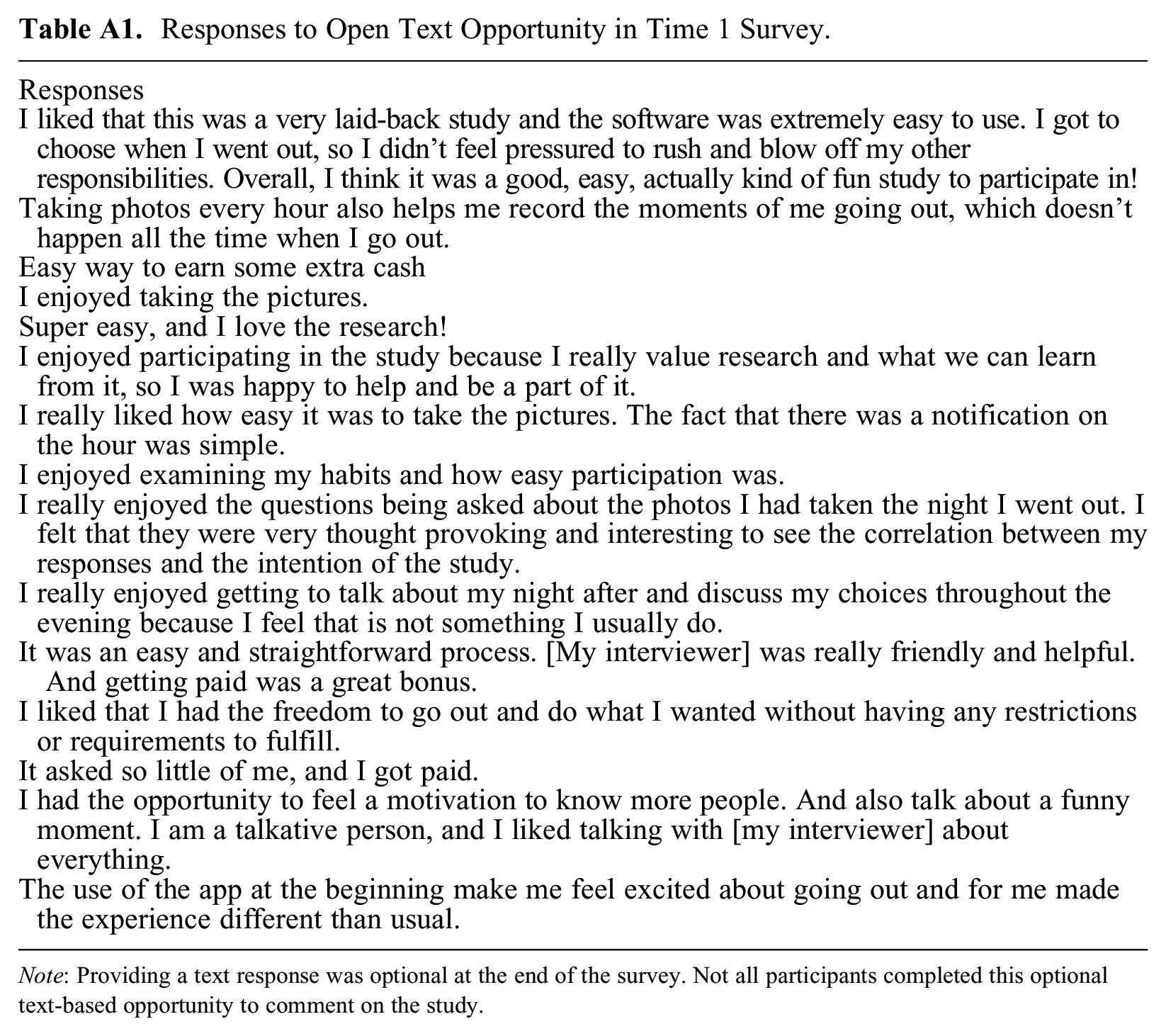
In the assessment of feasibility in the initial survey (shown in Table 1), participants were asked, “How easy did you find the process of taking photos with the data-collection app?” On a scale of 1 to 7 (with 7 being “extremely easy”), participants rated the process at an average of 6.33, indicating a high degree of ease. Participants were also asked, “How much easier was it for you to remember what happened that night by using the photos during the interview?” On a scale of 1 to 7 (with 7 being “much easier”), participants rated this at an average of 6.2, suggesting that most participants believed that the photo data facilitated recall during the interview. Finally, to identify the extent to which they found the ECI method acceptable, participants were asked, “If there was another research study like this, how likely would you be to participate in it?” On a scale of 1 to 7 (with 7 being “extremely likely”), participants rated this at an average of 6.93, suggesting strong enthusiasm about the ECI process. Participants also had the option to provide comments in a text box at the end of the survey. These comments largely reiterated participants’ enthusiasm for the ECI approach and thus we do not reproduce them here, but interested readers may see them in Appendix Table A1.
Sample Responses to Post–Pilot Survey Assessments.
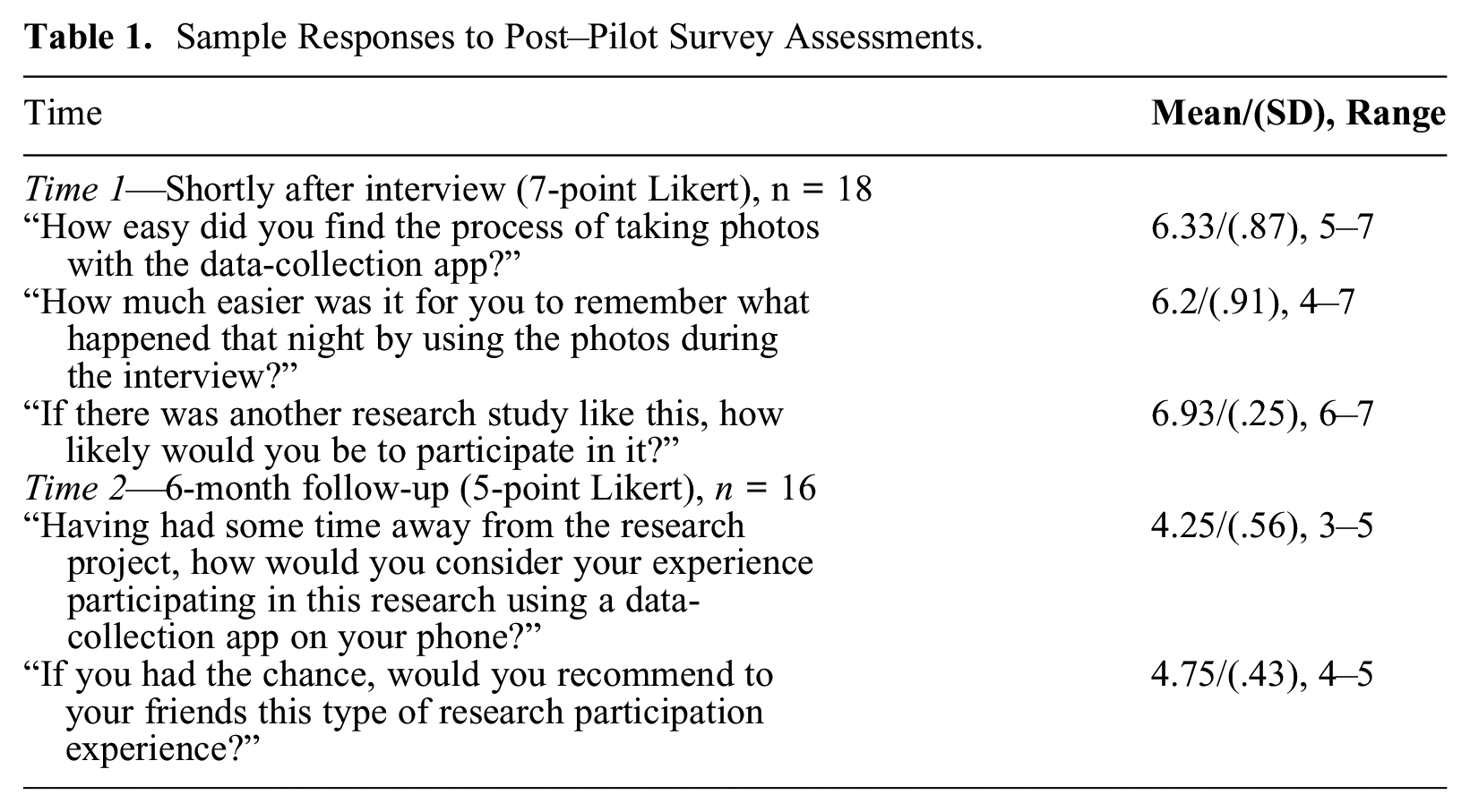
As a check, several months later, we recontacted study participants and asked them to fill out a second brief survey administered via Qualtrics with distinct measures from the first survey. This additional survey gave us the opportunity to assess their perceived experiences after time away from the study, moving beyond the immediacy of the interview experience to their long-term perceptions. Participants were first asked, “Having had some time away from the research project, how would you consider your experience participating in this research using a data-collection app on your phone?” On a scale of 1 to 5 (with 5 being “excellent”), participants rated their study experience to be 4.25, on average. To better understand their experience by documenting whether they felt that it would be worth referring a friend, participants were then asked, “If you had the chance, would you recommend to your friends this type of research participation experience?” On a scale of 1 to 5 (with 5 being “extremely likely”), participants rated their study experience to be 4.75. On the whole, even several months after participating in the study, participants still rated their experiences as highly favorable.
Analytic Approaches
Researchers can combine the ECI method with a variety of qualitative analytic techniques depending on the study goals. The versatility in choice of analytic techniques applies to event-centered interviews in much the same way as for traditional qualitative interviews—there is no single way to analyze data from event-centered interviews. We briefly note three common analytic approaches to highlight some of the techniques that may be applied, although this list is not exhaustive.
Thematic analysis is an inductive research method used to identify and analyze patterns in the description of particular phenomena (Boyatzis 1998). Application of a thematic analysis often seeks out themes patterned between participants. Data from event-centered interviews can provide greater opportunities for identification of both within- and between-participant themes over time. Because these interviews create a structure highlighting the arc of the event, it may prove easier for analysts to identify themes over event progression. For example, specific themes early in events may be distinct from late-event themes, and this analytic approach may create greater opportunities for the identification of between- and within-participant themes.
Narrative analysis is naturally suited to a data-collection methodology that is designed to create a sequence of the course of an event. Storytelling is a means for making sense of one’s experiences; it helps one to conceptually organize experiences and structure one’s own representation within them. Narrative analysis focuses on how stories get told—what gets centered by the storyteller and what gets pushed to the periphery—more than the objective content of the event in a positivist sense (Franzosi 1998; Riessman 1993). In coupling this approach with event-centered interviews, analysts can focus on how individuals recount the arc of an event, which is naturally structured within the interview. Participants begin the storytelling with their photos, and thus the photos and the narrative story become part of the analysis.
Interpretive phenomenological analysis is an inductive research method to identify and analyze how individuals make meaning in their descriptions of experiences (Smith 2015). As such, interpretive phenomenological analysis provides opportunities for studying experiences through participants’ accounts and their use of framing strategies and techniques to signal how these experiences are contextualized, interpreted, and made meaningful (Larkin and Thompson 2012). Integrated within event-centered interviews, interpretive phenomenological analysis provides a pathway for understanding the sense-making process by which individuals experience the events of interest. Such an approach may be especially useful for atypical events with high significance (e.g., a graduation or a wedding) but also for more routine events.
For any type of analytic approach, a key consideration with coding data from event-centered interviews is that the photos provide additional data for analysis alongside the interview transcript. This is where other advances for qualitative analysis become important. Many qualitative data-analysis programs now support the importing and coding of photo data, and as noted earlier, photo data from the event-centered interview technique can be embedded within interview transcripts. This provides opportunities for expanding coding approaches to include both text and photo analysis within the confines of several qualitative data-analysis programs.
Key Advantages
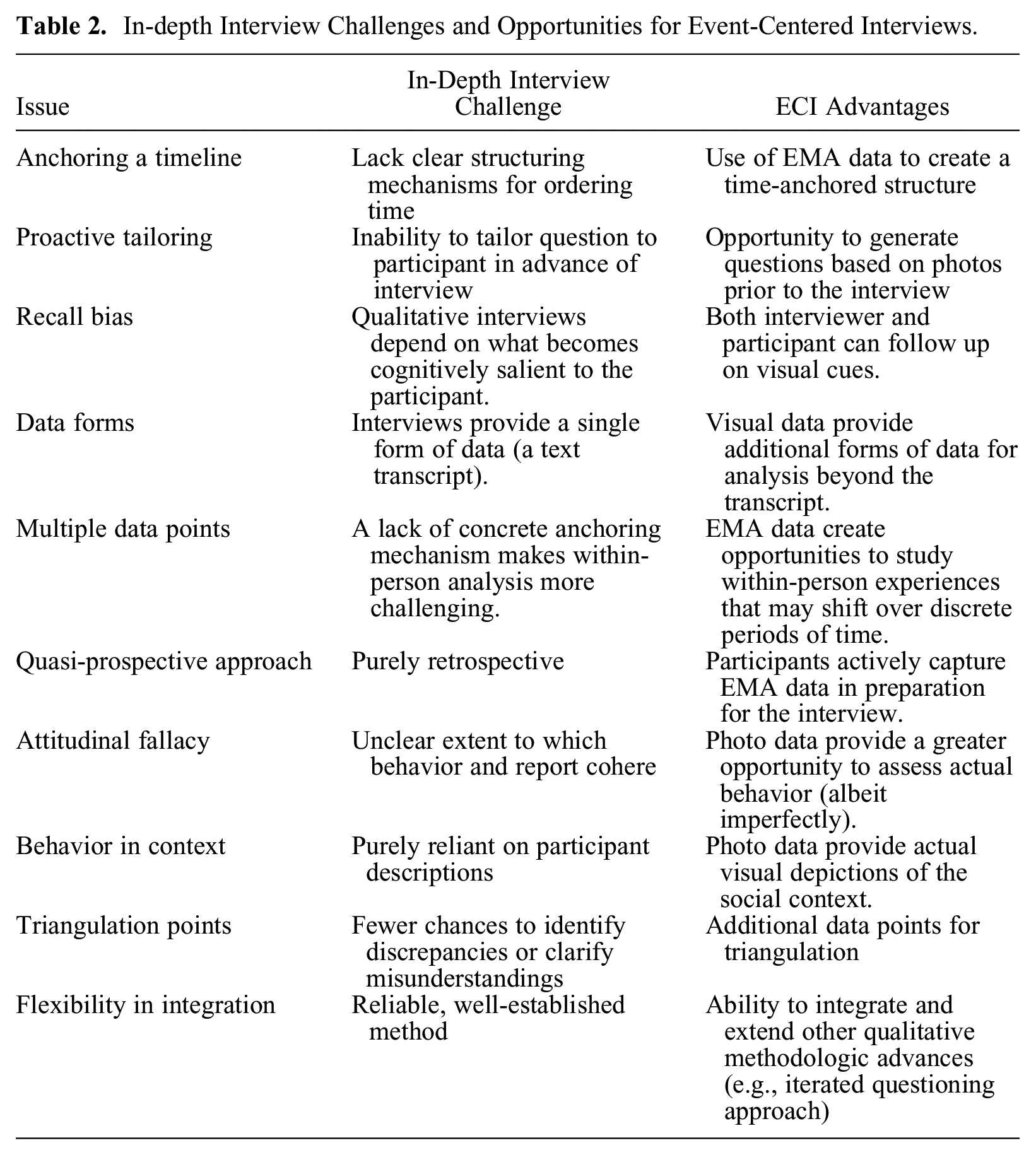
We see several advantages to a qualitative interviewing strategy using experience sampling technologies. As noted earlier, the utility for ECI is most evident for the study of social phenomena as concretized within discrete events. That is, the approach is likely to be most effective when researchers are interested in activities that occur within structured periods of time. Beyond this, the following (listed in Table 2) are other key considerations when evaluating whether this approach to qualitative interviewing has value for a particular study.
In-depth Interview Challenges and Opportunities for Event-Centered Interviews.
Anchoring a Timeline
The systematic nature of the experience-sampling data capture provides for a key structuring of the interview process itself. The photos serve as an anchor for walking the participant through the event with greater precision. The photos provide time-organized visual representations of how events unfolded over time; this can help structure an interview by anchoring moments within a timeline. Because the participant records these visual representations, interviews remain centered on the participant’s perspective. Furthermore, when given the opportunity to briefly review the photos in sequential order at the outset of an interview, participants may feel more confident in telling their stories, thus facilitating the interview process by reducing the participant’s burden to keep events organized. The method is particularly useful for studies in which temporal sequences are important for analysis. For example, in Serene’s description earlier, the photos provided her with a clear reference point for specifying when the fire alarm occurred during her night out.
Proactive Tailoring
As noted earlier, the use of these technologies allows for the tailoring of questions in advance of the interview. Interviewers receive visual representations of the events before participants tell their stories, which facilitates preparation for the interview. Interviewers can develop individualized lines of questions based on the photo data, which creates opportunities for proactive rather than reactive inquiry. For example, Mariann captured photos while standing in line to get into a popular bar. Waiting in line might not typically be discussed in an interview, but reviewing the photos ahead of time allowed the interviewer to develop questions that uncovered the extensive socializing that occurred while people waited to enter the venue.
Reducing Recall and Salience Biases
The issue of recall during self-report remains a consideration for many qualitative scholars, especially when the sequence and timing of behaviors and activities are of concern. Capturing photo data in a structured manner may reduce recall biases related to the salience of events after the occasion concludes. Qualitative interviews often depend on what becomes cognitively salient to participants during the interview. Through the use of photo data as an interviewing tool, event-centered interviews provide opportunities for elements that might otherwise recede within participants’ descriptions to remain foregrounded through the visual cues. Additionally, the interviewer has the opportunity to follow up on aspects of the visual depictions that are relevant to the study aims that might otherwise go undiscussed because they do not seem relevant to the participant. For instance, as described earlier, Meredith noted the confused expression on her face in a picture because she was searching for friends in that moment, which prompted a discussion that might otherwise have been left out.
Additional Data Forms
The systematically collected photos themselves provide an additional form of data. Although not achieving the same depth as participant observation, capturing photo data over the course of an event allows for a window into actions and interactions beyond simply relying on information the participant recounts to the interviewer. Along with providing visual information from the participant’s point of view, the photos provide interviewers with observable information about context that otherwise may be left unsaid, which can foster new lines of inquiry. As noted earlier, the photos also may be analyzed as data in the coding process, particularly if they are integrated within the interview transcripts.
Multiple Data Points
Event-centered interviews allow for a more intensive form of data collection for within-individual analysis by capturing multiple moments across extended events. Although not quite akin to longitudinal panel data assessing individuals over an extended period of time, experience-sampling approaches (qualitative or quantitative) allow for assessments of within-person experiences over specific periods of time. Taking photos over the course of an evening or workday captures discrete moments that allow one to study heterogeneity within individual experiences over the arc of an event. As noted earlier in the discussion of thematic analysis, this may permit greater opportunities to study within-person experiences that shift over the course of discrete periods of time (e.g., a workday). For example, one of our participants, Allie, was able to sequentially chart the different guys she engaged with at multiple points over the course of the evening, providing opportunities to analytically contrast these experiences.
Quasi-prospective Approach
ECI also creates a quasi-prospective qualitative method rather than purely relying on reports after individual experiences have occurred. Individuals are aware of their involvement in the study when the event happens, and they prospectively capture the photo data in the moment as the event proceeds. The lack of pure retrospection may allow participants to be more active in the reconstruction of the event.
Minimize Attitudinal Fallacy
Although photo data do not permit the same depth as participant observation, compared with traditional qualitative interviews, the photo data do provide interviewers with some opportunity to observe the otherwise unobservable. Photo data can capture actual behavior within its context at either regularly scheduled or random intervals, which allows the analyst to see what exactly the participant was doing over the course of the event. Although not completely avoiding discontinuities between what is said and what is done, the photo data create opportunities to minimize these discontinuities and, at the very least, allow interviewers to follow up when behavior observed in the photo does not fully cohere with what is being said by the participant.
Better Situate Behavior in Context
Given that the photo data provide visual depictions of the participant’s context, the interviewer has a better sense of the situated environment in which the arc of the event unfolds. Rather than replying purely on participant descriptions or potentially having no sense of the context overall, the interviewer has a visual understanding of the contexts in which the event played out, even prior to the interview occurring. For example, Becca’s photos of the frat party she attended gave a visual depiction of the crowd and its activities beyond what she verbalized. This allowed the interviewer to gain a fuller sense of the context when developing questions and offered additional contextual references during analysis.
Multiple Triangulation Points
The photo data generated by the ECI method enable triangulation during both the interview and the analysis. As indicated earlier, the interviewer reviews the photo data ahead of time, creating opportunities to identify discrepancies or clarify misunderstandings during the course of the interview. These photo data are retained during the analysis, which allows for additional triangulation during the process of coding and analyzing the data to generate theory and descriptive themes.
Flexibility in Integration
Finally, we note that there is also flexibility in integration with other innovative qualitative approaches. We previously highlighted the method’s analytic flexibility, but the approach is also amendable to other qualitative techniques. For example, Robinson and Schulz’s (2016) iterated questioning approach draws on symbolic interactionism to highlight frontstage–backstage distinctions. The use of structured picture taking can be aligned with such a technique aimed at generating understandings of the presentation of self in the photos relative to a participant’s “backstage” experience. The iterated questioning technique can be applied across photos gathered systematically over the course of an event.
Discussion
This article has provided a description of an interviewing method that integrates experience-sampling techniques with qualitative interviews. We described how ECI provides opportunities to enhance qualitative research on events experienced by participants. Generally, we found the method to be very well received by participants in our pilot study. They found the photo data capture easy to complete, and they understood the utility of the photo data during the interview that followed. This approach extends prior interview methods using photos, such as Photovoice (Wang and Burris 1997), by introducing a more structured approach focused on timing and sequences. We encourage further adaptation and use of this approach with other populations and for different purposes beyond those detailed here.
We reiterate that although there may be some degree of versatility with how ECI is deployed, it may be especially useful for research focused on people proceeding through specific events. These events may be routine, such as a day at the office, or more remarkable, such as a wedding. The uses of the approach described here are by no means an exhaustive list of opportunities; we encourage further experimentation with and application of the method to distinct types of events, which may further highlight the strengths and challenges of this approach. Additionally, we note that although the approach we described uses photo data, the method would retain many of the same benefits were participants to capture brief videos rather than photos. Furthermore, we anticipate that the technical aspects of video data capture will be enhanced over time and expect that this approach will translate readily to a process that incorporates video even more so in the future. Indeed, videos may be increasingly useful in the analysis of social situations, and this methodologic approach would provide a clear structure for their inclusion in research.
In considering the process (i.e., photo data capture) associated with this methodologic approach, we maintain that ECI may be especially useful for studies with younger people. The taking of selfies and other pictures with mobile phones has become so routinized within young people’s lives that our participants found the capture of photo data highly normalized. Pilot study participants indicated that they did not feel awkward or anxious about taking photos for the study. Rather, they indicated a high degree of enthusiasm for the approach. The feasibility and acceptability of this approach with older adults need further study.
Limitations
We noted a number of strengths to the method, but we wish to be clear that there are some tradeoffs to this methodologic approach and that it may not be suited to all types of qualitative inquiry. Most notably, we contend that while this approach may have various uses for qualitative interviewing, it is best suited for the study of experiences and behaviors occurring within discrete events. For example, this method cannot be used as a substitute for topics best suited to life-history interviews. Furthermore, the method is somewhat more time intensive for both the participant and the interviewer. The method not only requires the participant and interviewer to connect prior to the event of interest, but the photo data capture and pre-interview assessment of the photos also require additional time and effort prior to the actual interview. Interviewers also must account for the fact that participants need to know that they will participate in the event under study in the near future; this may be easier for some events (a workday) than others (going to a concert). Additionally, ECI may not be suitable for all events; for instance, scholars have identified the difficulties of using EMA approaches for the study of sport or exercise activities (Jackman et al. 2022).
Unlike a study design in which a participant meets with an interviewer for a single cross-sectional interview, there is potential for participant attrition across multiple stages of the ECI approach. As indicated earlier, the participant typically has a brief meeting with the interviewer prior to the collection of photo data to provide informed consent and download the data-collection app to their phone. During our pilot test, we lost one participant who consented to the study but then never completed the photo data collection. In addition, there may be some loss between the collection of photo data and the actual interview. Given that our interviews focused on a specific night of activities, our goal was to interview participants at some point during the week following their documented night out. Of the 24 participants who completed photo data collection, 2 were unable to coordinate their schedules to allow for an interview. Although we recommend that interviewers not allow much time to elapse between photo data collection and the interview for the sake of preserving participants’ memories of the experience, the focus of the study may affect the length of time feasible for completion of interviews. For example, a special event such as a wedding may allow for a longer period to elapse than a routine event such as a day at work or a night out with friends.
Finally, there is the potential for participants to craft what they choose to photograph (or not photograph) in ways that incompletely represent (or intentionally misrepresent) behaviors and interactions. How participants represent themselves is always a key consideration for social scientific research (both quantitative and qualitative). Yet, we contend that the systematic documentation in photos that provides points for triangulation potentially makes it less possible for participants to sanitize than would otherwise be the case for qualitative interviews. Nonetheless, this remains an area of consideration.
Conclusions
Event-centered interviews are a means to leverage the opportunities brought by experience-sampling techniques to qualitative methods. The use of EMA apps to capture visual data presents great opportunities for qualitative inquiry. By incorporating systematic photo data captured through experience-sampling techniques, event-centered interviews address some limitations of traditional qualitative interviews for certain types of inquiry. Although not applicable to all qualitative research, the use of experience sampling may help enhance qualitative inquiry and create a stronger sense of engagement with study participants.
Footnotes
Appendix
Responses to Open Text Opportunity in Time 1 Survey.
| Responses |
| I liked that this was a very laid-back study and the software was extremely easy to use. I got to choose when I went out, so I didn’t feel pressured to rush and blow off my other responsibilities. Overall, I think it was a good, easy, actually kind of fun study to participate in! |
| Taking photos every hour also helps me record the moments of me going out, which doesn’t happen all the time when I go out. |
| Easy way to earn some extra cash |
| I enjoyed taking the pictures. |
| Super easy, and I love the research! |
| I enjoyed participating in the study because I really value research and what we can learn from it, so I was happy to help and be a part of it. |
| I really liked how easy it was to take the pictures. The fact that there was a notification on the hour was simple. |
| I enjoyed examining my habits and how easy participation was. |
| I really enjoyed the questions being asked about the photos I had taken the night I went out. I felt that they were very thought provoking and interesting to see the correlation between my responses and the intention of the study. |
| I really enjoyed getting to talk about my night after and discuss my choices throughout the evening because I feel that is not something I usually do. |
| It was an easy and straightforward process. [My interviewer] was really friendly and helpful. And getting paid was a great bonus. |
| I liked that I had the freedom to go out and do what I wanted without having any restrictions or requirements to fulfill. |
| It asked so little of me, and I got paid. |
| I had the opportunity to feel a motivation to know more people. And also talk about a funny moment. I am a talkative person, and I liked talking with [my interviewer] about everything. |
| The use of the app at the beginning make me feel excited about going out and for me made the experience different than usual. |
Note: Providing a text response was optional at the end of the survey. Not all participants completed this optional text-based opportunity to comment on the study.
Acknowledgements
We acknowledge Stephanie Wilson, Abigail Nawrocki, Nicole Blackburn, OreOluwa Otegbade, and Carly Ringlespaugh for their research assistance during this study. We offer special thanks to Louis Tay and David Torres for their willingness to incorporate our feedback into Expimetrics. We thank Spencer Headworth and Daniel Winchester for feedback on this work.
