







Abstract
Youth unemployment is a continuing concern in South Africa, and, in the context of growing economic volatility, an increasing number of young adult graduates will find themselves without work. Given the negative effect of unemployment on psychological well-being, research is required to enhance insight into how unemployed graduates can negotiate times of unemployment. Although multiple studies have investigated the influence of unemployment on hedonic well-being, less research is available on how eudaimonic well-being is impacted by unemployment. Significance is a component of meaning, and refers to a sense of mattering in one’s social context. The aim of the current study was to explore how young adult graduates experience a sense of significance during unemployment. Semi-structured interviews were conducted to gain insights into participants’ career narrative, which were then analysed to find meaning plots that relate to significance. The results showed that threads of significance are present throughout the participant’s career narratives, and that the lack of significance during unemployment resulted in great distress, but also a need to restore significance. The value of the study lies in uncovering significance as an important resource during unemployment, which could be a focal point to address in psychological interventions.
According to the latest data, 74.7% of South Africans aged 15 to 24, and 51.4% of those aged 25 to 34, are unemployed. People who are unemployed are defined as individuals who are of working age (15–64), without current work, and who are available and willing to work; this includes discouraged work-seekers, that is, those who have given up hopes of finding a job (Statistics South Africa, 2021). With poor economic growth over the last decade, combined with credit downgrades and the impact of the COVID-19 pandemic during 2020, economic volatility is expected to further lower South Africa’s employment rate (International Monetary Fund [IMF], 2020). The deleterious effects of unemployment on psychological well-being have been reported in many influential studies (e.g., McKee-Ryan et al., 2005; Paul & Moser, 2009). Although a university qualification increases the likelihood of obtaining work, it does not offer immunity against unemployment.
Unemployment further affects young adults (individuals aged 18 to 30) at the start of their careers in a unique manner, as their progress towards adult milestones is obstructed (Van Lill & Bakker, 2020). Available research on the impact of unemployment is mostly centred on hedonic well-being (increased pleasure and decreased pain), and less on eudemonic well-being – contentment through self-actualisation, rather than happiness (Paul et al., 2016). The current article aimed to fill this paucity by exploring how graduates experience meaning during unemployment, with specific attention to significance as a component of meaning. A narrative methodology was chosen, as it has proven useful in gathering rich descriptions of the meaning people ascribe to work (Blustein, 2013).
Significance, work, and young adulthood
In response to the ambiguity in definitions of meaning, Martela and Steger (2016) argue that meaning consists of three components: coherence allows people to make sense of life, purpose gives direction towards goals, and significance generates a sense of being worthwhile. Significance is experienced when individuals feel that they matter, and their existence has impact (King & Hicks, 2021). Deeming personal actions important and influential further creates a comforting foundation when facing hardships (George & Park, 2016). According to Van Tongeren et al. (2016), people experience significance when they are connected and feel that they have a positive impact on others. Feeling worthwhile relies on an evaluation of the past, present, and future, with the evaluation leading to alignment of current actions to the pursuit of a significant life (Martela and Steger, 2016).
Given the amount of time people invest in work, many individuals view their careers as an important contribution to their overall experience of meaning (Ward & King, 2017). This might explain why people opt to qualify for a career that is aligned with their interests, and therefore experience it as fulfilling, instead of simply earning an income. A seminal theory that aims to explain the lack of subjective well-being associated with unemployment is the latent deprivation theory of Jahoda (1981), which holds that, beyond the manifest benefits of employment (an income), there are also latent benefits. The individual being deprived of social connections, a defined status and identity, regular work-related activity, a sense of purpose that transcends personal drives, and structured time contribute to the dissatisfaction associated with unemployment (Jahoda, 1981).
The psychology-of-working perspective holds that work is a considerable part of many people’s lives, and, as it is most often embedded in relations with others, work has the potential to enhance mental health by providing the means to satisfy basic human needs (Blustein, 2013). Through work, people can contribute to something outside themselves. They can receive feedback, achieve social status, and gain the means to provide for their family and loved ones (Ward & King, 2017). However, the negative effects of unemployment include a perception of social exclusion and decreased social status (Pohlan, 2019).
Meaning is a particularly relevant experience to explore among graduates, because there is an implicit meaning in the action of studying in preparation for a future career. People desire being valued in the world and their place in that world, and are thus driven to find significance (Steger et al., 2008). Mayseless and Keren (2013) argue that finding meaning is central to the identity exploration processes of young adults, and most societies allow young adults time to consider different ways of establishing meaning while discovering their authentic selves.
When negotiating difficult situations filled with uncertainty, a sense of meaning can result in greater clarity (George & Park, 2016). In fact, if people are able to view hardship as an opportunity to reflect, new realisations could follow, which may direct their gaining a sense of purpose in life (Kashdan & McKnight, 2009). People who experience greater meaning are more positively orientated towards others and, in turn, are perceived as interpersonally appealing (Folker et al., 2021). This might be especially valuable for unemployed young adults, who would benefit from establishing professional networks and impress potential employers. People with more meaning also have greater commitment to life goals, and utilise resources in a manner to achieve such goals, thereby enhancing self-determination (Kashdan & McKnight, 2009).
The above-mentioned literature suggests that part of the decreased psychological well-being associated with unemployment can be ascribed to a lack of meaning. Furthermore, re-establishing meaning could be a valuable resource during unemployment. The current study’s focus on significance narrowed the exploration to understanding how the desire to matter emerges in the career narratives of unemployed young adult graduates.
Method
A narrative methodology was considered best suited to the explorative nature of this study. One of the assumptions of narrative research is that people live through stories, making it a fundamental way to understand human experience (Pinnegar & Daynes, 2007). This approach allows for a holistic view of the person and his or her experiences, and is not restricted to a focus on isolated situations (Josselson & Lieblich, 2015), thereby generating rich and detailed data. The meanings that people generate in their narratives are created within a social context, which produces further insights into the person within a social world (Pinnegar & Daynes, 2007).
Participants
To be included in the sample, participants had to be between the ages of 21 and 30, have graduated from a university, and been unemployed for the previous 6 months or longer. The Protection of Personal Information Act 2013 (RSA) Government Gazette (n.d.) prevents universities from releasing graduates’ contact details. Therefore, a convenience sampling technique was used, and potential participants were accessed through professional online platforms, non-profit organisations that offer services aimed at assisting unemployed graduates, and personal acquaintances. The sample size ensured practicality but also data richness, and, after 12 interviews, the gathered data proved adequately extensive and data saturation had been achieved. Table 1 displays the participants’ biographical information.
Biographical details of participants.
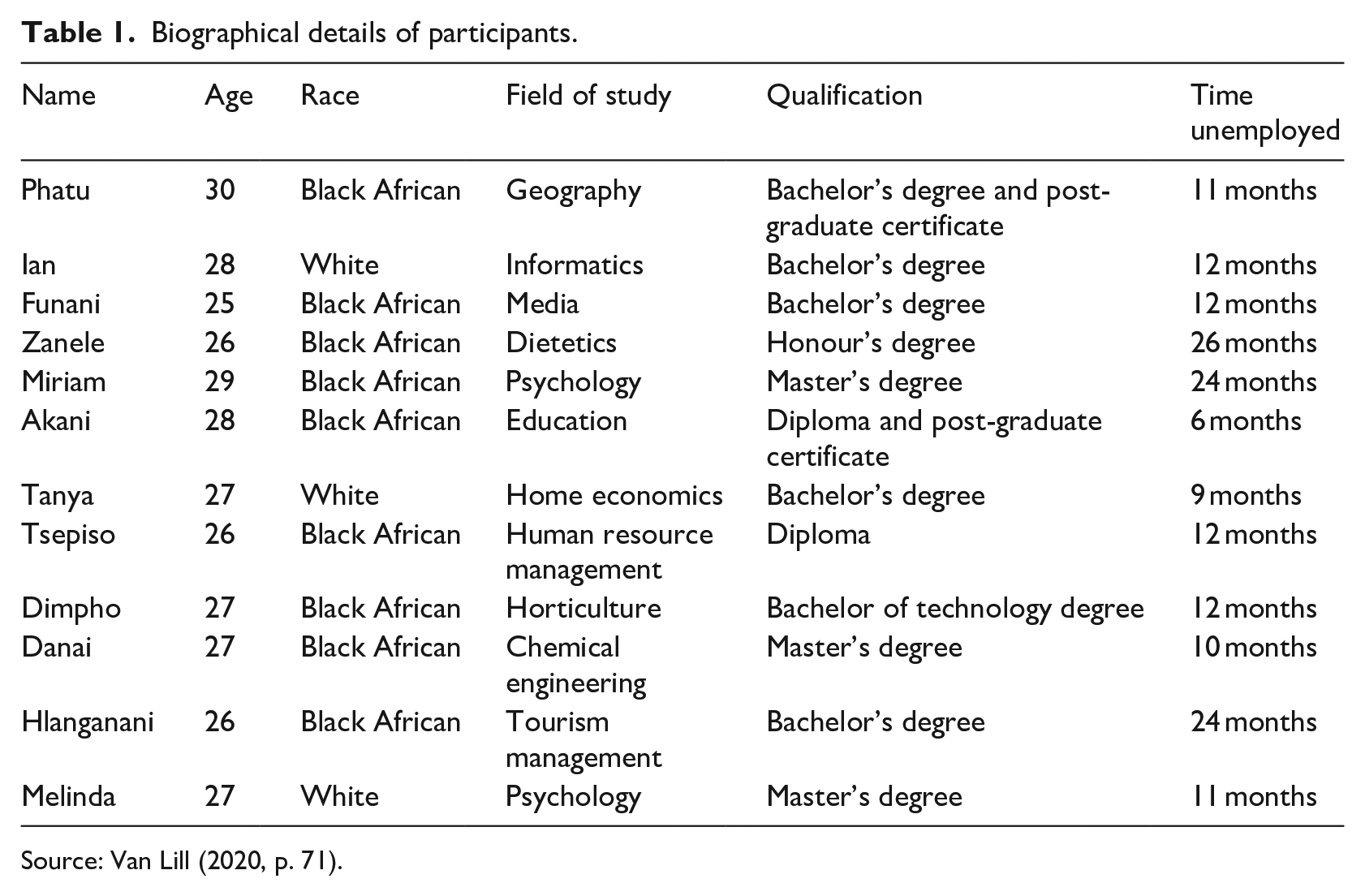
Source: Van Lill (2020, p. 71).
Interview guide
An interview guide directed the semi-structured interviews. It started with an open question, inviting the participants to share their story spanning the time when they made a career decision, the period they attended university, and the unemployment that followed, up to the time of the interview. Probing questions followed, to explore certain parts of the narrative that appeared subjectively meaningful to the participant or objectively relevant to the topic of investigation. Josselson and Lieblich (2015) encourage attention to the context and social world surrounding the narrator. Thus, the interview protocol included questions such as ‘Can you think of people who contributed to how you think about work?’, ‘Did not finding a job after graduation have an impact on the people close to you?’, and ‘Do you feel supported at present?’.
Procedure
The first author conducted in-person interviews, aimed at eliciting meaning-related themes as the participants shared their career narratives. The questions continued until the momentum of the conversation seemed to wane and themes became repetitive. The duration of the interviews varied between 32 and 67 min each. The first author transcribed the interviews, to increase familiarisation with the content. To allow the participants an opportunity to share any further reflections they might have had on the topic, the first author contacted them two weeks later with an invitation for a second interview or to contribute in writing. One participant shared a text message, which was incorporated into the transcribed data while the other participants declined the invitation for further engagement.
Ethical considerations
The research at hand formed part of a larger study (Van Lill, 2020), and an ethics committee affiliated with the University of Pretoria’s Faculty of Humanities gave permission for the research to be conducted. The participants granted informed consent after they had read information on the aim of the study, their right to withdraw at any time, and the publication of the information they shared. The interview recordings and transcriptions were stored to ensure the confidentiality of the participants’ information. Pseudonyms were used to protect the anonymity of the participants while any identifying particulars were removed from the transcripts.
Data analysis
After initial readings of the transcripts to ensure familiarisation with the data, experiences related to significance were highlighted throughout each participant’s narrative. One of the distinguishing qualities of a narrative methodology is the focus on temporality, which emphasises that people move from past, to present, to future (Clandinin & Rosiek, 2007). In each narrative, the experiences of significance were then arranged chronologically, to identify plots of significance. This temporal organisation of events makes it possible to form a holistic perspective and understand how singular events contribute to certain themes (Polkinghorne, 2015). Progression and regression in the plots of significance could be examined, and the plots of different narratives compared to identify commonalities. Particular attention was paid to how the plots were influenced by the participants’ social milieu. The common themes, together with examples, are reported in the next section.
Results
When viewing the results from a temporal perspective, four important plots of significance emerged. First, the candidates indicated that achieving significance was one of the motivations for their career choice. Second, they reported an increased sense of significance while studying. The third plot unfolded as a result of the insignificance associated with unemployment. Finally, all the participants invested in efforts to restore a sense of significance while unemployed.
Significance in qualification choice
The participants made career choices they hoped would ensure significance when they started working. For Ian, it was important to find work that would allow him to solve problems and be connected to people he considered important in his life: ‘Fundamentally, what I work for is to have good friends, good family, a roof over my head, and food in my stomach’. In fact, all the participants indicated an association between their careers and how it would matter to their families. Dimpho expressed the obligation she felt to make financial contributions to her family’s upkeep: Even though people, they call it ‘Black Tax’, but, like, I don’t think there is such a thing, because, with us black people, it’s been difficult. Imagine if your parents took their last cents to teach, help you go to varsity, and then, like, after you graduate, you expect to just focus on your own life.
For some of the participants, the desire to feel significant to their families resulted in career choices that were not a good fit. Phatu explained that her family’s and the community’s focus on financial stability had been the main reason why she studied law: The truth is, where I come from, from Limpopo, you’re always told that you should only study courses that will give you money in the end. So, your dreams, they sort of disappear, and you start looking for something that can give you money.
Phatu failed her first year, and decided to pursue a career in geography, which was more aligned with her interests. Melinda explained how her family members’ career choices influenced her to study medicine: ‘Because I come from a family that’s – everyone’s in really tense careers like engineering and medicine and financial actuarial sciences. So, I think there was always this thing, almost this narrative in my family’. However, when she was not selected to study medicine, Melinda pursued studies in psychology, and subsequently recognised this profession as a better fit for her. The participants thus had to find ways of balancing the pressure they felt from their families with their own career intentions.
Significance while studying
Being students and pursuing a qualification that would help them establish a career also added significance to the participants’ lives. As a first-generation student, Zanele mentioned that many people in her village asked for advice to help their children pursue a university qualification. She shared how privileged she felt: ‘After that time, I felt so special. You see, okay, I’m important to other people. Other people are seeing the light through me’.
Tsepiso regarded higher education as his best option to provide for his family when his stepfather abandoned the family: ‘I just have to make it work. My family was my motivation. Every time when I was lazy to study, I remembered my situation at home, and I woke up from my sleep’. This quote illustrates that adding value to his family was not limited to Tsepiso’s career choice but also extended to the act of studying. Achieving success in their studies was so important to the participants that they were prepared to make many sacrifices to achieve it. Zanele stated: ‘I didn’t want anything to disturb me or disrupt me to study here. Like, also with the cut of relationships and so forth. I didn’t want that. I only wanted to be single and focus on my studies’.
The significance of their time at university was perhaps best illustrated on graduation day, when the participants could celebrate their success with their families. The meaning of graduating did not lie in individual achievement alone but also in the manner that it contributed value to the family. After repeating 2 years of her chemical engineering course, Danai expressed relief at completing her qualification and explained the joy she experienced in sharing her graduation day with loved ones: I felt like a burden had been lifted off my shoulders, and, you know, when you see your family is happy. They even had a party for me, and I was like, ‘No, I don’t need it’. They were like, ‘No, no, no, we’re going to do it’. So, everyone was happy and excited about it. So, I was also happy, and I was touched.
Insignificance as a result of unemployment
After the excitement of university, unemployment became a barrier to the participants experiencing significance. Tanya had graduated with the highest marks in her year. She stated, ‘I feel a bit useless . . . You’re scared you’re not doing something, whereas, at least, at university, you were constantly busy with something to achieve some kind of goal’. This disappointment may have been aggravated by the fact she had expected to secure employment shortly after graduation, a sentiment expressed by all the participants. Melinda illustrated how unemployment was having a negative effect on how she valued herself in the greater social context: I think I really felt a bit like a loser this year . . . I don’t feel smart. I didn’t feel like I contributed to society, and I felt disappointed in myself for the choices that I made. And, I think, while you’re a student, you kind of have this idea that, ‘I’m a student, so I’m still learning . . .’ But, I think, this year, it just felt like I did all of this, but still I’m not really something.
Hlanganani was deeply distressed by the loneliness and lack of support he experienced during unemployment: The stress arrived when . . . you have to be by yourself. You no longer have friends that you are busy with at university. You’re on your own. You’re applying, applying. Then life becomes stressful, like, ‘Why did I even waste my four years’ time studying for something that I won’t even find a job for it?’ It’s very stressful.
The participants expressed feeling especially insignificant when comparing themselves to their more successful peers. Ian explained: ‘I haven’t earned my own, per se. Because, I mean, I’m 28. I’m looking at my friends buying houses, buying cars, getting married, making families, and growing up’. Not being employed also changed the participants’ social interactions. Melinda explained: ‘It really influenced my relationship with other people as well, because I saw – I put people on these pedestals . . . So, I think I really compared myself a lot this year, and I don’t feel like I really did that before. I think that was – it was the first time I did that’. In this regard, Funani said: At past, I used to go and visit friends, but, now, I don’t usually go to visit them, because they will be asking me a lot of questions: ‘What are you doing in life? Why are you not working? ’rong with your degree?’, and what-what.
Akani explained how she felt compelled to portray a facade to feel like she mattered: Everyone is happy, their life is going well, and you can’t always complain to people, ‘I’m not working’ . . . You have to pretend that everything is fine. You know, just put on some powder, some lipstick, and smile, and then just take a picture, post on Facebook, and everyone would be like, ‘Oh, wow! This is how she looks now!’.
Because their career choices were made with other people’s views and priorities in mind, the participants’ disappointment was exacerbated by the sense that they also failed to meet the expectations of important people in their lives. Tanya expressed this difficulty: I was devastated. I was so scared. I was thinking, ‘I’m a failure. How am I ever going to get a job? How am I ever going to take care of myself? I don’t want to sponge off my parents forever’.
A desire to restore significance
The lack of significance the participants experienced during unemployment sparked an urge to fill their lives with different ways of mattering. They relied on existing relationships to feel valued. Ian stated: I help out with family errands. The past while, I’ve been helping my mom renovate her place. So, I still get opportunities to help out where I can and help solve problems . . . . it’s just, the problems aren’t really challenging [chuckles].
Being unemployed, Melinda helped her mother and sister-in-law, who had both undergone surgery: And, I felt like, I know that it’s just looking for meaning as well, like telling myself that, maybe this had to happen, this year had to happen, so that I could help them, because I really don’t know what they would have done if I wasn’t around.
Although Melinda found that she could be of service to her husband, she also noticed a desire to prove her worth: I felt like I had to make him see that I still count, that I still contribute in a way that’s not necessarily with money, but in the house, which is really sad that it happens. But, I think it happens to a lot of people that stay at home, especially women, because you want to show your husband, ‘Okay, I’m still valuable, I still contribute’.
After being unable to fulfil her career aspirations, Tanya found ways to make a positive contribution through her role as homemaker, but admitted that it did not always come easy to her: It’s still a process . . . I have to accept it that it is a privilege to actually be a stay-at-home wife, and it’s not a shame. Sometimes, I still feel like I should be doing more. I can be doing more . . . I need to stop judging myself for being in this situation and the way that it is. It’s actually a privilege.
Phatu explained how she came to appreciate the time made available by unemployment, which made it possible for her to be a valuable part of her children’s lives: Going back to my kids, I’m thinking, I wouldn’t be able to spend this much time with them if I was at work, you know. So, I’m here, I’m available, I’m able to do some of the things that I wouldn’t do with them if I had to work.
Funani found that she could have a positive impact by volunteering to assist learners in her neighbourhood with homework and obtaining funding for school supplies: It was good. I felt good, because I was helping, especially the kids, because some of them, they just go home, put their bags, and go and play. They don’t study, and some of the parents neglect their children, so we have to help them.
Ian shared how much he relied on social connection from his friends to experience meaning during unemployment: I think, if I didn’t have the support I have, I probably would have given up a long time ago [chuckles]. So, yeah, suicide isn’t an option, ever. But, I think, if I didn’t have the friends now that I have – thinking about primary school days – I think it wouldn’t have been too much to ask of me to just go, ‘Well, [chuckles], what if I could end it and see what would happen at the end?’.
The significance the participants experienced contributed to their sense of purpose, which fuelled continuing efforts to secure employment. Hlanganani explained how the importance he attached to being a provider for his family encouraged him not to give up: What keep me motivated, it’s like, it’s the situation at home, that’s what. They keep me going, and then this: I have a little daughter, she’s four years old. She’s going to school next year. So, you know, it’s a big responsibility. So, that’s why I, like, I don’t give up. Whenever they don’t even give me feedback, I don’t give up, I keep on applying.
Discussion
The desire to obtain significance was a prominent part of every participant’s career narrative. Career intentions are not shaped in isolation, and the participants illustrated that their choices were aimed at ensuring that they would become valued members within the greater social sphere. This is in line with a growing trend of people desiring work that is fulfilling on multiple levels, including positively contributing to society (Ward & King, 2017). What was particularly notable in the current sample was the strong association between work and being of significance to their families (immediate social sphere). In a poverty-stricken context such as South Africa (Statistics South Africa, 2015), financial provision for family members is a prominent theme, as it offers a concrete way of being of value to others. Choosing a career with consideration of the desire to matter can contribute to a meaningful existence. Yet, the current findings suggest that complying with social expectations without due regard for individual abilities, interests, and employment needs could also be a risk for poor academic performance or dropout. Mhlongo and O’Neill (2013) found that South African students from families with a lower economic status are more likely to be pressured to choose higher education programmes that guarantee employment and take less time to complete.
After the progression in significance the participants experienced while studying, continuing unemployment deprived them of the valuable contributions they had hoped to make to the lives of others. This finding might contribute to explaining the decreased psychological well-being associated with unemployment (Paul & Moser, 2009). The insignificance the participants experienced was particularly prominent when they compared themselves to their peers. A study by Panagakis (2015) found that young adults compare the timing and quality of their adult transitions to those of their peers. Not securing employment after graduating made the participants acutely aware of the adult transitions they valued but were unable to attain.
Lack of meaning results in discomfort, which then compels people to search for new avenues to restore meaning (Steger et al., 2008). Since interdependence with others and a sense of belonging result in a higher sense of meaning (King & Hicks, 2021), seeking alternative ways to matter could be a helpful strategy to address the void created by unemployment. Most of the participants emphasised that care-taking roles, such as running errands, performing household chores, child rearing, and volunteering enhanced their sense of significance. Van Tongeren et al. (2016) found that people tend to see themselves as more prosocial when their sense of meaning is threatened. McKee-Ryan et al. (2005) suggest that social support and positive social interactions can help unemployed individuals to view their lives and future outlook in a more optimistic way while working as a buffer against stress. In a population of South African unemployed young adults, Coetzee and Esterhuizen (2010) established that social connectivity contributes to enhanced coping.
Shepherd and Williams (2018) recommend that young adults who are seeking employment opportunities focus on more immediate goals and explore the multiple facets of their identities. The current findings suggest that focusing on social connection and contributing to society are important processes in exploring one’s identity and coping during unemployment. From the current study, it thus appears that finding significance from other social roles could contribute to improved eudaimonic well-being during unemployment.
Among the study limitations is the narrative methodology applied in the current study, which yielded singular subjective perspectives on the research topic. To generalise the results, future research initiatives could expand the sample, to investigate whether establishing significance could act as a buffer against the negative impact of unemployment on psychological well-being. With the unemployment rate increasing in South Africa, it is important to establish ways to prevent graduates from becoming discouraged work-seekers. Time is a resource of which most unemployed people have an abundance, and future research could uncover significant daily occupations to utilise this resource. The scope of this study did not allow for comparison between different race groups. However, the findings suggest that especially black African students emphasise the importance of providing for their families. This phenomenon could be further investigated to inform career guidance practices within the South African context.
Conclusion
With continuing high unemployment rates among young adults, it is crucial to uncover measures to improve the psychological well-being of those who are unemployed. The current study aimed to gain insight into the emergence of significance in the career narratives of unemployed, young adult graduates, to gain an understanding of the role of eudaimonic well-being during unemployment.
The study found that the search for significance has an important influence on how prospective students make career choices, and that the need to contribute to their families is a potential factor to consider during career guidance. The role of a student is marked as a time of high significance in the lives of young adults; it is a time when they are actively pursuing their career goals, and the subsequent failure to secure employment is poignant. To compensate, unemployed graduates could seek alternative ways of making positive contributions in their social worlds, such as contributing to the household, finding ways of adding value to their family members’ lives, volunteering, or maintaining friendships. As a component of meaning that plays a vital role in career narratives, significance can be restored by focusing on activities that make unemployed individuals feel valued and connected to others.
Footnotes
Declaration of conflicting interests
The author(s) declared no potential conflicts of interest with respect to the research, authorship, and/or publication of this article.
Funding
The author(s) received no financial support for the research, authorship, and/or publication of this article.
