







Abstract
Spirituality is a universal human experience. Within the process of development, the role of spirituality as a developmental asset is understudied in general and especially within majority world contexts. In this article, we frame advances in spirituality research and practice with youth around three pillars: (a) theory, (b) measurement, and (c) research about and evaluations of positive youth development (PYD) programs in low- and middle-income countries. We place PYD programs as associated with dynamic, relational developmental systems (RDS)-based models of human development, describe spirituality and the “Big Three” features of effective PYD programs as aligning to promote thriving, and discuss spirituality as a strength, as a key asset, in the lives of youth. We discuss advances in developmental methods and measures for describing, explaining, and promoting spirituality and PYD and offer a case study that responds to a United States Agency for International Development call for action and evaluations of spirituality within the context of a PYD program in the majority world. Considerations for future research about spirituality and youth development are discussed.
Keywords
The purposes of this article are to discuss the concept of spirituality and illuminate its role as an important resource in the positive development of youth (e.g., Dowling et al., 2003, 2004; Dowling & Scarlett, 2006; King, 2012; King et al., 2024; Warren et al., 2012). To achieve these purposes, we discuss different conceptions of spirituality and the convergence or divergence of these definitions with definitions of religiosity (e.g., W. James, 1902; King & Boyatzis, 2015) and then focus on how these concepts of spirituality pertain to adolescent development and, in particular, to the resources needed for young people to thrive across time and place (e.g., Dowling et al., 2003, 2004). As such, we fame the discussion of adolescence and spirituality by using models of positive youth development (PYD) associated with dynamic, relational developmental systems (RDS) metatheory (Lerner, 2018; Overton, 2015), models that emphasize the mutually-influential and, in the case of PYD, mutually-beneficial relations between individuals and their context. These relations are usually represented in the RDS-based literature as individual context ⇔ relations (Lerner, 2018, 2021).
The cutting edge of contemporary developmental theory emphasizes that dynamic, RDS-based models are especially useful in describing, explaining, and optimizing the mutually-influential relations between specific individuals and specific contexts; these relations constitute the foundation of developmental processes across life (e.g., Cantor et al., 2021; Mascolo & Bidell, 2020; Overton, 2015). RDS-based models emphasize that, when these mutually-influential relations are also mutually beneficial to both individuals and contexts, the foundation of healthy, positive development is established (Lerner, 2018, 2021; Lerner & Lerner, 2019; Lerner et al., 2019; Lerner, Johnson, & Buckingham, 2015).
Developmental scientists interested in understanding and enhancing the mutually-beneficial relations between an individual and the individual’s context have sought to identify the key resources, or developmental assets (e.g., Benson, 2008), in both the individual and context which can be integrated in order to promote these positive bidirectional relations and, as a result, increase the likelihood of thriving. Because of the role of these assets in the process involved in the positive development of individuals, developmental assets may be considered strengths present in both individuals and contexts. Due to plasticity in development, the possession of and the potential to promote such strengths counters deficit models of individuals and contexts (Lerner, Lerner, et al., 2015) and contradicts claims that, when problematic development is seen among either individuals or contexts, the only recourse for programs or policies is to make these people and settings less bad (e.g., Benson, 2008; Masten, 2014, 2015; Masten et al., 2015).
While recognizing the relevance of identifying developmental assets for the positive growth of all individuals, there has been increasing interest in marshaling these assets to enhance the lives of young people who have been marginalized and treated inequitably because of challenging or, even more, traumatizing experiences associated with poverty, racism, or insecurities related to food, housing, education, health resources, employment, and physical safety (e.g., Barbarin et al., 2020; Nasir, 2021; Nasir et al., 2020). Although studies of groups of these youth have taken place around the world (e.g., Petersen et al., 2017), a focus on youth in low- and middle-income countries (LMICs) has, arguably, been of particular importance. This focus is warranted due to historical inequities and the significant number of youth in the majority world (i.e., LMICs) that are beset by the above-noted challenges and traumas (e.g., Banati, 2021; Leman et al., 2017; YouthPower Learning, 2017).
Indeed, using ideas from RDS-based models of PYD (e.g., Benson, 2008; Damon, 2008; Lerner et al., 2019; Lerner & Lerner, 2019; Murry et al., 2016; Smith et al., 2017), longitudinal research and evaluations of strengths-based PYD programs have burgeoned in LMICs. Many of these programs are faith-based for various reasons, not the least of which are the facts that (a) religious institutions are often the major context other than the family wherein youth encounter the key contextual asset of developmentally nurturant relationships with adults (Benson, 2008; Cantor et al., 2021; Tirrell et al., 2023) and, in turn, (b) young people’s spirituality and religiosity constitute key individual assets linked to PYD (Dowling et al., 2003, 2004) In short, theory-predicated studies of the mutually-influential and mutually-beneficial relations between youth spirituality and religiosity, and the implementation of strengths-based PYD programs for youth developing in LMICs, constitute an important sample case of how research predicated on dynamic, RDS-based models can enhance our understanding of how mutually-influential, positive relations between marginalized youth in LMICs and PYD programs can promote thriving.
In this article, we frame advances in research and practice around RDS-based models associated with the unique role of spirituality as a key developmental asset of youth involved in mutually-beneficial coactions with their program settings (Hardy et al., 2019; King & Boyatzis, 2015; King et al., 2011). To do so, we describe spirituality and the “Big Three” features of effective PYD programs that, when integratively aligned, promote thriving in such contexts. We explain why spirituality is a strength—a key asset—in the lives of youth, and describe advances in developmental methods and measures for describing, explaining, and promoting spirituality and PYD in LMICs. We review examples of existing and ongoing studies and evaluations seeking to respond to a United States Agency for International Development (USAID) call for action to design and implement theory-predicated and methodologically rigorous PYD programs (YouthPower Learning, 2017; see also Lerner et al., 2021; Tirrell et al., 2021).
Spirituality as a developmental asset
Religion and spirituality have been present in the study of psychology from the beginning; however, it is only during the first part of the 21st century that research on spirituality and religiosity among adolescents has burgeoned (e.g., Hardy et al., 2019; Hardy & Nelson, 2023). At psychology’s founding, William James (1902/1982) would have conceptualized religion and spirituality together, as one and the same, but, at this writing, these constructs are often treated as distinct by virtue of the fact that, in some studies of youth development (e.g., in the samples of youth studies by Search Institute, e.g., Benson et al., 1998), measures of religiosity and spirituality contribute unique variance to individual development (e.g., Dowling et al., 2003, 2004). This shift toward diversity of conceptualizing the nature of and relations between religiosity and spirituality became visible in the developmental literature in the mid-to-late 20th century when research identified people who were searching for alternative means of connecting with something beyond themselves, that is, to something transcendent; these individuals were found to be looking beyond the traditional church structures (Ammerman, 2014; Pargament, 2013).
Depending on various methodological factors such as sample characteristics, measurement instruments, research designs, and analytical approaches, this shift was marked by some individuals perceiving spirituality either as a personal experience or a search for a connection to the transcendent. Some individuals might associate these connections with religious traditions, while others might view the transcendent as part of the physical ecology sustaining human life on earth (e.g., Ammerman, 2013; Dowling et al., 2003, 2004; King, 2008; King & Boyatzis, 2015; King et al., 2011). Perhaps because of myriad methodological issues present in this literature (e.g., small and under-described convenience samples and use of measures with unknown validity), no endeavors have been made thus far to conduct a meta-analysis aimed at delineating the specific characteristics of individuals and of contexts that coact in the development of distinct conceptions of spirituality or religiously in specific individuals.
While recognizing the significance of future research in exploring related areas, it is important to note that our current study does not aim to address those aspects. Our focus is on spirituality as a developmental asset for PYD, as the experience of spirituality may be found both within religious traditions and independent of them. In addition, the growing number of individuals identifying as spiritual but not religious, primarily observed in Western societies, highlights the importance of understanding spirituality on its own terms (Lipka & Gecewicz, 2017). Moreover, our focus on spirituality as a developmental asset throughout adolescence is further supported by the increasing research on religiosity during this developmental stage over the past 20 years. Hardy and Nelson (2023) have emphasized the positive associations between religiosity and various facets of youth development, such as psychological well-being. Religiosity is a multidimensional construct that encompasses at least seven dimensions including cognitive, behavioral, and spiritual among others (Hardy & Nelson, 2023).
Given the positive manifold relation between measures of religiosity and spirituality (e.g., Dowling et al., 2003, 2004; Good & Willoughby, 2006; King & Boyatzis, 2015), many researchers continue to combine the experience of these constructs into a singular experience of religion/spirituality even as the underlying social (and empirical) meaning of each construct continues to diverge. In an effort to clarify the border between these two concepts, Dowling et al. (2003) used confirmatory factor analysis to identify spirituality as empirically distinct from religiosity within a sample of U.S. youth. Building on this factor structure, Dowling et al. (2004) then sought to examine the relationship between religiosity (i.e., adherence to a particular religion), spirituality (i.e., taking something to be transcendent or of great value), and thriving and found that spirituality’s impact on thriving was moderated by religiosity, and spirituality had a direct effect on thriving, thus demonstrating its importance as a stand-alone asset for youth within the PYD framework. In the 20 years after Dowling et al. (2003), researchers have sought to build on this distinction, with King and Mangan (2022) leveraging the empirical importance of spirituality as a stand-alone asset motivating what they term “aspirational development” (p. 488). Aspirational development is oriented toward a cohesive meaning-making process where adolescents and young adults discern their other-oriented purpose through an examination of personal, contextual, and historical motivators; spirituality is one asset anchoring this discernment process.
As a developmental process, nearly all societies have engaged in questions of human experience and gravitated toward understanding humans’ collective experience in spiritual terms (Benson et al., 2003). To further the study of spirituality, separate from religiosity, Benson et al. (2003) proposed the following definition: Spiritual development is the process of growing the intrinsic human capacity for self-transcendence, in which the self is embedded in something greater than the self, including the sacred. It is the developmental “engine” that propels the search for connectedness, meaning, purpose and contribution. It is shaped both within and outside of religious traditions, beliefs and practices (p. 205–206).
Thus, at its core, spiritual development is an intrinsic process oriented toward a connection with the surrounding community or context, with an aim to foster connection, meaning, purpose, and, ultimately, contribution. While spiritual development is a unique journey for each individual, engaging in a religious tradition or community can potentially augment this process, albeit not being essential for spiritual growth (Benson et al., 2012). Although Benson and colleagues (2003) proposed their definition of spirituality about a generation ago at this writing, the separation between religion and spirituality has not been generally accepted. Even at this writing, many measures and approaches examine religion and spirituality together; however, we have noted that there is evidence that each may affect the individual differently (e.g., Dowling et al., 2004; King, 2008; King & Mangan, 2022).
There are many examples of spirituality and religion as positive developmental assets for youth (e.g., Hardy et al., 2019; Mattis et al., 2019; McCullough & Willoughby, 2009); however, few researchers have embarked on the call of Benson et al. (2003) to explore spirituality as a stand-alone asset. One such study that builds on this notion of spirituality in youth development emerges from Benson’s colleagues at the Search Institute. Scales et al. (2014) developed a theoretical framework where fundamental developmental processes underpin youth spiritual development. Within this framework, youth develop an “awareness of self and the world”; develop a sense of life being interconnected and their role within it; and develop a sense of “life orientation grounded in hope, purpose, and gratitude” (Scales et al., 2014, p. 1109). To test this framework, Scales et al. (2014) surveyed 6725 adolescents from Australia, Cameroon, Canada, India, Thailand, Ukraine, the United Kingdom, and the United States (51% aged 12–17, 49% aged 18–25) and found that higher levels of spiritual development were related to better academic performance, better physical development, psychological well-being, and social and civic engagement.
In other studies that explored the nuances between religiosity and spirituality, personal spirituality was largely linked to higher positive outcomes. In one example, A. G. James et al. (2012) conducted a longitudinal study which asked youth to describe what it means to be a spiritual person and then asked them to evaluate their own spirituality in accordance with their definition. With the youth-provided definitions of spirituality, the researchers were able to assess spirituality as an internal developmental asset and found significant relationships between spirituality and components of PYD. Furthermore, a connection was observed between youth spirituality and later scores on a character dimension of PYD (A. G. James et al., 2012). In turn, Barton and Miller (2015) explored the connection between personal spirituality (i.e., spiritual and transcendent experiences common to daily life) and positive characteristics, including grit, optimism, sense of purpose, gratitude, and forgiveness among youth aged 18–25 years. The authors then used latent class analyses and found that levels of personal spirituality (low, medium, high) mirrored the number of positive characteristics (low, medium, high) for the overwhelming majority of their sample. In addition, Kor et al. (2019) examined spirituality’s connection to character strengths and how they contributed to longitudinal well-being and prosociality in Israeli adolescents. Over the course of 1 year, Kor and colleagues found that spirituality, as measured by four different scales (Faith Maturity Scale, Duke University Religions Index, Personal Devotion Scale, and Spiritual Transcendence Scale), made unique contributions to subjective well-being and prosociality. Thus, A. G. James et al. (2012), Barton and Miller (2015), and Kor et al. (2019) all demonstrated the need to include spirituality on its own merits within a discussion of youth developmental assets.
Spirituality within the big three features of PYD programs
Programs effective in promoting PYD often have three key features, termed the “Big Three” by scholars and practitioners (Lerner, 2004; Tirrell et al., 2020, 2021): (a) positive and sustained relationships between youth and adults (such as a mentor, pastor, or teacher); (b) life-skill building activities (e.g., activities that enhance skills pertinent to selecting and optimizing goals or compensating effectively when goals are blocked); and (c) opportunities for youth to apply these skills in contributions to and leadership of valued family, school, and community activities. Furthermore, such programs must take place within a safe space (Tirrell et al., 2021). This sense of safety within PYD programs is holistic (i.e., it includes physical, psychological, and social-relational elements), and, for faith-based programs, it may be further enhanced by the spirituality of youth participants (Hay et al., 2024).
Social relationships are key components of the “Big Three,” and similarly, they are key components in the development of youth spirituality. As Tirrell et al. (2023) demonstrated, feeling known and loved (KL) by adults is an important developmental asset of youth programs because these feelings are markers of the presence of developmentally nurturant relationships existing in a program, and such relationships are foundations of many developmental outcomes that are important goals in these settings (e.g., transcendence, contribution; e.g., Cantor et al., 2021). These developmentally nurturant relationships also impact how youth grow in their personal spirituality because relational variables have been linked to positive spiritual and psychological development (Augustyn et al., 2017). In addition, Hall et al. (2009) advanced a revision of the correspondence model of relating to God (see Granqvist, 1998), one wherein the implicit knowledge of how humans engage with each other informs how they relate with God. Extending their findings to youth development programs, the correspondence model would suggest that youth relationships with God would mirror relationships with adults or caregivers within this context. Thus, as youth learn to engage with and establish relationships with caring adults, they may be simultaneously learning how to be in relationship with God or, to reframe this idea from a non-monotheistic point of view, the transcendent. To underscore the active nature of the spiritual development process, Balswick et al. (2016) named this relationship with transcendence “reciprocating spirituality” (p. 308). Within this framework, a mature reciprocating spirituality entails some form of commitment, as youth learn to “transcend their own lives and commit to contributing to other institutions” (Balswick et al., 2016, p. 311).
To recognize spirituality as a developmental asset would necessitate that youth development programs teach life skills related to engaging with the transcendent in some fashion. In many faith-based contexts, transmitting the community’s understanding of its relationship with the transcendent is a critical element of its existence and is seen as their telos. Within faith-based youth programming, this drive to transmit community-level faith might be less apparent, but practitioners should pay attention to how they transmit youth-level spirituality because a study of over 1800 youth in the United States found that youth with a more coherent understanding of their spirituality have higher scores on various measures of positive development (A. G. James & Fine, 2015). In addition to teaching the knowledge and skills relevant to the development of a coherent spirituality, faith-based programs often have ways to incorporate older youth into these faith transmission activities as leaders and role models to enhance the effectiveness of the “Big Three” (Tirrell et al., 2021). Furthermore, when grounded within spirituality, other-oriented purposes are more likely to endure and motivate youth to contribute to their communities (Schnitker et al., 2019).
Such beyond-the-self orientations to contribute may be rooted in youth socialization within their families. Most youth first learn about social rules from their parents (Bornstein, 2015) and may develop an understanding of spirituality early in life, modeling the spirituality (and faith) of their parents during their childhood (King & Boyatzis, 2015). In addition, community organizations also play a role in the development of children, and faith-based organizations (FBOs) operate from an explicitly spiritual starting point. Caring adults working in FBOs coact with youth participating in their program. Whereas communities in many developed countries might have access to a number of youth-serving organizations (both secular and faith-based), FBOs are often trusted more by the local communities they serve because of their efforts to integrate with local churches and their collaboration with local spiritual leaders, who are often perceived as more trustworthy than other public leaders (Sim et al., 2024).
Limited research exists on the efficacy of FBOs to foster PYD; however, the available literature suggests that, when functioning optimally, FBOs may offer additional avenues for the spiritual development of youth, complementing broader PYD efforts (King & Boyatzis, 2015; Sim et al., 2024; Tirrell et al., 2019). It is important to note that the benefits offered by FBOs might be tempered for specific minority youth in contexts where their identities may be highly stigmatized (e.g., sexual minority youth in Christian FBOs in Uganda). Regardless, the quantity and quality of the evidence base linking FBOs, spiritual development, and PYD reflect a larger concern about the status of the overall literature pertinent to spirituality as an asset for PYD.
The evidence base linking spirituality as an asset in PYD
Over the course of the 20th century, research into the impact of religion and spirituality on youth development was minimal. During the first part of the 21st century, researchers have turned their attention to examining the developmental impacts of religion and spirituality on adolescents and young adults. As the understanding of religion and spirituality has grown, so too has recognition of the role of religion and spirituality on the developmental process, both when considered together and separately. To that end, researchers have begun to focus on the unique contribution of spirituality to the developmental process and found that the individual’s connection to God, gods, and/or the transcendent does indeed impact various developmental outcomes (e.g., a guiding sense of purpose in life; see A. G. James et al., 2012; King, Hardy, et al., 2021).
It may not be surprising, then, that researchers have focused on how youth grow and develop spirituality through youth programming, and it is clear that caring adults play an important role in transmitting an understanding of the sacred or transcendent to youth. Much of this work has taken place in the minority world (i.e., WEIRD, i.e., Western, educated, industrialized, rich, and democratic) with a minority-world focus on predominant religions in these settings (Abo-Zena & Ahmed, 2014). However, recent multinational collaborations have begun to explore these topics in previously under-researched contexts (e.g., Tirrell et al., 2019). Accordingly, the following sections present advances in the measurement of spirituality within the context of research that is ongoing as of this writing.
Measurement
The line between spirituality and religiosity is often blurred, making it challenging for researchers developing measures in this area as the two constructs are often blended into a global religion/spirituality measure to represent one or both of these concepts (for further exploration of the complexity of measuring spirituality and religiosity, see Ai & Wink, 2021). Furthermore, the overlapping nature of these constructs has led to the creation of many measures with a diverse array of definitions and items (e.g., King et al., 2017; Moore et al., 2016; Paloutzian et al., 2021; Plante & Boccaccini, 1997). Recently, however, there have been notable advances in the measurement of spirituality as a stand-alone construct, including advances in the majority world as highlighted in the Ai, Wink, et al. (2021) edited volume on spirituality in a diverse world. This volume presents numerous scales and underscores the options researchers have when selecting which religion and/or spirituality scale to use in their research. The volume also illustrates that definitions of religiosity and spirituality remain varied both within and across cultural contexts. One positive feature of this situation is that researchers have access to many scales validated across different contexts and can select one tailored to their particular sample, that is, of course, if one exists (Richards et al., 2021).
While the abundance of available scales has limited the use of many measures in the field, the Spiritual Well-Being Scale (SWBS; Paloutzian et al., 2021), as one example, has a long history of replication across many cultures and languages. The scale is based on a definition of spiritual well-being as a holistic concept, and the authors explicitly state that it is not synonymous with spirituality. Other scales, such as the Perceived Spiritual Support Scale (Ai, Tice, et al., 2021), focus specifically on spirituality distinct from religion but lack the extensive cross-cultural validation of the SWBS (Paloutzian et al., 2021). Other measures, such as the Measure of Diverse Adolescent Spirituality (MDAS; King et al., 2017), are useful for researchers looking for a measure of spirituality that evolved from a developmental perspective (King, Yoo, Vaughn, Tirrell, Geldhof, & Dowling, 2021). One scale not included in the Ai, Wink, et al. (2021) edited volume is the Dasti and Sitwat (2014) Measure of Islamic Spirituality, which was developed as an indigenous measure of spirituality from an Islamic perspective. For more detailed information on the spirituality scales mentioned above, please refer to Table 1.
Sample spirituality measures.
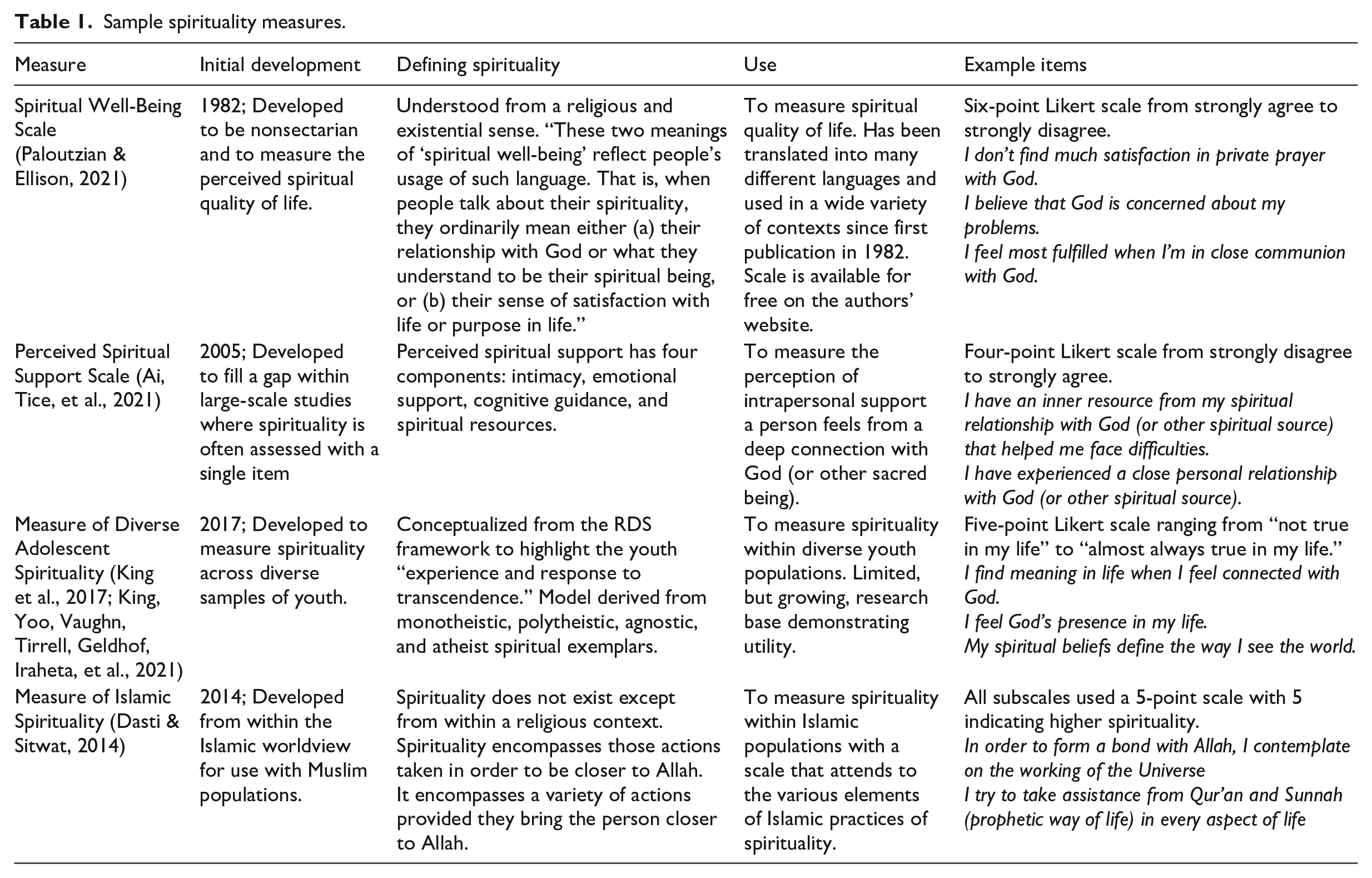
Although the range of available scales allows for nuanced understandings tailored to specific populations, the range also makes comparisons across studies and cultural contexts difficult. Clearly, then, comparative research seeking to establish measurement invariance is one needed next step in the methodology used to measure spirituality (Card, 2017; van de Vijver & He, 2017). However, the diversity of spirituality measures reflects the diversity of spiritual experiences. Despite the existence of multiple measures, it is still the case that the majority of these measures have emerged out of the Western Judeo-Christian traditions and may not fully reflect the embodied experience of spirituality of individuals developing in other traditions. Nevertheless, this possibility does not gainsay the conclusion that broadly generalizable measures of spirituality are still not available. However, progress in enhancing generalizability is certainly possible, and we offer next an example of how the goal of attaining cross-cultural generalizability may be approached.
The Measure of Diverse Adolescent Spirituality
As mentioned above, the MDAS is the only scale we are aware of with an RDS approach to measuring spirituality with adolescents. As such, the authors of this measure considered the reciprocal nature of spiritual development and accounted for how the adolescent engages with and is impacted by their surroundings (i.e., coactions; King, Yoo, Vaughn, Tirrell, Geldhof, & Dowling, 2021). The MDAS items emerged from in-depth qualitative studies with spiritually diverse youth around the world, including those who identify as atheists, and were developed to be faith-agnostic (King et al., 2014, 2017). Initially, the MDAS was tested with a sample of Mexican youth and found to reflect three components: transcendence, fidelity, and contribution (King et al., 2017). Transcendence measured how adolescents understand their connection to the divine or sacred and the meaning made of such connections over time; fidelity measured the internal psychological processes (e.g., identity and purpose) that followed their engagement with transcendence; and contribution measured other-oriented actions that are expected to emerge from the adolescent’s experiences of fidelity and transcendence (King, Yoo, Vaughn, Tirrell, Geldhof, & Dowling, 2021).
The MDAS has been used in Mexican and Salvadoran samples, and testing revealed invariance between the two samples on the transcendence and fidelity subscales (King, Yoo, Vaughn, Tirrell, Geldhof, & Dowling, 2021; contribution was not collected in the Salvadoran sample). While both samples were Christian, the Mexican sample was majority Catholic, while the Salvadoran sample was majority Evangelical. Finding measurement invariance on the MDAS among youth across two different countries and historical/cultural contexts was a crucial achievement and demonstrated the possibility of developing measures of spirituality among adolescents that possess cross-national and cross-cultural invariance. As the field moves toward measurement refinement and the development of other generalizable measures of spirituality, the lessons learned through the development of the MDAS may offer a valuable model. As such, we present a sample case of an international, cross-cultural, researcher-practitioner research partnership that has used the MDAS to study spirituality among youth from different national and cultural backgrounds.
Case study: The Compassion International study of PYD
The Compassion International (CI) Study of PYD is a longitudinal, cohort-comparative, mixed-methods study of youth in CI programs in El Salvador, Rwanda, and Uganda (see Tirrell et al., 2019). CI is a faith-based child-sponsorship organization that seeks to promote thriving through a holistic approach to youth development (Sim & Peters, 2014) and currently serves more than 2.2 million children and youth across 25 LMICs. The aim of CI is to alleviate child poverty and to promote thriving in the communities they serve. Consistent with their mission, CI emphasizes the importance of religious faith in the lives of youth. For practitioners managing CI programs, spirituality is viewed as a developmental strength to be fostered and has therefore been a central component to the CI Study of PYD.
The CI Study of PYD is ongoing, but there are many interesting findings with regard to spirituality and its coactions with ecological assets and youth development programs. First, Tirrell et al. (2019) examined connections between the ecological assets of the CI program and youth strengths and found that youth in CI programs score significantly higher than non-CI-supported youth on the transcendence subscale of the MDAS and on some components of PYD. Building on that work, the measurement invariance of the MDAS among Mexican and Salvadoran youth, noted above, was a significant achievement (King, Yoo, Vaughn, Tirrell, Geldhof, & Dowling, 2021). Then, in exploring the role of the Big Three components of effective faith-based youth programs with CI-supported youth, Tirrell et al. (2021) demonstrated that the Big Three features predicted youth spiritual transcendence, intentional self-regulation (ISR), hopeful future expectations (HFE), and contribution. In fact, when the Big Three was entered as a predictor of youth contribution, it accounted for variance above and beyond the contributions of youth strengths, and, as such, transcendence, ISR, and HFE no longer significantly predicted contribution.
Next, to assess the convergent validity of a new scale developed to measure youth perceptions of being KL within the context of the youth development program, Tirrell et al. (2023) established cross-national invariance of the measurement model between samples of youth from El Salvador and Rwanda and, in doing so, found significant and moderate correlations between the KL scale and the established transcendence subscale of the MDAS (rs = .45 and .59 for the El Salvador and Rwanda samples, respectively). The finding, that youth spirituality correlates with overall feelings of being KL, is an important point for FBOs to consider in program design because increasing feelings of being KL within the program might also enhance youth spirituality. With subsequent waves of data from the CI Study of PYD, researchers may better understand the connection between spirituality as a contextual and developmental asset and its role in youth outcomes.
Although the above-noted findings are quantitative in nature, another strength of the CI Study of PYD is its mixed-methods approach to understanding the influence of spirituality on various outcomes related to youth thriving. Tirrell et al. (2021) integrated qualitative and quantitative data to illuminate how the Big Three features of youth development programs were present within the CI program and whether and how they enhanced the program’s overall effectiveness. The same interviews with program participants in El Salvador also revealed the impact of spirituality on their overall sense of safety within the program and within their communities (Hay et al., 2024). These efforts to understand spirituality’s impact as a developmental asset through a triangulation of measures and methods provide greater contours to the nuanced importance of spirituality in youth development.
Future directions
To understand spirituality’s impact on the development of specific youth, researchers are able to leverage recent advances in idiographic longitudinal methods that incorporate Bornstein’s (2017, 2019) specificity principle to assess which elements of spirituality impact which domains of development, for what youth, and in what ways. Through research-practitioner collaboration, this individualized understanding of spirituality’s impact on youth development will improve the support offered by faith-based programs for positive development and encourage thriving in adolescents. In addition, further understanding how spirituality impacts individual youth may allow for practitioners within non-FBO contexts to leverage elements of spiritual practice (e.g., mindfulness) for the positive development of youth within those contexts.
Any methodology that incorporates idiographic and longitudinal designs necessarily needs precise measurement. Therefore, continued work to develop sound measures of spirituality that are cross-cultural and faith-agnostic will be critical. The MDAS offers a good example of the processes to develop and refine such measures, and these kinds of measures should be deployed in multiple contexts with youth from various faith backgrounds so that researchers may continue to refine and improve these existing and yet-to-be-developed measures. Whereas the aim is not to develop a singular measure of spirituality, further exploration of measures of spirituality specific to youth will enhance our understanding of spirituality’s impact on youth development.
Finally, this article has centered on spirituality as a developmental asset, but spirituality is multifaceted and encompasses more than simply a developmental asset or outcome and could be integrated into developmental interventions. One example of what this view might imply for developmental scientists comes from The Global Resilience Oral Workshop (GROW) study in Zambia, where researchers leveraged spirituality as a contextual asset through which to design a character intervention (Seale et al., 2021). The aim of GROW was to integrate evidence-based resilience training into both school- and community-based programming, using spirituality as the vehicle of their resilience intervention. That is, Seale et al. (2021) developed activities based on stories from the Christian Bible in which youth act out and discuss the stories with a focus on particular character strengths, such as forgiveness or honesty. Whereas spirituality was not the primary variable of interest, the researchers noted that youth participants prayed more regularly, increased their attendance at church, and assumed more leadership roles within their churches (Seale et al., 2021). This kind of approach, which leverages spirituality as a contextual asset, offers a promising avenue for intervention development because over 85% of the world’s population is projected to be religiously affiliated by 2060 (Pew Research Center, 2017).
Projects like GROW Zambia represent responses to the call from organizations such as USAID to expand youth development research into LMICs (YouthPower Learning, 2017). Expanding this work to LMICs is important and can benefit youth within the minority world as well. Such scholarship may refine the developmental science-based understanding of the parameters of cross-cultural and cross-national generalizability of approaches to theory and measurement about the ontogenetic significance of adolescent spirituality and religion. Adapting (or developing new) measures for work on spirituality within LMICs may also afford researchers a more nuanced understanding of spirituality in youth settings in the United States and other WEIRD countries, given the increased diversity many communities have experienced in recent years (Jensen et al., 2021).
This kind of in-depth exploration of spirituality will allow developmental scientists and practitioners to understand better what, if any, facets of youth spirituality development may be nomothetic (i.e., pertinent across cultural contexts), differential (i.e., generalizable to some but not all cultural contexts), and singularly specific (i.e., idiographic) to only one cultural context (Abo-Zena & Ahmed, 2014). The spirituality developmental process is therefore complex, and improvements in methodology that allow for greater nuance of understanding will enable communities to serve their youth better.
Conclusions
Human beings across generations have reflected upon, engaged with, and leveraged spirituality as part of their ontological self-understanding and development across the life span. For much of our history, spirituality was intimately connected with religion and religiousness and is a reflection in our lived experience of our understanding of God/the Sacred and our relationship to that understanding. Given spirituality’s important role in the human experience, its absence from the field of psychological and developmental science inquiry for the majority of the 20th century seems odd in retrospect. However, the first decades of the 21st century have witnessed a shift toward spirituality’s inclusion in psychological science. Many psychological studies today include spirituality as a factor influencing other developmental outcomes as well as viewing the development of spirituality as an outcome in its own right.
At the time of this writing, the influence of the Western developmental science focus on the minority world (i.e., WEIRD nations) continues to shape how and where spirituality is included in the study of human development. For developmental researchers focused on youth, the emergence of idiographic longitudinal work (e.g., as in the CI Study of PYD noted above) offers the potential to assess which elements of spirituality impact which domains of development, for what youth, and in what ways. As the field continues to mature within the globalized context of the early 21st century, cross-cultural and cross-national collaborations will improve how humanity understands the fundamental experience of spirituality for human flourishing.
