







Abstract
This study explores how mattering struggles and spiritual ties to place relate to mental well-being in the context of the COVID-19 pandemic. We used cross-sectional data from a nationally representative sample of US adults (n = 3640) who reported their experiences of mattering struggles, perceived increase in spiritual ties to place, and perceived change in mental well-being since the onset of the COVID-19 pandemic. Mattering struggles were associated with a perceived decline in mental well-being, while perceived increase in spiritual ties to place was associated with a perceived improvement in mental well-being. Adjusting for relevant covariates, there was evidence of a two-way interaction between mattering struggles and perceived increase in spiritual ties to place (i.e. a sense of connection to the sacred in place) on perceived change in mental well-being, such that mattering struggles were less strongly associated with a perceived decline in mental well-being when perceived increase in spiritual ties to place was higher compared with when it was lower. These preliminary cross-sectional findings introduce the possibility that spiritual ties to place may attenuate the negative association of mattering struggles with mental well-being, and lay the groundwork for further work inquiring into the role of place-based spiritual resources in supporting mental health among people experiencing struggles around mattering.
The COVID-19 pandemic led to an unprecedented global crisis, impacting not only physical health but also the mental well-being of individuals worldwide (Cowden et al., 2023). As communities navigated the challenges of isolation, illness, and economic instability, mental health concerns surged, manifesting in increased rates of anxiety and depression (De La Rosa et al., 2022; Pfefferbaum & North, 2020). This has necessitated an exploration into psychological constructs that could serve as buffers against psychological distress in a time when people’s sense of meaning is challenged. In this context, the construct of “mattering”—the subjective belief that one is significant to others and makes a difference in the world—has emerged as a potential psychological resource. Sense of mattering is posited to be a core component of self-esteem and identity, with significant implications for mental health (Rosenberg & McCullough, 1981). It provides individuals with a fortified sense of purpose and belonging, qualities that may be particularly salient during times of societal upheaval. In contrast, mattering struggles—experiences of being insignificant or unimportant—may be associated with loneliness, stress, anxiety, and depression (Besser et al., 2022; Flett et al., 2016).
At the same time, the COVID-19 pandemic also had a substantial impact on how people relate to the physical places in their lives. Many regularly visited communal spaces (e.g. churches, local businesses) were temporarily closed, and their use was often substantially altered to allow for social distancing (Cowden et al., 2021; Jacobi et al., 2022). In some cases, this forced separation from important places led to strong emotional responses and political protest (Counted et al., 2020). On the contrary, people tended to spend more time in their homes and in outdoor environments (Chesterman et al., 2021; Foley et al., 2022; Martos et al., 2023; Meagher & Cheadle, 2020), leading to a variety of new challenges for how people think about and act within these settings (e.g. sharing space more frequently with partners and family, adapting residential space in order to work from home).
Changes to where people spend their time have consequences for how they feel about such places. Findings from decades of research in environmental psychology (e.g. Lewicka, 2011; Scannell & Gifford, 2010) have demonstrated that people can form a strong psychological bond to particular physical places (i.e. place attachment). Importantly, these bonds to place are characterized by more than just the experience of positive emotions. That is, a person’s connection to place also often entails spiritual resonance, conceptualized as one’s spiritual ties to place (STP; Counted et al., 2024). These spiritual ties represent the connections individuals establish with places they consider sacred or spiritually significant, ranging from places of worship to pilgrimage sites to one’s own home (Meagher et al., 2025).
Although there is general acknowledgment that mattering and STP are relevant to mental well-being, there is a discernible research gap in understanding how these constructs interact, particularly in the aftermath of a crisis of the scale of the COVID-19 pandemic. The present study aims to address this gap by exploring the triadic relationship between mattering struggles, STP, and mental well-being.
Mattering and mental well-being
Mattering reflects the degree to which individuals perceive themselves as important to others and believe that they make a difference in their social circles (Rosenberg & McCullough, 1981). Its relevance to mental health is increasingly recognized in contemporary psychology, particularly in understanding its protective role against depressive symptoms and its contribution to overall life satisfaction (Flett et al., 2016; Gorgol-Waleriańczyk et al., 2025; Smith & McLellan, 2024).
Recent theories have postulated that mattering operates as a critical source of resilience and adaptability, providing a “psychological shield” against stress (Flett et al., 2016). The notion that others depend on us, recognize our importance, and pay attention to us contributes to a fortified sense of self that could potentially bolster our mental well-being. This sense of mattering is modifiable, suggesting that individuals can actively foster their sense of mattering through engagement and participation in community and relationships (Flett et al., 2016). However, certain stressors (e.g. the COVID-19 pandemic) can heighten the experience of mattering struggles, where individuals feel disregarded or unseen by others, exacerbating feelings of loneliness and mental distress. Stress-induced struggles for meaning can lead to withdrawal and depressive symptoms, highlighting the importance of addressing both the presence of mattering and the absence of it in mental health interventions (Krygsman et al., 2021).
In the developmental context, the importance of mattering is evident across the lifespan. For adolescents and young adults, a sense of mattering contributes to identity formation and societal integration (Rosenberg & McCullough, 1981). In older adults, mattering remains significant, correlating with well-being and buffering against the risks of depression and loneliness often associated with aging (Dixon, 2011; Myers & Degges-White, 2007). Mattering also intersects with broader psychological frameworks. For example, it aligns with the principles of positive psychology, where the emphasis on positive individual traits and societal contributions reflects the core of mattering (France & Finney, 2009). It is associated with self-compassion and self-efficacy, which are indicative of a person’s adaptive coping and effective problem-solving skills (Joeng & Turner, 2015; Raque-Bogdan et al., 2011). Mattering has been found to predict unique variance in mental well-being outcomes, even when controlling for other important psychological predictors, such as self-esteem and social support (DeForge et al., 2008; Dixon & Kurpius, 2008).
STP, mattering, and well-being
STP refer to one’s sense of and attachment to the sacred in a particular place (Counted et al., 2024; Meagher et al., 2025). As such, it is a distinct form of place attachment (Lewicka, 2011; Scannell & Gifford, 2010) in which the person–place relationship is experienced as sacred through the individual’s sense of connection to “a divine being, a divine object, Ultimate Reality, or Ultimate Truth” (Hill et al., 2000, p. 66). Individuals can form STP through strong transcendent emotional experiences, which are potentially elicited by physical features like the beauty of scenery or the aesthetics of nature (Lewicka, 2011). STP can also occur through cognitive processes that facilitate the formation of a “self-as-spiritual” self-concept, which often incorporate important places (Proshansky, 1978) and may reinforce or support the acquisition of spiritual realities (e.g. the experience of a secular Jew in Jerusalem). Finally, STP often result from the individual’s behavioral and social engagement with the activities present there (Counted & Zock, 2019). For example, people can be drawn to settings that elicit communal practices of spiritual significance (e.g. retreats).
Recent research suggests that STP manifest in diverse ways across a range of place types (e.g., worship places, nature, private places, and unfrequented sacred places: Meagher et al., 2025). As a result, STP may help satisfy a number of spiritual needs and facilitate unique forms of engagement, reflection, and meaning-making. For example, homes and private spaces offer personal sanctuaries for spiritual practices (see Bethell et al., 2021; Counted et al., 2021; Schmidt & Little, 2007). Monastic and retreat centers serve as intersections of personal and cultural significance, providing settings for deepened spiritual engagements (Mazumdar & Mazumdar, 2004; Norris & Inglehart, 2011). Socially, educational institutions and cultural venues become arenas for collective spiritual exploration (VanderWeele et al., 2016). Similarly, battlefields and memorials may act as sites of collective memory, evoking shared spiritual contemplation (Winter, 1995, 2020). Culturally, natural sites embody universal sacred symbols, a theme central to Eliade’s (1959) discussions on the religious significance of nature. Burial sites, historical sites, pilgrimage destinations, and places of worship are deeply embedded in cultural practices, and reflect the notion of pilgrimage as a communal spiritual journey (see Barush, 2021; Wheeler, 1999) and the cultural dimensions of spatial spirituality (Tuan, 1977). These diverse dimensions of STP illustrate the complex ways in which spirituality is woven into the fabric of human–environment relations, highlighting the significance of place in spiritual life (Counted et al., 2024).
The physical reality of such places can make them particularly valuable resources for spiritual and mental health. For example, physical manifestations of abstract entities (e.g. buildings, flags, symbols) have been shown to increase the perceived realness of such entities (i.e. their entitativity; Callahan & Ledgerwood, 2016). Having a secure, reliable connection to a particular physical setting one associates with the sacred represents a potentially valuable way to reify and maintain a sense of psychological proximity to an otherwise incorporeal and inaccessible deity (Meagher, 2023). Thus, STP may be one potential compensatory strategy and buffer during times of spiritual struggle, particularly when the divine feels more distant (Counted, 2026; Exline, 2002).
Empirical research has shown that people regularly seek out so-called restorative environments as a form of coping during times of stress (Korpela, 2003; Mason et al., 2010; Meagher & Marsh, 2017). However, places with which a person has spiritual ties may be uniquely valuable, helping individuals recover not just from cognitive or emotional exhaustion, but from crises of existential importance. STP may offer individuals a sense of intrinsic value that is buttressed by a specific location. For instance, participating in community-based activities at a place of worship or volunteering in a nature conservation effort can enhance an individual’s sense of mattering. Such engagement may not only reinforce a person’s social bonds but also strengthen their spiritual connection to these places, which in turn can bolster their mental well-being. When anchored in these spiritually meaningful places, mattering not only reinforces an individual’s social role but also elevates their spiritual awareness, offering a more profound sense of place and purpose that can be important for sustaining mental well-being (Lomas et al., 2021).
The conceptual link between mattering and STP might feature most prominently in how spiritual ties to significant places mitigate feelings of insignificance by fostering a geographically grounded sense of belonging and importance, which could support psychological resilience and well-being amid the disquietude induced by the COVID-19 pandemic (Counted et al., 2021, 2023). Hence, the strength and quality of an individual’s STP could influence the degree to which their sense of mattering translates into improved mental well-being. For instance, people who feel a deep spiritual bond when taking a walk in a park or exploring nature may experience a heightened protective effect of mattering on mental health during times of stress. Thus, STP may serve as a protective resource that could be mobilized to manage the negative effects of struggles around mattering on mental well-being.
The current study
The unprecedented nature of the COVID-19 pandemic has amplified the need for understanding psychological mechanisms that might promote resilience and psychological stability during times of crisis. Building upon the extant literature, this study investigates the relationships among mattering struggles, perceived increase in STP, and perceived change in mental well-being since the onset of the COVID-19 pandemic. In particular, we focus on the potential role of STP in moderating the association between mattering struggles and mental well-being in the midst of disruption to conventional sociocultural structures and support systems. Although our analysis is exploratory in nature, we anticipated that mattering struggles would be associated with a perceived decline in mental well-being; perceived increase in STP would be associated with a perceived improvement in mental well-being; and that perceived increase in STP would moderate the relationship between mattering struggles and perceived change in well-being, such that mattering struggles would be less strongly associated with a perceived decline in mental well-being when perceived increase in STP is higher.
Methods
Study sample
This study used data from the National Religion and Spirituality Survey 2022 (n = 3651), a cross-sectional study of religion and spirituality in the United States in the aftermath of the COVID-19 pandemic (Fetzer Institute, 2023). Data were collected from the AmeriSpeak panel, which is a probability sample designed to be representative of the US household population (NORC at the University of Chicago, 2023). A stratified sample was selected from the panel based on age, gender, race/ethnicity, and education. Surveys were fielded from 9 November to 7 December 2022 via a combination of self-administered web (n = 3456) and telephone interview (n = 105) data collection modes (completion rate 25.4%). Using US census data, post hoc weights were generated to ensure the sample is representative of the US adult population aged 18 years and older within all 50 states and the District of Columbia. Ethical approval was granted by the NORC Institutional Review Board. All participants provided informed consent.
Measures
Perceived increase in STP
Participants responded to a single item that assessed the degree to which their spiritual connection to sacred places had strengthened during the public health crisis: “Since the start of the COVID-19 pandemic, around March 2020, I have become more spiritually connected to places that are sacred to me.” Response options were anchored at “Strongly disagree” and “Strongly agree.” In our analysis, responses were coded such that higher values indicate greater agreement with the item (range: 1 to 5).
Mattering struggles
A single item was used to assess the extent to which individuals questioned the significance of their lives since the onset of the COVID-19 pandemic in March 2020. Participants were asked, “Since the start of the COVID-19 pandemic around March 2020, to what extent have you had the experience of questioning whether your life really matters?” Response options ranged from 1 (not at all) to 4 (a great deal). Other response options (e.g. don’t know, refused) were coded as missing. Responses were treated as a continuous variable in our analyses.
Perceived change in mental well-being
Perceived change in mental well-being since the beginning of the COVID-19 pandemic was assessed using a single item. Participants were presented with the phrase, “Since the start of the COVID-19 pandemic around March 2020, my mental well-being has. . .” with response options of “Worsened,” “Remained about the same as before,” and “Improved” provided to complete the phrase. Other response options (e.g. don’t know, refused) were coded as missing. We treated responses as a continuous variable, ranging from −1 (worsened) to 0 (remained the same) and 1 (improved).
Covariates
Drawing on prior research, our primary analysis adjusted for a set of potential confounders. For example, we adjusted for age because previous studies have shown that it is associated with both place attachment (e.g. Gilleard et al., 2007) and mental well-being (e.g. Chen et al., 2022). The full set of covariates included age, gender (female, male), race/ethnicity (Hispanic, non-Hispanic Asian, non-Hispanic Black, non-Hispanic White, non-Hispanic other race/ethnicity, non-Hispanic mixed race/ethnicity), geographic region (Midwest, Northeast, South, West), location of residence (non-metro area, metro area), highest level of education (less than high school, high school or equivalent, vocational/tech school/some college/associates degree, bachelor’s degree, postgrad study/professional degree), annual household income (less than $30,000, $30,000 to under $60,000, $60,000 to under $100,000, $100,000 or more), religious affiliation (Protestant, nondenominational Christian, Roman Catholic, Orthodox Christian, Jewish, Buddhist, Muslim, Hindu, other religion, nothing in particular, agnostic, atheist), political orientation (Democrat, lean Democrat, don’t lean/independent/none, lean Republican, Republican), spiritual identity (continuous), and religious identity (continuous).
Data analysis
We used an available case analytic approach. Our analytic strategy began with descriptive and inferential statistics to explore demographic differences by perceived increase in STP, followed by Pearson correlation coefficients to assess relationships among the key variables. We then employed hierarchical regression to investigate associations of mattering struggles and perceived increase in STP with perceived change in mental well-being by adding them incrementally to the model after starting with a covariate-only model. Finally, we included a two-way interaction term in the regression model to explore perceived increase in STP as a potential moderator of the relationship between mattering struggles and perceived change in mental well-being.
Results
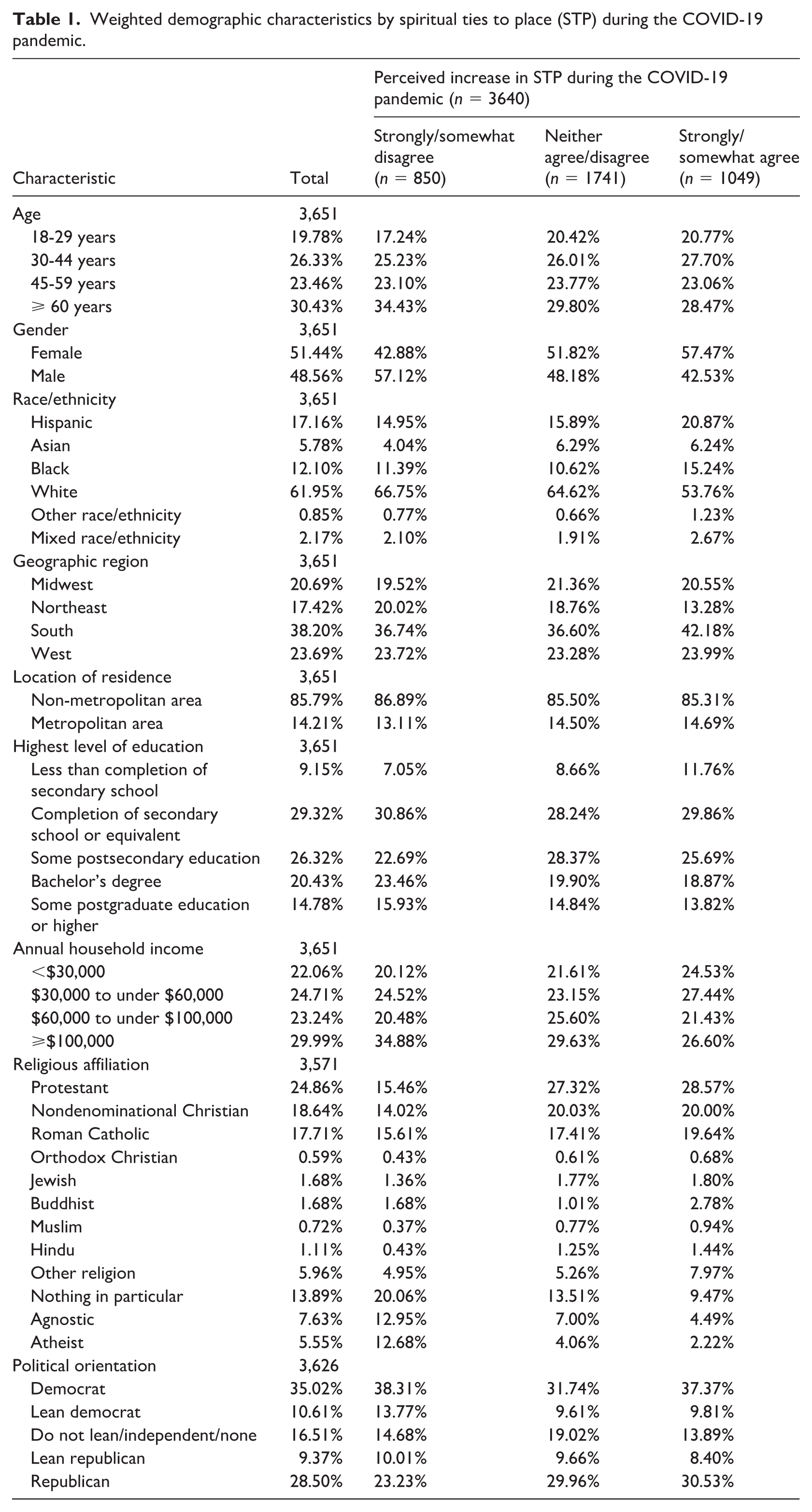
Weighted demographic characteristics by perceived increase in STP are reported in Table 1. Approximately 29% of individuals agreed to experiencing an increase in STP during the COVID-19 pandemic, with about 23% disagreeing (the remaining 48% endorsed a more ambivalent response to the perceived increase in STP item). This distribution suggests there was some variation in perceived changes in spiritual connection with places among US adults during the COVID-19 pandemic. Table 1 summarizes the demographic differences in perceived increase in STP. For example, females were more likely to endorse somewhat/strong agreement to perceived increase in STP than males.
Weighted demographic characteristics by spiritual ties to place (STP) during the COVID-19 pandemic.
Pearson correlation analysis revealed a very small association between mattering struggles and perceived increase in STP (r = .07, 95% confidence interval (CI): [0.03, 0.10]), and a similar small association between perceived increase in STP and a perceived improvement in mental well-being (r = .07, 95% CI: [0.04, 0.10]), while mattering struggles were modestly correlated with a perceived decline in mental well-being (r = −.15, 95% CI: [–0.18, –0.12]).
In the hierarchical regression analysis, the sequential inclusion of variables provided insight into the associations of meaning struggles, perceived increase in STP, and the two-way interaction of mattering struggles and perceived increase in STP on perceived change in mental well-being (see Table 2). In step 1, covariates alone accounted for 3.6% of the variance in perceived change in mental well-being (R2 = .036, p < .001). The addition of mattering struggles in step 2 yielded an improvement in model fit (∆R2 = .018, p < .001), followed by a smaller improvement in model fit after perceived increase in STP was added in step 3 (∆R2 = .002, p < .05). With both mattering struggles and perceived increase in STP entered into the model in step 3, mattering struggles were associated with a perceived decline in mental well-being (b = −0.10, 95% CI: [–0.12, –0.07]) and perceived increase in STP was associated with a perceived improvement in mental well-being (b = 0.02, 95% CI: [0.00, 0.04]).
Summary statistics for hierarchical regression analysis.
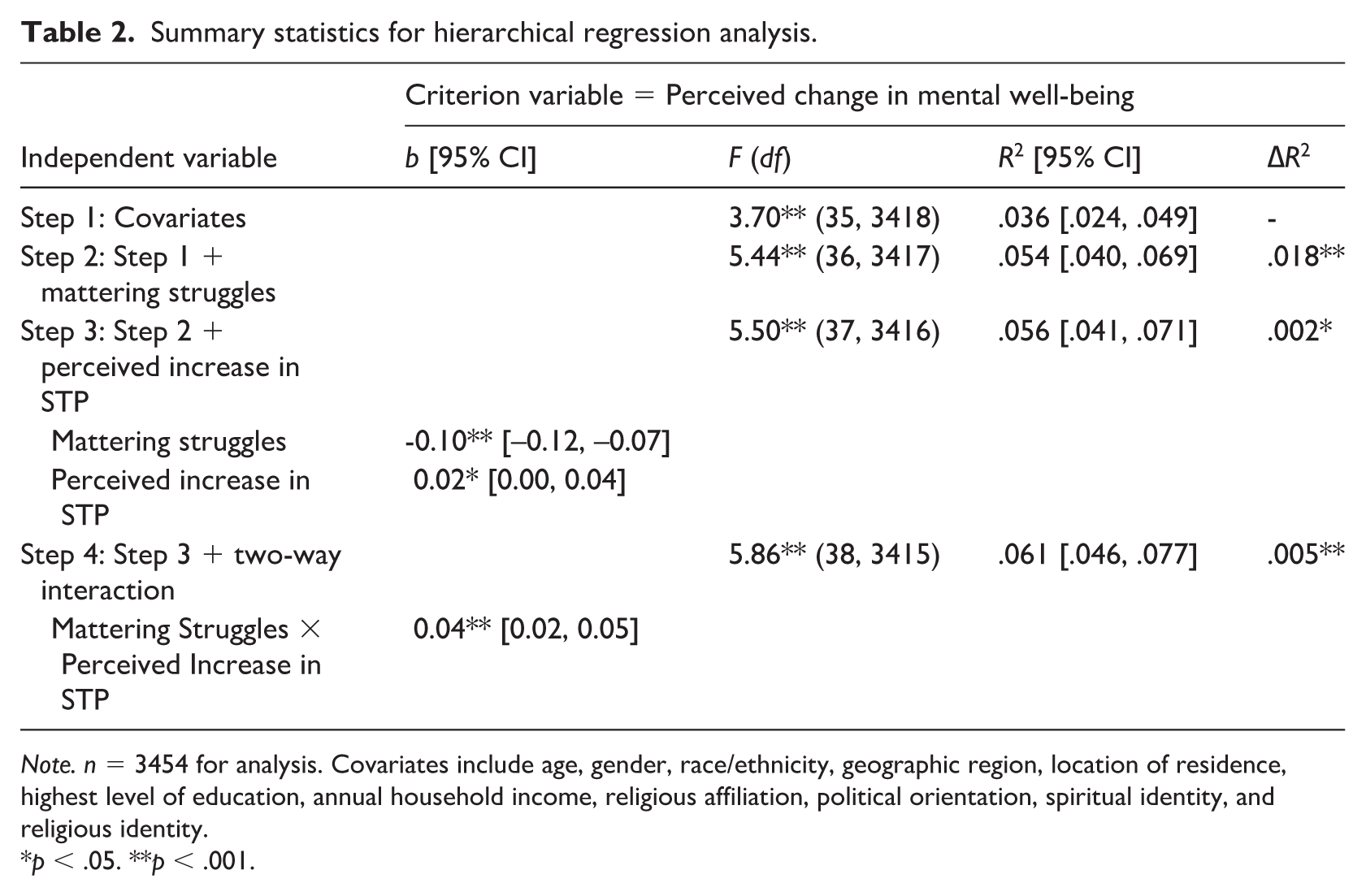
Note. n = 3454 for analysis. Covariates include age, gender, race/ethnicity, geographic region, location of residence, highest level of education, annual household income, religious affiliation, political orientation, spiritual identity, and religious identity.
p < .05. **p < .001.
There was a small improvement in model fit after the inclusion of a two-way interaction between Mattering Struggles × Perceived Increase in STP in step 4 (∆R2 = .005, p < .001), providing some evidence of an interaction of mattering struggles and perceived increase in STP on perceived change in mental well-being (b = 0.04, 95% CI: [0.02, 0.05]). This two-way interaction is illustrated in Figure 1. Simple slopes analysis of the two-way interaction suggested that mattering struggles were more strongly associated with a perceived decline in mental well-being when perceived increase in STP was lower (b = −0.14, 95% CI: [–0.17, –0.11]) compared with when perceived increase in STP was higher (b = −0.05, 95% CI: [–0.08, –0.03]).
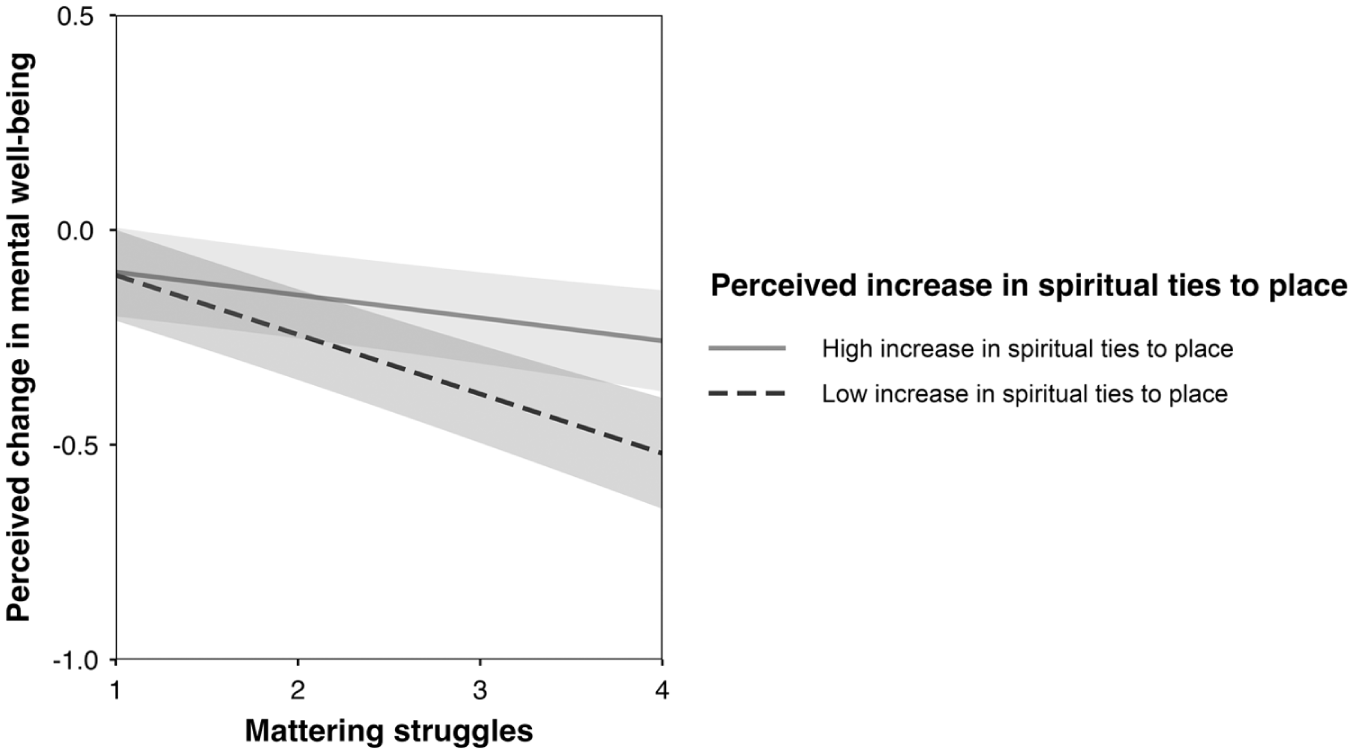
Two-way interaction of Mattering Struggles × Perceived Increase in STP on perceived change in mental well-being.
Discussion
We used nationally representative cross-sectional data from a large sample of US adults who participated in the National Religion and Spirituality Survey 2022 to explore associations between mattering struggles, perceived increase in STP, and perceived change in mental well-being since the emergence of the COVID-19 pandemic. While mattering struggles are associated with a perceived decline in mental well-being, a perceived increase in STP is associated with a perceived improvement in mental well-being. We observed some evidence of a two-way interaction between mattering struggles and perceived increase in STP on perceived change in mental well-being, with a weaker association observed between mattering struggles and a perceived decline in mental well-being when perceived increase in STP was higher compared with when it was lower.
Evidence of an association between mattering struggles and a perceived decline in mental well-being during the COVID-19 pandemic aligns with empirical literature that highlights the detrimental effects of feeling undervalued or unnoticed on an individual’s mental health, and suggests that mattering may be an important factor in supporting mental well-being (Flett et al., 2016; Taylor & Turner, 2001). Although our findings should be interpreted with some caution in light of the cross-sectional data, it is possible that the conditions precipitated by the COVID-19 pandemic (e.g. disrupted social interactions, constraints on access to significant places) set the stage for mattering struggles that negatively impacted mental well-being. If this is true, it suggests that mattering may be an important factor in supporting mental well-being.
The association between perceived increase in STP and a perceived improvement in mental well-being aligns with prior theorizing that suggests STP may contribute to mental well-being (Counted et al., 2024). STP are thought to facilitate engagement, reflection, and meaning-making, offering personal sanctuaries and communal spaces that support spiritual practices and collective memory (Bethell et al., 2021; Counted et al., 2021; Winter, 1995, 2020). During times of crisis, spiritual connections to significant places may serve as a source of comfort, stability, and resilience that can support mental well-being as people navigate challenges they face.
We also found that the association between mattering struggles and a perceived decline in mental well-being was weaker when perceived increase in STP was higher. This finding can be contextualized within broader psychological and ecological frameworks. For instance, Bronfenbrenner’s (1979) ecological systems theory emphasizes the role of environmental contexts in shaping development, within which spiritually significant places potentially serve as amplifiers of the mental well-being benefits afforded by mattering. For those struggling with a sense of mattering, a robust spiritual connection to place may offer a buffer against the psychological toll of the COVID-19 pandemic (Counted et al., 2021). However, one must consider that the potential buffering effect of STP may also be dependent on other factors (e.g. gender, ethnicity) that shape the utility of spiritual resources (see Counted & Newheiser, 2023). For example, females were more likely to report a perceived increase in STP, a finding that dovetails with previous research suggesting that women may engage with and draw upon spiritual resources more than men during times of stress (Koenig et al., 2001).
Practical implications
Humans are embodied and embedded organisms, and their mental lives are inextricably intertwined with the physical world and the places they occupy (Marsh et al., 2009; Meagher & Cheadle, 2020). Over the last two decades, mental health practitioners have shown a growing interest in the role that the physical environment can play in therapy, as reflected in the emergence of ecotherapy as a potential treatment approach (Buzzell, 2014; Chalquist, 2009). Nevertheless, the emphasis has almost exclusively been on natural environments, and the therapeutically relevant potential of a wide range of psychologically meaningful person–place relationships has been largely overlooked. For example, our findings that STP may coincide with better mental well-being when people are navigating struggles around mattering or self-worth suggest that spiritually significant places could be mobilized as an important resource for practitioners to draw upon when working with clients. Although further research is needed, spiritually significant places may be a valuable yet underutilized resource for supporting mental well-being.
Beyond their underexplored therapeutic potential, our findings suggest that STP may operate as one of the psychological mechanisms that sustain mental well-being. In particular, within the context of our study, these ties appear to function as adaptive psycho-spatial resources—a sort of psychological anchors rooted in meaningful places that help individuals withstand the destabilizing effects of mattering struggles and threats to self-worth. Theologically, STP appear to embody reservoirs of meaning and transcendence that bolster resilience in times of crisis. Theoretically, this expands prevailing models of resilience by positioning STP as not merely contextual backdrops but as active mechanisms of adaptation that help buffer against the psychological toll of feeling invisible or unvalued. In so doing, our study invites a broader framework for understanding how person–place relationships, particularly those imbued with spiritual meaning, contribute to both the sustainability of mental health and the restoration of dignity amid struggles of self-worth.
Limitations and future research directions
This study has methodological limitations. Key limitations include the cross-sectional design, which precludes causal interpretations, and the reliance on self-report measures, which can be subject to response biases (Podsakoff et al., 2003). We relied on single-item measures of the key variables, which may have limited reliability and measurement precision. Future work would benefit from the development and validation of a measure of STP (Counted et al., 2024). Moreover, longitudinal studies are needed to clarify the temporal relationship between these variables (Selig & Preacher, 2009). Qualitative approaches could also provide a richer understanding of the personal and subjective nature of STP and their influence on well-being. The context of the COVID-19 pandemic is highly unique, and it is possible that our findings might not generalize beyond this global public health crisis (Cowden et al., 2025). Many of the abovementioned limitations, however, pave the way for future research opportunities. For example, future work could investigate the underlying mechanisms through which STP might support mental well-being. It would also be valuable to explore the role of virtual spiritual communities and whether these can compensate for the loss of physical spaces during crises like a pandemic.
Further research would also benefit from a more nuanced measurement strategy when assessing STP, given that this construct is multifaceted. A sense of spiritual connection can emerge through multiple pathways, such as transcendent emotional experience elicited by the place, regular spiritual practice within the place, or developing a self-concept that integrates the social or cultural identity reflected by the place (Counted et al., 2024). Likewise, the types of places to which people bond vary, ranging from private homes to communal worship settings to public parks. STP might have varied implications for mental well-being depending on the type of place people have spiritual ties to, as well as the way in which those ties are manifested. These nuances would be worth exploring in future work.
Conclusion
This study helps to extend the conversation around the significance of place in the context of spiritual and psychological well-being, inviting a more holistic approach to future explorations in this domain by considering personal, social, and cultural aspects of STP as potentially protective resources involved in supporting well-being. We hope that these findings are useful in stimulating future research and applied efforts that attend more closely to the interdependence of spirituality, environment, and mental health.
Supplemental Material
sj-docx-1-prj-10.1177_00846724251408338 – Supplemental material for Spiritually significant places as adaptive psycho-spatial resources: Mattering struggles, spiritual ties to place, and mental well-being in US adults
Supplemental material, sj-docx-1-prj-10.1177_00846724251408338 for Spiritually significant places as adaptive psycho-spatial resources: Mattering struggles, spiritual ties to place, and mental well-being in US adults by Victor Counted, Benjamin R Meagher and Richard G Cowden in Archive for the Psychology of Religion/Archiv Für Religionpsychologie
Footnotes

Funding
The authors disclosed receipt of the following financial support for the research, authorship, and/or publication of this article: This research was supported by a Networking Grant from the Council of Christian Colleges and Universities.
Declaration of conflicting interests
The authors declared no potential conflicts of interest with respect to the research, authorship, and/or publication of this article.
Supplemental material
Supplemental material for this article is available online.
References
Supplementary Material
Please find the following supplemental material available below.
For Open Access articles published under a Creative Commons License, all supplemental material carries the same license as the article it is associated with.
For non-Open Access articles published, all supplemental material carries a non-exclusive license, and permission requests for re-use of supplemental material or any part of supplemental material shall be sent directly to the copyright owner as specified in the copyright notice associated with the article.
