







Abstract
Incarceration served as a primary apparatus by which abolition democracy was defeated after Reconstruction. Carceral institutions—such as the penitentiary, the convict-lease system, and the chain gang—functioned to demarcate the racial limits of citizenship and to impede equal political power. This article turns to W. E. B. Du Bois to argue that incarceration constrains democratic political equality. Turning to Du Bois’s treatment of crime and imprisonment in works including The Philadelphia Negro (1899), “The Spawn of Slavery” (1901), and The Souls of Black Folk (1903), alongside archival material, I situate incarceration in Du Bois’s democratic thought. According to Du Bois, carceral institutions bounded ideas of full citizenship, fueled panic over Black “criminality,” fomented feelings of inferiority, and hampered the possibility for abolition democracy, a multiracial, multiclass movement committed to worker democracy and a future rid of slavery and subjugation. Du Bois shows us how carceral institutions run into tension with democratic ideals.
W. E. B. Du Bois was nearly imprisoned. During the Red Scare of the early 1950s, the pioneering 82-year-old scholar and civil rights activist was charged by the US Department of Justice with failing to register as a foreign agent. 1 The case stemmed from Du Bois’s chairmanship of the Peace Information Center (PIC), a short-lived organization that campaigned for the worldwide abolition of nuclear weapons. If convicted, Du Bois could have been sentenced to five years in federal prison and fined up to $10,000 (Marable 2007, xxiii).
When Du Bois arrived in the federal court to face his bail hearing, he was fingerprinted, asked to empty his pockets, checked for concealed weapons, and handcuffed (Lewis 2000, 549; Du Bois [1952] 2007, 48). In an autobiography, In Battle for Peace, Du Bois calls the threat of incarceration a “gruesome experience” and “nerve-wracking” ([1952] 2007, 49, 57). Writes Du Bois, “I have faced during my life many unpleasant experiences: the growl of a mob; the personal threat of murder; the scowling distaste of an audience. But nothing has so cowed me as that day, November 8, 1951, when I took my seat in a Washington courtroom as an indicted criminal” ([1952] 2007, 82).
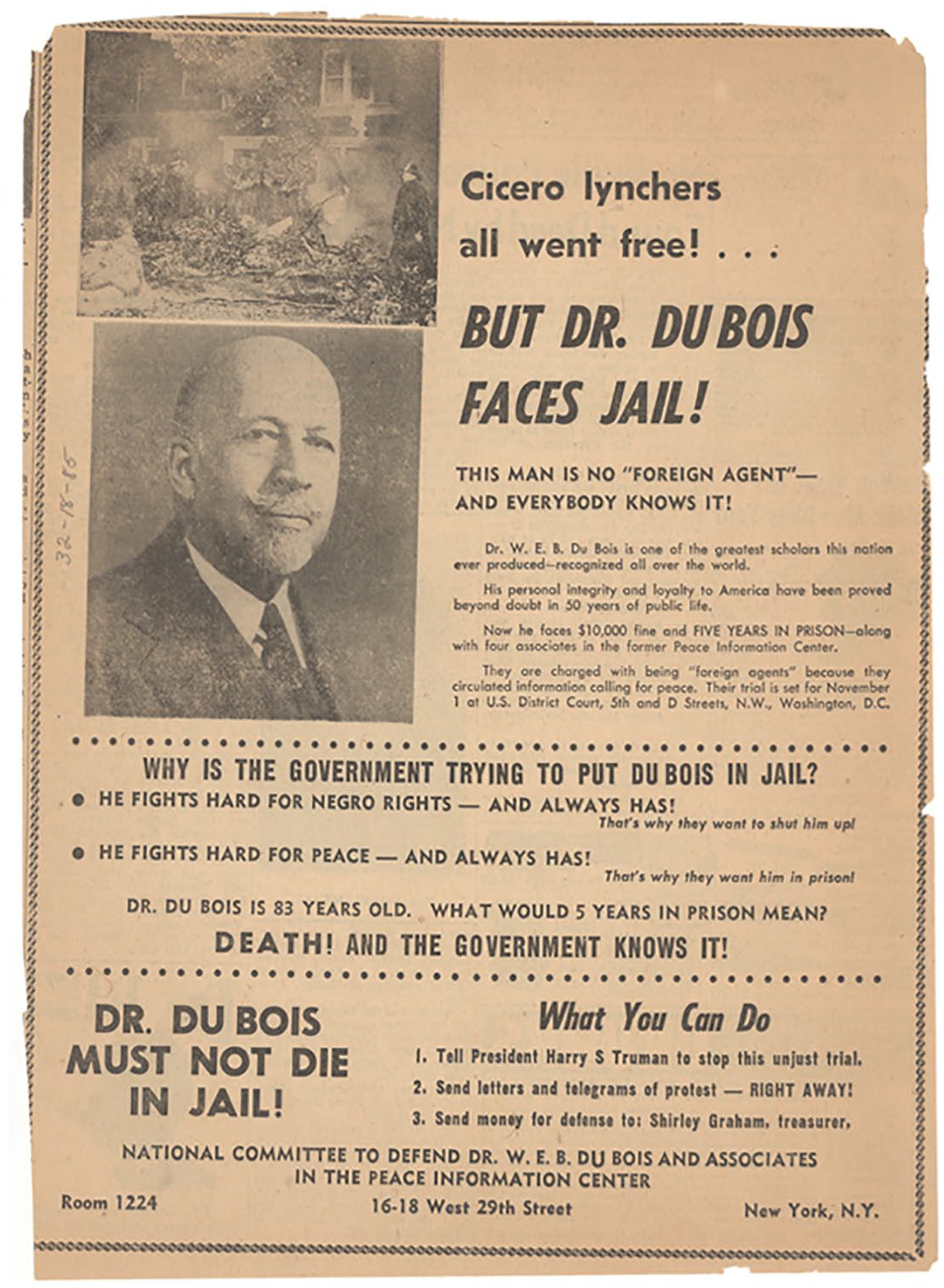
Clipping, “Why is the Government Trying to Put Du Bois in Jail?” 2
Threatened with incarceration for his political views, W. E. B. Du Bois was marked by the state as a political unequal, and treated differently than his fellow citizens because of his beliefs. The ideal of democratic political equality demands that all people be able to participate in political decision-making and that speakers be free to express their point of view. And yet, Du Bois’s brush with the criminal justice system illustrates that to be confined behind bars or threatened with incarceration is to be a political other, belying the equal political status that ought to characterize democratic politics.
Du Bois experienced the threat of prison—and he also thought carefully about prison and its politics throughout his long life. Digitized archival evidence from the Du Bois Papers held by the University of Massachusetts Amherst suggests Du Bois’s lifelong interest in the problem of prisons. 3 In a 1904 letter, for example, Du Bois wrote Samuel J. Barrows, corresponding secretary of the Prison Association of New York, to request speakers about race and crime in Georgia. 4 In 1926, Du Bois wrote the Department of Commerce requesting a census of prisoners. 5 In 1955, Du Bois wrote Morton Sobell, who was convicted of espionage for the Soviet Union in 1951 and whose cause was important among American progressive intellectuals. “I was brought up with an unflinching faith in English and American justice,” Du Bois wrote. “My greatest charge against the Southern states of the United States was the injustice of violence and lynching, even beyond discrimination in opportunity. In my later years I have come to realize that our jails are full of innocent men.” 6 This letter was written after the Peace Information Center case—in which Du Bois himself came close to being one of those innocent men placed behind bars.
These archival materials do not contain stray remarks. Instead, this essay reads Du Bois’s oeuvre to reconstruct his thinking about crime, punishment, and imprisonment. I argue that for Du Bois, incarceration constrains a degree of political equality necessary for democratic self-rule. Put otherwise, the incarcerated individual lacks the equal political standing latent in ideals of democratic politics. The essay proceeds as follows. First, by reading The Philadelphia Negro (1899) and “The Spawn of Slavery” (1901), I argue that Du Bois advocates a sociological, rather than psychological, conception of crime and punishment. For Du Bois, criminality and its attendant institutions of confinement and control are functions of structural power relations, not individual delinquency. Second, by analyzing carceral imagery in The Souls of Black Folk (1903), I identify the psychological inequality of the prison. Prisons and other forms of separation and confinement separate the condemned from their families, communities, and fellow citizens, in turn drawing a boundary around who counts as the people. Third, I lay out the democratic consequences of prisons for Du Bois through readings of Darkwater (1920) and Black Reconstruction in America (1935). I show that Du Bois advocates a positive vision of abolition democracy against racial subjugation and economic exploitation perpetuated by carceral democracy. For Du Bois, prisons impede the equality central to abolition democracy’s commitment of level political power for all.
Du Bois was an insightful and creative thinker on questions of imprisonment and incarceration. And yet, he is often peripheral to standard accounts of incarceration in American political thought (e.g., Dumm 1987; McBride 2007; Smith 2009), accounts that tend to focus on a small canon of carceral theorists including Benjamin Rush, Alexis de Tocqueville, Henry David Thoreau, and Charles Dickens, alongside more recent thinkers like George Jackson, Ruth Wilson Gilmore, Naomi Murakawa, Michelle Alexander, Mariame Kaba, and Angela Y. Davis. 7 Likewise, analyses of incarceration are peripheral to the major extant scholarship on Du Bois’s political thought (e.g., Reed 1997; Balfour 2011; Gooding-Williams 2011; Winters 2016; Chandler 2022). This essay aims to draw together these two bodies of scholarship to consider Du Bois as a thinker of prisons and democratic life—who underscores the tension between carceral institutions and democratic politics.
“Crime is Not Normal”: Du Bois’s Sociology of Crime and Punishment
Du Bois was a voluminous writer. It is estimated that he averaged six publishable pages of writing per day for over 80 years. 8 This oeuvre was the product of a pathbreaking scholar who foregrounded the color-line as the central problem of the twentieth century, a historian who revolutionized how we think about Reconstruction by explicating an argument that would be accepted generations later, and a democratic theorist whose insights helped shape the fight for justice through the civil rights movement to the present. 9 He was also a penologist. Incarceration occupies an important place not only in Du Bois’s life, insofar as he was very nearly imprisoned, but also in his thought. Well before his persecution in the Peace Information Center case, Du Bois reflected on the central place of the prison in the American democratic experiment.
No extant scholarly account traces Du Bois’s conception of incarceration, a lacuna that this essay tries to rectify. Scholars have explicated Du Bois’s broader conception of crime and punishment. 10 The most detailed analysis is contained in Shaun L. Gabbidon’s W.E.B. Du Bois on Crime and Justice (2007). Identifying Du Bois as an unrecognized founder of modern American criminology, Gabbidon offers a survey of the entirety of Du Bois’s writing on crime and punishment (2007, 7–52). 11 Applying a sociological lens to the study of crime and punishment, Gabbidon argues that Du Bois identifies the convict-lease system, “the attitudes of the courts,” the “lawlessness and barbarity of the mob,” and segregation as sources of Black criminality, at least in the South (2007, 60). Du Bois, Gabbidon argues, offered a progenitor of strain theory, the idea that the strain of lack of opportunity causes people to commit crime, and of conflict theory, the idea that crime is driven by struggles between individuals and groups for power.
Gabbidon is right to reassert Du Bois’s role in the development of American criminology, and he convincingly points attention to Du Bois’s absence in the canon of criminology (2007, 64–69). Yet while paying attention to structure, Gabbidon’s Du Bois is concerned with individual temperament, morals, and behavior. Gabbidon asserts that a “modern day application” of Du Bois on crime and punishment would entail “better class responsibility” and an improved “temperament” for African Americans, alongside other suggestions, including “issues concerning home training” and “spending habits and materialism” (2007, 71–75). While Gabbidon’s text helpfully synthesizes writing about crime and punishment across Du Bois’s oeuvre, it misses, as I will argue, the deeply structural approach that animates Du Bois’s anticarceral thought. While Du Bois undoubtably was influenced by Victorian elitism, the weight of his comments on criminality and incarceration throughout his career instead emphasize the racialized, antidemocratic structure of carceral institutions. It is this more radical Du Bois whose views I synthesize below.
This essay argues that Du Bois was a sociological theorist of crime and incarceration who views criminality and carceral punishment not as due primarily to individual choices, but instead as a mechanism by which racialized power asserts itself. What matters most in Du Bois’s account of carcerality is not “responsibility” and “temperament,” but instead the way confinement is used to entrench race-class hierarchies. For example, Deena Varner’s work (2018) traces how Du Bois’s 1899 study of Philadelphia’s Black residents was shaped by penal reform discourse from the Pennsylvania Prison Society. Ideas from penal reformers about social and spatial subjectivity were central to Du Bois’s analysis of the Black community in Philadelphia (Varner 2018, 18). This “scientific” approach focused on the sociological reasons underpinning deviance, rather than blaming crime on biological deficiency or racial inferiority. Instead of individual deviance or delinquency, what stands at the root of incarceration in this reading of Du Bois is political power and its attendant relations to race and class. 12
Du Bois was not alone in his sociology of crime. Booker T. Washington spoke out against convict leasing in the late 1880s (Norrell 2009, 83), as did D. E. Tobias, who condemned convict leasing as “barbarous . . . worse than the old system of slavery of which the convict lease is a relic and direct consequence” (1899, 959). 13 T. Thomas Fortune attacked the “brutality” of convict leasing (Fortune [1884] 2022, 44). Likewise, Mary Church Terrell wrote and organized against convict leasing, part of a large network of Black clubwomen who organized to abolish convict leasing and the chain gang (Parker 2010, 206–11; N. Brown 2019, 20–26; Parker 2020, 89–90). For Terrell, the denial of suffrage under the convict-leasing system was tyrannical; convict leasing was worse than slavery precisely because the lessees, unlike slave holders, had no economic incentive to keep their laborers healthy (Terrell [1907] 1990, 273). Most famously, Ida B. Wells-Barnett condemned convict leasing in her pamphlet The Reason Why the Colored American is Not in the World’s Columbian Exposition, writing that “the Convict Lease System and Lynch Law are twin infamies which flourish hand in hand in many of the United States” (Wells-Barnett [1893] 2014, 127). Among these thinkers, what makes Du Bois distinct is the extensive evidence he marshaled for his analysis. From in-depth interviews to data visualization and pioneering statistical methodology, Du Bois drew upon empirical analyses to illustrate the inequality of American carceral institutions.
For instance, Du Bois’s 1899 study of Black life in Philadelphia, The Philadelphia Negro, offers an explication of race and carceral institutions. Commissioned by the University of Pennsylvania (as a mere “assistant in sociology”) to write the text, Du Bois and his wife Nina moved to Philadelphia, where he would spend eight hours a day knocking on doors in Philadelphia’s Seventh Ward, interviewing roughly 2,500 African American households over three months (Lewis 1993, 190). “What is the real condition of this group of human beings?” Du Bois asks in framing the book (Du Bois [1899] 1996, 5). The Philadelphia Negro is innovative as a work of social science, melding qualitative and quantitative data to explain social relations in Philadelphia. Du Bois hoped it would “serve as the scientific basis of further study, and of practical reform” (Du Bois [1899] 1996, 4). It is a book that intellectual historians a century later would view as foundational to American sociology, in part due to its comprehensive data, its mapping and data visualizations, and its frankness about the scientific validity of its results (Zuberi 2004; Williams 2006; Morris 2017). Du Bois was proud of the text. He wrote in an autobiographical reflection decades later that The Philadelphia Negro was “so thorough that it has withstood the criticism of forty years. It was as complete a scientific study and answer as could have then been given” (Du Bois [1940] 2007, 30).
A complex work, The Philadelphia Negro is written in multiple registers at once to appease different readerships (Lewis 1993, 189). On the surface, the book followed a familiar format for mainstream reformers of the time, explicating Philadelphia’s Black history, surveying conditions for Black people as individuals, their condition as a group, and the physical and social environment (Du Bois [1899] 1996, 8). Du Bois divides the Black community in Philadelphia into four categories: respectable families “earning sufficient income to live well” (Grade 1), “the respectable working-class” (Grade 2), “the poor” with “no touch of gross immorality or crime” (Grade 3), and finally what he calls “the lowest class of criminals, prostitutes, and loaders” or “the submerged tenth” (Grade 4), contrasting with his more widely known “talented tenth” (Du Bois [1899] 1996, 310–11; O. Brown 2014; Hartman 2019, 112–13). 14 Analyzing topics ranging from education and occupation to health, organized life, race relations, and suffrage, the book’s structure mirrors earlier studies about social life in England by authors including Frederick Engels, Charles Booth, and Jane Addams (Aptheker 1973, 550).
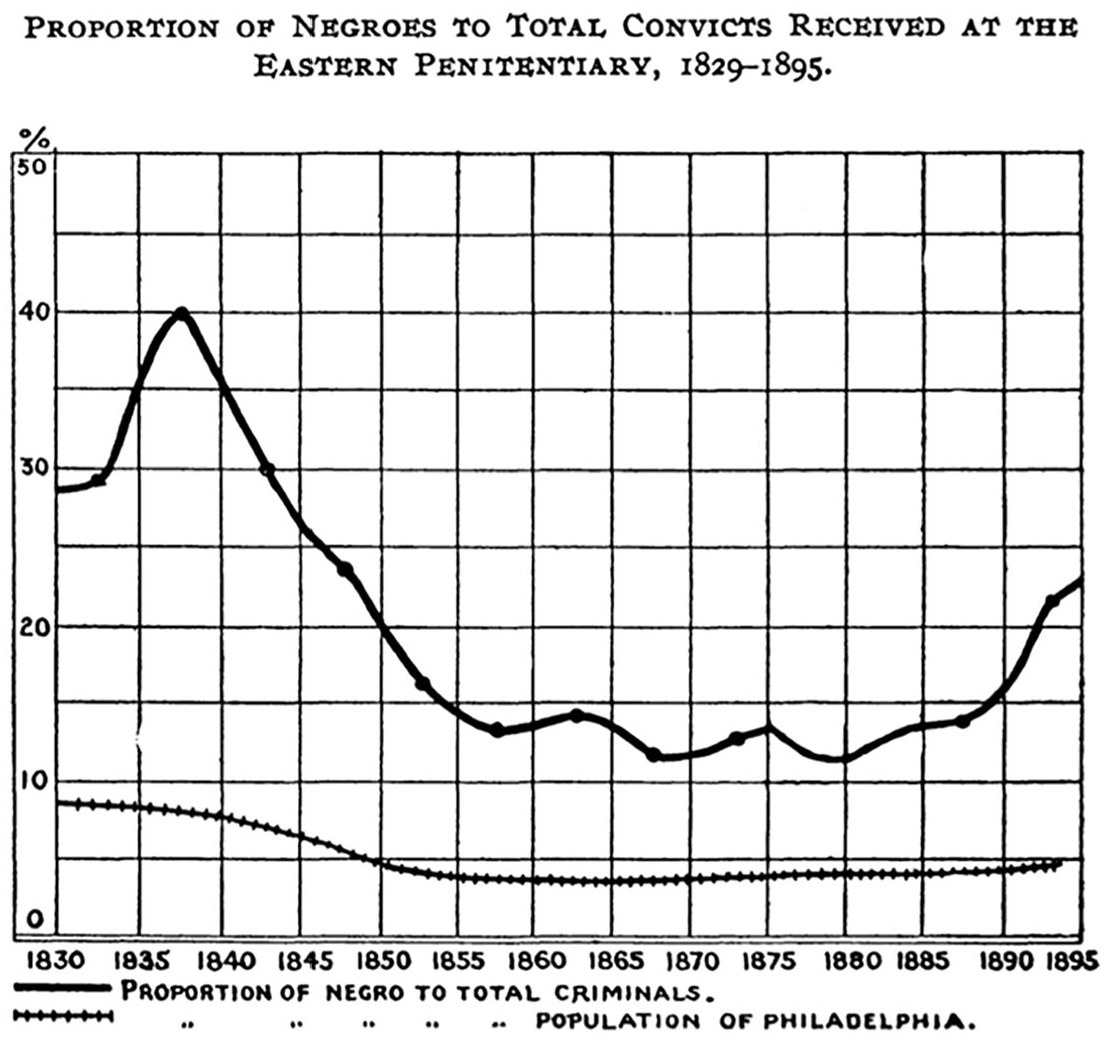
Chart of Overpopulation of Black Prisoners at Eastern Penitentiary, from Du Bois ([1899] 1996, 245).
I agree with those who read The Philadelphia Negro as containing a “hidden agenda” (Lewis 1993, 180; Davari 2018, 246), an agenda of upending established thinking about race, criminality, and politics within the bounds of a University of Pennsylvania–sponsored “social study.” This esoteric agenda is demonstrated through the book’s sociological analysis of crime and punishment. Explaining the causes of Black criminality, Du Bois notes that data about crime should be viewed in the dual contexts of slavery and emancipation, on the one hand, and northward migration on the other hand (Du Bois [1899] 1996, 283–84). Above all, “color prejudice” is to blame, “the widespread feeling all over the land, in Philadelphia as well as in Boston and New Orleans, that the Negro is something less than an American and ought not to be much more than what he is” (Du Bois [1899] 1996, 284). That the feeling is “widespread” and “all over the land” implies that it is rooted in a shared structural belief system rather than individual prejudice. What drives crime, Du Bois thought, were economic exclusions “which admits Negroes only to those parts of the economic world where it is hardest to retain ambition and self-respect” alongside race discrimination, a “real and mighty moral influence that causes men to have a real sense of manhood or leads them to lose aspiration and self-respect” (Du Bois [1899] 1996, 285–86). It is not individual delinquency but race-class hierarchies that drives crime. Punitive institutions thereby reflect and reproduce inequalities of race and class.
In 1901, two years after the publication of The Philadelphia Negro, Du Bois published a remarkable essay, “The Spawn of Slavery: The Convict-Lease System in the South,” in The Missionary Review of the World, a Protestant periodical. 15 Its thesis is that both the crop-lien system, in which farmers did not own the land they worked, and the convict-lease system, in which incarcerated people labored without compensation, “are the direct children of slavery, and to all intents and purposes are slavery itself” (Du Bois [1901] 1982, 110). Connecting slavery to the criminal justice system in the South, Du Bois traces the origin of the police to a fear of slave insurrection, citing the uprisings of Cato, Gabriel, Vesey, Turner, and Toussaint. “A system of rural police . . . was usually an effective organization, which terrorized the slaves, and to which all white men belonged, and were liable to active detailed duty at regular intervals,” he wrote (Du Bois [1901] 1982, 110–11). Institutions of policing were created by white enslavers to suppress violent challenges to the racial hierarchy, cementing political inequality in turn.
After emancipation, this system of racialized control and custody, backed by the force of law, persisted as a system of criminal justice that “had the worst aspects of slavery without any of its redeeming features” (Du Bois [1901] 1982, 112). It was a system whereby Black people were “herded together,” men, women, and children, guilty and innocent, and “given into the complete control of practically irresponsible men, whose sole object was to make the most money possible” (Du Bois [1901] 1982, 112). 16 Citing data from the New York State Library, Du Bois uses data to depict how the South, alone among regions in the United States, profited from its carceral system. Political economy, in other words, was central to his analysis.
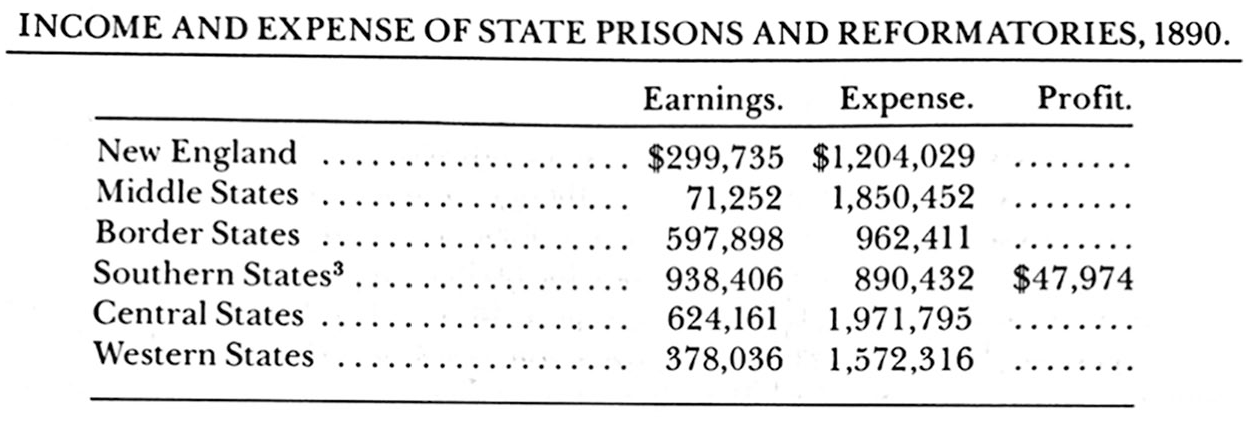
Table of Carceral Profit by Region, from Du Bois ([1901] 1982, 113).
In this system, criminality was still a function of race. As the convict-lease system evolved out of slavery, “there grew up a public sentiment which would not consent to considering the desert of a criminal apart from his color” (Du Bois [1901] 1982, 112). Whites went scot-free, whereas Blacks were disproportionately criminalized. Among white people, “the convict-lease system lowered respect for courts, increased lawlessness, and put the states into the clutches of penitentiary ‘rings.’” The convict-lease system’s effects on Black people, Du Bois writes, was “deplorable” (Du Bois [1901] 1982, 113). Overwhelmingly imprisoned (over 70% of prisoners in the South were Black), denied any semblance of fairness or due process, Blacks saw the criminal justice system “as simple forms of the white man’s oppression,” alongside slavery. Du Bois goes so far as to call the convict-lease system “evil” (Du Bois [1901] 1982, 112). It is here where Du Bois offers an illuminating statement on the structural character of crime. “Above all,” he writes, “we must remember that crime is not normal; that the appearance of crime among Southern Negroes is a symptom of wrong social conditions—of a stress of life greater than a large part of the community can bear” (Du Bois [1901] 1982, 116). What is needed, thought Du Bois, was abolition—an end to “the legalized slavery of men” that characterized the system of crime and punishment as it persisted after emancipation (Du Bois [1901] 1982, 116).
Du Bois’s argument, that crime is “not normal” but instead chiefly a function of a white supremacist racial order, poses a series of problems for how to think about the location of prison in a democracy. The four primary justifications for punishment and incarceration in democratic penal theory are, put crudely, (i) retribution, or a proportional response to a crime; (ii) deterrence, or preventing future crime through the threat of prison; (iii) rehabilitation, or gaining skills, cultivating maturity, and fostering judgment to prevent future wrongdoing; and (iv) incapacitation, or restricting the condemned from their liberty outside the prison walls (Gilmore 2007, 14; Tripković 2019). For one, these four theories assume the primacy and agency of the individual criminal. Du Bois suggests that criminality is structural, that it subsumes “the innocent, the guilty, and the depraved” into a single condemned class (Du Bois [1901] 1982, 112). The prison is used not to punish individuals for wrongdoing, but instead to siphon a racialized group into an inferior status. Moreover, each of the justifications for incarceration relies on the equal treatment of all people, regardless of social groups. 17 As Du Bois’s pioneering empirical analysis demonstrates, citizens were treated differently based on race and class. Carceral punishment was purveyed unequally—which rebuts democratic penal theory’s neutral logic of equality before the law.
Prisons, Inequality, and Inferiority in Souls
Incarceration begets social and political inequality. The condemned are separated from their families, communities, and fellow citizens; they are physically removed from the boundaries of political life. They are also made to feel inferior to those outside the prison walls. Du Bois illustrates the profound inferiority of incarceration through his 1903 masterwork, The Souls of Black Folk. The book, which introduced now canonical concepts of twoness, double consciousness, the veil, and the problem of the color-line, also yields important insights about how incarceration feels.
Souls begins with the problem of “being a problem,” the gulf between life under the veil and life outside and beyond it (Du Bois [1903] 1990, 7). Even there, incarceration looms. Du Bois begins chapter one, “Of Our Spiritual Strivings,” with his earliest memory of being treated differently on account of race. Boys and girls in schoolhouse exchanged beautiful visiting cards with one another, a merry exchange, Du Bois writes, “till one girl, a tall newcomer, refused my card,—refused it peremptorily, with a glance. Then it dawned upon me with a certain suddenness that I was different from the others; or like, mayhap, in heart and life and longing, but shut out from their world by a vast veil” (Du Bois [1903] 1990, 8).
When his white classmate refuses his visiting card, Du Bois first experiences life under a veil. He is seen only as a general outline, not as an individual, with feelings and worth. Du Bois analogizes this experience to a prison-house. “The shades of the prison-house closed round about us all: walls strait and stubborn to the whitest, but relentlessly narrow, tall, and unscalable to sons of night who must prod darkly on in resignation, or beat unavailing palms against the strong, or steadily, half hopelessly, watch the streak of blue above” (Du Bois [1903] 1990, 8). The prison-house both symbolizes and secures the condition of life under the veil. As a structure of confinement with unscalable walls, a structure that opens above to a “streak of blue,” the institution of prison-house marks a profound inequality in sentiment between those outside and those caged inside. 18
Incarceration is likewise a crucial theme in chapter nine of the text, “Of the Sons of Master and Man,” an essay studying “race-contact” after emancipation in three different domains (Du Bois [1903] 1990, 119–36, 120). In the domain of physical space, Du Bois observes that geographical color-lines persist in communities across the South. Cities were dotted by racial segregation. “[E]ach street has its distinctive color, and only now and then do the colors meet in close proximity” (Du Bois [1903] 1990, 121). In the domain of economic relations, Blacks were subject to “long hours of toil, low wages, child labor, and lack of protection against usury and cheating”—all of which are compounded by a race prejudice ranging from distrust to a “frenzied hatred” (Du Bois [1903] 1990, 123). Du Bois’s invocation of hatred here alludes to his famous question framing the beginning of Souls, “how does it feel to be a problem?” (Du Bois [1903] 1990, 7).
In the domain of politics, Du Bois surveys a rash of disenfranchisement laws across the South. These laws aim for no less than “the elimination of the black man from politics” (Du Bois [1903] 1990, 127). Half the laboring force of the South is “voiceless in the public councils,” Du Bois notes, viewing “law and justice” as “sources of humility and oppression.” The law, to those under the veil, does not appear neutral, following the logic of democratic penal theory. Instead, The laws are made by men who have little interest in him; they are executed by men who have absolutely no motive for treating the black people with courtesy or consideration; and finally, the accused law-breaker is tried, not by his peers, but too often by men who would rather punish ten innocent Negroes than let one guilty one escape (Du Bois [1903] 1990, 128).
19
Du Bois here raises a philosophical problem about the nature of law and consent, a problem he first raised in “Spawn.” If one is “voiceless” in the formation of a law, as a political unequal, why should that law be binding? What gives laws made under a Jim Crow system coercive force for those persons who lacked a say on how the law was made? 20 The so-called democratic lawmaking and criminal justice systems are, Du Bois argues, only democratic for whites (and, in turn, white men). One later reader of Du Bois (Olson 2004) would call this “white democracy”: a system in which those who could participate in collective decision-making were determined based on hierarchical racial classification and a normative ideal of whiteness. 21
Undergirding white political power was the specter of Black criminality. Again expounding on his argument in “Spawn,” Du Bois writes that “the political status of the Negro in the South is closely connected with the question of Negro crime” (Du Bois [1903] 1990, 128). White political control came with the emergence of a Black criminal underclass. To explain “this unfortunate development,” Du Bois noted “(1) that the inevitable result of Emancipation was to increase crime and criminals, and (2) that the police system of the South was primarily designed to control slaves” (Du Bois [1903] 1990, 129). On Du Bois’s account, the criminal justice system emerged in the wake of emancipation. It was a “double system of justice,” a double consciousness of sorts applied to penal institutions. This system “erred on the white side by undue leniency and the practical immunity of red-handed criminals, and erred on the black side by undue severity, injustice, and lack of discrimination.” It assumed every white person was a member of the police and pushed Black people into a criminal apparatus, in turn, Du Bois argues, reenslaving them (Du Bois [1903] 1990, 129–30). Criminality—and its concurrent institutions of police, jail, and prison—emerged to protect white political power. 22
To be incarcerated was to have something essential of your personhood meant to feel inferior and less than. In the dreamlike chapter “Of the Black Belt,” he writes about encountering the “high whitewashed fence of the ‘stockage,’ as the county prison is called; the white folks say it is ever full of black criminals,—the black folks say that only colored boys are sent to jail, and not because they are guilty, but because the State needs criminals to eke out its income by their forced labor” (Du Bois [1903] 1990, 93–94). In the postbellum period, Southern states and localities constructed carceral institutions that disproportionately confined Black persons and exploited them for unpaid labor. As part of the convict-lease system, the Black Codes in many Southern states provided for the arrest of freedmen who lacked lawful employment; in turn, these inmates could be “hired out” to white employers—in what was only later correctly called indentured servitude (Christianson 1998, 168–75, 171; Davis 2003, 28–29). The word Du Bois uses, “stockage,” generally refers to the carrying of cattle (Oxford English Dictionary 2021). It illustrates a dehumanizing comparison between man and animal. Exploited, confined, surveilled, and mocked, the figure of the prisoner exemplifies the political inequality created by the veil.
The inferiority enforced by carceral institutions was buoyed by feelings outside the prison walls, too. Among free whites, the entire system of crime and punishment relied on spectacle. Du Bois points out that “I have seen twelve-year-old boys working in chains on the public streets of Atlanta, directly in front of the schools, in company with old and hardened criminals” (Du Bois [1903] 1990, 130). Among free Blacks, it relied on mistrust. Carceral structures fomented Black distrust of white witnesses and skepticism about the fairness of all-white juries, 23 and in turn, “the criminal was looked upon as crucified rather than hanged,” a martyr to an unjust racial order rather than a justly condemned offender. White people, on the other hand, “careless as to the guilt or innocence of accused Negroes, were swept in moments of passion beyond law, reason, and decency” (Du Bois [1903] 1990, 130). 24 What remained was a society of racialized inequality, fear, and fragmentation (Ayers 1984, 182–83).
Feelings of inferiority, dehumanization, and mistrust are destabilizing for democratic politics. They foment stasis and discord, give rise to social hierarchy, and fray the bonds of civic life. As Reconstruction ended in the South and a racialized carceral system took hold, America’s experiment in multiracial democracy failed with it. Du Bois’s Souls conveys how incarceration shapes public affect—and diminishes the defenses of democracy against mob rule.
From Abolition Democracy to Carceral Democracy
I have argued so far that Du Bois offers a two-pronged critique of carceral institutions in a democracy. By tracing their historical continuity from enslavement in systems of white racial dominance, he lambastes their inequality. And, by highlighting the visceral feelings begot by confinement, he depicts how incarceration can unsettle fragile democratic bonds. In this section, I extricate Du Bois’s positive vision—abolition democracy—which preserves formal political equality, fosters feelings of belonging and trust, and offers an alternative to rule by cage.
Du Bois is often characterized as an elitist, a defender of the educated few against the democratic masses. Du Bois himself in Souls references the Talented Tenth (Du Bois [1903] 1990, 79), and in a 1903 essay of that name, argues for the training of a Black elite who would lead their communities to prosperity (Du Bois 1903). But he was simultaneously a committed democrat. Following work by Derrick Darby (2020, 213–18), I read Du Bois as a democrat and a thinker attentive to the conditions by which democracy can survive. In essays such as Darkwater’s “Of the Ruling of Men” ([1920] 2007, 65–76), Du Bois advocated a three-pronged defense of democratic politics, on grounds of its positive consequence, its proclivity for justice, and its wisdom of the crowd. 25 First, democracy works to provide the “greatest good for all,” increasing the benefits of rule to as many persons as possible, not just the few or the many (Du Bois [1920] 2007, 65). Democracy is preferable on this account, because it maximizes positive consequences. Second, and relatedly, democracy is justified insofar as it “is a method of realizing the broadest measure of justice to all human beings” (Du Bois [1920] 2007, 68). It is preferable to a benevolent tyranny or rule by a select few.
Third, democracy is epistemically beneficial by employing the knowledge of as many people as possible to make decisions, which is to say that democracy is preferable to a rule that excludes groups from political participation. Du Bois writes that women, Black people, the “submerged tenth,” even the ignorant must be allowed to participate. If democracy excludes “women or Negroes or the poor or any class because of innate characteristics which do not interfere with intelligence, then that democracy cripples itself and belies its name” (Du Bois [1920] 2007, 70). To exclude people from participating is to inhibit the full force of knowledge in democratic decision-making. More precisely, “the real argument for democracy is, then, that in the people we have the source of that endless life and unbounded wisdom which the rulers of men must have” (Du Bois [1920] 2007, 69). There is a political vitality that emerges from popular politics, a vitality absent in nondemocratic regimes. Exclusions violated this epistemic notion of democracy. “If America is ever to become a democracy built on the broadest justice to every citizen, then every citizen must be enfranchised” (Du Bois [1920] 2007, 71).
Central to all three of Du Bois’s arguments defending democracy was his commitment to political equality, the equal power of all to make decisions. 26 For Du Bois, political equality enables democratic agency, in turn imbibing politics with the energy of popular participation (Basevich 2019). This idea is most firmly articulated through the concept of abolition democracy introduced in Black Reconstruction in America ([1935] 2014), a revisionist account that centered Black political agency, rather than political corruption or incompetence, in the history of Reconstruction (Lester 2021). Abolition democracy is a multiclass, multiracial movement waged by both laborers and capitalists—political equals—committed to the abolition of slavery and subjugation. It imagines a future “based on freedom, intelligence and power for all men,” not just an autocracy dedicated to private profit (Du Bois [1935] 2014, 149). Abolition democracy conceived of the object of the Civil War not as the preservation of the union but instead as the abolition of slavery, which “could be thoroughly accomplished only if the emancipated Negroes became free citizens and voters” (Du Bois [1935] 2014, 151). Political equality is central to this vision.
This vision of abolition democracy stands in contrast, I argue, to carceral democracy—by which I mean rule by the people predicated on the carceral unfreedom of some. In the post-Reconstruction period, carceral institutions thwarted the aspirations of abolition democracy. Penal institutions—such as the penitentiary, the reformatory, the convict-lease system, and the chain gang—functioned to demarcate the racial limits of citizenship, to impede political equality, and to stymie multiracial democratic politics. “While all instruments of group control—police, courts, government appropriations, and the like—were in the hands of whites, no power was left in Negro hands . . . the group-will of the colored man has no power to express itself” (Du Bois [1935] 2014, 572–73). A genuine abolition democracy, committed to ideals of equal power to make collective decisions, gave way to a rule by some. 27 “White men became a law unto themselves,” Du Bois writes, and the Black man in turn “was a caged human being,” caged under the confines of caste (Du Bois [1935] 2014, 573–74). 28
Carceral institutions also functioned to benefit the owners of capital over laborers. “Above all,” Du Bois writes, “crime was used in the South as a source of income for the state. . . in no part of the modern world has there been so open and conscious a traffic in crime for deliberate social degradation and private profit as in the South since slavery” (Du Bois [1935] 2014, 571, see also 415–416). This passage challenges the extent to which the state’s extractive logic of crime and prison can even be called legitimate or legal at all. 29 Likewise, debtor’s prisons emerged to criminalize the poor (Du Bois [1935] 2014, 150). Here, Du Bois echoes his earlier arguments from “Spawn” about the connection between incarceration and economic exploitation. He quotes an English traveler who reports that “lessees work the prisoners both on estates and in mines, and apparently maintain severe discipline in their own way, and make a good thing of it” (Du Bois [1935] 2014, 571).
The “horrible system of convict leasing” stands in marked contrast to abolition democracy’s commitment to the fair distribution of property, especially for the formerly enslaved, via the Freedmen’s Bureau and the promise of forty acres and a mule (Du Bois [1935] 2014, 179–81, 416). 30 A system which criminalizes Black people and profits from their labor is incoherent with abolition democracy, which is based on multiracial worker solidarity and a genuine emancipation from domination. “Freedom in order to be free required a minimum of capital in addition to political rights,” Du Bois argues (Du Bois [1935] 2014, 151). Carceral institutions concentrate capital among the few and hence preserve a system of unfreedom incongruent with the vision of abolition democracy—and its attendant democratization not only of political rule but also of economic relations (Du Bois [1920] 2007, 72–76).
Thus, not only was Du Bois a committed democrat, but he situated his positive vision of abolition democracy against the racial subjugation and economic exploitation perpetuated by carceral institutions. To be political equals is central to his positive democratic vision, and it is political equality at stake through the confinement, caging, and intimidation of the penal system. Du Bois pushes us to think that another political world is possible: one rooted in the vitality of all persons, of all backgrounds, one that recognizes “not only the worth of the individual to himself, but the worth of his feelings and experiences to all” (Du Bois [1920] 2007, 70).
The Past and Future of Abolition Democracy
A democratic polity may offer various justifications for confining or caging someone: as retribution for a wrong committed against the polity or one of its citizens, to deter would-be criminals through threat, to rehabilitate wrongdoers by cultivating maturity and good judgment, or simply to immobilize the dangerous or violent. Du Bois turns our attention to the implications of the confinement for democratic ideals themselves. To place a member of the democratic community behind bars is to exclude them from the democratic community and to make them formally unequal vis-à-vis their fellow citizens. Du Bois shows not only that the prison is wrapped up with racial and economic injustice in America but asks about the deeper compatibility of incarceration with the political equality that ought to underpin democratic life.
Du Bois’s thinking about criminality and incarceration underscores an inherent tension between carceral and democratic ideals. It also stands in tension with a burgeoning literature within political theory, advocating for the democratization of prisons. 31 A range of contemporary theorists have suggested ways to make the prison more democratic. One way to do is through voting. Andrei Poama and Tom Theuns (2019), for instance, argue that voting should be mandatory for incarcerated offenders. Compulsory voting, on their view, is desirable because it would instill democratic habits, such as seeing oneself as a political equal, rather than a felon, and it would encourage incarcerated persons to emulate democratically engaged citizens, both inside and outside the prison. Beyond voting, Albert W. Dzur (2018) has advocated for making prison a more democratic space. He takes democracy to mean “sharing power to shape a common public life with others who are not the same as us” (2018, x) and lauds the democratic innovation taking place through organizations like Inside-Out and the Bard Prison Initiative, programs that build connections between the incarcerated and lay citizens, strengthening our shared democratic bonds in turn. Based on archival research into the 1973 Walpole prison uprising, Christopher Berk insightfully defends the value of prison self-governance, arguing that the prison is a community “whether or not its inhabitants are walled in. And every group in a community deserves a say in how it’s governed” (2018, 295). For Berk, participatory governance promotes political education and collective learning that fosters a democratic politics rooted in collective self-determination (2016, 278n15, 296, 300).
Du Bois’s historical and analytical observations about the antidemocratic function of the prison offer a more pessimistic perspective. For Du Bois, carceral institutions foment fear, racial subjugation, and economic exploitation, and cut against the ideal of political equality latent in democratic politics. No matter what democratic reforms occur, the incarcerated person inside remains politically unequal compared to their fellow citizen outside the prison walls, unable to participate in politics as a political equal. Du Bois’s work supports a decarceral approach to criminal justice policy, one rooted in a genuine political equality that he thought central to democratic politics. For Du Bois, to be incarcerated or threatened with incarceration is to be a second-class citizen—even in a democratic society. The vast overreach of carceral systems, rooted in racial caste and other forms of structural subjugation, poses a normative problem from the perspective of democratic politics, a politics centered on equal standing to make political decisions in concert with others.
Today, carceral democracy has seemed to win out against the ideals of abolition democracy. Prisons are part and parcel with the backlash against abolition democracy—a backlash that succeeded in gradually defeating Reconstruction in the 1870s, in winnowing back the expansion of civil and voting rights during a “Second Reconstruction” (Eubank and Fresh 2022), and that continues today. They remain an essential fact of our social and political life. Signs reading “Do Not Stop: Correctional Facility Ahead” dot our highways. We use furniture, eyeglasses, even hand sanitizer produced by prison labor. Local government revenue relies on fines and fees from carceral institutions (Page and Soss 2021). The United States has more correctional facilities than colleges. 32 And our prison system is vastly and abhorrently unequal. Racialized mass incarceration remains a core element of our public life.
And yet, carceral democracy need not win out as the paradigmatic logic for our politics. To read Du Bois is to be reminded that an alternative vision for democracy is not only possible but has a long history. This call has been taken up by contemporary activists including Angela Davis (2005, 107), who calls for “a continuum of alternatives to incarceration”; Mariame Kaba (2021, 2), who has advocated “building a society where it is possible to address harms without relying on structural forces of oppression or the violent systems that increase it”; and the Rev. William J. Barber (Barber and Wilson-Hartgrove 2016), whose Moral Mondays movement outside the North Carolina statehouse mobilized a multiracial, multiclass political coalition committed to work for an abolition democracy, part of what Barber has dubbed a “Third Reconstruction” (see also Yarish 2019). Contemporary movements have resonance with Du Bois and his defense of democratic political equality against carceral ideals. By turning back to Du Bois, this essay hopes to raise anew the question about how institutions of confinement relate to democratic life. More than an unfortunate development, the carceral order of Du Bois’s time and our own has constrained a politics whereby the people rule together as democratic equals.
Footnotes
Acknowledgements
This essay benefited from audiences at the University of Massachusetts Amherst New Directions in Law and Society Workshop; the King’s College London Graduate Conference in Politics, Philosophy & Law; and the Duke Political Theory Workshop. Special thanks to John Aldrich, Garrett Baker, Lucy Britt, Judah Buckner, Gent Carrabregu, James Chappel, Candice Delmas, Colin Devine, Ivy Flessen, Jihyun Jeong, Sarah Jobe, Michael Allen Gillespie, Paul Golightly, Ruth Grant, Michael Hawley, Elena Icardi, Alexander Kirshner, Jack Knight, Arvind Krishnamurthy, Kay Levine, Jacob Little, Warren Lowell, Max Lykins, Kenna McRae, Charles Nathan, Rutger van Oeveren, Joseph Rodriguez, Geneviève Rousselière, Sam Schmitt, Wan Ning Seah, Ehsan Sheikholharam, Brian Spisiak, Candis Watts Smith, Liza Taylor, Ruth Wygle, Matthew Young, the editors of Political Theory, and the anonymous reviewers for their insightful feedback and questions. I would also like to thank the staff at the Special Collections and University Archives, University of Massachusetts Amherst Libraries, whose incredible work digitizing the Du Bois papers made it possible to conduct research for this essay during the COVID-19 pandemic.
Declaration of Conflicting Interests
The author declared no potential conflicts of interest with respect to the research, authorship, and/or publication of this article.
Funding
The author received no financial support for the research, authorship, and/or publication of this article.
1.
Those in favor of prosecuting Du Bois included Secretary of State Dean Acheson, who publicly linked the PIC with the Soviet Union’s “peace offensive” amid the intensifying Cold War. Public opinion swung against him, and Du Bois was vilified as “un-American” (Lanham 2017; Burden-Stelly 2019; Getachew 2021). Even the NAACP, which Du Bois founded, refused to publicly support him beside a lukewarm statement of neutrality (Du Bois [1952] 2007, 62). Others defended Du Bois including Langston Hughes, who remarked that “if W.E.B. Du Bois goes to jail a wave of wonder will sweep around the world” ( , 552).
2.
Newspaper clipping from the National Committee to Defend Dr. W. E. B. Du Bois and Associates in the Peace Information Center. “Cicero lynchers all went free but Dr. Du Bois faces jail,” ca. October 1951. Du Bois Papers (MS 312). Special Collections and University Archives, University of Massachusetts Amherst Libraries. Permalink: .
4.
5.
6.
7.
Angela Y. Davis’s thinking about race, incarceration, and democracy is explicitly indebted to Du Bois (Davis 2005, 25, 91–93; 2012, 114, 136; 2016, 25, 70; Davis et al. [2016] 2021, 183; 2022, 54–58; Roberts 2021, 676–77). She had a lifelong interest in his writings. As a teenager in New York City, Davis participated in a radical youth group, Advance, convened by Herbert Aptheker, the close friend and literary executor to Du Bois (Roberts 2021, 662; , 109–13). Davis also read Du Bois while she was incarcerated; one of the “few books which held the slightest interest” in the jail library was Du Bois’s autobiography, and Davis was later to read Du Bois approvingly on his decision to join the Communist Party (Davis 1974, 51, 188). However, throughout her work, Davis focuses on Du Bois’s positive vision of abolition democracy in Black Reconstruction more than his substantive analysis about criminality, race, and punishment in a range of other works. While there are important similarities between their notions of abolition and democracy, Davis foregrounds intersectional feminism and the elimination of sexual and gendered oppression much more so than Du Bois. I thank the anonymous reviewers for pressing me to expand this point.
8.
This startling figure actually excludes his correspondence (Chandler 2006, 32). “His literary productivity,” writes Herbert Aptheker, who compiled a 1,975-item bibliography of Du Bois’s published and edited work, “was on a Dickensian scale” (1973, i). The comparison is one of substance as well as volume, for both Du Bois and Dickens were sharp critics of the American prison (see , chap. 7).
9.
As Paula McClain argues in her recent APSA Presidential Address (2021, 15), “Du Bois’ work, along with that of John Hope Franklin and others, contributed significantly to the development of sustained and increasing criticism of Dunning and his students, and a revision of the study of Reconstruction in history.” See also .
10.
Interestingly, Du Bois’s first article, published in the New York Globe at age 15, exhorted the men of Great Barrington to join a “Law and Order society” concerned with prohibition (Du Bois [1883] 1986; , 13).
11.
12.
Gender and sexuality, as Saidiya Hartman (2019) demonstrates, are often peripheral to Du Bois’s analysis in revealing and disturbing ways, a full account of which falls outside the scope of this article (see, e.g., Gillman and Weinbaum 2007; Balfour 2011, 97–114; Taylor 2021, 251–52). , 95–120) offers a dissenting interpretation, reading Du Bois as a progenitor of Black feminism and intersectionality.
13.
D. E. Tobias also noted how the penitentiary is a tool of disenfranchisement, writing that “once a negro voter is sent to prison, he is for ever thereafter disfranchised, and for this reason alone the whites have made thousands of negro convicts for the purpose of depriving them their votes!” (1899, 960). Tobias spent time in England, Scotland, and Wales, studying the prison system there, which he found “punitive, pure and simple, and once a poor human soul slips and falls, he or she is doomed to a life of sorrow for ever thereafter” (1905, 22). He was also one of the first Black students to study at the University of South Carolina. While Tobias is relatively obscure today, Booker T. Washington praised him as someone “doing much to give the race standing and respectability in England” and commending his “thorough study of [the] English penal system” (Washington [1899] 1976, 155). See also Mary White Ovington, 1865–1951. Letter from Mary White Ovington to W. E. B. Du Bois, June 27, 1905. W. E. B. Du Bois Papers (MS 312). Special Collections and University Archives, University of Massachusetts Amherst Libraries. Permalink: .
14.
The “submerged tenth” was to reappear in Du Bois’s later thought; see, for example, Du Bois ([1920] 2007, 69). The phrase was not Du Bois’s own; it originated with an associate of Jane Addams and was popularized by William Booth ([1890] 2014, 17–23; see also Himmelfarb 1990, 373; Woodall 2005). As Khalil Gibran Muhammad observes, Du Bois’s language of the “submerged tenth” indicates a kind of structural analysis, implying that “these individuals were oppressed by means other than just their own behavior” (, 69).
15.
The essay was to later influence Angela Y. Davis, who would write nearly one hundred years later that the “system of convict lease . . . transferred symbolically significant numbers of black people from the prison of slavery to the slavery of prison” (Davis 1998, 75; see also ).
16.
A reader is reminded of Du Bois’s famous characterization of Reconstruction: “The slave went free; stood a brief moment in the sun, then moved back again toward slavery” (Du Bois [1935] 2014, 24). For more on the progression from Reconstruction to Redemption and Jim Crow, see C. Vann Woodward (1966, 65) and , 324–43)
17.
18.
As Shades of the prison-house begin to close Upon the growing Boy But he beholds the light, and whence it flows, He sees it in his joy., 66–77) points out, Du Bois alludes here to Wordsworth’s “Imitations Ode”:
Du Bois first alluded to “Imitations Ode” in his 1898 commencement address at Fisk. When “Of Our Spiritual Strivings” was first published, in the 1897 Atlantic Monthly, “shades of the prison-house” was in quotations to indicate that Du Bois was quoting Wordsworth. In Wordsworth’s poem, the prison-house represents all the ways in which childhood curiosity and wonder are constrained when the innocence of childhood is lost; for Du Bois, the prison-house is a metaphor for the ways Black people specifically are constrained in a white supremacist society. One also thinks here of Fanon’s notion, in Black Skin, White Masks (, 5), that to be the subject of racist colonial state is to feel like “prisoner on his island.” I thank a reviewer for raising this comparison.
19.
Here, Du Bois is inverting William Blackstone’s famous formulation that “it is better that ten guilty persons escape than that one innocent suffer” (Blackstone [1769] 2016, 352; see also Volokh 1997). For more on how felony disenfranchisement has bounded notions of who counts as a citizen, and who is excluded, see .
20.
Voter suppression, Du Bois wrote in an unpublished diary, was occurring throughout the South. “In Durham an attempt was made first to keep Negroes from registering [to vote]. A presiding Elder of the A.M.E. Church was refused registration and immediately went to swear out a warrant against the registrar. The judicial officer phoned the registrar and advised against trouble. The registrar offered then to register the minister, but the minister would withdraw the warrant only when all those Negroes who had been refused registration were accepted.” Dairy of journey [sic.], ca. 1921, pg. 3. Du Bois Papers (MS 312). Special Collections and University Archives, University of Massachusetts Amherst Libraries. Permalink: . As John Hope Franklin was to write about this time period (1971, 341), Black people “were viewed as aliens, whose ignorance, poverty, and racial inferiority were incompatible with logical and orderly processes of government.”
21.
Tommie Shelby (2007; , 19–48, 203–51) asks about the nonideal questions of justice that emerge from what Shelby calls the “dark ghetto,” arguing that, under some circumstances, there are legitimate “reasons the ghetto poor have to refuse to accept the authority of law” (2016, 219). One of the innovations of Shelby’s work is that it turns the attention of political philosophy to the obligations of disadvantaged people to promote justice (2007, 153).
22.
Nikhil Pal Singh (2014, , 35–73) writes about the symbiotic connection between policing and the formation of race in the United States—from the founding to the present. For Singh, “policing makes race and race has defined the objects of police at the point where relations of force take primacy” (2017, 35).
23.
24.
Ida B. Wells-Barnett, writing at the same time as Du Bois, makes a similar argument about the emotions underlying lynching and the mechanisms of racial criminalization (Wells-Barnett [1901] 2014; Murakawa 2021; ).
25.
Beyond explicit textual evidence, Du Bois addressed his writings to a democratic audience, using pronouns of “we” and using the pen to build solidarity and understanding among readers. Nick Bromell (2018) has called this rhetorical move “democratic reasoning,” and it provides additional evidence for reading Du Bois as a democrat. For an insightful reading of the complexities of Du Bois’s democratic theory, see .
26.
Du Bois’s defense of political equality presages its centrality in contemporary democratic theory, including in work by Robert Dahl (2006) and .
28.
Michelle Alexander (2012, 20–58) frames the history of U.S. mass incarceration as a racial caste system, arguing that caste “proved far more durable than the institution that gave birth to it,” namely enslavement (26). Du Bois uses the concept of caste and caste distinction throughout his oeuvre (Du Bois [1909] 2007, 165) and in his correspondence (Wilkerson 2020, 26–27). He also explicitly compares “caste segregation” to “prison” (, 66–67).
29.
I thank a reviewer for raising this observation.
30.
General William Tecumseh Sherman’s promise in Savannah of forty acres for the formerly enslaved remains unkept. For more on the unfulfilled promise of reparations, see Lawrie Balfour (2003; 2015), William Darity and A. Kirsten Mullen (2020), and .
31.
32.
According to the Prison Policy Initiative, the U.S. holds “almost 2 million people in 1,566 state prisons, 102 federal prisons, 2,850 local jails, 1,510 juvenile correctional facilities, 186 immigration detention facilities, and 82 Indian country jails, as well as in military prisons, civil commitment centers, state psychiatric hospitals, and prisons in the U.S. territories” ().