







Abstract
This article argues that Carl Schmitt’s approach to the visual expression of political power evolves from an early reliance on symbolic form to a later adoption of allegory, influenced by Walter Benjamin. Initially attracted to the Catholic Church as a symbolic synthesis of bureaucracy and charisma, Schmitt grew disillusioned with its modes of visual representation. He then turned to political myth, envisioning the national leader as the symbolic incarnation of a unified people. This model, however, also proved untenable. In search of an alternative, Schmitt drew on Benjamin’s theory of allegory to retrieve the Baroque tradition of state personification: Sovereigns, like actors on a stage, outwardly represent the state without claiming to exhaust its meaning. I contend that this allegorical framework allowed Schmitt not only to sidestep the totalizing tendencies of political myth but also to open a conceptual path for reimagining Europe’s postwar fractured space.
Introduction
Carl Schmitt sustained a long-standing engagement with the visibility of political power—that is, with how ideas of political order are mediated and made concrete. 1 By analyzing Schmitt’s oeuvre, including his diaries and manuscripts, this article argues that his view on visibility underwent a decisive shift: from an early reliance on symbolic representation to a later embrace of an allegorical model. My central thesis is that a key factor grounding that turn is the influence of Walter Benjamin’s distinction between symbol and allegory as articulated in Origin of the German Trauerspiel (1928). Benjamin’s framework, I contend, is already discernible in Schmitt’s pre–Second World War writings. As we shall see, prior to the 1930s, Schmitt operated with a positive, albeit unsystematic, treatment of symbolic representation, and offered no specific account of allegory, much less “Baroque allegory.” In his 1916 essay on Nordlicht, he anticipated the need for a unifying symbol to face the challenges that modernity poses to human existence. Roman Catholicism as a political form was the first pathway he explored in this quest. The Pope, qua charismatic head of a bureaucratic corporation, served as a model of mediation of an idea of political and moral order into worldly reality. However, as Schmitt’s own encounters with the Church’s visual manifestations, especially through cinema, make evident, he rapidly became disenchanted with this alternative. By the mid-1920s, Schmitt turned to the unifying symbol of the nation. In this context, he adopted the framework of the political myth, mainly adapted from Georges Sorel. First in relation to fascism and then Nazism, Schmitt came to believe that the totality of a political idea (in this case, the nation) could be rendered visible through embodiment in a human leader. This tenet was clearly abandoned by the late 1930s, when Schmitt conducted an autopsy of the myth of the state: Leviathan as a failed political symbol.
It is against this backdrop that Schmitt distinguishes the symbolic register from Baroque allegory—an insight that, in my reading (pace Mehring), he derives from Benjamin. 2 While other interpreters have dealt with the theoretical similarities between Benjamin and Schmitt, the specific impact of Benjamin’s theory of allegory on Schmitt remains underexplored. 3 Furthermore, I argue that Schmitt employs this idea to recuperate the early modern conception of the state as a person externally represented by the sovereign, a view he lays out in The Nomos of the Earth (1950). This marks a decisive shift in how he conceives the visibility of state power: from symbolically incandescent entities to hieratic personifications. Although working from a distinct theologico-political tradition, I contend that Schmitt found in Benjamin’s allegorical insight a framework suited to the shattered landscape of postwar Europe—and perhaps even to our own.
The Symbol Against the Shadow of Modernity
Carl Schmitt’s engagement with the visual dimension of political power begins early in his career. His 1916 study of Theodor Däubler’s epic poem Nordlicht interprets the work as a symbolic attempt to articulate the origins of political order and the dangers posed by modernity in the West’s quest for redemption. According to Schmitt, Däubler draws on the traditions of German Romanticism to construct a narrative in which the characters are personifications—that is, “ideas striving for their incarnation in words.” 4 Central to the argument is the “symbol” of the Northern Lights, a form of nonsolar, Earth-originated light, which represents the hope of salvation in a battle against encroaching darkness (11–12). For Schmitt, Däubler’s poetic achievement lies in his “myth-creating power” through which he unfolds the “deepest problem of the philosophy of right and the state” (25). 5 Däubler traces the mythical origin of the state to an agreement among ancient Iranian farmers and priests. This primordial political form is an “expression of dualism,” rooted in a class opposition between “the ruling and servant” (31). Since then, the Earth has been searching for a redemptive unity. With the “Orient” having abdicated this mission, the burden falls to the “great Europeans” to achieve it “through grace” (57). Despite its “dizzying” complexity, Schmitt claims that Däubler succeeds in rendering an immense corpus of “philosophical and cultural-historical material” into visual-symbolic form, creating what he calls a “new, unprecedented pictura poesis” (36).
Myth and symbol, then, are indispensable tools for construing political reality and for imagining the form of political unity that overcomes the divide among human beings. 6 Yet, this symbolic mode of representation, Schmitt suggests, appears to be losing ground. He contrasts Däubler’s mythopoetic vision with the flattening effects of modernity: a “capitalistic, mechanistic, relativistic age” that turned the Earth into a “grinding machine,” where everything is susceptible to being calculated and registered (59–61). This strikes a chord with Schmitt’s 1918 science fiction satire The Buribunken, which explores a dystopian scenario where aesthetic expression collapses into a mere chronicle of everyday life and human existence is reduced to a “ratlike” repetition. 7 The loss of symbolic mediation is simultaneously the loss of political thinking as the realization of transcendent ideas of law and order in empirical reality.
Faced with this threat, the old symbolism of the Catholic Church might offer a compelling pathway to reflect on political power. 8 A first adumbration of the virtues of the Church vis-à-vis the impoverished imagery of modernity is attempted in his 1917 tract, The Visibility of the Church. Schmitt posits that the Christian ideal, the Word, acquires visibility through the “mediation” of “the Church, a corporate entity.” 9 The formula to retain is that abstract political ideas need to be translated into something manifest: “every Church is visible by definition” (54). In a much clearer manner, Roman Catholicism and Political Form (1923) expands on the argument by claiming that the Roman Catholic Church as a political form exemplifies a complex of opposites, combining the institutional with the extraordinary. “The Pope is not the Prophet, but the Vicar of Christ,” whereas “the office is made independent of charisma,” it is not “impersonal,” because it is “part of an unbroken chain” connected with “the concrete person of Christ” (14). The Church is a “juridical person” as stock companies are, but its exceptionality lies in its representation of a unique idea of human community (18–19). Schmitt adds that this is an “eminent sense” of representation, by which “abstract ideas like freedom and equality,” “God or the people” “become personified” (21). Similarly, in Political Romanticism (1919), Schmitt applied this model to differentiate the “absolute monarch” who “represents the state with his individual person” from the “Jacobin” who “vociferously” claims to incarnate the patrie but appropriates it privately. 10 The Church thus exemplifies in an eminent way how political ideas become concrete through an act of representation.
Schmitt continued in Roman Catholicism by linking political representation to “form, figure, and visual symbolism” (22). Although weakened, the Church still maintains a bond with the “creative arts.” In contrast, the mechanized and economic age is poor in “imagery” (22–23). This opposition mirrors Schmitt’s earlier diagnosis in his study of Nordlicht. Schmitt cites the “modern factory” and the communist state, both “machines” associated with a large-scale technological economy, as examples of this symbolic barrenness (22). He asserts that, “because the machine has no tradition,” it must take “its symbols from another age.” This is why the Soviets resorted to the hammer and the sickle, a thousand-year-old technology (14). In this work, the Leviathan appears as a demonic figure: a symbol of the diabolic mechanization of the state and its exclusion “from the world of representations” (21). 11 Against this background of symbolic exhaustion, Schmitt implies that Catholic vocabularies of symbolism may yet be redeployed as instruments of political visibility for the modern state. 12
The Church Exposed: Cinematographic Charisma
This fascination with Catholic symbolism, however, would not endure. On a personal level, Schmitt was excommunicated after marrying for a second time without obtaining a canonical annulment of his first wedding. 13 Additionally, he expressed frustration with what he perceived as a cold reception to his Roman Catholicism within Catholic intellectual circles. 14 These factors undoubtedly had an impact on his consideration of the Church as a model of political form. More revealing still are Schmitt’s own reflections on the actual visibility of Catholic power—that is, how its symbology was visually and viscerally experienced by him. This offers a fascinating perspective on what he ultimately found lacking in the Church.
In his 1929 diaries, Schmitt recounts having seen “the Pope on screen, blessing the crowd” and feeling “ashamed.” He delivered a peremptory judgment: “This won’t last another ten years.” 15 It is difficult to decipher specifically what annoyed Schmitt about the images of Pius XI in front of the crowd (Figure 1). To be sure, they resemble more a funeral than a celebration. Still, something deeper seems to be at play. 16 1929 is the year of the Lateran Treaty, by which the Vatican was recognized as a sovereign state under the authority of the Holy See. While Schmitt welcomed the Church’s statelike consolidation, he remained wary of its aesthetic and symbolic degradation. 17 In Roman Catholicism, he had already warned that “when the sanctuary lamps fronting all Catholic altars are fed by the same electric company that supplies the theaters and dance halls of the city, then Catholicism” will be captured by the “economic thinking” of modernity (16). The filmed image of the Pope seems to confirm this fear; with the Church entering the domain of mass media, its political form loses its arcana: “everything takes place on stage,” before an “audience” of “economic-technical” minded agents (34–35).
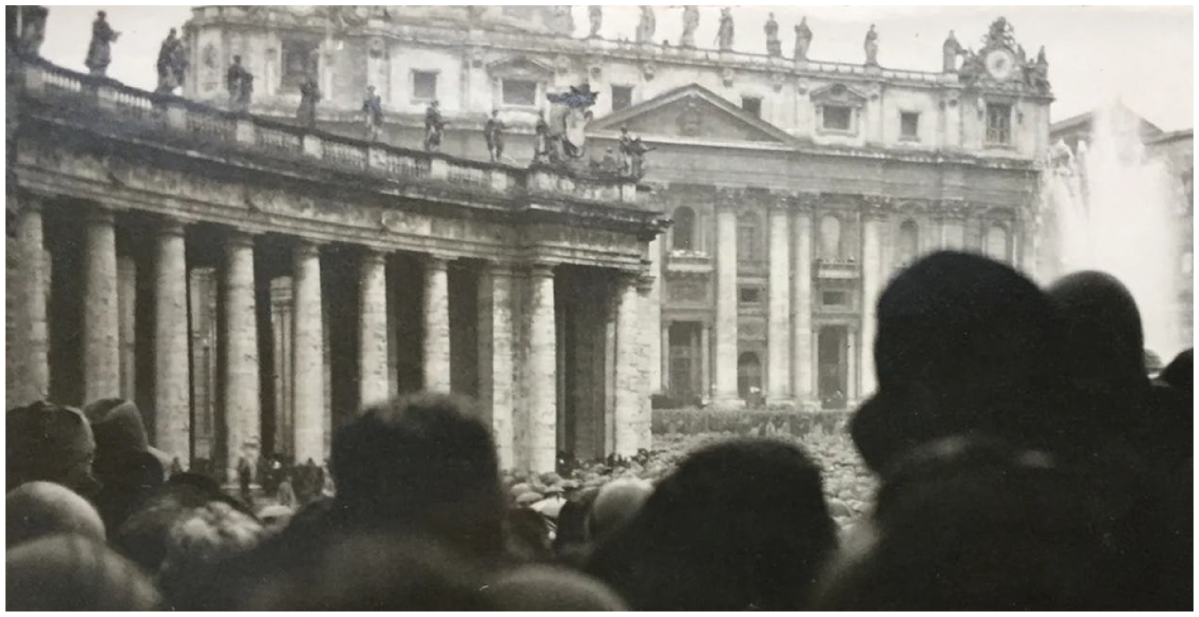
The Crowd in St Peter’s Square on 12 February 1929, awaiting the blessing of Pope Pius XI. Published with the permission of the Archivum Venerabilis Collegii Anglorum de Urbe.
However, it was not cinema per se that undermined the Catholic form. 18 In fact, cinema serves as a powerful lens through which to grasp the Church’s symbolic efficacy. After moving to Berlin in the summer of 1928, he took full advantage of its vibrant cinema scene. That November, he attended a screening of Theodor Dreyer’s The Passion of Joan of Arc. He recalled watching the movie “with great emotion, crying,” and returning home “satisfied” (Tagebücher 1925-1929, 234). He even planned to write an interpretation of it (239). If he admired the film so deeply, it is because it reflects one of his enduring Leitmotivs: the Roman Church’s capacity of “de-anarchizing Christianity” by defusing its charismatic phenomena while preserving their “legitimating effect in the background” (Glossarium, 184). Joan of Arc, canonized by Pope Benedict XV in 1920, was a prominent example of this dynamic. Her martyrdom, so carefully depicted in close-ups of her teary eyes, was finally trapped in the institutional frameworks of the Church (Figure 2). A complex symbol, Joan embodies both the intensity of religious charisma and the force of the Church’s bureaucratic machinery. Beyond that, she also functions as a personification of the motherland. Schmitt would later compare her to a telluric and defensive partisan. 19
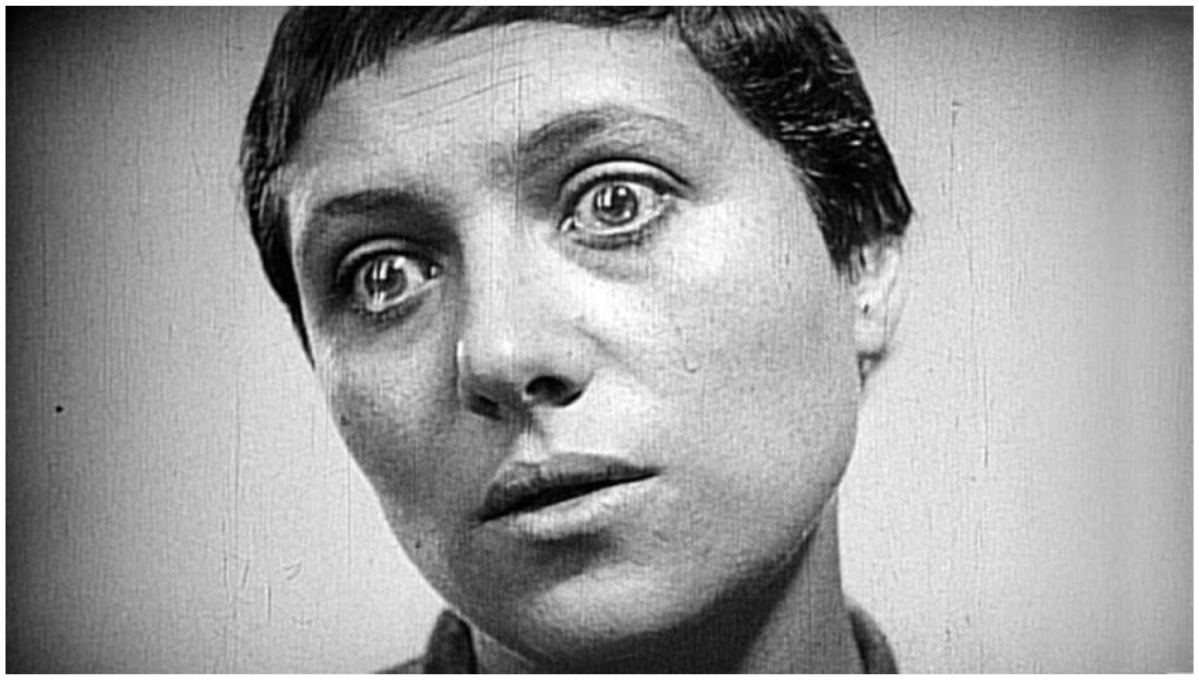
The Passion of Joan of Arc by Carl Dreyer (1928) . Public domain, photogram extracted from YouTube, GW Remasters (https://www.youtube.com/watch?v=P_gly_fIfEE&t=951s).
Opposite experiences in the cinema reveal that film can both capture true piety and expose it as a hollow performance. The problem, for Schmitt, is that the Pope cannot measure up to Dreyer’s representation. His charisma has become a marketed product, adulterated by “an alliance of bureau and altar” (Roman Catholicism, 24). The Pope’s ability to mediate the Catholic idea of civitas humana and, therefore, to obtain the “acclamation of the Church” has “been lost” (Tagebücher 1925-1929, 347). 20 But, if the Roman Catholic political form, emptied of its charismatic content, no longer functions as a compelling symbolic expression, the greater danger lies in what may rise to take its place. Mechanistic and economistic thinking might, contrariwise, achieve a symbolic maturity of its own and construct a leviathan with a counterfeit charismatic representative.
Whereas in Roman Catholicism, Schmitt claimed that “the personalism inherent in the idea of representation is human in the deepest sense” (33), the possibility of machines artificially mimicking human representation haunted his 1929 essay The Age of Neutralizations and Depoliticizations. There, he identified the emerging Soviet regime as cultivators of the “antireligion of technicity,” pushing it to “the ultimate conclusions.” 21 This entails the “evil and demonic” belief in the total “domination of man over nature, even over human nature” (94–95). The drift of a satanic “spirit” emerging out of the technical world would linger in his mind. 22 A decade later, Schmitt would refer to the state as a “Moloch” and to the possibility of the “personalistic element” being “absorbed” “into the mechanization process.” 23 In sum, Schmitt faces an impasse. The political form of the Church has been jettisoned from its charisma. The technological era might have found a way to erect a proper symbol. A different solution is needed.
Baroque Allegory Versus Myth: Early Benjaminian Traces
Alongside these developments, Schmitt actively explored the concepts of nation and myth as political resources. Myth ultimately allows him to embed the nation within a more solid theoretical structure, positioning it as the “antidote” to the “technobureaucratic” parliamentary democracy, to use John McCormick terms. 24 Schmitt elaborates on this argument in his 1923 The Crisis of Parliamentary Democracy. He draws heavily on the French thinker Georges Sorel and his idea of the myth of the general strike. 25 This is an article of “faith” that “binds the proletariat” together in the hope of a “monstrous catastrophe” that will ultimately lead to a subversion of “the whole social and economic life” (69). Unlike utopia, the myth is not born out of intellectual design but of the “genuine life” of the masses and gives a group “a historical mission” (68). This distinguishes a genuine political myth from the mythology of the Romantics, for whom “political reality” is simply an “occasion for subjective creativity” (160). For Schmitt, however, the best example of the political force of myths did not come from trade unions, but from fascism. He saw Benito Mussolini as a pioneer of the “irrational power of the national myth,” which founded an “authority” alternative to liberal democracy (75–76). He acknowledged that inherent in the myth is “the emanation of a political energy” that might offset the void left by the excessive mechanization of the liberal and communist state models (160). 26 Nevertheless, with foresight, Schmitt also warned of “the abstract danger of this kind of irrationalism” (76).
The idea of a substantive, nation-rooted myth provided Schmitt with a framework to construe, first, Italian fascism, then the Hindenburg government, and finally, the Nazi regime. 27 For a time, this functioned for him as a plausible third way, opposing both the rationalist mode of thinking that reduces political issues to technical-mechanical problems and the Church, which he viewed as lacking appeal. 28 This is evident in State, Movement, People (1933), where we encounter a further instantiation of the political symbol, following the Northern Lights and the Church: the personal incarnation of the people in the Führer. In this Nazi propaganda essay, Schmitt outlines the new legal and racial underpinnings of the Reich’s political order, highlighting the exceptional nature of the leadership exercised by Hitler. Contrary to the Roman Catholic concept of “sovereign power [Herrschaftsgewalt]” that remains “absolutely transcendent” to the governed, Hitler’s authority arises “from the concrete, substantive thinking of the National-Socialist movement.” 29 Such leadership, Schmitt argues, cannot be grasped through a “mediating image or a representative comparison [Vergleich],” forms he associates with “Baroque allegories.” In relation to the Führer, “all images fall short” (112, emphasis mine). The leader thus appears as the “immediate” and “real presence [Präsenz]” of his people, grounded in an “absolute ethnic identity [Artgleichheit]” (112). 30
What emerges here is a sharp contrast between two fundamentally different modes of visibility. On the one hand stands the embodiment of a totality—the “substance of a people [Volkssubstanz]” (103)—in the person of the Führer, analogous to the national myth Schmitt had earlier identified in Mussolini. On the other stands a representational logic he designates as “Baroque allegory,” which preserves a critical distance between the ideal represented and its representative. The pairing of “Baroque” and “allegory” is itself significant, marking a notable development in Schmitt’s conceptual vocabulary. In earlier writings, the adjective “Baroque” appears in a largely descriptive or incidental register: to refer in general to the artistic period (Tagebücher 1921-1924, 32), to describe the ornate style of Donoso Cortés, 31 or even to characterize a manner of smoking (Tagebücher 1925–1929, 489). Likewise, “allegory” had previously functioned in a loose, nontechnical sense. In The Visibility of the Church, it is used to describe the juridical relationship between the Church and Christ (56)—in private annotations, to refer to national personifications (Tagebücher 1921-1924, 442), and in The Guardian of the Constitution (1931), to critique Kelsen’s anthropomorphizing of legal norms. 32 This sharper conceptual distinction between symbolic and allegorical representation is also suggested by Schmitt’s revision of the 1933 edition of The Concept of the Political, where he replaces the earlier phrasing “metaphors or symbols” from the 1927 and 1932 editions with the more pointed contrast between “symbolic and allegorical figures of speech.” 33
My claim is that Schmitt derived the framework for this new opposition from Walter Benjamin. The first connection between the two thinkers is established by a well-known event: In 1930 Benjamin sent Schmitt a letter accompanied by a copy of his newly published Origin of the German Trauerspiel. In it, Benjamin acknowledges “how much the book owes to you in its account of the doctrine of sovereignty in the 17th century” and highlights the affinity of his art-philosophical method with Schmitt’s state-philosophical approach. 34 Following this exchange, a hint of Schmitt’s familiarity with Benjamin’s argument in Origin occurs in the preface to the 1934 edition of Political Theology, where Schmitt mentions the “recent” application of the idea of political theology to the “17th century monarchy,” conceived as “the god of Baroque philosophy.” 35 Though elliptical, this formulation directly resonates with Benjamin’s own citations of Schmitt in Origin, particularly regarding the “Baroque concept” of sovereignty and its “theological-juridical mode of thought.” 36 A few pages later, Benjamin alludes to the “theological hyperbole” of the Baroque through the “allegorical” comparison of the sovereign to the sun—an untenable image simply because, unlike the sun, multiple sovereigns exist (51–52). 37 Given these thematic convergences, it is likely that Schmitt consulted at least the passages in which Benjamin explicitly cites his work. The analysis that follows examines the textual interplays set in motion by this initial point of contact.
This line of inquiry, it must be noted, enters a contentious scholarly field. The tenor of the relationship between these two thinkers is deeply debated, and any attempt at reconstruction must therefore proceed with caution. 38 The explicit links were first brought to light by Schmitt himself in his 1956 Hamlet or Hecuba, where he cites both the personal letter Benjamin sent him in 1930 and the passages where Benjamin recognizes Schmitt’s intellectual influence (62). The year before, in a 1955 diary entry, Schmitt (Glossarium, 319) noted that he had been particularly drawn to Benjamin’s Origin while preparing his “Hamlet lecture.” 39 Even more significantly, in 1973, Schmitt revealed that with his 1938 book, The Leviathan in the State Theory of Thomas Hobbes, he intended “to respond to Benjamin” by focusing on “the symbolism of Leviathan,” overlooked by Benjamin. 40 Attention must thus be directed to this work.
The Autopsy of a Political Symbol
Schmitt’s focus on Leviathan as a political symbol of state power unfolds against the backdrop of his waning influence in the Third Reich. In 1936, a lapidary editorial in Das schwarze Korps, the official newspaper of the SS, severely damaged his reputation among the Nazi party establishment. 41 The following year, Schmitt published an article, “The State as Mechanism in Hobbes and Descartes,” in which he criticizes the French Catholic philosopher Joseph Vialatoux, who had identified Hobbes’s Leviathan with modern totalitarian regimes such as fascism, Nazism, and bolshevism. Schmitt argues that Vialatoux misinterprets Hobbes’s complex symbolism, overlooking the “half-ironic” intent with which the English philosopher operated (The Leviathan, 94). Far from promoting a personality cult around the leader, Hobbes sought to justify a “Baroque idea of representation of the 17th century” in which the sovereign is introduced as the animating element—the soul—of a “gigantic mechanism,” the “huge man” depicted in the frontispiece of Leviathan (98, emphasis mine). In his theory, Hobbes strives to make “personification [Personalismus]” compatible with mechanization (98). Yet, this juridical “person” constructed by means of a contract does not suffice to bring about “the totality of the state” (97). It is precisely to compensate for this deficit that Hobbes turns to the myth of the Leviathan. If his use of the biblical monster is only “half-ironic,” it is because he genuinely seeks a surplus of meaning that the legal-person model alone cannot deliver. For Schmitt, Hobbes believed that myth could concretize the otherwise abstract totality of state power. Hence, “totalization” necessitates “mythization” (100). But, as Schmitt reminds us, the three layers of this theory of the state—mechanistic, juridical, and mythical—are “irreconcilable with one another [miteinander nicht in Einklang zu bringende].” 42 Schmitt’s core insight, therefore, is that the state’s symbolic dimension must be distinguished from its Baroque-personified form, as they operate according to divergent logics of visibility. This distinction, as we shall see, is fundamental to Benjamin’s argument in the Origin and forms one of Schmitt’s most significant appropriations from it.
In 1938, Schmitt wrote to Rudolf Smend: “Why has nobody ever thought about what the Leviathan actually means as a symbol and political myth?” 43 That same year, Schmitt would publish The Leviathan, a book exploring the overlooked significations of this symbol. Although his claim to be a pioneering figure in this area might be somewhat exaggerated, Schmitt undeniably introduces a novel interpretive approach. Overall, the book traces a genealogy of the concept of the state from its philosophical inception with Hobbes and delves into its reliance on Old Testament mythology. 44 More pointedly, Schmitt conducts an autopsy on the state in its mythical form and identifies the “seed of death that destroyed the mighty leviathan” (57). As the subtitle clarifies, the work hinges upon the “meaning and failure of a political symbol.” Schmitt continues the trajectory of his previous article while considerably expanding its argument. He now denounces the slaying of the state by factious groups he labels as “indirect powers” (74), tracing the causes not only to contemporary German politics but also to an overtly antisemitic narrative about the insidious perversion of state theory. Yet the deleterious seed had already been sown by Hobbes, who left the “proviso” of an individualist reserve of freedom of conscience, immune to public power (56). This liberal inviolability of individual freedom is the cupio dissolvi of the state. Hobbes attempted to mend the fracture by invoking the symbol of Leviathan, a resource both deficient and excessive. It was deficient because the liberal germ of the Hobbesian foro interno would eventually justify a plurality of rights and agents that limit the power of the state. It was excessive because it marshalled a multitude of meanings impossible to hold in line, especially those that solidified an image of the state as an oppressive monster.
The tragic triumph of the old symbolic connotations over the Baroque idea of the state as a huge person is reinforced by Schmitt’s choice of a small vignette to adorn the front jacket of the book’s first edition (Figure 3). 45 This emblem is a cropped portion of a larger image from the Hortus Deliciarum by Abbess Herrad of Landsberg (Figure 4). 46 The original illustration depicts “God as a fisherman, Christ on the cross as a bait on a fishhook, and the Leviathan as a huge fish who took the bait” (The Leviathan, 8). But, removed from its full context, the vignette instead shows the Leviathan as a sea monster performing its swan song. The symbol is dead. Perhaps it is time to consider a different way of representing the state.
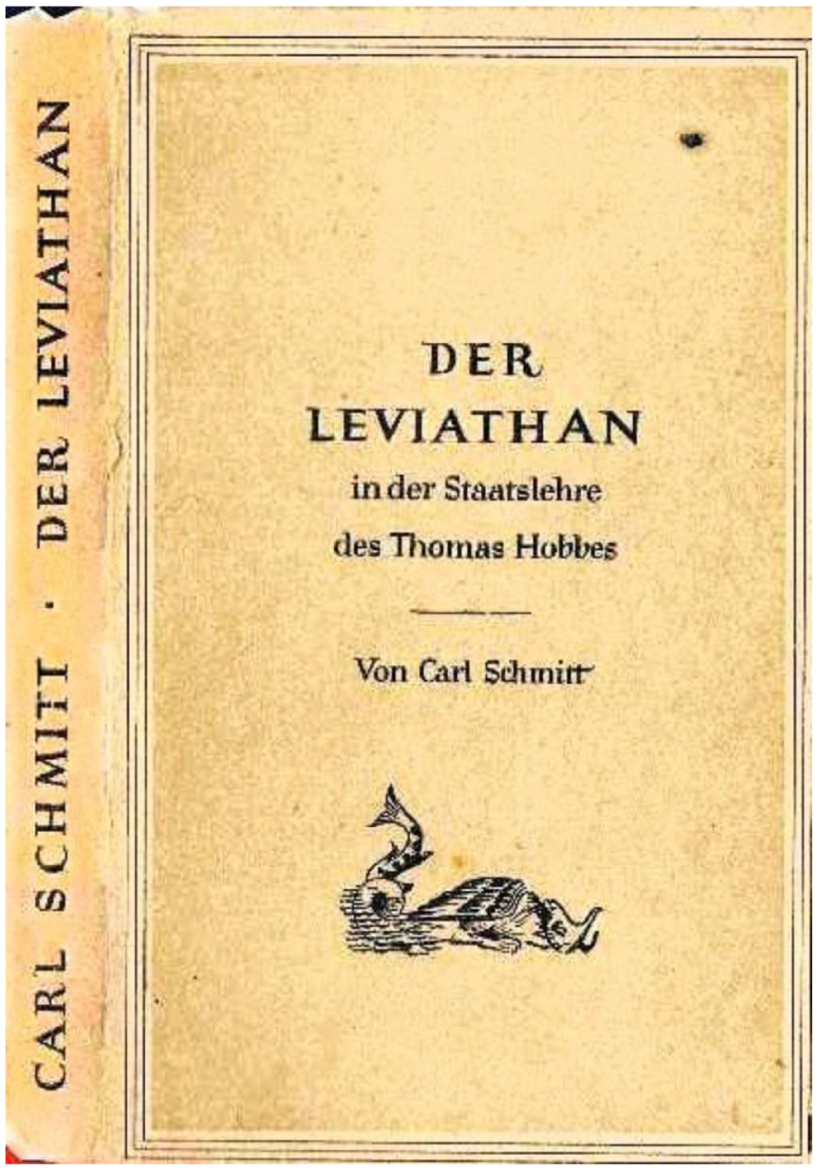
Jacket from the first edition of Der Leviathan. Public domain, via Wikimedia Commons (https://commons.wikimedia.org/wiki/File:Carl_Schmitt_-_Der_Leviathan_in_der_Staatslehre_des_Thomas_Hobbes,_1938.jpg).
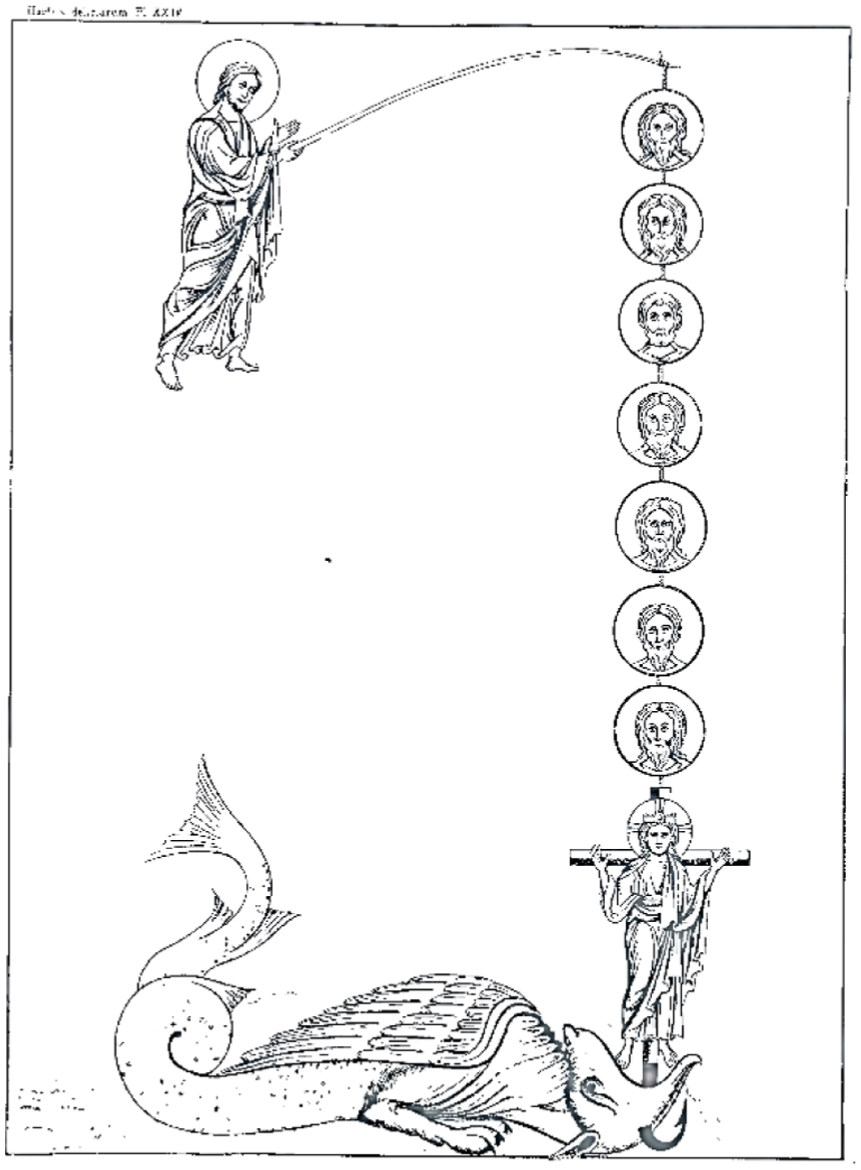
Hortus Deliciarum, plate XXIV: Leviathan caught on the hook of the Cross. Edited by A. Straub and G. Keller (Strasbourg: Imprimerie Strassbourgeoise, 1899). Public domain.
Benjamin’s Framework in Schmitt’s Leviathan
Schmitt’s analysis centers on exposing the fundamental failure of the state when conceived as a political symbol. He establishes this thesis early in his argument by claiming that the Leviathan, a powerful medieval symbol, was incompatible with a post-Renaissance aesthetic oriented toward “emblem” and “allegory” (The Leviathan, 22). This argument reflects a broader diagnosis of the decline of traditional symbols beginning in the sixteenth century (30n15). Schmitt’s critique of symbolic political forms thus develops in explicit contrast to Baroque allegory, an opposition already identifiable in his writings from 1937. To support this premise, Schmitt cites the 1915 work of Karl Giehlow, The Humanist Interpretation of Hieroglyphs in the Allegorical Studies of the Renaissance. 47 Focusing on his discovery of a translation of Horapollo’s Hyeroglyphica and on the triumphal arch of Emperor Maximilian I designed by Albrecht Dürer, Giehlow seeks to “lay out the foundations for the history of allegory of the Renaissance” (30). His thesis is that medieval allegory was transformed during the Renaissance by the introduction of the iconological language of Egyptian hieroglyphs.
This precise Giehlowian assessment of allegory is revisited and expanded by Walter Benjamin in his Origin: “The theory of allegory is crystallized around a number of ancient emblems” captured by “the Renaissance” “with unparalleled interpretive genius” (156). According to Benjamin, Giehlow describes a process that culminates in the “mature Baroque,” when allegorical emblems become more “hieratic,” thus differentiating them from symbols (178). 48 It is from this vantage point that Benjamin reconstructs the Romantic distinction between symbol and allegory. At issue is the problem of how we represent an abstract idea in a concrete form. 49 The Romantic movement placed the symbol above allegory, considering the latter as an outdated style from the Baroque era (200). As an exemplar of this position, Benjamin glosses the mythographer Georg Friedrich Creuzer’s 1819 study of symbols of the ancient world. While allegory designates “a concept or idea that is distinct from it,” thus substituting it, the symbol is “the idea itself bodied forth and rendered sensible,” the “concept itself has descended into the bodily world” (172). Benjamin seeks to push back and unsettle the “tyranny” of that hierarchy (169). He argues that the symbol stages a misleading totality, the illusion of “salvation” in a fleeting moment of “sublimation,” as if a concept could be wholly and materially rendered in our concrete, fallen reality (199). 50 In this view, symbolism is the form of expression that serves totalizing dreams. Conversely, allegory evinces the “fragmentary” character of reality. Baroque poets, like “alchemists,” tried “arbitrarily arranged” “emblems” to express an idea (201). 51 In closing, Benjamin draws on Creuzer and Giehlow to develop a “philosophical-historical” outlook of the matter, portraying the sixteenth century as the time when “love for the allegorical” thrived, while “the symbolic” “had to disappear” (176). This is the theoretical framework underpinning Schmitt’s identification of two contradictory aesthetic languages in Hobbes’ Leviathan.
Reinhard Mehring (“Geist ist das Vermögen,” 243–45) has carefully analyzed the engagement of Schmitt with Benjamin’s thought, focusing on Schmitt’s extant copy of the Origin, filled with pencil and ink annotations. Mehring’s central claim is that Schmitt sought to retrospectively position Benjamin as one of his former philosophical interlocutors to profit from Benjamin’s rising reputation in postwar Germany’s intellectual scene (255). According to Mehring, Schmitt’s first thorough reading of the Origin should be traced to 1949, with the more profuse ink remarks corresponding to the period when he was preparing Hamlet or Hecuba (245). However, he does not rule out the possibility of an earlier reading in the 1930s (245). It is this alternative that I wish to support.
As we have seen, a critique of Baroque allegory as a weak representational form of power already emerged in State, Movement, People (1933), and a distinction between symbol and allegory is further elaborated in The State as Mechanism (1937) and The Leviathan (1938). Taken together, these elements provide evidence of Benjamin’s early influence on Schmitt. 52 In fact, Schmitt kept the original copy Benjamin gifted to him for twenty years and paid sufficient attention to it back then to return to the same copy when he—or the “mysterious hand that steers us as we reach for books”—found it appropriate. 53 Furthermore, the marginalia on the first pages of the book Benjamin sent to Schmitt are particularly meaningful to my thesis, as they directly underscore the distinction between symbol and allegory. Schmitt begins with a reference to the “boundlessness of allegorizing,” citing the Song of Songs as prime example. 54 This suggests that the figure of allegory was a key takeaway from his reading. 55 On the next page, Schmitt’s handwritten notes include a bullet point on “symbol” and the observation that “Leviathan is missing” from Benjamin’s analysis.
All in all, Schmitt’s retrospective claim of having engaged with Benjamin’s Origin in the 1930s coincides with a more nuanced treatment of symbol and allegory in his own work. Prior to this, Schmitt’s understanding of these concepts was less systematic, as seen in his reading of Däubler’s Nordlicht. In Political Romanticism, in which a thorough exploration of these concepts might be expected, Schmitt offers only a cursory mention of “Creuzer’s symbolism,” without further elaboration (152). By contrast, Benjamin extensively discusses Creuzer’s distinction between symbol and allegory, as well as Giehlow’s interpretation of the transformation of allegory during the Renaissance. This was the framework that furnished Schmitt with the conceptual tools to regard them as distinct forms of expression. Specifically, it provided three crucial points of orientation. First, broadly construed, Benjamin’s argument challenges the aesthetics of Romanticism, which Schmitt had consistently found deficient. Second, it clarifies Hobbes’s failed attempt to use the Leviathan symbol to confer a measure of transcendence on the machinelike state. According to Benjamin, the symbolic genre inevitably falls short in its effort to render a conceptual totality concrete. 56 Third, it introduces a historical dimension into Schmitt’s understanding of the aesthetic expression of political concepts: While symbolism is tied to medieval times and revived by Romanticism, allegory is linked to the Baroque period. 57 Schmitt’s Second World War–era writings would bear an even clearer Benjaminian imprint in this respect.
The Nomos of Allegory
Symbolism features prominently in Land and Sea (1942), a text that may be defined as a children’s fable enmeshed with Nazi Germany’s international outlook, if such terms can indeed fit in a phrase. 58 The tone of the book is more heuristic and playful than intellectual-historical: Schmitt intends to explain global history by means of the opposition of two basic elements, earth and water. In doing so, he draws on a reservoir of archetypal symbols, most notably Leviathan and Behemoth (7). While he endorses the use of such figures as “collective signifiers,” he confines symbolism to a premodern horizon, suggesting it is no longer adequate for making political entities visible (9–10). Venice is singled out as “the symbol of dominion of the sea,” bestowing “a mythic consecration to sea-born power,” not only through “diplomatic superiority” but also through “festivals and artistic beauty” (18–19). Although its legend continued to attract the interest of “romantics from all European nations,” the heyday of this “fabled queen” occurred between the years 1000 and 1500 (19–20). The latter date marks the end of the era when symbolism could still function effectively as a language of state power.
The basis for this claim is laid out in The Nomos of the Earth, published in 1950 but written in the midst of the Second World War. In this impressive survey of European international law’s history, Schmitt reexamines the boundaries of symbol and allegory, emphasizing the nonsymbolic origin of the concept of the state. The book begins by considering Earth and Sea “in mythical language.” 59 According to Schmitt, prior to the sixteenth century, there existed a “pre-global image of the world,” in which “concepts of the world and of its peoples, remained in the mythical sphere” (52). However, such beliefs could not survive the age of great discoveries and navigations, nor the advancing frontiers of geography and science. The modern, post-mythical vision of the world was carved out by European powers and presupposed a reconfiguration of their own continental space. This led to the establishment of a new juridical framework in which the main protagonists were the emerging European states, each independent and involved in horizontal, regulated relations of peace and war. Crucial to my thesis is Schmitt’s explanation of how these nascent international players were conceptualized.
European international law relied on a “new institution called ‘state’” (143). States are defined by Schmitt as “contiguous and contained power complexes [Machtgebilde],” which rulers projected into the world as living “persons” or “magni homines.” 60 Schmitt notes that this “personification process” was driven by an “allegorizing [allegorisierende] tendency” that began in the Renaissance but fully matured “in the Baroque Age” (144–45, emphasis mine). Consequently, European jurists grew accustomed to reasoning “in terms of the personification of political powers,” speaking of Spain, England, France, Venice, and Denmark “as great individuals” (145). This origin story for the modern state dovetails neatly with Walter Benjamin’s account of the Baroque, marked by the employment of “allegorical personification” as a means to bestow a “more imposing form” upon ideas (Origin, 200). Further proof that Schmitt might be drawing this insight from Benjamin’s theory of allegory can be found in his correspondence with Roman Schnur in 1972. In the context of a discussion on the formation of modern European public law, Schmitt directed Schnur’s attention to two specific pages in his Nomos of the Earth, the very ones discussed previously, and suggested exploring “an interdisciplinary connection” between Franz Jerusalem’s Völkerrecht und Soziologie (1921), explicitly referenced on those pages, and Walter Benjamin’s Origin of German Tragic Drama. 61 The connection Schmitt hints at undoubtedly concerns the characterization of states as persons through allegory.
Jerusalem’s short treatise outlines a transformation in sixteenth-century international relations, where sovereigns began to be viewed as “bearers of abstract power,” representing their “people, or the state conceived as a legal person.” 62 Jerusalem attributes this shift to the intellectual contributions of Jean Bodin and, more broadly, to the expansion of the theatrical practices of French courts. The diplomatic arena, he suggests, increasingly resembled a continental-scale court, with rulers consciously adopting refined forms of “gallantry” to express mutual recognition of sovereignty and “spheres of power” (10). The entire system ultimately hinged upon the “heightened self-awareness” of sovereigns, who consciously performed their roles as personifications of their respective states (11). 63 This performative understanding of sovereignty resonates with a central topos in Benjamin’s Origin—namely, “the court” as “the innermost setting” of Baroque plays and, significantly, of “allegorical” representation (82). Schmitt draws on the same theoretical framework in his Völkerrechtliche Großraumordnung (1939/41), when he refers to the “Baroque-theatrical conception” of state power in international affairs. 64
This triangulation does more than merely reveal Benjamin’s subtle influence; it marks a significant breakthrough in Schmitt’s account of state visibility. The allegorical personification of the state—hieratic, codified, and theatrically staged—was precisely what the new European international law needed to stabilize and regulate mutual relations among sovereign political units. Rather than entities imbued with symbolic (and thus uncontrollable) connotations, the nomos required state personifications that could speak and act via their representatives. What the symbol failed to unify into a single coherent form, as Hobbes’s project had demonstrated, the Baroque and theatrical allegory retained as dual and ambiguous. Allegorical representation is always external. In this regard, the intellectual force behind the ius publicum Europaeum is less Hobbes than Jean Bodin. “Humorless” precisely due to his awareness—and perhaps attraction to—the excessive power of religion and demonology, Bodin is recognized by Schmitt in Ex Captivitate Salus as the architect of the “domestically and internationally sovereign state” (53–54).
The State on Stage
In the allegorical mode of thinking, the ruler, akin to an actor on stage, articulates the speech and sets in motion actions of the state’s “moral person” (Nomos, 142–44). To illustrate this duality, Schmitt again turns to Venice. Unlike Land and Sea, here Schmitt shifts his attention from symbolism to the immensely rich and meticulously crafted trove of allegories that the Serenissima boasts. He references two works. Firstly, the Ragguagli di Parnaso [Reports from Parnassus], published in three volumes, from 1612 to 1615, by Traiano Boccalini. 65 In a satirical vein, Boccalini critiques the political and intellectual landscape of his time through dialogues set in Parnassus, where allegorical characters such as the Most Serene Venetian Liberty or the Ottoman Empire converse with deceased luminaries like Seneca and Jean Bodin (55–58, 89, 109–12, and 278–88). Schmitt considers this work an illustration of “personalization through allegorization [Allegorisierung],” in which Venice, France, Spain, and England are “some of many ‘persons’ spoken of and dealt with” (Nomos, 144n5).
Secondly, Schmitt claims that “Shakespeare’s dramas, to the extent that they are political, also are determined by the same principle of political personalizations.” He focuses on Othello in virtue of its significant use of the word “state,” likely thinking of the instances in the tragedy where the Venetian state is treated almost as an active character in the narrative. Schmitt notes that his interpretation of the text was influenced by Lilian Winstanley’s book Othello as the Tragedy of Italy (1924). 66 Winstanley’s argument further supports my thesis as she claims that Shakespeare should be read contextually, asking what his story meant for his contemporaries (11). This signifies identifying his use of “vivid metaphor,” through which abstract characters or topoi represent real people of Shakespeare’s times or, vice versa, characters of human beings personify political entities (12 and 20–23). In essence, Winstanley advocates for a reconstruction of the allegorical way in which these works were coded—particularly the relationship between Othello and Desdemona, which she interprets as an allegory of the tragic alliance between the Kingdom of Spain and the Republic of Venice (50). She asserts that “the state of Venice is officially present at all the great crises of Desdemona’s life” (25). Significantly, Winstanley refers to “Venetian painters,” who “represented their republic as a beautiful woman,” and to Traiano Boccalini, who “personified” both Venice and Spain as ladies (49 and 70).
Likewise, for Schmitt, Othello provided the stage and the visibility required by the nascent concept of the state. This interpretive key is revisited in Hamlet or Hecuba, where Schmitt addresses the subject of “political symbols and allegories in Shakespeare's drama,” deeming it necessary to link Winstanley’s theses “with the thoughts of Benjamin” and to explore more deeply “the problem of allegory” (26n15, emphasis mine). He further observes that “a brief indication may be found in my book, The Nomos of the Earth,” referencing the pages we have discussed. Schmitt’s engagement with Benjamin’s theory of allegory is now as explicit and public as it can be. According to the German jurist, Hamlet’s contemporary audience would have decoded the play allegorically, discerning the future King James I behind the guise of the Danish prince (26n15). This political immediacy constitutes the play’s realistic core—the intrusion of time that transforms it into a tragic narrative (25). However, unlike Othello, Hamlet does not follow a “trajectory toward the sovereign state” (62). In an appendix intended as a response to Benjamin, Schmitt (63) argues that Hamlet remains fraught with “medieval barbarity,” insufficiently “polished [poliziert]” to achieve the “Baroque theatricalization of life” that he deemed essential to the crystallization of the modern state (41). 67 In fact, once detached from its historical context, Hamlet evolves into a “living myth,” with “inexhaustible mutability” (8). 68
As Schmitt had already anticipated in The Leviathan, it was the nonsymbolic, hieratic state that, from the Renaissance onwards, “defeated the estates and the church and governed public events and the politico-historical stage” (58). Now, if the Leviathan failed as a symbol, not all of Hobbes’s insights are to be abandoned. After all, Hobbes was the first to articulate the theatrical framework of the state, conceiving it as a persona or mask represented by the sovereign and mounted on a complex machinery as if “on a public stage” (34). Moreover, the idea of the state as a super-person understood through the lens of allegorical personification is also associated with Hobbes (19, 34, and 98). It is no coincidence, then, that Hobbes shares with Bodin the distinction of being a “midwife” of the modern state (Ex Captivitate Salus, 54).
Allegory Between History and Theory
Schmitt’s genealogy of the allegorical foundations of the state is not merely a sophisticated exercise in legal history; it also constitutes an intervention in contemporary political problems and in political theory more broadly. The weight he accords to allegory becomes fully intelligible only in light of his diagnosis of the unraveling of Europe’s political order. 69 Facing the continent’s shattered political landscape after 1945, Schmitt gestures toward a pathway analogous to the Westphalian system that emerged from the devastation of the religious wars (Nomos, 141). As in that earlier conjuncture, allegory here functions as a means of shoring up the fragments against those ruins and reconstructing a Großraum—a spatial order governed by a renewed ius publicum of juridically symmetrical states-as-persons. This vision marks a deliberate departure from the aspiration to incarnate peoples or nations in totalizing symbols, which Schmitt deemed too explosive for establishing a nomos on which European states could base their international relations. Yet if Schmitt deploys this Benjaminian device, he does so within an entirely un-Benjaminian theologico-political horizon. 70 In his Theses on the Philosophy of History, Benjamin famously argued that the picking up of history’s “pile of debris” is reclaimed by the past generations, whose call for “redemption” endows the present with “a weak Messianic power.” 71 For Benjamin, allegory is the representational mode suited to a fragmented reality that can never be redeemed by a totalizing symbol. 72 By contrast, Schmitt is concerned not with revolutionary redemption, but with averting complete disintegration. 73 The figure he has in mind is that of the katechon, the restrainer or delayer. Historically, the katechon was an “office” associated with the Holy Roman Emperor as guardian of Christian unity during the Middle Ages (Nomos, 62). 74
In the aftermath of the Second World War, what Schmitt sought to delay was the dissolution of the European nomos. Squeezed between the West and the East (280), the continent faced once again the risk of becoming a “world-historical cadaver” (292). For Schmitt, Europe represented a bulwark against what he foresaw as the new totalizing forces, the US and the USSR, each laying “global claims to world power” (245 and 296). Crucially, the resilience of the European nomos ensures the survival of the constellation of concepts it sustains, most notably, “the clear decisionism of continental statehood,” land occupation, the exercise of authority based on protection and obedience, and the Baroque notion of a “theater of war,” where sovereign states engaged symmetrically in friend/enemy relations (142–44, 178, and 317). By contrast, a world order subordinated to the universalist ambitions of a single hegemon leads not just to disorientation but to the disappearance of the political tout court, as no other actor remains capable of deciding on war. 75 Well into the twenty-first century, Schmitt’s warning about the “relativization of Europe” (217) and its dwindling political weight continues to provoke debate. 76 Yet, the very persistence of this question suggests that the European nomos, however exhausted in its katechontic role, dies harder than Schmitt might have foreseen.
Conclusion
Schmitt undertook a significant tour de force in his quest to elucidate the visibility of the state. After an initial fascination with the redemptive Northern Lights, he turned to the Roman Catholic Church as a symbol, admiring how it integrated its juridical and bureaucratic structures with the personalistic and charismatic features of representation. However, he soon became disenchanted as even the Church succumbed to modern mechanization. Shifting his focus, he then explored the symbolic genre of the national myth and Hobbes’s Leviathan as the paradigmatic representation of the state. These, too, proved inadequate, insofar as they released excessive irrational energies. To assess these shortcomings, Schmitt adopted Walter Benjamin’s framework. Benjamin also supplied an alternative model for rendering power visible: allegory. In his reflections on the origin of the now-lost European spatial order, Schmitt identified as its basic component the personified state represented allegorically by a sovereign. Unlike the totalizing aspirations of the symbolic genre, this model maintains an external relation between personifier and personified. It was this allegorical thinking that gave rise to the system that regulated conflict among European states. Whether Schmitt believed this conception remained viable is unclear, but its resonance with postwar Europe’s fragmentation—and even with contemporary debates—suggests that the jurist was navigating an intriguing path.
Footnotes
Acknowledgements
The author is grateful to Connor Grubaugh, Bruno Ruffier, Peter Schröder, Samuel Zeitlin, the participants in the 2024 Politics & Poetics Conference, and two anonymous reviewers for their generous and incisive feedback.


Funding
The authors disclosed receipt of the following financial support for the research, authorship, and/or publication of this article: The research for this article was funded by a Marie Sklodowksa Curie Actions Postdoctoral Fellowship (Grant ID: 101057315) and a British Academy International Fellowship (IF24/100496).
Declaration of Conflicting Interests
The author declared no potential conflicts of interest with respect to the research, authorship, and/or publication of this article.