







Abstract
A recent survey of 19,261 university students in Canada revealed the Government of Canada as the employer of choice, among the millennial generation. Drawing on the employer knowledge framework, we explore how the Millennials make career choices, what they find attractive, and how public service may help them achieve their career goals, work values, and work/life choices. Specifically, the Millennials prioritized balancing personal life and career, pursuing further education, and contributing to society as their top career goals. Those who indicated a career choice in public service also rated high ethical standards, social responsibility, and a progressive working environment as ideal employer characteristics. Moreover, the Millennials also consider an inclusive work environment and having diverse colleagues to be important factors when accepting employment. Overall, there appears to be a good fit between the factors the Millennials find important and a career choice in public service. Implications for theory and practice are discussed.
Introduction
One of the most pressing and significant challenges facing Canada involves the labor force and its aging population (Burke & Ng, 2006). The baby boomer generation currently in the workforce is reaching retirement age and leaving the labor market in large numbers. The proportion of working age population (15 years and older) in relation to the total population is projected to fall over the next 20 years, from approximately 70% in 2006 to about 62% by 2031 (Statistics Canada, 2007). Canada’s public service, much like its private sector counterpart, is facing the prospect of a massive shortage of knowledge and managerial workers (Templer & Armstrong-Stassen, 2005). To this end, the federal government has responded with an aggressive immigration policy aimed at providing skilled workers to the Canadian economy. The result is an increasingly diverse workforce in terms of race and ethnicity, requiring employer efforts to manage diversity (Benhamadi, 2003). Complementing this trend, young workers (Generation Y or Millennials) are also entering the workforce for the first time, bringing with them unique values and expectations that employers have not had experience hiring and managing. Given the tightening labor market and the demand for skills, it will be the Millennials who will be selecting which organizations they want to work for. Therefore, the challenge of attracting a new generation of workers into the public service is an important one. We draw on two strains of research in an effort to understand the challenges Canadian public sector employers may face in attracting the next generation of civil servants. First, we use Cable and Turban’s (2001) employer knowledge framework to explore how the millennial generation, presently attending universities, make career choices and what they find attractive about the employer characteristics and job attributes in the public and private sectors. Given the stereotypes that persist among the Millennials, we also explore the extent to which a career choice in public service may fit with their work values, career goals, and work/life choices. Second, we turn to the literature on public service motivation, particularly the work by Perry and Wise (1990) and Vandenabeele (2008). Here we assess whether differences, if any, between students who indicate a preference for government employers rather than private sector employers are related to elements these authors have identified as characteristic of the “public service motivation” construct.
Millennials
In 1996, David Foot used the term Baby Boom Echo to describe a cohort of children born between 1980 and 1995. These are the children of the boomers, and there are 6.9 million of them in Canada (Foot & Stoffman, 1998). This cohort has grown up in an era characterized by globalization, rapid technological advancement, and increasing diversity (Burke & Ng, 2006). They also exhibit values, traits, and behaviors that are very different from those of previous generations (Loughlin & Barling, 2001; Smola & Sutton, 2002). Given their characteristics and the events that define their lives, various authors have labeled them as Generation Y, Millennials, Nexters, and the Nexus Generation (Barnard, Cosgrove, & Welsh, 1998; Burke & Ng, 2006; Zemke, Raines, & Filipczak, 2000). In this study, we will use the term Millennials in keeping with popular press.
A review of the current literature on the Millennials indicates that they have been raised with increased self-esteem, narcissism, and a sense of entitlement (Twenge & Campbell, 2008; 2001). Stuart and Lyons (2008) noted that Millennials “believe they possess the talent and the intellect to achieve their goals, and are acutely focused on their own success.” Millennials feel empowered to do anything they want, and they have great expectations for fulfillment and meaning in their work (Twenge & Campbell, 2008). Millennials are also constantly looking for ways to lead more purposeful and interesting lives, and seek out intrinsic rather than extrinsic rewards. As a result, they are increasingly looking at a company’s (Lancaster & Stillman, 2002; Yang & Guy, 2006) values and mission and want to work for those firms that go beyond simply making money (Corporate Leadership Council, 2005). Many are said to have a desire to “save the world,” and are likely to have high expectations for social responsibility and ethical behavior on the part of their employers (Jackson, 2009).
Like the Gen Xers, Millennials also saw their parents and others downsized and dismissed from their jobs during the 1980s and 1990s (Loughlin & Barling, 2001; Smola & Sutton, 2002). Consequently, many have come to value job security, re-evaluate their priorities, and demand more work/life balance (Corporate Leadership Council, 2005). Of particular note, Millennials have been reported to be more tolerant of and have greater respect for diversity (Lowe, Levitt, & Wilson, 2008). This is not surprising given that the Millennials have gone to school with children from other ethnic and cultural groups, and have also been constantly exposed to messages of equal treatment for all (Ng & Wiesner, 2007). Furthermore, many young women were also raised by their mothers who were first generation feminists, and while they may not be feminists themselves, they are better equipped to break any glass ceiling barriers they encounter having been given very high self-esteem by their parents (Fuller, 2008).
In summary, the millennial generation appears to be self-assured, ambitious, have a strong social conscience, value diversity, and want to make a contribution. Based on the stereotypes that persist among the Millennials, we have a reason to believe that a career choice in public service may fit with their personal values, career goals, and work/life choices. In this article, we apply Cable and Turban’s employer knowledge framework to explore the career goals among the Millennials. We also compare their perceptions of public and private sector employer characteristics, and document the reasons why the Millennials may find a career choice in public service to be attractive. We focus our inquiry on public service because the Millennials have indicated the Canadian federal government as the employer of choice in this study.
Theoretical Framework
Employer Knowledge Framework
We begin by “going inside the heads” of the Millennials to understand their career goals what employer characteristics they find attractive, and specific work attributes in public service and private sector they find appealing. We draw on Cable and Turban’s employer knowledge framework to understand the career exploration of the Millennials and how they make job choice decisions. Cable and Turban (2001) defined employer knowledge as “beliefs that a job seeker holds about a potential employer” (p. 115). This knowledge is important because it predicts a job seeker’s behavior such as attending a career fair, applying for a position, and accepting a job offer (Aiman-Smith, Bauer, & Cable, 2001; Collins & Stevens, 2002).
According to Cable and Turban, applicants broadly evaluate employers based on three dimensions, which they labeled “employer information,” “job information,” and “people information.” Employer information refers to attributes such as organization size, geographical location, reputation, policies and practices. Job information refers to attributes about the specific job the applicant is considering, such as the work itself, pay levels, and advancement opportunities. Finally, people information refers to the types of individuals who would be potential coworkers to the job seeker. Research has shown that the three dimensions are related to job applicant attraction. For example, job seekers may be attracted by an organization’s reputation for being dynamic and innovative (Feeney, 2008; Highhouse, Thornbury, & Little, 2007; Lievens & Highhouse, 2003), the organization’s social responsibility record (Greening & Turban, 2000), its pay and promotion policies (Aiman-Smith et al., 2001), and the presence of minority groups, such as African Americans, when the job seekers are of minority status (Highhouse, Stierwalt, Bachiochi, Elder, & Fisher, 1999; Ng & Burke, 2005). Therefore, in this study, the dimensions from the employer knowledge framework will serve to guide in the analyses of job choice decisions among Millennials.
Public Service Careers
One of the ongoing issues in public personnel management discussions concerns whether there are differences between people who chose a career in public service and those who seek careers in business, and, if so, what those differences might be. Previous studies have shown that these differences come from demographic characteristics such as gender, race, and age (Bright, 2005; Lewis & Frank, 2002), work values (Lyons, Duxbury, & Higgins, 2006; Taylor, 2005), attitudes toward public service (Feeney, 2008; Perry & Wise, 1990), and attributes associated with the employer (Frank & Lewis, 2004; Jurkiewicz, Massey, & Brown, 1998; Rainey, 1999; Wittmer, 1991). Women and minorities were more likely to prefer government jobs, given that the government has better enforcement of antidiscrimination practices, and gives preferential hirings to members of “protected groups” (Benhamadi, 2003; Lewis & Frank, 2002). On the other hand, younger workers (<30 years of age) were less likely to want and have government jobs, as many have grown up being cynical about government (Gallup Poll, 2008; Lewis & Frank, 2002). However, recent calls for service in the United States by President Obama may have created a renewed interest in public service among young people (Barnes, 2009; Zeleny, 2007).
Differences in work values also exist between public and private sector employees. Work values are generalized beliefs about the desirability of various aspects of work (e.g., pay, autonomy, working conditions), and work-related outcomes (e.g., accomplishment, fulfillment, prestige; Lyons, Duxbury, & Higgins, 2005). In general, public sector employees value intrinsic rewards (meaningful and interesting) work over extrinsic rewards such as money and prestige (Buelens & Van den Broeck, 2007; Houston, 2000; Wittmer, 1991). Employees in public service were also more likely to report a sense of accomplishment (Houston, 2000), meaningful and interesting work (Jurkiewicz et al., 1998; Pattakos, 2004), and contributing to society (Lyons et al., 2006), than their private sector counterparts. Furthermore, having a sense of influence (being able to make a difference) is important to work satisfaction, as it contributes to the intrinsic satisfaction among public service managers (Falcone, 1991). Individuals in public service may simply view working as being more about serving the community and less about getting an income and prestige (Taylor, 2005).
We note that although public sector employees may be intrinsically motivated, it does not mean they value extrinsic rewards (e.g., money) any less. Public service employees may simply place a lower emphasis on extrinsic rewards because the government offers so few of them (Taylor, 2005). Individuals who choose to remain in public service may rationalize that salary is not a major priority (Houston, 2000). Alternatively, they may substitute the lower salary with other work preferences such as job security, good working conditions, and work/life balance (Buelens & Van den Broeck, 2007; Houston, 2000; Lewis & Frank, 2002; Wittmer, 1991).
In addition, Taylor (2005) reported that those who showed an interest in joining public service in Australia were found to display a public service ethic. Perry and Wise (1990) termed this ethic as public service motivation. Accordingly, these individuals possess altruistic motives and are drawn to careers in public service because of a desire to serve the public, effect social change, and shape policies that affect society (Lyons et al., 2006; Perry, 2000). Indeed, despite an early study by Gabris and Simo (1995) that found little evidence of motivational differences between public and private sector employees, more recent studies have found public service motivation to predict a career choice in public service (Vandenabeele, 2007, 2008), job satisfaction (Gabris & Simo, 1995; Taylor, 2007), organizational commitment (Steinhause & Perry, 1996; Taylor, 2005), intention to remain with the government (Naff & Crum, 1999), and support for government reinvention efforts (Naff & Crum, 1999). Furthermore, individuals who exhibited a greater concern for others and engaged in altruistic behavior (e.g., volunteering), also displayed strong motivations for public service (Coursey, Perry, Brudney, & Littlepage, 2008; Perry, Brudney, Coursey, & Littlepage, 2008).
Millennials may be attracted to public service for a number of reasons. As indicated earlier, there is some evidence to suggest that the millennial generation is socially conscious and want to make a contribution. A recent report, Viewpoint, documented that the Millennials are the most engaged generation in some time, and are concerned with everything “saving the world” (Jackson, 2009). Altruistic behaviors such as volunteering and self-sacrifice have been shown to be related to motivation for public service (Coursey et al., 2008; Perry et al., 2008). Second, the Millennials are seeking intellectual stimulation, interesting, and satisfying work (Ng, Lyons, & Schweitzer, 2010). These work values have also been found to be similar to those reported by public service employees (Houston, 2000; Lyons et al., 2006). In a survey of Australian university students, Taylor (2005) found students who indicated an interest in public service were most likely to value intrinsic rewards over extrinsic ones, including a preference for work/life balance. Third, while no study has directly linked a career choice in public service with social responsibility, previous studies in the private sector found job seekers to be attracted to a firm’s environmental and social responsibility reputations (Greening & Turban, 2000). On this basis, Vandenabeele (2007) found public service motivation to be related to making decisions for political, ethical, and environmental reasons. Given recent ethical failures among private sector employers and increasing social and environmental awareness among the younger generation (Ng & Burke, 2010), a career in public service may be an alternative to those who distrust large multinational corporations.
In this study, we seek to explore differences among Millennials who indicate preference for a career in public service vis-à-vis the private sector, by examining (a) their career goals and (b) what they identify as attractive in a potential employer with respect to employer characteristics, people, and job attributes. Given that this is an exploratory study, no a priori hypothesis is assumed. Instead, our study will allow us to compare employer characteristics (including other work dimensions such as job attributes and the people dimension of work) that have not traditionally been considered in studies of career choice in public service. Moreover, our study allows us to look at a range of employer characteristics to determine whether significant differences on these issues can be discerned between those desiring public and private sector employment.
Method
Data were made available to the researchers by Brainstorm, DECODE, and Universum, as part of their “From Learning to Work Report” on employer brands. The survey aims to provide an insight into students’ attitudes and their views of employers, career opportunities, and the future of work. A total of 34,632 Canadian postsecondary students completed the survey over the Internet in 2007. Given our research interests, we reduced the sample in several ways. First, we included only students from the millennial generation, that is, only respondents who were born after 1980. Second, we only included those students who, when asked “what type of organization” they wanted to work for after graduation indicated a preference for working in either the “government/public service” sector (i.e., public sector), or for a small, medium, or large company, or to start their own business (i.e., private sector). We also limited inclusion to respondents who were pursuing a university degree, as these students represent a major source of hiring for skilled jobs such as managers, professionals, and technical workers for the government and private sector employers. This yielded a final sample of 19,261 students, which represents 55.6% of the original data set.
Sample
Table 1 shows the demographic characteristics of the sample. Most of the respondents were pursuing an undergraduate degree (93.7%). The students’ fields of study included business (42.1%), engineering (25.7%), science (17.5%), liberal arts (16.3%), and information technology (IT; 6.6%) (note: number may not add up to 100% due to double majors). Women were also more numerous than men (58.8%). In addition, the sample included Aboriginal peoples (1.0%), persons with disabilities (1.1%), visible minorities 1 (20.7%), and sexual minorities (2.4%). Students from all 10 provinces and three territories were represented in the sample, with most respondents coming from Ontario (45.4%), followed by British Columbia (16.3%), and Alberta (10.5%).
Demographic Characteristics of the Sample (Millennials, Born on or After 1981).
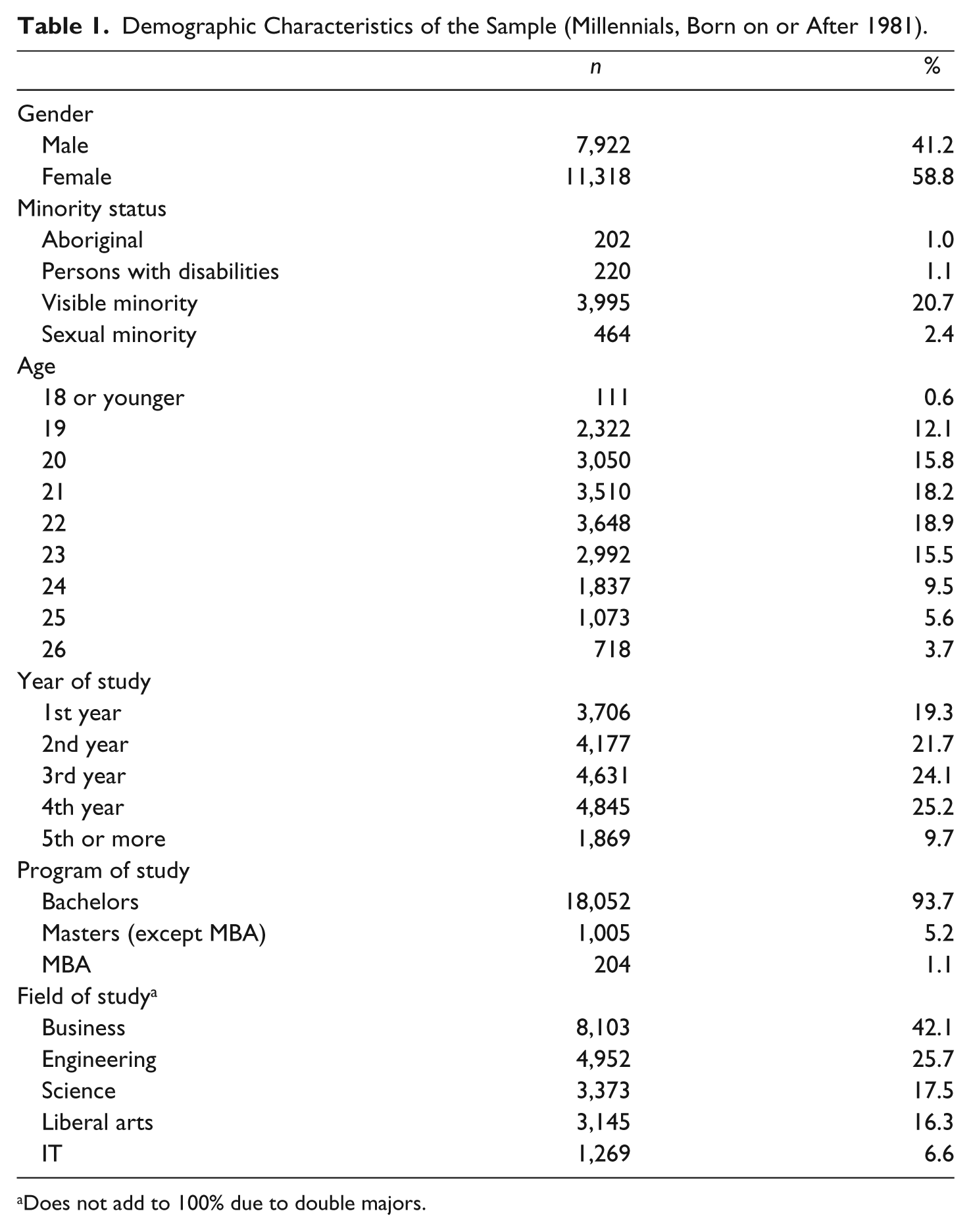
Does not add to 100% due to double majors.
Measures
Employers of choice
Students were asked to select from a list any employers that they would consider working for. A list of 163 of Canada’s largest employers was provided, including federal government departments, crown corporations, provincial governments, and private sector employers. Respondents also had the opportunity to write in up to two employers not on the list. They could choose as many employers from the list as they liked. In a separate question, students were asked to designate the “type of organization” they would prefer to work for and were limited to one choice only. Four of the choices referred to private sector employers (self-employed, small, medium, or large business); the other choices were nonprofit organization and government/public services. It is this item that is used as the dependent variable in this study. Given our interest in public service, the nonprofit option (n = 1,759 or 5.1%) was not included in our analysis.
Career goals
The students were also asked to indicate up to three career goals they wish to attain within 3 years of graduation. The list included 15 items such as “balanced personal life and career,” “contribute to society,” and “work with increasing challenging tasks,” and the respondents had an opportunity to write in a goal not on the list.
Employer image
Students were asked to select up to three terms from a list of characteristics associated with an ideal employer. Sample items included “acceptance towards gay employees,” “attractive location,” “environmental responsibility,” “industry leadership,” and “progressive working environment.” These items correspond closely to Cable and Turban’s (2001) employer and people dimensions of the employer knowledge framework. The two authors of the study independently classified each item as reflecting an employer dimension, a people dimension, or a job dimension; Cohen’s K for interrater reliability on these classifications is 1.0, indicating complete agreement.
Attractive offer
Students also indicated what aspects of a job they would find most appealing, again choosing up to three terms from a list of 23 items. Items included “clear advancement path,” “flexible working conditions,” “international career opportunities,” “secure employment,” “inspiring colleagues,” and “diversity/diverse colleagues.” These items correspond closely to Cable and Turban’s job and people dimensions. Cohen’s K for interrater reliability, using the method described above, is .70, indicating acceptable level of reliability (Fleiss, 1981).
Demographic characteristics
Finally, respondents were asked to indicate their year of birth and other demographic characteristics such as gender, ethnicity, aboriginal status, disability status, and sexual orientation. They also indicated their degree program, year in school, and fields of study.
Results
Demographic Characteristics
Table 2a lists the top 25 most frequently cited employers among the respondents. The Government of Canada tops the list with 33.1% of the respondents, followed by Google (23.5%), provincial governments (22.6%), and Health Canada (21.7%). A listing of other top choice government departments, agencies, and crown corporation employers are listed in Table 2b.
Top 25 Employers of Choice (N = 19,261).
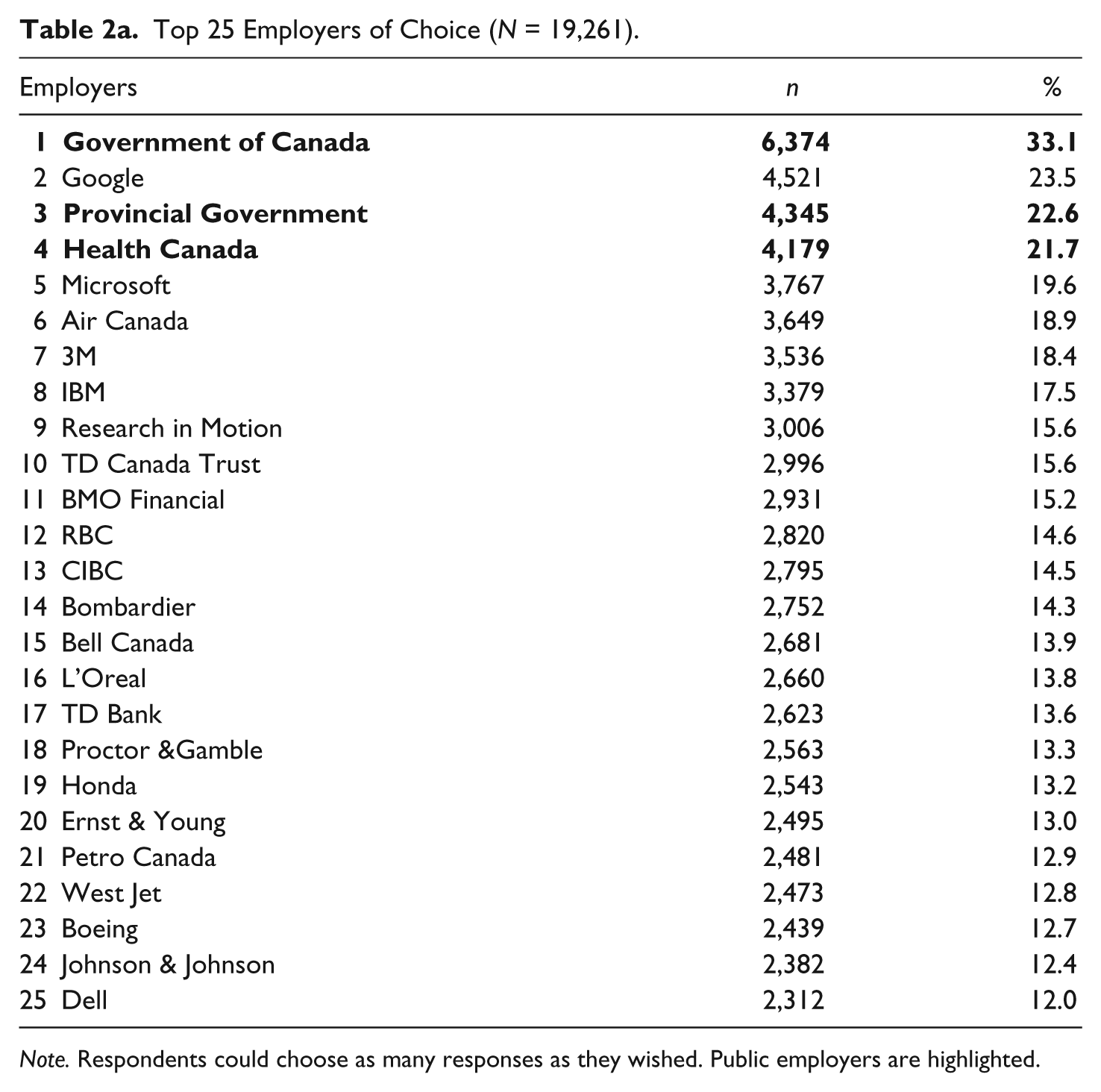
Note. Respondents could choose as many responses as they wished. Public employers are highlighted.
Top Government Agencies/Departments of Choice (N = 19,261).
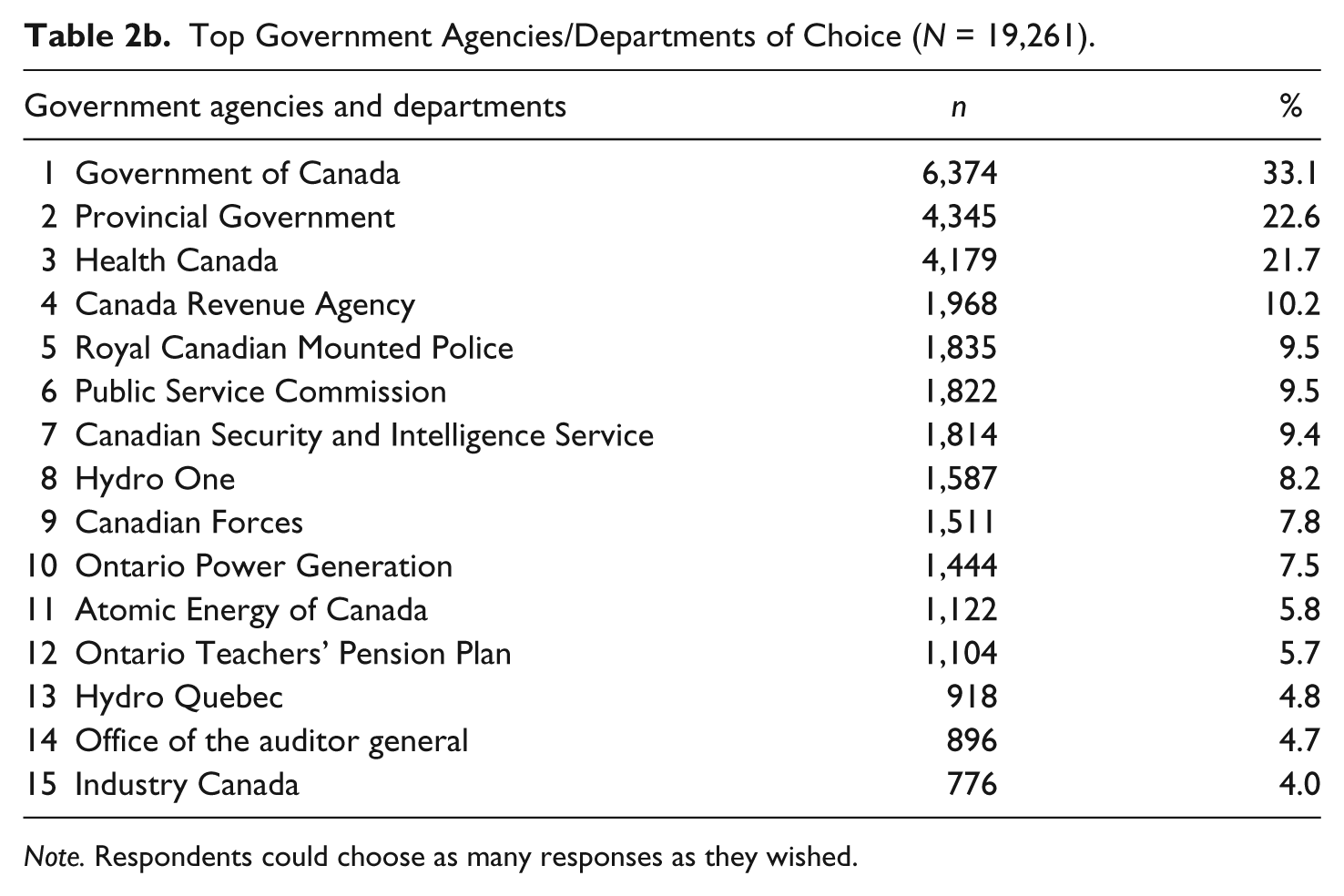
Note. Respondents could choose as many responses as they wished.
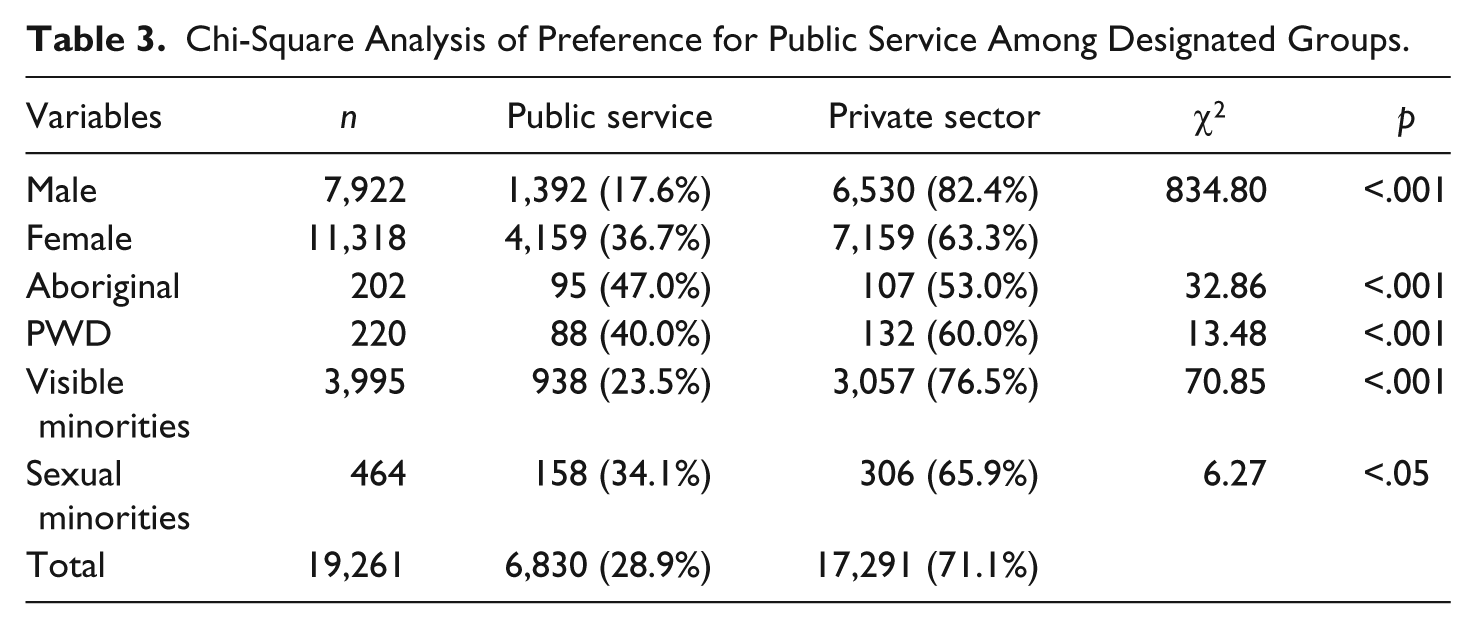
When respondents were asked which “type of organization” they would most like to work for, 28.9% indicated a preference for “government/public services.” Women (36.7%) were more likely to prefer public service compared with men (17.6%), χ2 = 834.8, df = 1, p < .001. Aboriginal peoples (47.0%), χ2 = 32.86, df = 1, p < .001, persons with disabilities (40.0%), χ2 = 13.48, df = 1, p < .01, and sexual minorities (34.1%), χ2 = 6.27, df = 1, p < .001, also had higher rates of preference for public service than those not in such designated groups. However, visible minorities were less likely than other designated groups 2 to prefer public service (χ2 = 70.85, df = 1, p < .001). Overall, members of designated groups, with the exception of visible minorities, were more likely to prefer public service than the sample as a whole (see Table 3).
Chi-Square Analysis of Preference for Public Service Among Designated Groups.
Career Goals
As noted earlier, it is important for employers to understand the career goals among the Millennials. Based on this survey, the top five career goals are (in order) (a) balancing personal life and career, (b) pursue further education, (c) building a sound financial base, (d) contribute to society, and (e) work internationally (see Table 4). Among the top five goals, respondents who indicated a career choice in public service were more likely to identify “balancing personal life and career,” “pursue further education,” and “contribute to society” as their career goals. Those who indicate a preference for the private sector were more likely to indicate “building a sound financial future” as a career goal. There was no significant difference between those preferring public service and private sector employers with respect to “work[ing] internationally.”
Career Goals.
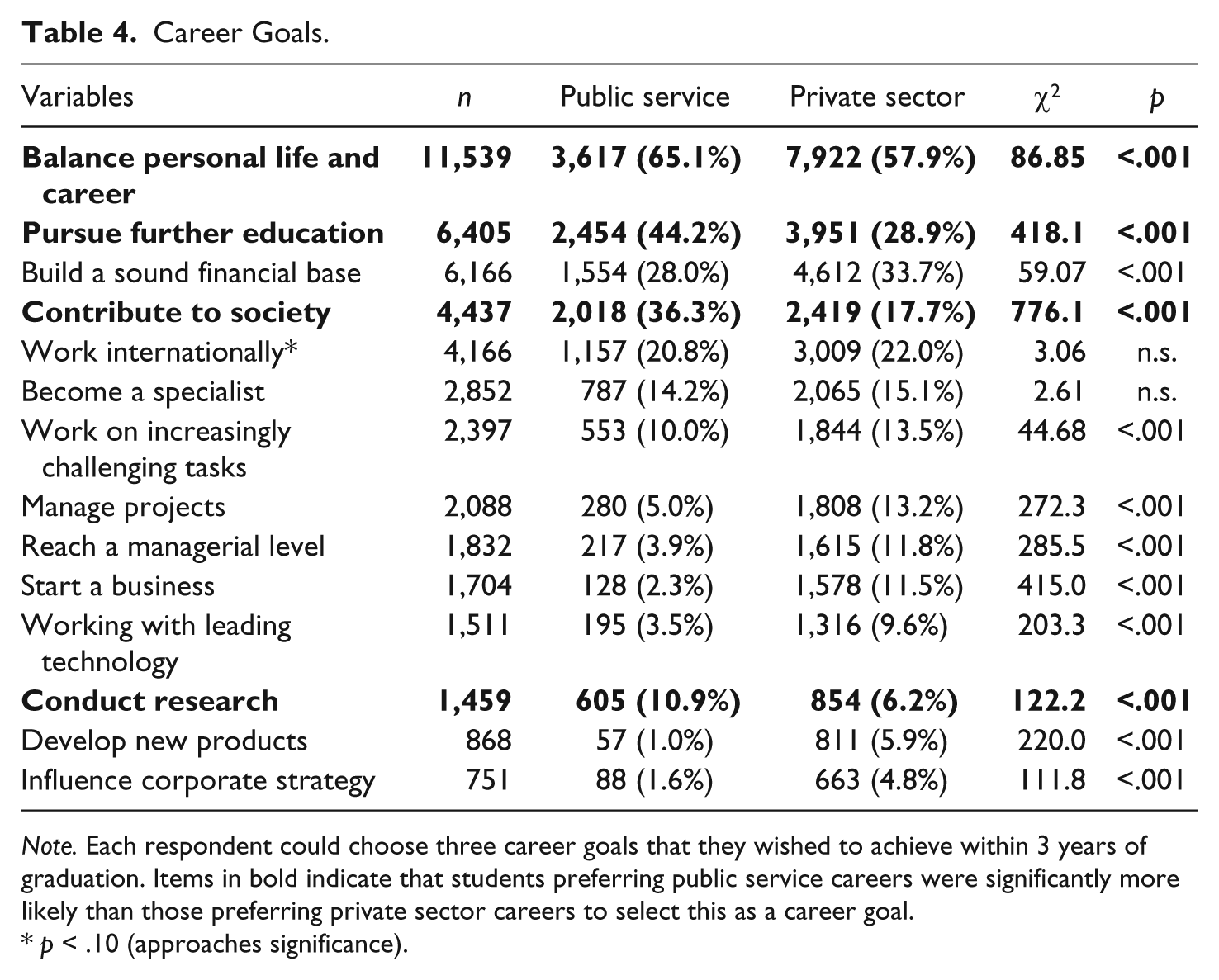
Note. Each respondent could choose three career goals that they wished to achieve within 3 years of graduation. Items in bold indicate that students preferring public service careers were significantly more likely than those preferring private sector careers to select this as a career goal.
p < .10 (approaches significance).
In addition, a greater proportion of those expressing a desire for a public sector career were more likely to identify “conducting research” as a career goal. Those who preferred private sector employment were more likely to mention the following career goals: “work on increasingly challenging tasks,” “manage projects,” “start a business,” “work with leading technology,” “develop new products,” “influence corporate strategy,” and “rotate jobs within company.”
Employer Knowledge Framework
Cable and Turban have demonstrated that potential employees evaluate possible employers from three different dimensions: employer information, job information, and people information. The survey instrument allows us to extract some information about each of these items from two different questions. One question asked respondents to identify the characteristics they most associate with a “top employer.” The items used in this question help us to assess items related to “employer information” and “people information” in Cable and Turban’s formulation. The second question asked what job characteristics the respondents would “find most attractive if offered by an employer.” The items used in this question allow us to analyze the “people information” and “job information” criteria in the employer knowledge framework.
Employer Information
There are some interesting similarities and differences between the two groups with respect to what the Millennials associate with a top employer (see Table 5). For respondents who chose public service, the five leading characteristics of a top employer are (a) high ethical standards, (b) social responsibility, (c) progressive work environment, (d) diverse workforce, and (e) environmental responsibility. For students preferring private sector employers, the top five employer characteristics are (a) innovation, (b) industry leadership, (c) financial strength, (d) high ethical standards, and (e) attractive location. On comparing the groups, those preferring public service are more likely to want their ideal employer to have “high ethical standards,” “social responsibility,” “progressive working environment,” “diverse workforce,” and “environmental responsibility.” They also want their employers to have greater “acceptance towards disabled and gay employees” and a “conservative working environment,” all at significant levels.
Employer Image.
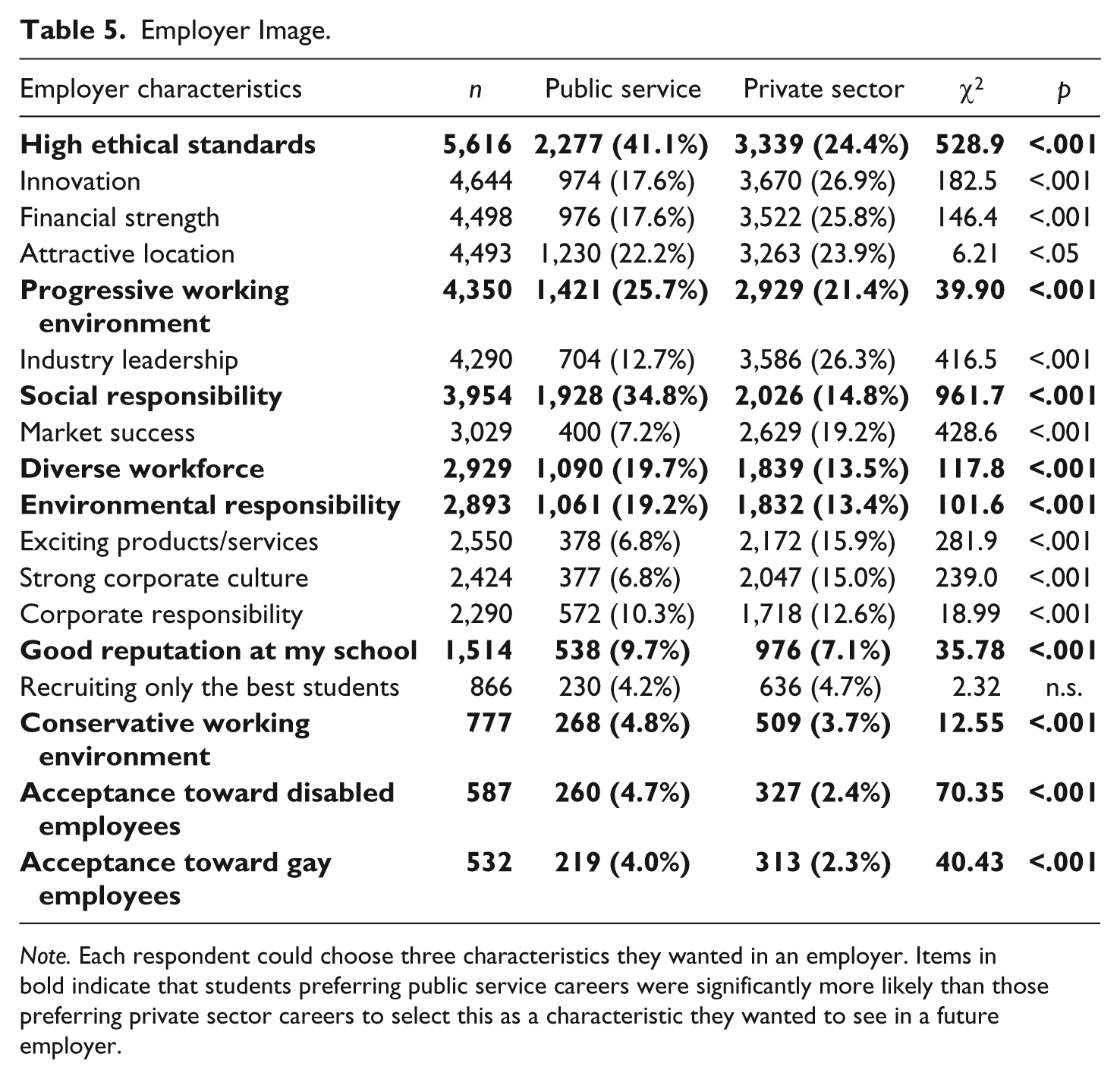
Note. Each respondent could choose three characteristics they wanted in an employer. Items in bold indicate that students preferring public service careers were significantly more likely than those preferring private sector careers to select this as a characteristic they wanted to see in a future employer.
Respondents who chose the private sector were significantly different from their public sector counterparts when it came to the importance of having an employer who displays “innovation,” “financial strength,” “attractive locations,” “industry leadership,” “market success,” “exciting products and services,” “strong corporate culture,” and “corporate responsibility.”
There was no significant difference between the two groups of students on “recruiting only the best students” or “hierarchical structure.” About one third of these items, however, were identified by less than 5% of the respondents in either category as a characteristic associated with an ideal employer.
People Information
Respondents who preferred public service careers were more likely than their counterparts choosing the private sector to desire “inspiring colleagues,” an “inclusive work environment,” “diverse colleagues,” “community commitment,” and “support group networks.” These factors were considered to be important when accepting a job offer; none of the survey items identified as relating to “people information” were more likely to be important to those selecting private sector careers (see Table 6).
Attractive Offer.
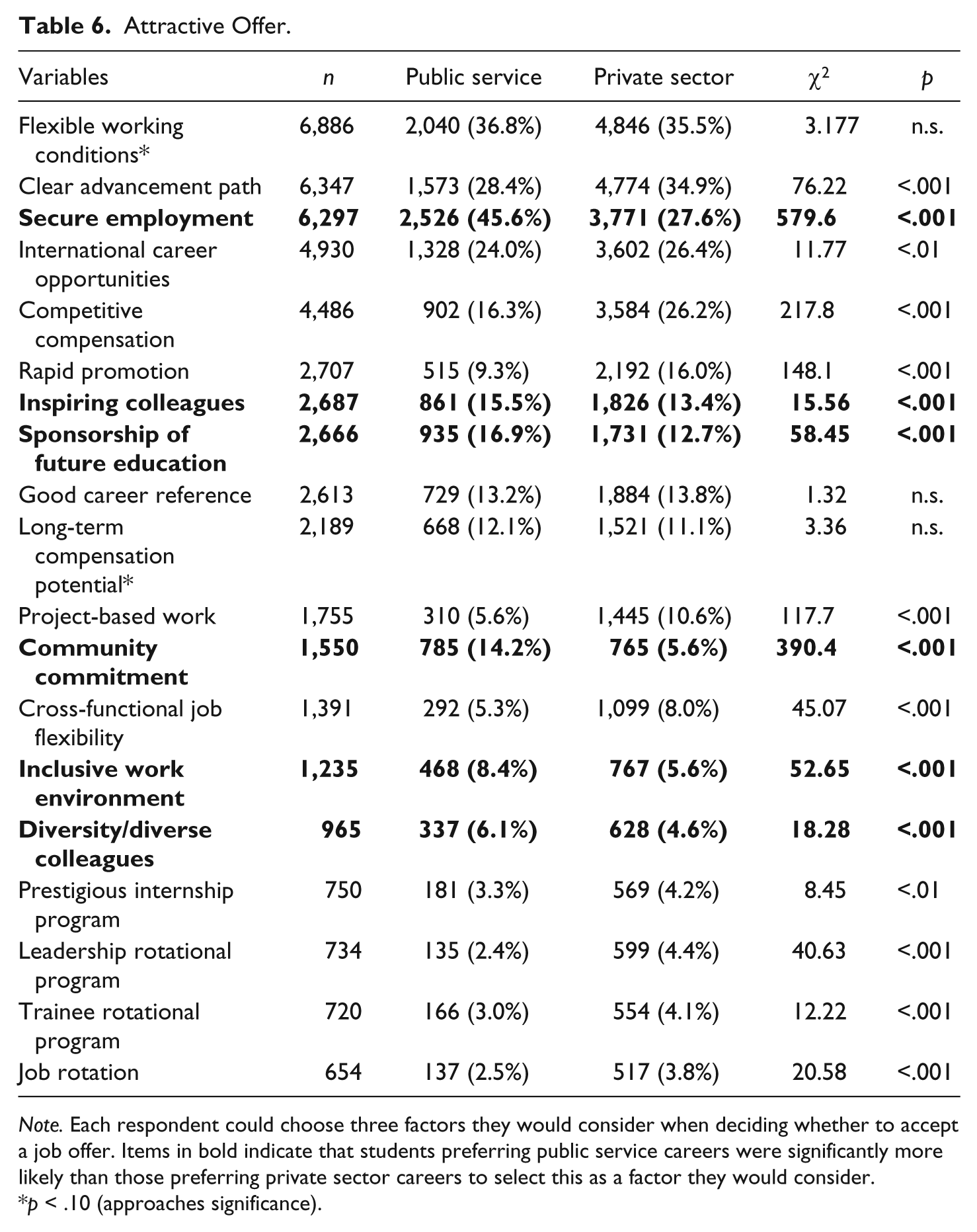
Note. Each respondent could choose three factors they would consider when deciding whether to accept a job offer. Items in bold indicate that students preferring public service careers were significantly more likely than those preferring private sector careers to select this as a factor they would consider.
p < .10 (approaches significance).
Job Information
When it came to job characteristics, one of the interesting findings was about characteristics of a job that did not result in a significant difference between those interested in public and private sector careers. The most commonly selected desirable job characteristic was “flexible working conditions” but there was no significant difference between the two groups (although there is a trend among those who preferred public service to indicate this feature as important, p < .10). The same lack of significant difference was true for “long term compensation potential,” “good career reference,” and the availability of “employee resource networks/affinity groups.” However, respondents who selected public service were more likely to consider “secure employment” and “sponsorship of future education” as important when accepting employment.
Those who chose private sector employment were more likely to name “clear advancement path,” “international career opportunities,” “competitive compensation,” and “rapid promotions” as important. They also considered “project-based work,” “cross-functional job flexibility,” “prestigious internship program,” “leadership rotations,” “trainee rotations,” and “job rotations” to be important. Finally, students choosing private sector were more likely to find “dynamic recruiters” a positive factor.
Discussion
So what messages do the results of this nationwide survey offer to public employers in Canada? What challenges will they face in trying to recruit the next generation of workers and are there things that they can do to enhance their ability to attract well-qualified workers from among Canadian university students?
First, only 28.9% of all the respondents indicated they would choose public service over the private sector, and 33.1% indicated the Government of Canada as an employer of choice. The survey was conducted in 2007 when the economy was stronger and it may be that today, as in the United States, tough economic times and inspiring political leadership may result in more young people looking for government employment (Polfeldt, 2009; Vogel, 2009). Monitoring these preference patterns over time will be important. Looking at the survey results, however, several other issues become apparent and public sector employers will need to figure out how to best take advantage of them.
Among specific demographic groups, women, people with disabilities, aboriginal peoples, and sexual minorities are all more likely to be interested in public service employment opportunities than their counterparts (i.e., men, nondisabled, nonaboriginal people, and heterosexuals). Visible minorities are more likely to be interested in the private sector than White Canadians. The Canadian federal public service already claims credit for its inclusiveness as it already has women, aboriginal peoples, and those with disabilities in greater percentages than they are in the workforce itself. Thus, the awareness of opportunities for these groups may simply be reinforcing student interest in these public sector career paths (Jauvin, 2007). The issue of visible minorities in the federal public service especially has been a cause for concern for a number of years. Until recently, the data used by policy makers indicated that visible minorities were dramatically underrepresented in federal government new hires and in overall employment, that is, visible minorities were represented in these positions at only about half the rate of their presence in the population (van Gaalen, 2002). In a rather stunning declaration in March of this year, however, the head of the Canada Public Service Agency (CPSA), Maria Barrados, testified before the Senate Human Rights Committee that the agency had been miscounting visible minorities for at least the past 2 years and that in fact the proportion of visible minorities among new hires was double what had been previously reported, and the number exceeded their proportion in the available labor force (Canwest News Service, 2009). Other studies have suggested that the issue was not so much an inability to attract applicants, but rather the problem was systemic discrimination against visible minority government employees and, hence, difficulties in retaining them. For example, a 1997 Canadian Human Rights Tribunal decision cited “glass ceiling barriers” to the promotion of visible minorities to senior management levels at Health Canada (Beck, Reitz, & Weiner, 2002). And while there are yet no discussions of male underrepresentation in the public service, there are discussions about their underrepresentation in higher education (Canadian Council on Learning, 2007). This is something that recruiters for public service employment may want to take into account, especially given the disproportionately lower level of interest shown by male respondents to employment in this sector.
Characteristics sought in employers by those who are interested in employment in government/public service seem consistent with the concept of public service motivation. While many students in each group were concerned about working for employers who had high ethical standards, it was noteworthy that those with a preference for public sector work were significantly more likely to prioritize ethics, social, and environmental responsibility, and community commitment, than those preferring private sector positions. These students also expected a more diverse workforce and greater acceptance of disabled and gay employees. In fact, all of the “people” items on which there were significant differences between the two groups suggested that concerns about coworkers are more important to those seeking public sector careers overall. Moreover, the desire to contribute to society is much more likely to be a highly ranked career goal for students interested in public service. Such preferences seem consistent with the idea of there being something like “public service motivation” that exists a priori to actual employment in the public sector (Vandenabeele, 2008). That disposition is something that public sector recruiters need to emphasize to ensure that this predisposition turns into application for and acceptance of public employment by those who are well qualified.
As an employer, governments and other public employers in Canada will find that some of the things that they are able to offer already are consistent with the desires of current university students. For example, those choosing public sector careers want the ability to pursue further education after they have begun working. Respondents interested in public service and government also were significantly more likely to seek some characteristics in employers that some see as negative traits in government. Specifically, those preferring public service prioritized employers who could provide job security. It is possible that the student respondents, having seen their overworked parents downsized, therefore prioritize work/life balance and secure employment in their own careers. And while somewhat ambiguously, students choosing public service were more likely to prefer a progressive working environment and a conservative working environment. It is possible that some government departments may be seen as more progressive, such as the Government of Canada and the Public Service Commission, while other federal agencies such as the Canadian Forces, the Royal Canadian Mounted Police, and the Office of the Auditor General may be seen as more conservative in nature. Or it may be that to the respondents “progressive” suggested the kind of diversity and openness to differences that they desired while “conservative” was consistent with their interest in job security and clear reporting relationships.
Conclusion
This study, based on a sample of Canadian university students, is noteworthy for several reasons. First, the student sample, by virtue of being highly educated, is an important source of managerial and technical workers and represents the workforce of the future. Therefore, the findings reported here can inform employers on how best to attract and engage the next generation of skilled workers. Second, for at least a quarter of the respondents, there appears to be good person−organization fit between the career goals, aspirations, and work/life choices and the characteristics of public service and government jobs. This is encouraging given the projected shortage of skills, and the government will have to compete with private sector employers in the war for talent. Third, public sector employers wishing to expand the potential recruitment pool are well advised to pay attention to the factors respondents preferring private sector employment find to be attractive. For example, the government needs to pay attention to those students’ desire for interesting and challenging work and international opportunities and make clear that the government does offer such opportunities. This same group also emphasized the importance of active on-campus recruitment to entice the younger workers to consider a career in public service.
The present study makes several contributions to the literature. First, this study utilizes Cable and Turban’s employer knowledge framework to examine career choice in public sector from three perspectives (i.e., employer, job, people dimensions of work). Previous studies have only considered employer characteristics (Feeney, 2008; Lewis & Frank, 2002; Taylor, 2005; Vandenabeele, 2008) and job attributes (Falcone, 1991; Houston, 2000; Jurkiewicz et al., 1998; Pattakos, 2004; Wittmer, 1991) in public service, ignoring the people dimension of work. Second, this study compares the preferences in job attributes, employer characteristics, and people characteristics between the public and private sector among job seekers. The findings can help public sector employers compete more effectively in applicant attraction and recruitment efforts. Previous studies (Lyons et al., 2006) examined differences in individuals already employed in public and private sectors, and thus may suffer from rationalization and cognitive dissonance (Houston, 2000; Gabris & Simo, 1995). In general, individual preferences for government or business jobs may rest on perceptions of which sector best satisfies their needs (Lewis & Frank, 2002). Third, this study represents a large-scale survey of university students in Canada. This population segment is important to organizations as they represent a major source of hiring for skilled jobs such as managers, professionals, and technical workers, for the government and private sector. Other studies investigating public service motivation have generally used small samples of students (Groeneveld, Steijn, & van der Parre, 2009; Taylor, 2005; Vandenabeele, Hondeghem, & Steen, 2004). Finally, this article makes a contribution to the literature on public service motivation, principally by looking at what might be called “pre-public service motivation.” This was a large sample of university students, not limited to those who were already studying management (either public or business). The study relied on responses based on items not specifically designed to test the concept of public service motivation but that tapped into comparable ideas about motivation. Yet, despite the large sample and the need to adapt to the language used in the survey, it is apparent that there are significant differences in values and preferences about work among Canadian students and that such differences do, in fact, lead to different career and employer choices or preferences in the directions hypothesized. Thus, the study serves as additional confirmation that there is something “tangible” in the concept of public service motivation.
A few limitations should be noted to put the findings in a greater context. First, the data were collected in 2007, and while all trends indicate a shortage of skilled workers in Canada over the next two decades, it may not reflect the job market in current economic recession. Second, we recognize that the millennial generation is not a homogeneous cohort, and their values and attitudes may differ by race, gender, and socioeconomic backgrounds. However, the findings about the Millennials do potentially allow us to compare the average member of the younger generation with the average member from previous generations (Twenge & Campbell, 2008). Third, while students from all provinces and territories were included in the survey, students from Ontario, British Columbia, and Alberta were overrepresented in the sample (72%). Therefore, care should be taken when interpreting the findings of this study. Fourth, the study needs to be expanded to incorporate those students choosing the nonprofit sector as their employer of choice and to examine the similarities and differences they have to the other students (Lyons et al., 2006). Finally, given that the sample is comprised of students, respondents may not have realistic job expectations of workplace policies and practices especially in a professional work environment. The findings, nonetheless, represent the career goals, aspirations, and work/life choices of an important segment of the future workforce in Canada. In closing, we call for more research into the values, attitudes, and expectations of the young people, as they will emerge as public and private sector leaders of tomorrow. Moreover, following a cohort of students to determine the extent to which preferences for career sectors expressed as students actually lead to careers in that sector will permit analysis of a number of important issues including changes in motivation over time and the impact of motivation on individual and organizational performance.
Footnotes
Acknowledgements
The authors would like to thank DECODE, Brainstorm, and Universum for making the data available to us.
Declaration of Conflicting Interests
The author(s) declared no potential conflicts of interest with respect to the research, authorship, and/or publication of this article.
Funding
The author(s) disclosed receipt of the following financial support for the research, authorship, and/or publication of this article: The preparation of this manuscript has been supported in part by Dalhousie University and California State University, Sacramento.