







Abstract
This study presents a taxonomy for public personnel management based on emergent profiles of local human resource managers in Spain. The analysis focuses on the task environments of managers defined by three salient constructs from strategic human resources management research. Specifically, this study looks at the level of participation of human resource managers in strategic-level policy-making processes, vertical and horizontal policy integration, and the flexibility of human resource managers in interpreting and implementing key functions of personnel management (i.e., recruitment, hiring, and remuneration). The results yield five distinct profiles that describe different approaches of human resource management. The five profiles include Technical Administrative (TA); Technical Functional (TF); Managerial Administrative (MA); Managerial Functional (MF); and Strategic Executive (SE). The profiles are not a linear typology of human resource management practices. However, they do fit within a larger theoretical framework that captures central constructs of strategic human resource management (SHRM).
Introduction
Given the past two decades of global economic downturn, governmental agencies are facing pressures to become more efficient and effective through reduced cost and increased productivity. A critically important, yet costly element of every organization is personnel. In both public and private sectors, personnel management is an area that often garners a great deal of attention for enhancing efficiency and effectiveness (Klingner, Nalbandian, & Llorens, 2010).
In the public sector, governmental functions range from relatively predictable bureaucratic operations such as waste management to highly complex and adaptive operations such as crisis response to human and/or natural disasters. Of the many government functions, personnel management impacts every division and agency. Personnel management often spans a wide variety of functional units within an organization. Thus, personnel management functions (e.g., supervision, recruitment, training, remuneration, and evaluation) coexist with general organizational strategic and operational aims and functions. Ideally, personnel management systems support the well-being of employees and contribute to the effectiveness and efficiency of the organization.
Innovative approaches to human resource management (HRM) that were previously confined to the private sector are finding a place in public personnel management (Klingner, Nalbandian, & Llorens, 2010). In recent decades, some governments have responded to pressures for increased efficiency and effectiveness by adopting practices that have shown to be effective in the private sector. The response has included streamlining processes, out-sourcing programs and services, and moving away from bureaucratic features (e.g., top-down decision making, rigid processes, divisionalized operations, etc.) in favor of more strategic, inclusive, integrated, and flexible practices attributed to the New Public Management movement (Bryson, Crosby, & Bloomberg, 2014; Klingner, 2012).
The dynamic nature of the public sector (e.g., context, structure, shifts in political leadership and ideology, reallocation of resources, etc.) requires researchers and practitioners to continue to look for dynamic ways to think about and research public personnel management (Jordan & Battaglio, 2013). As public personnel management develops in complexity, there is a need to continue to explore and develop new ways to describe research and practice in this increasingly diverse and dynamic landscape.
Human resource managers are at the nexus of these undulations in the public sector. Some of the central questions that managers may encounter include the following: Does a given policy make sense? Is the policy effective? Does the policy run at odds with other functions/policies internal and external to the agency? Can the manager shape/influence the policy process at the strategic level? Can the manager shape/influence policy procedures and implementation? This study presents a taxonomy that builds on existing work to describe and understand some of these fundamental questions facing managers.
Among public agencies, there are differences in approaches to public personnel management. Some agencies have adopted some aspects of “newer” and “different” approaches, while others have largely relied on classical and traditional models of HRM. This leaves a landscape of public personnel management that is far from uniform and predictable in terms of form and function. Nevertheless, policy making, policy implementation, and policy integration are salient features that provide a robust way to describe and understand variations among approaches to public personnel management.
Researchers have developed frameworks and models to capture various approaches to HRM practice in both public and private sectors. This article uses a taxonomy approach for modeling HRM in the public sector. The purpose of a taxonomy is to organize or structure knowledge and/or information. When developing a taxonomy, there is a tension between over simplifying and overly complicating models (Bobko & Russell, 1991). If a taxonomy is too narrowly focused or context specific, it loses its ability to be applied more generally; on the contrary, if a taxonomy is too complex (aka kitchen sink), it can become too intricate and unwieldy for practical application in research or in the field.
Purpose of the Study
The purpose of this study is to develop a general taxonomy that has the ability to describe various forms of public personnel management. To avoid oversimplification or overcomplication, three core aspects of personnel management form the basis of the proposed taxonomy: policy making, policy implementation, policy integration. Specifically, the study presents a taxonomy based on the following constructs:
Participation: participation by human resource managers in strategic-level policy making;
Autonomy: flexibility of managers to implement human resource policy; and
Integration: vertical and horizontal integration of human resource policy within the broader government policy framework.
Significance of the Study
In his review of HRM theory and research, Perry (2010) notes the contributions of both highly focused, contextualized research and general theories which more broadly characterize veins of the literature. However, according to Perry (2010), the field of HRM needs more works that represent the “middle range” theory to advance HRM.
Following Perry’s charge, this study distills HRM down to three salient features and uses them as the basis for developing a middle range theory—a taxonomy. The value of the taxonomy put forth by this study is its potential to capture and describe complex aspects of HRM while using a relatively simple framework.
Framing Public Personnel Management
HRM theory and research has its roots in the field of organizational behavior. So, it should be expected that perspectives in organizational behavior have influenced how researchers and practitioners approached HRM. Three general types of models are often used as advanced organizers for categorizing different views of the structure and dynamics of organizations. The three forms have many descriptors, but generally speaking, they are mechanistic, human-centered, and emergent models.
In a public administration context, the literature includes several taxonomies that describe various types of HRM. The taxonomies are most often built on central concepts grounded in general HRM and the field of organizational behavior (e.g., power, decision making, structure, roles, motivation, etc.; Watson, 2007).
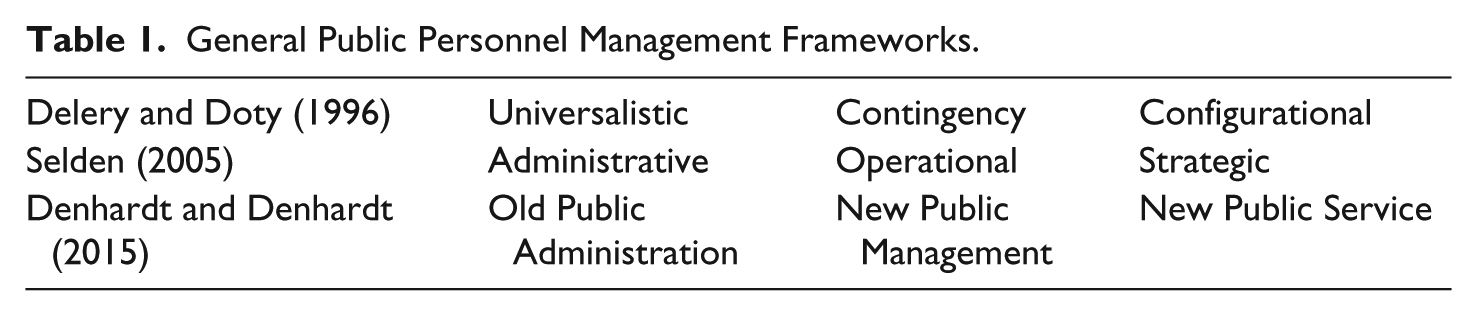
For example, Delery and Doty (1996) categorize models of HRM into three general groups: universalistic, contingency, and configurational. Universalistic models generally view organizations as closed systems, and the underlying assumption is that there is a set of HRM practices which “enable a firm to achieve its goals” (Wright & McMahan, 1992, p. 298). Contingency models emphasize that the “fit” between overall organizational strategy and internal HR practices determines organizational performance. Configurational models are similar to contingency models; however, configurational models suggest that internal and external variables (including HR policy) impact business performance. Thus, from the configurational perspective, the HRM systems are ideally internally coherent (i.e., each HRM function is aligned with the managerial roles and responsibilities).
In Selden’s (2005) study of county governments in the United States, she suggests a typology for HRM that includes three fundamental forms of HRM: administrative, operational, and strategic approaches. The administrative form of HRM practice involves the day-to-day functions of HRM professionals. Administrative practices are characterized by the use of technical skills which apply policies to execute routine procedures. The administrative category is comparable with a traditional bureaucratic or Theory X (McGregor, 1960) view of organizations. Operational practices involve activities of professionals focused on design and managing the implementation of policies and procedures. The operational category views human resource managers as professionals with knowledge skills and abilities to contribute to the operations/functioning of the organization. The operational practices reflect a more humanistic, Theory Y (McGregor, 1960) point of view. The strategic practices involve upper level (e.g., executive, legislative, etc.) planning, policy making, and decision making. In this framework, ideally each of these forms of HRM practice is well integrated, providing for effective and efficient HRM (Dickmann & Müller-Camen, 2006; Schuler & Jackson, 2007; Selden, 2005; Walker, 2013).
Denhardt and Denhardt (2015) describe public personnel management as having evolved overtime from Old Public Administration toward New Public Management. They describe Old Public Administration as reflective of traditional models of bureaucracy, rational decision making, and control. On the contrary, while the more “evolved” orientation of New Public Management features more flexible and inclusive practices around policy making, implementation, and evaluation, emphasizing an orientation toward developing policy and practices meant to fulfill public needs. Denhardt and Denhardt also suggest yet another form of public personnel management in the form of “New Public Service.” They describe New Public Service as a distinct approach that builds on elements of the humanistic view of New Public Management yet goes further by using highly inclusive strategies to involve stakeholders in processes of dialogue with the purpose of co-constructing (i.e., defining) public needs, priorities, and strategies policy, implementation, and evaluation.
New Public Service has an orientation that resembles thought and practice in postmodern perspectives of organizational behavior. The inclusive democratization of the New Public Service approach mirrors the philosophical orientation of political scientists and activists such as Paulo Freire (1973). While New Public Service offers a vision of public personnel management, there is room for more cultural, anthropological, and inclusive participatory methods of inquiry; however, current research on ;public personnel management remains heavily focused on the New Public Management approach.
General Public Personnel Management Frameworks.
Policy Making, Implementation, and Integration: Where Are the Managers?
Each of these general models presents three general views of public personnel management, and within each, there are implications for the role of the human resource manager in the areas of policy making, implementation, and integration. For example, strategic human resource management (SHRM) can be broadly characterized as efforts that include human resource managers in (a) the process of setting the strategic directions of the agency (i.e., strategic decision making); (b) consideration of impacts and inputs from a human resources perspective during the strategic-level policy-making processes; (c) increasing the level of integration (configurational approach) among functional departments throughout the organization; and (d) granting authority and discretion to human resource managers to adapt policy to meet the conditions during implementation (Delery & Doty, 1996; Dickmann & Müller-Camen, 2006; Schuler & Jackson, 2007; Selden, 2005; Walker, 2013; Watson, 2007).
In addition to SHRM, other models suggest that adaptability and flexibility have an impact on organizational effectiveness (Dessein & Santos, 2006). Kathleen Monks (1992) adds the concept of “innovation” as an important conceptual dimension to HRM models of practice. She defines innovation as the ability for human resource personnel specialists to alter (adapt) policy to increase overall effectiveness. Monks highlights the need for autonomy given to human resource personnel to interpret and implement policies and procedures such as hiring and remuneration to fit the context and needs of particular governmental agencies. Such freedom can be more generally viewed as managerial discretion (Wangrow, Schepker, & Barker, 2015) or executive behavior.
In a dynamic organization, autonomous/executive behaviors can be invaluable if it is accompanied by a clear understanding and commitment to the overall strategic goals and operations of the organization. However, without such understanding and commitment of overall strategy, autonomous behavior can easily result in inefficient and ineffective outcomes such as confusion and suboptimization (Hitch, 1953).
Beer, Spector, Lawrence, Mills, and Walton (1984) suggest that managers need to play a role in the integration and alignment of human resource policies within broader policy frameworks: (a) Managers have more responsibility to ensure the alignment of organizational strategy and HR policies, and (b) HRM departments have the mission of setting policies that develop and implement activities in ways that make them more mutually reinforcing.
Power, Politics, and Influence in Public Personnel Management
Power in the form of authority and influence is an important component of the task environment of a human resource manager. It is equally important to consider the distinction between public and private sector sources and uses of power. In the public sector, power, politics, influence, and accountability may look quite different. For example, according to Klingner and Lynn (2005), three main groups share responsibility for public HRM: political leaders, personnel directors, and specialists. Political leaders are often responsible for authorizing personnel systems, establishing agency objectives, and playing a role in municipal policy making. However, personnel directors and specialists are often on the frontline of HRM and in an ideal position to design and implement personnel systems, or directly help those who do (Klingner and Lynn, 2005).
Nalbandian (1994) and Klingner, Nalbandian and Llorens (2010) focus their research on the differences between political leaders in representative democracies (appointed by elected officials) and administrative executives (professional bureaucrats). The nature of authority is distinct in these two different forms of HRM. Political authority has a broad capacity to manage professionals, while professional authority is often more technical and skilled. The professional (bureaucratic) authority often remains in place when changes occur in political leadership. Therefore, according to Nalbandian (1994) and Klingner, Nalbandian and Llorens (2010), the professional bureaucrat has the potential for gaining greater power and deeper knowledge over time due to political turnover.
Power and politics have the potential to determine who gets to participate in policy-making processes and the amount of discretion a manager has in implementing policy. Thus, depending on the values of the people who hold influence (e.g., political leaders, top agency officials, or human resource managers themselves), managers may or may not have access to strategic policy-making processes or granted the authority to use discretion when implementing policy.
The Influence of New Public Management in Public Personnel Management
New Public Management has had a significant influence on the public administration around the world. For example, Verheijen (1998) characterizes approaches to public administration vis-à-vis private sector models and privatization using three categories. The first category includes countries such as the United Kingdom, New Zealand, or Austria. Each of these countries has undertaken relatively dramatic shifts in the public sector by adopting management practices very similar to or the same as what one would expect to find in the private sector. The second category is characterized by a more measured and balanced adoption of private sector management tools. Rather than complete overhauls of traditional public sector practices, countries such as Ireland and the Netherlands blend key elements of traditional public and private administration. The third category includes countries that have incrementally employed private sector solutions to public management. Verheijen (1998) include France and Spain in this category.
According to Verheijen (1998), Spain and France have similar profiles in their ongoing development of public management. However, no country can be absolutely placed in a given category. For example, in both France and Spain, managers at the local level tend to have more freedom, so that there are some administrations that have used more innovative private sector techniques, while adhere more closely to classic bureaucratic practices.
Theoretical Framework
The theoretical framework for the study focuses on three dimensions of the task environment of the human resource manager: participation in policy making, the autonomy of managers to adapt and implement human resource policy, and human resource policy integration. These dimensions are salient areas of the literature and have the potential to be useful in research and practice. Figure 1 illustrates the continua of these three dimensions.
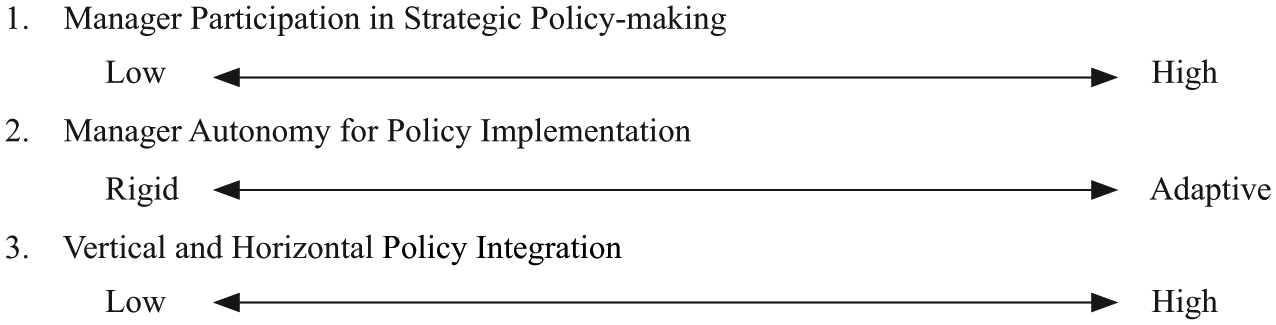
Three dimensions of manager policy task environment.
According to Sheehan (2005), the level at which policies are made can impact the effectiveness and efficiency of HRM practices. Sheehan further suggests that the participation of managers in policy making increases the effectiveness of HRM. Dyer (1999) further explains that human resource managers who participate in high-level decisions will have a clearer understanding of how HR fits within and supports the organization’s overall mission and strategy.
Increasingly, models of organizational behavior are examining how adaptive and agile behavior among managers and personnel can help organizations to respond to complex and changing contexts (Lavelle, 2006). Whether governments are faced with restructuring and reform or responding to crises, adaptation and agility are alternatives to relying on rigid or predetermined bureaucratic policies and procedures.
In our theoretical framework, manager autonomy (discretion) is thought of as adaptive behavior. On the other end of the continuum, a bureaucratic view of public personnel management is reflected by strict adherence to policy. Depending on the level of policy integration and an organizational unit’s commitment to enacting the strategic goals of the organization as a whole, compliant or adaptive behavior can have a positive or negative impact on the effectiveness and efficiency of the entire organization. For example, if policy integration is low, strict compliance to subunit policies may conflict with the strategic aims of the organization. On the contrary, if policy integration is high and subunits strictly comply with policy, there is the presumption that the practices of the subunit will be in alignment with the strategic goals of the organization and, therefore, improve the organization’s effectiveness.
Another potential benefit of manager participation in strategic policy making is increasing the extent to which human resource policies are aligned and consistent with the strategic-level policies of the organization, that is, policy integration. Policy integration can be viewed in two basic ways, vertical and horizontal. Vertical integration is focused on the consistency between policies of subdivisions of an organization and the broad strategic goals of the organization as a whole, while horizontal integration is focused on the consistency of policies among subunits of the organization. According to several researchers, vertical and horizontal integration of human resource policies are critical to effective and efficient operations of the organization as a whole (Fombrun, Tichy, & Devanna, 1984; Miles & Snow, 1984; Schuler & Jackson, 1987).
Low levels of policy integration can have the impact of organizational units operating in relative isolation, which can result in suboptimization (organizational subunits behaving in ways that serve the goals of the unit at the expense of serving the strategic goals of the organization as a whole; Van Thiel & Leeuw, 2002). Conversely, when policies are highly integrated, the operations of organizational subunits have a greater potential to complement and create synergies throughout governmental operations. In the case of extremely high-level integration, the line between different organizational operations is said to be embedded into the fabric of the overall operations of the organization (Arthur, 1992, 1994; Baird & Meshoulam, 1988; Ichniowski & Shaw, 1997; Miles & Snow, 1984; Richard & Johnson, 2001; Youndt, Scott, Dean, & Lepak, 1996). However, it is conceivable that too much integration could have negative effects such as suppressing the climate for innovation or creating overly interdependent systems (i.e., over engineering).
Candel and Biesbroek (2016) have offered important additional considerations for policy integration. In addition to the impacts on collaboration and coordination, they raise the critically important issue of the process of moving toward integrated policy. In their discussion of the process, they critique existing theory and research that neglects to focus on the process of involving subsystems (e.g., subunits, departments, stakeholders) in the progression toward policy integration. This consideration relates back to the first construct of participation by HR managers in the strategic policy-making process.
Table 2 summarizes how the dynamics of high and low levels of each of the three dimensions are related to theory discussed previously. The second column in Table 2 broadly associates each dimension with theoretical frameworks from existing literature; the third column identifies some general theoretical constructs associated with each dimension; and the fourth column presents implications for the role of the HR manager.
HR Managers Situated in Theory.
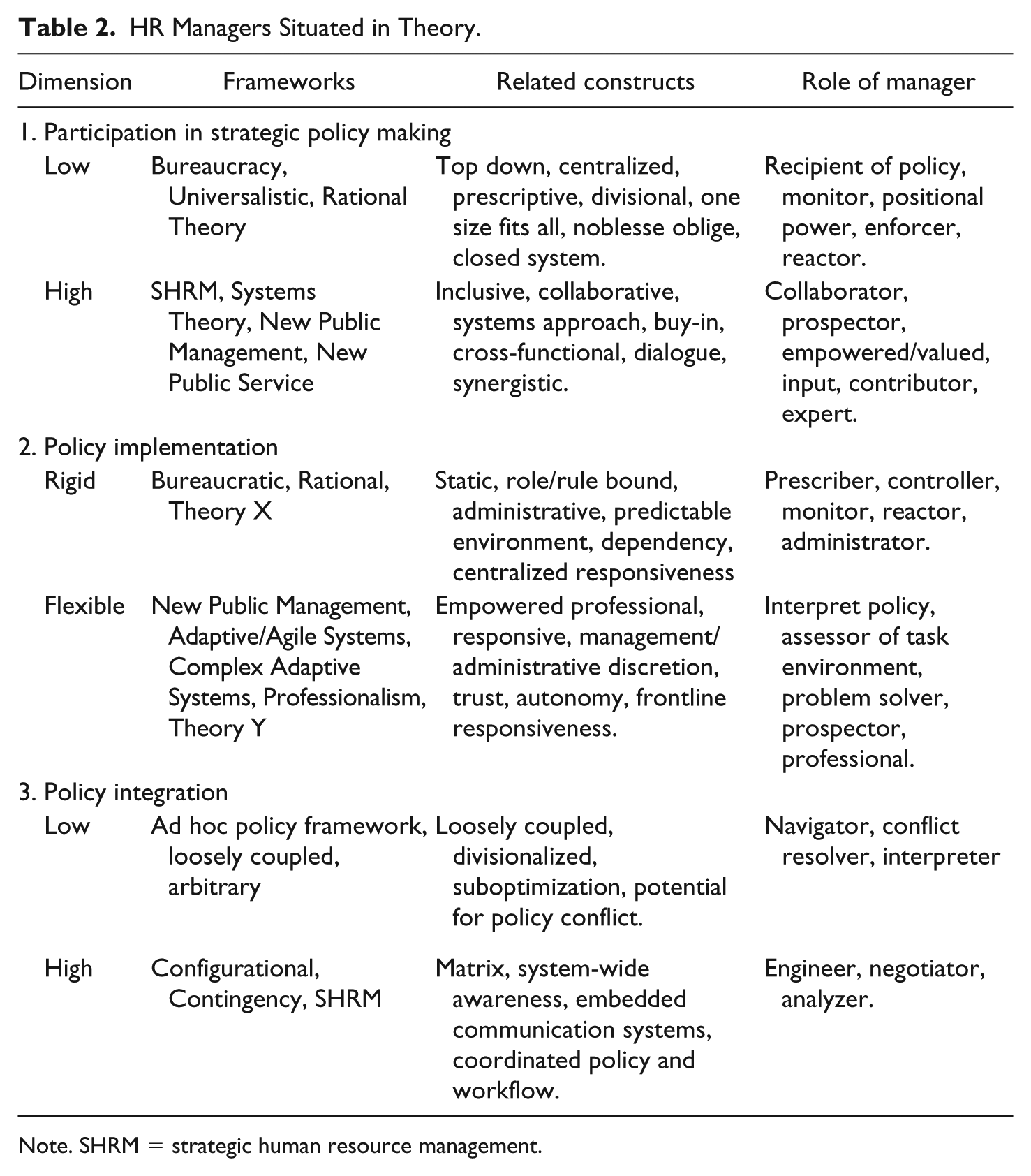
Note. SHRM = strategic human resource management.
In summary, the theoretical framework for this study is built upon three salient themes that, according to previous research, have important implications for public personnel management. Together, these themes create a task environment that is used (a) to explore whether multiple configurations (profiles) emerge for public personnel management, and if so, (b) to present and interpret any distinctive characteristics among these forms of HRM. These areas of the manager task environment are not meant to be exhaustive, but instead capture themes and constructs that continue to inform fundamental understandings of HRM research. Given the robust presence of these themes in HRM research, it is expected that by using these themes to classify and describe different approaches to HRM, a resulting taxonomy will be more generalizable.
Methods and Procedures
This section contains the methods and procedures for developing the taxonomy. The study used data collected from human resource managers in Spanish local governments. Although there is great variation in the management of public employees among local governments in Spain, all local governments are situated within the broader Spanish government. Given the setting, a brief description of the context of the Spanish public followed by the specific methods and procedures are used for the study.
Context of Spanish Municipalities
The public sector in Spain involves three tiers of government: General Administration of the State (national), Autonomous Communities (regional), and Local (cities, towns, and villages). The national government has power over the entirety of the country, including the authority to delegate tasks to the other two levels. The State has legal authority to be involved in regulations at the lower tiers of government, but the State also has exclusive responsibilities and authorities in matters such as national defense, the justice system, international relations, public finance, labor legislation, civil, mercantile, and penal.
The second tier of government in Spain includes each of the 17 Autonomous Communities in which the State is divided. At this level, the Communities assume responsibility for matters of public works, agriculture, education, and health. In some instances, Communities are delegated authority and act as extensions of the State and allowed to generate specific policy and implement duties of some State-level functions consistent with State policy.
The third tier of Spanish government is local municipalities. The focus of this study is on human resource managers at this level. Municipalities are responsible for activities such as urban planning, potable water supply, culture and sports, parks and gardens, policing, and social care for local citizens. Similar to the extension of responsibilities of the State to the Autonomous Communities, local-level governments can be delegated responsibilities from both the State and Community tiers. An important difference between the local level and the Community and State levels is that there is no legislative power at the local level; however, local governments can develop regulations and self-organize so long as they fall within the policy framework of the Community and State.
Population
The total number of municipalities in Spain during the data collection (2007-2008) was 8,116. In all, 4,929 of these were small villages with no administrative structure (i.e., no human resource managers). Given that the focus of this study is on human resource managers, these municipalities were not included in the population for study. Thus, the total population for this study includes 3,185 municipalities.
Data Collection
The data used for this exploratory study were gathered for a previous study of Spanish municipalities over the span of 2007-2008. The data set contains variables that resemble and, therefore, had the potential to proxy the theoretical constructs that comprise the proposed theoretical framework. The data were collected prior to the full impact of the global financial crisis in both public and private sectors, which resulted in dramatic changes in public policy in Spain, directly impacting public personnel management (e.g., drastic reductions in public personnel, public agency finance, and restructuring). Thus, the data used for the study were not collected under particularly extreme or unusual circumstances that would have made the data anomalous.
Survey Instrument
The data used in this study are a subset of responses to a questionnaire that was distributed as part of a larger research project in 2008. The questionnaire for the original study collected self-reported data from human resource managers on four topics related to the local government: (a) characteristics of municipalities, (b) human resources management practices, (c) systems of evaluation, and (d) performance and evaluation. The data used in this study included a single demographic item (size of municipality population) and seven items related to HRM practices.
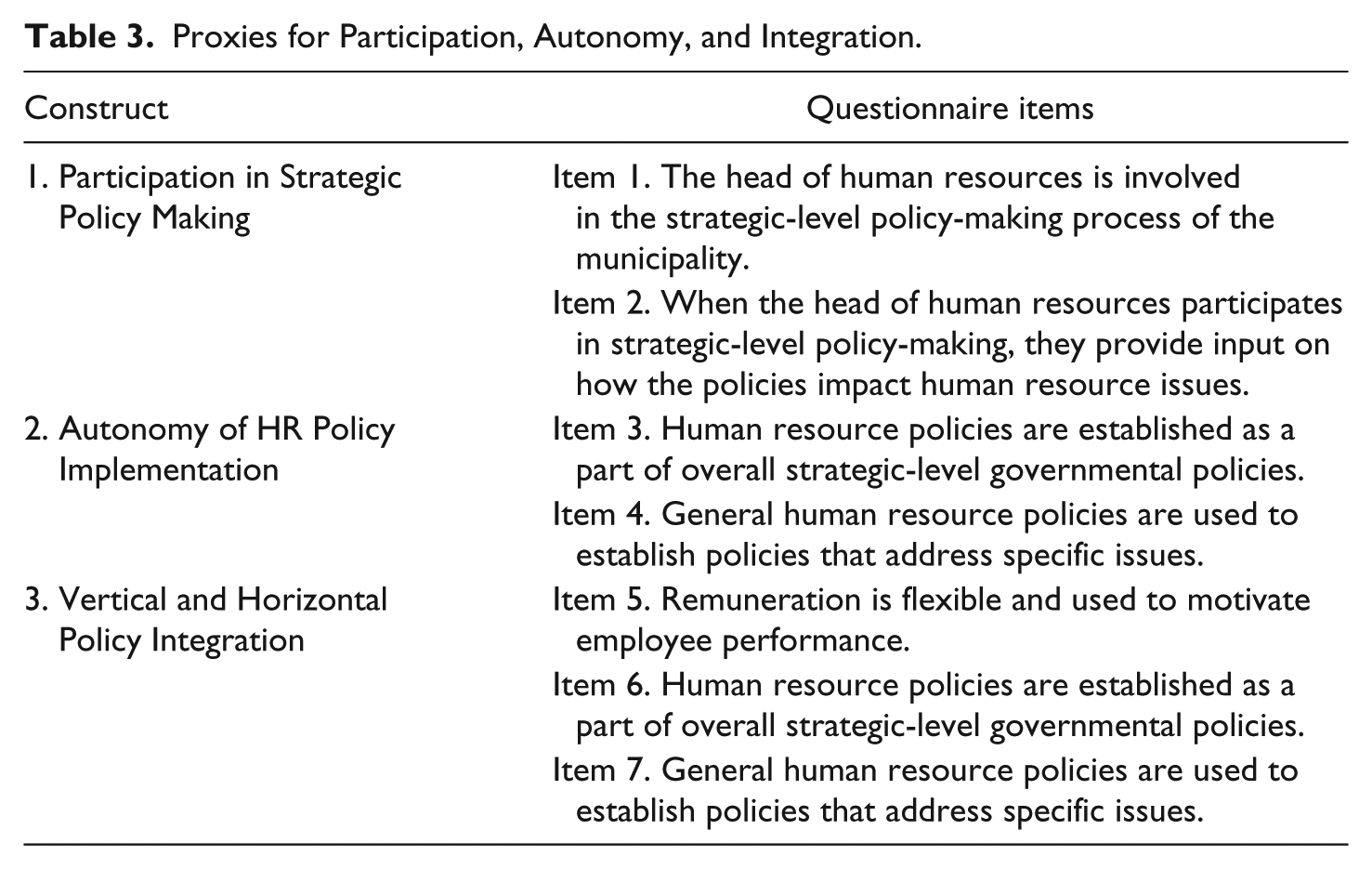
Of the 61 items from the original questionnaire, seven were identified that appeared to reflect the constructs that inform the underlying theoretical framework of this study. Two items reflect the involvement of managers in strategic-level policy making; three items reflect the range between strict adherence versus the autonomy of human resource personnel to interpret and implement human resource policy; and two items reflect the level of integration of human resource policy with other governmental policy. The questionnaire asked the respondents to rate each item on a 5-point Likert-type scale with responses ranging from strongly disagree to strongly agree for each statement (see Table 3).
Proxies for Participation, Autonomy, and Integration.
The size of municipalities was among the data available to the researchers. It was of particular interest due to the relationship often found in research that connects organization size with the structure and dynamics of organizations (e.g., decision making, divisional/departmental structures, executive layers, hierarchy, etc.). However, the item on the questionnaire that indicates the size of the municipalities is a categorical measure that is not a continuous nor evenly distributed variable. The questionnaire was designed for government reporting and, therefore, used the legal criterion set forth by FEMP (Spanish Federation of Municipalities and Provinces) to group municipalities. The result is a measure of municipality size based on the number of citizens: 1,000 to 5,000; 5,000 to 20,000; 20,000 to 50,000; >50,000. However, in spite of these shortcomings, the variable is examined using descriptive analyses.
Sampling Strategy
The sampling strategy for the original survey targeted local public human resource managers across Spain. Given the large number of municipalities in Spain and the skewed number of municipal governments relative to their respective number of citizens (i.e., small municipalities in Spain greatly outnumber large municipalities), a random sample of every municipality was not used for data collection. Due to cost constraints, reaching out all of the “small” municipalities (1,000-5,000 citizens) was not possible. In addition, to insure the inclusion of large municipalities, a more purposeful approach was used in an attempt to include large municipalities, which would be underrepresented in the sample had it been a purely randomized sampling approach. With these considerations in mind, a stratified sampling strategy was used. For municipalities with 1,000 to 5,000 residents, half of the nearly 2,000 municipalities were invited to participate. The procedure for selecting these municipalities involved obtaining an alphabetized list of these municipalities and selecting every other municipality for inclusion in the study. The questionnaire was distributed to all municipalities having a population greater than 5,000 (1,214 localities). Given these two conditions, the sampling pool consisted of 2,293 residents.
Data Analyses: The Process of Looking for an Emergent Taxonomy
There were two phases for developing the taxonomy of data analysis for the study. The first phase examined the construct validity of the items used from the questionnaire to represent the three theoretical constructs of participation, autonomy, and integration. A confirmatory factor analysis was performed to analyze whether there was support that the items from the questionnaire were measuring separate and distinct constructs.
The second phase looked for statistical clusters of managers when all seven items were considered simultaneously. This part of the analysis involved performing a k-means cluster analysis to observe whether distinct combinations of the three constructs emerged as clusters and, therefore, representing unique, yet emergent profiles of approaches to public personnel management. In other words, this phase of analysis did not assume an a priori set of categories/typologies of public personnel management. Instead, this phase focused on grouping managers into statistically distinct groups (profiles) that would later serve as profiles for constructing a general taxonomy of public personnel management.
The decision to use a k-means cluster analysis was largely based on the purpose of the study, which was to have groupings of management practice emerge from the data, rather than imposing a priori categories and constructs. K-means clustering techniques typically use Euclidean distance as the means to identify a predetermined number (i.e., k) of centroids from the data set. After the centroids are identified, additional data are added to the analysis by grouping observations with its nearest centroid. As data are added, centroids are recalculated through this iterative process. Ultimately, the analysis reaches a point of “data convergence” where the data centroids are distinct (mathematically distant) from each other and the added data have been clustered into groups mathematically close to the finally established centroids (Bahr, Bielby, & House, 2011; Rupp, 2013).
After the groups were established through statistical clustering, weighted mean scores on the three dimensions of the task environment were then calculated for each distinct grouping of managers. This allowed for the analysis and description of each “profile” using constructs from the literature and the theoretical framework undergirding this study. The resulting profiles of public personnel management (PPM) were then incorporated into a larger taxonomic scheme. The development of the larger PPM taxonomy relied on plotting the weighted mean scores for each profile on a two-axis grid of manager behavior, where x is participation in policy making and y is autonomy to adapt policy.
As mentioned above, the primary analysis was followed by examining how the various profiles might look vis-à-vis the size of municipalities. Given that the population data were not continuous or normally distributed, the method of ;exploring municipality size was limited to observing of the frequency/percentage of each type of cluster (profile) in each of the different size categories of municipalities.
Results
Response Rate
Of the 2,293 questionnaires that were distributed, 366 questionnaires were returned, 328 of those had complete data for the seven items used in this study, which resulted in overall response rate of 15.9% and 14.3%, after removing cases with missing data. The response rate of 14.3% has a confidence interval of .051 at 95% confidence level with a relative standard error of 5.01. The implications for the low response rate on the findings are discussed in a later section of this article.
Of the total sample, 98 of the respondent were from small municipalities. One hundred eighty-five were from medium size municipalities and 45 were from large municipalities. Again, these size categories do not represent continuous or ordinal variable.
Construct Validity: Confirmatory Factor Analysis
Our theoretical model suggests that there are three latent factors (constructs)—Factor 1 (F1): Participation in Strategic Policy Making (Questionnaire Items 1 and 2); Factor 2 (F2): Integration of Policy (Questionnaire Items 3 and 4); and Factor (F3): Autonomy of Policy Implementation (Questionnaire Items 5, 6, and 7). The model was estimated using a maximum likelihood method. Table 4 shows the factor loadings (from the standardized values). Table 5 shows the estimated covariance among the three factors.
Confirmatory Factor Analysis for Participation, Autonomy, and Integration.
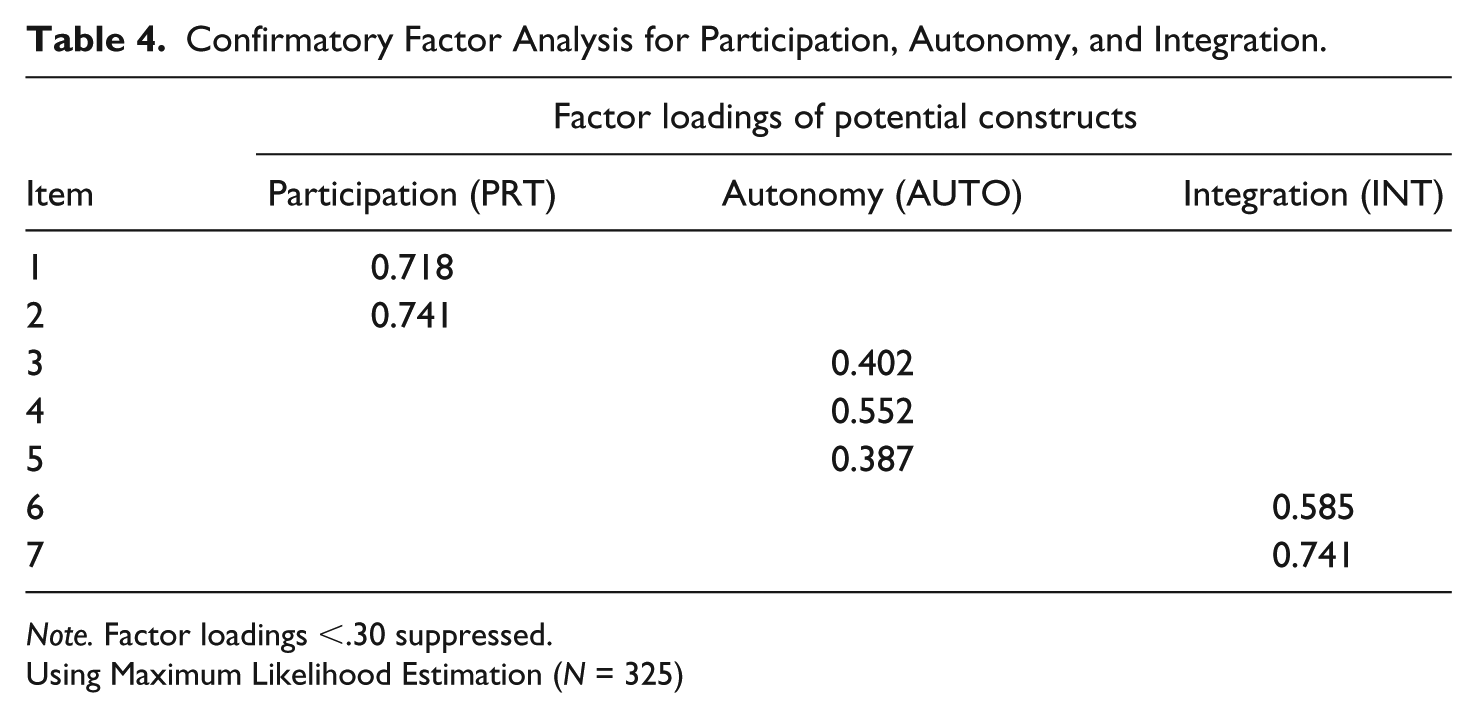
Note. Factor loadings <.30 suppressed.
Using Maximum Likelihood Estimation (N = 325)
Estimated Covariance Between the Three Latent Factors.
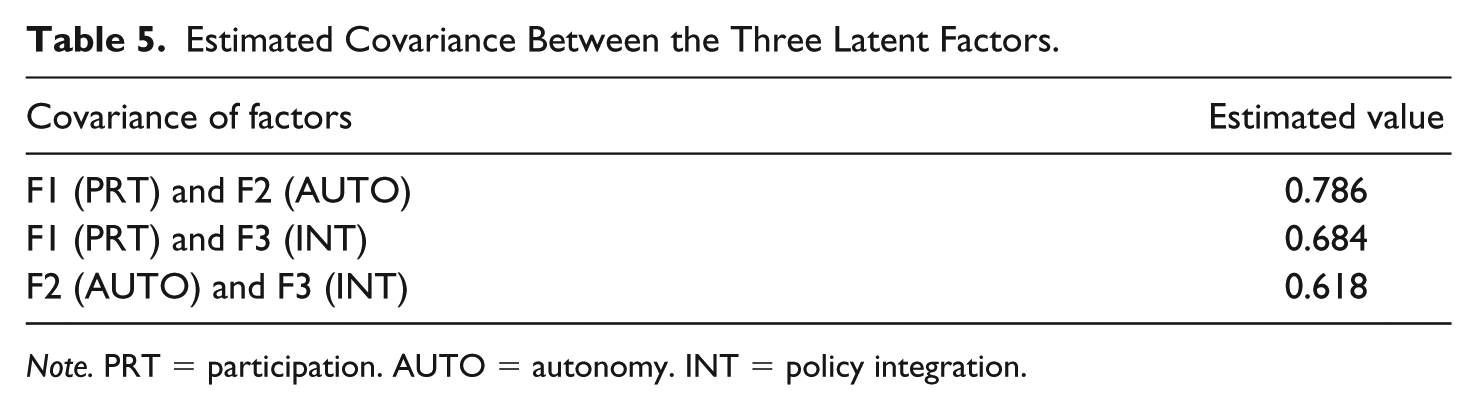
Note. PRT = participation. AUTO = autonomy. INT = policy integration.
The overall goodness of fit of the model was tested by the observing the correlation matrix between the items, the goodness of fit index (comparative fit index [CFI]), and the square root of the average of the squared residuals (root mean square error of approximation [RMSEA]). The value χ2 = 18.27 indicates that the model should not be rejected at a significance level of ⩽5%. Furthermore, the CFI index (.980) and RMSEA (.045) reveal that the degree of fit is high. Based on the results of factor analysis and the goodness of fit tests, there is support for the model that includes three distinct constructs.
Grouping Managers Using Cluster Analysis
Recall that the purpose of the cluster analysis is to group managers into statistically distinct groups. This process of grouping the managers is not based on theoretical assumptions or themes from HRM research; instead, it is an approach that relies on a statistical “sorting” of managers into groups based on the statistical similarity of their responses to all seven survey items. These statistically distinctive groups are then analyzed and described as “profiles” that compose an emergent taxonomy. It is during the analysis phase when the three dimensions of the task environment are unpacked to describe and situate the profiles into the larger taxonomy.
In our analysis, we explored using different k values (3, 4, 5, 6, and 7). After reviewing the results of each iteration of cluster analysis (i.e., k = 3, 4, 5, 6, and 7), the results of the analysis where k = 5 were determined to be of particular interest. At k = 5, the results appeared to provide the best way to avoid an oversimplified (too few clusters) or overcomplicated (too many clusters) taxonomy. In other words, at k = 5, the taxonomy has a greater number of categories than the three constructs (factors) of our conceptual building blocks, yet at k = 5, the number of possible clusters remains low enough to be used as advanced organizers for interpreting distinct (statistically) profiles of manager practice.
The n of managers in Clusters 1, 2, 3, 4, and 5 are 94, 67, 50, 69, and 48, respectively. The n for Cluster 1 is notably larger than the other groups. The 94 managers included in this cluster make up nearly 29% of the total number of participants in the study. Cluster 1 has, on average, 62% more managers than any other clusters and nearly double the number of Cluster 5. However, there is a relative even distribution of managers among the remaining four clusters. When k = 6 and k = 7 were used, the n for Cluster 1 was similar when using the value of k = 5; however, the remaining clusters became much smaller. Given that n was a consistent value when using k = 5, 6, or 7, we decided to follow the principle of parsimony and settle on the value of k = 5 to further the analysis.
In the previous phases of the analysis, the presence of three distinct constructs were supported through factor analysis and the k-means cluster analysis resulted in five distinct groups of managers. Each of these groups manifest the three constructs in a unique way; thus, each group provides a unique profile for the human resource managers in this study. In the following sections, mean scores for strategic participation, policy integration, and autonomy are examined to interpret and describe each of the five emergent profiles.
Making Sense of Profiles
Manager Behavior: Policy Making and Autonomy
The participation in strategic-level activities and autonomy in implementing policy focus on behavioral aspects of human resource professionals. This section is a starting point for describing the profiles based on the mean of the measures of participation in policy making and autonomy from each of the emergent manager clusters. Figure 2 plots the mean scores for managers’ role: (a) participation in strategic policy making and (b) level of autonomy in carrying out their work.
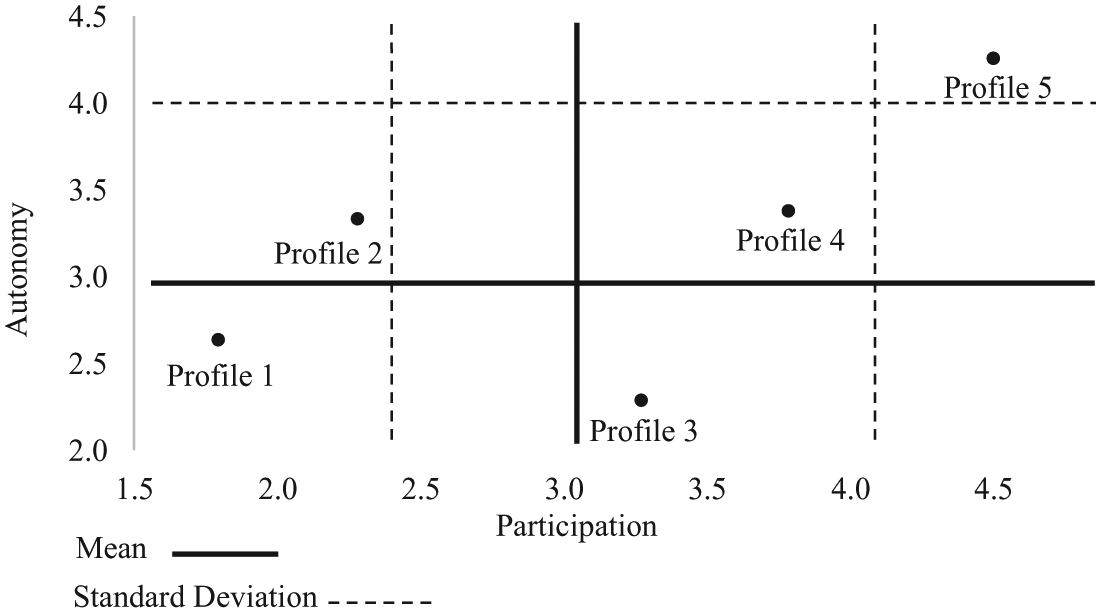
Plotted managerial profiles (Autonomy × Participation).
On the dimension of participation, Profiles 1 and 2 fell below the standard deviation of mean responses. Profiles 3, 4, and 5 are above the mean; however, only Profile 5 is greater than one standard deviation (1.36) beyond the mean on the dimension of participation in strategic-level policy making. With respect to the dimension of autonomy, Profiles 1 and 3 fall below the mean, which means that in these profiles, managers tend to adhere to policy. Profiles 2, 4, and 5 are above the mean. However, Profile 5 mean is above one standard deviation above the larger sample mean, suggesting that managers in Profile 5 are more autonomous in their application of policy.
Profile Descriptors
Each profile was assigned a descriptor to reflect characteristic manager behavior in strategic-level policy making and autonomy. The descriptor for the profiles rely on terms that are drawn from the literature that reflect the associated behavior. The term “technical” characterizes low levels of participation in strategic policy-making processes. The terms “managerial” and “strategic,” respectively, represent increasing levels of participation in strategic-level policy making. On the dimension of adaptation, the term “administrative” characterizes strict applications of policy that is conceptually consistent with behavior in a highly bureaucratic environment (e.g., Old Public Administration), while the terms “functional” and “executive” reflect increasing levels of adaptive behavior, respectively (e.g., New Public Management). The profiles descriptors are Technical Administrative (TA: Profile 1); Technical Functional (TF: Profile 2); Managerial Administrative (MA: Profile 3); Managerial Functional (MF: Profile 4); and Strategic Executive (SE: Profile 5). Table 6 summarizes the profiles with respect to participation and autonomy.
To further the analysis of the profiles, policy integration is added to the analysis of each of the profiles below.
Summary of Profiles Based on Policy Making and Autonomy Descriptors.
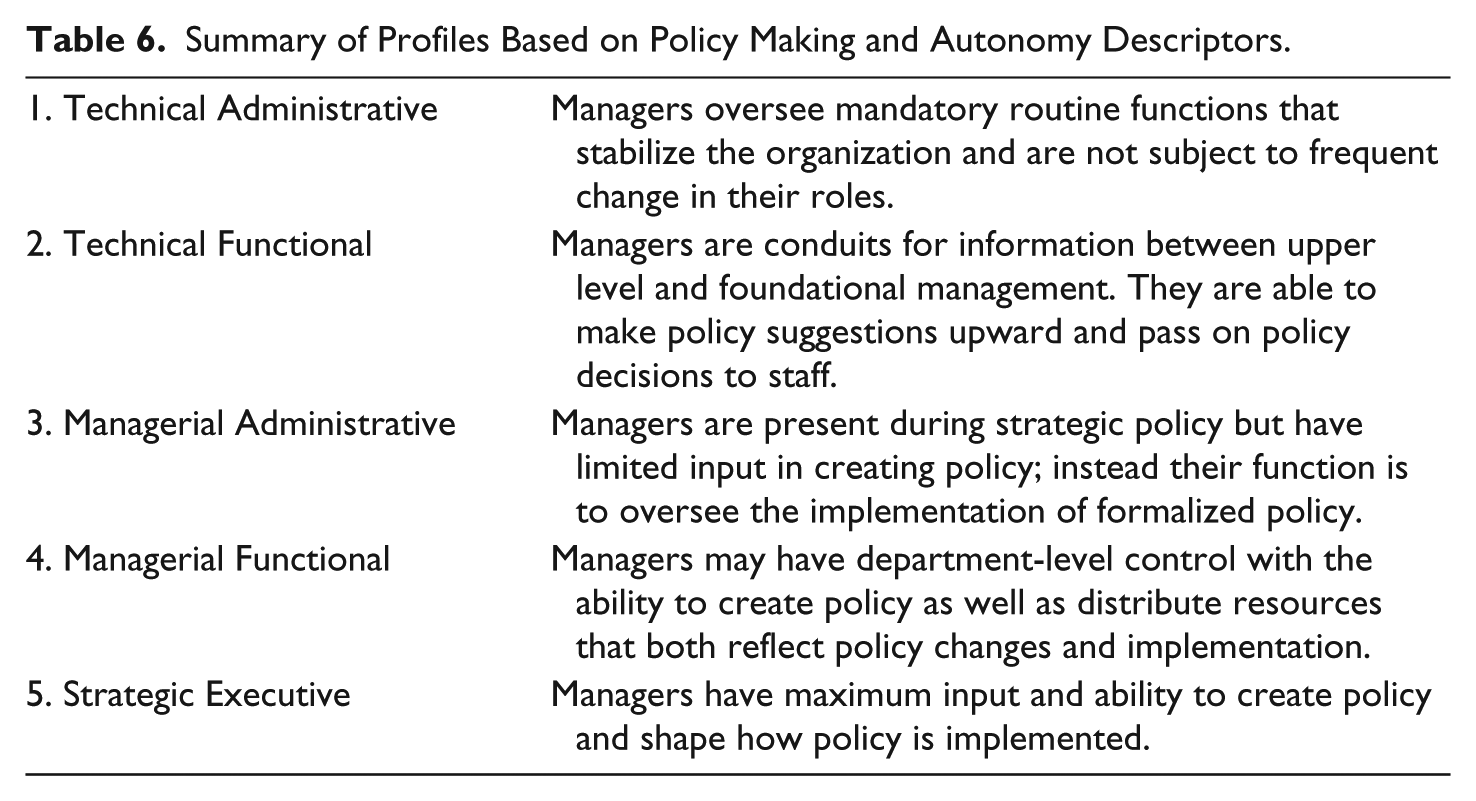
Profile 1: TA
Managers in this group report relatively low levels of participation in strategic policy-making processes. The TA group seems to reflect the exclusion of managers from the strategic apex of the policy-making process. Thus, these groups of managers reflect a middle management role. Policy making is not the responsibility of the managers. Instead, policy is generated at the strategic apex (Mintzberg, 1989) of the organization, which excludes the participation of HR managers. The policy-making process in the traditional bureaucratic form of organization that is often isolated (i.e., not integrated into the overall organizational policy framework) and the role/behavior of managers are relatively constrained.
TA managers would most likely oversee routine tasks or processes. These managers would oversee personnel whose functions change relatively infrequently; however, they are responsible for the important mandatory routines that keep a department stable.
Profile 2: TF
Managers in this group report modest levels of participation in strategic-level policy-making processes. However, the level of policy integration reported by managers is quite high relative to the other groups. The high level of self-reported integration does not appear to come from managers being involved, but rather from another source in the organization. Yet, in this group, managers’ report a relatively high level of adaptive behavior suggesting that they have the autonomy to adapt policies to specific needs as they arise.
Profile 3: MA
Mangers in the MA group report a higher level of participation in policy-making processes than the previous groups. In addition, the level of policy integration is quite high. However, managers report the lowest level of adaptive behavior of all five profiles. This does not conform with the pattern of the other profiles, where level of adaptation increases when participation and integration increases. A further analysis of this anomalous result is discussing in more detail following the profile summaries.
Profile 4: MF
In the MF group, there is a relatively high level of strategic participation, though policy integration is the second lowest among the five profiles. The level of autonomy is moderately high. Even though policy integration is relatively low, these managers have knowledge and participate in strategic levels of the organization and have the flexibility to adapt policy to that strategic vision.
Profile 5: SE
SE managers report high levels of participation, policy integration, and adaptive implementation of policy. When looking at Figure 3, the SE approach appears to represent an idealized form of SHRM. Managers are highly involved in strategic policy making; they report very high levels of both vertical and horizontal policy integration, and managers indicate that they adapt the implementation of personnel management policies.
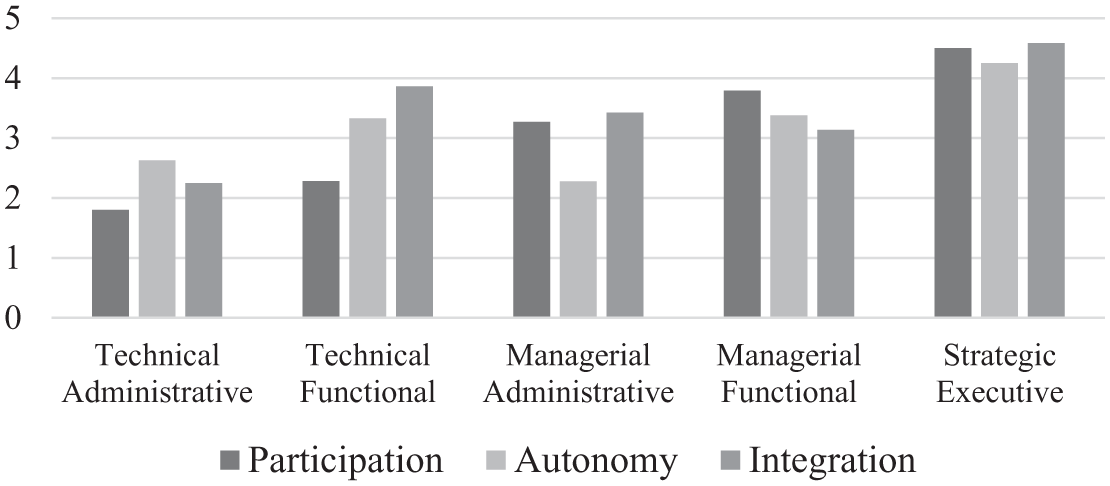
Profiles of manager behaviors and policy integration.
Unpacking the Nonlinearity of Profiles
A casual look at Figures 2 and 3 reveals that the profiles do not progress in a linear fashion. The mean scores for participation, autonomy, and integration do not rise or fall in any obvious or predictable manner. The MA management profile stands out in particular. It seems to mark a point of departure from the first two profiles and the two that follow. TA and Technical Function, the two profiles that precede MA, indicate levels of strategic involvement that are lower than their respective levels of autonomy. However, the MA group shows a dramatic reversal where the level of participation is quite high, yet autonomy is very low. In fact, MA has the lowest level of reported autonomy among all of the profiles. The flip in participation being reported higher than autonomy continues in the MF and SE profiles, but the difference is much less pronounced.
One approach to examining this outlier is to look more closely at responses to individual items that make up the constructs of strategic participation. Two items from the questionnaire observe participation in strategic-level policy making; however, each represents a different form of participation. The first item simply asks whether the manager is present during strategic policy making. However, the second item asks managers to assess the level of their input related to human resources during this policy-making process. Figure 4 illustrates that across all of the profiles, both types of participation (i.e., Item 1 [presence] and Item 2 [input]) are reported at similar levels, except for the MA approach.
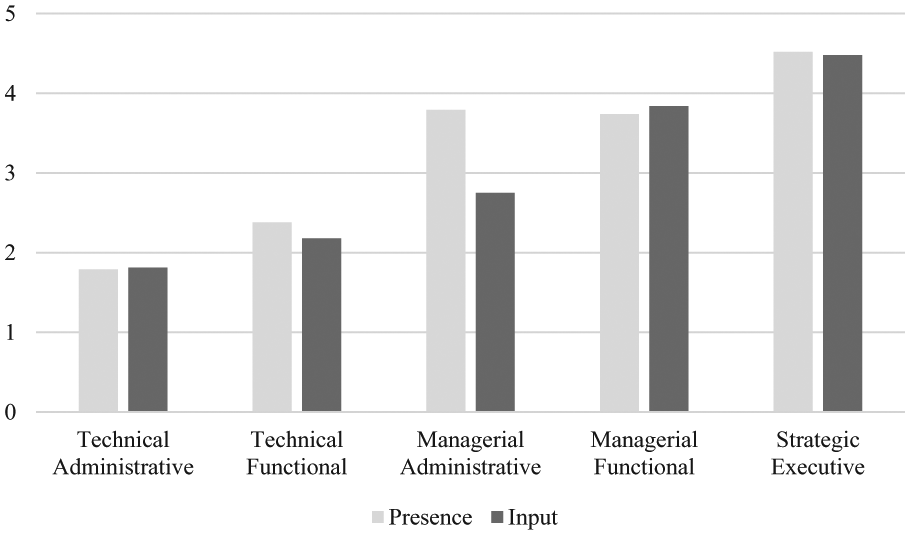
Strategic policy making participation: Presence and input.
In the MA approach, people report a high level of being present during the policy-making processes; however, they also report less input in the concerns of human resources in policy-making process. Although the level of input in the MA approach is higher than in the Technical Administration and TF approaches, the MA approach shows a greater difference between the presence (Item 1) and input (Item 2) in the policy-making process. So, the disparity between “being present” and “having input” at the strategic level could be impact autonomy. If the form of participation impacts behavior, there are different ways to interpret such a dynamic. Although purely speculative, it is reasonable to conclude that even though the manager may be in the mid of strategic processes, the role of the manager in the MA group is “to be seen, not heard,” or perhaps does not possess the expertise or capacity.
Analysis of Profiles by Size of Municipality (Population)
This phase of the analysis looked at the size of the population of municipalities in relation to the five profiles. As noted in the “Methods and Procedures” section, the data on the size of municipalities are categorical and originated from FEMP. Thus, the analysis relating to size is limited to basic descriptive statistics. Even so, there are some interesting results when looking at the frequencies and percentages of each profile when the sample is grouped by the Spanish government categories of municipality size.
One such result is that the raw number of SE managers in the small municipality category (30) is greater than any of the other four profiles. Another interesting result is that there are no (zero) managers from the SE group represented in the large municipality category (see Table 7).
Number of Managers Grouped by Profile and Size of Locality.
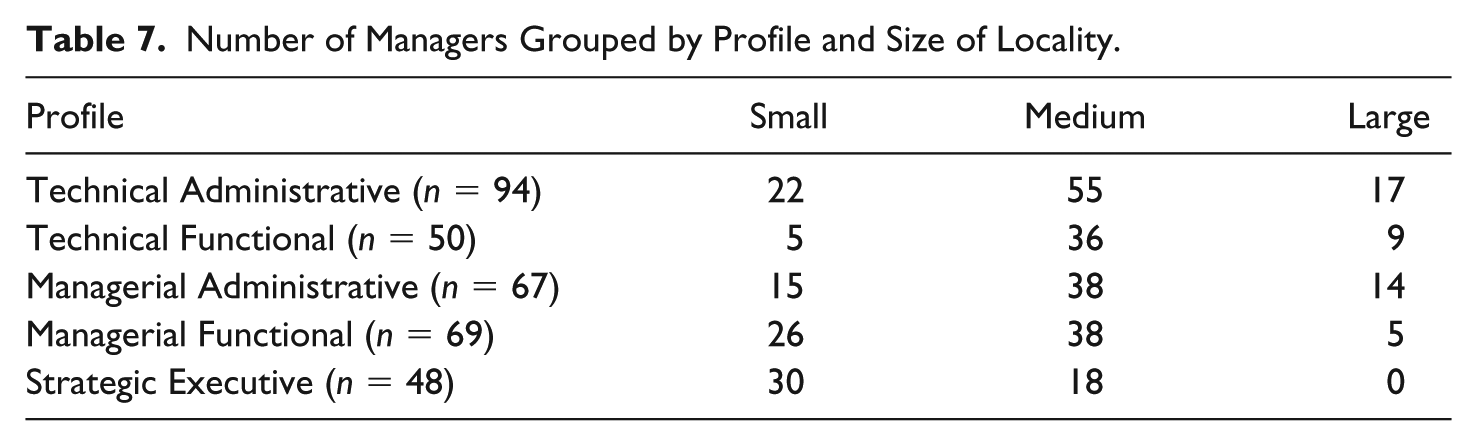
When comparing the distributions of the histograms from one size category to another, it is noteworthy that the small group has a low number of managers in the TF group, the medium group is relatively flat (relatively evenly distributed among profiles), and the large grouping appears to have a downward trend (see Figure 5). As these categories are not available for inferential or correlational analyses, there is no way to conclude or make claims about the impact of size on the form of personnel management.
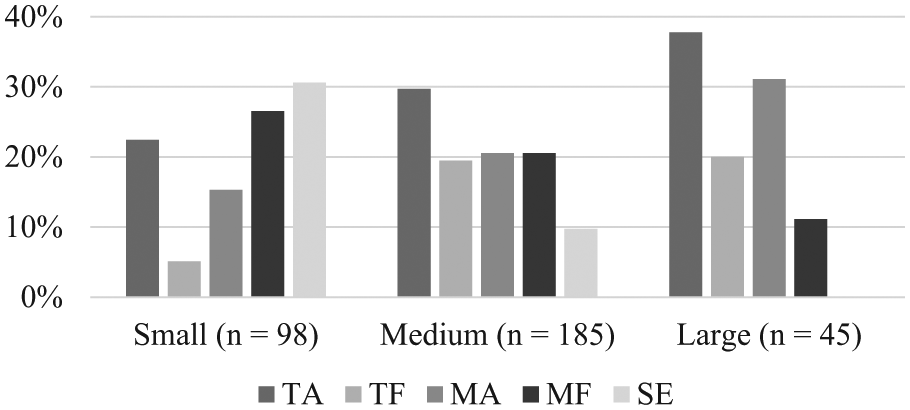
Percentage of profile types by municipality size.
Discussion
In this section, aspects of the profiles that emerged from the study are discussed vis-à-vis previous descriptions of HRM research.
TA
Of the emerging profiles, Technical Administration is most closely associated with traditional ways of thinking about organizations and their employees reflected by the Old Public Management paradigm (i.e., universalistic, administrative, and mechanistic). The TA approach implies that there is uniformity among all organizations and suggests a “one size fits all” solution to HRM. In addition, given the lack of participation by HR managers in strategic policy making and limited autonomy, this perspective does not appear to embrace the notion that the various functional units are interdependent and mutually influential that need to be coordinated through involving managers as strategic partners and professionals.
The TF profile goes a bit further toward the contingency category in that there is the implied notion that policy may need to be adapted to fit with conditions as they emerge. This profile moves away from the Old Public Administration view toward elements of New Public Management. That is, managers are considered professionals who are operationally competent and capable of adapting policy when needed, but not necessarily considered capable of generating policy.
The MA profile seems to represent a retreat back toward Old Public Management. Even though the participation in strategic policy making is high, the level of input is low, and the low level of autonomy makes this profile seem like a display (window dressing) of SHRM and New Public Management without managers playing a substantive role at the strategic level. The function of manager is more administrative than professional in this profile.
The MF profile captures the SHRM and New Public Management approach than the MA profile. The manager participates in strategic-level decisions, (strategic) the manager has autonomy to adjust (contingency, operational), and the human resource policy is integrated into the overall policy framework of the municipality.
The final profile, SE, has the highest level of strategic participation, autonomy, and policy integration. This profile suggests that the human resource manager is fully integrated into the strategic and operational aspects of the municipality. As stated above, this profile represents an idealized version of New Public Management.
Conclusion
This study yielded five profiles that provide useful ways to conceptualize, describe, and further investigate the nature of HRM in the public sector. In its pursuit of developing a taxonomy, the study led with the assumption that approaches to HRM vary in their form and function. While some efforts classify human resource practices along a developmental or evolutionary trajectory (e.g., historical or organizational growth), this taxonomy does not explicitly demonstrate such progressions. Instead, it acknowledges traditional and newer concepts of organizational and human behavior and incorporates them into a framework that is integrated along central themes from research.
Although continuous data on the size of municipalities were not available for this study, there are provocative questions that arise when considering how the structure of agencies can have influence on the role and behavior of human resource managers. For example, it is interesting to consider that none of the managers in large municipalities identified characteristics of SE approaches. Instead, the smaller municipalities had the largest proportion of managers in the SE profile.
Literature in organizational behavior suggests that the size of organizations impacts the formalization of roles, responsibilities, and tasks (i.e., structure) within organizations. As organizations increase in size, structures often become more divisionalized by separating specialized function areas of the organization. As the number of divisions increase, coordination and collaboration in policy making and operations become more challenging and complex (Greiner, 1972). This has implications for manager participation in strategic policy making, integration and consistency of policy, and the flexibility of managers to adapt. If divisions are not cohesive and focused on the same set of strategic goals, different interests can create political struggles for power and resources.
It is not unreasonable to conclude that governance structures that serve smaller populations have more intimate relations among the various actors in government resulting in more integration of government functions and, therefore, closer involvement with strategic levels of decision making, policy making, and governing functions. In addition, human resource managers’ roles in the overall government varies (i.e., elected, appointed, or professional) and may also impact HRM. Given this, it could be concluded that managers’ approaches to HRM is influenced by the size and/or nature of governance structures as well as the role of the HR manager.
Limitations
Three main limitations of the study are related to the data. First, the data used for this study were not collected with the purpose of precisely measuring the three constructs that compose the theoretical framework of this study. Second, the response rate to the survey was very low, which raises the issue of external validity. Third, the data regarding the size of municipalities were not in a form that would allow for correlational or other inferential statistical analyses.
While the data analysis supported the presence of three distinct constructs, a more precise and intentional effort to measure these constructs would enhance the validity of the findings. Related to the measurement of the three constructs, the primary source of data is self-reports of human resource managers; thus, there this no ability to triangulate their perceptions with the perceptions of their peer colleagues, supervisors, and/or subordinates. In addition, a confirmatory factor analysis was used for the first part of the analysis based on the sense of robustness of the three constructs in theory and research. In hindsight, however, it makes sense to conduct an exploratory factor analysis to see if the constructs would emerge on their own.
Another limitation is the lack of clarity on the locus of control or authority for managerial participation and flexibility. There is an absence of a measure that ;indicates if managers were in the position to make a decision to opt into or opt out of strategic policy making. The presence of such a measure may yield more useful insight whether managers have the authority to participate in policy making or modify the ;implementation of policy. It is possible that the personality or characteristic of the manager, the nature/characteristic of the organization, the organizational leadership (power structure), or some combination of each could impact participation and ;flexibility. Additional items could help shed light on these questions.
Implication for Further Research
Many of the limitations of this study can be addressed in future research by developing a more robust strategy for data collection. This would include efforts to improve the sampling strategy to increase the response rate, incorporate random sampling, which would ideally yield a more normally distributed data set. With respect to the survey instrument itself, a new questionnaire that specifically targets the theoretical constructs could improve the precision of measuring the three constructs. The form of the items of the new questionnaire should focus on collecting data that is in a form (e.g., continuous) that allows for more sophisticated statistical analysis, and additional items should be added to the questionnaire to measure contextual variables that could be related to different profiles (e.g., antecedent, outcomes, mediating and moderating variables, etc.).
In the case of contextual variables (e.g., antecedents), additional variables could be included such as the number of public personnel, variation among public personnel functions (e.g., administrative, professional, executive), variation among governmental functions (e.g., health, safety, finance, education, etc.), population density, and HRM leadership (e.g., elected, appointed, etc.).
In the case of outcomes, further research could focus on developing an understanding of the relationship between different profiles and variables such as psychosocial aspects of personnel (e.g., satisfaction, motivation, skill development, teamwork, etc.) and measures of productivity (i.e., efficiency and effectiveness) at the level of individuals, departments, agencies, and municipalities in general (Guest, 1997; Poister, 2003; Posthuma, Campion, & Masimova, 2013).
The addition of specific variables should be intentional in an effort to advance and build upon existing theoretical frameworks and empirical research. For example, an intentional approach to expanding social cognitive theory could involve exploring possible relationships among variable of participation in strategic policy making, discretion in policy implementation, and manager self-efficacy.
As noted in the introduction of this article, human resource managers are at the nexus of dynamic changes occurring in the public sector. Policy-making, policy implementation, and policy alignment are critical factors that create the context for managers to perform their duties. The ability of managers to participate and provide input in strategic activities of the government likely impacts the quality and consistency of human resource policies and the effectiveness and efficiency of managers and employees and the organization as a whole.
The results of this exploratory study provide a basis for furthering research in approaches to public personnel management. The constructs of participation, autonomy, and integration appear to be robust and informative ways to characterize and observe dynamics of the task environment of a human resource manager. The five profiles that emerged from this study offer distinct, yet related forms of HRM that are grounded on existing theory and research in this area of study. The five profiles offer an enhanced level of complexity for examining public personnel management by building on central themes of existing HRM models.
Although we offer a taxonomy, it is not likely for a human resource manager or an agency to be exclusively oriented and/or operating within a single framework in practice. It is also not evident that one model of practice is superior to another in comparing practice and productivity. This taxonomy simply offers another vantage point from which to continue research and practice in public personnel management.
Footnotes
Declaration of Conflicting Interests
The author(s) declared no potential conflicts of interest with respect to the research, authorship, and/or publication of this article.
Funding
The author(s) received no financial support for the research, authorship, and/or publication of this article.