







Abstract
Educational professionals are expected to be able to deal with diverse societal challenges and are closely scrutinized in their daily work. As a consequence, teachers are increasingly subject to public pressure, that is, a demand from the public for improved services, increased responsiveness, and better information provision. Given the dynamic working environment of teachers, dealing with this demand requires teachers to behave proactively. Grounded in job demands–resources theory, this study explores how human resource management (HRM) can support teachers in portraying proactive behavior in the context of public pressure. More specifically, regular feedback is investigated as a tool to empower employees in this demanding working environment. Findings reveal that the relationship between regular feedback and proactive behavior through psychological empowerment is moderated by public pressure, which highlights the relevance of considering public sector contextual demands in the motivational process of HRM practices. The results furthermore support the call for further integration of a multilevel perspective in HRM research.
Keywords
Introduction
Society is expecting ever more from educational professionals. Current societal issues, such as teacher shortages, diversification of student populations, and technological innovations, pose challenges for educational professionals (OECD, 2019, 2023). Moreover, they are performing their jobs under increased public scrutiny (Crosswell & Beutel, 2017). The consequent demand of society for improved services, increased responsiveness, and better provision of information can be referred to as public pressure (Lonti & Verma, 2003). Public pressure requires educational professionals who are willing to contribute to school success regardless of their formal job description (Cerit, 2017). It furthermore calls for teachers who are able to proactively identify and solve problems (Crant, 2000). The need for teachers to engage in proactive behavior—active work behaviors that are anticipatory, future-oriented, or self-starting in nature (Belschak & Den Hartog, 2010)—is thus becoming crucial for school performance (Cerit, 2017).
The current study aims to better understand how human resource management (HRM) can help teachers engage in proactive behavior in the context of public pressure. As depicted in Figure 1, this study builds on job demands–resources (JD-R) theory (Bakker et al., 2023; Demerouti et al., 2001) to examine how the HRM practice of regular feedback empowers teachers to exhibit proactive behavior in the context of public pressure. Regular feedback refers to continuous, day-to-day work-related feedback received from the supervisor (Kuvaas, 2011). It concerns a type of performance information that helps employees make sense of the diverse aspects of their job and enables them to perform adequately within them (Fishbach et al., 2010; Kuvaas, 2011). In doing so, the provision of regular feedback improves employees’ flexibility and aids them in achieving work goals (Fishbach et al., 2010; Kuvaas, 2011; Mertens et al., 2021). Feedback has thus far been understudied as a tool for improving teacher performance (Firestone, 2014); however, research suggests that regular feedback is positively linked to employees’ affective commitment, job satisfaction, overall performance, and more specifically (Kuvaas, 2011; Mertens et al., 2021), improved classroom performance (Stronge & Tucker, 2003; Tuytens & Devos, 2017). This study follows JD-R theory in arguing that regular feedback is a job resource that stimulates personal learning and is linked to improved proactive behavior as a type of performance (Bakker et al., 2023; Parker et al., 2006).
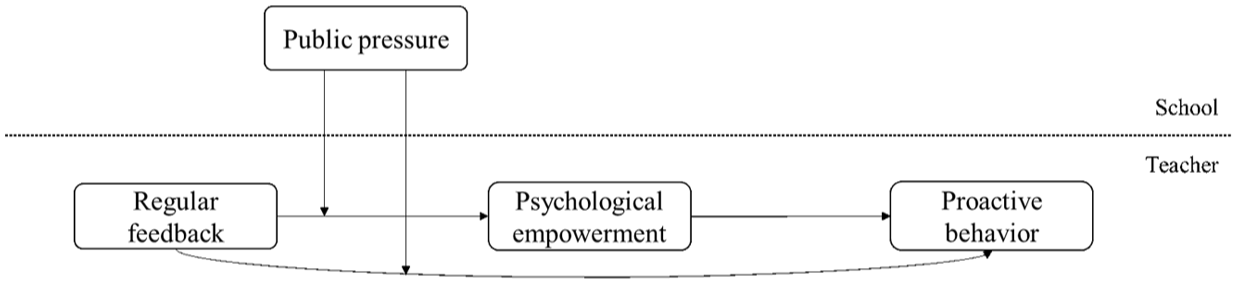
Multilevel Moderated Mediation of the Relationship Between Regular Feedback and Proactive Behavior.
JD-R theory further states that job resources instigate a motivational process that explains how job resources link to improved performance (Bakker et al., 2023). Therefore, psychological empowerment is tested as a mediating mechanism in this study. Psychological empowerment refers to intrinsic work motivation that is reflected in four cognitions: a sense of meaning, confidence, self-determination, and impact (Spreitzer, 1995). In complex work environments such as schools, empowerment is pivotal for overcoming organizational challenges, yet little is known about the factors that promote teachers’ empowerment (Kang et al., 2022). Additionally, in order to understand the impact of public pressure, defined as perceived pressure from the public for improved services, as well as better information provision and greater attention to public views (Lonti & Verma, 2003), the current study conceptualizes public pressure as a job demand, as it represents a social aspect of the job that requires cognitive effort (Bakker et al., 2023). This study builds on the boost hypothesis of JD-R theory, which presupposes that when a job resource, such as regular feedback, interacts with a job demand, the positive, motivational impact of the job resource is amplified. As depicted in Figure 1, public pressure is regarded as a school-level demand, so it was measured at the level of the school principal. School principals serve as the primary intermediaries between the external world and the internal world of the school and have the greatest access to the broader network of the school (Botha, 2004). They therefore have a comprehensive view of the school’s social context and the demands within it.
This study aims to make several contributions to the literature. First, this paper contributes to recent calls for the further contextualization of HRM research (Boselie et al., 2021; Knies et al., 2024). The Contextual Strategic HRM Framework (Paauwe & Farndale, 2017) highlights the important role of the social and institutional contexts of organizations in evaluating the effectiveness of HRM practices. HRM in the public sector is not “business as usual” and applying what works in other sectors will not necessarily lead to the same results (Knies et al., 2024, p. 2433). Accordingly, Tuytens and Devos (2017) argue that practices of teacher evaluation should be considered within the context of the school, since teacher feedback does not occur in a vacuum and the context can either enhance or undermine the effectiveness of feedback practices. Moreover, research acknowledges that employee empowerment also does not develop in a vacuum and is the result of organizational features, but the specific boundary conditions remain understudied (Kang et al., 2022). Research into HRM should thus be carefully contextualized. This paper does so by, first, examining how the HRM practice of regular feedback can help promote two aspects that are especially relevant to teachers, namely psychological empowerment and proactive behavior. Furthermore, the current study builds on insights from education research (e.g., Botha, 2004; Tintoré et al., 2022) to highlight the specific dynamics of schools as work environments. Lastly, this study investigates the concept of public pressure in schools, a highly prevalent feature of today’s schools. In doing so, the paper is firmly grounded in the school context. Consequently, by studying teachers as civil servants and using literature from HRM and public administration, this study addresses calls for further integration of these two domains (Boselie et al., 2021; Knies et al., 2024).
This study moreover provides an expansion of the boost hypothesis of JD-R theory by investigating a cross-level interaction. By examining the role of public pressure experienced by a school, the current study proposes and empirically tests the interaction effect of a school-level factor on individual-level outcomes. This paper thereby addresses the further exploration of a multilevel JD-R model (Bakker et al., 2023). Furthermore, to date, only limited public sector characteristics have been attributed to the JD-R model (Bauwens et al., 2021), such as public service motivation (Bakker, 2015), red tape (Muylaert et al., 2023), and the organizational restructuring of public organizations (Borst & Knies, 2023). This study tests the applicability of the model in explaining the role of public pressure as a public sector job demand.
A further contribution involves investigating psychological empowerment as a mediator. The motivational process of job resources on positive employee outcomes is often explained using work engagement as the explanatory mechanism (Bakker et al., 2023). However, given the nature of the outcome examined in the current paper, that is, proactive behavior, this study deems psychological empowerment to be the more relevant potential mediator. Proactive behavior is an active, change-oriented behavior that requires a certain sense of self-efficacy and autonomy, which is best captured by the concept of psychological empowerment (Parker et al., 2006). This study, therefore, examines the mediating role of psychological empowerment between regular feedback and proactive behavior. In doing so, it expands understanding of the motivational processes associated with job resources and contributes to the psychological perspective in public administration research (Tummers et al., 2018).
Theory and Hypotheses
According to the JD-R theory, all job characteristics can be divided into two categories, namely job demands and job resources (Bakker et al., 2023; Demerouti et al., 2001). Firstly, job demands are the aspects of a job that require sustained effort. These job demands can be physical, psychological, social, or organizational in nature. Examples include workplace conflict and high work pressure. Job demands instigate a health-impairment process and deplete employees’ energy. Secondly, job resources are the physical, psychological, social, or organizational aspects of a job that help employees achieve work goals, manage job demands, or promote personal development (Bakker et al., 2023). Examples include supervisory support and training opportunities. Job resources initiate a motivational process that can result in both increased intrinsic and extrinsic motivation (Bakker & Demerouti, 2008). To explain how exactly job resources have a motivational impact, JD-R theory builds on self-determination theory (Deci & Ryan, 1985) and states that job resources satisfy the basic human needs for autonomy (desire to act with a sense of volition), relatedness (desire for connection), and competence (desire to feel effective), which leads to increased work engagement and work motivation in general (Bakker & Demerouti, 2007, 2008; Bakker et al., 2023; Van den Broeck et al., 2008). Below, an explanation is given of how this study builds on JD-R theory to develop its argumentation.
Regular Feedback and Proactive Behavior
In line with JD-R theory, the current study conceptualizes regular feedback as a job resource (Bakker & Demerouti, 2007; Bakker et al., 2010). Regular feedback refers to “perceived frequency of regular day-to-day work-related feedback” that takes place outside of formal performance feedback activities (Kuvaas, 2011, p. 125). It thus concerns feedback given on a more informal and continuous basis. Regular feedback provides employees with the necessary information about their work performance, enabling them to use this information to improve their work and achieve work goals (Fishbach et al., 2010; Kuvaas, 2011). Therefore, it is an essential part of the broader HRM system of performance management, in which employee performance is continuously planned, monitored, and evaluated (Aguinis, 2013; Van Waeyenberg et al., 2022). Regular feedback furthermore allows supervisors and employees to interact and exchange information in a more tailor-made way than is usually the case in a formal performance evaluation. Finally, regular feedback can help improve employee flexibility in a dynamic work context, as supervisors can quickly address less effective employee behavior (Mertens et al., 2021). Receiving regular feedback thus fosters employees’ learning (Bakker & Demerouti, 2007) and it helps satisfy one of the basic psychological needs that people have (Deci & Ryan, 1985), namely that of competence (Bakker & Demerouti, 2008; Kuvaas, 2011; Spreitzer, 1995). It therefore plays an intrinsic motivational role (Bakker et al., 2010). Regular feedback also has extrinsic motivational potential, since it helps employees achieve work goals.
In line with the proposed motivational role of job resources in the JD-R model, this study expects regular feedback to be positively related to proactive behavior as a type of extra-role behavior. Proactive behavior is defined by Crant (2000, p. 436) as “taking initiative in improving current circumstances or creating new ones; it involves challenging the status quo rather than passively adapting to present conditions.” It concerns discretionary work behaviors with an organizational focus that are future-oriented, change-oriented, and self-starting in nature (Belschak & Den Hartog, 2010). Examples of proactive behavior are taking initiative and suggesting ideas for improvement.
Theoretically, Bakker et al. (2004) suggest that the engagement of employees in extra-role actions, such as proactive behavior, is predicted by the availability of job resources, as these resources encourage employees to go beyond mere goal accomplishment. Empirical research has additionally established that job resources are important antecedents of extra-role behavior through their relationship with (dis)engagement (Bakker & Demerouti, 2007; Bakker et al., 2004). Taken together, the current paper hypothesizes:
The Mediating Role of Psychological Empowerment
Employee empowerment has been emphasized as an important topic in recent public management literature (García-Juan et al., 2019; Kang et al., 2022). Two distinct perspectives have developed on empowerment: a structural and a psychological perspective (Fernandez & Moldogaziev, 2013; García-Juan et al., 2019). Where the structural perspective views empowerment as management practices that increase employee autonomy and participation in decision-making, the psychological perspective views empowerment as an individuals’ internal, cognitive state. The relevance of this latter perspective has been recognized, but has only scarcely been empirically researched in public organizations (García-Juan et al., 2019). Nonetheless, it may be especially relevant because of the autonomy that frontline employees, such as teachers, typically already enjoy in their work (Kang et al., 2022). More specifically, psychological empowerment refers to intrinsic work motivation that is manifested in four cognitions that combine additively to an overall concept of an individual’s orientation to their work (Spreitzer, 1995). The four cognitions are (a) meaning, referring to the fit between an individual’s values and their work role, (b) competence, which concerns one’s beliefs about their ability to complete their work role, (c) self-determination, referring to the degree to which one has a choice in filling in their work role, and (d) impact, which relates to the degree one feels they can influence work outcomes. Psychological empowerment is an active concept in the sense that it represents an individual’s wishes and abilities to shape their work role (Spreitzer, 1995).
This study conceptualizes regular feedback as an HRM practice within the performance management system, consistent with research that frames performance management as an integrated cycle of goal-setting, monitoring (i.e., feedback), and evaluation (Aguinis & Pierce, 2008; Decramer et al., 2013). Within this cycle, feedback is a central mechanism through which employees receive guidance, align their efforts with organizational objectives, and experience professional growth. Informal and ongoing feedback can thus provide teachers with information about goals and performance, guidance to enhance their skills, and opportunities to exercise professional autonomy. In this way, regular feedback functions as an HRM practice that strengthens the four dimensions of psychological empowerment (meaning, competence, self-determination, and impact). This view aligns with recent conceptual and empirical work showing that performance management practices, including feedback, can fulfill employees’ psychological needs (Kubiak, 2022) and support their development and growth (Van Strydonck, Decramer & Audenaert, 2025; Van Strydonck, Decramer, Peccei & Audenaert, 2025).
Moreover, an important antecedent to psychological empowerment is the availability of performance information (Spreitzer, 1995; Seibert et al., 2011). Given that regular feedback enables people to understand how they are performing, it can also be regarded as a form of performance information, argued to invoke the cognitions of psychological empowerment. More specifically, through regular feedback on their work actions, employees gain insight into how their efforts align within broader organizational goals, thereby enhancing their sense of meaningfulness (Seibert et al., 2011). Moreover, performance information enables employees to determine the actions to take within their work role, fostering a sense of self-determination. Next, the resulting enhancement of knowledge from receiving performance information will increase employees’ sense of competence (Spreitzer, 1995; Seibert et al., 2011). Finally, employees’ perception of impact will grow when they receive input about how their work contributes to the functioning of the broader organization (Seibert et al., 2011). Taking together the crucial role of performance information in promoting psychological empowerment, as well as the motivational impact regular feedback has as a job resource by supporting employees’ learning and the achievement of work goals (Bakker & Demerouti, 2007; Bakker et al., 2010), the current study expects:
As a motivational state, psychological empowerment can in turn be linked to several mechanisms that promote proactive behavior. Psychologically empowered employees take an active stance toward their job and have a willingness to perform beyond their formal work duties (Spreitzer, 2008). More specifically, given that psychologically empowered individuals believe in their own abilities, they are more inclined to feel self-efficacious enough to suggest ideas for future improvements (Spreitzer, 1995; Seibert et al., 2011). Furthermore, empowered individuals believe they can have an impact, reinforcing their belief in the potential value of their innovative ideas (Seibert et al., 2011). Additionally, the self-determination aspect of psychological empowerment ensures that individuals feel the freedom to be creative in how they perform their work, opening up space for proactive behavior. Empirical results provide support for this argumentation (Huang, 2017; Spreitzer, 1995). Research has shown that innovative behaviors—conceptually close to proactive behavior—are indeed an important outcome of psychological empowerment (Spreitzer, 1995; Seibert et al., 2011). The arguments above are in line with the assumption in JD-R theory that, as a job resource, regular feedback has a motivational effect. This study, therefore, hypothesizes that:
The motivational pathway of JD-R theory proposes a motivational mechanism that explains the relationship between job resources and positive employee outcomes (Bakker et al., 2023). In this study, psychological empowerment is put forward as the explanatory mediator that links regular feedback to proactive behavior. This study considers psychological empowerment the relevant mechanism, as it represents an active motivational orientation to work (Seibert et al., 2011) and encompasses the sense of self-efficacy and autonomy important for exhibiting proactive behavior (Parker et al., 2006). Thus, combining hypotheses 2 and 3, the fourth hypothesis reads:
The Moderating Role of Public Pressure
Society’s expectations of educational professionals are rising, making it more challenging for them to meet the diverse demands placed upon them (Tintoré et al., 2022). The public—not just in terms of parents or another singular actor, but in terms of the broader society—pressures educational professionals to perform their job in an ever more transparent and responsive way (Botha, 2004), subjecting them to public pressure. More precisely, the concept of public pressure reflects the extent of perceived pressure from the public for more services, better quality of services, better provision of information, and more attention to views of the public (Lonti & Verma, 2003). This study expects that there are differences between schools with regards to the public pressure that schools experience. Even though all schools in this study are part of the public education sector, variations in external factors such as student population, location, and stakeholders might influence the level of pressure from the public that a school is exposed to. For instance, a school located within an urban neighborhood with low social–economic status is likely to face different pressures from its stakeholders than a rural school with relatively affluent parents.
To capture these school-level differences, school principals were asked to report on their perceptions of public pressure. School principals are highly exposed to public pressure, as they are the primary intermediaries between the external network of the school and its internal environment, and they have the greatest access to the broader school network (Botha, 2004; Kelchtermans et al., 2011). Principals, therefore, play a crucial role in linking the school’s broader context to day-to-day practices. More specifically, as crucial sense-makers, principals’ perceptions of public pressure influence what meaning school staff attach to societal demands (Coburn, 2005). Principals additionally help teachers understand the implications of these demands for their daily functioning. Thus, school principals’ perception of public pressure not only matters for their own work, but also affects the climate regarding this demand throughout the school, creating a cross-level impact.
In the current study, the moderating role of public pressure at the school level in the teacher-level relationship between regular feedback and psychological empowerment is examined. The argumentation for the interaction effect builds on a specific proposition of the JD-R model, namely the boost hypothesis. According to this proposition, job resources gain their motivational potential particularly under high job demands (Bakker et al., 2023). Hobfoll et al. (2018) argue that individuals strive to accumulate a substantial resource pool to better cope with potential resource loss in the future. When individuals are confronted with a demanding situation, they are more inclined to use the job resources at their disposal. For instance, when dealing with a high job demand, an employee might utilize their supervisor’s feedback or training opportunities more (Bakker et al., 2023). Empirical research has indeed shown that job demands amplify the influence of job resources (Tadić et al., 2015). Dealing with public pressure requires energy and effort from school staff. Even though school principals act as sense-makers, teachers still need to decide to what extent they will respond to this pressure, and they need to act accordingly. As a result, dealing with public pressures is associated with certain psychological costs and can be regarded as a job demand (Bakker et al., 2023). In line with the boost hypothesis, the current study expects that the motivational potential of the job resource of regular feedback will be higher when the public pressure is high. Thus:
Lastly, considering that psychological empowerment is predicted to mediate the relationship between regular feedback and proactive behavior (Hypothesis 4) and that regular feedback—psychological empowerment relationship is expected to be dependent on public pressure (Hypothesis 5), the study hypothesizes that public pressure acts as a moderator in determining the strength of the indirect relationship between regular feedback and proactive behavior via psychological empowerment. More specifically, this mediated relationship is predicted to be stronger when public pressure is high. Thus, the final hypothesis reads:
Methods
Context: Flemish Education
To test the hypotheses of the current study, time-lagged survey data were collected in public elementary and secondary schools in Flanders, the Dutch-speaking part of Belgium. Almost all schools in Flanders are public schools, meaning they are subsidized by the government (OECD, 2017). Flemish education is divided into several different stages, of which elementary education and secondary education are of interest in this study. Elementary education is organized for children from age 2.5 to 12 (Eurydice, 2023). After elementary education, children move on to secondary education, which is targeted at children from 12 to 18 years.
Procedure and Sample
The surveys were administered online and distributed to the participants using Qualtrics. The data from teachers were collected in two waves. The first survey was distributed in November 2021, and the second wave was distributed in December 2021. The first survey was sent to 1370 teachers and received 930 responses (response rate: 68%). The second survey was sent to the respondents of the first survey and yielded 730 responses (response rate: 86%). The data on school-level public pressure were collected through a single survey distributed to school principals in November 2021. This survey was completed by 92 school principals out of the 104 to whom it was sent (response rate: 88%). After linking the teacher data to the school principal data and removing missing data, 596 cases for the teachers and 79 cases for the school principals remained.
The participating teachers in this study were on average 42.5 years (SD: 10.5) and had been in the teaching profession for 18.3 years (SD: 10.9). School principals were on average 49.8 years (SD: 7.0) and had been working as a school principal for 9.0 years (SD: 6.5). According to the Flemish Department of Education, the biggest proportion of educational staff in Flanders are between 40 and 44 years (Department of Education, 2024). Of the teachers in this sample, 75% were female, which is in line with the Flemish average of 75% (Statistiek Vlaanderen, 2024). A total of 46% of the school principals were female, slightly below the 61% average in Flanders (Department of Education, 2024).
Measures
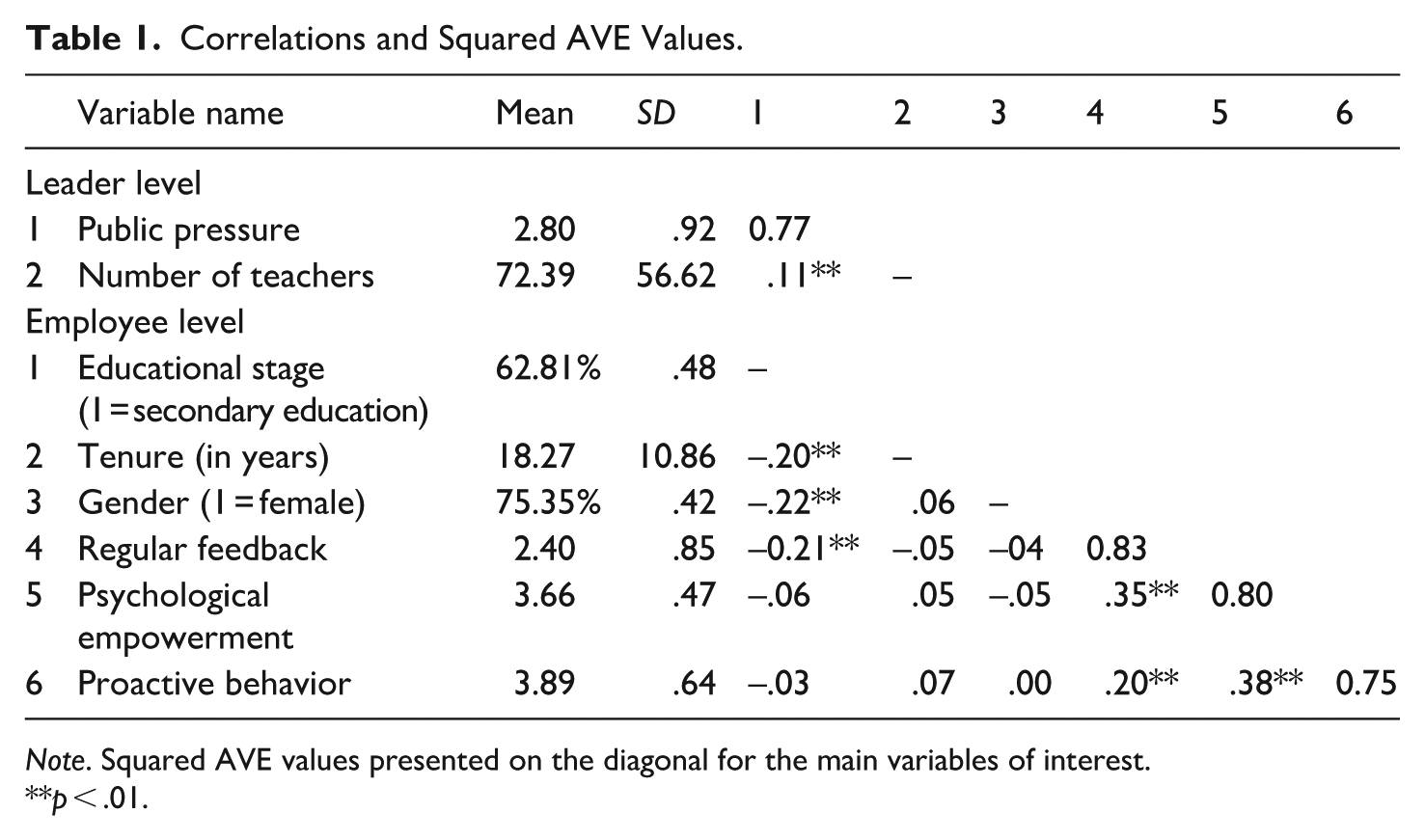
All items were measured on a 5-point Likert scale, except for the control variables. Where available, Dutch items were used, and blind back-translation was applied to all items without an existing translation. The items of regular feedback, psychological empowerment, and proactive behavior were all measured at the employee level. The items of public pressure were measured on the level of the leader, i.e., the school principal. Factor analysis was performed for all variables in the model, using a 0.40 cutoff point (Osborne et al., 2008). An overview of the descriptive statistics are provided in Table 1. An overview of the items are provided in Appendix. Cronbach’s alpha ranged between .79 and .89, indicating the reliability of the scales (Hair et al., 2006).
Correlations and Squared AVE Values.
Note. Squared AVE values presented on the diagonal for the main variables of interest.
**p < .01.
Regular feedback was assessed using a 5-item scale developed by Kuvaas (2011). The response scale ranged from 1 (“totally disagree”) to 5 (“totally agree”). Due to a low factor loading (0.35), one item (“I know little about what my colleagues think about my work performance”) was removed from the scale. Cronbach’s alpha was .84 for the full scale and .89 for the 4-item scale.
Psychological empowerment was measured with Spreitzer’s (1995) 12-item scale. The response scale ranged from 1 (“totally disagree”) to 5 (“totally agree”). Cronbach’s alpha was .83.
Proactive behavior was measured using the 3-item organizational focus dimension of the proactive behavior scale developed by Belschak and Den Hartog (2010). The response scale ranged from 1 (“totally disagree”) to 5 (“totally agree”). Cronbach’s alpha was .79.
Public pressure was assessed using the 4-item public pressure scale of Lonti and Verma (2003). The response scale ranged from 1 (“not at all”) to 5 (“to a large degree”). Cronbach’s alpha was .85.
Control Variables
In addition to the main variables of interest, several control variables were also included. Firstly, this paper controlled for the educational stage of a school, that is, elementary or secondary education. Secondly, this study controlled for the number of teachers under the responsibility of a school principal, as this could affect the amount of regular feedback teachers receive. Additionally, this study also controlled for teachers’ gender and age, two common control variables when researching proactive behavior (Bernerth & Aguinis, 2016).
Analyses
The analyses were conducted using Hierarchical Linear Modeling in HLM 8. Full maximum likelihood was used as the estimation method, as it is suited to multilevel regression modeling (Hox et al., 2017). All teacher-level measures were group-mean centered in order to establish a meaningful zero point (Enders & Tofighi, 2007; Hofmann & Gavin, 1998). The public pressure measure was grand-mean centered. To assess the fit of the models, the deviance and the pseudo R2 for all of the models is reported (Hox et al., 2017; Snijders & Bosker, 1994).
The proposed moderated mediation was tested using the steps outlined by Muller et al. (2005): (a) Regular feedback is significantly related to proactive behavior, (b) the relationship between regular feedback and proactive behavior is mediated by psychological empowerment, (c) the relationship between regular feedback and psychological empowerment (i.e., the mediator) is moderated by public pressures, and finally (d) the indirect effect of regular feedback on proactive behavior through psychological empowerment is stronger/weaker for different levels of public pressure. Additionally, the mediation package (version 4.5.0) and lmer function in the lme4 package (version 1.1-27.1) in R were used to generate 95% confidence intervals and test the significance level of the indirect effect via quasi-Bayesian Monte Carlo simulations for 10,000 simulations.
Results
Preliminary Results
To assess the validity and reliability of the variables in the model, several tests were conducted. First, the average variance extracted (AVE) and composite reliability (CR) of all the scales were calculated. The AVE values for regular feedback, psychological empowerment, proactive behavior, and public pressure were all classified as good (0.69; 0.64; 0.56; 0.60, respectively) as they are all above the 0.50 threshold (Hair et al., 2019). The CR values for regular feedback, psychological empowerment, proactive behavior, and public pressure (0.90; 0.95; 0.79; 0.85, respectively) are also all above the 0.70 threshold and can thus be deemed acceptable (Hair et al., 2019). This indicates that the convergent validity of the variables is good. The discriminant validity of the model can also be assumed since the correlations between the constructs are all well below the square root of the AVE values of these constructs (Fornell & Larcker, 1981; see the diagonal in Table 1).
Additionally, since the teacher-level variables are measured using single-source, albeit time-lagged data, Harman’s one-factor test was performed to check for potential common source bias (CSB). The test indicated that CSB is unlikely to be an issue, as a one-factor model explained only 21% of the variance, well below the 50% threshold (Podsakoff & Organ, 1986). Moreover, research has shown that cross-level moderations are not susceptible to inflated effect sizes due to CSB (George & Pandey, 2017; Siemsen et al., 2010). This study additionally took several procedural precautions to minimize the risk of CSB. Based on recommendations by George and Pandey (2017) and Podsakoff et al. (2012), the current study ensured anonymity to mitigate social desirability, avoided ambiguous questionnaire items by slightly rewording some items in order to fit the education context and separated the questionnaire items into several chapters to ensure psychological separation.
This paper checked the suitability of multilevel analyses by testing the intercept-only models. These models show significant between-group differences for psychological empowerment (p < .001) and proactive behavior (p < .01). Furthermore, the current study assessed the degree of variance of a variable that can be explained at the group level by calculating the intraclass correlation (ICC) values for psychological empowerment (ICC(1) = 0.09) and proactive behavior (ICC(1) = 0.05), which warrant the use of a multilevel model (Bliese et al., 2018).
Table 1 presents the correlations between the variables of interest. The results show that educational stage is negatively related to the control variables tenure and gender (respectively, r = –.20 p < .01; r = –.22, p < .01). Furthermore, the educational stage is negatively related to regular feedback (r = –.21, p < .01). As expected, regular feedback is positively related to both psychological empowerment (r = .35, p < .01) and proactive behavior (r = .20, p < .01). Finally, psychological empowerment is significantly related to proactive behavior (r = .38, p < .01).
Hypothesis Testing
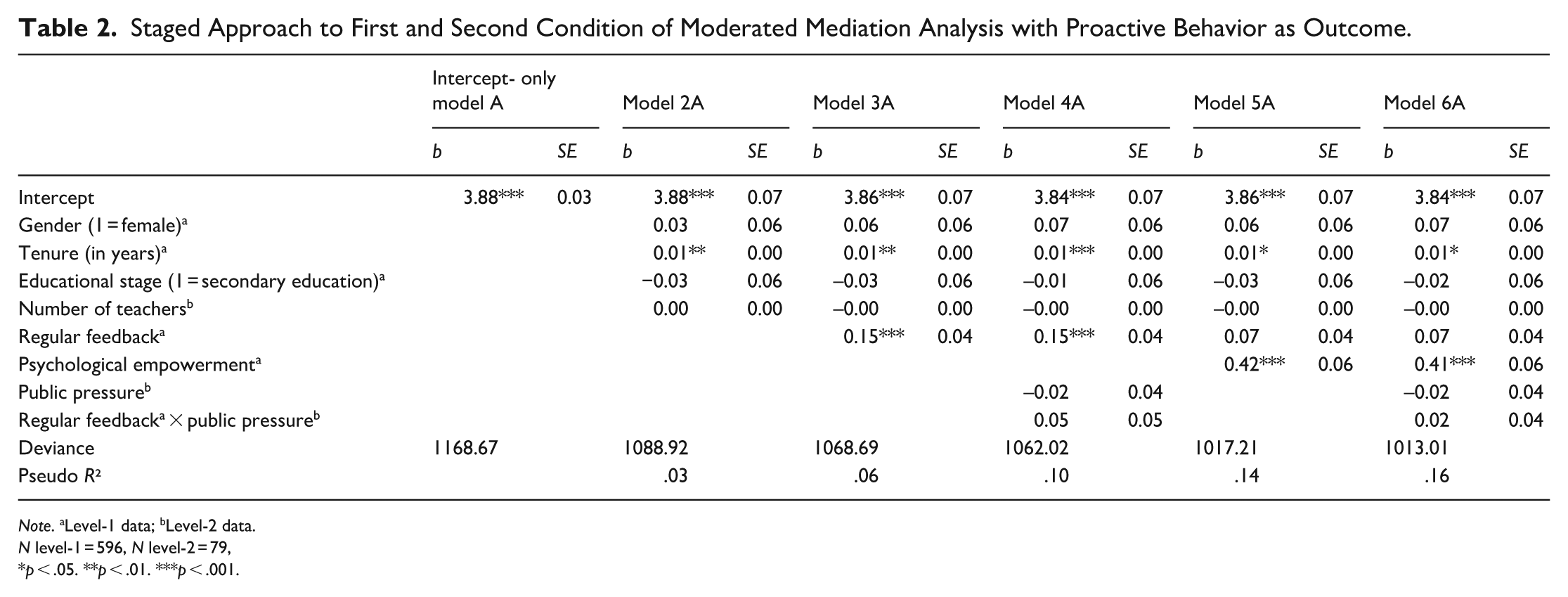
Table 2 provides an overview of the models with proactive behavior as outcome, and Table 3 provides an overview of the models with psychological empowerment as outcome. The level-1 and level-2 control variables were added in model 2A. Tenure was found to be positively related to proactive behavior (b = 0.01, p < .01). In model 3A, the predictor variable regular feedback was added. The analysis reveals that regular feedback is positively related to proactive behavior (b = 0.15, p < .001), which confirms hypothesis 1. Next, model 4A tested whether public pressure acted as a nonhypothesized moderator in the relationship between regular feedback and proactive behavior. No significant result was found here. Given that the direct relationship between regular feedback and proactive behavior is not dependent on the moderator, the first condition of moderated mediation is met.
Staged Approach to First and Second Condition of Moderated Mediation Analysis with Proactive Behavior as Outcome.
Note. aLevel-1 data; bLevel-2 data.
N level-1 = 596, N level-2 = 79,
p < .05. **p < .01. ***p < .001.
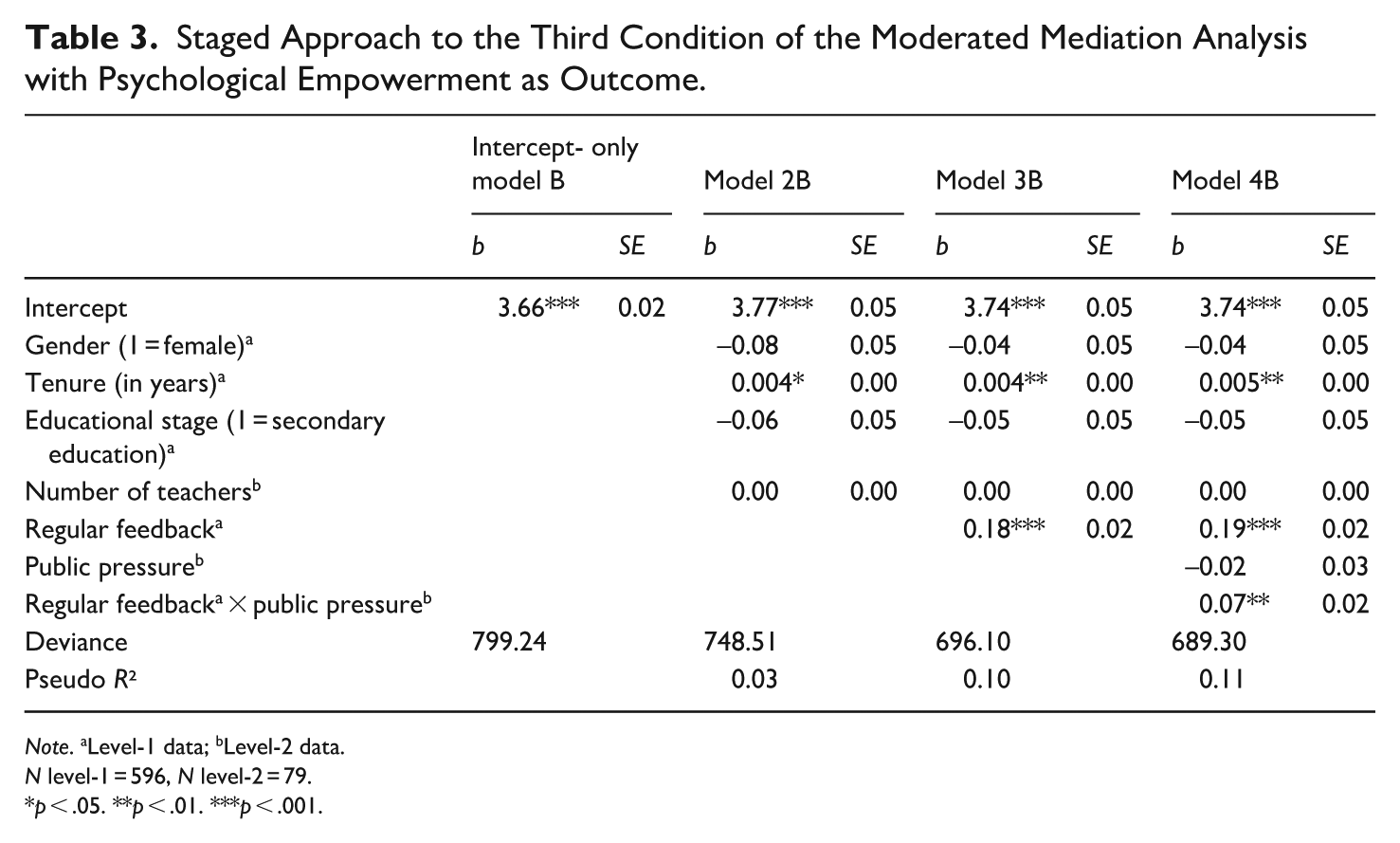
Staged Approach to the Third Condition of the Moderated Mediation Analysis with Psychological Empowerment as Outcome.
Note. aLevel-1 data; bLevel-2 data.
N level-1 = 596, N level-2 = 79.
p < .05. **p < .01. ***p < .001.
To test the second condition of moderated mediation (Muller et al., 2005), the mediating role of psychological empowerment in the relationship between regular feedback and proactive behavior was investigated. Table 3 shows the outcomes of the multilevel regression analyses with psychological empowerment as the outcome. Control variables were added in model 2B. The results show a significant relationship between tenure and psychological empowerment (b = 0.004, p < .05). Next, model 3B indicates that there is a significant relationship between regular feedback and psychological empowerment (b = 0.18, p < .001), confirming hypothesis 2. Hypothesis 3 can also be accepted, since model 5A in Table 2 shows that psychological empowerment is significantly related to proactive behavior (b = 0.42, p < .001). To assess whether psychological empowerment mediates the relationship between regular feedback and proactive behavior, this study used the quasi-Bayesian Monte Carlo method (Tingley et al., 2014). The regression estimate and the confidence intervals indicate a significant indirect effect for the relationship between regular feedback and proactive behavior, mediated by psychological empowerment (indirect effect = 0.08, 95% CI [0.05, 0.11], p < .001). The direct relationship between regular feedback and proactive behavior becomes nonsignificant after adding psychological empowerment into the regression, which indicates full mediation. Summarizing, these results confirm hypothesis 4 and are in line with the second condition of moderated mediation (Muller et al., 2005).
The current study then investigated the moderating role of public pressure in the relationship between regular feedback and psychological empowerment. Model 4B shows that public pressure indeed moderates the relationship between regular feedback and psychological empowerment (b = 0.07, p < .01), confirming hypothesis 5. This study performed simple slopes analyses to assess the significance of the moderation for different levels of public pressure and found a strong relationship between regular feedback and psychological empowerment when public pressure was low (simple slope −1 SD = 0.31, p < .001) and an even stronger relationship when public pressure was high (simple slope +1 SD = 0.43, p < .001). To visualize this moderation, the plotted cross-level interaction is shown in Figure 2. The graph shows that, in line with this study’s expectations, the positive relationship between regular feedback and psychological empowerment is stronger when school-level public pressure is high, compared to when it is low. In model 6A, all variables from the previous models were combined. This model has the highest explained variance of the different models (Pseudo R² = .16), suggesting that the inclusion of all variables indeed explains the most variance in proactive behavior. The model reveals no new, nonhypothesized information, as no moderation effect of public pressure on the relationship between regular feedback and proactive behavior was found.
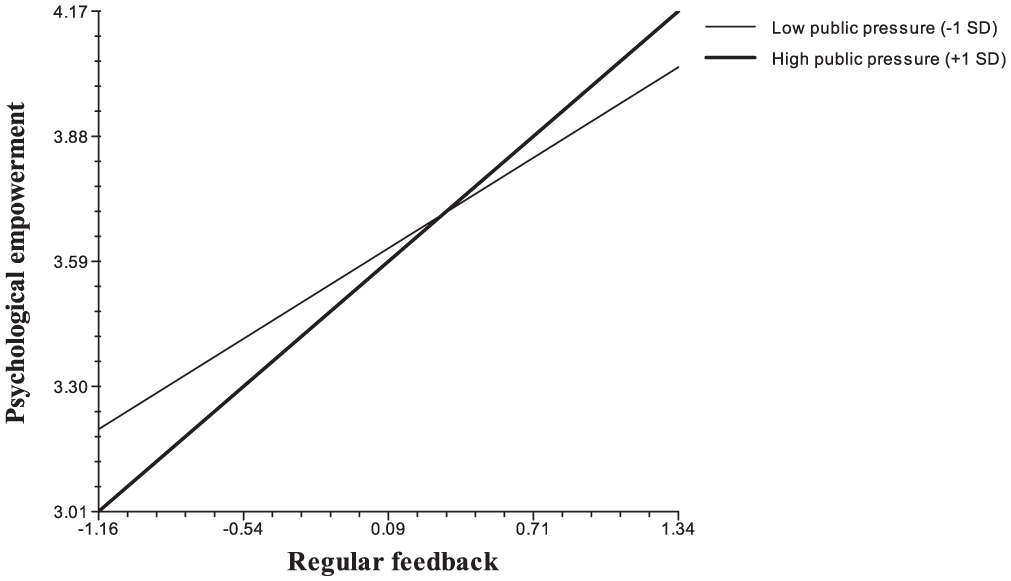
Cross-Level Moderation of the Relationship Between Regular Feedback and Psychological Empowerment.
The last condition of moderated mediation (Muller et al., 2005) requires that public pressure moderates the mediation of regular feedback via psychological empowerment on proactive behavior. Again, this study used the quasi-Bayesian Monte Carlo method (Tingley et al., 2014) to generate 95% confidence intervals. The mediator was assigned to one standard deviation above the mean and one standard deviation below the mean in order to assess the moderated mediation effects. The analyses reveal a conditional indirect effect for proactive behavior. When public pressure was low (–1 SD), the indirect effect of regular feedback on proactive behavior via psychological empowerment was significant (indirect effect = 0.05, 95% CI [0.02, 0.09], p < .001). When public pressure was high (+1 SD), the indirect effect of regular feedback on proactive behavior via psychological empowerment was significant as well (indirect effect = 0.10, [0.07, 0.14], p < .001). The beta coefficients of the indirect effects suggest that the mediation effect was slightly stronger for the condition where public pressure was high, compared to when it was low. These findings are in line with the last condition of moderated mediation and thus confirm hypothesis 6.
Discussion
The current study examined the roles of psychological empowerment and organizational-level public pressure in the relationship between teachers’ perception of regular feedback and proactive behavior. Supporting our hypotheses, the results indicate that regular feedback is positively related to proactive behavior, through the underlying mechanism of psychological empowerment. Furthermore, public pressure strengthened the relationship between regular feedback and psychological empowerment. This relationship became stronger when public pressure on the organization was high. Finally, public pressure also impacted the strength of the indirect relationship between regular feedback and proactive behavior through psychological empowerment. This mediated relationship became stronger when high public pressure was reported. In doing so, this study provides support for a cross-level boost hypothesis of JD-R theory.
A first valuable contribution of this paper lies in its focus on the contextualization of an HRM process. This study examined two employee outcomes that are especially relevant for teachers, built on education research into school dynamics, and highlighted a prevalent characteristic in today’s school context, namely public pressure. Scholars have drawn attention to the important role that the social, cultural, and institutional contexts play in determining the effectiveness of HRM processes (Boselie et al., 2021; Knies et al., 2024; Paauwe & Farndale, 2017), but empirical investigation remains relatively scarce. Existing research on the interaction between HRM and context has, for instance, focused on the role of technology intensity (Garavan et al., 2021), labor regulations, and competitive pressure (Krammer, 2022). These pressures are mostly competitive and legal in nature (Paauwe & Farndale, 2017), and the current study adds to this work by investigating a pressure with a societal nature. Moreover, research acknowledges that the boundary conditions to psychological empowerment and feedback practices in schools remain understudied (Kang et al., 2022; Tuytens & Devos, 2017). This study finds that public pressure at the school level influences the strength of the individual-level relationship between regular feedback and psychological empowerment. By highlighting the relevance of a job demand that arises from the organizational context of schools, the current research contributes to the further contextualization of HRM research (Knies et al., 2024). Relatedly, this paper shows the relevance of applying a public administration concept, that is, public pressure, to a HRM process and addresses calls for further integration of HRM and public administration research (Boselie et al., 2021).
The findings of this article, moreover, contribute to the development of a multilevel, public sector JD-R model. Specifically, it tested the boost hypothesis within JD-R theory with a typical public sector job demand, namely, public pressure. Beyond testing a new moderator, this study’s findings extend JD-R theory by showing that a contextual job demand can strengthen the motivational process, consistent with the boost hypothesis. In particular, this study demonstrates that public pressure at the school level reinforces the empowering effect of regular feedback as a job resource. This emphasizes the relevance of incorporating sector-specific demands into JD-R theory and highlights the value of applying the model in multilevel public sector contexts (Bakker et al., 2023). Previous research has shown that public sector characteristics such as public service motivation (Bakker, 2015), red tape (Muylaert et al., 2023), and the organizational restructuring of public organizations (Borst & Knies, 2023) are relevant for the well-being and functioning of civil servants, but their integration as specific job demands and job resources within the JD-R model has remained limited. By incorporating public pressure as a current public sector characteristic, this study advances the development of a public JD-R model and responds to calls for research on multilevel applications of JD-R theory (Bakker et al., 2023). Existing studies (Dollard & Bakker, 2010; Idris et al., 2014) indicate that job characteristics at the organizational level, such as organizational climate, impact employee well-being, both directly and as moderators (Bakker et al., 2023). The findings of this study add to these insights by suggesting that public pressure functions as a contextual job demand that varies across schools and reveals a cross-level interaction effect of a school-level job demand with an employee-level outcome, thereby supporting a multilevel boost hypothesis.
Thirdly, this paper expands the knowledge on the motivational process of job resources by investigating psychological empowerment as a mediator. Work engagement has often been invoked as an explanatory mechanism in the relationship between job resources and positive employee outcomes (Bakker et al., 2023). However, given the nature of the current outcome, namely proactive behavior, this study argued that psychological empowerment, with its emphasis on self-efficacy and autonomy (Parker et al., 2006), is most aligned with the motivational state required for the portrayal of proactive behavior. This study’s findings indicate that psychological empowerment is a crucial mechanism through which job resources relate to civil servants’ proactive behavior, contributing to Bindl and Parker’s (2011) notion on the important role of the cognitive-motivational processes that forego proactive behavior. This also suggests that it may be a relevant predictor to other employee behaviors that require a certain degree of self-confidence, such as job crafting, in complex work environments. Finally, the inclusion of psychological empowerment contributes to advancing a psychological perspective in public administration research (Tummers et al., 2018). While the role of work engagement as a motivational mechanism for civil servants has been well established (Borst, 2018; Borst et al., 2019), psychological empowerment has received comparatively less attention (García-Juan et al., 2020). The results of this paper demonstrate the motivational potential of psychological empowerment for teachers as civil servants. This study contributes to ongoing debates about how HRM practices embedded in performance management can enhance employee motivation and well-being. Previous studies have similarly emphasized the developmental role of feedback as a core HRM practice within the performance management system (Van Strydonck, Decramer & Audenaert, 2025; Van Strydonck, Decramer, Peccei & Audenaert, 2025). Moreover, insights from the broader empowerment literature indicate that structural empowerment practices, such as providing access to information and skills, serve as important antecedents of psychological empowerment (Nuwagaba et al., 2025). By integrating these perspectives, the current study underlines how regular feedback operates as part of a broader set of HRM practices within performance management systems.
With regard to the implications of this study for practice, its results suggest that contextual job demands are not necessarily something that schools need to eliminate. Instead, when the job demands are matched with specific HRM practices, it can enhance the motivational potential of these practices. Rather than spending energy on trying to eliminate the contextual job demands that public organizations are exposed to and usually have only limited control over, it might be fruitful to ensure that civil servants are offered the right tools to be able to mitigate the potentially negative effects of these contextual job demands.
Despite its advantages, this study also has some limitations that need to be addressed. First, due to the nature of its research design, the current research was not able to establish causal relationships. To further insights into causal or long-term effects of the moderating role of public pressure, it would be interesting to deploy a longitudinal research design in future research. Next, survey data can be subject to CSB. The current article is based on multilevel, multi-wave data, which is already less susceptible to CSB. Several procedural precautions were taken based on the recommendations by George and Pandey (2017) and Podsakoff et al. (2012). Harman’s one-factor test furthermore indicated that CSB is unlikely to be a problem for the data. However, this paper is not able to completely rule out the possibility of CSB. For future research, it would be worthwhile to include objective data sources (e.g., data on characteristics of the student population as an indicator of the public pressure a school is exposed to). Moreover, the current study focused on the outcome of proactive behavior because of its relevance in the school context. Nevertheless, there are other employee outcomes that are relevant for civil servants and teachers specifically, such as turnover intention, that could be studied in future research. Additionally, our findings align with research suggesting that more feedback is generally better for promoting employee performance, even at very high absolute frequencies of feedback (Mertens et al., 2021). For future research, it would be interesting to investigate whether this also holds for well-being outcomes, such as emotional exhaustion. Specifically, it would be interesting to collect data on absolute feedback frequencies to see if the “more is better” (Mertens et al., 2021, p. 333) assumption is applicable. Lastly, future research could investigate the role of public pressure in other relevant people management processes (Knies et al., 2022)—such as effective leadership—that can function as job resources for employees in the public sector.
To summarize, this study is, to the best of the authors’ knowledge, among the first to investigate the moderating role of organizational-level context in individual-level HRM processes. The results suggest that providing regular feedback to employees might be a valuable way to promote their psychological empowerment and proactive behavior. Furthermore, this study found that the motivational link between regular feedback on psychological empowerment depends on the level of public pressure to which an organization is exposed.
Footnotes
Appendix
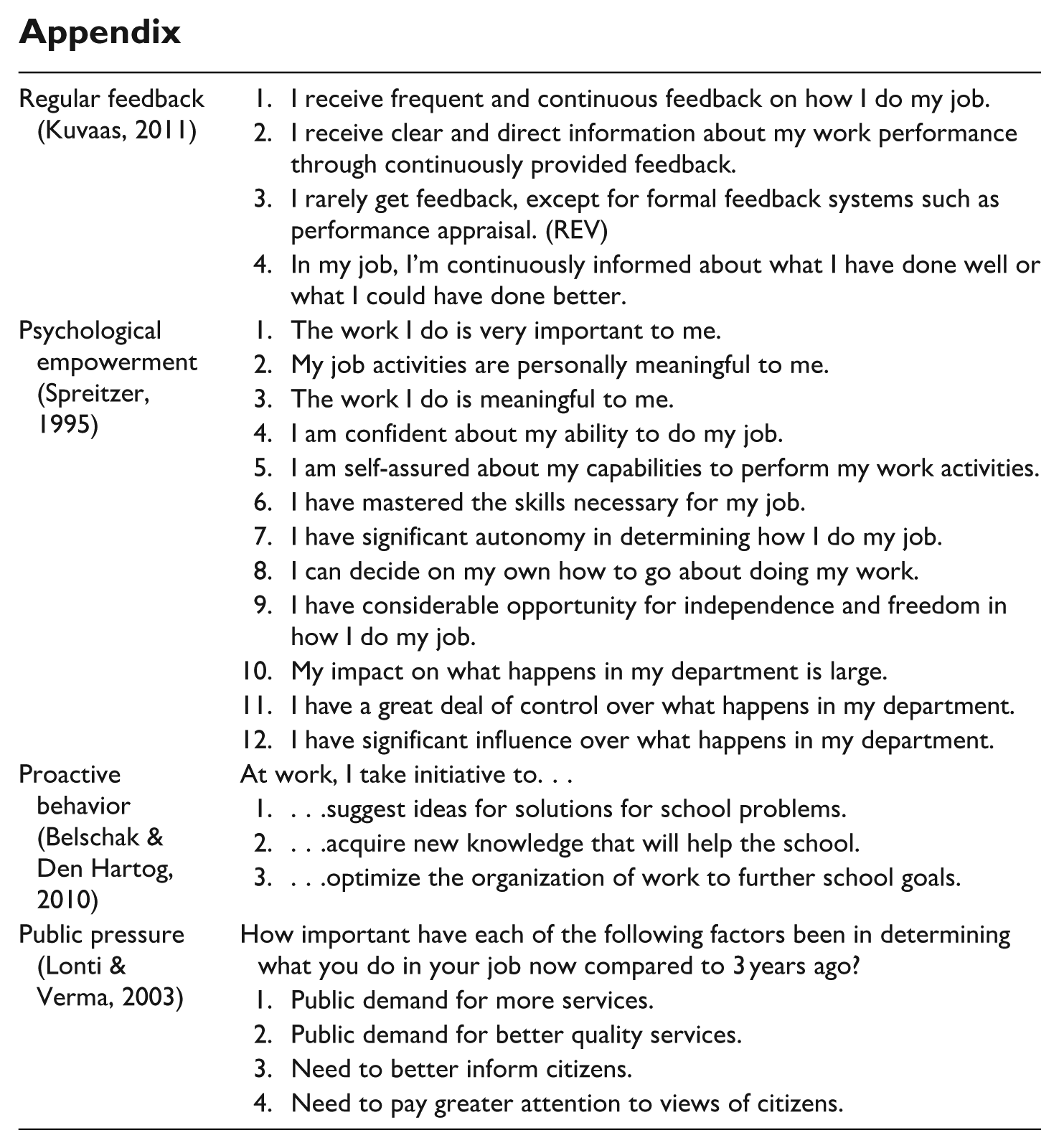
| Regular feedback (Kuvaas, 2011) | 1. | I receive frequent and continuous feedback on how I do my job. |
| 2. | I receive clear and direct information about my work performance through continuously provided feedback. | |
| 3. | I rarely get feedback, except for formal feedback systems such as performance appraisal. (REV) | |
| 4. | In my job, I’m continuously informed about what I have done well or what I could have done better. | |
| Psychological empowerment (Spreitzer, 1995) | 1. | The work I do is very important to me. |
| 2. | My job activities are personally meaningful to me. | |
| 3. | The work I do is meaningful to me. | |
| 4. | I am confident about my ability to do my job. | |
| 5. | I am self-assured about my capabilities to perform my work activities. | |
| 6. | I have mastered the skills necessary for my job. | |
| 7. | I have significant autonomy in determining how I do my job. | |
| 8. | I can decide on my own how to go about doing my work. | |
| 9. | I have considerable opportunity for independence and freedom in how I do my job. | |
| 10. | My impact on what happens in my department is large. | |
| 11. | I have a great deal of control over what happens in my department. | |
| 12. | I have significant influence over what happens in my department. | |
| Proactive behavior (Belschak & Den Hartog, 2010) | At work, I take initiative to. . . | |
| 1. | . . .suggest ideas for solutions for school problems. | |
| 2. | . . .acquire new knowledge that will help the school. | |
| 3. | . . .optimize the organization of work to further school goals. | |
| Public pressure (Lonti & Verma, 2003) | How important have each of the following factors been in determining what you do in your job now compared to 3 years ago? | |
| 1. | Public demand for more services. | |
| 2. | Public demand for better quality services. | |
| 3. | Need to better inform citizens. | |
| 4. | Need to pay greater attention to views of citizens. | |
Declaration of Conflicting Interests
The authors declared no potential conflicts of interest with respect to the research, authorship, and/or publication of this article.
Funding
The authors received no financial support for the research, authorship, and/or publication of this article.

Data Availability Statement
Due to the nature of the data and the conditions of the data collection process, the data used in this study are not publicly available. Access to the data requires a specific arrangement with the authors.