







Abstract
Research has shown that levels of public service motivation (PSM) among public employees tend to decrease in their early years of employment in Korea. This study examines specific managerial functions in maintaining and enhancing PSM among early-career public servants. It utilizes a sample of 5,627 public servants with less than 5 years of service, drawn from pooled cross-sectional data from three annual surveys (2022–2024) of the Public Employee Perception Survey in Korea. The results indicate that goal clarity, performance feedback, autonomy, and supervisory support are positively associated with PSM. However, these relationships vary across government levels. Goal clarity and performance feedback are positively associated with PSM at all levels of government, operating through both direct and indirect pathways. In contrast, autonomy and supervisory support are positively associated with PSM only in the central government context, and their effects operate entirely through indirect pathways mediated by value congruence, job satisfaction, and career satisfaction. These findings suggest that informational managerial functions have universal applicability, while the effectiveness of relational managerial functions is contingent on institutional context. The implications and limitations of this study are discussed.
Introduction
Public service motivation (PSM) refers to an individual’s willingness to engage in meaningful service for society and the public (Kim & Vandenabeele, 2010; Perry & Hondeghem, 2008; Perry & Wise, 1990). Previous studies have consistently found a significant positive effect of PSM on job satisfaction, individual performance, organizational commitment, and organizational citizenship behavior (Awan et al., 2020; Cho & Song, 2021; Ritz et al., 2016). Therefore, it is essential for public organizations to choose applicants with high levels of PSM and to continue to cultivate and improve their PSM to fully reap the benefits associated with it (Christensen et al., 2017).
Korea has maintained a strong career civil service system for more than 1,200 years, during which public officials have enjoyed high social prestige, power, economic welfare, and stability (Kim, 2010). Although the status of public service has somewhat declined in recent years, government positions continue to attract many young job seekers who view public service as both an honorable and secure career. Individuals with strong PSM invest substantial time and effort preparing for the highly competitive civil service examination to realize their aspirations to contribute to society. Empirical evidence supports this tendency: Korean public employees generally report higher PSM levels upon entry compared to private-sector newcomers (Woo & Kim, 2024).
However, many new public servants soon encounter a “reality shock” (Kjeldsen & Jacobsen, 2013; Schott et al., 2019). Those who initially believed they could make a meaningful social impact often feel frustrated by the mismatch between their expectations and the bureaucratic realities of their work. Consequently, PSM among early-career officials may erode as they adjust to organizational routines and constraints over time (Woo & Kim, 2024). This pattern warrants attention because PSM has been consistently linked to a range of desirable outcomes (Awan et al., 2020; Cho & Song, 2021; Ritz et al., 2016).
Early-career attrition has also emerged as a growing concern, with the number of public servants leaving within 5 years more than doubling from 6,500 in 2019 to 13,566 in 2023 (Cho, 2024). While the precise motivations behind these departures are likely multifaceted, and the link between PSM and turnover intention is weak (Hur & Abner, 2024) and context-dependent (Lim & Moon, 2025), these trends underscore the importance of identifying actionable managerial functions that help early-career public servants maintain their connection to public purpose (Christensen et al., 2017).
In this circumstance, what functions can immediate supervisors and managers perform to maintain and enhance PSM among new public servants? Public managers can perform various functions at both individual and organizational levels (Paarlberg et al., 2008). While other managerial functions are important and deserve attention in future research, this study deliberately narrowed its focus to the four theoretically and practically salient functions: goal clarity, performance feedback, autonomy, and supervisory support. Clarifying goals helps newcomers understand the broader public purpose of their work. Providing performance feedback helps newcomers gauge their effectiveness, adjust behaviors, and experience a sense of achievement. Granting autonomy empowers newcomers to take initiative and exercise judgment in their work. Offering supervisory support provides guidance and encouragement, reinforcing newcomers’ sense of being valued in their public service roles. First, these functions are particularly relevant for early-career public servants, who are still developing their professional identity. These functions are helpful for inculcating organizational values and norms in newcomers and transferring the knowledge and information required by newcomers to perform their tasks effectively. Second, these functions can be exercised directly within the supervisor–subordinate relationship without requiring substantial changes to organizational policy or structure. Public managers can implement them within the scope of their formal authority and day-to-day interactions. Third, these functions are consistently emphasized in public management and organizational behavior literature as influential for employee motivation, engagement, and performance (Deci & Ryan, 2000; Hackman & Oldham, 1980; Kluger & DeNisi, 1996; Parker et al., 2017).
This study aims to examine the functions that public managers may perform to maintain and enhance PSM among their subordinates. The analysis is based on pooled cross-sectional data from three annual surveys (2022–2024) of the Public Employee Perception Survey conducted by the Korea Institute of Public Administration. It includes 5,627 public servants with less than 5 years of service in the central government, upper-level, and lower-level local governments in Korea.
This study is structured as follows. First, it develops hypotheses regarding the influence of autonomy, goal clarity, performance feedback, and supervisory support on PSM, and explains the multilevel structure of the Korean government. Second, it explains the sample, measures, and analytical approach. Third, it summarizes the results of the statistical analysis and verifies the hypotheses. Fourth, it discusses the theoretical and practical implications, along with key findings, limitations, and potential directions for future research.
Theoretical Background and Hypotheses
PSM is defined as “an individual’s orientation to delivering services to people with a purpose to do good for others and society” (Perry & Hondeghem, 2008, p. vii). Individuals with high PSM are more likely to engage in behaviors that benefit society and the public, even without tangible rewards (Kim & Vandenabeele, 2010). Perry and Wise (1990) proposed that PSM consists of rational, norm-based, and affective motives. Kim and Vandenabeele (2010) suggested that PSM is primarily rooted in self-sacrifice, encompassing three distinct categories of motives: instrumental, value-based, and identification. Kim et al. (2013) developed a 16-item measure of PSM with four dimensions: attraction to public service, commitment to public values, compassion, and self-sacrifice. These dimensions represent instrumental, value-based, and identification motives, as well as self-sacrifice, in the conceptual components of PSM, respectively.
PSM is influenced not only by individuals’ socio-historical backgrounds but also by the organizational environment in which employees find themselves (Jacobson, 2011; Klatt & Fairholm, 2023; Moynihan & Pandey, 2007). PSM may result from long-term socialization, but it can also be influenced by more immediate factors in an individual’s organizational environment (Christensen et al., 2017). PSM can change over time due to the impact of organizational factors (Jensen & Vestergaard, 2017; Ward, 2014; Woo & Kim, 2024).
Among organizational factors, previous research has primarily focused on the influence of human resource management (HRM) practices and leadership on PSM (Christensen et al., 2017). For example, Schott and Pronk (2014) found that PSM is influenced by various HRM practices such as training, consultation, and job characteristics in Germany. Giauque et al. (2015) demonstrated that intrinsic HRM practices are positively related to PSM, while extrinsic ones are negatively related to PSM in Switzerland. Similarly, Mostafa et al. (2015) discovered that high-performance HRM practices, including training and development, job security, autonomous work design, communication, and promotion, are positively associated with employees’ PSM in Egypt. Kim and Roh (2018) demonstrated that promotion, training, job competency, and supervisory support are positively related to public servants’ PSM in Korea.
In relation to the connection between leadership and PSM, previous research generally suggests that transformational leadership is positively associated with PSM, and that ethical and servant leadership are also positively linked to PSM (Hameduddin & Engbers, 2022; Shim & Park, 2019). However, Jensen et al. (2019) found that transformational and transactional leadership, when experimentally induced, do not necessarily have the intended positive impact on PSM. This mixed evidence suggests that broad leadership styles may operate through multiple pathways—some of which enhance PSM while others may not—making it difficult to isolate consistent effects, and the net relationship with PSM may depend on how leadership translates into concrete day-to-day work conditions. As a result, there is still a limited understanding of the specific managerial functions that can help maintain or enhance early-career public servants’ PSM.
Job demands-resources theory emphasizes a wide range of job resources that can influence employees’ motivation, including PSM (Bakker, 2015). Job resources are physical, psychological, social, or organizational aspects of a job that can help achieve work goals, reduce job demands, and stimulate personal growth and development while minimizing physiological and psychological costs. These resources can be present at various levels within organizations, from individual tasks to the organization as a whole. Importantly, immediate supervisors play a pivotal role in shaping job resources by influencing subordinates’ work design and social environment through daily managerial practices. Therefore, this study focuses on four key managerial functions—autonomy, goal clarity, performance feedback, and supervisory support—that managers can implement through regular interactions with subordinates.
First, public managers may grant autonomy to their subordinates. Autonomy refers to the extent to which a job offers significant freedom, independence, and discretion to an employee in scheduling work and determining the procedures to be used in carrying it out (Hackman & Oldham, 1980). Although autonomy may co-vary with certain leadership behaviors in some settings, it is conceptually a job design/resource characteristic and is not synonymous with any particular leadership style. From a job demands-resources perspective, autonomy is considered a core job resource because it provides employees with discretion in how they execute tasks and cope with work demands, thereby supporting their learning and growth (Bakker, 2015).
Autonomy can influence each component of PSM in distinct ways. By allowing early-career public servants to choose how they contribute, autonomy can enhance the attraction to public service, as they feel a greater sense of purpose and engagement in their work. The freedom to interpret and apply organizational rules can deepen commitment to public values, as new public servants can internalize and align these values with their own beliefs. Autonomy also enables public servants to customize their responses to citizens’ needs, leading to greater compassion through the use of empathy and judgment in service delivery. Additionally, autonomy nurtures a sense of ownership over work outcomes, encouraging public servants to make self-sacrifice in order to advance collective goals. In these ways, autonomy enhances PSM. Research has shown a positive relationship between task autonomy and PSM in Maltese public officers (Camilleri, 2007). Additionally, autonomous work design was positively related to employees’ PSM in Egypt (Mostafa et al., 2015), and autonomy was an important factor affecting PSM in Türkiye (Kiyak & Karkin, 2023). These empirical findings are consistent with the expectation that autonomy is positively associated with PSM among early-career public servants.
Second, public managers may clarify goals for their subordinates. Goal clarity refers to how well public servants understand the objectives, expectations, and priorities associated with an organizational goal or set of goals. Organizational goals establish a vision of a desired future state (Wright et al., 2012), providing both a rationale for the organization’s existence and standards by which performance can be measured. Clear goals explain what public servants should do and why they should do it (Wright, 2007).
Goal clarity can influence PSM by reinforcing its components. First, by explicitly linking individual tasks to the organization’s mission, clear goals strengthen attraction to public service, as early-career public servants see their work as an opportunity to contribute meaningfully to society. Second, when organizational goals are clearly tied to broader societal values, new public servants are more likely to internalize these priorities, thereby deepening their commitment to public values. Third, understanding how their work benefits citizens fosters empathy and responsiveness to the needs of others, enhancing the compassion dimension of PSM. Finally, clear goals provide a rationale for why personal sacrifices—such as investing extra time or effort—are worthwhile, thereby reinforcing self-sacrifice. Taken together, goal clarity helps early-career public servants connect day-to-day tasks to the broader public mission, thereby cultivating and sustaining their PSM. Ritz et al. (2014) demonstrated that goal clarity has a positive effect on PSM among civil servants in Switzerland. Caillier (2016) found a positive association between goal clarity and PSM among government employees in the United States. Kim et al. (2023) reported a positive association between goal clarity and PSM among Korean public servants. Therefore, it is reasonable to expect that managers who clarify organizational goals for early-career public servants and help them understand these goals clearly may contribute to enhancing their PSM.
Third, public managers may provide performance feedback to their subordinates. Performance feedback is the process that provides public servants with direct and clear information about their work performance, including what they are doing well and areas where they need improvement. Performance feedback can reinforce the connection between a subordinate’s daily tasks and broader public service goals, enabling them to gauge their progress toward goal attainment (Selden & Brewer, 2000). While feedback can sometimes produce unintended consequences such as reduced morale or risk-averse behavior (DeNisi & Kluger, 2000; Van Dooren et al., 2015), this study focuses on constructive feedback that emphasizes improvement and alignment with public service goals (Wright & Pandey, 2008), as this form of feedback is most likely to enhance PSM.
First, when performance feedback emphasizes how early-career public servants’ work advances societal goals, it strengthens their attraction to public service by highlighting the meaningful impact of their contributions. Second, performance feedback that underscores the alignment between individual performance and organizational missions fosters commitment to public values, as public servants see their efforts as consistent with broader societal principles. Third, by showing how their actions affect citizens and society, constructive performance feedback nurtures compassion, encouraging greater empathy and responsiveness to public needs. Finally, performance feedback can validate the personal costs of public work, thereby reinforcing self-sacrifice as new public servants recognize that extra effort contributes to valued public outcomes. In these ways, performance feedback can enhance subordinates’ PSM. Therefore, it is reasonable to expect that managers who effectively provide performance feedback to early-career public servants may contribute to enhancing their PSM.
Fourth, public managers may support their subordinates. Unlike task-focused managerial functions such as autonomy, goal clarity, and performance feedback, supervisory support reflects a broader relational and socio-emotional dimension. This includes encouragement, recognition, and care for subordinates’ well-being and professional development (Andersen et al., 2018; Camilleri, 2007; Schwarz et al., 2016).
These aspects contribute to enhancing PSM. First, when supervisors provide recognition and encouragement, they strengthen subordinates’ attraction to public service by validating that their work contributes meaningfully to society. Second, supportive supervisors who model and emphasize ethical standards and organizational missions foster commitment to public values, helping early-career public servants internalize and uphold principles of fairness, integrity, and service to the public interest. Third, by demonstrating care for public servants’ well-being and encouraging empathy in their work, supervisory support cultivates compassion, motivating subordinates to better understand and respond to the needs of citizens. Finally, when supervisors acknowledge the personal sacrifices required in public service, they reinforce self-sacrifice, encouraging subordinates to devote extra effort for the benefit of others. Through these mechanisms, supportive supervisors can enhance subordinates’ PSM (Christensen et al., 2017; Park & Rainey, 2008). Research has shown that superiors’ consideration and support for subordinates enhance subordinates’ PSM in Malta (Camilleri, 2007) and that supervisory support is positively associated with public employees’ PSM in Korea (Kim & Roh, 2018). Therefore, it is reasonable to expect that managers who encourage and support early-career public servants may contribute to enhancing their PSM.
While the previous hypotheses suggest positive relationships between managerial functions and PSM, the mechanisms through which these functions operate may vary. Drawing on job demands-resources theory (Bakker, 2015) and self-determination theory (Deci & Ryan, 2000), this study differentiates between informational and relational pathways to PSM.
Goal clarity and performance feedback serve as informational functions. They offer employees cognitive resources such as knowledge about organizational objectives, understanding of priorities, and information about their own contributions. These functions can enhance PSM by highlighting the public service mission and showing how individual work contributes to societal outcomes (Wright & Pandey, 2008; Wright et al., 2012).
On the other hand, autonomy and supervisory support are relational functions. Autonomy satisfies the need for self-determination, while supervisory support fulfills the needs for relatedness and competence development (Deci & Ryan, 2000). These functions may indirectly enhance PSM by creating psychological conditions such as job satisfaction, career satisfaction, and a sense of value congruence (Vandenabeele, 2014).
To explore these potential mechanisms, this study conducts additional mediation analyses to test whether value congruence, job satisfaction, and career satisfaction mediate the relationships between managerial functions and PSM. Understanding whether different managerial functions operate through direct or indirect pathways has significant implications for management practice.
The Multilevel Structure of the Korean Government
The Korean government is divided into three levels: the central government, upper-level local government, and lower-level local government. These levels of government operate in a coordinated yet hierarchical manner, but they differ in ways that may have implications for how managerial functions influence PSM. First, the central government, including ministries and agencies, operates at the national level. It is primarily responsible for formulating and implementing national policies, national security, diplomacy, financial management, the provision of nationwide public services, and support for local governments. The central government plays a crucial role in national policy, while local governments are responsible for decentralized implementation, though the central government still maintains significant influence (Cho et al., 2023). Second, upper-level local governments consist of metropolitan cities and provinces (Special Metropolitan City, Metropolitan City, Special Self-Governing City, Special Self-Governing Province or Do). Their responsibilities include wide-area administration, coordination between central and lower-level local governments, large-scale infrastructure, promotion of culture and economy, and disaster management. They often serve as a crucial intermediary layer for regional development and coordination (Seo & Joo, 2019). Third, lower-level local governments include municipalities (Si, Gun) and districts (Gu) within metropolitan cities. They handle more localized administration, such as community services, public facilities, basic infrastructure, and local regulations. While implementing national initiatives, these local governments frequently modify them to better fit local needs and actively plan and execute their own initiatives to address local issues not covered by central government policies (Kim & Jeong, 2023). They are the closest level of government to citizens, directly managing and delivering essential community services.
These institutional differences between government levels provide a theoretical rationale for expecting that the relationships between managerial functions and PSM may vary across contexts. First, the nature of tasks differs across government levels. Central government work typically involves complex policy planning, regulation, and inter-agency coordination with visible national impact, whereas local government work—particularly at the lower level—tends to involve routine service delivery, administrative processing, and compliance-based tasks (Lipsky, 2010). This distinction has implications for the motivational relevance of different managerial functions. Autonomy, for instance, may be more consequential in settings where tasks require professional judgment and creative problem-solving, as is common in central government policy work. In contrast, when tasks are standardized and procedurally constrained, formal grants of autonomy may have limited practical meaning and thus weaker motivational effects.
Second, institutional capacity varies across government levels. Central government agencies operate with higher administrative autonomy, greater fiscal resources, and more professionalized personnel systems (Kim, 2010). These conditions create space for managerial experimentation and high-quality supervisory practices. Local governments, especially at the lower level, function within tighter fiscal constraints and stronger political and procedural oversight, which may limit the scope for meaningful autonomy and the quality of supervisory support. Under such constraints, supervisory support may be perceived as routine oversight rather than developmental guidance, diminishing its potential to enhance PSM.
Based on these theoretical considerations, this study anticipates that goal clarity and performance feedback will be effective across all levels of government. However, the impacts of autonomy and supervisory support may depend on institutional context. Specifically, these relational functions may be more effective in the central government.
Methods
Sample
This study focuses on the factors that influence PSM among public servants with less than 5 years of service. To test the hypotheses, data from three consecutive annual surveys (2022–2024) of the Public Employee Perception Survey conducted by the Korea Institute of Public Administration were utilized. The survey, conducted since 2011, aims to gather data to inform the government’s strategic human resource policies by monitoring changes in public servants’ perceptions of HRM within the government.
The target population consisted of approximately 27,000 public servants in general positions at central government ministries and agencies, about 55,000 public servants in 17 upper-level local governments, and roughly 135,000 public servants in 226 lower-level local governments. The sampling method employed was stratified cluster sampling, with the primary sampling unit being a department or team in each agency.
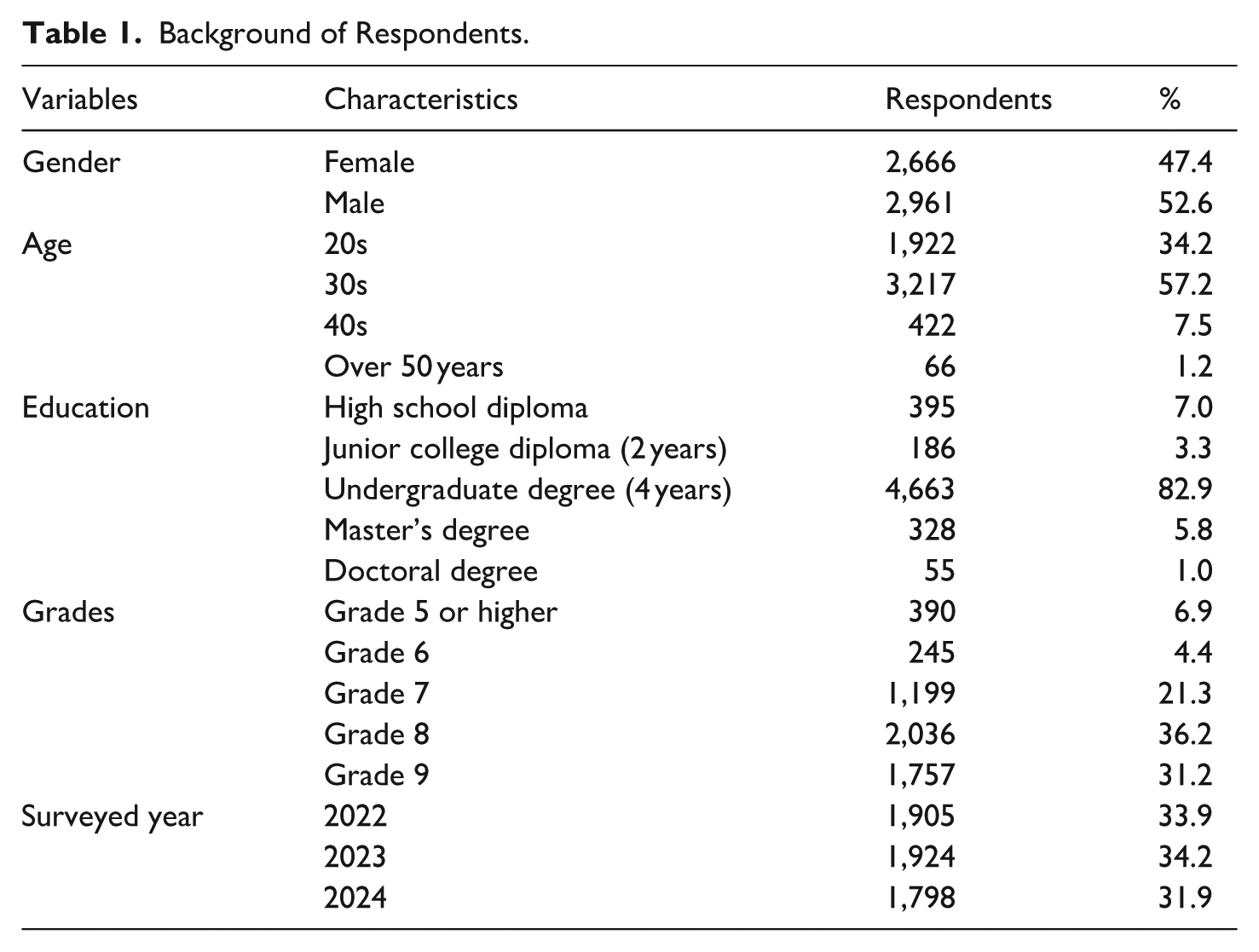
In 2022, there were 1,905 respondents with less than 5 years of service out of 6,170 survey participants. In 2023, there were 1,924 out of 6,444 participants. In 2024, there were 1,798 out of 6,075 participants. Therefore, the sample size is 5,627. The sample consists of 1,575 public servants (28.0%) from central government, 1,085 (19.3%) from upper-level local government, and 2,967 (52.7%) from lower-level local government. The grades of Korean public servants range from Grade 1 (highest) to Grade 9 (lowest). There are three types of open competitive examinations available for Grades 5, 7, and 9. Table 1 provides the general characteristics of the respondents used in this study.
Background of Respondents.
Measures
This study utilized survey items from the Public Employee Perception Survey. All survey items allowed for five response options on a Likert scale (1 = strongly disagree, 5 = strongly agree). The reliability coefficients (Cronbach’s α) of all latent variables were greater than 0.7, indicating good internal consistency (Cho & Kim, 2015). All items used in this study, along with their basic statistics, are displayed in the Appendix.
PSM was measured using a five-item unidimensional scale of PSM (Alonso & Lewis, 2001; Kim, 2005; Naff & Crum, 1999) that was included in the 1996 Merit Principles Survey conducted by the U.S. Merit Systems Protection Board. Research has provided empirical justification for this measure, showing that it is highly correlated with the four-dimensional measure of PSM (Kim, 2017a).
Autonomy was assessed using three items based on the research of Breaugh and Becker (1987). These items focused on autonomy in selecting methods and procedures, establishing the pace and deadlines for work, and developing performance evaluation indicators and standards. Goal clarity was assessed using four survey items based on those employed by Rainey et al. (1995). These items concentrated on the clarity of organizational goals, goal priorities, and guidance for employees. While these survey items reflect public servants’ perceptions of organizational goal clarity, previous research suggests that such perceptions are greatly influenced by how managers articulate and communicate goals in practice (Jung & Rainey, 2011; Wright et al., 2012). Therefore, these measures serve as an appropriate indicator for testing the hypothesized effect of goal clarity shaped and communicated by public managers on PSM.
Performance feedback was assessed using four items derived from previous studies conducted by Herold et al. (1987), Kluger and DeNisi (1996), and Morgeson and Humphrey (2006). These items specifically evaluate the effectiveness of feedback received from the organization. Supervisory support was evaluated through four items (Bass, 1990; Greenhaus et al., 1990) that examine the extent of career support provided, including vision guidance, motivation, encouragement, and assistance in personal development.
For the mediation analysis, each mediating variable was measured using one item. Value congruence was assessed using the item: “The values my organization pursues align with my own personal values.” Job satisfaction was evaluated through the item: “Overall, I am satisfied with the work I do.” Career satisfaction was measured with the item: “I am satisfied with working as a public servant.”
Analyses
The research model was initially analyzed using the entire sample, and then reanalyzed using three sub-samples. The analytic process is as follows. First, exploratory factor analysis was conducted using principal component analysis and Varimax rotation. The analysis identified five components with eigenvalues greater than 1, explaining 75.073% of the variance. The rotated solution showed loadings ranging from 0.630 to 0.847 with no cross-loadings exceeding 0.4.
Second, structural equation modeling (SEM) with Stata was utilized to test the hypotheses. SEM was chosen because each construct was measured by multiple items, allowing for the estimation of latent variables that account for measurement error (Kline, 2023). The evaluation of the SEM results followed a two-step approach: assessing the quality of the measurement model and then evaluating the structural model results. For the assessment of model fit, a group of goodness-of-fit indices is consulted instead of relying solely on the χ2 test. A lower value of χ2 indicates a better fit and should be non-significant. However, for large sample sizes, this statistic may lead to the rejection of a model with a good fit. A model with less than 30 observed variables achieves an acceptable fit to the data when the comparative fit index (CFI) exceeds 0.92, the root-mean-square error of approximation (RMSEA) is below 0.07, and the standardized root mean residual (SRMR) is below 0.08 (Hair et al., 2010). When comparing models, the difference is considered insignificant if the change in the CFI (ΔCFI) between the two models is less than 0.01 (Cheung & Rensvold, 2002).
Results
Measurement Model
Table 2 presents the results of the estimated measurement model. The model fit indices indicate that the five-factor model fit the data well: CFI = 0.975, RMSEA = 0.046, SRMR = 0.031. All of Raykov’s factor reliability coefficients were above 0.7, and all average variance extracted (AVE) scores were above 0.5. Additionally, each latent variable showed discriminant validity, as the AVE was greater than the squared correlations among latent variables. Therefore, the results demonstrate that the measurement model is acceptable.
Measurement Model Estimates.
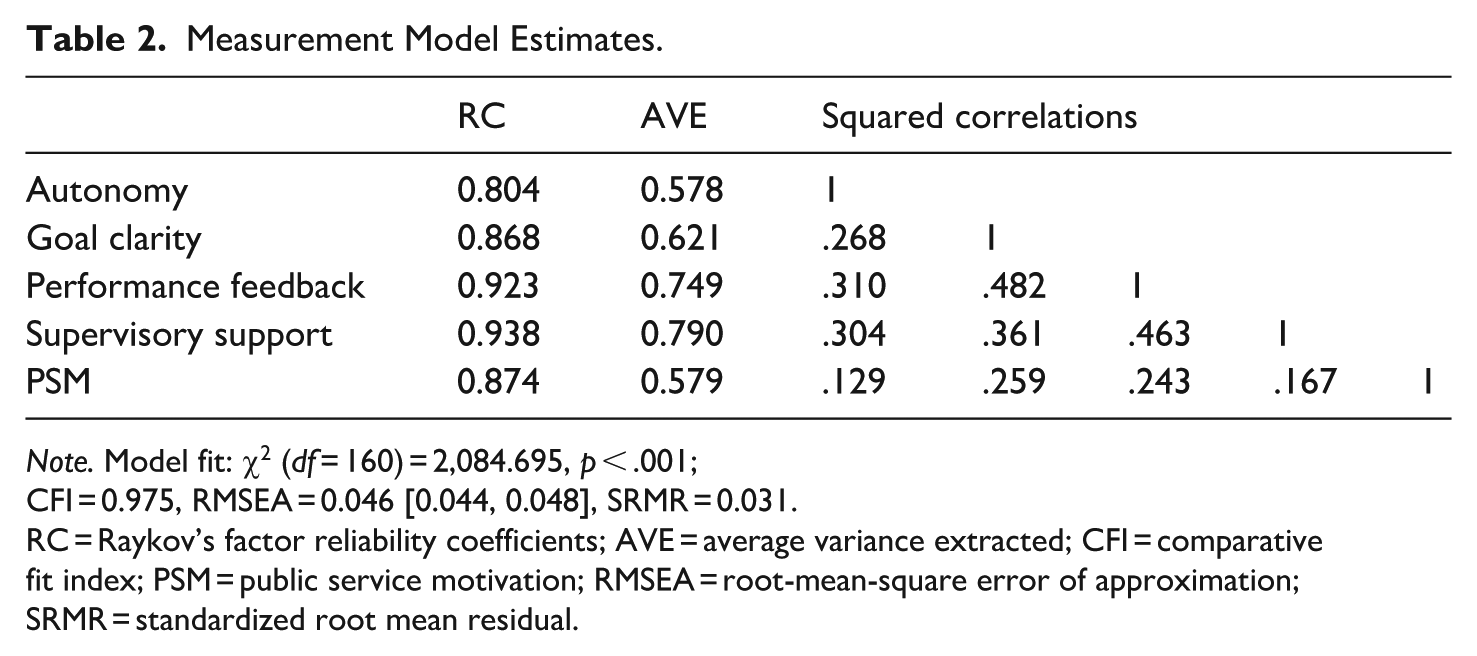
Note. Model fit: χ2 (df = 160) = 2,084.695, p < .001;
CFI = 0.975, RMSEA = 0.046 [0.044, 0.048], SRMR = 0.031.
RC = Raykov’s factor reliability coefficients; AVE = average variance extracted; CFI = comparative fit index; PSM = public service motivation; RMSEA = root-mean-square error of approximation; SRMR = standardized root mean residual.
Common method bias (CMB) may occur when both the dependent and independent variables are collected from the same method (Podsakoff et al., 2024). To reduce bias, measures of the dependent variable (PSM) and independent variables were physically separated in the questionnaire. Statistical methods were then utilized to evaluate the potential impact of CMB. Initially, Harman’s single factor was examined using confirmatory factor analysis in SEM. All survey items were treated as indicators of a single factor representing method effects. Method biases are deemed significant if the proposed model fits the data. However, the single-factor model exhibited poor data fit: CFI = 0.633, RMSEA = 0.172, SRMR = 0.113. This process assesses the fit of the measurement model but not the absence of CMB. Podsakoff et al. (2024) strongly advise against using Harman’s single factor technique. Subsequently, to evaluate the potential biasing effect, the measurement model was compared to a model that included an unmeasured latent method factor additionally. The fit of this alternative model was: CFI = 0.978, RMSEA = 0.044, SRMR = 0.028. The difference in the CFI (ΔCFI) was 0.003 (0.978–0.975), which is less than 0.01 (Cheung & Rensvold, 2002). These findings suggest that there is no significant CMB in this dataset. However, the possibility of CMB cannot be completely ruled out, so caution should be exercised regarding its potential influence in this study.
Structural Model
Table 3 presents the results of the estimated structural model. A set of control variables, such as gender, age, education, and rank, was included in the analysis to enhance the accuracy of the model estimation. The model fit indices indicate that this model is a good fit for the data: CFI = 0.970, RMSEA = 0.043, and SRMR = 0.029. This model accounts for 31.5% of the variance of PSM.
Structural Model Estimates for All.
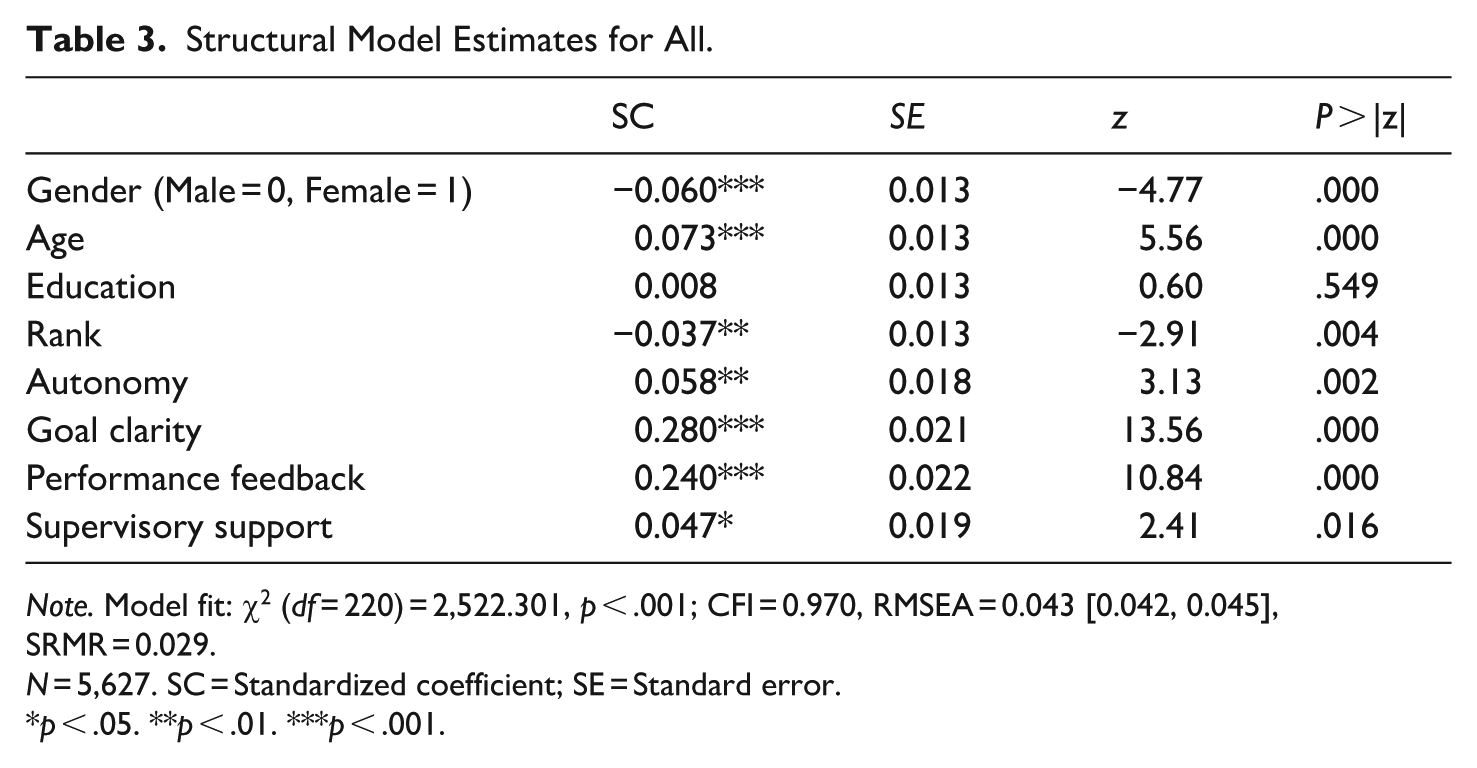
Note. Model fit: χ2 (df = 220) = 2,522.301, p < .001; CFI = 0.970, RMSEA = 0.043 [0.042, 0.045], SRMR = 0.029.
N = 5,627. SC = Standardized coefficient; SE = Standard error.
p < .05. **p < .01. ***p < .001.
Among the control variables, gender (β = −.060, p < .001) is negatively related to PSM, indicating that male public servants have higher levels of PSM than female ones. Age (β = .073, p < .001) is positively associated with PSM, suggesting that older respondents have higher levels of PSM. Rank (β = −0.037, p < .01) is negatively related to PSM, meaning that respondents with higher ranks tend to have higher levels of PSM. This is because Grade 1 is the highest rank and Grade 9 is the lowest rank. However, education level is not significantly related to PSM.
The results also show that goal clarity (β = .280, p < .001), performance feedback (β = .240, p < .001), autonomy (β = .058, p < .01), and supervisory support (β = .047, p < .05) are positively related to PSM. These results support Hypotheses 1, 2, 3, and 4. Therefore, this study expects that public managers who clarify organizational goals for their subordinates, provide constructive performance feedback, grant autonomy, and offer supervisory support may contribute to enhancing their subordinates’ PSM.
Table 4 presents the results of the estimated structural model for each government level. In the sub-sample of central government public servants, age is the only control variable that is positively related to PSM. Similar to the total sample, all independent variables are significantly and positively associated with PSM. However, in the sub-samples of upper-level and lower-level local government public servants, gender and age are significantly related to PSM. Among the independent variables, goal clarity and performance feedback are positively and significantly associated with PSM, but autonomy and supervisory support do not show a significant relationship with PSM. This suggests that autonomy and supervisory support are important for PSM in the context of the central government, but not in local government.
Structural Model Estimates for Government Levels.
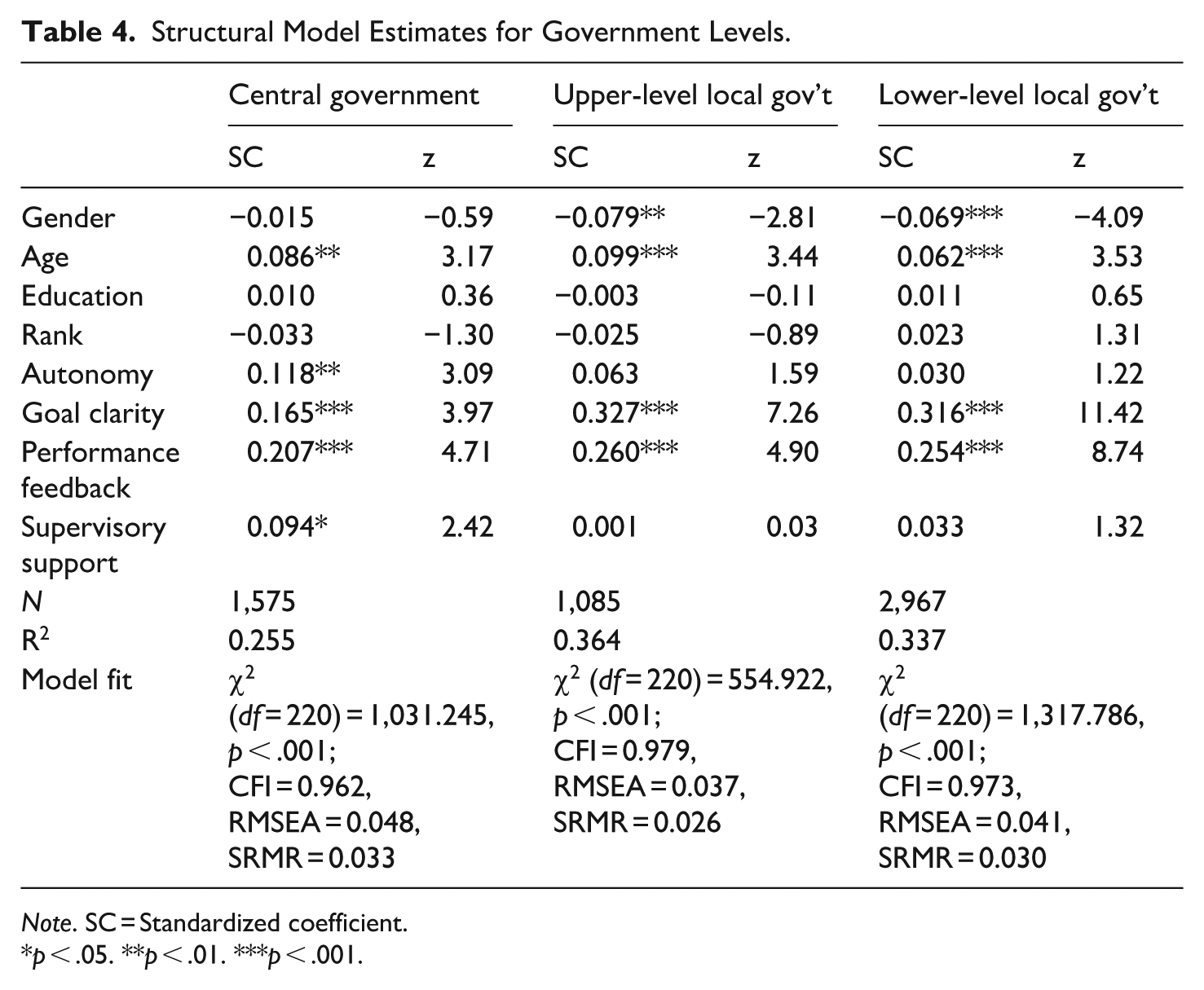
Note. SC = Standardized coefficient.
p < .05. **p < .01. ***p < .001.
Mediation Analysis
To examine the mechanisms through which managerial functions influence PSM, this study estimated a structural model including value congruence, job satisfaction, and career satisfaction as mediators. The mediation model demonstrated acceptable fit: CFI = 0.953, RMSEA = 0.051, and SRMR = 0.035. This model accounts for 38.9% of the variance of PSM. The results are presented in Table 5.
Estimates for the Mediation Model.
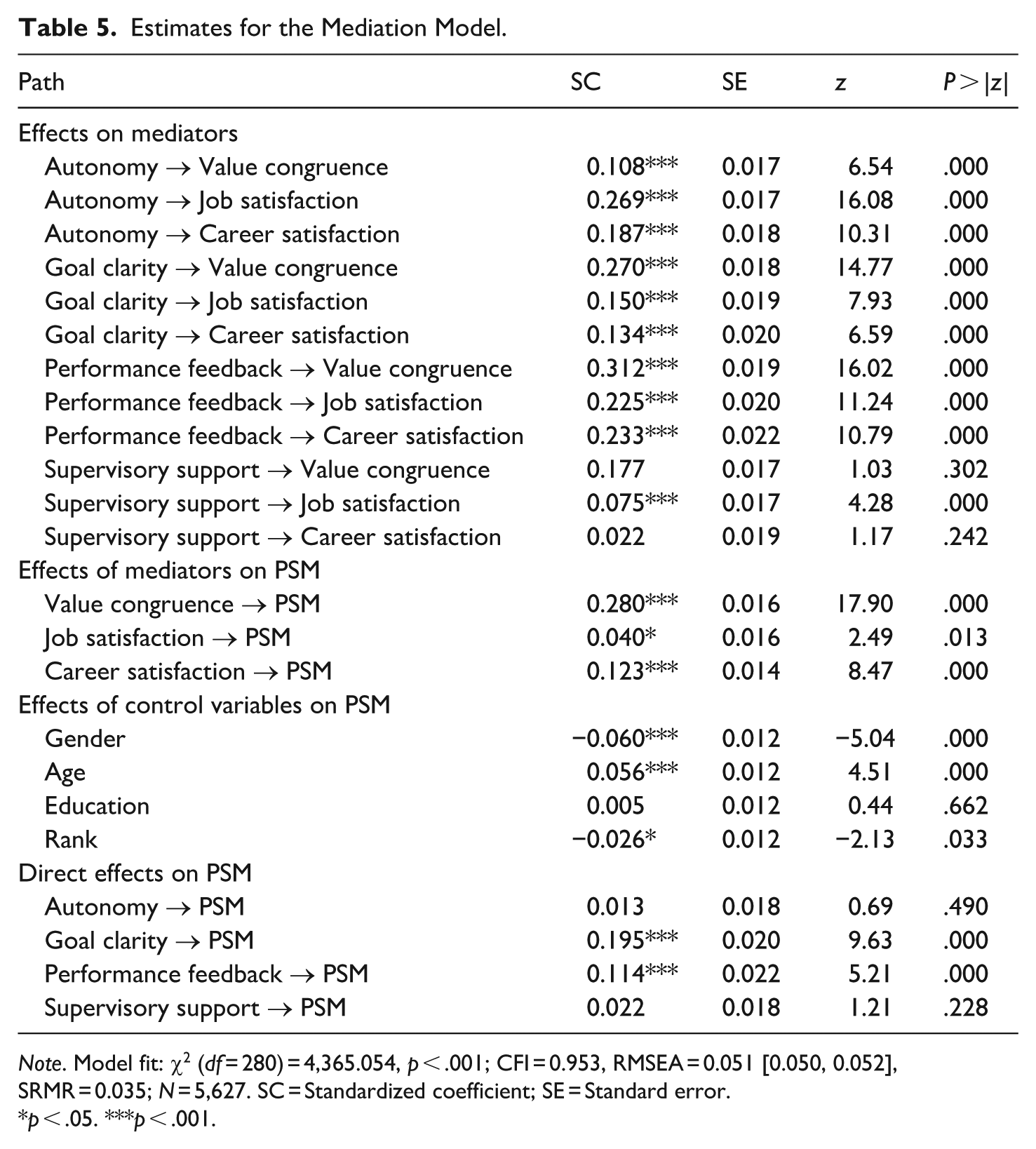
Note. Model fit: χ2 (df = 280) = 4,365.054, p < .001; CFI = 0.953, RMSEA = 0.051 [0.050, 0.052], SRMR = 0.035; N = 5,627. SC = Standardized coefficient; SE = Standard error.
p < .05. ***p < .001.
In terms of paths from managerial functions to mediators, performance feedback, autonomy, and goal clarity were significantly and positively related to all three mediators. Meanwhile, supervisory support was only significantly related to job satisfaction (β = .075, p < .001). All three mediators were significantly and positively associated with PSM.
The analysis of effects revealed distinct mediation patterns across managerial functions. For goal clarity and performance feedback, both direct effects on PSM (β = .195; β = .114, respectively) and indirect effects through the mediators (β = .098; β = .125, respectively) were statistically significant, indicating partial mediation. However, for autonomy, the direct effect on PSM was not statistically significant (β = .013, p = .490), while the total indirect effect through all three mediators was significant (β = .064), suggesting full mediation. In the case of supervisory support, the direct effect on PSM was also not statistically significant (β = .022, p = .228). Among the three potential mediating pathways, only the indirect effect through job satisfaction was supported (β = .003).
Discussion
New public servants who have high levels of PSM often experience reality shock, which can lead to a decrease in their motivation during the early years of employment (Kjeldsen & Jacobsen, 2013; Schott et al., 2019; Woo & Kim, 2024). This study especially focused on four managerial functions—goal clarity, performance feedback, autonomy, and supervisory support—that public managers can implement within their authority through regular interactions with subordinates.
The Universal Effectiveness of Informational Functions
The findings demonstrate that goal clarity and performance feedback are positively associated with PSM across all levels of government. When public managers articulate clear organizational goals and provide feedback on how public servants contribute to those goals, they make the public service mission cognitively salient. Early-career public servants can directly perceive the connection between their daily tasks and broader societal outcomes, reinforcing their orientation toward public service.
This interpretation is further supported by the mediation analysis, which revealed that goal clarity and performance feedback operate through both direct and indirect pathways to PSM. This dual pathway underscores the motivational power of mission-related information (Wright, 2007; Wright & Pandey, 2008). As Wright and Pandey (2008, p. 515) argued, “communication and performance feedback that highlights how the organization’s values and goals coincide with those of the employee and how the employee’s work contributes to both the organization and society” is essential for enhancing PSM. When early-career public servants understand how their work contributes to important goals for both the organization and society, their levels of PSM increase.
The Context-Dependent Effectiveness of Relational Functions
The relationships between relational functions—autonomy and supervisory support—and PSM varied significantly across government levels. Both autonomy and supervisory support were positively associated with PSM among early-career public servants in the central government, but these associations were not statistically significant in either upper-level or lower-level local governments.
The mediation analysis provides a theoretical explanation for this pattern. Autonomy and supervisory support influence PSM entirely through indirect pathways. This full mediation pattern indicates that autonomy and supervisory support create positive psychological conditions that enable PSM to develop. This finding aligns with self-determination theory (Deci & Ryan, 2000), which posits that need satisfaction is a precondition for intrinsic motivation. Because these relational functions operate through intermediate psychological states, their effectiveness depends on whether these mediating mechanisms can be meaningfully activated in a given institutional context.
First, the central government involves complex policy planning and coordination requiring professional judgment, where granting autonomy allows employees to shape policy outcomes. Local government work tends toward routine, procedural tasks offering limited meaningful discretion regardless of formal autonomy. Second, central government agencies operate with higher administrative autonomy, greater resources, and more professionalized systems conducive to supportive leadership. Local governments function within tighter constraints, where supervisory support may be perceived as routine oversight rather than developmental mentorship. Third, local government employees may derive motivation from direct citizen interactions and tangible community impact (Pratama et al., 2025), rather than from autonomy or supervisory support. Therefore, the motivational effects of autonomy and supervisory support depend on the overall institutional environment in which public servants operate.
Demographic Variables and PSM
The analysis revealed significant relationships between demographic characteristics and PSM. The positive relationship between age and PSM aligns with previous Korean studies (Jung & Ryu, 2020) and suggests that as public servants age, they become more focused on making lasting positive contributions to society (Pandey & Stazyk, 2008; Parola et al., 2019). This pattern held across all government levels.
The relationship between gender and PSM varied depending on the institutional context. While gender did not show a significant relationship with PSM in the central government, male public servants in local governments reported higher levels of PSM than their female counterparts. This is in contrast with Ritz et al.’s (2016) meta-analysis, which suggests that women typically exhibit higher levels of PSM. However, it is consistent with evidence showing that mean PSM scores are higher for males in Confucian Asian countries (Parola et al., 2019). Further research is needed to explore mechanisms underlying this difference.
Conclusion
Both personal and contextual factors are crucial in developing public servants’ PSM (Moynihan & Pandey, 2007; Pandey & Stazyk, 2008). This study specifically focused on contextual factors within the Korean government, examining the managerial functions that public managers can perform to maintain and enhance PSM among early-career public servants with less than 5 years of service.
The findings indicate that goal clarity and performance feedback are positively associated with PSM at all levels of government, operating through both direct and indirect pathways. In contrast, autonomy and supervisory support are positively associated with PSM only in the central government context, and their effects operate entirely through indirect pathways mediated by value congruence, job satisfaction, and career satisfaction. These results suggest that informational managerial functions have universal applicability, while the effectiveness of relational managerial functions is contingent on institutional context.
This study contributes to PSM scholarship in several ways. First, it identifies specific managerial functions operating through distinct mechanisms: informational functions through both direct and indirect pathways, and relational functions entirely through indirect pathways. This distinction suggests that different functions activate PSM through different processes. Second, the findings underscore the significance of institutional context, as the effects of autonomy and supervisory support vary across government levels. Third, this study addresses the need for research on actionable managerial practices (Christensen et al., 2017) by focusing on functions that managers can implement within their formal authority and day-to-day interactions.
The findings have practical implications for public managers. First, managers at all government levels should prioritize clarifying organizational goals and providing constructive performance feedback, explicitly connecting individual tasks to the public service mission. Second, emphasis on relational functions should be customized to the context. In the central government, granting autonomy and providing supportive guidance can effectively enhance PSM. In local government, managers may need alternative approaches, such as highlighting community impact or encouraging direct citizen engagement. Third, the distinction between direct and indirect pathways has implications for the timing of interventions. To directly reinforce public service orientation—during onboarding or in response to declining morale—managers should focus on goal clarity and performance feedback. To build psychological foundations for sustained motivation, managers should address autonomy and supervisory support, understanding their effects manifest through satisfaction and value alignment improvements.
This study has several limitations that need careful consideration. First, it used a five-item unidimensional measure of PSM (Alonso & Lewis, 2001; Kim, 2005; Naff & Crum, 1999). While this measure effectively evaluates an individual’s overall PSM level and is comparable to the four-dimensional measure (Kim, 2017a), future research should utilize the established four-dimensional measure (Kim, 2017b; Kim et al., 2013; Perry, 1996) to explore which dimensions of PSM are most affected by different managerial functions. Second, measures of goal clarity do not directly capture a manager’s specific communication of goals but instead reflect public servants’ general perceptions of organizational goal clarity. Future research could improve the validity of this relationship by using measures that explicitly assess how managers communicate and clarify goals to their subordinates. Third, while this study centers on early-career public servants who are especially prone to experiencing reality shock (Kjeldsen & Jacobsen, 2013; Schott et al., 2019), the Public Employee Perception Survey lacks items that specifically address reality shock that arises from the disparity between expectations and bureaucratic realities. Future research should incorporate reality shock as a potential mediator to enhance understanding of how managerial functions can affect PSM. Finally, this study relies on pooled cross-sectional, self-reported data, limiting causal inference. Reverse causality is plausible—public servants with higher PSM may perceive greater goal clarity or support. Despite diagnostic tests indicating no significant CMB, residual bias cannot be entirely ruled out (Podsakoff et al., 2024). The identified relationships should, therefore, be interpreted as correlational rather than causal. Therefore, future research should employ longitudinal or experimental designs to establish causality.
Footnotes
Appendix
Items and Basic Statistics.
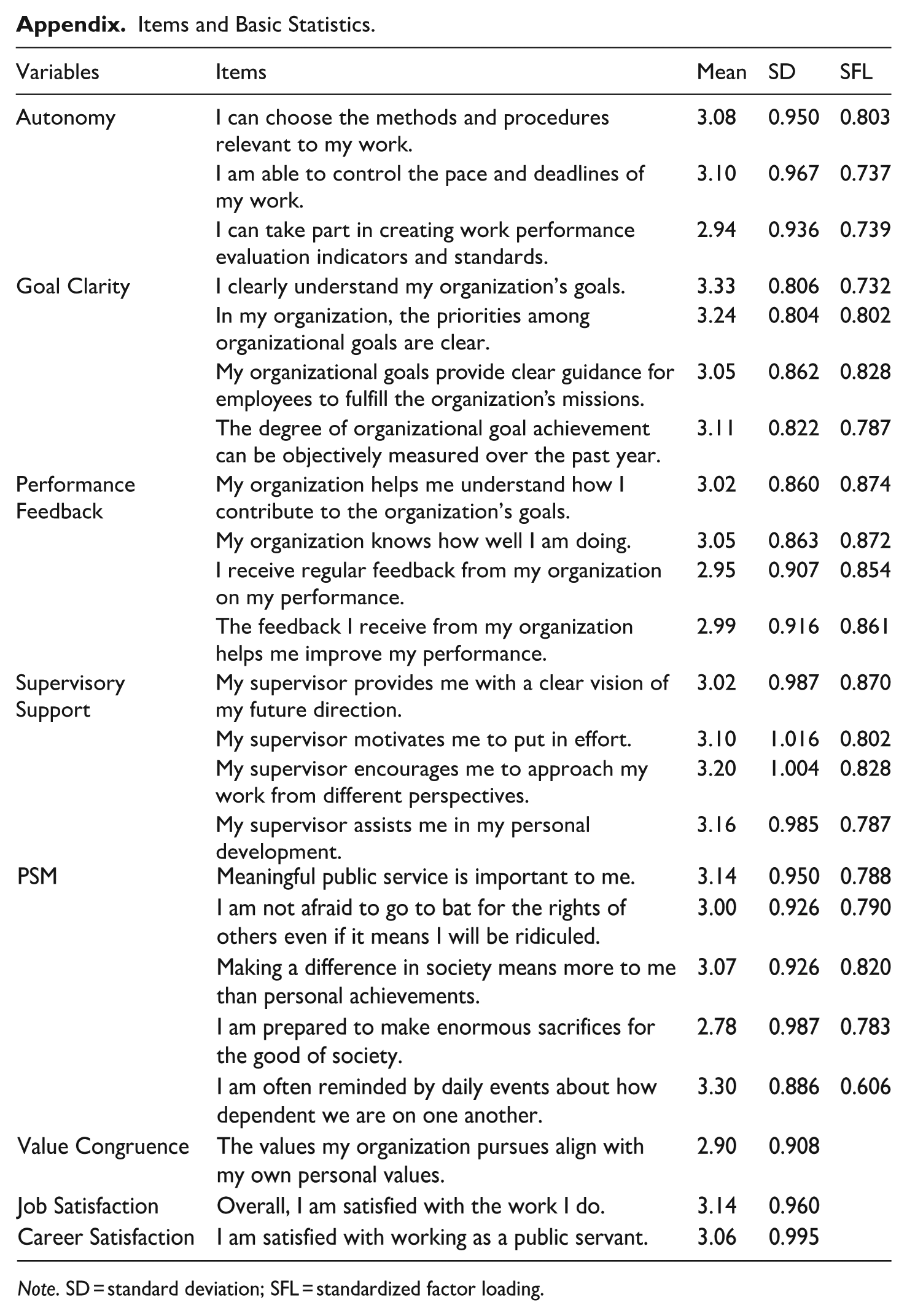
| Variables | Items | Mean | SD | SFL |
|---|---|---|---|---|
| Autonomy | I can choose the methods and procedures relevant to my work. | 3.08 | 0.950 | 0.803 |
| I am able to control the pace and deadlines of my work. | 3.10 | 0.967 | 0.737 | |
| I can take part in creating work performance evaluation indicators and standards. | 2.94 | 0.936 | 0.739 | |
| Goal Clarity | I clearly understand my organization’s goals. | 3.33 | 0.806 | 0.732 |
| In my organization, the priorities among organizational goals are clear. | 3.24 | 0.804 | 0.802 | |
| My organizational goals provide clear guidance for employees to fulfill the organization’s missions. | 3.05 | 0.862 | 0.828 | |
| The degree of organizational goal achievement can be objectively measured over the past year. | 3.11 | 0.822 | 0.787 | |
| Performance Feedback | My organization helps me understand how I contribute to the organization’s goals. | 3.02 | 0.860 | 0.874 |
| My organization knows how well I am doing. | 3.05 | 0.863 | 0.872 | |
| I receive regular feedback from my organization on my performance. | 2.95 | 0.907 | 0.854 | |
| The feedback I receive from my organization helps me improve my performance. | 2.99 | 0.916 | 0.861 | |
| Supervisory Support | My supervisor provides me with a clear vision of my future direction. | 3.02 | 0.987 | 0.870 |
| My supervisor motivates me to put in effort. | 3.10 | 1.016 | 0.802 | |
| My supervisor encourages me to approach my work from different perspectives. | 3.20 | 1.004 | 0.828 | |
| My supervisor assists me in my personal development. | 3.16 | 0.985 | 0.787 | |
| PSM | Meaningful public service is important to me. | 3.14 | 0.950 | 0.788 |
| I am not afraid to go to bat for the rights of others even if it means I will be ridiculed. | 3.00 | 0.926 | 0.790 | |
| Making a difference in society means more to me than personal achievements. | 3.07 | 0.926 | 0.820 | |
| I am prepared to make enormous sacrifices for the good of society. | 2.78 | 0.987 | 0.783 | |
| I am often reminded by daily events about how dependent we are on one another. | 3.30 | 0.886 | 0.606 | |
| Value Congruence | The values my organization pursues align with my own personal values. | 2.90 | 0.908 | |
| Job Satisfaction | Overall, I am satisfied with the work I do. | 3.14 | 0.960 | |
| Career Satisfaction | I am satisfied with working as a public servant. | 3.06 | 0.995 |
Note. SD = standard deviation; SFL = standardized factor loading.
Acknowledgements
This study makes use of research material produced by the Korea Institute of Public Administration (KIPA), and has been authorized for use according to KIPA’s regulations on the ownership and use of said research material.

Funding
The author disclosed receipt of the following financial support for the research, authorship, and/or publication of this article: This research was supported by the Seoul National University of Science and Technology.
Declaration of Conflicting Interests
The author declared no potential conflicts of interest with respect to the research, authorship, and/or publication of this article.