







Abstract
Waterpipe smoking among youth and adolescents in Iran has gained in popularity. The aim of this study was to investigate the relationship between waterpipe smoking and different dimensions of religiosity in a sample of students attending two major universities in South East Iran. A total of 682 students completed a waterpipe and cigarette smoking questionnaire along with the Duke University Religion Index. The lifetime prevalence of dual cigarette and waterpipe use was 48.3%, with prevalence of current use (within the last 30 days) of 24.9%. The proportions of lifetime and current waterpipe-only users were 27.0% and 18.8%, respectively. Students who participated more often in private religious activities were less likely to report engaging in waterpipe smoking (odds ratio: 0.82; 95% confidence interval: 0.71–0.98). A higher level of attendance of religious services was negatively associated with dual cigarette and waterpipe smoking (odds ratio: 0.71; 95% confidence interval: 0.54–0.93). Waterpipe-only use was significantly higher among males, students who had lower grade point averages, those who reported having a close friend or a family member who was a waterpipe smoker. To conclude, it is possible that religious observance may have a protective role in lowering waterpipe usage among Iranian university students.
Introduction
The waterpipe (also known as Hookah, Narghile, Shisha, Goza, Chica, Mada’A, Hubble-bubble, and Qalyan) is an ancient device used for tobacco smoking. 1 There are three kinds of tobacco for waterpipe smoking: (1) the flavored tobacco Mo’assel, composed of tobacco mixed with honey and treacle; (2) the unflavored pure Persian tobacco known as Ajami; and (3) an intermediate form of tobacco known as Jurak. A waterpipe user inhales the tobacco smoke, which passes through the water in the body of the pipe.2–4
It is possible that, due to the sweet smell, the use of flavored tobacco, and the presence of water as a filter, 5 the risk perception of waterpipe use is lower compared to that of cigarette smoking. In reality, waterpipe smokers are exposed to higher levels of nicotine and other toxins such as polycyclic aromatic hydrocarbons, tar, carbon monoxide, arsenic, chromium, lead, and volatile aldehydes.6,7 The waterpipe is more harmful than cigarettes for involuntary and second-hand smokers, as users are exposed to higher concentrations of smoke by the waterpipe when smoking in an indoor environment. 8
Waterpipe smoking is considered a risk factor for a broad range of diseases, including lung cancer, respiratory diseases, heart disease, periodontal disease, and obstetric and perinatal complications such as low birth weight.9,10 Furthermore, it may be a causative factor in increasing the incidence of Helicobacter pylori infection, hepatitis A, hepatitis C, herpes simplex, and Epstein–Barr virus. 11 Nicotine dependence is another consequence of long-term waterpipe smoking.12,13
In spite of these health-related problems, recent evidence has confirmed that waterpipe smoking is a pandemic health issue,12,13 with prevalence high and increasing in the Eastern Mediterranean countries, the Middle East, and some parts of Southern Asia. In each of these locales, waterpipe smoking is a common cultural and traditional practice.4,14
Waterpipe smoking among youth and adolescents in the Eastern Mediterranean and Middle East has gained in popularity. For example, the results of research on adolescents in Lebanon showed that the percentages of lifetime and current smokers were 60% and 20%, respectively. 15 Current waterpipe smoking prevalence among medical students was 20.6% in Lebanon, 23.5% in Syria, and 28.6% in Turkey in one study. 12 The prevalence of lifetime waterpipe smoking in a sample of Iranian university students in south Iran was 42.5% and 18.7% continued to smoke. 16
Several studies have focused on the effect of various behavioral and psychological factors on waterpipe smoking, but little research has studied the role of religiosity on this practice. In one of the few studies that investigated this issue, Klassen et al. 17 found no significant relationship between religiosity and frequency of waterpipe use in American students who attended freshman orientation. On the other hand, the results of another American study indicated that atheism and lower proportions of individuals with religious orientations were positively associated with lifetime and current waterpipe smoking. 8 Furthermore, the results of a study in Lebanon showed that religiosity was a protective factor for waterpipe use in adolescents. 2 A second study, also in Lebanon, found a negative correlation between religiosity and waterpipe smoking in sixth and seventh grade students. 15 Alzyoud et al. 18 reported that frequency of praying and religious observance was negatively related to tobacco smoking (cigarettes and waterpipe) in Jordanian students.
Islam is the official state religion in Iran. According to the latest Iranian national census in 2011, Muslims comprise 99.4% of the population.19,20 Historically, in Iran, a synthesis has been formed between religion and other elements of the social structure, culture, politics, customs, and society as a whole. Religious beliefs and practice play a considerable role in the formation of many attitudes and behaviors related to health and safety issues (among other types of behavioral issues) in different social settings. Therefore, the influence of religion on health-related concerns in Iran should be investigated. This approach can be considered a step forward in recognizing and solving many health-related problems. The present study sought to address this knowledge gap by investigating the relationship between waterpipe smoking and different dimensions of religiosity in a sample of students attending an Iranian university.
Methods
Participants
The sample comprised 800 students conveniently selected from two major universities in Kerman, located in South-East Iran. Initially, one class from different majors was selected then all students in the classes were invited to participate in the survey. At the last nationwide Census in 2011, the population of Kerman was 770,595. 19
A total of 682 students completed the waterpipe and cigarette smoking questionnaire, the Duke University Religion Index (DUREL), and a questionnaire that measured age, gender, marital status, place of residence, academic year, academic grade point average, and academic degree or major. As DUREL’s questions were related to Islam, the sole inclusion criterion was that the respondent had to be Muslim. Respondents completed questionnaires in their classrooms; they took about 10 min to fill out.
Instruments
Waterpipe and cigarette smoking questionnaire
This questionnaire asked students about items related to waterpipe and cigarette smoking. The questionnaire asked about lifetime and current cigarette and waterpipe smokers, the age onset of waterpipe smoking, the rate of waterpipe smoking, and whether any friend and family member smoked using a waterpipe. 16
Lifetime smokers were defined as those who had engaged in waterpipe smoking at least once in their lifetimes; current smokers, as those who had used a waterpipe at least once in the last 30 days. 21
The Duke University Religion Index
DUREL is a brief scale that measures three dimensions of religiosity, including organizational religious activity (ORA), nonorganizational religious activity (NORA), and intrinsic religiosity (IR). 22 The psychometric properties of DUREL have been adapted for use in Persian-language Muslims in Iran. 23 ORA is measured by the item: “How often do you attend a mosque, hussainia (i.e., Islamic religious places), or other religious meetings?” The item used to measure NORA was “How often do you spend time in private religious activities, such as prayer, meditation or study of the Quran?” IR was measured with the three following items: “I experience the presence of God in my life,” “My religious beliefs are what really lie behind my whole approach to life,” and “I try hard to carry my religion into all other dealings in life.” The last dimension evaluates the degree of personal religious commitment or motivation. In this questionnaire, the ranges of scores for ORA and NORA were from 1 to 6. IR has an overall score ranging from 3 to 15. The Cronbach’s alpha of the overall scale was 0.78.
Ethical considerations
Prior to conducting this research, permission was obtained from university authorities. Before completion of the questionnaire, verbal informed consent was obtained from all participants, who were assured that participation in the study was voluntary and anonymous and that their responses were confidential. The study protocol was approved by the university’s Ethics Committee.
Data analysis
Frequencies, percentages, means, and standard deviations (SDs) were calculated. Multinomial logistic regression analyses were performed to assess correlates between the three main predictors and the outcome. In the regression models, “Never smoking” was used as a reference category for the outcomes “waterpipe-only smoking” and “dual cigarette and waterpipe smoking.” The adjusted odds ratio and 95% confidence intervals (CI) were reported. P values < 0.05 were considered significant. All analyses were carried out using SPSS version 21 (SPSS Inc., Chicago, IL).
Results
Descriptive statistics
Characteristics of participants in this study.

ORA: organizational religious activity; NORA: nonorganizational religious activity; IR: intrinsic religiosity.
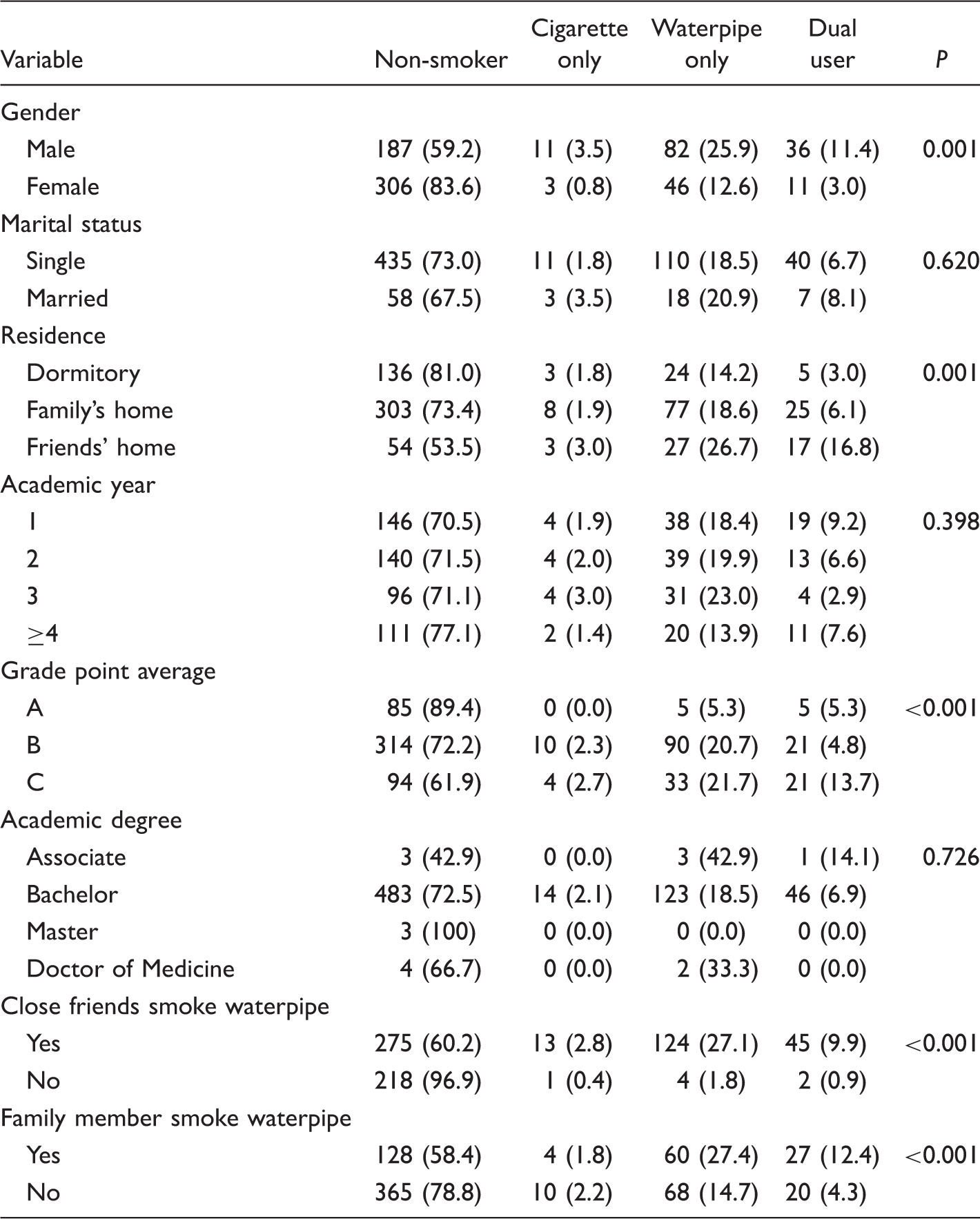
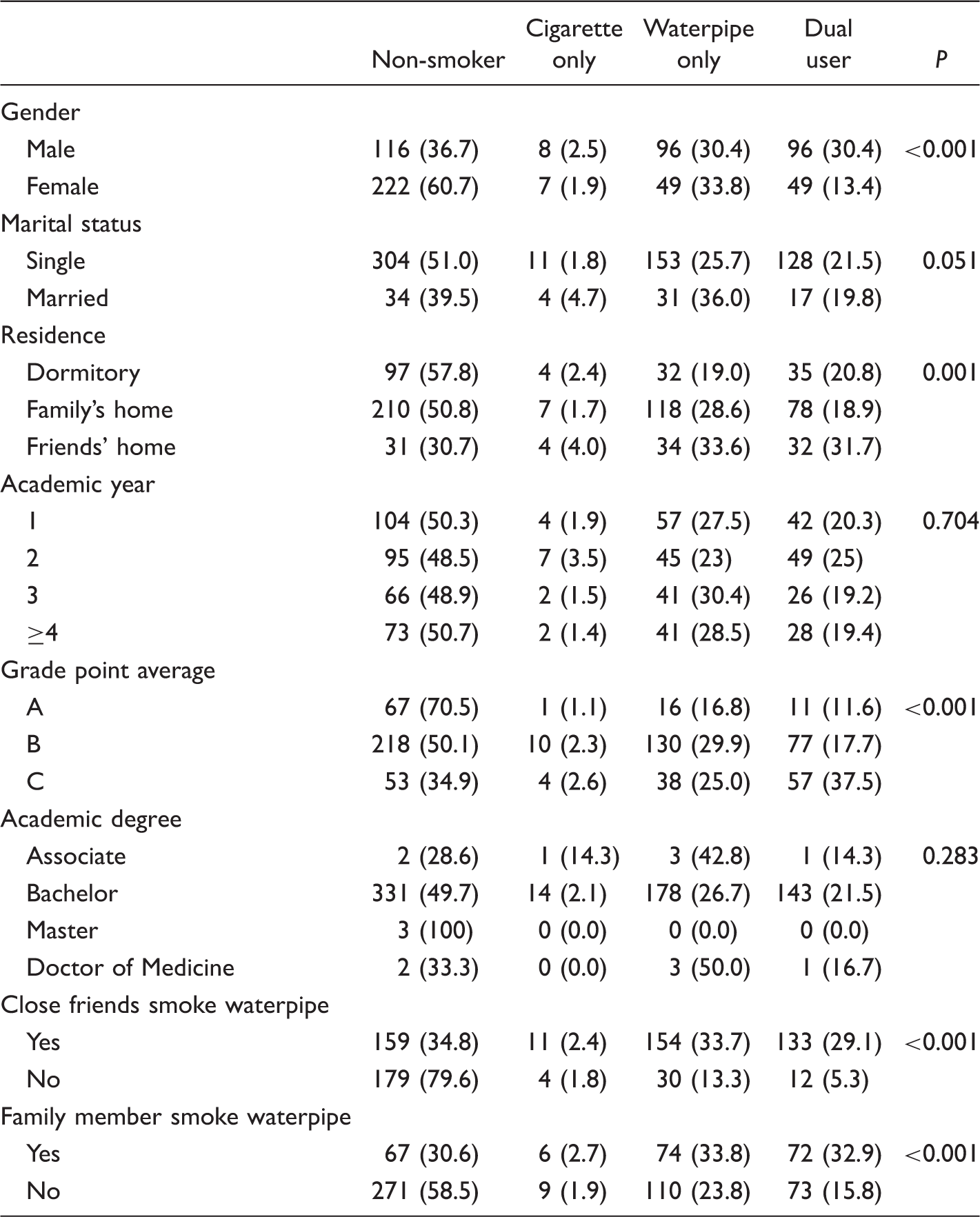
Table 1 shows that the lifetime prevalence of waterpipe-only use was 27.0% and current prevalence was 18.8%. The proportions of lifetime and current dual cigarette and waterpipe user were 21.3% and 6.9%, respectively. A plurality of current users reported using a waterpipe 1–2 times per month (39.4%); 26.3% were daily users, and the remainder used a waterpipe 1–2 times every week.
Frequency and univariate analysis of current users according to baseline characteristics.
Frequency and univariate analysis of life time users according to baseline characteristics.
Mean, standard deviation (SD) of three dimensions of religiosity in current tobacco users.

ORA: organizational religious activity; NORA: nonorganizational religious activity; IR: intrinsic religiosity.
Mean, standard deviation (SD) of three dimensions of religiosity in life-time tobacco users.

ORA: organizational religious activity; NORA: nonorganizational religious activity; IR: intrinsic religiosity.
Multinomial logistic regressions using religiosity and other variables to predict waterpipe only smoking and dual cigarette and waterpipe smoking.
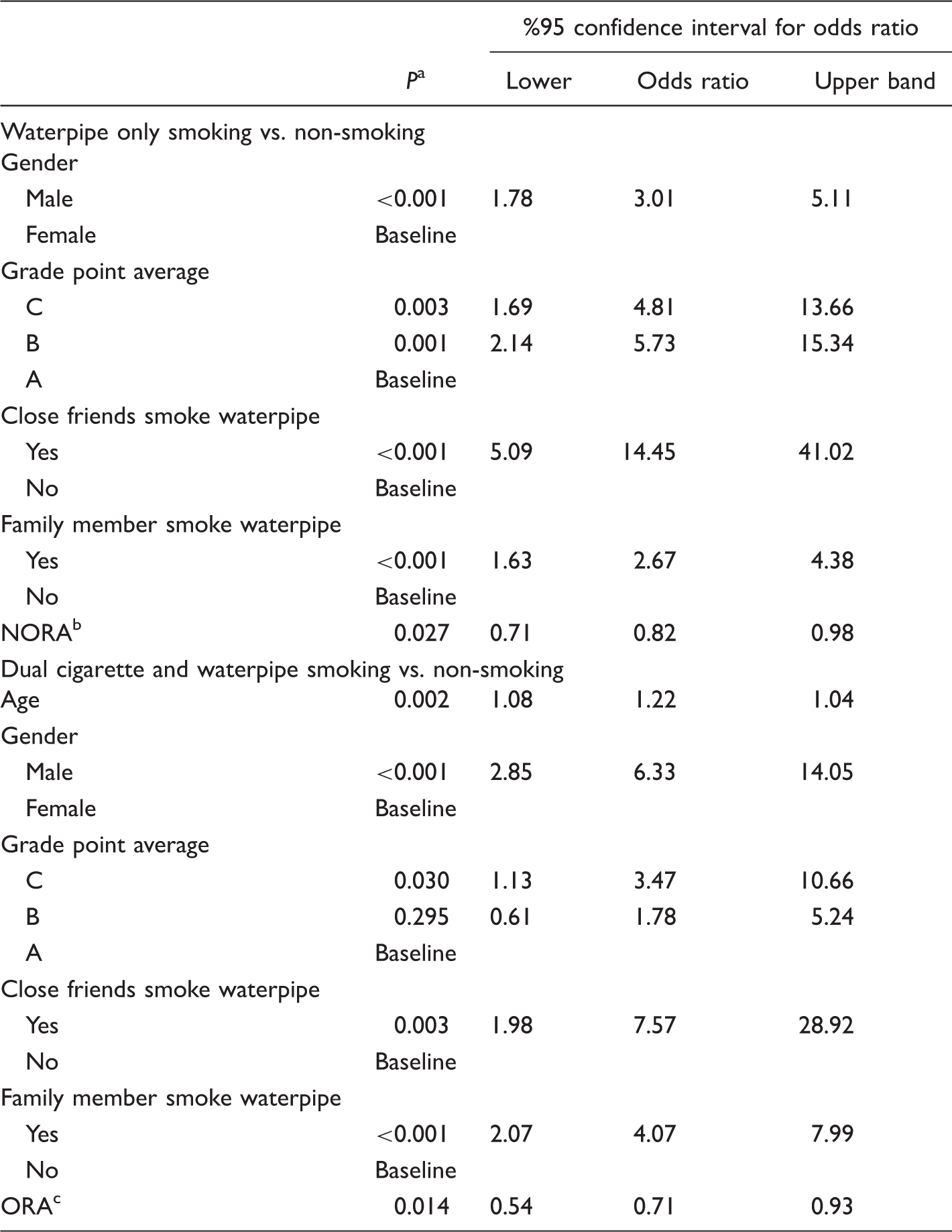
Note: R2 = 0.33 (Cox and Snell), 0.42 (Nagelkerke), Model (chi-square) = 270.86, goodness-of-fit: Pearson (chi-square) = 1235.68, df = 1308, P = 0.923.
Only the variables with significant relationship are shown.
Nonorganizational religious activity.
Organizational religious activity.
Discussion
The findings of this study indicate that about half of students had ever tried a waterpipe and slightly more than a fourth of them were current waterpipe smokers. The rate of lifetime smoking was higher in comparison to university students in the US (20%) and the UK (38%) but lower than for students in Pakistan (54%). The prevalence of current waterpipe smoking was higher compared to Lebanon (20.6%), Syria (23.5%), and the US (7.2%) and lower compared to Turkey (28.6%), Pakistan (54%), and Jordan (42.7%). 12 These discrepancies may be due to differences in university students’ awareness regarding the potential harm of waterpipe tobacco and cultural differences.
Previous research in a population in Kerman (in 2010) showed the prevalence of lifetime and current waterpipe smoking was 42.5% and 18.5%, 16 respectively. However, the present study showed the pattern of waterpipe smoking seems (alarmingly) to be increasing. Therefore, interventional programs should be designed that place particular emphasis on increasing the knowledge of students attending university with respect to the risks of waterpipe smoking.
In line with previous research,2,5,16,18,24 waterpipe use was more prevalent than cigarette smoking. Perhaps, an explanation of this phenomenon may be due to the fact that students believe smoking with a waterpipe is less harmful in contrast with cigarettes and that it therefore serves as a safer alternative. 25 The majority of students started waterpipe smoking at 15–20 years old, in accordance with previous studies.9,16 This finding implies that middle and late adolescence is a critical period in the initiation of waterpipe smoking, as adolescents are getting more freedom and independence from their guardians and without knowledge about the risks of tobacco may start to use waterpipes. Therefore, it seems that particular emphasis should be placed on health promotion programs that focus on preventing waterpipe smoking among Iranian adolescents.
To the best of our knowledge, this is the first study in which the relationship between different dimensions of religiosity and waterpipe smoking among Iranian university students has been investigated. The present study found that NORA has a protective effect on waterpipe-only smoking. In support of this finding, previous research in Jordan has shown that adolescents who had partial and full religious commitment to required prayers were less likely to smoke cigarettes and waterpipes. 18 A possible explanation for this finding is that involvement in private religious activities positively influences self-esteem, a sense of self-efficacy, and personal conservatism.26,27 Additionally, those engaged in religious practices are more likely to have parental supervision of their behavior. 28
The present study also found a negative relationship between ORA and dual use of cigarettes and waterpipes. In support of this finding, a previous study on Christian university students in Brazil has shown that higher levels of religious attendance were associated with less tobacco use. 29 However, this finding was not consistent with the results of the Jordan study in Muslim university students, in which attendance of religious events was not significantly related to waterpipe and cigarette smoking. 18 The less frequent engagement in tobacco smoking in those involved in ORA is probably related to the attendance of religious meetings in which Muslims are encouraged to follow an approach that is related to safe behavior and taking precaution in life 30 ; the mechanism of role modeling and mentorship may also contribute to the protective role. 28
In agreement with other studies, the odds of dual cigarette and waterpipe smoking increased with age.16,31 One of the reasons for this is that the likelihood of exposure to tobacco smoking tends to increase as students grow older.
Similar to other studies, the prevalence of tobacco smoking was higher in male students.8,15,16,25,32–37 This may be because male students have a lower risk perception of tobacco smoking and female students receive stronger parental supervision. Another potential reason for this discrepancy is that tobacco smoking by women in Iran is considered an unacceptable practice in many traditional families.
The lower prevalence of tobacco smoking among students with a grade point average of A in comparison to those with lower grade point averages may be because of the higher risk perception of these students due to better knowledge about the adverse effect of tobacco smoking on health. This finding, however, is contrary to the results yielded by a cohort study on adolescents in the US, 38 which reported that those who smoke waterpipes had an overall higher grade point average compared to non-waterpipe users.
Students reported that having close friends who smoke waterpipes were more likely to be current tobacco users, which is in agreement with several studies.2,15,16 Peer pressure may provide an explanation for this. In this regard, a waterpipe smoker may encourage their friends to start waterpipe smoking, leading to changes in behavior that conform to those of the influential individual or group.16,39
Consistent with previous research, 16 students who reported that someone in their families smoked using a waterpipe were more likely to be current tobacco users. This finding could be due to the fact that these students live in families where tobacco using is not considered a stigma, and therefore, they imitate and copy the tobacco smoking of their family members.
However, tobacco smoking among family members was less strongly associated than close friends to tobacco use among students, which is in line with previous Iranian research. 16
This study had some limitations. First, the results of the study are not generalizable to Iranian university students, as the participants in the present study are not representative of all students attending universities in Iran. Second, social desirability bias may have occurred due to the nature of the data collection, which relied on self-reported measures. Third, the number of “cigarette only” smokers is zero in some of the cells of Tables 2 and 3, which may influence the findings of the multinomial model.
Conclusion
This study shows that the prevalence of waterpipe smoking among university students is alarmingly high. However, involvement in private and organizational religious activities is a protective factor in waterpipe smoking. Therefore, it seems that religion may help prevent waterpipe smoking among university students. The findings of this study also appear to suggest that teaching religious values is integrated into interventional programs regarding waterpipe smoking prevention.
Footnotes
Declaration of Conflicting Interests
The author(s) declared no potential conflicts of interest with respect to the research, authorship, and/or publication of this article.
Funding
The author(s) disclosed receipt of the following financial support for the research, authorship, and/or publication of this article: The research protocol has been financially supported by Kerman Neuroscience Research Center.