







Abstract
Objective
Balint groups have shown promise in addressing clinician–patient relationships, clinician burnout, referral practices, and psychological mindedness. However, their traditional format of in-person sessions limits their ability to meet the needs of clinicians practicing in locations without trained Balint leaders. We report on a pilot of an international, internet-based Balint group in collaboration between the World Organization of Family Doctors regional Young Doctors Movements and the International Balint Federation.
Method
Balint 2.0 arose through interest of the Young Doctors Movements leadership, who approached the International Balint Federation for assistance. Initial discussions and some trialing of videoconference platforms led to monthly group meetings over the internet. Surveys evaluated each individual session as well as quarterly progress of the group. Survey items were borrowed from existing surveys in use by the American and German Balint Societies.
Results
Session surveys demonstrated the effectiveness of the videoconferencing platform for convening a Balint group, with a majority of participants expressing agreement with survey items evaluating each session. Quarterly survey responses were more positive reflecting agreement with outcomes seen from in-person Balint groups.
Conclusions
The Balint 2.0 pilot has demonstrated the ability of a Balint group to successfully convene over the internet and reach the common outcomes of a Balint group meeting in-person. The Young Doctors Movements and International Balint Federation plan to expand this work based on this successful pilot. We hope that others may also be able to build on this success with the result that Balint groups are available to clinicians in areas where they might not otherwise be accessible.
Introduction
Balint groups founded on the work of Michael and Enid Balint have been meeting in a variety of in-person settings since the 1950s. 1 In small studies, Balint groups have shown beneficial effects on clinician burnout, referral practices, and psychological mindedness.2–4 A recent systematic review highlights the potential of Balint groups as well as the need for further research. 5
Recently, reports have begun appearing in the literature of Balint groups being conducted or facilitated via internet-based videoconference technology. Family Medicine faculty at the Medical University of South Carolina reported on remote leadership of a Balint group at the American University of Beruit. 6 Koppe et al. 7 reported on a group conducted via videoconference across Australia. The potential advantages of “virtual” Balint groups include the ability to conduct groups with clinicians where no trained Balint leaders exist locally and the ability to deliver Balint groups to rural and internationally diverse regions, both of which could serve to dramatically increase the availability of Balint groups.
This paper seeks to describe the formation and evaluation of the ongoing work of the Balint 2.0 group, a working example of an online Balint group with international participants conducted in partnership between the International Balint Federation (IBF) and the World Organization of Family Doctors (WONCA) regional Young Doctors Movements (YDMs).
Over the past 12 years, WONCA has supported the creation of seven regional YDMs that—when working together—cover all the countries around the globe. Having set sail in Europe with Vasco da Gama, it was not until 2014 that the North American Polaris YDM group opened the way for an age of cross-YDM projects, shifting attention from regionally focused activities within each YDM chapter.
Suggestions for new initiatives emerged in September 2014 on Polaris’ Facebook group—one of which regarded an online international Balint collaboration. Within hours of the initial post, a dozen representatives from each of the regional YDMs signed up to participate—namely, the Vasco da Gama Movement (Europe Region), Polaris Movement (North America Region), Waynakay Movement (Iberoamerican Region), and The Spice Route (South Asia Region). Additional representatives from AfriWon (Africa region), the Al Razi Movement (East Mediterranean region), and The Rajakumar Movement (Asia Pacific Region) soon joined the initiative. Members were selected based on a “first come, first serve” basis while ensuring that all seven YDMs were represented.
The group decided to call itself the “Balint 2.0 Ambassadors” with the “2.0” referencing the application of technology while “ambassadors” touches on the international nature. Some participants had met in-person through previous WONCA conferences and events while others had performed previous collaborations together through the internet. Still a handful used this opportunity to participate in an international YDM initiative for the first time. Of note, all members shared a bond in that each was active in their specific regional YDM.
After an initial videoconference in October 2014, the group sought and found the support of the IBF. The partnership with the IBF also produced two Balint leaders: Dr. Don Nease (then and current President of the IBF) and Dr. Albert Lichtenstein (at that time President of the American Balint Society). On their inaugural meeting in December 2014, they set the grounds for the Balint group work that should ensue.
Methods
Group formation and technical aspects
After an initial video conference via Skype in October 2014, the group started the search for an online platform best suited to their needs: finding a commercial platform that could maximize the number of video streams while holding them steadily enough to allow normal conversation (Figure 1). Consideration was given to other features like presentation and screen sharing, file share and polls, layout customization, focus and quality of video stream, hardware and software requirements, cross-platform compatibility and support for mobile devices, security, encryption, and privacy controls, price, and customer support. After testing different options, the group made an attempt with a platform that seemed suitable; however, the poor quality necessitated a change. This led the group to the Zoom platform (http://zoom.us), which continued to serve the group well. The Zoom platform allowed all participants and the leaders to be visible and appeared to be more tolerant of lower internet bandwidth than the other platforms tested.
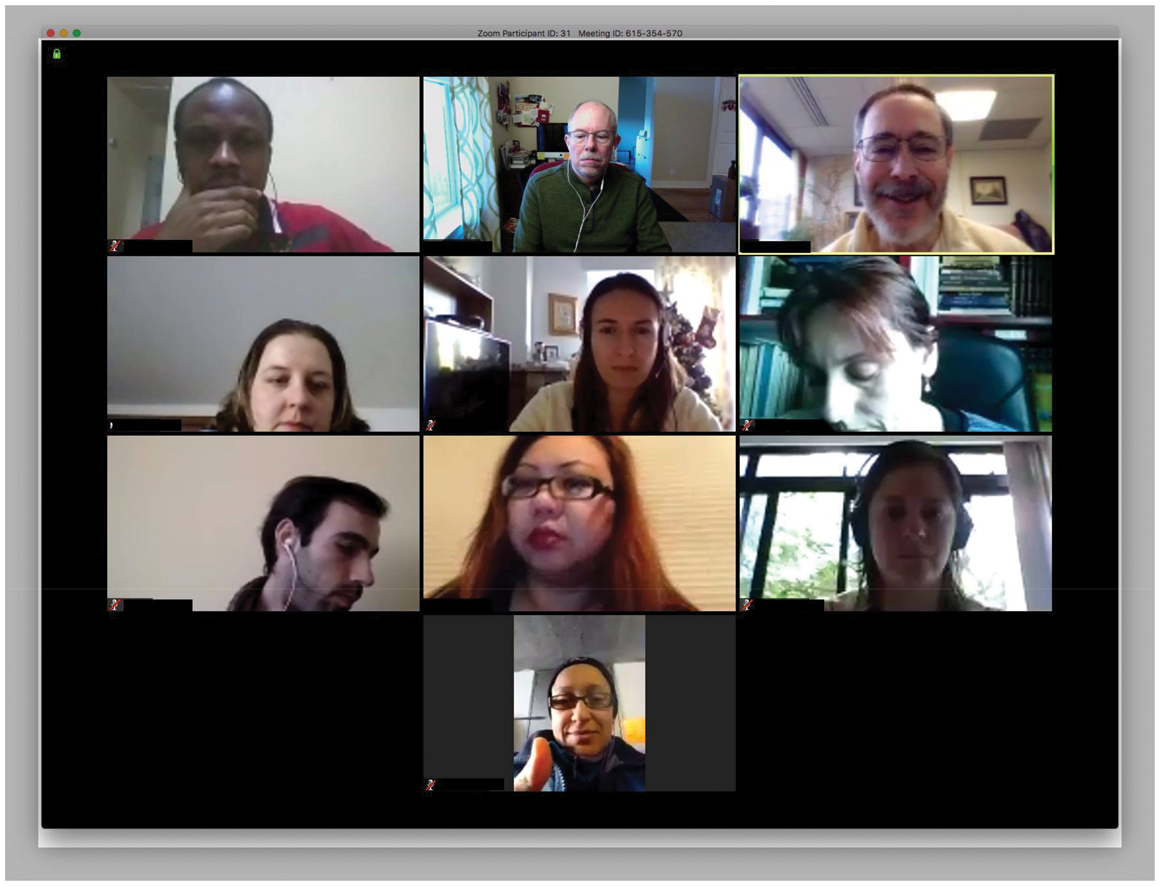
Screenshot of Balint 2.0 on the zoom videoconferencing platform.
Soon after the initial plan was made clear, the Balint leaders began to discuss how to maintain as stable a frame as possible for group work. Challenges appeared to be to a certain extent rotating members, rotating times, in addition to whatever challenges a virtual environment would present. The leaders decided on the following: First, a typical Balint model of co-leaders would provide both stability and mutual support. Second, it would be best if there was a constant time when most people could be there. Third, the groups would have to be scheduled so that both Balint leaders would be available for at least the first couple of groups and that each group member would commit to not missing more than one group in a row.
As is often done for in-person groups with new members, the leaders thought that it would be useful to do an introduction to Balint, not only to test the platform but also to make sure the group members, most of whom were Balint naïve would be on the same page. We also requested a snapshot and information from each person as to their location, what drove their interest in being involved in this Balint group, and their experience with Balint.
Some aspects unique to a videoconference format became clear early on. Some people could get on with audio and video, others with just one or the other. A few people would blink out and then come back on. Many group members resorted to texting their comments on a side bar. There were multiple “side conversations” through the platform’s chat window that were distracting and led to the loss of clarity about what was the main conversation. In the debrief after the initial group session, the leaders came to two conclusions. The first was that it would be important going forward for all group members to use the “raise your hand” function of the platform prior to talking or writing.
Later it became apparent that group members could sign on from anywhere (riding in a car, walking down a street, and in a room with family). After several months, the group had a conversation about the challenges of managing confidentiality. There was consensus that confidentiality and minimizing interruption was extremely important while it was also clear that participating group members would need to have some freedom to sign on in less than optimal places. In all cases, having open discussion between the group members and leaders about the issues of a videoconference approach to Balint greatly facilitated discussion of options and resolution.
Group members and development over time
The 14 original members hailed from all corners of the globe including the United States, Puerto Rico, Portugal, Switzerland, Greece, Egypt, Peru, Nigeria, India, Australia, and the Philippines. The initial contract was for one year of monthly meetings. Members agreed not to miss more than three meetings in a year or two in a row. Over the first-year period, the group experienced attrition of five members for various practical reasons. After the year initial contract, the group decided to make a commitment for a second year with the nine remaining members. In the second year, the group struggled with attendance for several months. Groups were often held with five or six members. As a result, the group and leaders decided to open the group to new members. Four new members joined the group. Attendance continues to be hampered by spotty internet connections. The group has coalesced well but some of the discussion suggested that the group needed to regress slightly and begin again.
Evaluation
There was interest in evaluating the Balint 2.0 work from the beginning. Working with the IBF leaders and the YDM leads, we developed a strategy for evaluation that would both assess the individual group sessions as well as the longitudinal outcomes over time. For these purposes, we developed two surveys one of which was given at the conclusion of each group session and the second of which was given quarterly. The survey items were taken from several different sources: the American Balint Society’s Leader Evaluation and Weekend Evaluation Forms and Flatten’s evaluation form 8 (with slight modification of some questions). Surveys were administered to group members via an e-mail link sent out from SurveyMonkey (http://surveymonkey.com). We report here descriptive analysis of the survey responses, as well as reporting some of the quotes written in free text fields.
Results
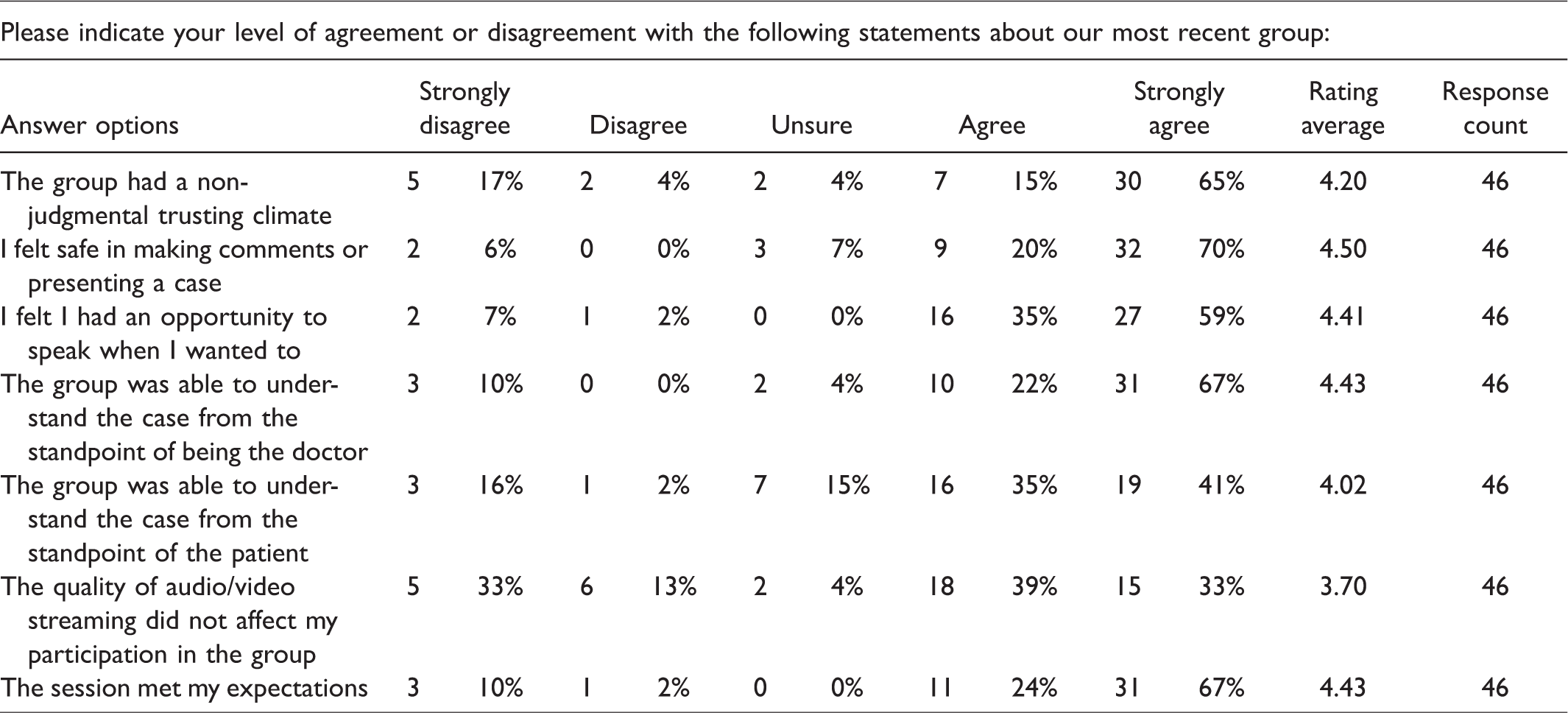
Seven individual group session surveys were administered following each group session between August 2015 and June 2016. Several months were skipped due to either the group not meeting or low attendance. There were 46 total responses, with the number of participants responding ranging from three to nine for any given month with a mean of 6.57 respondents per group meeting.
Table 1 shows responses from group members to individual items across the seven administered surveys. Group members rated agreement over 50% for each item, with the highest ratings being for the “session met my expectations” and lowest for “audio-video streaming.”
Individual session survey response summary.
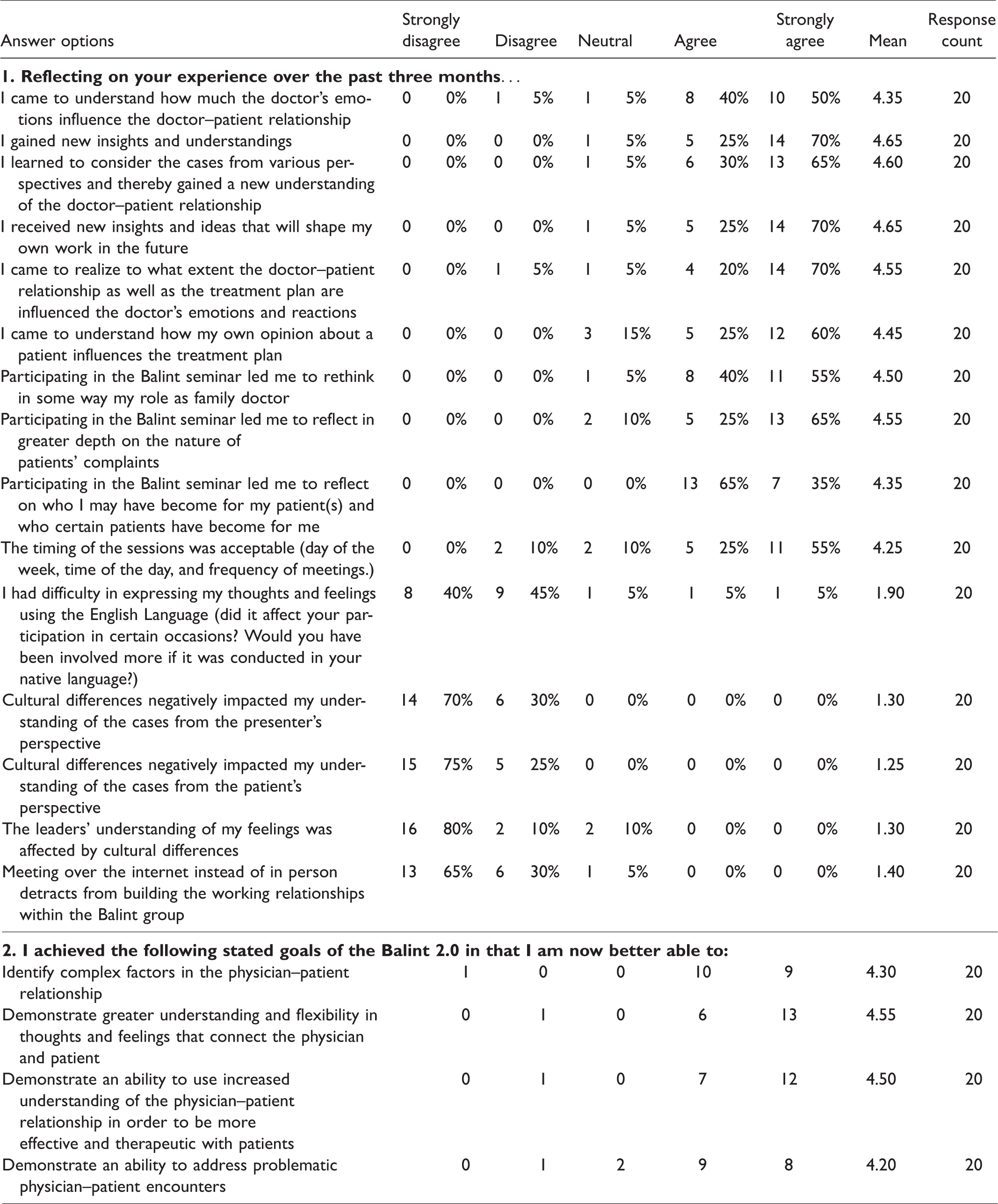
Three quarterly surveys were administered between August 2015 and June 2016. There were 20 total responses across the three surveys, ranging from six to seven participants responding with a mean of 6.67 respondents per quarterly survey.
Table 2 shows responses from group members to individual items across the three quarterly surveys. Here again, group members responded positively to items reflecting their overall experience over the previous three months. Especially notable were the responses to question 2 on the quarterly survey. Ninety-five percent rated agreement that they were more able to “identify complex factors in the physician–patient relationship,” “show greater understanding and flexibility in thoughts and feelings that connect the physician and patient,” and “use increased understanding of the physician–patient relationship in order to be more effective and therapeutic with patients.”
Quarterly survey response summary.
Individual written comments validated the positive response ratings but also commented on the multicultural aspects and a wish that the experience could be available to more: It is a unique experience every time. It has changed in many ways the way I act as a physician and it helps a lot that it is a multicultural setting since we live in a multicultural environment. I would strongly suggest it to all of my colleagues. I strongly recommend it to all General Practitioners, we live in a multi-cultural society and a tool like this is more important than ever.
Discussion
This paper reports on the initial experience of the Balint 2.0 pilot collaboration between the WONCA YDMs and the IBF. When considering both the evaluation of individual group sessions and the quarterly progress, the response data are uniformly positive. These responses are confirmed by the written comments. Additional validation has come in the fact that the group has continued to meet monthly well beyond the initial agreed period, and there is interest for the development of more groups for YDM members.
Important lessons were learned during the pilot that should be helpful for others wishing to convene a similar internet-based Balint group. First, the platform is extremely important and should be tested thoroughly with all group members and leaders. Second, while all the typical group rules for Balint groups apply, additional parameters should be discussed to ensure confidentiality and group cohesion. As we learned, having group members join in a setting where privacy and freedom from distraction was possible seemed important. In our case, group cohesion was facilitated by the fact that our members are active participants in the YDM Facebook group and had developed relationships through that social media platform and WONCA and YDM conferences, which seemed to benefit the Balint process. Additional group development time might be required for an internet group without prior knowledge of or relationships with one another. This bears further observation as more groups convene over the internet.
There is keen interest on both the part of the WONCA YDM leadership and IBF leadership to further this partnership, and spawn additional Balint 2.0 groups. Logistics remain to be worked out, including ways to fund the platform use and provide some compensation for the leaders’ time; however, we anticipate these questions will be solved soon.
In conclusion, we have found our Balint 2.0 pilot to be quite successful and beneficial for both the group members and leaders. This demonstrates the robustness of the Balint process to cross boundaries of distance and culture via the internet. We look forward to continued development of this work in years to come.
Footnotes
Authors’ Note
Portions of this work have been presented at the 19th International Balint Congress, Metz, France, September 5–9, 2015 and American Balint Society 2nd National Meeting, Oak Brook, IL, July 21–24, 2016.
Acknowledgments
The authors would like to acknowledge the ongoing WONCA YDM participants in the Balint 2.0 pilot work: Maria Bakola, Greece; Shakera Carroll – Bahamas; Maria Colon, USA; Vasiliki Garmiri, Greece; Marinela Hertzug, Greece; Bhavna Matta, Pakistan; Nagwa Nashat, Egypt; Maha Obedoza, Philippines; Ana Rochadel, Brazil; and Kenneth Yakubu, Nigeria.
Declaration of conflicting interests
The author(s) declared no potential conflicts of interest with respect to the research, authorship, and/or publication of this article.
Funding
The author(s) received no financial support for the research, authorship, and/or publication of this article.