







Abstract
Studies of leadership have identified several key traits and skills among successful leaders, including honesty, emotional intelligence, setting a vision, effective communication, and interest in providing feedback and developing others. These attributes, in addition to specific knowledge and skills related to health care systems, medical education, and effective team dynamics can propel behavioral scientists to success in graduate medical education. Whether or not it was labeled directly as leadership development, many behavioral scientists have had specific training in these core competencies, creating a potential for them to excel in leadership positions. We outline strategies for behavioral scientists to identify their leadership strengths, areas for growth, and pathways to seek opportunities for leadership within their programs or other avenues in medical education.
Introduction
“True leadership lies in guiding others to success. In ensuring that everyone is performing at their best, doing the work they are pledged to do and doing it well.” —Bill Owens “I define a leader as anyone who takes responsibility for finding the potential in people and processes, and who has the courage to develop that potential.” – Brene Brown
As reflected in the above quotes, definitions of leaders highlight their important functions: someone who guides, influences, and develops other people. A leader is someone who “selects, equips, trains, and influences one or more followers who have diverse gifts, skills, and abilities and focuses [them] to the organization’s mission.” 1 Similarly, leadership itself has been defined as “a process of social influence which maximizes the efforts of others towards the achievement of a goal.” 2
Kotter (1990) differentiates leadership from management by noting the latter focuses on order and consistency through planning, problem solving, and organizing, whereas the former is focused on establishing direction and aligning and empowering people to produce change. 3 In other words: “Managers manage things. Leaders lead people.” 2
A related role, facilitator, is a person who helps others on their team reach a goal. Though usually in advisory rather than formal leadership roles, these individuals nonetheless are seen as “agents of change” and possess commonly desired attributes of good leaders: authenticity, strong communication skills, the ability to move things forward, and emotional intelligence. 4 A facilitator role may be seen as balancing the ability to organize and direct things (manager) with supporting the achievement of people (leader).
Some aspects of leadership may be emphasized depending on the field in which the person is involved. For example, in healthcare organizations “caring” is more likely to be valued than in other environments. In academic organizations, “intelligence” often receives higher priority.5,6 However, there are core functions of leaders that transcend profession, culture, and time, including the ability to create a vision for others and to identify and grow the potential of the individuals surrounding them. 6 Additionally, across decades of research on leadership traits using the Characteristics of Admired Leaders (CAL) survey, four qualities have consistently been identified as those most admired in a leader. When asked to consider the qualities “that you would most look for and admire in a leader, someone whose direction you would willingly follow,” the majority of respondents reliably indicate they value leaders who they believe are “honest,” “competent,” “inspiring” and “forward looking”. Honesty has consistently been ranked as the most important characteristic. 5
Professionals intersect with the concept of leadership in different ways. A few moments of reflection about leadership characteristics and how they may be applied can highlight the ways in which they resonate individually and fit (or don’t fit) with one’s professional identity.
Behavioral science and leadership
Behavioral science principles are important for effective leadership, and yet relatively few behavioral scientists serve in leadership positions (such as assistant program directors, vice-chairs, or executive level dean roles) to influence family medicine education. More commonly, their spheres of influence lie in education (e.g., clinical supervision of psychology or counseling trainees, behavioral science or wellness curriculum for family medicine residents), clinical service, research committees, or committees in professional organizations. 7 When behavioral scientists (and other leaders in academic medicine) fail to appreciate their knowledge and skills this potentially deprives the discipline of many effective leaders.
Smith (2015) notes that “fundamentally, academic medicine is a human enterprise” (p. 228). 8 Further, transformational leadership, the type of leadership that inspires people to develop their potential in the service of a bigger mission, draws upon the meta-cognition and expertise in human behavior cultivated in behavioral science training. Effective graduate medical education leaders can create a culture of collaboration, embrace innovation, adhere to ethical principles, and promote self-care and care of others. 9 Leadership competencies parallel those laid out in the professional standards for social work and psychology in primary care settings. Professional organizations in both fields highlight the need for those working in academic medicine to understand systems, communicate effectively, advocate for changes when needed, and lead the way for trainees.10,11 Thus, many basic leadership skills likely have been developed through courses and practical experience in human behavior, systems, ethics, methods of evaluation, cultural awareness, research, communication and counseling skills, etc. Behavioral science training provides a solid foundation for leadership skills and can be enhanced through additional training.
Developing leadership skills and creating a pathway to leadership
A core tenet of Kouzes and Posner’s work is that leadership skills can be learned, “Leaders are made, not born.” A leadership title is not required to be a leader in an organization. Emerging leaders can enhance certain skills and abilities that will enable them to be more effective in leadership roles. As part of developing the CAL survey, they asked leaders to reflect on the question, “What do you do as a leader when you're performing at your personal best?” This is a good question for all faculty to ponder. Those who want to continue to enhance their leadership skills can learn from this introspection. Based on interviews and written responses from over 75,000 individuals to the “personal best” question, Kouzes and Posner distilled five themes of leadership behaviors and actions that provide an “operating system” for what people are doing as leaders when they are at their best. The five practices are “Model the Way,” “Inspire a Shared Vision,” “Challenge the Process,” “Enable Others to Act,” and “Encourage the Heart.” Their research has demonstrated that leaders who use the five practices more frequently are more effective than those who use them less frequently.
Model the way
When leaders “model the way,” they model the behavior and standards that they expect from others. This means consistent follow through on commitments and setting a personal example of what one expects. This also includes having a clear philosophy per leadership. “To effectively model the way, you first must be clear about your guiding principles. You must clarify values by finding your voice. When you understand who you are and the values you hold dear, then you can speak authentically about the beliefs that you want to guide your decisions and actions” 5 (p. 5). Exemplary leaders recognize the critical role of shared values within an organization and align their behavior and actions with those shared values.
A core element in the training of behavioral scientists is interpersonal reflection. They are trained to examine their own values, biases, and motivations as well as to consider the impact of their actions on others. Clinically focused behavioral scientists model acceptance and a non-judgmental stance when in patient care, and they can carry this into other domains of work as well. Modeling consistency and dependability helps build credibility which is crucial to being an effective leader.
Inspire a shared vision
Exemplary leaders have a vision of what the future can be for an organization and engage others collaboratively in this vision with a focus on shared ideals and aspirations. “When you truly understand and take to heart the hopes and dreams of those you are involved with, you can breathe life into the aspirations of others. You are able to forge a unity of purpose by explaining and showing how and why the dream is for the common good” 5 (p. 7).
Behavioral scientists are trained in communication skills with a strong focus on reflective listening. They can use these skills to communicate their vision while also soliciting input from others.
Challenge the process
Exemplary leaders engage in continuous quality improvement by looking for innovative ways to enhance the goals of the organization. They listen carefully to input from within the organization while they also seek innovation outside traditional structures. They think critically about why things are done in a certain way and embrace trying new approaches, evaluating the impact and asking what can be learned. “The best leaders are the best learners, treating every experiment, every innovation, and every mistake as an opportunity to develop and grow” 5 (p. 9).
Behavioral scientists are trained to reflect on process. They can capitalize on this skill by observing organizational dynamics. They are also trained in the scientific method, recognizing the importance of evaluating current knowledge, developing hypotheses, testing them, and using the results to develop insights and new ideas.
Enable others to act
Exemplary leaders recognize that success is achieved through teamwork. This entails encouraging the ideas of others and giving others a voice in decision making. This fosters collaboration, strengthens relationships, and builds trust. When others feel valued, they are more likely to give their all and exceed their own expectations. “Leaders strengthen others by increasing self-determination and developing competence and confidence. People don’t stick around for very long or perform at their best if their leader makes them feel weak, dependent, or alienated. People will give their all when you can strengthen their belief that they can do more than they ever thought possible” 5 (p. 10).
A significant part of the training of behavioral scientists is in understanding interpersonal dynamics and relationships. They can utilize their communication skills to solicit diverse points of view. Inherent in their clinical work are skills in facilitating self-efficacy and self-determination.
Encourage the heart
Exemplary leaders create an environment where contributions made by others are authentically noticed, appreciated, and celebrated. Celebrating shared accomplishments and victories enhances morale and builds a spirit of community. “Genuine acts of caring, whether exhibited in dramatic gestures or simple actions, uplift people’s spirits and keep them motivated. It is part of a leader’s job to recognize contributions by showing appreciation for individual excellence” 5 (p. 12).
This domain often is described as the most challenging for leaders, yet it is a domain where behavioral scientists, due to the nature of their training, are likely to excel. They are trained to observe the behavior of others and to give feedback in the context of a supportive relationship. They understand the critical role of positive reinforcement on future behavior.
Behavioral scientists can use this knowledge to enhance leadership skills and opportunities in a number of ways. One step is to assess their perceptions of their leadership behavior and to solicit feedback from others (360-degree method). Synthesizing this feedback can illuminate blind spots in their understanding of their leadership behaviors and identify skills that they need to develop further. The Leadership Practices Inventory (LPI) is a 30-item questionnaire based on Kouzes and Posner’s Five Practices of Exemplary Leadership where “observers” rate a leader on the frequency with which they engage in 30 leadership behaviors (e.g., “Treats people with dignity and respect,” “Follows through on promises and commitments,” “Sets a personal example of what is expected”). They recommend that the questionnaire be completed by 5-10 observers and that the leader also completes a self-assessment version of the LPI.
Behavioral scientists may also consider specific skills to further cultivate and resources that may benefit their development. Utilizing small groups, mentoring, and coaching are the most effective ways to engage in leadership development. 12 This is especially true for women and underrepresented minorities, who historically have had less access to leadership development opportunities and may have unique hurdles to overcome. A mentoring team should include coaches for specific performance questions, sponsors who can help promote one’s accomplishments and advocate for them, mentors to act as a sounding board, and peers who can provide feedback and support. 13
Sample leadership development programs in academic medicine. a
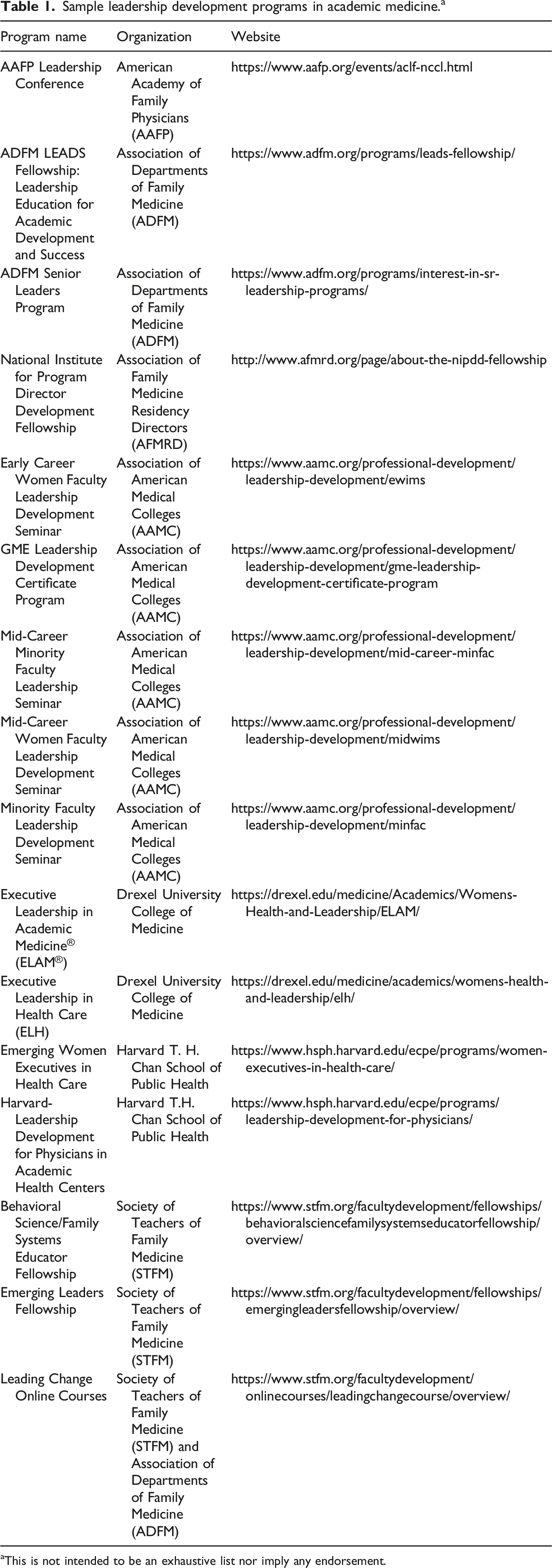
aThis is not intended to be an exhaustive list nor imply any endorsement.
Finally, behavioral scientists working in medical cultures may need to build comfort and skill in advocating for themselves. They need to make current leaders in their organizations aware that they are interested in being considered for leadership opportunities. While the historically physician-centric nature of medical systems is slowly changing, this perspective and implicit bias can lead to behavioral scientists being overlooked despite the skills that they bring to leadership. Aspiring behavioral scientist leaders need to let others know that not only do they have the skills, but also that they have the desire to “be in the room where it happens.”
Conclusion
Leadership can look different at various times, settings, and in response to organization or team needs. What will be more consistent is a focus on role modeling values, encouraging/inspiring others, positive communication, and systems thinking. In these facets of leadership, behavioral scientists can bring tremendous skills. The need for authentic, compassionate leaders is only growing through times of great change; they can serve their teams by embracing their leadership strengths.
Footnotes
Declaration of conflicting interests
The author(s) declared no potential conflicts of interest with respect to the research, authorship, and/or publication of this article.
Funding
The author(s) received no financial support for the research, authorship, and/or publication of this article.
