







Abstract
Objective
Burnout during residency education is a phenomenon which requires careful study. A single item for measuring burnout shows promise for its brevity and concordance with the most commonly used measure of burnout, the Maslach Burnout Inventory, but has not been compared to the Copenhagen Burnout Inventory. We compared the single-item measure of burnout question to the Copenhagen Burnout Inventory to assess the convergence between these two measures of burnout.
Method
Family Medicine residents (n = 32) from three residency programs completed the single-item measure of burnout question and the Copenhagen Burnout Inventory. We compared the single-item measure of burnout measure to the three scales of the Copenhagen Burnout Inventory.
Results
Our analyses indicated that the single item measure is highly correlated with personal burnout (r = .76), moderately correlated with patient burnout (r = .58), and not correlated with work burnout (r = .18).
Conclusions
Because the single-item measure of burnout is particularly useful for identifying personal burnout, it may help to identify early signs of burnout amount physicians in training.
Introduction
Burnout continues to plague medical professionals at alarming rates. Burnout is prevalent across levels of training from residency to practice.11,2 Burnout during residency education may be of particular concern because of its impact on habits and well-being of physicians early in their careers. 3
We face multiple challenges in measuring burnout. One of the most frequently used measures of burnout is the Maslach Burnout Inventory (MBI), which measures three symptoms of burnout: emotional exhaustion, depersonalization and sense of personal accomplishment. As a proprietary questionnaire, licensing fees could make it a less feasible measurement option, especially for assessing effectiveness of interventions.4,5 Further, medical learners experience survey fatigue, 6 particularly when presented with lengthy questionnaires. Efficient measurement of burnout is essential to monitor programmatic efforts to improve well-being while respecting the time each assessment might require. Findings indicate that a single-item measure of burnout is strongly correlated with the MBI Emotional Exhaustion subscale,4 4 with a correlation of .79. The single item measure of burnout shows similar correlations with depressive symptoms (r = .59), distress (r = .70) and intent to leave one’s practice (r = .21) 7 as the Emotional Exhaustion subscale of the MBI.
There are no studies in the existing literature that have compared the single item measure to the Copenhagen Burnout Inventory (CBI). The nineteen-item CBI represents a useful divergence from the Maslach Burnout Inventory, measuring three separate factors of burnout: personal, work and patient. The CBI has the advantage of being non-proprietary, readily allows for comparison to non-health care workers and has been validated internationally.8 8
We assessed associations between the single-item measure of burnout and the three scales of the CBI.
Methods
Participants
Thirty-seven individuals from 3 separate Family Medicine residency programs agreed to participate in data collection. This cross-sectional analysis is part of a longitudinal study of resident well-being and stress. We did not collect demographic information from participants to maintain privacy; in many cases demographic information could have created identifiable data. Seventy three percent of the 45 Family Medicine residents in the Kalamazoo and Battle Creek programs participated in the study. Twenty four percent of the 21 Family Medicine residents in the Terre Haute program participated. Some participants did not complete all of the questionnaires, resulting in final analyses with thirty-two observations.
Procedures
The study was approved by the IRB at Western Michigan Homer Stryker MD School of Medicine in July of 2022. Our programs make time during didactics for residents to complete questionnaires annually, in late July and early August. Each resident receives an e-mail invitation to participate, including informed consent and questionnaires which take approximately 25 minutes to complete. For this study, we were most interested in single-item measure of burnout assessment and the CBI (see below).
Measures
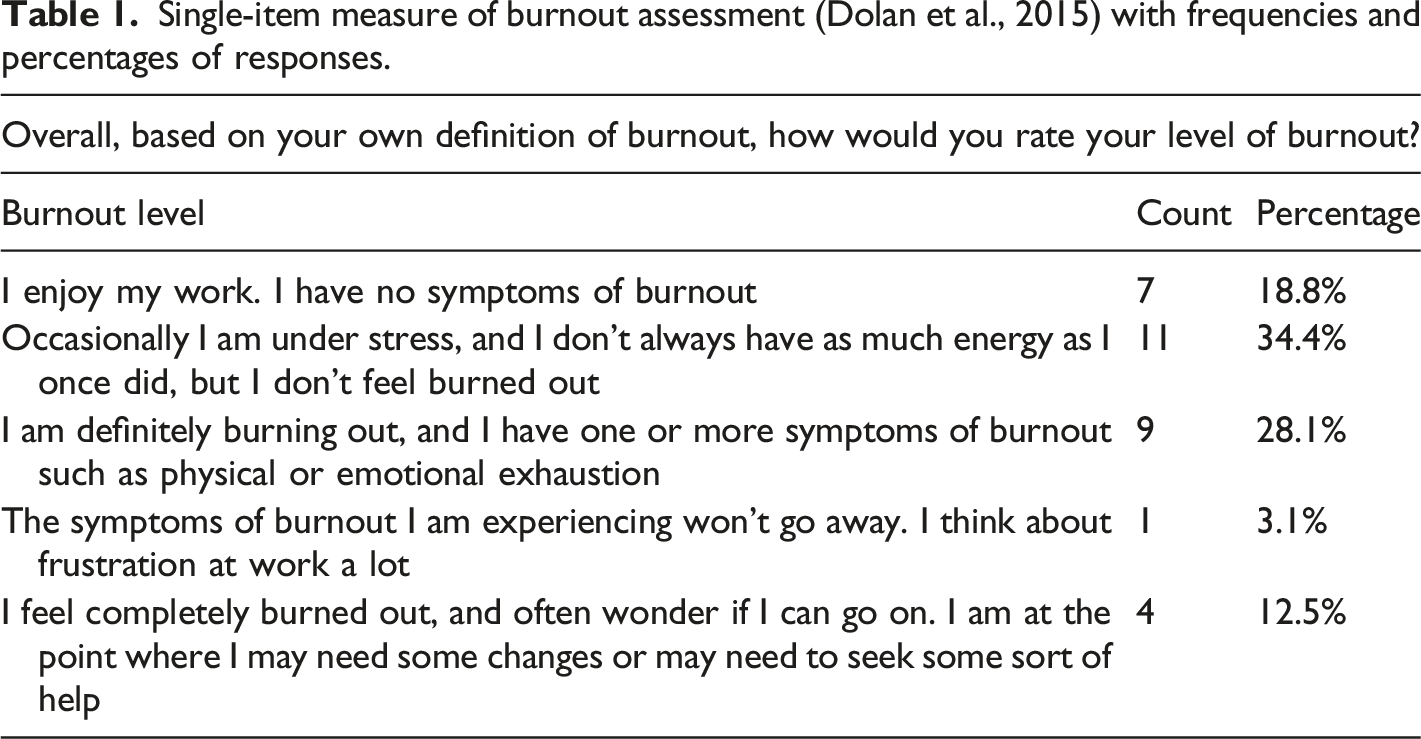
Single-item measure of burnout assessment (Dolan et al., 2015) with frequencies and percentages of responses.
Copenhagen Burnout Inventory. 8 The Copenhagen Burnout Inventory (CBI) is a questionnaire developed to measure different dimensions of professional burnout. Domains include personal burnout, work related burnout and patient related burnout. Personal burnout (6 items) includes items such as, “How often do you feel tired?” Work burnout (7 items) includes items such as, “Do you feel burned out because of your work?” Patient burnout (6 items) includes items such as, “Do you feel that you give more than you get back when you work with patients?” Each question includes a five-point Likert-type scale. Response options and wording vary based on item content (i.e., “always, often, sometimes, seldom, never” vs. “to a very high degree, to a high degree, somewhat, to a low degree, to a very low degree”). Each item is scored 0, 25, 50, 75 or 100 and scores across items are averaged for each subscale.
Pearson correlations were calculated between burnout scores using SAS v9.4. The CBI means, standard deviations and 95% confidence intervals were also calculated.
Results
Our results indicated that single-item measure of burnout scores were distributed across the full possible range for 32 residents who completed the single item. More than two in five residents were experiencing signs of burnout, and four of 32 residents, or 10.8%, reported experiencing significant burnout (see Table 1).
Copenhagen burnout inventory descriptive statistics.
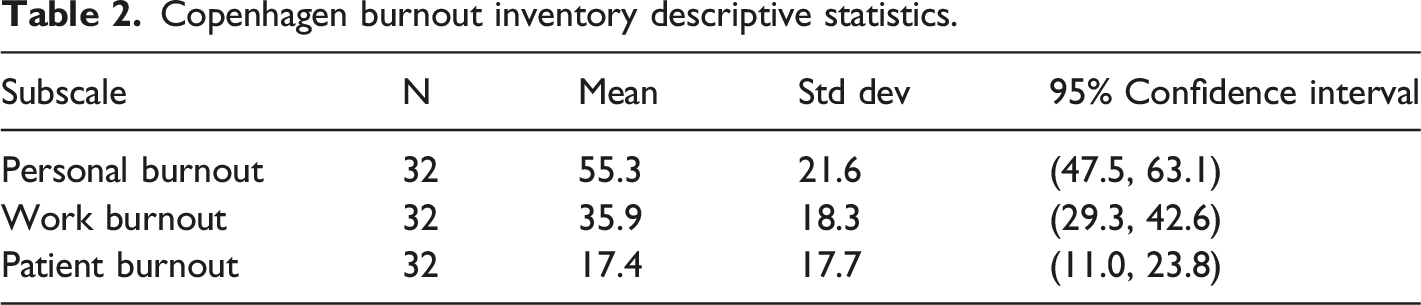
The single item measure of burnout was significantly correlated with two of the three scales on the CBI. The single-item measure of burnout was strongly correlated with personal burnout (r = .76; p < .01; n = 32) and was moderately correlated with patient burnout (r = .58; p < .01; n = 32). The single item measure of burnout was not statistically significantly correlated with work burnout (r = .18; p = .31; n = 32).
Discussion
For our purposes, single-item measure of burnout is capturing burnout effectively. The strong association with personal burnout from the CBI increases the single item’s utility as an indicator of distress. The moderate association with patient burnout from the CBI bolsters its utility as an indicator of concern for patient care. It is not clear why work burnout was not associated with the single-item measure of burnout.
With only 48 percent of the residents in three residency programs participating in this study, our findings may not be generalizable to other programs, and could be vulnerable to selection bias. As we collect longitudinal data, we hope to better understand changes in burnout over time and to better understand whether a single item could prove as effective as a longer questionnaire such as the CBI for understanding longitudinal variability in burnout. Further research will be needed to better understand factors associated with the separate scales of the CBI that could account for differences in strength of association with the single item measure of burnout.
The present study adds to the body of evidence that single-item measure of burnout is strongly associated with longer measures, including elements of the CBI. As such single-item measure of burnout should be effective for identifying personal burnout. Because of its brevity and utility, this single item measure could be used in serial measurement of burnout over time. This could allow for better understanding of the impact of specific rotations, changes in curriculum, and evaluation of efforts to address burnout within residency programs as an aggregate measure across residents at a specific site.
Footnotes
Declaration of Conflicting Interests
The author(s) declared no potential conflicts of interest with respect to the research, authorship, and/or publication of this article.
Funding
The author(s) received no financial support for the research, authorship, and/or publication of this article.
