







Abstract
Objective
This mixed methods study examined depictions of spirituality among people with psychosis in influential television programming. Spirituality is a central strength for many people with psychosis. Yet, despite the important role media plays in shaping perceptions, little research has examined the intersection between spirituality and psychosis in the popular media.
Methods
To address this gap, we conducted a content analysis of the 50 most viewed primetime fictional television shows over a 10-year period as determined by the Nielsen rating organization. Characters with psychosis were identified via keyword searches of online sources (Wikis, IMDb, etc.) and subsequently independently coded by two individuals. Characters were rated on 18 items in three domains related to demographics, life status, and character framing. Inter-rater reliability ranged from good to excellent across variables.
Results
Of 120 identified characters with psychosis, just 16% (n = 19) had a spiritual identity. Analysis revealed few differences between spiritual and secular characters on demographic and life status variables. Conversely, an examination of framing variables revealed spiritual characters were comparatively less attractive, exhibited a greater negative impact on society, and were more likely to be referred to pejoratively (as a psychopath) and engage in criminal activity. Trend analysis indicated portrayals of spiritual characters decreased over time.
Conclusions
The results suggest media depictions of spirituality contribute to the stigmatization of spirituality among people with psychosis, potentially preventing access to important coping resources and discouraging professional help-seeking. Primary care physicians should consider incorporating a spiritual assessment into care to determine spiritual coping assets and then support these.
Keywords
Introduction
People living with psychosis in contemporary western societies contend with many challenges stemming from their symptoms, which can include hallucinations, delusions, and a distorted view of reality. 1 Primary care physicians are often the first point of contact for individuals struggling with these challenges. 2 Consequently, physicians play an instrumental role helping people with psychosis receive care that positions patients to lead productive, successful lives. One common coping resource that helps people move in this direction is spirituality.3,4
How people with psychosis are framed in media plays an important role in shaping public perceptions.5,6 While many content analyses have examined media representations of mental illness (MI), few studies have investigated representations of psychosis. 7 Furthermore, we are unaware of any studies examining the intersection of spirituality and psychosis, despite the importance of spirituality to many people with psychosis. 4
To address this knowledge gap, this study investigates depictions of spirituality among people with psychosis in primetime fictional television programming, perhaps the most influential form of media. The following section reviews relevant theory and research, and concludes by articulating the study’s research questions.
Literature review
Theoretical framework
Framing theory provides the conceptual foundation for the study. 8 Developed by Goffman, 9 this theoretical framework posits that subjects can be “framed” from many different perspectives. The choice to emphasize certain facets of existence while minimizing or ignoring other facets transmits moral judgements about the subjects being portrayed. 10
The perspective selected to frame a particular entity tends to engender certain attitudes towards the subject matter. 11 Viewers are implicitly instructed how certain groups and issues should be understood through the selective presentation of social reality. For instance, depicting people as less attractive or engaging in socially undesirable behaviors such as criminal activity conveys subtle messages about a character’s appeal and desirability. 8
Cultivation theory posits that repeated exposure to selective representations leads viewers to adopt inaccurate views of the world. 12 Over time, common messages delivered through extensive media viewing shapes viewers’ perceptions of social reality. People tend to interact with individuals in their social networks in the same way they have seen others interact with similar individuals in media depictions. 13
Media representations can influence people’s attitudes and behaviors through both direct and indirect pathways. 13 In the former case, attitudes are shaped directly through repeated exposure to media messages. In the latter case, attitudes are informed indirectly through social networks. People adopt views and behaviors on subjects through social interaction with others in their environment.
Existing research
To understand representations of MI, scholars have conducted content analyses of various media. Included among these are investigations of Australian 14 and Canadian news coverage, 15 children’s programing on Netflix 16 and television shows in New Zealand. 17 Similarly, depictions have been examined in popular films, 18 Bollywood movies, 19 video games, 20 and rap music. 21 Studies have also explored portrayals on American primetime television 22 and crime dramas. 8
These studies have typically found that MI is associated with characteristics that carry negative connotations. For instance, a study of American primetime crime dramas found that 42 percent of characters coded as mentally ill demonstrated poor hygiene or grooming. 8 Similarly, an examination of popular films revealed that characters with MI were significantly underrepresented, essentially de-legitimizing members of this population by their invisibility. 18
A few studies have focused on characters with psychosis. Examining representations of psychosis is important because psychotic symptoms may lend themselves to especially negative framing. 20 In turn, this framing may potentially accentuate the stigma people with psychosis experience.6,23,24
Portrayals of psychosis have been examined in movies, 25 horror films, 26 and news reports in Australia. 7 Consistent with the above studies on MI, this limited body of research has documented uncomplimentary portrayals. For instance, one study found that 83 percent of movie characters with schizophrenia displayed dangerous or violent behaviors directed towards others. 25
Significantly, none of the above research has examined depictions of psychosis on primetime television programing. Television viewing continues to be the dominant form of media consumption in the United States. 27 According to the Nielsen Company, the typical American adult spends almost four hours each day watching television. 27 Cultivation theory suggests widely viewed popular television programming plays a disproportionate role in shaping perceptions about psychosis.
Also neglected in prior analyses is the relationship between spirituality and psychosis. A large body of research links spirituality with mental health and wellness. 28 Spirituality frequently plays an important role in coping with, and recovery from, serious mental illness,29,30 including psychosis.3,4
For instance, among a sample of 364 Singaporean outpatients diagnosed with psychosis-related disorders, approximately 70 percent reported spirituality played an important role in coping with their illness. 31 A review of facilitators of recovery from psychosis identified two distinct functions regarding spirituality. 4 Specifically, spirituality provides a method for making sense or meaning of psychosis and it serves as source of comfort and support.
Importance of the present study
Despite the significance of spirituality to people with psychosis, we are unaware of any research examining the intersection of spirituality and psychosis in television programing. Consequently, we do not know how often characters with psychosis are depicted with spiritual identities, or if spiritual characters are depicted differently relative to secular characters. Similarly, it is unknown if the visibility of spiritual characters is changing over time.
The lack of research holds particular significance for primary care physicians. When individuals have an initial episode of psychosis, primary care physicians are frequently their first point of contact with a helping professional. 2 Research indicates many patients, including those with psychosis, want to discuss spirituality with their physicians.3,32 Doctors, however, are frequently hesitant to broach the topic. 33 Accordingly, studies investigating media representations are of critical importance as television messages may shape understandings of spirituality among people with psychosis, physicians, and key actors in their respective social networks.
This study adds to the limited media research on psychosis by conducting the first examination of spirituality among characters with psychosis in popular media. More specifically, we investigated depictions in the 50 most watched primetime fictional television shows over a 10-year time period. The study sought to answer three key questions: 1. What percentage of characters with psychosis are depicted as people with a spiritual identity or orientation? 2. Are spiritual characters with psychosis depicted differently compared to secular characters in terms of their demographics, life status, and framing? 3. Is the visibility of spiritual characters with psychosis increasing or decreasing over time?
Methods
Program selection
To identify programs that featured characters with psychosis, several search strategies were used. Consistent with prior related research, searches were conducted of online wikis, IMDb, TVguide.com and other sources using the keywords “psychosis”, “schizophrenia” “hallucinations” and “delusions”15,18,19 To be included in the study, potential characters had to be featured in the top 50 most watched shows on primetime for each season from 2011-2021 as determined by the Nielsen rating organization. 27
Characters appearing in programs outside the top 50 in a given year were excluded from the study to focus on those characters with the greatest reach and potential influence on audiences. 18 Characters in sports and news programming were also omitted. 8 Potentially relevant episodes that met the inclusion criteria were obtained and reviewed in their entirety.
Unit of analysis
The unit of analysis in this study was within-episode focal characters who either: (1) believed they had hallucinations or delusions, or (2) were reported as having hallucinations or delusions by another character. 17 Other manifestations of MI were excluded from the study. Thus, anxiety, mood, and other disorders fell outside the parameters of the study.
In keeping with prior related research, focal characters had to appear on screen for at least 10 seconds. 8 For characters that appeared in multiple episodes, up to three episodes in a season were viewed after the first identified appearance. If more than three episodes in a program included focal characters, three episodes were randomly selected for analysis, excluding the first and last episode of a season, which are often atypical in nature. 34 The application of these procedures produced 120 focal characters who appeared in 101 episodes. These characters were then analyzed using the following mixed methods approach.
Qualitative analysis
Based upon a postpositivist epistemological understanding, we performed an interpretive content analysis. 35 A basic content analysis focuses on the explicit or manifest meaning, while an interpretive content analysis moves beyond literal coding by incorporating an inductive frame. Accordingly, coders were sensitive to non-verbal behaviors, visual and aural cues, and other forms of latent and manifest communication in the coding process.
Two coders, both with experience recognizing the signs and symptoms of psychosis, were trained in the study protocols by a doctoral faculty member with extensive experience conducting content analyses. Coders were trained using characters with psychosis symptoms in shows outside the 50 most highly rated programs. 8 During the training phase, both coders watched one episode of a program together, coded independently, then discussed their codes to compare results and revise the coding instrument as needed. All individuals involved in the research are aware of the stigma people with psychosis encounter in society and were committed to analyzing characters in an unbiased and responsible manner. After finalizing the coding protocol, the coders independently analyzed the identified episodes.
Subsequently, 20 percent of the sample was analyzed by both coders to determine reliability. 36 To assess inter-rater reliability, Intraclass Correlation Coefficients (ICC) were calculated. Values ranged from .76 to 1.00 with the majority falling in the range of .90 to 1.00. Thus, reliability ranged from “good” to “excellent” across all variables.37,38
In addition to their metaphysical orientation, characters with psychosis were rated across 17 items in three domains (see table). The domains (and associated items) pertained to demographics (age, gender, race/ethnicity), life-status (employed, a parent, married, veteran, homeless, and hospitalized), and character framing (attractiveness, impact on society, villain, victim, hero, comedic relief, called psychopath, and criminal activity).
Regarding their metaphysical orientation, characters were designated as spiritual (or secular) based upon either their words or their actions. 18 More specifically, individuals were coded as spiritual if they made one or more verbal references to a higher or supernatural power, or if they were shown engaging in a spiritual practice such as actively attending a religious service, meditating, praying, or reading tarot cards. Accordingly, spirituality was understood broadly, as encompassing both traditional and alternative manifestations of an individual’s relationship with the transcendent regardless of whether it was expressed inside or outside a religious context. Characters were classified as secular if their words and actions indicated no interest in spirituality or religion.
Demographic characteristics were coded as follows: age (youth and young adult <30, adult and older adult >30), gender (female, male), and race/ethnicity (European American, BIPOC). All life status variables noted above were coded dichotomously (yes, no). 39
In terms of character framing, a character’s attractiveness and impact/effect on society was assessed using a 7-point scale (e.g., −3 = very unattractive, 3 = very attractive), in which zero denoted the assumed population mean for all characters. 22 The values were subsequently recoded, 0 to 7, with higher numbers indicating greater levels of, respectively, attractiveness and positive impact on society. All other traits in the character framing domain were assessed with a dichotomous response key (yes, no) in preparation for the quantitative analysis. 8
Quantitative analysis
The qualitative codes were stored in Excel and then transferred to the Statistical Package for the Social Sciences (v. 28) for the quantitative analyses. To answer the first research question, descriptive statistics were used to determine the percentage of characters with psychosis depicted as either secular or spiritual. To answer the second research question, the chi-square and independent samples t test procedures were used to examine differences in the demographic, life-status, and character framing variables. To ascertain if the visibility of spiritual characters changed over the ten-year period—the third research question—a trend analysis was performed using logistic regression.
Results
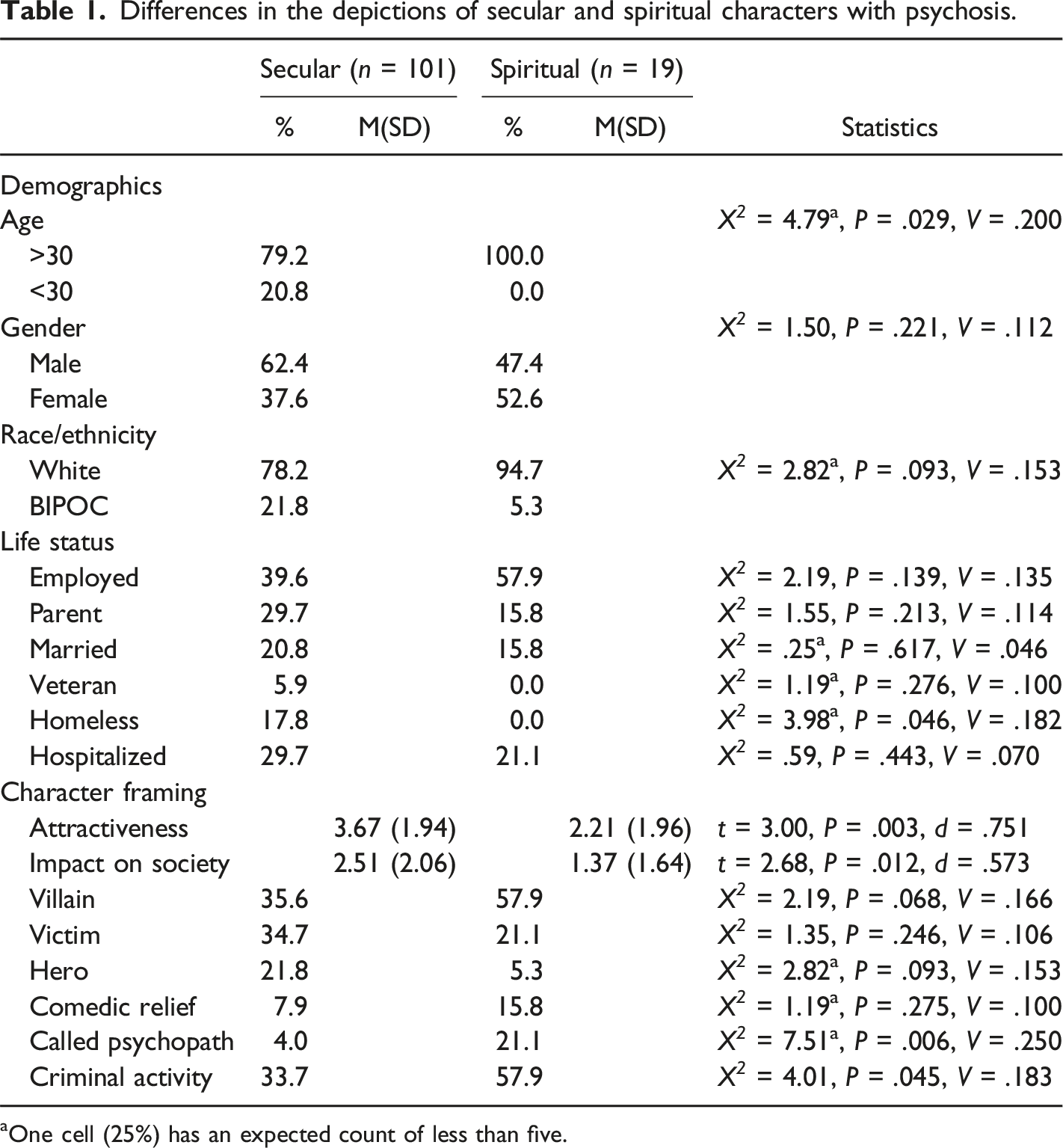
Differences in the depictions of secular and spiritual characters with psychosis.
aOne cell (25%) has an expected count of less than five.
The table features the results to the second research question pertaining to differences between the two groups regarding their demographics, life-status, and character framing. In addition to descriptive data, the table features the results of the appropriate statistical procedure with associated significance (i.e., P values) and effect size statistics (i.e., Cramer’s V and Cohen’s d).
Of the three demographic traits examined—age, gender, and race/ethnicity—only age was significant. One hundred percent of spiritual characters were over 30 compared to 79 percent of the secular characters.
Regarding the six life status variables examined, only one was significant. No spiritual characters were portrayed as homeless in contrast to 18 percent of the secular individuals. Spiritual and secular characters were equally likely to be depicted as employed, a parent, married, a veteran, and hospitalized.
A different pattern of relationships emerged regarding the eight framing variables. Spiritual characters were framed as significantly less attractive (M = 2.21, SD = 1.96) than secular characters (M = 3.67, SD = 1.94) and their impact on society was significantly more negative (M = 1.37, SD = 1.64) than secular characters (M = 2.51, SD = 2.06). Spiritual characters were also significantly more likely to be referred to in a derisive manner (i.e., called a psychopath, 21% vs 4%) and engage in criminal activity relative to secular characters (58% vs 34%). Using a nontraditional P value (<.10), spiritual characters were more likely to be shown as villains (58% vs 36%) and less likely to be framed as heroes (5.3% vs 22%) than secular individuals. Conversely, spiritual and secular characters were equally likely to be victims and used as comedic relief.
As can be seen in the table, most effect sizes were small (<.2). However, two variables (i.e., impact on society, and called a psychopath) exhibited moderate effects (<.6), and one (i.e., attractiveness) exhibited a large effect (>.6). 40
To answer the third research question, we conducted logistic regression using the dichotomous metaphysical variable (spiritual, secular) and the continuous variable year. 41 The model was significant (χ2 (1) = 10.10, P = .001). The odds ratio of .702 (95% CI = .549–.897) indicates the percentage decrease in the average annual portrayal of spiritual characters over the study’s 10-year timeframe. In other words, the depiction of spiritual characters decreased significantly over the examined decade.
Discussion
Theory and prior research suggest popular media contributes to shaping perceptions of MI including, perhaps particularly, psychosis.5,20 Spirituality frequently plays a central role in the lives of people with psychosis, facilitating both coping and recovery. 4 Numerous studies have examined depictions of MI in various influential media, but few have focused on psychosis; and none have investigated portrayals of spirituality among members of this population. To address this gap, this study investigated depictions of spirituality among people with psychosis. Portrayals were examined in three domains—demographics, life status, and character framing—in the 50 most viewed primetime fictional television shows over a 10-year period.
The results reveal just 16 percent of characters were depicted with any type of spiritual orientation. Put differently, spiritual individuals were substantially underrepresented relative to the larger population of people with psychosis. 31 Few significant differences emerged between spiritual and secular characters across both the demographic and life status domains. In other words, the general demographic and life status variables—such as being employed, a parent, married, or a veteran—were roughly similar among both spiritual and secular characters.
A substantially different picture appeared regarding the variables that comprise the key character framing domain. Spiritual characters were shown in a much less favorable light compared to their secular counterparts.
Spiritual people were framed as less attractive and their effect on society was more negative. They were more likely to be referred to pejoratively and to be shown engaging in criminal activity. Spiritual characters were also more likely to be depicted as villains and less likely to be framed as heroes than secular characters using a nontraditional level of significance (P<.10). Notably, all the variables in the character framing domain exhibited a trend toward more unfavorable portrayals of spiritual characters.
Finally, a trend analysis indicated decreasing representation of spiritual characters over the study’s 10-year timeframe. In other words, the small percentage of spiritual characters identified in this study decreased over the decade of programing examined.
Although this is the first study to examine portrayals of spirituality among people with psychosis, this analysis does have points of congruence with prior research. Riles and colleagues 18 investigated characterizations of MI in 30 years of popular films. These authors found 28 percent of identified characters with MI embraced spiritual activities related to belief in a deity or deities, a percentage somewhat higher than the 16 percent identified in our study. Compared to characters without MI, spiritual characters with MI were overrepresented, with MI being disproportionally associated with an array of negative traits, such as verbal and physical aggression.
Analysis of spirituality on television programing is rare. However, the results are consistent with prior research indicating portrayals of spiritual characters are infrequent.42,43 In the few instances where spiritual characters are featured, they are often presented unfavorably. 44 Taken together, these findings have important implications.
Implications
How MI is framed in media can have a significant effect on people’s perceptions, both positively and negatively.5,6 Characterizations may be particularly relevant for people with psychosis. Psychosis is often more frequently and intensely stigmatized relative to other manifestations of MI. 20 This suggests that media characterizations are particularly pertinent for members of this population. This is a significant concern as some research indicates approximately 40 percent of the United States population will have a psychotic experience during their lifetime, 45 an experience that can lead to a subsequent clinical diagnosis of psychosis. 46 Many people turn to their spirituality to deal with psychotic experiences in a productive manner. 4
Yet, the findings of this study indicate spiritual characters are seldom depicted, and when depicted, are framed in a disproportionately deleterious manner. This implicitly functions to delegitimize spirituality among people with psychosis. It also tends to invalidate spirituality among the broader population who interact with people with psychosis. In turn, this can engender adverse effects among people with psychosis, primary care physicians, and community members, as discussed in more depth below.
The negative depictions of spirituality in television programming may discourage people with psychosis who are already experiencing challenges tapping into their spiritual strengths. Many individuals rely upon spirituality to cope with psychosis. 31 Spiritual narratives provide a source of comfort and support, enhancing one’s sense of purpose, hope, and meaning in life in the face of often challenging circumstances. 4 Spirituality frequently plays a central role assisting people to live productively.
The symptoms associated with psychosis, however, can make accessing spiritual assets difficult. 47 In addition, people with psychosis may internalize the stereotypes and other negative messages conveyed through media regarding spirituality. 8 This dynamic may further deter people from maintaining their engagement in spiritual activities. As a result, spiritual assets that are instrumental to coping may not be fully operationalized.
Alternatively, those invested in their spirituality may avoid seeking assistance. 48 The negative depictions may engender the perception that health professionals view their spirituality unfavorably. As a result, spiritually committed individuals having psychotic experiences may eschew needed professional help. If potential patients believe a central aspect of their identity will be viewed unfavorably, they will be disinclined to engage in help-seeking.
Biased media depictions may also discourage primary care physicians and other providers from addressing spirituality in clinical work. As noted previously, many physicians are reluctant to discuss spirituality with patients. 33 Going back to at least Freud, many health professionals have conceptualized spirituality as a form of mental illness, a view that shaped earlier versions of the DSM. 49 The hypothesized link between spirituality and mental illness has been disproven by a substantial body of empirical research demonstrating spirituality is positively, rather than negatively, associated with mental and physical health. 28 Despite this evidence, some health professionals continue to advocate against addressing spirituality in service provision. 50
Adapting services to incorporate the spiritual needs of patients with psychosis is essential to coping and recovery, a process that starts with the administration of a spiritual assessment.47,51 Unfavorable media depictions of spirituality may incline primary care physicians to neglect, or even discourage, a key client resource. Given that media depictions of spirituality reflect deeply embedded stereotypes in mental health discourse—particularly in regard to psychosis—they may be especially salient in terms of shaping the views of primary care physicians and other providers.
It is important to reiterate that patients commonly want to discuss spirituality with their physicians 32 including patients with psychosis. 3 Among the general population, addressing spirituality in primary care has been linked to greater patient satisfaction, mental well-being, and quality of life.52,53 Administering a spiritual assessment positions primary care physicians with the information they need to assist patients draw upon spiritual coping resources. 3
The deleterious depictions of spirituality may also deprive people with psychosis of social support. One of the major factors in coping and recovery is a network of supportive individuals. 4 Family members, community colleagues, and other individuals provide invaluable sources of practical and emotional support. Biased portrayals of spirituality can have a detrimental effect on these social networks. 8 Programming that frames spirituality as harmful may cause individuals to discourage spirituality. Alternatively, others may be less supportive due to the perception that spirituality has a detrimental effect on people with psychosis, as well as people in their social environment. In either case, spiritual people with psychosis may experience less support from their social networks due to media portrayals that implicitly delegitimize spirituality.
This discussion implicitly highlights the importance of positive representations of spirituality in media. While negative depictions can have a detrimental effect on people’s attitudes and behaviors, 54 the converse is also true. 55 Positive media portrayals of spirituality may contribute to a more supportive environment for individuals with psychosis. This reality underscores the importance of advocating for more frequent and accurate representations of spiritualty in television and other influential media. In the interim, efforts to promote awareness among primary care physicians and other health professionals regarding the salutary role spirituality plays in the lives of people with psychosis should be encouraged.
Limitations and suggestions for future research
Our method of identifying focal characters relied upon explicit references provided in program summaries and synopses. Content creators may have developed some characters with subtler symptoms of psychosis. Accurately representing mental health conditions can be challenging and psychosis can manifest without hallucinations or delusions (e.g., disorganized thoughts or catatonic behaviors). Accordingly, it is possible we failed to identify all characters who were managing psychosis.
Concurrently, it is also important to note that our results likely reflect the experiences of viewers of fictional television programming. 18 The typical viewer is not diagnostically trained. Even trained health professionals may not be able to identify every instance of psychosis, especially when the symptoms are very subtle. Thus, our findings likely capture the most influential representations in the surveyed programming. This implicitly raises the issue of selection bias as representations may differ in programming outside the 50 most watched shows that served as the study’s data.
Due to the small number of identified spiritual characters, some assumptions for the chi-square procedure were not met. Specifically, the assumption that no more than 20 percent of cells should have an expected count of less than five was violated. In several cases, 25 percent of cells had an expected count less than five which, in turn, reduces test power. 56 On a related note, we used a nontraditional P value (<.10) in some analyses in light of the relatively small sample size and the consistent trend regarding more negative depictions of spiritual characters. In turn, the use of this P value increased the potential for Type I errors to occur.
Future research might explore portrayals in specific genres (e.g., television crime dramas), and in other media (e.g., social media, films, etc.). Researchers might employ experimental designs to investigate the effects of negative portrayals of spirituality on public perceptions. In addition, studies are needed that explore the reasons behind the pejorative representations of spirituality observed in this and other studies.
Conclusion
The personal and societal costs of psychosis are substantial. 57 Through operationalizing their spirituality, many people with psychosis can lead productive, successful lives. The results of the present study suggest that media portrayals of spirituality function to delegitimize spirituality as a valid option for members of this population.
Depictions of spirituality are rare, decreasing over time, and linked to several negative traits. These portrayals may adversely affect people with psychosis, as well as primary care physicians and community members who provide services and support to members of this population. More frequent and positive depictions of spirituality are needed in television programing to support this important source of strength in the lives of people with psychosis.
Footnotes
Author’s note
The manuscript does not contain clinical studies or patient data.
Author contributions
David R. Hodge conceptualized the study and was primarily responsible for writing the manuscript. Patricia R. Turner was primarily responsible for the data analysis and also contributed to the writing of the manuscript. Both authors read and approved the final manuscript.
Declaration of conflicting interests
The author(s) declared no potential conflicts of interest with respect to the research, authorship, and/or publication of this article.
Funding
The author(s) received no financial support for the research, authorship, and/or publication of this article.
