






Abstract
Objective
Chopra Wellbeing Index (CWI) was developed as a multidimensional measure of wellbeing, integrating physical, emotional, social, and spiritual domains consistent with contemporary models of human flourishing. The purpose of this study was to systematically evaluate the psychometric properties of this measure.
Methods
The psychometric properties of the CWI were assessed in 1637 participants (ages 18-83) who completed the CWI alongside established comparator measures of wellbeing, mental health, and quality of life. Exploratory factor analysis (EFA) and confirmatory factor analysis (CFA) were used to test the dimensionality of the instrument. Internal consistency was assessed using Cronbach’s alpha and McDonald’s omega. Criterion validity was assessed via correlations with validated scales. Measurement invariance testing was conducted with respect to several demographic dimensions to assess generalizability of the scale’s underlying factor structure.
Results
The 24-item CWI demonstrated strong internal consistency across subscales. Factor analyses supported a multidimensional structure with four correlated subscales: physical, psychological, social, and spiritual wellbeing. Evidence of criterion validity was found via positive correlations with wellbeing and life satisfaction measures along with negative correlations with measures of depression, anxiety, and negative emotions. Partial measurement invariance was supported with respect to gender, education, marital status, employment status, income, race/ethnicity, and country.
Conclusions
The Chopra Wellbeing Index is a reliable and valid tool for assessing multidimensional wellbeing in adults. Its integration of spiritual and existential domains alongside traditional health indicators distinguishes it from existing instruments, making it suitable for use in holistic health research, clinical practice, and population wellbeing monitoring.
Introduction
In recent years, there has been growing recognition that traditional models of health, anchored primarily in assessing symptom reduction and absence of disease, are insufficient frameworks for understanding complexity of human flourishing. Rather, contemporary flourishing frameworks conceptualize wellbeing as a positive, multidimensional state encompassing psychological, social, physical, and existential aspects of human life, consistent with the World Health Organization’s foundational definition of health being more than simply the absence of disease.1-3
Wellbeing has thus become increasingly understood as a multidimensional construct that cannot be reduced to the absence of detrimental psychiatric or physiological symptoms. While wellbeing and flourishing have traditionally been conceptualized in terms of positive feelings and positive functioning, recent work suggests that the measurement of these constructs remains conceptually diverse, with no single framework dominating the field.2-8
One such framework put forth by the Chopra foundation advances a consciousness-centered approach rooted in both empirical research and contemplative science that encompasses four interdependent domains, namely, Physical, Mental, Social, and Spiritual wellbeing, reflecting distinct yet interconnected dimensions of human flourishing. 9 This framework aligns with emerging evidence that psychological resilience, relational health, and existential meaning are biologically embodied and socially mediated.10-12 While broadly aligned with much of the extant literature on wellbeing and human flourishing, which consistently recognizes several aspects of physical, mental, and social health as crucial components of human wellbeing, this framework offers a novel perspective on explicitly recognizing spirituality as a distinct dimension of wellbeing.3,6,8
This recognition of spirituality as a distinct component of wellbeing offers a meaningful extension to the ways in which flourishing has been traditionally conceptualized due to extensive theoretical considerations and empirical evidence linking spirituality with healthy living. Recent reviews on the literature of spirituality and wellbeing indicate that spirituality has been linked to a wide variety of wellbeing indicators including enhanced coping behaviors and psychological wellbeing, as well as reduced incidence of depression, anxiety, suicidality, and substance use.13-18 Meta-analytic and prospective evidence also suggests that involvement in spiritual practice is associated with lower depressive symptoms and better psychosocial functioning over time, particularly where spirituality is embedded in community, meaning making processes, and coping behaviors.19-23
Despite the benefits of spirituality, an important limitation underlying its study across fields related to health and wellbeing is a lack of consensus surrounding its conceptualization.24,25 Contemporary scholarship on spirituality typically emphasizes elements related to meaning, purpose, connectedness, and transcendence, along with related beliefs, experiences, and practices. 25
Existing measurement tools only partially address this conceptual space. For instance, widely used measures of wellbeing and flourishing typically emphasize dimensions related to physical, psychological, and social wellbeing, along with some minor conceptual overlap with spirituality via measures of meaning and purpose, without explicitly representing spirituality as a distinct domain in and of itself.6-8,26,27 Conversely, measures designed to assess spirituality in clinical settings typically do so in isolation, lacking sufficient integration with other elements of wellbeing to adequately capture the distinct role of spirituality in impacting clinical.28-33 As such, the development of measurement tools that integrate traditional conceptualizations of flourishing with more explicit spiritual elements represent an important step forward in supporting the study of health and wellbeing.
Given these considerations, the present study aims to develop and validate the Chopra Wellbeing Index (CWI) as a brief multidimensional measure of wellbeing. The CWI will comprise numerous indicators designed to assess four distinct but interrelated dimensions of Physical, Mental, Social, and Spiritual wellbeing. The present study aims to examine various characteristics of the CWI, including its factorial structure, internal consistency reliability, construct validity, and generalizability of measurement structure, through a series of psychometric testing procedures. We expected the instrument to reflect related but distinguishable wellbeing domains while operating in a similar manner across various demographic groups in a large international sample.
Methods
Participants
1761 participants of at least 18 years of age spanning 46 countries were recruited through Prolific. The sample included individuals from various age groups (18 and up), ethnic backgrounds, and socio-economic statuses, contributing to the generalizability of the CWI across different global populations (See Appendix A for a summary of demographic descriptive statistics in the current sample). Recruitment was also aimed at representing individuals with varying levels of health and wellbeing to assess the tool’s ability to differentiate among states of wellbeing. Participants who failed attention checks or provided implausible responses (e.g., responding with patterns such as choosing the same answer for all questions) were excluded from the analysis. 1637 responses were retained for subsequent analysis.
Participants were provided with an introductory text explaining the purpose of the study and instructions on completing the CWI. All participants were compensated for their time, with the compensation rate aligned with Prolific’s standard practices to ensure fairness and ethical treatment of participants. The survey included the full set of items from the CWI, several additional scales employed in criterion-related validation of the CWI, and demographic questions aimed at capturing data on participants’ Gender, Country, Race/Ethnicity (Only for participants in the United States (n = 232)), Age, and several markers of socio-economic status including Education, Level of Income Employment Status, and Marital Status. In total, the survey took approximately 15 minutes to complete.
While Prolific is an excellent tool for recruiting participants, there are some inherent limitations to using the platform. One limitation is that the platform primarily attracts individuals who are already familiar with online surveys and research, which may slightly limit the diversity of the sample in terms of general population representation. Additionally, the platform does not guarantee the representation of individuals who may be less engaged in online platforms, such as older adults or individuals from rural areas with limited internet access. Despite these limitations, the platform’s rigorous quality control, diverse participant pool, and cost-effectiveness make it an ideal tool for psychometric validation studies.
The study was approved by the Institutional Review Board (IRB) at a Southern California-based, WASC-accredited university on October 9th, 2024. Ethical guidelines for the study were strictly followed, in accordance with the standards of the university’s IRB on human research ethics research. This approval ensured that the research adhered to ethical guidelines for the protection of participants. Informed consent was obtained from all participants, and they were given the option to withdraw from the study at any time without penalty. Privacy and confidentiality of participant data were maintained throughout the process, with all personal information anonymized before analysis. Compensation was provided only after participants completed the survey in full, ensuring that there were no incentives that could biased responses.
Measures
PERMA+4 Scale 34 : Multidimensional scale designed to measure broad range “building blocks” of Wellbeing. Subscales include Positive Emotion, Engagement, Positive Relationships, Meaning, Accomplishment, Physical Health, Positive Mindset, Environmental Quality, and Economic Security.
Cantril Self-Anchoring Scale 35 : Two-item scale designed to measure current and prospective Life Satisfaction as grounded in hedonic conceptions of Wellbeing and the corresponding literature on Subjective Wellbeing.
Satisfaction with Life Scale 36 : Unidimensional scale designed to measure Life Satisfaction as grounded in hedonic conceptions of Wellbeing and the corresponding literature on Subjective Wellbeing.
Scale of Positive and Negative Experience (SPANE) 37 : Bi-dimensional scale designed to measure propensities for experiencing discrete positive and negative emotions.
The Flourishing Scale 38 : Unidimensional scale designed to measure Flourishing, which describes state of high psychological functioning as grounded in eudaimonic conceptions of Wellbeing and the corresponding literature on Psychological Wellbeing (in contrast to Subjective Wellbeing).
Generalized Anxiety Disorder 7-item (GAD-7) 39 : Unidimensional scale designed to measure Anxiety in adults.
PROMIS Emotional Distress— Depression— Short Form 40 : Unidimensional scale designed to measure Depression in adults.
Procedures
Item Generation and Content Validity
The initial item pool for the CWI was developed based on a thorough review of existing wellbeing models, particularly those informed by Chopra’s mind-body-spirit framework. 80 preliminary Likert-type items were crafted to assess key domains of wellbeing such as emotional health, social engagement, life satisfaction, spiritual connection, and physical vitality. Content validity was ensured through expert review by a panel of professionals in the fields of psychology, public health, and spirituality. The experts reviewed the items for clarity, relevance, and alignment with theoretical constructs of wellbeing. Feedback from this panel led to the refinement of the item pool, ensuring that each item was appropriate for the intended measurement goals. This iterative process resulted in a robust set of items that comprehensively covered the construct of wellbeing.
Data Cleaning
With respect to valid responses (n = 1637), several contained a small number of missing items. With respect to the CWI scale, 738 out of 130,960 (1637 responses x 80 items) were missing (0.6%), but listwise deletion resulted in removal of 285 cases with at least one missing value, so missing values were instead imputed for retention of statistical power. With respect to the PERMA4 scale, 2 out of 54,021 (1637 responses x 33 items) were missing (0.004%), similarly treated via imputation. Little’s mcar test indicated that data were missing completely at random for both the CWI (160 unique missingness patterns, X2 = 840.0626, df = 12149, P = 1) and PERMA4 (3 unique missingness patterns, X2 = 63.5, df = 64, P = 0.49) scales, so mean imputation was employed to treat missingness across both. There were no other missing items across any scales included in the study (This is likely due to scale-wise blocking during survey administration. While scale and item order was randomized, participants were presented with each scale in chunks, so it is likely that longer scales presented participants with higher cognitive load, leading to higher relative completion rates for shorter scales).
Structural Validity
Structural validity was assessed via a two-stage factor analytic approach as outlined by Koenig 13 (2021). In stage one, exploratory factor analysis (EFA) was employed to evaluate the CWI’s dimensionality and subsequently refine the scale. In stage two, confirmatory factor analysis (CFA) was employed to evaluate several psychometric qualities of the refined scale. Prior to running these analyses, data were split into exploratory (N = 803) and confirmatory (N = 834) subsets to mitigate the risk of data leakage in exploratory and confirmatory validation procedures. All factor analyses were conducted using the lavaan package 41 in R.
Reliability
Internal consistency reliability testing was conducted to evaluate the degree to which CWI scores were self-consistent. Cronbach’s alpha and McDonald’s Omega were calculated for each dimension of the CWI to assess the internal consistency of the items within each subscale.42,43 The first of these metrics is reported as per standard practice 44 but is limited in assuming equal factor loadings (tau equivalence), or statistical correspondence between indicator and construct, across all items in each subscale. McDonald’s Omega accounts for variability in factor loadings, giving a more accurate measure of internal consistency in cases where items exhibit variable loadings. 43
Criterion Validity
The CWI was administered alongside other established wellbeing and psychological health measures, detailed above in the Measures section. Criterion-related validity was assessed by examining the relationship between CWI scores and scores on several validated scales for measuring constructs related to Wellbeing. Moderate to strong (but not so high as to signal statistical redundancy) positive correlations between the CWI and established tools for measuring constructs related to mental wellness like life satisfaction, flourishing, and positive emotion observed in tandem with negative correlations involving established tools for measuring elements of mental distress like negative emotion, depression, and anxiety signal that the CWI may serve as a valid tool for Wellbeing measurement.
Measurement Invariance
Given the diverse population that the CWI aims to serve, measurement invariance testing was undertaken to assess the scale’s generalizability via the degree to which its factor structure held across different groups of respondents. Traditional Measurement invariance testing involves the iterative estimation and comparison of Multiple Group Confirmatory Factor Analysis (MGCFA) Models with increasingly stringent cross-group equality constraints on different model parameters.
The first of these models assumes a single factor structure form with model parameters allowed to vary across groups (configural invariance). The next model imposes a cross-group equality constraint on factor loadings (metric invariance). Cross-group equality is then imposed on item intercepts (expected item scores for individuals exhibiting average levels of an underlying factor) is then imposed (scalar invariance). Finally, cross-group equality is imposed on item residuals (the amount of unique variance in each item not explained by its corresponding factor) in a strict invariance model.
Similarity of these models’ statistical fit to the underlying data, despite their reduced capacity to capture group-wise differences in item functioning, is taken as evidence that a given factor structure holds across distinct groups of people. Similarity is typically assessed via Likelihood Ratio Testing (LRT) at the 0.05 significance level, with P < 0.05 indicating non-invariance, or an inability to conclude higher standards of measurement invariance for a given scale. Because LRT has been shown to be overly sensitive to sample size in measurement invariance testing contexts, changes in alternative fit indices (ΔAFI) < 0.002 has also been proposed as a valid standard of evidence. 45
Results
Exploratory Factor Analysis
Six rounds of EFA model estimation were employed before simple structure was identified, with one additional round employed to ensure conceptual alignment with all indicators of each specified factor. Rather than employing parallel analysis to identify the optimal number of factors during model estimation rounds, all models specified four factors in alignment with theoretical considerations. Due to violations of multivariate normality across the initial item set, all models were estimated using principal axis factoring rather than traditional maximum likelihood estimation. Factors were rotated via direct oblimin rotation during to allow for estimation of between-factor correlations. Sampling adequacy was high across all rounds, with both item-wise and overall Keyser-Meyer-Olkin metrics exceeding 0.9. Joint analysis of Bartlett’s test of Sphericity and correlation matrix determinants suggested that the pattern of correlation across the items retained during each round of EFA estimation was appropriate for examination via EFA. Items exhibiting salient cross-loadings or failing to exhibit salient primary loadings, with cutoffs set to 0.3 and 0.4 respectively, were dropped at each round. The number of items dropped at each round were 34, 8, 2, 7, and 4, leaving 25 items as indicators of four factors for round six.
Round six yielded simple structure with no cross loadings and all items saliently loading onto one factor. However, one item, “In the last month, how often have you set boundaries with others to protect your wellbeing?” exhibited a high degree of conceptual misalignment with other corresponding indicators of the same factor. One model was thus specified without this item, which exhibited both a simple structure and conceptual alignment within factors, ultimately resulting in a final scale consisting of 24 items serving as indicators of Physical, Psychological, Social, and Spiritual Wellbeing.
EFA Factor Loading Matrix (N = 803)
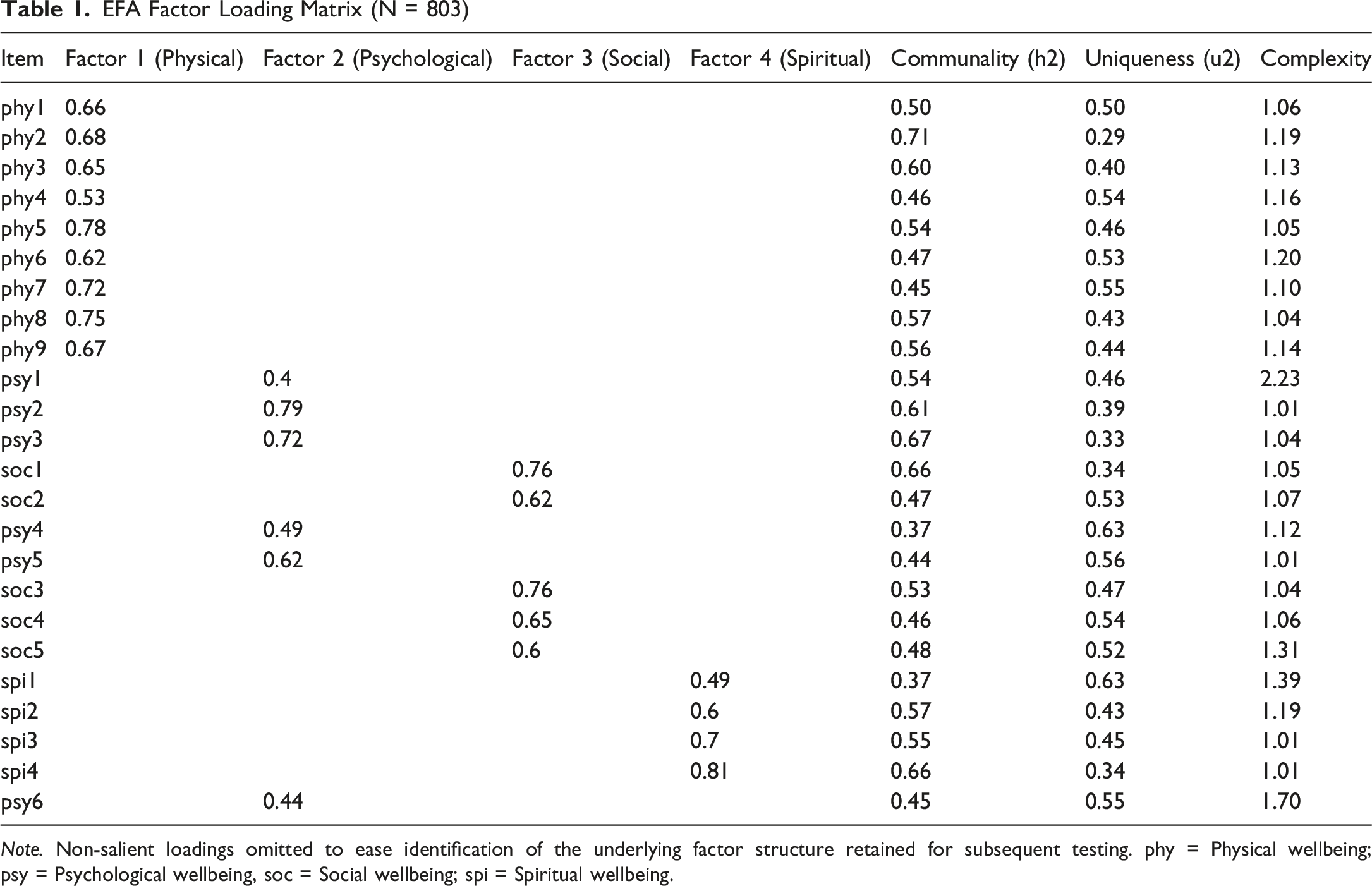
Note. Non-salient loadings omitted to ease identification of the underlying factor structure retained for subsequent testing. phy = Physical wellbeing; psy = Psychological wellbeing, soc = Social wellbeing; spi = Spiritual wellbeing.
Chopra Well-being Index: Final Version
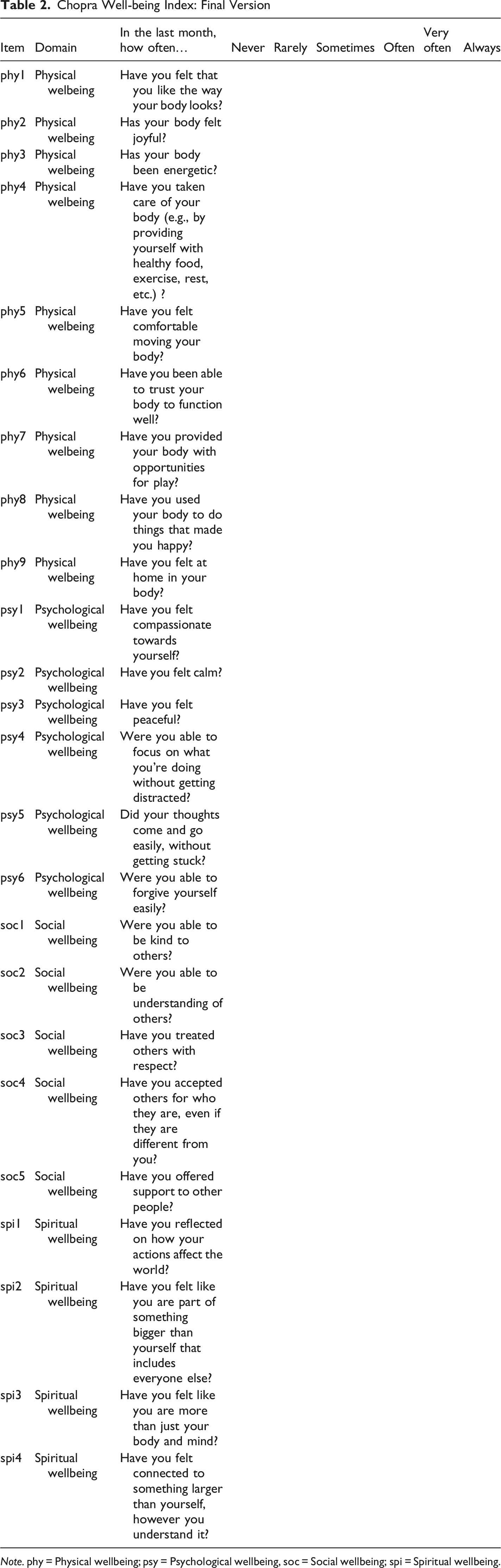
Note. phy = Physical wellbeing; psy = Psychological wellbeing, soc = Social wellbeing; spi = Spiritual wellbeing.
In some cases, indicators did not align with the domains under which they were originally classified, but sufficient conceptual alignment with new classifications was deemed across all such items. As such, this final factor structure was retained for subsequent testing. Content Analysis of the indicators underlying each of the four CWI subdimensions suggested the following descriptions for each facet of Wellbeing.
Physical Wellbeing: Marked by a sense of joy, satisfaction, and care towards the body, alongside a sense that the body is functioning well and capable of doing what one wants it to do.
Psychological Wellbeing: Marked primarily by tranquility, self-compassion, focus, and an absence of rumination primarily characterized by the capacity to allow thoughts to come and go without any unnecessary lingering.
Social Wellbeing: Marked primarily by a positive treatment of others and active efforts to foster community and social relationships.
Spiritual Wellbeing: Marked primarily by a sense of connection to and responsibility towards some greater power beyond the self, reflected to a large degree in other people and the world as a whole.
Confirmatory Factor Analysis
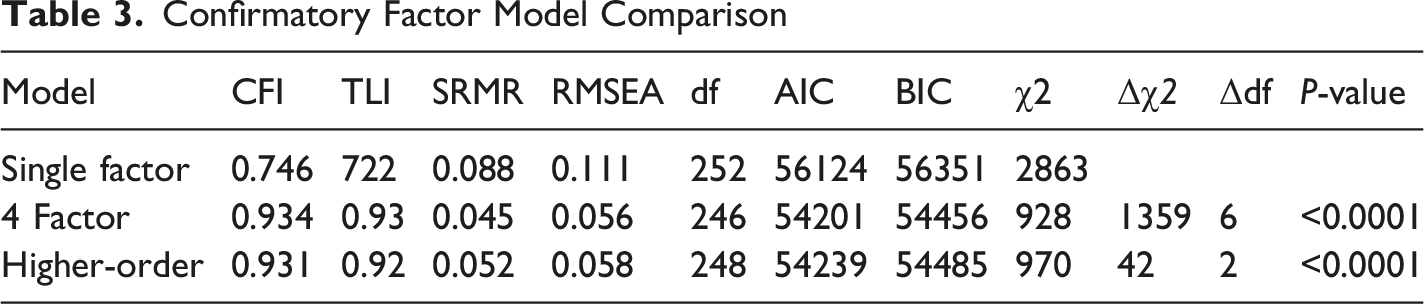
To evaluate the factor structure identified via EFA, several confirmatory factor models were specified and compared on balance of both LRT and AFIs.46-49 First, a correlated four factor model aligned with the structure retained during EFA was compared to a simpler model in which all items loaded onto a single factor. The four-factor model exhibited a significantly better statistical fit with the data than the single factor model, demonstrating that the CWI adequately distinguishes between its four subdimensions of wellbeing based on the underlying sets of items it employs as indicators of each.
Confirmatory Factor Model Comparison
Confirmatory Factor Analysis of Revised Reduced Item set (N = 834)
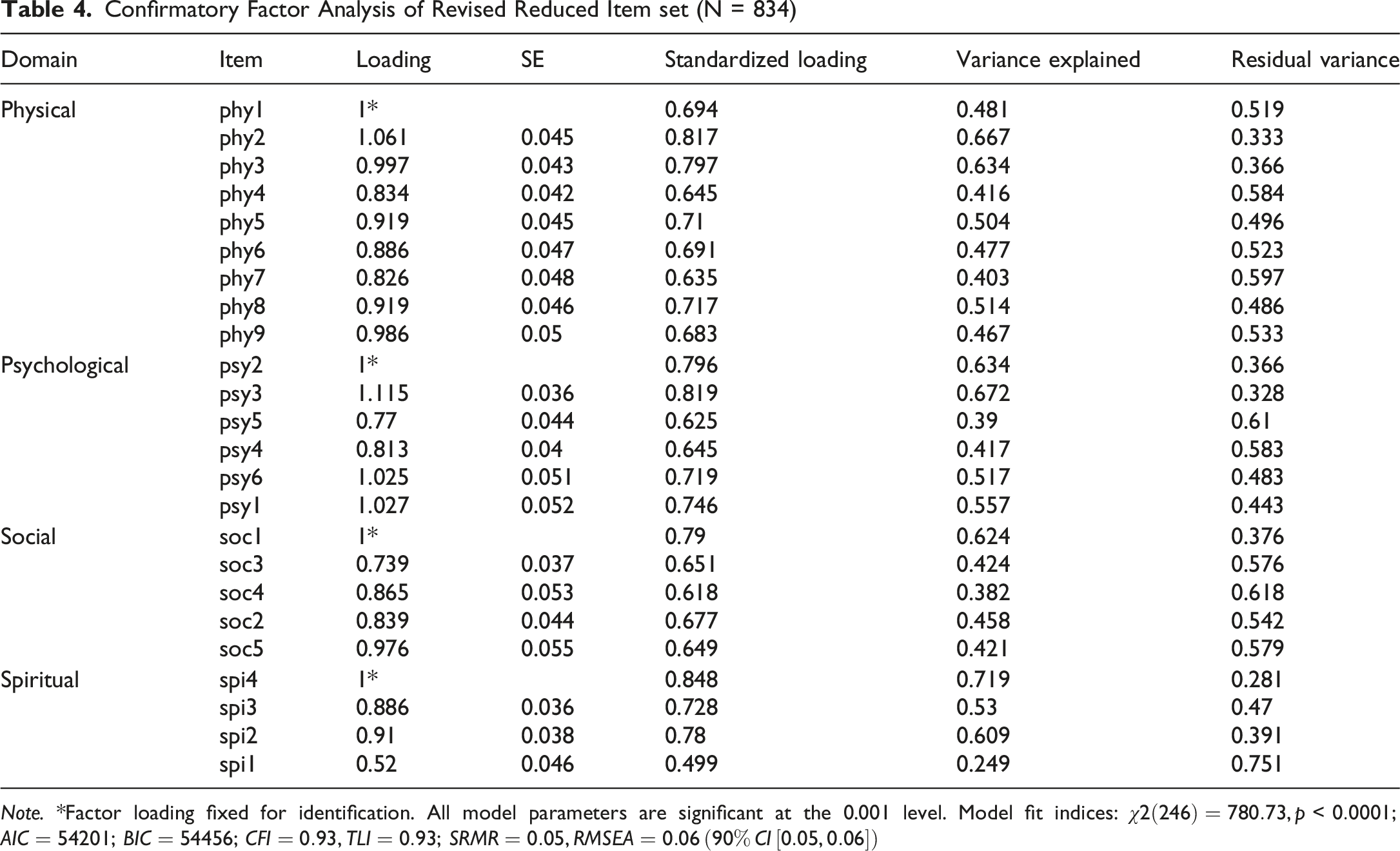
Note. *Factor loading fixed for identification. All model parameters are significant at the 0.001 level. Model fit indices:
A higher order factor model, in which the pattern of correlation among these four lower order factors was accounted four via there loadings onto a higher order generalized Wellbeing factor, was also tested. Despite demonstrating significantly worse statistical fit when compared to the correlated four-factor model, the higher order factor model still exhibited adequate statistical fit with the data (See Table 3), further supporting the CWI’s convergent validity with respect to its four measured subdimensions of Wellbeing. Both Cronbach’s Alpha and McDonald’s Omega were above 0.8 across all CWI subscales, as well as across the scale as a whole (Total Score α = 0.93, ω = 0.94; Physical α = 0.90, ω = 0.87; Psychological α = 0.81, ω = 0.87; Spiritual α = 0.81, ω = 0.83), indicating that the CWI and all subscales demonstrated adequate internal consistency reliability.
Criterion Validity
Composite Score Correlations in CFA Sample
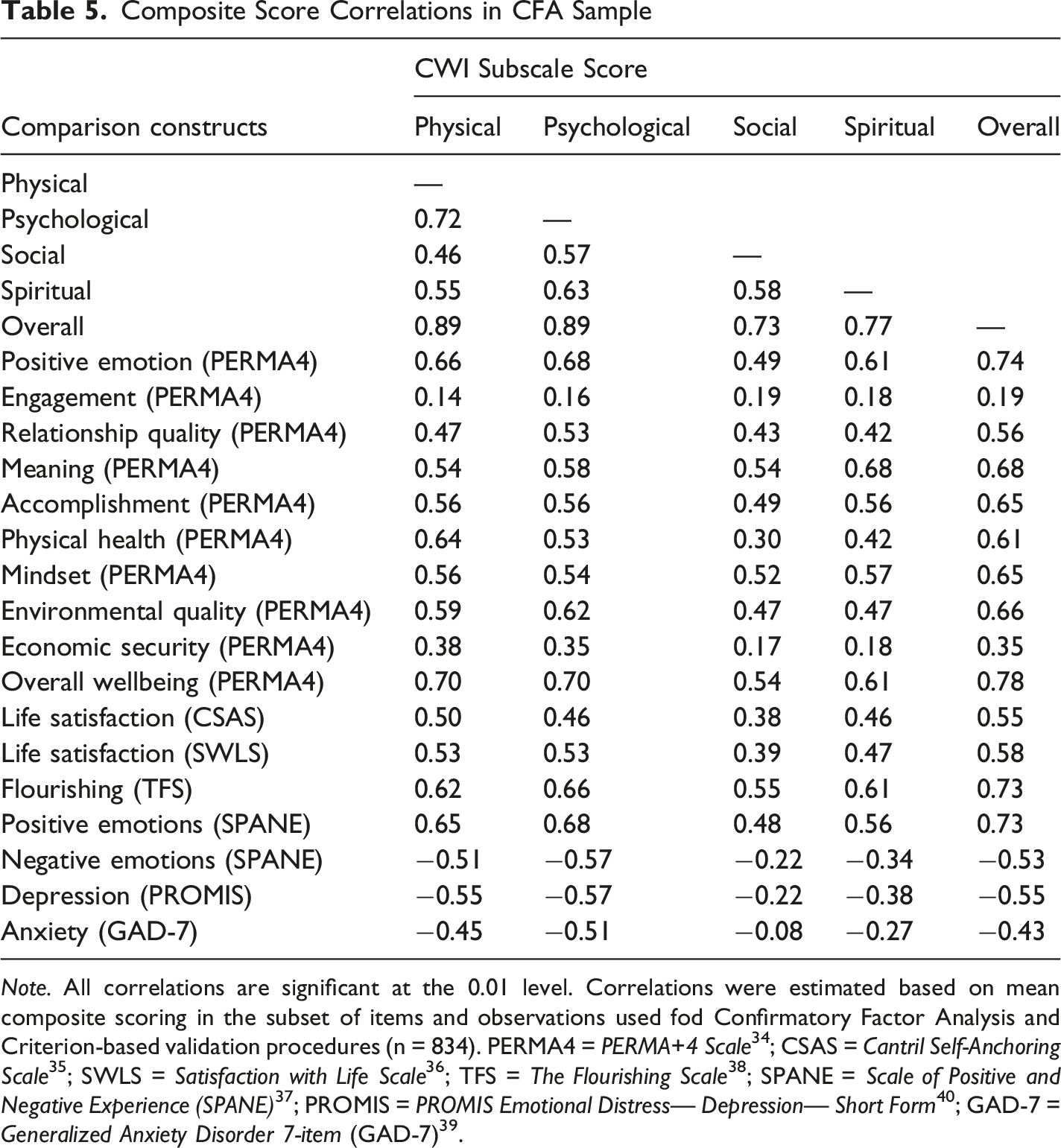
Note. All correlations are significant at the 0.01 level. Correlations were estimated based on mean composite scoring in the subset of items and observations used fod Confirmatory Factor Analysis and Criterion-based validation procedures (n = 834). PERMA4 = PERMA+4 Scale 34 ; CSAS = Cantril Self-Anchoring Scale 35 ; SWLS = Satisfaction with Life Scale 36 ; TFS = The Flourishing Scale 38 ; SPANE = Scale of Positive and Negative Experience (SPANE) 37 ; PROMIS = PROMIS Emotional Distress— Depression— Short Form 40 ; GAD-7 = Generalized Anxiety Disorder 7-item (GAD-7) 39 .
Measurement Invariance
Results are generally supportive of measurement invariance across demographic factors, with a moderate amount of heterogeneity in the degree to which invariance is supported depending on the characteristic in question. Moderate to strong evidence of measurement invariance at all levels was observed with respect to Gender, Marital Status, Education, Employment Status, level of Income, and Race/Ethnicity (See Appendix B for summary statistics related to this testing). Demographic characteristics with fewer groups (and hence larger group sizes), while tending to demonstrate a higher propensity towards suggesting measurement non-invariance at higher levels (i.e. metric and above) according to LRT-based metrics, still typically suggested full invariance according to most ΔAFI-based metrics (at a cutoff level of 0.002).
With respect to Country however, only moderate evidence of configural invariance was observed, with both LRT and ΔAFI-based metrics only offering strong support for up to metric invariance while strongly suggesting violation of scalar invariance. These results suggest that, although the pattern of item-construct relationships is stable across countries, participants from different countries may vary in expected item-level scores when constructs are held constant. As such, CWI benchmarking efforts may need to account for systematically higher or lower scale scores among respondents from different countries.
Discussion
This study provides the first systematic psychometric validation of the Chopra Wellbeing Index (CWI), confirming it as a reliable and valid instrument for assessing multidimensional wellbeing in diverse populations. The analyses demonstrated that the CWI captures four distinct but interrelated domains, physical, psychological, social, and spiritual wellbeing in a similar fashion across various demographic groups, consistent with its conceptual framework and with contemporary models of flourishing.
The Index’s four domains, Physical, Mental, Social, and Spiritual, embody a systems-based understanding of health consistent with allostatic and ecological models of adaptation.50,51 Physical wellbeing reflects vitality and physiological balance; mental wellbeing represents cognitive clarity and emotional regulation; social wellbeing encompasses belonging and relational trust; and spiritual wellbeing captures purpose, transcendence, and alignment with a higher order of meaning. This integration acknowledges that disruptions in one domain inevitably influence the others, producing fragmentation that manifests as disease, distress, or alienation. The CWI thus seeks to restore coherence across these interdependent dimensions, a process akin to what Chopra describes as “awakening to the flow of existence.”
Interpretation of Findings
The strong internal consistency reliability coefficients across all domains support the scale’s measurement robustness. Factor analytic results further validated the multidimensional structure, with the four-factor model showing significantly better fit than a unidimensional alternative. Importantly, moderate to strong inter-factor correlations indicate that while the domains share conceptual overlap, each represents a distinct aspect of wellbeing. This supports the theoretical assertion that flourishing is best conceptualized as a multidimensional construct rather than a singular outcome. Measurement Invariance testing further supported the generalizability of this factor structure with respect to several demographic characteristics.
Evidence of convergent validity was provided by positive correlations between the CWI and established measures of life satisfaction, flourishing, and positive affect. At the same time, negative correlations with measures of depression, anxiety, and negative emotion demonstrated discriminant validity, reinforcing the scale’s ability to capture wellbeing rather than simply the absence of distress. These findings align with prior work highlighting the interdependence of positive psychological resources and reduced mental health risk.2,38
Notably, the inclusion of spiritual wellbeing as a core domain distinguishes the CWI from many existing instruments. Spirituality and existential meaning have increasingly been recognized as critical components of human health and resilience, 13 yet remain underrepresented in mainstream wellbeing measures. By integrating this domain alongside physical, psychological, and social dimensions, the CWI advances a more comprehensive multidimensional framework for understanding and assessing wellbeing.
Contribution to the Literature
The findings support the CWI as a multidimensional measure of wellbeing that integrates spirituality with elements of physical, mental, and social flourishing more typically assessed across the wellbeing measurement literature. The CWI’s inclusion of spirituality as a measurable domain of wellbeing is supported by an increasing body of empirical research tying spiritual connection and practice with several aspects of flourishing and mental health such as meaning-making, coping, and social integration.12,13,15,24,25,52 One note of caution surrounding this study’s contributions is that spirituality, when framed as a measurable domain of wellbeing, should be interpreted broadly as reflecting a sense of connection to and responsibility towards something larger than the self, rather than as affiliation with or connection to any specific religious tradition or set of spiritual practices.
Given these considerations, the CWI’s integration of spirituality within a multidimension measure of wellbeing represents a meaningful contribution to the expanding field of wellbeing science because existing measures of wellbeing typically emphasize hedonic or psychological aspects of wellbeing without representing spirituality as an explicit domain.4,26,53 Conversely, measures designed to assess spiritual wellness in clinical settings typically do so in isolation, lacking sufficient integration with other elements of wellbeing to adequately capture the distinct role of spirituality in supporting flourishing among clinical populations.28-33
By positioning spiritual wellbeing as an explicit subdomain of wellbeing related to but ultimately distinct from physical, mental, and social wellbeing, the CWI offers a meaningful extension of existing wellbeing frameworks that can be used to better differentiate the impacts of spirituality from other wellbeing domains across a wide variety of clinical settings. Such framing aligns with longstanding calls for integrative frameworks that can bridge psychological science, public health, and spirituality by capturing the full spectrum of human flourishing through comprehensive multidimensional measurement of wellbeing. 54
Practical Implications
The international and demographically diverse sample enhances the generalizability of the findings, and evidence of measurement invariance with respect to multiple demographic characteristics suggest that the CWI can be applied across varied contexts and populations. As such, the present results provide a strong foundation for its use in global health monitoring, intervention evaluation, and community-based research.
The brevity and accessibility of the CWI further support the notion that it is well-suited for widespread use in research, clinical practice, and community wellbeing initiatives. Its multidimensional design provides clinicians, researchers, and policymakers with a tool to assess strengths and deficits across specific domains, thereby informing more targeted interventions. The integration of spiritual wellbeing also makes the instrument particularly useful in healthcare, pastoral, and integrative medicine settings where existential concerns are central to patient care.
From a public health perspective, the CWI offers a valuable tool for addressing the intersecting epidemics of loneliness, chronic disease, and existential despair. By integrating subjective, behavioral, and physiological indicators, it enables researchers and practitioners to quantify how interventions, ranging from meditation and social engagement to purpose cultivation, affect overall flourishing. Moreover, the CWI’s focus on spiritual, conscience and social determinants aligns with emerging frameworks for whole-person care, moral resilience, and ecological sustainability. 12 It reframes wellbeing as a moral, relational, and planetary imperative rather than an individual pursuit.
Limitations and Future Directions
Several limitations should be noted. First, reliance on an online data collection platform may limit representativeness of individuals with limited digital access. Second, the cross-sectional design precludes conclusions about sensitivity to change. Longitudinal research, including the explicit assessment of test-retest reliability, is needed to determine whether the CWI is responsive to interventions and life transitions.
Third, although Measurement Invariance was generally supported for the CWI with respect to most demographic characteristics tested in the current study, results did suggest a potential violation of scalar invariance with respect to country. Future studies may benefit from replication efforts with a focus on assessing which items in the CWI contribute most to scalar non-invariance, potentially via the use of methods like alignment optimization. 55
Such efforts may also benefit from the use of techniques like Moderated Nonlinear Factor analysis (MNLFA), which focus on assessment of partial measurement invariance by quantifying and explaining differential item functioning rather than making scale-wise invariance prescriptions.56,57 MNLFA could be employed to, for example, assess how country-level characteristics like macroeconomic (e.g. GDP per capita, Gini Coefficients, etc.) or cultural (e.g. WEIRD classification, Hofstede’s cultural dimensions, etc.) factors impact country-wise item intercepts.
Furthermore, beyond assessment of measurement invariance focused on assessing the impact of demographic factors on the statistical correspondence between latent constructs and their underlying indicators, future studies may benefit from efforts focused on known-groups validation. Such efforts would focus on assessing the degree to which demographic factors impact structural aspects of the latent constructs themselves. Such studies may, for example, focus on assessing the degree to which demographic factors predict the expected level of a latent construct, the variability of a latent construct, or the pattern of correlation amongst groups of latent constructs, lending towards the development of a deeper understanding surrounding the generalizability of the CWI.
Future research should further explore how CWI domains interact to predict long-term health, resilience, and flourishing, as well as their sensitivity to intervention-induced change. Expanding validation into non-Western cultural contexts and clinical populations will also be critical to establishing the scale’s global relevance.Future theorizing may also uncover avenues for substantive testing of antecedents and outcomes related to the dimensions of Wellbeing measured by the CWI. Such testing represents a fertile ground for future research and efforts to expand our understanding of human wellbeing.
Conclusion
The Chopra Well-Being Index (CWI) advances a transformative paradigm within positive psychology by re-centering consciousness as the organizing principle of human flourishing. Traditional models such as hedonic and eudaimonic wellbeing have contributed valuable insights into subjective happiness, virtue, and meaning, yet they remain primarily anchored in individual psychological states. The consciousness-centered model proposed by the Chopra Foundation expands this framework, emphasizing that wellbeing arises in part from a dissolution of ego-boundaries stemming from realizations of interconnectedness with something larger than the self, often termed the sacred or transcendent in the broader empirical literature on spirituality. 9 The CWI works to capture such realizations through the explicit integration of Spirituality as a distinct subdomain of wellbeing, offering a tool for assessing the relative clinical impacts of such realizations alongside those of more traditionally studied elements of wellbeing like physical health, psychological wellness, and social connectedness.
Psychometric validation of the Chopra Wellbeing Index confirms its reliability and validity as a comprehensive multidimensional measure of wellbeing. This study demonstrates the tool’s ability to accurately reflect the multifaceted nature of human health and flourishing, making it a valuable resource for research, clinical practice, and personal development. As such, the current study represents a systematic effort to bridge the empirical and the existential, addressing the “two cultures” divide between scientific materialism and spiritual understanding. In an era defined by fragmentation, of body from mind, self from community, and science from spirit, the Chopra Well-Being Index offers a framework of human flourishing instead centered around integration of these various facets. By situating consciousness as the axis of integration amongst more traditional facets of wellbeing in physical, mental, and social health, the CWI advances the science of wellbeing by acknowledging the integral role of unity with the transcendent in allowing humans to flourish around the world.
Supplemental Material
Supplemental Material - The Chopra Wellbeing Index: Examination of Psychometric Properties
Supplemental Material for Community The Chopra Wellbeing Index: Examination of Psychometric Properties by Jennifer S. Wortham, Daniel Martin, Stewart I. Donaldson, Caroline G. Howley in The International Journal of Psychiatry in Medicine.
Footnotes

Ethical Considerations
The study was approved by the Institutional Review Board (IRB) at Claremont Graduate University (Protocol # 4810, Approved October 9th, 2024). This approval ensured that the research adhered to ethical guidelines for the protection of participants.
Author Contribution
All listed co-authors have made substantial contributions to the conception or design of the work; or the acquisition, analysis, or interpretation of data for the work; AND the drafting the work or revising it critically for important intellectual content; AND give their final approval of the version to be published; AND agree to be accountable for all aspects of the work in ensuring that questions related to the accuracy or integrity of any part of the work are appropriately investigated and resolved. Please see individual Author contributions enumerated below:
Funding
The authors disclosed receipt of the following financial support for the research, authorship, and/or publication of this article: This work was supported by Spiritual Care Partners, a Solace Institute Initiative. Chopra Foundation.
Declaration of Conflicting Interests
The authors declared no potential conflicts of interest with respect to the research, authorship, and/or publication of this article.
Supplemental Material
Supplemental material for this article is available online.
References
Supplementary Material
Please find the following supplemental material available below.
For Open Access articles published under a Creative Commons License, all supplemental material carries the same license as the article it is associated with.
For non-Open Access articles published, all supplemental material carries a non-exclusive license, and permission requests for re-use of supplemental material or any part of supplemental material shall be sent directly to the copyright owner as specified in the copyright notice associated with the article.
