







Abstract
The current study attempted to describe how personality traits of older adults are associated with components of successful aging (cognition, volunteering, activities of daily living, and subjective health). Three-hundred and six octogenarians and centenarians who participated in the third phase of the Georgia Centenarian Study provided data for this study. Factor analysis was conducted to test the existence of two higher-order factors of the Big Five personality traits, and a two-factor model (alpha and beta) fit the data well. Also, blocked multiple regression analysis was conducted to examine the association between personality traits and four components of successful aging. Results indicated that low scores on neuroticism and high scores on extraversion, openness to experience, agreeableness, and conscientiousness are significantly related to the components of successful aging. After controlling for demographic variables (age, gender, residential type, and race/ethnicity), alpha (i.e., emotional stability, agreeableness, and conscientiousness) was associated with higher levels of cognition, higher likelihood of engaging in volunteer work, higher levels of activities of daily living, and higher levels of subjective health. Beta (i.e., extraversion and openness to experience) was also positively associated with cognition and engaging in volunteer work.
Given that people can expect to live longer than ever before (Christensen, Doblhammer, Rau, & Vaupel, 2009), the meaning of successful aging takes on greater significance. How individuals maximize the possibility of aging well becomes more important than simply living a longer life. Longevity itself or a longer life expectancy does not always imply successful aging and not every survivor into old age can be characterized as a successful ager.
The term successful aging has been used in attempting to understand how well individuals experience their later life and improve the quality of life they lead (Martin et al., 2015; Ryff, 1982). To specify this, there have been various attempts to define successful aging. Although the lack of clarity regarding the definition of successful aging continues in the literature, Rowe and Kahn’s model (1997) seems to be most widely used because it provides an assessment coming from multiple dimensions and a scientific background for understanding healthy aging across the life course (Crowther, Parker, Achenbaum, Larimore, & Koenig, 2002). They described successful aging as an inclusion of a “low probability of disease and disease-related disability, high cognitive and physical functional capacity, and active engagement with life” (Rowe & Kahn, 1997, p. 433).
Personality is often used to explain consistency of individuals’ social behavior toward particular situations. As personality does not possess characteristics of physiological decline, it can compensate for other types of loss in older adults (Ryff, 1982) and serve as a useful construct to explain various aspects of the successful aging process. Previous studies have actually examined the structure and role of personality traits in the patterns of aging (Chapman, Roberts, & Duberstein, 2011; Davey, Siegler, Martin, Costa, & Poon, 2015; Martin, 2007) and reported that personality can be considered as a potential explanatory mechanism for longevity and a healthy aging process (Martin et al., 2006; Versey, Stewart, & Duncan, 2013; Wilson, de Leon, Bienias, Evans, & Bennett, 2004).
To assess the role of personality traits in aging process, the Big Five personality constructs, (i.e., neuroticism, extraversion, openness to experience, conscientiousness, and agreeableness), conceptualized by Costa and McCrae (1985, 1989), have been frequently used (Martin et al., 2006). Neuroticism denotes a general tendency to be vulnerable to negative stimuli and to experience negative affect easily; extraversion indicates a tendency to be sociable, outgoing, and energetic; openness to experience indicates willingness to try new things and having intellectual curiosity; conscientiousness denotes a preference for goal-oriented and organized work and a disposition to be responsible and diligent; and finally agreeableness means being cooperative, trusting, and empathetic.
Although McCrae and Costa (1987) have contended that their Big Five personality constructs represent fundamental and comprehensive dimensions of personality, some researchers have noted its limitations. For example, Hough (1992) has argued that the Big Five personality constructs are too broad and are adequate for describing, but not for predicting specific criteria. In a related vein, McAdams (1992) has also noted that the five-factor model failed to provide significant information that may be useful in predicting certain behaviors and describing personality functioning. While there is still wide acceptance of the Big Five personality constructs, Digman (1997) introduced two higher-order factors across several data sets and labeled them as alpha and beta. The alpha factor consists of low levels of neuroticism (emotional stability) and high levels of conscientiousness and agreeableness while the beta factor consists of extraversion and intellect/openness. Digman suggested that these two factors might represent individuals’ socialization and personal growth.
DeYoung, Peterson, and Higgins (2002) have also identified these higher-order factors and assessed their usefulness in personality studies. They have suggested that Digman’s interpretation of each factor does not represent basic personality traits or dispositions, but rather outcomes, thus they labeled the alpha as stability (i.e., one’s willingness to be stable and avoid emotional, social, and motivational disruption) and the beta as plasticity (i.e., the ability of being flexible in engaging with a new experience; DeYoung, 2006; DeYoung et al., 2002).
Many questions still remain regarding the use of two higher-order factors in understanding personality and some argue that correlations among the Big Five personality traits are method artifacts (Biesanz & West, 2004; McCrae et al., 2008). However, Digman (1997) suggested that the higher-order factors of the Big Five may serve as a bridge to fill the gap between standard personality theories and personality constructs and provide “theoretical accounts of the why of personality may be found” (p. 1246). For example, he related factor alpha to Adler’s (1939) concept of social interest because alpha-linked traits are socially desirable. He also related beta-linked traits, such as being active, outgoing, creative, and imaginative to Rogers’ (1961) self-actualization. By linking personality theories with personality functioning, Digman suggested a more integrative model in personality studies.
Although the relationship between these personality traits and physical and psychological aspects of aging has been quite extensively investigated in previous research (Martin et al., 2006; Masui, Gondo, Inagaki, & Hirose, 2006; Siegler & Brummett, 2000; Wilson et al., 2005), earlier studies applying the two higher-order factors have only focused on adult or older adult participants (DeYoung, Peterson, Séguin, & Tremblay, 2008; Hirsh, DeYoung, & Peterson, 2009) but did not include those who are considered as oldest-old. More importantly, to our knowledge, no previous studies have examined the association between the higher-order factors of the Big Five personality traits and selected components of successful aging. As personality traits have been considered as a resource for resilience that ultimately increases older adults’ level of subjective well-being (Adkins, Martin, & Poon, 1996; MacDonald, Aneja, Martin, Margrett, & Poon, 2010), in this study, we attempted to examine the configuration of the Big Five personality traits and test the existence of higher-order factors in an oldest-old population. In addition, we analyzed their association with four components of successful aging that we have selected. The current study will provide valuable information that can be used for more in-depth analysis of personality functioning for the oldest-old population.
Personality Traits and Successful Aging
High cognitive functioning capacity is the first component we chose according to Rowe and Kahn’s (1997) model of successful aging. Recent studies on cognitive aging have shown interest in the relation of personality traits to cognitive ability in later life and considered personality traits as a potential predictor of variability in cognition of older adults (Curtis, Windsor, & Soubelet, 2015). Researchers have suggested that different personality traits may cause cognitive changes in older adults. For instance, the feelings of negative emotion or depression (e.g., neuroticism) might have deleterious effects on brain functioning, whereas more positive characteristics (e.g., openness to experience or extraversion) might work as a protector against cognitive decline by encouraging older adults to engage in intellectual activities and by facilitating a positive attitude toward aging (Hertzog, Kramer, Wilson, & Lindenberger, 2009). A study examining the association between one of the personality traits, openness to experience, and longitudinal cognitive functioning (Sharp, Reynolds, Pedersen, & Gatz, 2010) revealed that both men and women with higher levels of openness to experience performed better in all cognitive domains. This pattern remained the same across time.
Conscientiousness was also found to reduce the risk of Alzheimer’s disease and mild cognitive impairment in older adults because highly conscientious individuals may have been more exposed to educational experiences, and their characteristics may have lessened the adverse consequence of life events that may cause dementia in later life (Wilson, Schneider, Arnold, Bienais, & Bennett, 2007). Older adults who are not emotionally stable also showed poorer cognitive performance because high neuroticism causes chronic stress (Jorm et al., 1993). Based on these findings, we assume that these alpha-linked traits may help older adults to cognitively develop by emphasizing socialized behaviors through frequent interactions with others. However, the results on the relationship between neuroticism and cognitive functioning of older adults are not consistent. Jelicic et al. (2003) found that neuroticism was not related to cognitive performance in older adults as well as their cognitive decline over a 3-year period. Pearson (1993) even found that neuroticism was positively related to cognitive ability in older women.
Next, low probability of disease or disease-related disability and high physical functioning capacity are also significant components of successful aging. Personality traits may affect physical health of older adults directly and indirectly, and several researchers pointed out that through physical health variables, the relationship between personality traits and longevity could be understood (Martin et al., 2006).
Previous studies have consistently reported that emotional stability (low levels of neuroticism), extraversion, and conscientiousness are positively related to better physical functioning of older adults (Friedman, Kern, & Reynolds, 2010; Jaconelli, Stephan, Canada, & Chapman, 2013; Magee, Heaven, & Miller, 2013) and conscientious older adults are more likely to better take care of themselves and sustain a healthier lifestyle, which will lead them to age successfully (Martin, 2007). In addition, in both cross-sectional and longitudinal studies, researchers have consistently reported that high levels of neuroticism or negative affectivity (e.g., anxiety, anger, depression, and hostility) have an influence on heart disease, cancer, high blood pressure, and negative health behaviors such as smoking, which can subsequently increase mortality (Aldwin, Spiro, Levenson, & Cupertino, 2001; Scheier & Bridges, 1995; Smith, Glazer, Ruiz, & Gallo, 2004). People with high levels of neuroticism may tend to experience more negative life events and distress because they are particularly sensitive to their failures and hide the negative side of themselves and the world (Watson & Clark, 1984). As personality plays a significant role in the stress process (Williams, Suchy, & Kraybill, 2010), it would also indirectly affect physical health by lowering the levels of psychological well-being. It was found that older caregivers who scored high in neuroticism and low in optimism performed poorly in mental health tests and their high stress levels were associated with overall physical health impairment (Hooker, Monahan, Bowman, Frazier, & Shifren, 1998).
Conscientiousness can also serve as a resilience factor against negative physical outcomes. Conscientiousness is related to prudent health behaviors (Bogg & Roberts, 2004) and these health-related behaviors play a mediating role in the relationship between personality traits and physical disease (Contrada, Cather, & O’Leary, 1999). The characteristics of conscientious people, which include being goal-oriented, responsible, reliable, and seeking achievement, may lead to more positive health behaviors such as having a healthy diet and activity pattern, less consumption of alcohol or drugs, and avoiding risky sexual behaviors (Bogg & Roberts, 2004; Kern & Friedman, 2008).
The last component is an active and continuous engagement with one’s life, which consists of maintenance of social relations and productive activities. Older adults’ engagement in productive activities, volunteering for instance, has been consistently found to be a predictor of positive affect because it provides them a role-identity, which is associated with better physical and mental health (Greenfield & Marks, 2004). A qualitative study exploring older adults’ perspectives on successful aging also revealed that contributing to others or society through volunteering is significant to aging successfully (Reichstadt, Sengupta, Depp, Palinkas, & Jeste, 2010). Volunteering helps older adults remain actively engaged with their life and promotes interaction with others. In the eighth stage of Erikson’s psychosocial development, Integrity versus Despair, reviewing one’s past life experiences becomes an important task (Haber, 2006) as it “brings about a sense of failure or fulfillment in life” (Bishop, Martin, Poon, & Johnson, 2011, p. 2). If older adults who are outgoing and attentive to others recall the experience of volunteering as positive, even if long ago or once in a lifetime, they would be more likely to perceive themselves as successful agers.
Both extraversion and agreeableness seem to be the core personality traits dealing with social interactions and engagement. Extraversion mainly focuses on social impact, whereas agreeableness is mostly related to maintaining of relationships (Jensen-Campbell & Graziano, 2001). Thus, people with higher levels of extraversion and agreeableness tend to show higher scores in sociability and positive emotions (McCrae & Costa, 1999) and to be more friendly and helpful (John & Srivastava, 1999). They also display prosocial behaviors (Graziano & Eisenberg, 1997), as social activities require extensive social interactions with others (Carlo, Okun, Knight, & Guzman, 2005).
Research Questions
The primary purpose of this study was to explore associations among the Big Five personality traits and to examine their association with the components of successful aging. In addition, as there have been no attempts to assess the two higher-order factors with the oldest-old population, we attempted not only to test the existence of the two higher-order factors of the Big Five personality traits, but also to assess how they correspond with previous findings. Based on Digman’s (1997) work, we hypothesized that the two higher-order factors would fit our data: alpha, which consists of low levels of neuroticism, high levels of agreeableness and conscientiousness and beta, which consists of high levels of extraversion and openness to experience. We also expected that these two higher-order factors are all positively associated with each component of successful aging.
Method
Participants
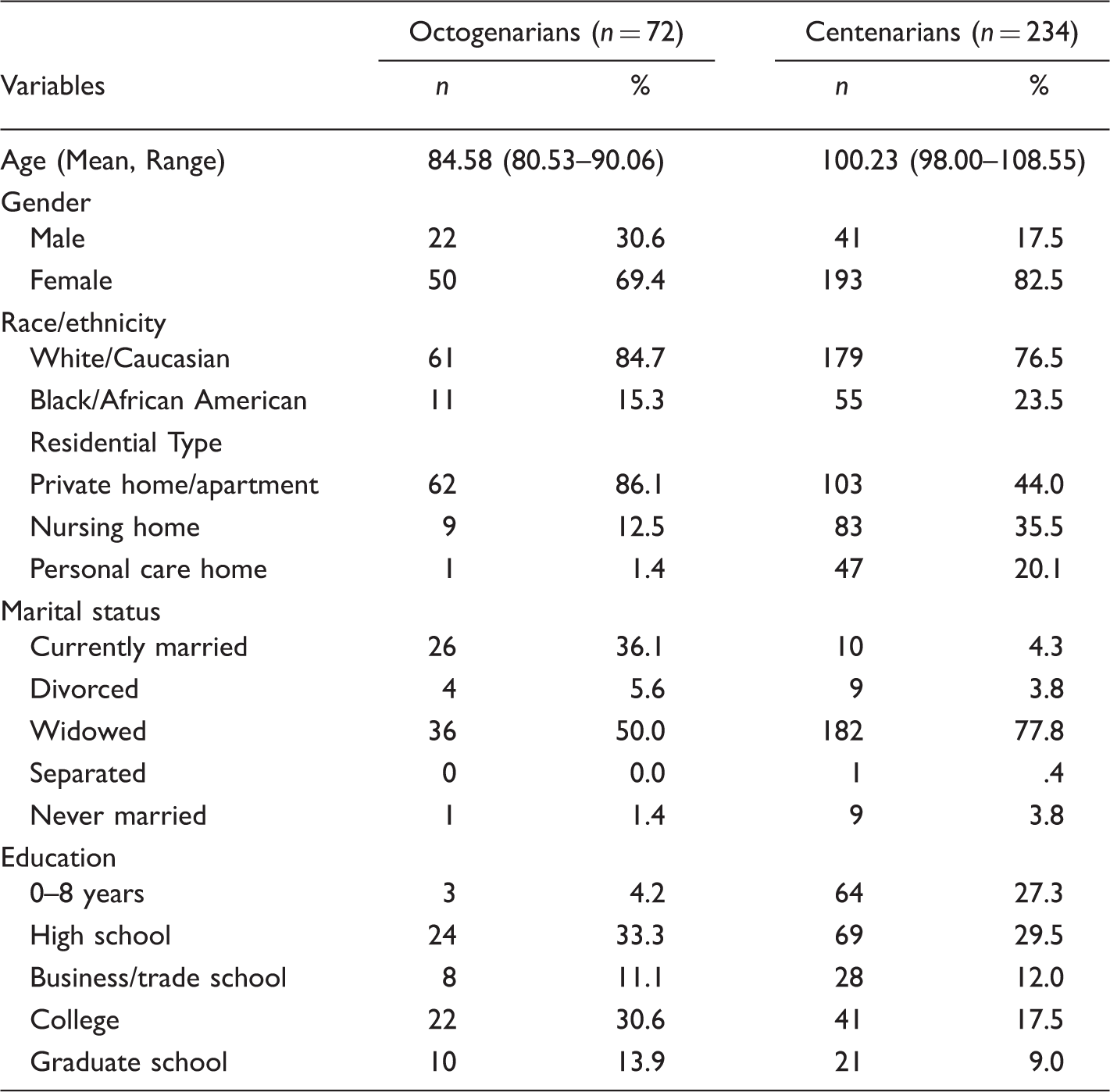
Data for this study were collected from the Georgia Centenarian Study (Poon et al., 1992) in order to understand longevity and survival of older adults. Among three phases of the Georgia Centenarian Study, we used the data collection at Phase 3 (2002–2009), which provides biomedical and psychosocial aspects of longevity (Poon et al., 2010). Information was collected from a population-based sample of octogenarians and centenarians in northern Georgia and also through their proxy informants. In this study, the data from proxy informants were used. Some may argue that using informant-report data is not reliable because of its potential inaccuracy. However, informant-report data are important not only for providing alternative information of older adults but also for adding meaningful perspectives of older adults (MacDonald, Aneja, Martin, Margrett, & Poon, 2010). Also, proxy informants can provide reliable data in circumstances where oldest-old adults have physical or cognitive difficulties in participating in studies on health (Bassett, Magaziner, & Hebel, 1990). A study that asked both individuals with early-stage Alzheimer’s disease and their informants to fill out the NEO inventory found that informant ratings were even more sensitive to group differences and better predicted early-onset dementia, when compared with self-ratings (Duchek, Balota, Storandt, & Larsen, 2007).
Summary of Demographic Characteristics.
Measures
Personality traits
In this study, the NEO PI-R (Revised NEO Personality Inventory) assessed basic personality traits of older adults (Costa & McCrae, 1989), which were reported by proxy informants. The NEO-PI-R has five factors of personality: neuroticism, extraversion, openness to experience, agreeableness, and conscientiousness. It consists of 240 items answered on a 5-point scale (−2 = strongly disagree, −1 = disagree, 0 = neutral, 1 = agree, and 2 = strongly agree). In this study, the reliability for neuroticism was α = .85, .77 for extraversion, .69 for openness to experience, .88 for agreeableness, and .90 for conscientiousness, demonstrating moderate to strong internal consistency reliability. Higher scores suggest higher levels of each personality trait. As the scores for neuroticism were reversely coded for the interpretation, higher scores suggest higher levels of emotional stability.
Cognitive functioning
The Mini Mental Status Examination (MMSE) assessed the cognitive functioning of older adults (Folstein, Folstein, & McHugh, 1975). It measures five aspects of cognitive functioning: orientation, registration, attention and calculation, recall, and language with 30 items. The range of scores was 0 to 30 (0 = incorrect and 1 = correct) and the MMSE has high internal consistency of α = .88. Higher scores indicate better cognitive functioning in this study.
Volunteering
Participating in volunteering activities was measured with the following question: “Did he/she ever do volunteer work for an organization such as a hospital, church, school, or political party?” (1 = yes, 0 = no).
Activities of daily living
Both instrumental activities of daily living (IADL) and physical activities of daily living (PADL) were assessed to examine the ability of self-care of older adults (Fillenbaum, 1988). The scale consists of 14 items in total, 7 items for each, and the overall reliability in this study was strong, α = .94. Items were measured on a 3-point scale (0 = completely unable to do, 1 = able to do with some amount of help, and 2 = able to do without help) and higher scores reflect better ability of ADLs. IADL questions included the ability of telephone use, use of transportation, shopping, preparing meals, doing housework, taking medicine, and handling own money. PADL questions included the ability of eating, dressing and undressing, taking care of own appearance, walking, getting in and out of bed, bathing, and moving to the bathroom.
Subjective health
Descriptive Information for Study Variables.
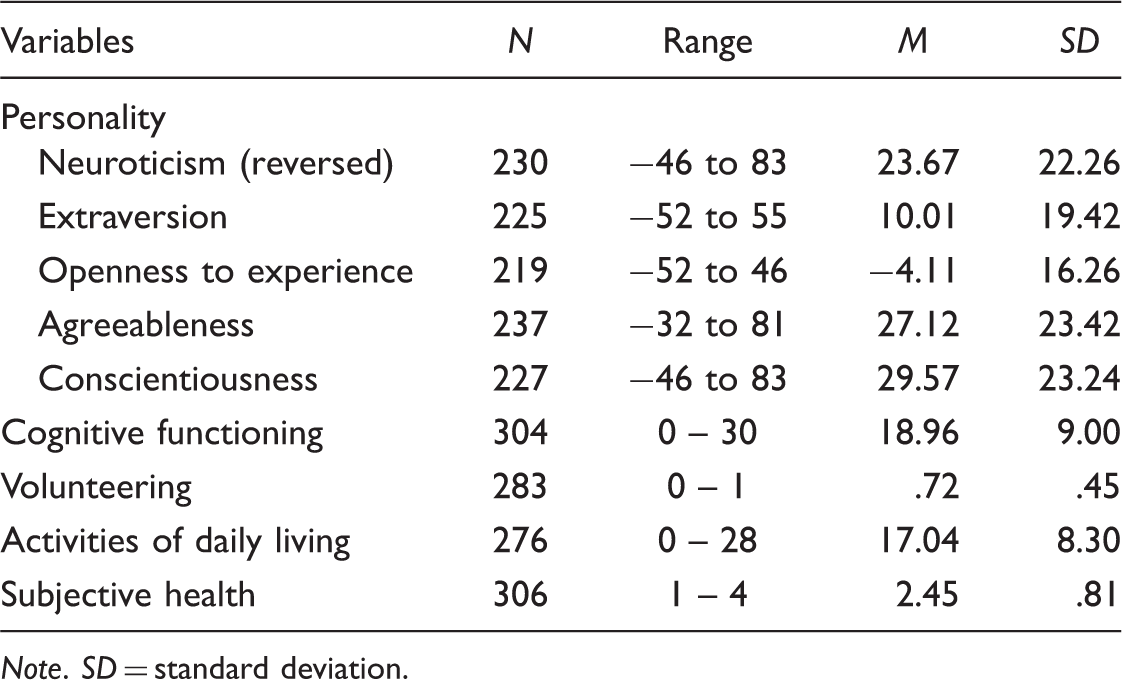
Note. SD = standard deviation.
Analysis
Two analyses were performed in this study. As a first step, we conducted a confirmatory factor analysis by using Mplus to compare two competing models (i.e., a single-factor model and a two-factor model). To examine the association between two personality factors and components of successful aging, blocked multiple regression analyses were conducted. Blocked multiple regression analyses were computed twice; once using the two higher-order factors and once using the original Big Five personality traits. In the first model, age, gender (0 = male, 1 = female), race/ethnicity (1 = White/Caucasian and 2 = Black/African American), and residential type (1 = private home/apartment, 2 = nursing home, 3 = personal care home, and 4 = other) were included as control variables. In the second model, the first factor extracted was included and in the third model, the second factor was added. When using the Big Five personality traits, the control variables were added in the first model, and all five personality traits (i.e. neuroticism, extraversion, openness to experience, agreeableness, and conscientiousness) were entered into the second model.
Results
Correlations Between the Variables Used in Analyses (N = 306).
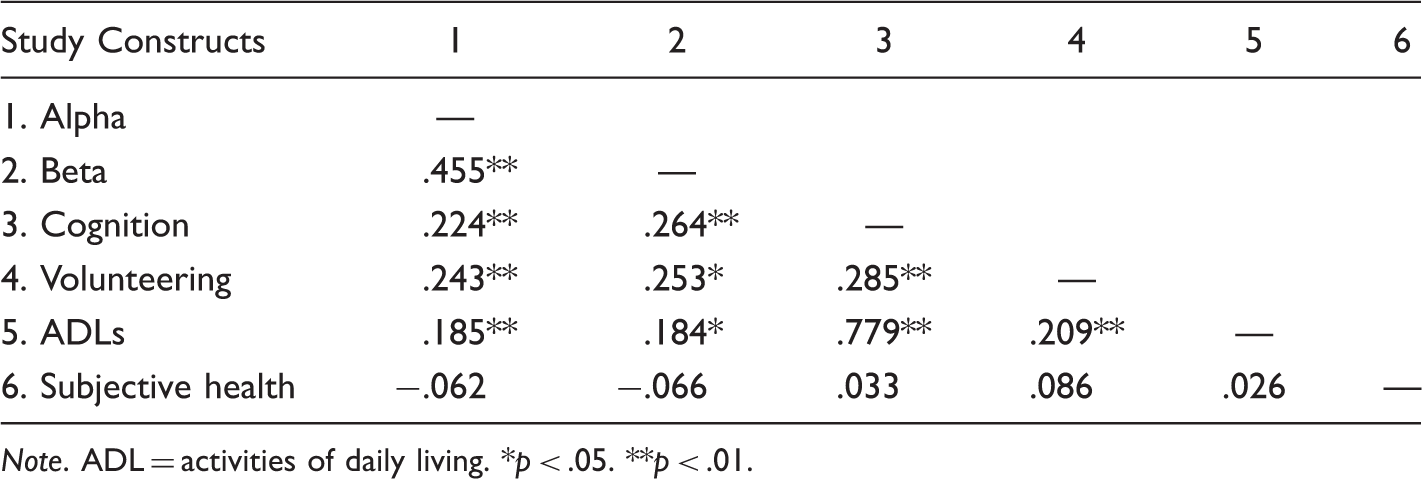
Note. ADL = activities of daily living. *p < .05. **p < .01.
Comparison of Fit Indices.
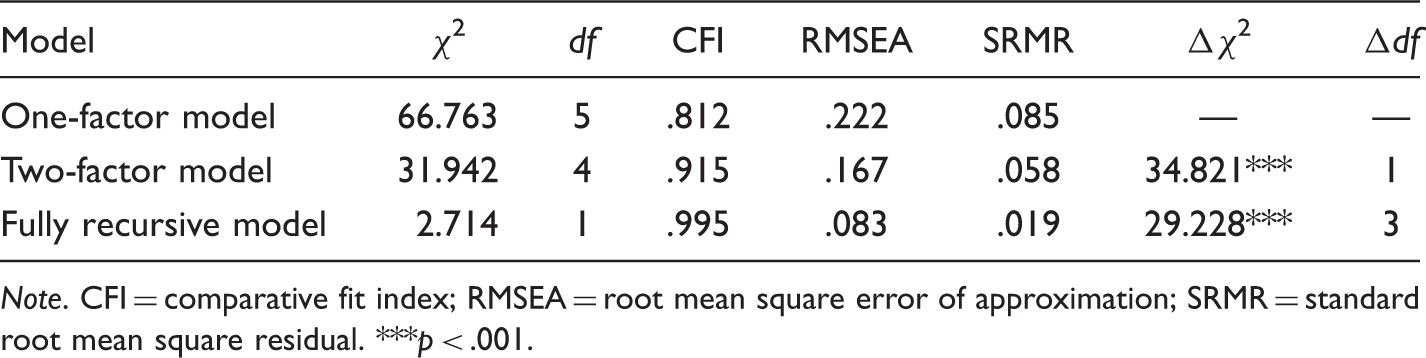
Note. CFI = comparative fit index; RMSEA = root mean square error of approximation; SRMR = standard root mean square residual. ***p < .001.
Personality Traits as Predictors of Successful Aging in Octogenarians and Centenarians.
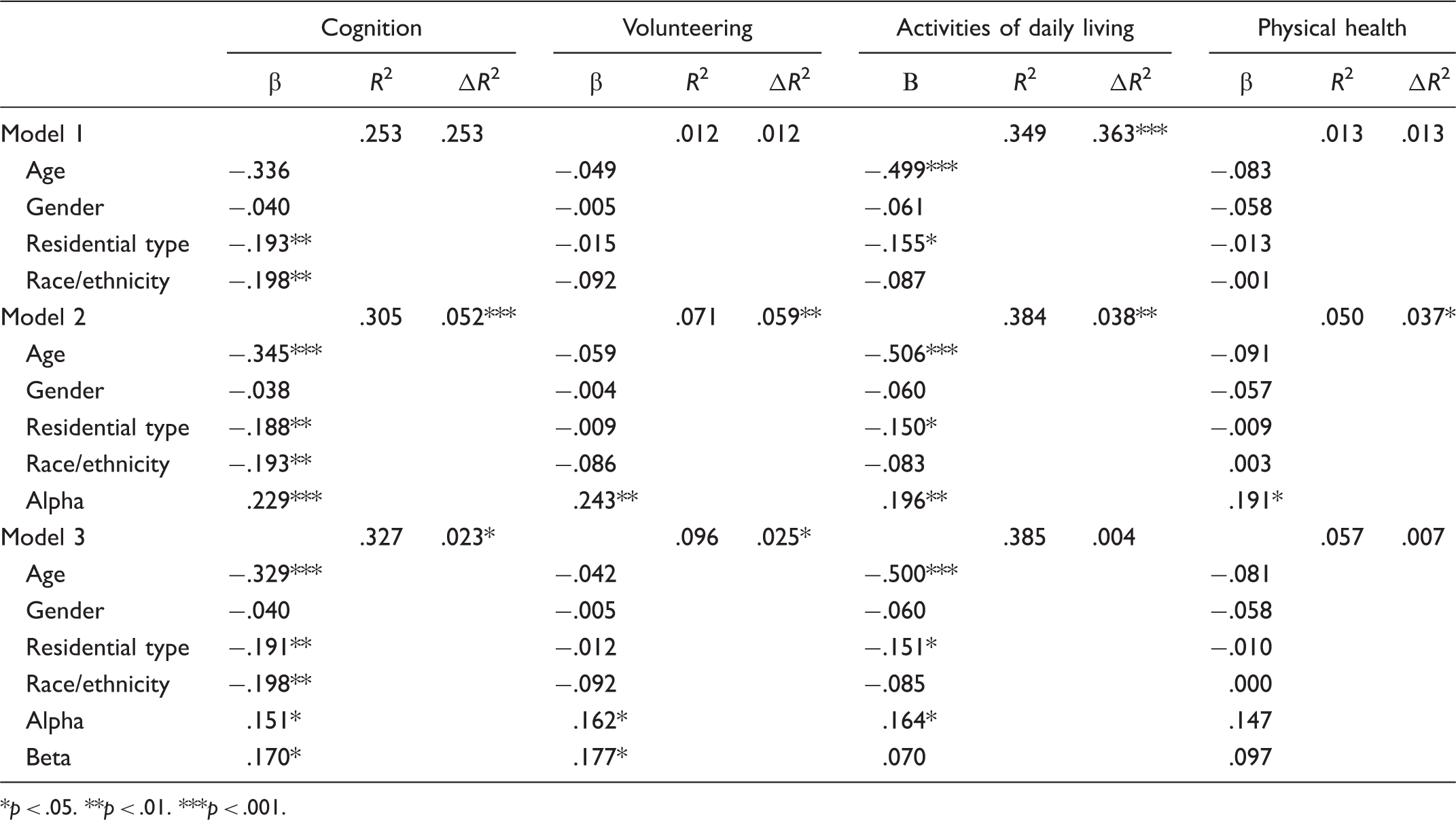
p < .05. **p < .01. ***p < .001.
We also compared the amount of variance explained by the original Big Five personality traits (i.e., the five-factor model) to the variance explained by the two-factor model. The five-factor model explained 34.5% of cognition, 12.1% of volunteering, 44.7% of ADLs, and 11.5% of subjective health. The amount of variance explained by the five-factor model is slightly higher in each case.
Taken together, the results demonstrated that two higher-order factors of the Big Five personality traits are significant factors related to successful aging in later life.
Discussion
The purpose of this study was to assess Digman’s (1997) two higher-order factors of the Big Five personality traits among oldest-old adults and to examine the association between extracted factors and successful aging. Several findings emerged from this study. Our results suggested that the two higher-order factors of the Big Five personality traits were evident in the data obtained from the oldest-old population. Our results are consistent with Digman and DeYoung et al.’s (2002) findings; extraversion and openness to experience formed one factor and reversed neuroticism (emotional stability), agreeableness, and conscientiousness formed another. As mentioned earlier, Digman labeled them as alpha and beta and made an effort to relate classic personality theories to each factor.
It is important to recognize that the application of the two higher-order factors of the Big Five personality traits is still a subject of debate. Along with McCrae and Costa (1999), Biesanz and West (2004) argued that correlations among the Big Five personality traits do not always exist but highly depend on types of informants and are affected by their biases. On the other hand, DeYoung (2006) demonstrated in his article that the two higher-order factors are caused neither by method artifacts nor informants’ biases. We believe that the two higher-order factors would provide unique information regarding successful aging. Rather than broadly describing people’s lives, Digman (1997) and DeYoung et al.’s (2002) interpretations of the two higher-order factors appear to enable psychologists to effectively account for personality functions and causal relationships between personality traits and human behavior.
Next, we found that personality traits were positively related to the components of successful aging although the cross-sectional nature of the data limits our ability to conclude causality between these two variables. Alpha was associated with higher levels of cognition, volunteering, ADLs, and subjective health, and beta was also related to higher levels of cognition and volunteering. However, it should be noted that the effect size of these results is relatively small. When entered together, alpha and beta showed no relations with subjective health, but overall the results of this study support previous research examining the relationship between personality traits and each component of successful aging.
More specifically, older adults with higher scores in factor alpha and beta were more likely to report better cognitive functioning ability and higher levels of ADLs. Neuroticism, which is one of the alpha-linked traits, may negatively affect older adults by leading them to consider their life events and people around them as stressful and threatening (Bromberger & Matthews, 1996). Being emotionally stable and less sensitive may help older adults to reduce the risk of stress-related illness that can cause cognitive impairments. Schaie, Willis, and Caskie (2004) also found that openness to experience was most related to higher levels of cognitive abilities of older adults aged over 60. The results are consistent with Digman’s (1997) idea that self-actualization involves active engagement with creating new experiences, which in turn increases individuals’ levels of cognitive functioning. DeYoung and his colleagues’ (2002) interpretation of the shared variance of extraversion and openness to experience, labeled as plasticity, also adds a good explanation. Older adults who are flexible in their thinking and experience new knowledge may tend to more actively participate in cognitively stimulating activities. In addition, the maintenance of high cognitive functioning ability of older adults could have worked as a protective factor for disability in ADLs. Dodge, Hayakawa, and Sekikawa (2005) found both cross-sectionally and longitudinally that cognitive impairment of older adults was related to higher risks of losing functional abilities.
Next, as expected, both alpha and beta may motivate older adults to be involved in volunteering. As discussed earlier, these two personality traits, extraversion and agreeableness, reflect prosocial behaviors, altruism, and a positive perspective toward other individuals. This may enhance social interactions that are required for volunteering. More social interactions found in other-oriented volunteers, meaning those who choose to volunteer to help others, not for their own satisfaction, also had powerful effects on reducing mortality risks (Konrath, Fuhrel-Forbis, Lou, & Brown, 2012). These results are closely related to Digman’s identification of the two higher-order factors. Older adults who have socially desirable personality traits may tend to accept themselves and others more easily, rather than experiencing self-denial or isolation, thus having more opportunities to build and maintain various types of relationships. Further, serving communities and neighborhoods through volunteering might be the best way of achieving personal growth and self-actualization.
We also found that alpha-linked traits were positively associated with subjective health but its significance disappeared when beta was also included. A substantial body of the personality-health literature has shown that personality traits not only directly affect physical health but also serve as both mediator and moderator on the relationship between environmental stress and physical disease (Heck, 1997). As noted earlier, findings have consistently related conscientiousness to healthy behaviors (Bogg & Roberts, 2004), which promote positive health outcomes and reduce the risks of disease progression. Low neuroticism and high extraversion are also useful predictors of longevity and better health outcomes (Smith & Williams, 1992) as they are associated with stress-reducing benefits for different reasons. However, contrary to our expectation, the association between the two higher-order factors and subjective health was not significant in this study when entered into the same model. Interestingly, however, Heck (1997) suggested that the original Big Five personality model is not specific enough to explain the complexity of physical health. The model also does not provide information needed to explain how personality traits might be connected to physical health but rather describes personality itself (Smith & Williams, 1992). In this study, the two higher-order factors of the Big Five personality traits did not suggest a solution to this problem. We assume that the association between the two higher-order factors and subjective health may have weakened because of the inclusion of oldest-old adults who were at least 80 years old. At this age, subjective health can be less important than other factors in determining successful aging. No matter of their personality traits, very old adults are aware of the fact that their health may have been declining over time and take it as a common process of aging. Compared with younger adults in their 50 s or 60 s, octogenarians and centenarians might be more ready to face and accept their physical decline and are less interested in maintaining a physically healthy lifestyle as self-acceptance tends to be achieved with increasing age (Ryff, 1995).
We have suggested that Digman’s (1997) two higher-order factors may fulfill the limitations of the Big Five personality traits by providing more integrative and meaningful information of personality traits and their functioning. However, the amount of variance explained by the original Big Five personality traits and by the two higher-order factors was very similar for both models. It is difficult to say which model better explains successful aging, but we interpret these results that the two higher-order factor model can serve as an alternative model in understanding the association between personality traits and successful aging.
The current study is not without limitations. First, as in other studies using the data of the Georgia Centenarian Study, octogenarians and centenarians who participated in this study were all from one state of the southeastern United States, therefore the results may not be generalized to the entire population. Second, in this study, the difference between octogenarians and centenarians was not examined. If personality traits do not remain stable across the life span and can change, it may be necessary to separately assess personality traits of two different cohorts. A study comparing younger and older adults in identifying personality traits as predictors of intelligence found that openness to experience and extraversion were significant predictors of cognitive ability in young adults, while these two traits showed no effects in older age groups (Baker & Bichsel, 2006). We analyzed the data for octogenarians and centenarians separately, but perhaps due to the relatively small sample size, we did not find any significant results. In a related vein, because our participants’ personality traits and their components of successful aging were measured at one time point, the results may be different in a longitudinal study. Age at the first measurement (i.e., starting age) and a length of retest interval may be related to instability of personality traits (Ardelt, 2000). Therefore, future studies need to specify and compare different age groups. Another limitation is that because we used proxy data for our analysis, it is necessary to be careful in interpreting our findings. Although the majority of proxies were participants’ family members or relatives they directly nominated, we did not obtain information about how close their relationships were or how knowledgeable the proxies were about the participants. It should also be noted that although the MMSE is known as the most widely accepted cognitive screening test, future studies may need to consider using other measures for detecting cognitive impairment because of its low sensitivity for participants with high educational attainment (Carnero-Pardo, 2014). Finally, the utilization of single-item measures of subjective health and volunteering is sometimes discouraged because it may not convey meaningful information. Future studies may want to include more inclusive and comprehensive measurements assessing each study variable used in this study.
In conclusion, the current findings suggest that two higher-order factors of the Big Five personality traits were found in the data set of an oldest-old population and that these two factors may play an important role in aging successfully in later life. Based on the previous literature and our current findings, we believe that Digman’s (1997) two higher-order factors effectively explain how personality traits predict successful aging by describing specific functions of personality traits. As there have been no attempts to correlate the two higher-order factors with all components of successful aging, the identification of the two higher-order factors of the Big Five personality traits in the Georgia Centenarian Study and their relations to successful aging is useful because it provides an alternative way to incorporate personality traits into positive development of older and oldest-old adults. Moreover, this study will serve as a basis for understanding the role of personality traits and their causal relationships with successful aging.
Footnotes
Author Note
Additional investigators include S. M. Jazwinski, R. C. Green, M. MacDonald, M. Gearing, W. R. Markesbery (deceased), J. L. Woodard, M. A. Johnson, J. S. Tenover, W. L. Rodgers, D. B. Hausman, C. Rott, A. Davey, and J. Arnold. Authors acknowledge the valuable recruitment and data acquisition effort from M. Burgess, K. Grier, E. Jackson, E. McCarthy, K. Shaw, L. Strong, and S. Reynolds, data acquisition team manager; S. Anderson, E. Cassidy, M. Janke, and J. Savla, data management; M. Poon for project fiscal management.
Declaration of Conflicting Interests
The authors declared no potential conflicts of interest with respect to the research, authorship, and/or publication of this article.
Funding
The authors disclosed receipt of the following financial support for the research, authorship, and/or publication of this article: The Georgia Centenarian Study (Leonard W. Poon, PI) was funded by 1P01AG17553 from the National Institute on Aging, a collaboration among The University of Georgia, Tulane University Health Sciences Center, Boston University, University of Kentucky, Emory University, Duke University, Wayne State University, Iowa State University, Temple University, and University of Michigan. Additional support was provided by U.S.D.A. Hatch Project Grant, IOW03716 to the second author.