







Abstract
Objectives
Gerotranscendence is defined as a transition from a materialistic and rationalistic perspective to a more cosmic and transcendent view of life accompanying the aging process. Would gerotranscendence levels still increase in later life? The current prospective study investigates 10-year trajectories of cosmic transcendence (a core dimension of gerotranscendence).
Methods
Four interview cycles of the Longitudinal Aging Study Amsterdam with 3-year intervals from 1995 to 2006 provide data on cosmic transcendence, demographics (ages 57–85), religiousness, health, sense of mastery, and humor coping. Data are available for 2,257 respondents and 1,533 respondents in multivariate models.
Results
Latent Class Growth Analysis shows three course trajectories of cosmic transcendence: stable high, intermediate with a decrease, and stable low. Higher levels are predicted by age, importance of prayer, Roman Catholic affiliation, a low sense of mastery, higher cognitive ability, and humor coping. Similar results were obtained for the respondents who died during the study (N = 378).
Discussion
Although levels of cosmic transcendence do not show much change during 10 years of follow-up, the oldest respondents nonetheless attain the highest cosmic transcendence levels. An inclination toward relativism and contemplation may facilitate cosmic transcendence. However, lower cognitive ability probably impairs the development toward cosmic transcendence.
With wisdom as its basic strength, the last developmental stage of life as defined by Erik Erikson (Erikson, Erikson, & Kivnick, 1986) implies an appropriate balancing of the psychosocial tendencies toward integrity and despair. Erikson describes wisdom as a kind of informed and detached concern with life in the face of death. The individual at this stage of life may develop a more philosophical approach to life, and the integrative experiences of earlier stages come to fruition. In addition, Erikson characterizes wisdom in late life also as “a compliance with disinvolvement.” The potential development toward a more philosophical outlook on life is further examined and conceptualized by the Swedish gerontologist Lars Tornstam (1994). He defines gerotranscendence as a transition from a materialistic and rationalistic perspective to a more cosmic and transcendent view of life accompanying the aging process. Gerotranscendence represents a concept of aging with an emphasis on purpose in life and making positive use of solitude (Jewell, 2014). The current study examines the 10-year course of gerotranscendence in older adults in The Netherlands. Would gerotranscendence levels still increase in later life? Which trajectories of gerotranscendence, and their possible correlates or predictors, can be demonstrated?
Gerotranscendence and Relativism
According to Tornstam (1994), the development toward gerotranscendence occurs at three levels. The first is the cosmic level, with the experience of an increased feeling of unity with the universe, a redefinition of the perception of time, space, life, and death, and an increased affinity with past and future generations. The second level entails a redefinition of the self as is apparent from a decrease in self-centeredness. The third level, the social one, implies less interest in superfluous social contacts, a decline in material interest, and more time spent in meditation.
For the process of attaining gerotranscendence, Tornstam applies terms such as shift of perspective and redefinition. These terms carry a certain conceptual ambiguity. From a psychological point of view, redefining and shifting perspective may be assumed to require a capacity for relativism. Here, relativism is defined as a view that knowledge is relative to the limited nature of the mind and the conditions of knowing. In the theory on wisdom-related performance, Baltes and colleagues propose three criteria on relativism that may be at work in gerotranscendence as well: life-span contextualism, value relativism, and awareness and management of uncertainty (Smith & Baltes, 1990; Staudinger, 1999, p. 644).
Joan Erikson (Erikson & Erikson, 1997) interprets some of Tornstam’s redefinitions, stating that “one’s sense of self expands to include a wider range of interrelated others.” Another interpretation she provides is of the redefinition of death, leading to a kind of acceptance of death as a fact inherent to life, “death becomes syntonic, the way of all living things.” She also adds a component of relativism, “transcendance,” including the regaining of old skills such as play, activity, joy, and song, and a major leap above and beyond the fear of death.
The psychologist Dan McAdams (1993, p. 278) refers to Erik Erikson’s definition of the development toward integrity in the later years of life. McAdams theorizes on how the personal story of life, the personal “myth,” is completely intertwined with one’s identity. He assumes that older individuals attain a certain distance from the personal story of life and perhaps an acceptance of their personal story of life. Relativism, acceptance, and distancing may thus all qualify as traits relating to the development towards gerotranscendence.
Cosmic Transcendence Levels and Aging
Gerotranscendence is expected to increase with age. Several quantitative empirical studies explore cross-sectional associations with age. The largest amount of evidence is available on the dimension of cosmic transcendence. However, at most, the associations between age and cosmic transcendence are modest. In his first quantitative, cross-sectional study among older adults in Denmark in the 74 to 100 age-group, Tornstam (1994) does not find an association between age and cosmic transcendence. Braam, Bramsen, van Tilburg, van der Ploeg, and Deeg (2006; Braam, Deeg, van Tilburg, Beekman, & van Tilburg, 2010) confirm the absence of this association in the Netherlands in two samples of older adults (56–75 and 67–82). In Belgium, Raes and Marcoen (2001) find lower cosmic transcendence scores among adults in the 45 to 54 age-group than in older age groups. Two studies with a wide age range, 20 to 85 in Sweden (Tornstam, 1997) and 18 to 60 and older in India (Kalavar, Buzinde, Manuel-Navarrete, & Kohli, 2015), describe a modest association with age (β = .16 in both studies). For male respondents above the age of 65 in the Swedish study, the scores show a slight decrease. Tornstam describes a similar finding in another Swedish sample in the 65 to 104 age-group (Tornstam, 2005, p. 112). Cosmic transcendence scores flatten after the age of 75 for men and after the age of 85 for women. Read, Braam, Lyyra, and Deeg (2014) use two waves with an interval of 3 years of data from the Longitudinal Aging Study Amsterdam (LASA), a community-based study in the Netherlands (which is also the resource for the current study, using four waves). Higher ages are associated with a higher initial level of cosmic transcendence. The cosmic transcendence scores of respondents in the 58 to 75 age-group show an increase after 3 years. The scores of the 75 to 89-year-olds, however, exhibit a decrease. The changes are significant, but modest (0.1 to 0.2 on a scale range of 0–6). Although gerotranscendence can decrease in the period before death due to physical disabilities, according to Tornstam (1994, p. 203), facing the end of life can sometimes lead to peace of mind (e.g., Proulx & Jacelon, 2004) not unlike gerotranscendence.
Trajectories of Gerotranscendence
The various trajectories of the development of gerotranscendence can be assumed to differ with some individuals attaining higher levels, some experiencing a decline, and others remaining stable. Certain personal resources reflecting a potential of relativism perhaps facilitate the further development or maintenance of gerotranscendence. Examples suggested in the current study include an affinity with contemplation or prayer, and humor as a coping mechanism, as humor has been linked to closely related concepts such as wisdom (Jeste et al., 2010; Webster, 2003) and self-transcendence as a spiritual task of aging (Mackinlay, 2004).
To study the possible development of gerotranscendence over time, a longitudinal design is warranted. The current study aims to describe changes in cosmic transcendence scores over a 10-year period using four assessments of the LASA study referred to above. The current study also explores whether trajectories of cosmic transcendence over time are affected by humor coping and the importance of prayer. Covariates include demographics, religiousness (also to verify cohort effects), psychological characteristics, and health variables. Special attention is devoted to respondents who died during the study.
Methods
Sample
Data are used from LASA. Details on the sampling and data collection procedures of LASA are described by Huisman et al. (2011). In short, a random sample of older adults in the 58 to 75 age-group was drawn from the population registries of 11 municipalities in three geographical regions in the Netherlands in 1992. A total of 3,107 men and women, some of whom live in the community while others were institutionalized, participated in LASA interview Cycle 1 in 1992 to 1993 (cooperation rate 62%), with examinations repeated approximately every 3 years and consisting of a face-to-face general interview, a medical interview in the respondent’s home and a self-administered questionnaire. The study was approved by the Medical Ethics Committee of the VU University Medical Center. Informed consent was obtained from all the respondents. For the present study on cosmic transcendence, data from four measurement waves are used (LASA Cycle 2 in 1995–1996, Cycle 3 in 1998–1999, Cycle 4 in 2001–2003 and Cycle 5 in 2005–2006). Some descriptive data (education, religious affiliation) are derived from LASA Cycle 1, 1992 to 1993.
Mortality data are repeatedly collected up to LASA Cycle 6 in 2008 to 2009. The number of respondents in the various measurement waves differs due to deaths and drop-outs, but all the respondents who participated in at least two interview cycles are included.
Measures
Cosmic transcendence
Quantitative empirical studies that make an effort to operationalize the various dimensions of gerotranscendence provide sufficient empirical consistence for the assessment of the cosmic dimension of gerotranscendence (Braam et al., 2006, 2010; Hoshino, Zarit, & Nakayama, 2012; Tornstam, 1994, 1997). The internal validity of the available cosmic transcendence scales in these studies is acceptable. The current study uses the Dutch translation of the cosmic transcendence subscale derived from Tornstam’s first (retrospective) version of the gerotranscendence scale (Braam et al. 2010; Tornstam 1994). The subscale includes six items (original English translation by Tornstam, 1994). (1) “Today I feel that the border between life and death is less striking compared with when I was 45 years of age.” (2) “Today I feel to a higher degree, how unimportant an individual life is, in comparison to the continuing life as such.” (3) “Today I feel a greater mutual connection with the universe, compared with when I was 45 years of age.” (4) “Today I more often experience a close presence of persons, even when they are physically elsewhere.” (5) “Today I feel that the distance between past and present disappears.” (6) “Today I feel a greater state of belonging with both earlier and coming generations.” Respondents are asked “Do you recognize this?” with response categories yes (1) or no (0), leading to a scale range from 0 to 6. In a previous study, the cosmic transcendence subscale had a satisfactory level of reliability (Cronbach’s α = .67; Braam et al. 2010). The reliability of the scale in the current study is similar. Cronbach’s α in successive LASA cycles is .66 (Cycles 2, 3, and 5) and .64 (Cycle 4). The scale characteristics show a mean interitem correlation of .25, with all the items loading on one factor (Eigenvalue 2.2, explaining 37% of the variance).
Demographics
Gender and age were retrieved from the municipality registries. Education was addressed during LASA Cycle 1 and expressed by the number of years of schooling. Marital status and partner status were addressed in each assessment and categorized as (0) married or partner, (1) no partner, and (2) widowed, no partner.
Health Variables
Self-rated health was measured by the question (Galenkamp, Braam, Huisman, & Deeg, 2011) “How is your health in general?” Response categories are (1) poor, (2) sometimes good, sometimes poor, (3) fair, (4) good, and (5) very good. Functional limitations were assessed by six questions on the following activities. (Can you) walk outside for 5 minutes, get dressed and undressed, walk up 15 stairs without stopping, sit down and get up from a chair, cut your own toenails, and use your own or public transportation (van Sonsbeek 1988). Response options were (0) yes, without difficulty, (1) yes, with some difficulty, (2) yes, with great difficulty, (3) only with help, or (4) no, I cannot. The number of functional limitations is defined as the number of items “with some difficulty” or worse (range 0–6, internal reliability 0.85).
Depressive symptoms were assessed using the Center for Epidemiologic Studies Depression Scale (CES-D, 20 items, range 0–60; Radloff, 1977). CES-D scores of 16 or higher generally indicate clinically relevant depressive symptoms, also in later life (Berkman et al., 1986). For this cut off criterion, high sensitivity and satisfactory specificity for late life major depression are reported (Beekman et al., 1997). Dichotomized CES-D scores are used to obtain an indication of clinically relevant depressive symptoms. If full symptom scores were used, associations with other variables with a component of well-being (such as sense of mastery and self-rated health) would have become obscured in multivariate analyses.
Cognitive functioning was assessed with the Mini-Mental State Examination, a brief screening method that is widely used (Folstein, Folstein, & McHugh, 1975). The Mini-Mental State Examination consists of 20 items such as recall, attention, and orientation. Scores range from 0 to 30, higher scores indicating better cognitive functioning.
Personal Resources
Mastery (personal control beliefs or sense of mastery) was measured by the Pearlin Mastery Scale (Pearlin & Schooler, 1978). An abbreviated version of this scale is used, consisting of five negative items, for example, “I have little control over things that happen to me.” Response categories ranges from (1) strongly disagree to (5) strongly agree. The score is the sum of the recoded ratings with a range from 5 to 25, and the higher the rating, the higher the sense of mastery. The internal consistency of the scale can be considered sufficient (Cronbach α = .69).
The Humor Coping Scale is a self-report scale assessing the degree to which respondents report using humor to cope with stress. It is a 7-item scale with statements such as “I often found that my problems were greatly reduced when I tried to find something funny in them.” Respondents were instructed to rate each item on a 5-point Likert-type scale, ranging from (1) strongly disagree to (5) strongly agree. The total score is computed by summing across items (Martin & Lefcourt, 1983). The Humor Coping Scale is included in the self-administered questionnaire at LASA Cycle 1 (1992–1993, Cronbach α = .82) and Cycle 3 (1998–1999, Cronbach α = .83). Since the humor coping variable is not available for all four assessment waves in the current study, it is applied as a baseline variable only (similar to years of education). For 365 respondents without a score at Cycle 1, the scores are computed using their scores at Cycle 3 on the assumption that humor coping is a stable trait. For those with scores at both cycles, humor copings scores at Cycles 1 and 3 show a correlation of moderate strength (r spearman = .52, p < .001, N = 1,166).
Religiousness
Meaningfulness of prayer was assessed by a 1-item question, “Do you think praying makes sense for you?” This question is part of a questionnaire on orthodox religious beliefs. Response categories are (0) no or (1) yes. Meaningfulness of prayer is used as a measure of the tendency to contemplate instead of a question on the frequency of prayer and meditation, which is not included in assessment Cycles 1 or 2. However, at assessment Cycle 3 (1998–1999), the frequency of prayer (assessed with an 8-point scale with responses varying from (0) never to (7) more than once a day) and the meaningfulness of prayer correlate strongly (r = .85, p < .001; Braam, Deeg, Poppelaars, Beekman, & van Tilburg, 2007).
Religious affiliation, assessed at LASA Cycle 1, consists of five categories: non-affiliated, with non-affiliated parents as well (serving as comparison group in multivariate analyses); non-affiliated but with at least one parent affiliated (indicating the possibility of a religious upbringing); Protestant (belonging to a range of congregations, mainly of Calvinist origin); Roman Catholic; and a minority of adherents to non-Christian religions.
Statistical Analysis
For descriptive purposes, mean cosmic transcendence scores are computed for each assessment cycle. However, longitudinal developments in our study sample may not be adequately captured by only one average growth trajectory, as there can be many interindividual and intraindividual differences. For example, subpopulations might be identified with rising cosmic transcendence scores over time, decreasing scores, stable high or stable low scores, or other patterns. Each of these patterns (classes) may have different associations with predicting variables. Growth mixture models such as Latent Class Growth Analyses (LCGA) can take this heterogeneity into account and identify homogeneous subpopulations within the larger population via similar developments in cosmic transcendence (Andruff, Carraro, Thompson, Gaudreau, & Louvet, 2009; Nagin & Odgers, 2010).
Using LGCA, up to five classes (trajectory patterns) are inspected. In determining the optimal number of trajectories (i.e., classes), a combination of fit indices are used. We keep increasing the number of trajectories as long as (a) the Bayesian Information Criteria (BIC) parameter shows a substantially lower value than in the K−1 class model, (b) the Vuong-Lo-Mendell-Rubin Likelihood ratio test remains significant when adding a class, and (c) the percentage of people in each class is not lower than 5% of the total sample size. Furthermore, entropy (a measure of classification certainty) is inspected and solutions with higher entropy are preferred. Finally, we inspect linear, quadratic, and cubic patterns of change and if necessary to obtain a good fit of the model, quadratic and cubic change is modeled. The LCGAs are carried out using Mplus version 7 (Muthén & Muthén, 1998–2011). An advantage of LCGA is that the analyses tolerate missing values due to non-response.
First, the optimal amount of classes is determined, and the type of trajectories described. Second, the independent variables are included in the model to analyze their associations with the trajectory types. The trajectory with the lowest cosmic transcendence scores serves as reference group. In all the analyses, at least two assessments from LASA Cycles 2 to 5 should be available. To make the associations more comparable between the various independent variables and the trajectories of cosmic transcendence, not only are the B coefficients shown but also the Wald χ2 statistic as well.
The LCGAs are repeated for the subsample of respondents who died during the study. This model is chosen to examine whether the 3 to 6 years before death show a specific time gradient for cosmic transcendence. For these respondents, the last two assessments are used (Cycles 2 and 3, Cycles 3 and 4, or Cycles 4 and 5). As these analyses contain no more than two assessments, only linear trajectories can be identified. Again, independent variables are included in the model.
Results
Characteristics of the Sample
Characteristics of the Sample With Data From LASA Assessment Cycle 2 (1995–1996).
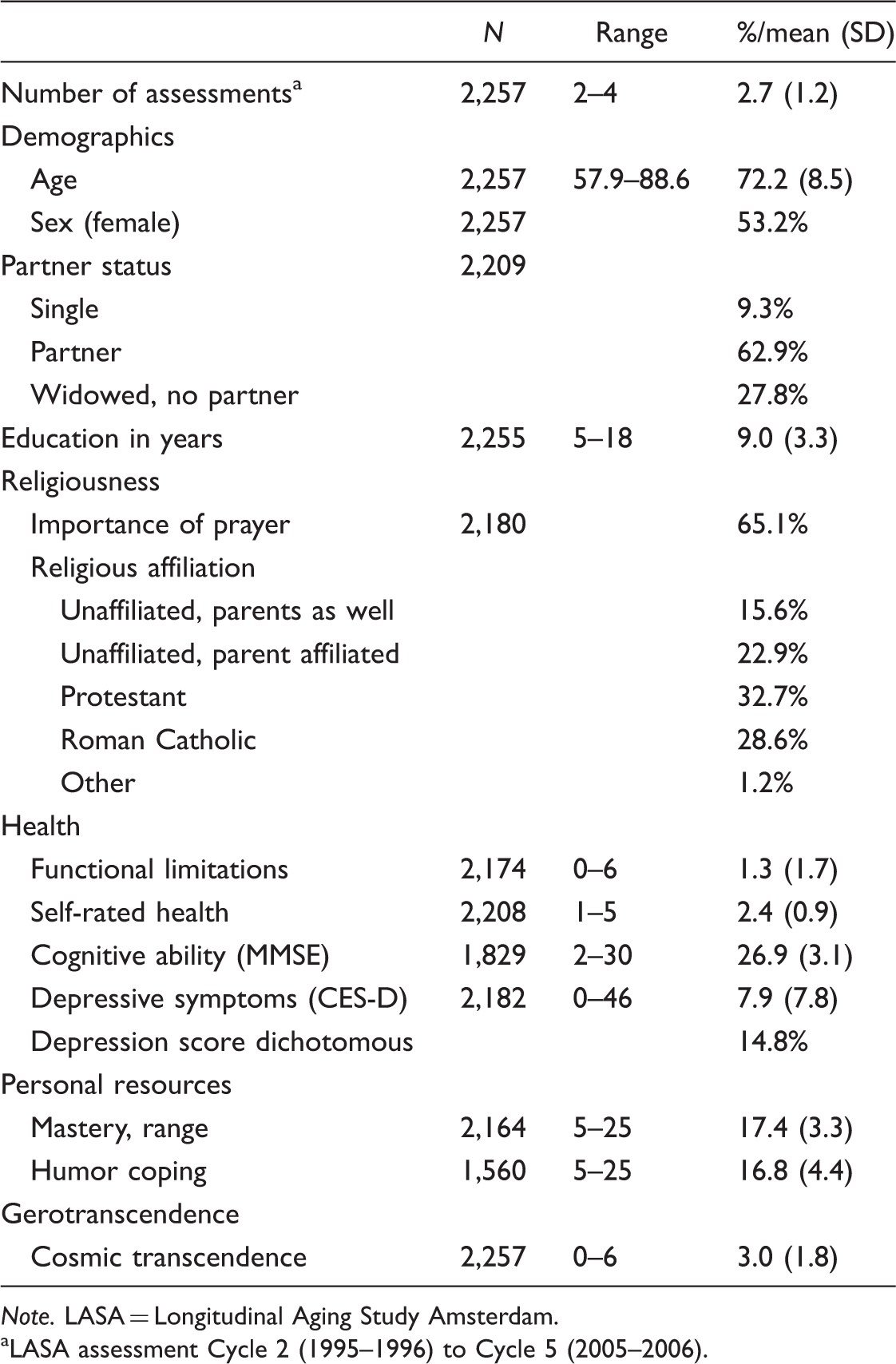
Note. LASA = Longitudinal Aging Study Amsterdam.
LASA assessment Cycle 2 (1995–1996) to Cycle 5 (2005–2006).
Mean Cosmic Transcendence Scores Over Time
There is hardly any change in the total sample mean levels of cosmic transcendence from 1995 to 2006, as is shown in Figure 1 (left). The scores in the oldest female group, that is, 75 and older, tend to decrease over time (which was significant, results on request). For male respondents who died during the study, there is a slight increase in scores in the group aged 65–74 (Figure 1, right).
Course of Cosmic Transcendence scores (range 0–6) over a 10-year period for three different age groups, for respondents who were still in the study at 10-year follow-up (left), and for those respondents who died, with last two assessments shown (right).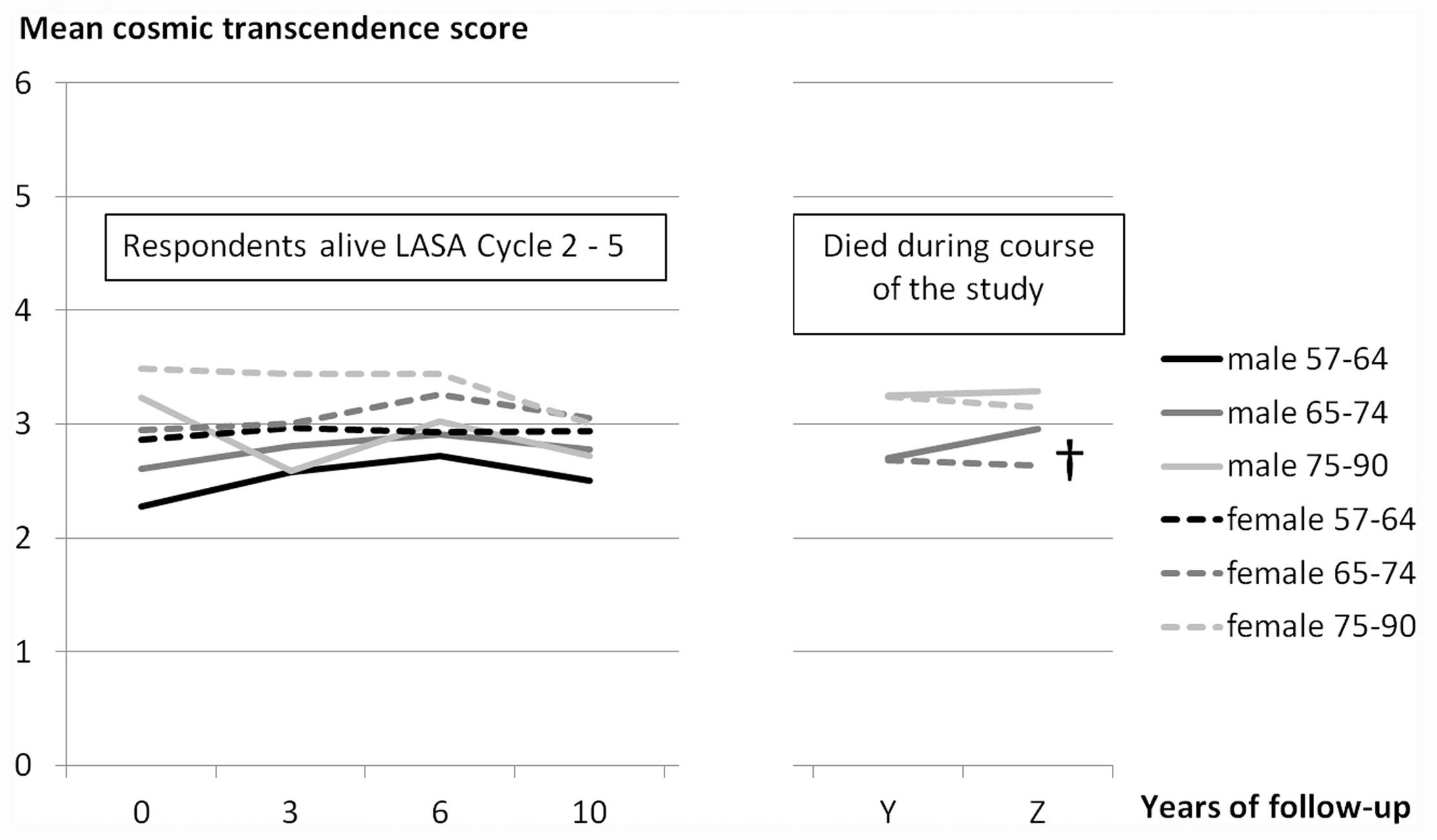
Latent Class Growth Analysis: Model Specifications
Latent Class Growth Analysis Model Specifications for Class Solutions Inspected up to Five Classes.

Note. BIC = Bayesian Information Criteria; VLMR: Vuong-Lo-Mendell-Rubin Likelihood ratio test: p value.
Three-class solution
Figure 2 illustrates the three trajectories of cosmic trasncendence scores as derived from the LGCA. The three classes identify “stable high,” “intermediate decreasing,” and “stable low” score trajectories. As is clear from the significant cubic slope (B = −0.005, SE = 0.002, p = .007), the intermediate trajectory shows a decrease of about one point on the cosmic transcendence scale between the last two assessments.
Course trajectories of cosmic transcendence scores (as derived from Latent Class Growth Analysis) over a 10-year period for respondents who completed at least two out of four assessments (N = 1,726); three-class solution, scores (range 0–6) are computed relative to the intercept of Class 3.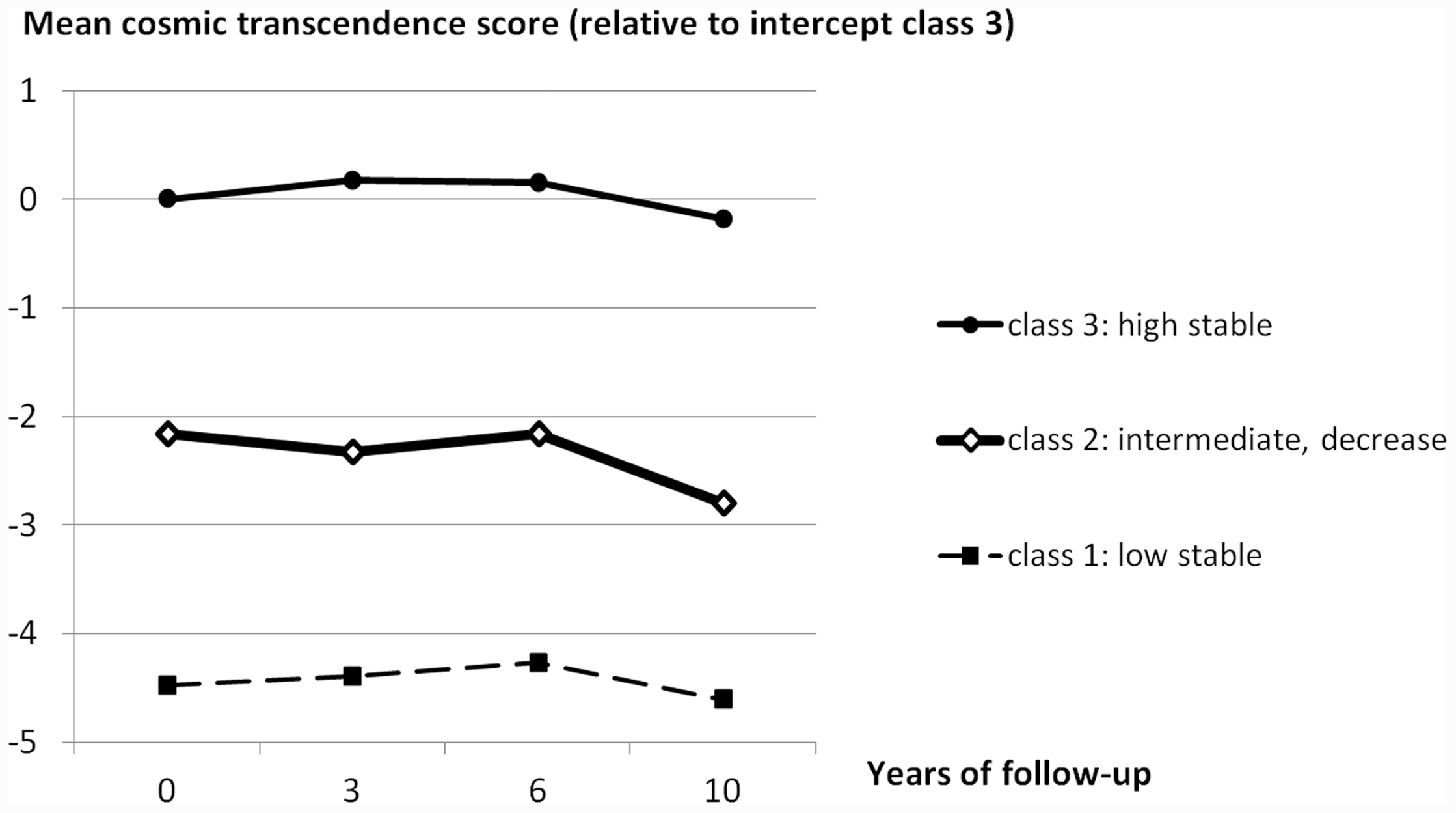
For the respondents who died during the study (N = 433), a two-class solution emerges as the optimal solution from the LCGA models. BIC for the one-class solution is 3,363 and decreases to 3,310 for the two-class solution (entropy .50). The linear slope parameters do not reach statistical significance, indicating that the trajectories represent stable levels of cosmic transcendence. The two classes can consequently be qualified as “stable high” and “stable low.”
Correlates of 10-Year Course Trajectories of Cosmic Transcendence
Multivariate Associations With 10-Year Trajectories of Cosmic Transcendence as Identified Using Latent Class Growth Analysis; Analyses Pertaining to at Least Two LASA Assessments From LASA Cycle 2 (1995–1996) to LASA Cycle 5 (2005–2006).
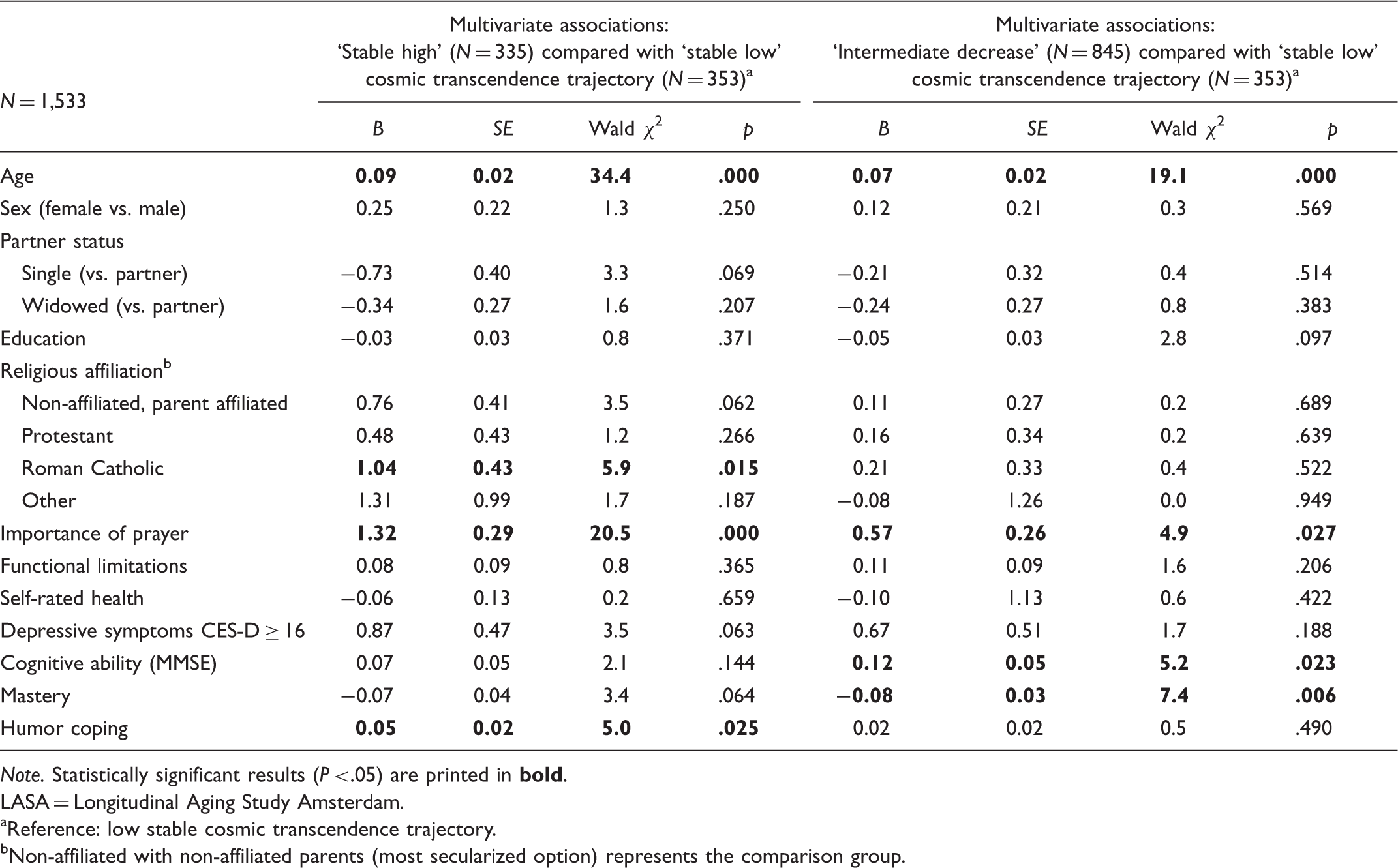
Note. Statistically significant results (P < .05) are printed in
Reference: low stable cosmic transcendence trajectory.
Non-affiliated with non-affiliated parents (most secularized option) represents the comparison group.
Correlates of Course Trajectories of Cosmic Transcendence Before Death
Multivariate Associations With 3-Year Trajectories of Cosmic Transcendence as Identified Using Latent Class Growth Analysis; Analyses Pertaining to the Last Two Assessments of the Respondents Before Death.
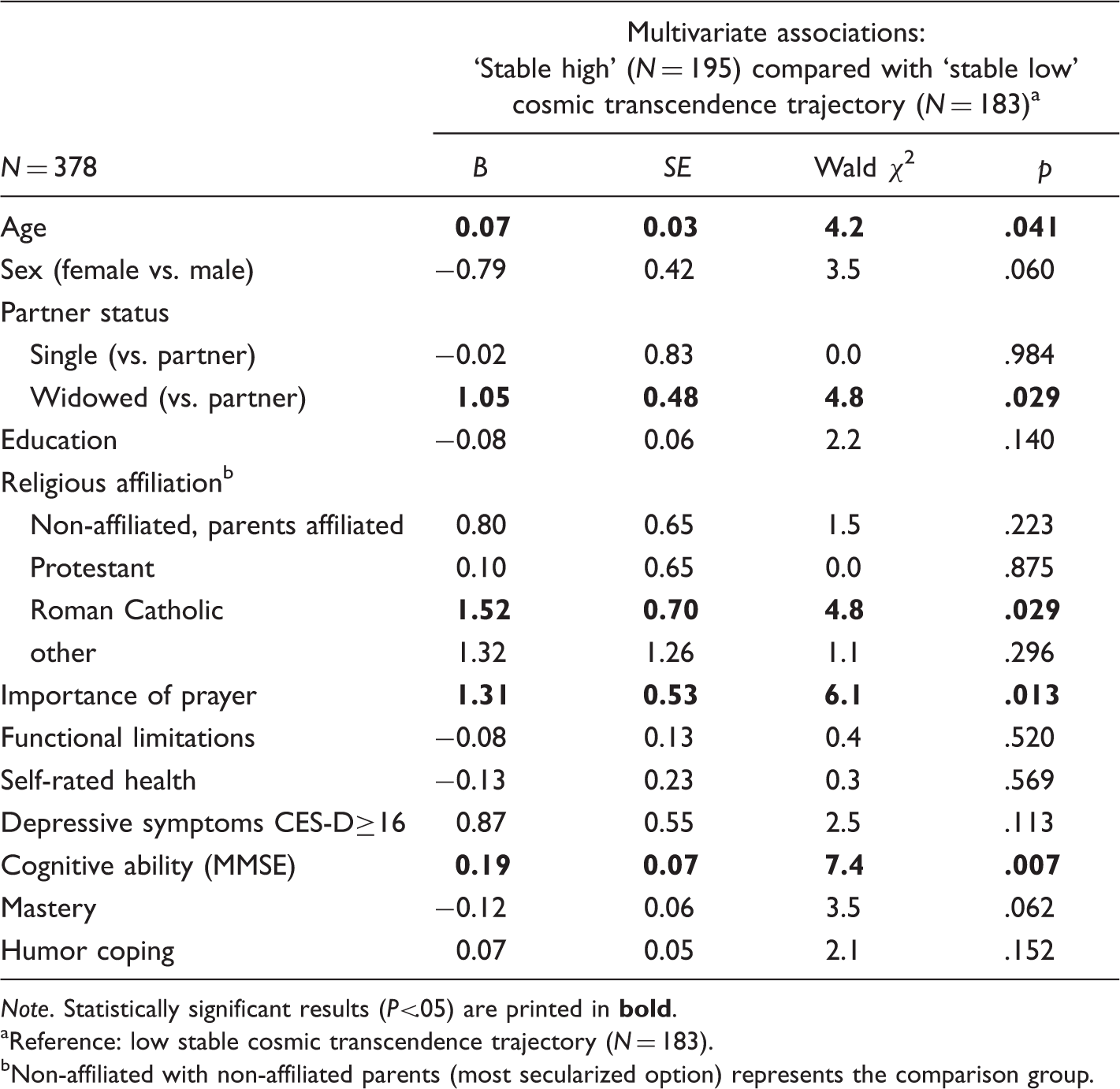
Note. Statistically significant results (P<.05) are printed in
Reference: low stable cosmic transcendence trajectory (N = 183).
Non-affiliated with non-affiliated parents (most secularized option) represents the comparison group.
Discussion
The current prospective study aimed to examine whether levels of cosmic transcendence exhibit any change over a 10-year period in older adults who live in the community in the Netherlands. The main result is clear: very few changes in cosmic transcendence can be demonstrated over time. The results do not differ substantially for respondents who died during the study. One out of four respondents exhibited positive answers on at least 5 out of the 6 items during the study. The oldest respondents had slightly higher scores. Certain considerations thus need to be addressed with respect to age, period, and cohort effects.
As regards age, an inevitable conclusion is that the current results do not support Tornstam’s assumption that gerotranscendence develops with rising age, at least not in old age. In a literature review, Dalby (2006) discusses several themes in studies that examine spiritual change or development including gerotranscendence. He finds some evidence of an increase in spirituality with age. These changes are, however, not exclusive to older age and are not universal but tend to be mediated by life experiences, gender, religiousness, and culture. For example, in a large European survey, Robinson (2013) describes that adults aged 40 or older had higher scores on a self-transcendence values scale than younger adults aged 20 to 40. In the adjacent field of wisdom research, no age differences are observed in levels of wisdom-related knowledge between 30 and 70 year olds (Ardelt, 2010; Smith & Baltes, 1990; Vaillant, 2002). Perhaps, the LASA respondents in the present study had already attained the gerotranscendent peak in their development when they entered the study.
The second consideration pertains to possible period effects. During the lives of the respondents, society has changed with respect to religious involvement. The process of secularization has been ongoing in the Netherlands since the 1950s (de Hart, 2014). Moreover, religious disaffiliation may relate to a society’s level of rationalization, which is enhanced by higher average educational levels (te Grotenhuis & Scheepers, 2001). A speculation that requires further study is that secularization, along with rationalization, may attenuate the development of gerotranscendence.
Third, cohort differences may explain the current finding that the oldest respondents still have significantly higher cosmic transcendence scores. Perhaps, socialization in a religious tradition facilitates a gerotranscendent development. Religious affiliation, religious upbringing, and the perceived importance of prayer have thus been included in the multivariate models: the association with age, however, remains significant. Formative experiences other than the religious climate in early life might have made it easier for the older cohorts to attain cosmic transcendence during their lifetime.
So in summary, the presumed age-period-cohort components can be combined as follows. According to the cohort effect, all the older adults in the current study (born in 1907–1937) may have grown up during a period when world-view and ideological commitment were important social phenomena, and pertained to more than religious affiliation or a tendency to contemplate. According to the aging effect, individuals may develop a cosmic transcendent view of life in adulthood before the age of 55. According to the period effect, this process can have been disturbed by the ongoing secularization that started in the 1950s. An unresolved question, however, is why the cosmic transcendence scores in the intermediate trajectory decrease during the observation period. Perhaps, a decrease in cognitive abilities is in effect here—a correlate of cosmic transcendence not yet described in research studies, although this effect has been hypothesized in wisdom-related knowledge (Staudinger, 1999).
Other correlates of cosmic transcendence that remain significant in the multivariate models are Roman Catholic church affiliation, low levels of mastery and high levels of humor coping. The positive association with Roman Catholicism is also observed in another study in the Netherlands (Braam et al. 2010). Some cosmic transcendence items such as the connection with the universe might bear mystic connotations, which are perhaps more easily recognized by Roman Catholics than Protestants or non-church members. This finding supports the hypothesis by Ahmadi Lewin (2001) that the development toward gerotranscendence may be stimulated by a cultural setting where mystical-type ideas are integrated into people’s ways of thinking.
The association between a low sense of mastery and somewhat higher levels of cosmic transcendence scores may give rise to further questions. This finding shows statistical significance for the “intermediate decreasing” trajectory, whereas it reaches the level of a statistical trend for the “high stable” trajectory (also among those who died during the study). Perhaps, gerotranscendence only develops if an individual tends to accept aging and is able to defer control. This could also be understood as “surrendering” to late life adversity, or as a step toward realism and meaning in life. In this way, the theory of gerotranscendence challenges paradigms of “successful aging,” which centers around an active life and a high level of physical and mental abilities (Rowe & Kahn, 1987). Some authors described an association between higher levels of well-being and cosmic transcendence (Wang, 2011), albeit that the findings with respect to depressive symptoms are mixed (Braam et al. 2006; Tornstam, 1994; Wang, Lin, & Hsieh, 2011). The current study does not show an association between high levels of depressive symptoms and cosmic transcendence.
Humor coping acts as a modest correlate of cosmic transcendence. Although humor turns up in Joan Erikson’s considerations about gerotranscendance, Tornstam does not mention it as a core feature in his introduction of the concept (1994). However, in one of his qualitative studies, Tornstam (1999) identifies the theme of “emancipated innocence.” This “innocence” can be understood as breaking away from role expectations, regardless of social conventions. For example, gerotranscendent people do not care about making a fool of themselves. In other words, they are able to admit that conceding ignorance is far from foolish. If older adults already tend to cope with humor, the capacity for “emancipated innocence” may be more easy to develop.
The cosmic transcendence items might be perceived as difficult to comprehend. However, the LASA respondents did not object to the cosmic transcendence items. Some of the interviewers even characterized the atmosphere in this part of the interview as tranquil. In spite of this anecdotal evidence, the question remains as to how to conceive of “cosmic transcendence” or “transcendence” as such. Baumeister (1991) identifies four needs for meaning: purpose, moral worth, self-worth, and competence (i.e., efficacy or perceived control). In the tradition of humanist reasoning, Derkx (2013) suggests adding three more needs for meaning derived from various sources: comprehensibility, connectedness, and transcendence. Derkx draws distinctions between three aspects of transcendence. First, transcendence can be conceived as a relation to another person (or entity) who, being fundamentally different from me, transcends my personal perspective. Second, transcendence implies ethical values that transcend self-interest and also provide targets in life. Third, transcendence may consist of amazement and excitement, for example, curiosity about the unknown.
The cosmic dimension of gerotranscendence is likely to relate to all three aspects of transcendence as characterized by Derkx. In part, this relatedness reflects a religious approach to transcendence: in relating to others (or the Other), to values and to amazement. However, one would not expect that a religious component of cosmic transcendence is entirely determined by age. What specific aging element would be unique for cosmic transcendence? Given its definition and its operationalisation, cosmic transcendence is about transcending the general perception of aging, generations, life, and death. Possibly, the gerotranscendent adult transcends one of the other needs of meaning: the need for comprehensibility, as far as it pertains to the comprehensibility of the individual experience of aging. Aging adults may attain a sense of relativism of the fundamental incomprehensibility of aging. For a more profound understanding of the meaning of transcendence and aging, it might be valuable to examine different facets of transcendence with respect to their age-specificity, employing a qualitative empirical design.
Some limitations need to be discussed. First, a disadvantage of the first version of the cosmic transcendence scale, as applied in LASA, is that two items include a comparison with the age of 45 in retrospect. This retrospective comparison requires a personal recollection and a judgment about personal change that is not always accurate (Pearson, Ross, & Dawes, 1992). The type of questioning in the two cosmic transcendence items can even evoke an ambiguous response: “When I was 45, I already had this view on life.” This retrospective component was omitted in a later version of the scale (GT2; Braam et al., 2006; Tornstam, 1997). Newer gerotranscendence scales also feature more response options than only yes or no. As to the representativity of the current study, one limitation pertains to its non-response rate. The initial response rate was 60%. The frailest older people participated less often than the “healthy well.” Nevertheless, the response to the follow-up assessments is high (Huisman et al., 2011), which facilitates a close monitoring of the process of aging. In addition, it was possible to focus some analyses on the last two measurements before death. Another concern pertains to LGCA as a choice out of a considerable variety of sophisticated techniques for longitudinal analysis. As an advantage, the classes as identified by LCGA in the current study can be considered appropriately illustrative. This is at the expense of statistical variation in examining associations with independent variables. However, preliminary analyses employing Generalized Estimating Equations, maintained the variation in cosmic transcendence scores and produced a similar pattern of associations.
Implications and Future Directions
In keeping with the results of studies on wisdom and aging, cosmic transcendence does not seem to increase with age in the older population. The paradigm of gerotranscendence is nevertheless provocative and demands an innovative view on aging. The operational definition of gerotranscendence still shows development. Gondo, Nakagawa, and Masui (2013) identify two probably new and relevant aspects of gerotranscendence among older Japanese adults including the oldest-old up to age 99. The first is “transcendence from dualism,” implying carefulness with judgements about good or bad. This bears a similarity to value relativism as a trait of wisdom as defined by Smith and Baltes (1990). The second pertains to “letting go,” an even more explicit manifestation of transcending the need for control. As a recommendation, future studies might benefit from examining the varieties of transcendence starting in younger cohorts and following them into old age. Possible overlaps with wisdom, religiousness, and secular spirituality deserve a more profound in-depth study.
Furthermore, the current study provides empirical evidence that one out of five community-dwelling older adults is able to maintain high levels of cosmic transcendence for at least 10 years. Some studies explored the possibilities for recognition of gerotranscendence among younger adults and professional caregivers (Buchanan, Lai, & Ebel, 2015; Wadensten & Carlsson, 2007). The current longitudinal findings may provide further motivation to inform caregivers about recognizing and possibly accomodating the contemplative and gerotranscendent frame of mind, at least for a substantial minority of older adults.
Previous Presentations
The results were presented at the 20th World IAGG Congress of Gerontology and Geriatrics, Seoul, Korea, on June 24, 2013.
Footnotes
Acknowledgments
The authors would like to thank Professor Geert P.A. Braam, sociologist (†1930–2013), for his constructive comments, marked by age, on the results of the current study.
Declaration of Conflicting Interests
The authors declared no potential conflicts of interest with respect to the research, authorship, and/or publication of this article.
Funding
The authors disclosed receipt of the following financial support for the research, authorship, and/or publication of this article: This work was supported by the Netherlands Organization for Health Research and Development (Zon-MW grant 2003-05769) and received additional funding from Altrecht Mental Health Care, Den Dolder, the Netherlands. The data have been collected in the context of the Longitudinal Aging Study Amsterdam, which was funded primarily by the Netherlands Ministry of Health.