







Abstract
Recent research on the decision-making abilities of older adults has shown that they use less information than young adults. One explanation ascribes this age difference to reductions in cognitive abilities with age. The article includes three experimental studies that focused on determining the conditions in which older and young adults would display dissimilar information processing characteristics. Findings from Studies 1 and 2 demonstrated that older adults are not necessarily at greater disadvantage than young adults in decision contexts that demand more information processing resources. Findings from Study 3 indicated that older adults when faced with decisions that require greater processing are likely to use a strategy that reduces the amount of information needed, whereas younger adults rely on strategies that utilize more resources. Combined the findings indicate that older adults change their decision-making strategies based on the context and information provided. Furthermore, support is provided for processing difference.
Introduction
Young adults and older adults make numerous decisions each day, some of which are relatively mundane, such as what to eat for dinner; whereas others are more complex and can have a profound effect on health and quality of life, such as financial or medical treatment decisions. Hanoch, Wood, Barnes, Liu, and Rice (2011) found that increased complexity is associated with older adults making poorer decisions. Research on the decision-making processes of older adults has consistently shown that older adults use less information than younger adults (Johnson, 1993, 1997; Mata & Nunes, 2010; Meyer, Russo, & Talbot, 1995; Riggle & Johnson, 1996; Walsh & Hershey, 1993). Although several theories have been posited to help explain this, the limited cognitive resources theoretical perspective has gained the most attention. According to this explanation, older adults use less information in order to conserve limited cognitive resources (cf. Meyer et al., 1995). In the present investigation, three studies focused on developing experimental conditions that reduce the need for cognitive resources, and as such, determining if differences between older and younger adults’ information processing are reduced under certain constraints.
Research on aging and decision making has consistently shown that younger and older adults differ in how they process information. For example, studies have shown that older adults are less selective in the information they consider (Rafaely, Dror, & Remington, 2006), consider less information (Thornton & Dumke, 2005), perform poorer (Mata, von Helverson, & Rieskamp, 2010), and focus on different information or modify information search under certain conditions (Kim, Healey, Goldstein, Hasher, & Wiprzycha, 2008; Lockenhoff & Carstensen, 2008). Mikels et al. (2010) found that when participants were instructed to focus on information, younger adults performed better than older adults. Research has shown that older adults are often aware of these differences. For example, de Bruin, Parker, and Fischhoff (2010) found that older adults reported that they are poorer at decision making. They argued that these declines in basic cognitive abilities can lead to impaired decision making. Furthermore, Queen, Hess, Ennis, Dowd, and Gruhn (2012) suggested that compared with younger adults, older adults may limit themselves to simpler information sets. This is an adaptive approach to decision making because older adults focus on the most relevant information and thus reduce information processing demands.
The most comprehensive study of aging and information processing was a meta-analysis conducted by Mata and Nunes (2010) which confirmed that older adults use less information than younger adults and that the age differences increase when there is a greater need for cognitive resources. They concluded that additional research is needed that examines how the context of decisions (e.g., number of alternatives to decide among) increases or decreases age-related changes in information processing. This supports our argument that modifying the context or parameters of a decision will have an impact on age-related differences in information processing.
In their discussion of factors that influence the decision processes of young adults, Payne, Bettman, and Johnson (1993) suggested that various information contexts differentially affect information acquisition and evaluation. Several recent studies have offered empirical support for this. Brand and Markowitsch (2010) found that age differences in decision making were moderated by the degree ambiguity associated with the decision. Two additional studies have shown that older adults prefer to have small choice sets when making decisions (Mikels, Reed, & Simon, 2009; Reed, Mikels, & Simon, 2008). Others have found that choice set influences information use and search patterns for older adults (Frey, Mata, & Hertwig, 2015). These differences may be rooted in age-related declines in information processing. As such, when task difficulty is increased by manipulating the type or amount of information, decision makers will search a smaller proportion of information and have a greater tendency to base their alternatives on simple rather than complex decision rules (Abelson & Levi, 1985). Given older adults’ limited cognitive resources, age differences should be reflected in the amount of information reviewed as well as variability and organization of information search strategies. However, in supportive decisional contexts (e.g., where the need for information processing is reduced), older adults should perform more similarly to younger adults.
In the present set of studies, the context of a decision task was manipulated so that the cognitive resources required to make a decision were taxed or not. The three studies capitalize on task manipulations that influence participants’ information acquisition and evaluative processing of information to distinguish between the two explanations. In Study 1, the type of information was manipulated such that in one condition, comparative information was presented, and in the other, specific details about each alternative was presented. It was hypothesized that older and younger adults would perform similarly in the evaluative information condition; however, when given specific details about the decision alternatives, age differences would emerge. In Study 2, the amount of information was manipulated. It was hypothesized that both younger and older adults would conduct a comprehensive search of information when two alternatives were presented but when a larger number of alternatives were presented, younger adults would conduct a more exhaustive information search. In Study 3, the availability of information was manipulated which was hypothesized to differentially affect the tendency of participants to draw inferences regarding missing information.
Study 1
The purpose of this study was to examine the impact of type of information available during the decision-making task on performance. A two (age-group) by two (information type) experimental design yielded data using a multialternative, multiattribute decision-making task.
Method
Participants
Forty-one college-aged adults (M age = 22.2 years, SD = 4.70; 31 women, 10 men) recruited from behavioral science and psychology courses at a large public university comprised the young adult sample. The older adult sample consisted of 41 retirement-aged adults (M age = 66.4 years, SD = 4.10; 24 women, 17 men), recruited from a volunteer participant pool of older adults.
Procedure
Upon providing informed consent, participants were randomly assigned to experimental conditions. In one condition, the information table contained specific information describing alternatives. This required participants to view additional information in order to compare the alternatives. In the second condition, comparative rankings were provided (such as best and worst) which meant that participants did not have to compare the alternatives.
Data were collected one-on-one in a single session that lasted about an hour. A laptop computer presented stimulus materials and recorded responses. A research assistant was present throughout the task to answer questions. Participants first completed a practice task involving renting one of two apartments, and then they began the experimental decision task that involved buying a car. A table with six columns labeled Car 1 through Car 6 and nine rows labeled attributes lettered A through I was presented. Under the matrix, participants were prompted to enter a letter (A–I) corresponding to one of the listed attributes and to enter the number (1–6) for a particular car in order to request a piece of information. At the bottom of the screen participants were prompted to press the space bar to continue and to type READY when they wanted to make the decision.
Participants viewed as much information as they wished in deciding which car they would prefer to buy. Once a piece of information had been viewed, the cell was marked with three asterisks; however, they could review the information. The attribute and alternative stimuli were arranged such that no car represented the “best” alternative.
The computer recorded the sequence of information requests, time measures, and the final choice. From this record, several dependent measures were derived. There were two time measures: total time to decision (measured from the appearance of the information matrix until a decision is made) and time per piece of information (mean calculated from the seconds spent viewing information divided by the total number of information cells accessed). The proportion of information used was calculated from the number of cells accessed divided by the total amount available. Strategy measures have two components: the organization of information searches and the variation of information accessed across alternatives. Organization is operationalized as (repetitions of attributes – 1) divided by (information viewed – 1) and (repetitions of alternatives – 1) divided by (information viewed – 1). The second strategy measure was the standard deviation of the proportion of information accessed across alternatives. Because the above measures indexing time, information use, and strategy reflect distinct theoretical constructs that will be differentially affected by task manipulations and age-related differences in cognitive functioning, analyses were completed separately (instead of performing a single omnibus multivariate analysis of variance) with alpha level set at .05.
Following the experimental task, participants answered a series of questions which provided demographic information and individual difference measures. The 30-item forced-choice Memory Self Report (Reige, 1983) measured participants’ self-perceptions of memory functioning. The Shipley Institute of Living Scale (Shipley, 1967) administered via paper or pencil and measured vocabulary and abstraction skills. It contains 40 multiple-choice vocabulary items and 20 series completion problems. Scores ranged from 0 to 40 for each subscale.
Results
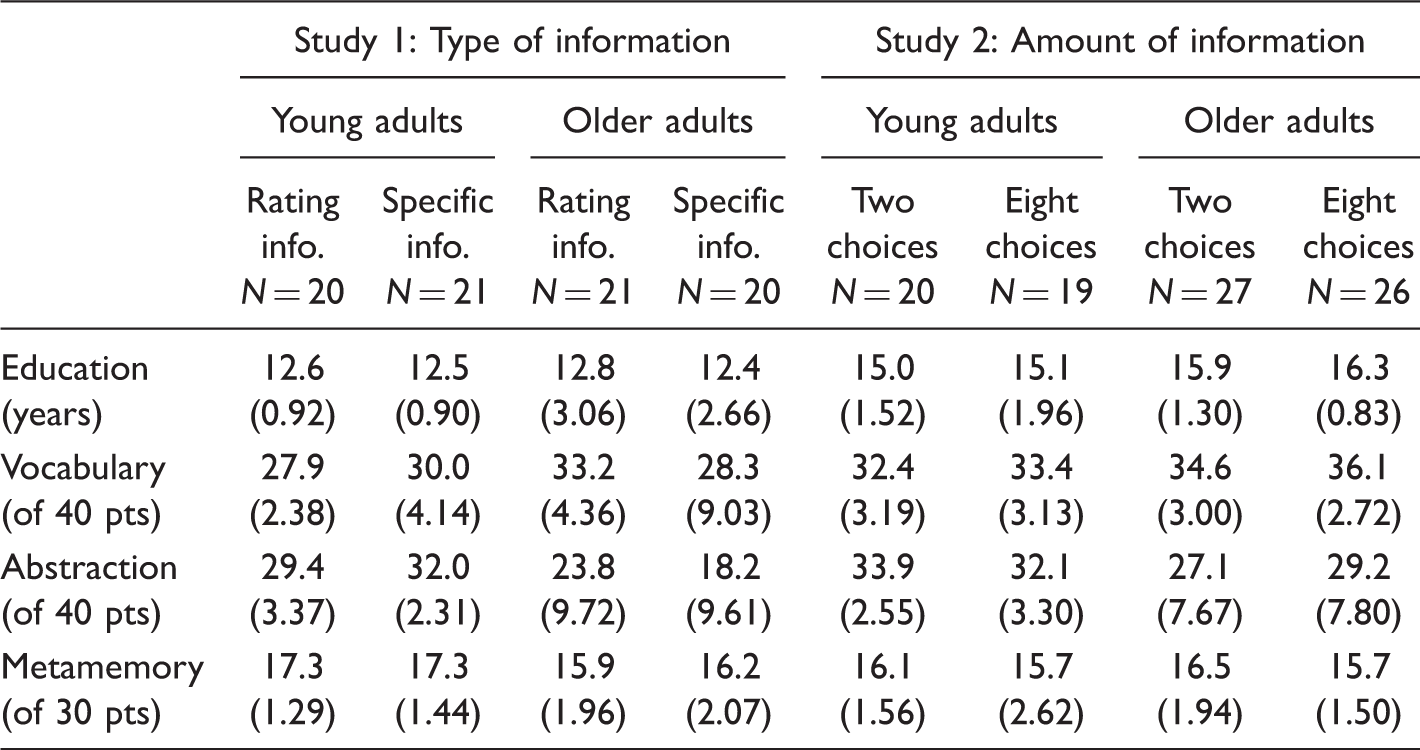
Means and Standard Deviations for Measures Describing Samples in Study 1 and Study 2.
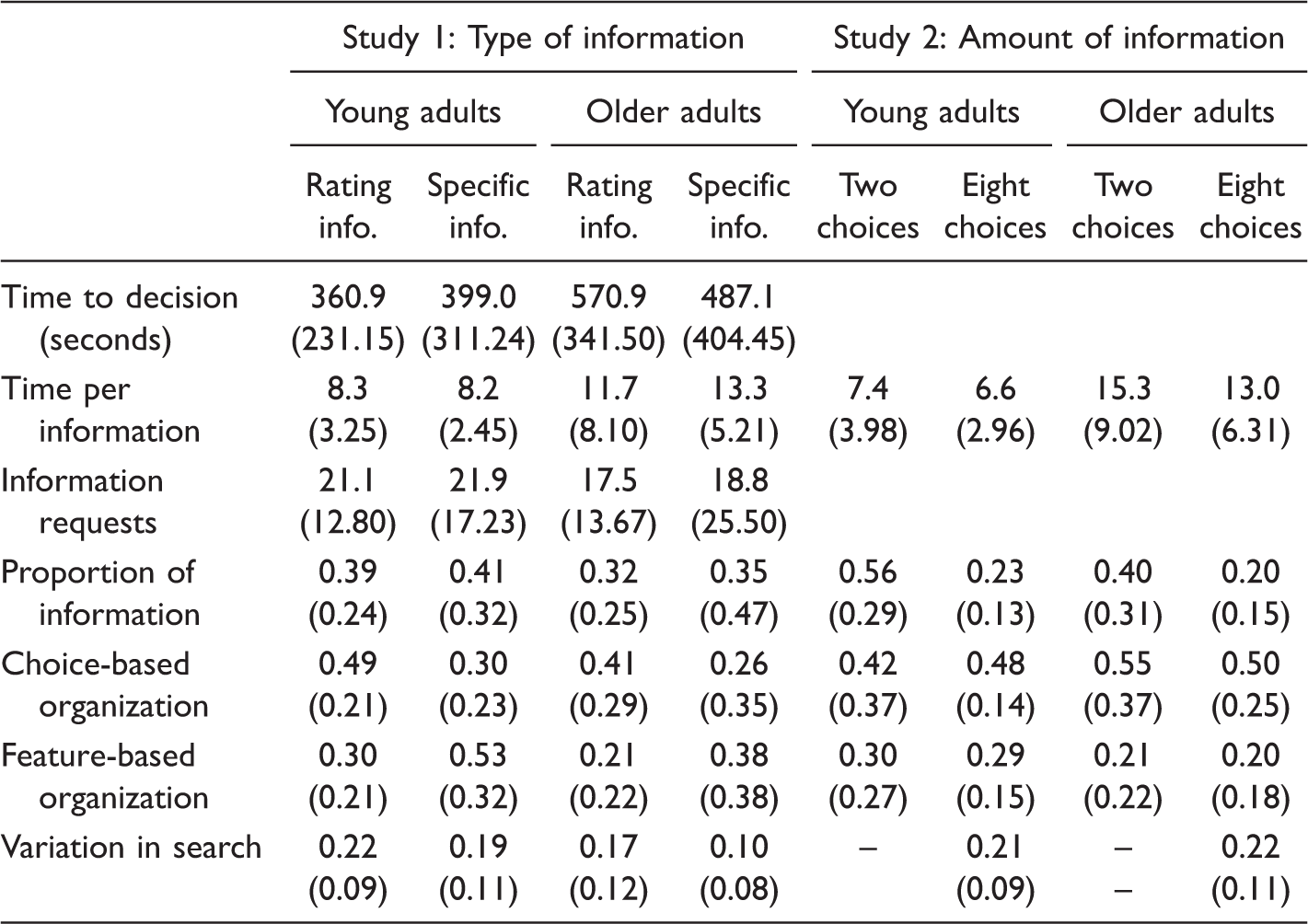
Means and Standard Deviations for Measures of Decision-Making Performance in Study 1 and Study 2.
Before further analyses, participants’ who requested fewer than six pieces of information (the number of alternatives in the decision task) were excluded. Use of too little information is problematic for the indices of organization and variation of information research patterns. Two young adults, one in each condition; and seven older adults, five in the specific information condition and two in comparative information condition were excluded. Excluding participants did not change the pattern of findings related to sample characteristics or decision-making performance.
An two (age) and two (condition, between-subjects factors) and two (measure-alternatives vs. attributes; within-subjects factor [ANOVA]) showed a main effect of age on the organization of information searches, F(1, 69) = 5.04, p = . 05 (see Table 2) and a significant interaction between the organizational measure and condition, F(1, 69) = 12.54, p = .01. Younger adults and older adults changed the way they organized their information search depending on whether the information available was specific or comparative. Finally, an age-group by condition ANOVA indicated that age influenced the variation in the information searched, F(1, 69) = 24.41, p = .01 (see Table 2), such that older adults were more consistent in the amount of information they reviewed across alternatives.
Discussion
Consistent with findings from Payne et al. (1993), Study 1 showed that younger and older adults adopt a strategy to fit the task. When given specific information, participants tended to search by attributes; however, when given within-group comparative ratings, they searched by alternatives. As the evaluative step had been completed in the comparative condition (i.e., alternatives rated best to worst), they organized their information acquisition more efficiently, considering several attributes for each alternative at once. Participants (in both age groups) confronted with specific information had to assess which was “best in group” searching additional information to provide a context for evaluation.
It was predicted that older adults (at an information processing disadvantage due to limited cognitive resources) would be at a greater disadvantage in the condition with the specific information rather than the ratings. Although findings failed to support the limited cognitive resource explanation, it should be noted that the study was designed to detect large differences in the proportion of information used. In fact, the manipulation may be too weak to detect subtle differences in information use due to limited cognitive resources. For this reason, a stronger manipulation of the information context was used in Study 2.
Study 2
The purpose of this study was to explore age-related differences through manipulating the amount of information. The amount of information was varied by having participants choose between two apartments or from among eight apartments. It was anticipated that older and younger adults would perform similarly on the two-apartment task, but that younger adults would perform better on the eight-apartment task, such findings would support the limited cognitive resource explanation for strategy shifts and potential age differences in decision-making performance.
Method
A two (age-group) by two (two-apartment vs. eight-apartment alternatives) design yielded data in a similar paradigm as that of Study 1. The dependent variables and measures characterizing the samples were the same as in Study1.
Participants
None of the participants in Study 1 participated in Study 2; however, participants were recruited in an identical fashion. Thirty-nine young (M age = 23.0 years, SD = 4.39; 12 women, 27 men) and 53 older (M age = 66.5 years, SD = 4.89; 25 women, 28 men) adults participated in this study.
Procedure
Procedures were identical to those of Study 1. However, during the practice session, participants practiced making information requests but information was not displayed in order to reduce the chance that participants would adopt a strategy before encountering the experimental task. To examine information, participants entered a number corresponding to one of two- or eight-apartment alternatives. Then they entered a letter (A–L) corresponding to one of the apartment’s attributes (e.g., brightness of rooms, closet space, landlord attitude, kitchen facilities) listed on the table of information. Information available to participants’ included comparative ratings (e.g., small-sized rooms) and specific values (e.g., rent per month). After the decision task, participants answered demographic questions and completed the Shipley Institute of Living Scale (Shipley, 1967) and Memory Self Report (Reige, 1983).
Results
The samples are described in Table 1. Younger and older adults differed in that older adults had more education, F(1, 88) = 13.04, p = . 01 and better vocabularies, F(1, 88) = 15.29, p = .01. There were no significant interactions or main effects associated with assignment to experimental conditions.
Table 2 contains the means and standard deviations for the dependent measures. Because of the disparity in experimental conditions, total time to decision and number of information requests are not meaningful. A two (age-group) by two (two-, eight-apartment alternatives) ANOVA showed a significant main effect of age on time spent viewing each piece of information, F(1, 88) = 28.11, p = .01, with no significant interaction or main effect for experimental condition. Older adults spent nearly twice the time viewing each piece of information as young adults (roughly 7 compared with 14 seconds). A two (age-group) by two (two, eight-apartment alternative condition) ANOVA using the measure of the proportion of available information used showed a significant main effect for experimental condition, F(1, 88) = 28.14, p = .01, with no significant interaction or main effect of age. When confronted with a large amount of information for processing, young and older adults used proportionally less information.
Before analyzing decision-making strategies, 12 protocols (three younger and nine older adults) which used fewer pieces of information than the number of choice alternatives available were excluded. Variation measures were not calculated for the two-apartment condition (a standard deviation calculated across two observations would not be meaningful). Comparison of excluded older adults to other older adults revealed that excluded participants scored lower on the abstraction subscale (Mexcluded = 22.2, Mincluded = 29.4, t(51) = 2.67, adjusted for unequal variances).
Table 2 contains means and standard deviations for measures highlighting participants’ use of information search strategies. An age by condition by organizational measure (attribute based vs. alternative based), with repeated measures on the latter, ANOVA failed to reveal a main effect of age or condition, or any interactions for search strategies. Instead, a significant main effect for type of measure (attribute based vs. alternative based) indicated that participants organized their information searches according to apartments, F(1, 76) = 17.88, p = .01. No effects other than those reported for the ANOVAs above were significant.
For participants in the eight-apartment condition, an ANOVA of the variation information search across alternative using age as a between-subjects factor showed no significant effects. Organizing searches by apartment was associated with more variability, r(80) = .41, p = . 01, that is, use of a satisficing rule; and organizing searches by attribute was associated with less variability, r(80) = −.23, p = .05).
Discussion
In examining the effects of number of alternatives and age on decision processes and strategies, there were main effects for age and task but no interaction effects. Consistent with other studies (Johnson, 1990, 1993, 1997; Riggle & Johnson, 1996), older adults spent more time on average with each piece of information than younger adults. More importantly, the harder task of choosing one from among eight apartments reduced the proportion of information considered. These findings suggest that younger and older adults may not differ in their overall response to increasing task difficulty. When choosing between two apartments, they searched about the same amount of information and in a similar fashion with little variation in the information searched across the apartments. However, when choosing one from among eight apartments, younger and older adults reduced the amount of information—consistent with an increase in the variability of information searched. This is similar to research by Queen et al. (2012), who reported that both younger and older adults adjust their search strategy when tasks get more complex. This measure is the hallmark of strategies in which alternatives are eliminated as quickly as possible on the basis of limited information, while the remaining alternatives are considered more fully.
Study 3
The purpose of this study was to examine the impact of availability of information on age differences in decision making. In contrast to the manipulations employed in Studies 1 and 2, this manipulation does not directly tax cognitive resources but rather examines the ability of participants to employ strategies that conserve cognitive resources.
When information is missing, individuals who use a “top-down” or deductive approach will infer the value of the missing information based on other information available on the alternative (Payne et al., 1993); their information search patterns are well organized. Top-down processors also used more heuristic decision strategies; their information search patterns show greater variability as they use noncompensatory decision rules such as elimination by aspects and satisficing. In contrast, bottom-up processors will retain their information-intensive processing strategies. We hypothesized that older adults would use less information in making decisions because they engage in top-down processing which requires less information; in contrast, younger adults would engage in bottom-up processing which is an information intensive processing strategy (cf., Hershey, Walsh, Read, & Chulef, 1990; Walsh & Hershey, 1993).
Method
A two (age-group) by three (information condition) design yielded data on the decision-making processes as participants chose which one of eight apartments they preferred to rent. The three information conditions included a complete information (control) condition and two conditions in which 25% of the information was missing. In one condition, the missing information was the most relevant information (cost, location, neighbors, and floor or décor) for the decision as determined by the most frequently used information in previous studies. In the other, the least relevant information, defined as the least frequently used information in previous studies, was missing (parking, appliances, square footage, and management). The frequency of information use was determined using data from a previous study (Johnson, 1997). Additional data were collected on participants’ educational level, vocabulary, and abstraction skills (Shipley, 1967), perceived memory abilities and frequency of problems (Crook & Larrabee, 1992), and need for cognition (Cacioppo, Petty, & Kao, 1984). Dependent measures were identical to those of Studies 1 and 2.
Participants
Sixty-seven young adults were recruited from undergraduate liberal arts courses. Fifty-eight older adults were recruited from a volunteer participant pool of older adults. The mean age of the young adults was 21.5 years (SD = 2.32); the mean age of the older adults was 72.3 years (SD = 7.36). All participants were paid $10 for their participation and randomly assigned to one of the three different conditions.
Procedure
Participants participated individually using a laptop computer. Participants received an oral overview and demonstration of the decision task. The decision task involved choosing one apartment from among eight that the participants would prefer to rent. In the missing information condition, participants were told that sometimes the information they requested would not be available. Information was organized in an eight by eight matrix with numbers for the apartments labeling the columns and attributes labeling the rows (management, neighbors, square footage, location, floor or décor, appliances, parking, and cost). To view a piece of information, participants moved the cursor to a cell of the matrix and pressed the enter key. When finished reading the information, participants pressed the backspace key; thus marking that cell with an asterisk to denote that it had been viewed. Participants could view as much or as little information as they wished before making their decision.
At any time during the task, participants had an OVERVIEW, REVIEW, and DECISION option available to them. The overview option permitted participants to reread the introductory description of the task and instructions regarding how to use the computer. The review option displays cues for information from the matrix cells with asterisks. This REVIEW function is in the form of a computerized note pad—by showing cues for all the information previously accessed at the same time. The cues are five character words or abbreviations designed to capture the essence of information contained in each cell of the matrix. The decision option is used when participants finish their information gathering; using the cursor to highlight their alternative from a list, they press the enter key to complete the task.
After the experimental task, data were collected to characterize each sample. The Shipley Institute of Living Scale is the same test as used in Studies 1 and 2. Four subscales of the Crook and Larrabee (1992) metamemory scale were included. Seven items assessing everyday task-oriented ability and spatial memory ability were included (rated on a 5-point scale). Nine items assessing the frequency of problems (1 = very rarely and 5 = very often) with attention or concentration, and everyday tasks were included. The need for cognition scale (Cacioppo et al., 1984) was included to assess participants’ motivation for the task. It contains 16 statements rated on a 5-point scale (1 = extremely uncharacteristic of me and 5 = extremely characteristic of me).
Results
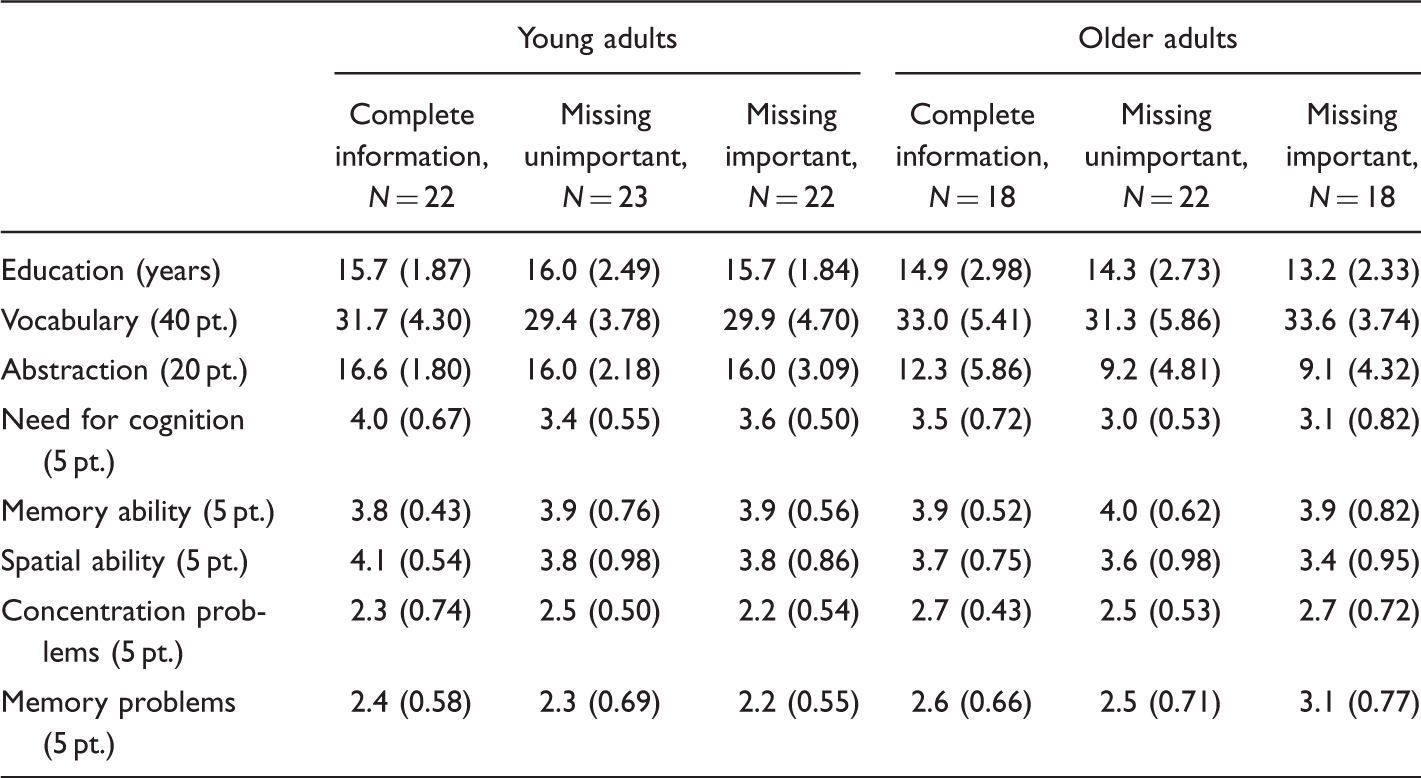
Means (and Standard Deviations) for Measures Describing Study 3 Sample.
Means (and Standard Deviations) for Decision Performance Measures in Study 3.
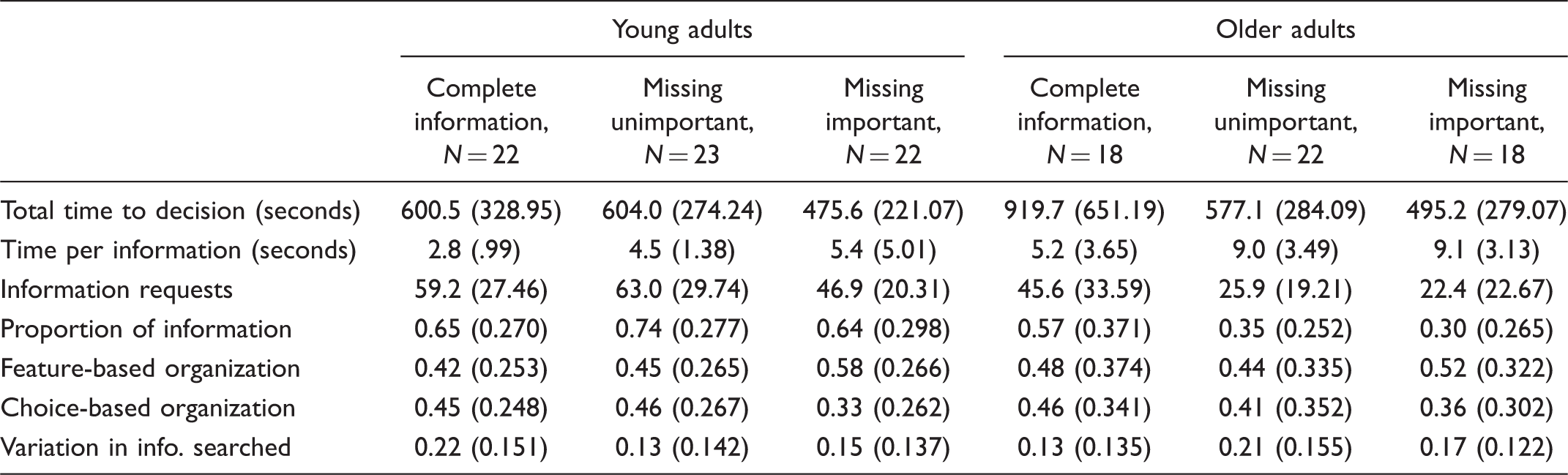
A series of two (age-group) by three (information condition) ANOVAs were conducted on measures of decision speed and information use (see Table 4 for means and standard deviations). Older adults spent longer viewing each piece of information, F(1, 119) = 36.49, p = .01. Older adults made fewer information requests, F(1, 119) = 29.14, p = .01 and used a smaller proportion of available information, F(1, 119) = 27.21, p = .01. There were also main effects for information condition such that participants in both missing information conditions took less time to make their decisions, F(2, 119) = 5.97, p = .01, but spent more time viewing each piece of information, F(2, 119) = 11.76, p = .01. Participants in the missing conditions also made fewer information requests, F(2, 119) = 4.69, p = .05. In addition, there was a significant interaction for the proportion of information used, F(2, 119) = 3.60, p = .05, indicating that older adults in the missing information condition used significantly less information than older adults in the complete information condition and young adults in all conditions.
Two older adults and one young adult used less than eight pieces of information, making any measurement of the organization of their information search patterns unreliable; so these three participants were deleted from analyses of that measure. ANOVA using age and information condition as between-subjects factors and organizational measure (attribute based vs. alternative based) revealed one significant interaction effect between age-group and information condition, F(2, 112) = 5.06, p = .01. This interaction indicates that search patterns of older adults varied across information conditions. Young adults search patterns did not vary in their organization across conditions.
Finally, a two (age-group) by three (information condition) ANOVA was performed on the measure of variability of information searched across alternatives. This analysis showed a significant interaction, F(2, 119) = 4.04, p = .05. Means for older and young adults revealed the opposite pattern across the information conditions; older adults showed the least variability in the complete information condition and the most variability in the condition missing the least frequently used information. In contrast, young adults showed less variability in their searches in the missing information conditions and were most variable in their searches with complete information conditions and were most variable in their searches with complete information displays.
Discussion
Findings support the notion that age is related to top-down (vs. bottom-up) processing strategies. Analyses of organizational measures of older and young adults’ information search patterns revealed an age-group by information display condition interaction which indicated that older adults were most organized in the complete information condition, while young adults were most organized in the condition missing the least frequently used information. Analyses of the variability in information search measure revealed that older adults in the missing information conditions conducted the most variable searches, while young adults conducted the least variable searches. Higher variability in information search patterns indicates the use of noncompensatory decision rules such as elimination by aspects or satisficing (Todd & Gigerenzer, 2000). Thus, these results suggest that older adults were more likely to use noncompensatory strategies in the missing information conditions. In contrast, young adults used more data-intensive compensatory strategies in the missing information conditions. Of note, this manipulation did not differentially tax cognitive resources—in fact, the pattern of results is inconsistent with the notion that a complete information condition requires more cognitive resources in order to process all possible information. These findings are consistent with differences between top-down and bottom-up processors and provide support for the different decision strategy explanations of age
General Discussion
In Study 1, varying the type of information available affected age differences in the amount of variation of information searched across alternatives and the organization of information searches. Older adults’ information search patterns showed less variability in the amount of information considered across alternatives. Variability is the key measure highlighting use of noncompensatory decision rules. In examining a consistent amount of information across alternatives, older adults did not utilizing effort-saving decision rules. Instead, they conducted more “thorough” searches to evaluate information for each alternative. In Study 2, varying the amount of information available affected the proportion of information used. This measure reflects participants’ attempts to reduce the information load of the task within bounds, affecting the acquisition but not the evaluation of the information.
Taken together, Studies 1 and 2 provide support for the limited cognitive resources explanation of decision behavior for both young and older adults. That is, the processing strategies of young and older adults were somewhat different in patterns of information use and organization, as well as decision time. This is similar to findings from previous research (Mata & Nunes, 2010; Thornton & Dumke, 2005). Frey et al. (2015) also reported an age-related reduction in information use as complexity increased. Due to resource limitations, older adults are likely to rely more heavily on noncompensatory strategies (Yates & Patalano, 1999). However, other research has shown that both younger and older adults adjusted their search patterns when the complexity of a decision task increased (Queen et al. 2012). Studies 1 and 2 supported this prediction as well as establish that increased cognitive loads also prompt young adults to adult effort or resource-saving strategies. As such, the findings suggest that older adults benefit from decision contexts that reduce demands on cognitive resources (Artistico, Orom, Ceryone, Krauss, & Houston, 2010). The role of context in decision making is one area of research that needs to be more fully addressed.
In Study 3, young adults and older adults engaged in different decision strategies even under conditions that do not directly tax cognitive resources or effort. Although older adults required more processing time, they used less information than young adults; depending on the information context (i.e., what type of information was missing), older adults shifted their information search patterns. This is similar to other research that shows that older adults will shift their strategies when making decisions depending on the context of the problem (Thornton, Paterson, & Yeung, 2013). This shift is consistent with processing strategy explanations for age differences in decision performance. Top-down processing enables older adults to make inferences regarding missing (or nonaccessed) information, thereby reducing requirements for information acquisition. Thus, a consistent explanation for the findings of similar processing strategies in Studies 1 and 2 is that the strong manipulations of information context dictated the appropriate use of strategy consequently causing younger and older adults to use similar processing. Similarly, Hess, Queen, and Ennis (2013) found that both younger and older were likely to use noncompensatory search patterns and that knowledge was more indicative of strategy than age.
There are several limitations associated with the present study. First, the decisions domains were mundane but realistic, and it is not clear how these findings will translate to decisions that have a high degree of risk. Future research should examine how the context of the decision impacts information processing. A second limitation is that the decisions were purchasing or moving decisions that were made without the assistance of others such as spouses, family members, or close friends. Given the nature of the decisions, it is highly likely that they would have collaborated with others on the decisions. However, it is not known how younger and older adults collaborate with other when making these types of decisions. Future research should examine how older and younger adults processing information when collaborating with others to make decisions. In addition, research has shown that the valance of the information may impact information processing (see Reed, Chan, & Mikels, 2014 for review). As such, future studies should take into account how the information is presented to older and younger adults.
There are several implications of age differences in processing strategies that should be examined in the future. First, processing strategies can be inappropriately applied in certain situations yielding poor decisions. For example, a top-down processing strategy that embraces decision rules such as elimination by aspects may ignore or omit critical information. It is important for future research to address the conditions under which processing strategies influence decision outcomes. Second, assuming that processing strategies differ across the lifespan, it is not clear whether the development of a top-down processing strategy is associated with experience, a means to accommodate for reductions in processing resources, or some other factor associated with aging. The findings from the three studies in this article indicate that age differences in decision making are influenced by the context in which the decision is made. Taken together, the studies indicate that under certain context, older and younger adults will use similar information processing strategies. However, under conditions that require substantial cognitive resources, older adults modify their strategies to compensate for declines in cognitive function.
Footnotes
Declaration of Conflicting Interests
The authors declared no potential conflicts of interest with respect to the research, authorship, and/or publication of this article.
Funding
The authors disclosed receipt of the following financial support for the research, authorship, and/or publication of this article: This work was supported by a grant from the National Institute of Aging (AG09976-01).