






Abstract
In this study, we examined personality traits of older adults and their emotional experiences associated with engaging in specific leisure activities. Older individuals (17 males, 32 females), ages ranging from 65 to 97 years (mean age 74), completed measures of Big Five personality traits, positive and negative affect, subjective well-being (SWB), independent functioning, and an emotion-activity inventory. As expected, Extraversion, Agreeableness, Conscientiousness, and Openness to experience were related to positive affect, while Neuroticism was related to negative affect. Openness and Agreeableness were related to positive emotions experienced in social and cognitive domains, and Agreeableness was related to greater SWB, greater positive affect, and more positively experienced activities. Neuroticism was related to lower SWB and fewer positively experienced activities. These findings suggest that assessing the fit between personality and emotions experienced during activities should be considered when creating programs tailored to elderly individuals, with the goal of encouraging more active and rewarding lives.
The demographic changes relating to aging in the last century have been profound. More people live for 65 years or longer, and this age group accounted for 13.7% of the U.S. population in 2012 with projected increases to 20.3% in 2030 (Ortman, Velkoff, & Hogan, 2014). People who live to be 65 in 2014 have an average life expectancy of about 19 years, with 20.5 years for females and 18 years for males (Administration on Aging, 2015). Recent improvements in functioning and lifespan (e.g., better cardiovascular functioning and improved vision, see Chernew, Cutler, Ghosh, & Landrum, 2016) create potential for benefits at both individual and societal levels. Individuals may enjoy additional years of engagement with life, and society may benefit from the contributions of an increasing number of people with valuable life experience. Older people continue to develop until, perhaps, the latest stages of life, making the young-old or “third age” (Laslett, 1987) a time of life which, similar to earlier periods of development, can be enjoyed and optimized. Correspondingly, the framework for understanding aging has moved from a model of decline and loss to one that, while acknowledging declines, includes positive change and development (Vaillant & Mukamal, 2001). Research on successful aging provides information on optimizing these additional years.
Successful Aging as Activity Engagement: Type, Frequency, and Emotional Valence
An important component of successful aging is an active engagement in life. While there is some discussion about definitions and measures of successful aging (Depp & Jeste, 2006), a prominent framework is that of Rowe and Kahn (1997, 2015) whose model includes three components: low risk of disease and disability, high mental and physical functioning, and engagement with life. As the concept of successful aging continues to evolve, with definitions including, among others, psychological well-being, and adaptation to and compensation for life changes (Cho, Martin, & Poon, 2015), active engagement remains a critical component (Baltes, 1997; Liffiton, Horton, Baker, & Weir, 2012; Rowe & Kahn, 2015; Vaillant, 2002). Many older adults maintain active lives (James, Pitt-Catsouphes, Coplon, & Cohen, 2013) and furthermore, older adults define successful aging in ways consistent with active engagement theory, for example, keeping busy and enjoying hobbies was second only to health when individuals discussed what successful aging meant to them (Knight & Ricciardelli, 2003).
Elderly individuals who engage in a wide spectrum of activities experience greater physical health and life satisfaction (Brajša-Žganec, Merkaš, & Šverko, 2011; Menec, 2003; Ruchlin & Lachs, 1999; Silverstein & Parker, 2002), show less disability (Agahi, Lennartsson, Kåreholt, & Shaw, 2013; Mendes de Leon, Glass, & Berkman, 2003), are less stressed and depressed (Herzog, Franks, Markus, & Holmberg, 1998), and live longer (Glass, Mendes de Leon, Marottoli, & Berkman, 1999; Moore et al., 2012). Vaillant (2007) reported that a “happy retirement” and successful aging would be enhanced by the opportunities and capacity for play, and Knight and Ricciardelli (2003) emphasized the importance of individuals choosing activities consistent with their interests and abilities.
Maintaining an actively engaged life requires strategic compensations, especially in older adults, as described in the Selection, Optimization, and Compensation model (Baltes, 1997; Baltes & Baltes, 1990; Freund & Baltes, 2002). For example, participation in organized sports can be replaced with taking brisk walks or dancing (Brown, McGuire, & Voelkl, 2008), and bowling and tennis can be replaced with interactive computer technologies, resulting in positive outcomes such as decreased loneliness and increased positive mood (Kahlbaugh, Sperandio, Carlson, & Hauselt, 2011). When activities are meaningfully connected to those previously enjoyed, they are more likely to be participated in (Eakman, Carlson, & Clark, 2010; Kahlbaugh et al., 2011). The research showing positive links between activity engagement and overall life satisfaction (Brajša-Žganec et al., 2011; Rowe & Kahn, 1997, 2015; Ruchlin & Lachs, 1999; Vaillant & Mukamal, 2001) have typically taken a “more is better” approach (Lemon, Bengston, & Peterson, 1972; Menec, 2003), focusing on the number and frequency of activities without considering the affective quality of the experience. The emphasis on the number of activities may miss important aspects of successful aging in older seniors, for whom the “paradox of leisure in later life” (Nimrod & Shrira, 2014) is especially relevant—that is, that due to physical limitations, older adults may benefit relatively more from the quality of leisure activities than number. An approach that considers the affective qualities of activity may provide a way to measure the benefit of activities without relying on frequency, a measure likely to reduce naturally with age. Choosing to engage in activities may be predicted by how that activity makes the older individual feel. Researchers have examined specific qualities of activities, such as structure, purpose, and affiliation for younger adults (Celen-Demirtas, Konstam, & Tomek, 2015; Liu, 2014), but this has not been done for older individuals and has not included affective quality.
To address the affective quality of activities, we are interested in activities associated with positive mood states such as happiness and excitement. We consider these to be positively valenced activities (Lewin, 1938; 1951), involving movement toward a desired goal or meaningful state. We also consider activities associated with negative mood states such as fear, anger, and sadness, and as such, consider them to be negatively valenced activities. Negative valence represents an aversion or movement away from the activity. A positive or negative valence “merely indicates that, for whatever reason, at the present time and for this specific individual a tendency exists to act in the direction toward this region or away from it” (Lewin, 1938, p. 88). Beyond number or frequency of leisure activities, research on activities that are positively valenced can add to our understanding of the relationship between active engagement and successful aging.
Successful Aging as Subjective Well-Being: Cognitive and Emotional Appraisals
Subjective well-being (SWB) can be viewed as cognitive appraisals of the quality of one’s life as a whole (Diener, 1984, Diener, Emmons, Larsen, & Griffen, 1985) and as experiences of positive affect (PA) (Simone & Haas, 2013). From a cognitive perspective, SWB is an evaluation of the quality of one’s state of existence and an expression of the evolving ways of seeing the self in relation to others and to the greater existential questions (Tornstam, 2011). Dimensions of SWB, including developmental, physical, mental, and social, have been identified in qualitative research, with higher order themes emerging such as personal development (including achievement and purpose), independence, fitness, and emotion (Stahi, Fox, & McKenna, 2002). Factors associated with low SWB in older people include frailty due to emotional losses (e.g., missing loved ones, feeling abandoned, etc.), and lack of participating in socially oriented activities (Simone & Haas, 2013), particularly on the weekend (Heo, Kim, Kim, & Heo, 2014).
Emotions provide the motivation for and meaning of experience, both as thought and action, across the lifespan (Izard, 1971). Strong positive emotional content of autobiographical memories predict between a 6.9- and 10.7-year increase in survival rates in the Nun Study (Danner, Snowdon, & Friesen, 2001). Research on cognitive appraisals of SWB and overall PA has been conducted; however, it is not clear how these are related to the emotional qualities of activity engagement. In addition, individual differences in predicting the particular emotional quality of activity engagement should be addressed. One major quality of individual difference is captured in personality traits.
Personality
The positive and negative valence of activities may be connected to one’s personality. Personality traits represent stable approaches to life that provide information about motivations to behave in certain ways and in certain situations (McCrae & Costa, 1997) and provide frames for how experiences are evaluated (Judge, Simon, Hurst, & Kelley, 2014). Personality traits taxonomies, such as the Big Five, have been useful in the study of applied phenomena such as emotions, social behavior, and health (John, Naumann, & Soto, 2008). Each of the Big Five traits are characterized by different trait adjectives. For example, Openness to experience is characterized by trait adjectives such as original, curiosity, and wide interests; Conscientiousness by organized, thorough, responsible; Extraversion by talkative, assertive and energetic; Agreeableness by kind, appreciative, and sympathetic; and Neuroticism by tense, anxious and high-strung (John et al., 2008). Personality traits of Extraversion and Openness to experience have been associated with plasticity and engagement (Hirsh, DeYoung, & Peterson, 2009) and approach motivation (Updegraff, Gable, & Taylor, 2004). Agreeableness, Conscientiousness, and Neuroticism have been associated with stability and self-control (Hirsh et al., 2009) and Neuroticism with avoidance motivation (see Updegraff et al., 2004).
The Big Five model of personality has predictive value for aspects of aging well. Extraversion has been identified as an approach motivational trait positively related to SWB, while Neuroticism, as an avoidance motivational trait, is inversely related (see Updegraff et al., 2004). Conscientiousness has particular relevance for health and longevity (Chapman, Duberstein, & Lyness, 2007; Jokela, Pulkki-Råback, Elovainio, & Kivimäki, 2014), possibly due to the effect of increased self-regulation (English & Carstensen, 2014), and behaviors promoting better health outcomes such as adhering to medication regimens (Molloy, O’Carroll, & Ferguson, 2014), health screenings (Gale, Deary, Wardle, Zaninotto, & Batty, 2015), and reduced risk of smoking (Hakulinen et al., 2015; Terracciano & Costa, 2004).
Neuroticism, with the characteristics of negative mood, such as anxiety, has a similarly strong relationship with health outcomes in the negative direction. Neuroticism is associated with greater mortality, even when controlling for social class and health status (Jokela et al., 2014; Mroczek, Spiro, & Turiano, 2009; Shipley, Weiss, Der, Taylor, & Deary, 2007). From the perspective of successful or optimal aging, Neuroticism can be considered an indication of “psychobiological vulnerability” with a myriad of negative consequences for the older adult, including depression (Ormel, Oldehinkel, & Brilman, 2001), lower emotional complexity and emotional well-being (Ready, Akerstedt, & Mroczek, 2012), an increase in the reporting of somatic symptoms (Costa & McCrae, 1985), and lower physical functioning (Canada, Stephan, Jaconelli, & Duberstein, 2016).
Openness to Experience has been found to predict cognitive reserve in older adults, as measured by crystallized intelligence, possibly due to the experience-seeking and engagement aspects of this quality (Franchow, Suchy, Thorgusen, & Williams, 2013) and through a general enhancement of cognitive ability (Booth, Schinka, Brown, Mortimer, & Borenstein, 2006; Soubelet & Salthouse, 2011). Lower Openness to experience scores may be a risk factor for Alzheimer’s disease (Duberstein et al., 2011).
A meta-analysis of research on personality and physical activity in adults found that Extraversion, Openness, Agreeableness, and Conscientiousness are associated with more activity, and Neuroticism with less (Sutin et al., 2016). Openness and Extraversion facilitate an approach orientation (Zhang & Tsingan, 2014) and are associated with a large variety of leisure activities, ranging from sedentary to more physically challenging (Stephan, Boiché, Canada, & Terracciano, 2014).
Much of the research on the relationship between personality and leisure activities has focused on the frequency or variety of activities rather than the emotions associated with participating in them. Research in this area also has not been sensitive to the age of the participants. What is not known is how personality traits are related to emotions linked to particular leisure activities and to cognitive and affective appraisals of SWB in older adults. Investigating associations between personality traits and positive and negative emotionally valenced activities in older people provides predictive information about the motivations to engage in particular leisure pursuits. Will a person higher in Neuroticism find the same degree of happiness while participating in activities such as physical exercise or social outings compared to a person lower in Neuroticism or compared to a person higher in Openness to experience? Is there a match between individuals’ personality traits and the types of activities that make them happy or afraid? The present study focuses on a range of activities older individuals engage in, and explicitly on the positive and negative emotions reported to have been experienced while doing so. By capturing the emotional quality of the activity, this research can expand the picture of the motivational quality of active engagement.
The present study investigates the following three questions: In what ways do personality traits predict positive and negative emotionally valenced leisure pursuits, do these traits predict the emotional components of SWB, specifically, PA and negative affect (NA), and finally, do these personality traits predict the cognitive appraisal of the overall quality of their life experience?
We predict that personality characteristics of Extraversion, Agreeableness, Openness to experience, and Conscientiousness will be related to positive emotionally valenced leisure pursuits and Neuroticism will be related to negative emotionally valenced leisure pursuits. Specifically, positive emotions associated with social activities like visiting friends and family will be more likely to occur for people higher in Extraversion, Openness to experience, and Agreeableness. Positive emotions associated with physical activities will be more likely to occur for people higher in Extraversion and Openness to experience. Positively valenced activities involving attention to detail will be more likely to occur for people higher in Conscientiousness, and activities accompanied by positive emotions involving exploration and curiosity, such as outings and reading, will be more likely to occur for people higher in Openness to experience. Individuals higher in Neuroticism are expected to experience have lower positive emotions with physical, social, and cognitive activities.
We predict that for the emotional component of SWB (i.e., PA and NA), Conscientiousness, Extraversion, Agreeableness, and Openness to experience will predict PA, and Neuroticism should predict NA. Finally, we predict that for the cognitive appraisal of SWB, Agreeableness, Conscientiousness, Extraversion, and Openness will be positively related and Neuroticism will be negatively related.
Method
Participants
Forty-nine participants were recruited using a snowball sampling strategy resulting in a community sample of individuals from CT (n = 24), NY (n = 10), MT (n = 3), MO (n = 3), AZ (n = 2), FL (n = 2), GA (n = 2), MA (n = 2), and PA (n = 2) (17 men and 32 women) aged 65–97 years (M = 74, SD = 8.5, Mdn age = 71).
Measures
Positive and negative emotionally valenced activities
An instrument assessing the positive and negative emotional valence of seven activities was developed by the first author. The activities listed were games, reading, physical exercise, outings, visiting friends/family, puzzles, crafts, and “other” (gardening/being outdoors and volunteering were the only activities mentioned by more than three participants in this “other” category). Positive emotions of happy, calm, and excited, and negative emotions of nervous, stress, sad, anger, and fear were rated in response to each activity with the instruction to rate the degree to which each activity was accompanied by the particular emotion on a scale of 1 to 3 (with 1 = not at all, 2 = some, and 3 = a lot). For example, a participant might report that physical exercise is accompanied by a lot of excitement (3), some happiness (2), no sense of calm (1), no anger (1), no fear (1), no sadness (1) but some nervousness (2) and some stress (2). In this example, physical exercise would be given a score of 6/3 or average of 2 for positive emotions felt during this activity, and a score of 7/5 or an average of 1.4 for negative emotions. Cronbach’s alpha for positively valenced activities was 83.7% and for negatively valenced activities was 50.9%. The low alpha for negatively valenced activities likely resulted from the low frequency with which participants reported links between activities and the negative emotions listed, and caution should be used when interpreting results for this measure.
Total number of Positively Valenced Activities (TPVA) represents the total number of activities having a positive emotion rating greater than 1. TPVA ranged from 4 to 10 activities with an average number of 7, and standard deviation of 1.5.
Total number of Negatively Valenced Activities (TNVA) represents the total number of activities having a negative emotion rating greater than 1. TNVA score ranged from 0 to 7 activities with an average number of negatively valenced activities of 1.86, and standard deviation of 1.9.
Subjective well-being
A 3-item measure adapted from Campbell, Converse, and Rogers (1976) and Diener et al. (1985) was administered to assess the cognitive appraisal of SWB. Participants rated three statements on a 10-point scale, where 0 represents the negative dimension (e.g., completely dissatisfied) and 10 the positive (e.g., completely satisfied). An example of this scale is “At present, to what extent are you satisfied with your life as a whole?” The three items were added together for a total SWB score and all analysis for SWB was conducted on this total score. The mean SWB was 23.58 with standard deviation of 4.20.
Positive and negative affect scale (PANAS)
The PANAS is a 20-item scale (10 items for PA and 10 items for NA) developed by Watson, Clark, and Tellegen (1988) to assess PA and NA experienced “right now.” This affect scale was used to measure of the emotional component of SWB. Items were rated using a scale from 1 (very slightly or not at all) to 5 (extremely). An example of PA is “enthusiastic” and of NA, “afraid.” Items were summed to create PA and NA scores. Means and standard deviations for PA and NA were 33.98 (8.8) and 12.91 (5.1), respectively.
Big Five Inventory
A 44-item measure of the Big Five personality traits developed by John et al. (2008) was administered. The five broad dimensions of personality assessed were Openness to experience, Conscientiousness, Extraversion, Agreeableness, and Neuroticism. Participants were asked to rate statements on a 5-point likert scale (1 = strongly disagree to 5 strongly agree) following the stem “I see myself as someone who … ” Examples of items are “is original, comes up with new ideas” (Openness, 10 items), “does a thorough job” (Conscientiousness, 9 items), “is full of energy” (Extraversion, 8 items), “is helpful and unselfish with others” (Agreeableness, 9 items), and “worries a lot” (Neuroticism, 8 items). At least two items in each scale are reversed scored. Responses to items for each factor were added and divided by the number of items in that factor resulting in scores that can range from 1 to 5. Means and standard deviations for the personality traits were the following: Extraversion, 3.45(.73), Agreeableness, 4.42(.48), Conscientiousness, 4.13(.68), Neuroticism, 2.34(.81), and Openness, 3.79(.73).
Instrumental activities of daily living (IADL)
The IADL (Lawton & Brody, 1969) is an 8-item scale designed to measure individual’s current functional ability. Areas assessed were ability to use telephone, shopping, food preparation, housekeeping, laundry, modes of transportation, responsibility for own medication, and ability to handle finances. Scores can range from 2 to 8 with a high score representing greater level of independence. The mean and standard deviation IADL was 7.4 (1.45) indicating a high level of functionality in this sample.
Results
Descriptive Statistics for Emotions Associated With Activities.
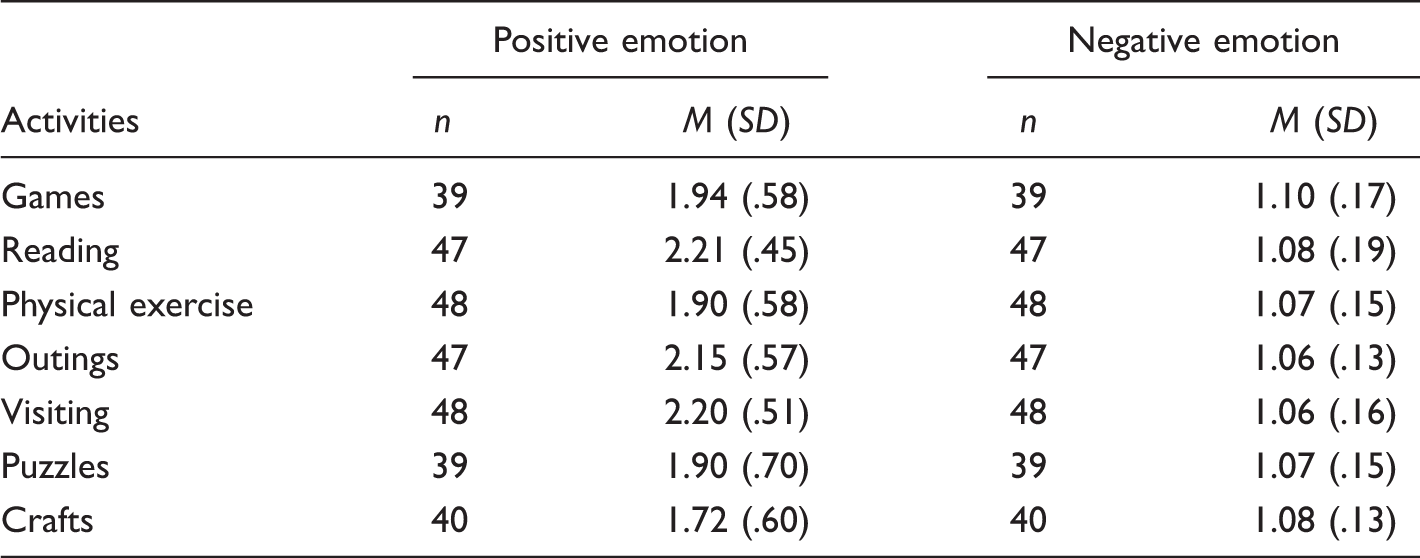
Analysis
The analyses focus on three questions, the first of which concerns patterns of relationships between personality traits and positive and negative emotionally valenced leisure pursuits. Pearson correlations between personality traits and positive emotions reported to be experienced while engaging in Games, Reading, Physical Exercise, Outings, Visiting, Puzzles, and Crafts were computed. As predicted, Openness to experience was positively correlated to positive emotion while visiting with friends and family (r = .362, p < .05), participating in physical exercise (r = .518, p < .001), reading (r = .497, p < .001), and going on outings (r = .432, p < .01). Although not predicted, Openness was also related to positive emotions reported while doing crafts (r = .465, p < .01). Finally, Openness was related to TPVA (r = .286, p < .05).
Similar to Openness to experience, people higher in Agreeableness reported more positive emotions while reading and going on outings (r = .471, p < .01 and r = .396, p < .01, respectively) and had higher TPVA (r = .291, p < .05). We did not find a relationship between Agreeableness and positive emotions while visiting with friends and family.
Contrary to our hypotheses, Conscientiousness was inversely related to reporting positive emotions while doing crafts (r = −.392, p < .05) and was not related to positive emotions while doing puzzles. However, people higher in Conscientiousness reported experiencing fewer negative emotions while doing puzzles (r = −.385, p < .05). Finally, although research points to a relationship between Extraversion and physical exercise, Extraversion was not related to positive emotions associated with this activity. In fact, no relationships between Extraversion and positive emotional valence of particular activities emerged, suggesting that assessing the number and frequency with which activities are participated in is different from assessing the emotions that are reported to be experienced while doing them.
We did not expect that Neuroticism would be associated with positive valenced activities, and in fact, no relationships were observed; however, aggregating across activities, we found that Neuroticism was negatively related to TPVA (r = −.303, p < .05). In addition, as would be expected, Neuroticism was associated with negative emotions while visiting with friends and family (r = .391, p < .01).
Personality and PA and NA: Emotional Component of SWB.

p < .05. **p < .01.
Our third hypothesis predicted relationships between personality traits and the cognitive appraisal of quality of life experience (i.e., SWB measure). Two traits were related to SWB: Agreeableness, (r = .348, p < .05) and Neuroticism (r = −.339, p < .05).
In this work, we have viewed successful aging well as composed of three aspects: emotional quality of activity engagement, and the emotional (PA and NA) and cognitive appraisals of SWB. Notably, our focus on activity engagement moved beyond frequency measures to capture the emotional qualities of activity engagement. As part of our work, then, we considered how personality traits and demographic variables of age, gender, and functionality predict variables TPVA, PA and NA, and SWB. Our last set of analyses was concerned with prediction and exploration, working toward an understanding of how these variables together predict these aspects of successful aging. Because our goals are prediction and exploration we conducted stepwise regression analyses, which can be used with forward and backward elimination (Keith, 2006).
Four stepwise linear regressions were performed, and in these models, demographic variables, such as age, gender and functional status (IADL), and personality traits of Extraversion, Openness, Conscientiousness, Agreeableness, and Neuroticism as predictors were included. In the first regression analysis, the criterion was TPVA. The overall model included two predictors of TPVA: IADL and Agreeableness, F(2, 45) = 5.896, p = .007, accounting for 19.9% of the variance in TPVA. The first predictor was functional status (IADL) with a β = .329, t = 2.465, p = .018, R2 = .109, and the second was the personality trait, Agreeableness, with a β = .299, t = 2.245, p = .030, R2 change = .09.
In the second and third regression analyses, the same predictors as in the first regression were used and the criterion was first PA and then NA. For PA, the overall model, F(4, 40) = 14.265, p = .001, accounted for 54.7% of the variance, and included two personality traits, Agreeableness, β = .299, t = 2.625, p = .012, R2 = .283, and Openness, β = .397, t = 3.567, p = .001, R2 change = .123, and two demographic characteristics, Gender, β = .365, t = 3.33, p = .002, R2 change = .078, and IADL, β = .332, t = 3.175, p = .003, R2 change = .104. For NA, the overall model, F(2, 42) = 11.44, p < .001, included Neuroticism, β = .568, t = 4.5, p < .001, R2 = .272, and Extraversion, β = .288, t = 2.29, p = .027, R2 change = .081, accounting for 35.3% of the variance in NA.
Finally, the fourth regression analyses investigated the demographic and personality traits predictive of reported SWB. In forward elimination, Neuroticism was the sole predictor of SWB, F(1, 46) = 6.712, p = .013, accounting for 10.8% of the variance, β = −.36, t = −2.59, p = .013, and in backward elimination, the personality trait of Agreeableness was the sole predictor of SWB F(3, 44) = 4.063, p = .012, accounting for 16.4% of variance, β = .323, t = −2.145, p = .038. Because the regressions resulted in two different models, both are presented to be interpreted.
Discussion
By 2021, the largest group of elderly people in the United States will be between 70 and 74 years old (census.gov/), making a science of successful aging a central concern (Depp, Vahia, & Jeste, 2007). Previous research has identified specific elements of successful aging, including, but not restricted to, active engagement in life, positive emotions, and cognitive appraisals of SWB. Much of the work on successful aging and active engagement has focused on number and frequency of activities but not on emotions associated with them. By looking at active engagement, research has been concerned with amplifying cognitive health, but we argue here that understanding how individuals choose to spend their time should include an assessment of feelings associated with specific activities and the alignment of these with personality traits.
Toward that end, the current study examined a group of older adults to understand relationships between personality factors and three features of successful aging: positive or negative emotional valence of a variety of activities, overall PA, and appraisals of SWB. Our work sheds light on how activities function as emotionally rich, individualized experiences, integral to having meaningful, relevant lives. In addition, this research identifies personality traits that predict both emotional and cognitive dimensions of SWB.
We found that personality traits are related to the positive emotional valence of a variety of activities. Participants reported the degree of positive (happiness, excitement, and calmness) and negative feelings (fear, anger, sadness, stress, and nervousness) associated with seven specific activities: games, reading, physical exercise, outings, visiting friends and family, puzzles, and crafts. Consistent with our predictions, personality traits of more Openness, more Agreeableness, and less Neuroticism are related to the TPVA.
In particular, individuals higher on Openness reported greater positive feelings about physical exercise, going on outings, reading, doing crafts, and visiting friends and family.
According to Hirsh et al. (2009), Openness falls under the metatrait of plasticity and engagement, and this characterization is consistent with our finding that individuals higher in Openness reported experiencing positive feelings while engaged in leisure activities spanning cognitive, physical and social domains. Stephan et al. (2014) state that people higher in Openness are characterized by their intellectual curiosity and exploration of new ideas and experiences. According to Baltes (1997), people with more Openness are more likely to face challenges associated with growing older by identifying and adopting strategies that offset losses, particularly strategies that involve compensatory behaviors. These compensatory strategies are particularly important in the pursuit of living a meaningful and happy life (Kahlbaugh et al., 2011).
Agreeableness, a trait representing a combination of prosocial motives and self-control, was associated with experiencing outings and reading as emotionally positive. Both Openness and Agreeableness were traits related to the TPVA. On the other hand, individuals higher in Neuroticism reported fewer positively valenced activities and were more likely to report experiencing negative emotions while visiting with others. In contrast, Extraverts reported fewer of these negative emotions while engaging in social visits. Individuals higher in Conscientiousness reported fewer negative feelings about puzzles, while Extraverts reported more negative feelings about crafts. These findings support the idea that motivation to engage in a particular activity could be predicted by the match between personality and expected emotional outcome. Matching personality with activity may increase individual’s participation (Hill, Kolanowski, & Kürüm, 2010), especially for older adults when activities might become less varied, but more meaningful (Selection, Optimization, and Compensation model, Baltes & Baltes, 1990).
We also identified relationships between personality traits and overall affect. In terms of overall affect, individuals higher in Agreeableness, Openness, Conscientiousness, and Extraversion all reported higher levels of PA and those higher in Neuroticism reported more NA. These findings are consistent with the literature. Extraversion has been associated with greater positive mood and Neuroticism with more negative, particularly more stress and anxiety (Booth et al., 2006; Costa & McCrae, 1995; Plopa, Plopa, & Skuzińska, 2016; Stephan et al., 2014; Sutin et al., 2016; Wang, Qi, & Cui, 2014). Our findings support these relationships between traits and overall affect, extending them to an older sample. In addition, because we studied all five personality traits, we found that individuals higher in Openness, Agreeableness, and Conscientiousness also reported more PA. This is consistent with Terracciano and Costa (2004) who argue that all five traits should be investigated with respect to emotion. Terracciano and Costa suggest that a combination of high Agreeableness and low Neuroticism represents a style of anger control, and Plopa et al. (2016) mention that Extraversion and Conscientiousness create a better style of coping with stress. Openness is often associated with curiosity and exploration, which our findings support; however, Openness has been associated with greater PA and NA (Plopa et al., 2016). In our study, Openness was related to overall PA but not overall NA.
For appraisals of SWB, individuals higher in Agreeableness experienced greater levels of well-being and individuals higher in Neuroticism experienced lower levels. To understand this, we refer to the idea that individuals higher in Agreeableness are more social, accommodating (McCrae & Costa, 1991), and able to create networks of social support (Plopa et al., 2016; Wilkinson & Hansen, 2006). For older people, social resources are vital (Cho et al., 2015). Although not as frequently studied (Stephan et al., 2014), Agreeableness has been associated with greater cooperation (Hill et al., 2010), seeing others as friendly, having better interpersonal relationships and trust, and, when combined with less Neuroticism, having better conflict resolution (Plopa et al., 2016). Agreeableness has also been related to qualities such as generosity, inhibition of aggression, and health-related behaviors (Hirsh et al., 2009). Thus, older people higher in Agreeableness may be better able to sustain long-term, supportive relationships, and this ability contributes to their greater sense of SWB. Further work should focus on the trait of Agreeableness to see if social support mediates the relationship between Agreeableness and SWB.
We found it interesting that, unlike previous research, Agreeableness was the only personality trait associated with all measures of successful aging, being related to TPVA, overall PA, and cognitive appraisal of SWB. Furthermore, the two most prominent combinations of traits with respect to successful aging were (a) Openness and Agreeableness, a combination of traits characterizing a style of attitude, and (b) Agreeableness and low Neuroticism, characterizing a style of anger control (Terracciano & Costa, 2004).
Individuals who were higher in functionality and higher in Agreeableness reported the greatest degree of positively valenced engagement. Similarly, overall positive affective state was higher in those who were higher in the traits Agreeableness and Openness, were female, and had a higher functional status. Together these variables accounted for nearly 55% of the variance in overall PA.
In our study, NA was predicted by both Neuroticism and by Extraversion (both with positive betas), together accounting for nearly 35% of variance in NA. This last is surprising given that most of the research has found Extraversion to be related to PA and engagement and warrants replication.
The present study of people between 65 and 97 years of age reveals a number of relationships between personality traits and emotions experienced while engaging in activities.
We believe that a better understanding of emotions and personality may improve the benefits of interventions designed to promote successful aging, by personalizing interventions (Chapman, Hampson, & Clarkin, 2014). Chapman et al. (2014) suggest that a focus on individual “desires, wishes, priorities, and attitudes” could improve health outcomes more so than standard procedures. Also, changing the focus from the frequency of activities to the affective quality of pleasure or happiness, moves this research away from a “more is better” model to that approaching Positive Psychology and what “makes life worth living” (Seligman & Czikszentmihalyi, 2000).
This work underscores factors that motivate older individuals to engage in particular activities, with the assumption that individuals approach activities with positive emotional associations and avoid those with negative (Lewin, 1951). Of particular interest for health outcomes are physical exercise, stimulating experiences (reading, outings, crafts, etc.) and interacting with others (visiting), and total positive activities. The contribution of this work is the examination of relationships between personality, affect, and activity engagement in people who are in young-old phases of the life cycle.
Limitations and Future Research
Future research should explore the meaning of positive valence, that is, do positive feelings associated with activities mean greater pleasure, or do they refer to a meaningful connection between the person and activity? Wong (2011) describes one type of happiness—“prudential happiness” as coming from engagement or “flow” from enjoyable activities. Moreover, leisure activities with a positive valence may contribute to SWB using the “broaden and build” theory (Fredrickson, 2003) which describes the potential of positive emotions to lead to more openness, creativity, and resiliency. Frederickson suggests that people find ways to experience positive emotions more frequently—which may happen when there is a good fit between the personality and activity. In depth interviewing of the activities listed, as well as the activities mentioned in the open-ended responses, such as volunteering, gardening/being in nature, could provide more information about the meaning of positively valenced activities. One suggestion for future work would be to capture emotional reactions, both positive and negative, while individuals are actually participating in the activity. In this study, we were only able to capture how people understood the emotional quality of a particular activity in retrospect. A strategy of interviewing individuals about their emotions while engaging in activities would most likely result in a richer description of the emotional valence of activities.
Finally future work should look at the role of social support as a mediator between the trait Agreeableness and measures of SWB. Much research has focused on Extraversion and Neuroticism, and more recently Conscientiousness, but our work points to the importance of the traits Agreeableness and Openness in understanding successful aging. These traits may have emerged as important as a function of our sampling technique and so future work will aim to replicate our findings. In addition, although our sample spanned the ages of 65 to 97, our sample of older adults had a mean age of 74 and was higher functioning, thus limiting the generalizability of the findings. Future should extend our paradigm to adults who are older and less functional. Finally, we believe that interventions can use this information to help tailor options for elderly individuals with the goal of encouraging more active and rewarding lives.
Footnotes
Declaration of Conflicting Interests
The authors declared no potential conflicts of interest with respect to the research, authorship, and/or publication of this article.
Funding
The authors received no financial support for the research, authorship, and/or publication of this article.