







Abstract
We examined to what extent the depression, poverty, and elder abuse experience affect suicide ideation among older Koreans. The data from the Survey of Living Conditions and Welfare Needs of Korean Older Persons were used. A sample of 10,279 members was analyzed. Logistic regression analysis revealed that younger old (65–69 years) were more likely to have suicide ideation that oldest old (80 years and older). After including all predicting variables such as depression, poverty, and abuse experience, results showed that depression, poverty, and abuse experience remained predictors for suicide ideation. Higher level of depression (OR = 1.19) was positively associated with suicide ideation. Poor older person (OR = 1.59) and those who experienced abuse (OR = 2.37) were more likely to have suicide ideation than their counterparts. We conclude that suicide prevention policy needs to take a holistic approach, which integrates the mental health of the older people, family welfare, and economic well-being.
Introduction
Suicide ideation is an important predictor for suicide attempt as well as suicide completion, which is the leading cause of death and disability (Klonsky, May, & Saffer, 2016). According to the Centers for Disease Control and Prevention (n.d.), suicide ideation refers to “suicidal thinking, considering, or planning suicide.” Suicide attempt refers to the behavior of an individual who attempts to commit suicide. Attempted suicide is a major public health problem and social welfare issue (World Health Organization [WHO], 2014). Therefore, it is suggested that the identification of risk factors for suicide ideation and then addressing the intervention to reduce these risk factors is the first and most important strategy for reducing suicidal attempt.
While the suicide mortality rate has been decreasing among Organisation for Economic Co-operation and Development (OECD) countries, the suicide mortality rate within the Republic of Korea (henceforth, South Korea) has increased by 280% between 1985 and 2010 (Jeon, Reither, & Masters, 2016). As a result, South Korea has the highest older adult’s suicide rate of any OECD country. Of all the world’s countries, South Korea has the third largest estimated rate of suicides (WHO, 2014). Indeed, within South Korea, suicide is the fourth leading cause of death among the general population after cancer, heart disease. and cerebrovascular disease (Shin et al., 2016).
Previous studies around the globe have demonstrated the risk factors for suicide ideation among the older person. These risk factors have been broadly categorized into psychiatric disorders (especially depression and stress), medical illness, functional impairment, financial difficulties, loneliness (alienation), substance use, and other adverse life events (Britton et al., 2008; Conwell & Thompson, 2008; Conwell, Van Orden, & Caine, 2011; Cukrowicz, Cheavens, Van Orden, Ragain, & Cook, 2011; Erlangsen, Stenager, & Conwell, 2015; Foster, 2011; Jahn, Cukrowicz, Linton, & Prabhu, 2011; Li, Xiao, & Xiao, 2009; McLaren, Gomez, Bailey, & Van Der Horst, 2007; Neufeld & O'Rourke, 2009; Schneider, 2009).
In the South Korean context, depression and anxiety were the risk factors for suicide ideation (Kim, 2016; Kim, Ko, & Chung, 2010; Lee, Kim, Choi, & Choi, 2014; Ro, Park, Lee, & Jung, 2015; Shin, Choi, Park, & Han, 2014). Other factors such as financial difficulties, living in poverty (Lim, 2014; Park et al., 2014), physical pain (illness) and discomfort (Kim et al., 2010), substance use (Kim et al., 2010), and abuse experience (Jeong & Kim, 2014; Lim, 2014; Seo & Ko, 2011; Seo & Lee, 2016) were also risk factors for suicide ideation. In addition, South Korean specific structural factors such as rapid industrialization, the 1997 Asian financial crisis, increased inequality, and an aging population are seen as risk factors for suicide ideation (Jeon et al., 2016).
Studies that are based on nationally representative samples in South Korea revealed that suicide ideation among older persons was mainly due to depression, poor health status, substance abuse, poverty, and chronic illness. For example, a study undertaken with a sample of 1,447 older persons revealed that depression, individual’s self-reported poor health, and unmet medical need were predictors for suicide ideation (Lee et al., 2014). Another study, with a sample size of 10,279, revealed that drinking alcohol had a moderating effect on the association between depression and suicide ideation among older Koreans (Kim, 2016). Similarly, a study utilizing a sample of 2,845 older persons, reported that poverty, chronic disease, and depression were major predictors of suicide ideation among Korean older persons (Shin et al., 2014). Small-scale survey studies also revealed poverty and depression as major predictors for suicide ideation in specific cities and provinces (e.g., Daejeon, Gyeongju city, Gyeonggi-Do province, Jeollabuk-Do, Jeollanam-Do, Seoul) as well as older citizens living in social welfare centers in South Korea (Lim, 2014; Seo & Ko, 2011; Yoo & Jeong, 2016).
There are some small-scale survey studies which also demonstrated that experience of abuse has a direct effect on suicide ideation among the older person (Jeong & Kim, 2014; Seo & Lee, 2016). For instance, Seo and Lee (2016) reported that an older adult’s experience of abuse (measured as a combination of physical, emotional, sexual, neglect, and financial abuse) was directly associated with suicide ideation, whereas depression mediated the relationship between experience of abuse and suicide ideation (Jang & Nam, 2015; Seo & Ko, 2011). Specifically, verbal and emotional abuse was more likely to act as a risk factor for suicide ideation within the South Korean context compared with the older person who never experienced verbal and emotional abuse (Lim, 2014).
Identification of the key predictors of suicide ideation as well as the complex association among key predictors is important for designing intervention strategies which will reduce the suicide rate within a culture specific context. Within the South Korean context, previous studies have demonstrated that older adult’s suicide ideation is due to older adult’s depression, poverty, being abused, and other sociodemographic factors. These predictors are examined as independent predictors and mediator or moderators for suicide ideation. However, a review of the literature provided no Korean example of a study that, using a nationally representative sample, examining the relationship between likelihood of older persons’ suicide ideation and the older persons’ experience of depression, poverty, and abuse experience. This study therefore examined to what extent the intersection of depression, poverty, and elder abuse experience predicts older person suicide ideation within the South Korean context.
Methods
Data
We used data from the Survey of Living Conditions and Welfare Needs of Korean Older Persons. The survey was conducted by the Korean Institute for Health and Social Welfare in 2014. The survey data were collected from June 11, 2014 to September 4, 2014. To make the data a nationally representative sample, the data were collected by using a two-stage cluster sampling design which represented 7 major cities and 10 provinces. The sampling procedure followed the 2010 Population and Housing Census block as primary sampling units while the secondary sampling units incorporated households with older persons, excluding those older persons living in dormitories and specific facilities. The sample size of the Survey of Living Conditions and Welfare Needs of Korean Older Persons was 10,327 older citizens from age 65 years old and the above. Of these, 48 cases had missing information and were list-wise deleted, the remaining data (number = 10,279) were analyzed.
Measure
Dependent Variables
Suicide ideation was measured by a single question: “Have you ever considered committing suicide after the age of 65?” Respondents who answered yes were coded as 1, while no answers were coded as 0.
Independent Variables
Independent variables included depression, economic status (poverty), and abuse experience of older persons.
We used the short version of the Geriatric Depression Scale with its 15-item questionnaire measuring depression levels among the older persons (Sheikh & Yesavage, 1986). This scale was validated and used in previous studies in Korea (Park, Park, Yang, & Chung, 2016). All these items were added and the scores on the Geriatric Depression Scale ranged from 0 to 15 (mean = 5.34; SD = 4.55; reliability alpha = .904); the higher the score, the higher the level of depression. We measured depression as a continuous variable.
We measured poverty as a dichotomous variable using 0 for not in poverty and 1 for a poor older citizen. Korean older persons were asked whether their economic status was very good, good, fair, bad, or very bad. Those who answered very good, good, and fair economic status were coded as “not in poverty,” and those who answered bad and very bad were coded as “a poor older citizen.”
We measured abuse experience based on the answers to the following five statements: (a) I was physically abused, (b) the word or activities caused me pain, (c) I was not financially supported, (d) while I was sick, my family members did not come to care me, and (e) my family neglected me and did not provide me any living allowance. We recoded 0 for those who responded “not at all” and 1 for those who mentioned an affirmative statement. All values were added and ranged from 0 to 4. The added values from 1 to 4 that measured older persons experiencing abuse, whereas 0 was recoded for older persons not experiencing any form of abuse.
Control Variables
We included sociodemographic factors based on previous studies (Park et al., 2014). We included age, gender, place of residence, educational attainment, marital status, religion, work status, and subjective health status. We recoded age as a categorical variable; 1 was coded for age-group between 65 to 69 years old, 2 for 70 to 74 years old, 3 for 75 to 79 years old, and 4 for 80 years old and the older. We recoded as 1 for male and 2 for female. Place of resident was dummy coded as either urban or rural areas. Education was categorized into four values: having not attained any formal education, less than 6 years of schooling, from 7 years to 12 years of schooling, and more than 13 years of schooling. Marital status was dummy coded as 1 for single, divorced, or widowed, and 2 for a married older person. Religion was dummy coded as 1 for no religion and 2 for those who have a religion. Work status was dummy coded as 0 for those who were not currently working and 1 for those who were currently working. Subjective health status was categorized into four categories: good, fair, bad, and very bad.
Data Analysis
The data were analyzed using SPSS 23.0. Descriptive, bivariate, and multilevel logistic regression methods were used. Descriptive statistics were run to characterize the study population. The association between each independent variable and suicide ideation were tested by Chi-square statistics (χ2). Finally, multivariate logistic regression was used to examine the relationship between older person’s suicide ideation and selected independent variables.
Results
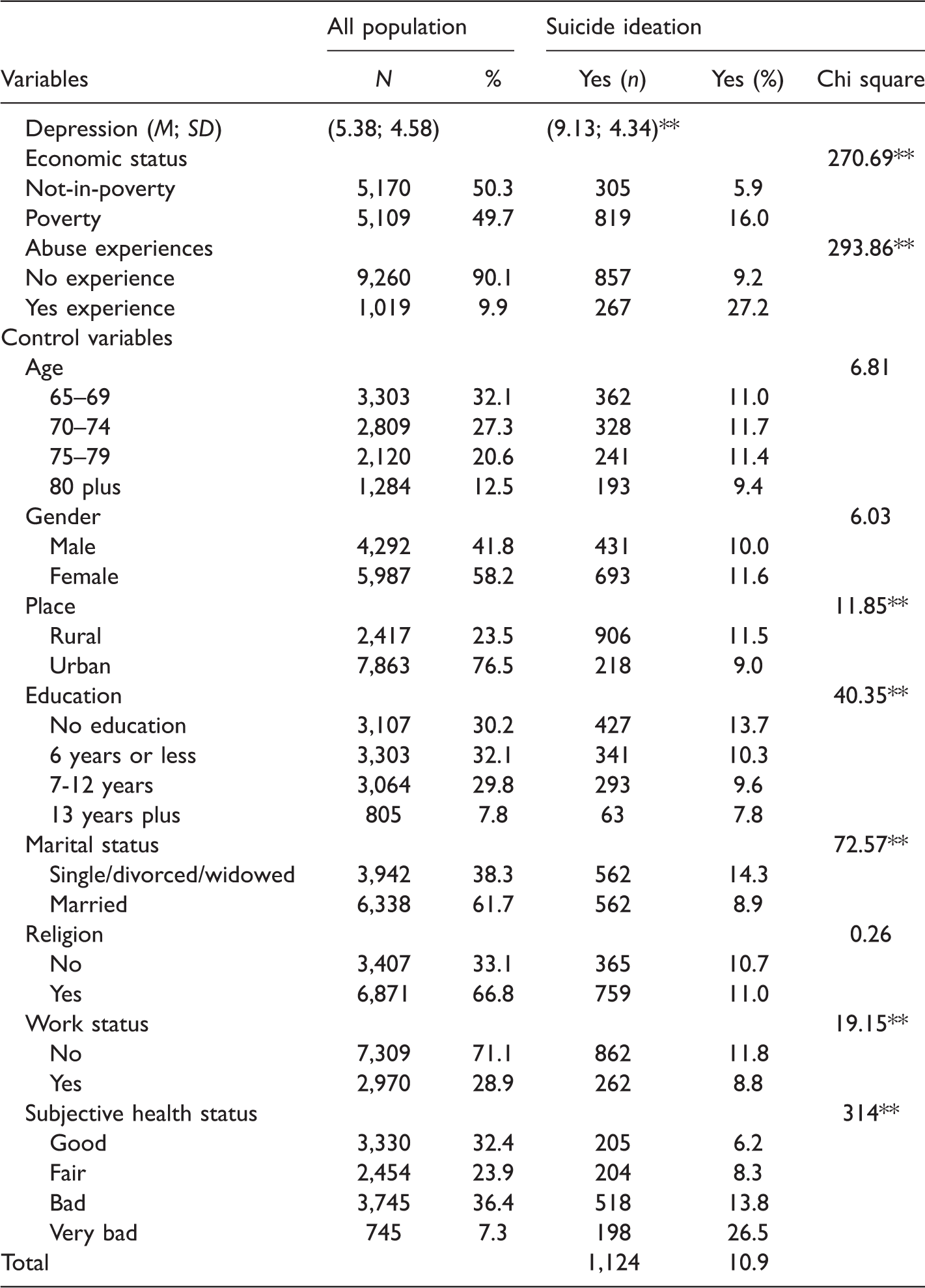
Table 1 presents the descriptive characteristics of the sample and bivariate association between selected independent and dependent variables. About 11% of the Korean older persons reported that they had experienced suicide ideation. The mean value for depression was 5.38 (SD = 4.58; range = 0–15). About 10% of the Korean older persons had experienced abuse. About 58% of the sample were female and 76.5% were living in urban areas. About 32% of the sample belonged to the age-group between 65 and 69 years old, about 27% belonged to the age-group between 70 and 74 years old, about 21% belonged to the age-group between 75 and 79 years old, and about 12% belonged to the age-group 80 years and older. About 38% of them were single, divorced, or widowed. About 7% of the sample had very bad subjective health status.
Descriptive Characteristics of the Sample and Bivariate Association With Suicide Ideation Among Older Adults in South Korea (N= 10,279).
Note. N = number; contd. = continuous; M = mean; SD = standard deviation.
**p < .001.
At the bivariate level, variables such as depression, economic status, abuse experience, place of residence, educational status, marital status, currently work status, and subjective health status had statistical association on older person’s suicide ideation in South Korea (p = <.001).
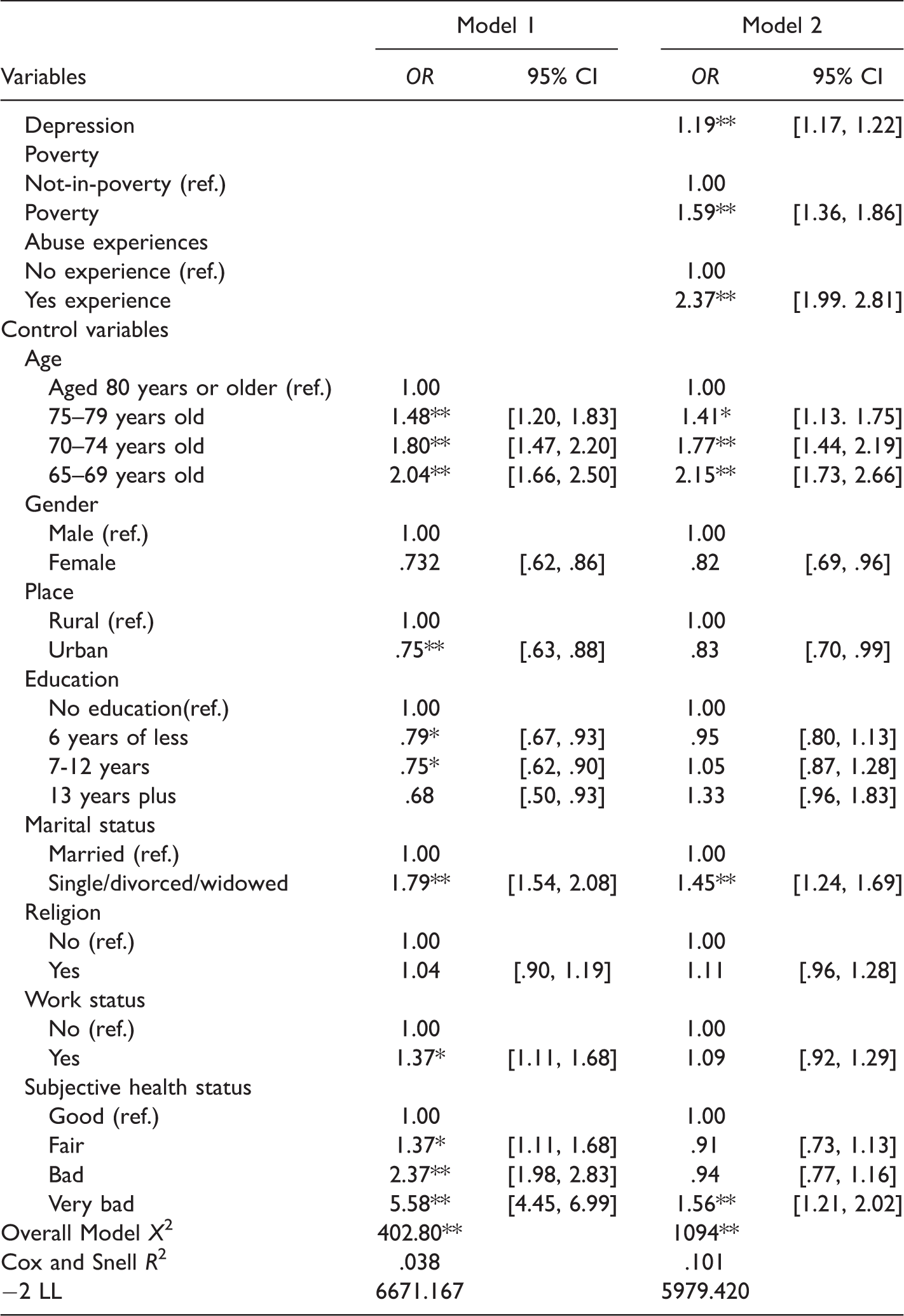
Table 2 presents the results from logistic regression analysis for the likelihood of older person’s suicide ideation in South Korea. Two models were presented. In Model 1, variables such as sociodemographic characteristics and subjective health status were analyzed. We found that odds ratio (OR) for older persons aged 75 to 79 years were 1.48 (CI = [1.20, 1.83]) times more likely to have suicide ideation than older persons aged 80 years and older. Older persons aged 70 to 74 years were 1.80 (CI = [1.47, 2.20]) times more likely to have suicide ideation than older persons aged 80 years and older. Similarly, those aged 65 to 69 years were 2.04 (CI = [1.66, 2.50]) times more likely to have suicide ideation than older persons aged 80 years and older. Korean older persons who live in urban areas were less likely (OR = .75) to have suicide ideation than older persons who live in rural areas. We found that the higher the educational level, the lower the likelihood of suicide ideation. Single or divorced or widowed were 1.79 (OR = 1.54; CI = [1.54, 2.08]) times more likely to have suicide ideation than the married counterparts. Currently, working older persons were more likely to have suicide ideation than nonworking older Koreans. We found that bad and very bad health status had the higher level of OR for suicide ideation among older Koreans.
Odd Ratio (OR) for the Likelihood of Suicide Ideation Among Older Adults in South Korea.
Note. ref.= reference category; OR= odds ratio; CI = confidence interval of OR; −2 LL = − 2 log-likelihood.
*p < .01. **p < .001.
In Model 2, we included all predicting variables including depression, poverty, and abuse experience on suicide ideation. We found that the higher the level of depression, the higher the suicide ideation among Korean older persons (OR = 1.19; CI = [1.17, 1.22]). Among the impoverished older persons, the suicide ideation was 1.59 times more likely than the older persons who were not-in-poverty. Among those older citizens who had experienced abuse, suicide ideation was 2.37 times more likely compared with the counterpart. Among sociodemographic factors, the lower the age-group, the higher the likelihood of suicide ideation. The OR for suicide ideation among older persons aged between 65 and 69 were 2.15 times more likely to have suicide ideation than older persons aged 80 years and older. Similarly, the single or divorced or widowed older persons were 1.45 times (CI = [1.24, 1.69]) more likely to have suicide ideation than the married older persons. The older persons with “very bad” subjective health status were 1.56 times more likely to have suicide ideation than older persons with “good” subjective health status.
Discussion
Identification of the single most important suicidal risk factor is a complex issue; prevention strategy should take a holistic approach. Thus, the findings of this study suggest that an integrated approach to addressing older person’s suicide prevention should focus on the mental health of the older person, their financial difficulties, and family-level abuse experience within the South Korean context.
Worldwide, lifetime prevalence rates for suicidal ideation are about 9.2% (Klonsky et al., 2016). Our study revealed that 10.9% of the older persons of South Korea, 65 years old and older, have suicide ideation. The rate is one of the highest among OECD countries. In Europe, the estimate of the prevalence of suicide ideation ranged between 5% and 10% (Stolz, Fux, Mayerl, Rásky, & Freidl, 2016).
We found that younger older persons were more likely to have suicide ideation than the older persons in South Korea. The findings are consistent in both models, Model 1 and Model 2. In fact, younger older persons have a higher level of economic stress and lower level of family support in South Korea. As a consequence, the majority of older persons aged between 65 and 69 years have to work for their survival. Statistics Korea (2016, p. 28) reported that 76.3% of the older Koreans aged between 65 and 69 years have to make their living. Among them, 55% of older persons of this age-group are working for their living. The report further mentioned that only about 16% of older persons aged between 65 and 69 years received financial support from their children and relatives, whereas 47% of older persons aged over 80 received support from their children and relatives. About 8% of the older persons aged between 65 and 69 years received financial support for living from the government and other social organizations, whereas about 22% of older persons aged over 80 received support from the government and social organizations.
In Model 2, we entered all predicting factors in order to examine the extent in which the depression, poverty, and abuse experience affect suicide ideation among older persons in South Korea. The result suggests that depression, poverty, and abuse experience are the predictors for suicide ideation in the South Korean population. In addition, older persons in the age-group of 65 to 69 years old, those who were single or divorced or widowed, and those who had very bad subjective health status are at elevated risk of suicide ideation.
We found that older persons with depression were 1.19 times more likely to have suicide ideation. This finding is consistent with previous studies that found depression to be an important risk factor for suicide ideation among the older Korean person (Kim et al., 2016; Lee, Hahm, & Park, 2013; Ro et al., 2015).
We found that older persons who self-identified as poor were 1.59 times more likely to have suicide ideation than those who did not. This OR for predicting suicide ideation is much higher than depression. In fact, the relative poverty level among Korean older persons is nearly four times higher than OECD countries (Jones & Urasawa, 2014). This finding is consistent with the study of Shin et al. (2014) that revealed older persons belonging to a lower income level were at greater risk of suicide ideation than those at a higher economic level.
Surprisingly, experience of abuse had the highest odd ratio (2.37 times more likely) for predicting suicide ideation when compared with those older persons who never had any experience of being abused. This finding is consistent with the study of Jeong and Kim (2015)’s study. Similarly, Lim (2014) revealed that verbal and emotional abuse was the strongest predictor for suicide ideation among older women in the South Korean city of Daejon. Most recently, the association between older persons receiving abuse and its effect on suicide ideation had been emphasized in the Chinese population as well (Dong et al., 2016; Wu et al., 2013).
The majority of studies in South Korea have suggested that mental health problems (e.g., depression) are the most important risk factors. As a consequence, the Korean government recently adopted a 5-year plan (2016–2021) to combat the high rate of suicides among the older person, emphasizing mental health care, including programs to reduce stigma associated with mental illness. Most recently, the Korean government amended the “Act on the improvement of mental health and the support for the welfare services for mental patients (Act no. 14224),” which emphasized improving public mental health by providing appropriate prevention and treatment programs (Ministry of Health and Welfare, 2017). Mostly, the law has focused on the early detection of mental health problems, the aim of which is to eliminate the stigma associated with mental illness, including depression. In South Korea, seeking treatment for mental health problems is still uncommon due to the stigma associated with it.
Despite the fact that poverty among older persons is an acute problem in South Korea, around 70% of older persons receive some subsidies, according to the Basic Senior Pension Act (enforcement date, July 14, 2011). In addition, the Korean government provides a variety of work opportunities for poor and able-bodied older persons. However, in our study, we found that older person who were depressed, poor, and abused, as well as those who were in the age-group of 65 to 69 years old, currently engaged in work, single or divorced or widowed, and had very bad subjective health status were more likely to have suicide ideation in South Korea. Specifically, the ORs for suicide ideation among abused older persons and in the age-group of 65 to 69 years old were much higher for suicide ideation. Therefore, we infer that these older people are the most at risk population for elder suicide attempts in the South Korean context.
Limitations and Strengths
The strength of the study is that it used a large representative sample with a robust response rate. Therefore, the findings of the study can be generalized to the entire Korean population. The findings of the study are similarly robust and are helpful for designing national policy so as to prevent suicide ideation among South Korea’s older citizens. Despite these strengths, the study has some limitations. The first limitation is that the sample is cross-sectional; therefore, it only provides a snapshot of the findings. It is not possible to make a causal relationship between selected independent and dependent variables. Further, a longitudinal study is needed to infer causal relationship between the intersection effect of depression, poverty, and elder abuse on suicide ideation in South Korea. The second limitation is that abuse among older persons could be underreported. This is because of the social stigma associated with experience of abuse combined with family prestige. Thus, older persons are less likely to report experience of abuse in the South Korean context. Moreover, the scale used for the measurement of abuse is based on a South Korean cultural context; hence, it cannot be generalized in all cultures.
In conclusion, we found that the intersection effect of depression, experience of abuse, and poverty is strongly associated with older person’s suicide ideation in South Korea. There is no specific counseling center for older persons in South Korea; mental health centers offer counseling services for all ages. In fact, service delivery for older persons has been scattered. Support for the older poor is dealt with in the district offices and issues of elder abuse are dealt with in the adult protection agency. Therefore, we suggest that a comprehensive one-stop center service should be designed, for the purpose of suicide prevention. Such a program should include elements that support the mental health of the older person, their family welfare, and their economic well-being.
Footnotes
Declaration of Conflicting Interests
The authors declared no potential conflicts of interest with respect to the research, authorship, and/or publication of this article.
Funding
The authors received no financial support for the research, authorship, and/or publication of this article.