







Abstract
Drowsy driving is a major cause of motor vehicle injuries and fatalities, yet little is known about its impact on older adults. This group may face heightened risk due to age-related sleep issues. Using survey data from 3,411 Floridians aged 60 and older (collected in 2020/2021), we examined how self-rated sleep quality relates to two indicators of driving safety: frequency of self-reported distracted driving behaviors (e.g., texting, eating, and grooming) and involvement in a crash or near-crash in the past year. Regression results showed that poor sleep quality did not significantly predict distracted driving but was associated with increased odds of a crash or near-crash. Our findings, which partially align with studies of younger drivers, highlight the need to understand how the relationship between sleep and driving safety may change with age.
Drowsy driving is strongly associated with motor vehicle injuries and fatalities, accounting for an estimated 7% of all crashes and 17% of fatal ones ( Tefft, 2012). Although any driver can experience drowsiness, research has focused primarily on young drivers and those in shift work—such as long-haul truck drivers—due to risks linked with inexperience and extended driving hours (e.g., Cestac et al., 2011; Girotto et al., 2019; Harbeck et al., 2017; Ozkan & Lajunen, 2006; Ren et al., 2023; Smith et al., 2020; Wise et al., 2018). However, much less is known about how sleep-related risks manifest in older adult drivers, a growing segment of the driving population.
This gap is concerning given that sleep disturbances are prevalent in later life, although not inevitable (e.g., Canever et al., 2024; Crowley, 2011; Miner & Kryger, 2020; Neikrug & Ancoli-Israel, 2009; Ohayon et al., 2004; Schouten et al., 2022). A meta-analysis of nearly one million community-dwelling older adults across 36 countries reported high prevalence rates of sleep disturbances: 46% experienced sleep apnea, 40% poor sleep quality, 29% insomnia, and 19% excessive daytime sleepiness (Canever et al., 2024). These issues stem in part from age-related changes in sleep architecture, including declines in total sleep time, sleep efficiency, and both slow wave and rapid eye movement sleep (e.g., Neikrug & Ancoli-Israel, 2009; Ohayon et al., 2004). A meta-analysis of 65 overnight sleep studies involving 3,577 individuals (ages 5-102) found that slow wave sleep declined by 2% per decade across young and middle adulthood, stabilizing beyond age 60 (Ohayon et al., 2004). In addition to biological factors, situational stressors—such as chronic health conditions, polypharmacy, and stressful life transitions like retirement, widowhood, or relocation—can further disrupt sleet in older adults (e.g., Foley et al., 1995; Neikrug & Ancoli-Isreal, 2009).
Although age-related changes in sleep are well-documented, their real-world consequences—particularly in the context of driving safety—have received relatively little empirical attention. This issue is gaining importance as recent cohorts of older adults remain behind the wheel longer than earlier cohorts (Schouten et al., 2022). To better understand this connection, our study draws on survey data from adults aged 60 and older residing in Florida, a state with one of the highest proportions of older adults in the nation (Administration for Community Living, 2021). Our study examines how self-reported sleep quality is associated with two driving outcomes: the frequency of self-reported distracted driving behaviors (e.g., texting, eating, and grooming) and having experienced a crash or near-crash in the past year. Gaining insight into these associations can inform public health and traffic safety initiatives that promote safe mobility in later life.
Sleep Quality and Driving
While most studies focus on younger drivers, they consistently find that poor sleep is associated with an increase in risky driving—raising questions about whether similar patterns hold for older adults (e.g., Cestac et al., 2011; Harbeck et al., 2017; Ozkan & Lajunen, 2006; Robbins et al., 2021). For example, a study using a survey of 1,305 college students found that respondents experiencing sleep disturbances once or twice a week were at a higher risk of engaging in risky driving behaviors, including texting or emailing, talking on the phone, and driving under the influence, compared with those who reported no sleep issues (Robbins et al., 2021). Similar findings are reported in studies of shift workers, like truck drivers (e.g., Filtness et al., 2020; Girotto et al., 2019; Ren et al., 2023; Smith et al., 2020; Wise et al., 2019). For example, a study based on a roadside survey of 453 long-haul truck drivers found that extended work hours, lack of sufficient sleep, driving late into the night, and drowsiness behind the wheel are major factors associated with engaging in more unsafe driving behaviors, such as speeding (Mahajan et al., 2019). Other research on truck drivers finds that strategies to combat sleepiness, like excessive caffeine intake, increase behaviors like aggressive driving (Filtness et al., 2020).
Poor sleep quality has also been linked to elevated crash risk. However, most studies have focused on younger drivers, giving little attention to older ones (e.g., Banz et al., 2020; Hutchens et al., 2008; Lucidi et al., 2006; Martiniuk et al., 2013). For example, a study of 20,822 17- to 24-year-olds found that respondents who slept 6 hr or less per night had a higher risk of crashing compared with those who slept more than 6 hr (Martiniuk et al., 2013). Similar results are reported in research on truck drivers and shift-workers (e.g., Gold et al., 1992; Mizuno et al., 2020; Novak & Auvil-Novak, 1996). For example, a study of 635 night-shift nurses estimated that drowsy driving accounted for nearly all—95%—of crashes and driving incidents experienced by this group of workers (Gold et al., 1992).
A small number of studies have directly compared younger and older drivers to assess age differences in vulnerability to sleep-related driving impairment (e.g., Bartolacci et al., 2020; Cai et al., 2021; Cai et al., 2023; Cai et al., 2024; Duffy et al., 2009; Filtness et al., 2020; Lowden et al., 2009). Interestingly, the findings suggest that older drivers may be less susceptible to the effects of drowsiness-induced driving errors than younger drivers (e.g., Cai et al., 2021; Duffy, 2009; Filtness et al., 2020; Lowden et al., 2009). For example, a study comparing 16 younger drivers (aged 21-33) with 17 older ones (aged 50-65) on an on-road test under two conditions—well-rested and sleep-deprived—found that younger drivers displayed seven times more lane departures and 11 times greater risk of near-crash events following sleep loss (Cai et al., 2021). Similarly, a study that compared 10 younger drivers (aged 18-24) with 10 older drivers (aged 55-64) on performance on a 45min driving simulation found that younger drivers showed greater performance deterioration than older drivers, who also exhibited higher cortisol levels—possibly providing a protective buffer against sleepiness (Lowden et al., 2009). Behavioral differences may also play a role. Older drivers are less likely to report driving while sleepy and are more likely to engage in preventive strategies—such as opening the window or decreasing the temperature in the vehicle (Watling et al., 2015). These findings suggest that experience, self-regulation, and physiological differences may mitigate some of the risks associated with poor sleep in older drivers.
Still, existing studies are limited by small sample sizes and narrow age ranges. More research is needed using large samples of older adults to clarify how sleep quality relates to driving safety in later life. Our study contributes to this literature by examining associations between sleep quality and two driving outcomes—engaging in self-reported distracted driving behaviors and having a crash or near-crash in the past year—in a large sample of older adults. These findings have the potential to inform interventions aimed at reducing motor vehicle risk while promoting healthy aging and mobility.
Research Design and Methods
Data
We used data from an online survey of over 4,200 Floridians aged 50 and older that was conducted between December 2020 and April 2021 and funded by the Florida Department of Transportation (FDOT). The survey, which was approved by the Florida State University Institutional Review Board, was intended to assist the FDOT's Safe Mobility for Life Coalition (SMFLC) in its mission to enhance the safety, access, and mobility of aging road users, with the goal of eliminating fatalities and reducing serious injuries. The survey aimed to investigate the transportation-related attitudes and behaviors of Floridians aged 50 and older. Sixty-two of Florida's 67 counties are represented in these data. Details about the survey, along with a participation link, were shared through the listservs and e-newsletters of SMFLC, AARP Florida, and Florida's Osher Lifelong Learning Institutes. Additionally, it was sent to the registry of older adults interested in research at Florida State University's Institute for Successful Longevity.
The analytical sample (n = 3,411) was restricted to respondents aged 60 and older with complete data on the self-reported distracted driving behaviors scale and the crash variable. Missing values for independent variables, which ranged from 3% for the self-regulated driving scale to 27% for household income, were addressed using multiple imputation. Respondents in the sample averaged 71 years of age, 54% were women, and 89% identified as non-Hispanic white.
Measures
The variables used in the analyses are summarized in Table 1. Self-reported distracted driving behaviors is a mean scale (α = .75) measuring the frequency of six behaviors: eating or drinking while driving, making or accepting phone calls, reading something (e.g., book, newspaper, iPad, and Kindle), reading emails or texts, sending emails or texts, and grooming oneself (e.g., putting on make-up or looking at oneself in the mirror). Responses were never (coded 1), rarely (coded 2), sometimes (coded 3), often (coded 4), or always (coded 5). Crash or near-crash incidence is a dichotomous variable coded 1 if the respondent experienced a near-crash, minor crash, or major crash in the past year and coded 0 if they did not. Sleep quality is measured using respondents’ assessment of their overall sleep quality in the past month, with responses ranging from very bad (coded 1) to very good (coded 4). Sociodemographic variables include the following: age, gender, race and ethnicity, college graduate, household income, employed, homeowner, rural resident, and married or partnered. Variables measuring respondents’ health include the following: physical limitations, pain, memory problems, and depressive symptoms. Transportation experiences are measured using the following variables: driving frequency, self-rated driving ability, and self-regulated driving.
Summary of Variables.
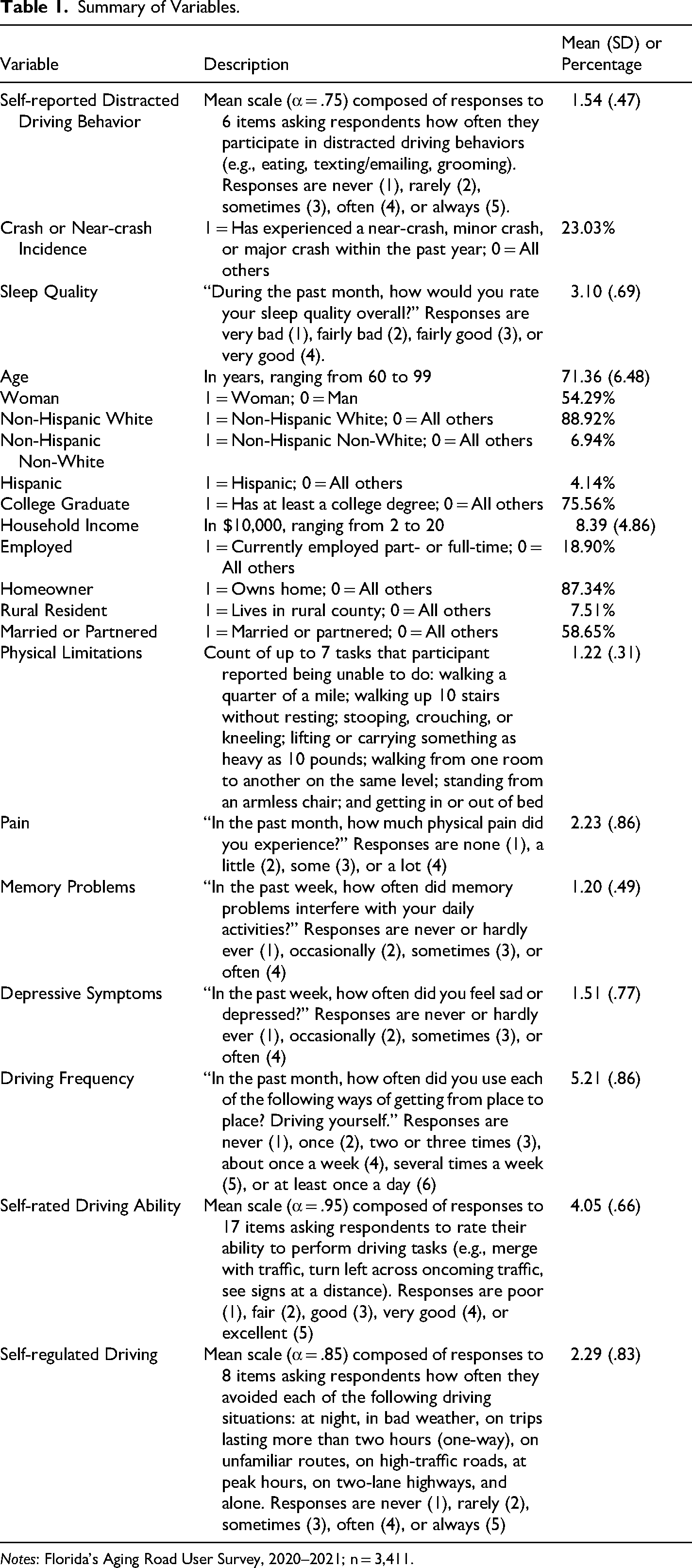
Notes: Florida's Aging Road User Survey, 2020–2021; n = 3,411.
Methods
Data were analyzed using Ordinary Least Squares (OLS) regression and logistic regression. The two outcome variables—frequency of self-reported distracted driving behaviors and crash or near-crash incidence—were regressed on self-rated sleep quality and the control variables, including sociodemographic, health, and transportation measures. Analyses were also conducted using two variables that disaggregated the crash-related outcomes. The results indicated that the association between sleep quality and near-crash did not differ substantively from that of crash, so we present the results of analyses using the combined variable. Multicollinearity diagnostics revealed that none of the predictors were highly interrelated.
Results
Results of the OLS regression model predicting self-reported distracted driving behaviors in the past week are reported in Table 2. Poor sleep quality did not significantly predict self-reported distracted driving behaviors. Other predictors, however, reached significance. Older age was associated with lower levels of distracted driving, and women reported higher levels of distracted driving than men. Reporting more engagement in distracted driving behaviors was linked with being employed, reporting more income, and residing in a rural area. More self-reported distracted driving behaviors were also associated with worse health. Having more frequent memory problems and depressive symptoms predicted more self-reported distracted driving. Two variables measuring transportation experiences emerged as significant predictors of reporting more distracted driving behaviors. They included driving more frequently and engaging in fewer self-regulated driving behaviors.
OLS Regression of Self-Reported Distracted Driving Behaviors on Sleep Quality.
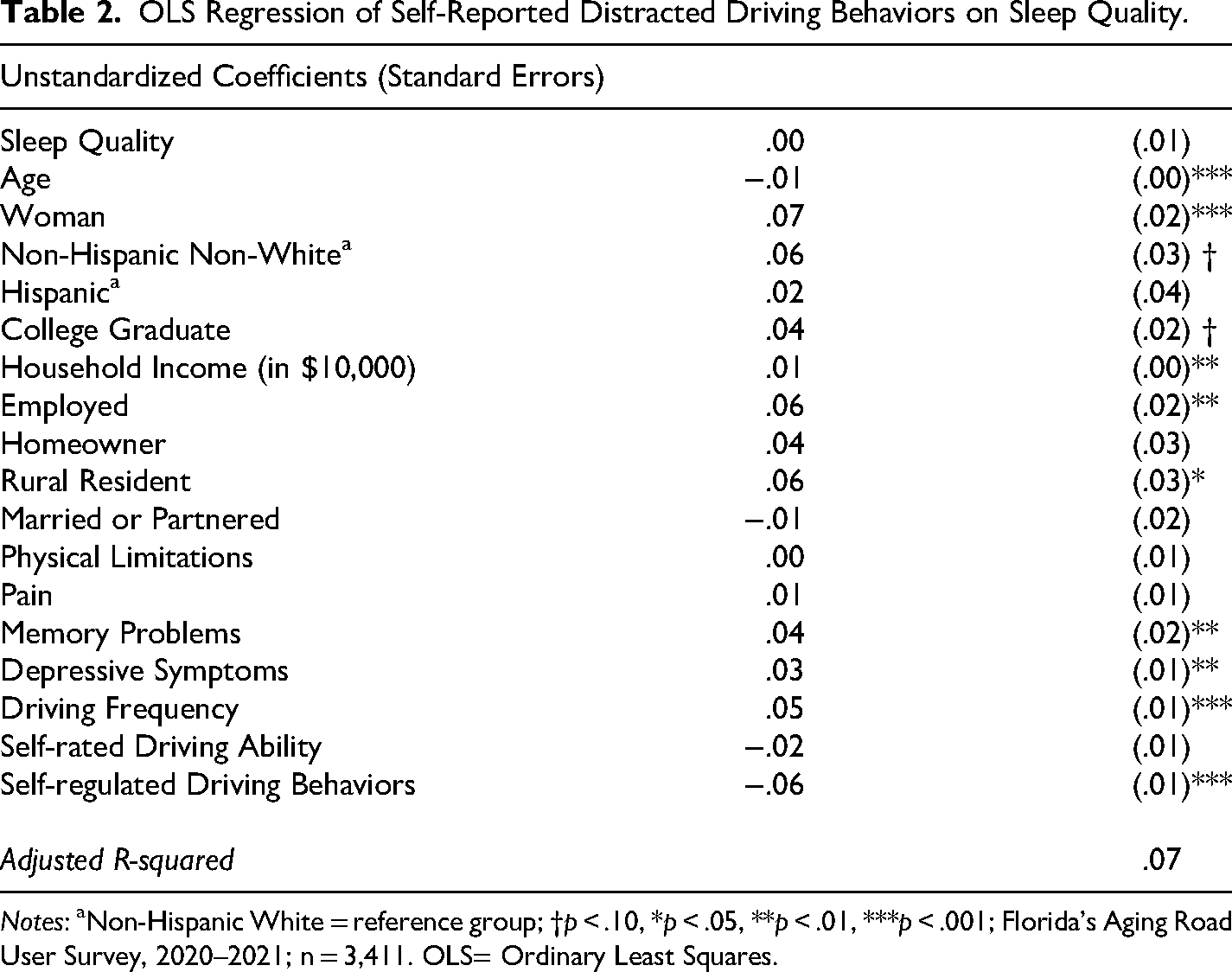
Notes: aNon-Hispanic White = reference group; †p < .10, *p < .05, **p < .01, ***p < .001; Florida's Aging Road User Survey, 2020–2021; n = 3,411. OLS= Ordinary Least Squares.
Results of the logistic regression of having experienced a crash or near-crash in the past year are reported in Table 3. Results indicate that poorer sleep quality is associated with a greater likelihood of having experienced a crash or near-crash in the past year. Other significant predictors include age and gender, with women and those of older ages less likely to report having had a crash or near-crash in the past year. Three of the health measures emerge as significant predictors, with results indicating that experiencing more pain, more frequent memory problems, and greater depressive symptoms predicted a higher risk of a crash or near-crash. Two of the transportation measures reached significance. More frequent driving and worse self-rated driving ability predicted greater risk of having had a crash or near-crash.
Logistic Regression of Crash or Near-Crash Incidence on Sleep Quality.
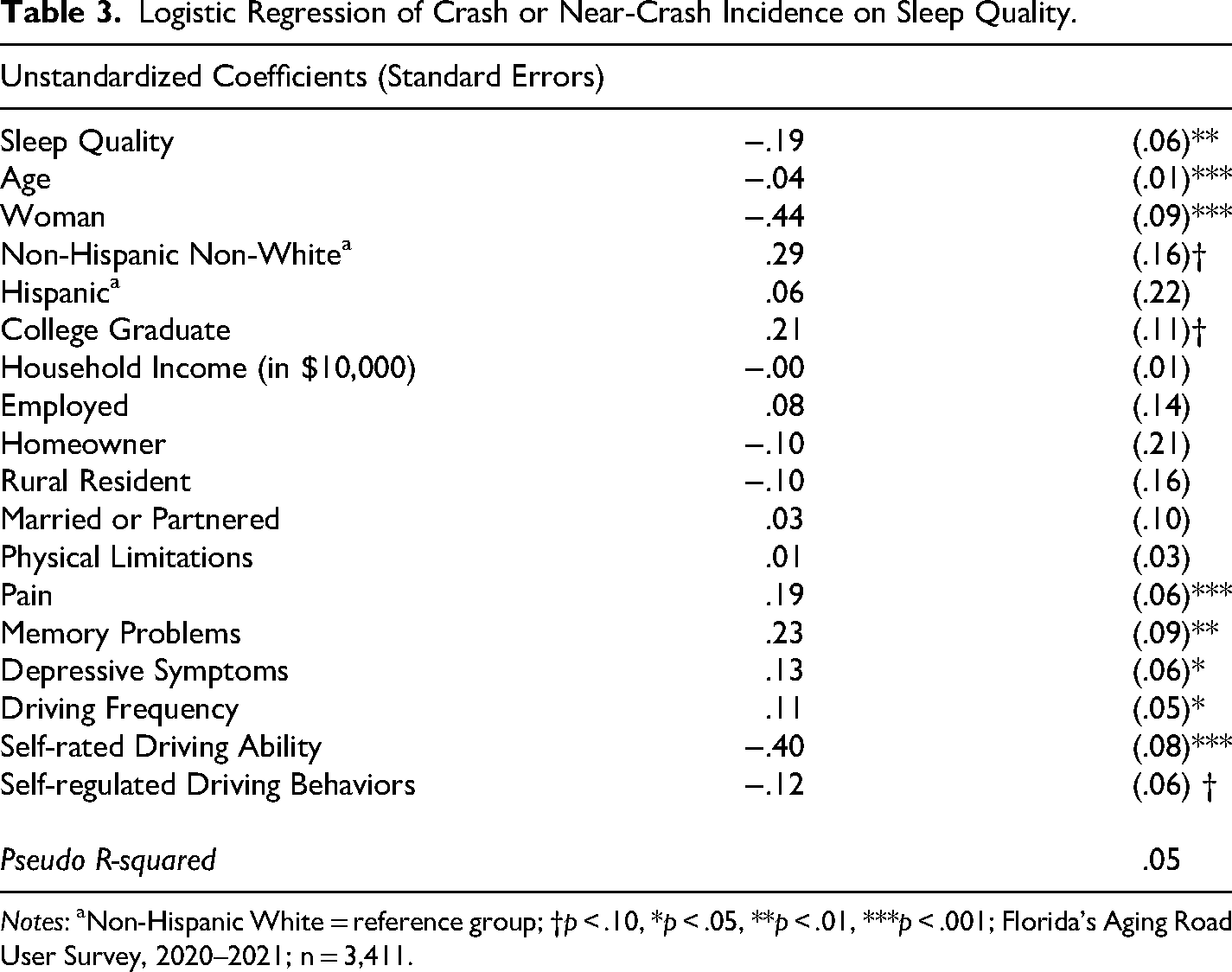
Notes: aNon-Hispanic White = reference group; †p < .10, *p < .05, **p < .01, ***p < .001; Florida's Aging Road User Survey, 2020–2021; n = 3,411.
Discussion
Our study extends the literature on sleep quality and traffic safety by focusing on older adults—a segment of the population that has received limited attention in prior studies. This gap is especially notable given that older adults are not only more vulnerable to sleep disturbances but also comprise a growing share of the driving population (e.g., Canever et al., 2024; Crowley, 2011; Miner & Kryger, 2020; Neikrug & Ancoli-Israel, 2009; Ohayon et al., 2004; Schouten et al., 2022). Our findings—some of which align with existing studies on younger drivers and others that diverge—underscore the need to examine how the relationship between sleep quality and driving safety may evolve with age.
We found no association between sleep quality and self-reported distracted driving behavior among older adults, a finding that contrasts with studies of younger drivers and shift workers, which often link poor sleep with behaviors like speeding, distracted driving, and abrupt lane changes (e.g., Cestac et al., 2011; Filtness et al., 2020; Girotto et al., 2019; Harbeck et al., 2017; Ozkan & Lajunen, 2006; Ren et al., 2023; Robbins et al., 2021; Smith et al., 2020; Wise et al., 2018). Our results are more consistent with research showing that older adults are less likely to drive while drowsy and more likely to adopt preventive strategies (Watling et al., 2015). These patterns suggest that older adults’ driving experience and greater willingness to self-regulate may buffer against some of the safety risks associated with poor sleep. Consistent with this argument, we also found that those who engaged more frequently in self-regulated driving—such as avoiding nighttime driving or congested roads—reported fewer distracted driving behaviors.
While the lack of an association between sleep quality and distracted driving might lessen concern about sleep as a traffic safety issue for older adults, the results for crash or near-crash experiences suggest otherwise. Older adults who reported poorer sleep quality were significantly more likely to have experienced a crash or near-crash in the past year. This result aligns with previous research focused on younger drivers and shift workers, reinforcing that sleepy quality is a critical safety factor across the life course (e.g., Banz et al., 2020; Gold et al., 1992; Hutchens et al., 2008; Lucidi et al., 2006; Martiniuk et al., 2013; Mizuno et al., 2020; Novak & Auvil-Novak, 1996; Tefft, 2012).
Our study sheds light on the effects of sleep quality on traffic safety among older adults, but it has several important limitations. First, our study is limited by the measures available in our dataset. We measure sleep quality using a single item rather than a multi-item scale, which introduces measurement error and should be interpreted with caution. Our use of a single measure also prevents the assessment of how different dimensions of sleep—such as duration, disturbances, or daytime fatigue—may be differentially associated with driving outcomes. In addition, all our measures were self-reported, and likely affected by recall or social desirability biases. Future studies should incorporate validated, multi-item scales and objective indicators to strengthen measurement quality. Second, our study's cross-sectional design prevents us from examining how sleep quality, self-reported distracted driving behaviors, and crash involvement interact and change over time, thereby precluding any conclusions about causal direction. Longitudinal research is needed to understand how these relationships unfold over the life course. Third, our sample underrepresented certain demographic groups, including non-white individuals and those with lower socioeconomic status, which limits generalizability.
Despite these limitations, our findings have clear implications for public health and traffic safety initiatives. They underscore the need to treat sleep health as a core component of safe driving messaging for individuals of all ages. However, the strategies should be age sensitive. For younger drivers—who are more likely to engage in distracted driving when drowsy—campaigns may be most effective when focused on recognizing and responding to sleep-related impairment. For older adults, whose self-regulation may reduce engagement in distracted behaviors, messaging may instead focus on helping them recognize how poor sleep can still impair judgment, reaction time, and attention, increasing crash risk. Finally, the broader importance of sleep quality for driving safety supports a policy focus on expanding access to safe, affordable, and appealing alternatives to driving across the lifespan—particularly for older adults who may be contemplating reduced driving or cessation.
Footnotes
Acknowledgments
The opinions, findings, and conclusions expressed in this publication are those of the authors and not necessarily those of the Florida Department of Transportation.

Ethical Consideration
This study was approved by the Florida State University Institutional Review Board.
Funding
The authors disclosed receipt of the following financial support for the research, authorship, and/or publication of this article: This work was supported by an award from the Florida Department of Transportation (FDOT; BVD30-977-32).
Declaration of Conflicting Interests
The authors declared no potential conflicts of interest with respect to the research, authorship, and/or publication of this article.
Data Availability Statement
Data are not available to other researchers.