







Abstract
Understanding the major purposes that individuals identify as central to their lives is fundamental to psychosocial health and life satisfaction. This study examined how major life purposes vary across six generational cohorts using categorical analysis. A sample of 364 participants was interviewed to assess their major life purposes. Results revealed statistically significant differences in life purpose distribution across generations, χ2(25) = 254.11, p < .001, Cramér's V = .374. Family Responsibility emerged as the most prevalent overall purpose (37.4%), with particularly strong endorsement among Generation X (73.7%) and Baby Boomers (61.5%). The Silent Generation demonstrated the highest prioritization of Religious Obligations (57.1%), while younger generations (Alpha and Z) showed greater diversity in their life purposes, reflected in higher endorsement of “Mixed” categories (51.8% and 47.9%, respectively). These findings suggest important developmental and cohort-related differences in how individuals conceptualize meaning and purpose across the lifespan.
Keywords
Introduction
The search for purpose in life is a fundamental human drive (Bassham, 2014). This concept has captured the attention of philosophers, theologians, and scientists for centuries (Rass, 2018). Humans are naturally inclined to seek purpose in life, which contributes to positive experiences (Emmons, 2003). Purpose in life is defined as the sense of meaning in one's existence and a director of one's life (King & Hicks, 2021; Martela & Steger, 2016; Pfund & Lewis, 2020; Ribeiro et al., 2020). It has been identified as a critical component of psychosocial health and flourishment in life (Keyes, 2011; McKnight & Kashdan, 2009). Research consistently demonstrates that individuals who perceive their lives as purposeful report higher levels of life satisfaction, better mental health outcomes, greater resilience in the face of adversity, superior physical health outcomes, and reduced risk of mortality and psychopathological complications including depression and sleep problems (Hill et al., 2018; Hill & Turiano, 2014; Kim et al., 2021; Musich et al., 2018; Nygren et al., 2005; Thoits, 2012; Willroth et al., 2021; Zilioli et al., 2015).
The purpose in life may vary based on developmental stage, cultural context, historical period, and generational membership (Hill et al., 2015; Pfund & Lewis, 2020; Steger et al., 2009). The concept of generations refers to the cohorts of individuals born within a similar period of time (Eyerman & Turner, 1998). It has been theorized that people belonging to the same generation share common historical, social, and cultural experiences. This concept of differentiating individuals based on their generation has emerged as a powerful lens through which to understand meaningful variation in values, priorities, and life trajectories (Rudolph & Zacher, 2017; Schewe & Noble, 2000; Weston, 2001; Whittier, 2013). Each generation appears to be associated with distinctive responses to the significant historical events, technological innovations, economic conditions, and social movements that occurred during their formative years (Benckendorff & Moscardo, 2013). This results in distinctive worldviews, beliefs, motivational patterns, and behavioral tendencies that persist throughout their lifespans (BarwiŃSka-MaŁAjowicz, 2022; Rudolph & Zacher, 2016; Whittier, 2013).
The Silent Generation (born 1928–1945) came of age during the Great Depression and World War II, experiences that fostered values of sacrifice, duty, and collective responsibility. This cohort has been characterized by strong religious commitments, emphasis on family obligation, and deference to authority (Rogler, 2002). Baby Boomers (born 1946–1964), came of age during a period of unprecedented economic prosperity and significant social upheaval marked by the civil rights movement and anti-war protests (Pruchno, 2012). Baby Boomers have been associated with individualism and self-exploration. They are supposed to question traditional institutions, while still maintaining relatively strong commitments to family and religious values (Roof, 2018; Sherkat, 1998). Generation X (born 1965–1980) experienced the emergence of personal computing and early internet technologies. They also witnessed economic instability during their formative years (DeSoucey, 2012; Hardy, 2012). Often characterized as pragmatic and independent, they demonstrate strong focus on family responsibilities and economic security (David et al., 2017; Howe & Strauss, 2007). Millennials (born 1981–1996) represent the first truly digital native generation (Rodríguez Zambrano et al., 2023). They came of age with the widespread internet and smartphones. Millennials have been characterized as highly educated, diverse, socially conscious, and focused on both personal development and meaningful work (Kurz et al., 2018; Louie et al., 2019; Wandhe, 2024). Generation Z (born 1997–2012) grew entirely in a digital world. The experienced constant connectivity, social media, rapid social change, and heightened awareness of global challenges, including climate change, political polarization, and social justice issues (Deandra Rafiq et al., 2024). This generation demonstrates high levels of social consciousness, mental health awareness, and openness to diverse identities and life trajectories (Jayatissa, 2023; Smith & Cawthon, 2017; Wajdi et al., 2024). They are often reported to have significant mental health challenges (Fitriana, 2024; Liang, 2024; Muktifada Matilda et al., 2025; Ramadhan & Karnita, 2025). Generation Alpha (born 2013–present) represents the newest cohort, born to older millennial parents and Generation X parents in an increasingly digital, uncertain world marked by pandemic disruption, social polarization, and technological advancement (Aini et al., 2025; Nil & Nil, 2025; Vlasuk, 2022).
Given these distinct generational contexts and formative experiences, we might expect to see meaningful differences in how individuals across these cohorts conceptualize and prioritize their life purposes. However, empirical research directly comparing how different generations conceptualize and prioritize major life purposes remains limited. Most research on purpose has either focused on single life domains (e.g., work purpose, spiritual purpose) or has not systematically examined generational variation. The present study addresses this gap by conducting a comprehensive categorical analysis of major life purposes across six distinct generational cohorts. It examines how patterns of purpose prioritization vary across the lifespan and across historical-generational contexts.
Methods
Participants and Procedure
The study sample consisted of 364 participants (Males = 182, 50%; Females = 182, 50%) distributed across six generational cohorts: Generation Alpha (n = 56), Generation Z (n = 73), Millennials (n = 64), Generation X (n = 57), Baby Boomers (n = 65), and the Silent Generation (n = 49). The participants’ ages spanned from 6 to 90 years, with an average age of 43 years (SD = 23). A convenience sampling strategy was used. Participants were recruited through direct, individual contact during visits to academic institutions and to government and private sector offices in Islamabad, Pakistan. Participation was voluntary, and informed consent was obtained from all respondents prior to data collection. The study was carried out in compliance with established ethical standards, consistent with the principles of the 1964 Declaration of Helsinki and its subsequent revisions, to safeguard the rights, dignity, and well-being of the participants. Ethical approval was granted by the departmental review committee at (blinded for review).
Instrument
Data were collected through a structured interview schedule designed to produce participants’ perceptions regarding the purpose of life. The interview schedule comprised two demographic items (age and gender) and one open-ended, substantive question: “What do you see as the main purpose of life?” This question was intentionally broad to allow participants to articulate their views freely, without conceptual constraints imposed by predefined response categories.
Participants’ responses were recorded verbatim in written form during the interviews. Following data collection, all responses were subjected to a systematic thematic coding process using an inductive approach, in which themes were allowed to emerge from the data rather than being imposed from a predetermined framework. In the first phase, two members of the research team independently read all responses and generated initial codes reflecting the content and meaning of each response. In the second phase, initial codes were compared across coders and discussed to resolve discrepancies. Conceptually similar codes were then grouped into broader thematic clusters through iterative comparison and refinement. This process continued until no new themes emerged and consensus was reached on the categorical structure. Through this procedure, six overarching thematic categories were identified: Economic Stability, Family Responsibility, Inner Peace and Contentment, Religious Obligations, Personal Growth and Self-Development, and Mixed Purposes. The Mixed Purposes category was applied to responses in which a participant articulated more than one equally prominent life purpose that could not be meaningfully subsumed under a single category. Inter-rater agreement was assessed prior to finalizing the coding scheme, and any remaining disagreements were resolved through discussion and consensus. These six categories collectively captured the full range of participants’ expressed meanings regarding life purpose.
Data Analysis
Data were entered and analyzed using the Statistical Package for the Social Sciences (SPSS), version 23. Initially, descriptive statistics were computed to summarize the data, including frequencies and percentages for each thematic category representing participants’ perceived major purpose in life. For inferential analysis, a Pearson chi-square test of independence was conducted to examine the association between generational group and perceived major purpose in life. This test was selected as it is appropriate for assessing relationships between categorical variables.
Results
Descriptive Statistics
Frequencies and percentages of major life purposes across all six generational cohorts were calculated (Table 1; Figure 1). Across the entire sample, Family Responsibility was identified by the largest number of individuals (n = 136, 37.4%), followed by the Mixed category (n = 101, 27.7%), Religious Obligations (n = 49, 13.5%), Economic Stability (n = 41, 11.3%), Personal Growth and Self-Development (n = 30, 8.2%), and Inner Peace and Contentment (n = 7, 1.9%).
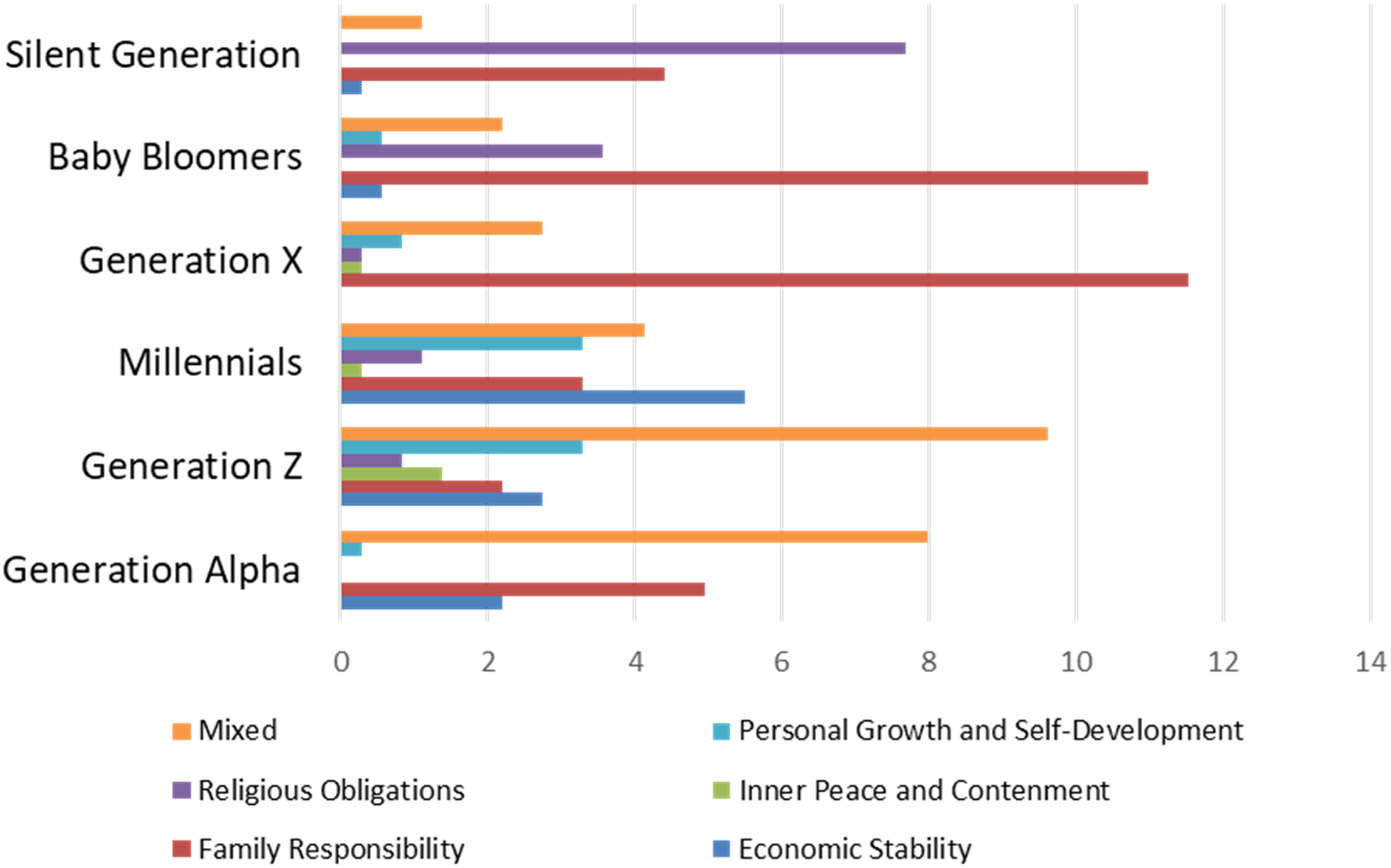
Percentages of the generation-wise major purpose in life.
Frequencies and Percentages of the Generation-Wise Major Purpose in Life (N = 364).
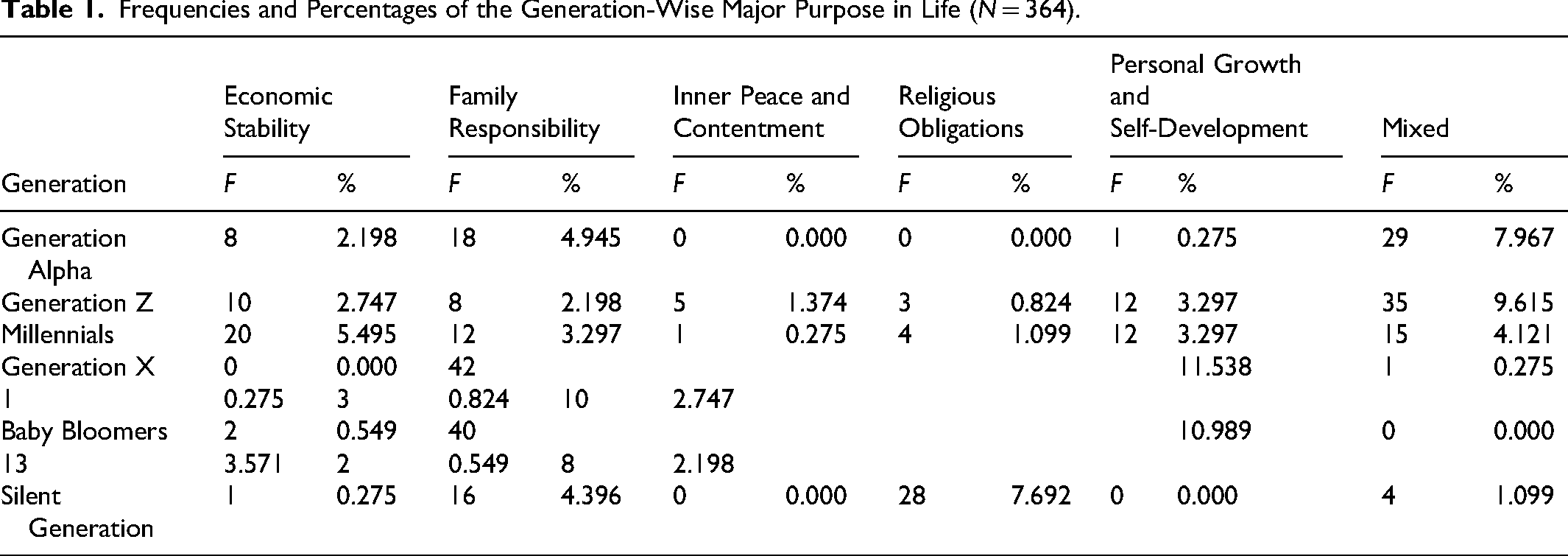
However, substantial variation existed across generational cohorts. Generation X demonstrated the highest concentration of individuals identifying Family Responsibility as their major purpose (n = 42, 73.7% of their cohort), substantially exceeding all other generations. Baby Boomers similarly showed strong endorsement of Family Responsibility (n = 40, 61.5%), suggesting that these mid-to-older cohorts have made family caregiving and responsibility central to their life purposes. In contrast, Generation Alpha, Generation Z, and the Silent Generation showed more diverse patterns, with Family Responsibility representing only 32.1%, 11.0%, and 32.7% of their respective cohorts.
Religious Obligations showed the most pronounced generational pattern. The Silent Generation demonstrated substantially elevated rates of identifying Religious Obligations as a major life purpose (n = 28, 57.1% of their cohort), substantially exceeding all other generations. Baby Boomers also showed notable endorsement of religious purposes (n = 13, 20.0%), while younger generations showed minimal identification with religious purposes (range 0.0% to 4.1%). This pattern of declining religious purpose endorsement across younger age and generational groups is consistent with broader societal trends of secularization, though age-related and period-related factors cannot be ruled out as contributing influences.
Economic Stability was most prominently endorsed by Millennials (n = 20, 31.3% of their cohort), consistent with the experiences of this generation who came of age during economic uncertainty and the Great Recession. Generation X showed no identification with Economic Stability as a major purpose, while younger generations showed modest endorsement (13.7% to 14.3%).
Personal Growth and Self-Development was most prominently endorsed by Generation Z (n = 12, 16.4% of their cohort) and Millennials (n = 12, 18.8% of their cohort), suggesting that younger cohorts place greater emphasis on self-actualization and individual development compared to older generations. The Silent Generation showed no identification with this purpose category.
Inner Peace and Contentment was the least frequently endorsed category overall, with only Generation Z showing any representation (n = 5, 6.8% of their cohort). This finding suggests that contemplative or acceptance-oriented purposes are not primary life goals for most individuals, regardless of generation.
The Mixed category showed inverse generational patterns compared to single-purpose categories. Younger generations showed substantially higher representation in the Mixed category, with Generation Alpha at 51.8% and Generation Z at 47.9%, compared to older generations ranging from 8.2% to 17.5%. This suggests that younger cohorts are more likely to identify multiple equally important life purposes rather than prioritizing a single dominant purpose.
Figure 2 aggregates the data across all generations, showing the overall distribution of life purposes in the combined sample. The figure reveals that Family Responsibility is the most prevalent major purpose in life overall (37.4%), followed by the “Mixed” category (27.7%) and Religious Obligations (13.5%). Economic Stability accounts for 11.3% of responses, while Personal Growth and Self-Development represents 8.2%, and Inner Peace and Contentment is the least common response at 1.9%.
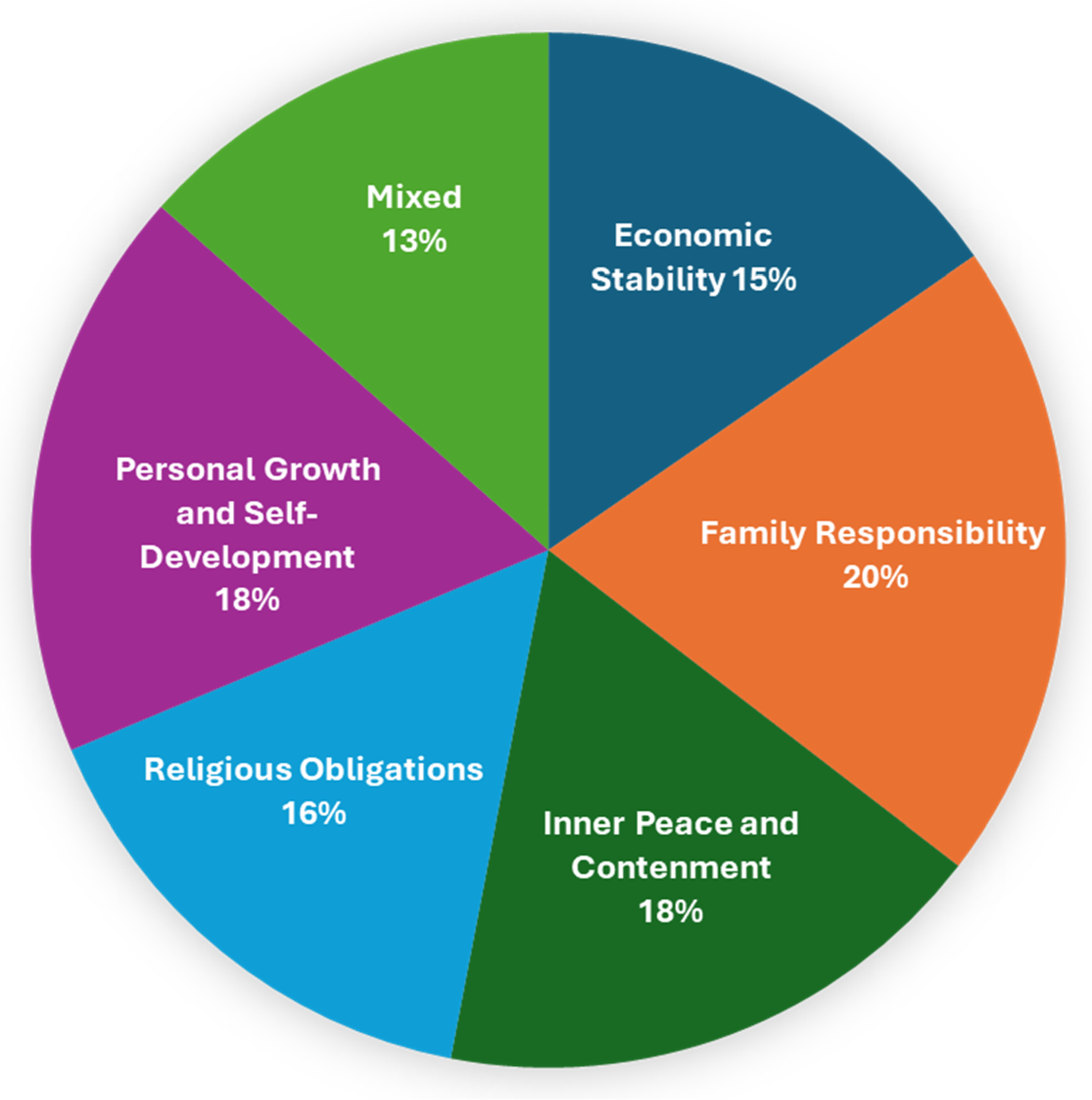
Major purpose in life among all generations.
Generational Comparisons
A Pearson chi-square test of independence was conducted to examine the association between generation and major purpose in life (Table 2). Prior to interpreting the chi-square results, the assumption of adequate expected cell frequencies was examined. As is common in studies involving multiple categories and unequal group sizes, a number of cells contained expected frequencies below the conventional threshold of 5. This should be considered when interpreting the chi-square statistic, as it may affect the precision of the p-value. The overall pattern of results, however, is supported by the magnitude of the association (Cramér's V = .374) and the large adjusted standardized residuals observed in several cells, which together provide a robust basis for the substantive conclusions drawn. Future studies with larger and more balanced samples across generational cohorts would allow for more statistically stable estimates.
Chi-Square Test for Distribution of Major Purpose in Life Across Generations (N = 364).
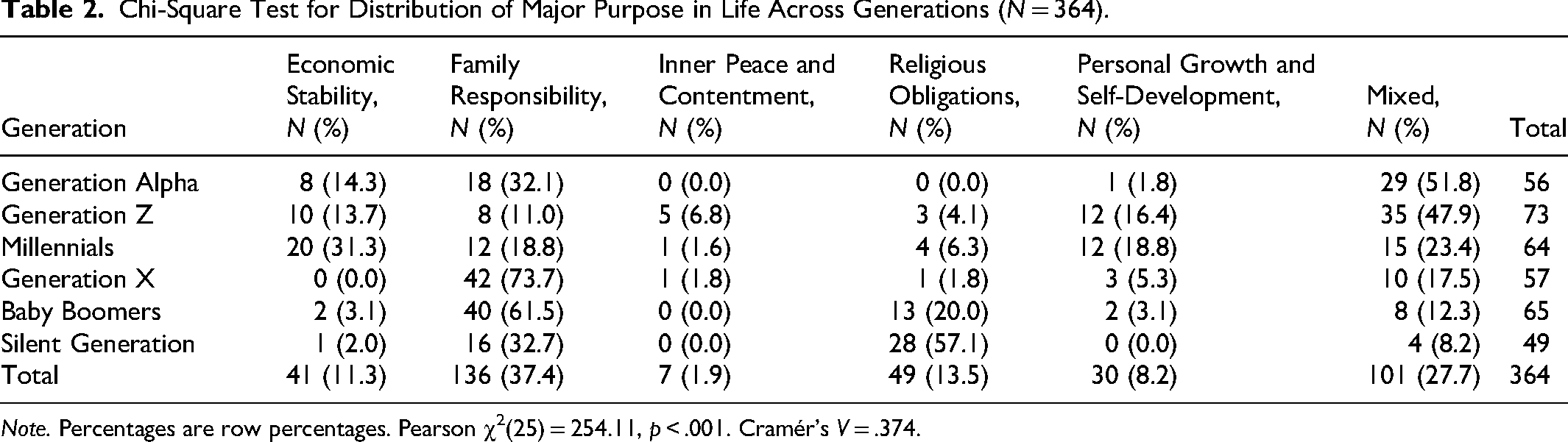
Note. Percentages are row percentages. Pearson χ2(25) = 254.11, p < .001. Cramér's V = .374.
The analysis revealed a statistically significant relationship between generational cohort and primary life purpose, χ2(25, N = 364) = 254.11, p < .001. The magnitude of this association was moderate to large, as indicated by Cramér's V = .374, suggesting that generational membership accounts for a meaningful proportion of variability in how individuals define their major purpose in life.
The post-Hoc (cell-wise) analysis inspection of adjusted standardized residuals identified several generation-specific deviations from expected frequencies:
Generation Alpha was significantly over-represented in the Mixed purpose category (ASR = 4.4) and significantly under-represented in Religious Obligations (ASR = −3.2). Generation Z showed over-representation in Inner Peace and Contentment (ASR = 3.4), Personal Growth and Self-Development (ASR = 2.8), and Mixed purposes (ASR = 4.3), while being under-represented in Family Responsibility (ASR = −5.2). Millennials were over-represented in Economic Stability (ASR = 5.6) and Personal Growth and Self-Development (ASR = 3.4), and under-represented in Family Responsibility (ASR = −3.4). Generation X was strongly over-represented in Family Responsibility (ASR = 6.2) and under-represented in Economic Stability (ASR = −2.9) and Religious Obligations (ASR = −2.8). Baby Boomers were over-represented in Family Responsibility (ASR = 4.4) and modestly over-represented in Religious Obligations (ASR = 1.7), while being under-represented in Mixed purposes (ASR = −3.1). Silent Generation showed a very strong over-representation in Religious Obligations (ASR = 9.6) and under-representation in Economic Stability (ASR = −2.2), Personal Growth and Self-Development (ASR = −2.3), and Mixed purposes (ASR = −3.3).
Overall, these findings demonstrate a clear generational gradient, with younger cohorts emphasizing pluralistic, growth-oriented, and internally defined purposes, while older cohorts prioritize family responsibility and religious obligation as dominant life purposes.
Discussion
The findings of this study reveal meaningful variation in how individuals across different age and generational groups conceptualize and prioritize major life purposes. It is important to note, however, that given the cross-sectional design, these patterns cannot be attributed definitively to generational cohort membership. Age-related developmental processes, cohort-specific historical experiences, and broader period effects are all plausible contributors to the observed variation, and the present data do not permit their separation. With this interpretive caution in mind, the following patterns are noteworthy.
The Silent Generation's pronounced emphasis on Religious Obligations (57.1% of cohort). The relatively modest endorsement of Family Responsibility (32.7%) among the Silent Generation may reflect the fact that by the time of this study, many Silent Generation members were advanced in age and may have reoriented their primary purposes toward spiritual preparation and existential reflection appropriate to later life stages. Baby Boomers demonstrated a transitional profile, substantially endorsing both Family Responsibility (61.5%) and Religious Obligations (20.0%), while showing minimal emphasis on Economic Stability (3.1%) and Personal Growth (3.1%). Generation X showed the most pronounced concentration of Family Responsibility endorsement (73.7% of cohort), a pattern that may reflect both cohort-specific values and the life stage characteristics typical of this age group at the time of data collection. Millennials presented a notably more distributed pattern of purpose identification compared to older generations, with substantial representation across multiple categories: Economic Stability (31.3%), Family Responsibility (18.8%), Personal Growth and Self-Development (18.8%), and a Mixed category (23.4%). The balanced emphasis on Family Responsibility, Personal Growth, and Economic Stability suggests that Millennials are attempting to integrate multiple purposes rather than prioritizing a single dominant domain. This may reflect both the availability of choice in life domains (education, career, and family) and awareness that modern life requires balancing multiple competing demands and sources of meaning. Generation Z demonstrated a substantially different pattern from all older generations, with the lowest percentage endorsing a single dominant purpose and more even distribution across multiple categories. Only 11.0% identified Family Responsibility as their major purpose, which is a dramatic decline compared to older generations. 16.4% emphasized Personal Growth and Self-Development, 13.7% emphasized Economic Stability, and 47.9% identified Mixed purposes as equally important to their life goals. Additionally, Generation Z was the only cohort showing any meaningful percentage (6.8%) identifying Inner Peace and Contentment as a major life purpose. Generation Alpha, born 2013-present, is the youngest cohort in this study. At the time of data collection, most Generation Alpha members were children or young adolescents, making their endorsement of any specific life purpose somewhat preliminary and subject to substantial change as they mature. However, the emerging patterns are noteworthy: the highest percentage endorsing Mixed purposes (51.8%), substantial emphasis on Family Responsibility (32.1%), and minimal emphasis on other single purposes.
The generational differences observed in this study have important implications for lifespan developmental theory. Erikson (Erikson & Erikson, 1998) proposed that individuals navigate distinct psychosocial stages across the lifespan, with different developmental tasks and sources of meaning becoming salient at different life periods. The results of this study partially support Erikson's framework while also suggesting that historical and generational context shapes the specific content and prioritization of purposes independent of developmental stage. For example, the Silent Generation's emphasis on Religious Obligations appears to reflect both their later-life developmental stage (consistent with increased spiritual focus in late adulthood) and their specific generational cohort membership and historical context. In contrast, the reduced emphasis on Religious Obligations among Baby Boomers at comparable life stages suggests that historical and cultural changes in religious practice and belief have substantially shaped purpose prioritization independent of life stage.
This suggests that a truly comprehensive developmental framework must integrate both life stage and generational/historical context as interactive influences on meaning-making and purpose identification. The present findings support the developmental contextualism perspective, which emphasizes that individual development is fundamentally shaped by the historical and cultural contexts in which it unfolds, not merely by universal developmental stages (Elder, 2008; Gale et al., 2023; Mariano, 2014).
The findings also illuminate the psychology of meaning-making across different generational cohorts and historical periods. Individuals construct meaning through narrative integration of their experiences, goals, and values (Baumeister & Newman, 1994; Fivush et al., 2017). The patterns observed in this study suggest that older generations, operating in more economically stable and culturally homogeneous contexts, were able to construct relatively focused narratives around singular purposes (family, religion, or work). In contrast, younger generations, operating in more economically uncertain, culturally diverse, and informationally rich contexts, appear to be constructing more complex, multipurpose narratives that integrate multiple sources of meaning without privileging a single dominant purpose. This shift from singular to plural purpose identification may reflect genuine adaptive responses to the conditions of contemporary life, wherein rapid social change, economic uncertainty, and diverse opportunity structures make commitment to a single purpose less viable or desirable. Alternatively, the shift may reflect generational differences in how purposes are conceptualized and communicated, with younger cohorts more comfortably acknowledging the multiplicity and complexity of their motivations rather than reducing them to singular narratives.
The dramatic decline in Religious Obligations as a stated major life purpose from the Silent Generation (57.1%) to younger cohorts (0–4.1%) is consistent with broader documentation of secularization trends in different societies (Casanova, 2007). This has important implications for religious institutions and for counselors and psychologists working with individuals across generations. Rather than viewing the decline in explicit religious purpose identification as a simple loss of religious commitment, it may be more accurate and nuanced to recognize that younger cohorts have access to multiple potential sources of meaning and are actively constructing purposes through integration of religious, spiritual, secular, and personal development frameworks.
Implications
The study demonstrates clear and statistically significant generational differences in how individuals conceptualize the purpose of life, with important practical, clinical, organizational, and theoretical implications. These findings highlight the need for age-appropriate and generationally sensitive interventions in clinical, counseling, and educational settings. If replicated with longitudinal and more representative samples, these findings could inform age-sensitive and generationally aware interventions in clinical, counseling, and educational settings. Tentatively, purpose-support initiatives for older cohorts might consider incorporating spiritual, existential, and family-based meaning frameworks, while approaches targeting younger cohorts could explore ways to validate multipurpose orientations. However, these suggestions remain speculative pending further research and should not be adopted as established practice guidelines.
Limitations
Perhaps the most important limitation of this study concerns the confounding of generational cohort effects with age-related developmental effects. Because this is a cross-sectional study in which participants from different generations were assessed at a single point in time, it is not possible to determine whether the observed differences in life purpose reflect cohort-specific influences (shared historical, cultural, and social experiences unique to each generational group) or developmental influences (changes in purpose orientation that occur naturally as individuals age). As Reker et al. (1987) demonstrated, meaning in life varies systematically across life stages in ways that may be independent of generational membership (Reker et al., 1987). For example, the Silent Generation's strong emphasis on Religious Obligations may reflect both their cohort's historically religious context and the well-documented tendency for spiritual concerns to become more salient in late adulthood. These influences cannot be separated with the present data. Properly disentangling cohort, age, and period effects requires analytic approaches such as age-period-cohort (APC) analysis or time-lagged longitudinal designs, neither of which was employed here. Accordingly, the findings reported in this study should be understood as cross-sectional, descriptive patterns reflecting age-and-cohort-associated variation, rather than as evidence of generational cohort effects per se. Future research employing longitudinal or APC designs is necessary to clarify the relative contributions of developmental and generational influences on life purpose.
Another notable limitation concerns the inclusion of Generation Alpha participants, some of whom were as young as 6 years of age at the time of data collection. Research in developmental psychology consistently demonstrates that stable identity formation and coherent life purpose articulation are not reliably present in young children. At this developmental stage, responses to open-ended purpose questions are likely to reflect immediate, context-dependent, or socially prompted answers rather than internalized, enduring life orientations. Consequently, the Generation Alpha findings reported here must be interpreted with considerable caution and should be understood as preliminary and exploratory at best. These data cannot be treated as equivalent in reliability or interpretive validity to those obtained from adolescent or adult participants. Future research should either exclude young children from purpose-in-life studies of this kind or employ developmentally appropriate methods, such as age-adapted interview protocols or observational approaches, that are better suited to assessing nascent purpose in younger populations.
The lack of detailed demographic variables limits deeper interpretation. Small sample sizes for some cohorts further limit generalizability. Future research should employ longitudinal, qualitative, and mixed-methods designs, examine demographic and cultural moderators, and investigate both antecedents and psychological consequences of different purpose configurations.
Conclusion
This study contributes to lifespan and generational research on meaning by documenting systematic variation in life purpose across age and generational groups. The findings are consistent with the view that life purpose is shaped by the interplay of historical, cultural, socioeconomic, and developmental contexts, though the cross-sectional design precludes causal interpretation. The emergence of multipurpose orientations among younger cohorts may reflect an adaptive response to contemporary conditions characterized by uncertainty and rapid change, though longitudinal research is needed to confirm this interpretation. Recognizing and validating diverse forms of purpose, particularly multipurpose orientations, has potential implications for promoting psychological well-being across the lifespan, and future research should examine whether purpose configuration has differential consequences for health and meaning outcomes across generational groups.
Footnotes
Ethics Approval and Consent to Participate
Ethical approval was granted by the departmental review committee at COMSATS University Code CUI-ISB/HUM/ERC-CPA/2025-23. Informed consent was obtained verbally from the participants. All the procedures performed in this study were in accordance with the 1964 Helsinki Declaration and its later amendments.
Author Contributions
Conceptualization, WH and HJ; Methodology, WH, MAH, FI, and HJ; Data collection, MAH and FI; Software, WH and HJ; Formal analysis, WH and HJ; Writing – original draft preparation, WH, MAH, FI, and HJ; Writing and editing, WH, MAH, FI, and HJ; Funding acquisition, not applicable.
Funding
The authors received no financial support for the research, authorship, and/or publication of this article.
Declaration of Conflicting Interests
The authors declared no potential conflicts of interest with respect to the research, authorship, and/or publication of this article.
Declaration of Generative AI Use
The authors declare that Claude (Anthropic) was utilized in the preparation of this manuscript for the following purposes: enhancing clarity of expression, refining grammar and syntax, and improving overall academic writing quality. The AI tool was used iteratively during the revision process to ensure consistency and readability. All substantive contributions to this work, including research design, data analysis, interpretation of results, and scientific conclusions, remain the exclusive responsibility of the authors. The authors reviewed and verified all AI-generated suggestions and accept full accountability for the final manuscript content.
Availability of Data and Materials
Data associated with this paper can be produced upon request from the corresponding author.
