







Abstract
This study explored romantic relationships in older adulthood and was guided by the Lifecourse Perspective. It investigated how lifespan development, linked lives, historical context, timing of transitions, and human agency influence relationship decisions in later life. Twenty-one participants completed in-depth interviews exploring their romantic relationships. Reflexive thematic analysis revealed two themes. First, societal expectations and influences on relationships highlight how norms during the early stages of life shape initial trajectories. As individuals aged, these expectations weakened, allowing greater agency in choosing to pursue, maintain, or avoid romantic partnerships. Second, apprehension about caregiving roles emphasized concerns about the emotional and physical demands particularly among single and widowed women who had previously provided care. Participants in committed relationships viewed caregiving as a more reciprocal, expected part of caregiving. Findings underscore the complexity of later-life relationships and the importance of historical context, gendered expectations, and accumulated life experiences in shaping romantic decision-making.
The term “situationship” has been popular in Western culture since 2010 and is defined as individuals who have a complicated relationship status (Langlais et al., 2024). While the term has often been applied to younger adults, as individuals continue development throughout the lifespan, the term may also reflect complicated relationships in later life. In older adulthood, relationship status becomes pivotal, as marriage, singlehood, dating, or widowhood reflect the intersections of historical norms, social expectations, and personal decisions. Given the varied aspects of relationship status in older adulthood, it is essential to better understand the intricacies of romantic relationships. The purpose of this qualitative study was to explore how romantic relationships and decision-making around them are impacted by lifespan development, linked lives, historical context, timing of transitions, and human agency for married, dating, single, and widowed older adults.
Theoretical Framework
The Lifecourse Perspective was selected as the theoretical framework for this research project because it highlights how time and place shape the roles individuals acquire in adulthood. The cohort individuals are born into can determine the social and cultural history to which individuals in a particular area are exposed (Bengtson et al., 2005). The Lifecourse Perspective was first developed by Elder (1998) and includes five key tenets: lifespan development, linked lives, historical time and place, timing of transitions, and human agency. These tenets explain how individuals are influenced and impacted over the life course.
Lifespan development focuses on continued development throughout our lives. At all ages, we must navigate gains and losses; development is a lifelong phenomenon. Linked lives consider the roles we occupy and how others influence us. As children, the dynamics and situations among parents and siblings can continue to impact them well into adulthood, both positively and negatively (Elder et al., 2014). Historical time and place consider the impact of historical events on individuals’ lives, including where they were and how old they were when the event occurred. Historical events may be perceived differently depending on the country in which an individual resides and their age at the time they experienced them (Elder et al., 2014). The timing of transitions in our lives may affect the likelihood of future transitions or events. For example, during the 1960's and early 1970's, when many of the individuals in this study were entering adulthood, the predominant social norm was to get married and have children shortly thereafter. These dynamics significantly shaped the romantic relationships that young adults pursued during this time. Finally, human agency reflects the choices individuals make when pursuing new opportunities (e.g., moving, taking a new job, choosing a school). The power of individual choice can shape what additional social roles individuals take on and what opportunities they are exposed to (Elder et al., 2014).
A pivotal part of development in older adulthood is relationship status, in which the accumulation and intersection of life events, social contexts, and historical timing influence attitudes, behaviors, and decision-making. Healthy relationships have long been associated with numerous physical and psychological benefits, including increased life expectancy, higher life satisfaction, and improved mental health (Jace & Makridis, 2021; Whisman et al., 2018). The death of a spouse, increased risk of debilitating illness, and rising divorces in aging populations are prevalent life events that influence identity and relationships. Social attitudes about relationships are constantly evolving, complicating perceptions of relationships for older adults, who have a lifetime of mixed messages to inform their behavior. Finally, the historical trend of people living longer and being healthier provides opportunities for new and ongoing relationships, unlike those of previous generations. The four main relationship types we will explore include married, single, widowed, and dating.
Married
The majority of older adults are married: 47.3% of women and 69.8% of men aged 65 years and older (Loo & Brown, 2024). The discrepancy between genders and marriage rates is connected to women's greater likelihood of being widowed, men's lower life expectancy, and men's tendency to marry younger partners and remarry following divorce or widowhood (Brown & Wright, 2017). Marriage rates do decrease with increased age as a result of widowhood. Healthy marriages have long been associated with numerous physical and psychological benefits, including higher self-reported health, increased happiness, improved management of chronic health conditions, and longer life (Ford & Robitaille, 2023; Jace & Makridis, 2021; Liu & Upenieks, 2021). Alternatively, unhealthy relationships are problematic as those with high levels of marital strain have more physical and psychological problems (Carr et al., 2017). Over the lifespan, these strains and challenges can compound in older adult relationships, leading to years of relationship dissatisfaction.
A shared responsibility found in aging relationships is that one partner often becomes a caregiver. Individual and social obligations call for spouses to care for each other as they age, a transition that is unquestioned and unconscious for those in marriage relationships (Cash et al., 2019). Older married couples are more likely to assume caregiving responsibilities for a partner than older adults in unmarried relationships (De Jong Gierveld, 2015). Societal and family expectations make women more likely to provide care to family members (Wolff et al., 2018). This burden of spousal care is heavier for women, but both genders do step into caretaking roles. Compared with middle-aged relationships, the gap in spousal care in older relationships diminishes as external work demands decrease, leading to more similar time investments in caregiving (Glauber, 2017; Langner & Furstenberg, 2020). These experiences and changes throughout the lifespan of family life can influence attitudes and behaviors toward current and potential relationships.
Dating, Cohabitation, and Living Apart Together
With growing numbers of unattached older adults, increased life expectancy, and healthier aging, older adult dating is on the rise. Standards for partner selection are high at this age, as many choose to be alone rather than enter unsatisfactory relationships (Malta & Farquharson, 2014). Compared to younger generations, older adults are more likely to make decisions based on their preferences and identity and are less pressured by social conformity (Castrellon et al., 2024). Higher levels of education, financial resources, good health, and more social connections increase the likelihood that an older adult will date rather than remain single (Brown & Shinohara, 2013). Similar to other relationship stages, there are gender differences in dating behaviors and outcomes among older adults. Compared to women, older men are significantly more likely to date, want to remarry, and cohabitate (Crowley, 2018; Miller et al., 2021). These trends are partly explained by the increased presence of women in the dating pool and by men being more likely to consider dating younger women (Harris, 2023). Essentially, men have more dating options. Additionally, men in relationships experience significant physical, psychological, and social benefits.
When women date, they are more likely to date someone their own age (Harris, 2023). With men's life expectancy being lower, there are fewer eligible partners and greater caretaking potential for women. Avoidance of caretaking responsibilities is a significant factor in women's dating decision-making. To avoid caretaking responsibilities, there is an increasing preference among women to live apart but together, or to live separately in a committed relationship (Benson & Coleman, 2016). This allows women to receive emotional and sexual benefits from relationships while still maintaining independence and minimizing caretaking expectations and responsibilities (Funk & Kobayashi, 2016).
After dating, if individuals choose to pursue further commitment, many older adults are choosing to cohabitate rather than remarry. Over the last several decades, attitudes supporting cohabitation among older adults have increased (Brown & Wright, 2015). Unsurprisingly, cohabitation rates among older adults have risen in line with changing attitudes and quadrupled since 2002, with older adults more likely to choose cohabitation over remarriage (Brown et al., 2019; Loo, 2024). When comparing the relationship quality between older adults who were cohabiting versus married, no differences were reported (Wright, 2020). However, when investigating gender differences, men were more likely to report greater satisfaction levels in both cohabiting and marital relationships compared to women (Wright, 2020). Brown and Wright (2016) found that cohabitating men had lower levels of depression and that living together seems to be beneficial for men. These findings suggest that men appear to be more satisfied with cohabiting and marital relationships and that marriage is not needed to have a positive impact on men.
Single
Single older adults, defined as individuals who are divorced or were never married, are a growing demographic. Research indicates that 15.2% of adults aged 65 and older are divorced, and 6.6% have never been married (Loo & Brown, 2024). In what is known as “gray divorce” or “silver splitters,” divorce rates among middle-aged and older adults are increasing around the world (Raley & Sweeney, 2020; Tang, 2020). Never-married populations have grown over previous decades, but the number of divorced older adults has increased threefold since 1990 (Loo & Brown, 2024). The result is a large, growing population of single older adults.
A key distinction between single older adults is that some want to marry or remarry, while others have no desire for marriage. In the Mouzon et al. (2020) study on African American romantic involvement, approximately two-thirds of participants were not married or cohabiting and reported having no romantic involvement and no desire to pursue such relationships. Additionally, older adults may want companionship but are unwilling to settle for subpar relationships and instead opt for their own independence when relationship prospects are unfavorable (Malta & Farquharson, 2014). Other adults remain single as they prioritize caregiving for family members, such as children, grandchildren, and siblings, rather than forming new relationships (Harris, 2023).
There are significant gender differences in relationship preferences for single older adults. Crowley (2018) observed that while many older women expressed a desire for romantic companionship and emotional intimacy, nearly half reported no interest in remarriage. Furthermore, women in their seventies and eighties were the least likely to engage in active dating (Miller et al., 2021). This reluctance toward marriage or remarriage is often attributed to women's perceptions of diminished benefits and increased burdens associated with romantic partnerships (Mouzon et al., 2020). Older single women often prioritize autonomy and may be reluctant to enter committed relationships, fearing the expectation of assuming caregiving responsibilities (Davidson, 2002). In contrast, men tend to experience health declines more rapidly than women, which can necessitate caregiving support from partners in later life. While living alone is associated with increased risk of mortality for all genders, men have a higher risk of death when they live alone, which highlights their increased impetus to develop relationships (Nakou et al., 2025).
Widowed
Individuals who have experienced the death of a partner make up the widowed category. However, recent research suggests there may be more nuance to this designation. In Compton and Kaufman's (2024) study, the authors reported that a new category is needed to understand relationship status among widowed individuals, as some choose not to be in relationships. This only captures part of this population, because a minority of those who have lost a spouse are dating or have previously dated. When it comes to relationship status, those who are widowed report struggling to figure out where they fit in because they are not in the married club or single club (Taylor & Robinson, 2016). Widowed individuals are least likely to want to marry; only 8.6% of widowed individuals in the American Marriage Survey, a national probability-based survey, indicated they wanted to remarry someday (Compton & Kaufman, 2024). Many factors contribute to this decision not to be in a romantic relationship, such as not wanting the responsibility of caring for another spouse or still feeling like one is in a relationship. Family factors also influence decisions to seek new romantic relationships, as widowed individuals report being less likely to repartner because of the potential discomfort experienced by family members believing that their surviving parent is “moving on” from their deceased parent (Cotton, 2025).
There are also gender differences in relationship decisions following the loss of a spouse. Though the majority of widowed individuals do not desire a romantic relationship, for those who do, men are more likely than women to want to date, remarry, or be in a relationship six months following the loss of their spouse (Carr, 2004). Differences in desires to remarry diminish at 18 months, but men are still more likely to report dating or wanting to date. These gendered differences are highly connected to social support. Men experience a decrease in social interactions and participation in social activities following the death of their spouse, with women not experiencing the same pattern (Yoon et al., 2022). When men have higher levels of social support from friends and family, the differences subside, and they are not more likely than women to seek a romantic partner (Carr, 2004).
The opportunities for relationships in older adulthood are extensive. However, additional research is needed to explore the relationship desires of older adults. In addition, understanding more about how they might define levels of commitment in these relationships is needed.
Methodology
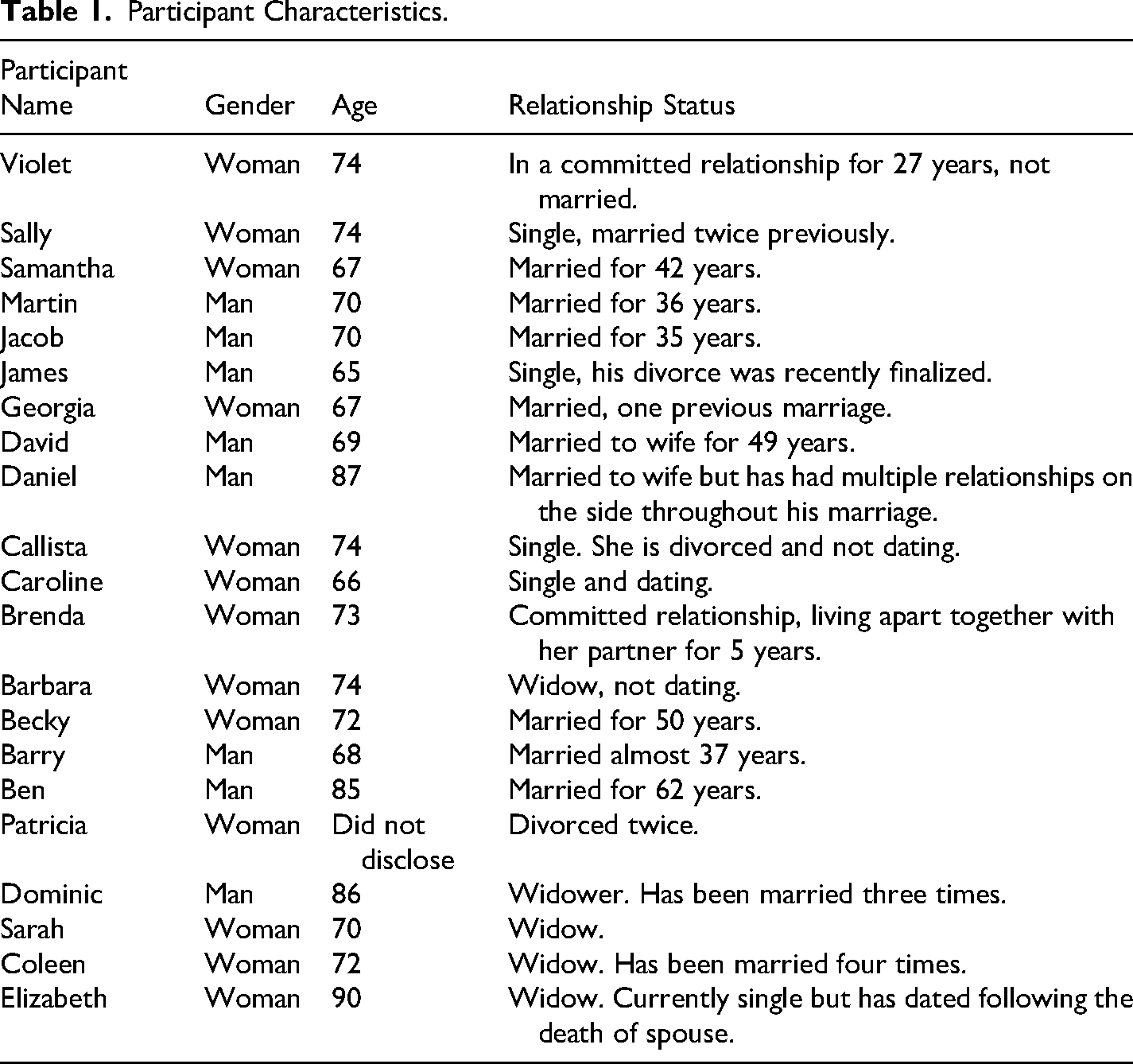
The Institutional Review Board (IRB) at the University of Northern Iowa approved this study. After receiving authorization, researchers contacted the administrators of the Seniors Together in Aging Research (STAR) database at the University of Iowa to send out the survey via email to potential participants. The survey was sent to all older adults who were aged 65 and older (n = 907) that resided in Iowa. A total of 155 individuals completed the survey, and an additional subsample agreed to be contacted for an interview (n = 21). The average age of participants was 70 years, and most were highly educated, with approximately 57% having earned a Master's or Doctoral degree. Additional participant characteristics are presented in Table 1.
Participant Characteristics.
Researcher Positionality
Understanding the influence of the researcher's worldview on the project is an essential component of qualitative research. It provides a framework for why the study was conducted and the researcher's role in data interpretation (Holmes, 2020). The first author is a gerontologist in the US whose research often focuses on purpose and meaning in life in older adulthood. Relationships in later life are an integral part of wellbeing. While not all relationships are romantic, learning how and why older adults maintain, seek out, or end romantic relationships in later life to uphold their is of particular interest to the researcher. As the only individual who completed the interview analysis, she influenced what was coded, what was perceived as meaningful, and the final themes. Braun and Clarke (2024) note that, in thematic analysis, there is no assumption of reliability; instead, the researcher's positionality is justified, providing context for how the data were understood and its impact on the analysis.
Procedure
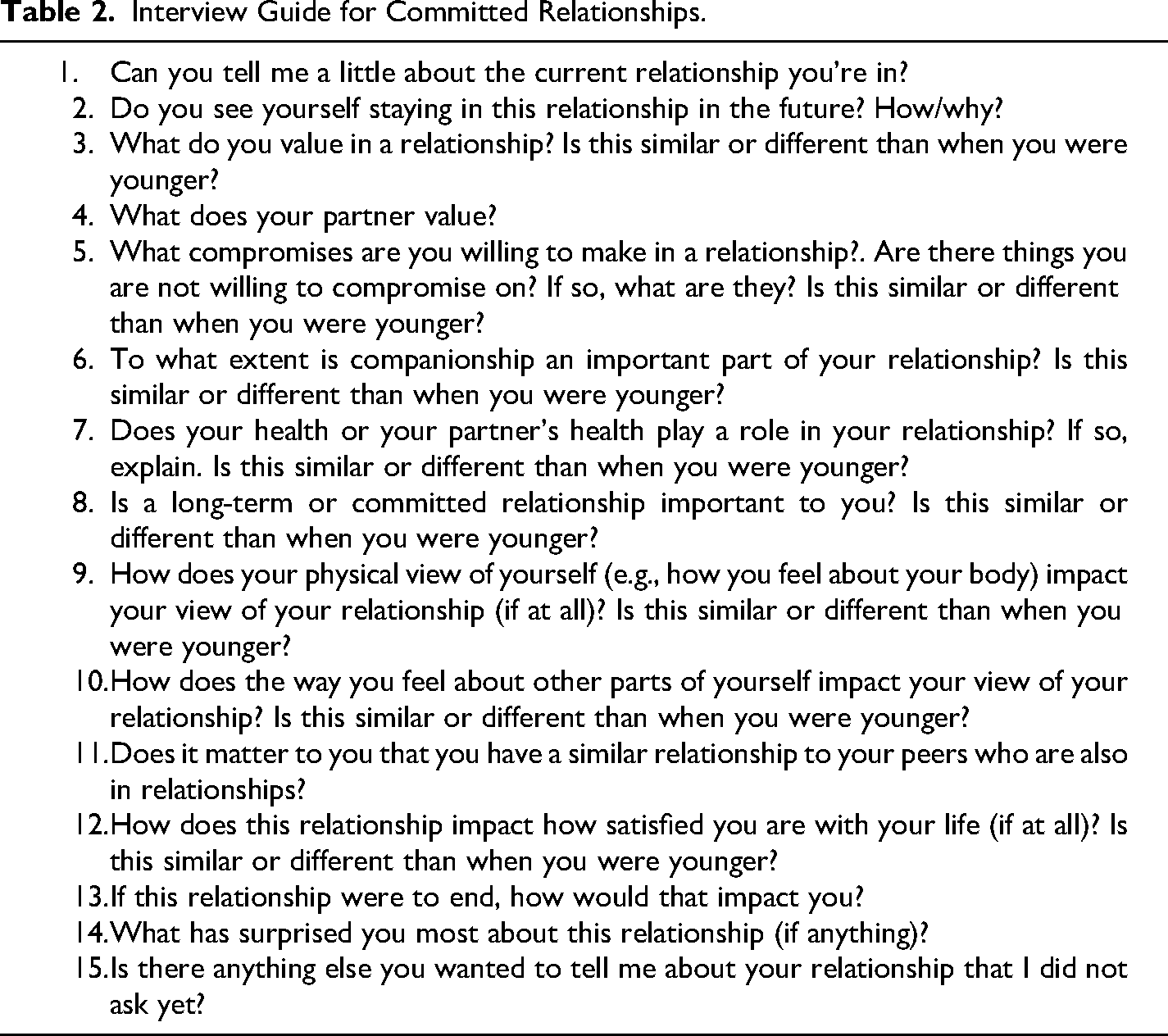
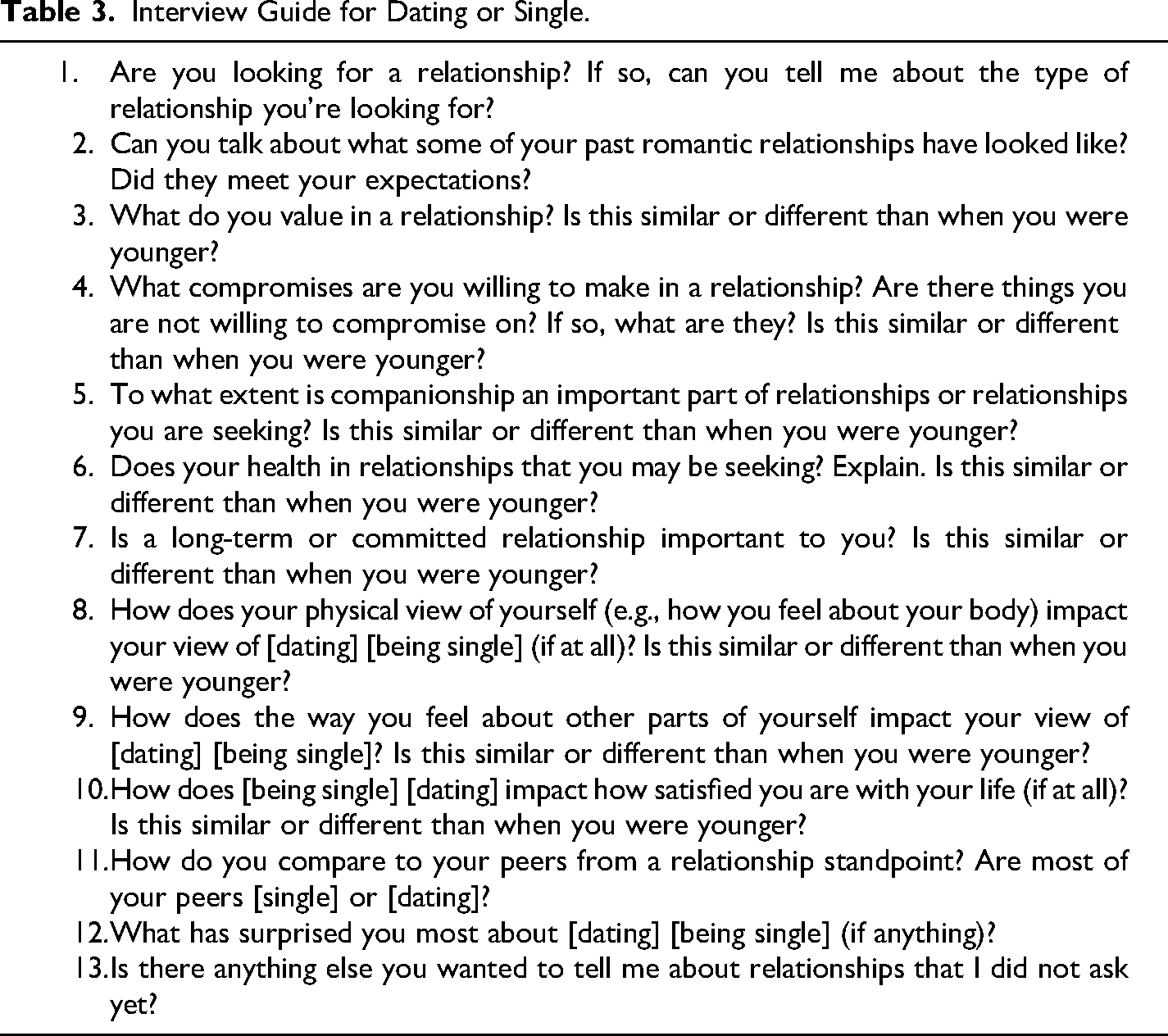
At the end of the survey, individuals who were willing to participate in an interview shared their email addresses. After compiling a list of potential participants, individuals were randomly selected from those categories and contacted for interviews. Two graduate students sent a follow-up email to any participant who did not reply within 2 weeks of the original email. Because so few men who were not in committed relationships responded, the students ended up interviewing 13 women and 8 men. Two graduate students conducted Zoom interviews with participants, lasting 30 to 60 min. Although similar, the interview guide for older adults in committed relationships (Table 2) used different questions than that for those who were single or dating (Table 3). Each participant was given a pseudonym to ensure anonymity.
Interview Guide for Committed Relationships.
Interview Guide for Dating or Single.
Data Analysis
Braun and Clarke's (2021) reflexive thematic analysis was used to analyze the interviews with older adults. Their approach includes a six-step process for researchers to consider, including: (a) data familiarization, (b) coding the data pieces, (c) recoding of initial codes, (d) creation and revision of initial themes, (e) continued adjustment of themes, and (f) finalizing results for write-up. Two graduate students transcribed the data. Afterward, the first author reviewed the transcripts and began initial coding. Quotes from each participant were coded and grouped under larger categories in Excel. These categories were later pared down to themes. The first author returned to the data after initial theme generation to identify additional quotes related to each theme and discussed them with the co-authors. As discussed by Braun and Clarke (2024), single researcher coding is appropriate in qualitative research and does not compromise validity. Relatedly, from a non-positivist perspective, the researcher's subjectivity as a coder is an interpretive practice, and finding a single “correct interpretation” is not possible (Braun & Clarke, 2023). Findings are described below, with participant quotations to illustrate emergent themes.
Results
Two themes were identified from the interviews with older adults. The first theme,
Categories and Themes.
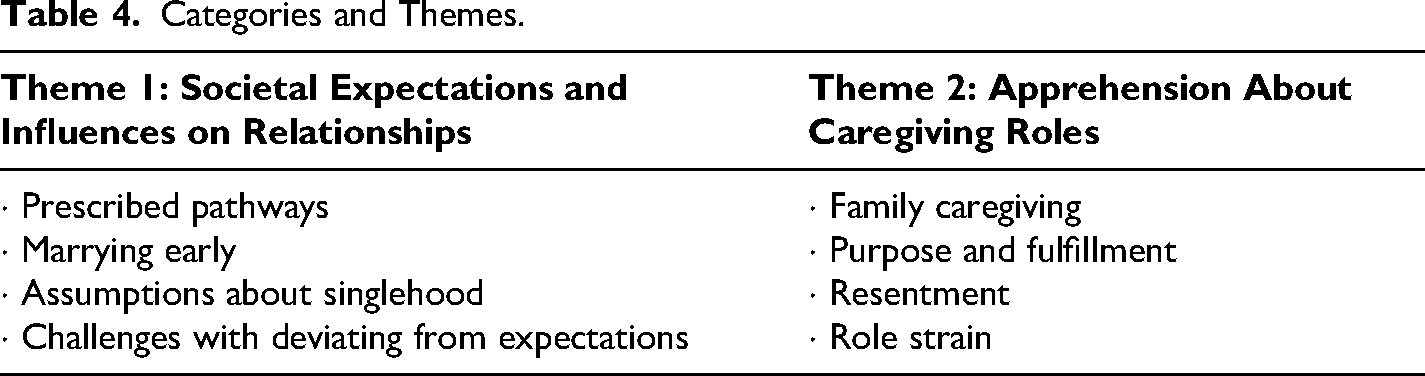
Theme 1: Societal Expectations and Influences on Relationships
For most interviewees, societal expectations significantly shaped the romantic relationships older adults pursued in early adulthood. Many of the older adults commented that there was a preconceived path for them to follow, and this often included marrying a person of the opposite gender and having children. For some older adults, this was entirely satisfying, particularly for men. However, when older adults pursued new romantic relationships in later life, they gave greater consideration to their own needs. As individuals aged, they became more comfortable exercising their own agency and discerning whether a romantic relationship suited them, feeling less pressure to stay married or get married.
Sally, a single woman, reflected on the impact societal and familial expectations had on her first marriage. She explained, “…we were really married too young, but my mother in particular was upset because she knew we were sleeping together. And I thought, well okay, I’ll make her happy, and we’ll get married.” She went on to explain, “it was in many ways a very good relationship, but in many ways very difficult, because we were just too young.” Relatedly, Violet, a woman in a committed relationship, also discussed how societal expectations affected her first marriage after she became pregnant. She explained, “And kind of the next thing I know is I’m pregnant, and I’m married. And wait, that's not what I had in my thought process.” Violet's perspective further illuminates the extent to which pregnancy imposed a socially prescribed trajectory on romantic relationships. Relatedly, Ben, a man in a committed relationship, explained that, “Back then, it was, you know, everybody was expected to get married.” Alternatively, other men, like Martin, reported feeling little pressure from societal expectations when they were younger. He said, “certainly my parents would have appreciated it (if he got married). No, I didn’t really feel outside pressure.”
For other women, like Becky, who were in committed relationships, the societal expectation of marrying early seemed less burdensome, perhaps because it aligned with their own desires. She said,
I think culturally, I grew up believing that a young woman married a young man… a fairytale-type environment I grew up in was very standard. That was what my parents modeled…It wasn’t really until I went to college that I was exposed to much more diversity.
As individuals aged, participants often felt more comfortable expressing greater human agency and deciding which, if any, romantic relationships to pursue. Coleen explained,
I think when I was younger, I thought I had to have a male partner. I finally realized, no, you don't need a male partner…you don't have to follow that model if you don't want to. So yeah, that has changed a great deal.
…there were children involved. So that also kept it in the back of your mind that you at least ought to stay with the person to help raise them and that sort of thing. But it just got unbearable, and so that dissolved.
Dominic also described that as he aged and gained more life experience, he was able to make decisions based on his own agency rather than simply what society expected. He describes this process as,
When you're younger, you're still in an experimental stage in your thinking. As you develop your mental acuity, you have to say, does this fit? Is this part of me, or is this not? That type of continual decision process goes on as you grow older and have different experiences, and you have to throw them in that category of yes or no. You get to know yourself better over time and build your identity. If you don’t, you just make a bunch of silly mistakes over and over again.
Interestingly, Jacob, a man in a committed relationship, explained his experiences with societal expectations and their impact on his relationship with his wife. He said,
…we were not able to have children, I really wanted kids. And she did as well at first, but she always says that she wanted kids because she thought that's what you were supposed to do…And then when we got married, she realized that it was like no, I don’t just have to become a mother because I’m a wife.
When he and his wife were unable to achieve societal expectations of parenthood, it took them time to embrace deviating from traditional roles and expectations. As they got older and more mature, societal expectations became less influential on their circumstances.
Theme 2: Apprehension About Caregiving Roles
Many participants recognized that the likelihood of taking on a caregiving role increased with age. However, among the individuals interviewed, women were more likely than men to discuss caregiving dynamics in the context of their relationships or potential relationships. Single and widowed women were most concerned about the possibility of having to care for a new partner. In some cases, this prevented women from pursuing romantic relationships. While none of the men spoke about apprehension regarding taking on caregiver roles, one man did speak about his likelihood of needing care in the future, further illustrating the gendered expectations for caregiving found in relationships.
Barbara, a widow, explained that…
I do have reservations about a relationship. They might be in need of more medical stuff or things like that…[I have] been down that road once, and then helped take care of my brother…But that's being kind of selfish and not wanting to be a caregiver. So you know, if it's the right person, then it's okay, you know, it's okay.
In Barbara's case, especially since she had provided care to her husband, who died, and to other family members, she was wary of taking on this role again. Sarah, a widow, also commented on her lack of interest in seeking out a new relationship. She explained, “That's, that's my biggest fear, is if I would meet somebody and really enjoy them and like them and stuff, and then they get sick, and then you, then you're kind of stuck right, yeah?”
Relatedly, Caroline, a single woman, explained how caregiving can take a toll on relationships. She said, “It was so hard to be supportive of somebody with a disability, and I just don’t think I could do it again. It actually kind of led to us splitting up, because I couldn’t do it anymore, and I was having anxiety attacks…” She seemed cautious about taking on this role again and mentioned that she and her peers were also facing caregiving responsibilities for aging parents. Caroline explained, “And you know, for people my age, it's like our parents are starting to be like children. We also have to be taking care of them.” Her comments also demonstrated the cumulative impact of caregiving on individuals. Because Caroline had already been a caregiver to multiple people, it was challenging for her to consider taking on this role again.
Other older adults who seemed less concerned about caregiving dynamics were more likely to be in committed relationships. Brenda, a woman in a committed relationship, commented that “I think I give a lot more to the relationship than he does. And I’m willing to do that.” She later commented, “So it pleases me to be able to take care of him…we both have our independence, but yet there's things that I can do for him that he doesn’t do for himself. And that gives me satisfaction.” Similarly, Georgia, a woman married to her second husband, explained that “I’m the one taking care of the medications for him.” She expressed some resentment by reflecting, “It's something I kind of wish I wouldn’t have to do, but there have been times where I’ve been ill and he's taken care of me, so yeah, turnabout's fair play.” She seemed to recognize that both she and her partner might need to provide more care to each other as they aged.
Jacob, a married man, spoke about some of the limitations of his rheumatoid arthritis and its impact on his wife. He said, “I’m obviously not getting around the way you do…but she married me knowing that I had a chronic disease and that there would be things that we might not be able to do.” It is possible that since these individuals were already in committed relationships, they were more willing to provide care to their partners. Likewise, as Jacob's comments indicated, when individuals need care, it may feel easier to ask a partner to provide it within the context of a committed relationship.
Coleen, a widowed woman, was one of the few women to discuss how she might have benefited from having a partner who could provide care. She said,
It is tough. I'm going to have to have knee replacement surgery, and for that, I'm probably going to have to go to a rehab facility to recoup, because I can't be home alone. So yes, I kind of miss having a partner then, because you can rely on somebody to temporarily help you…
Overall, reflecting on caregiving expectations and their impact on romantic relationships was more common as individuals aged. Martin, a married man, mentioned, “when you’re younger, you feel like I’m not quite immortal, but I’m going to be this way for 100 years.” His comments suggested that for many individuals, caregiving dynamics may not affect romantic relationships until older adulthood.
Discussion
The purpose of this study was to explore perceptions of romantic relationships among older adults in committed relationships and those who were not. We investigated how social, cultural, historical, and personal factors influenced relationships. We noted that older adults had decades of experience navigating relationships, and that these experiences often shaped whether they were interested in staying in, ending, or pursuing new romantic relationships in later life. Further theoretical connections are outlined below.
Theoretical Connections—Lifecourse Perspective
In this study, many individuals were highly educated, suggesting they may have come from families that were similarly educated or had the resources to send their children to college. Those with higher education are more likely to earn higher incomes (Bartscher et al., 2020). In addition, previous researchers have used education as a proxy for socioeconomic status (SES) (Antonoplis, 2023). Relatedly, SES is a major contributor to the Lifecourse Perspective, in which a person's upbringing and resources influence their roadmap for later-life decisions (Kalmijn, 2024). Vespa's (2012) research found that those with higher SES felt less pressured to remarry later in life. While some individuals with fewer financial resources may feel inclined to remarry for the financial advantages it provides, individuals in this study seemed to have greater economic flexibility that higher education (and, with it, higher income) affords, enabling them to be more discerning about long-term commitments. These findings represent an area of research that requires further exploration, particularly how SES may influence relationship decision-making for different cohorts of women.
While individuals still desire emotional intimacy in later life (Crowley, 2018), many women in this study demonstrated that it could be satisfied in multiple ways, such as through friendship or by creating nontraditional arrangements, such as living apart together, where the couple is in a committed relationship but lives in separate residences. As Benson and Coleman (2016) indicated, some women may be especially interested in these types of partnerships because fewer caregiving expectations are placed on them. Because many of the older adults in this study were highly educated and likely had greater financial resources, they may have felt less pressure to conform to societal expectations and instead chose to create new options for companionship or forgo romantic relationships in later life.
These dynamics present an interesting turning point and a possible cohort effect, with older women exhibiting greater decision-making power in later life. It also presents an alternative perspective to that of Brown and Shinohara (2013), who suggested that those with higher levels of education and resources are more likely to date. However, findings from that study were likely conducted with an older cohort of older adults, demonstrating how relationship preferences may change as cohorts age. Many older women today are Baby Boomers born between 1946 and 1964, who had greater opportunities for contraception (Bailey, 2013), higher education, careers, and financial resources compared to women in previous generations (Pruchno, 2012). With these resources and opportunities come greater independence and decision-making power, and these women are likely to continue executing this power in later life. Therefore, older women may view remarriage as an option but not a requirement. More research is needed to further explore the differences.
Historical Influences and Timing
The individuals in this study were born during the 1930s–1950s and lived through historical events that likely shaped their perceptions of relationships. Advancements in the Women's Rights Movement, including the Women's Strike for Equality, where women marched for access to abortion in all states, equal opportunities for education and work, and affordable, high-quality childcare (Doherty, 2020), may have impacted participant perceptions of women's roles, opportunities, and expectations for relationships. Over the last several decades, significant increases in earning potential have led to almost one-third of women in heterosexual relationships now earning more than their husbands (U.S. Census Bureau, 2025). Greater economic freedom allows people to exercise their agency to remain single or live apart together, rather than being financially dependent on relationships, which may be a shift in this cohort compared to previous generations.
Participants in this study often cited the role of social expectations in their early adult lives and their impact on romantic relationships. Social pressure to date, fall in love, and get married is especially prevalent in the United States (Sprecher & Felmlee, 2020). In this study, most participants were currently married or had been married, indicating that societal expectations had previously influenced their decision-making. Within the Lifecourse Perspective theoretical framework, “time and place” appeared to play a pivotal role in these societal pressures, as the interviewed couples came of age in a period when early marriage and having children were cultural expectations. It should be noted that these social expectations sometimes led to satisfying relationships, while other participants reported that those prior unfulfilling relationships ended. In cases like Sally's, societal expectations led her to marry when she felt she was too young. It is possible that the weight of those expectations to marry may have added stress to the relationship and contributed to its end.
Linked Lives and Human Agency
Many participants also mentioned that experiences in their early relationships influenced their later-life decisions about relationships, further demonstrating linked lives and the “interaction between the individual's social world over the life span” (Elder, 1994, p. 6). For women, an overarching theme was apprehension about taking on caregiver roles if a partner experienced declining health. Moreover, women like Barbara and Caroline, who had experienced caregiving for a former partner, were more likely to voice concerns about the responsibilities a new relationship might bring. These previous caregiving experiences significantly shaped their interest in pursuing new relationships.
Other women, like Sarah, a widow, did not discuss many details of her former relationship but mentioned concerns about being stuck in a relationship if the other person experienced declining health and needed care. Overall, women were more likely to discuss the impact of caregiving on relationships, especially those who were single or widowed. For some women, the cumulative impact of caregiving contributed to their apprehension about pursuing new romantic relationships. Because women spend significantly more time providing care to others throughout the life course (Bracke et al., 2008), it is possible that prior caregiving experiences left them with few reserves and little interest in pursuing romantic relationships. In addition, these previous relationship examples demonstrate how linked lives and prior relationship dynamics influence current relationship preferences (Settersten, 2005).
Older adults in committed relationships were less likely to express concerns about caregiving. Some older adults saw caregiving as a natural part of the evolution of their relationship and age-related changes. However, few men spoke about providing care to their partners in this study. This may be because men have shorter life expectancies and they are less likely to provide care (Brown & Wright, 2017), or they engaged in little of it because there were fewer societal expectations for them to do so (Wolff et al., 2018). Alternatively, because the participants in this study were relatively young, their partners may not yet have required significant assistance. Relatedly, although their partners may have had few caregiving needs, substantial evidence in the literature suggests that men are unaware of the caregiving they receive and that their partners do not expect them to reciprocate that level of caregiving. Other researchers have suggested that men provide increasing levels of care to their wives in later life, as retirement affords them more opportunities to do so than when they were working full time (Glauber, 2017). However, women are more likely to bear a much greater caregiving burden as loved ones age (Duangjina et al., 2025; Wenshan et al., 2022). The Lifecourse Perspective implies that each couple's lived experience and the historical context in which they reside will strongly influence how they perceive their caregiving responsibilities and the burden they may create.
In the complexity of human relationships, participants identified examples of how they exercised varying degrees of agency in relationship decisions throughout their lives. The ability to express agency may play an even greater role in later life, particularly in romantic relationships. The cumulative experiences older adults have had influence decision-making in unique ways, providing additional support for the complex factors and considerations that go into relationships in later life.
We agree with Sassler (2010), who discussed the benefits of exploring romantic relationships in older adulthood through a life-course lens, noting that what we know about relationships can change over time and that continued research across a wide range of age groups is necessary to understand how perspectives and interests may change with age. Overall, marriage may become less beneficial, particularly for women who are more likely to have access to educational and financial resources to meet their needs. If women do consider relationships, they may be more likely to choose living apart together or cohabitation, which reduces their likelihood of taking on caregiving roles.
Relationship Categorization
As other researchers have noted, we found it challenging to categorize relationships in later life due to their diversity. For widows who had experienced the death of a partner and then had a different relationship end afterward, we were unsure if they should be classified as widowed or single. Taylor and Robinson (2016) noted that widows do not clearly fit in the “single” or “married” categories anymore, especially if they had pursued relationships after the death of their spouse. Furthermore, exploring how older adults classify their own relationships is needed. As this study illustrates, not all older adults neatly fit into the existing categories used to classify relationships.
Limitations
A limitation of the present study is the lack of diversity among participants. The older adults who completed the surveys, including the subsample who participated in the interviews, were recruited from the STAR database at the University of Iowa. As a result, these older adults were primarily from Iowa and more likely to share values or characteristics associated with Midwestern American culture. While these interviews add depth to what is known about relationships in later life, they may reflect those in the Midwest more than others. As previously mentioned, the participants also had high levels of education, with 57% holding a Master's or Doctoral degree. The higher level of education is not representative of the wider population.
Gender-related differences in romantic preferences and expectations were another area of interest to the authors of this study and to the themes found in the qualitative data. The experiences and perspectives described by the participants in this study, particularly those of the women interviewed, align with previous literature on gendered experiences in romantic relationships during older adulthood. However, given the relatively small number of single male participants in the interview portion of this study, there is limited ability to make gendered comparisons within this sample. Further qualitative data on the perspectives of older adult single men would provide a more balanced view of these gender differences and support the themes discussed in this paper.
Future Directions
One of the significant hallmarks of Life Course Perspective Theory is the role that historical context plays in shaping one's beliefs and actions. Given the split in men's and women's perspectives on caregiving and their willingness to engage in subsequent relationships, it is essential to identify the role a cohort effect may play in these beliefs. As society becomes more egalitarian, both men and women may shy away from relationships after the salience of caregiving is introduced into their perspective. Alternatively, a more equalized distribution of caregiving across genders in current generations may reduce apprehension toward caregiving. Currently, there is not enough data to make these cross-generational comparisons. Future studies investigating this phenomenon could shed light on how caregiving affects relationships as both parties age.
Life timing plays an important role in what people want from romantic relationships and in how they approach finding them. Of the many factors that influence what a person looks for in a romantic relationship at different stages of life, two important ones are financial resources and prior experiences. Older adults likely have more disposable income and have been through more romantic relationships than young adults of similar SES. To this end, research examining the specific variables that influence whom and how young adults and older adults choose to enter romantic relationships would augment current findings.
Finally, this paper demonstrates the diversity and complexity of older adult relationships and explains that some older adults are interested in varying levels of commitment in later life. Situationships have been explored among young people and are often thought of as having lower levels of commitment than other relationship types (Langlais et al., 2024). Varied types of situationships might be present in older adulthood and look different from how they do in younger adulthood. Additional research exploring commitment in older adulthood is needed to understand better which older adults are most interested in these relationships.
Implications
During retirement, women may have more time to reflect on their relationships and consider whether they want to stay married, begin dating, or remain single. As women reflect on what they want, there will be a greater need for counselors to understand the complexities of older adult relationships and aid in decision-making. Historically, women have been more likely to turn to counselors and therapists during times of transition, and these findings speak to the importance of these mental health professionals being well trained in older adult relationship dynamics to help support them as they navigate these changes. In addition, with Medicare now covering some mental health visits, barriers to care are lessened making it more accessible for older adults to seek out these services (Medicare, n.d.).
These findings also speak to the importance of turning to a financial planner for guidance when considering relationship changes in later life. Interestingly, while some findings have demonstrated that greater earnings afford women greater power over making financial decisions, other results noted that men still have greater financial decision-making power, even if their wives outearn them (Klesment & Van Bavel, 2022). Particularly for women who may be considering gray divorce, adjusting to widowhood, or for those considering remarriage, a greater understanding of one's financial resources enables more informed decision-making.
Footnotes

Funding
The authors received no financial support for the research, authorship, and/or publication of this article.
Declaration of Conflicting Interests
The authors declared no potential conflicts of interest with respect to the research, authorship, and/or publication of this article.