







Abstract
This study investigates the portrayal and age-related stereotypes of older adult characters in popular Chinese films. Content analysis of 100 films (2000–2024) yielded 305 older adult characters. Findings show older adults remain underrepresented, with a pronounced gender imbalance favoring older males. Contrary to prior research, positive portrayals predominate; over 90% of characters showed positive stereotypes like Tidy, Experienced, Face-conscious, and Polite. Tidy was the most frequent positive stereotype, while Despondent was the most common negative one, differing from Western stereotypes of The Perfect Grandparents and Shrew/Curmudgeon. Gender differences occurred in positive stereotypes: older men were more often Experienced and Hard-working, whereas older women were more likely Noncompetitive and The Perfect Grandparent. Negative stereotypes showed no gender differences. These findings contribute to understanding the evolving media construction of ageing in contemporary popular Chinese films and hold important implications for future research on age stereotypes and the cultural politics of media representation.
Introduction
Population ageing has become a global trend, unfolding at an unprecedented pace and attracting increasing scholarly attention. China stands as one of the nation most profoundly impacted by this demographic shift. According to the Statistical Bulletin of National Economic and Social Development of the People's Republic of China (2024), the population aged 60 and above has reached 310 million, accounting for 22% of the national total. Against this backdrop, research on the portrayal of older adults in the media has expanded considerably.
Researchers have extensively documented the representation of older adults across various media platforms, including advertisements, television, and film. A substantial body of work consistently shows that older adults are often underrepresented and depicted with limited diversity and nuance. These findings have been intensified by growing global demographic shifts, which fuel scholarly interest in the complexity of older adult portrayals. Such media portrayals are not merely descriptive; rather, they reflect broader societal perceptions and cultural values surrounding ageing. In particular, stereotypical depictions of older adults both mirror prevailing attitudes toward ageing and actively shape and reinforce cultural understandings of what it means to grow old (Levy, 2009).
Recurrent onscreen portrayals are important because media serve as a major channel through which symbolic representations circulate in contemporary society. Although the present study does not examine audience responses directly, prior theoretical work has long suggested that repeated media images may shape how social groups are recognized, interpreted, and evaluated. In this broader sense, Social Cognitive Theory (SCT) offers a useful background perspective by highlighting the potential social relevance of recurring mediated representations (Bandura, 1986, 2001, 2009). At the same time, the current study does not operationalize SCT mechanisms such as observational learning, identification, self-efficacy, or outcome expectancies. Instead, it remains focused on representation itself: the visible traits, roles, and patterned portrayals through which older adults are depicted on screen.
Cinema is especially important in this regard. Beyond reflecting social attitudes, film provides recurring narrative and visual patterns through which later life may be imagined, valued, or marginalized. In China, accelerating population ageing alongside the rapid expansion of the film industry makes popular cinema a particularly important site for examining the roles and traits repeatedly associated with older adults.
Accordingly, this study uses content analysis to examine the portrayals of older adults in a sample of 100 widely released Chinese films. It focuses on the visibility, narrative positioning, and age-related stereotypes of older adult characters. Rather than testing audience effects, the study aims to document how older adults are represented in contemporary popular Chinese cinema and to provide a descriptive basis for future research on ageing and media.
The Underrepresentation of Older Adults in Media
Ageing represents a significant societal phenomenon, and media portrayals of older adults play a critical role in shaping public perceptions of this life process. Prior research consistently demonstrates the underrepresentation of older individuals across advertising, television, and film, with older women particularly vulnerable to invisibility and marginalization.
In advertising, older adults appear infrequently and often occupy peripheral roles (Kessler et al., 2010; Prieler et al., 2017; Raman et al., 2008). For example, Lee et al. (2007) reported that older adults were featured in only 15% of advertisements, while Robinson and Callister (2008) found an even lower rate of 13.1%. Furthermore, when older adults are featured, they are typically relegated to minor or background positions (Greco, 1993). This pattern is compounded by persistent gender disparities, with older women represented less frequently than men (Baumann & de Laat, 2012; Moore & Cadeau, 1985; Roy & Harwood, 1997).
Similar patterns are evident in television programming (Daalmans & Ter Horst, 2017; Lauzen et al., 2007; Vasil & Wass, 1993), where younger characters overwhelmingly dominate screen time. Studies consistently show older adults comprising only a small fraction of characters: rates have been reported as low as 2.8% in U.S. prime-time television (Robinson & Skill, 1995a), 4% in later analyses (Lauzen & Dozier, 2005a), and 8% in animated television (Robinson & Anderson, 2006). Even when present, older adults are most often secondary characters (Robinson & Skill, 1995a), with older women further marginalized (Sink & Mastro, 2017).
Film research points to a similarly persistent underrepresentation. Older adult roles are rare, particularly for characters aged 60 and above (García et al., 2022; Margaret, 2012). Analyses of Disney animated films, for instance, demonstrate that older adults are often peripheral figures (Atkinson & Plew, 2017). Crucially, numerous studies confirm that older women appear significantly less often than men (Lauzen, 2021; Lauzen & Dozier, 2005b; Smith et al., 2015). A study of top-grossing films from 2010 to 2020 documented stark gender disparities, with female characters aged 50 and above far less represented than their male counterparts (Davis, 2021). These findings underscore the double discrimination faced by older women, who are disproportionately relegated to supporting roles (Lauzen & Dozier, 2005b) and portrayed as marginalized figures (Jürgens et al., 2022; Kessler et al., 2004).
Importantly, these patterns deviate significantly from demographic realities. Census data universally reveal that the proportion of older adult characters in film and television is substantially lower than their actual presence in the population (Çelik, 2023; Harwood & Anderson, 2002; Markov & Yoon, 2021; Smith et al., 2015). For example, the reported gap in film representation for older women reaches 12.6%, compared to 4.9% for older men (Neville & Anastasio, 2019). Similar disparities have been observed in advertising, where older adults consistently appear in proportions well below their population share (Prieler et al., 2017; Simcock & Lynn, 2006; Swayne & Greco, 1987). This long-standing underrepresentation highlights the structural neglect and exclusion of older people in media, perpetuating the misleading notion that they occupy only a marginal position in society and reinforcing their symbolic distance from the social mainstream (Gerbner, 1980).
As a central cultural medium, film carries a responsibility to present more balanced and diverse portrayals of older adults. Yet cinematic representations frequently reinforce stereotypes, portraying older individuals as marginalized and subject to multiple forms of discrimination. Against this backdrop, this study asks whether similar patterns of underrepresentation are evident in popular Chinese films. Accordingly, we propose the following research questions:
Age Stereotypes in Media Portrayals of Older Adults
Ageism, first defined by Butler (1969), refers to the prejudice and discrimination directed toward individuals on the basis of age. Nelson (2004) later conceptualized ageism as a multidimensional phenomenon encompassing stereotypes (cognitive), prejudice (affective), and discrimination (behavioral). This formulation is especially relevant to the present study because it draws attention to the central role of stereotypes in shaping ageist attitudes and social practices. Ageism and aging stereotypes have enduring impacts on the lives and self-perceptions of older adults (Swift et al., 2017). These cultural patterns influence how older people are perceived and treated (Hummert et al., 1995; Jiang & Zhou, 2012).
Theories of ambivalent sexism and ambivalent ageism reveal a phenomenon in which prejudice is not solely manifested as overt hostility, but also includes “benevolent discrimination”—a form of bias that appears warm on the surface but is fundamentally restrictive (Cary et al., 2017; Glick & Fiske, 1996, 2001). Older adults are frequently stereotyped as “warm but incompetent,” eliciting pity and over-accommodation rather than genuine respect. This suggests that positive media portrayals of older adults as “kind and wise” may, in fact, be specific manifestations of benevolent ageism. Existing research demonstrates that stereotypes of older adults indeed exhibit an ambivalent structure characterized by high warmth and low competence (Fiske et al., 2018). Furthermore, earlier studies identified a range of negative (e.g., Shrew/Curmudgeon and Despondent) and positive stereotypes (e.g., John Wayne conservative, The Perfect Grandparent, Healthy) (Schmidt & Boland, 1986). In the Chinese context, Zhang et al. (2002) found similar dual patterns, with older adults often viewed as Experienced and Hardworking, but also associated with frames like Meddlesome or Male favoritisms. Surveys examining stereotypes across media and regions have revealed differences in the portrayal of older adults, with this disparity being particularly prominent along gender lines—older women often confront more severe double discrimination based on both age and gender.
Advertising commonly employs positive stereotypes, highlighting happiness, health, and family roles (Duduciuc, 2016; Robinson & Callister, 2008; Roy, 1999; Simcock & Lynn, 2006). “The Perfect Grandparent” is especially associated with older women, reflecting cultural expectations but severely narrowing their portrayals (Miller et al., 2004; Zhu, 2017). Television, by contrast, more often reinforces negative stereotypes, though patterns cross-cultural patterns exist (Rovner-Lev & Elias, 2020). For example, while Indian television may depict older adults as frail or grumpy (Laskar & Sarkar, 2019), whereas U.S. prime-time and Christmas television tend toward positive depictions such as the “Golden Ager” (Kline et al., 2024; Markov & Yoon, 2021). Chinese prime-time programming similarly highlights happiness and self-satisfaction (Chen et al., 2005).
Films also heavily rely on stereotypes, influenced by genre and geography. Animated films often emphasize negative stereotypes such as the “Shrew,” while teen films portray older adults more positively (Robinson et al., 2009; Zurcher & Robinson, 2018). Comedic films often draw on negative stereotypes for humor (Margaret, 2012), though recent romantic comedies show more balanced portrayals (De Sutter & Van Bauwel, 2023). Globally, depictions differ: older adults are more negatively portrayed in the Middle East, North Africa, and Southeast Asia, while South and East Asian films are relatively positive (Ng et al., 2023). Specifically, older adults in Nigerian (Obari & Ohiagu, 2025) and Iranian films (Zanjari et al., 2021) are characterized with negative stereotypes. In China, limited research suggests films addressing ageing often resort to extreme stereotypes (Yang & Yu, 2024). Western cinema has shifted toward “successful ageing,” portraying older adults as independent and active (Chonody et al., 2025; Smith et al., 2015), though such portrayals may overlook real health challenges (Robinson & Callister, 2008).
The intersection of age and gender dimensions complicates the portrayal of stereotypes. Applying an intersectionality perspective to gerontological research, gendered ageism maintains that ageism does not operate neutrally but generates asymmetrical effects along gender lines (Calasanti & Slevin, 2001, 2013). Research indicates that older women face a double burden of discrimination in media, where ageism and sexism are intricately intertwined. They are often characterized as unattractive, unintelligent, or socially isolated (Bazzini et al., 1997; Rovner-Lev & Elias, 2020), while older men are more likely depicted as active and dignified (Markson and Taylor, 2000). This disparity is visible in advertising, where older women are often culturally devalued and shown without professional or occupational roles (Baumann & de Laat, 2012). In film, they are more likely than men to be portrayed as depressed or malicious (De Sutter & Van Bauwel, 2023), reinforcing persistent gender disparities.
In sum, the underrepresentation and partial characterization of older adults in media sustain societal stereotypes. Given the cultural specificity and massive reach of Chinese cinema, this context raises critical questions regarding the nature and application of age stereotyping in popular Chinese films. Accordingly, we propose the following research questions:
Methods
This study employed content analysis to examine the representation of older adult characters in popular Chinese films. A total of 100 films released between 2000 and 2024 were selected, yielding 305 distinct older adult characters for analysis. Coding followed operational definitions established in prior content analysis research to ensure reliability. The year 2000 was chosen as the starting point, marking both China's demographic shift into an ageing society (Xie, 2004; Yan et al., 2021) and the beginning of significant structural reforms in the film industry (Liu, 2022).
Sampling
This study employs purposive sampling to select 100 popular films released in Mainland China between 2000 and 2024. The selection prioritizes films with high box office performance, critical acclaim, and realistic themes to focus on works with social impact and the capacity to shape public perception. The sample is restricted to films produced independently or primarily by Mainland Chinese production companies.
To ensure rigor and reproducibility, the screening process was conducted in three distinct phases:
Phase 1: Market Performance (N = 1,342)
Initial data were retrieved from China Box Office, Maoyan, and the National Film Administration. This phase included all films released in Chinese theaters from 2000 to 2024 with a cumulative box office exceeding 10 million RMB. This threshold was established to exclude films with negligible market presence and limited social reach, ensuring the sample represents popular works within the contemporary Chinese mass communication context. This phase yielded 1,342 films.
Phase 2: Public Reputation (N = 211)
Films were required to have a minimum score of 6.0 on Douban, China's most influential film review platform. Furthermore, accolades from major professional industry awards—specifically the Golden Rooster, Hundred Flowers, and Huabiao Awards—served as secondary validation to verify the professional standing of the films, though they were not used as primary exclusion criteria. This phase ultimately yielded 211 films.
Phase 3: Final Sample (N = 100)
From the remaining pool, the study first excluded genres with “surreal” attributes, such as animation, costume films, science fiction, fantasy, suspense, and ancient war epics. A comprehensive content review was then conducted on the remaining 137 films. During this phase, a further 31 samples were precluded due to the absence of elderly characters, and an additional six samples were excluded as the corresponding film sources could not be retrieved. Ultimately, this study finalized 100 sample films.
Data Integrity and Robustness
This sampling strategy ensures that the dataset reflects both the esthetic habits of the general public and mainstream market trends. All data were retrieved on March 27, 2025, to ensure timeliness.
To verify the robustness of these criteria, a sensitivity analysis was conducted by slightly adjusting the box office and rating thresholds. The analysis indicated no significant shifts in the composition of the core sample, confirming the stability of the study's findings. For transparency, a detailed list of the 100 films is provided in Appendix 02.
Coding Procedure
The coding work was carried out by three coders, one of whom is the author of this study. In accordance with United Nations regulations, individuals aged 60 and above are classified as older adults for the purpose of this study. The primary task for the coders is to identify all characters with speaking roles and determine whether each character is an older adult. The definition of older adults is based on the following criteria: (a) retirees who have exited their most productive working phase; (b) individuals who are perceived as older adults by other characters; (c) individuals who consider themselves to be old; (d) individuals whose age is explicitly mentioned in the storyline (Çelik 2023); (e) individuals whose children are middle-aged or who have grandchildren; (f) individuals with physical characteristics such as gray or white hair, visibly wrinkled skin, hoarse voices, a stooped posture, difficulty breathing, an inability to walk without assistance (e.g., cane and wheelchair), or those residing in nursing homes (Markov & Yoon, 2021; Roy & Harwood, 1997). Older adult characters for this study were required to meet at least two of the preceding criteria.
After identifying the older adult characters, the coders assessed their prominence within the film and categorized them as either major, supportive, or minor characters (Robinson & Skill, 1995b). Thus, characters who appear repeatedly and serve as the focal point of the narrative were coded as major characters; those who are not the primary focus of the story but are crucial to the plot were coded as supportive characters; the remaining speaking characters (with more than one line of dialogue) who are not integral to the story and do not significantly influence the plot's development were coded as minor characters.
The current research focuses on the portrayal methods of older adult characters and their representativeness. Based on this focus, we employed content analysis to explore our research question. Neuendorf (2017) points to content analysis as a scientific research method, characterized by systematic and quantitative approaches to analysis. Its content encompasses objectivity-intersubjectivity, generalizability, replicability, reliability, and validity.
This study draws upon the research of Hummert et al. (1994) on stereotypes of older adults in Western countries, which has been widely applied to television and advertising analysis (Lee et al., 2007; Markov & Yoon, 2021; Miller et al., 2004). Concurrently, to assess stereotypes of older adults in China, this study also adopts the research findings of Zhang et al. (2002) on positive and negative stereotypes of Chinese older adults, which has been previously applied to Chinese advertising research (Zhang et al., 2008). However, the representation of older adults in Chinese popular film has not been examined. In this study, positive stereotypes include the following characteristics: Healthy, Experienced, Young at-heart, Hard-working, Content, Prudent, Tidy, Honest, Non-competitive, Principled, Responsible, Polite, Face-Conscious, Friendly, Sacrificing, Confident, The Perfect Grandparent, and Golden Ager. Negative stereotypes include: Laodao, Meddlesome, Superstitious, Gossipy, Boastful, Male favoritisms, Careless, Despondent, Exposed to age discrimination, and Shrew/Curmudgeon.
This study employed content analysis to assess the presence and nature of age stereotypes in the portrayal of older adult characters. For each identified stereotype, characters were coded into one of three categories: “consistent” (indicating that the character's portrayal aligned strongly with the defining traits of the stereotype), “not consistent” (indicating minimal or no alignment), or “undefined” (indicating insufficient evidence for a clear determination). To reduce over-attribution, coders were instructed to code a stereotype as present only when the character's dialogue, behavior, interactions, or narrative positioning provided sufficient and reasonably consistent evidence for that trait.
The analysis was conducted in two stages. First, chi-square tests were performed to examine the bivariate associations between gender and stereotype categories. Second, to address the non-independence of observations arising from characters being nested within films, we employed binary logistic regression with cluster-robust standard errors. In this approach, the film was specified as the clustering unit to adjust the standard errors for intra-film correlations. Finally, to control for the False Discovery Rate (FDR) across multiple stereotype categories, the resulting p-values were adjusted using the Benjamini–Hochberg procedure.
Intercoder Reliability
To ensure coding reliability, 20 films were randomly sampled from a total of 100 films (20% of the film sample). The sample comprised 55 older characters (18% of the total sample) for intercoder reliability analysis. Krippendorff's alpha values were computed for variables such as role and the positive and negative stereotypes displayed by older adult characters, with values ranging from 0.727 to 1, indicating high coding reliability. After establishing intercoder reliability, the remaining samples were randomly divided and independently coded by three coders (Table 1).
Reliabilities for Coding Variables.
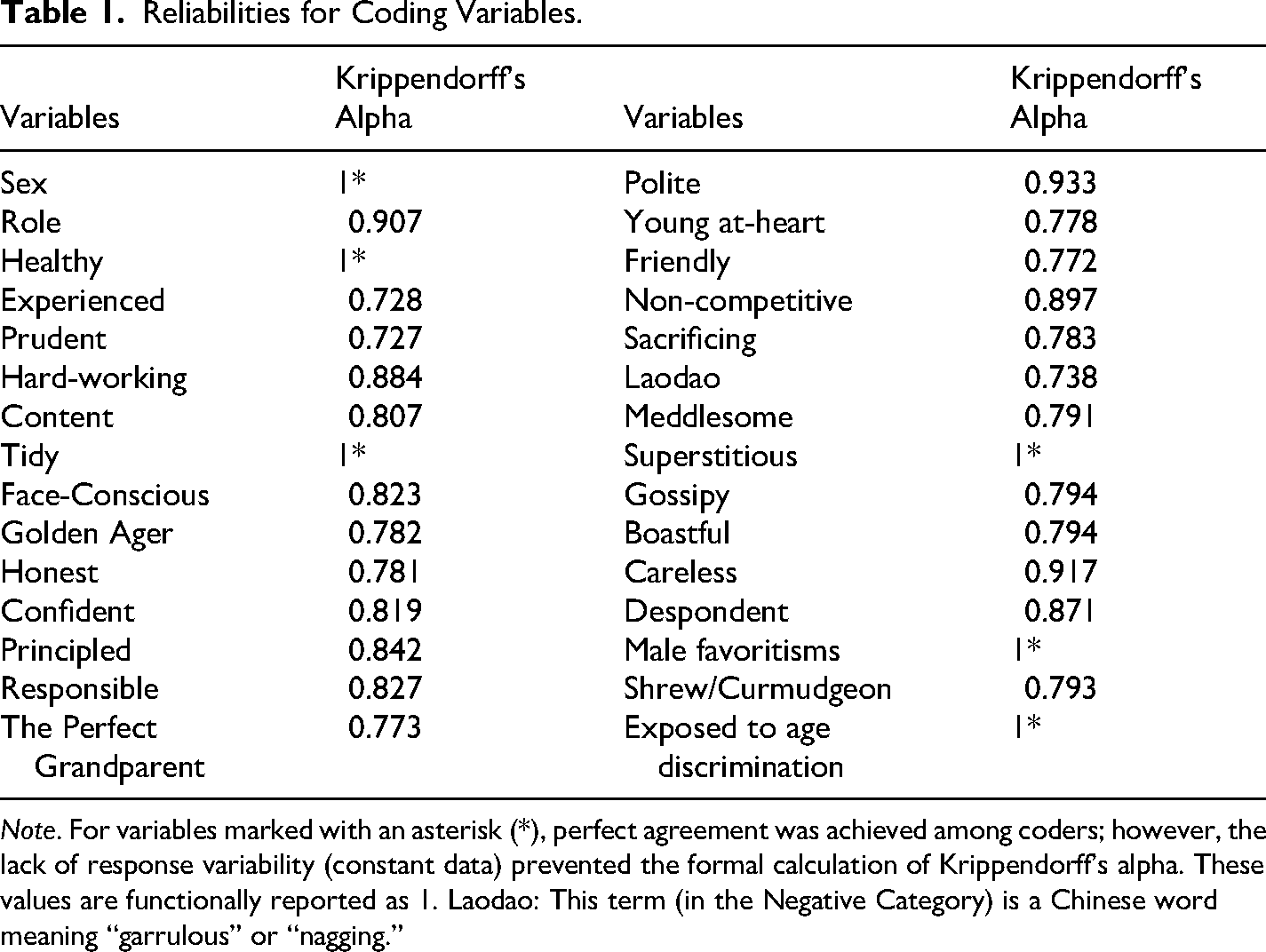
Note. For variables marked with an asterisk (*), perfect agreement was achieved among coders; however, the lack of response variability (constant data) prevented the formal calculation of Krippendorff's alpha. These values are functionally reported as 1. Laodao: This term (in the Negative Category) is a Chinese word meaning “garrulous” or “nagging.”
Findings
Representation of Older Adult Characters
RQ1 compares the representation of older adult characters in the film sample with their demographic presence in China's population. Among the 100 films analyzed, older adult characters (n = 305) accounted for 6.9% of all speaking characters (n = 4,415), compared with 18.7% of the population aged 60 and above in China's 7th National Population Census. This comparison reflects a substantial descriptive disparity between cinematic representation and demographic reality. A gender imbalance was also observed: older male characters (n = 210) far outnumbered older female characters (n = 95). While the demographic ratio of older men to women is approximately 1:1.07, the ratio in the film sample is approximately 1:0.45, again pointing to a descriptive gap in representation (Table 2).
Comparison of Older Adult Representation in China's Population and in the Film Sample.
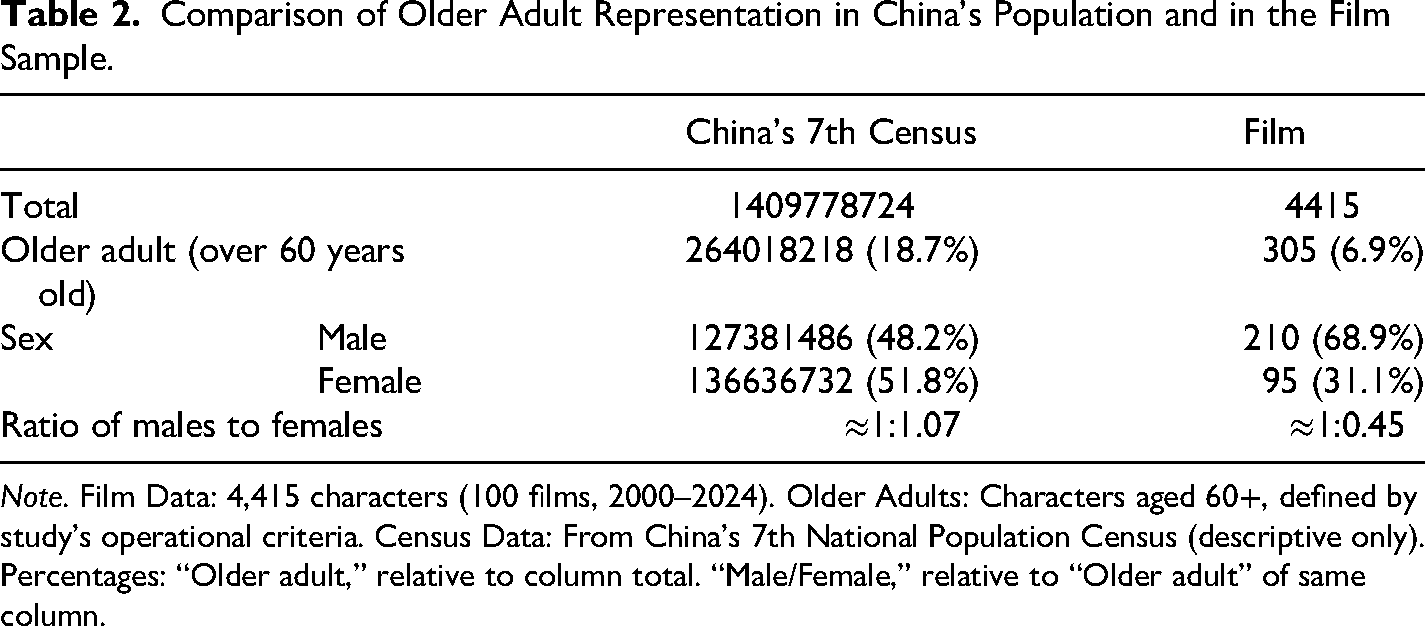
Note. Film Data: 4,415 characters (100 films, 2000–2024). Older Adults: Characters aged 60+, defined by study's operational criteria. Census Data: From China's 7th National Population Census (descriptive only). Percentages: “Older adult,” relative to column total. “Male/Female,” relative to “Older adult” of same column.
RQ2 examines role distribution across major, supportive, and minor categories. The findings show that older adults are predominantly assigned minor roles: only 8.2% appeared as major characters, 32.5% as supportive, and 59.3% as minor. Gender comparisons reveal no significant differences (p = .975). Both men and women have similarly low representation in major roles (8.1% vs. 8.4%), with comparable distributions in supportive and minor roles. Overall, older adults—regardless of gender—are seldom depicted as central figures in popular films.
Taken together, the findings from RQ1 and RQ2 demonstrate a dual pattern of underrepresentation: not only are older adults depicted far less frequently than their real demographic presence, but when included, they are largely confined to peripheral roles with minimal narrative influence. This systematic marginalization highlights the gap between population realities and popular film portrayals, setting the stage for further analysis of how stereotypes shape these representations (Table 3).
Narrative Prominence of Older Adult Characters by Gender in Popular Chinese Films.
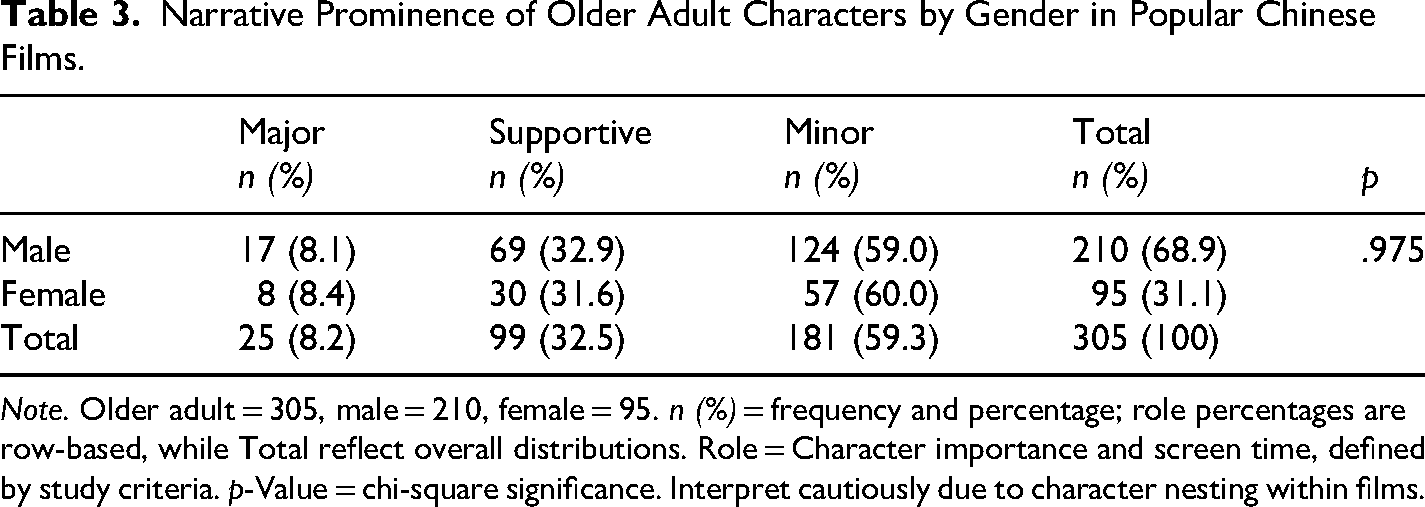
Note. Older adult = 305, male = 210, female = 95. n (%) = frequency and percentage; role percentages are row-based, while Total reflect overall distributions. Role = Character importance and screen time, defined by study criteria. p-Value = chi-square significance. Interpret cautiously due to character nesting within films.
Age Stereotypes in Popular Film Portrayals of Older Adults
RQ3 asks whether the portrayal of older adult characters in popular films reflects positive or negative stereotypes. This study examined 18 groups of positive stereotypes and 10 groups of negative stereotypes associated with older adult characters. As summarized in Table 4, the results of chi-square indicate a predominant tendency toward positive portrayals.
Frequency of Stereotype Coding for Older Adult Characters by Gender.
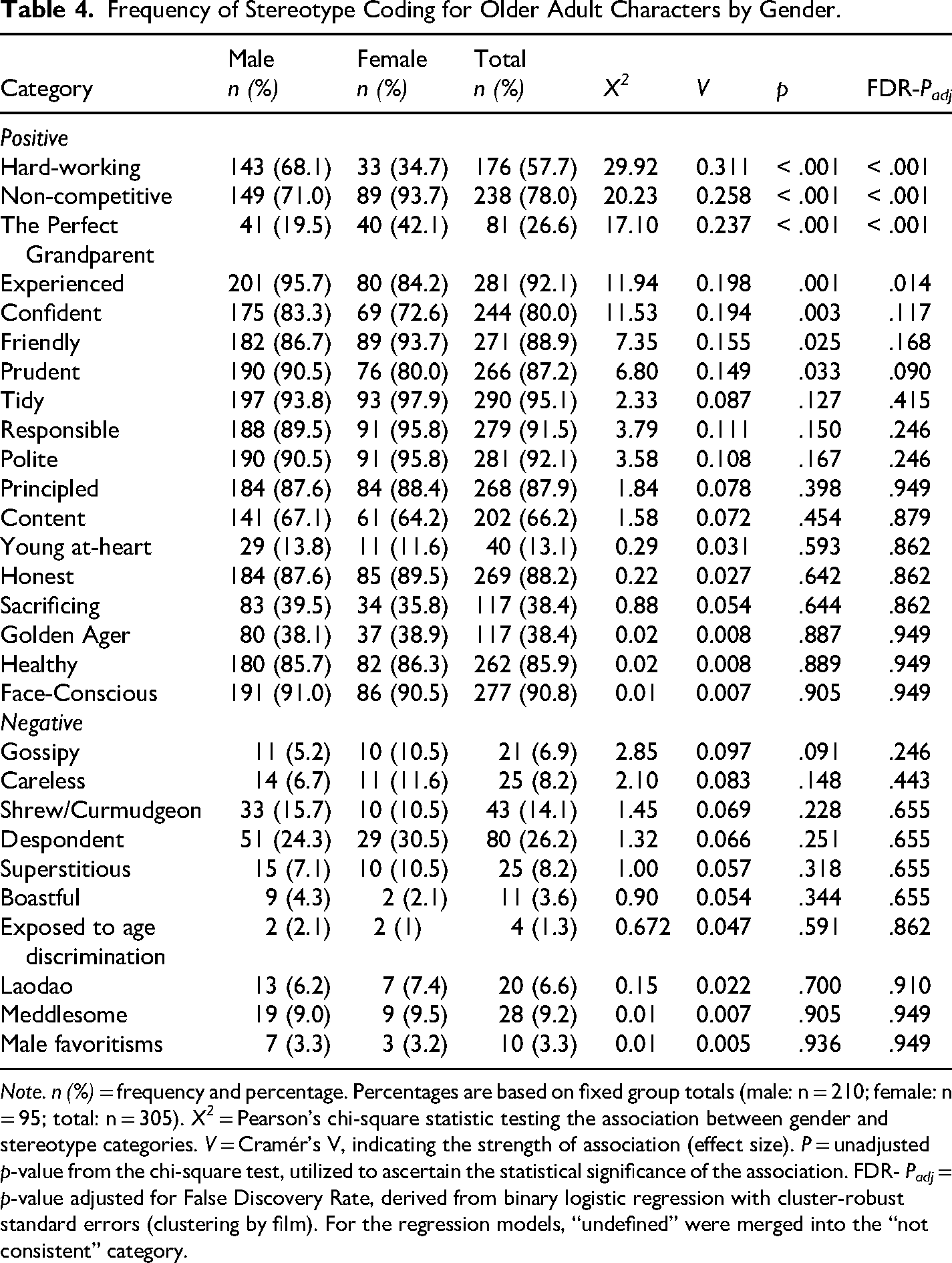
Note. n (%) = frequency and percentage. Percentages are based on fixed group totals (male: n = 210; female: n = 95; total: n = 305). X2 = Pearson's chi-square statistic testing the association between gender and stereotype categories. V = Cramér's V, indicating the strength of association (effect size). P = unadjusted p-value from the chi-square test, utilized to ascertain the statistical significance of the association. FDR- Padj = p-value adjusted for False Discovery Rate, derived from binary logistic regression with cluster-robust standard errors (clustering by film). For the regression models, “undefined” were merged into the “not consistent” category.
Positive stereotypes such as Tidy (95.1%, n = 290), Experienced (92.1%, n = 281), Polite (92.1%, n = 281), Responsible (91.5%, n = 279), and Face-Conscious (90.8%, n = 277) appeared most frequently. Other widely observed traits included Principled (87.9%, n = 268), Friendly (88.9%, n = 271), Honest (88.2%, n = 269), Prudent (87.2%, n = 266), Healthy (85.9%, n = 262), and Confident (80%, n = 244). Compared to the most prevalent positive stereotypes, the Golden Ager (38.4%, n = 117) and The Perfect Grandparent (26.6%, n = 81) were portrayed less frequently. Notably, only 40(13.1%) characters displayed the stereotype of Young at-heart, suggesting that older adults were predominantly portrayed as grounded and mature rather than overtly youthful or spirited.
Compared to the prevalence of positive stereotypes, most negative stereotypes occurred with an overall frequency below 10%. Only Despondent (26.2%, n = 80) and Shrew/Curmudgeon (14.1%, n = 43) emerged as the most common negative stereotypes, with their proportions significantly exceeding 10%. By contrast, stereotypes such as, Male Favoritism (3.3%, n = 10) and Boastful (3.6%, n = 11) appeared only rarely.
Taken together, these findings suggest that older adult characters in popular films are more often depicted through favorable and respectful stereotypes, with limited reliance on explicitly negative imagery.
RQ4 examines the relationship between the portrayal of older adult characters and gender by comparing positive and negative stereotypes. Comparative statistics, incorporating chi-squared tests and FDR-adjusted p-values for multiple comparison control, reveal that both older male and older female characters predominantly exhibit positive stereotypes, with significant gender differences observed in several key traits.
As shown in Table 4, older male characters demonstrate significantly higher proportions of being Hard-working (68.1% vs. 34.7%, Padj < .001) and Experienced (95.7% vs. 84.2%, Padj = .014). While the differences for Confident (83.3% vs. 72.6%) and Prudent (90.5% vs. 80%) were descriptive in nature after FDR correction (Padj > .05), the raw percentages still suggest a directional tendency where older male characters are more likely to be depicted as industrious and capable.
Conversely, older female characters show significantly higher proportions of being Non-competitive (93.7% vs. 71%, Padj < .001) and The Perfect Grandparent (42.1% vs. 19.5%, Padj < .001). Although the trait of being Friendly (93.7% vs. 86.7%) showed a descriptive difference favoring females, it did not reach statistical significance after the stringent FDR adjustment (Padj > .05). These findings indicate that older female characters are more consistently portrayed through communal and family-oriented roles.
No significant gender differences—either in raw or adjusted terms—were observed for traits such as Tidy (97.9% vs. 93.8%, Padj = .415) or Honest (87.6% vs. 89.5%, Padj = .862). Overall, while some traits remain robustly gendered after multiple comparison control, others reflect descriptive patterns that align with traditional gender stereotypes in popular Chinese films.
Overall, these findings indicate that older adult characters in popular Chinese films are predominantly depicted through positive stereotypes. Specifically, older male characters are significantly more likely to be portrayed as Hard-working and Experienced, while older female characters are significantly more often characterized as Non-competitive and The Perfect Grandparent. Although traits such as Confident, Prudent, and Friendly showed similar directional tendencies in their distributions, these differences did not reach statistical significance after multiple comparison adjustment. For the remaining traits, no significant gender differences were observed, suggesting a relatively balanced portrayal in those specific dimensions.
Discussion
This study is able to make important contributions to the image of older adults in popular Chinese films. This research builds upon similar studies conducted in Western countries and expands upon them. We addressed our research questions using chi-square and correlation tests, incorporating multiple controls with FDR and clustered standard errors. The findings indicate a marked descriptive gap between demographic reality and cinematic visibility. Older adults accounted for a much smaller share of speaking characters in the film sample than their demographic presence in China's population would suggest. This descriptive disparity was especially pronounced for older women, whose visibility in popular Chinese films remained considerably lower than that of older men.
Furthermore, this adds to the findings from Western countries that, generally speaking, older adult roles are described in a positive rather than negative manner. Within age stereotypes, older adults in popular Chinese films are frequently depicted with positive stereotypes, most notably as Tidy rather than as The Perfect Grandparent.
Older Characters Remain Invisible in Popular Films
Older adults account for only 6.9% of characters in popular films, representing a substantial descriptive disparity when compared to their actual population share of 18.73%. This persistent underrepresentation, documented in prior studies (Chen et al., 2005; Daalmans et al., 2024; Lauzen & Dozier, 2005a; Smith et al., 2015), reflects the broader consequences of an age-segregated society (Riley et al., 1994). A clear gender imbalance further emerges: older women appear far less often than older men. This pattern, consistent with earlier findings (Baumann & de Laat, 2012; Lauzen & Dozier, 2005b; Simcock & Lynn, 2006), supports the argument that older women face “double discrimination” in media representation, experiencing discrimination based on both age and gender (Sink & Mastro, 2017).
The persistent underrepresentation of older characters and the evident gender imbalance in popular cinema convey a troubling message to audiences—namely, that older individuals are socially insignificant, and that only older men hold cultural relevance. Despite China's rapidly ageing population, popular Chinese cinema, as a vital cultural medium, has yet to adequately reflect the nation's demographic reality. This omission reinforces the notion that social value and respect decline with age (Lauzen & Dozier, 2005a). Such recurring portrayals may sustain a media environment where older adults are consistently positioned in ways that reflect themes of limited social worth.
Beyond underrepresentation, this study reveals important narrative deficiencies in the portrayal of older characters. Our analysis shows that most older adults occupy minor roles and are excluded from the central storyline, which substantially reduces their influence and agency. Even when present, they are often positioned as passive figures with minimal narrative significance. These findings underscore how cinematic narratives can perpetuate ageism by reinforcing intergenerational power imbalances. Interestingly, gender patterns appeared consistent across the narrative distribution of older characters. This suggests that once individuals are categorized as “old,” gender becomes a less decisive factor, as both men and women are similarly marginalized. A likely explanation is that cinematic storytelling tends to overlook older individuals altogether, thereby neutralizing the advantages or disadvantages typically associated with gender.
Mass media functions as a significant vehicle for the dissemination of symbolic social representations. The persistent underrepresentation of older adults in media exemplifies ageism (Van Bauwel, 2018) resulting in a narrow range of aging narratives available within the public sphere. The findings of this study further suggest that the biased portrayal of older adults—particularly older women—in popular films reinforces their absence and weakens their voice within cinematic culture. This pattern highlights a lag in the film industry's responsiveness to the realities of an ageing society.
Prominent Positive Stereotypes in the Portrayal of Older Adults in Popular Films
Quantitative analysis reveals a notable trend toward the positive characterization of older adults in popular films. This finding is consistent with much of the international research (Chonody et al., 2025; De Sutter & Van Bauwel, 2023; Kline et al., 2024). In earlier Chinese media, older adults were often framed as a “vulnerable group,” portrayed primarily through stereotypes of loneliness, helplessness, or dependency (Ren & Jia, 2022). By contrast, our results indicate that contemporary popular Chinese film is moving beyond this narrow and negative framework. The majority of older characters are now imbued with positive attributes aligned with traditional cultural values, particularly their roles as custodians of family ethics and transmitters of moral norms. Traits such as tidy, experienced, polite, and face-conscious account for more than 90% of descriptive portrayals, signaling a meaningful shift in representational patterns.
However, this seemingly optimistic shift in representation does not necessarily signify the disappearance of ageism; rather, it reflects a more complex manifestation. While older characters are endowed with positive traits in our coding scheme, these depictions often function as positive stereotypes that are better explained through the lens of Ambivalent Ageism. Grounded in the theory of ambivalent sexism, this perspective indicates that ageism encompasses both hostile and benevolent dimensions (Cary et al., 2017; Glick & Fiske, 1996). Consequently, the numerous positive stereotypes observed in this study essentially manifest as benevolent ageism. As Cuddy and Fiske (2002) noted, age-related stereotypes are not merely negative; they represent ambivalent cognitions. While these portrayals ostensibly grant respect to older individuals, they may simultaneously restrict autonomy and social participation. Chonody (2016) emphasizes that positive ageism, despite its benevolent intent, ultimately harms older adults due to its underlying restrictive assumptions regarding their competence.
This study identifies Tidy and Despondent as the most prominent positive and negative stereotypes of older adult characters in popular Chinese films. This pattern contrasts sharply with findings from Western cinema, where The Perfect Grandparent and Shrew/Curmudgeon have been identified as dominant stereotypes (Markov & Yoon, 2021; Robinson et al., 2009). In our sample, however, The Perfect Grandparent (26.6%), Golden Ager (38.4%), and Shrew/Curmudgeon (14.1%) appeared at relatively low rates, suggesting they are not central to popular Chinese films portrayals.
This disparity likely reflects cultural differences in expectations and narrative emphases surrounding older adults. In Western media, grandparents are often associated with emotional support and the transmission of wisdom, particularly in television and teen films targeted at younger audiences. By contrast, in China, grandparents frequently assume substantial caregiving responsibilities for grandchildren, a role that can generate physical and emotional strain and reduce overall life satisfaction (Xiao et al., 2021). At the same time, low levels of social participation and rising loneliness among older adults (Yan et al., 2014) make it challenging to depict them as carefree retirees. Consequently, while traits associated with “The Perfect Grandparents” exist in reality, such portrayals are infrequently represented in popular Chinese films, partly due to definitional criteria emphasizing wisdom, love, and selflessness.
The prominence of Tidy as a positive stereotype and Despondent as a negative one may further stem from traditional Chinese cultural values. The Confucian classic Book of Rites (Dai, 2013) emphasizes personal grooming and tidiness as expressions of self-cultivation and respect for others, reflecting societal regard for older adults and their quality of life. Conversely, the prevalence of Despondent illustrates the challenges older adults face in navigating social change, family relationships, and the pursuit of personal fulfillment, highlighting a humanistic concern for their psychological well-being. Together, these traits reveal that Chinese popular films construct a complex and nuanced portrayal of older adults—diverging from Western idealized models and blending traditional virtues with contemporary psychosocial realities.
In popular films, older adult characters are predominantly portrayed as physically healthy, a pattern consistent with international research (Chonody et al., 2025; Robinson & Callister, 2008) and likely reflecting filmmakers’ tendency to idealize characters to align with audience esthetic preferences. Contrary to Smith et al. (2015), the health status of older female characters in popular Chinese films is comparable to that of older males, indicating no significant gender disparity in physical health portrayals. However, the positive portrayal of old age does not always yield positive consequences (Fung et al., 2015). This emphasis on idealized health may create a disconnect between cinematic representations and reality. Kotter-Grühn and Hess (2012) argue that positive health stereotypes can have unintended negative consequences: by portraying older adults as uniformly healthy, media can propagate the expectation that all older individuals “must be healthy,” neglecting individual variability. Such portrayals may induce feelings of inadequacy or anxiety among ordinary seniors who do not meet these idealized standards (Dionigi, 2015). In reality, many older adults face challenges such as declining physical function and chronic illnesses, and overemphasizing idealized health risks obscuring genuine ageing-related health issues, including Alzheimer's disease and other chronic conditions.
Positive and negative portrayals of older adults can have positive or negative effects on audiences (Kovács et al., 2021). Therefore, in addition to positive stereotypes, this study also examined 10 sets of negative stereotypes. The results showed that older adult characters are rarely depicted as Male favoritisms. This trend reflects increasing societal awareness of gender equality and the enhanced status of women in both familial and social contexts, which have influenced cinematic narratives and contributed to a departure from traditional gender biases. Although son preference persists in some regions and families, its absence in films carries important social implications: by challenging and deconstructing traditional gender hierarchies, these portrayals encourage audience reflection on gender equality and promote cultural progress. The combination of positive health representations and equitable gender portrayals underscores the media's potential to empower older adults and foster discourse on positive ageing (Zhang & Zhang, 2024).
Gender Differentiation in Positive Stereotypes in Popular Films
Although older adults are increasingly depicted with positive traits in popular films, notable gender distinctions persist. Older men are more frequently associated with authority, sociability, and professional competence, while older women are primarily linked to familial roles. Specifically, male characters are more often portrayed as Hard-working and Experienced, whereas female characters are more commonly characterized as Non-competitive and The Perfect Grandparent. Notably, no significant gender differences were observed in negative stereotypes, contrasting with previous research suggesting that older women face greater negative stereotyping (Bazzini et al., 1997; Rovner-Lev & Elias, 2020; Varjakoski, 2019). This suggests that in popular Chinese films, older women do not bear a disproportionate burden of negative stereotyping.
The higher representation of older males in categories such as Experienced can be understood through Butler and Trouble (2006) framework in Gender Trouble, which draws on Foucault's theory of power. Historically, men have occupied dominant positions within social structures, allowing greater opportunities for social participation and experience accumulation. Film narratives reinforce this power dynamic by portraying older men as symbols of knowledge and skill. Ethical considerations also influence portrayals: older male characters are often shown as actively engaged in work, reflecting moral values and social responsibility, which explains their frequent depiction as Hard-working. These reflect societal perceptions of male autonomy and authority (De Beauvoir, 2023).
In contrast, older women are more frequently depicted as The Perfect Grandparent and Non-competitive, reflecting enduring cultural expectations of gendered roles. These portrayals emphasize patience, care, and tolerance, aligning with the familial caregiver role historically ascribed to women. Chinese popular film narratives thus reinforce distinct societal expectations for older men and women. According to Glick and Fiske (1996), Ambivalent Sexism posits that traditional gender structures disadvantage women through hostile sexism while rewarding those who conform to traditional divisions of labor through benevolent sexism. The portrayal of older women in Chinese film as Non-competitive and the Perfect Grandparents is essentially a form of benevolent reward. By positively evaluating them as the Perfect Grandparent media facilitates their withdrawal from the sphere of social competition.
Taken together, these seemingly positive characterizations obscure gender inequalities among older populations. In popular Chinese cinema, the passage of time does not strip men of their agency; they continue to be presented as Hard-working and Experienced. For women, however, aging often entails a retreat into Non-competitive and The Perfect Grandparent domestic roles. This disparity is not merely an extension of traditional gender roles but a product of the double jeopardy of age and gender. As Calasanti and Slevin (2001) notes, male aging is often accompanied by the accumulation of social capital, rendering them as “symbols of wisdom and power” on screen; conversely, as women enter old age, they face both age-related devaluation and a gender-based push toward “de-skilling” or de-capacitation. Consequently, the danger of this representation lies in its promotion of a benevolent prejudice that rationalizes the absence of social competitiveness among older women. While audiences accept these images of older women, they often overlook the actual status of their competence and individual agency.
Limitations and Future Research
As the ageing population continues to grow, examining the portrayal of older adults in media becomes increasingly important. This study is limited to a quantitative and qualitative content analysis of 100 popular films and does not cover a broader range of cinematic samples. Consequently, while our findings highlight imbalances in the representation of older characters—particularly older women—future research should expand the scope to include a wider variety of traits and roles. This would enable a more comprehensive and nuanced analysis of the diversity and complexity of older characters in film.
Further, a key limitation stems from our sampling strategy, which intentionally focused on films with high box office, strong Douban ratings, and contemporary-realistic themes. This approach, though critical for capturing mainstream cultural constructions and widespread public perceptions of aging in China, inherently meant that our findings primarily reflect these dominant narratives. We acknowledge that it limited the inclusion of more marginalized or unconventional portrayals found in independent, experimental, or nonrealistic genre films, thus not encompassing the full spectrum of older adult representation across all cinematic works.
A further limitation concerns measurement validity. Although intercoder reliability was generally high, reliability does not by itself establish construct validity. Some stereotype categories—particularly those used to classify positive and negative portrayals—may remain broad and may not fully capture ambivalent, context-dependent, or weakly signaled characterizations. Future research could refine these categories, introduce stricter evidentiary thresholds, or combine quantitative coding with qualitative textual analysis to better capture the complexity of older adult portrayals.
Furthermore, the current study focuses exclusively on the 100 popular Chinese film representations of older characters and does not examine audience reception or the social impact of these portrayals. Future research should address these gaps to better understand how cinematic depictions influence perceptions of aging. Such research will contribute to a more holistic understanding of older adult portrayals in contemporary media and offer insights for promoting diversity, inclusivity, and more authentic representations of older individuals.
Notes
China's Golden Rooster Awards
China's Golden Rooster Awards, co-hosted by the China Film Association and the China Federation of Literary and Art Circles, is a prestigious and professional film award established in 1981. It is widely regarded as the most authoritative and specialized film award in mainland China. The selection process is managed by a jury composed of experienced film experts and artists, who assess films purely on their artistic achievements, technical innovation, and professional merit. https://baike.baidu.com/item/%E4%B8%AD%E5%9B%BD%E7%94%B5%E5%BD%B1%E9%87%91%E9%B8%A1%E5%A5%96/185250
The Hundred Flowers Awards for Popular Films
The Hundred Flowers Awards for Popular Films, also co-organized by the China Film Association and the China Federation of Literary and Art Circles, was established in 1962. It stands as mainland China's premier audience award. Its defining characteristic is that all awards are determined by popular vote from audiences nationwide, making it a true “audience award.” This accolade directly reflects the popularity of films and filmmakers among the general public. https://baike.baidu.com/item/%E5%A4%A7%E4%BC%97%E7%94%B5%E5%BD%B1%E7%99%BE%E8%8A%B1%E5%A5%96/571066
China's Huabiao Film Awards
China's Huabiao Film Awards, presented by the National Film Administration, is the official government award for Chinese cinema. The selection process for the China's Huabiao Film Awards not only considers artistic merit but also places significant emphasis on a film's ideological direction, social impact, and its contribution to the development of China's national film industry. https://baike.baidu.com/item/%E4%B8%AD%E5%9B%BD%E7%94%B5%E5%BD%B1%E5%8D%8E%E8%A1%A8%E5%A5%96/188202
Douban
Douban Movies is China's most representative film fan and cultural community rating platform. Utilizing a 10-point scale, Douban scores are derived from voluntary user submissions, with a final score calculated by an algorithm. At its core, the scoring mechanism reflects the artistic quality, intellectual depth, and humanistic value of a film. Achieving a high score on Douban typically signifies strong recognition of a film's artistic and ideological merit by its core audience. https://movie.douban.com/
Maoyan
As China's leading integrated film and television service platform, Maoyan Movie's box office data reliability is built upon its cooperation with official institutions. The core source of its real-time box office data is the National Film Special Fund Office (China Film Bureau), which is affiliated with the National Film Administration. The core data provided by the Maoyan platform, including real-time box office, total box office, screening ratio, and attendance rate, is not only updated rapidly but also possesses a high degree of authority and reliability. This makes Maoyan box office data the benchmark for market observation and analysis within China's film industry, by media, and by the general audience. https://piaofang.maoyan.com/rankings/year
Book of Rites
The Liji, or Book of Rites, serves as a collection of Confucian thought and a curated selection of essays. It primarily details and discusses the ritual systems and ceremonies prevalent from the pre-Qin period through the Han dynasty, while also elucidating the Confucian philosophical underpinnings of these practices. Rather than being the work of a single individual, it was compiled by the Western Han scholar Dai Sheng, who assembled the most important elements from prior works on ritual. It stands as a crucial text for understanding ancient Chinese ritual, societal structures, and ethical values, and remains a vital source for comprehending later Confucian views on the world, education, and governance.
Footnotes
Acknowledgements
The authors are immensely grateful to Liwen Zhang and Xueer Cai for their significant support and expertise. Their profound guidance and perceptive advice during the intricate process of data analysis were instrumental. The detailed feedback and constructive suggestions provided by them were pivotal in enhancing the analytical depth and strengthening the methodological foundation of our study, leading to more robust and compelling conclusions. Finally, we recognize the broader community of peers and mentors whose collective wisdom continues to inspire our academic pursuits.

Author Contributions
All authors contributed substantially to designing and conceptualizing the study, analyzing and interpreting the data, and preparing the manuscript. Specifically, Liya Sun and Deying Cai contributed equally to this work.
Funding
The authors received no financial support for the research, authorship, and/or publication of this article.
Declaration of Conflicting Interests
The authors declared no potential conflicts of interest with respect to the research, authorship, and/or publication of this article.