







Abstract
Mass media sources influence numerous aspects of society including public perceptions of social problems and public policy. Illegal drugs have been stigmatized in the U.S. media for decades using particular frames, devices, and rhetorical practices, which have contributed to the social construction of drug use as deviant behavior. This article examines the ways in which U.S. media sources have framed news stories of heroin and cocaine. It analyzes a sample of 197 national broadcast transcripts of National Broadcasting Company and American Broadcasting Company evening news segments focusing on heroin and cocaine between 2000 and 2015. A content analysis of frame elements was employed to identify the most salient features of each news broadcast, and hierarchical cluster analysis was then performed to identify the predominant frames in media coverage over time. The identified frames are Ongoing Fight, Dangerous Use, Violent Traffickers, and Fallen Star. News coverage primarily emphasized drug seizures and other efforts to stem supply, risks associated with drug use, violence involved in the drug trade, and tragic or controversial events surrounding public figures. Some substantive differences were noted in media narratives throughout the studied time period, such as the conflation of the War on Drugs with War on Terror discourse between 2000 and 2009 and the predominance of the disease model and notions of a drug “epidemic” between 2009 and 2015. However, I argue that media framing of drugs has not evolved substantially from the stigmatizing representations prevalent in 1980s and 1990s U.S. media reports.
Introduction
The use of psychoactive drugs and related social problems are subjects of regular examination by mainstream news outlets, sources from which the public draws much of its understanding of societal issues. Media are agents of socialization that convey normative standards, and they have consistently regarded drug use as deviant behavior, a portrayal to which individuals who have limited experience with drugs may be particularly susceptible (Blendon & Young, 1998; Swalve & DeFoster, 2016). As mass media sources continue to be among the principal ways Americans obtain information, media representations have significant cultural implications including effects on opinion formation and levels of public support for certain policy measures (Entman, 1989; Fan, 1996; Iyengar & Kinder, 1985; Nielsen & Bonn, 2008), particularly in cases of emotionally charged issues. It is therefore critical to recognize the ongoing framing devices and dominant narratives regarding drug issues that are pervasive in news media outlets.
Historically, mainstream U.S. media sources have tended to discuss drugs using uncompromising and dramatic rhetoric, emphasizing consequences such as addiction, financial problems, and personal turmoil (Speaker, 2004). Previous research, such as Speaker’s (2004) content analysis of articles published in popular U.S. periodicals and newspapers between 1920 and 1940, revealed that this rhetoric stems from anti-alcohol ideologies that were prevalent during the era of Prohibition and subsequently came to be applied to other drugs. Antidrug ideology and rhetoric have since continued in the U.S. as drugs have become part of a “discourse of fear” promoted by the media (Altheide, 1997). For example, in 1980s and 1990s media sources, drugs were found to be frequently linked with and discussed in the context of crime and violence (Altheide, 1997). Furthermore, mainstream news sources in the U.S. have often cited government officials and law enforcement figures while excluding the accounts of other potential sources such as social scientists, health professionals, and people who use drugs (Beckett, 1995; Chermak, 1997). News reports have also regularly depicted stereotypical notions of drugs and drug-related activity, presenting people who use drugs as “outsiders” and thereby encouraging marginalization and misunderstandings of drug issues and policies (Taylor, 2008). These representations have perpetuated stigma associated with those who use or sell drugs that renders them immoral, irresponsible, and inherently prone to criminal behavior (Beckett, 1995). The habits and structural limitations of mass media have had an impact on how the public has perceived and discussed drug policy. For example, Beckett (1995) suggested that the public’s impression of drugs as a criminal problem has been exacerbated by the punitive tone used by media outlets over the last century. In addition, McGaw (1991) pointed out that the drug war metaphors heavily used by politicians and media in the 1980s focused attention on law enforcement and punishment, and marginalized or excluded alternative policies, contributing to the public’s ranking of drugs among the nation’s most significant problems at the time. Media representations of illegal drugs have also affected perceptions of risk, restricted the possibility of a deeper understanding of drug issues, and limited support for drug policy reform (Lancaster, Hughes, Spicer, Matthew-Simmons, & Dillon, 2011).
The consequences of this framing of proscribed drugs have been vast. The rhetoric and misinformation pervading drug-related discourses helped generate support for ill-advised drug laws in the U.S., which were notoriously harsh compared to other developed countries. These draconian drug laws were not only ineffective as they failed to decrease drug sales and consumption, but they also produced serious social problems such as mass incarceration (Alexander, 2010). Moreover, drug laws have been inequitably enforced, such that racial minorities are more frequently incarcerated and receive harsher penalties than White drug offenders, with impoverished communities suffering the most (Alexander, 2010; Chermak, 1997; Sirin, 2011). The drug war has also resulted in an erosion of civil liberties, increased violence, property crime, drug contamination, overdoses, the spread of diseases, the punishment of nonviolent individuals, and exorbitant financial expenditures (Benavie, 2009). In recent years, an increasing number of public figures and individuals have unequivocally acknowledged that the War on Drugs in the United States was misguided. However, efforts to reform extant drug policies have been exceedingly challenging due in part to the antidrug sentiment that appears to be “woven into the very fabric of American culture” (Reinarman, 1994, p. 92). As a result, a transition to an alternative policy framework such as harm minimization, decriminalization, or legalization has not occurred.
Illegal drugs continue to be commonly discussed in public discourse and in U.S. media sources as a critical social problem. Prior studies have examined central themes, dominant discourses, and common depictions of illegal drugs in various media sources in the U.S. as well as outside the U.S. context and have offered insight into public opinion and support for certain drug policies. This article builds on extant research using a sample of drug-related national news stories in the U.S. from the National Broadcasting Company (NBC) and American Broadcasting Company (ABC) networks to identify the dominant frames in news coverage between 2000 and 2015 and to examine whether media framing of drugs has changed over time.
Historical Background and Traditional Media Narratives of Drugs
Psychoactive drugs have been used throughout human history in virtually all cultures for a variety of medicinal, recreational, and spiritual purposes (Goode, 1999). However, periods of alarm related to drug use in the U.S. have been recurrent, and research has suggested that panics related to drugs have been considerably more frequent and infectious in American society than they have been in other cultures (Reinarman, 1994). Social constructionists have highlighted the fact that drugs have been considered a significant social problem during various time periods even when empirical evidence did not corroborate that drugs were a serious problem. Media reporting on drugs is often not necessarily based on an empirical evaluation of the magnitude of the threat, but instead influenced by factors such as journalists’ assumptions, cultural stereotypes, and the demographic groups perceived to be at the greatest risk (Manning, 2006). Media coverage has contributed substantially to “drug scares” (Reinarman, 1994; Reinarman & Duskin, 1992)—periods of time during which “a number of antidrug individuals, groups, and media outlets…identify and denounce a particular drug as a new social problem requiring increased attention and regulation” (Boyd, 2010, p. 6). The timing and persistence of recurring drug scares in the U.S. indicates that these crises and “epidemics” are created rather than discovered (Murakawa, 2011, p. 221).
The media spend a substantial amount of time reporting deviant and criminal behavior, and this news of deviance conveys information to the public regarding societal norms; even if media sources are not consciously engaging in a moral crusade, simply reporting certain incidents can be enough to galvanize public concern or apprehension (S. Cohen, 1972). With regard to drugs, S. Cohen (1972) explained that “the media play on the normative concerns of the public and by thrusting certain moral directives into the universe of discourse, can create social problems suddenly and dramatically” (p. 17). Moreover, media coverage of illegal drugs has often engaged in the “routinization of caricature” (Reinarman, 1994, p. 96; Reinarman & Duskin, 1992, p. 81), a process whereby news sources present extreme and rare cases as typical and frequently occurring. This tendency has resulted in drug coverage that contained distortions, misguided assumptions, and false information (Reinarman, 1994; Reinarman & Duskin, 1992). Much of this discourse regarding drug use can be described as “demonology—the effort to demonstrate that drug use is inherently evil, by its very nature inevitably dangerous and damaging” (Goode, 1999, p. 12).
Drug problems have been inflated and public concern has been heightened throughout the many decades of communication campaigns in the U.S. (Alexander, 2010; Baum, 1996). Media coverage beginning in the early 20th century was dominated by antinarcotics messages, with sources writing disparagingly about drug users and inciting public concern (Bellis, 1981; Helmer, 1975). Prior to alcohol prohibition, moral entrepreneurs initiated a “Temperance crusade” (Reinarman & Duskin, 1992), advancing the notion in prominent media sources that alcohol was culpable for a variety of social problems (Levine & Reinarman, 1987). Subsequently, the rhetoric and ideological underpinning of Prohibition policy, which held that alcohol or other drug dependency should be fought because it constituted a moral failing and an indication of weakness (Bellis, 1981), were transferred to antidrug discourses and campaigns when Prohibition ended in 1933 (Bellis, 1981; Boyd, 2010). The newly formed Federal Bureau of Narcotics (FBN) then embarked on a media campaign of antidrug propaganda (Bellis, 1981; Boyd, 2010; Gerber, 2004) and advocated an increase in criminal justice approaches (Boyd, 2010). The FBN and media were successful in associating drugs with racialized groups and fears about corrupting White moral citizens and facilitating the enactment of new laws (Becker, 1963; Goode & Ben-Yehuda, 1994).
Drug historians have established that the origin of American drug laws is strongly linked to racism, xenophobia, sexism, classism, and oppression (Levine & Reinarman, 1987; Musto, 1987; Sirin, 2011). Drugs were maligned as they became linked to supposedly disreputable populations, and these connections were reflected in media accounts. For example, in the 1890s, the association of opium with the Chinese immigrant population altered the social context of opiate use (Hoffmann, 1990; Levine & Reinarman, 1987; McGaw, 1991; Murakawa, 2011; Musto, 1987; Sirin, 2011). Print media disseminated sensational reports about Chinese men in opium dens preying on White women and coercing them into opium addiction (Levine & Reinarman, 1987), and as a result, the first laws against opium smoking were implemented in California (Hoffmann, 1990; Levine & Reinarman, 1987). Another drug scare in the 1910s focused on African American men and cocaine (Murakawa, 2011), as the notion was circulated and exacerbated by the media that the drug transformed ordinary, peaceful individuals into dangerous criminals (Helmer, 1975). Contrary to these representations, it was questionable to what extent Black Americans were even using cocaine (Helmer, 1975; Musto, 1987), and there was no evidence that the drug caused criminal activity (Musto, 1987). This drug scare can be understood as another instrument of oppression, as it occurred at the height of “lynchings, legal segregation, and voting laws all designed to remove political and social power” from Black residents in southern states (Musto, 1987, p. 7). In the 1930s, the FBN was instrumental in galvanizing a drug scare in which Mexican immigrant laborers were identified as a disreputable demographic and unjustifiably linked to violence and crime as print media sources reported that marijuana caused violent behavior (Levine & Reinarman, 1987; Musto, 1987; Reinarman & Duskin, 1992).
Media messages denouncing and misrepresenting a variety of drugs continued to be disseminated throughout subsequent decades. For example, media sources in the 1960s conveyed that cannabis was a “drop-out drug” that affected users’ motivation and patriotism (Levine & Reinarman, 1987, p. 388; Reinarman & Duskin, 1992) and that LSD resulted in severe birth defects (Reinarman & Duskin, 1992). In the 1970s, it was reported by the press that phencyclidine gave users “superhuman strength” and that police officers needed new equipment to handle those under its influence (Reinarman & Duskin, 1992, p. 81). Other prominent drug issues included the prescription sedative methaqualone, colloquially referred to as “ludes” due to the brand name “Quaalude,” about which many articles were published in newspapers and magazines (Goode, 1999). During the 1970s, President Richard Nixon’s desire to eradicate the opium poppy also received significant attention (Reinarman & Duskin, 1992). Nixon identified narcotics addiction as an “infectious disease” and spurred public concern by describing heroin addiction as an “epidemic” and “Public Enemy Number One” (Bellis, 1981, p. 19). Media reports also discussed heroin use among children as an epidemic despite a lack of evidence (Baum, 1996).
In the following decade, President Reagan escalated the War on Drugs dramatically at a time when illegal drug use was declining (Alexander, 2010), stating in 1982 that his administration would “do what was necessary to end the drug menace” (McGaw, 1991, p. 56). Subsequently, the media became saturated with antidrug messages, sensational stories, and stereotypes (Alexander, 2010). The panic about crack cocaine that was prevalent throughout the 1980s was focused on African American residents of inner cities (Reinarman & Duskin, 1992; Sirin, 2011). Stereotypes emerged as the media depicted “black ‘crack whores,’ ‘crack dealers,’ and ‘crack babies’—images that seemed to confirm the worst negative racial stereotypes about impoverished inner-city residents” (Alexander, 2010, p. 5). Stories circulated regarding children and cocaine addiction, and news media personnel used misleading graphic representations to reflect a sharp rise in use (Orcutt & Turner, 1993). “Just Say No” campaigns and a few high-profile overdose deaths in the mid-1980s also helped focus public attention on drug use (Shoemaker, 1989). For example, media coverage related to both crack and powder cocaine intensified in 1986, as the cocaine-related death of basketball star Len Bias was highly publicized (Baum, 1996; Goode, 1999).
The rhetoric and policies of the War on Drugs continued in succeeding eras, and media representations consistent with its ideology continued to be prevalent. Presidents George H. W. Bush and Bill Clinton both presented drugs as the nation’s most urgent problem (Alexander, 2010). Bush constructed a drug spectacle by using misleading props in his speeches (McGaw, 1991; Reinarman & Levine, 1997), and media messages included the identity construction of his drug czar as a “drug warrior” who was “ambitious, abrasive, and tough” (McGaw, 1991, p. 57). Clinton subsequently proceeded with “get tough” policies that surpassed his predecessors (Alexander, 2010).
News coverage in the 1990s also “othered” drug issues by concentrating on African Americans and Latin Americans and continuing the “pattern of drug wars as a means of social control over racial and ethnic minorities” (Jernigan & Dorfman, 1996, p. 192). “Othering” refers to “practices of marginalization based on apparent differences, often race or ethnicity” that position a particular group as problematic or different from the mainstream (Haines-Saah et al., 2014, p. 55). Methamphetamine also became widely discussed and stigmatized in the 1990s (Goode, 1999; Murakawa, 2011). However, the social construction of the methamphetamine “epidemic” was unique as it focused on White users (Murakawa, 2011). Murakawa (2011) observed that accounts portrayed White users as victims who were in danger of inhabiting or descending into “‘white trash’ status” (p. 219). Furthermore, in contrast to previous drug scares that demonized people who use drugs along with dealers and manufacturers, the construction of the methamphetamine epidemic granted “users a more contextualized victim status, emphasizing…fear for White drug users” (p. 220). Murakawa also posited that this construction, which emphasizes harm to users’ health and socioeconomic status rather than harm to others, “preserves the default assumption that Whites deserve their White privilege” (p. 225).
In later years, the George W. Bush administration was dominated by terrorism-related rhetoric as a result of the tragedies on September 11, 2001, and drug war ideology was incorporated into the discourse of terror (Altheide, 2003). Drug use was then framed as unpatriotic and millions of dollars were spent on advertising to link drug use to terrorism. Bush asserted in his speeches that drug trafficking financed terrorism and that Americans should abstain from drugs in order to “join the fight against terror in America” (Altheide, 2003, p. 24).
President Barack Obama’s administration exhibited a departure from the presidential rhetoric of previous decades (Sirin, 2011) by releasing statements about drug policy reform that used treatment-oriented language and emphasized “smart” rather than “tough” approaches (see Kerlikowske, 2013). The Director of the Office of National Drug Control Policy in 2012 referred to addiction as a “disease” and advocated a “balanced public health and safety approach” which de-emphasized incarceration (Office of National Drug Control Policy, 2012). These articulations, which promoted prevention and treatment, diverged from the punitive statements made by previous drug czars and presidents. However, this explanation of drug addiction is individualistic and adheres to a medical model or disease model of addiction (Goode, 1999), which presumes that those who use drugs are ill and can be “cured” through medical treatment (McGaw, 1991). While the disease model seems to constitute a more progressive ideology than the earlier more punitive iterations on which drug control policy was based, it neglects the social, cultural, political, and economic contexts that are essential in understanding the causal factors, interactive processes, and varying experiences of individuals who use drugs and those who develop patterns of problematic drug use and addiction (Reinarman & Granfield, 2015). This model also continues the stigmatization of people who use or become addicted to drugs and, in certain contexts, can actively lead to discrimination. For example, Seear and Fraser (2014) showed that viewing “addicts” as inherently pathological facilitates the notion that “addict” and “victim” are mutually exclusive identities, which has implications for how crime and victimhood are considered and approached. The conception of addiction as a disease has also been regarded as problematic because it has paradoxically helped move discourse in the direction of public health while concomitantly serving as a “legitimation of repressive drug policies” (Reinarman, 2005, p. 307). While discourse has shifted to indicate a need for expanding treatment and reducing punitive responses to addiction, the representation of addiction as a brain disease serves as “more of an adjunct to the war on drugs than an alternative” (Reinarman & Granfield, 2015, p. 10), as it “walks arm in arm with the punitive prohibition laws that have led to the mass incarceration of the powerless” (p. 17).
Narratives that demonize drugs or utilize the disease metaphor obscure from public discourse important information that, if included, could help allay fear and stigma surrounding drugs and broaden potential treatment and policy options. A false dichotomy between alcohol and other drugs continues to heighten the “illusion of difference” between the users of these substances (Levine & Reinarman, 2010, p. 807), but the harms often associated with drugs are as much a result of the criminalization of drugs and lifestyle imposed on users through illegality as they are of the substances themselves (Bellis, 1981; Reinarman & Granfield, 2015; Speaker, 2004). Linking certain drugs to inevitable problematic behavior and addiction is a narrow and simplistic model that fails to resonate with the varied experiences individuals have with drugs (Seear & Fraser, 2010a). For example, most individuals who use drugs are able to engage in moderate use and circumvent the problems typically associated with addiction (Cheung, 2000; Goode, 1999; McSweeney & Turnbull, 2007; Taylor, 2008; Warburton, Turnbull, & Hough, 2005), and many who do experience difficulties with drug use are able to reduce their use without treatment, particularly if they have adequate social capital to facilitate their recovery (Granfield & Cloud, 2001). Nevertheless, recreational and judicious use of most drugs continues to remain largely hidden from public discourse (Duncan, White, & Nicholson, 2003; McSweeney & Turnbull, 2007). The promulgation of certain ideas and marginalization of others have persisted in media framing of drugs, subjugating knowledge that would facilitate a more thorough understanding of drug use and related issues.
Media Framing
In this article, I build on extant literature by utilizing a frame analysis approach to examine the parameters of drug-related discourses in recent U.S. news coverage. The concept of frame analysis, originally coined by Erving Goffman (1974), has been utilized and expanded by scholars across numerous disciplines. Gitlin (1980) described frames as “principles of selection, emphasis, and presentation composed of little tacit theories about what exists, what happens, and what matters” (p. 6). He explained that “frames, largely unspoken and unacknowledged, organize the world both for journalists who report it and, in some important degree, for us who rely on their reports” (p. 7). Frames are considered significant in examinations of media discourse as they constitute “central organizing ideas” (Gamson, 1988, p. 165) or organizing principles that assign “coherence and meaning to a diverse array of symbols” (Gamson, Croteau, Hoynes, & Sasson, 1992, p. 384). According to Entman (1993), framing refers to the process by which some aspects of an issue are made more salient, thus including a certain “problem definition, causal interpretation, moral evaluation, and/or treatment recommendation” (p. 52). Accordingly, functions of framing include defining and highlighting the sources of problems, advancing moral judgments, and promoting preferred policies (Entman, 2007). All of these processes can be traced in media reporting of drug use.
Relationship between Media Framing, Public Opinion, and Policy
The framing of drugs in the media has implications for drug and health policy as well as public discourse and perceptions of social problems. Power is exerted in the selection and framing of events in the media because these frames shape political discourse, policy formation, and public opinion (Beckett, 1994). Frames influence the way viewers conceptualize issues by setting parameters for discussion (Altheide & Schneider, 2013). Researchers have shown that “state elites and the mass media play a prominent role in the construction of social issues, and, as a result, in the generation and shaping of public concern around those issues” (Beckett, 1994, p. 426). Lexical choices and their configuration in news stories also “hold great power in setting the context for debate, defining issues under consideration, summoning a variety of mental representations, and providing the basic tools to discuss the issues at hand” (Pan & Kosicki, 1993, p. 70). News media have also been shown to normalize and facilitate the adoption of “stigmatized language,” or language that advances particular notions of deviance, among the general public (Altheide & DeVriese, 2007). Once dominant discourses are encountered by individuals and broadly accepted, they may become “self-perpetuating” due to their power and pervasiveness in society (Bright, Marsh, Smith, & Bishop, 2008, p. 136). Furthermore, discourse can “become a tool for reproducing inequality, because it can serve not only to regulate thought and emotion, but also to identify Others and thus to maintain boundaries” (Altheide, 2003, p. 19). As periods of intense reporting expand and subside, they leave behind an informal legacy in the public consciousness, which can shape how society responds to subsequent events (Goode & Ben-Yehuda, 1994).
Priming and agenda setting are also key instruments of political power. They enable political actors to influence the considerations of the populace (Entman, 2007). The agenda-setting role of media entails deciding what to report and therefore helping to establish the agenda for what the population will consider. As Bernard Cohen (1963) explained in an early work on the media, the press “may not be successful much of the time in telling people what to think, but it is stunningly successful in telling its readers what to think about” (p. 13). In their influential study of the agenda-setting function of the mass media, McCombs and Shaw (1972) found strong correlations between media coverage and participants’ impressions of the importance of certain political issues.
More recently, Altheide (2004) has argued that the pervasive application of “media logic” has produced a “media culture” wherein the “infotainment” news style has become taken for granted shaping news discourse in important ways (p. 295). In particular, the entertainment-oriented nature of the news, and limitations such as time constraints, affect the style, format, content, rhythm, and grammar of news presentation. Events are packaged “for media attention, including visuals, urgency, language, and drama” (p. 295). As such, “journalistic interviewing—especially among TV reporters—has changed from what was primarily a ‘discovering’ or ‘information-gathering’ enterprise into an aspect of entertainment” (Altheide, 2004, p. 294). Additionally, the news has typically displayed “obedience to the relevant enduring values” and is “generally supportive of governments and their agencies, private enterprise, the prestigious professions, and a variety of other national institutions” (Gans, 1979, p. 61). Journalists also organize interviews in accordance with their desired messages, and these emphases have not only fostered audience support for particular policies, they have also “led to an immense simplification of politics and world events” (Altheide, 2004, p. 295). Moreover, corporations that own media outlets promote “fear as entertainment throughout popular culture and news” (Altheide, 2004, p. 295). Discussing U.S. news media as both an institution of information dissemination and a business, Brownstein (1991) asserted that news reporting is “as likely to serve as an instrument of propaganda as it is to be a source of information, and as likely to be a creator of myth as it is to be a purveyor of truth” (p. 86). This affects how social problems are viewed and addressed throughout society.
Sensationalizing media coverage and the demonization of drug users have implications for public opinion, and studies have analyzed the effects of drug reporting on audience perception (Lancaster et al., 2011). Evidence of media impact on public opinion is compelling in various studies that have examined concern about drugs in relation to official data about drug use. Studies have found that the media attention placed on an issue directly relates to the level of public concern about the issue (Beckett, 1994; Fan, 1996; Shoemaker, 1989). Blendon and Young (1998) analyzed national survey data compiled between 1978 and 1997 and found that most Americans relied primarily on television for information about drugs, and that during the same period, most respondents felt that drug use was morally wrong and was a serious societal issue. Using data from 1975 to 2004, Nielsen and Bonn (2008) found a significant relationship between television consumption and attitudes on drug addiction spending; specifically, greater frequencies of television consumption were associated with the view that not enough money was spent on addressing addiction.
Researchers have noted that the media can also influence the formation of public policy in various ways (Chermak & Weiss, 1997). News media coverage can catalyze reform by elevating the interest of elected officials and the public. Televised network news content can also change the policy preferences of U.S. citizens. For example, Page, Shapiro, and Dempsey (1987) found that just one commentary by a news anchor, reporter, or other professional supporting a policy position was “associated with more than four percentage points of opinion change” (p. 31). Likewise, Sharp’s (1992) analysis of agenda setting and drug policy initiatives indicated that politicians’ stances precede and influence popular concern. Furthermore, the media can control which policy alternatives receive genuine consideration and assist policy entrepreneurs in advancing and sustaining their interests (Lancaster et al., 2011).
News framing directs viewers to specific types of solutions for social problems (Iyengar, 1991; Jernigan & Dorfman, 1996). However, scholars have also noted that framings can be contested and interpreted variously by audience members. Viewers are “sophisticated consumers” who may actively interpret media messages through complex processes and in varying ways (Katovich, 1998), with diverse interpretations based on their interests and outlooks (McGaw, 1991). Factors such as age, gender, personal experience, or socioeconomic status also play a role (McCorkle & Miethe, 2002). Thus, audiences may not necessarily accept hegemonic narratives in every case (Gamson et al., 1992). In one study examining media framing and audience perceptions of celebrity drug use, Shaw, Whitehead, and Giles (2010) found that young consumers interpreted the varied media coverage of singer Amy Winehouse’s drug use in unexpected ways (e.g., that Winehouse herself may have been active in creating the media hype), displaying media literacy that challenged previous assumptions of “media effects” research.
Media Framing of Drugs
Research on media framing has found that the majority of crime (Iyengar, 1991) and drug stories (Jernigan & Dorfman, 1996) are reported “episodically” rather than “thematically.” Episodic framing omits social context and can influence viewers’ attributions of responsibility and lead them to neglect structural forces in their perceptions of social problems (Iyengar, 1991). Therefore, the presentation of drug stories by the media has likely contributed to the tendency of Americans to individualize drug problems rather than considering systemic issues. Jernigan and Dorfman (1996) argued that televised nightly news coverage of illegal drugs on the networks ABC, CBS, and NBC in 1990 “supported the nation’s single-minded reliance on punitive approaches to the illegal drug problem” (p. 193) and likely increased public support for ineffective responses to illicit drug use. Similarly, Beckett (1994) found support for constructionist and agenda-setting perspectives, stating that “the definitional activities of state actors and the mass media have played a crucial role in generating public concern about ‘street crime’ and drug use” (p. 426). Her analysis of media and public opinion in the late 1980s and early 1990s found that the extent to which mass media and state actors focus on drugs affects the likelihood that the public will identify drugs as an important social problem. In an additional study, Beckett (1995) utilized frame analysis to research the impact of state actors (e.g., executive branch members or spokespersons, law enforcement officials) as the primary sources in news media depictions of drug use between 1982 and 1991. She found a strong association between the presence of state officials as sources and “law and order” or social control frames for drug issues. Drawing on Gamson’s conception of “interpretive packages,” Beckett identified three main “drug issue packages” (Get Tough, Need More Resources, and War Fails) and found that television news portrayed drug issues predominantly through the lens of Get Tough or its subpackage, Zero Tolerance. Moreover, 88% of state-sponsored stories carried these messages while War Fails was largely absent from news coverage. Two additional examples of frames for discussing illegal drug use are those of criminal justice and public health. A criminal justice frame involves punitive discourse and excludes the themes of health care, treatment, and education, which would be present in a public health frame (Altheide & Schneider, 2013).
More recent research regarding media framing of drugs has shown that media sources continue to fail to properly contextualize drug-related stories and present incomplete and misrepresentative accounts. In a study of media coverage of “designer drugs” such as “bath salts” on several major U.S. networks (e.g., CNN, ABC), reporters used framing devices such as sensationalizing language and excessively vivid depictions while encouraging policy makers to tighten drug restrictions (Swalve & DeFoster, 2016). Terms such as “epidemic” were employed to allege widespread use of bath salts and links to violence despite little clinical or scientific literature on usage trends and pharmacological effects. Furthermore, mental health issues were ignored, resulting in unbalanced and misleading accounts of events. A similar trend was found regarding the drug “Krokodil,” with U.S. media reporting in 2013 that it could be a new “epidemic” at a time when no cases of use in the country had been verified (Swalve & DeFoster, 2016). Drug coverage outside of the U.S. in recent years has also been shown to contain rhetoric and themes that bolster prohibition ideology and portray drugs as a threat to children, a moral failing, or a dangerous invasive force (Alexandrescu, 2014). This recent research suggests that despite subtle shifts in rhetoric from some public figures and an ostensible evolution toward treatment-oriented rather than punitive discourse with regard to drugs, many traditional narratives and fear-based tactics continue to persist in media coverage. However, ongoing research examining media framing of psychoactive drugs is necessary to identify hegemonic narratives and the trajectory and limitations of cultural discourses. While past research on drug-related media representations has highlighted prominent themes and trends, this study undertakes a systematic and multifaceted approach to the identification of frames in news media coverage. As frames guide discourse and limit treatment and policy recommendations, their analysis can elucidate the boundaries and constraints of drug coverage. It can also suggest how alternative frames might be constituted and employed to challenge these constraints and to reduce stigma and other barriers to drug policy reform.
Method
The present study utilizes a frame analysis approach to examine recent coverage of heroin and cocaine in U.S. evening news broadcasts. It does this in order to assess whether contemporary drug discourses and media frames have evolved from the stigmatizing and limited representations dominant in media reports beginning in and continuing throughout the 20th century. A purposive sampling method was employed. Transcripts of NBC and ABC evening news programs, which aired between January 1, 2000, and December 31, 2015, were retrieved from the LexisNexis Academic database. Four separate searches were conducted using key words to narrow results based on the drug, program, and network (i.e., Heroin, NBC Nightly News, NBC; Cocaine, NBC Nightly News, NBC; Heroin, news, ABC; and Cocaine, news, ABC). Each news segment was reviewed to determine the centrality of heroin or cocaine in the report and was only included in the final sample if heroin, cocaine, or related consequences were a primary focus or if either drug was referenced substantially. After extraneous and duplicate stories were removed, including the stories regarding other drugs, the final sample consisted of 197 evening news segments (100 between 2000 and 2009 and 97 between 2009 and 2015) with notable content pertaining to heroin or cocaine.
Drawing from the methods of frame analysis conducted by Matthes and Kohring (2008), who operationalized Entman’s (1993) definition of framing, a content analysis was employed. The following frame elements were manually coded for each news segment: problem definition, causal interpretation, moral evaluation, and treatment recommendation. Problem definition refers to the central topic of the story as well as the main actor (Matthes & Kohring, 2008). This frame element highlights the content of the debate and defines the central issue of the newscast. Causal interpretation refers to the attribution of risks or benefits related to the issue (i.e., the actor or actors regarded as responsible for the risks or benefits associated with drugs). Moral evaluation was coded based on the assessment of risks or benefits presented with regard to drug use or trafficking. Treatment recommendation was coded based on any proposed policy (i.e., what should be done in response to the issue) or if support was conveyed for an existing policy. Consistent with general protocols for media analysis (see Altheide & Schneider, 2013), basic information was also recorded for each news segment such as the network, document number, broadcast date, length of the news segment (i.e., word count), and title of the story. The word count of each news story was then recoded into an additional variable to indicate minimal coverage (40–100 words), moderate coverage (101–499 words), or substantial coverage (500 words or more). The majority of the news stories in the sample were categorized as having a moderate or substantial coverage level.
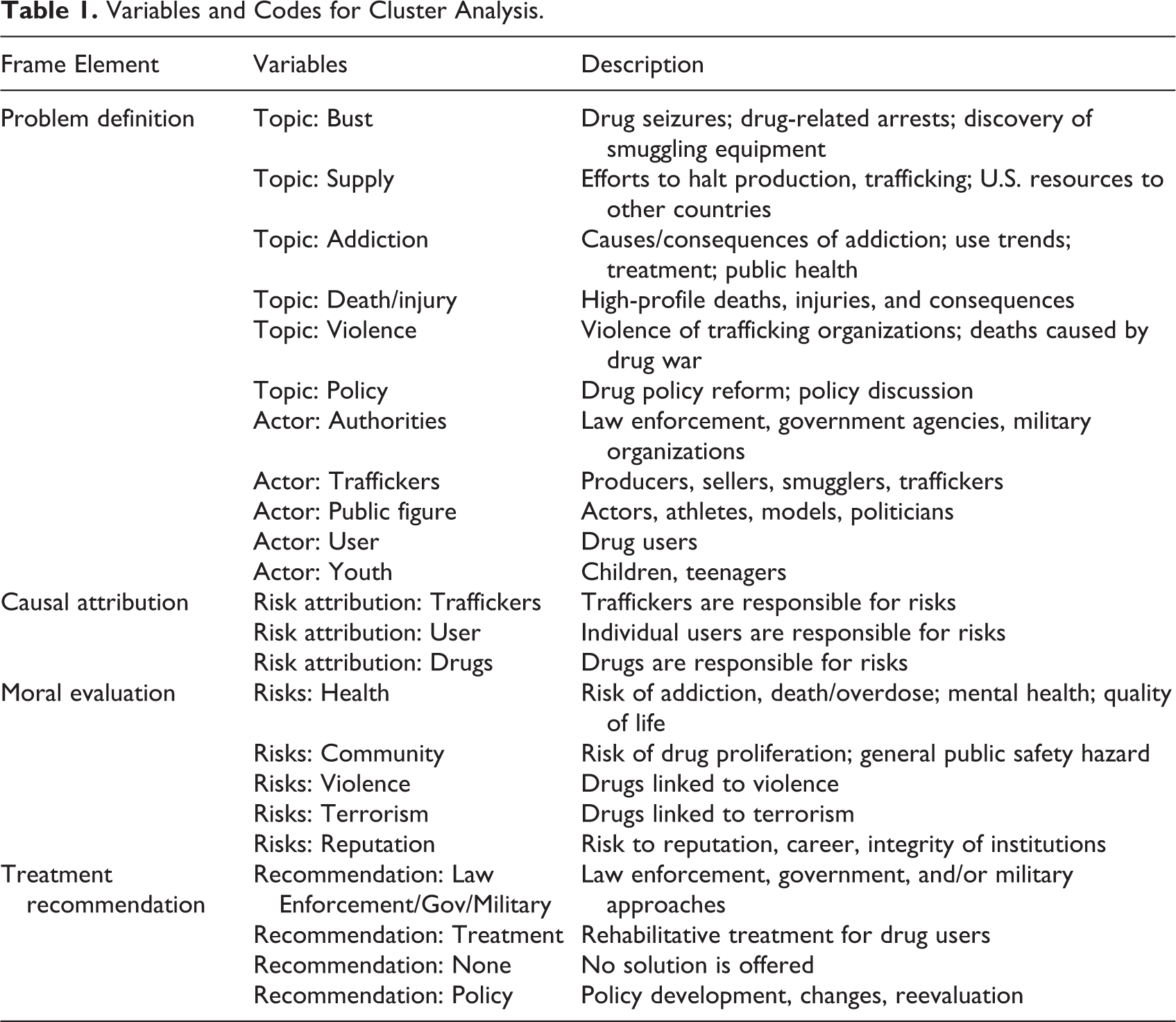
Upon completion of the coding of frame elements, hierarchical cluster analysis was conducted for two time periods (2000–2009 and 2009–2015) in order to identify the principal frames in news coverage as well as to assess whether the framing of heroin and cocaine in news discourse has changed over time. Table 1 displays the codes for the variables included in the cluster analysis. Based on the coding of the four frame elements, predominant media frames for drug issues were identified and are delineated below.
Variables and Codes for Cluster Analysis.
Analysis
Hierarchical cluster analysis using Ward’s method was conducted for the time periods of 2000–2009 and 2009–2015. The number of clusters for each time frame was determined by the agglomeration schedules’ coefficients and the “elbow criterion,” which refers to the identification of a point or “elbow” depicted when plotting the heterogeneity measures that indicates the ideal number of clusters necessary to avoid having a cluster that is too heterogeneous (Matthes & Kohring, 2008). Additionally, the qualitative interpretability of numerous cluster solutions was tested to corroborate the clarity of the results. A three-cluster solution was determined to be the most appropriate for the first time period, while four clusters were identified for the second period.
Results
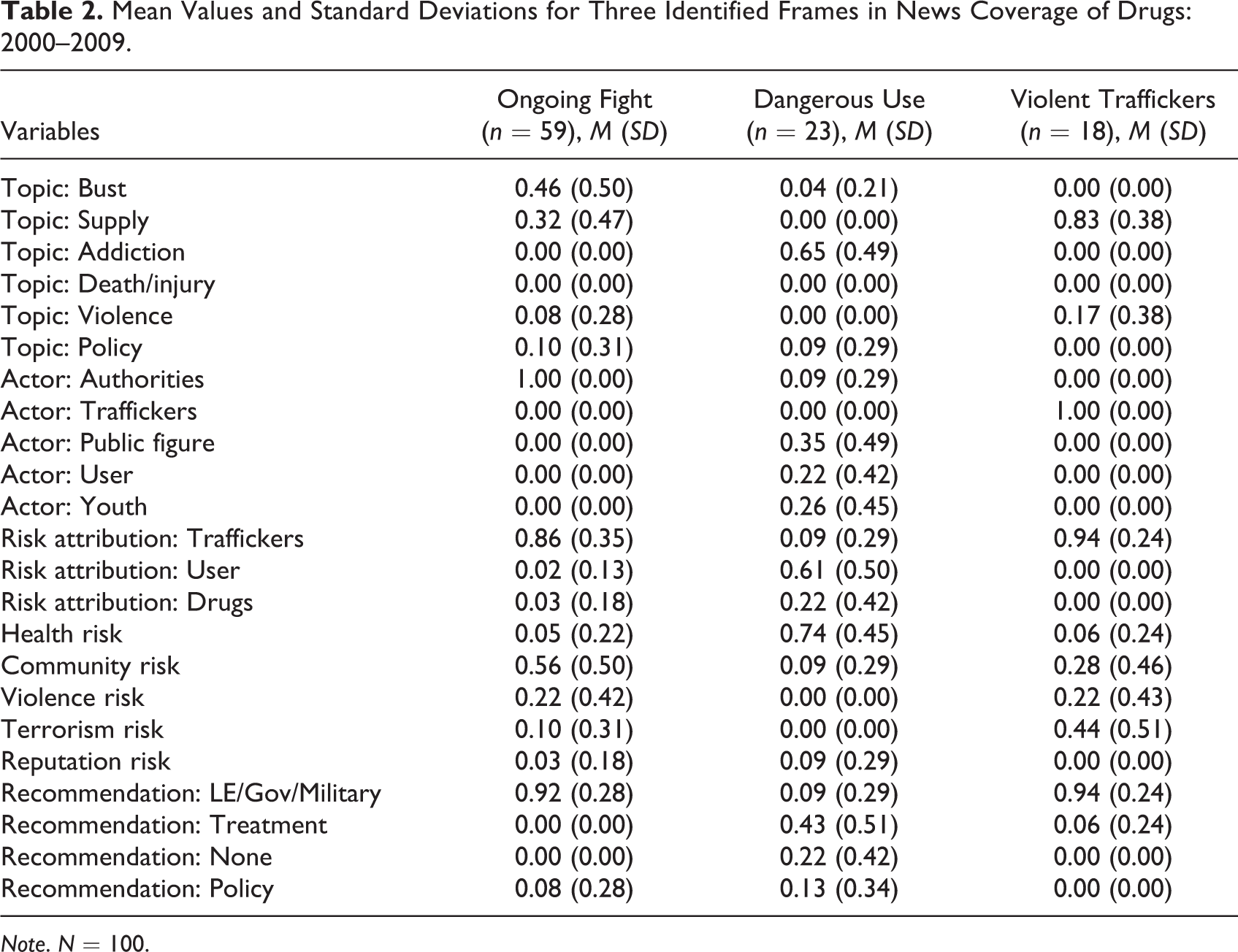
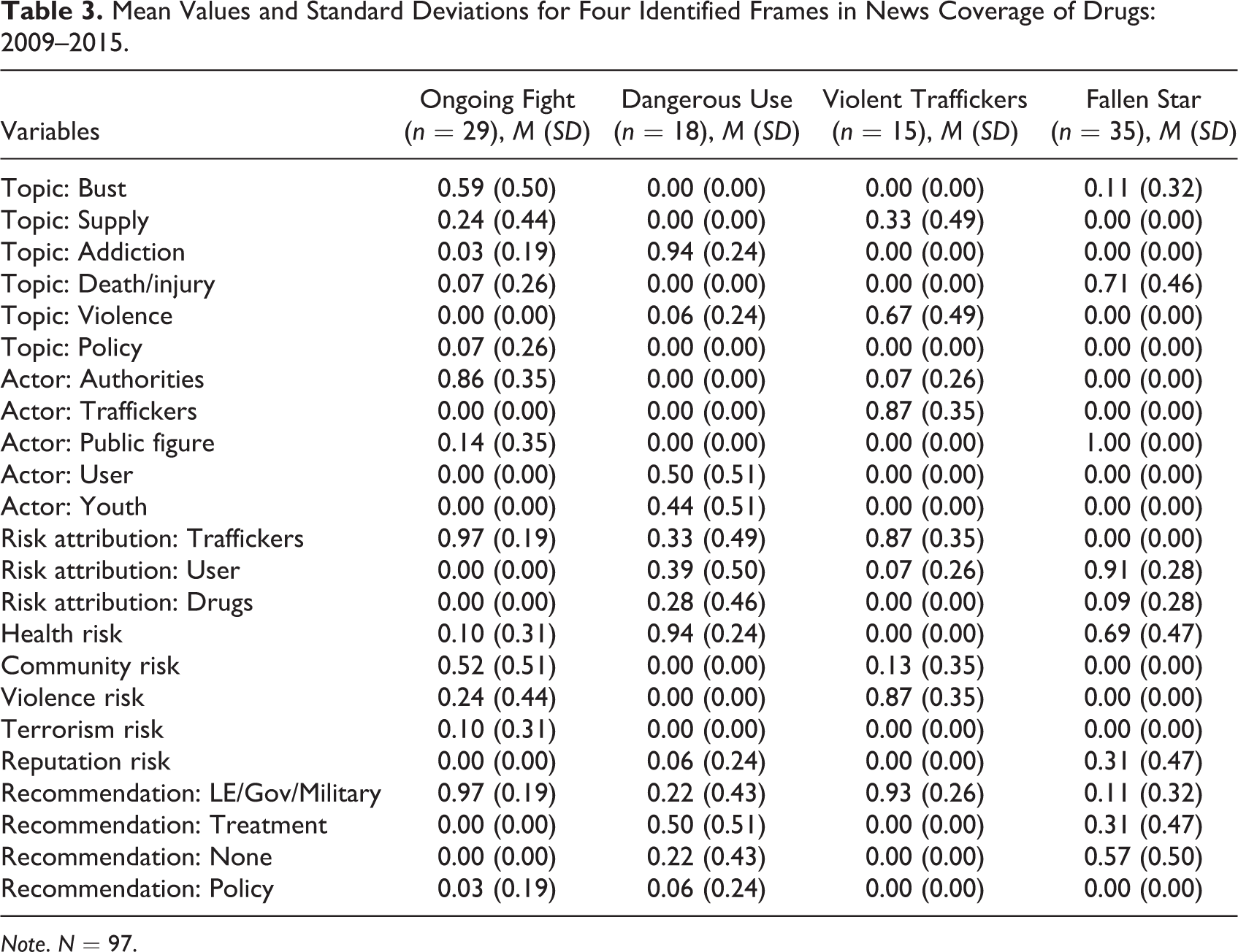
Frames were identified based on the most salient features of each cluster as evidenced by the highest mean values for the variables included in the analysis. Table 2 displays the mean values for the three clusters identified between 2000 and 2009 (n = 100). Three predominant frames were identified in reports throughout both time periods in the sample; these were titled Ongoing Fight, Dangerous Use, and Violent Traffickers. The second time period contained an additional frame entitled Fallen Star. The mean values for the four clusters identified between 2009 and 2015 (n = 97) are shown in Table 3. Elements and characteristics of each frame are explained below along with examples of common narratives.
Mean Values and Standard Deviations for Three Identified Frames in News Coverage of Drugs: 2000–2009.
Note. N = 100.
Mean Values and Standard Deviations for Four Identified Frames in News Coverage of Drugs: 2009–2015.
Note. N = 97.
Framing of Heroin and Cocaine from 2000 to 2009
The reports in the largest cluster, comprising 59% of the sample during the period from 2000 to 2009, focused heavily on the control of drug supply. In this frame, titled Ongoing Fight, drug busts were the most prevalent topic; almost half of the stories in this cluster primarily discussed the disruption of drug smuggling rings, drug seizures, the arrests of traffickers and/or drug lords, and the discovery of smuggling equipment such as submarines and tunnels. These actions were presented as victories in the interdiction efforts of law enforcement officials. A large proportion of stories in this frame also focused on continuing efforts to control drug supply through a fight against production, trafficking, and drug availability. These approaches included providing aid to other countries such as Colombia and Mexico in order to apprehend smugglers, diminish production, and stem the supply of drugs. Authorities (e.g., Drug Enforcement Administration (DEA), Federal Bureau of Investigation (FBI), U.S. Customs, Homeland Security, Coast Guard, government officials, military personnel, police, federal agents, and prosecutors) were the central figures and most important actors in these reports, and their strategies and tactics were described supportively. In the majority of stories in this frame, traffickers (including leaders, smugglers, cartels, sellers, and drug producers) were portrayed as responsible for the risks associated with drugs, and the risks emphasized were those to the community (i.e., drug proliferation, public safety). Specifically, traffickers were regarded as a pernicious force responsible for the destruction of communities through the diffusion of drugs and crime. Violence was also described as a risk related to drugs in a portion of stories. In this first frame, the typical responses advocated were continuations of law enforcement, government, and/or military tactics for dealing with drugs. These reports supported extant supply reduction strategies such as searches and seizures by law enforcement, supply eradication, attempts to dismantle smuggling rings, the maintenance of War on Drugs resources (e.g., money, equipment), military raids and training, border patrol monitoring, and governmental collaboration including U.S. aid to other countries.
A second frame, which comprised 23% of the sample during the first time period, is titled Dangerous Use. The most prevalent central topic in this frame was addiction, with coverage discussing the dangerousness of new forms of heroin, trends in drug use and overdoses, the challenges of maintaining recovery, and particular demographic groups perceived to be at risk. The vast majority of stories in this frame focused on the U.S., and the primary actors discussed were drug users, public figures, and youth demographics. The actions of users, as well as the pharmacological properties of drugs, were represented as responsible for the risks associated with drug use. For example, these reports focused on the dangers of certain drug combinations such as heroin and fentanyl, the creation of potential public safety hazards by individuals who use drugs and drive, or drug use by pregnant women and the potential risks to their children. Risks to health such as addiction, overdose, mental health issues, and developmental problems for infants were the most prominent consequences conveyed in this frame. Occasionally, stories discussed other risks such as harm to the community (e.g., public safety), legal trouble, or negative effects on an individual’s reputation, career, family, and/or general quality of life. The primary response or recommendation was rehabilitative drug treatment, although many stories included no discussion of a solution. Specifically, individual drug treatment was touted as a challenging but necessary and ultimately effective undertaking for people dealing with drug issues. The remaining few reports included brief policy-oriented debates regarding how best to handle drug issues. The stories in this frame espoused an objectivist or positivist approach to drugs which takes for granted that drugs are a social problem solely due to the concrete damage they cause (Fraser & Moore, 2011). This narrative assumes that certain drugs, due to their pharmacological properties, will inevitably cause harm to those who encounter them. Such an approach omits contextual factors and critical policy analysis from the discourse.
The third frame, Violent Traffickers, constituted 18% of the sample during the first time period. This frame focused on violence as well as efforts to reduce the proliferation of drugs. The main actors in these reports were all in the category of traffickers, which included smugglers, growers, cartels, and other drug trafficking organizations. The risks associated with drugs were overwhelmingly attributed to traffickers and primarily included violence and terrorism. During this time, drugs were discussed in the context of the War on Terror; the most prevalent risk conveyed was terrorists’ financial benefit from drug production and proliferation. Several reports discussed the violence of Mexican drug wars, while others represented the drug business as contributing directly to terrorist groups. Stories also occasionally included discussions about general threats to communities and public safety. Recommendations or proposed solutions involved continuations of law enforcement and military tactics; these included FBI initiatives, government strategies, military resources and operations, U.S. aid to other countries, arrests of traffickers, and poppy eradication efforts. Story content in this frame was reminiscent of past media coverage which “othered” or vilified particular demographic groups. By presenting threats to the public as committed by an “other,” the “dominant group defines into existence an inferior group” (Altheide, 2003, p. 18). Almost all of the stories in this frame were regarding groups outside the U.S., predominantly in Afghanistan, Mexico, and Colombia. News stories utilized conventional war metaphors and employed labels such as “drug terrorists” (NBC, April 27, 2003). In another example, the newscast suggested that the “defeat” of a violent and “ruthless guerrilla group” in Colombia may help lessen the flow of cocaine into the U.S. (ABC, July 5, 2008).
Framing of Heroin and Cocaine from 2009 to 2015
Results of the analysis of the second studied time period were similar to the first as the same three media frames were found in both. However, one additional frame emerged in the second time period: Fallen Star. The first frame, Ongoing Fight (30%), was consistent across both time ranges, with similar mean values for the most important variables in these clusters. In this frame, the primary topics were drug busts and efforts to stem supply, and authorities were the most important actors in the reports. Traffickers were deemed responsible for violence and other community-level risks, and the most common solution involved law enforcement, government, and/or military approaches.
Values for the frame Dangerous Use (19%) showed similar variables with high importance across both time periods; addiction was the most common topic in this frame, while users and youth were the most important actors. Users achieved the highest value for risk attribution, followed by traffickers and the properties of drugs. In both time periods, coverage in this frame focused on drug issues inside the U.S. While discussions were similarly constrained throughout the sample as a consequence of the Dangerous Use frame, some differences were noted when comparing the nature of the coverage in this frame from one time period to the next. Specifically, news stories in the first period were more varied and the majority were of a shorter or moderate length. While this frame comprises a slightly smaller proportion of stories in the second time period, the duration of the coverage during this period was more substantial as all but two stories were coded as having the highest coverage level. After 2009, there was also an increase in the number of stories focusing on heroin use among youth in American suburbs, and reports used language such as “explosion of heroin” to describe usage trends (ABC, March 29, 2010). When risks to young people were attributed to traffickers or dealers, stories represented drug lords’ actions as aggressive marketing and predatory targeting of American teenagers (ABC, March 30, 2010). When the risks were attributed to properties of the drugs themselves, reports called heroin use “scary and startling” (ABC, July 31, 2013) and a “steadily growing problem” (NBC, June 20, 2012). Risks predominantly focused on health, and treatment was the most commonly advocated solution.
Stories in the Dangerous Use frame typically advanced the disease model of addiction, emphasizing a lack of agency and referencing the “power of the addiction,” “instant” addiction, and the likelihood of inevitable relapse once a person is addicted to heroin (ABC, March 29, 2010). Furthermore, heroin use in American suburbs became increasingly described as an “epidemic” (ABC, April 24, 2010; October 19, 2010; October 29, 2010; July 31, 2013; NBC, June 19, 2012; April 3, 2014; April 8, 2014; April 11, 2014; July 7, 2015; December 13, 2015). Reports referred to a “new generation” of heroin users in suburban America (NBC, June 20, 2012) and stated for example that the “heroin problem” was “exploding among people in all walks of life across our country” (NBC, February 3, 2014). Furthermore, in July 2015, NBC conducted an ongoing series they titled “Hooked: America’s Heroin Epidemic.” The increase in attention to heroin use among middle-class suburban users was accompanied by notions that incarceration is no longer a viable or reasonable approach. This has led to greater emphasis on treatment as a solution but may have also facilitated the expansion of coerced treatment in criminal justice contexts, such as drug courts, which have grown substantially in the 21st century. In one example framing drug use as dangerous, NBC news praised a drug court program for “forcing addicts to get clean…through a combination of compassion and consequences” (NBC, April 11, 2014). Drug courts, despite reliance on a disease model of addiction, involve little to no medical professionals in their practice. Instead, drug courts use the disease model and the pretense of “helping people” to justify expanded judicial control and monitoring of drug offenders (Tiger, 2015b). This approach “keeps the War on Drugs firmly intact and does little to address the biases that this war perpetuates” with regard to race and class (p. 194).
The third frame, Violent Traffickers (15%), emphasized law enforcement and military responses to drug issues in both time periods and portrayed drug traffickers as the primary actors responsible for risks to society. However, slight differences in the nature of the coverage and changes in the salience of particular variables were noted in this frame over time. Specifically, prior to 2009, the most prominent risk in this frame was related to terrorism, while the terrorism risk was absent from the post-2009 coverage. Stories in this frame generally focused on the violence of traffickers and attempts to stem drug supply. Prior to 2009, more stories focused on poppies in Afghanistan and the financing of terrorists, while after 2009, reports in this frame primarily discussed the drug war in Mexico and the violence of Mexican drug cartels. However, the tendency of news discourse to “other” dealers and traffickers persisted in the coverage in this frame. For example, one news story, in discussing Atlanta as a hub of drug smuggling, described it as an “American city…under siege” and stated that “Mexican traffickers” were “now firmly entrenched across America among unsuspecting neighbors” (NBC, October 23, 2010). Another report described “American farmers and ranchers” living along the southern border of the U.S. “in constant fear” of “armed Mexican traffickers” (NBC, November 25, 2011).
Finally, one additional frame, Fallen Star, emerged in the second time period. It comprised 36% of the sample due to the deaths of several public figures including Amy Winehouse, Whitney Houston, Cory Monteith, and Philip Seymour Hoffman. The number of celebrity deaths related to drug use is thought to have increased in the 21st century and, along with prescription drugs, heroin and cocaine were among the leading drugs deemed responsible (Just, Bleckwenn, Schnakenberg, Skatulla, & Weckbecker, 2016). This frame is titled as such largely because news networks often used this phrasing to characterize these types of events. For example, transcripts indicated that stories covering Cory Monteith’s death used graphics that read “Fallen ‘Glee’ Star” (ABC, July 16, 2013) and “‘Glee’ Actress on her Fallen Friend” (ABC, August 12, 2013). Similarly, in coverage of the heroin use of Philip Seymour Hoffman, graphics often read “Fallen Star” (ABC, February 3, 2014; February 4, 2014; February 6, 2014; February 7, 2014) and “Tragic End” (ABC, February 3, 2014; February 4, 2014; February 6, 2014). News stories with a Fallen Star frame frequently discussed the drug-related deaths or injuries of various celebrities. Occasionally, these broadcasts reported the drug use of a public figure that resulted in a bust or scandal such as in the cases of Toronto Mayor Rob Ford and U.S. Congressman Trey Radel. The most common risk attribution was the individual drug user. The risks discussed were primarily to health (e.g., overdose, addiction, stroke, and brain damage), with some reports emphasizing consequences for the person’s reputation or career. There was most commonly no proposition for what should be done; however, if the report included a response, the importance of drug treatment was more likely to be emphasized than law enforcement approaches or policy changes. These treatment recommendations coupled with the absence of punitive discourse are suggestive of the “privileged normalization” discussed in past research which refers to some drug use being normalized or less stigmatized for certain people with power and status (Haines-Saah et al., 2014). However, while drug use by individuals with status has been normalized to an extent in media coverage, certain stories follow a “fallen hero” script which can be simultaneously accepting and stigmatizing (p. 53).
The substantive content found in the Fallen Star frame is consistent with prior research which found that media coverage of celebrity drug use can reinforce double standards related to race and gender. For example, Tiger’s (2013) analysis found that coverage of Lance Armstrong’s drug use received more complex and nuanced treatment, allowing him to simultaneously occupy a range of identities, while coverage of Whitney Houston’s drug use tended to be overly simplistic and evoke narratives of an “addict” who had squandered her talent. While most of the celebrities covered in the present sample were White males, there is some evidence which suggests that media may be more likely to employ particular narratives based on gender and race. For example, in the news coverage in the present study, reports about Whitney Houston focused primarily on her “struggles” and drug consumption. Conversely, while coverage of other celebrities also contained those elements, their lives and personality traits were granted more diverse descriptions. Specifically, coverage of Philip Seymour Hoffman described him as “just a regular dad” (ABC, February 2, 2014), “talented and troubled in equal measure” (NBC, February 3, 2014), and “shy and generous” (ABC, February 3, 2014). Likewise, coverage of Cory Monteith described him not only as a person who had a “troubled childhood” (ABC, July 16, 2013) but also as a “compelling star” and a “humble guy with a big heart” (ABC, July 18, 2013). Additionally, stories about Hoffman and Monteith were placed in the context of the national trend of rising heroin use. In stories regarding the drug-related “scandals” of Rob Ford and Trey Radel, reports evoked a redemption narrative and often mentioned that the person had apologized, suggesting a prerequisite of remorse for successful redemption after the discovery of their drug use. Analyses of media representations of celebrity drug use outside the U.S. context have also noted the presence of the expectation that a public figure who uses drugs should publicly apologize and display genuine remorse to win back public favor (Seear & Fraser, 2010b).
Based on the analysis of the two time periods in this study, I argue the framing of heroin and cocaine in the media did not change substantially from 2000 to 2015. The same three frames were found throughout the sample, with one additional frame emerging in the second time period due to the highly publicized deaths of certain public figures. Across both time periods, topics of primary focus included drug busts, efforts to control supply, violence, and the negative consequences of drug use and addiction. Policy was the least prevalent topic, and policy changes were rarely reported or discussed. However, some differences between the two time periods were noted. For example, Ongoing Fight comprised a smaller proportion of the news reports in the second time period than in the first. Additionally, while the frame Violent Traffickers was found throughout both time periods, there was a shift in the subject matter of the coverage contained in this frame. Finally, the conflation of War on Drugs and War on Terror discourse appears to have largely dissipated by the second time period, perhaps due to the differing rhetorical emphases and priorities of the presidential administrations.
Discussion
This study examined the coverage of heroin and cocaine in televised evening news reports by conducting a content analysis of frame elements and hierarchical cluster analysis to identify patterns in media frames over time. Results demonstrate that media coverage of heroin and cocaine remained relatively homogeneous from the year 2000 to 2015, with drugs frequently discussed in contexts of crime, deviance, and tragedy. The common deployment of particular frames underscores societal attitudes and habitual media frameworks for reporting drug issues, and the consistency of framing over time indicates that mainstream news sources continue to disseminate hegemonic ideologies and stereotypical assumptions regarding drugs. Frame analysis illustrates that the most salient features of drug-related stories during this period included violence, crime, addiction, and health risks, while the leading policy choices remained traditional prohibition-oriented approaches.
The identification of predominant frames also highlights the omission of alternative frames and discourses (Altheide & Schneider, 2013). News media framing facilitates a limited discourse of drug use and distribution as a pernicious force, which excludes more progressive policy options and perpetuates the long-standing stigma associated with these drugs. The existence of the four frames identified in this study illustrates the absence of public health and harm reduction narratives, as well as those related to decriminalization or legalization of illicit substances and the normalization of drug use. This has important implications for drug and health policy particularly in an era when media outlets are increasingly referring to the nation’s “drug epidemic.”
The pervasiveness of the Ongoing Fight frame shows that a large portion of news coverage disseminated to the public attempts to convey progress in suppressing drug circulation. News stories in the sample often boasted arrests, raids, and seizures as representative of advancements in quelling the drug trade, and disruptions of smuggling rings and the apprehension of drug traffickers were frequently touted as “victories” or battles won in the War on Drugs. Presenting these stories as victories for law enforcement reinforces the appropriateness of prohibition as the principal policy choice. Reports in the studied sample also contained reminders that although challenges exist for law enforcement officials, their goals and approaches were admirable. Propositions for handling drug issues largely favored domestic and international interdiction efforts, substantiating the notion that “news media and criminal justice policy seemingly mirror each other’s beliefs” (Taylor, 2008, p. 381). These findings are consistent with past research which found substantial reliance on social control frames and an absence of critical perspectives (Beckett, 1995), news coverage which focused on supply reduction (Jernigan & Dorfman, 1996), and the presentation of law enforcement as the primary response to drug-related issues (McGaw, 1991). Additionally, the finding that authorities are the most prominent actors and often-cited interviewees in a large proportion of stories is consistent with prior research which has noted that law enforcement or government sources provide most of the information while alternative sources are marginalized (Beckett, 1995; Chermak, 1997).
The presence of Dangerous Use and Violent Traffickers as popular frames shows that overarching narratives pertaining to drug-related danger and violence remain common. The news contained traditional alarmist messages about the harmfulness and negative consequences of engaging in drug use. Drug use was framed as inherently hazardous with no attention devoted to the fact that an absence of regulation is largely what makes the drugs dangerous (Reinarman & Granfield, 2015). Media stories in the Dangerous Use frame instead advanced conventional causal formulations of drug effects wherein it is taken for granted that certain drugs, due to their inherent properties, will affect users in predictable and consistently negative ways and that society should therefore attempt to prohibit their consumption (Fraser & Moore, 2011). These stories offered narrow treatment and policy recommendations and failed to include that most drug overdoses are primarily due to criminalization and the resultant lack of drug regulation, potency labeling, and quality control (Reinarman & Granfield, 2015).
The emphases on threats to children in stories especially in the Dangerous Use frame are similar to messages found in past media reports which encouraged fear regarding younger generations’ drug use. Potential risks to children have often been used by the media to evoke emotional reactions from audiences and to justify social control efforts. Previous research has recognized the centrality of children in “constructing drug victims” (McGaw, 1991) and disseminating discourses of fear (Alexandrescu, 2014; Altheide, 2002). Research has also noted the simplistic framing of drug stories using the creation of “villains” and “victims” (Lancaster et al., 2011).
Treatment recommendations and other statements in the stories framing drug use as dangerous indicated an adherence to the disease model or medicalization of addiction. The disease model of addiction has become a functional concept for people seeking to explain various experiences and difficulties (Reinarman & Granfield, 2015), and it is therefore a pervasive approach that is increasingly being applied to an expanding array of personal issues with consumption (Fraser, Moore, & Keane, 2014; Reinarman & Granfield, 2015). People who experience problematic substance use or addiction in contemporary society may find disease metaphors reasonably suitable to help make sense of “seemingly inexplicable decisions to persist in problematic behaviors” (Reinarman & Granfield, 2015, p. 15). As such, many people who experience the expanding treatment industry “come to adopt the addict or ex-addict identity” and learn “to interpret their experience in terms of the reigning addiction-as-disease paradigm” (p. 15). However, these labels and definitions can perpetuate stigma and influence how people think of themselves as well as how others view them. While this understanding of addiction may arguably be considered a more compassionate and progressive approach than past frameworks, it may pose new challenges for drug policy reformers in the current era of increased addiction attribution (Fraser et al., 2014) and the growing treatment industry (Reinarman & Granfield, 2015). This model promulgates notions that habitual drug use is a “medico-moral disorder” that warrants monitoring and punitive responses (Tiger, 2015a, p. 353), and it is presently employed to justify coerced treatment and expanded judicial control over people who use drugs (Tiger, 2015b). It is therefore increasingly important to critically examine and rethink how we conceptualize and respond to addiction, and the media will continue to play an important role in shaping public attitudes as society attempts to address drug-associated problems.
Stories in the Violent Traffickers frame conveyed conventional messages of moral corruption and the predatory nature of dealers and traffickers as well as the violence of the drug trade. News media framed drugs as heavily linked to violence and brutality, emphasizing the dangerous nature of engagement with the drug trade, but failing to propose alternative policies or explicate the idea that prohibition propagates violence. As such, these newscasts may have served to reinforce a punitive philosophy and endorse drug prohibition and the interdiction efforts enacted through law enforcement and military operations.
In the Fallen Star frame, stories about certain individuals were provided along with warnings about the ominous nature of drugs. Emphasis was placed on negative consequences such as damage to career, reputation, or life. Media habits in this frame were reminiscent of the drug scares of the 1980s (Reinarman & Levine, 1997), particularly in coverage of the deaths or injuries of prominent public figures. In the present sample of news broadcasts, the deaths of actor Philip Seymour Hoffman and Glee star Cory Monteith were used as foundations for media outlets to subsequently spotlight the “heroin epidemic” among suburban youth. Journalists’ frequent labeling of drug use as an “epidemic” creates a rhetorical link between drugs and danger (Reinarman & Levine, 1997), and the use of terminology such as “epidemic” and “plague” puts “the most fearful spin possible” on descriptions of drug use in society (Reinarman & Levine, 2004, p. 187), which can inhibit reasoned responses and produce harmful social consequences (Chitwood, Murphy, & Rosenbaum, 2009). At a time when the disease model has become the prevailing view of addiction, and the “drug epidemic” is widely discussed in traditional media and their digital platforms as a current social problem, it is important to be critically engaged with media content and framing.
The interactive and increasingly complex nature of the current media landscape may complicate interpretations of media impact on consumer attitudes as many people receive news from social media as well as traditional media platforms. However, traditional media continue to make substantial contributions to public discourse through both television and digital platforms. Research has also indicated that there is a reciprocal relationship between traditional and social media (Guggenheim, Jang, Bae, & Neuman, 2015). Traditional news sometimes reports information obtained from social media (e.g., Twitter, Facebook), and social media users often share stories from traditional media sources. Furthermore, Dwyer and Fraser (2016) showed that despite the presence of a multiplicity of enactments of addiction on Twitter, dominant concepts and logics of addiction remained pervasive and the technical constraints of the platform tended to facilitate a reproduction of the “simplified and reductive addiction objects of dominant expert discourse” (p. 93). Many reporters in televised media encourage viewers to visit their websites for more information, or they reference hashtags or other social media in the broadcast. It follows that they are disseminating similar discourses and ideologies on their digital platforms as they are in televised broadcasts. In one example from this sample of news stories, NBC directed audiences to their website for more thorough coverage of a particular aspect of heroin addiction treatment and also noted that they had received a substantial response from viewers on Twitter using “#HeroinInAmerica” (NBC, April 8, 2014). In other cases, reporters mentioned that celebrities were using Twitter to express condolences after the death of Philip Seymour Hoffman (NBC, February 2, 2014) or included the text of specific tweets (ABC, February 2, 2014). While the nature of social media content is beyond the scope of this study, it is possible that many of the dominant frames found in traditional media coverage would also be present in social media discourses. Extant research has indicated that online comments by consumers of media largely reflect and can help construct the dominant narratives being promoted by mainstream news sources (Tiger, 2013). In Tiger’s (2013) analysis of the differing media coverage pertaining to the drug use of Whitney Houston and Lance Armstrong, for example, it was noted that New York Times readers responding to Houston’s obituary reflected long-standing narratives with assumptions about addiction as tragic and inevitably devastating. Most consumers’ comments reflected the overly simplistic and negative attitudes characteristic of the Houston coverage. Conversely, Armstrong’s drug use received more nuanced and complex media coverage, and this diversity of opinion was also reflected in reader comments. Due to the dynamic interplay between social and traditional media (Guggenheim et al., 2015) and the interactive nature of the new media landscape (Tiger, 2015a), citizens have the potential to contribute to discursive constructions that could reflect a more diverse range of experiences. Thus far, however, analyses have shown that online comments and social media content often support hegemonic cultural constructions of addiction (Dwyer & Fraser, 2016; Tiger, 2015a).
Traditional news media, by choosing what to report and how to frame societal issues, can produce and reproduce existing inequalities. If alternative narratives were prevalent in public discourse in the U.S., more progressive policy options may be considered viable and have greater public support. Media campaigns against drugs have promoted abstinence, and responsible and controlled drug use has not been presented as a legitimate or respectable possibility. Furthermore, drug prohibition has created a social context that is not conducive to “humane responses” to drug issues (Levine & Reinarman, 2010, p. 807). However, if U.S. media were to give equal time and emphasis to critical discourses, it may lead to public support for the adoption of alternative policy frameworks which would likely mitigate the social problems, systemic inequality, and ill effects often linked with drugs. For example, proponents of drug legalization have posited that this reform would decrease violence and other drug-related problems (Boaz, 1990; McGaw, 1991; Nadelmann, 1997), eliminate the black market, allow regulation of psychoactive drugs, and enable spending on prevention and treatment instead of prohibition (Cheung, 2000). With diligent attention to framing habits, and by providing more thorough, balanced, and nuanced reporting, media sources could play an important role in educating and informing the public and facilitating greater acceptance of drug policy reform and the reduction of stigma.
While the systematic coding of frame elements coupled with cluster analysis performed in this study results in a reliable and valid way to identify frames in media coverage, there are several limitations of this approach. First, the number of clusters is not always immediately apparent and various facets require interpretation to identify the appropriate results and conclusions. To address this limitation, various alternate solutions were tested for interpretability and clarity. In addition, only one dominant frame was assigned to each news story despite the possibility of the presence of two or more competing frames. Another limitation of this method is that drug-related news stories were obtained using particular search terms, so a systematic analysis of the placement of each story in the overall news broadcast was precluded. Additionally, as this analysis focused on the identification of media frames, the order of ideas conveyed in the newscasts was not a principal area of exploration. This study also utilized broadcast transcripts for analysis and thus excluded prosodic information and paralinguistic characteristics. As such, while some elements of the representation of race-, class-, and gender-related discourses were noted, a systematic analysis of these components is beyond the scope of this study. Finally, the studied sample focused on heroin and cocaine in U.S. network evening news sources and was derived from those search terms, so the results may not be applicable to other drugs or media sources. Future research related to media representations and the framing of drugs may analyze audio and video components or other media or news sources and could include alternative search terms which would yield a different sample of reports. Social media outlets would also be fruitful subjects for future analyses to explore emergent and prevalent drug discourses, given the complexity of the contemporary media landscape and interactive nature of traditional and social media. A comparative approach could also be employed to explore the messages of the United States’ mass media outlets and those of another country, particularly one in which drugs are less demonized. This approach may be illuminating and helpful for facilitating progress in drug-related media representations, U.S. drug policy reform, discourse and public opinion, and evolving cultural narratives.
Footnotes
Acknowledgments
The author would like to thank the Contemporary Drug Problems associate editor and anonymous reviewers for comments on an earlier draft of this article.
Declaration of Conflicting Interests
The author(s) declared no potential conflicts of interest with respect to the research, authorship, and/or publication of this article.
Funding
The author(s) received no financial support for the research, authorship, and/or publication of this article.