







Abstract
A study was undertaken to determine how teaching in learning communities (i.e., courses that are linked or intentionally integrated in terms of learning objectives and shared assignments) affects the perspectives and work of community college faculty members. Interviews with 14 faculty members who taught in learning communities at a Midwestern community college indicated that the benefits of participation included greater empathy for and awareness of students, the development of authentic relationships with students, enhanced engagement in the larger campus community, and active collaboration and professional development with faculty colleagues across disciplines. Study limitations and implications are discussed.
Student retention and improved graduation rates continue to be vital outcomes of community colleges and other higher education institutions (Barbatis, 2010; Fike & Fike, 2008). Over the last two decades, a growing number of 2-year and 4-year institutions have implemented initiatives designed to help college students persist toward meeting their academic and professional goals (Hagedorn, Perrakis, & Maxwell, 2006; Kinzie, Gonyea, Shoup, & Kuh, 2008; McPhail, McKusick, & Starr, 2006; Minkler, 2002; Tinto, 1998). One such retention effort is the learning community movement (Lenning & Ebbers, 1999; MacGregor & Smith, 2005; Smith, MacGregor, Matthews, & Gabelnick, 2004). For purposes of this article, learning communities are comprised of two or more classes that are linked together or intentionally integrated in terms of learning objectives and shared assignments (Larnder & Malnarich, 2008). Often, the learning community will be built around a certain theme related to the academic courses or disciplines within the community. Faculty members work closely together with a shared group of students, typically over the course of a semester. One primary objective of the learning community model is to promote academic and social engagement (MacGregor & Smith, 2005). Scholars, including Kuh (2008), have designated learning communities as a high-impact educational practice that facilitates both academic and social engagement among participants; this engagement often leads toward greater success in college (Kuh, 2009; Kuh, Kinzie, Schuh, Whitt, & Associates, 2005; Kutnowski, 2005; Shapiro & Levine, 1999).
Much of the scholarly work on the outcomes of learning community initiatives has been conducted on students who attend 4-year institutions (Jehangir, 2010; Pike & Kuh, 2005). A growing body of research on learning community efforts at 2-year institutions is evident in the literature (Bambara, Harbour, Davies, & Athey, 2009; Raftery, 2005). This research tends to focus on the experiences of the students who participate in these programs. Although a great deal is known about the impact of learning communities on students (Engstrom & Tinto, 2007), there is a dearth of research on the experiences of faculty members who teach in learning community programs (i.e., “What are the potential outcomes for instructors?”). We know that college students in learning communities tend to demonstrate enhanced engagement; yet little is known if faculty members are engaged in similar ways. Therefore, the central research question for this study is, “What are the experiences of faculty members who participated in a learning community program at a community college?”
Literature Review and Conceptual Framework
The literature is replete with potential benefits of student participation in learning community programs. These benefits range from enhanced involvement (Tinto, 1993), multicultural awareness (Chang, 2005; Jehangir, 2009), and heightened academic and social engagement (Kuh, 2009; Pike & Kuh, 2005). But what do faculty members get out of this experience? MacGregor and Smith (2005) noted 15 lessons about learning communities, beginning with the fact that “learning communities have arrived as a national movement” (p. 2). One potential benefit outlined is that learning community programs have become locations for faculty and staff development as well as student development. Also, MacGregor and Smith contended that “faculty and staff development benefits are substantial but often underreported” (p. 4). The benefits move beyond student success and include the opportunity for faculty members to engage in disciplines different from their own.
Another possible faculty outcome is enhanced interpersonal relationships. Effective learning communities involve close collaboration between faculty members, often involving shared time in classroom settings. As noted above, many learning community arrangements include combined courses from diverse disciplines, thereby giving faculty members the opportunity to learn more about a new academic area (Engstrom, 2008). Furthermore, faculty members can develop stronger peer and working relationships; this is especially evident when faculty members spend substantial time together generating shared syllabi with integrative curriculum, learning objectives, and collaborative student projects (Lardner & Malnarich, 2008).
Hesse and Mason (2005) contended that other advantages accrue to faculty members who participate in learning communities. One example is that faculty members develop strategic and innovative pedagogies and methodologies, “such as cooperative and collaborative learning, service learning, experiential learning, problem-based learning, writing and speaking across the curriculum, and innovative uses of technology” (p. 34). This collaboration can lead to innovation, creativity, and rejuvenation. MacGregor (2000) described how faculty members (even experienced teachers) encountered a sense of collegiality and renewal after participating in learning community programs. Some faculty members commented that the learning community experience was a highlight of their careers (Dodge & Kendall, 2004).
Many faculty members at 2-year institutions wholly embrace a hallmark of the community college mission—to help students succeed (Murray, 2010). From this perspective, faculty members are eager to get involved in initiatives that enable students to become more actively engaged in their experiences; these faculty members want to become active participants in this engagement process (Grubb, 1999). Given this commitment, it is important to consider other reasons for faculty engagement in learning community efforts and similar retention initiatives. For more recent hires, this type of involvement is often an expectation of the position. Community college administrators continue to seek out engaged faculty hires. According to the Association of American Colleges and Universities, in addition to possessing core knowledge in their academic areas, one of the characteristics that institutions are looking for in new faculty members is their potential and ability to be involved and engaged (Adams, 2002; Sprouse, Ebbers, & King, 2008); this argument can be extended to engagement in campuswide retention efforts.
Finally, many community college faculty members seek out collaborative partnerships with other faculty colleagues; in doing so, they potentially view learning community involvement as a way to promote job satisfaction. Too often the silo-like nature of the academy has caused some faculty members to become isolated and disengaged within the larger profession, which can often lead to job dissatisfaction. Hagedorn (2000) noted that individuals who are experiencing job satisfaction are more likely to be engaged in their job and are more productive. Herzberg, Mausner, and Snyderman (1959) offered a now classic theory on workplace motivation and satisfaction. More specially, they identified 14 first-level factors that can lead to job satisfaction; among those noted is quality of interpersonal relations with peers. It is possible that faculty involvement in a learning community initiative can enhance interpersonal relationships and, in turn, affect overall job satisfaction. In this study, we aim to learn more about the experiences of 14 faculty members who participated in a learning community program at a U.S. community college located in the Midwest.
Study Context and Method
This study took place at Great Lakes Community College (GLCC). GLCC (a pseudonym) is located on 90 acres in an urban metropolitan area in the upper Midwest. The campus houses 57 academic disciplines, 24 two-year degree options and 29 certificates. This college is accredited to deliver approximately 125 sections of online classes each semester. With over 200 full-time and part-time faculty members, the college is committed to meeting the needs of diverse learners. GLCC enrolls over 8,500 students from 15 different cities in the surrounding areas (more than 2,000 are full-time students). The average age of students is approximately 23. Sixty-one percent of students are women, and 18% are students of color. Over one third of students are first-generation students and about 60% of the college’s graduates go on to pursue higher degrees at 4-year institutions. GLCC serves a significant number of recent immigrant students who reside in the metropolitan area.
A basic interpretive approach was employed for this exploratory study. With a basic interpretive approach, the primary objective is to understand how participants assign meaning to a situation or phenomenon of interest (Merriam & Associates, 2002). This approach also allows for the discovering and understanding of “a phenomenon, a process, the perspectives and worldviews of the people involved” (p. 6). This study was designed to understand the experiences of faculty members who taught in a learning community at GLCC. More specifically, this study sought to understand how the learning community faculty members described and made meaning of their overall experiences within the learning community environment. Learning community faculty members were identified and invited to participate in this study. The research team conducted interviews with learning community faculty members who volunteered to participate in the study.
Participants
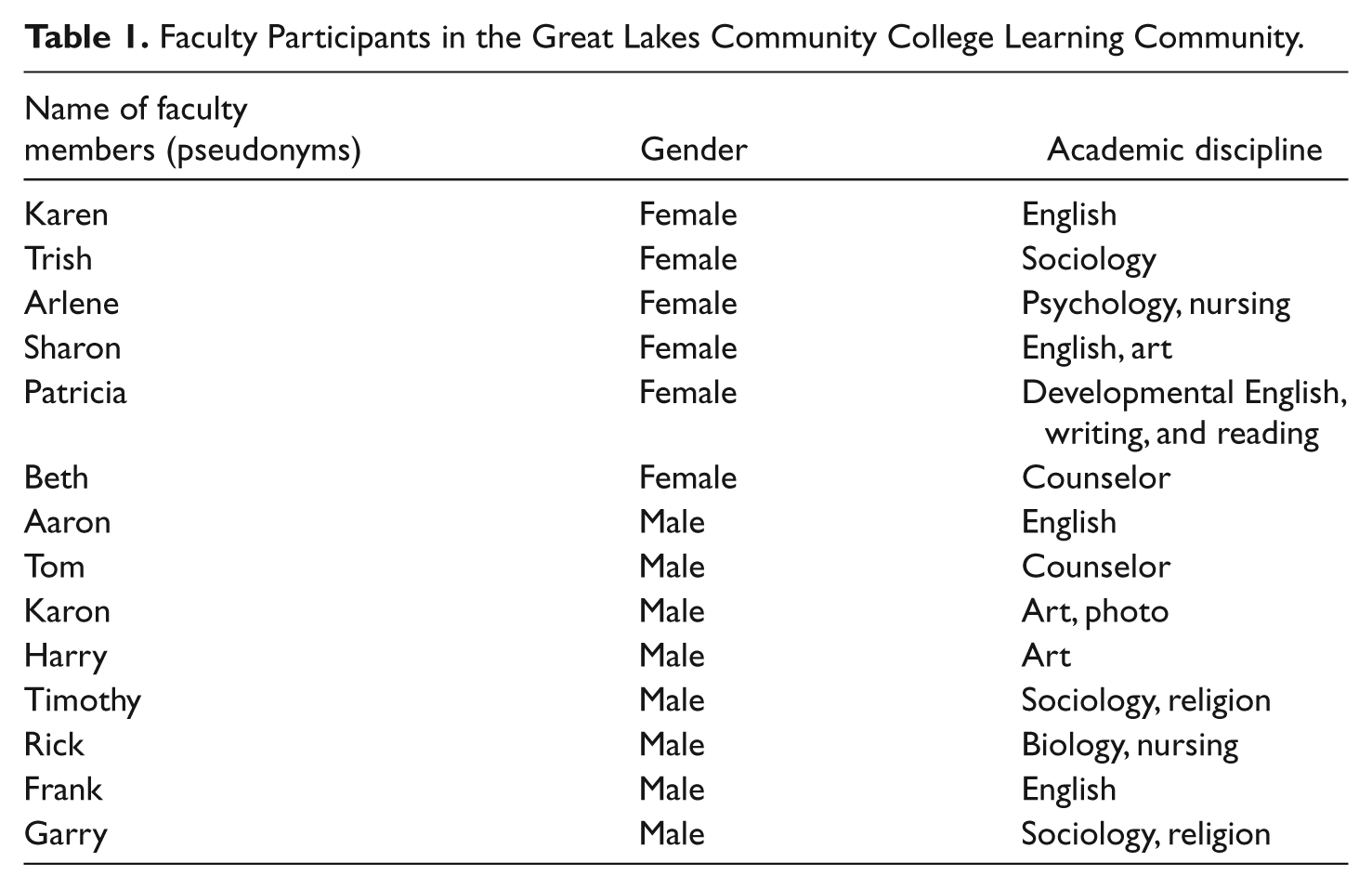
Prospective participants—the learning community faculty at GLCC—for the study were identified by the learning community director; invitations were sent asking if they would be willing to be included in the study. Purposeful sampling, which is also referred to as purposive or judgment sampling, was used to obtain information-rich cases that could assist in obtaining an in-depth understanding (Patton, 2002) of faculty experiences in learning communities at GLCC. Four aspects, as identified by Creswell (2007), were considered: the setting, the events, the actors, and the process. The participants for this study included 14 faculty members across several disciplines (Table 1) who were involved in the learning community at GLCC during the fall semester of 2007 and the spring semester of 2008. The largest numbers of participants were in social sciences and humanities. The smallest number of participants were in fine arts and life sciences. Six of the faculty members were female and 8 were male. Although the participants in this study were diverse in terms of gender and academic discipline, the majority of the participants identified themselves as White; one faculty member of color participated.
Faculty Participants in the Great Lakes Community College Learning Community.
Interviews
Interviews were conducted to engage in intentional dialogue and discussion with the participants (Lichtman, 2006; Merriam & Associates, 2002). An experienced research team, consisting of two members, conducted the initial interviews over a 3-day period on the GLCC campus. (Three additional members were added to the team at the data analysis stage). Face-to-face, 1-hour individual interviews were conducted with each of the interested learning community faculty members. A semistructured interview protocol was used that allowed the interviewees to talk freely for approximately an hour. The interview protocol consisted of questions that encouraged faculty members to discuss their experiences in the learning community as well as their experiences on campus. As the participants described their experiences, the interviewers posed follow-up inquiries that stemmed from the participants’ previous statements. After the interviews, the research team transcribed the audio-taped interviews verbatim; interview transcripts were developed for each interview.
Data Analysis
The constant comparative method as described by Merriam and Associates (2002) and initially outlined by Glaser and Strauss (1967) was used to analyze the interview text. The research team reviewed copies of each interview transcript. Each transcript was reviewed once by each team member without taking notes; this provided the team member with a better idea of the intent and meaning of faculty statements (Creswell, 2007). Each researcher then analyzed the transcripts and coded data that appeared to address the research questions, comparing segments of data with each other within each interview transcript. Next, the codes and concepts were compared across each of the 14 individual interview transcripts, and preliminary codes were established. On the basis of this analysis, each research team member had varying numbers of preliminary codes, ranging from 10 to 20 codes. The researchers then met and compared coding and analyses (Glaser & Strauss, 1967). A back-and-forth discussion strategy was used to gain a clearer understanding of the codes and information from the transcripts that supported each of the codes. From this process, a set of four preliminary themes was inductively derived that characterized the experiences of the faculty members teaching in a learning community project. Based on the coding and the discussion of the codes at the research meetings, subthemes were established for each of the four themes. The research team participated in several meetings at different times in the course of the study to discuss preliminary themes and subthemes. Themes were recoded when necessary (Creswell, 2007). Any discrepancies that emerged as a result of the discussions of the codes and themes at the team meetings were further explored through the reexamination of the transcripts and interpretation of the information. Interrater reliability was reached on both the themes and subthemes. All of the members of the research team agreed on the themes and subthemes but may have “packaged” them differently.
The study has at least three potential limitations. First, the 14 faculty participants were identified by the learning community director and invited for interviews by the principal investigators. The goal was to include a diverse sample based on gender, ethnicity, and discipline represented. Although the majority of learning community faculty members were included in this study, not all faculty members from the learning community groups participated. Several disciplines (e.g., faculty counselors) were overrepresented and, as a result, not all faculty members were included. Other factors for nonparticipation included lack of interest or limited resources (e.g., time) for participating in the study. Some adjunct faculty members did not participate. Thus not all faculty voices were represented. Including a broader sample would allow the findings of future studies to better represent the experiences of learning community faculty members.
Second, this was intended to be a small pilot study of the perceived experiences of learning community faculty members at a single community college. The sample size is small and the findings cannot be generalized to other institutions. Finally, the interview scope was somewhat limited in the sense that we captured faculty experience at one specific moment in their involvement. Ideally, a more extensive study would interview faculty members at various points in their experience, including before the beginning of a semester rather than only after the fact in a postexperience interview. Although academic disciplines and the gender makeup of the participants were diverse in nature, the demographics of the participants are homogeneous in terms of ethnicity, which is also representative of the institutional demographics.
Results
The faculty members were asked to discuss how participating in the learning community has affected their experiences and their overall perceptions regarding their role as faculty members within a learning community. Findings indicate that participating in the learning community was beneficial not only to the students who were involved but also to the faculty members who had the opportunity to engage in these experiences. The learning communities provided opportunities for faculty members to explore and connect with the issues and needs of students in ways that had an impact on the faculty. When asked to elaborate on ways that the learning community experiences had affected them, the faculty members drew attention to four themes: (a) creating empathy and greater awareness, (b) building authentic student relationships, (c) engaging in the larger campus community, and (d) promoting active collaboration and professional development with other faculty members.
Creating Empathy and Greater Awareness
Many of the learning community faculty members at GLCC expressed more empathy and a greater awareness of students’ issues and needs. The faculty members talked extensively about moving from just assisting students and providing resources to really understanding the students and approaching their needs and concerns from a point of empathy. Rick, an instructor in biology and nursing, discussed how he had been affected:
I think the one thing that I got out of this was that I think I started to feel a little bit more empathy for the wandering student, the student that doesn’t quite know their place, maybe feels a bit lost . . . I just felt more “invested” is the best word for the students . . . I don’t think it changed me too much again other than I definitely felt more empathy for some of those student; I always want my students to succeed.
The opportunity to work with students who were in the processing of “figuring out” their place in life proved to be beneficial for the learning community faculty members. This connection encouraged them to reach out to students in ways they otherwise would not have.
Beth, a faculty member in the counseling department, elaborated how the learning community environment had helped her to become more aware of her students and what they experienced as students.
I think it has certainly helped me be more aware of what students are experiencing. I think if we weren’t doing this [learning community] I would be teaching my class, [going] back to the counseling center, teaching my class, and so [I’d be] less aware of the big picture of what’s going on with students, and I also think it helps build relationships.
The assumption is often made that students are “okay” and the job of the instructor is to just teach the students. The learning community faculty members began to develop a different type of connection with the students, which allowed them to view their roles as more than teaching and more like “educating holistically.” Additionally, Karen, an instructor in the English department, discussed her experiences by stating the following: “It’s [involvement in the learning community] made me really think about the way I establish community in the classroom.”
Overall, active participation in the learning community allowed the instructors to gain an enriched understanding of the learning community students. These experiences placed the instructors in positions to understand the experiences of the students and build authentic relationships among the students in the learning community.
Building Authentic Student Relationships
Building authentic student relationships is a process that takes time and energy. The faculty members in the learning community understood the importance of establishing relationships with students. Tom, a counselor who is also involved in the learning community, expressed how each student has his or her own individual, unique story and how one can become drawn to students in such a way that it feels like a family connection is being made. He stated,
I really loved the student contact again (having been away from it as an administrator). Every student has a story, and to validate that story for them and to help them take wherever they are and move; it’s just what I love about the job. Every student is different; it’s just taking the story and helping them make sense of the story, and yet [I try to help them] work from that base and move toward what it takes to be successful in academics. It becomes like a family. You can get really attached to them.
Patricia, an instructor in developmental English, writing, and reading, explained how the connection that was established and created as a result of participating in the learning community has translated into classroom approaches:
I think that the thing has changed the most for me is to really be aware of the importance of those connections to students. I’m trying to look at some of the benefits of the learning community that I’ve seen with students interacting with each other, and I try to develop some of those connections in my other courses even they’re not part of a learning community.
Developing authentic relationships and connections in the learning community environment encouraged the faculty members to become involved and engaged with individuals and activities external to the learning community environment and more within the larger campus community as well.
Engaging in the Larger Campus Community
Participating in the learning community allowed faculty members to see how little they had been engaged in the larger campus prior to this experience. Many faculty members discussed how they were able to engage and interact with faculty members whom they had never interacted with before. This awareness of the importance of engaging with colleagues outside of their particular area had an effect on classroom approaches. Aaron, an English instructor, discussed how the importance of making connections and building relationships is now a part of classroom discussions. He mentioned,
I think I am more engaged in the campus overall. I think part of it was becoming a full-time instructor. But even having the learning communities and interacting with instructors that I hadn’t meet before and other disciplines I hadn’t worked with before just kind of [got me] more involved and engaged in the whole community. It has gotten better over the years, and I think the learning community has helped with that with me too—and working with a lot of good people.
Harry, an African American instructor, expressed the importance of engaging in the larger campus community by stating,
Yeah, the learning community has helped me enforce the fact that you learn a lot better in a community, so I want to take any chance I can to get out of my studio. I love being in the studio, but art is sometimes [being in a] box by yourself. I feel there’s a need for me to kinda have that experience more [participating in] the learning communities; you feel more active, and it helps balance out the ideas and the skills; that’s our purpose behind it.
While engaging in the larger community, learning community faculty members also expressed their increased motivations to collaborate professionally with other professionals and gain knowledge beyond their respective areas of expertise.
Promoting Active Collaboration and Professional Development with Other Faculty Members
Participation in learning communities affected faculty members in many ways. A common premise heard throughout the voices of the faculty is that the learning community environment has affected them professionally. Participating in learning communities definitely promoted the importance of collaborating with professionals within and beyond one’s respective area. These interactions allowed for broader perspectives, which can be incorporated into classroom discussions. Additionally, the collaborations allowed faculty members to build relationships with individuals who can help students gain authentic experiences in other areas. Sharon, both an English and art instructor, also spoke about how forming collaboration efforts and relationships with individuals from varying backgrounds and experiences is a way of establishing credibility. She stated that,
Certainly if you teach in my area you can feel really isolated and segregated, and learning communities is a way to get out there and really interact with your colleagues. Over the years, I would have to say it’s been professionally rewarding because I have relationships with faculty in different areas, and I need that contact just for my personal edification, but professionally if you’re going to teach reading you need to be offering your students some authentic experience, and if you won’t know what that is if you’re not actively collaborating with faculty. Learning communities give you an opportunity to interact in a professional way and get ideas.
Sharon also spoke about how forming collaborative efforts and relationships with individuals from varying backgrounds and experiences is a way of establishing credibility.
I think it’s a way to establish some credibility, I think professionally. You can’t just talk to the people in your own department, you know? Oh my God, that would be the worst thing to only interact with the people in your immediate [department] . . . oh that would be awful especially on a small campus like this. People think this is big, but it’s pretty small.
Lastly, in addition to gaining more credibility, one faculty member highlighted how collaborations and relationships with professionals in other areas encouraged more respect from students. A broader understanding that extends beyond one’s teaching style and one’s experience has allowed the learning community faculty members to develop professionally, even if partners disagreed on pedagogical approaches. Garry, an instructor in sociology and religion, asserted,
[I gained] more respect for a variety of the students, more respect for a variety of teaching styles. I have much more respect for Shon [another learning community faculty member] and his style [even if it is different]. I learned from him, but I also learned respect. Even the one learning community teacher that didn’t work out, I still learned respect . . . that some people can’t do learning communities—at least not fully. But that’s okay. They’re still good teachers in their own stand-alone classes. I learned from that too.
Although Garry’s observation about a colleague who did not “work out” as a learning community faculty member suggests that not all teachers have a positive experience with this instructional format, his comments, along with those of others participating in this study, indicate the potential of the learning community environment to affect instructors greatly. By creating empathy and greater awareness among the instructors, encouraging authentic relationships with students, fostering engagement in the larger campus community among fellow instructors, and encouraging professional development with other faculty members, the learning community experience was a benefit to instructors.
Discussion
The purpose of this study was to explore the experience of community college faculty members who opted to participate in a new learning community program at Great Lakes Community College. From a faculty perspective, participation led to areas of outcomes or benefits. Several of the faculty members noted how the learning community environment facilitated a more nuanced sense of empathy with certain students, whom they began to view on a more personal level, understanding their unique issues and needs. This enhanced relationship building is often a positive outcome of a successful learning community (Jehangir, 2009). The learning community environment also encouraged the faculty members to view their role as more than just delivering content. The opportunity to make connections with the students and learn about their individual stories was a powerful experience for most of the faculty members; it provided a sense of meaning to their work. These interactions involved students who had a clear understanding of where they wanted to be in terms of a career path as well as “wandering” students who were still in the process of exploring various opportunities. Through this understanding and empathetic stance, authentic relationships were created between the faculty members and the students. Authentic student–faculty relationships frequently can take time to develop; they require trust and honesty. Through the learning community environment, the faculty members were able to build a good foundation with the students and foster a supportive classroom environment.
In addition to the faculty members expressing how the learning community affected their ability to work with students, the study participants also discussed how the learning community motivated them to become invested in the institutional community and promoted collaboration and professional development. The learning community allowed the faculty members to work collaboratively with other colleagues outside of their home departments (Dodge & Kendall, 2004). In an authentic multidisciplinary learning environment, both students and faculty members learn how to think critically across academic disciplines. The learning community participation encouraged connection to the larger institution. By interacting with other faculty members through the learning community, the faculty participants were able to realize how little they were involved in the institution beyond their respective areas. Working in this format also extends one’s professional development (Brooks, 2010; Smith et al., 2004). Gaining knowledge from and interacting with faculty members in other areas of the institution expanded the perceptions of the study participants and helped them gain an understanding of how their experiences and knowledge could be enhanced through this interaction.
Faculty members can play key roles in the challenge to engage and retain community college students. Learning communities serve as an example of high-impact practices that have been effective in reaching these objectives. We attempted to shed light on an often-overlooked component of the learning community experience—the perceptions of community college faculty members who participated in a LC experience at a college in the Midwest (GLCC). Based on these findings, we offer some recommendations for practice, policy, and future research.
Implications
Practice
The learning community faculty expressed a greater awareness and empathy toward students’ needs and issues as a result of participation. Training opportunities for interested learning community faculty members is essential. Effective pedagogical strategies and methodologies, which have been identified as advantages of learning community participation (Hesse & Mason, 2005), can be infused into professional development training and workshops for faculty members who intend to teach in learning communities. Learning community instructors can be advised to use innovative pedagogy and strategies that engage students throughout the semester. This may include using technology, peer teaching, small-group activities, and off-campus learning in the form of experiential learning. As an example, one such first-year experience course may entail arranging to take an entire class to a play. Another first-year experience project could require students to play the role of social scientists, using newly acquired participant observation skills. Some students will learn best through this type of hands-on, experiential learning (Kolb, 1984).
High-impact educational practices, such as learning communities, will have a greater chance of sustainability if more faculty members become invested. Program directors and administrators can encourage faculty members and student affairs practitioners across campus to get involved with learning communities and related retention efforts (Hunter & Murray, 2007; Stebleton & Schmidt, 2010). Often, the same cohort of faculty members is tapped to create and develop new programs on campus. If other faculty members can be encouraged to participate and opportunities are shared, stress and burnout from overcommitment can be minimized.
Several faculty members talked about the challenges and rewards of working collaboratively with colleagues across disciplines. Research on learning communities suggests that the most successful efforts occur where faculty members teaching paired courses jointly create assignments that intentionally integrate core concepts from multiple disciplines (Engstrom & Tinto, 2007; Lardner & Malnarich, 2008; Malnarich, 2005). This integration of courses (rather than courses linked by registration only) takes more time and effort to develop and implement into the shared curriculum (Cargill & Kalikoff, 2007). Learning community faculty members can be advised to build these efforts into the planning of their courses (Thomson, 2007). Likewise, administrators might consider providing committed learning community faculty members with extra resources (e.g., stipends or extra time during professional duty days at the onset of the semester).
Policy
The faculty members in this study asserted their desire to participate in learning communities. They highlighted many benefits that resulted from their participation. Institutional leaders and advocates of student retention initiatives can be encouraged to develop policies that support faculty who choose to participate in learning communities (Oburn, 2005). These policies may include allowances for planning time.
Based on the findings, participation in the learning community program has motivated the faculty to become involved in other areas of the institution. Providing release time for faculty members to engage in professional development activities and participate in effective learning community planning is an ideal way of encouraging more participation and supporting faculty members who currently participate. Additional policies may include financial compensation and relevant educational resources, to name a few. While time consuming, the learning community experience has great benefits for the faculty, which, in turn, positively affects the student experience. Policies that support faculty members in learning communities not only encourage faculty participation in learning communities but also foster a culture of consistency among faculty members who currently participate.
Future research
Several learning community faculty members talked about the increased level of commitment needed to participate in the program as well as the desire to create a positive experience for the students. Studies that include broader samples of learning community faculty members should be conducted to gain a broader perspective of faculty experiences in learning communities. Additionally, more intensive, longitudinal studies need to be conducted with faculty members to explore the short-term and long-term impacts of participation in a learning community program. How might participation influence the trajectory of faculty members’ careers? Does participation pose disadvantages for pre-tenure-track or probationary-level faculty members? (Wolf-Wendel, Ward, & Twombly, 2007). It is possible that learning community involvement at some institutions takes priority over other types of service or responsibilities for pretenure faculty members. This would be worth exploring at the community college level. Future studies should involve multiple institutions that incorporate learning communities into their first-year student initiatives. Faculty members can be studied across various community colleges (e.g., different sizes, geographic locations) to gain a deeper understanding of the lived experience of participants. One question that might be pursued is, “How might participation affect faculty perceptions of collaboration or integration of multidisciplinary thinking across the curriculum?”
Faculty members at community colleges can play vital roles in helping to engage and retain students. High-impact educational practices such as learning communities serve as one such tool to help students meet academic, career, and personal goals. Faculty members who participate in learning community initiatives have the potential to make a powerful impact on the lives of their students, while at the same time enriching their own academic and professional development.
Footnotes
Acknowledgements
The authors would like to thank Marina B. Aleixo for her helpful feedback on previous drafts of this article.
Declaration of Conflicting Interests
The authors declared no potential conflicts of interest with respect to the research, authorship, and/or publication of this article.
Funding
The authors received no financial support for the research, authorship, and/or publication of this article.