







Abstract
Although community colleges have offered study abroad for more than 50 years, this sector remains marginalized in conversations surrounding international education in the United States, with many simply assuming that community college students do not study abroad (Zhang, 2011). Numerically, associate-degree–seeking students represented only 1.7% of the students who studied abroad during the 2016–2017 academic year (Institute of International Education, 2018). Although this percentage may seem small, it masks considerable growth in study abroad participation among community college students over the past few years. That is, although at the height of the economic recession in 2009 to 2010, only approximately 4,000 community college students studied abroad, not even a decade later in 2016 to 2017, approximately 5,600 community college students earned academic credit through education abroad (Institute of International Education, 2018).
Despite this growing interest in study abroad among community college students, international education remains very much at the periphery of practice and policy at many 2-year institutions, particularly at rural institutions (Harder, 2010; Oberstein-Delvalle, 1999; Raby, 2008, 2012) This marginalization is likely due to competing economic interests, lack of consistent administrative support, vagueness in the intent of internationalization efforts, lack of a professional foundation for international education at community colleges, and the adoption of a narrow definition of the community that a community college seeks to serve (Green, 2007; Raby, 2012). Within this context, research that assists international education professionals who work at community colleges to better understand the student population that they serve when creating study abroad programs is especially important. Such international opportunities at community colleges are particularly relevant for students without plans to transfer to the 4-year sector, where study abroad is a more prominent educational opportunity, and for students who, for a variety of reasons, are unable to transfer (Frost & Raby, 2009; Raby, 2012; Raby & Valeau, 2007; Zhang, 2011).
Community colleges are often the point of entry to higher education for underserved student populations and for students who follow a wide variety of pathways to success, such as short-term certificate programs and continuing adult education, in addition to associate degrees. For this reason, the student populations that community college study abroad programs serve are diverse (Brand et al., 2014; González Canché, 2018). These systematic differences between students who attend community colleges and those who attend 4-year institutions suggest that results of studies that explore study abroad participation among students attending 4-year institutions may not be applicable in the 2-year sector. Consequently, policies and practices that derive from this prior research are not necessarily appropriate in the community college context. The purpose of this study is twofold. First, it aims to further our understanding of who exactly studies abroad through community colleges. Second, it identifies when they are most likely to do so. This latter point is particularly relevant to international education professionals working at community colleges, who must build study abroad programs within a context where widespread support, including financial support, is generally lacking (Raby, 2012). The event history modeling (EHM) analytic approach used in this study allows both these purposes to be addressed within the same statistical model.
Using administrative data from a large community college located in the U.S. Southeast, this study provides a systematic analysis of individual characteristics that contribute to study abroad participation among this institution’s students, accounting especially for characteristics that are more prevalent among this student group compared with students who traditionally enroll in the 4-year sector. In addition, the EHM technique used in this study allows for the identification of not only which student characteristics are associated with study abroad participation but also when, over the course of their studies, these students are most likely to study abroad. The following research questions guided this inquiry:
Literature Review
Study Abroad Participation at 4-Year Institutions
As already indicated, the majority of previous literature on study abroad intent and participation is confined to studies of students attending 4-year institutions. Four key studies are illustrative of this line of research. Salisbury et al. (2009) found that numerous social, educational, and demographic characteristics predicted students’ intent to study abroad. Specifically, parental educational attainment was positively related to intent to study abroad, as were female sex, attitude toward literacy, openness to diversity, majoring in a social science, and participating in diverse interactions and cocurricular activities during the first year of college. These findings were echoed in Luo and Jamieson-Drake (2015), who linked intent to study abroad to study abroad participation. Generally, in both of these studies (Luo & Jamieson-Drake, 2015; Salisbury et al., 2009), students’ race/ethnicity was not significantly associated with intent to study abroad, with Asian American and Pacific Islander students being the only group significantly less likely to intend to study abroad compared with White students. However, Luo and Jamieson-Drake (2015) found that when considering study abroad participation itself (rather than intent), both Asian American and African American students were significantly less likely to participate, suggesting that other factors may intervene to thwart the study abroad participation intentions of many historically minoritized students.
Regarding other student characteristics, Salisbury et al.’s (2009) findings indicated that men, students who were heavily involved in high school extracurricular activities, those not enrolled at a liberal arts institution, and those receiving a federal grant, were less likely to intend to study abroad. This latter finding is likely related to students’ socioeconomic status, given that federal grant aid tends to be need-based (e.g., Pell funding). Simon and Ainsworth (2012) found that students from lower socioeconomic status groups struggle to overcome not only barriers to study abroad participation, including financial impediments, but also barriers imposed by bureaucratic institutional structures. Finally, in considering when 4-year students are most likely to participate in study abroad, Whatley (2017) found that students at earlier stages of their studies, namely, first-, second-, and third-year students, were more likely to study abroad compared with students in the fourth year of their studies.
Although these studies make valuable contributions to the study abroad participation literature in general, their results are likely limited to the 4-year context. Salisbury et al.’s (2009) data set included students enrolled at community colleges (representing around 4% of the data set), but this study did not examine community college students’ study abroad participation aside from controlling for institution type in regression models. Simon and Ainsworth (2012) and Whatley (2017) relied on data from students enrolled at 4-year institutions only, and the data set used in Luo and Jamieson-Drake (2015) represents students enrolled at a single, highly selective, 4-year institution. Because the demographic characteristics and social situations of community college students often differ from those of students enrolled in the 4-year sector, lessons learned from this line of inquiry might not be especially applicable in the 2-year context. For example, given the 2-year sector’s prominence in enrolling students from historically minoritized race/ethnicity backgrounds, community colleges might be more adept at fulfilling these students’ study abroad aspirations.
Study Abroad Participation at Community Colleges
Literature on community college student engagement, defined broadly as participation in educationally effective activities both in and out of the classroom (Harper & Quaye, 2009), finds that differences in engagement emerge along the lines of certain student characteristics, including enrollment status, race/ethnicity identity, and sex (Greene et al., 2008; Saenz et al., 2011). National-level data indicate that community college students who study abroad are more diverse along racial/ethnic lines compared with study abroad students attending 4-year institutions (Institute of International Education, 2018; Raby, 2008; Whatley, 2019). At the same time, nationally, a larger proportion of community college students who study abroad are women compared with students who study abroad from 4-year institutions (Institute of International Education, 2018). Previous studies have found that students who study abroad through community colleges tend to reflect the demographic characteristics of the general student populations at their institutions (Raby & Rhodes, 2018). One reason for which community college study abroad might attract a more diverse student population is that, although traditional, 4-year study abroad tends to be academically based only (Hoffa, 2007), community college study abroad often includes a wider variety of course options, including technical, vocational, and career education (Malveaux & Raby, 2019).
Prior literature on community college study abroad participation suggests that community college students encounter some barriers to participation similar to those highlighted in the 4-year study abroad literature, such as financial need (Amani, 2011), but this line of research generally approaches this topic from a counter-barrier rather than a barrier perspective. This literature highlights how community college study abroad programming can be inclusive of working students (Robertson, 2019), students in remedial education courses (Raby et al., 2014), and first-generation students (Quezada & Cordeiro, 2016), among others.
Amani (2011) and Amani and Kim (2018) conducted two studies that focus specifically on study abroad participation rather than outcomes of study abroad among community college students, such as increased intercultural competence, or policies and practices in community college study abroad. Both studies used semi-structured interview data to identify community college students’ reasons for studying abroad and the challenges they had to overcome to do so. Generally speaking, their results indicated that students’ reasons for study abroad were academic, such as coursework plans and aspirations to transfer to a 4-year institution; social, such as wanting to study abroad with friends; and institutional, such as encouragement from key faculty members and particular honors program offerings. These students were motivated to study abroad for reasons of cultural and personal development, the academic “fit” of study abroad programs, prior experience with travel or study abroad, and a desire to travel with peers (Amani, 2011; Amani & Kim, 2018). Many students participating in these studies indicated that studying abroad through the community college was a once-in-a-lifetime opportunity. They expressed that study abroad was more possible for them at a community college because of the lower cost and because community college study abroad offerings were well timed in accordance with their academic plans. Although obstacles to study abroad that students identified included funding, fear of travel, academic–life balance, and both academic and family conflicts, these obstacles were often accompanied with information about how they could be overcome. For example, students in Amani and Kim (2018) mentioned that financial barriers could be overcome with enough planning time and enough information about study abroad finances and financial aid. Although not an empirical study, Robertson (2019) presented information that suggests that though some family members may indeed be unsupportive of community college students who want to study abroad, family members often recognize the importance of international study, especially when they have worked or studied abroad themselves.
Previous work on community college study abroad highlights its unique character. This literature underscores the need to study community college study abroad participation in its own right rather than folded into the 4-year study abroad literature.
Theoretical Framework
This study adopts a capital resources theoretical framework, which has been applied consistently among researchers examining study abroad participation in 4-year students (e.g., Luo & Jamieson-Drake, 2015; Salisbury et al., 2009; Simon & Ainsworth, 2012). This framework posits that uneven social structures provide differential access to amounts and types of capital resources, namely, economic, cultural, and social capitals (Bourdieu, 1986). In turn, these capital resources assist individuals in social advancement, which often includes participation in education and, in the case of this study, participation in education abroad. Economic capital represents financial or monetary resources to which an individual has access. Cultural capital refers to informal interpersonal skills, habits, manners, linguistic competencies, and lifestyle preferences, derived in part from one’s family (Berger, 2000; Perna & Titus, 2005). This form of capital refers to the value placed on educational attainment and other educational experiences (Perna, 2006). Finally, Portes (1998) defines social capital as relationships with others and the resources available through them. These capital resources do not remain stable over time—Bourdieu (1984) emphasizes that both the volume and composition of an individual’s capital resources can change. For this reason, change over time is important in studies applying this theoretical approach, which must account for both individuals’ backgrounds, the origin of many capital resources (e.g., high school experiences), and changes in these resources over time.
Much of the study abroad research that has been conducted using these theoretical constructs advances a deficit perspective. This research suggests that students lacking in certain capital resources, perhaps money (economic capital; for example, Salisbury et al., 2009; Whatley, 2017) or knowledge gained from friends, family members, and colleagues about how to navigate the education system (social capital; for example, Simon & Ainsworth, 2012), are somehow less able to participate in study abroad. However, community college education abroad research often challenges such a perspective (e.g., Raby, 2019). Although financial barriers to study abroad participation are most certainly real for many students (not only community college students), Amani (2011) and Amani and Kim (2018) find that community college students view study abroad through their institutions as an affordable way to travel and indicate that with enough planning time, they are able to account for the financial resources necessary for study abroad participation. Given the differing nature of community college study abroad from traditional, 4-year study abroad, it would not be surprising if the current study’s results were somewhat “counterintuitive” regarding the relationship of capital resources to study abroad participation.
Because of its focus on community college study abroad, the current study includes indicators of capital resources that might be particularly salient for community college students. For example, full-time student status is included given the numerous students who enroll in community college part time (National Center for Education Statistics, 2019). Although students who attend college full time might have access to social capital resources that encourage study abroad participation, such as friends or classmates who have studied abroad or more frequent contact with faculty who encourage this participation, students who attend part time may have greater access to social connections who encourage study abroad participation outside of the college setting, such as family members or employers who value the outcomes of international education (Robertson, 2019). Cultural capital resources, particularly those related to the importance placed on education (Perna, 2006), that may be especially important for community college students include whether a student completed high school by taking a general education development (GED) exam and a student’s current academic objective, especially as it relates to intent to transfer to a 4-year institution. Again, though the expectation from a deficit perspective may be that students with less traditional educational backgrounds or without plans to transfer to the 4-year sector are less likely to invest in study abroad, prior community college study abroad research suggests otherwise. These students often view community college study abroad as the opportunity of a lifetime (Amani, 2011; Amani & Kim, 2018).
Method
Institutional Context and Data
The administrative data used in this study originate from a large urban community college located in the U.S. Southeast. Like many community colleges, this institution offers a wide variety of academic opportunities, such as certificates, technical degrees, associate degrees, and transfer options. Students with intentions to transfer to a 4-year institution are able to access opportunities through articulation agreements that this institution has with the state’s 4-year flagship institution, which is located in close geographic proximity. Students are able to study abroad during both spring and summer terms through programs that last between 7 and 28 days. Programs are offered in a variety of countries and are not confined to a single region of the world. Most study abroad programs cost between US$3,000 and US$5,000. To apply to study abroad students must have a minimum 2.0 GPA, be in good academic standing, have completed at minimum 12 college-level credit hours, and be 18 years old by the time the program begins.
The data used for this study correspond to all students who were enrolled during spring and summer terms, starting in the 2009–2010 academic year through 2016–2017. Therefore, students who were enrolled at this institution for more than one term are represented multiple times in the data set, once for each semester of enrollment. Inclusion of observations from a single student at multiple time points is important for at least two reasons. First, existing literature indicates that the decision to participate in study abroad relates to many variables that change over time, such as field of study or GPA. From a theoretical perspective, too, students’ capital resources and their influences on students’ decision making are expected to change over time. Accounting for these variables at only a single time point would obscure their time-varying nature as they relate to study abroad. Second, without a time-series component, this data set would be unable to address this study’s second research question, which asks about when, over the course of their studies, community college students are most likely to study abroad. This data set’s time-series dimension acknowledges that students make decisions about their educational trajectories, including study abroad participation, over the course of several semesters rather than at a single moment.
Prior to analyses, several groups of students were excluded from the data set. These groups included high school students who were participating in a dual enrollment program (N = 6,901), students whose approximate ages were lower than 18 (N = 28) or higher than 65 (N = 195), and students who participated in multiple study abroad experiences (N = 161). These exclusions were made to comply with institutional policies surrounding the use of data from minors (the first group excluded), students who were not eligible to study abroad (the second group), and to focus analyses on what might be thought of as a more typical community college education abroad experience (the latter two groups). In addition, observations with missing data for any of the variables included in analyses were dropped from the data set. These observations included 15 lacking information about students’ sex (corresponding to data representing six students), one observation missing information about a student’s residency status, and 6,320 observations with missing term GPAs. After these modifications, the data set contained information corresponding to 48,352 students representing a total of 95,265 student–semester observations.
The full list of variables collected from institutional records for this study is displayed in Table 1. Along with information about students’ study abroad experiences, the data set included covariates falling into two groups: covariates that do not vary over time (time invariant) and those that do (time variant). Time-invariant covariates correspond to demographic information, namely, students’ gender, race/ethnicity, and residency status (in- or out-of-state), as well as descriptors of students’ high school experiences: whether they attended high school abroad, whether they were homeschooled, and whether they took the GED to complete high school. Incorporation of this high school information into statistical models is important because these variables account for students’ capital resources, especially cultural capital, prior to enrolling in higher education. From a theoretical perspective, high school educational experiences are reflected in students’ future educational decision making, such as the decision to study abroad (Berger, 2000; Perna, 2006; Perna & Titus, 2005; Salisbury et al., 2009). Time-varying covariates include a student’s approximate age, qualification for need-based financial aid (e.g., a Pell grant), GPA, academic objective (e.g., associate degree in a certain field, technical degree, transfer), and attendance status (full- or part-time). In addition to their status as time invariant or time variant, these variables represent measures of students’ economic, social, and cultural resources that likely predict their participation in study abroad. For example, whether a student qualified for need-based financial aid in a given term of enrollment is indicative of financial resources, whereas full- or part-time enrollment status reflects the type of social connections the student likely has—whether within the community college context (full-time students) or outside of it (part-time students). A variety of student background information, such as information corresponding to students’ educational choices and experiences, represents cultural capital resources.
Variables Included in Analyses.
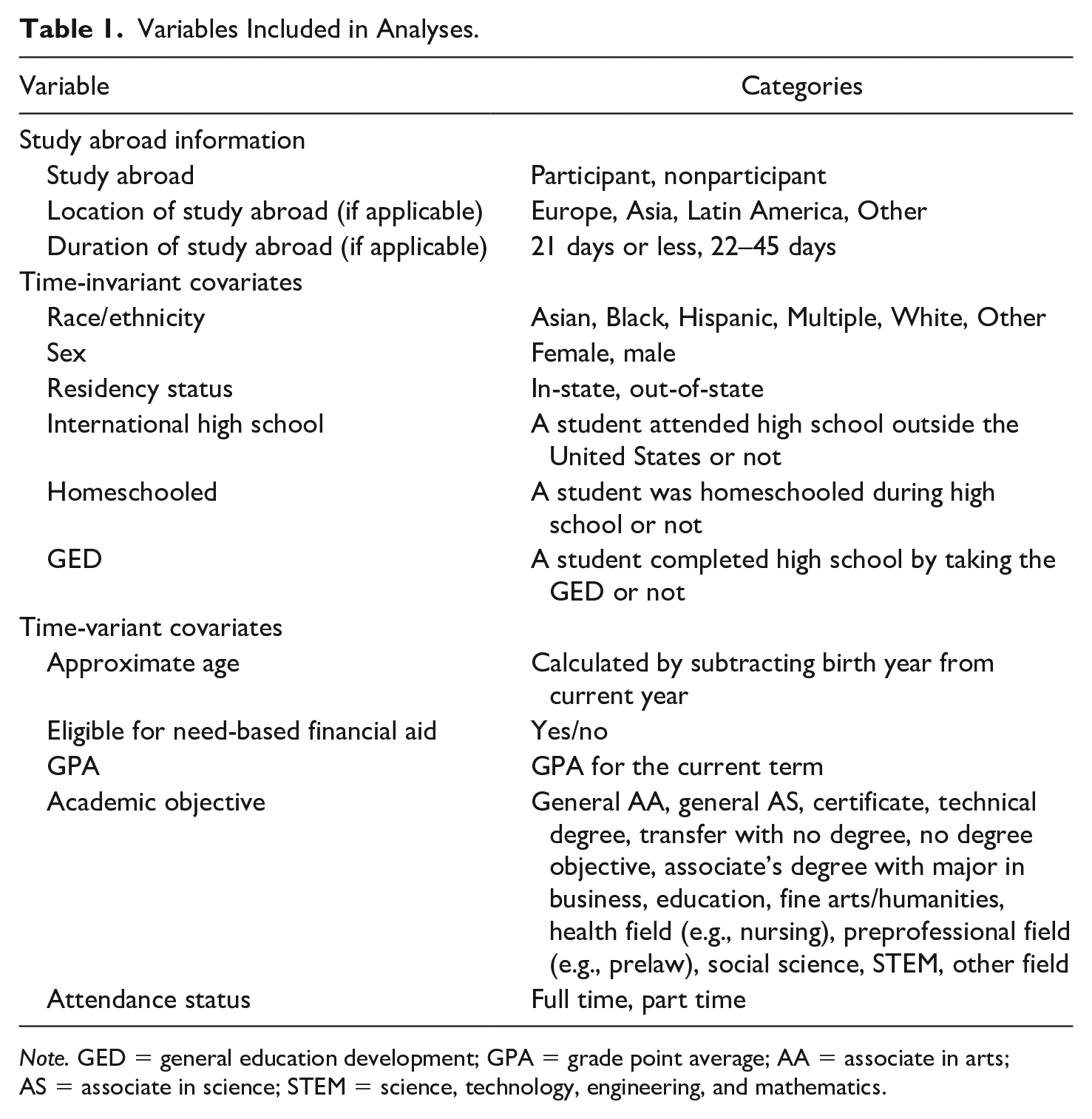
Note. GED = general education development; GPA = grade point average; AA = associate in arts; AS = associate in science; STEM = science, technology, engineering, and mathematics.
Analytic Strategy
Because many of the variables used in this study to predict study abroad participation vary over time, typical means of modeling a binary outcome using cross-sectional data, such as logit or probit regression, were not entirely appropriate. These standard analytic strategies restrict variables to be time constant (e.g., without substantial problems of collinearity, only one GPA per student can be entered into the model, even though a student’s GPA varies across terms of enrollment), thus obscuring any time-varying effects, and have the potential to lead to biased conclusions (DesJardins, 2003). In addition, a simple binary model ignores the variation of how long it takes before a student will actually study abroad, which is important in its own right given that delays in study abroad reduce opportunities to participate in such programs. For these reasons, this study relied on EHM, a statistical technique that can be used with longitudinal data when modeling relationships between time-varying predictors and event occurrence (here, study abroad participation; Box-Steffensmeier & Jones, 2004). EHM additionally allows the researcher to extract the hazard rate of an event, that is, the probability that an event will occur at a specific point in time (DesJardins, 2003). In other words, through EHM, a researcher can predict not only if an event happens, but also when the event is most likely to happen.
This study specifically employed a Cox proportional hazards event history model. This type of EHM does not impose a particular functional form on the hazard rate as do parametric EHM techniques (e.g., a Weibull model), but rather uses the data to predict it (Box-Steffensmeier & Jones, 2004). In a Cox model, observations (students) are placed into risk sets, groups that have not experienced a particular event (study abroad). Multiple failures (study abroad participation) can happen at the same time within the risk set (Box-Steffensmeier & Jones, 2004). The hazard rate

where

where
Figure 1 outlines the logic of EHM with covariates as applied in this study (adapted from DesJardins, 2003). In this figure, each box represents a risk period, the time (semester) during which a student experiences certain covariate values (time-invariant and time-variant covariates) and one of the two outcomes in the ovals below the box
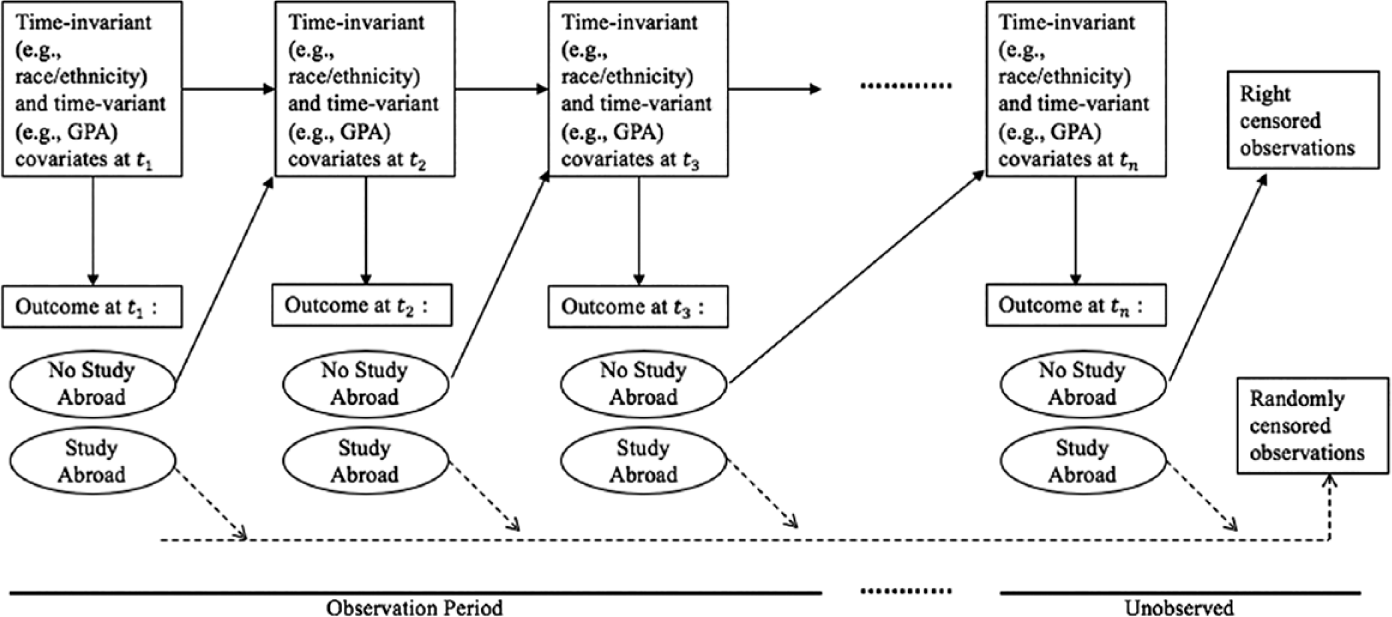
Event history model of study abroad participation.
Robustness Check
Although EHM accounts for the time structure of the data that inform this study, it complicates an analysis that might otherwise consist of a simpler regression model, such as the ones used in prior study abroad literature (e.g., Lingo, 2019; Salisbury et al., 2009). To this end, a standard logistic regression was conducted as a robustness check to examine how covariates included in this study’s EHM related to whether a student studied abroad at any time during enrollment at this community college. This model took the form of Equation 3:

where the outcome is the log-odds of a student participating in study abroad,
Results
Descriptive Statistics
Table 2 displays descriptive statistics for time-invariant covariates corresponding to all students, study abroad participants, and study abroad nonparticipants. These statistics first provide information about the study abroad experiences of students at this institution, offering a more detailed description of the kinds of study abroad opportunities that students at this institution access. In total, 899 (2%) students in the data set studied abroad. Seventy-eight percent of students who studied abroad did so in Europe, whereas 31% studied in a Latin American destination. Eight percent of students studied abroad in Asia, and 4% studied abroad in another region of the world. This latter group is primarily comprised of students who studied in South Africa. Concerning length of study abroad (not shown in Table 2), the overwhelming majority of students participated in programs lasting 21 days or fewer (90.18%), whereas no student participated in a program lasting longer than 45 days.
Descriptive Statistics of Time-Invariant Covariates for All Students (N =48,353), Study Abroad Participants (N = 899), and Nonparticipants (N = 47,454).
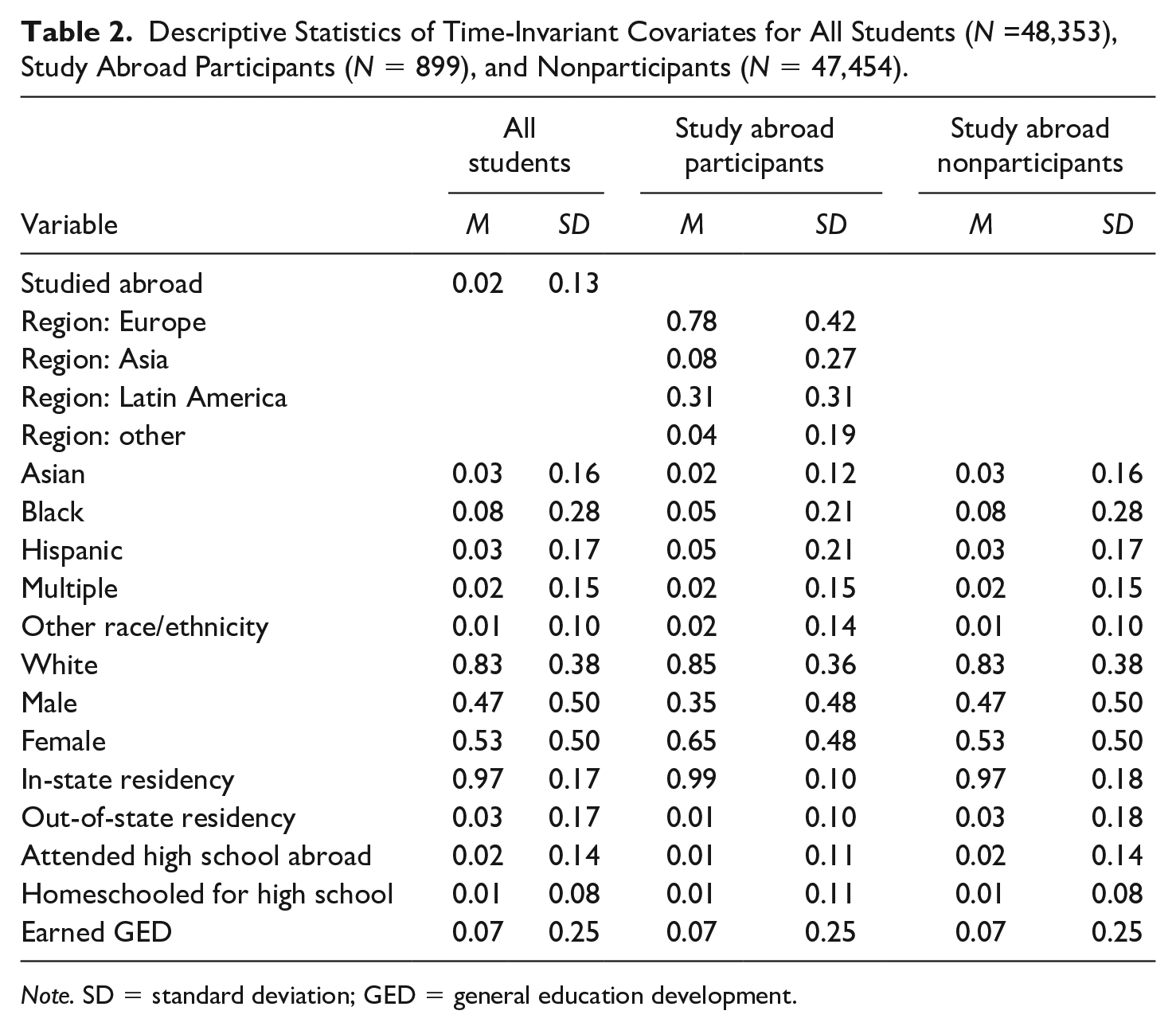
Note. SD = standard deviation; GED = general education development.
These descriptive statistics also provide a general overview of how the study abroad participant and nonparticipant groups were similar to or different from one another. Overall, the participant and nonparticipant groups approximated the full sample in terms of their demographics and high school enrollment patterns. The full sample was comprised of mostly White students (83%), whereas Black students represented the second largest race/ethnicity group (8%). Most students were classified as in-state residents (97%), whereas 2% attended high school abroad, 1% were homeschooled, and 7% earned a GED. Although the full sample was comprised of almost equal proportions of men (47%) and women (53%), women were overrepresented in the study abroad participant group (65%).
Descriptive statistics for time-variant covariates are displayed in Table 3 and correspond to columns for all observations, observations for study abroad participants, and observations for nonparticipants, respectively. Again, participant and nonparticipant groups approximated the full sample in many cases. The mean approximate age for the full sample was 25.7 years, and approximately 33% of observations belonged to students who qualified for need-based financial aid at a certain point in time. Observations corresponding to the study abroad participant and nonparticipant groups proportionally approximated the full sample for most degree fields, with about 16% of students seeking technical degrees, 14% seeking a general associate of science degree, 2% seeking an associate degree in business, 1% seeking a certificate, 4% an associate degree in education, 1% a preprofessional degree (e.g., premedicine), 2% an associate degree in a social science field, 5% an associate degree in a science, technology, engineering, and mathematics (STEM) field, and 9% an associate degree in a field not counted in another category. Differences emerged when comparing the study abroad participant and nonparticipant groups, in that, a greater proportion of observations belonged to students who aimed to earn a general degree leading to transfer to the 4-year sector (18% vs. 9% for participants and nonparticipants respectively), a general associate of arts degree (14% vs. 5%), and an associate degree in a fine arts or humanities field (4% vs. 1%). In contrast, the nonparticipant group was more likely not to seek a specific degree (19% vs. 3% for nonparticipants and participants, respectively) or to seek an associate degree in a health-related field (11% vs. 6%). The study abroad participant group exhibited, on average, a higher average term GPA compared with the nonparticipant group (3.31 vs. 2.71) and was also comprised of a greater proportion of students enrolled full time (56% vs. 39%).
Descriptive Statistics of Time-Variant Covariates for All Observations (N = 95,265), Study Abroad Participants (N = 2,419), and Nonparticipants (N = 92,846).
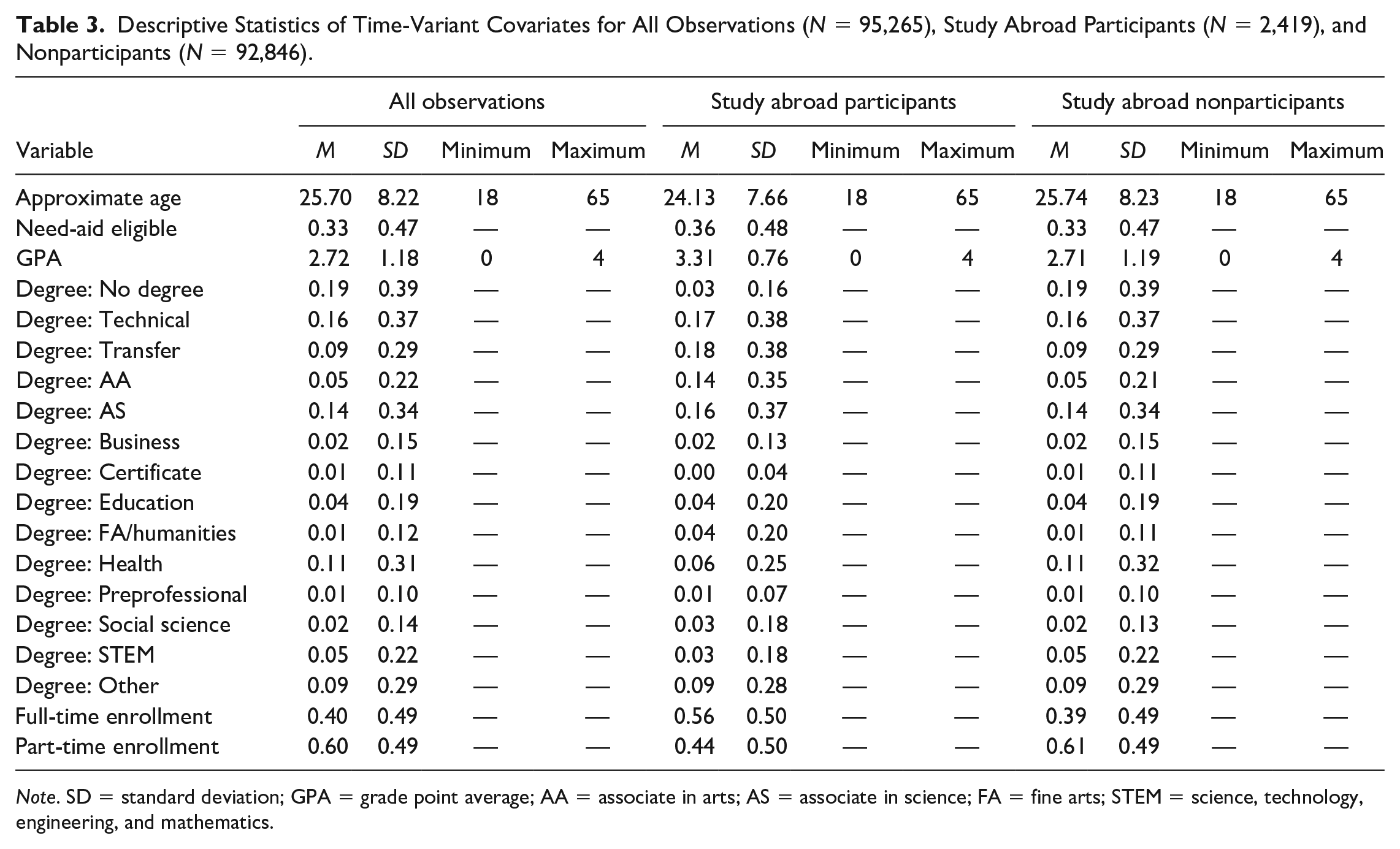
Note. SD = standard deviation; GPA = grade point average; AA = associate in arts; AS = associate in science; FA = fine arts; STEM = science, technology, engineering, and mathematics.
Proportional Hazard Models Predicting Study Abroad Participation
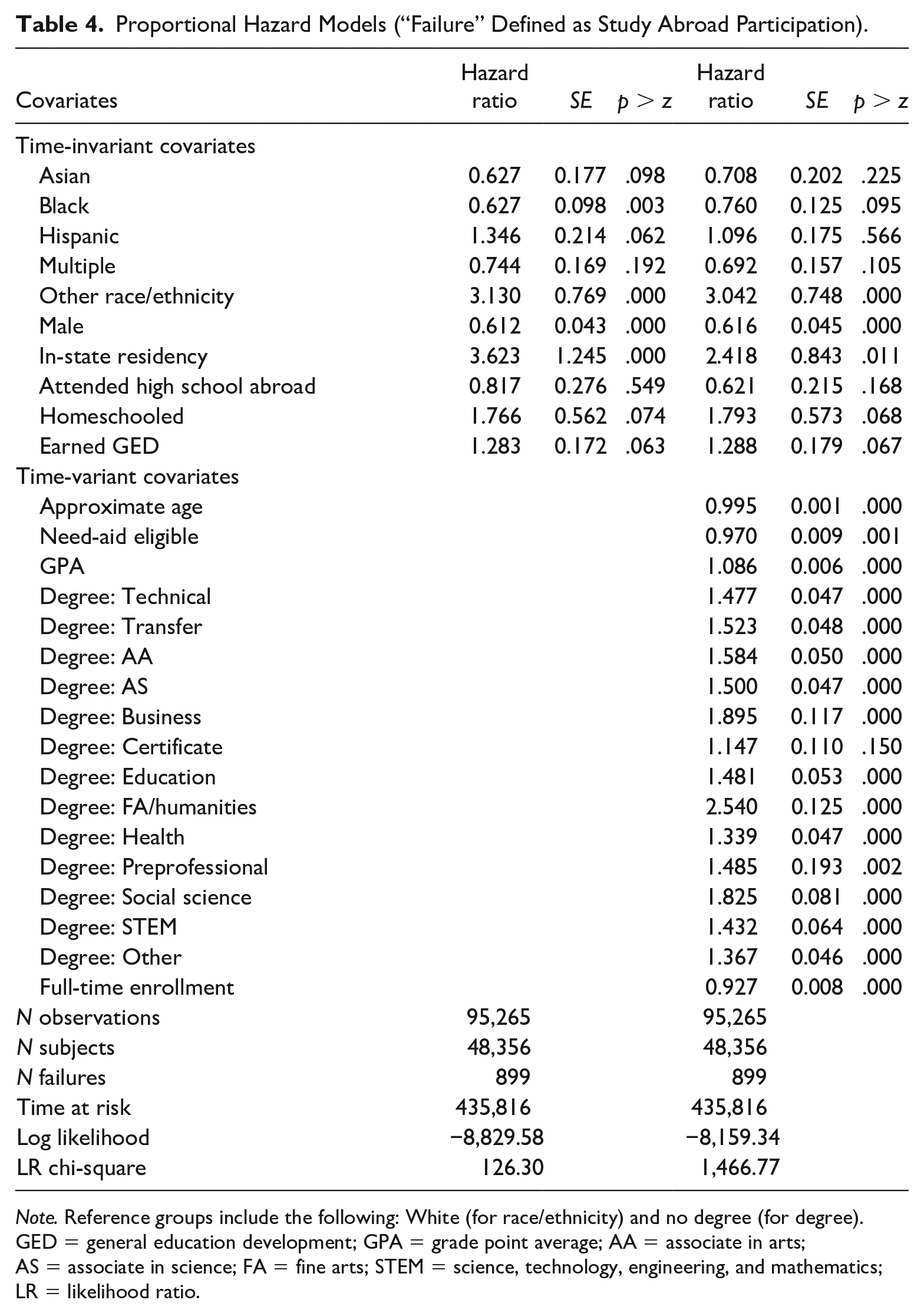
Results of proportional hazard models predicting study abroad participation are displayed in Table 4. The first three columns of this table correspond to a model containing only time-invariant covariates, whereas the last three correspond to a model with all (time-invariant and time-variant) covariates. Several time-invariant covariates were significant in both models, namely, Other race/ethnicity, 1 sex, and residency status. In the second model in Table 4, students belonging to the Other race/ethnicity group were 213% more likely to participate in study abroad compared with White students (the comparison group). In this model, no other race/ethnicity group exhibited a likelihood of study abroad participation that was significantly different. Men were 40% less likely to study abroad compared with women. Students who were classified as in-state residents on average exhibited an approximate 260% increase in the likelihood of study abroad participation.
Proportional Hazard Models (“Failure” Defined as Study Abroad Participation).
Note. Reference groups include the following: White (for race/ethnicity) and no degree (for degree). GED = general education development; GPA = grade point average; AA = associate in arts; AS = associate in science; FA = fine arts; STEM = science, technology, engineering, and mathematics; LR = likelihood ratio.
Turning to time-variant covariates, included in the second model in Table 4, older students were less likely to study abroad, although the decrease in the likelihood of study abroad participation associated with an additional year in age was small (0.5%). A small decrease in the likelihood of study abroad (3%) was also found for students who were eligible for need-based financial aid. A student’s GPA was positively related to study abroad participation, and a 1-point increase in GPA corresponded to an approximate 9% increase in the likelihood of study abroad. When compared with students without specific degree goals, students in most fields of study were more likely to study abroad (all except certificate seekers). Percent increases in the likelihood of study abroad were 48% for technical degrees, 52% for transfer seeking, 58% for general associate of arts, 50% for general associate of science, 90% for business, 48% for education, 154% for fine arts or humanities fields, 34% for health fields, 49% for preprofessional fields, 83% for social science fields, 43% for STEM fields, and 37% for fields falling into the “Other” category. Finally, students enrolled full time were somewhat less likely (7%) to study abroad.
Figure 2 illustrates the smoothed hazard estimates of study abroad participation that were extracted from the second model in Table 4, which included both time-invariant and time-variant covariates. In this figure, the y-axis corresponds to the hazard estimate, whereas the x-axis represents time in terms of semesters of enrollment. Students’ overall likelihood of study abroad participation increased the longer they were enrolled, but the estimated hazard rate of study abroad participation remained low in general.
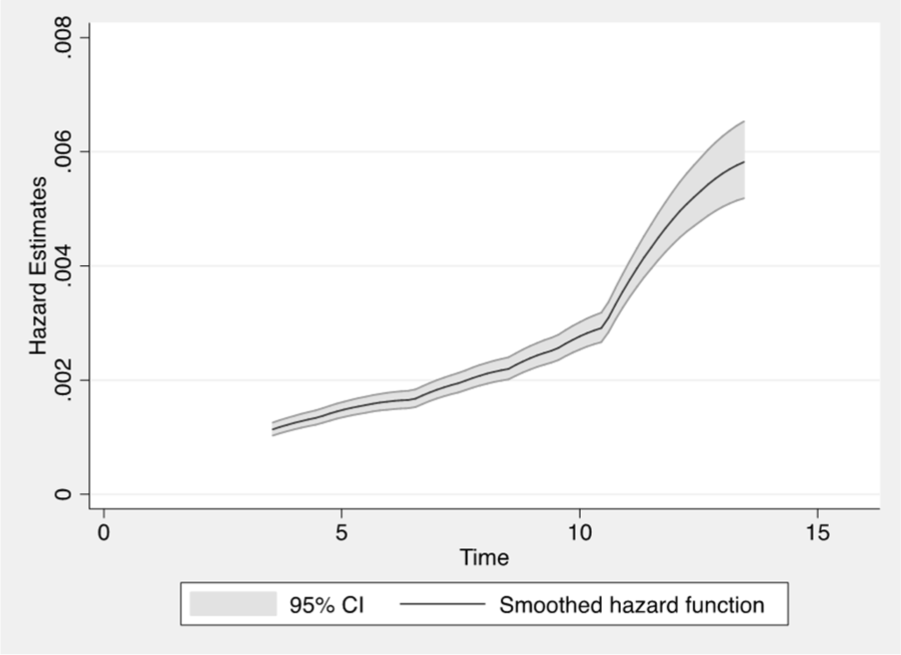
Smoothed hazard estimates of study abroad participation.
Logistic Regression Robustness Check
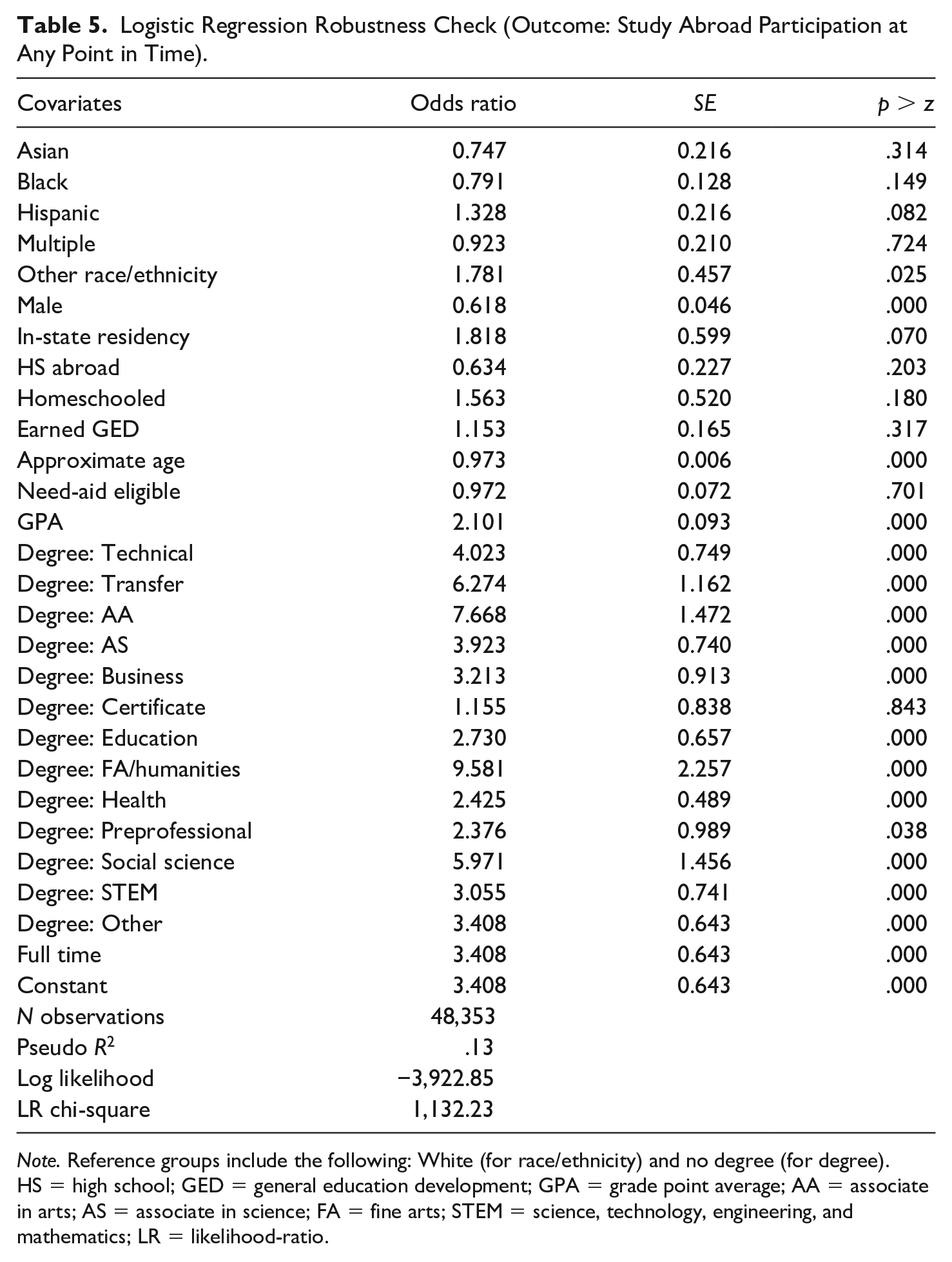
Results of this study’s logistic regression robustness check are displayed in Table 5. For ease of interpretation, coefficients are displayed as odds ratios, which are interpreted similarly to the hazard rates estimated in EHM. That is, odds ratios above one indicate an increase in the likelihood of study abroad participation, and odds ratios below one indicate a decrease in this likelihood. In most cases, these results confirm the EHM results just presented. For example, in both analyses, male students were predicted to study abroad at a lower rate and students with higher GPAs were predicted to study abroad at higher rates. Two differences that emerged when comparing the results of this logistic regression model with EHM results related to need-aid eligibility and full- or part-time enrollment status, both time-varying covariates. In the case of need-aid eligibility, the negative relationship between this variable and study abroad participation was significant in the EHM but not significant in the logistic regression. Although enrollment status was a significant predictor of study abroad participation in both EHM and logistic regression models, full-time enrollment (compared with part-time enrollment) was negatively related to study abroad in the EHM and positively related to study abroad in the logistic regression. What is important in this comparison of EHM and logistic regression results is that differences in findings corresponded to time-variant, but not time-invariant, covariates. Such discrepancies likely result from EHM’s ability to incorporate time-variant covariates into statistical models, and logistic regression’s lack thereof. Although EHM offers a somewhat more complex analytic strategy compared with a standard regression model, its estimates do not obscure the effects of time-varying covariates and as a consequence are less likely to be biased (DesJardins, 2003).
Logistic Regression Robustness Check (Outcome: Study Abroad Participation at Any Point in Time).
Note. Reference groups include the following: White (for race/ethnicity) and no degree (for degree). HS = high school; GED = general education development; GPA = grade point average; AA = associate in arts; AS = associate in science; FA = fine arts; STEM = science, technology, engineering, and mathematics; LR = likelihood-ratio.
Limitations
Although this study makes a significant contribution to the literature given both its focus on the community college sector and its use of an analytic technique that examines study abroad participation over time, it is limited in at least two ways. First, because of concerns surrounding Family Educational Rights and Privacy Act (FERPA) regulations, certain information about students, such as their first generation in college status and marital status, was not made available to the researcher. This limitation is not unique to this study and is a concern for all research using deidentified institutional data. Second, it is important to consider that the results of this study correspond to a single institution and as such may not be representative of the community college sector as a whole. Indeed, the institution participating in this study is unique in many ways, not the least of which is its geographic proximity to a major 4-year research institution. The articulation agreements that this institution has been able to negotiate with its 4-year neighbor are not possible for many community colleges and may result in the attraction of students with higher propensities toward transfer to the 4-year sector compared with many other community colleges. Indeed, many of the students attending this community college may study abroad with the explicit goal of strengthening their transfer applications.
Discussion and Implications for Practice
This study explored the relationship between individual characteristics of community college students and their study abroad participation, in addition to the likelihood of a community college student’s participation in study abroad over time. Although this study adopted a capital resources theoretical framework common in similar research involving the 4-year sector, focus was placed on the unique character of the 2-year sector with respect to how capital resources might support students’ participation in international education. Considering social sources of support, results indicated that students enrolled full time were less likely to study abroad compared with those who were enrolled part time. This result contrasts with prior research on community college study abroad using nationally representative institutional data that found that institutions with higher levels of part-time student enrollment had significantly lower study abroad participation rates (Whatley, 2019). These contrasting results are likely indicative of the unique institutional context of the community college that provided data for the current study. Given its geographic proximity to its 4-year flagship neighbor and the resulting articulation agreements between these two institutions, students who intend to transfer to the 4-year sector might enroll full time at the community college, complete transfer coursework as quickly as possible, and then transfer to the 4-year institution where they are more likely to participate in opportunities such as study abroad. Part-time students might be more likely to participate in activities such as study abroad while still enrolled at the community college for reasons related to timing of degree programs and other educational activities. Longitudinal research that follows community college students after they transfer to a 4-year institution would clarify whether students are simply delaying study abroad participation until after transfer or whether transfer impedes study abroad participation altogether, as suggested by McClure et al. (2010). The results of the current study indicate that part-time students are interested in the opportunity to study abroad and do take advantage of these educational opportunities. These students should not be ignored in future conversations surrounding who participates in international education.
Results concerning economic sources of support indicated that, much like students enrolled in the 4-year sector (Salisbury et al., 2009), community college students eligible for need-based financial aid are less likely to participate in study abroad. This result underscores the salience of financial barriers to study abroad participation among all, not just community college, students (Amani, 2011; Amani & Kim, 2018; Luo & Jamieson-Drake, 2015; Salisbury et al., 2009; Whatley, 2017) and provides support for the use of scholarships and other forms of financial aid to encourage study abroad among students enrolled in the 2-year sector. At the same time, it is noteworthy that the decrease in likelihood of study abroad participation associated with receiving need-based financial aid was, although statistically significant, only 3%. This result suggests that finances may not be the most important factor preventing community college students from participating in study abroad.
Turning to cultural capital resources, although high school attendance patterns did not significantly differentiate study abroad participants from nonparticipants in this study, significant differences did emerge based on a student’s field of study and GPA. Students who declared a degree objective of any kind, compared with having no declared degree objective, and earned higher GPAs had an increased likelihood of study abroad participation. Having declared a degree objective might provide students with a different perspective of the value of study abroad opportunities. For example, a student without a degree objective might not see much value in a study abroad program to Costa Rica that provides students credit for a biology course after hands-on experience working with local flora and fauna. However, a student pursuing a STEM-related degree might view the academic value of such a program more favorably. Therefore, institutions might pay specific attention to how study abroad opportunities are presented to students with particular emphasis on how study abroad relates to a student’s academic and career goals. Of note is that students in technical degree programs were just as likely to study abroad as their counterparts in fields of study more traditionally associated with education abroad (e.g., the humanities or the social sciences). Like part-time students, this student population is important to consider in future conversations surrounding international education opportunities. Inclusion of these students likely serves to distinguish community college study abroad from study abroad in the 4-year sector.
This study’s finding concerning GPA is not unique to the community college sector, and studies of 4-year students have also found that students with higher GPAs are more likely to study abroad (e.g., Thomas & McMahon, 1998; Whatley, 2017). This correspondence between higher GPAs and study abroad participation potentially reflects both increased academic motivation among students who study abroad and GPA requirements of study abroad programs themselves (Thomas & McMahon, 1998). Indeed, at this institution, students were required to have a GPA of 2.0 or higher to study abroad. GPA requirements for study abroad programs are worrisome, in that, they inherently restrict study abroad opportunities to only a subset of the student population. Such requirements ignore research findings showing that students with low GPAs benefit from study abroad and may garner greater-than-average academic gains after participating in such an experience (Sutton & Rubin, 2004; Trooboff et al., 2004). Equally as worrisome, prior research within the community college sector finds that students highlight honors program offerings abroad among their motivations for pursuing study abroad (Amani & Kim, 2018). Restricting study abroad programs to students exhibiting a certain level of academic achievement or academic motivation conflicts with the open-access philosophy of community colleges, compromising the democratizing function of the community college itself.
Several student demographic characteristics were found to be significant predictors of study abroad participation among students enrolled at this community college. A decreased likelihood of study abroad participation among older students or men is not unique to the community college context, as studies in the 4-year sector indicate similar patterns (Gore, 2005; Lucas, 2018; Surridge, 2000). In contrast, this study’s finding that students representing a variety of race/ethnicity groups were just as likely, if not more likely (as in the case of students in the “Other” race/ethnicity group), to study abroad compared with White students differs from the 4-year study abroad literature. The 4-year literature overwhelmingly indicates that White students are more likely to study abroad compared with their minoritized race/ethnicity counterparts (e.g., Luo & Jamieson-Drake, 2015; Salisbury et al., 2009; Whatley, 2017). Results from this study might indicate that this community college has implemented policies and practices that encourage and facilitate study abroad participation among certain groups of minoritized students. Future work is needed to explore whether this result extends to other community college contexts. Given national trends in the race/ethnicity composition of community college study abroad students (Institute of International Education, 2018), it may be that community colleges in general represent places where study abroad includes groups of students who are excluded from study abroad opportunities in other sectors of U.S. higher education.
Results for this study’s second research question show that the likelihood of a community college student participating in study abroad increases the longer a student remains enrolled. This result again contrasts with prior work on study abroad in the 4-year sector, which indicates that students at earlier stages in their studies are more likely to study abroad (Whatley, 2017). Such a finding suggests a situation wherein students need time to plan, financially and otherwise, to study abroad. As McClure et al. (2010) suggest, the planning required prior to study abroad participation, such as saving up funds to pay for study abroad, means that students enrolled at a community college for only a short time are at risk of discovering study abroad opportunities too late to take advantage of them. Given the short enrollment periods of many community college students, students must be provided with information about study abroad quickly, and shortly after enrollment.
Conclusion
This study examined study abroad participation patterns among community college students. In line with an open door mission, to the extent that study abroad comprises an essential component of a high-quality education, community colleges must take necessary steps to ensure that such opportunities are available to all students (Raby & Valeau, 2007). This study highlighted differences in students’ access to such international opportunities related to economic, social, and cultural capital resources. These findings provide information that is essential to implementing practices and policies at community colleges that open access to this important educational experience.
Footnotes
Acknowledgements
I am grateful to Manuel González Canché and Rob Toutkoushian for their feedback on this study in its early stages, to Jamie Monogan for his useful comments on an earlier version of this manuscript, and to the two anonymous reviewers who provided constructive criticism that strengthened this study. All remaining errors are mine.
Declaration of Conflicting Interests
The author declared no potential conflicts of interest with respect to the research, authorship, and/or publication of this article.
Funding
The author received no financial support for the research, authorship, and/or publication of this article.
