







Abstract
Keywords
Students with disabilities are more likely to enroll at community colleges than 4-year institutions (Evans et al., 2017). According to the National Center for Education Statistics (NCES, 2018a), while 9.1% of students at private and public 4-year institutions report having a disability, 12.4% of students at public 2-year institutions and 12.2% of students at private 2-year institutions report having a disability. Researchers have called for further disaggregation of this population to better understand the unique experiences of students with varying disabilities (Peña, 2014; Peña et al., 2016). At public 2-year institutions, 9.4% of students report a cognitive disability or serious difficulty concentrating, remembering, or making decisions (compared to 7.3% at public 4-year institutions), 2.3% report an ambulatory disability (compared to 1.2%), 1.3% report a visual disability (compared to 0.7%), and 1.6% report an auditory disability (compared to 0.8%) (NCES, 2018a). Scholarship has highlighted the importance of the efforts of student affairs educators, such as disability service offices (Berry & Domene, 2015; Vaccaro et al., 2018). Also, peers, faculty, staff, or family have been shown to positively influence students with disabilities (Kreider et al., 2015; Lombardi et al., 2016; Mamiseishvili & Koch, 2011; Mytkowicz & Goss, 2012; Shepler & Woosley, 2012).
The purpose of this study is to examine the experiences of students with disabilities in higher education, specifically, students who use disability services at community colleges. The current study was guided by the following research questions: (1) At community colleges, how does frequency of use of student support services significantly relate to engagement among students who use disability services? and (2) For first-generation and transfer students with disabilities, in what way does frequency of use of these services mediate engagement among this population? In the next sections, I review the literature related to first-generation and transfer student representation in community colleges, along with scholarship on students with disabilities use of services at these institutions.
First-Generation and Transfer Students With Disabilities
The open enrollment mission of community colleges allows these institutions to play a critical role in expanding access to college for students who are first generation or from other underserved groups (Bragg et al., 2006). At 2-year institutions, 42% of students came from families where neither parent had attended college and 29% came from families where neither parent had completed college (NCES, 2018b). Though little research has focused on the confluence of disability, first-generation status, and community colleges, researchers at 4-year institutions have identified first-generation college students with disabilities as a vulnerable subgroup (Lombardi et al., 2012). These students experience less family support and have lower GPAs than their non-first-generation peers (Lombardi et al., 2012).
While many students attend community colleges with intentions of transferring to 4-year institutions, significant proportions also transfer between community colleges (Cohen et al., 2014). One third of all community college students transfer within 5 years of initial enrollment, and 38% of these students transfer laterally to another 2-year college (National Student Clearinghouse, 2012). Research has shown that many community college students practice “swirling (back-and-forth enrollment among two or more institutions) and double-dipping (concurrent attendance at two institutions)” (McCormick, 2003, p. 14). These practices are most common in metropolitan areas and states with high densities of community colleges; one study found that as many as 13% of California community college students have been enrolled in multiple 2-year institutions simultaneously (Bahr, 2012). Though these larger phenomena are important, little research currently exists that specifically explores the transfer experiences of students with disabilities (Evans et al., 2017).
Student Services
Within community college literature, understandings of students with disabilities’ use of student services stems from three studies exploring the important service areas of academic advising, career counseling, tutoring, and financial aid. First, Lindstrom et al. (2009) found that interactions with academic advising services, career counselors, tutoring services, and financial aid resources all have a positive influence on the success of these students at community colleges. Academic advising services at community colleges offer a critical support system for this population; students using these additional services were more likely to complete their programs of study. Interactions with career counselors serve to expose students with disabilities to wider career path options and can be critical for these students who often lack information about the variety of career and technical training programs available at community colleges. This gap is especially concerning since learning that involves community-based, hands-on training has been associated with positive outcomes for individuals with disabilities (Flannery et al., 2008). In addition, tutoring services can be a much needed support for these students at community colleges; students using tutoring services were more likely to complete their academic programs (Lindstrom et al., 2009). Last, complicated financial aid procedures sometimes created barriers for this population; these overwhelming initial steps may lead students to decide against enrollment.
Second, Mamiseishvili and Koch (2012) investigated factors related to success for students with disabilities at 2-year institutions. For this population, full-time enrollment had a positive effect on first-to-second-year persistence, though 3-year cumulative persistence was found to not be significantly impacted by this enrollment status. Meetings with academic advisors had a significant positive association with students’ long-term persistence; more frequent academic advisor meetings decreased the likelihood of a student leaving the institution without returning. The researchers found 73% of students with disabilities attending 2-year institutions never had informal meetings with faculty members, and 60% never participated in study groups—a troubling finding since each of these have shown to be important factors for success.
Third, McCleary-Jones (2008) conducted a mixed-methods study of students with learning disabilities at two community colleges to explore their challenges and pathways to success. Students with learning disabilities tended to feel rushed during course registration—especially in their first and second semester; those who did not have enough time to discuss course selections with counselors may feel especially unprepared for class. Students in this study found tutoring through disability support services departments to be an especially helpful resource; this finding supports other research on this population that found that 78% of students with disabilities utilizing tutoring services found the service to be effective (Kurth & Mellard, 2006). Students with learning disabilities found financial constraints to be especially burdensome, challenging their ability to stay enrolled at their community college (McCleary-Jones, 2008). In fact, prohibitive costs are the primary reason for students with disabilities’ early departure from community college (Littlepage & Clemson, 2018).
From this research, scholars have shown that some student services (i.e., academic advising, career counseling, tutoring, and financial aid) can be particularly effective in improving outcomes for students with disabilities at community colleges. What is absent from this research is consideration of how other services such as academic skill labs or transfer advising may relate to these outcomes. This absence is important because these services may be helpful to first-generation or transfer students who use disability services. The current study can address this problem by evaluating the degree to which these services mediate engagement among these subgroups.
Conceptual Framework
Researchers seeking a framework relating multiple identities for students with disabilities to engagement will not find a convenient conceptual framework to guide variable selection. In Kimball et al.’s (2016) review of disability literature, the authors point out, “ultimately, this disconnect from theory produces a situation whereby higher education journals show little connection to the disability studies field, and disability-focused journals, even those explicitly focused on college students, show little engagement with higher education’s theory base” (p. 123). As such, I chose to focus on first-generation and transfer students with disabilities because what little literature exist on these populations demonstrates lower outcomes for these groups while suggesting improvement for these outcomes through student services (Evans et al., 2017). We do know that compared to their non-first-generation counterparts, first-generation students with disabilities have lower GPAs, lower peer and family support, and higher financial stress (Lombardi et al., 2012). Other scholars have called for curtailed services for transfer students with disabilities, “As service offerings are being planned at postsecondary institutions, it would be helpful for disabled student services staff to know specific challenges faced by transfer students with disabilities” (Burgstahler et al., 2001, p. 4). That is not to say other aspects of identity such as gender, race, income, and age are not worthy of similar study; in fact, further investigation along these aspects of identity are promoted in the Limitations and Future Research sections of this manuscript. For the focus of the current study, I have chosen to investigate the ways first-generation and transfer students who use disability services may use other student services to increase the desired outcome of student engagement. The findings from this research suggest unique pathways to success, measured through increased engagement.
The concept of student engagement (i.e., the time and energy students spend on educationally purposeful activities inside and outside the classroom and the ways institutions support these positive learning environments) was used as the guiding framework for the current study (Kuh, 2001). In his research on this concept, Kuh (2009) distinguishes between different engagement behaviors (e.g., student-faculty interaction, reflective learning, and peer collaboration) which represent optimal learning conditions and the institutional organizational components (e.g., curricula, learning opportunities, and student services) to support these behaviors, while leading to other desired outcomes. In one of the few studies on engagement of students with disabilities, Kimball et al. (2017) articulated this distinction:
Furthermore, engagement and its mediating factors interact with these students’ intersectional identities, of which disability is only one facet. The many ways that students with disabilities engage with college means that there is a great need for intentional and proactive design. There are many vectors for engagement, including academic programs, intramural athletics, and social entities like clubs and student organizations. (p. 72).
I maintain this distinction to understand the ways academic programs (in this case student services) relate to engagement behaviors for students who use disability services. In previous research, scholars have described relationships between student engagement with student services such as academic advising (Campbell & Nutt, 2008) and student success programs (Hatch-Tocaimaza, 2017). This aspect of the conceptual framework guided a first hypothesis that these processes and outcomes may be related for this group.
Unlike Kuh’s work centered on engagement at 4-year institutions, the current study is focused on the experiences of students attending community college. Engagement behaviors specific to this context were explored as reflected in the Community College Survey of Student Engagement (CCSSE) (McClenney, 2004, 2007). The CCSSE measures engagement of community college students with five benchmarks: (1) Active and Collaborative Learning, (2) Student Effort, (3) Academic Challenge, (4) Student-faculty Interaction, and (5) College Support for Learners. Survey items measure students’ frequency and intensity of activities related to these benchmarks (Center for Community College Student Engagement, 2017). These responses are valuable to individual institutions and the bank of knowledge about community college practices, as student engagement and certain institutional/administrative practices are related to student success (McCormick & McClenney, 2012). The survey has been used in research looking at several aspects of the community college experience. Hatch (2012) used the survey to create a big-picture, comparative view of community college student engagement. Other research has been more specific, looking at engagement with certain types of courses (Wang et al., 2017) and interactions with specific peers (Museus et al., 2012). Academic engagement has been the most concentrated area of study by the CCSSE (Walpole et al., 2014).
Since students with disabilities attend community colleges more often than they attend 4-year colleges (Evans et al., 2017), using these CCSSE data are essential to understanding this population’s needs related to engagement with coursework and college. Prior research has focused primarily on the transition out of community college, and mainly evaluates factors related to academic success and persistence. Previous research on student engagement in community college, specifically where CCSSE data was used, guided covariate selection of race and ethnicity (Wang et al., 2017), age (Chan & Wang, 2016), and full-time status (Jones, 2016). In the current study, the most popular student services (i.e., academic advising/planning, career counseling, peer or other tutoring, skill labs [writing, math, etc.], financial aid advising, and transfer advising/planning) were used as mediating variables to understand how frequency of use of these services relates to these three dimensions of engagement for students who use disability services. Scholars have used data measuring engagement from students transferring from 2-year institutions into 4-year institutions to measure mediating relationships between participation in high-impact practices and engagement (Zilvinskis & Dumford, 2018). This aspect of the conceptual framework guides my second hypothesis suggesting the usefulness of mediation relationships for student identity, such as first-generation and transfer status.
Research Design Principles
The current study answers Kimball et al.’s (2016) call to use more advanced statistical models, thereby expanding the questions that may be answered and potential readership of this topic, and to use large datasets, thereby understanding disability from the perspective of engagement of students on multiple community college campuses. Aspects of critical quantitative research, such as creating research questions guided by an anti-deficit framework (Stage, 2007) and the disaggregation of data (Vaccaro et al., 2015) was also invoked.
First, I avoided a deficit narrative of comparing students who use disability services to those who do not, by using research questions that examine the relationships between the independent and dependent variables only within the population of interest which is a goal of critical quantitative research (Stage, 2007). Within higher education research, a deficit model of studying students with disabilities is particularly problematic because it, “. . .supports the stereotype of individuals with disabilities as being victims in need of support” (Evans et al., 2017, p. 66). Vaccaro et al. (2015) argue, “. . .deficit paradigms prohibit us from seeing students with disabilities as fully equal” (p. 27). Therefore, I employed an anti-deficit approach to strictly examine the ways students with disabilities succeed at community colleges to measure how use of student services significantly relates to engagement (Harper, 2010). This approach avoids contributing to a deficit narrative such as, “students who use disability services are less engaged than those who do not.” Instead, the current study examines the engagement solely of students who use these services to identify their pathways to increased engagement through other student services.
Second, the current study uses disaggregation, an approach endorsed by critical quantitative researchers, to measure how these paths to success are mediated by student services for first-generation and transfer students with disabilities (Vaccaro et al., 2015). Students with disabilities are often treated as a monolithic group, with other aspects of identity neglected (Peña, 2014). Disaggregating this group by other aspects of identity can be useful for guiding specific interactions to improve lived experiences. The focus of this paper is on the engagement of first-generation and transfer students who use disability services. While other important aspects of identity such as gender and race were included as covariates in the model, the explicit investigation of their mediation paths was beyond the scope of this analysis (see limitations and future research sections). The following research questions guided the current study: (1) At community colleges, how does frequency of use of student support services significantly relate to engagement among students who use disability services? and (2) For first-generation and transfer students with disabilities, in what way does frequency of use of these services mediate engagement among these populations?
Data Sources and Measures
For the current study, I analyzed survey data from the Community College Survey of Student Engagement (CCSSE). The CCSSE is administered during the spring as a tool to explore institutional practices and student behaviors that are highly correlated with student learning and retention (Center for Community College Student Engagement, 2019). Using data from community colleges will best inform research about students with disabilities, as the majority of this population attend 2-year institutions (Snyder et al., 2019). The dataset for the current study was drawn from the 2016 to 2019 administrations of the CCSSE which included 588 institutions from 46 states (N = 103,537). For the analysis of the current study, I restricted the sample to only students who use services for students with disabilities (n = 9,558). After cases with missing data were removed, 77.54% of the students with disabilities subpopulation were analyzed (n = 7,441). Using Little’s Missing Completely at Random (MCAR) test, the missing data failed to meet the criteria allowing me to reject the null hypophysis (Chi-Square = 5,904.662, df = 5,650, p = .009). To offset this issue, a maximum likelihood estimate that was conducive for categorial data was estimated in the analysis. Data used with permission from the Center for Community College Student Engagement, The Community College Survey of Student Engagement 2016 to 2019, The University of Texas at Austin. Purchasing the data for the current study was made possible from a research grant by the American College Personnel Association Foundation.
To identify students with disabilities, respondents were asked, “How often have you used the following services during the current academic year?” Those who selected either one time, two-four times, or five or more times using services for students with disabilities were retained in the model (n = 9,558). The sample contained 2,689 first-generation (36.14%) and 1,666 transfer students with disabilities (22.39%) (see Table 1). The sample included 454 students (6.10%) who identify as Asian, Native Hawaiian, and other Pacific Islander, 870 students (11.69%) who identify as Black or African American, 1,058 students (14.22%) who identify as Hispanic or Latino, 3,694 students (49.64%) who identify as White, and 1,365 students (18.34%) who identify as other races or ethnicities. Nearly three-quarters of the sample were traditional aged (72.62%) and full-time students (73.14%).
Descriptive Statistics of Frequency of Use of Student Services and Engagement Benchmarks by Student Background Characteristics.
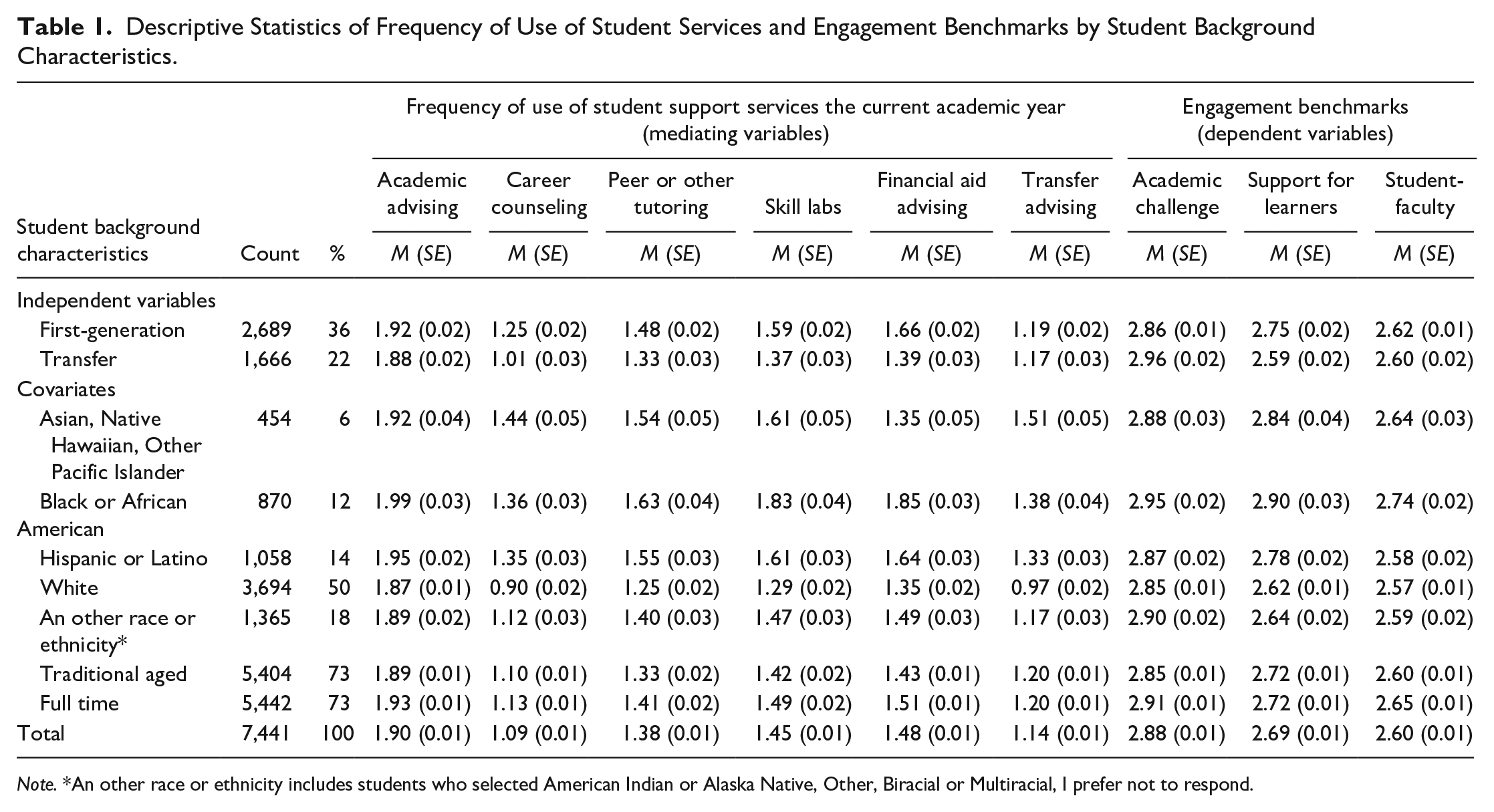
Note. *An other race or ethnicity includes students who selected American Indian or Alaska Native, Other, Biracial or Multiracial, I prefer not to respond.
Independent Variables
When answering the first research question, the independent variables included responses to the item, “How often have you used the following services during the current academic year?” Respondents answered between Never = 0, 1 time = 1, 2 to 4 times = 2, and 5 or more times = 3 when assessing six services on campus: academic advising/planning, career counseling, peer or other tutoring, skill labs (writing, math, etc.), financial aid advising, and transfer advising/planning. For the second research question, these variables served as mediating variables between student identity and the study outcomes.
When answering the second research question, the variables first-generation and transfer student status were used as independent variables in the model. First-generation status was gathered by interpreting responses to the question “Who in your family has attended at least some college?” Respondents were classified as first-generation they neither parent attended at least some college (Center for Community College Student Engagement, 2019). Transfer status was derived from students’ answers to “Did you begin college at this college or elsewhere?” Respondents who answered “elsewhere” were categorized as transfer students. This broad definition for transfer students includes reverse transfer (from a 4-year institution to a community college) and horizontal transfer (from a community college to another community college) among other permutations of swirling.
Covariates
Covariates incorporated into the model include race or ethnicity, traditional age, and full-time enrollment. To identify race and ethnicity, students were asked to select all that apply from a list including American Indian or Alaska Native, Asian, Black or African American, Hispanic or Latino, Native Hawaiian, Pacific Islander (non-Native Hawaiian), White, other, or “I prefer not to respond.” These responses were recoded so that students identifying with multiple groups were categorized as “two or more races or ethnicities.” Students identifying as other races or ethnicities included those selecting American Indian, Alaska Native, multiple races or ethnicities, as well as those who preferred not to respond, or explicitly selected “other.” Monoracial groups included Asian, Native Hawaiian, and other Pacific Islander; Black or African American, Hispanic or Latino, and White. Students noted their age as falling within a particular bracket (18–19, 20–21, 22–24, 25–29, 30–39, 40–49, 50–64, or 65+) and were categorized as traditional aged if they were 24 or younger. To determine enrollment status, respondents were asked “Thinking about this current academic term, how would you characterize your enrollment at this college?” and could answer either “part-time” or “full-time.”
Dependent Variables
Because of their use in previous research, three engagement benchmarks were included as dependent variables, comprised of the average value of four to six survey items: Academic Challenge (Eρ2 = 0.86), Support for Learners (Eρ2 = 0.83), and Student-Faculty Interaction (Eρ2 = 0.77) (see Appendix for item description and corresponding scale).
Methods
To realize the anti-deficit goal of this study, the CCSSE dataset (N = 103,537) was limited to only include students who answered in the affirmative that they used services for students with disabilities (n = 9,558). By removing the counterfactual group, I was able to focus on the pathways to success for these underserved students, achieving one of the tenets of this framework (Harper, 2010). For data that were missing, I employed list-wise deletion for all variables in the model and conducted analysis on the remaining subsable (n = 7,441). I removed cases of missing data to improve model fit by reducing the number of estimated parameters (Byrne, 2013).
I used structural equation modeling to measure the mediation effects of frequency of use of student services on engagement for first-generation and transfer students with disabilities at community colleges (see Figure 1). Using Mplus Version 8, a Multiple Indicators Multiple Causes (MIMIC) model was employed to accomplish this analysis, in which the indicators included the single measures as covariates and the frequency of use of student services measures as mediators; while the outcomes of the model included three endogenous latent variables (Bollen, 1989). In the first iteration, the three engagement benchmarks were established as latent endogenous variables: Academic Challenge (ac, ƞ1), Support for Learners (sl, ƞ2), and Student-Faculty Interaction (sf, ƞ3). The individual measures included in these latent variables were derived from Center for Community College Student Engagement (2017) research on the use of the engagement benchmarks and my own reliability analysis (see measures section and Appendix). Then, I regressed these outcomes on to the six measures of frequency of use: Academic advising/planning (acaaid, β11-3), Career counseling (career, β21-3), Peer or other tutoring (tutor, β31-3), Skill labs (writing, math, etc.) (skilab, β41-3), Financial aid advising (faid, β51-3), Transfer advising/planning (trnaid, β61-3). This process answered my first research question, “At community colleges, does frequency of use of student support services significantly relate to engagement among students who use disability services?”
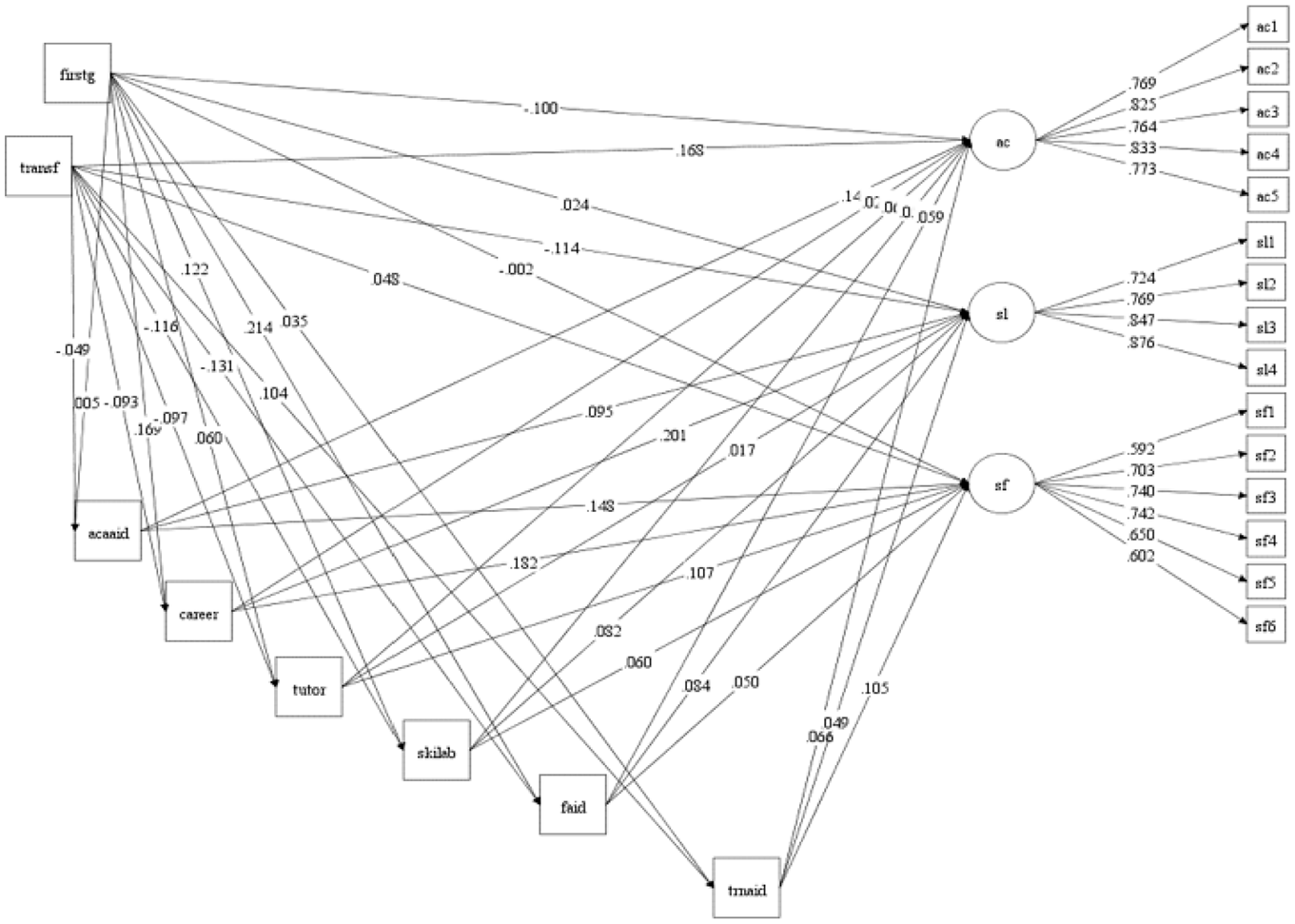
The standardized parameter estimates for mediation effects of use of student services on engagement for first-generation and transfer students with disabilities at community colleges. Covariates related to race and ethnicity, age, and full-time status were included in the structural equation model (not pictured).
Second, the dichotomous covariates related to student identity were introduced to the model and directly related to the engagement benchmarks: First-generation (Ɣa); Transfer (Ɣb); Asian, Native Hawaiian, other Pacific Islander (Ɣc); Black or African American (Ɣd), Hispanic or Latino (Ɣe); An other race or ethnicity (Ɣf); Traditional age (Ɣg); and Full-time (Ɣh). The frequency of use variables were treated as indirect mediators between the outcomes of the study and the covariates of first-generation status (Ɣa1–Ɣa18) and transfer status (Ɣb1–Ɣb18). Third, using the default Mplus estimator, model fit was evaluated and improved by correlating the errors of 15 model measures recommended by the program’s modification indices function (Muthén & Muthén, 1998–2010). Fourth, the model was rerun using the Weighted Least Square Mean and Variance adjusted (WLSMV) estimator to account for the categorical nature of the model outcomes (Brown, 2014), while bootstrapping the Confidence Intervals (CI) through 1,000 iterations (Cheung, 2007), and measuring the StdY standardized parameter estimates for the indirect effects of the model, which is the most appropriate standardization for dichotomous covariates (Muthén & Muthén, 1998–2010). The path from the independent variables to the dependent variables through the mediating variables was established, answering the second research question, “For first-generation and transfer students with disabilities, in what way does frequency of use of these services mediate engagement among this population?”
After these modifications, the final model held a significant χ2 (121,181.77, p < .05) which indicates poor model fit; however, this measure may be less accurate for fit analysis with large sample sizes (Hu & Bentler, 1999). Alternative measures, on the other hand, indicated adequate model fit (CFI = 0.949 and TLI = 0.925, and RMSEA = 0.057). For the general latent variable aspect of the model, identification is determined using the two-step rule (Bollen, 1989). First, the number of known elements (29[29 + 1]) / 2 = 435 must be greater than the number of unknown elements, which included the error variances of each model item (29), the factor loadings (15), the direct relationships to the model outcomes for the covariates (8) and mediating variables (6), the errors of the latent variables (3), the correlated errors (15), and the indirect effects (2 × (8 × 6) = 96). This calculation is not sufficient but necessary to establish model identification and is the leading reason so few covariates were included in the model. Since the model used unifactorial measures for the mediating variables, the three-indicator rule is invoked. This rule is satisfied because all three latent variables have at least four indicators to create their corresponding factor. Satisfying this rule is sufficient, but not necessary for model identification. Second, the paths of the three latent variables of the model are analyzed and, since there is no feedback loop in the model, the model meets the criteria of the recursive rule. This rule is a sufficient measure for model identification. All three of these measures indicate total model identification. Below are the hypothesis criteria for these methods:
Null Hypothesis: Frequency of use of student services is not significantly related (directly or indirectly) to engagement of students with disabilities at community colleges.
Hypothesis 1: Frequency of use of student services is significantly related to engagement of students with disabilities at community colleges.
Hypothesis 2: Frequency of use of student services is significantly indirectly related to engagement for first-generation and transfer students with disabilities at community colleges.
Results
When examining the standardized parameter estimates between the mediating variables and the model outcomes, only two of the 18 relationships were not significant (p < .05), allowing me to reject the null hypothesis and accept hypothesis 1: frequency of use of student services is significantly directly related to engagement of students with disabilities at community colleges (see Table 2). Using a critical quantitative lens to study students with disabilities, Vaccaro et al. (2015) described the importance of expressing practical significance to audiences:
Standardized Effects Between Frequency of Use of Student Services and Engagement Benchmarks for Students with Disabilities (n = 7,441).
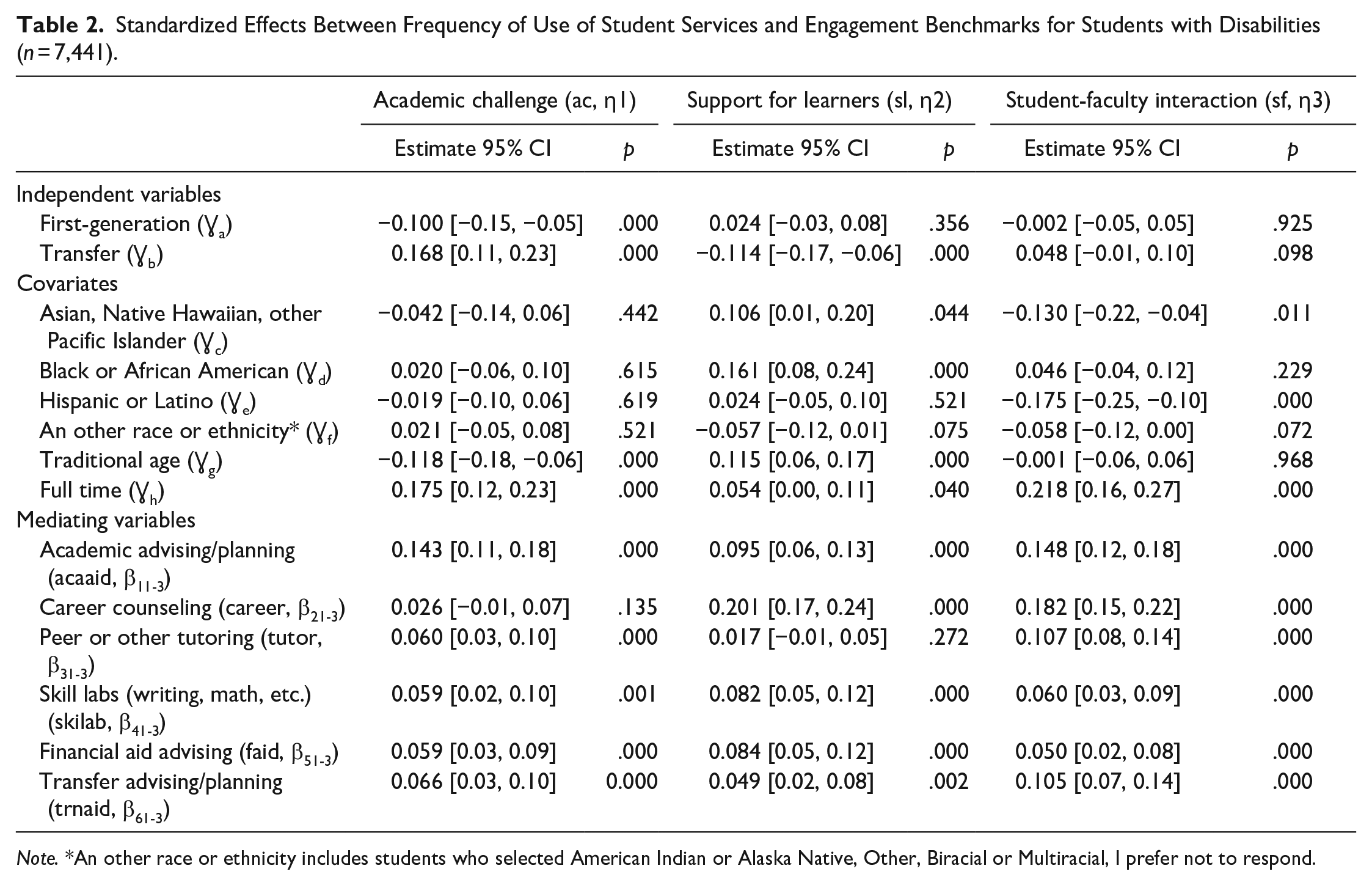
Note. *An other race or ethnicity includes students who selected American Indian or Alaska Native, Other, Biracial or Multiracial, I prefer not to respond.
We recommend that, when appropriate, quantitative criticalists push the boundaries of field and institutional norms around statistical significance when interpreting results. If the educational or substantive significance of a finding for a specific subgroup of students with disabilities is worthy of attention, the finding should be discussed regardless of whether it is statistically significant. . . (p. 35)
Responding to this call, I have maintained designation of standardized coefficient for small (.06), medium (.12), and large (.20) effects recorded in higher education literature (Mayhew et al., 2016); while presenting information for small effects which may indicate paths for future research, without overstating their importance.
The strongest relationships exist between the frequency of use of Career Counseling with Support for Learners (β22 = 0.201, CI = [0.17, 0.24]) and Student-Faculty Interaction (β23 = 0.182, CI = [0.15, 0.22]), along with frequency of use of Academic Advising/Planning with Student-Faculty Interaction (β13 = 0.148, CI = [0.12, 0.18]) and Academic Challenge (β11 = 0.143, CI = [0.11, 0.18]). All of the other relationships were positive, indicating that increases in frequency of use of student services was directly related to increases in engagement for students with disabilities; however, the strength of the other 12 significant effects were small to trivial in magnitude.
The model for the current study allows for an understanding of the direct and indirect effects between the independent variables, mediating variables, and the outcomes of the study. When answering the second research question, understanding if these significant (p < .05) relationships are completely mediated (only indirect effects are significant), partially mediated (both direct and indirect effects are significant), or not mediated (indirect effects are insignificant) is important (see Figure 1). For both first-generation and transfer students with disabilities, there were significant direct and indirect effects with the engagement benchmarks, allowing me to reject the null hypothesis and accept hypothesis 2: frequency of use of student services is significantly indirectly related to engagement for first-generation and transfer students with disabilities at community colleges.
First-Generation Students With Disabilities
For the outcome Academic Challenge, the direct effect (Ɣa
Standardized Indirect Effects Via Frequency of Use of Student Services and Direct Effects for First-Generation and Transfer Students With Disabilities.
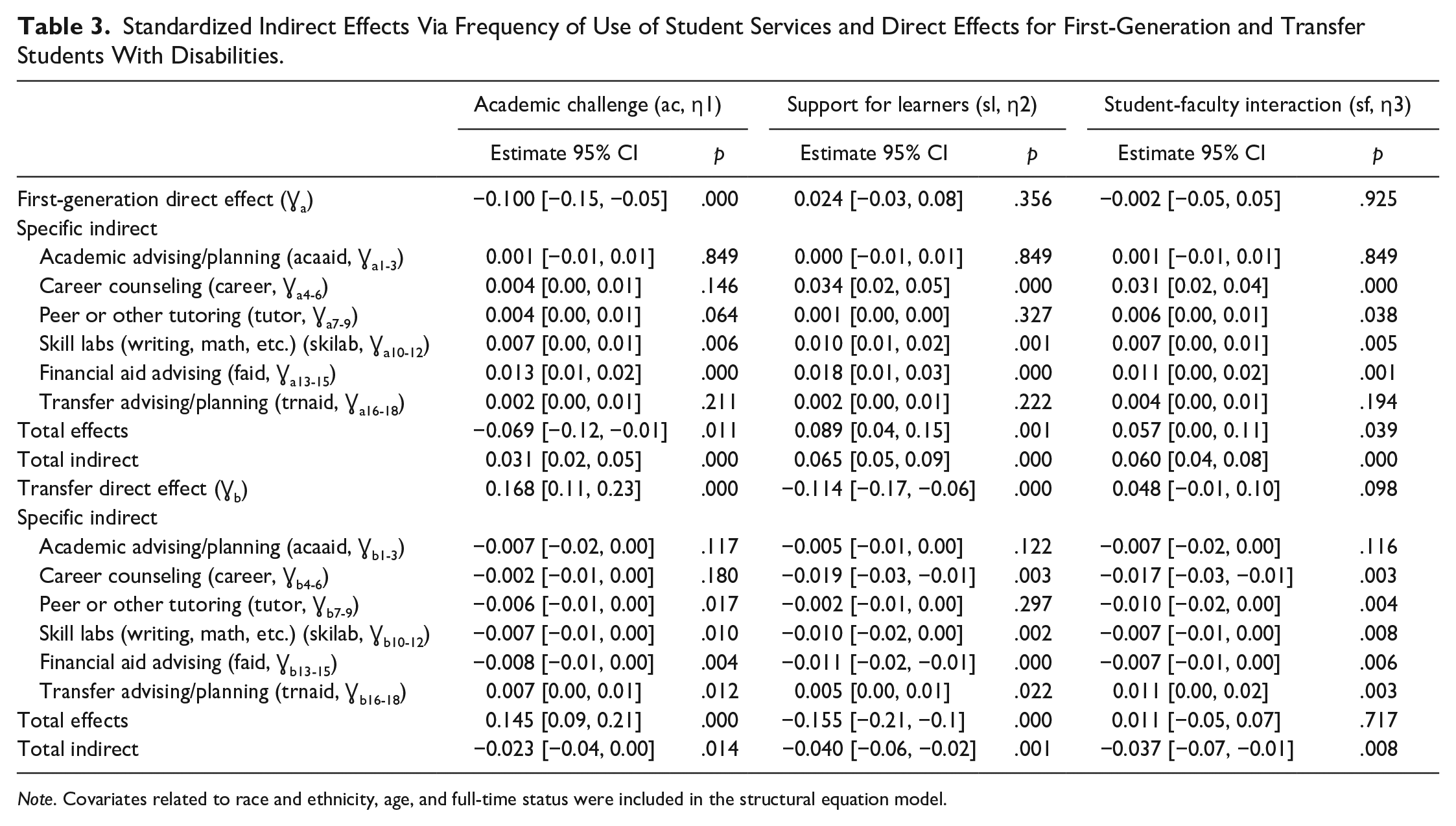
Note. Covariates related to race and ethnicity, age, and full-time status were included in the structural equation model.
For the outcome of Student-Faculty Interaction, the direct effect (Ɣa
Transfer Students With Disabilities
The SEM model worked very differently when examining the direct and indirect paths for the transfer measure, compared with first-generation students with disabilities (see Table 2). For the first two outcomes there was partial mediation and for all three outcomes there were several significant indirect measures; however, most of them are trivial in size. I have only reported the largest significant indirect effect per outcome here. For the outcome of Academic Challenge, the relationship was significantly positive (Ɣb
When examining the mediation results as a whole, a couple of key findings emerge. First, the direct effects between first-generation and transfer status were inconsistent: one was positively significant, two were negatively significant, and three were insignificant. Second, there were several significant indirect effects, most of them were trivial in size with some small positive effects related to the mediation of Career Counseling for first-generation students with disabilities. Third, for first-generation students with disabilities, all of the indirect effects of the use of student services were positive, indicating that as frequency of use of student services increased so did engagement among these students. For transfer students with disabilities, the indirect effects were uniformly negative, indicating that increases in frequency of use of student services was related to decreases in student engagement. This trend is curious but should be treated with caution considering these effects were trivial in magnitude.
Limitations
The CCSSE itemset does not directly measure the numbers of students with disabilities; rather, it measures the frequency of use of services for students with disabilities (Center for Community College Student Engagement, 2019). When constructing the group of students with disabilities, I was not directly measuring the group of students choosing to report disabilities, but rather those who chose to use the services for students with disabilities at their colleges. Since only 25% of students with disabilities at community colleges receive disability services from their college (Newman & Madaus, 2015), the sample included in the analysis is likely an underrepresentation of the actual population.
Of the 103,537 students that responded to the survey, 9,558 or 9.23% are students who use disability services. The Digest of Educational Statistics indicates that students with disabilities should make up 19.4% of the total population, which clearly demonstrates a disconnect, as most students with disabilities who participate in postsecondary education enroll at community colleges (Snyder et al., 2019). Although readers should be cautious to apply the trends found within the current study to all students with disabilities at community colleges, understanding the reported experiences of students who use these services does provide actionable results for educators.
Discussion
The current study contributes to knowledge in the field in several ways. First, it fills the gap identified by Kimball et al. (2016) (i.e., analyzing single-institution data with descriptive statistics) by using a multi-institutional dataset to forward statistically advanced understandings of students who use disability services at community colleges. The current study shows that overall increases in use of student services are related to increases in engagement among this population. Unlike prior scholarship in this area, my research does not compare students with disabilities to the general population, thereby avoiding deficit framing (Peña, 2014). The research design of the current study contributes to the field by demonstrating how scholars can use structural equation modeling to examine within-group pathways to success for small populations in large datasets, adding to other disability research using large datasets such as Mamiseishvili and Koch (2011, 2012) and Newman and Madaus (2015). In all but a few relationships, there was a significant positive correlation between frequency of use of student services and engagement for students using disability services at community colleges, some of the strongest relationships existing between the use of academic advising and career counseling with the outcome of Student-Faculty Interaction.
For community colleges, these findings present a practical need for promoting academic advising and career counseling services among students who use disability services; and there are opportunities for collaboration among these units to enhance student engagement. Aune (2000) described the ways institutions can conceptualize these services:
Academic and career advisers have a unique opportunity to bring their institutions closer to universal design by examining their own attitudes and practices, establishing mutual respect and trust with students with disabilities, understanding how disability and institution interact to create barriers, using flexibility and creativity to solve problems, addressing disclosure issues, achieving a balance in focus between disability-related and nondisability-related issues, and balancing support with fostering independence for students with disabilities. (p. 65)
Research on students with disabilities has shown that improvements to services can include asking staff to connect students with other services (Fleming et al., 2017), expanding access and hours of services (Abreu et al., 2016), and disseminating information via email (Lyman et al., 2016). Research on students with disabilities at 2-year institutions has shown that increases in academic advising is positively related to increased persistence (Mamiseishvili & Koch, 2012). Between increases in retention and, as demonstrated in the current study, increases in engagement, administrators can use this evidence to champion for academic advising resources to support these students.
Because the nature of these data are cross-sectional rather than longitudinal, causal inference cannot be assumed. Although academic advising and career counseling are significant mediators for Student-Faculty Interaction, it may be the case that these activities are acting in accordance with each other. To put it another way, students with disabilities who are able to successfully navigate and use these services may also have the skills needed to discuss grades, career plans, or class ideas with instructors. Notably, these student services have much stronger relationships with engagement compared with others that are academic in nature like tutoring (peer or otherwise) or skill labs (writing, math, etc.). The usefulness of these services is not related to their average use among the subgroup. Although academic advising was the most frequently used service, career counseling held the lowest average use, supporting evidence that these services are the most effective in improving engagement among these students, regardless of popularity.
Second, this study continues to answer the call to disaggregate data by explaining the ways these pathways work for two understudied populations within the disability community (Vaccaro et al., 2015). This use of structural equation modeling uncovered discriminate ways these services work for two subpopulations within the sample of students who use disability services. For first-generation college students, the largest indirect effects were significant positive relationships with career counseling and the outcomes Support for Learners and Student-Faculty Interaction. In both cases, these relationships constituted complete mediation, which is an important nuance uncovered by this type of analysis. If a researcher were to only consider a direct effect through a regression model, there would be no significant difference between first-generation and non-first-generation students with disabilities for these outcomes. However, in this analysis I discovered that for first-generation college students, increased use of career counseling has a significant, direct effect on engagement—identifying a unique pathway for success for this disaggregated group.
For transfer students, on the other hand, although the indirect effects were significant, they were trivial in size. It is worth noting that they were uniformly negative, indicating that as students used more student services, they reported lower engagement scores. In previous research using student engagement data, Pike (2004) surmised that it may be the case that students who are not reporting high levels of engagement may be supplementing their experience in other ways. In the case of the current study, it may be that students who use disability services are transferring to new campuses and to offset their low engagement, they are seeking student services. Students with disabilities are not a monolithic group—these students occupy multiple identities (Peña et al., 2016). Therefore, interventions for this population can be curated based on other aspects of identity to improve outcomes. The utility of this model is an understanding of the mediated pathways to engagement for different groups within the disability community. Individuals who wish to improve outcomes can use these results from this research direct specific educator intervention (e.g., focusing student services) for specific populations (e.g., first-generation students with disabilities).
Career Counseling
Results from the current study indicate that career counseling is positively related to engagement among students who use disability services overall and, specifically, for first-generation students with disabilities. Since many students attend community college with goals of acquiring job skills or earning a degree or certificate that will enable access to a particular field, career guidance is of critical importance (Cohen et al., 2014). In fact, student populations across all postsecondary institutions continue to cite their intention to gain “better” jobs as the primary motivation for entering higher education, prompting researchers to call for institutions to refocus attention around career counseling services (Mayhew et al., 2016). When colleges offer holistic career guidance programs, students benefit by increased exposure to previously unexplored career paths (Garis, 2014), which may be especially important to students with disabilities who may have access to fewer career options (Evans et al., 2017).
Because of the stated benefits of career counseling for community college students, and specifically students with disabilities, it is apparent why this mediator had such strong effects on engagement. Career counseling is particularly important for students with disabilities because these services can alleviate issues related to stigma and disclosure embedded within the job search process (Evans et al., 2017). There is not much research describing these interventions for students with disabilities at community colleges. One limitation of this secondary data analysis is that, beyond frequency of use, I do not have information on the implementation of these services for these students. Additional qualitative research on this intervention would be helpful to guide practitioner implementation.
Future Research
Beyond the need for research on the use of career counseling for this group, other model results suggest possible avenues for future research. Although not the scope of the current study, the direct effects between the model covariates, which included other student background characteristics, and the outcomes for engagement were significant and may be worth investigating. For example, full-time status held the largest standardized parameter estimates and these measures were significantly positively related with Student-Faculty Interaction and Academic Challenge, indicating that full-time students who use disability services reported higher engagement than their part-time peers. For the measures related to race and ethnicity, Asian, Native Hawaiian, and other Pacific Islanders, along with Hispanic and Latinx students reported significantly lower levels of Student-Faculty Interaction compared with their White peers. I chose to focus on two underserved populations, first-generation and transfer students who use disability services. Evidence from the current model indicated that future research disaggregating students with disabilities by enrollment and race and ethnicity may provide distinct information on the engagement of these subgroups.
The current study contributes to the literature by using large datasets, advanced statistical models, and disaggregation to learn about students with disabilities. Also exercised within this research are tenets of critical quantitative research, such as designing research questions that are thoughtful to avoid deficit framing (Stage, 2007) and reporting on the magnitude of the effect sizes to distinguish between statistical and practical significance (Vaccaro et al., 2015). The use of structural equation modeling allows researchers to understand the pathways of success for subpopulations, while presenting results that are disaggregated within these groups; in this case, first-generation and transfer students who use disability services. In the current study, academic advising and career counseling were directly related to the measures of engagement for students who use disability services at community colleges, and the latter student service was additionally effective for first-generation students, but not for transfers. These findings indicate that services for students should be specified in ways that support students who share multiple identities. Results such as these provide evidence of the discriminant effects for groups within populations and suggests to educators that they should stop treating students with disabilities as a monolithic group (Peña et al., 2016).
Footnotes
Appendix
Declaration of Conflicting Interests
The author declared no potential conflicts of interest with respect to the research, authorship, and/or publication of this article.
Funding
The author disclosed receipt of the following financial support for the research, authorship, and/or publication of this article: This research was supported in part by a grant from the American College Personnel Association Foundation.
