







Abstract
Objective/Research Question:
The urgency to replace retiring community college leaders has been a topic of research and discussion for the past two decades. Concurrently, expansive definitions of leadership and collaborative approaches to leading have emerged. The central research question for this study was: How do sitting community college leaders define leadership? The sub-questions included: Do definitions of leadership differ by gender? Do definitions of leadership differ by position?
Methods:
Coding of survey data from approximately 770 sitting leaders occurred based on responses to the prompt: How do you define leadership? Descriptive statistical analysis occurred based on demographics and on position related to the coded responses.
Results:
This study found three prevalent ways of defining leadership: leader-focused (leader’s abilities mentioned); other-focused (leader included others, collaboration mentioned); institution-focused (leader focused on institutional needs/mission). About half of both women and men used leader-focused definitions, with slightly more men than women in the tallies. More women than men used other-focused definitions, whereas men used definitions more institutionally focused compared to women (not statistically significant). Leader-focused definitions were also most prevalent by position, with mid-level leaders using this definition slightly more than top-level leaders. Top-level leaders used a combination of institution-focused definitions more so than mid-level leaders, however (not statistically significant).
Conclusions:
A shift to more other-focused ways of leading is emerging. Those in mid-level positions hold onto leader-focused definitions of leadership, and this points to the need to reconceptualize mid-level leadership and ideas of leading that include others and connect to institutional missions and initiatives. The complex nature of today’s organizations requires broader conceptions of leadership.
Over the last decade, the demands facing current community college leaders have created a perfect storm (Bragg, 2014). First, national attention on community colleges in the last decade has turned the spotlight on these institutions (Bailey et al., 2015) and with it, public demands for accountability (Ma et al., 2016). Community colleges have long been described as “democracy colleges” (Diekhoff, 1950) and their open-access mission provides leaders with a particular context in which to lead. These institutions have long been front and center in providing students access to college, and the models in place to open doors have worked; but increasingly, colleges are under pressure to increase completion rates and levels of student success (Bragg & Durham, 2012). Second, added to this are demands in higher education for equity and social mobility. Community colleges provide a pivotal opportunity to address these issues of social justice, but it is abundantly clear that today’s challenges require different approaches to scaffold students for success and to meet community needs (Boggs & McPhail, 2019).
Community colleges have been undergoing great turnover in leadership positions over the past two decades as leaders retire, creating opportunities for shifts and innovation in leadership approaches (Eddy & VanDerLinden, 2006; Weisman & Vaughan, 2007). Levin (1998) argued that despite the inclusive mission of community colleges, operations are solidly bureaucratic. This orientation relies on hierarchies and positional leadership, which can make the institutions less nimble and create particular challenges for leaders. Critical to change is innovative approaches to leadership that move beyond reliance on hierarchical position (Garza Mitchell & Amey, 2020). Further, leaders must honor community colleges’ existence within a “condition of paradox” (Sydow & Alfred, 2013, p. 41), in which leaders maintain a delicate balancing act that honors past innovations that allowed institutions an opportunity to mature since their founding and craft a new future of what is needed to lead today’s community colleges (Levin & Kater, 2018). This paradoxical tension accentuates the need for leaders who are creative and collaborative (Meier, 2013) and bring new approaches to leading today’s complex community colleges (Eddy & Kirby, 2020).
Equally important to examining advances in leadership is understanding who fills these leadership positions. True to their democratic mission, community colleges have traditionally offered more opportunities for women and leaders of color to ascend to top-level positions as president (Eddy, 2018; Townsend & Twombly, 2006). Women presidents make up 1 of every 3 community college presidents (36%) relative to less than 1 in 10 (8%) for research universities; leaders of color now represent 20% of presidents in community colleges (Gagliardi et al., 2017). Thus, these institutions are not only important sites for understanding leadership but also for the influence they have on gender and race/ethnicity in leadership, given the higher percentages of women and leaders of color in the sector.
In this study, we used survey data from mid- and senior-level community college leaders to examine how community college leaders define leadership and the influence of gender and position on the construction of these definitions. Specifically, the central question was: How do sitting community college leaders define leadership? Sub-questions investigated if there were differences in definitions of leadership based on (1) gender, (2) race/ethnicity, and/or (3) leadership position?
Literature Review
Over time, conceptions of leadership within community colleges have shifted from a reliance on hierarchical modes of leading in which a positional leader holds power to more collaborative ways to lead that involve the participation of others (Kezar et al., 2006). Recent scholarship on team leadership (Boggs & McPhail, 2019) highlighted how movement to more participatory leadership that includes roles for others in the college not in named leadership positions is gaining traction within community colleges. Calls for this type of inclusion exist in earlier studies of leadership, as well. For example, Rost (1991) posited that in the post-industrial era, a shift from understanding traits and profiles of leaders required a focus instead to the processes of leading and, in particular, relationships between leaders and followers. At the center of this shift was attention to collaboration and mutual influence on the processes for seeking a common good in setting up goals (Kezar & Carducci, 2009).
Additionally, historical conceptions of community college leadership were often built on male norms (Amey & Twombly, 1992). Even with the recognition of the benefits of collaboration, a skill often attributed to women leaders (Chliwniak, 1997), literature on women leaders in community college is scant (Eddy & Khwaja, 2019). Indeed, the early research on community college presidents showcased profiles of sitting leaders based on traits of the predominately White men leading the institutions at the time (Vaughan, 1986). By the 1990s, turmoil embraced the community college sector due to resource constraints, changing demographics, and an expanding mission (Baker & Associates, 1992). The resource constraints of the 1990s ushered in a move to participatory leadership (Sullivan, 2001; Twombly, 1995). This cycle of budgetary constraint repeats itself over time, arguably prompting shifts toward participatory leadership in 2022 and beyond, given the fiscal context facing community colleges (Romano & Palmer, 2016).
The focus on participatory leadership occurred simultaneously with burgeoning attention on women’s leadership (Chliwniak, 1997; Townsend & Twombly, 1998). Amey and Twombly (1992) conducted a discourse analysis of the community college literature up to 1990 and found that a small group of men writing about community college leaders influenced conceptions of leaders as “pioneer, builder, commander, visionary” (p. 147, italics in original), aligning with historically masculine forms of leading. Yet, Amey and Twombly (1992) also found alternative voices emerging, albeit most often as a side note or described in ways that required alignment with the male norms of leading (Vaughan, 1989). At the time, the early voices of women emerged through the work represented in the American Association of Women in Community and Junior Colleges Journal that supported more connected forms of leadership (Lipman-Blumen, 1992) and webs of inclusion (Helgesen, 1995). The limited reach of the AAWCJC Journal, however, kept this writing at the margins versus as a central means for thinking about community college leadership.
A decade later, additional research focused on women leaders in community colleges emerged. For example, Eddy and VanDerLinden (2006) wrote about emerging definitions of leadership, researching how current community college administrators self-described their own leadership to determine the influence of modern-day writings of leadership and the actual work of leading on how individuals defined their leadership. Through an analysis of survey data from over 900 leaders, Eddy and VanDerLinden (2006) found that 47% of leaders held traditional views of leadership ascribing to the view of leadership as being based on position and fulfilling job responsibilities. This percentage of respondents affirmed the “great man” or “hero” leader, rather than embracing some of the alternative and emerging understandings of leadership. They found little difference in the position of president or provost between how men and women defined their leadership. Other definitions of leadership explored in this 2006 research related to guiding and managing change, providing vision and direction, as well as leaders’ knowledge and expertise. A small percentage (3%) of leaders in 2006 discussed empowering others, mentoring, advocating for others, role modeling, or motivating others as reasons why they were leaders at their institutions. And only 2% of leaders discussed team leadership, guiding Eddy and VanDerLinden to conclude that emerging definitions of leadership were not prominent in practice, as more traditional ideals of a singular “great man” or hero leader held true. Yet, the multiple and nuanced definitions of leadership provided beyond positional leadership highlighted the complexity of the position and opened up the possibility of shifting conceptions of leadership that are more participatory and defined beyond positions.
Additional evidence of shifting conceptualizations of leadership occurred over time. A discourse analysis on community college literature between 1990 and 2015 conducted by Eddy and Khwaja (2019) sought to update Amey and Twombly’s (1992) earlier article to determine if new visions of leading were emerging in the literature. The backdrop for the study included larger numbers of women leading community colleges in 2015 (36%) compared to 1990 (8%; Gagliardi et al., 2017) and expanded conceptions of leadership (Kezar & Carducci, 2009). Despite more women in leadership positions and a value for participatory leadership emerging, findings highlighted a prevalence of ideal worker norms (Williams, 2000) and an unquestioned reliance on masculine-normed leadership was presented in the literature reviews for the articles. Around 2000, published research focused more on participatory leadership, with the bulk of writing on women’s leadership conducted by women. For example, women authors using feminist methodologies and frameworks disrupted the historic reliance on using male norms of leading as a metric for thinking about leadership.
Further confounding recent scholarship on the role of gender in leadership are continued calls for equity- and social justice-oriented approaches to leadership. Literature on community college leadership circa 2020 underscores expanding concepts related to mid-level leaders (Garza Mitchell & Amey, 2020), Latinx leaders (Elenes, 2020), team leadership (Boggs & McPhail, 2019), and racial equity in leadership positions (Eddy, 2018). The backdrop of social justice calls for new forms of leading (Baber et al., 2019). Since the 2010s, more critical perspectives of leadership are emerging as community college leaders and leaders, writ large, wrestle with what it means to be a leader for social justice. Much attention on equity and pathways for students of color occurs in community colleges (e.g., Felix & Castro, 2018; Harris et al., 2017) and on women leading community colleges (e.g., Garza Mitchell & Garcia, 2020; Gillett-Karam, 2017), informing thinking about developing more critically oriented community colleges leaders to focus on issues of equity.
Over time, the evolution of leadership theory showcased the benefits of more inclusive, participatory, and team-based leaders. This process is a move away from historic definitions of leadership, which reinforced the male-normed idea of singular heroes leading the way. In order to support innovative approaches, leaders must determine how to manage their institutions based on the funds they have, how to transform academics to get students to completion, and how to enact a social justice mission in which all students feel welcomed and engaged in learning. Understanding how sitting leaders define leadership can shed light on ways to accomplish the needs evident in the community college sector and point to implications in developing aspiring community college leaders.
Methods
To investigate how leaders define leadership and the role of gender, race/ethnicity, and position in these conceptualizations, we administered a national survey to top-level (presidents and vice-presidents) and mid-level (deans and directors) community college leaders across the U.S. in 2015 and 2016. The survey instrument focused on several goals. The first section included questions to determine career background and pathways of participants. Second, participants were asked about their educational background and the type of professional development in which they participated. The third portion of the survey focused on the ways the participants learned to lead. Here, survey participants were also asked what they felt most prepared for and what they felt least prepared for when assuming their leadership position. The fourth part of the survey asked about their access to professional development opportunities. And the final portion of the survey focused on the American Association of Community College Leadership Competencies. Demographic data, including self-reported gender and race/ethnicity, were collected to understand how these variables influenced leadership options and choices. Descriptive statistics were conducted to determine frequency and means among the variables of interest.
Survey Respondents
We began the data collection process by building a listing of mid-level (i.e., deans, directors) and senior-level (i.e., vice president/provost, president) leaders by accessing online state community college directories and culling names and emails from individual community colleges in other to identify and recruit participants. This census survey approach resulted in the distribution of a total of 9,217 surveys. After an initial email was sent requesting participation, three follow-up contacts via email were made by members of the research team. Based on the currency of the online directories, several individuals were no longer working at their institutions. A total of 1,001 usable surveys comprise the data for this study, which exceeded the sample size suggested for the population we surveyed (sample size n = 369; response rate of 11%).
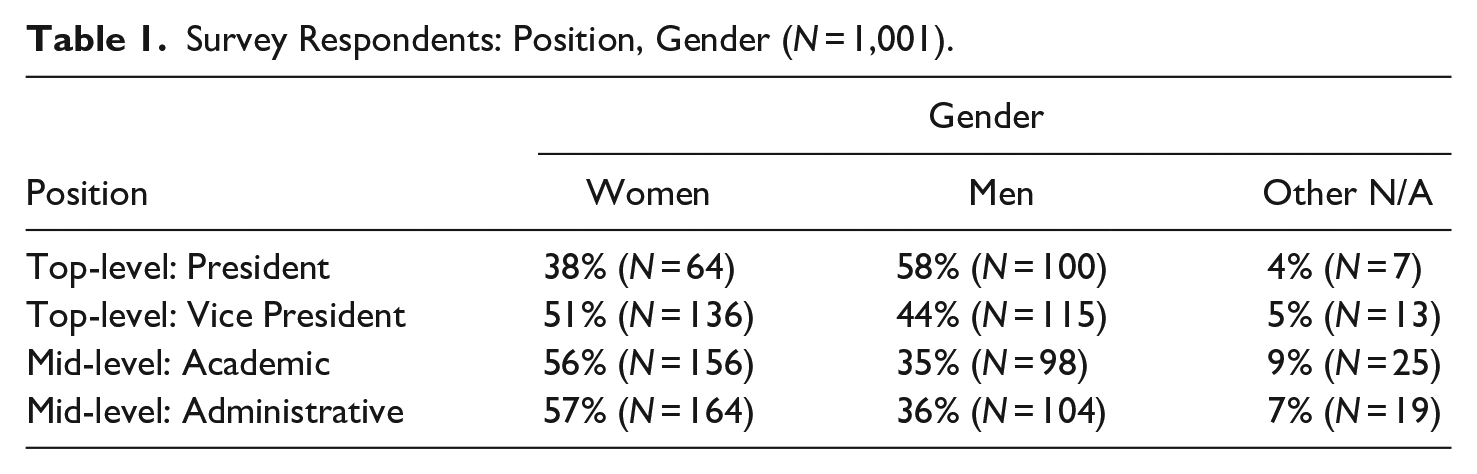
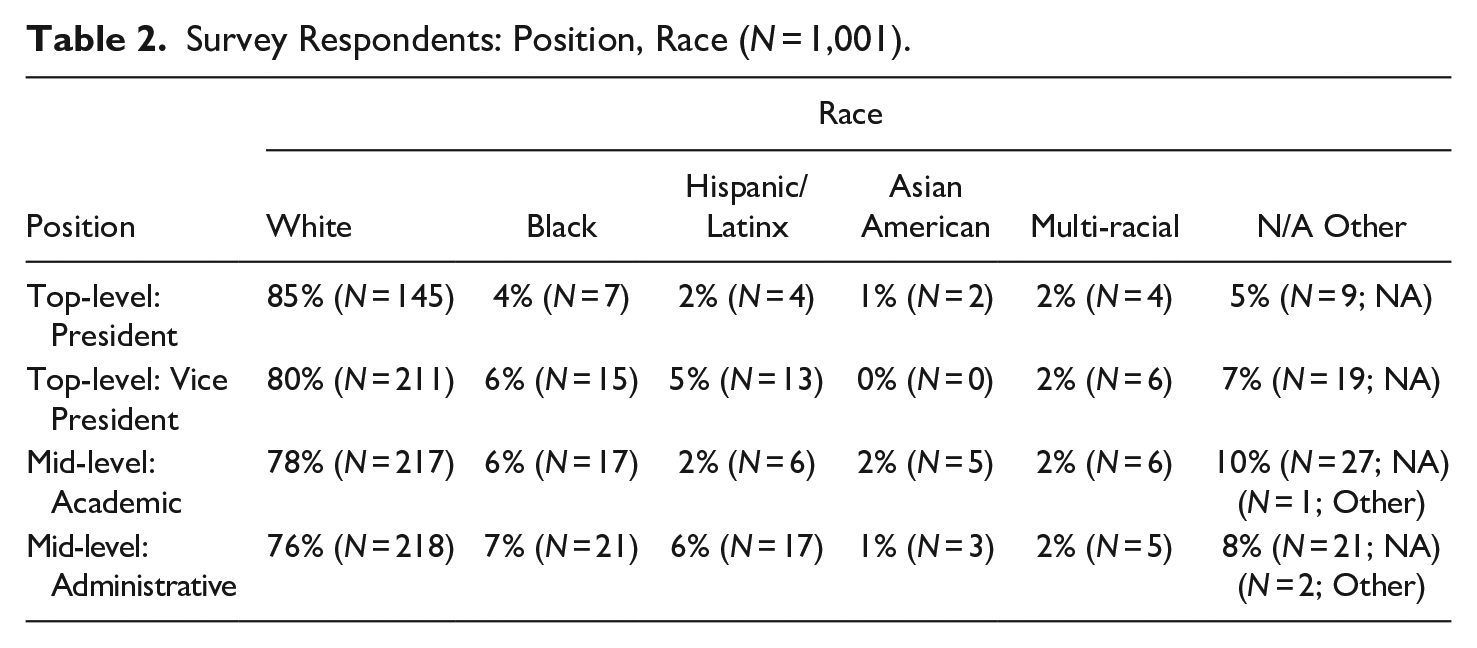
Top-level leaders for this study included both presidents (17%) and vice-presidents (26%), and mid-level leaders included both academics (28%) and administrative (29%) staff. Women responded at higher rates (52%) compared to men (42%); three respondents identified as non-binary, and 6% did not provide a response regarding their gender. Table 1 shows the breakdown of participants by position and gender, and Table 2 by race/ethnicity. When known, we indicate gender and race/ethnicity on the participants’ quotes to illustrate perspectives. Overall, the number of leaders of color in the survey responses was 13%, with leaders in the role of president having the least diversity among their ranks (9.8%). The most recent American Council on Education survey of presidents indicated that in 2017, 20% of community college presidents were leaders of color (Gagliardi et al., 2017). Thus, non-response bias may be present for survey data on the top-level leaders in this study. Caution in interpretation is wise given this backdrop.
Survey Respondents: Position, Gender (N = 1,001).
Survey Respondents: Position, Race (N = 1,001).
Coding Framework
For the purposes of this paper, we focused on responses to an open-ended prompt on the survey that asked participants “How do you define leadership?” Our analysis of this question builds on Eddy and VanDerLinden’s (2006) examination of defining community college leadership. We used the authors’ content analysis approach to analyze how administrators defined leadership. Like this earlier work, our initial codes examined multiple dimensions of leadership, including: (1) position, responsibilities, and expertise; (2) initiating and enforcing change; (3) providing vision and shaping direction; (4) expertise and knowledge; (5) being respected as a leader; (6) fulfilling a greater mission, such as that of the college or organization; (7) empowering others; (8) me-centered approaches; (9) collaboration; and (10) influence, power, and authority.
Of the 1,001 surveys received for this research study, a total of 771 respondents provided a response to the prompt “How do you define leadership?” Our first round of coding resulted in the emergence of three themes. We derived three macro-coding categories for these themes related to how the participating leaders defined leadership. These categories include whether the respondents defined leadership as (1) leader-focused, (2) other-focused, (3) institution-focused, or a (4) combination of the three. Leader-focused coding used a definition that centered on the leader’s role and responsibilities in performing tasks. The other-focused code represented responses that described leadership as collaborative or with a focus on others beyond the self. Lastly, institutional-focused codes centered on definitions that signified a focus on the institution’s goals and/or mission. The combination codes represented when two or more of the foci were present in a definition. For example, the leader/institution code highlighted a response that emphasized the actions of the leader, but with an additional focus on strategic outcomes for the institution.
The research team independently coded the definitions based on the three macro themes, identify both a primary theme and any combination codes (e.g., combined code of leader/institution, leader/other). A high rate of interrater agreement was found (92.6%) for the team. The long-term coding process helped the team come to agreement early on for the three macro-themes that were coded, as over time our thinking coalesced around the nuances of what was included in each code (Belur et al., 2018). In cases of disagreement, we discussed each definition as a group to determine consensus on the final coding schema.
Findings
Through content analysis, we categorized respondents’ definitions of leadership in four primary ways: (1) individual leader focused, with a leader’s abilities mentioned; (2) others/follower focused, with collaboration or servant-leadership orientations mentioned; (3) institution focused, with leaders focused on institutional needs and mission; and (4) combined leader and other-focused. In the latter coding, because the definitions often included more than one category, we captured definitions not focused predominately on one of the three singular areas. The majority of codes were single coded (61%), with the majority of combined codes represented by the code of leader/other or other/leader (24%) or leader/institution (6%). The remaining combination codes represent approximately 1 in 10 of the categories coded. We also present findings related to gender, race, and position differences in definitions.
Leader-Focused Definitions of Leadership
The main research question we sought to answer was, how do sitting community college leaders define leadership? We identified a large percentage (48%) of responses as being primarily leader-focused definitions of leadership. The definition and hallmark of this theme was the importance of the individual leader, as well as individual attributes of and actions taken by the leader. The responses were marked by phrases such as, “influencing others,” “having the necessary skills and abilities to lead,” “leading by example,” and “setting the vision for others to follow.” The attributes, behaviors, and actions described in the responses coded as leader-focused were suggestive of those belonging to individual positional leaders. Many of the responses that fell into this leader-focused code adhered to the “great man” or hero theories of leadership. As explained by a white male vice-president, “Leaders take command over their responsibilities in a reflective but decisive way.” A white female mid-level administrator described the leader as “someone who rallies the troops and takes the hits.” Simply put, leadership was about the “ability to get things done and bringing the people of the organization along” (Black male president).
Several elements of the leader-focused definitions also aligned with the tenets of transformational leadership (Kouzes & Posner, 2017). Here, the leader is an individual who can create a shared vision, inspire others, and then model the way. As explained by a white male president, “leadership is about going to the future (figuratively) and coming back to inspire others.” In transformational leadership, encouraging the heart requires leaders showing “appreciation for people’s contributions, and creating a culture of celebrating the values and victories by creating a spirit of community” (Kouzes & Posner, 2017, p. 19). As a white female president offered, “Leadership depends on having a brain, a heart, and courage.” In these cases, leaders took an active role in setting the vision and inspiring others.
Within the definitions coded as leader-focused were elements of management and business acumen. For example, a white male vice-president provided an explicit connection to business management: “Good leaders run it like they own it.” Another white male president explained, “Leaders as a general rule must have management ability and management skills.” All these responses highlight the importance and necessity of leaders in accomplishing tasks and projects.
Another theme throughout the leader-focused responses was the idea that leaders were able to exert influence on others. For example, a white male vice president shared, “Leadership is having the ability to get others to do what they may not want to do and feel good about it.” Further, as explained by a white female president, “Leadership is knowing where you are going and assisting others in getting there.” As such, gaining followers was an important component of leader-centered approaches. There were aspects of the definitions that implied that the leader could envision the future in a way that the followers could not or would not be able to grasp on their own. Other definitions suggested that the leader is visionary, while the followers must be led to that vision. For example, a Black female Associate Vice-President stated that “The ability to share my vision with others, plan how we’re going to get there together, delegate execution and knowing that whatever happens, I’m responsible for it all,” while a white male mid-level leader explained, “Leadership is inspiring others to fulfill a vision they have yet to grasp themselves.”
The implication in some definitions is that without the leader, followers would be unable to progress toward a worthy future. These responses are suggestive of leaders being all-knowing (or at least better-knowing than the followers), as well as exuding power and control of others. One particular response from a white male vice president exemplified this leader-centric code: “Someone once told me that leadership was telling people to go to hell in such a way that they looked forward to the trip.” While some leader-centered definitions described the importance of followers, others were inherently self-focused. For example, a white male president explained that leadership is “getting people to believe in the direction you want to go enough to help get you there” (emphasis added). Additional responses that were self-focused included: “The ability to influence a group to achieve specific goals and objectives” (Black male vice-president); “Leadership is the ability to get people to do what you need them to do” (white female vice-president); and leadership is “the ability to share my vision with others” (Black female associate vice-president).
Some of these definitions represent exertions of power and influence that stand in contrast to the other-focused definitions of leadership discussed in the next section of findings. As a white female mid-level administrator wrote, “leadership is saying to others, “follow me,” and they do.” The other-focused definitions suggest a walk together, rather than a leader sprinting ahead.
Other-Focused Definitions of Leadership
While 48% of leadership definitions were coded as leader focused, 12% of responses were coded as being primarily other-focused (i.e., collaborative, focused on others beyond the self). As a white female mid-level administrator put it, “leadership can take place anywhere in an organization and does not require position or authority.” The other-focused definitions were squarely centered on those that the leader serves—their followers. Phrases that occurred throughout the responses coded as other-focused included, “developing,” “serving,” “supporting,” and “mentoring” others so that they can be successful. A white female chancellor noted that leadership is the “removal of barriers for others' success.”
The definitions in this category discussed the importance of building connections with others. Put simply, a Black female vice-president stated, “leadership is a relationship.” And that relationship, for some leaders, must be collaborative. According to a white male mid-level academic administrator, leadership is “the ability to collaborate to achieve the goals of the college, individual teams, and each individual working at the college.” A female mid-level administrator noted that in addition to collaboration, other-centered approaches require a multitude of skillsets centered around the intention to help others: Leadership is a collaborative activity that brings individuals together to achieve a common goal. Leadership involves active listening, coaching, engagement, and communication. Most of all leadership is the ethical encouragement of people in order to meet goals and improve the lives of others.
Other-centered responses often included specific references to a team of people. In this way, the responses stood in contrast to the leader-focused definitions about individual attributes, behaviors, and actions of the singular leader. Some examples of other-focused definitions included: “Leadership is identifying talent in others with the agenda to motivate the talented to generate effective and impactful results” (Black female mid-level leader), and leadership is “the ability to develop individuals and lead teams to work together for a common mission and vision” (white male vice-president).
Rather than a strong, explicit focus on the leader, the other-focused definitions suggest that the followers are most important. For example, leadership is “understanding that its people are the most important resource of an institution” (white female mid-level administrator). Additionally, a white female mid-level administrator’s definition of leadership stood in contrast to what was repeated throughout the leader-focused definitions, as leadership is about letting go of the control and about “letting them [followers] feel the maximum degree of control over their fate.”
And, finally, some of the other-focused leadership definitions expressed the need for certain attributes, such as empathy, caring, and an ability to listen. Further, “leadership is the ability to listen to others and help others be successful” (white female vice-president). Asking others "How can I help you?. . .is the essence of leadership” (multi-racial male mid-level administrator). As a last example, a white female vice president offered, “leadership means giving, even when you don’t feel that you have much left to give.”
Institution-Focused Definitions of Leadership
The responses within this category focused on advancing the college and moving forward toward organizational goals. Unique to this category of responses was the personification of the organization and the focus on aspects of the organization such as goals, plans, and strategic initiatives. A mere 1.4% of definitions were coded as being primarily institution-focused. Examples of a focus on the institution include the definition provided by a white female dean who explained, leadership “is the effort to communicate the institution’s goals and culture broadly within my area of responsibility so that everyone knows what the college stands for and where it’s going.” Another mid-level leader (Hispanic/Latinx male dean) added leadership is “being a strong advocate for the mission of the institutions, serving as a positive source of energy to complete institutional goals, and collaborating with multiple individuals to complete relevant tasks.”
Moving from definitions of institutional advocacy to providing direction, top-level leaders focused more directly on goals. A white male vice-president linked institutional focus with abilities of the leader, writing that leadership is “using the strategic plan of the institution to make decisions regarding the allocation of resources (physical, human, fiscal, technological) to achieve the goals of the institution and drive continuous quality improvement.” An Asian-American male president defined leadership as “assisting the organization in moving toward its defined goals.” These definitions highlight the focus on advancing institutional objectives with the leader making the decisions.
As was the case with the leader- and other-focused codes, the definitions were multi-faceted and displayed elements of the role of the leader and the importance of others to the position. For example, a white female mid-level administrator defined leadership as “balancing the needs of the institution with the needs of the student and somehow bringing the two together.” The definitions explored in the other-focused definitions had a shared element related to serving others, but within some responses, the focus was on serving the institution. As a white male vice-president explained, leadership is “serving an organization through support of mission driven initiatives and organizational activities.” The goal of serving the college focused on mission critical outcomes for both students and the college.
With the advent of student success positions and increased emphasis on student-centeredness during the 1990s and 2000s, a literal connection between students and leadership was absent from the majority of definitions and understandings that many of the leaders shared in their responses. “Student success” and “student learning” were themes for a small number of leaders, but these phrases were only used explicitly in a few instances and only in combined codes containing an institutional focus. Examples included: “Leadership is effectively working toward goals and strategies leading to student success and community enhancement” (white female president); “I define educational leadership as the activities that result in the identification, acquisition, allocation, co-ordination, and use of resources necessary to establish the conditions for the possibility of the teaching and learning mission of an institution” (white male mid-level administrator); and “I see leadership is providing the tools and resources to faculty and staff that enable them to provide excellent service to our students and have a positive impact on learning” (white female mid-level administrator).
Even though the institution-focused definitions provided often mentioned strategies and mission, scant attention was offered to central institutional objectives of supporting student success and student learning. On the one hand, respondents may assume these objectives when mentioning fulfilling the college mission. On the other hand, the absence of specifically identifying leadership involving student success indicates that the discourse on college completion through student success was not top-of-mind for the leaders in this study. Likewise, no specific mention of equity or social justice occurred when leaders described institutional-focused attributes of leadership.
An area of prominence, however, were combinations of leader and other definitions of leadership. Specifically, 14.4% of the definitions included an institutional focus in combination with a leader-focused (8.4%), other-focused (2.9%), or multi-combination of institution and leader/other foci (3.1%). For example, a definition that drew upon all three primary codes was offered by a white female mid-level administrator, who described leadership as: The ability to formulate and communicate an inspiring vision. The ability to listen and to involve stakeholders in solving problems and making positive changes that move the institution towards realizing the vision. The ability to ensure each member of the community understands (and is valued for) the importance of his/her role in achieving the institutional vision.
This definition highlights the focus on the leader’s ability to form a vision and listening to others on campus, all with the end goal of achieving the vision of the college. Given the complexity of leadership and its multi-faceted enactment based on position and institutional needs, the inclusion of others represents movement toward more collaborative and participatory ways of defining leadership.
Combined Leader and Other-Focused Definitions
Twenty-four percent of the definitions were dually coded as being both leader and other focused such that a singular primary code could not be assigned. Central to these combined definitions of leadership was the individual attributes of leaders and working with others. Valuing the contribution of campus stakeholders and envisioning the shared work as the result of a team effort contributed to the other-focused portion of the definition. For example, definitions coded as both leader and other focused included: “The best ideas come from others, I just need to pay attention and know when the time is right to get the team energized over implementation” (white female president), and “Leadership is the ability to set and reach goals that advance an organization by tapping the full talents of all willing participants” (white female mid-level administrator). In a similar way, a white male mid-level administrator defined leadership as, “the ability to listen to and understand multiple perspectives and then make an independent judgment as to what would be effective and to present one’s position clearly.”
Here, a few definitions referenced diversity and building a multicultural campus, including the following quote from a white male president: “[Leadership is] the ability to create a multicultural environment that (1) empowers everyone to play a role in the achievement of the mission and strategic direction of the institution; (2) supports the development of each individual’s full potential: and (3) promotes an atmosphere of civility.”
Many of the definitions that fell into the leader- and other-focused category had similar elements to those definitions coded as leader-focused; however, the language was suggestive of a shared partnership between leader and follower whereby leaders and followers are equally responsible for success. For example, a white female president offered that leadership is “the ability to mobilize a collective group around a shared vision and to bring the tools and resources together for implementation and sustaining of the implementation.” And a white female associate vice president defined leadership as the “ability to work with others, understanding their needs and goals and identifying ways to collaborate so that the needs of all parties are met.”
The combination codes represented involvement of others in building the campus vision and working to obtain strategic objectives. They also illustrated that the leader plays an active role as orchestrator of bringing people together on teams or making decisions based on information broadly collected by others in the institution. This combination code represents a transition from a historic reliance on top-level leaders operating in more isolated manners to an approach that values and seeks out the perspectives of others in the institution (Amey & Twombly, 1992; Kezar et al., 2006).
Gender, Race/Ethnicity, and Position Differences
Beyond answering the question of how sitting community college leaders define leadership, our analysis sought to explore differences in definitions of leadership based on gender, race, and position.
Gender
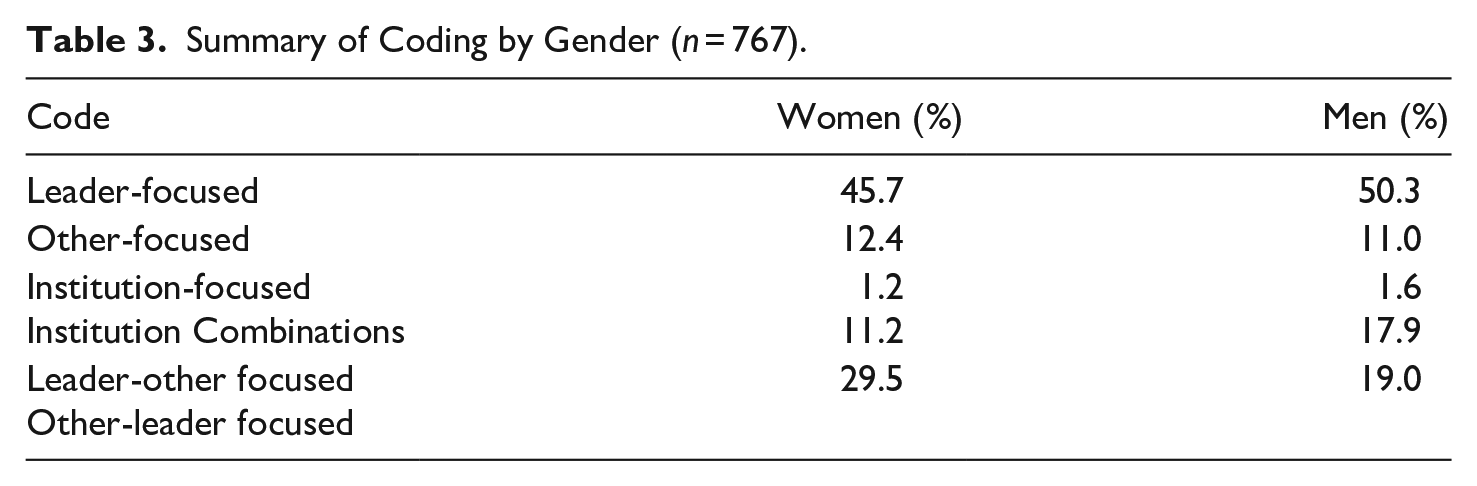
Although some percentage differences were evident from the coding of the leadership definitions, none of the percentage differences between women and men were statistically significant. The most frequent code was leader-centered for both women (45.7%) and men (50.3%) (see Table 3). A few nuanced differences in word choice are worth noting. As explained above, leader-centered definitions focused on the importance of the leader in providing vision, influencing change, and providing resources necessary to complete a job. This response by one of the white male presidents was common: “The ability to envision a future for the institution and the ability to clear obstacles to that vision.” Compare this to a response from a white female mid-level academic leader who offered, “Coordinating resources, which includes people, to successfully achieve a goal.” Both examples highlight how the focus is on the leaders’ ability to “do something” and having a vision, yet the woman’s definition especially calls out the need to include the human capital of others in the effort.
Summary of Coding by Gender (n = 767).
Race/ethnicity
The small number of leaders of color who responded to the prompt to define leadership (n = 125) resulted in insufficient data to run any analysis beyond providing descriptive data. Some observations included: 49% of African-American, 39% of Hispanic/ Latinx, and 42% of multiracial leaders’ definitions were leader centric. Keeping in mind that the response rates for leaders of color was small, the type of language used was similar to responses from the White leaders in the study. The second most prominent code for leaders of color aligned with definitions focused on other, or some combination of other and leader (African American = 41%; Hispanic/Latinx = 36%; Multiracial = 37%).
Position
Leaders in top-level positions included both presidents and vice presidents, and those in mid-level positions included academic leaders (e.g., dean) and administrative leaders (e.g., director). Those in mid-level positions had a particular vantage point of the institution relative to top-level leaders, and this organizational position resulted in different definitions of leadership, however, none of the differences were statistically significant.
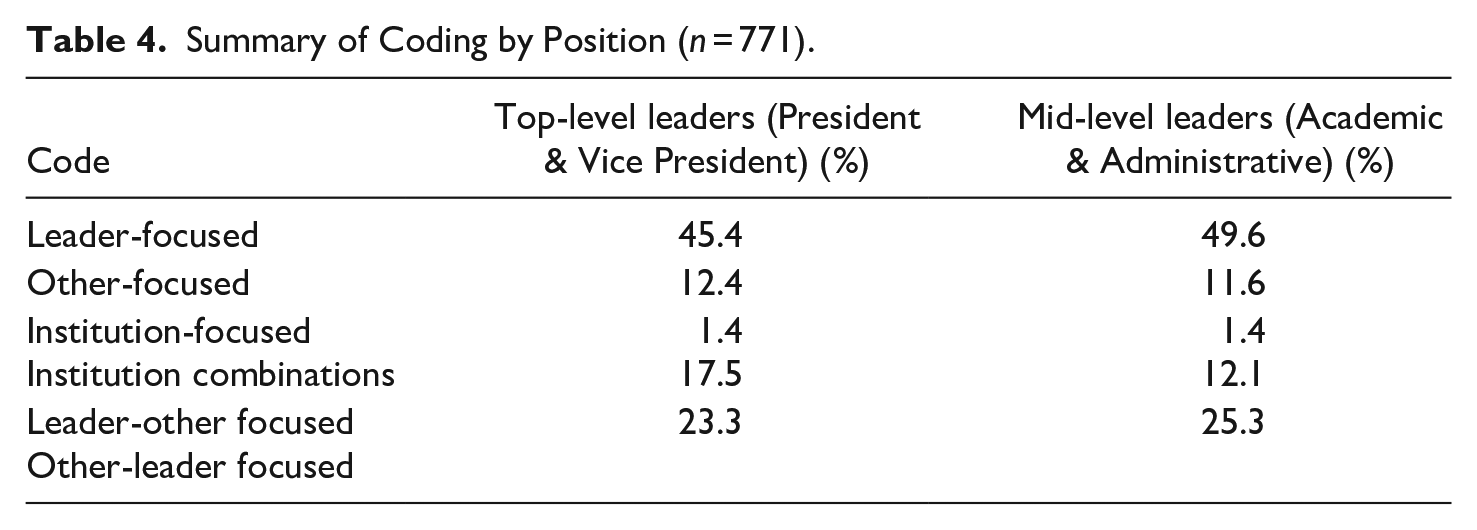
Nearly half (49.5%) of the mid-level leaders defined leadership with a leader-focused definition, compared to 45.4% of top-level leaders (see Table 4). More so than top-level, mid-level administrators used language that included a need to provide management skills. For example, a Black female dean stated that leadership is “Being able to manage conflicts and putting out fires without triggering lawsuits. Being able to effectively plan and communicate goals, strategies and resources needed to complete projects by said deadline.” A white male mid-level administrator focused too on the need to accomplish goals: “The act of motivating and facilitating the appropriate things to be done well in an organized and timely manner.” Those in the middle ranks are responsible for implementing strategic plans and making sure systems operative effectively. Senior-level leaders likewise focused on the ability to do things or their ability to make things happen. As one white male president offered in his definition of leadership, “The ability to plan for, direct, and encourage others to do more than they thought possible.” A Hispanic/Latinx female president responded that leadership is “The ability to set the vision and roadmap and to persuade others to join you in the pursuit of that vision.” Here, the focus is on the leader influencing others more so than managing others.
Summary of Coding by Position (n = 771).
Discussion
This study found three prevalent ways of defining leadership: (1) leader-focused; (2) other-focused; (3) institution-focused. To a lesser extent, definitions emerged that combined institution-focused with one of the other approaches. About half of both women and men used leader-focused definitions, with slightly more men than women in the tallies. More women than men used definitions that were other-focused, whereas men used definitions more institution-focused compared to women. Leader-focused definitions were also most prevalent by position, with mid-level leaders using this definition slightly more than top-level leaders. Top-level leaders used a combination of institution-focused definitions more than mid-level leaders.
Defining Leadership
In Eddy and VanDerLinden’s (2006) earlier study, they found that 49.2% of men and 45.1% of women defined their leadership based on positional responsibilities and being a leader within an area (p. 16). Notably, in the current study a decade later, thoughts had shifted beyond reliance of leading by authority of position, as only 9% of men and 10% of women defined leading based on position within the leader-focused coding. What has not changed, however, is attention on leaders being responsible for setting the vision, using their abilities to bring along others, and providing overall direction (leader-focused = 48%). True, the definitions show there is still a reliance on possessing certain traits and abilities to get others to act, and the preponderance of leader-focused definitions existed for men and women, across position levels, and across race and ethnic categories. The ubiquitous evidence of leader-focused definitions highlights the ways in which hegemonic norms remain strong in thinking about community college leadership (Eddy & Khwaja, 2019). The need of leaders to accomplish strategic objectives (Lattimore et al., 2012) places emphasis on tactical action. As one white male president simply summarized, leadership is “getting things done.” Clearly, in an environment of accountability, leaders need to show that community colleges are making strides in student success (Bailey et al., 2015), addressing community needs (D’Amico et al., 2017), and meeting demands of employers (D’Amico et al., 2015).
Definitions provided by leaders of color aligned with the overarching findings, namely predominance of leader-focused definitions. Like the overall findings, the role of others is on the climb among leaders of color in thinking about community college leadership. Changes in community college settings and conceptions of leadership over time have made the leader-focused definitions more nuanced. The definitions offered in this study focus more on leaders exerting influence versus demanding actions (American Association of Community Colleges [AACC], 2013), and strategically using resources to support a college mission that targets student success (Wyner, 2019). Notably, within the leader-focused codes were explanations regarding the role of followers ranging from cajoling others to work toward a common goal to empowering staff and faculty to move to a desired outcome. This recognition of the role others play in overall college outcomes showcases that even in the leader-focused codes was a recognition of the need to move past concepts of hero-like leadership.
Gender
The findings highlight how the consideration of others is more prominent relative to the 2006 study, but also show divergence regarding the level that men and women think about others in their definitions of leadership (see Boggs and McPhail (2019) for more on team leadership). Women were more likely to give preference to the role of others (42%) compared to men (30%; see Table 3). The statements made by men and women highlight the subtlety of language in thinking about the roles others play. Women in general used more inclusive language in describing working with others (e.g., “facilitate,” “empower,” “motivate,” “work with others,” “supporting,” “helping”), whereas men more often used language that fore fronted their own role (e.g., “guiding,” “assemble a team,” “ability to bring teams together,” “lead teams,” “management of a diverse team”). On the one hand, the gendering of language may merely signal one of the many ways men and women are socialized to “do” gender (Glass & Cook, 2020; West & Zimmerman, 1987). On the other hand, the choice of more inclusive language by women may indeed translate to more collaborative ways of leading (Lipman-Blumen, 1992).
The inclusion of others in the definitions by men and women differed, with the men’s definitions often presenting a sense of power and role hierarchy when reporting on leading with others. For example, some definitions essentially stated, “I’m leading the team,” instead of a more collaborative approach to team leadership (Boggs & McPhail, 2019). Even instances mentioning inclusivity and servant leadership still had leaders figuring prominently. In the end, the collaborative setting of forming a collective vision and providing supports for others by both men and women shows movement over time in how sitting mid-level and senior leaders define leadership. The true test is how (and if) these types of leadership are showing up in practice at our nation’s community colleges.
Position
Since the original study done by Eddy and VanDerLinden (2006), more research has emerged on mid-level leadership (Amey & Eddy, 2018; Garza Mitchell & Amey, 2020). Kezar and Lester (2009) highlighted the role of grass roots leaders, and how change can occur on campus with individuals exerting influence without having a named leadership position. What is notable in the analysis of our research is the similarity among top-level leaders and mid-level leaders in how they define leadership. Certainly, differences existed in mid-level leaders using more leader-focused definitions and top-level leaders having greater emphasis on institution-focused definitions relative to those in the middle ranks. None of these differences, however, were statistically significant.
Different conclusions can be made from these findings. First, universal conceptions of leadership prevail regardless of position. For our participants, there is wide-spread agreement on the role of leaders at the helm, with expanding roles for others emerging. The actions of top-level leaders serve as a model for those throughout the college. How presidents and vice-presidents model leadership matters (Boekhorst, 2015). Second, the modeling of leadership by top-level leaders reinforces the norms of what is expected in advanced leadership positions for those in mid-level leadership positions. As the analysis of Eddy and Khwaja (2019) found when looking at the literature on community college leadership, ideal worker norms (Williams, 2000) remain prevalent and scant critique of the existing literature on community college leadership literature occurs. What remains unknown is how more recent writing on community college leadership will begin to challenge leader-focused definitions of leadership and how alternative definitions emerge and are reinforced.
Implications for Further Research, Policy, and Practice
We found that 51% of the respondents were promoted within their college for their first administrative position. Thus, it is critical to understand what forms of leadership development are occurring to prepare individuals for innovative leadership. Kezar and Eckel (2002) noted that alignment with the culture is important for transformational change, and insiders have good awareness of the culture. Yet, equally critical is staff development. Half of the survey respondents indicated that their institution does not offer a leadership development program, and most of the respondents learned how to lead on the job versus in a formal program. The pending retirements in the community college sector and the historic lack of succession planning present a dilemma—can community colleges continue to rely on leaders without leadership development backgrounds to face current challenges? Elsewhere in the survey, respondents noted issues of integrity and ethics as missing leadership competencies (AACC, 2013). The need to empower others to leverage the talents of all staff and faculty was also noted as a critical competency not in the current AACC listing of competencies. It is imperative to provide leaders with opportunities to learn how to lead better and to create a community that can be tapped when campuses face tough problems.
Understanding that men and women defined leadership differently is important, both in terms of how individuals might ultimately lead and in terms of how individuals distil and interpret leadership training opportunities. Linking the needs of the institution to the forms of leadership approaches individuals use can help leverage change. Finally, it is important to recognize that even when men and women use particular terms to define leadership (e.g., team) they may have very different meanings for the same terms.
The outcome of little difference in definitions based on gender, position, or race/ethnicity highlights hegemonic norms of how individuals define leadership. When individuals advance in leadership positions, they often learn by observing what sitting leaders do that are successful and when they fail (Boekhorst, 2015). Despite the fact that community colleges have more women leaders and leaders of color relative to other institutional types, their ranks are still in the minority (women = 36%; leaders of color = 20%; Gagliardi et al., 2017). Women and leaders of color face a double bind (Eagly & Carli, 2012) in judging of their performance. Building in a critique of historic literature on community college leadership (Eddy & Khwaja, 2019; Shields, 2010) and infusing broader conceptions of leadership in development programs can begin to change the overarching norms of leadership. This research adds complexity to thinking about how to develop leaders, what individuals’ hold as centrally important for leaders, and how we might think forward in developing tomorrow’s leaders.
Conclusion
Over half of the leaders in our study defined leadership using more inclusive or other focused language than historic leader-focused thoughts. Even in the leader-focused definitions, there was evidence of the role of followers and including others, though the bottom line was a focus on a leader’s attributes and skills in being able to get things done. Men more than women hang onto a leader-focused way of defining leadership, and mid-level leaders hold to this same concept more than top-level leaders. Evidence of male normed conceptions of leadership remains strong, and those in the middle ranks more often construct leadership based on those at the top.
The attention to incorporating others in moving the mission of community colleges forward emerged in this research. Often, the role of others differed for men and women. Women leaders used inclusive language more frequently, whereas men focused on the ways others helped move the institution forward. Given the community college context in which neoliberal forces emphasize attention to the bottom line of budgets (Baber et al., 2019), a focus on accountability and accomplishing college goals is unsurprising. What matters, however, is how leaders help institutions move forward. Critical to advancing community colleges to meet the needs of students, communities, and the labor force is a focus on tapping the talents of everyone at the college (Eddy et al., 2015). Sitting and aspiring leaders must continue to disrupt and question current practices and norms (Shields, 2010), which ultimately can elevate issues of inclusion of others to a central place in definitions of leadership.
Footnotes
Declaration of Conflicting Interests
The authors declared no potential conflicts of interest with respect to the research, authorship, and/or publication of this article.
Funding
The authors received no financial support for the research, authorship, and/or publication of this article.
