






Abstract
In December 2019, an outbreak of severe acute respiratory syndrome coronavirus 2 (SARS-CoV-2), the virus that causes coronavirus disease (COVID-19), was reported. The World Health Organization declared COVID-19 a global pandemic in March of 2020, initiating a series of policies and events that caused significant and sudden changes within education institutions in the United States. Educational systems were disrupted because of safety measures designed to lessen the spread of the COVID-19 virus and the severity of pandemic-related outcomes. An estimated 1,300 colleges and universities canceled in-person classes and over 80% of college students had some or all of their classes moved to online-only instruction (Cameron et al., 2021; Smalley, 2021). Colleges and universities also encouraged non-essential staff and faculty to work remotely, closed housing and daycare facilities, and limited student services. Over 124,000 public and private elementary, middle, and high schools across the nation closed and shifted their courses to distance learning modalities, impacting an estimated 55.1 million students (Education Week, 2021). By July 2020, 20% to 40% of childcare programs remained closed, with ultimately over 16,000 childcare centers permanently closing due to the pandemic (Childcare Aware, 2021).
Those pandemic-related shifts in educational policies and procedures led to challenging situations for many college students; however, community college students who were caregivers, parents, or guardians to children under 18 (hereafter referred to as “caregivers”) experienced some of the greatest burdens during the pandemic. Between one-fourth to one-third of community college students are caregivers (Center for Community College Student Engagement [CCCSE], 2022; Cruse, Holtzman, & Gault, 2020; Karp & Cruse, 2023). Pandemic-related events may have exacerbated many of the existing challenges experienced by community college caregivers. Even prior to the pandemic, community college caregivers had among the lowest degree completion rates of any group in higher education, with only 14.7% earning an associate’s degree after 6 years of enrollment (National Center for Education Statistics [NCES], 2012/2017).
Although college students’ food insecurity has received increased attention over the last several years (Goldrick-Rab et al., 2020) and community college students experience much higher rates of food insecurity compared to students attending 4-year institutions (Baker-Smith et al., 2020; Broton, 2020; Broton et al., 2022; Broton & Goldrick-Rab, 2018; The Hope Center for College, Community, and Justice [The Hope Center], 2021), at present, researchers have not specifically examined community college caregivers’ food insecurity and the factors that might be associated with their food insecurity. Therefore, the purpose of this study is to examine community college caregivers’ experiences with food insecurity during the pandemic.
Student Caregivers’ Experiences During the COVID-19 Pandemic
The stressors associated with providing educational support for children on top of fulfilling their own academic responsibilities compromised caregivers’ ability to fully engage in courses during the pandemic (Lin et al., 2022). As childcare centers, daycares, and K-12 schools closed or shifted to remote operations during the pandemic, caregivers were significantly less likely to attend their online classes and more likely to lack access to appropriate study environments because they had to care for children while attending classes or studying (Soria et al., 2020, 2023). Affordable and accessible high-quality childcare remains out of reach for many community college caregivers and is a significant factor in many caregivers’ decision to drop out of college altogether (CCCSE, 2014; Nelson et al., 2013). Community college caregivers encounter significant demands on their time: over two-thirds of community college caregivers are employed (Karp & Cruse, 2023) and 74% of student caregivers spend over 30 h a week providing care for dependents while also attending school (Johns et al., 2022).
The events surrounding the pandemic affected more than caregivers’ academic experiences: caregivers were more likely than non-caregivers to experience financial hardships such as the loss or reduction of family members’ wages, unexpected increases in expenses, and loss of hours, wages, or jobs (Lin et al., 2022; Soria & Horgos, 2021; Soria et al., 2020, 2023; The Hope Center, 2021). Those pandemic-driven financial hardships may have worsened caregivers’ already precarious financial situations (Lin et al., 2022; Nelson et al., 2013). Community college caregivers are nearly three times more likely to have income at or below the poverty level compared to community college students who are not caregivers (NCES, 2012/2017). Two-thirds of employed student caregivers do not have access to paid sick days and 72% earn less than $19/hour (Cruse, Mendez, & Holtzman, 2020). The expected family contribution for community college caregivers ($1,688) is over four times lower than the expected family contribution for community college students who are not caregivers ($7,169; NCES, 2012/2017). Community college caregivers also pay three times more than non-caregivers for monthly or mortgage costs and twice as much in monthly car loan payments (NCES, 2012/2017).
The pandemic-related financial hardships experienced by caregivers likely exacerbated their existing financial insecurities (Cruse, Mendez, & Holtzman, 2020). As a result, many caregivers struggled to meet their families’ basic needs, culminating in high rates of food insecurity (CCCSE, 2022; Goldrick-Rab et al., 2020; Soria et al., 2020, 2023; The Hope Center, 2021). Food insecurity encompasses limited access to nutritious foods, an uncertain ability to acquire nutritious foods, an inability to acquire nutritious foods, interrupted eating patterns, or a reduction in the quality of diet due to the lack of resources to access nutritious food (The Hope Center for College, Community, and Justice, 2021). Presently, 29% to 39% of community college students experience food insecurity (CCCSE, 2022; The Hope Center, 2021).
Food insecurity is associated with an array of negative academic outcomes for college students, including lower academic achievement, lower retention and degree completion rates, less engagement with faculty, and diminished capacity for academic and career planning tasks (Broton et al., 2022; Hagedorn-Hatfield et al., 2022; Soria, 2023; Wolfson et al., 2022) . Food insecurity makes it difficult for students to focus on academics (Cliburn Allen & Alleman, 2019; Crutchfield et al. 2020). There are physical complications from hunger, such as migraines, dizziness, and disrupted sleep patterns (Cliburn Allen & Alleman, 2019; Crutchfield et al., 2020). Students experiencing food insecurity are more likely to experience psychological distress, loneliness, stress, poorer mental health, loneliness, generalized anxiety disorder, major depressive disorder, feelings of shame, and suicidal behavior (Becerra & Becerra, 2020; Broton et al., 2022; Cliburn Allen & Alleman, 2019; Soria, 2023; Soria & Horgos, 2021). College students who are caregivers may also sacrifice their own dietary intake to meet their children’s nutritional needs; consequently, caregivers may be at a heightened risk for negative health and academic consequences due to food insecurity (Lee et al., 2022).
The challenges associated with food insecurity, in addition to the concomitant stressors of the COVID-19 pandemic, could exacerbate the psychological tensions and hardships already encountered by caregivers and create spillover effects into other areas of their lives as well (Lin et al., 2022). It is therefore important to examine any variables that might be associated with increased food insecurity among caregivers during the pandemic. Researchers have not previously explored some of the factors that might exacerbate food insecurity among community college caregivers. Therefore, the research question driving this study is as follows: are demographic, academic, caregiving, financial, or COVID-19-related variables associated with community college caregivers’ food insecurity during the COVID-19 pandemic?
Conceptual Framework
We combined Maslow’s (1943) theory of human motivation and Glover et al.’s (2020) conceptual framework for mitigating the equity harms of COVID-19 as frameworks for the study. Maslow’s theory is commonly used as a theoretical framework in research about college students’ basic needs insecurity (Goldrick-Rab et al., 2018; Nix et al., 2021). In Maslow’s theory, there are five sequential levels (physiological needs, safety needs, love and belonging, esteem, and self-actualization) of human needs and each one needs to be fulfilled before individuals can consider higher-level needs. Within higher education, Maslow’s model explains the impetus to address students’ basic needs—including food security—so that students can concentrate upon their academic success and degree completion (Goldrick-Rab et al., 2018; Nix et al., 2021). While authors have extended Maslow’s theory over time (Kenrick et al., 2010), the physiological needs component is still recognized as foundational within hierarchies of needs.
In their conceptual framework for mitigating the equity harms of COVID-19, Glover et al. (2020) proposed that inequitable COVID-19 policies generate interactive and multiplicative harms upon individuals who were already marginalized, oppressed, and disenfranchised before the pandemic. As applied to the present study, pandemic policies in higher education institutions created academic and financial hardships that may have exacerbated rates of food insecurity among caregivers. Glover and colleagues cited several demographic variables associated with equity harms due to policies, including employment, disability, race/ethnicity, gender, and socioeconomic status. When examining the variables associated with food insecurity during the pandemic, we included Glover et al.’s demographic variables, additional demographic variables, and pandemic-related difficulties community college caregivers may have experienced.
Methodology
Instrument
We used data from the 2020 #RealCollege Survey (The Hope Center, 2022), which was administered to 1.84 million college students at 130 community and technical colleges and 72 four-year colleges in 42 states in fall 2020. The survey was emailed to students, and it was framed as a survey about college life, not about basic needs insecurity. The 2020 #RealCollege Survey included items about students’ demographic characteristics, experiences during the pandemic, food insecurity, and housing insecurity. The survey response rate for both the 2-year and 4-year colleges averaged 10.6% (n = 195,629). Although low, the response rate was the highest for any #RealCollege Survey administration, and the response rate is comparable to similar surveys (Betancourt & Wolff-Eisenberg, 2019; California Student Aid Commission, 2020).
Sample
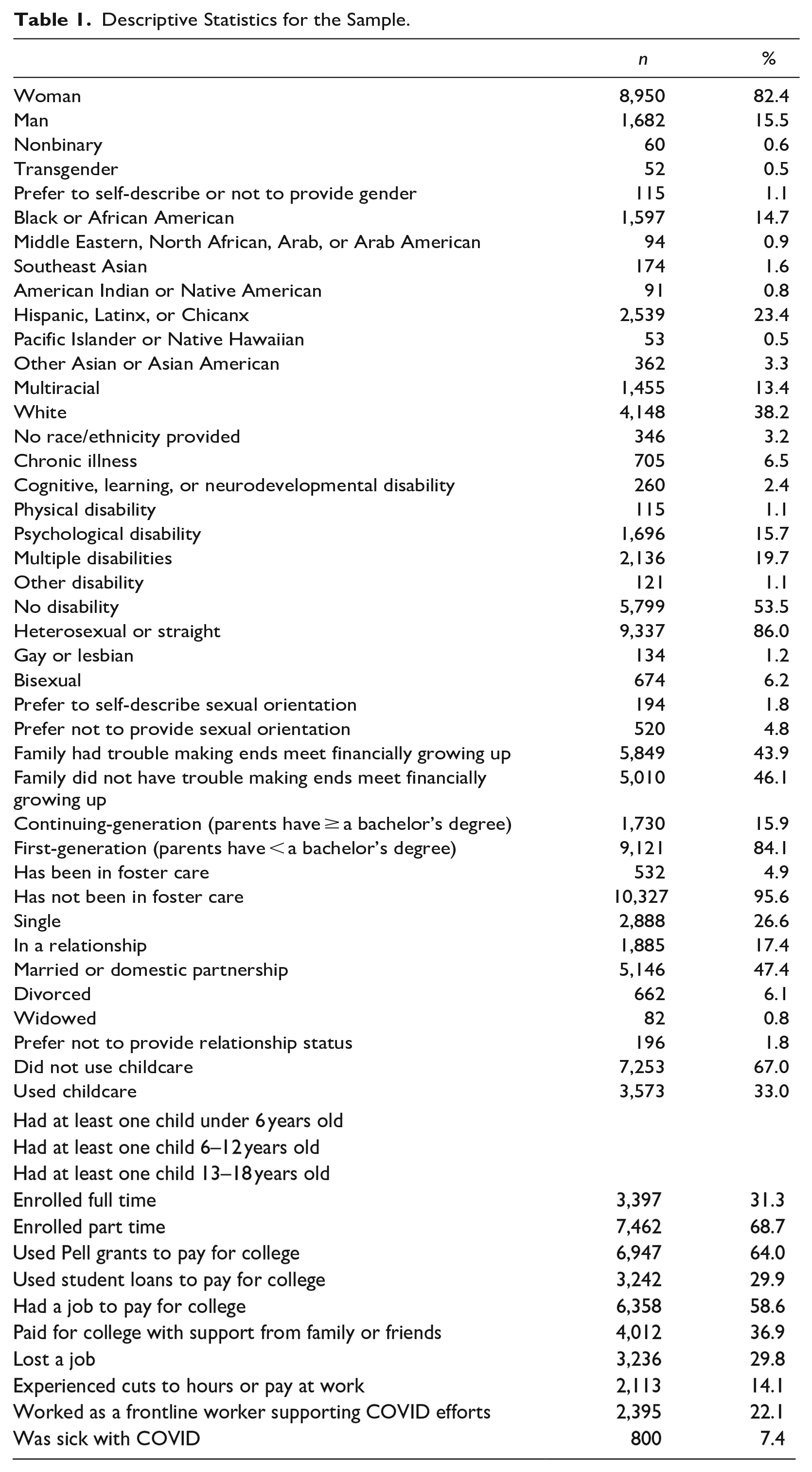
Students responded to an item about whether they were parents, guardians, or caregivers to children (yes or no). In the original sample of community college students who responded (n = 39,923), 27.2% (n = 10,859) indicated they were caregivers. The demographic information from the sample of community college caregivers is shown in Table 1. The sample was primarily comprised of cisgender women, which is congruent with national samples of college caregivers (CCCSE, 2014, 2022; Cruse, Holtzman, & Gault, 2020).The majority of respondents were White (38.2%), first-generation students (84.1%), and heterosexual or straight (86.0%)
Descriptive Statistics for the Sample.
Measures
Dependent Variables
The 2020 #RealCollege Survey assessed food security using the U.S. Department of Agriculture’s (2012) 18-item set of questions (e.g., “in the last 30 days, did you ever cut the size of your meals or skip meals because there wasn’t enough money for food?”). The sum of affirmative responses represents a raw food insecurity score, dichotomized to 1 = experiences food insecurity (raw score 3–18), 0 = does not experience food insecurity. In the sample, 52.0% (n = 5,647) of community college caregivers experienced food insecurity.
Independent Variables
We selected independent variables that are associated with college students’ food insecurity, including demographic variables (Goldrick-Rab et al., 2020; Soria et al., 2023; The Hope Center, 2021). Students reported their gender, race/ethnicity, sexual orientation, disability, age (x̄ = 35.62, SD = 9.65), parents’ or guardians’ highest level of education, and previous experience in foster care. We recoded parents’ and guardians’ highest level of education such that students with parents/guardians who had less than a bachelor’s degree were considered first-generation students while those whose parents/guardians had a bachelor’s degree or higher were continuing-generations students. Students reported whether their family had trouble making ends meet financially while they were growing up (1 = yes, 0 = no).
We included items related to caregivers’ current relationship status, use of childcare services, the affordability of childcare, and their children’s ages. Caregivers answered the question “How would you describe your relationship status?” and the majority were married or in domestic partnerships (47.4%; Table 1). Caregivers responded to the question, “Do you need, use, or plan to use childcare this year?” and 33% answered “yes.” Students also indicated their agreement on a scale from 1 = strongly disagree to 5 = strongly agree to two items: “I can afford to pay for childcare” (x̄ = 2.21, SD = 1.29) and “after childcare, I earn enough to make working worthwhile” (x̄ = 1.98, SD = 1.14). We observed that 65.7% of caregivers strongly disagreed or disagreed that they can afford childcare while 72.3% strongly disagreed or disagreed that they earn enough money to make working worthwhile. Caregivers indicated how many children they had in different age groups, which we collapsed to three categories: had at least one child under 6 years old (47.1%), 7 to 12 years old (51.8%), and 13 to 18 years old (31.9%).
We also included housing insecurity, which has strong associations with food insecurity (Soria et al., 2023; The Hope Center, 2021). The survey assessed housing insecurity using nine items (e.g., “In the past 12 months, was there a rent or mortgage increase that made it difficult to pay?”). Caregivers were coded as experiencing housing insecurity if they responded “yes” to any of the items or if they indicated that they had moved at least three times in the last 12 months, dichotomized to 1 = experiencing housing insecurity, 0 = does not experience housing security (The Hope Center, 2022). In the sample, 66.8% (n = 7,258) of community college caregivers experienced housing insecurity during the pandemic.
Finally, we also included academic variables, including the average total number of years caregivers were enrolled in college (x̄ = 2.96, SD = 2.17) and whether they were enrolled part-time or full-time (The Hope Center, 2021; Table 1). We used items regarding whether caregivers pay for college with Pell grants, with student loans, through a job, or through support from family or friends (Walsh et al., 2021). Those variables were coded 0 = did not pay for college with that type of financial support and 1 = paid for college with that type of financial support (Table 1). We also used four items in which caregivers shared whether they lost a job, experienced cuts to hours or pay at work, worked as a frontline worker supporting COVID efforts, or were sick with COVID during the pandemic (Soria et al., 2023; The Hope Center, 2021). The caregivers responded “yes or no” (1 = yes, 0 = no) to the COVID-19 items (Table 1).
We converted most of the variables using effect coding (Ro & Bergom, 2020) except in the case of variables with dichotomous categories (e.g., full-time or part-time enrollment). Dummy coding omits one group (the referent group) from the analysis of variables with more than two categories (e.g., race/ethnicity); however, when using effect coding, the odds ratios can be interpreted relative to the average of the full sample and all groups can be analyzed (Ro & Bergom, 2020). With the dichotomous variables, each coefficient or odds ratio can be interpreted compared to the other level (e.g., full-time vs. part-time enrollment).
Data Analyses
We next used one logistic regression model to analyze the relationships between the independent variables and caregivers’ food insecurity. We ran additional diagnostics to assess the model. McKelvey and Zavoina’s (1975) pseudo-R2 value was .366 and Hosmer et al.’s (2013) test suggest the model seemed to fit well (χ2 = 502.35, p = .437). We examined the variables for multicollinearity and discovered that none of the variance inflation factors (VIF) had values above 5.0, suggesting multicollinearity was not a problem in the models (Field et al., 2012). We finally computed marginal effects, which presents results as a difference in probabilities (Austin, 2011), in addition to the 95% confidence intervals for the marginal effects, standard errors, and p-values for each of the variables.
Results
Transgender community college caregivers had significantly (p < .05) higher probabilities of experiencing food insecurity, as did those who were previously in foster care, were divorced or single, and were first-generation students (Table 2). Community college caregivers with multiple disabilities, disabilities not listed in the survey, and whose family had trouble making ends meet growing up also had higher probabilities of food insecurity.
Logistic Regression Analysis for Food Insecurity Among Caregivers.
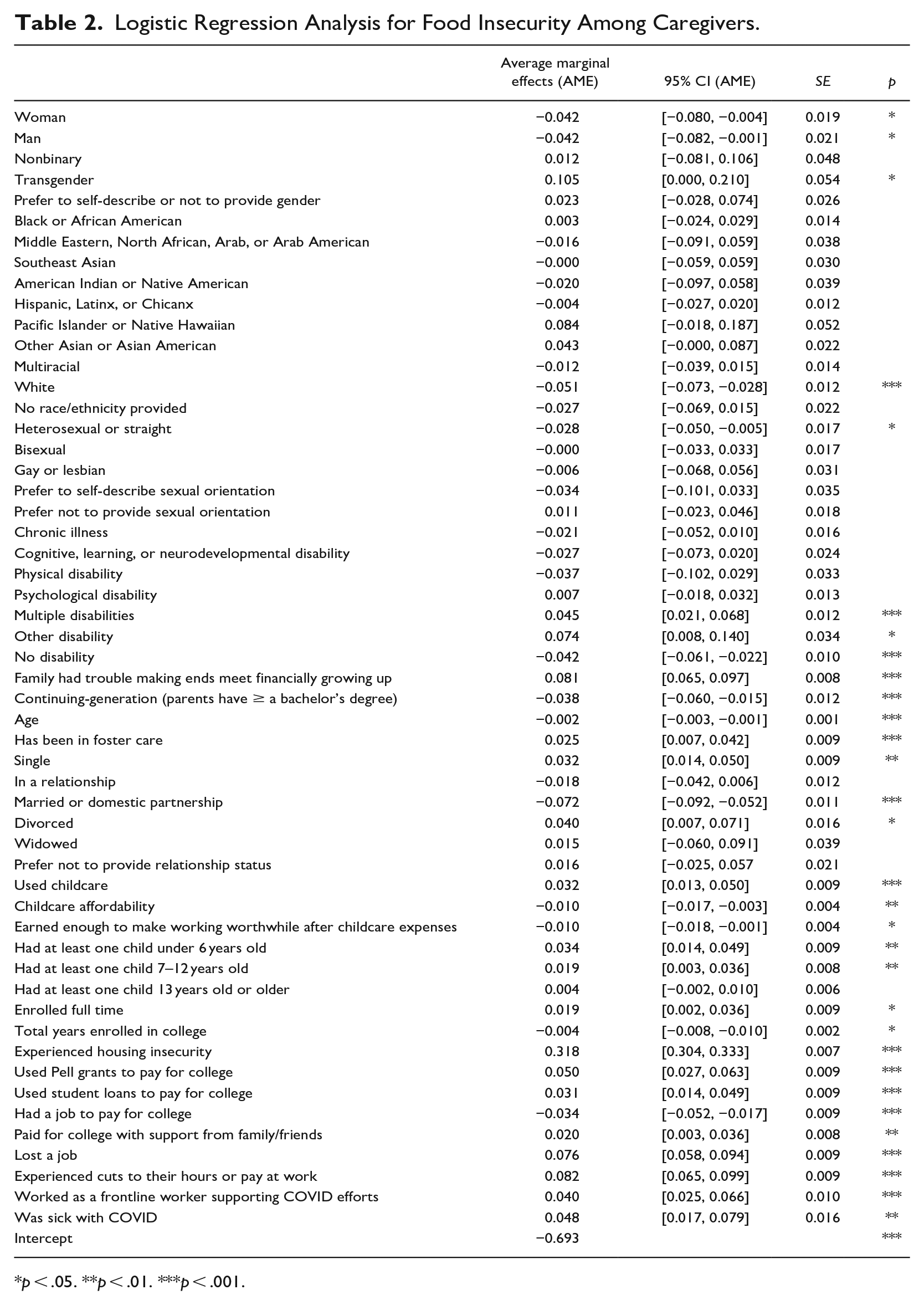
p < .05. **p < .01. ***p < .001.
Several groups had significantly (p < .05) reduced probabilities of experiencing food insecurity, including cisgender men and women, White, and heterosexual or straight community college caregivers. Caregivers with no disabilities and those who were married or in a domestic partnership also reduced probabilities of experiencing food insecurity. Every 1 year increase in caregivers’ age was also associated with a reduction in the probability of food insecurity.
Community college caregivers who use childcare had significantly (p < .05) increased probabilities of experiencing food insecurity. Compared to caregivers who had at least one child between 13 and 18 years old, those who had a child less than 6 years old or between the ages of 7 to 12 years old also had increased probabilities of experiencing food insecurity. Caregivers who more strongly agreed that the cost of childcare was affordable and that they earn enough to make working worthwhile after childcare expenses had reduced probabilities of experiencing food insecurity. Put differently, community college caregivers who felt childcare was not affordable and believed that they did not earn enough money to make employment worthwhile after paying for childcare expenses had higher probabilities of food insecurity.
Caregivers who were enrolled full-time had significantly (p < .05) increased probabilities of experiencing food insecurity, while caregivers who were enrolled longer in higher education had decreased probabilities of food insecurity. Community college caregivers who experienced housing insecurity had significantly (p < .05) greater probabilities of food insecurity; in fact, housing insecurity increases the probability of food insecurity by 31.8 percentage points.
Community college caregivers who used Pell grants, student loans, and support from friends or family to pay for college had significantly (p < .05) increased probabilities of experiencing food insecurity compared to their peers. Caregivers who paid for their college with jobs had decreased probabilities of experiencing food insecurity. All of the COVID-19 related variables were associated with increased probabilities of food insecurity: losing a job, experiencing cuts to hours or pay, working as a frontline worker, and contracting COVID.
Discussion
The results of this study suggest that 52% of community college caregivers experienced food insecurity during the COVID-19 pandemic, a proportion that is congruent with other research on community college caregivers and higher on average compared to community college students who are not caregivers (Baker-Smith et al., 2020; The Hope Center, 2021). In addition, community college caregivers with specific demographic characteristics related to gender (i.e., transgender students), disability (i.e., caregivers with multiple disabilities or a disability not listed in the survey), socioeconomic background (i.e., students whose family had trouble making ends meet growing up and first-generation students), and previous experience in foster care were more likely to have higher probabilities of food insecurity. By and large, these results are congruent with prior research about groups of college students who are more likely to experience food insecurity (CCCSE, 2022; Laska et al., 2021; Olfert et al., 2023; Soria, 2023; Soria & Coca, 2023; Soria et al., 2023; The Hope Center, 2021); however, the present results are novel due to the focus upon community college caregivers as a unique sample.
The results also suggest that several factors relative to childcare were associated with increased probabilities of food insecurity. Community college caregivers who used childcare had increased probabilities food insecurity compared to those who did not use childcare. Those who felt that childcare expenses were not affordable and believed that they did not earn enough money to make employment worthwhile after childcare expenses had increased probabilities of food insecurity. Affordability and accessibility to high-quality childcare are some of the biggest challenges student caregivers face in completing their degrees (Johns et al., 2022). The challenges of obtaining affordable and accessible childcare in the United States are not exclusive to college students: they are systemic, making the United States one of the lowest-ranked wealthiest countries in terms of childcare affordability, quality, and access (second only to Slovakia; Gromada & Richardson, 2021). The costs of full-time childcare for young children on average exceed the cost of in-state college tuition (Economic Policy Institute, 2023). On average, caregivers who hold a minimum wage job need to work 54 h per week to afford both their own tuition and the cost of center-based childcare (Williams, 2022). In some states, such as Virginia, those making minimum wage would need to spend 95% of their income to just afford childcare (Johns et al., 2022). The majority of college student caregivers—approximately three-quarters—pay for childcare expenses from their own income while one-quarter use public aid or subsidies (Johns et al., 2022). The expenses of childcare are a burden for community college caregivers and clearly conflict with their ability to afford food for their families.
While many childcare centers closed during the initial months of the pandemic, over three-quarters of college student caregivers had to take care of their children while attending their own classes (The Hope Center, 2021). Women were disproportionately impacted by childcare closures: in summer 2020, women caregivers were three times more likely than men to be unemployed due to childcare demands and reduced their work hours four to five more times than caregivers who were men (Collins et al., 2021; Heggeness & Fields, 2020). Women were more likely to take leave from work due to childcare needs as well, thus diminishing their income. Therefore, even if community college caregivers did not have as many direct childcare-related expenses due to childcare center closures during the pandemic, caregivers—especially women, who were the majority of our sample—were negatively impacted financially by a reduction in employment so that they could provide childcare (Heggeness, 2020).
Community college caregivers’ relationship status and age of children were also factors associated with the probability of experiencing food insecurity. Single and divorced caregivers and caregivers with younger children (0–12 years old) had higher probabilities of experiencing food insecurity compared to other caregivers. While there are limited studies from which to draw comparisons, researchers have generally discovered that single or divorced parents and caregivers of younger children tend to experience higher rates of food insecurity (Bastian et al., 2022; Matheson & McIntyre, 2014). Caregivers with younger children are more likely to have greater financial expenses related to childcare, single caregivers are likely to have lower household incomes, and divorced caregivers with primary custody are more likely to experience economic setbacks from divorce (Teachman & Paasch, 1994).
Caregivers who had Pell grants, loans, or had help from family or friends to pay for college were also consistently more likely to experience food and housing insecurity compared to caregivers who did not receive those types of financial assistance. Further, all of the COVID-19-related experiences—losing a job, experiencing cuts to hours or pay, working as a frontline worker, and contracting COVID—were also consistently associated with increased probabilities of food insecurity. Connecting back to the conceptual framework (Glover et al., 2020; Maslow, 1943), it appears as though the pandemic-related policies, such as closures of campuses and changes to employment, may have exacerbated the food insecurity experienced by caregivers. Those high rates of food insecurity may, in turn, compromise community college caregivers’ ability to be successful in higher education.
Recommendations
The overall share of caregivers who have enrolled in higher education has dropped precipitously over the last decade and community colleges experienced the greatest declines in students’ enrollment during the pandemic (Cruse, Holtzman, & Gault, 2020; National Student Clearinghouse Research Center, 2023). Therefore, it is important that community college leaders take action to support community college caregivers who experience food insecurity to help them complete their degrees. We have included some recommendations that campus administrators, practitioners, and faculty can employ to alleviate food insecurity among caregivers and that researchers can take to enhance future research in this area.
The results suggest that specific groups of community college caregivers may benefit from more directed support and communications related programs to alleviate food insecurity (e.g., transgender caregivers, caregivers with multiple disabilities); however, institutions may not collect some of those demographic data on students, so we encourage institutions to collect more robust data to better identify students who may benefit from enhanced support (Johns et al., 2022). Many caregivers experience a deficit in the amount of available time they have while juggling responsibilities (Wladis et al., 2018); therefore, resources related to food insecurity, such as food pantries, should have accommodating hours of operation, delivery services, mobile services, or alternatives such as gift cards or discounts at local grocers. Food-related resources should be located within or near existing resources (e.g., in daycare facilities) or scattered in a variety of locations across campus (e.g., via little free pantries or in classroom buildings).
Among faculty and practitioners, there is a general lack of understanding related to the availability of governmental programs, including eligibility requirements, what those programs provide to students, and how students can apply (Larin, 2018). It may therefore be preferable to have dedicated practitioners working in a “single point of contact office” who are trained to help students identify their eligibility and apply for assistance (Crutchfield et al., 2020). The single point of contact resource center can also feature wraparound services for caregivers, including support with accessing affordable daycare, access to a variety of basic needs items (e.g., hygiene supplies, childcare supplies), and assistance applying for institutional aid or government aid (Crutchfield et al., 2020; Nix et al., 2021). Faculty could also notify students about existing support resources on campus through communications in their learning management systems.
Given the systemic challenges with childcare, it is important for campus administrators to provide free, low-cost, or subsidized childcare assistance for students on campus. Unfortunately, the percentage of public institutions offering childcare services has declined since 2004, with the greatest declines in community colleges (Cruse et al., 2021). Institutional leaders should reinvest in childcare services by creating flexible childcare opportunities, such as drop-in centers located near libraries, classrooms, or study spaces so that caregivers can spend a few hours studying or completing assignments (Johns et al., 2022). To support caregivers, administrators can reduce or subsidize on- or off-campus daycare costs, including the costs of childcare meals, which could help caregivers redirect financial resources to support their basic needs. Institutional grants or scholarships could also be provided to caregivers to help them with childcare expenses.
Community colleges can also implement two-generation approaches, which simultaneously work with children and their caregivers to holistically improve their wellbeing (Mosle & Patel, 2012). Two-generation approaches feature education, economic support (e.g., childcare subsidies, housing, transportation), and social capital (e.g., peer support, learning communities; Mosle & Patel, 2012). As an example, caregivers could be employed part-time on-campus (even in childcare centers), their children could attend childcare centers for free or at reduced cost, and they could form a supportive community of other caregivers who also work in the same location. Such an arrangement could provide caregivers with living wages and free or inexpensive childcare while their children concurrently benefit from childhood development.
Community colleges are disproportionately underfunded compared to 4-year institutions (Laderman & Tandberg, 2021) and community college administrators, faculty, and practitioners should continue to lobby for additional general state funding alongside local, state, and federal opportunities to support students’ basic needs insecurity. Community college administrators can also apply to competitive grants, such as the Child Care Access Means Parents in School Program (U.S. Department of Education, 2023), and lobby for increased grant opportunities. Finally, college administrators, faculty, and practitioners should lobby legislators to create legislation to support students’ basic needs. For instance, the Food for Thought Act (H.R. 6934, 2023) was recently introduced to bring free meal programs to community colleges.
There are limitations to the study that present opportunities for future researchers. The participants completed the surveys in the fall of 2020 at the beginning of the pandemic, so this cross-sectional study of experiences with food insecurity may not reflect changes as the pandemic progressed. It would be useful for researchers to replicate this work as the pandemic continues to wane. Although the study has a large sample, there may be response bias because the response rates for the individual campuses were low (Fosnacht et al., 2017). The average marginal effects are also small for most of the independent variables, suggesting that other variables may be more strongly associated with caregivers’ food insecurity; consequently, we encourage researchers to explore more variables that may exacerbate caregivers’ food insecurity.
Conclusion
The results of this paper suggest that community college caregivers experienced alarmingly high rates of food insecurity during the COVID-19 pandemic. We encourage community college administrators, faculty, and practitioners to provide support to caregivers via targeted support, wraparound support services, and guidance navigating off-campus resources. Furthermore, we recommend that those stakeholders continue to advocate for additional funding and legislation to support community college caregivers experiencing food insecurity.
Footnotes
Declaration of Conflicting Interests
The author(s) declared no potential conflicts of interest with respect to the research, authorship, and/or publication of this article.
Funding
The author(s) received no financial support for the research, authorship, and/or publication of this article.
