






Abstract
Objective/Research Question:
The purpose of this study was to examine how innovative rural-serving community college presidents lead their institutions through change and innovation in response to the evolving nature of work. Specifically, the study sought to identify the strategies used to enhance organizational performance and the systemic changes needed to support innovations that promote student success.
Methods:
A qualitative case study method was employed that included interviews with 17 rural-serving community college presidents representing 15 different states. The Burke-Litwin causal model of organizational performance and change provided the theoretical framework used for analysis.
Results:
The study identified strategies critical to successful change efforts, including monitoring external context, tracking trends, and the identification of frameworks, resources and support organizations to leverage implementation of ideas into practice. The findings include a profile of the participants and their colleges, participant definitions of effective innovation, transformational and transactional factors the participants leveraged for change, and adaptive leadership strategies employed in the change initiatives.
Conclusions/Contributions:
This research found that most innovative leaders were engaging in first-order change versus second-order change. Elements of the Burke-Litwin model of organizational performance were evident in the 17 community colleges included in the study, and the participating leaders used a range of levers to advance innovation. The leaders supported change on their campus by attending to campus culture, building relationships with local employers, having knowledge of labor market trends, attending to strategic priorities, and tapping into collective leadership on campus. Clear and constant communication built campus sensemaking around innovation initiatives.
Introduction
Rural community colleges are understudied, yet they provide students key educational opportunities to higher education and the world of work, as well as impacting local community and economic development. In a world of increasing technological disruption and rapid economic change (Qureshi & Woo, 2022; Schwab, 2017; World Economic Forum, 2016, 2019, 2020), community college innovation and adaptation play a central role in helping their local communities thrive economically (Corbin & Thomas, 2019; Drury, 2003; Koh et al., 2019; Salomon-Fernández, 2019). This is especially true in rural areas.
Nearly half of the nation’s community colleges are located in rural locales (Koricich et al., 2022). Definitions of rurality complicate the precise identification of rural community colleges (Manly et al., 2020), and for the purpose of this article, we define rural-serving institutions (RSI) as follows: colleges located in counties or adjacent counties with a population classified as rural and offering certificates or degrees that are unique and helpful to rural regions and industries (i.e., agriculture, natural resources, and parks and recreation; Koricich et al. 2022). The Alliance for Research on Regional Colleges (ARRC) built a rural-serving postsecondary institution database, which provides a valuable resource for those studying rural-serving community colleges. The ARRC moved beyond colleges being merely rural located, and instead supplied a rural-serving definition that allows a means to capture a particular mission focus for the colleges. Koricich and colleagues (2022) from the ARRC found that RSIs as a whole are most concentrated among public, two-year institutions, with more than half of this sector designated as an RSI. . .and more than one-quarter designated as High RSIs. Comparatively, about 46% of public, four-year institutions are RSIs and 18% are High RSIs. (p. 12)
Rural areas tend to have higher unemployment rates (Rosenberg et al., 2021), lower numbers of college graduates (Sanders, 2023), high levels of poverty (Davis et al., 2023), less broadband internet connectivity (Lai & Widmar, 2021), and lack public transportation (Mosley, 2023). Amidst this challenging context, rural community colleges provide a cultural hub for communities (Rush-Marlowe, 2021), open access to higher education degrees and certificates that prepare graduates for further education and work opportunities (Crisp & Potter, 2024), and programs and services to meet and advance economic development (Holzer & Hoffman, 2023). Rural America’s future depends on its people, and community colleges are central catalysts for human capital development in rural communities (Friedel & Reed, 2019; Mullin & Winkel, 2019; Salomon-Fernández, 2019).
Disruption in higher education is at an all-time high. Contributing to this recent period of disruption are the remnants of the COVID-19 pandemic that spurred rapid shifts to remote learning and flex models of learning (D’Amico et al., 2022). The impact of the pandemic on students of color and low-income students was particularly acute and contributed to an expansion of equity gaps in student success (Lackner, 2023). The pandemic exacerbated declines in the mental health of students and faculty, and it required institutions to institute more mental health services (Broton et al., 2022). Currently, fiscal challenges exist for many colleges and universities, and community colleges were hit particularly hard with enrollment declines and the associated financial losses post-pandemic (Bray et al., 2023). Increasingly, natural disasters disrupt college operations (Bataille & Cordova, 2023), and as federal and state funding for recovery decreases, rural areas become increasingly vulnerable (Rush-Marlowe, 2021). On top of these disruptions, public perception of higher education continues to decline as highlighted in a Gallup report in which the percentage of the public confidence in higher education is now equally divided among those with quite a lot of confidence (36%), some confidence (32%), or little to no confidence (32%) (Jones, 2024). Adding to this disruption, modern advancement in technology has ushered in the use of artificial intelligence (AI) tools (e.g., Chat GPT, Perplexity) that have not only transformed how teaching and learning occurs but also changed how faculty maintain academic integrity. These disruptions also have also had an influence on the future of work and preparing graduates for a changing workplace.
If people in rural areas are not equipped with the skills, resources, and connections they need vis-à-vis the changing nature of work, they stand a greater chance of being excluded and harmed by these changes (Muro et al., 2017; Rembert et al., 2021a). Innovation within community colleges is critical to effectively and equitably serving students (Phelan, 2016). The following overarching research question was at the heart of this study: How do innovative rural-serving community college presidents empower their institutions to address factors that impact innovation and adaptation aligned with the changing nature of work? A set of three sub-questions sought to tease out how the participating presidents monitored the changing nature of work, aligned their innovation with the changes in work, and what helped guide the presidents as they led change on campus. This study sought to identify the effective strategies the participating presidents employed to improve organizational performance and the system change required to support innovation.
Literature Review
The literature supporting this research focused on the role of leadership in supporting innovation, a portrait of the changing nature of work, and models of organizational change. The Burke-Litwin (1992) causal model of organizational performance and change provided the theoretical framework for the study, as it ties together the various literatures that inform this study.
Community College Leadership
Community college presidents serving rural areas face challenges that require an evolving set of leadership competencies. Historical underfunding of community colleges (Romano & Palmer, 2016) and recent enrollment declines (Jenkins, 2023) create funding instability (Fain, 2018) that requires college presidents to skillfully pursue private giving (Boggs & McPhail, 2016), build deeper relationships with the state legislature (Mayfield et al., 2022; Phelan, 2005), and develop entrepreneurial activities that contribute to fiscal health (Fliegler, 2007; Madeline & Carrie, 2019). Resource constraints, which are more prevalent among rural-serving community colleges (Klement, 2019; Preston & Barnes, 2017), also require skillful partnership-building with civic organizations, economic development organizations, business and industry, philanthropic foundations, faith-based organizations, and private donors (Milliron et al., 2003; Phelan, 2016). Successful partnerships require strong relationships that often take time to build and contribute significantly to serving community college students and other stakeholders in a college’s service area (Amey, 2010; Bovaird, 2007; Eddy & Amey, 2014). Fundraising and capital ventures are also important contributors to the sustainability and effectiveness of rural community colleges (Thiede et al., 2017). Moreover, even core academic functions related to teaching, learning, accreditation, and operations are being reshaped by new models of accountability, big data, and analytics (Eddy et al., 2019). Traditional career pathways for community college presidents have not, historically, cultivated the skills, relationships, and nuanced competencies to lead and innovate in the evolving environment in which rural-serving community colleges operate (Eddy, 2009; Eddy et al., 2019). However, a new set of diverse competencies has emerged over time.
When Eddy (2013) studied rural community college leaders, she found that leaders learned predominantly on the job via “trial by fire” (p. 28) and used ongoing relationships and mentoring to enhance their leadership. Few had participated in any formal leadership development programs. Rural-serving community college leaders wear many hats, must deal with making hard choices given lower resources, and constantly deal with immediate problems versus having time to think of innovative solutions. These core issues remain today. Recently, Barricklow (2023) studied rural-serving leaders who were successful leading innovation on campus and found that their success centered on investing time in discovery, having courage to challenge the status quo, and institutionalizing innovative ideas.
Community college presidents today and in the future must have a wide array of qualities to succeed. The Aspen Institute and Achieving the Dream (2013) listed five essential qualities of highly effective community college presidents: (1) deep commitment to student access and success; (2) willingness to take significant risks to advance student success; (3) ability to create lasting change within the college; (4) having a strong, broad, strategic vision for the college and its students, reflected in external partnerships, and (5) raising and allocating resources in ways aligned with student success. The American Association of Community Colleges (AACC; 2022) developed a similar list of areas of core competencies and areas of stewardship that should be cultivated by effective community college CEOs. The relative importance of each area of competency may vary based on the college context and community environment (Antonakis et al., 2003). Top-level leaders may not possess all the competencies needed for effective leadership at the start of their presidency and may face a learning curve that consists of trial and error during change initiatives. The challenges and expectations of ability imposed on community college presidents provide an important contextual backdrop to the innovation and change being pursued by institutions across the country.
Contextualizing these competencies in rural-serving community colleges becomes an added important step. The role of contextual competency is often not identified in many leadership frameworks (Eddy & VanDerLinden, 2024) but proves crucial for presidents at rural-serving community colleges. The range of lists of competencies outlined by community college researchers and organizations (AACC, 2022; Burmicky et al., 2024; The Aspen Institute and Achieving the Dream, 2013) are not prescriptive, though they lay out in broad strokes essential building blocks for effective leadership. What remains unknown are the strategies rural-serving community college presidents use to drive change on their campuses.
Changing Nature of Work
Technology has changed the nature of work in the U.S. economy over the past 30 years and continues to change it. The shift from production to knowledge economies laid the foundation for current trends (Bailey et al., 2014; Glaeser, 2010; Organisation for Economic Co-Operation and Development, 2019; Rembert et al., 2022b), and manifest in increased automation, including AI (Autor & Salomons, 2018; Jaimovich & Siu, 2020; Frey & Osborne, 2017; McKay et al., 2019), the increased demand for digital and specialized skills as technology becomes more embedded in work processes (Bharadwaj et al., 2013; Lund et al., 2021; Matt et al., 2015; Rembert et al., 2021a), the prevalence of remote work and flexible work arrangements (Agrawal et al., 2020; Wulff Pabilonia & Vernon, 2024), and demographic shifts in the general population and workforce (Fry & Parker, 2018; Hetrick et al., 2021; Johnson & Lichter, 2019). These labor trends are important to examine, as they require innovation and change within rural-serving community colleges for these institutions to provide adequate workforce and economic development for their rural communities (Corbin & Thomas, 2019; Phelan, 2016; Salomon-Fernández, 2019).
The rapid evolution of digital technologies and emerging technologies, such as AI, machine learning, and robotics, may hasten the pace of automation. Businesses are adopting AI at increasing rates. A 2018 survey of executives found that 61% had implemented some form of AI, compared to just 38% the year before in 2017 (Narrative Science, 2019). The pace of change is accelerating as witnessed with the proliferation of Generative AI tools such as ChatGPT that affect student learning (Arum et al., 2025) and campus operations (Barrett et al., 2019).
Automation impacts the mission fulfillment of rural-serving community colleges. For community college students to succeed in the labor market, many, if not most, community college degree pathways in business, health care, public safety, manufacturing, and agriculture require adaptation to align with automation-related skills (Autor & Salomons, 2018; Rembert et al., 2022a). As rural-serving community colleges seek to prepare the displaced, incumbent, and the emerging workforce to mitigate risks and maximize opportunities inherent in automation, it may be necessary to analyze the proportion of curricula focused on routine versus non-routine physical, cognitive, and social tasks, as well as accompanying technologies, to ensure that graduates are equipped with the most competitive, enduring skills possible. The acceleration of digital tools, including the spread of AI, requires college leaders and instructors to prepare students for a world of work that uses different skill sets than in the past (Kopackova et al., 2024). Leading change in this new era of rapid advancement of technology may involve different approaches to change (Benchea & Ilie, 2023; Dudar et al., 2017). The specific nature of change aside, this study focused on the means by which leaders can drive successful organizational change.
Organizational Change
Organizational change refers to alterations within organizations at the broadest level among individuals, groups, and at the collective level across the entire organization (Burns, 1996). There are two types of organizational change. “First-order change involves minor adjustments and improvements in one or a few dimensions of the organization; it does not change the organization’s core” (Kezar, 2001, p. 16). First-order change is associated with transactional, evolutionary, continuous changes to the organization (Burke, 2018). Second-order change transforms the “underlying values or mission, culture, functioning processes, and structure of the organization” (Kezar, 2001, p. 16). Second-order change is associated with transformational, revolutionary, discontinuous changes to the organization (Burke, 2018).
Moving community colleges to achieving more systemic change requires leaders who are adept at addressing fundamental, underlying systems and structures to achieve second-order change (Felix et al., 2024). González and colleagues (2025) presented a comprehensive guide community colleges can use, a Change Leadership Toolkit, to help leaders advance change. Their model outlines how leaders can build a vision and strategy for the college that builds inclusive practices for change. Key in their toolkit is the way in which leaders help others on campus make sense of ongoing change. As leaders look to advance innovative change in a rapidly changing context, it is critical to outline a change process that allows for adaptation, includes a range of perspectives, and is widely communicated for buy-in, which requires leaders to tap into a wide range of tools to achieve success (Barricklow, 2023).
Theoretical Framework
The theoretical framework applied to analyze the data for this study was the Burke-Litwin causal model of organizational performance and change (Burke & Litwin, 1992). The Burke-Litwin model aligns with open-systems theory, recognizing the reciprocal nature of inputs, throughputs, and outputs in relation to external factors (Burke, 2018), in this case, the community college’s service area and the global economy that impacts it. The model acknowledges the influence of the external environment on strategic, operating, and individual factors contributing to organizational performance (Burke, 2018). It provides a framework for analyzing how these factors contribute to organizational performance and, by extension, the reciprocal impact of the organization on the external environment (Burke, 2018). Further, the model distinguishes transformational factors more strongly associated with second-order, revolutionary, discontinuous changes to the organization versus transactional factors more closely associated with first-order, evolutionary, continuous changes (Burke, 2018; Burke & Litwin, 1992; Kezar, 2018). Applying Burke-Litwin to this study allowed for analysis of how innovative rural-serving community college presidents in the United States approach leading change in their institutions, and how their innovative initiatives employ an open-systems lens and address multidimensional organizational factors that inhibit or contribute to innovation success (see Figure 1). The layers of the model include the following factors: external, strategic, operational, work unit and individual, and outcomes.
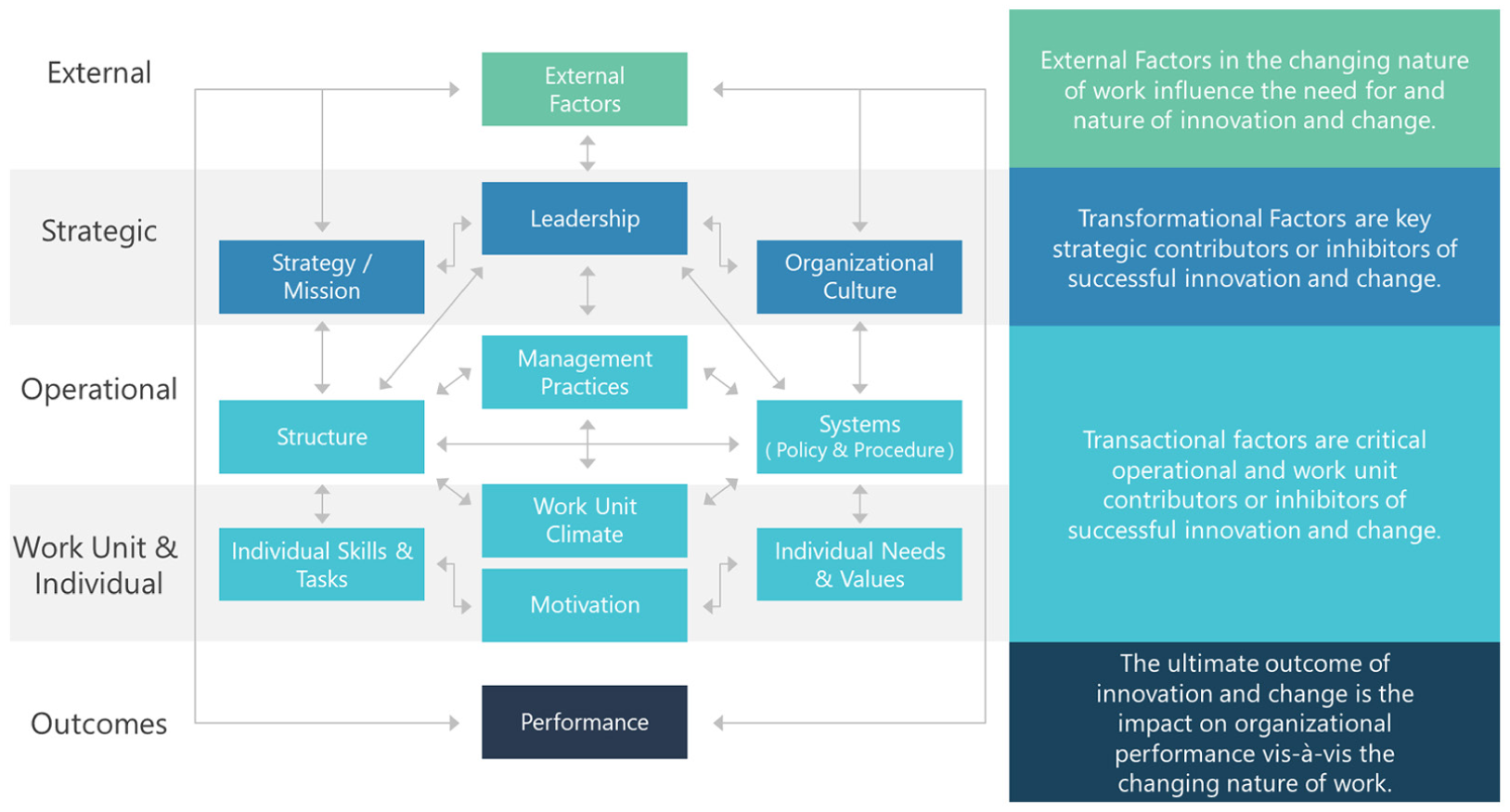
Conceptual framework for analysis of innovation in rural-serving community colleges.
External Factors
Every organization exists in a broader ecosystem of social, economic, political, and competitive forces (Burke, 2018; Pfeffer & Salancik, 2003). Government regulations, local and global economic conditions, changing technologies, and shifting demographics are just a few of the myriad external factors that impact organizations (Burke, 2018). The Burke-Litwin model (1992) integrates these external factors into the analysis of organizational change and performance as critical influencers of both transformational and transactional actions. The model aligns with other organizational change research, insomuch as it acknowledges that change can be planned or unplanned, proactive or reactive, driven by internal or external forces, first-order evolutionary or second-order revolutionary, depending on the nature of and intensity of external factors which impact the organization (Burns, 1996; Kezar, 2001; Levy & Merry, 1986; Rajagopalan & Spreitzer, 1997). Just like any organization, rural-serving community colleges are susceptible to shifts in the external environment.
Strategic Factors
The factors considered transformational in the Burke-Litwin model include mission and strategy, leadership, and organizational culture (Burke, 2018; Burke & Litwin, 1992). An organization’s enduring purpose, or reason for being, is conveyed in its mission statement (Ayers, 2005, 2015; Pearce & David, 1987). The approach it takes to accomplish the mission is captured in its strategy (Burke, 2018). The concept of vision often accompanies mission and strategy; the vision conveys an organization’s aspirations for the future and desired outcomes (Burke, 2018). Alongside this institution-level work, the external environment influences an organization’s mission, vision, and strategy, and inversely, an organization’s analysis of the external environment is influenced by what is relevant to its mission, vision, and strategy (Burke, 2018; Porter, 1985). As publicly controlled organizations with a prescribed mandate and mission, rural-serving community colleges must consider their core mission when interpreting external factors and shaping their vision and strategy. Evidence suggests that executive-level leaders significantly influence organizational change and that change requires the support of the executive level leaders (Burke, 2018; Yukl, 1998; Zaccaro, 2001). Understanding how leaders seek to innovate is central to the change process (Dyer et al., 2008, 2009, 2019). Five discovery skills are linked to strong innovation: associating, questioning, observing, networking, and experimenting (Dyer et al., 2008, 2009, 2019).
Operational Factors
The factors considered transactional in the Burke-Litwin model include management practices, structure, systems, work unit climate, and motivation (Burke, 2018; Burke & Litwin, 1992). In the Burke-Litwin model, structure refers to the arrangement of organizational functions (e.g., accounting, human resources) and operational units (e.g., unique service teams, geographic sites) that delineate areas of responsibility, lines of communication, decision-making authority, and relationships involved with implementing the organization’s mission and strategies (Burke, 2018; Burke & Litwin, 1992). Structural silos and boundaries that prevent collaboration and communication, as compared to cross-functional teams and matrix organizations, are issues of structure that impact organizational change (Burton et al., 2015; Galbraith, 1971). Leaders of rural-serving community colleges may experience organizational structures that inhibit or facilitate effective organizational change and innovation. The Burke-Litwin (1992) model refers to management practices as the daily behaviors of managers directed at implementing the organization’s mission and strategies. Effective execution is driven by effective management (Dyer et al., 2008, 2009, 2019); therefore, rural-serving community college leaders must foster managerial excellence as a contributor to the effective execution of organizational change and innovation.
Work and Individual Factors
The Burke-Litwin model (2018) refers to climate as the “collective perceptions of members within the same work unit” (p. 235). It incorporates perceptions of supervisory quality, expectation clarity, recognition equity, decision-making accessibility, fairness of performance standards, sense of support from peers, and perceived quality of cross-unit collaboration (Burke, 2018; Burke & Litwin, 1992). More favorable perceptions of work unit climate, especially those that foster trust, are correlated with lower turnover, higher employee engagement, and higher performance (Zak, 2017). As rural-serving community college leaders approach organizational change and innovation, the work unit’s climate may inhibit or contribute to success. Motivation references the desire to take action toward a goal, positively affiliate with others, and achieve a level of power or accomplishment (Burke, 2018; McClelland, 1961). Factors such as job-person match and congruence between the organization’s goals and values with the individual’s needs and values impact workplace motivation (Burke, 2018; Katzell & Thompson, 1990).
Outcomes
Outcomes of organizational change center on performance (Burke & Litwin, 1992). A primary success metric of community colleges has evolved from enrollment to completion to labor market outcomes, resulting in many institutions deepening their engagement with industry (Bailey, 2015; Wyner, 2014). As opposed to educational outcomes measured by access or with the hope of employment after graduation, many community colleges are integrating employers into skills mapping, curricular design, work-based learning and on-the-job training via internships and apprenticeships, extracurricular engagement such as mentoring and field trips, as well as donations of funds, equipment, facilities, or faculty to support instruction (Wyner, 2014). To this point, many winners of the coveted Aspen Prize for Community College Excellence were recognized for uniquely responsive degree and non-degree programming that supported relocation or expansion of industry supported by the community college (The Aspen Institute College Excellence Program, 2025; Wyner, 2014). Industry partnerships may occur with large individual employers, employer consortiums, workforce development system partners, unions, or management organizations (Scott et al., 2018).
Methods
A qualitative approach using case study methods best aligned with addressing the research questions in this study, as this form of inquiry centers on questions that ask how or what in seeking an in-depth exploration of a topic. Merriam (1998) reviewed five assumptions of qualitative research. The researcher is primarily concerned with the participants’ perspectives versus their own, and the researcher is the primary instrument for data collection and analysis done in the field. Next, the research allows for theme construction via observations. Finally, qualitative research is descriptive in nature and uses the participants’ own words to support the findings of the study.
A distinctive feature of case studies is the bounded parameters of the cases (Yin, 2018). “By concentrating on a single phenomenon or entity (the case), the researcher aims to uncover the interaction of significant factors characteristic of the phenomenon” (Merriam, 1998, p. 29). In this study, the phenomenon of interest was how rural-serving leaders identified as innovative helped foster innovation and change on their campuses. The boundaries of the overarching case included rural-serving community colleges with leaders who were identified as innovative. Each president represented an embedded case within this larger collective. Using a heuristic approach presents the reader with a way of understanding the process of the this case. When readers interpret the case study, they have a particular population in mind and can extrapolate their understanding to that population (Stake, 1995), which can help spur additional research on rural-serving community colleges. The use of Burke and Litwin’s (1992) theoretical framework of organizational performance and change makes this an interpretive case study (Merriam, 1998).
The main researcher on this study was a community college vice president at the time of data collection. His positionality provided an informed way to situate the stories of the participating presidents, and it also required him to bracket his own experiences to not insert his personal perspectives onto the stories the participants shared (Thomas & Sohn, 2023). By setting aside personal biases and assumptions, the stories of the participants emerge in their own voice (Tufford & Newman, 2012). The other researchers involved research and study community colleges and their leaders.
Recall, the overarching research question for this study: How do innovative rural-serving community college presidents empower their institutions to address factors that impact innovation and adaptation aligned with the changing nature of work? A set of sub-questions for this study focused the researchers on how the presidents were keeping abreast of changes in the nature of work. This research focused the researchers on how innovative presidents used a range of strategies to influence innovation on their campuses, and to uncover what informed the ways the presidents sought to guide their campus forward. The sub-research questions included:
How do innovative presidents monitor and interpret the changing nature of work on behalf of their institutions?
What strategies did these presidents employ to influence innovation on their campus that aligns with the changing nature of work?
What principles and concepts guided innovative presidents as they led organizational change?
Data Sources
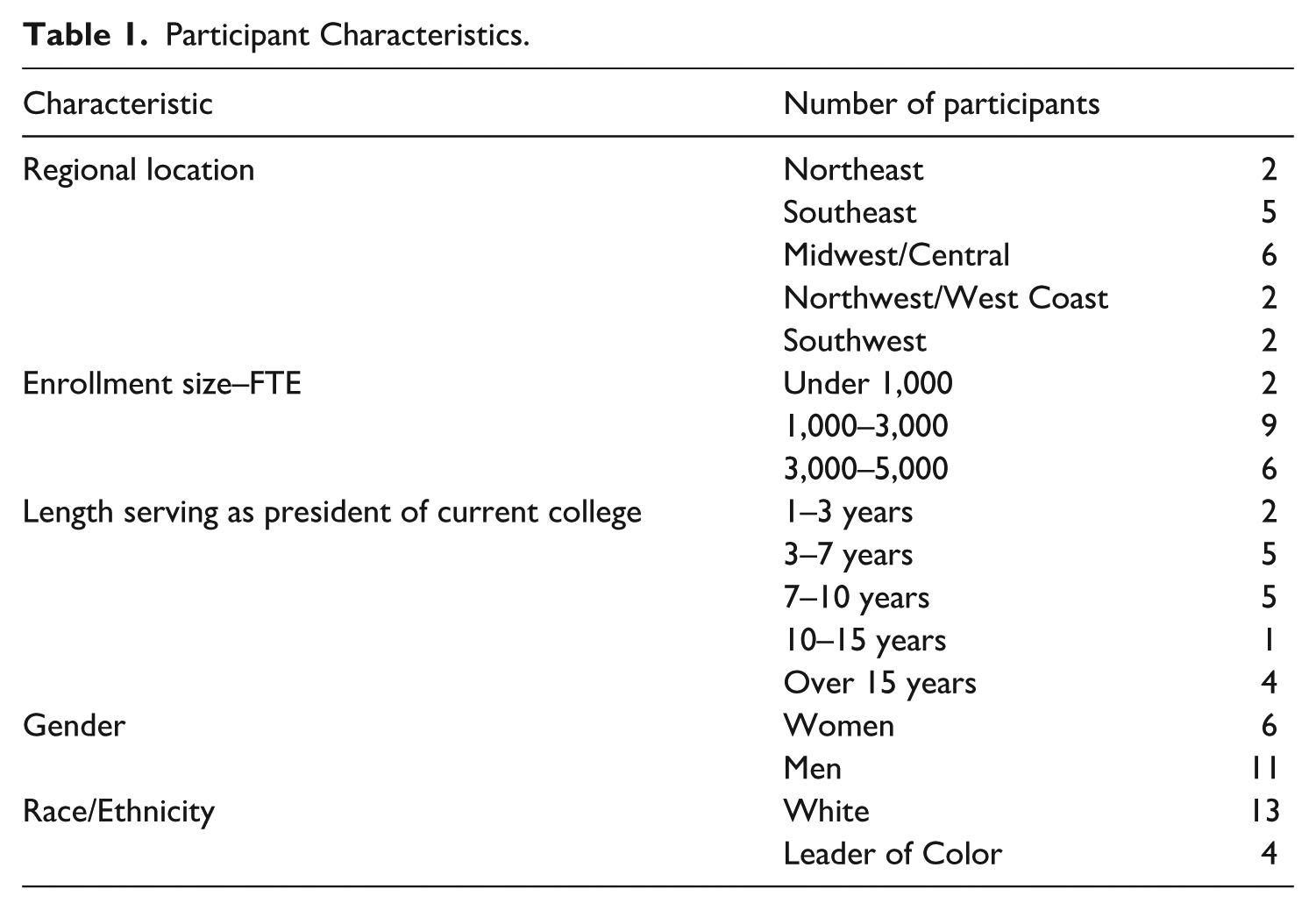
Purposeful, criterion-based sampling was used to identify research participants. Participants for the study had to meet three criteria. First, they had to be presidents of publicly controlled, open-admission, rural-serving community colleges, as indicated by inclusion in the Alliance for Research on Regional Colleges (ARRC; 2022) database of rural-serving postsecondary institutions. Second, they had to have at least five years of leadership experience in a rural-serving community college, either in their current capacity or some other leadership capacity. No minimum tenure as president was required. Third, eligible participants must have demonstrated an ability to lead their institution through an innovative organizational change, as recognized by thought-leading institutions such as the Achieving the Dream, Ascendium, The Aspen Institute, Belk Center for Community College Leadership and Research, Community College Research Center, or National Center for Inquiry and Improvement. Participants were recruited through referrals from these nationally recognized organizations, which identify, reward, and study innovative rural-serving community colleges and their leaders. Seventeen rural-serving college presidents participated in this study. Table 1 outlines the participants’ characteristics.
Participant Characteristics.
The researchers employed a semi-structured interview format in the data collection process. A semi-structured interview guide incorporated a sequence of open-ended questions targeting specific, consistent data from each interviewee but was used flexibly to allow for unexpected themes and ideas to emerge from respondents (Merriam & Tisdell, 2016). Interviews occurred online via Zoom, one-on-one, and lasted 60 to 90 minutes. The average interview lasted 85 minutes. A total of 1,445 minutes of one-on-one interviews were conducted. Interviews took place between November 2022 and February 2023.
Analysis and Coding
Data analysis followed Creswell and Creswell’s (2018) recommended procedures. Prior to the termination of data collection, simultaneous procedures for data analysis were used, even while the interview was happening, to note themes or connections for further probing and clarification or connections. Following the termination of data collection, five phases of analysis were implemented. First, data were prepared and organized for analysis by ensuring interview notes and audio recordings were transcribed, checked for accuracy, saved in Word processor format, and imported into Atlas.ti qualitative data analysis software. A third party was contracted to compare automated transcripts with actual recordings to ensure accuracy. Second, all data were reviewed, scanning for “overall depth, credibility, and use of the information,” noting general thoughts in Atlas.ti (Creswell & Creswell, 2018, p. 193). Third, data were coded, which entailed noting, color-coding, and organizing categories and themes in Atlas.ti (Rossman & Rallis, 2012). A priori coding and open coding were used in the analysis. A priori coding occurred by applying pre-defined codes based on the theoretical framework. Open coding occurred by identifying additional concepts within or outside of the theoretical framework that emerged in the data. Fourth, codes and themes were described and defined in detail, “supported by diverse quotations and specific evidence” (Creswell & Creswell, 2018, p. 194). Fifth, interrelating and major themes were compiled and described in narrative form (Creswell & Creswell, 2018).
Findings
The first section of the findings provides a profile of the participants. This information helps set the context in which each of the presidents worked to innovate and links this context to the future of work. The second section summarizes how the participants defined effective innovation and identifies key challenges the presidents faced in leading change. The third and fourth sections review the transformational and transactional factors that the participants leveraged in implementing innovation on campus. The final section discusses adaptive strategies the leaders used.
Profile of Rural Context
Institutions led by presidents in the study had an average 3-year graduation rate of 38%, approximately nine percentage points higher than the national average of 29% for public 2-year institutions at the time of this research (National Center for Education Statistics, 2021). Students served by the institutions represented were predominantly low-income, with six out of 10 students receiving the Pell Grant, averaged across all institutions. The Economic Research Service (2019) classifies regions based on poverty levels, employment and education; 8 of the 17 institutions were designated as low education, low employment, persistent child poverty, persistent poverty, or population loss. The institutions represented in this study were more racially and ethnically diverse than the national rural population and perhaps reflective of the younger rural population being more diverse than the older adult population (Johnson & Lichter, 2022). The institutions ranged in enrollment headcount from 700 to 6,750 and spanned full-time equivalent (FTE) enrollment from 400 to 4,375. On average, the institutions had an enrollment headcount of 3,964 and FTE enrollment of 2,394. Full-time equivalent employees ranged from 94 to 683, with an average of 325 FTE employees.
Defining Effective Innovation and Challenging External Factors
Innovation and change are not inherently beneficial, and the leaders in this study made a point of distinguishing between innovation and change for its own sake versus innovation and change that truly advances the mission of the college. One president summed up this distinction: Innovation is always about changing the outcomes that really need to be addressed. . .I love innovation. . .but if I’m doing that for the fun of it or because I can, but it’s not impacting the change that’s really necessary, then it’s not effective innovation.
The vision of the campus can be achieved when innovation is focused on excellence at the college and building systems to support achieving the college’s core mission to better service students and communities. While some presidents had technology at the center of innovation on campus, not all had this focus. “By innovation, I don’t always think robotics, automation, or digital; sometimes innovation means responding to the needs of students,” explained one president, who instead emphasized that change on their campus was about serving students in new and novel ways that may or may not include technology.
A subset of presidents, however, did have disruptive technologies and business models at the center of their innovations. Here, the presidents conducted regular research into new technologies and experimented with pilot programs. According to one leader, remaining competitive in the marketplace included helping “local employers understand, ‘Here’s what’s coming that you need to be prepared for.’” By staying a step ahead of the curve for employers, the leaders were driving change to help them remain competitive in the marketplace and to support local businesses.
The presidents identified three challenges of staying current with changes in the external environment that affect students, communities, and institutions. These included the pace of change, the unpredictability of change, and the tension of addressing urgent internal campus dynamics while staying engaged in external dynamics – especially prevalent during the COVID-19 response. One president offered, “This job has changed in the last five years. I need to know more and devote more time to staying current on disruptive technologies and industry trends that affect our service area.” Doing this type of scanning took the leaders more time. With the recent onset of use of AI tools, leaders today may find that some of the disruptive technologies affecting their support for local business are also tools they can use to help address the challenge of the pace of change. Like the COVID-19 pandemic, the unpredictability of recent changes regarding AI creates ambiguity and requires leaders to focus on framing processes and supporting learning for their internal stakeholders.
Strategies to keep themselves, their team, and their institution informed of external dynamics, including the changing nature of work, included regular reading, engaging the data, activating a network, pursuing professional development, and observing industry practices. Engaging in different forms of environmental scanning and examining external trends provided a better understanding of their context. Presidents referenced labor market data, demographic data, and K12 data for key insights with which to plan. For example, several presidents cited declining K–12 populations and demographic shifts in rural areas that require enhanced efforts to reach prospective student populations currently unserved, such as adults above 24 years old, ethnic minorities, low-income, first-generation, male, and justice-involved individuals. The presidents focused on these groups of students to address the demographic shifts, and it was unclear how much of this attention was also aligned with intentions to address equity-gaps. Like leaders of other institutions of higher education, the leaders of rural-serving community colleges were dealing with repercussions of the pandemic. One president reflected, “We are contending with two to three years of lost learning due to the pandemic that will affect us. This complicates the successful transition from secondary to postsecondary.”
Finally, the presidents discussed how they experienced the political and cultural divides that have ratcheted up over the last several years. The presidents noted how they dealt with some of the political turmoil in their areas. One leader simply stated, “This partisan divide. . .has impacted rural communities.” This same leader reviewed how they spoke about good jobs and opportunities for community members, and how the college could help bridge some of the political divide by finding common ground that helps community members succeed. The presidents offered how they used neutral language, for example, “instead of talking about equity gaps, we talk about opportunity gaps and we talk about employability gaps.” Avoiding trigger words and coming up with other language to avoid political conflict was a strategy the leaders employed.
Transformational Levers for Change
Presidents in the study provided extensive commentary on the relevance of mission and strategy, leadership, and organizational culture as factors of change and innovation in the rural-serving community college. An articulated strategy catalyzes organized action, prioritization, and innovation in which experimentation plays a critical role in strategic innovation. The community college mission extends beyond access and completion of a postsecondary credential to the end goal of economic opportunity and mobility. Advancing a mission of economic opportunity and mobility provided a framing mechanism for the presidents. According to one president, “The credential is not the end game anymore. The end game is a job with a good-paying wage, a family-sustaining wage that allows for economic mobility.” Another participant added, “For 40% of our students, we are the pathway out of poverty.” These comments reflect a vision that presidents found helped unify internal and external stakeholders across political lines and differences.
The presidents leveraged the strategic planning process to launch innovation on campus. Broad inclusion of stakeholders in the planning process helped build buy-in and provided transparency during the process. One president even developed a “stop doing this list” along with a “strategic priorities” list to sharpen his team’s focus. Having a unifying vision for how to organize improvement and innovation provided a blueprint for change. Regular communication helped make sure the strategic plans were living and active documents. One president reported, “It was important everybody was speaking the same language. Most of our staff knew the major tenets of our strategic plan, and they were excited about it.” Moving from planning to action proved critical for innovation to occur. Most presidents saw the value of pilots and experimentation, yet they also noted that it was important to think ahead about the ability to scale up the pilot.
All the presidents in the study emphasized the need for strong leadership at all levels of the organization to drive effective innovation and change. Overall, a set of 10 manifestations of leadership emerged as critical contributors to effective innovation and change in the rural-serving community college: 1) discovery–regular reading, review of data, developing a network, professional development, observation of other industries; 2) sifting–“to sift [the ideas] out there, and distill [them] down to something that is most impactful within the resource limitations you have”; 3) safety–constructing an environment in which employees felt safe and not afraid to try new things; 4) healing– “when someone hurts, the president plays a role in helping the healing process” such as following a tragedy, natural disaster, or amidst a pandemic; 5) trust–trust precedes innovation, “If they don’t trust you, you're not going anywhere”; 6) visibility–having a presence on campus to build relationships, keep a finger on the pulse, and being available; 7) communication–consistent, transparent, frequent, and clear communication; 8) alignment– “I think you can empower people to learn to lead from wherever they are within the organization”; 9) barriers–removal of barriers to create conditions for change to flourish; 10) advocacy–being an advocate outside the college through participation in community events and being the face of the college to garner support for change efforts. Leading change for innovation requires a multi-prong approach.
Recognizing the role of culture proved critical to successful innovation. One president summed this up, “We have built a culture of innovation, it is the ethos of the institution, and there is a working-class underdog spirit, so there is typically excitement about continued innovation.” Building an effective culture meant for some of the presidents the need to address dysfunction in the historical culture of the college and hiring the right people for the right roles. Given the importance of the contribution of all campus members to innovation, the role of each employee matters – from the president’s cabinet to the front lines of student engagement and campus maintenance. Once people were in place, the presidents could leverage their individual strengths to shape culture and impact innovation, and having an inclusive culture helped this process. Presidents in this study had a strong value for taking action toward needed adaptations and innovations that would better serve their students and communities. Celebrating innovation and having fun in the process contributed to a culture ripe for innovation. How the presidents spoke of failure mattered. As one president offered, “I would rather have somebody trying to make change and do something wrong–who we needed to redirect and correct–than to have people who just are afraid of change.” This approach connects to the concept of safety discussed above. Knowing that changing culture takes time, the presidents needed to be realistic about the timeframe from culture building to change initiation to results. “It took time to build momentum. . . Even then, it wasn’t a light switch. . . . There were varying levels of support for change over time,” explained one president. Taking the time to build relationships and trust contributes to a healthy campus culture.
Transactional Levers for Change
Presidents in the study identified myriad factors inhibiting and contributing to innovation and change related to institutional structures, systems, work unit climate, management practices, and motivation. A strong reciprocal relationship with mission, strategy, leadership, and organizational culture underlay many of these factors. The common theme across responses was the imperative to continuously assess and address a range of issues preventing effective innovation in the service of students, the community, and the institutional mission.
Elements of structure concurrently enabled and inhibited innovation and change. Organizational hierarchy and operational silos served to slow down innovation, as conveyed by one president, “There really wasn’t a big emphasis on. . .cross-department collaboration and working together.” Making their colleges flatter in reporting structure, creating cross-functional teams, and eliminating the credit versus non-credit divide helped the presidents support change. Bringing groups together on campus helped seed the transfer of ideas across the college. Moving to virtual meetings helped address connecting across the large service areas in which many of the rural-serving colleges were located, which required upgrading technology on campus. The systems at work at the college related to policy and procedures also required attention. Updating outdated internal policies, such as flexible work arrangements to attract and retain talented college employees, was a step toward removing barriers.
Governance structures at the colleges varied, yet a common element noted by the participants was the need to nurture board relationships. As one president said, “Feed and care of the board is job number for the president,” and another added, “Colleges move at the speed of their governance.” Fourteen of the 17 participating presidents operated within a state system of community colleges. This organizational relationship helped the rural-serving colleges with lobbying efforts, provided access to system dashboards that provided benchmark data, and opened access to shared resources. The flip side of being in a state system was noted by one president who offered, “There are efficiencies operating in a system,. . .but it can slow our ability to change and do things that need to be done due to greater oversight and more steps required.” The added layer of bureaucracy and approvals often proved challenging to jumpstarting innovative practices.
Seven of the 17 (42%) presidents in the study led a campus with unions. A linchpin on these campuses was defining workload for faculty and the need to compensate faculty for duties beyond teaching (e.g., supporting recruitment, professional development). Connected to this issue was budget and salary market values, given the need to recruit faculty in high need areas such as nursing that required differentiated salaries versus strictly following union job steps. On all campuses, budgetary constraints slowed innovation and change. Presidents became creative in seeking alternative funding sources from industry, private philanthropy, and grants.
There was consensus among the presidents in this study that the work unit climate is critical to fostering innovation across the organization, not just from the top. One president summed this up succinctly, “A positive work climate is absolutely essential to organizational change.” Some of the presidents conducted climate surveys to assess opportunities to enhance working conditions, noting that critical to this work was actually addressing the challenges brought up in the survey instruments. To support and enhance climate, on the one hand, the presidents invested in developing mid-level managers and supporting champions. On the other hand, they deprioritized coworkers against virtually everything (CAVEs) and worked to channel healthy skeptics of change. One president reflected, “You’re going to have people who are a hard no. . .and then you have people on the other side. . .and then you have a lot of folks in the middle.” A key strategy to address resistance, according to several presidents, is to empower the champions of change (the early adopters) to sway those in the middle, who can be positively influenced by examples of success. The presidents tapped into a range of motivation strategies to achieve buy-in and found that developing trust first served as a foundation for motivating others to change. When the goals of the change and those of campus members aligned and when campus members felt they had agency in the process, they were more motivated to get behind the proposed changes.
Gauging the timing and pace of change was also critical to success. One president in the study noted being intentional when during the academic year they announced change initiatives, finding that January usually garnered the best response with the highest level of energy and focus versus any other point in the year. The leaders sought to avoid initiative fatigue by proactively monitoring the volume of change and general energy of employees amidst other internal and external pressures, which required active listening and engagement with employees.
Central to the work of change was building trust, which contributed to motivation to engage in innovation. Presidents built trust by displaying humility and integrity and being transparent and open. They communicated the core value of highlighting that the work was in service of students. Showing how the campus staff shared first-generation status with many of the students they served built affinity and motivation. Next, setting goals and measuring success helped campus members see the outcomes of their efforts. One president shared, “We set the bold goal of doubling our completion rate within five years. That became the central metric and the goal toward which all other goals throughout the organization aligned.” Importantly, this campus achieved this goal after extensive innovation and change efforts. By communicating successes and accomplishments of campus members, the presidents built momentum for their change efforts.
Adaptive Strategies for Innovation
The need for adaptation was central to innovation. This research study identified seven categories of adaptation that emerged for all the presidents: 1) better reaching underserved student populations; 2) shorter stackable credentials; 3) flexible convenient scheduling; 4) whole student understanding and support; 5) tighter linkage to employment and entrepreneurship; 6) adoption and promotion of current technologies; and 7) continuous monitoring and experimentation of new models. Many of these factors affect all community colleges, and the rural location of the campuses showed nuance in how the identified areas were addressed. Table 2 outlines how the participants noted their use of the seven adaptive strategies for innovation within their rural context.
Adaptive Strategies for Innovation.
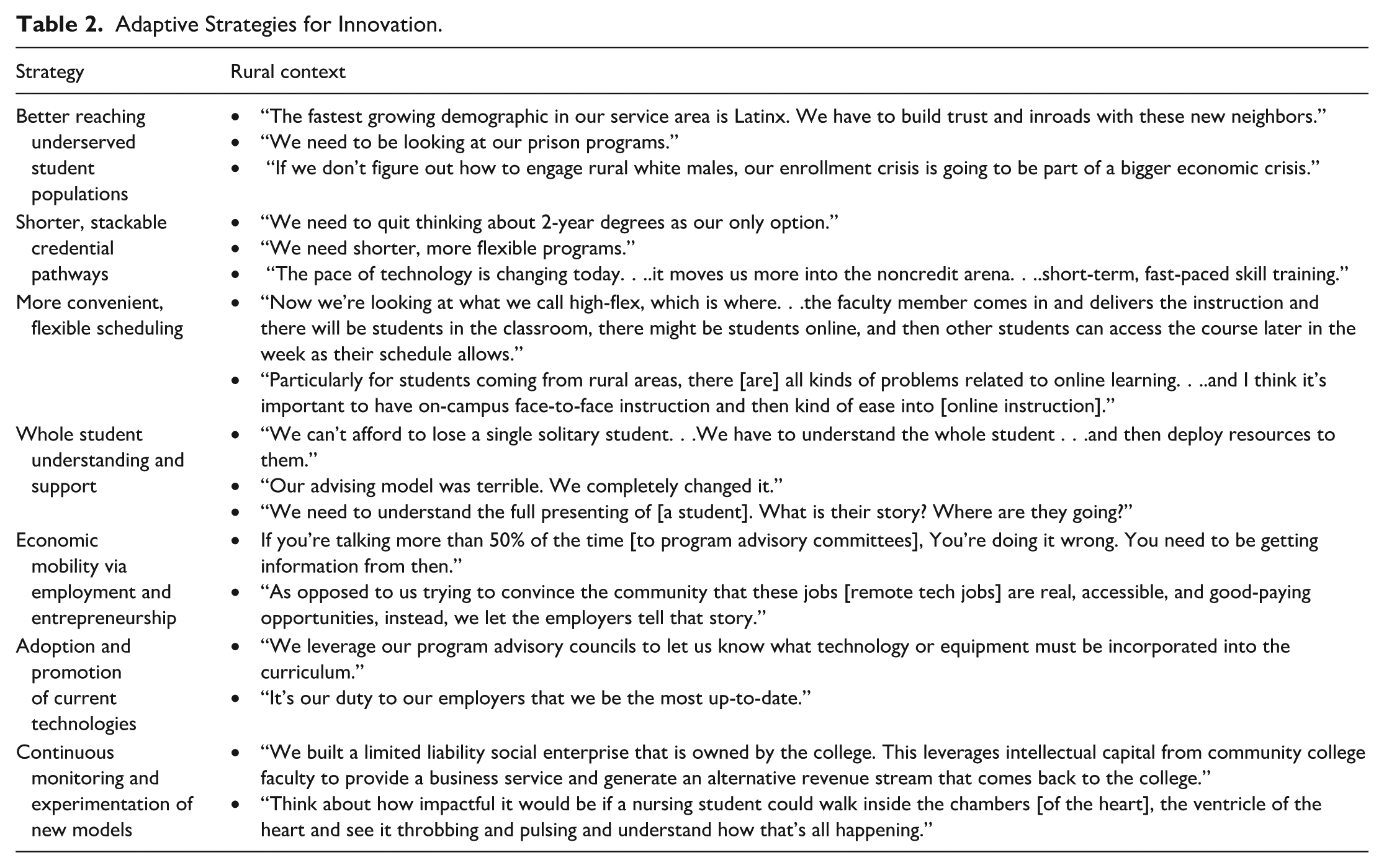
In rural areas, there are lower college-going rates, and the presidents discussed their work to reach the untapped talent in their regions who would benefit from attending their community college. Some were looking to engage growing Latinx populations in their region, tapping into prison education programs, building a stronger pipeline among high school graduates to college, and drawing from local military bases, to name a few. Moving to stackable certificates provided onramps for students and helped them obtain direct employment. Mixing non-credit and credit was central to thinking about this form of stacking. Hand-in-hand with stackable programming is flexible scheduling. Rapidly changing technologies and task composition of jobs require shorter, stackable credential pathways that allow students to enter and exit postsecondary with a meaningful credential aligned to labor market demand as efficiently as possible.
Addressing the whole student in rural areas takes on heightened importance given lower enrollment numbers; as one president argued, “We can’t afford to lose a single solitary student.” An increasing number of working, caregiving adults in need of additional postsecondary education requires scheduling options that are convenient and flexible, leveraging technology and individualized timing, pacing, and support. Some strategies to help support students focused on improving advising on campus, increasing student housing options, providing on-campus childcare, and establishing a food pantry.
Strategies to help tighten links with employers and develop entrepreneurship opportunities were critical, according to the leaders in the study. Directly working with employers in the region helped local industry address workforce needs and customize training. Here, presidents noted how the key to success was listening to what employers needed versus trying to push existing programs. Learn-and-earn models, such as apprenticeships and other programs, aided employer’s needs and supported financial stability of students. Sometimes, the students were learning on technologies that were ahead of what employers had, which helped drive change. Tapping into advisory boards helped with aligning programs to employer needs. Finally, pilot testing of programs helped campus leaders quickly learn what would work, what needed tweaking, and what simply didn’t work.
Summary
Strong leadership is critical at all levels of the organization – not just at the presidential level – to drive effective innovation and change. The presidents who participated in this study described organizational culture as a powerful factor enabling or inhibiting effective innovation and change. By setting bold goals and establishing a positive work climate, the presidents in the study began to shape the organizational culture of their colleges. They were strategic in their announcements of new initiatives and were realistic about the timeframe required to change culture. The existing structural arrangement of the community college may enable or inhibit effective innovation and change aligned with the changing nature of work, and important considerations to catalyze change include addressing issues in organizational hierarchy, operational silos, facilities overlap, staffing capacity, operating schedules, geographic distance, and technological barriers.
Internal and external systems of policy and procedure impact a rural-serving community college’s ability to drive innovation and change. Internal policies, local governance, regional accreditation, state systems, budget, and unions all influence outcomes. Work unit climate is critical to fostering innovation across the organization. Work unit climate has a reciprocal relationship with management practices, individual motivation, and organizational culture. Continual monitoring of the state of work unit climate is important; various instruments and responses may be adopted successfully. As well, the quality of management and supervisory roles throughout the institution impact design and implementation of innovation and change. The importance of developing managers, supporting champions of change, channeling healthy skeptics of change, timing and pacing of change, and execution of innovation and change are important considerations.
Individual and collective motivation play a critical role in staying current with the external environment, pursuing the organization’s mission, influencing and implementing strategy, and shaping organizational culture, structure, systems, and work unit climate to be more adaptable and innovative. Practices for sparking and sustaining motivation fell into four categories: trust and motivation, expectancy-value and motivation, goals and motivation, and self-efficacy and motivation. The presidents tapped into a range of strategies to motivate campus members and to jump-start change.
Discussion
This study demonstrated the centrality of vision, external engagement, and organizational culture-building in presidential leadership related to innovation and change. First, the participants embraced an ambitious vision for community colleges. The vision extended beyond access to postsecondary education, which was a founding principle of all open-admission community colleges. The vision also extended beyond equitable completion of a postsecondary credential, albeit an essential prerequisite. The vision extended beyond the college, in fact. The more ambitious vision for rural-serving community colleges embraced by most interviewees was labor market outcomes as the ultimate goal. Labor market outcomes may be achieved through employment, entrepreneurship, or continued education aimed at achieving a thriving income and quality of life. Labor market outcomes may be achieved through a degree or shorter-term credentials, certificates, and diplomas. The throughline of labor market outcomes is economic opportunity and mobility for students and communities served by the institution. This vision of community colleges as a means of economic opportunity and mobility aligns with the literature, community college leadership convenings, and thought-leading institutions in recent years (Corbin & Thomas, 2019; Glasper, 2019; Phelan, 2016; Salomon-Fernández, 2019; Stout, 2022). This common vision for the community college mission drives the degree and nature of engagement in the wider community, state, and national ecosystems and addresses the demands of the external environment.
Second, the presidents in this study remained engaged in the external environment to help inform their perspective on needed innovation and change. Every president in this study emphasized the need to stay connected and current with the external environment and labor market their students would eventually navigate. Each participant referenced some form of benchmarking with other postsecondary institutions to gather promising practices and gauge their institution’s room for improvement. All the presidents in this study invested in regular reading, review of labor market data, cultivation and activation of networks, professional development, and intentional observation in the service of innovation and change aligned with the evolving context into which students graduated and sought opportunity. These practices align with the literature on innovative leaders and organizations (Dyer et al., 2008, 2009, 2019; Phelan, 2016; VanWagoner, 2018).
Third, the participants embraced a style of leadership and organizational culture that enabled innovation and change across the institution to serve students better. They did this by making employees feel safe, included, and supported. They did this by displaying humility and a growth mindset about their own ideas and continuous learning. They did this by intentionally allocating resources, adapting structures and systems, addressing work unit climate, improving management practices, and fostering motivation that enables and empowers innovation and change to better serve students. Notably, the interviewees seemed unified in their view of their own task as leaders: not to preserve an institution in its historical or current state but to ensure it continually fulfills its mission within its evolving environment. These practices align with the literature on leadership and organizational culture related to innovation and change (Cameron & Quinn, 2011; Edmondson, 2019; Ding & Yu, 2021; Kane et al., 2021; VanWagoner, 2018). Despite this alignment of perspective related to vision, external engagement, and organizational culture, there was a differing recognition of the role of technological change among presidents in the study.
The following is a brief analysis of the overall findings. It includes commentary on the usefulness of the Burke-Litwin (1992) model for community college analysis, the centrality of vision, external engagement, and culture in presidential leadership, and variation between presidents in the study regarding awareness of disruptive technologies.
Organizational Performance and Change
The Burke-Litwin (1992) causal model of organizational performance and change proved useful as a theoretical framework for the analysis of community colleges. The framework contributed to the interview protocol and facilitated comprehensive commentary from participants relating to myriad factors that inhibit and enable effective innovation and change. Because the Burke-Litwin model includes external, internal, strategic, operational, transformational, and transactional considerations, it incorporates most dimensions of a given organization as evident in the findings (Burke, 2018). The institutionally comprehensive nature of the model allowed presidents to address determinants of effective innovation and change from multiple vantage points prompted by questions derived from the Burke-Litwin model. The theoretical framework offered a multifaceted, open-systems view of the conditions for effective innovation and change from the vantage point of the institutional leader most responsible for shaping these conditions: the community college president. As noted in the findings, the presidents employed both transformational and transactional strategies to achieve change.
As this study illustrated, the community college is a quasi-governmental, hierarchical bureaucracy while also a nimble, flexible, and diverse arm of higher education. Embracing and enhancing the latter while managing within the former is the task of innovative community college leaders. This study uncovered insights related to external, internal, strategic, and operational factors of innovation and change through the lens of the rural-serving community college president. Every president in this study referenced practices aligned with Dyer et al.’s (2019) five skills of disruptive innovators: associating, questioning, observing, networking, and experimenting. Many of the specific tips and practices promoted by Dyer et al. (2019), such as attending conferences, observing other industries, and cultivating a more diverse professional network, were regular habits of these rural-serving community college presidents. Notably, the pursuit of innovation referenced by these presidents was not driven by breakthrough technologies, albeit commonly enabled by technology. It was driven by the need to better serve evolving student and community needs. This aligns with Christensen’s (1997) adamant claim that breakthrough technologies do not necessarily equate to disruptive innovations. For Christensen (2023), innovation was more about making the service or product available and useful to substantially more people, whether through innovative business models, coherent value networks, or enabling technologies. In this sense, both the philosophy and practice of these innovative presidents align with the originator of the concept and predominant researcher on disruptive innovation over the past 30 years, Clayton M. Christensen (Christensen et al., 2013; Christensen et al., 2018). Presidents were concerned with serving more students more effectively. Sometimes with technology, many times not.
Variation in Awareness of Disruptive Technologies
While there were unifying themes across presidents and institutions represented in the study, there was variation in the degree to which emerging technologies were understood in relation to potential disruptions to middle-skill jobs historically filled by community college students. The literature, taken as a whole, predicts that automation, AI, digitization, and remote work have the potential to dramatically change the prevalence and nature of tasks, jobs, and careers as diverse as healthcare, manufacturing, agriculture, technology, education, retail, logistics and transportation (Abulibdeh, 2020; Frey & Osborne, 2017; Global Workplace Analytics, 2021; Rembert et al., 2021a; Rembert et al., 2021b). Despite evidence for impending disruption, only four participants articulated an understanding or concerted pursuit of understanding regarding emerging technologies and business models that could fundamentally change the community college’s value, role, and approach.
For example, the next generation of general AI for personal and commercial use via chatbots has disrupted education. Generative AI can write essays, summarize books, compose emails, and even generate code (Giannakos et al., 2024). This technology evolution has sparked widespread concern, excitement, and commentary on potential uses and ethical implications for academic and professional life (Cotton et al., 2023; Norton, 2025; Rathore, 2023; Rudolph et al., 2023). No one can predict with certainty the extent and nature of disruption that artificial general intelligence represents. However, disruption is inevitable. In that case, it begs a series of questions and concerns: What proportion of our country’s rural-serving community colleges are prepared with the vision, leadership, organizational culture, and operational elements necessary to adapt on behalf of their students and communities? Is responsive innovation enough, or should institutions proactively anticipate disruptive change and innovate accordingly? If indeed “change happens at the speed of governance,” as one president explained, how can local governing boards be educated on the disruptive change ahead?
Implications for Practice
This study reinforced the impact that presidents, senior leaders, and local governance boards can have on the ability of their rural-serving community college to innovate and adapt to the changing nature of work. According to both the study participants and the extant literature, community colleges have the potential to equip rural residents, employers, and communities to succeed amidst shifting economic, technological, and demographic forces (Friedel & Reed, 2019; Garza & Eller, 1998; Mullin & Winkel, 2019; Salomon-Fernández, 2019). Below are five recommendations for practitioners. Each recommendation contributes to a rural-serving community college’s ability to pursue effective innovation and change in the service of student success and economic mobility.
Evaluate the Scope of Vision
Following the example of the interviewees, community college leaders should evaluate their vision for the institution. Research demonstrates the importance of rural-serving community colleges as catalysts of economic growth and opportunity for their communities (Corbin & Thomas, 2019; Mullin & Winkel, 2019; Salomon-Fernández, 2019). Leaders should assess whether their vision for their community college extends beyond access to postsecondary education and beyond completing a credential to embrace labor market outcomes through employment, entrepreneurship, or continued education aimed at a thriving income and quality of life. By embracing a vision of economic mobility, decision-makers, and stakeholders may develop a clearer criterion for change initiatives and what constitutes effective innovation.
Engage with Others Outside the Institution
Based on the findings of this study, community college leaders should proactively stay engaged outside their institution. Innovation is supported by engaging a diverse network of individuals from varying backgrounds and perspectives in the mutual sharing of ideas aimed at enhancing the community college’s impact on the students and communities it serves (Dyer et al., 2008, 2009, 2019; Phelan, 2016; VanWagoner, 2018). Observing successful and innovative organizations outside of higher education can support innovation (Dyer et al., 2008, 2009, 2019; Phelan, 2016; VanWagoner, 2018). Community college leaders can arrange site visits to innovative for-profit or nonprofit organizations to see and hear firsthand how they deploy technologies, services, products, or organizational culture in ways that may spark ideas for the community college.
Optimize Organizational Culture
Based on examples in this study, community college leaders should evaluate and optimize an organizational culture that enables innovation and change across the institution in the service of student success and mobility. Community college leaders can diagnose the existing culture and determine how it compares with the preferred culture of innovation (Cameron & Quinn, 2011; Phelan, 2016; VanWagoner, 2018). They can foster psychological safety that allows for the introduction of new ideas and trial and error – within reason – without fear of repercussion (Bergmann & Schaeppi, 2016; Edmondson, 2019; Nembhard & Edmondson, 2011). Leaders can support innovation through strengths-based management practices using instruments such as Gallup Strengths Assessment (Ding & Yu, 2021; Rath & Conchie, 2008) and support innovation through cross-functional collaboration that brings together a range of skills, knowledge, and resources from across and even outside the college to solve a problem or pursue an opportunity that advances the college mission (Kane et al., 2021; Page, 2019). By regularly incorporating work-unit climate surveys, leaders can gather employee perspectives that can inform new initiatives, practices, policies, or strategic direction, gauging campus climate and allowing for comparison with peer institutions (Davis et al., 2020).
Enable Execution of Change and Innovation
Following the participants’ example, community college leaders should equip managers to execute innovation and change. The use of Kotter’s model for change management (Kotter, 1996, 2008, 2014; Kotter et al., 2021; Kotter & Cohen, 2012; Kotter & Heskett, 1992; Kotter & Rathgeber, 2006) can provide a staged approach to leading and managing change. The model addresses concerns and tactics the participants mentioned, such as how to manage resistance, empower coalitions as champions of change, accomplish short- and long-term wins, and address structural and resource barriers to success (Kotter, 1996, 2014; Kotter et al., 2021; Kotter & Cohen, 2012). Complementary to the Kotter model, managers can be trained in the four disciplines of execution (McChesney et al., 2012), or 4DX, the model’s short-form moniker. 4DX was the model most widely referenced by the interviewees. The model helps teams overcome the whirlwind of urgent daily work to pursue wildly important goals by acting on lead measures, using a compelling scoreboard, and creating a cadence of accountability (McChesney et al., 2012). Additionally, the salient insight from presidents in the study was the importance of having mechanisms for budget requests from any employee or level of the organization to encourage and support continuous improvement and innovation. This practice pairs well with the change management and execution models proposed above, equipping managers with a means of acquiring needed resources for innovation and change.
Integrate Promising Practices into Leadership Development
Following the examples shared in this study, community college leaders should design intentional leadership development programs that integrate the promising practices listed above. As community colleges face an imminent wave of retirements, creating a strong pipeline of future leaders is critical (Eddy et al., 2019; Gagliardi et al., 2017; Wyner, 2021). Moreover, the leadership skills and organizational capabilities needed to navigate today’s volatile, uncertain, complex, and ambiguous environment may differ from those needed for success in the past (Eddy, 2009; Eddy et al., 2019; Eddy & VanDerLinden, 2024; Moldoveanu & Narayandas, 2019). The shifting circumstances of the community college, especially rural-serving institutions, require new leadership competencies and new approaches to leadership development (Amey, 2021; Boggs, 2003; Eddy et al., 2019; Milliron et al., 2003; Thiede et al., 2017). The findings from this study inform four helpful design objectives for future leadership development programs. Making leadership development available to every community college employee distributes leadership throughout the college. Growing evidence suggests that community colleges can no longer assume senior talent will come from a linear progression through the hierarchical ranks (Eckel et al., 2009; Garza Mitchell & Amey, 2020); therefore, leaders must be developed across the organization. Leadership development programs should incorporate the experiential application of learning. The application of learning supports skills acquisition and capabilities not typically applied on the job following a professional development event (Moldoveanu & Narayandas, 2019).
Implement Adaptive Innovations
Following the advice of presidents in this study and prior research, community college leaders should consider implementing adaptive innovations aligned with the changing nature of work. While the nature and nuance of innovations at each institution may vary, there are clear areas where change is urgently needed. Community colleges must better reach underserved student populations to maximize the available human capital for employers and economic opportunity for residents (Fuller et al., 2021; Grawe, 2021; Hetrick et al., 2021; Korzenik, 2021). Shorter, stackable credentials should be developed to facilitate successful entry and exit from postsecondary pathways aligned with the constantly changing nature of work (Austin et al., 2012; Bailey & Belfield, 2017; Ganzglass, 2014). Also, more convenient, flexible scheduling should be implemented to reach prospective students who may be working adults, caregivers, or who may otherwise need to access postsecondary education during nontraditional hours (Breeden et al., 2022; David et al., 2013; Goldrick-Rab et al., 2017; Nolte, 1992; Smith, 2016).
Adoption and promotion of current and emerging technologies should be pursued by community colleges to help students compete in the labor market, support employer needs, or develop relevant entrepreneurial ventures (Autor & Salomons, 2018; Koricich et al., 2018; McKay et al., 2019; Muro et al., 2017; Rembert et al., 2022a; Wells et al., 2019). Amid a rapidly changing technological, economic, competitive, and demographic environment, community colleges should continuously monitor and experiment with new models that ensure relevance and mission fulfillment in the future of work and postsecondary education (Phelan, 2016; Salomon-Fernández, 2019; VanWagoner, 2018). (See Barricklow and Jaeger (2025) for a more detailed breakdown of adaptive innovations to prepare for the future of work.)
Conclusions
Several conclusions emerged from this research study. First, rural-serving community college leaders were able to support innovation on their campus due to their attention to campus culture, relationship building with local employers, heightened awareness of labor market trends, attention to strategic priorities, and by tapping into collective leadership within their institutions. Clear and constant communication helped with campus sensemaking around innovation initiatives, as did the reliance on data to better understand student experiences and student outcomes.
Despite the innovations occurring on campus, this research found that most of the participating leaders engaged in first-order change versus second-order change. The majority of presidents in this study focused on first-order, incremental change, and sustaining innovations; only a few were thinking beyond and assessing second-order, transformational change and disruptive innovations that may be required of rural-serving community colleges in the not-too-distant future. If this group of study participants is among the most innovative in the United States, the lack of second-order change in practice raises concerns about the extent to which other, presumably less proactive, innovative rural-serving presidents and institutions will fare in the future.
Elements of the Burke-Litwin model of organizational performance (i.e., external environment, strategic factors, management practices, work and individual factors, outcomes) were evident on the 17 community colleges included in the study, and the participating leaders used a range of levers to advance innovation on their campuses. In particular, the leaders leveraged the strategic planning process to support their change initiatives, paid attention to external trends, and understood what motivating factors spurred campus member involvement.
Rural-serving community college leaders must invest time in discovery, which includes discovery via questioning, discovery via observation, and discovery via implementation. Successful change requires leaders to have the courage to challenge the status quo, to have the ability to synthesize novel ideas, and to find ways to institutionalize innovative ideas. When leaders question long-held assumptions about campus operations and processes, second-order, deep change can occur that fundamentally alters how rural-serving community colleges can innovate to meet future workforce needs that support both economic mobility and living wage jobs for students.
Footnotes
Acknowledgements
None

Ethical Considerations
This study was approved by the University of Southern California’s Research Ethics Committee. All participant provided written informed consent prior to participating. No individual information is presented in the manuscript, thus separate consent for publication was not applicable.
Funding
The authors disclosed receipt of the following financial support for the research, authorship, and/or publication of this article: The manuscript writing was supported by the Belk Center for Community College Leadership and Research.
Declaration of Conflicting Interests
The authors declared no potential conflicts of interest with respect to the research, authorship, and/or publication of this article.
Data Availability Statement
Data are available upon request, and qualitative data are included in the manuscript.