






Abstract
Objective:
This study investigates the perspectives of faculty, administrators, and counselors on a mathematics reform that eliminated most remedial mathematics classes at a Hispanic-serving community college in California.
Methods:
This study uses qualitative analytical methods to examine interviews with nine mathematics faculty and 10 administrators, counselors, and professional development leaders at the college. Institutional statistics showed that overall mathematics enrollment fell, and course failure rates remained consistent before and after the reform. Interviews were analyzed using an iterative qualitative method to generate themes organized by participants’ institutional roles.
Results:
The stakeholders’ experience of the reform differed by role. Non-instructional staff highlighted the reform’s success, focusing on the metric of throughput. Instructional faculty expressed frustration with the reform and primarily focused on course pass rates and students’ level of preparation. Throughput, a metric the state used to assess the reform, improved.
Conclusion/Contribution:
We discuss implications in relation to how the reform effort shifted the institutional mission, and how this Hispanic-serving community college serves its students.
Keywords
Introduction
Community colleges provide wide access to higher education, yet many students who enroll in these institutions begin their coursework in remedial classes that do not offer college credit. Such students often do not complete the transfer-level courses necessary for a bachelor’s degree (The Campaign for College Opportunity, 2018). Minoritized students from Black, Latine, and Indigenous communities 1 are disproportionately affected by remedial mathematics course placements, which may discourage them from advancing to transfer-level mathematics courses (Attewell et al., 2006; Hern et al., 2020). In the past decade, policy makers in multiple states including Texas, Florida, and Tennessee have changed the way students at community colleges are placed into their initial mathematics classes, with the goal of decreasing remediation (Brower et al., 2018; Mangan, 2019; Park et al., 2018).
In 2017, the state of California passed Assembly Bill 705 (AB 705), a law that changed placement policies for California’s community college students in English, English as a second language, and mathematics by requiring all students to complete a transfer-level mathematics and English class within one year of enrolling. AB 705 (2017) authorizes community colleges to mandate concurrent support enrollment (co-requisites) if it “will increase [students’] likelihood of passing” the transfer-level course. In this paper, we present findings from a study that investigated the impact of mandated changes in mathematics placement at a Hispanic-serving institution 2 (HSI) community college in Southern California (we call the institution SCHSI 3 ). HSIs enroll two-thirds of all Hispanic/Latine students in the United States (Hispanic Association of Colleges and Universities [HACU], 2023), so they play a critical role in the education of a key student population. While HSIs were not the focus of AB 705, the majority of community colleges in California are HSIs (HACU, 2023; Santiago, 2006). In the following, we use Garcia et al.’s (2019) servingness framework as a lens for examining how AB 705 has transformed the way SCHSI serves its student population. We used a qualitative analysis of interviews with key stakeholders to answer the following research questions:
How did mathematics instructors and administrators at SCHSI describe and experience the reform of gateway mathematics in their institutional context?
How did the external mandate for reform transform the ways SCHSI served its students?
We focused on the instructors who taught three gateway mathematics courses taken by transfer-intending students who have declared majors which require further mathematics courses (i.e., business, science, technology, engineering, or mathematics). These non-terminal gateway mathematics courses at SCHSI include College Algebra, Trigonometry, and Pre-calculus. To contextualize participants’ experiences, we also present mathematics course data from SCHSI.
Our analysis illustrates how clashing definitions of success by stakeholders in different roles at SCHSI led to divergent perspectives on the policy change. Specifically, administrators who focused on throughput—the number of students who completed a gateway course within a year—saw the reform as a success while instructors, who focused on course pass rates, were much less positive about the change. We conclude by considering two theoretical themes: (a) the tensions among equity, efficiency, and defining success of reform efforts in HSIs such as SCHSI, and (b) how metrics such as throughput and course pass rates become a focus for stakeholders to interpret success or failure of policies.
Literature Review
The first two-year colleges, then referred to as a junior colleges, were established at the start of the 20th century, with the goal of preparing largely wealthy, White male students for transfer to four-year institutions (Arendale, 2016). As the sector expanded and the K-12 system developed, the role and mission of junior colleges changed. Admissions to community colleges expanded, vocational and terminal programs emerged, and community colleges increased their offerings of remedial coursework (Arendale, 2016; Morest, 2013; Vaughan, 1985). Thus, rather than replacing one mission with another, community colleges evolved to encompass multiple, sometimes competing purposes including preparation for transfer, workforce development, and expand access to postsecondary education through remedial coursework.
Community colleges provide an affordable access point to higher education (Community College Research Center, 2021), but the history of community colleges shows there is an underlying tension in their purpose: some view community colleges as a gateway to vocations and middle-skilled careers (Grubb & Lazerson, 2005, as cited in Grubb, 2020), while others primarily view community colleges as venues for preparing students who do not meet local measures for academic preparedness for direct admissions to a four-year colleges (Bragg, 2001). This tension is the backdrop for AB 705.
The Need for Gateway Mathematics Reform in STEM Pathways
High attrition in science, technology, engineering, and/or mathematics (STEM) majors continues to be a pressing issue at postsecondary institutions within the United States (Sithole et al., 2017; Whitcomb et al., 2022). This issue has been framed as both a matter of equity and economic concern. One proposed solution is to address the underrepresentation of minoritized students in STEM fields in order to meet anticipated workforce needs (President’s Council of Advisors on Science and Technology, 2012, p. i). Chen (2013) found that high attrition is even more prevalent for associate’s (69%) than bachelor’s degrees (48%) in STEM. Further, community colleges serve 44% of all undergraduate students in the United States, and many of these students are members of underrepresented populations (Community College Research Center, 2021). Thus, because a large proportion of students take their first STEM courses at a community college and then leave STEM, it is important to investigate this context in order to understand the overall phenomenon of student success in STEM.
Mathematics courses play a significant role in the academic experience of first and second-year STEM majors. These courses can impact a student’s choice to stay in STEM (Bressoud & Rasmussen, 2015; Ellis et al., 2016; Seymour & Hewitt, 1997). Gateway mathematics courses, and the racialized interactions students experience therein, are a common barrier for STEM-intending students from minoritized communities (Koch, 2017; Leyva et al., 2021; Olson & Labov, 2012). Yet, a larger institutional obstacle for many students from minoritized communities is not being able to take transfer-level courses at all because they are placed into remedial courses and never complete the prerequisite requirements for enrollment in transfer-level classes (California Community Colleges and Multiple Measures Assessment Project [CCC&MMAP], 2023). Once students enroll in remedial classes, the likelihood that they will complete a college credit-bearing class decreases (Jaggars & Stacey, 2014; Xu & Dadgar, 2018).
In response to the persistent issue of low student retention and completion at community colleges, local and state reform efforts have been introduced and implemented across the US (e.g., Texas House Bill 2223, California Assembly Bill 705). Measuring the effectiveness of reforms such as AB 705 requires a metric. In a joint memo about AB 705 implementation sent from the executive vice chancellor for educational services and support and the president of the academic senate for California community colleges to all California community colleges and districts, the authors identified throughput as a baseline metric for assessing the innovations outlined in AB 705 (Hope & Stanskas, 2018). Throughput is “the amount of material or the number of items passing through a system or process; spec. the amount of raw material processed by a factory in a given time period” (Oxford English Dictionary, n.d.). In the context of college course taking, throughput is a measure of how many students successfully complete a class or sequence of classes in a given timeframe (Hope & Stanskas, 2018).
AB 705 has led to students having greater access to gateway mathematics courses earlier in their college pathway. However, inequities, including racial gaps, persist (Acevedo, 2022; CCC & MMAP, 2023; Mejia et al., 2020; Melguizo et al., 2021). Mejia et al. (2020) found that while there was increased access to gateway mathematics across California’s community colleges, there was also wide variation in this increase from college to college. Additionally, as Melguizo et al. (2021) found, though more students were attempting and completing their gateway mathematics course, more students were also attempting and failing these courses.
Challenges, Tensions, and Emotional Toll of Reforms
Efforts to reform gateway mathematics courses have led to implementation challenges, tensions, and an emotional toll on instructors. For instance, in the absence of tests, students must rely on counselors for placement guidance. Yet, Melguizo et al. (2014) noted inconsistencies in student placements, where students with similar academic backgrounds received different recommendations at different community colleges. Such misalignment in course placement can inhibit STEM-intending students from completing transferable mathematics and STEM units within the first two years of enrollment at community college (Park et al., 2021).
The implementation of AB 705 has also created tensions among other community college stakeholders. Acevedo (2022), for example, found that counselors experienced resistance from some mathematics instructors. This resistance took the form of deficit orientations toward both counselors and students. However, Acevedo also found that collaboration between these two groups, including sharing of relevant data, facilitated progress toward addressing the goals of AB 705. Another tension regarding AB 705 that has emerged since implementation lies within the instructor experience. Lopez (2022) presented a case study about one college’s experience with AB 705 which included interviews with 11 administrators, support staff, and faculty. Lopez reported that members of the mathematics department planned to fail students to show that AB 705 did not work.
The tensions surrounding the implementation of AB 705 align with research on the emotional labor undertaken by faculty in community colleges. Gonzales and Ayers (2018) made a theoretical argument tying institutional logics to the emotional labor demands on community college faculty members. Their explication of the logic of the bureaucratic state is especially relevant to our analysis of how the metric throughput shaped stakeholders’ experiences of AB 705 and created emotional stress for faculty. In a recent empirical work that illustrates this emotional labor in the context of developmental education reforms, Nix et al. (2023) conducted focus group interviews with 294 faculty at Florida community colleges. The Florida faculty members expressed negative feelings about the reform effort, they felt powerless within the policy setting, and they struggled to understand the meaning behind reform decisions. Nix et al. also highlighted instructor’s voices about the added labor (actual and emotional) that faculty performed in order to teach their courses under difficult circumstances, e.g., investing in more time and effort to course planning than they would do otherwise.
In this work, we extend prior research on developmental education reform, and AB 705 in particular, by interrogating how AB 705 implementation was experienced by SCHSI administrators as well as mathematics instructors (both full-time and part-time) at one HSI community college. In the next section we introduce the conceptual framework of servingness within HSIs.
Conceptual Framework: Hispanic Serving Institutions–Servingness
HSIs are designated based on the proportion of Hispanic/Latine students they enroll. As of 2021, 572 US institutions of higher education were classified as HSIs, and of those, 235 were community colleges. Most community colleges in California are HSIs (Santiago, 2006). HSIs are important access points to higher education for students who identify as Latine as well as for students from other minoritized ethnic and racial groups (Nuñez et al., 2011). While HSIs and other minority-serving institutions serve the majority of US students from minoritized backgrounds enrolled in higher education, scholars and policymakers have questioned the effectiveness of these institutions (Garcia et al., 2019). Garcia (2019) noted that all US institutions of higher education are racialized, and many metrics for assessing institutional quality were developed in predominantly White institutions. Thus, metrics such as four-year graduation rates can reinscribe biases or assumptions about who should be served by institutions of higher education (Garcia, 2019). Similarly, Contreras and Contreras (2015) found that some traditional models of success are less relevant in predicting college success and undergraduate degree completion for Latine students. For example, some Latine students and their families prioritize graduating without taking on debt, which means students work throughout college. For these students, a two-year community college completion rate or a four-year undergraduate degree completion rate does not capture their priorities.
Garcia et al. (2019) reviewed research on HSIs and proposed a multidimensional framework to understand the concept of servingness. In their framework, institutions have structures for serving students such as mission and values statements and programs and services for minoritized students. These structures are shaped by external influences including federal and state legislation, historical conditions, and structures of White supremacy. The institutional structures, in turn, shape students’ experiences in the institution, academic outcomes, and non- academic outcomes. In this work, we draw on Garcia et al.’s (2019) framework (Figure 1) to examine how an external influence on serving (AB 705) shaped the structures for serving (course placement policies and support structures), and academic outcomes (course enrollments and pass rates). Our analysis highlights how external influences created tensions among stakeholders regarding what it meant to serve students.
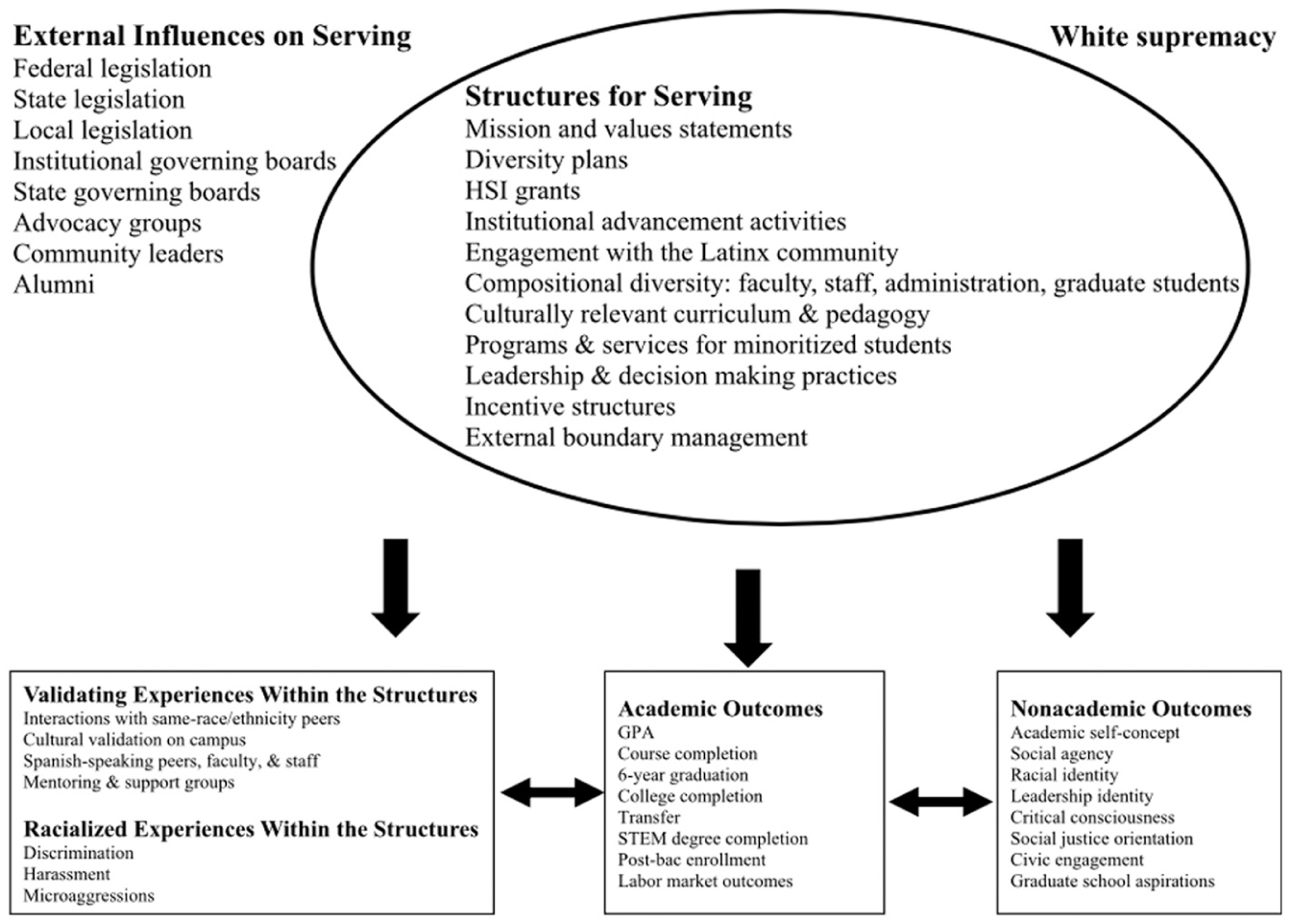
Garcia et al.’s (2019) multidimensional conceptual framework of servingness in HSIs. Reprinted with permission.
Methodology, Data, and Analysis
Methodology
The implementation of AB 705 at SCHSI is an instrumental case (Stake, 1995) of the more general phenomenon of stakeholders responding to an external policy mandate (Cohen et al., 2007; Nix et al., 2023). Such a framing is helpful because, as the policy landscape continues to change (e.g. the passing of AB 1705 in 2022), the insights gained into the experience of local community college stakeholders implementing state-level reform efforts remains relevant. We used a qualitative approach to analyze interviews with a wide range of stakeholders to examine participants’ experiences of the implementation of AB 705 at SCHSI. We present numerical data on course enrollments and pass rates to contextualize the case, while the qualitative data provide insights into participants’ subjective experiences.
We solicited the perspectives of mathematics instructors (both full-time and part-time) as well as non-instructional staff and administrators. During the qualitative data analysis we also drew upon the conceptual framework from Garcia et al. (2019). Specifically, the categorization of the codes focused on external influences, institutional structures, and student outcomes related to serving students at SCHSI in light of AB 705.
Case Introduction and Institutional Data
SCHSI is a community college located close to the US-Mexico border. At the start of 2020 it enrolled an average of 26,000 students each term. In terms of race and ethnicity, Latine students were the largest proportion of students (69%), followed by White (9%), Filipine (8%), Black (4.5%), and “two or more races” (4.4%). Fifty-one percent of full-time, first-time undergraduates at SCHSI received a Pell Grant. Like many community colleges, SCHSI offers multiple educational programs and pathways including associate’s degree programs, transfer pathways, vocational programs, and community-focused classes.
To contextualize the interview data that follows, here we present institutional data on mathematics course enrollments and pass rates 4 . Prior to the implementation of AB 705, incoming SCHSI students took a mathematics assessment which was used to guide placement into a first mathematics class. Many were placed into pre-transfer level, or developmental, classes (e.g., Pre-Algebra, Elementary Algebra, and Intermediate Algebra). Figure 2 shows the pathway through introductory mathematics classes at SCHSI before AB 705. Post-AB 705, students were required to complete a transfer level class within one year and many fewer students took pre-transfer level mathematics classes.
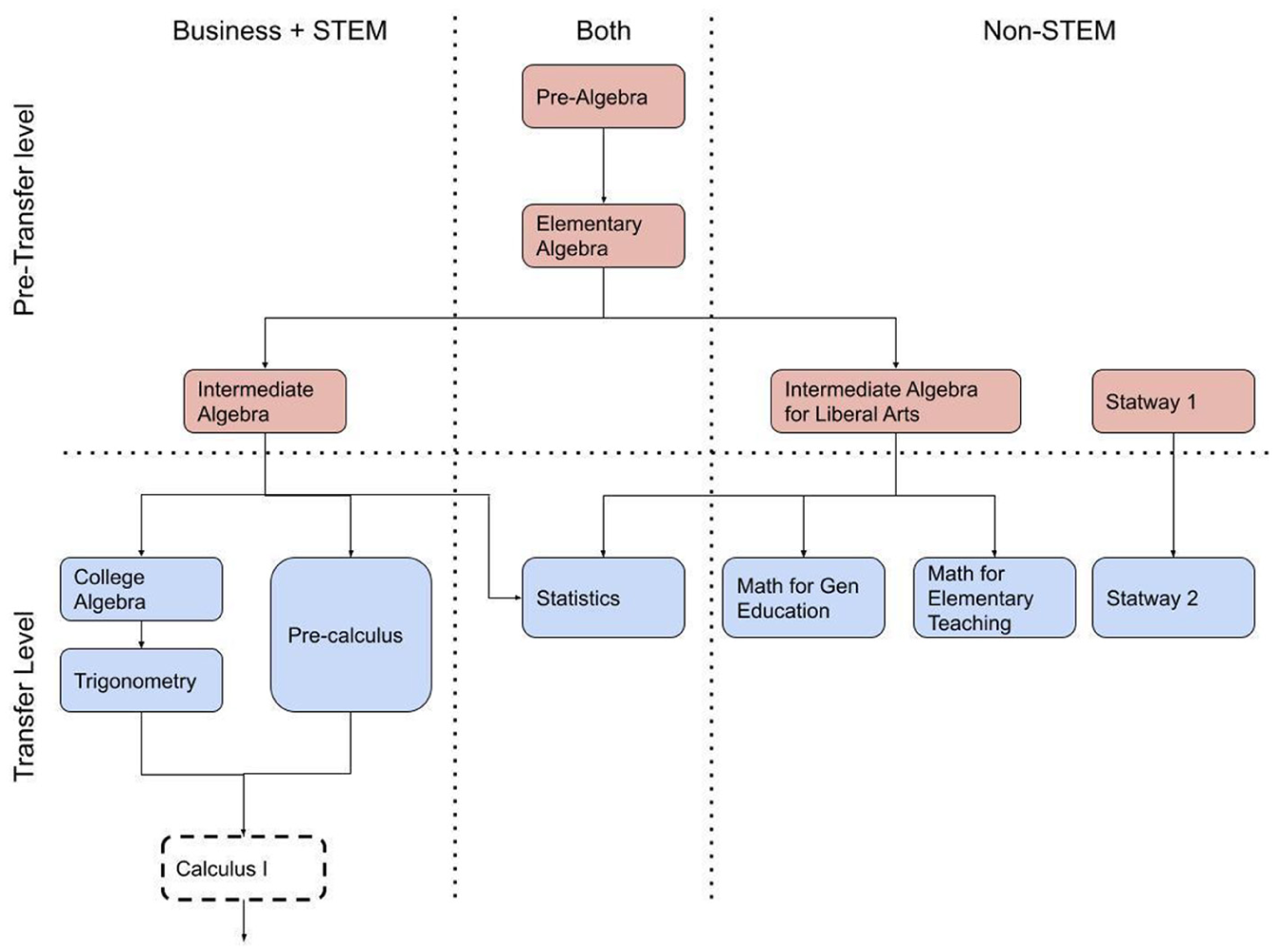
Mathematics pathways at SCHSI before AB 705.
We collected the total mathematics class enrollments at SCHSI for classes ranging from Pre-algebra (the lowest level mathematics course offered before AB 705) through Pre-calculus. The data were collected for academic years 2017–18 through 2021–22. Table 1 summarizes the enrollment trends, distinguishing the transfer-level and pre-transfer-level mathematics courses (Figure 2 shows all courses we analyzed). Consistent with the intention of AB 705, pre-transfer level mathematics enrollment decreased by 80%, and transfer-level mathematics enrollment increased by 32%. Total enrollment in all mathematics classes below calculus decreased by 57% across 2017–18 and 2021–22. Narrowing the focus to College Algebra, Trigonometry, and Pre-calculus, the enrollment in these gateway STEM classes started at 1,160 in 2017–18, peaked at 1,785 in 2019–20, and then decreased to 1,228 in 2021–22. This indicates that the largest increases in transfer-level course enrollments were in non-STEM track mathematics courses or in statistics (a course in statistics was required for STEM majors and was an option for non-STEM majors). Additionally, the decrease in mathematics course enrollments at SCHSI over this timeframe (57%) was larger than the decrease in enrollment in non-mathematics courses (17%).
Mathematics Course Enrollment.
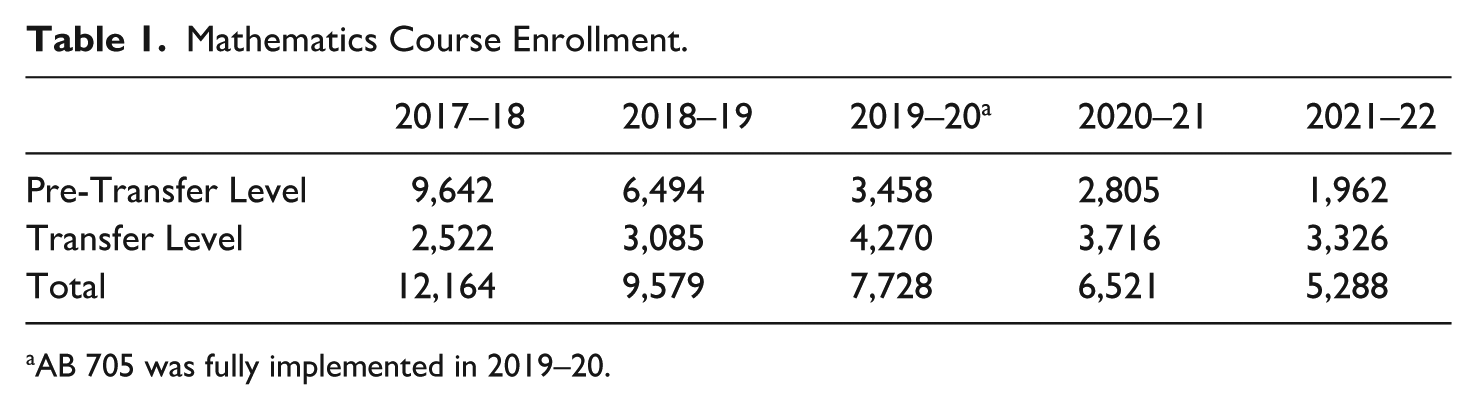
AB 705 was fully implemented in 2019–20.
Focusing on the three gateway mathematics courses for business and STEM-intending students (College Algebra, Trigonometry, and Pre-calculus), Figure 3 shows the fall term enrollment totals and passing rates. More students finished the classes with a grade of A, B, C, or P when compared to the number of students who passed before AB 705 was implemented. Simultaneously in College Algebra and Trigonometry, the course pass rates decreased—meaning a higher proportion of students failed each term. Pass rates in Pre-calculus stayed roughly the same and then increased slightly across this timeframe. 5
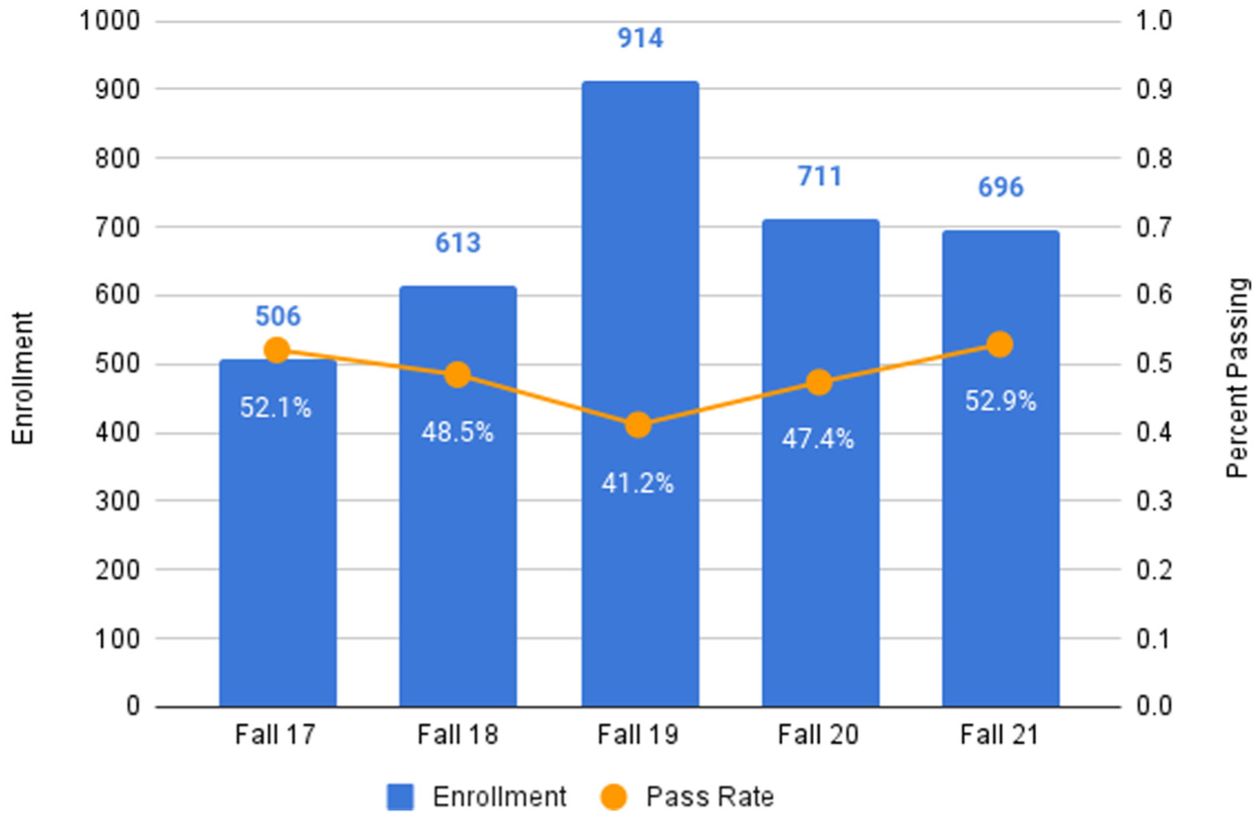
STEM gateway mathematics transfer level enrollment and pass rates.
The effect of AB 705 can be seen in Figure 3 by comparing the enrollment in fall 2018 to fall 2019. In all, 301 additional students took College Algebra, Trigonometry, or Pre-calculus in fall 2019 compared to fall 2018. Of those 301 students, 124 passed and 177 failed. In sum, more students enrolled in transfer-level STEM mathematics courses in fall 2019, but course pass rates were lower. The overall trend in pass rates could be summarized as an increase in enrollment, an increase in throughput, and an increase in students failing classes. This was followed by a decrease in enrollment and a rebound in pass rates by fall 2021. This local trend is consistent with prior findings by Melguizo et al. (2021).
A goal of AB 705 was to address equity gaps between underrepresented minority (URM) students and their non-URM peers. Looking at enrollment and student outcomes in College Algebra, Trigonometry and Pre-calculus disaggregated by URM status, we found persistent equity gaps before and after the implementation of AB 705 (Figure 4). Across all five years, the pass rate for non-URM students was between 48% and 64% and the pass rate for URM students was between 40% and 51%. These percentages can be interpreted as showing persistent inequities in pass rates when comparing URM and non-URM students. There was a closing in the difference in pass rates, but that was due to an increase in non-URM students failing these classes. Figure 4 shows the course outcome data for College Algebra, Trigonometry, and Pre-calculus for the fall terms between 2017 and 2021. Figure 5 shows the pass rates for URM and non-URM students across this time period.
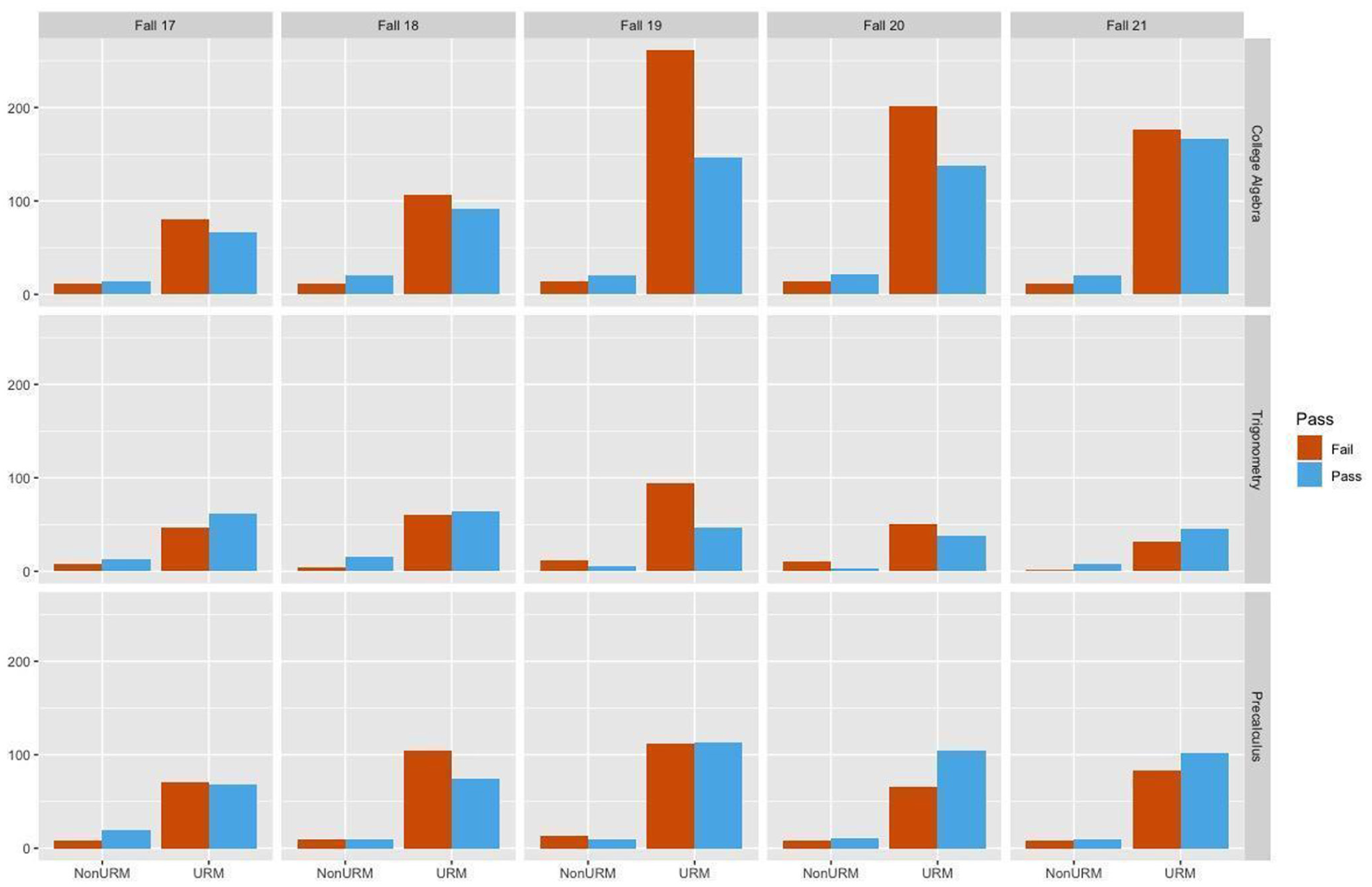
STEM gateway mathematics course outcomes by course, term, and URM status.
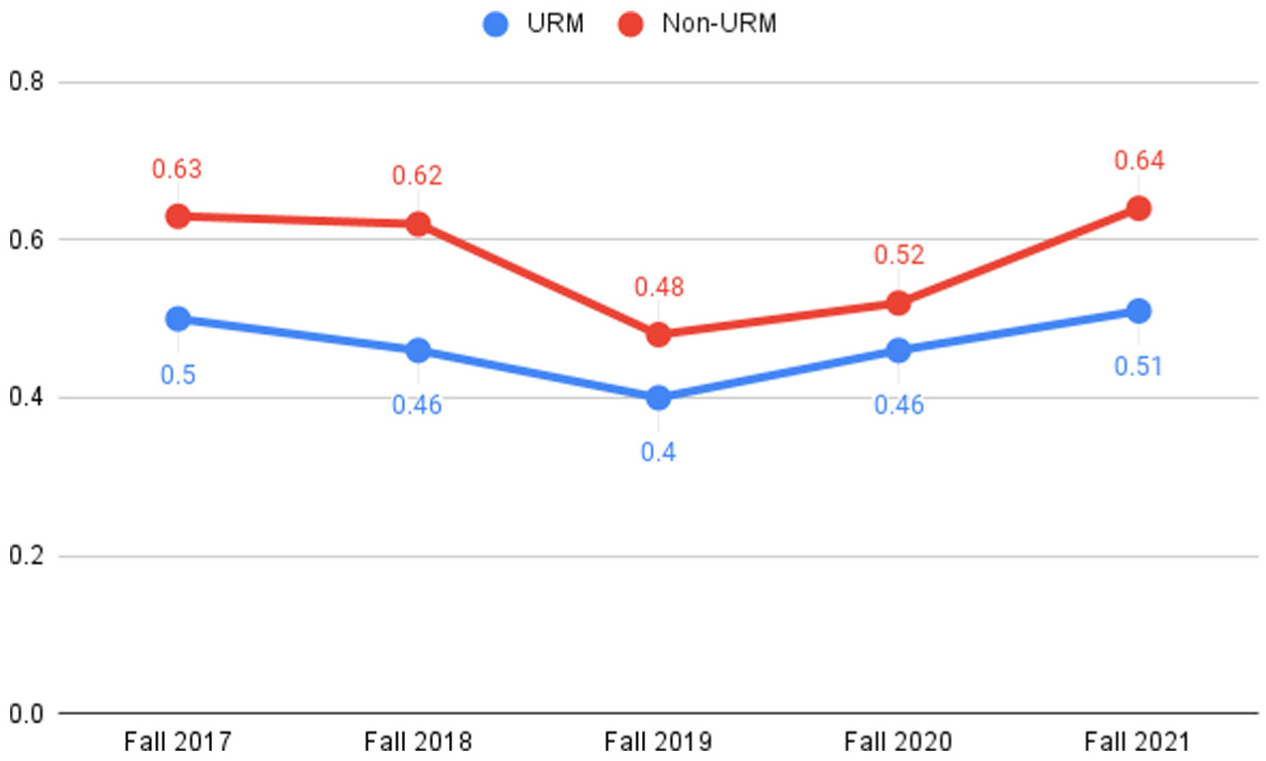
Pass rates for URM and non-URM students.
Data and Analysis
Authors’ Positionality
Following Creswell’s guidance for qualitative studies of participants’ experiences of a phenomenon, we bracketed our own knowledge and experiences (Creswell, 2013) to focus on participants’ perspectives. However, we acknowledge that we come to this work with positionality that shapes this study. We are mathematics faculty and graduate students from two different four-year HSIs. All four members of the author team are STEM education researchers and college mathematics instructors; two authors have taught mathematics at community colleges similar to SCHSI. Two authors identify as White women, one identifies as a Black woman, and one identifies as a White man. One author is proficient in Spanish and has worked with local mathematics teachers in grades 6–12 and postsecondary mathematics instructors for a decade.
The author team was part of a research and professional development effort at SCHSI focused on improving gateway mathematics classes in the wake of AB 705. The data presented here were collected in the first phase of that effort, prior to professional development. Given our long-term engagement with SCHSI, our shared identities as mathematics instructors, and our shared connections in the local higher education community, the authors were able to establish rapport with participants. To enhance the trustworthiness of our analysis, we engaged in informal member checking by sharing emergent findings and draft interpretations with instructors and instructional leaders, allowing participants to provide feedback that informed our analysis and grounded our interpretations in their lived experiences. This work has been approved by the human subjects research institutional review boards at SCHSI and the authors’ home institution.
Interviews
We interviewed 19 stakeholders at SCHSI. AB 705 was passed in 2017, and California’s community colleges had 20 months to plan for the change. In fall 2019, the mathematics department at SCHSI fully implemented AB 705 by removing mandated placement exams, eliminating most remedial, non-credit bearing classes, and recommending course placement based on multiple measures. In fall 2020 we interviewed mathematics instructors, administrators, and non-instructional staff at SCHSI. We interviewed nine instructors of gateway mathematics courses and 10 non-instructional staff who were responsible for implementing AB 705 (Table 2). The non-instructional staff included administrators, a counselor, and leaders of staff professional development. We focused on instructors of College Algebra, Trigonometry, and Pre-calculus. The administrators and leaders of faculty support were recruited by our partners at SCHSI. They were identified as centrally involved in the implementation of AB 705 by our local contacts.
Description of Interviewees.
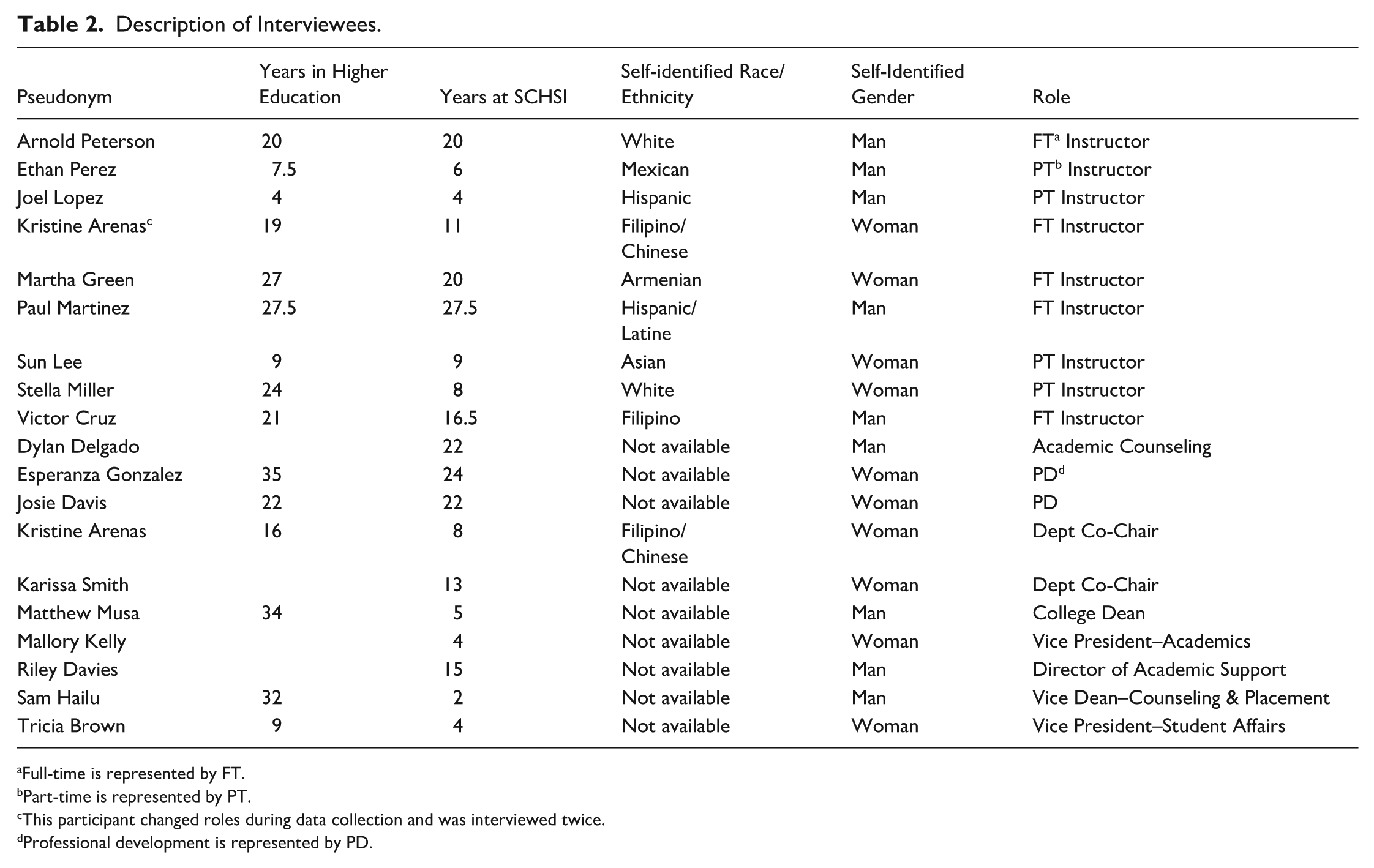
Full-time is represented by FT.
Part-time is represented by PT.
This participant changed roles during data collection and was interviewed twice.
Professional development is represented by PD.
Each interview lasted about one hour and was conducted via video conference. The semi-structured interview questions were crafted to elicit perspectives on the implementation of AB 705. For example, one question from the leader/administrator interview was about positive outcomes following the implementation of AB 705. The instructor interview protocol included questions about what instructors knew about how students were placed in their classes, and whether they felt that students were placed in the correct classes.
The interviews were transcribed and summarized for content. Then, the interview transcripts were analyzed through iterative cycles of coding, visualization, and sensemaking (Miles et al., 2019). First, open-ended descriptive codes (Saldaña, 2016) were used to summarize the content of each interviewee’s responses. In this stage, we focused on capturing how participants experienced AB 705. Some of these descriptive codes were in vivo words and phrases such as “throughput.” Other descriptive codes were words or phrases capturing the essence of an interviewee’s response. For example, some administrators and counselors talked about their concern about the cost of co-requisite support classes for students in terms of credits and time. We coded this concern as “credit creep.” Each transcript was read and coded by at least two members of the team.
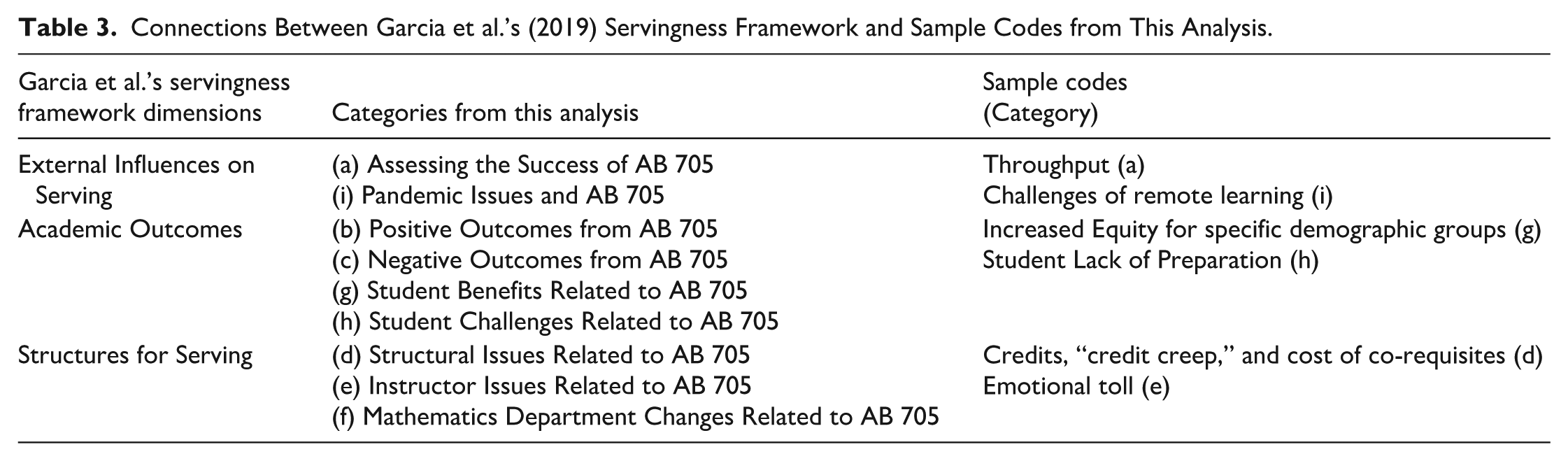
Next, the research team met, combined similar codes, and wrote a brief definition for each code. After first-cycle descriptive coding, we grouped related codes into analytic categories. The nine categories were: (a) assessing the success of AB 705, (b) positive outcomes from AB 705, (c) negative outcomes from AB 705, (d) structural issues related to AB 705, (e) instructor issues related to AB 705, (f) mathematics department changes related to AB 705, (g) student benefits related to AB 705, (h) student challenges related to AB 705, and (i) pandemic issues and AB 705. We drew on Garcia et al.’s (2019) servingness framework to organize and interpret these categories in relation to external influences, institutional structures for serving, and academic outcomes (see Table 3). We moved into second cycle coding (Miles et al., 2019) with a reduced set of descriptive codes organized into nine categories, each of which had two to eight descriptive codes. In the final step of coding, each team member used the new set of codes on different interviews from what they originally coded. Table 3 shows the connection between our categories and Garcia et al.’s (2019) servingness framework. We also include samples of descriptive codes that were developed in the analysis and the corresponding category.
Connections Between Garcia et al.’s (2019) Servingness Framework and Sample Codes from This Analysis.
We merged the final coded interviews and generated a role-order matrix (Miles et al., 2019; Figure 6). In our role-ordered matrix, each row corresponded with one participant, and the columns included the participant’s role (instructor, administrator, support), job title/course focus, status (adjunct or full-time), notes on identity, and list of the codes that appeared at least once in the interview. By sorting the role-ordered matrix according to participants’ roles, courses, full-time or part-time status, and identity markers, we could use the sensemaking strategy of finding patterns in the qualitative data set (Miles et al., 2019). The role-ordered matrix highlighted participants’ role-based interpretations of servingness and success, which are central to the conceptual framework. From this sensemaking, we summarize the data in the form of three themes that capture the experiences of participants: (a) a difference in focus on throughput versus pass rates, (b) a shared focus on student preparation and placement, and (c) the emotional toll on instructors.
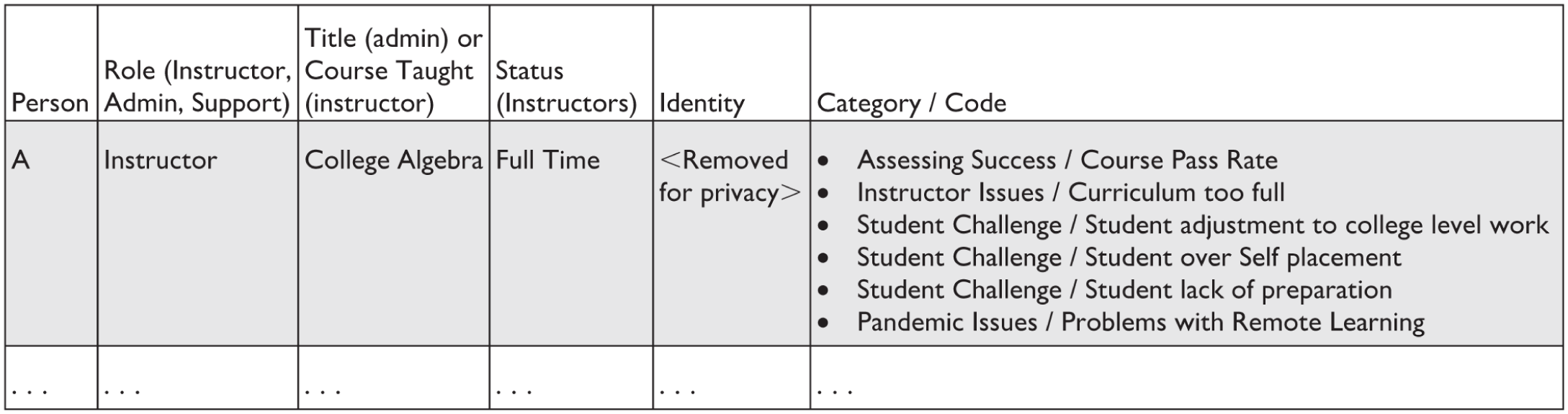
Excerpt from the role-ordered matrix used in the analysis.
Timing of Data Collection: AB 705 and COVID-19
Finally, the disruptions caused by remote teaching were relevant to this study. AB 705 was passed in 2017 and the policy went into full effect in fall 2019. We conducted interviews in fall 2020 and winter 2021. At that time, remote learning occupied teachers’ and administrators’ thoughts. Thus, we provided space in the interview for instructors and staff to talk about challenges related to the pandemic. Then, we asked instructors and administrators to set aside pandemic teaching-related concerns, reflect on the implementation of AB 705, and to discuss their perspectives on the new policies and on student placement.
Findings
In this section, we present three themes from the analysis of interviews with instructors and administrators: (a) a difference in focus on throughput versus pass rates, (b) a shared focus on student preparation and placement, and (c) the emotional toll on instructors. In our presentation of the data, we use multiple quotations in order to show how participants experienced the reform. We have edited some filler words for clarity. We used italics in direct quotations to show words or phrases that were emphasized by the participant.
Throughput versus Pass Rates
The most striking trend in the interviews was the presence or absence of the concepts of throughput and course pass rates in the interviews when stakeholders discussed the reform effort. All the administrators, with the exception of the mathematics department chairs, mentioned increased throughput as one of the benefits of AB 705. For example, Matthew Musa, the dean of the college stated, “well, some of the positive outcomes [of AB 705], is that we’re noticing, and forgive me I don’t know the exact details of the throughput rates, but we’re noticing that our students are succeeding.” Similarly, Mallory Kelly, a vice president stated, “So the preliminary data that I have seen is there’s definitely an uptick in success. Throughput rate, there’s definitely an uptick in throughput rate.” Riley Davies, who was charged with assessment and placement, explicitly linked throughput rates to the equity-focused discourse of serving the college’s Latine student population better: There are fewer students being placed into below transfer level. . . Throughput rates in general are up. So those students who are getting through the gateway more quickly, I assume, are benefiting. . . a lot of our Latino students, which is our largest student population, are actually having access to. . . a quantitative reasoning course in their major much more quickly.
Addressing equity via throughput raised the question of whether the throughput rates in the initial classes would translate into persistence in subsequent classes such as Calculus. This tension was captured by the administrator in charge of counseling, Sam Hailu: As you know, the throughput for AB 705, the beautiful part is high numbers . . . You got the numbers, but the issue you got then is what- how many of them actually are succeeding in terms of the domino effect? How many are actually able to do the follow up coursework to continue on the STEM path versus those who might just do statistics and call it a day . . . The attrition, in my opinion, is horrible, especially for our equity populations that have shown equity gaps. The Black students: prime example. You pick up in any equity data category at [SCHSI], we have horrible data.
Hailu’s statement encapsulates many of the dilemmas that appeared in our data. He acknowledged that the throughput numbers were “high” and that was the “beautiful part.” We interpreted this to mean that throughput was a metric that Hailu used to assess AB 705. He then noted that throughput does not tell the whole story of student success, and that equity may require addressing attrition through the STEM major, in particular for the students from groups termed “equity populations.” We interpret Hailu’s assertion that the data are horrible to indicate he saw the longitudinal data revealing inequities among groups of students. Thus, he highlighted the need to foster persistence and long-term success, not just throughput in the gateway classes.
In contrast to the administrators’ consistent mention of throughput, none of the instructors mentioned throughput when discussing the reform of gateway mathematics at SCHSI. Five of the nine instructors focused on whether students passed their classes and the pass rates. For example, Ethan Perez, who was a part-time instructor, said In the section [of College Algebra] I did [in fall 2019], well the experience was interesting because I had students who were just out of high school and even those students either ended up dropping the course halfway through the semester or remained in the classroom but didn’t pass the class. I even saw their exams, I saw them even blank with just drawings. Or filling in the empty spaces in the letters, you know like, I don’t know.
For this instructor, the experience of teaching College Algebra in the first semester post AB 705 was seeing many more students fail his class. Five of the nine instructors explicitly mentioned pass rates or student failure as a challenge. The four instructors who did not explicitly discuss their course pass rates did bring up our next major theme, students’ lack of preparation.
Student Preparation and Self-Placement
One common descriptive code that appeared in the interviews of both instructors and administrators was a concern that some—or many—students in the gateway mathematics courses were not prepared for their classes. For example, Kristine Arenas, who was a full-time instructor of College Algebra at the time of this interview, and later became department chair said, I think also the hard part is that because of AB 705, students are coming into [College Algebra] less prepared. It’s always been a tough class to teach. It always has been, but recently it’s been like I have students who come in who don’t know how to factor. . . . I feel like hey, you should be able to graph a line. . . . They’re going, “You didn’t teach this thoroughly.” [Nervous Laugh] Like, “You’re right. I didn’t. You should know it already.”
SCHSI’s College Algebra course outline assumed students came in with knowledge from Intermediate Algebra, but Intermediate Algebra had been eliminated by the reform. Arenas’s reflection describes her experience of discovering the course outline was not aligned with students’ incoming knowledge, and the students’ feedback as she tried to teach based on that outline. We do not interpret her laugh as laughing at the students. Rather, it sounded like a nervous laugh, anticipating a problem.
Interviewees shared concerns specific to students’ preparation for college-level mathematics as well as concerns about student preparation for college-level work in general. Both instructors and administrators noted there were few options for underprepared students who needed more support in mathematics than what was available in the co-requisite support classes. This concern was explicitly voiced by seven of the nine instructors, and six of the seven administrators.
The most common descriptive code we applied to the instructors’ discussions of the reform effort was student over self-placement. Five of the nine instructors shared their perception that some students were placing themselves into classes for which they were not prepared. For example, Paul Martinez, a full-time instructor of Pre-calculus shared a conversation he had with a student who was struggling in his class: I just had to deal with an issue last night with a student who came forward to me and confessed, “I didn’t know what I was getting into. I took math analysis in high school, and I got a C, and the counselor told me I should take [Pre-calculus], but I was thinking, ‘I don’t know if I should,’ but I did anyway, and now I regret it.”
Connecting the interviews with the institutional data, we hypothesize that instructors were concerned about student self-placement due to pass rates in gateway STEM mathematics courses. The overall pass rates were 47%, indicating that the majority of students did not pass College Algebra, Trigonometry, and Pre-calculus. A placement process is intended for students to find the “right” class. Then, if course pass rates are low, one explanation for low pass rates would be incorrect placement.
The issue of placement also raised structural issues that were made more visible under the reform effort. Kristine Arenas talked about a policy whereby students were not able to “go back” and take a non-transfer level class after enrolling in a transfer level class: I think one of the challenges–well, I don’t know if this is necessarily due to the implementation of AB 705, but I think it’s highlighted during it–is that if a student really does not know a lower-level math, but then signs up for a higher-level math, then they can’t go back.
It appears that this structural issue existed before the reform effort. However, AB 705 highlighted the challenge for students who thought they were placed in the wrong class.
Emotional Toll on Instructors
The third theme was the emotional toll on instructors. Seven of the 10 non-instructional faculty mentioned that implementing the new policy had created an emotional burden on instructors. For example, Dr. Tricia Brown, the vice president of student affairs, related a story from a faculty meeting related to AB 705.
[Math instructor] talked about how students are struggling and she cried and she said, you know, I’ve seen students come in and they have their heart set on the STEM major and they can’t pass these courses and they’re not ready, and we place them in these courses and they’re not successful.
In a similar vein, the dean of the college, Matthew Musa, said, “My math faculty, they needed a lot of emotional support.” He described how faculty feel less competent in their jobs when so many of their students do not pass their classes.
The instructors raised the theme of an emotional toll indirectly. Recall that three of the nine instructors we interviewed were Latine and two were Filipinx. Research suggests that faculty of color do additional service supporting minoritized students (Trejo, 2020). In the faculty interviews, the emotional toll of navigating AB 705 was made salient for some interviewees based on their shared backgrounds with students. For example, Paul Martinez said his background as a transfronterizo (a student who crosses the border regularly) student “helps me relate with the struggles of having to commute over here.” He continued, It is a struggle [to commute across the border]. Absolutely. First day of class, when all of a sudden, I just break out into perfect Spanish and all my students go, “What?” Yeah, I grew up in [Border City]. They’re like, “Really?” . . . Then that helps them to relate with me because they think, “He’s one of us. He knows what it’s like.”
In a similar vein, Kristine Arenas told a story about how she drew upon her experience growing up Filipina to relate to one student who intended to major in art and was failing her College Algebra class, a course designed for STEM majors.
He’s like, “My parents want me to be here. I’m an art major.” And I’m like, “you’re in [College Algebra]! . . . Go to [Math for General Education].” He said “my parents don’t want me to.” I’m like, “but you’re an art major”. . . . So I was like, “okay, so I understand the whole familiar pressure. I also have Filipino parents. Let’s talk about this.” . . .Three weeks [later] he came and talked to me, and then he finally goes, “I dropped.” “Good for you! Go take [Math for General Education] next.”
These quotations highlight how, for both Arenas and Martinez, their racial/ethnic and linguistic identities were salient to their interactions with students. Arenas’s experience highlights how a shared identity can be an asset when understanding students’ pathways. Beyond the instructors’ personal connections based on shared identities, none of the instructors stated they were satisfied with the situation of having so many students fail or withdraw from their classes. The emotional toll came through in their impassioned response to the policy. For example, Stella Miller a White College Algebra instructor used hyperbole and a sarcastic tone to express her feelings about “somebody in Sacramento” who determined who should be in her class. Stella continued, “AB 705 is the worst thing ever! It’s a nightmare!” While there is research on students’ experiences in “weed out” classes (Leyva et al., 2021), to our knowledge there is little research on the emotional toll on mathematics instructors of teaching classes with a high failure rate. But, the interviews of Floridia faculty by Nix et al. (2023) align with this theme. Next, we discuss these findings in relation to prior research and theory.
Discussion and Conclusion
In the foregoing, we presented institutional data and described the experiences of stakeholders implementing AB 705 at SCHSI. We answered Research Question 1 using a qualitative analysis of stakeholder interviews. In brief, the non-teaching SCHSI staff, particularly administrators, focused on throughput as their primary measure for the success of AB 705. Based on increased throughput numbers in mathematics, the administrators judged AB 705 to be successful. On the other hand, instructional faculty reported dissatisfaction with AB 705, and they mostly focused on class-level pass rates and their feeling that students were unprepared for the classes they taught. While these positions appear contradictory, the institutional data show both perspectives were valid: Throughput did increase and the instructors of gateway mathematics classes failed more students after AB 705 was implemented. We call this phenomenon the paradox of throughput.
Our second research question concerns how SCHSI served its students and it is grounded in Garcia et al.’s (2019) multidimensional framework for servingness in HSIs. In brief, AB 705 induced a shift in how SCHSI served its students: the mathematics program decreased in size and served fewer students overall, but more students were able to complete a transfer-level class than before the policy took effect. Specifically, overall, mathematics enrollment fell more than 50% as pre-transfer level courses were eliminated from the schedule. At the same time, pass rates in the key gateway mathematics classes for STEM majors hovered around 50%, and enrollment in these classes increased slightly, resulting in an increase in the number of students earning transfer-level credit in mathematics. In the remainder of this section, we discuss (a) the tensions that arise in conceptualizing servingness, and (b) how the metrics which stakeholders use to interpret success or failure of policies shape success. We conclude with limitations and suggestions for future research.
Servingness and the Discourses of Reform at SCHSI
The institutional roles of our participants shaped their impression of the success of AB 705. In particular, the administrators and non-instructional staff at SCHSI focused on course throughput and aggregate success numbers as the key measure of the success of AB 705. The mathematics instructional faculty, meanwhile, were much more focused on course-level outcomes and individual student success. There was an implicit tension between efficiency and equity in the interviews with the instructors and administrators. This tension has a parallel in the logics of community colleges discussed by Gonzales and Ayers (2018). All administrators highlighted the throughput metrics as a sign of success, which aligns with a focus on efficiency. Simultaneously, multiple administrators highlighted the equity benefits of AB 705, describing the positive impact of the policy on the academic progress of minoritized students. Yet, administrators also noted that throughput might be an incomplete measure of academic success since it does not capture longitudinal success. In Garcia et al.’s (2019) multidimensional servingness framework, throughput and course pass rates align with the academic outcomes dimension. Thus, an external influence (AB 705) induced SCHSI to develop new structures for serving students, such as mathematics placement policies and the provision of support classes, which led to improved academic outcomes.
Yet, AB 705 also coincided with a more than 50% decrease in mathematics course enrollments at SCHSI. Thus, the administrators’ focus on throughput may have obscured other ways SCHSI could serve its predominantly Latine student population. Additionally, mathematics instructors struggled with teaching students who they felt were not prepared for transfer-level mathematics, and they were disheartened with failing more students. Regardless, some instructors maintained their efforts to connect with their students. For example, the three Latine and two Filipinx instructors discussed the social and cultural connections they had with their students. While the instructors did not use the terminology that appears in Garcia et al.’s (2019) framework, we noted that such cultural connections are another way that faculty members at HSIs can serve their students.
AB 705, with its focus on one-year timeframes and transfer-level credits, has subtly (re)defined SCHSI as an open-enrollment, community college serving the local community. While community colleges have traditionally provided multiple forms of education including vocational programs and opportunities for people to restart their education after a break, policies such as AB 705 focus stakeholders’ attention on the mission of preparing students for transfer to four-year institutions. Yet, Garcia’s (2019) analysis and case studies highlight that racialized open-enrollment institutions like SCHSI will always appear inferior when measured by criteria developed in predominantly White and privileged settings. As we analyzed transcripts and waited on the peer review cycle for this manuscript, a new policy, AB 1705, has become law. AB 1705 extends the policy changes that started with AB 705. While AB 1705 is relatively early in implementation, it has further increased failure rates in Calculus at SCHSI. Based on this work we hypothesize that the impact of AB 1705 on enrollment in mathematics classes at SCHSI will be visible soon.
Implications for Research, Policy, Practice
This work has led us to identify areas where further research is needed and implications for policy makers and practitioners. First, understanding the impact of policies on instructors’ morale and emotional well-being may be an important follow-up to this study. Our findings resonate with previous research documenting the emotional labor faculty experience in navigating institutional reform. Gonzales and Ayers (2018) argued that community college instructors operate within bureaucratic logics that often constrain their autonomy and intensify emotional demands of their jobs. Similarly, Nix et al. (2023) found that Florida community college faculty felt disempowered by top-down reforms and expressed frustration, confusion, and burnout as they attempted to implement new developmental education policies. At SCHSI, instructors described similar affective burdens. While none reported intentionally failing students, as Lopez (2022) suggested might happen, several instructors and leaders discussed the emotional toll of teaching classes where students’ preparation did not align with the expected course content. We noted that AB 705 removed placement tests, and this implicitly positioned instructors as both educators and gatekeepers. These dual roles weighed heavily on instructors’ professional identities and emotional well-being. Yet, as follow up policies such as AB 1705 are implemented, policy makers continue to put instructors in the role of failing students, and most instructors lack a voice in the policy making process.
The study of Calculus outcomes from the California Community Colleges and Multiple Measures Assessment Project (2023) highlights the disconnect between policy makers and instructors. In that study, the authors examined the effects of AB 705 on Calculus for Business. The Calculus course pass rates ranged from 47% to 76% depending on students’ prior preparation (Geometry through a prior Calculus course). The authors of the report wrote “no group emerged from this analysis as highly unlikely to succeed in Business Calculus” (p. 5, emphasis added) and, based on the analysis of throughput metrics, they suggested Business Calculus should not have any prerequisites. As mathematics instructors, we were struck to see that such failure rates (53% to 24%) were considered acceptable by California policy makers. The report authors suggested structures such as concurrent support courses as a mechanism to meet the needs of students with inadequate preparation for college-level mathematics. However, there was no suggestion of a support system for the instructors who are positioned to fail a large proportion of their students each term.
This investigation also suggests that a worthwhile extension of our analysis of success rates by course is an examination of students’ longitudinal course success. Our interview data suggested course-level pass rates may not reveal the full picture of student success. Recall Sam Hailu, the administrator in charge of counseling, who described persistence as another metric that should be studied alongside throughput. Simultaneously, the mathematics instructors at SCHSI described feeling pressure to teach more prerequisite content in their transfer-level classes (e.g., Kristine Arenas talking about teaching how to graph linear functions in College Algebra). Thus, one additional area for further investigation is whether students who are part of the throughput metrics—those who pass College Algebra or Pre-calculus—also succeed in subsequent classes. Since throughput focuses on one class, longitudinal measures of persistence should be studied more thoroughly to understand the long-term effects of gateway mathematics reform efforts. In addition, as reform in developmental education has been happening across several states, this could also be studied at impacted institutions. Further, studies could also examine the success rates of such reform efforts more broadly (e.g., have graduate rates in STEM fields increased?).
Finally, implementing a statewide policy such as AB 705 at the local level involves strategic planning, decision making with regard to local context, and identifying relevant goals (Reinholz & Apkarian, 2018). However, our data suggest that administrators and instructors at SCHSI did not engage in these processes together. Instead, both administrators and instructors experienced AB 705 as a top-down reform imposed by an external source (Nix et al., 2023). We did not see evidence that instructors and administrators had developed shared meanings of success, including in the area of student outcomes (e.g., throughput versus pass rates). Based on other case studies examining AB 705 (e.g., Acevedo, 2022), we know that when stakeholders are engaged in an open dialogue, communication about goals and rationale occur, which allows for greater collaboration around plans for change. Thus, as an implication for practitioners, this case, and the experiences of the participants shared here, can inform future efforts to develop buy-in for reforms to improve mathematics outcomes in community colleges.
Limitations and Future Research
This study has several limitations that can be used to inform future research. First, in line with Stake’s (1995) conceptualization of case study research, this study necessarily leads to particularizations over generalizations. That is, we aimed to understand the distinct institutional and human dynamics surrounding the implementation of AB 705 at SCHSI. We do not make claims that the results from SCHSI can be directly applied to other cases. Rather, readers can learn from this case to consider how policies are designed and enacted in their contexts. Second, the qualitative element of this work is focused on the perspectives of instructors and administrators. Future studies may probe more deeply into the experiences of students who are enrolled in the gateway mathematics and non-gateway mathematics courses analyzed here. Third, the timing of this study was relatively early in the reform effort and our data collection occurred while COVID-related disruptions were still prevalent in participants’ minds. Since we completed the data collection and analysis for this study, there have been additional rounds of reform efforts (such as AB 1705). In future work we plan to examine the longitudinal effects of AB 705 and to gather additional insights into efforts to reform gateway mathematics in community colleges.
Footnotes
Acknowledgements
We acknowledge that the grant was terminated in May 2025, but the results reported here are based on research conducted prior to that termination.

Funding
The authors disclosed receipt of the following financial support for the research, authorship, and/or publication of this article: This work was supported by the National Science Foundation under Grants No. 1953713 and 1953753. Any opinions, findings, and conclusions or recommendations expressed in this material are those of the author(s) and do not necessarily reflect the views of the National Science Foundation.
Declaration of Conflicting Interests
The authors declared no potential conflicts of interest with respect to the research, authorship, and/or publication of this article.