







Abstract
Missionary effectiveness is found at the confluence of divine calling, human need, and missionary ability. Missionaries are ineffective when their abilities—including spiritual formation, missiological education, and ministry development—are inappropriate for the context to which God has called them as ambassadors. Great ability without divine calling is professionalism, and inadequate ability to respond to the divine calling and human need is amateurism. Since short-term missionaries possess limited abilities, they may serve appropriately in limited contexts. However, all missionaries can and should grow. As missionary ability increases, so do the possibilities for appropriate engagement in God’s mission of redemption.
Keywords
Ralph Winter contended that all Christians should be involved in mission, and effective involvement required appropriate training, in which neither training for professionalization (Winter, 1997) nor amateurization (Winter, 1996) predominated. The Perspectives on the World Christian Movement training program was born of his desire to engage all Christians in God’s mission while recognizing the need to equip them with basic missiological education (Winter et al., 2009). However, the advent of widespread short-term missions (STM) caused him concern over a potential “re-amateurization of missions” (Winter, 1996).
Winter was joined by Evangelical scholars who also found fault with this new wave of amateur missionaries. STM advocates claimed that the “repetitive deployment of swift, temporary, non-professional missionaries” (Peterson et al., 2003) would revolutionize the missionary endeavor and would propel the church toward closure; however, the results from the field were decidedly mixed. Winter lamented that missions “has become any Christian volunteering to be sent anywhere in the world at any expense to do anything for any period of time” (Winter, 1996).
Eventually missiologists began conducting serious critiques of STM’s effectiveness (Adeney, 2006; Birth, 2006; Hesselgrave, 2005; Priest et al., 2006; Ver Beek, 2006). In the clamor, though, amateurization has become nearly synonymous with STM. Consequently awareness of the dangers of both amateurization and professionalization across the spectrum of missionary practitioners has been lost. The purpose of this article is to propose a model of missionary effectiveness and to consider amateurization and professionalization in missions, using that model.
A model of missionary effectiveness
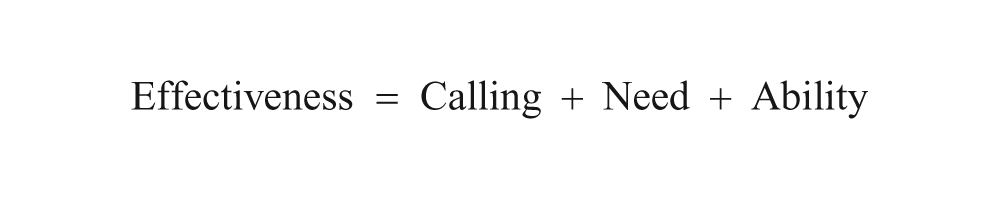
When missiologists like Winter raise the alarm about “the re-amateurization of missions,” they are arguing for more effective ways to prepare people for missionary service (see Priest, 2008: passim). Effectiveness exists at the confluence of divine calling, human need, and missionary ability (see Fig. 1).
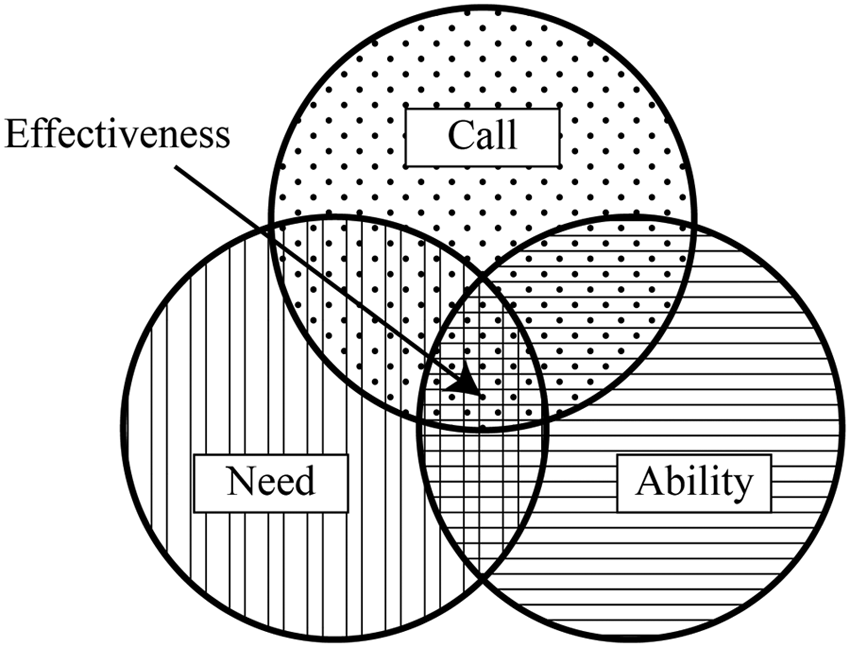
A dimensional model of missionary effectiveness.
Divine calling
Effective missionary service requires a divine calling to cross-cultural ministry. David Hesselgrave, in an insightful treatment of amateurization and professionalization, declares, “the main distinction between professionalism and amateurism is our assumption that missions work is a divine calling, rather than a human choice” (2005: 207–208). He further distinguishes between volunteerism—in which anyone can volunteer for missionary service based simply on knowledge of a need—and voluntarism—in which Christians voluntarily submit to a divine calling for missionary service. In volunteerism, knowledge of human need is all that is required for Christians to launch out into cross-cultural ministry. Voluntarism, by contrast, requires submission to a sense of divine calling—usually confirmed by the Church—which compels the missionary to act in a particular way in order to meet human need. While missionaries serve voluntarily in response to a divine call, they are not simply well-meaning Christians responding to a wide appeal for volunteers. “Generally speaking, early Protestant missions did not operate through a call for volunteers. More often, dedicated candidates who were willing to pay the price presented themselves to church leaders for consideration and support” (Hesselgrave, 2005: 230). Still, volunteerism and voluntarism are not mutually exclusive categories. Those who begin in missions by answering a call for volunteers may experience a divine calling to which they voluntarily submit. The move from volunteerism toward voluntarism represents a move away from amateurism and toward effectiveness.
Hesselgrave is not alone in his assertion that divine calling is essential to voluntary missionary service (see also Rance, 2004: 33–44); however, neither is there unanimity on this issue. Those who object to the idea of a special calling for missionary service often contend that all Christians have been called to engage in mission through the Great Commission (Matt 28:19 and parallels). Thus, there is no need for a believer to experience a divine calling when he or she may read about it in canonical revelation. On closer inspection, though, it appears that this is something of a semantic argument. David Platt, arguing from the perspective that all are called to missionary service, writes, If there are a billion people who have never heard the gospel and billions of others who still have not received the gospel, then we have an obligation to go to them. This is not an option. This is a command, not a calling. What is a matter of calling is where we will go and how long we will stay. We will not all go to the same places, and we will not all stay the same length of time. But it is clearly the will of God for us to take the gospel to the nations. (Platt, 2010: 199–200)
Those who argue for a missionary calling to the entire church still allow for individuals receiving guidance from the Holy Spirit and counsel from church or mission leaders regarding where and when to go, how long to stay, and even what kind of work to do (Moreau, Corwin, and McGee, 2004: 159–71; Steffen and McKinney Douglas, 2008). Voluntary commitment to this secondary calling (or guidance) has been essential to missionary effectiveness throughout Church history (Winter, 2009).
Human need
A second component of missionary effectiveness is human need. Duane Elmer points out the basic fallacy of most short-term missionaries and of many career missionaries: the belief that people all over the world have the same needs (2002: 14). While it is true that God created humans to enjoy fellowship with Him and others in families and communities, at that point the similarities begin to evaporate quickly. Pop culture pundits observe the worldwide proliferation of iDevices, cell phones, blue jeans, and musical styles among urbanites and declare that globalization is certainly (re)uniting the world. Technology is making it easier for cultural symbols to be shared around the world, but the meaning behind those symbols varies from society to society. Hofstede and Hofstede (2005, 7) point out that cultural practices, such as symbols, heroes, and rituals, are revised with each generation while the cultural values which invest meaning into those practices remain fairly static (see Fig. 2). A culture’s values lie at the heart of a society. They unite the people, and they determine a society’s self-understanding of their need.
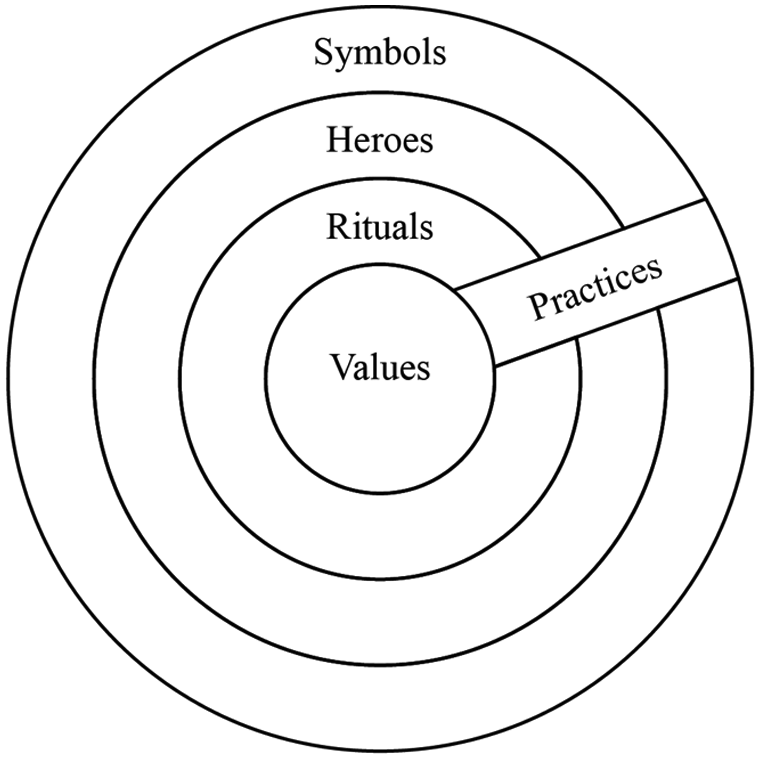
The “Onion”: manifestations of culture at different levels of depth (Hofstede and Hofstede, 2005: 7, fig. 1.2).
The world’s needs must be addressed by the gospel, which is incarnated into its particular societies. Paul speaks to the need of people everywhere to hear the gospel (Rom 10:14), and Jesus commands us to go everywhere and make disciples (Matt 28:19). There is no shortage of need. Rather, the church has often struggled to provide an understandable answer to the world’s need. Sherwood Lingenfelter and Marvin Mayers (1986: 15–26) admonish Christians to imitate the kenosis of Jesus, by putting off their own culture (however imperfectly) and taking on their host culture (insofar as that is possible). Daryl Guder recognizes this incarnational necessity in the words of John 20:21: “As the Father has sent me, I am sending you.” 1 He writes, “this ‘as’ is interpreted with a double meaning. It refers both to the fact God has sent Christ, and also to the way in which God has sent Christ, as a human among humans, in the particularity of human experience” (Guder, 1994: 418).
The needs of human beings are, thus, both universal and socially constructed. Divinely called and empowered missionaries are sent by the Holy Spirit to address those needs incarnationally by entering into their host societies as Christ’s ambassadors of good news. However, few would dispute that divine calling—even with Holy Spirit empowerment—is insufficient to address the needs of the world. Those called to serve as missionaries may resist that calling; they may pursue it without wisdom; they may pursue it according to human wisdom; or they may cooperate with the Holy Spirit through preparation or missionary formation. Missionary formation contributes to a missionary’s ability to fulfill a divine calling and meet the human need of the respondent culture.
Missionary ability
I will begin the discussion of missionary ability with echoes of Charles Kraft, who suggested that contextualization is understood from such a variety of perspectives that it has become necessary to substitute an altogether new term. In place of contextualization of theology or contextualization of Christianity, he proposes Appropriate Christianity (Kraft, 2005). I wish to examine “appropriate ability” or “appropriate training” within the missionary community. The terms “amateur” and “professional” define the poles of a dimensional model of appropriate ability (see Fig. 3). However, these terms are often used in an alarmist or pejorative fashion which disregards the fact that some missionaries are in fact amateurs, requiring only introductory training, while others are professionals, requiring advanced preparation. The level of ability that is necessary to accomplish the missionary task varies with the particular missionary calling and human need of the respondent culture. While it is popular to decry the relative inability of short-term missionaries, the truth is that appropriate training is uncommon even among career missions practitioners (Kraft, 2005: 32). Amateurism among short-term missionaries is to be expected; however, it also occurs among career missionaries, where it is tragic.

A dimensional model of missionary ability.
The process of missionary formation develops the missionary’s ability to accomplish the Holy Spirit’s calling and meet the world’s need. When I was 12 years old, I was challenged to pray, asking God whether or not He wanted to use me in full-time, vocational ministry. In prayer I was distinctly aware that God wanted me to serve as a missionary. My initial reaction was to resist that calling. At the age of 14, though, I yielded my will to God’s desires. If only calling and need were necessary for missionary effectiveness, I could have proceeded into missionary service immediately. However, my first duty was to submit myself to the process of missionary formation, becoming able to fulfill God’s calling, insofar as that is possible to do.
Missionary formation is multi-faceted. J. Dudley Woodberry writes, Like all good religious education, missiological education has three goals—spiritual formation, graduate or undergraduate education, and ministry development. These involve, respectively, becoming, learning, and doing. Thus we face the challenge to keep in balance the inherent tensions among the spiritual, the academic, and the practical. (1997: 271)
Thus, missionary formation is concerned with increasing a missionary’s (or missionary candidate’s) ability to fulfill his or her divine calling through spiritual formation, education, and ministry development. Because missionary ability is the only component of effectiveness which we can influence, I will consider each of these elements in greater detail in the section titled, “Missionary formation determines ability.” First, though, I will consider how this model of missionary effectiveness serves as a lens for understanding the problems of amateurization and professionalization.
Amateurization, professionalization, and effectiveness
Missionary effectiveness is found at the confluence of divine calling, human need, and missionary ability (see Fig. 1). Effectiveness demands missionaries possess appropriate abilities in spiritual formation, missiological education, and ministry development.
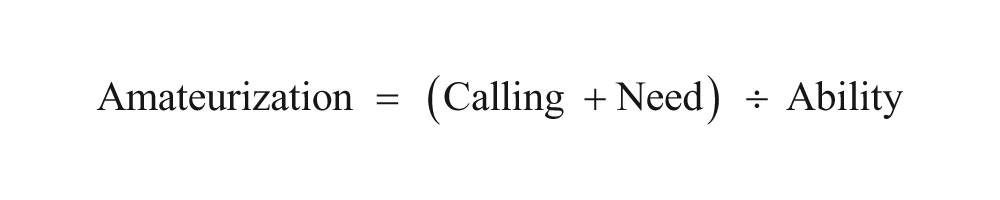
Much of the recent discussion around amateurization in missions has centered on the relative inability of short-term missionaries to accomplish the tasks to which God has called career missionaries. Amateurization (or amateurism), then, can be found where missionary ability is inadequate to fulfill a divine calling and meet a human need (see Fig. 4). The diagram shows an extreme example wherein a missionary’s ability does not overlap calling or need at any point. Except in children who have received a divine calling into missions, this rarely happens. More commonly missionaries possess abilities which are inadequate to fully engage with the opportunities presented to them. Additional work in spiritual formation, missiological education, and ministry development enables missionaries to more completely fulfill their callings.
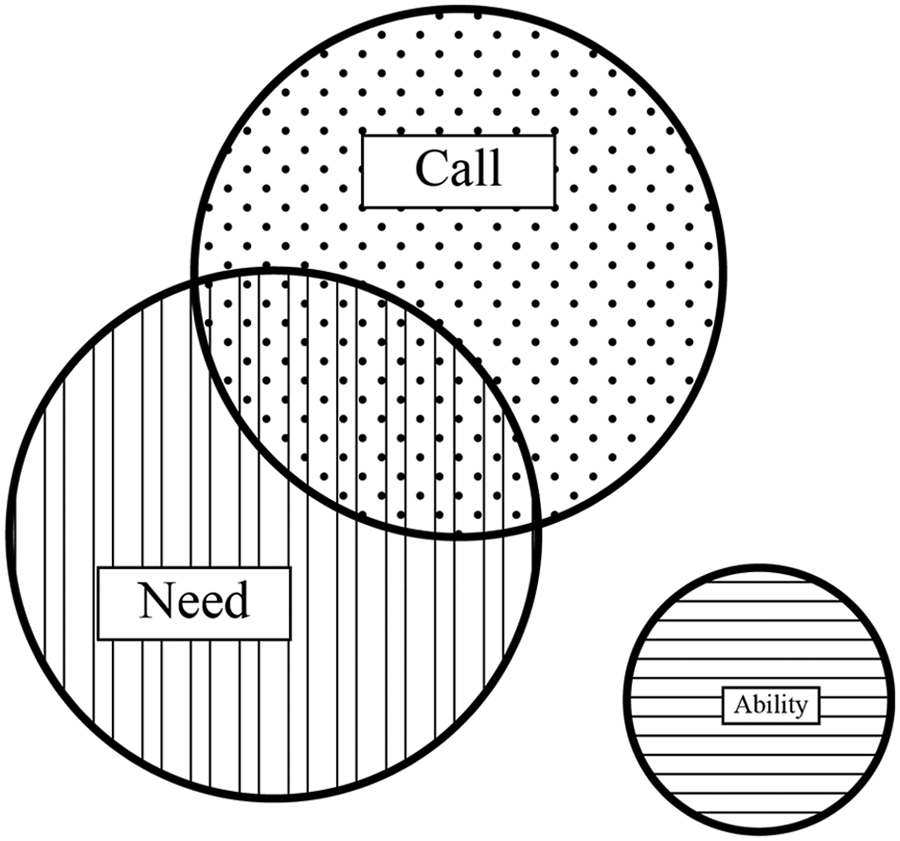
Amateurism in missions.
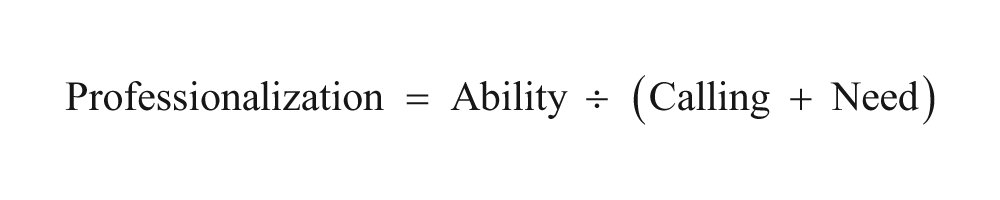
Similarly, professionalization exists where missionaries focus on their own abilities without regard to divine calling. Another way of explaining professionalization is when missionary ability—apart from divine calling—is applied to human need. Professionalization tends to be both ethnocentric and egocentric (see Fig. 5). In this model, the missionary tends to address needs, which are readily apparent from the missionary’s perspective. Little thought is given to the fact that all societies exhibit a spectrum of needs. The result of this type of missionary work is philanthropic social action at best. At its worst, this type of professionalization creates meaningless monuments to the missionary’s culture and ego, leaving the critical needs of the society largely untouched. Both amateurization and professionalization involve inappropriate missionary ability for the calling and need.
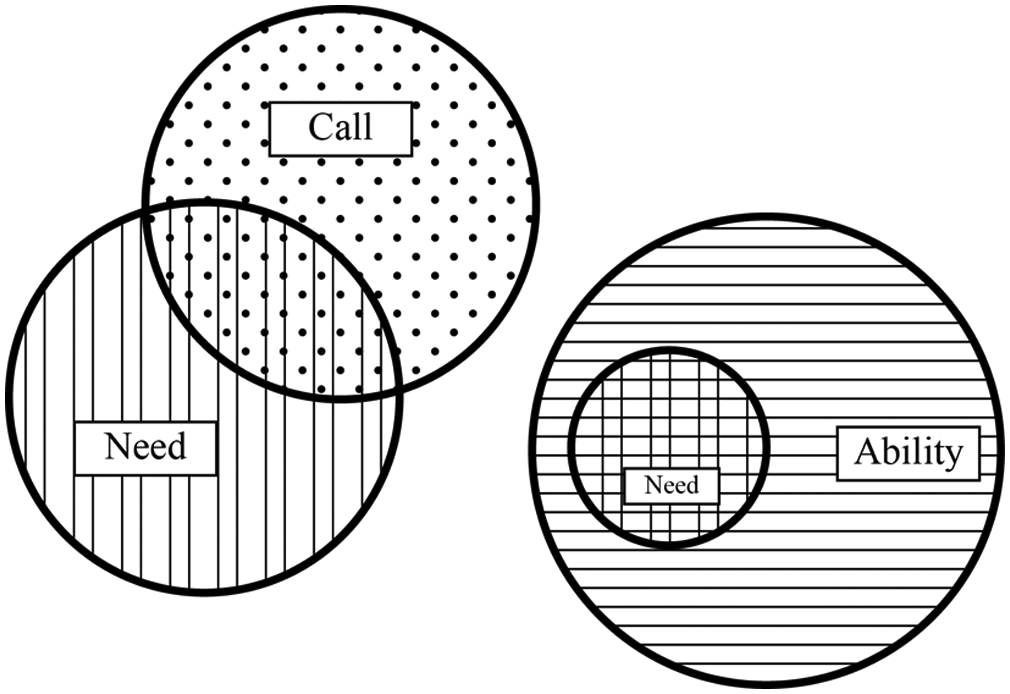
Professionalization in missions.
The need to correctly balance calling, need, and ability extends beyond the current concern over the so-called re-amateurization of missions. Improperly balancing these three components of missionary effectiveness can lead missionaries to frustration and worse. Where only a sense of calling and the missionary’s ability overlap without a missiologically sound evaluation of the society’s need, practitioners risk irrelevance. Where need and ability intersect apart from divine calling, missionaries risk pouring out their lives to little eternal effect. As we have already seen, where divine calling and human need intersect apart from missionary ability, there is only ineffectiveness.
For missionaries to engage effectively in meaningful, God-ordained ministry, they must constantly work to fit their ability to the need God is calling them to address. In order to achieve, maintain, or regain effectiveness, we must focus on missionary formation.
Missionary formation determines ability
Missionary ability is the only component of effectiveness that can be humanly influenced. God’s calling is his sovereign act. Human need stands outside a missionary’s influence. However, missionary ability can be enhanced in cooperation with the working of the Holy Spirit in the missionary’s life. By focusing on spiritual formation, missiological education, and ministry development, missionaries can fit their abilities to the tasks they have been assigned in the missio Dei.
Biblical examples of missionary formation
Missionaries are in a life-long process of formation, which mirrors the development that took place in the lives of biblical missionaries and of Jesus himself. Though this is certainly not a complete biblical theology of missionary formation, Jesus and John-Mark provide modern missionary practitioners with examples of how they can grow to meet the challenges of their callings.
Missionary formation in Jesus
Three components of formation—becoming, learning, and doing—are clearly illustrated in the life of Jesus. Following his presentation at the Temple, Luke records, “And the child grew and became strong; he was filled with wisdom, and the grace of God was upon him” (Luke 2:40). Here we see the maturation of a child becoming strong, wise, and grace-ful. He is experiencing spiritual formation and education. It might not be too much to assert that Jesus was learning in a praxis model of education. The text does not indicate that he became “smart” or “knowledgeable.” Instead, it says he grew in “wisdom,” which implies both knowledge and practice. Again Luke writes that the 12-year-old “Jesus grew in wisdom and stature, and in favor with God and men” (2:52). Jesus’ becoming continues as (1) his stature increases and as (2) he connects to his Father, growing in favor with God. His learning is also advancing and is demonstrated in wisdom. He is able to question the teachers at the Temple, and “Everyone who heard him was amazed at his understanding and his answers” (Luke 2:47). Even at his young age, Jesus is doing the same kind of ministry that would mark his post-baptismal work: he is questioning the teachers and framing his presentation of the good news. For Jesus to effectively fulfill his divine calling by ministering to the people of first-century Palestine—and ultimately the entire world—he had to develop spiritually, educationally, and ministerially.
Missionary formation in John-Mark
Another biblical example of missionary formation can be found in the life of John-Mark. Though he had lived around the disciples in Jerusalem, where his mother hosted prayer meetings for the disciples, his first venture into missionary work did not meet with unqualified success. While we are not told of the exact reason he left Paul and Barnabas in Perga (Acts 13:13), that act of abandonment caused Paul to temporarily lose trust in John-Mark. At the time of the second missionary journey (Acts 15:36ff.), Paul refused Barnabas’s request to include Mark, and that decision caused Paul and Barnabas to go their separate ways. Paul teamed up with Silas, while Barnabas took Mark to Cyprus.
Interestingly, there is no indication in the text that either Paul or Barnabas made a poor or ungodly decision: “Paul chose Silas and left, commended by the brothers to the grace of the Lord” (Acts 15:40). Hesselgrave points to verse 40 in support of his assertion that “Paul had the better case” (2005: 219). He makes much of the fact that such commendation is not included for Barnabas and Mark. Further, he highlights the fact that Luke’s account follows Paul throughout his journeys while “Barnabas all but disappears from the New Testament record after this incident” (2005: 219). Here Hesselgrave overreaches, making his argument from silence without regard for the fact that Luke accompanied Paul and would have recounted the story from Paul’s perspective. Paul’s record needs no defense, and there is no compelling reason to condemn either Barnabas or John-Mark based solely on the charge of faint praise.
Neither is there any permanent rupture in the relationship between Paul and Mark. In Col 4:10, Paul writes, “My fellow prisoner Aristarchus sends you his greetings, as does Mark, the cousin of Barnabas. (You have received instructions about him; if he comes to you, welcome him.)” Again in 2 Tim 4:11, he states, “Only Luke is with me. Get Mark and bring him with you, because he is helpful to me in my ministry.” Whatever inabilities John-Mark exhibited on that first missionary journey, he has apparently developed significantly in the years he spent under the tutelage of Barnabas and Peter (Bruce, 1984: 179).
In the case of John-Mark’s missionary formation, we do not have the tripartite formula of development that Luke gives us in describing Jesus. However, we do have important information. First, John-Mark’s initial test of his missionary ability ended in failure. Second, though that failure had consequences, it was not permanent. Third, at the time of the second missionary journey, it appears that he was able to accompany Barnabas but was unable to accompany Paul and Silas. This circumstance seems to indicate that missionary abilities vary: a missionary can be capable of one type of cross-cultural work and incapable of yet another kind. Finally, Mark’s ability changed throughout his service, as recorded by Luke, Paul, and Peter. He progressed from (1) a short-term missionary to (2) an apprentice to (3) a valued member of the apostolic band. John-Mark’s growth can be seen as paradigmatic of effective missionary formation even today.
Missionary spiritual formation (becoming)
A missionary’s ability begins its development in company with all Christ followers—at the feet of Jesus. Jesus modeled a life of spiritual disciplines, including Richard Foster’s “inward disciplines” of meditation, prayer, fasting, and study; “outward disciplines” of simplicity, solitude, submission, and service; and the “corporate disciplines” of worship, guidance, and celebration (Foster, 1978). Only the corporate discipline of confession was unnecessary in his life. Still, he taught his followers to pray confessionally (Matt 6:12). Jesus sets himself up as the example for his disciples to follow, explicitly using the words “follow[ed] me” seven times in the Gospel of Matthew alone.
Paul adopts a similar posture in his appeal to the Corinthian church as they wrestle with contextualizing the gospel in a pagan world. After presenting his reasoning on the issue of meat sacrificed to idols, he concludes with “Follow my example, as I follow the example of Christ” (1 Cor 11:1). To Timothy, Paul asserts that those who are leaders and teachers in the Church of Jesus Christ are held to particularly high standards of behavior (cf. 1 Tim 3–5). They are to serve as examples of a Christ-centered, Spirit-filled life. Far from proposing a standard of outward perfection that leads to hypocrisy, Paul argues for mature authenticity in leaders who can display the fruit of repentance for unbeliever and new believer alike (cf. 2 Cor 7:8ff.).
Missionaries face the extraordinarily difficult task of representing Christ in places where he is not known. When Christians live in a place where there are many believers, one aberration is unlikely to warp the witness of the entire community of faith. Though nobody is ever “spiritually formed” in the absolute sense (Phil 3:12), the example of “life and godliness” that missionaries live out may become paradigmatic of what it means to be a Christian in their host culture. Thus, it is critically important that missionaries make the necessary investment in their spiritual formation before embarking on missions which require spiritual maturity.
Don’t all missionary efforts require spiritual maturity? No, probably not. Not all missionary callings and needs are equal; therefore not all missionary tasks require the same abilities or the same spiritual capabilities. Consider a 16-year-old Christian from suburban Chicago who is traveling to Ecuador on a ten-day trip with a group of 20 friends and two adult sponsors. The team is being hosted by a career missionary who has lived full-time in Quito for the past 20 years. That team will not require the same spiritual maturity as will a single missionary who is moving abroad for her first four-year term of service among an unreached people group in an undeveloped region of northern Laos. The spiritual ability required to accomplish their tasks is unequal even though each of these “missionaries” may be responding to a very real and divine calling and though they may be responding to a need that has been articulated from within the society and that is consonant with the revealed Word of God.
Virtually every mission organization establishes minimum requirements for participation in missionary activity, even very short-term missionary activity. Often character references are sought, and data are collected from applicants seeking to represent Christ in missionary service. The goal is to ensure that missionaries—whether short-term or career—are equipped with appropriate spiritual formation for the task to which they have been called. Inadequate spiritual formation leads to one facet of amateurization: inability to cooperate with God in the accomplishment of missio Dei.
Missionary education (learning)
In addition to spiritual formation, missionary ability is developed through missiological education. 2 There is broad consensus in the church that missionaries must have more than passing familiarity with the Bible, that they must be effective communicators of the gospel, and that they must have at least rudimentary understanding of culture and its impact on communication. It is the perceived lack of missiological understanding among short-term missionaries that causes heartburn among career missionaries and missiologists.
When conducting research into the effectiveness of STM (Klassen et al., 1999; Plake, 1999), the consensus among missionary practitioners in the Assemblies of God World Mission was that cultural understanding could only be gained through “the school of hard knocks” and that short-term missionaries could not be taught cultural truth in a pre-field setting. The results of sending wealthy, enthusiastic, outspoken, ethnocentric North American Christians abroad in the service of Christ and his Kingdom were predictable. Against all odds, a few teams succeeded and were a blessing. The vast majority were average, which is not to say effective. Some others were catastrophic. As I was developing a video-based training program for short-term mission teams headed to the nations of the Asia Pacific (Nene, 2006; Plake, 2006), a veteran missionary confided in me that “a short-term mission team can undo in 12 days what it has taken me 12 years to accomplish.” Virtually every career missionary I interviewed from 1999 to 2005 could tell me at least one horror story of short-term missionary incompetence. Only a few of them could tell of truly outstanding ministry conducted by short-term personnel.
However, pre-field training has a significant impact on the entry posture of short-term missionaries (Ybarrola, 2008). Teams that I have led have responded with resistance to correction when they have not received pre-field training. Teams which have received pre-field preparation tend to respond appropriately to correction, and they often self-correct culturally inappropriate behaviors. This is not to say that trained teams do not make mistakes; however, they do tend to err more gently than their untrained counterparts.
Missionaries’ effectiveness will be limited partly by their ability to learn and understand the impact of cultural dynamics. Though short-term missionaries are expected to manifest “unconscious incompetence” regarding culture, proper pre-field training can help them to achieve “conscious incompetence” (cf. Storti, 1999). This simple change in entry posture makes short-term missionaries less offensive and helps them to become more open to new information.
Career missionaries, on the other hand, behave amateurishly and dangerously if they engage in missionary work across great cultural distances without a deeper understanding of worldview, epistemology, and the implications of the Kingdom of God. It may not be important whether missionaries receive advanced education prior to field experience. A missionary administrator in Southeast Asia writes, there is a difference between awareness and understanding. Yes, people can become aware of issues, but my experience is that only a small percentage of what is taught before arrival is remembered and applied. We have [career missionaries who] come to the field…some principles were learned; they’ve had education in missions, but…they need another orientation upon arrival, or shortly thereafter, since at that point the receptors are fully open. (in Plake, 1999: 18)
Missionary education is a lifelong pursuit, which combines theory with practical learning in missiological praxis. The critical consideration is that missionaries—whether short-term or career—must possess an educational background that is appropriate to the tasks that God has called them to accomplish.
Missionary ministry development (doing)
Besides spiritual formation and missiological education, full-orbed missionary formation requires ministry experience. Again, mission agencies normally require evidence of candidates’ ministry effectiveness in their home culture before approving them to serve as missionaries abroad for any significant length of time. However, for shorter durations of ministry, agencies are known to accommodate willing and sincere candidates who lack experience in ministry. A. Elizabeth Grant, founder/co-director of Project Rescue, commonly receives requests from North Americans who want to come to India to work with Project Rescue in the red-light districts. Unfortunately most of these inquirers have no ministry experience in their own countries. She usually responds to such requests by urging the applicant to get some experience in compassionate ministry at home before trying to minister in a foreign context (interview, Sept. 2011).
Grant insists on ministry experience because she recognizes the critical role of praxis in missionary formation. “Praxis is an action that includes the telos, or final meaning, and the character of truth. It is an action in which the truth is discovered through action, not merely applied or ‘practiced’” (Anderson, 1993: 27). Our activity on Christ’s behalf should be through the empowerment of the Spirit of Christ, reaching out to individuals, families, and societies in grace and embodying a praxis in which redemptive action and theological reflection are twin moments of the same event. Thus, apart from action, it is impossible to truly know, and apart from theological reflection, it is impossible to properly act.
It is this necessity for ministry development as a component of ability that presents one of the greatest challenges for missiological education at all levels. Winter’s advocacy of Theological Education by Extension arose from his conviction that removing Guatemalan lay ministers from their context of ministry would not truly increase their ability. It would, instead, tend to invest them with theory-apart-from-action and disable them from meaningful ministry on behalf of Christ. Neither theological reflection nor redemptive action can be removed from the process of ministry development. Those who eschew theological reflection soon devolve into anti-intellectual activists, while those who omit redemptive action develop theories which are of little benefit to the church of Christ or the missio Dei. Missionaries at all levels must learn while doing and serve while learning.
It is imperative to focus on all three aspects of ability: doing, learning, and becoming, because missionary ability is the only component of effectiveness that can be humanly influenced. However, missionaries do not simply engage in formation activities as self-improvement. Through conscious attention to formation, missionaries fit their abilities to the tasks they have been assigned in the missio Dei. Thus, a focus on improving missionary ability is an act of worship wherein missionaries cooperate with the Holy Spirit, who is already at work in the world.
Limitations
This model of missionary effectiveness is certainly not exhaustive. These observations are offered as a part of the ongoing missiological conversation on appropriate ability in missions. Additionally, this model has application to the current challenges faced by short-term and career missionaries. Obstacles to effectiveness in short-term missions include:
excessive task orientation
ignorance of cultural dynamics
inadequate mentoring
insufficient partnership with mission agencies
Similarly, career missionaries face contemporary challenges such as:
inappropriate pre-field education
the need to engage with majority world missions
the trend toward missionaries-as-specialists
the challenge of frontier missions
Space does not permit examination of these challenges and their engagement by means of this model of effectiveness.
Conclusion
Missionary effectiveness is found at the confluence of divine calling, human need, and missionary ability. Missionaries are ineffective when their abilities—including spiritual formation, missiological education, and ministry development—are inappropriate for the context to which God has called them as ambassadors. Great ability without divine calling is professionalism, and inadequate ability to respond to the divine calling and human need is amateurism. Because short-term missionaries possess limited abilities, they may serve appropriately in limited contexts. However, all missionaries can and should grow. As missionary ability increases, so do the possibilities for appropriate engagement in God’s mission of redemption.
Footnotes
Funding
This research received no specific grant from any funding agency in the public, commercial, or not-for-profit sectors.