






Abstract
With the growth of globalization, partnerships between US NGOs and the Evangelical Church of Vietnam (ECVN) have expanded, particularly in community development. This study explores how cultural differences impact these collaborations. Drawing from Erin Meyer’s The Culture Map as an analytical framework, the research investigates how differences in communication styles, trust-building, leadership, flexibility, and decision-making affected collaboration between ECVN and US NGOs. Ten in-depth interviews were conducted with ECVN’s leaders who have been working directly with US NGOs. The study revealed that cultural differences shaped how partners (1) interpreted Vietnam’s cultural and historical context, (2) chose the methods to build trust, (3) approached project flexibility, and (4) empowered local leadership. The research highlights the need for mutual understanding, humility, and adaptive leadership in fostering sustainable, culturally sensitive collaboration.
Introduction
Globalization has enabled greater collaboration between Western and non-Western partners in community development and mission. However, while such partnerships offer tremendous potential, they also reveal deep cultural differences that can hinder effectiveness if not properly understood. This is especially true for collaborations between US NGOs and Vietnamese Christian partners within the Evangelical Church of Vietnam (ECVN), a denomination rooted in local history but now increasingly working with international stakeholders.
Vietnam’s unique historical and cultural development, including its Confucian roots, colonial past, and Communist governance, shapes how Vietnamese Christians view authority, time, trust, and responsibility. Western partners, particularly from the United States, often bring assumptions grounded in individualism, egalitarianism, and direct communication. The cultural gap is not merely theoretical; it plays out in practical decisions about budgets, timelines, reporting, and leadership development.
This research addresses the question: How do cultural differences impact the collaboration between ECVN and US NGOs in community development? The goal of this study is to provide a nuanced understanding of how cultural dimensions influence real-world interactions and outcomes. Through this, both Vietnamese and US partners can develop better frameworks for communication, trust, mutual respect, and effectiveness in cross-cultural collaboration.
To situate these empirical findings within a broader scholarly foundation, it is necessary to survey existing research on cultural dimensions and church–NGO collaboration. The following literature review provides the conceptual lenses through which the interview data in this study can be understood. These macro-level frameworks help explain why specific tensions, misunderstandings, and adaptive practices continually emerged in ECVN–US NGO partnerships.
Literature review
When churches and NGOs collaborate across cultures in community development, success often depends on both understanding cultural differences and forging effective partnerships. Because of this, I structured this literature review around two closely connected areas of study: cultural dimension theories and principles for church–NGO collaboration.
Cultural dimensions
Contemporary cultural theory offers multiple macro-level frameworks for understanding cross-national value and behavior differences, including Hofstede’s cultural dimensions, Hall’s high-/low-context communication, Trompenaars’s seven dimensions, the GLOBE project, and the World Values Survey cultural map (Haerpfer et al., 2020; Hall, 1976; Hofstede, 1980; House et al., 2004; Trompenaars and Hampden-Turner, 1997). While these models are foundational, they often rely on static national averages and underplay intra-cultural variation and real-time interaction. Erin Meyer’s The Culture Map (2014) is therefore adopted in this study as the primary analytical framework, as it provides a more flexible, practitioner-oriented, and micro-level tool for navigating contemporary intercultural collaboration in organizational and ministry settings (Nyssen Guillén and Deckert, 2021).
Meyer
Erin Meyer’s The Culture Map (Meyer, 2014) presents eight cultural dimensions that enable businesspeople to visualize cross-cultural interactions and apply these insights in real-world scenarios (Shah, 2014; Taoka, 2022). The eight dimensions of Meyer’s framework are:
Communicating—The contrast between high-context and low-context communication. Evaluating—Direct versus indirect feedback styles. Leading—Hierarchical versus egalitarian leadership styles. Deciding—Consensus-based versus top-down decision-making. Trusting—Task-based versus relationship-based trust-building. Disagreeing—Confrontational versus avoiding disagreement. Scheduling—Linear versus flexible time orientation. Persuading—Principles-first versus applications-first reasoning.
Figure 1, The Country Mapping Tool (Meyer, 2023), is a visual representation comparing the United States and Vietnam across Meyer’s eight dimensions, providing a clear illustration of their cultural differences. This comparison highlights key areas where collaboration may face challenges, such as communication, leadership, decision-making, trust, and scheduling.
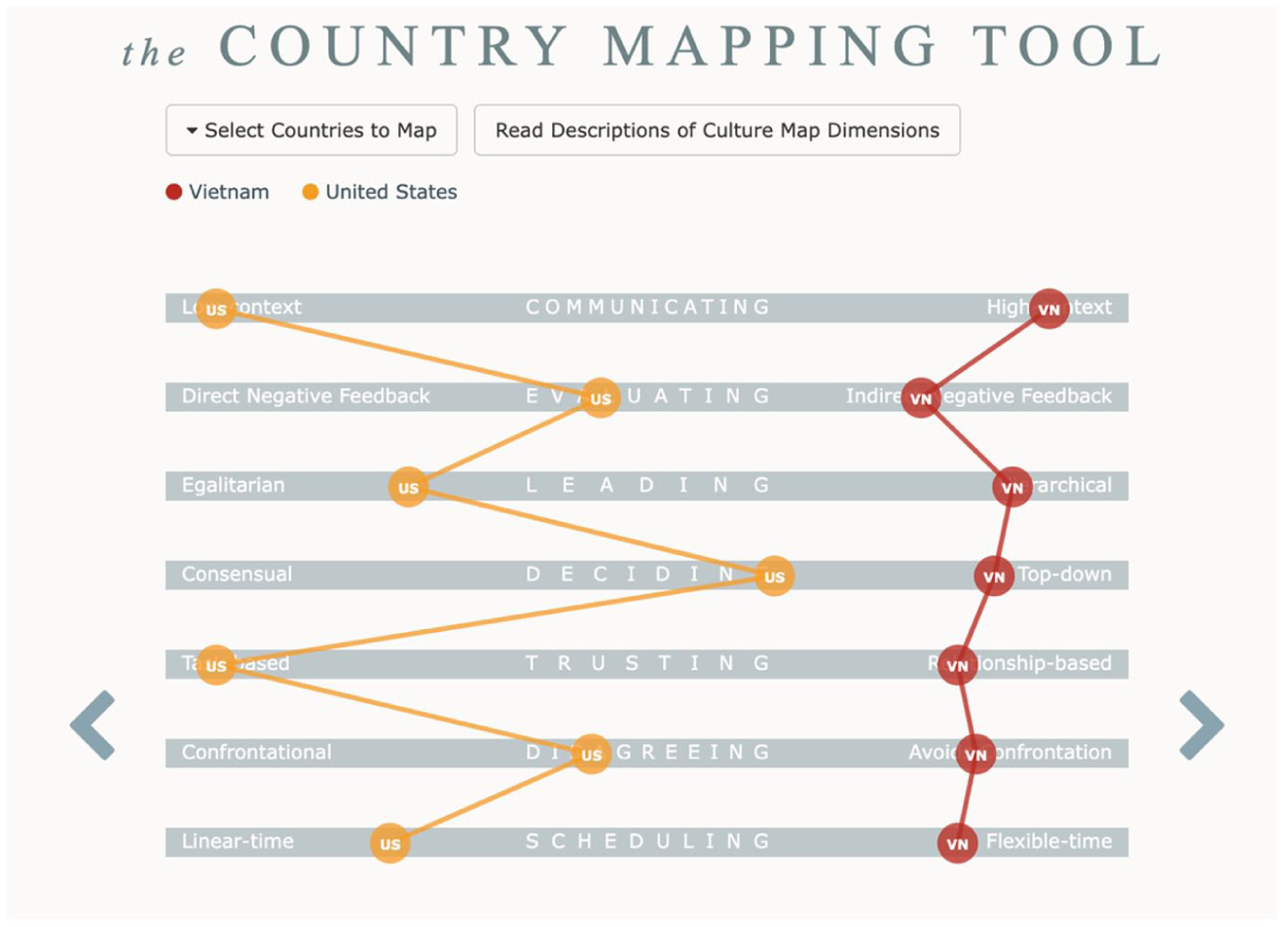
A side-by-side comparison of the United States and Vietnam across Meyer’s seven cultural dimensions.
For example, Vietnam is a high-context culture, where implicit communication is favored, while the US is low-context, emphasizing clarity and direct messaging. Similarly, Vietnamese culture values hierarchical leadership and top-down decision-making, whereas US NGOs lean toward egalitarian leadership and consensus-driven decision-making. Another key difference is in trust-building: while the US prioritizes task-based trust, Vietnamese professionals develop trust through long-term personal relationships. These insights are crucial for organizations working across these cultural contexts, as failure to adapt to these differences can lead to miscommunication and inefficiency (Anderson, 2021; Meyer, 2014). By mapping out these dimensions, Meyer’s framework helps practitioners anticipate potential frictions and develop strategies to bridge gaps, such as adjusting communication styles or leadership approaches to better align with their counterpart’s expectations.
A major strength of Meyer’s model lies in its immediate applicability. Business leaders and multinational teams have used the Culture Map to tailor their communication, leadership, and decision-making strategies to various cultural environments. For example, Anderson (2021) recounts how Netflix applied Meyer’s insights to translate its core corporate values across different country cultures, which contributed to the company’s successful global expansion. Likewise, Sumit (2019) and Williams (2022) emphasize that familiarizing oneself with Meyer’s eight scales can help managers reduce miscommunication and build trust in diverse teams.
Meyer’s model has also been applied across a range of management disciplines. Research in project management (Rodríguez-Rivero et al., 2018), leadership (Caldwell and Prizant, 2017; Nida and Anika, 2020; Service et al., 2019), innovation (Nyssen Guillén and Deckert, 2021), change management (Van Der Zouwen, 2019), and negotiation (Chung and Celadon, 2019) demonstrates the model’s broad utility (Dinçer et al., 2023). Studies on emerging markets (Aery and Engelbrektsson, 2019; Deeter-Schmelz et al., 2019; Gallego-Toledo, 2015; Sharma, 2016) further highlight how the framework can be adapted to understand specific regional and administrative challenges. Dinçer et al. (2023) emphasizes that Meyer’s approach is particularly functional for overcoming cultural barriers in global business operations, aligning well with an “insider’s eye” classification that deepens the understanding of cultural context (Ray, 2018). In sum, the uptake of Meyer’s framework in both corporate practice and academic research attests to its relevance and versatility.
Church–NGO collaboration
Having established the importance of cultural context, it is also essential to examine how partnerships function in cross-cultural ministry. In development work, cultural understanding must go hand-in-hand with practical collaboration strategies.
Theological foundations for collaboration
A strong theological basis undergirds the push for church–NGO partnerships. Many Christian development thinkers argue that collaboration is rooted in God’s own nature and mission. Alawode (2024: 1) notes that “God created the world to function in mutual relationships,” pointing to the Trinitarian community as a model for partnership. He emphasizes that Christian mission is inherently collaborative: believers are meant not only to partner with God but also “partner with other believers to fulfil[l] the Great Commission” Alawode (2024: 1). In this view, partnership is “coming together to do something for God’s glory” (Alawode, 2024: 1). The missio Dei theology reinforces that God is already at work in the world; thus, churches and Christian organizations are invited to work together rather than acting alone.
The Christian community development movement echoes this high view of the church. In Gordon and Perkins’ (2013) handbook, one chapter bluntly states, “The church—followers of Christ gathered as a community—is God’s chosen change agent for ministry” (Gordon and Perkins, 2013: 120). They maintain that while churches are imperfect, God has ordained the church “as the blueprint” for a worshiping, witnessing community to embody God’s love in the world. Indeed, “one could make the case that it is the church that separates Christian community development from [secular] community development” (Gordon and Perkins, 2013: 121). This does not mean parachurch NGOs are unimportant, but it underscores that any lasting transformation must involve a vibrant local church. As Kehrein put it, “It is virtually impossible to carry out effective wholistic ministry apart from the local church. A nurturing community of faith can best provide the thrusts of evangelism, discipleship, [and] accountability” needed for holistic development (Gordon and Perkins, 2013: 121). Thus, an NGO’s programs will have greater depth and sustainability if they work with and through local congregations.
Church–NGO partnership
While the theological rationale for partnering is clear, the practice of partnership can take many forms. A development organization might identify local churches as implementing partners in community programs. Toop (2023) cautions that these arrangements can “easily fall into purely transactional relationships” (Toop, 2023: 64) if not carefully managed. A church might be treated as just another local contractor to meet donor targets, rather than a valued collaborator with its own vision. Toop describes how World Concern undertook an intentional reflection with their African church partners about “the character of our partnership,” with the goal of fostering “mutually life-giving” relationships rather than using the church instrumentally. One risk she notes is when partnerships are driven primarily by the NGO’s timelines and donor-defined metrics—“numbers of lives impacted” or development milestones—which “may or may not align with the church” and its rhythms (Toop, 2023: 64). In such cases, the local church can be reduced to “simply a means to an end” for the NGO’s project goals (Toop, 2023: 64). To avoid this, World Concern asked a pivotal question: What changes if we view the local church as distinct from other partners? The answer was to treat the church more like family—committing to her even when she does not seem the most efficient choice—because of the spiritual bond and mission shared (Toop, 2023: 65). This represents a model of partnership as covenantal relationship, reflecting faith commitments, rather than a contract based solely on performance.
Mutual empowerment and capacity building
A healthy church–NGO partnership should lead to mutual empowerment—strengthening the capacity and dignity of everyone involved, especially the local communities being served. An oft-quoted principle is “never do for the poor what they have (or could have) the capacity to do for themselves” (Lupton, 2011: 128). Partnerships grounded in empowerment will focus on capacity building—equipping and encouraging local actors to take the lead in their development.
Bryant Myers (2011) emphasizes that the ownership of development “lies with the people themselves.” He urges outsiders to start by acknowledging that the poor “already know a great deal” about their situation; indeed, “the poor already know how to survive,” and any journey of development “needs to begin with this significant fact” (Myers, 2011: 18). This perspective shifts the NGO or donor from hero to facilitator. It calls for listening to local knowledge and building upon it. Myers describes a progression “from participation to empowerment,” noting that participation is quality-dependent: it becomes true empowerment only when local people are “less passive and more the primary actors in their own development” (Myers, 2011: 18). For church–NGO collaborations, this means programs should be designed to put local church members and community stakeholders in the driver’s seat as much as possible, with the NGO in a supportive role.
Corbett and Fikkert (2014) highlight that partnership should address the “poverty of being” on both sides: the poor gain dignity, and the affluent relinquish their “god-complex.” Haasl (2018) notes partnerships framed as exchanges of gifts—material support on one side, spiritual richness on the other. Vanier (2019) describes such relationships as transformative spaces where difference leads to mutual growth. Trust, noted in Bell (2021), is both a product and catalyst of empowerment, enabling local leadership to flourish.
Methodology
This qualitative research uses a phenomenological approach to explore the lived experiences of ECVN’s leaders collaborating with US NGOs. Erin Meyer’s The Culture Map (2014) serves as the theoretical framework, offering eight cultural dimensions: communication, evaluation, leading, deciding, trusting, disagreeing, scheduling, and persuading.
Data was collected in October 2024 through ten semi-structured interviews with ten participants who serve as either full-time community developers or pastors engaged in community development within ECVN. Their experience of collaboration with US NGOs ranged from 10 to 24 years, encompassing diverse projects such as medical trips, housing for low-income families, clean-water initiatives, wheelchair distribution, and broader community development programs. Interviews were based on a set of eleven guiding questions, and all were conducted in Vietnamese and later translated to English. The key findings are organized into four thematic sections: the cultural and historical context of Vietnam; overcoming cultural barriers in building trust, flexibility and adaptability in projects; and empowering local leadership.
Findings and analysis
The cultural and historical context of Vietnam
The participants emphasized that any collaboration must account for the complex history of Christianity in Vietnam, the nation’s sociopolitical history, and deep-rooted Vietnamese cultural values. Indeed, those three major facets shape how the ECVN engages with partners today.
History of Christianity in Vietnam
Vietnam’s Christian history provides essential background. Christianity was introduced by the Christian and Missionary Alliance in 1911 and grew steadily; by the 1950s, ECVN was the only Christian denomination in Vietnam. During the Vietnam War (1955–1975), numerous other Protestant groups entered South Vietnam and established their own congregations. After 1975, with the ECVN suppressed under communist rule, many believers met in unofficial “house churches.” During this period, some pastors within the ECVN adopted doctrines that contradicted the church’s convictions and were disciplined by ECVN leaders. These pastors—along with others who were disciplined for personal moral failures—chose to join newly arrived denominations or establish new ones rather than seeking reconciliation with the ECVN. Some of these new denominations drew members away from the ECVN (Reimer, 2011), introducing interdenominational competition and fragmenting the once-unified Protestant community.
Given this history, ECVN leaders today remain mindful of past schisms and protective of the church’s unity. They are cautious about partnering with organizations tied to other denominations that had conflicts with ECVN in the past.
Sociopolitical history
Vietnam’s turbulent modern history has deeply affected the church’s posture toward foreign involvement. As the country’s political regimes shifted, the church had to adapt for survival. These trials left a deep imprint on how ECVN relates to foreign partners today. Decades of underground activity instilled in church leaders a habit of secrecy and caution. One pastor emphasized that their reluctance to share detailed information is not due to lack of transparency, but to safety: “If the government knows where our funding comes from, they might find ways to stop it.” Even now, some churches cannot openly collect donations to avoid attracting government scrutiny. Throughout those years, ECVN clung to the “three-self” principles (self-governance, self-support, self-propagation) to maintain autonomy and prove it was not a foreign pawn. This legacy of independence means ECVN is protective of its authority over church affairs—a direct result of its survival strategy. Thus, if foreign organizations push too quickly for information or try to impose their own procedures, ECVN may instinctively resist—not out of ingratitude, but to guard its security.
Understanding Vietnam’s history of colonialism, war, and communist oppression is critical for understanding these protective reflexes. In practice, it calls for patience with bureaucratic processes and sensitivity in publicizing financial details. US NGOs that show appreciation for the church’s past suffering and respect its need for discretion tend to earn greater trust.
Vietnamese cultural values
Vietnamese culture—including Confucian values absorbed over centuries of Chinese influence—plays a crucial role in shaping the dynamics for effective collaboration. Confucianism emphasizes hierarchy, filial piety, preservation of “face,” and communal harmony (Hwang, 1987; Tu, 1989).
Two cultural implications are especially important. First, authority is to be respected. One should show deference to Vietnamese leadership (Jamieson, 2020: 15–40). A foreign partner who bypasses a provincial official or a church president and deals directly with lower-level staff may unintentionally transgress local norms by ignoring the chain of command. Second, Vietnamese culture is one of strong collectivism (Jamieson, 2020: 15–40). People generally identify as part of a family or community and value group consensus over individual preference. An ECVN pastor will usually seek approval from senior leaders before making major decisions, rather than acting independently. To outsiders from a more individualistic culture like the United States, this deliberative process can appear slow or indecisive. But in the Vietnamese context, taking time to gain group buy-in and respect hierarchical order is essential to avoid missteps and ensure no one loses face. As Erin Meyer observes, in Confucian societies hierarchy comes with mutual obligations: subordinates are expected to defer to leaders, and leaders are expected to protect and guide subordinates. “This type of dual responsibility is the backbone of a virtuous society” (Meyer, 2014: 132).
In summary, Vietnam’s historical and cultural context imposes certain constraints (bureaucratic hurdles, guarded communication, slower decision-making), but understanding this context provides crucial insight into why the ECVN operates as it does. Recognizing and respecting this context is the first step toward a successful partnership.
Overcoming cultural barriers in building trust
Cognitive vs. affective trust
Trust emerged as a foundational element of the ECVN-US NGOs’ collaboration. Participants consistently indicated that relationship-building precedes effective partnership. “Vietnamese people do not share much unless there is trust or a relationship. If the US team spends more time . . . building connections, the partnership will be much smoother, and people will open up to them about their real struggles,” one interviewee noted. This reflects Vietnam’s relationship-based approach to trust, where personal bonds must be formed before business or ministry can be conducted. Vietnamese focus more on who you are than what you can do, so you have to be friends before you start working or making decisions. Whereas in the US it tends to be more task-based, built through successful transactions (Meyer, 2014).
To illustrate this difference, Erin Meyer describes how trust is built differently across cultures: In a task-oriented culture, trust comes from the head (cognitive trust)—“You do your work well . . . you are reliable . . . I trust you”—whereas in a relationship-based culture, trust comes from the heart (affective trust)—“We laugh together, relax together, and see each other at a personal level, so that I feel affection or empathy for you and sense that you feel the same for me. Result: I trust you” (Meyer, 2014: 168).
In practice, this means US teams need to budget significant time for informal interactions—sharing meals, meeting families, exchanging stories—as these are the activities through which Vietnamese partners come to know them and decide they are trustworthy. One pastor explained that when an American team visited his church, the breakthrough came “not in the formal meetings, but when we drank tea in my home and talked about our children.” Only after that personal connection was established did the church feel comfortable moving forward.
Indirect vs. direct negative feedback
Cultural differences in communication and social norms were another major barrier that had to be overcome to build trust. Direct versus indirect communication styles in giving negative feedback emerged as a key point of contrast. In Vietnamese culture, negative feedback is usually delivered in a subtle or roundabout way to avoid offending the listener. Americans, in contrast, tend to be more frank and explicit when pointing out problems. One participant shared a story of a meeting between American donors and local staff. The American donors gave frank feedback on project details, intending to share their idea and help improve the project, but the way they expressed their ideas made the local people think that the donors were complaining about their poor work. The locals felt hurt and inadequate, when in reality, the Americans were actually pleased with the overall work and were only suggesting minor improvements. The misunderstanding was cleared up only later, when the Americans realized the issue, apologized for the confusion, and praised the local team’s accomplishments.
This incident underscores how easily differing communication styles can erode trust: what is meant as constructive critique by a straightforward American can be perceived as disrespect in the Vietnamese context. As Meyer humorously notes, feedback that a Dutch person finds “brutally honest yet delightfully polite” may strike someone from a less direct culture as “downright insulting, offensive, and yes, rude” (Meyer, 2014: 87). The American donors in the story were certainly not Dutch, but the principle holds—their bluntness, while normal in their home culture, inadvertently embarrassed their Vietnamese counterparts. Such gaps were ultimately bridged through open dialogue and, importantly, by the Americans adjusting their communication style. The donors learned to temper their delivery, couching critiques with more praise and gentle wording, and the local staff learned to voice concerns if they felt uncomfortable. By finding a middle ground, the partnership avoided festering resentments.
In summary, being aware of indirect vs. direct negative feedback differences
The role of the mediator
A unique and highly important factor in Vietnamese culture is the role of a mediator (người trung gian) or intermediary when establishing new relationships. Many interviewees stressed that having an introduction through a trusted third party greatly accelerates the building of trust. One leader explained, “If the introduction comes through a common friend or someone we trust, the process is very fast because we trust that friend.” In contrast, if an NGO approached a local church cold (without any endorsement), “we take time to learn about them, and we also ask our leaders in the national office if they know about this organization before proceeding,” one pastor said.
This suggests that US NGOs should, whenever possible, proactively seek out a mediator to make introductions in Vietnam—perhaps a well-known pastor, a denominational leader, or even a mutual friend who has earned the trust of the church. By humbly accepting that they need someone to “vouch” for them, US NGOs can avoid long delays and skepticism.
In sum, the mediator plays an invaluable role in building initial trust and alignment. Recognizing this, empowered local leaders often insist on an introduction phase. And when US partners honor that norm by coming through proper channels, they demonstrate cultural respect, which in itself starts the trust-building process on the right foot.
Flexibility and adaptability in projects
Given the volatile and complex environment in which ECVN operates, participants highlighted flexibility as a critical success factor. Both ECVN and US collaborators learned that rigid plans often falter in Vietnam’s context, and the ability to adapt is key to overcoming unexpected challenges. They shared concrete examples illustrating why adaptability is necessary.
In one housing project, local families were supposed to contribute a portion of the costs, but unexpected hardships (a failed crop harvest in one case) meant some families could not provide their share on time. This delayed construction beyond the planned timeline. Fortunately, the US NGO in that instance was understanding; they allowed the project to report the completed houses first and gave extra time for the remaining families to catch up later. “It made us feel trusted and supported because they understood the situation instead of blaming us,” the project coordinator said gratefully. Such flexibility deepened trust and led to a successful outcome despite the delays.
In contrast, another project during a typhoon relief effort was less flexible: the plan estimated two months to repair houses, and the US team scheduled a visit exactly at the two-month mark for a closing ceremony. When only around 60% of the work was done by that time (due to families waiting for better conditions and resources to rebuild properly), the American team was reportedly upset. They had already booked flights based on the initial schedule and were reluctant to adjust. The local leader recalled telling them that they “should add a little time to the original plan when they book the tickets.” In other words, build in extra time rather than assume everything would go as planned. In the end, the premature push to finish caused a great deal of pressure and frustration on both sides.
The implication from that story was clear: in Vietnam, strict timelines often collide with reality. Successful collaborations were those where US NGOs were willing to revise schedules and expectations as conditions evolved. Indeed, Erin Meyer’s framework identifies differing attitudes toward time (linear versus flexible scheduling) as a common source of friction in multicultural teams (Meyer, 2014). The Vietnam case validates this point—a linear-time approach (set deadlines, fixed milestones) can falter in a flexible-time culture where delays are unavoidable and plans must adjust to circumstances. As Meyer puts it, “Time may be of prime importance in some cultures, but in others it is firmly subordinated to the needs of the moment” (Meyer, 2014). The Vietnamese context leans toward the latter: people are willing to extend deadlines to ensure the quality and appropriateness of aid rather than meeting an arbitrary date.
Paul Hiebert similarly notes that worldviews vary in how they conceptualize time. Some see time as uniform and linear, marching forward objectively, while others see it as cyclical or event-driven, organized around relationships and natural rhythms (Hiebert, 2008: chapter 2). Hiebert describes how Western cultures often create “well-formed” (rigid, digital) structures for understanding life, whereas many non-Western cultures use “fuzzy” (flexible, analogical) patterns (Hiebert, 2008: chapter 2). Applied to scheduling, a US team might treat the project timeline like a train schedule (with non-negotiable departure and arrival times), whereas a Vietnamese team treats it more like a river’s flow—adaptable to the terrain and obstacles encountered. In the typhoon project, the Americans’ fixed, digital view of time (“two months means two months”) met a Vietnamese fuzzy scheduling reality (“two months maybe, if all goes well, but if not, we adjust”). The result was unavoidable stress. Had the US team built in buffer time or shown willingness to stay longer, the project could have continued to completion without strain. This case teaches a powerful lesson: planning for the unexpected is not just a contingency tactic but a cultural necessity in Vietnam.
Flexibility was required not just in when aid is delivered, but also in what aid is delivered and how projects are implemented. Another vivid example of adaptability (or the lack thereof) came from a food distribution project during the COVID-19 pandemic. SOMEDCO and a US NGO planned to deliver basic food supplies to families in locked-down areas. 1 “We planned to give rice, fish sauce, sugar, and canned food,” the organizer said. However, upon arriving, the team discovered those families already had plenty of rice but desperately needed milk for children. The local team immediately decided to swap out rice for milk to meet the real need. This on-the-spot change, though logical from a humanitarian perspective, upset the US team. They accused the local team of not following the agreed plan. In fact, the US side ended the partnership after this incident, seeing the deviation as a breach of trust. From the ECVN side, such inflexibility was disheartening. “For us, it was more important to meet the real needs of the people,” the coordinator explained, reflecting that adhering rigidly to the original plan would have meant ignoring what was actually happening on the ground and bad stewardship. This case teaches a painful lesson: without flexibility, well-intended projects can collapse when conditions change. Conversely, a willingness to adapt not only ensures relevance but also signals respect for local knowledge and priorities. In the milk-versus-rice scenario, had the US NGO trusted the local judgment, the outcome might have been positive for all; instead, it became a cautionary tale of a partnership that soured.
Government regulations and local events were frequently cited as factors requiring flexibility as well. Rules can change abruptly, and events like floods, epidemics, or political shifts introduce new challenges. Participants mentioned that even importing charitable goods (like wheelchairs for disabled persons) can become a bureaucratic maze, requiring approvals from multiple ministries and taking months or years. “What might seem like a straightforward task can stretch into months or even years, depending on the province and the officials involved,” one leader noted, emphasizing that delays are just part of the reality of working in Vietnam. When US NGOs did not understand this and kept comparing timelines to their past experiences elsewhere (where things move faster), they sometimes grew frustrated and wrongly perceived the local side as inefficient. To mitigate such tensions, US NGOs should incorporate flexibility into project planning from the start. For example, setting range-based timelines (best-case and worst-case scenarios) rather than fixed deadlines, and having contingency budgets or buffer periods for likely delays. Such adaptability not only kept projects on track despite surprises but also deepened the partnership. It showed the US side’s commitment to learning from the local context rather than imposing a foreign timetable.
Empowering local leadership and recognizing donors’ contributions
Empowering local leadership
A recurring theme in the interviews was the importance of empowering the ECVN in joint community development projects. Empowerment here means more than just consulting local leaders; it involves actively utilizing local knowledge, skills, and structures rather than sidestepping them. Participants suggested that visiting US teams should spend time observing what the church is already doing on the ground and recognizing the existing capabilities. In other words, ECVN is not coming to the table empty-handed. The church has trained volunteers, professionals (teachers, doctors, etc.), local credibility, and intimate understanding of community needs. When US NGOs recognize and build upon those assets, collaboration flourishes.
Empowerment begins with awareness—when US NGOs see the competencies of local staff, they can tailor their support to amplify (rather than duplicate or sideline) the work of the church. This approach resonates strongly with the concept of asset-based community development (ABCD), which emphasizes starting with the strengths and gifts already present in a community rather than focusing on its deficits (Corbett and Fikkert, 2014: 119–122). Coming in with an asset-based approach is a way of honoring what God has already been doing through the local church and joining it, rather than starting from scratch.
Empowering the local team also boosts sustainability. If a project relies solely on foreign personnel or ideas, it may succeed temporarily but falter once the foreign NGO exits. Bryant L. Myers, a prominent Christian development thinker, argues that one key to sustainable transformation is ensuring local ownership and leadership. When a community feels a project is truly “theirs,” they are more likely to invest time, energy, and resources to keep it going long after external support wanes (Myers, 2011: 214). By continuously building local capacity—training indigenous leaders and providing them with experience and responsibility—a partnership leaves behind a legacy that endures. According to Myers, sustainable development emphasizes local ownership, capacity building, and continual learning as opposed to dependency on outside help (Myers, 2011: 214). The interviews provided concrete examples: A water filtration project initially led by a US team was gradually handed over to a team from a local church in Binh Dinh province, who were mentored and then took charge. Years later, this team has expanded the project to neighboring villages and trained many other teams, well after the US NGO shifted their focus elsewhere. This success came because the NGO saw itself not as a permanent operator but as a catalyst to equip the local church.
Empowering local leadership also means respecting the ECVN’s decision-making processes and authority structures. According to Meyer’s cultural dimensions, Vietnamese culture tends to value hierarchical leadership, whereas American culture leans toward egalitarianism. Meyer provides a useful insight: “In an egalitarian culture, an aura of authority is more likely to come from acting like one of the team, while in a hierarchical culture, an aura of authority tends to come from setting yourself clearly apart” (Meyer, 2014: 122). In Vietnam’s church context, a pastor or leader is expected to behave with a certain formality and decisiveness (“Clearly apart”), and subordinates may hesitate to challenge them openly. American team leaders, in contrast, might try to be “one of the team” to show humility, expecting open input from everyone.
When it comes to deciding, Vietnamese style leans toward top-down decisions, whereas American culture often prefers a consensual approach. During joint meetings, this could lead to confusion: Americans wondering why local staff are quiet, and Vietnamese wondering why the Americans do not simply tell their team what to do. This played out in the interviews. One participant shared that initially there was friction because
we were used to having decisions made by the pastor, but the US group insisted everyone have a say. . . . We would sit in a session for several hours debating. It was frustrating at first, but we learned to adjust by letting them discuss some parts while keeping our leadership structure intact.
This quote highlights a compromise: the local team allowed more open discussion (to accommodate the Americans’ style), but ultimately maintained their internal hierarchy for final decisions. The implication is that US NGOs should not force their own decision-making models without regard for local culture. Honoring ECVN’s established chain of command is crucial. US partners that understood this showed it by not bypassing the ECVN hierarchy—for example, by communicating plans through the appropriate church channels (national leadership and the SOMEDCO department, if applicable) rather than directly approaching local pastors or staff. This empowers local leaders because it validates their authority in front of their own people. It also aligns with cultural expectations—the congregation sees that their pastors and elders are steering the project (not an outside entity), which maintains trust.
In sum, empowering local leadership in ECVN-US NGO collaborations involved adapting leadership and decision-making styles to fit the context. It meant letting ECVN lead in culturally sensitive decisions and respecting the authority of their leadership structures. At the same time, it did not mean foreigners had no voice; rather, both sides found ways to incorporate the strengths of each approach. The overall tone from interviewees was that partnerships thrived when the local church felt genuinely in charge on their side. This sense of ownership not only empowered the church but also motivated them greatly—knowing that the success of the project rested in their hands, they rose to the occasion. And for the US NGOs, learning to step back at times proved to be an exercise in humility and faith; many saw it as a way of trusting God to work through the local believers. Ultimately, the leadership structure issue is a delicate dance of deference and initiative. The culturally intelligent partner recognizes when to lead from behind and when to step forward, always in consultation with their counterparts.
Recognizing donors’ contributions
Another recurring issue was how credit or public recognition is handled in joint projects. This emerged as a culturally sensitive point that, if mishandled, could strain the church-community relationship. American donors or NGOs sometimes wanted to erect signs or plaques publicly crediting the NGO for funding a project (such as a new house or a bridge). From a US perspective, this is often seen as a normal way to acknowledge contributors and increase transparency about where aid comes from. However, local ECVN leaders observed that this practice can backfire in the Vietnamese context. One pastor explained that in Vietnamese culture, it can be shameful for a beneficiary family to be publicly seen as an object of charity. For example, if a sign in front of a new house names a donor, it effectively broadcasts that the homeowners could not afford their own home. “In our culture, it is shameful to publicly show that a family could not build their own house . . . when the kids hang out, their friends will laugh at them,” one participant shared. So, while the intention of a donor sign is to celebrate a gift and increase transparency, it may inadvertently cause the recipient to “lose face.” Additionally, overt signs of foreign involvement can raise government suspicion about the church accepting overseas aid. One interviewee shared that a local official questioned the church about a banner in front of a church medical outreach, wondering if it meant the church was aligning with foreigners.
Perhaps most importantly, putting the US NGO’s name out front can undermine the local church’s connection with the community. As one ECVN leader put it, slapping the foreign NGO’s logo on everything essentially “takes credit away from the local church, which damages their relationship with the community.” The people in the community might begin to see the social work as “the foreigners’ project” rather than an expression of the church’s love and care. In a country where evangelism is done carefully through relationships and service, it is vital that the community associates good works with the local believers (who will be there for the long haul), not just with a one-time foreign donor.
The interviewees consistently noted that empowering the local side means allowing them to decide how to thank donors in a way that fits local norms. In practice, ECVN leaders usually prefer either no public sign at all or one that names the local church or ministry, rather than the US sponsor. They have their own culturally appropriate ways to express gratitude—perhaps a thank-you note read in church, or a mention in a church newsletter, or a private certificate of appreciation given to the NGO. This satisfied all parties: the NGO was acknowledged, but the event spotlight stayed on the church-community relationship. This discretion empowered the local leaders to maintain dignity and trust in their community.
In conclusion, recognizing donor contributions in ECVN-US NGO collaborations is a delicate but important matter. It requires putting the interests of the local community and church first. By allowing the local church to be seen as the primary agent of help, US NGOs actually fulfill a core principle of Christian community development—empowering those closest to the need to be the heroes of their own story. This keeps relationships intact and honors the dignity of those served. Meanwhile, the NGO can rejoice in the impact achieved and be content with a quieter form of recognition. In practice, when the church gets the credit and the NGO supports in humility, Christ gets the glory, and the partnership can flourish in unity.
Conclusion
The primary purpose of this study was to understand how cultural differences impact the collaboration between the ECVN and US NGOs in community development. I found that cultural differences shape collaboration in four main ways: (1) by affecting how each side interprets Vietnam’s cultural and historical context, (2) by influencing the methods each side uses in building trust, (3) by shaping expectations around flexibility and adaptability in projects, and (4) by determining how local leadership is empowered. Furthermore, I also suggested specific ways for both the ECVN and US NGO partners to address these differences so that their cooperation becomes more fruitful and Christ-honoring.
Further study
Further study could include interviews with US NGO participants to understand their perspective of their collaboration with the ECVN. Furthermore, studying collaborations between US NGOs and other denominations in Vietnam could provide broader insights into the factors influencing partnerships. Finally, it would also be valuable to research how collaboration plays out in other ministries, such as church planting, aside from community development.
Footnotes
Acknowledgements
I would like to express my deep gratitude to Dr. Ron Barber, Ph.D. (Trinity Evangelical Divinity School), for his invaluable supervision, guidance, and encouragement throughout the development of this research. His insight and expertise have been instrumental in shaping this study.
Author’s Note

Consent to participate
Verbal informed consent was obtained from all individual participants included in the study.
Funding
The author received no financial support for the research, authorship, and/or publication of this article.
Declaration of conflicting interests
The author declared no potential conflicts of interest with respect to the research, authorship, and/or publication of this article.
Availability of data and materials
Due to the confidential nature of the interviews and the promise of anonymity to participants, supporting data (e.g., interview transcripts) are not publicly available.