







Abstract
This study presents an experiential exercise designed to heighten students’ awareness of overconsumption in the United States and allow them to see how their own consumption habits are linked to larger social factors. Students engaged in the “Not Buying It” project—which involved refraining from purchasing all but essentials for a set number of days—as part of a broader lesson on consumerism. Qualitative and quantitative data, gathered from students enrolled in three sections of Introductory Sociology, suggest that the exercise was effective in enhancing students’ sociological imaginations by helping students see how their own consumption habits are shaped by larger social forces and how they, along with most Americans, tend toward overconsumption. To a more limited extent, it may help enhance cognitive understanding of consumption. Teaching about consumption in general, and the Not Buying It project in particular, offers instructors an excellent pedagogical means by which students can acquire a sociological imagination, reinforces key sociological principles, and links to broader goals within the discipline.
The United States has the dubious distinction of leading the world in hyperconsumerism and overconsumption. Data reported by FacingtheFuture.org (n.d.), a not-for-profit organization that provides schools and educators with curriculum on environmental issues and sustainability, reveal extreme discrepancies between U.S. consumption and that of many other countries. For instance, the United States accounts for less than 5 percent of the world’s population but one-third of all consumption. The average person living in the United States uses 300 shopping bags worth of raw materials every week. It would take the resources of three planets for everyone on Earth to live as people do in the United States. The typical American buys 53 times as many products as someone from China; one American’s consumption of resources is equal to that of 35 citizens in India; and the average American will inflict 13 times more environmental damage than the average Brazilian (FacingtheFuture.org n.d.). According to the WorldWatch Institute (2010), the global average “ecological footprint”—the amount of biologically productive space allocated per person (in resources) to sustain them—is 2.3 hectares; but for a typical American, it is 9.7. Furthermore, new housing developments as of 2002 are about 38 percent larger than homes built in 1975 but include fewer people per household (WorldWatch Institute 2010).
It is imperative that consumption habits change if humans hope to avoid ecological and environmental devastation, and it is particularly important that Americans do so since the average American consumes at over six times the sustainable rate (FacingtheFuture.org n.d.). Although significant changes in consumption patterns will require action at multiple levels, we believe that the classroom is a site where social change can and does occur. Educating students about consumer culture from a sociological perspective offers the promise of enhancing students’ sociological imaginations by helping them to understand the connection between personal consumption and larger social realities.
Pedagogical Approaches to Teaching about Consumption
Consumption has traditionally been taught in advertisement and economics, where the focus primarily is on how to increase consumption. Within sociology, the topic of consumption has been explored mostly within areas of environmental sociology and sociology of culture but has been ignored within mainstream sociology (Ritzer 2000, 2001) until very recently (in 2011, the American Sociological Association [ASA] approved the Section on Consumers and Consumption as an ASA section in formation). Although the issue has expanded somewhat into other areas, such as popular culture and sociology of food, historically, there has been limited sociological interest in understanding the nature and effects of consumption patterns, despite its obvious importance to the planet and its potential to enhance students’ sociological imaginations.
In the simplest sense, consumption refers to “the using up of goods and services having an exchangeable value” (Dictionary.com), but from a sociological perspective, consumption is much more complex and interesting. Postmodern, capitalist societies become defined by consumption and consumerism. In these societies, consumption takes on new forms and functions, as nearly everything is commodified and consumed (e.g., bodies, space, the “sacred,” rebellion) (see Gottdiener 2000). Although all these ideas can be incorporated into lessons on consumption, the exercise we present here focused primarily on consumption of material goods (i.e., tangibles), such as clothing, alcohol, movies, and entertainment, which required monetary cash or credit card exchange. More particularly, we focused on hyperconsumption (use of goods and services that are in great excess of basic needs).
Hyperconsumerism is entrenched in the American lifestyle and capitalist culture, and as such, everyone has experience with consumption and, most likely, overconsumption. Students, like other Americans, often survive on a steady diet of consumer products—fast food, clothing, snacks, books, music, alcohol, energy to fuel Internet bandwidth and cellphones, and so on. Thus, teaching about consumption offers an excellent opportunity to enhance students’ sociological imaginations. Teaching about consumption from a sociological perspective can help students see how their own consumption is linked to larger social forces, including media, corporate domination, global labor practices, and so on. By engaging students in “the real world” in this way, we help students develop their sociological imaginations and become more conscious citizens who are better prepared to deal with socioenvironmental issues and crises.
With rare exceptions, classroom exercises that teach students about consumption, especially overconsumption, are nonexistent. An extensive search of classroom activities and assignments listed in the TRAILS (the ASA’s Teaching Resources and Innovations Library for Sociology) database revealed only eight exercises or assignments related to the topic of consumption (there are, of course, many more syllabi for courses that include consumption). Only one assignment (Schor 2010) asks students to reflect on their own consumption habits by having them write an essay answering the question, “What type of consumer are you?”
Dowell (2006) described an innovative way for students to understand the sociological perspective on consumption, waste, and environmental degradation. Students collected their own garbage for a 24-hour period and brought it to class for analysis and discussion. Although the exercise appears to be effective in raising awareness about environmental issues (85 percent of the students “agreed” or “strongly agreed” that the assignment raised their awareness of environmental issues and their understanding of the sociological imagination), such an exercise may be inappropriate for large classes, given potential problems with waste disposal after the class period is over.
Another (less messy) approach to increasing students’ awareness of their ecological footprint and the impacts on local and global inequality involved having students document their own consumption for a three-day period, noting consumption of fuel, packaging, water, energy, and food (Obach 2009). Obach (2009) also asks his students to take the “ecological footprint quiz” online to get a sense of their overall consumption global impact and to write reflection papers about the assignment and what types of social change should take place. Obach found that all students reported an increase in awareness of their individual consumption, and about 80 percent stated they were surprised by their degree of consumption on a regular basis. Additionally, Obach reports that 93 percent of students stated they have a better understanding of how their consumption patterns are connected to global natural resource inequality and social and structural forces that shape this inequality.
A more time- and resource-intensive approach to teaching students about sustainability and environmentalism is Christiansen and Fischer’s (2010) project that took a group of students to various cities to compare and contrast sustainable policies and local initiatives. They ventured with students to Portland, Oregon, and Vancouver, British Columbia, and had the students compare these cities’ sustainability practices with those in their home site, Minneapolis, Minnesota. While traveling, students participated in “green” initiatives, such as riding public transportation, bicycling, eating locally grown and served foods, visiting green businesses, and speaking to policy makers about the sustainable efforts in their communities. Students were asked to keep a journal while traveling, write reflection papers, and participate in an oral presentation comparing the three cities after returning from the trip. Overall, Christiansen and Fischer (2010) report positive results, suggesting that their project helped students engage on a personal level with major social structural issues. In fact, a handful of students began major sustainability projects after completing the course. For example, one student started an organization, Pedalers for Progress, in which members bicycled from Minneapolis, Minnesota, to Portland, Oregon, and organized various meetings with Portland officials, policy makers, business owners, and community activists to discuss sustainable practices that could be brought back to Minneapolis (Christiansen and Fischer 2010). The course also gained considerable attention and led to the creation of many campuswide projects and initiatives.
Our exercise builds on these earlier works. Like others, we felt it was important to engage students experientially if we hope to engage students deeply and help them see the connections between their personal habits and global realities (also see Hironimus-Wendt and Wallace [2009] for the necessity of engaging students on intimate, personal levels to enhance their sociological imaginations). Like Schor (2010) and Obach (2009), we wanted to encourage personal and critical reflection about hyperconsumerism by having students document and reflect on their own consumption. The exercise we describe here goes beyond these works by directly incorporating an experiential component that can be used in courses of any size.
The overall goal of this experiential exercise was to enhance students’ sociological imaginations with respect to consumption. That is, we wanted students to make a connection between cultural consumer patterns and their own individual habits and behaviors. In addition, the objectives of the exercise were to help students gain greater knowledge and understanding of hyperconsumerism in the United States and to increase students’ awareness about these societal-level patterns of consumption and their own personal habits.
The “Not Buying It” Project
The exercise, which we refer to here as the Not Buying It (NBI) project, was introduced in the last few weeks of the semester, after students had been schooled in the basics of sociological thinking. In our classes, the issue of consumerism was framed within a broader discussion about the environment, which itself was framed within the larger issue of inequalities and stratification. Throughout the semester, students had engaged in discussions about how the sociological imagination applies to their lives, although most of the previous exercises explored private-public connections on more micro levels (e.g., we analyzed their first names from a sociological perspective based on Lieberson and Lynn’s [2003] work; students violated a folkway). Thus, we incorporated NBI as a way for students to apply the sociological imagination and understand better how these connections can be made globally. Although we used the exercise at the end of the semester, we believe it would work equally well earlier in the semester as a stand-alone topic or in conjunction with discussions of globalization, environment, culture, or inequalities.
Students began by reading Judith Levine’s (2006) Not Buying It, an autobiographical account of a year when Levine refrained from buying all but necessities (students in an honors course read the entire book; in nonhonors sections, students were required to read only two chapters). Students then emulated the lifestyle described in the book for three to seven days (we have varied the length of time to conform to other class demands). We explained to students that for the allocated time period, they must not shop, or if they did, it would be only to purchase essentials. Thus, no Starbucks, no clothes, no alcohol, and so on. We did not define what was “essential,” however. Indeed, this is one of the most illuminating parts of the assignment. By not defining what they could purchase, students were forced to grapple with what is truly essential (as Levine [2006] does in her book). If they purchased something, they had to justify the purchase (e.g., several students purchased gas because carpooling or public transportation to school or work were not options). Because the project spanned just a few days, we focused on consumption of items that required immediate monetary purchases (e.g., food, gas, entertainment) rather than services that students purchased on a monthly basis (e.g., Internet service, rent). (This project could easily be expanded to include such consumption if it were done as a month-long or semester-long project.)
Because we wanted students to succeed, we felt it was important to provide flexible scheduling to accommodate travel, major sporting events, holidays (the exercise fell during Thanksgiving and Black Friday one semester), and the like. Thus, students were allowed to pick which days (within about a three-week time period) to do the project, but the days had to be consecutive. We believe such flexibility would help eliminate excuses for why they could not succeed. We also allowed students to choose which days, within this window, not to shop. This introduced interesting insights in the nature of consumption. For example, students who opted to engage in NBI during a weekend experienced much more angst than did those who opted for weekdays, and this led to a stimulating discussion about how central consumption has become to social interaction in contemporary society. Indeed, some students felt that they could not spend any time with friends unless they could consume. (Instructors may wish to broaden this discussion to how the role and nature of consumption shifts as societies move from production based to consumption based.)
During the project, students were also required to keep a journal or blog of their experiences and insights, to participate in online discussions, and write a short paper in which they described what they did, what they learned (about themselves, the environment, cultural consumption) in the process, whether and what changes they hoped to make in the future, and why or why not. They were encouraged to write the paper in the same style and tone as Levine (2006) and to include some of their journal or blog entries to elaborate their points. Students were graded not on whether they successfully implemented the experiment but on the seriousness with which they approached the project. They had to demonstrate—through the journal or blog, discussions, and papers—that they took the project seriously, made a concerted effort to implement the model, and reflected thoughtfully on the process and their roles as consumers. We encouraged them to follow the plan 100 percent but told them that if they lapsed, they would not be penalized. Even if they were not able to complete the project in part or at all, they could discuss the difficulties encountered and explore implications. We have modified the requirements (i.e., amount of writing) in classes and, as a result, the grading. For example, in an honors class, the project was worth 20 percent of students’ final grade, whereas in a very large class, it was worth just 2.5 percent. One would assume that the seriousness with which students take the assignment will vary by points derived, but in our experience, even as a low-stakes assignment, the NBI exercise seemed to engage students deeply.
In class, students watched a short documentary by Annie Lennox titled The Story of Stuff (www.storyofstuff.com), and the instructor lectured for one day on consumption patterns and engaged students in class discussions about these issues and their experiences with refraining from buying. Class discussions and lectures were structured in similar ways for all classes, although students in the honors class also viewed Maxed Out (Scurlock 2006), a documentary about, among other things, college students’ growing credit card debt. (For instructors wishing to incorporate other materials, the appendix contains academic and nonacademic resources that may be helpful.)
Method
We have used this assignment in three sections of Introductory Sociology, taught at the University of Central Florida (UCF) across three semesters (spring 2010, summer 2010, fall 2010) and by the same instructor. As context, the Carnegie Foundation for the Advancement of Teaching (www.carnegiefoundation.org) classifies UCF as large, HU (high undergraduate), and RU/H (research university with high research activity). Although the assignment was taught at the same university in introductory courses, we should note that there was variation in course structure: spring semester was a small (N = 12) honors course, summer was an intensive (six-week) session with medium enrollment (N = 22), and fall was a regular, very large (N = 187) section. For simplicity, we refer to the spring class as A; summer, B; and fall, C.
In all classes, students were given the option to do an alternative assignment (e.g., a paper on consumption patterns in the United States). No students in classes A or B opted out of the project. Because we wanted to assess the effectiveness of the NBI project, apart from other class activities, we opted to create a quasi-experiment in class C by offering an “attractive” alternative assignment and gave students the option of which assignment to do (the alternative assignment corresponded to a lesson on impression management and was adapted from Bruba [2010] and involved taking photographs of living spaces and analyzing what these spaces say about themselves). Of the 164 students who completed one of the two assignments, 55 completed the consumption project. In retrospect, the alternative assignment may have been too attractive, given that about two-thirds of the students opted for the alternative assignment. (The relatively large number of students who did neither assignment is likely due to the fact that the assignment was worth just 2.5 percent of their final grade.)
Those students completing the NBI project became the experimental group (designated here as Ce); those completing the alternative assignment (not related to consumption) composed the control group (Cc). Having two groups allows us to compare students who engaged in the project with those who did not to see whether it was in fact the NBI assignment or simply other materials presented that achieved learning outcomes. However, we must note that because of lack of random assignment, comparability between students in Ce and Cc cannot be guaranteed. However, in terms of variables for which we had data, the groups appeared similar. In fact, there were no significant differences between the control and experimental groups in terms of a range of questions concerning their own buying habits and questions about knowledge and awareness on the pretest. Both groups’ final course grades averaged to a B–.
Data
Data for assessing effectiveness and student learning outcomes come from students’ writing, students’ self-reports of learning and effectiveness, and direct measures of learning obtained via questionnaires. Data collection varied slightly across sections, in part to adapt to different course structures and also from our efforts to improve assessment.
Student writings constitute a major source of data. Students who completed the NBI project (groups A, B, Ce) submitted daily journals, online discussion posts, and short papers (ranging from 300 to 2,500 words in length). All students in classes B and C completed an in-class short essay to assess knowledge and awareness about consumption. A major source of quantitative data comes from questionnaires obtained before and after the exercise from students in class C and from a postexercise questionnaire from students in class B. We also obtained limited pre- and postexercise information from class A. The various sources of data are summarized in Table 1.
Types of Data Used to Assess Outcomes
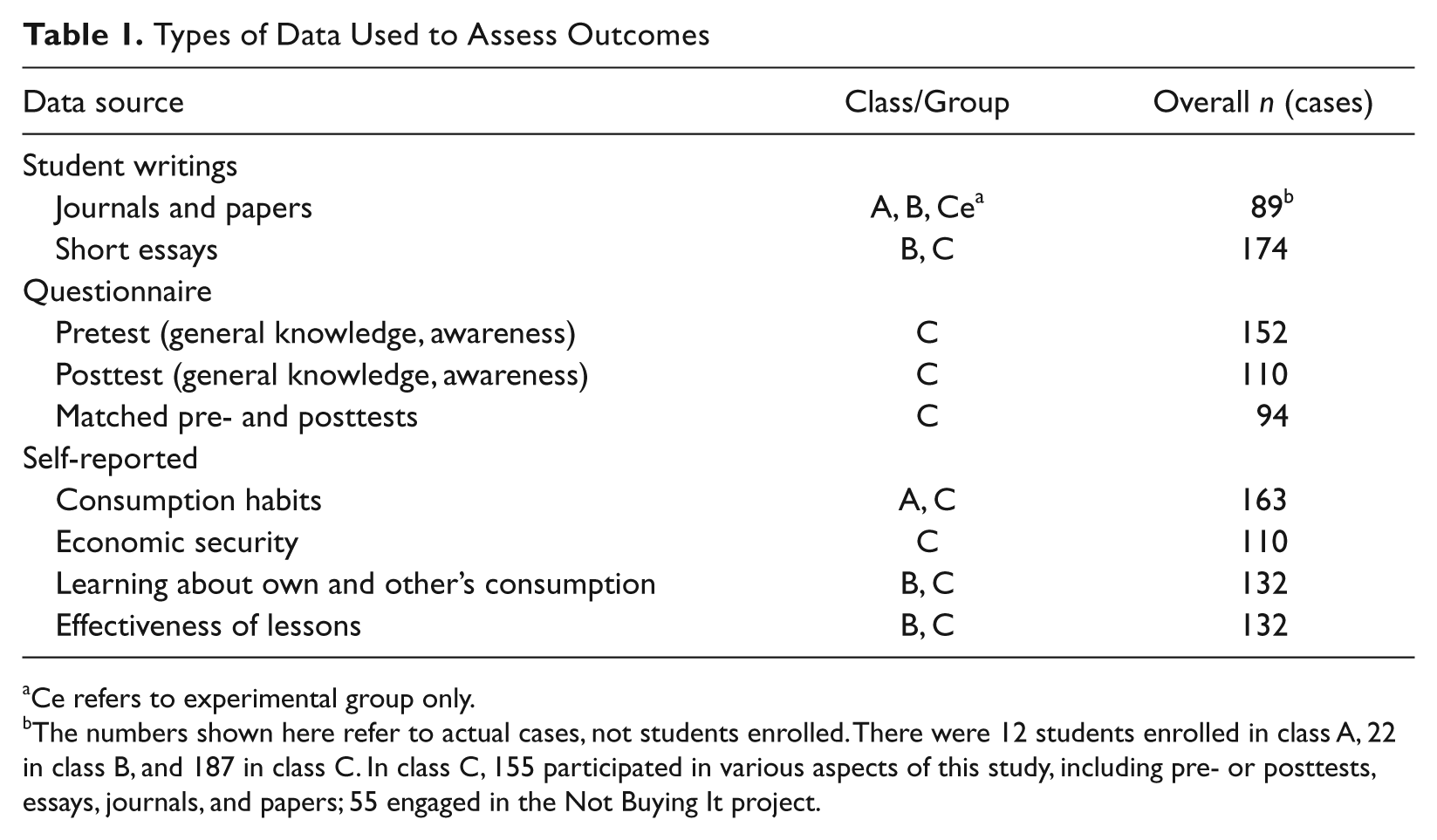
Ce refers to experimental group only.
The numbers shown here refer to actual cases, not students enrolled. There were 12 students enrolled in class A, 22 in class B, and 187 in class C. In class C, 155 participated in various aspects of this study, including pre- or posttests, essays, journals, and papers; 55 engaged in the Not Buying It project.
Concepts and Measures
Consumption habits
Students in classes A and C were asked about their current consumption habits. We asked students in class A about two key items (clothing, public transportation) and amount of money spent on clothing and/or shoes each month. Students in class C were asked these same questions and an additional one about purchasing of beverages. As an additional measure of consumption as it relates to economic security, we also asked students in class C which of the following statements best described their current situation: “I struggle to buy even the basics (food, housing, medicine, tuition),” “I can afford the basics but struggle to buy any little ‘extras’ or non-essentials (e.g., movies, drinks, eat out),” “I can afford to buy little ‘extras’ but struggle to afford big ‘extras’ such as travel, nice clothing,” “I can afford to buy most things but still have to watch where my money goes,” and “I can afford to buy anything and never have to think about it.”
Knowledge and awareness of hyperconsumerism
In class C, students were asked two questions on both pre- and posttests that were designed to test general knowledge and changes from time 1 to time 2. 1 The first question asked, “To what extent do you agree or disagree that there are sufficient natural resources to support the typical American lifestyle for the next 50 years?” Options included (1) “There definitely are sufficient natural resources to support the typical American lifestyle,” (2) “There are probably enough natural resources . . . ,” (3) “Not sure if there are enough natural resources . . . ,” (4) “There probably are not enough natural resources . . . ,” and (5) “There definitely are not enough natural resources . . . .” The second question was “How do you think your consumption habits differ from the typical American?” Options included (1) “I consume much less than the average American,” (2) “I consume somewhat less . . . ,” (3) “I consume about the same amount . . . ,” (4) “I consume somewhat more . . . ,” and (5) “I consume much more . . . .”
To measure awareness, students in class C were asked to respond to the question, “Do you think Americans consume more (clothing, oil, food, etc.) than people in other parts of the world?” In the pretest, this question was open-ended and we coded responses yes or no. The posttest obtained this information through a closed-ended question for which responses included (1) “Americans consume much more than people in other parts of the world,” (2) “Americans consume somewhat more . . . ,” (3) “Americans consume about the same . . . ,” (4) “Americans consume somewhat less,” and (5) “Americans consume much less than people in other parts of the world.” Students’ writings were also analyzed qualitatively for awareness of consumption.
Sociological imagination
We qualitatively analyzed students’ papers and journals (from groups A, B, and Ce), paying particular attention to whether and how students made connections between their own consumption habits and cultural patterns.
Effectiveness of the NBI project
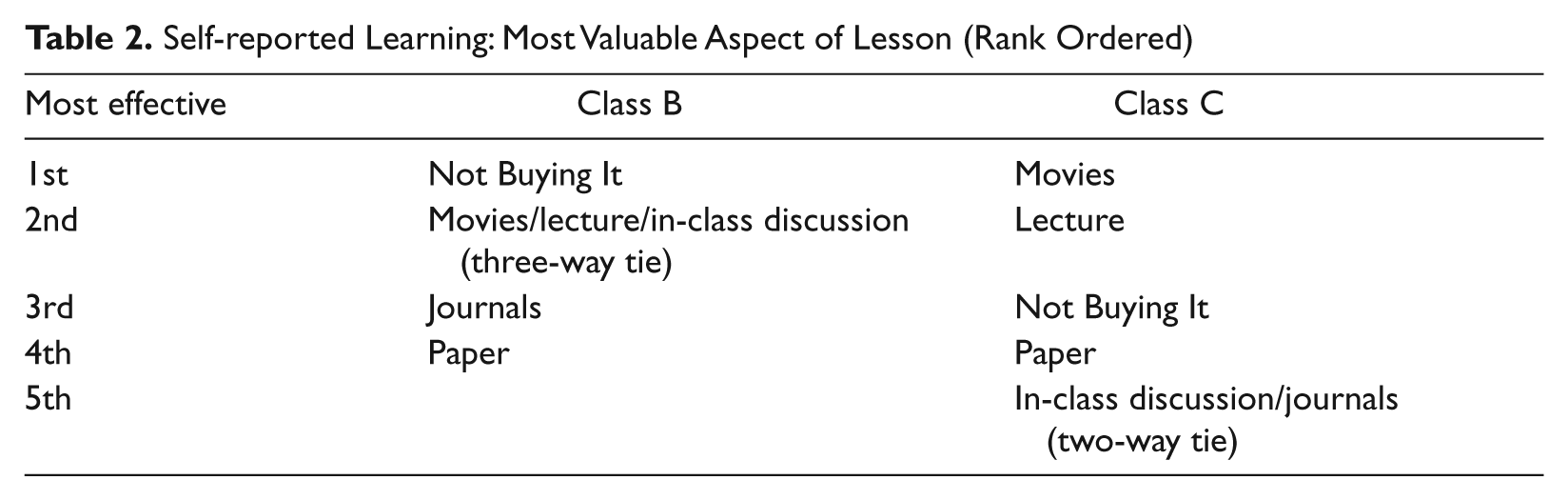
Students in classes B and C were asked to report which aspects of the lesson were most effective in helping to understand consumption. They could indicate all that applied among the following: information provided in lecture or handouts, movies viewed in class, refraining (or trying to refrain) from buying nonessentials, journaling, short paper, and in-class discussion. We rank ordered these from most to least effective according to students’ perspectives. In class A, we distributed an end-of-semester assessment, asking students to state one thing they will remember from the class or something they have learned and analyzed these for mentions of the consumption exercise. All students in classes B and C were asked to rate how valuable the section on consumption was in terms of helping them to learn about their own and others’ consumption. We also used students’ writings (papers and journals) for groups A, B, and Ce to assess the project’s overall effectiveness. Effectiveness of the NBI was also determined by comparing pre- and posttest responses for the control and experimental groups.
Analytic Strategy
We qualitatively analyzed students’ writing (journals, papers, in-class responses) using a line-by-line coding process outlined by Strauss and Corbin (1998). Although we began with sensitizing concepts to explore specific outcomes (e.g., whether students could see the connection between their own consumption and larger social forces), we allowed themes to emerge from the data themselves, and through this process, important insights emerged (e.g., about students as consumers).
Where appropriate, we used quantitative data to explore overall patterns of consumption, knowledge, and change in these measures. To measure pre- and posttest differences, we used a paired-sample t test to compare change over time. Because we used unique identifiers (students were asked to provide the last four digits of their student identification number), we are able to compare shifts at both the individual and aggregate levels for students in class C. To measure individual-level change, we created a difference score by subtracting a student’s answer on the posttest question from his or her answer to the identical question on the pretest. We also compare those students in class C who completed the NBI assignment (Ce) and those who did the alternative assignment (Cc) on three measures of cognitive knowledge and awareness.
Students as Consumers
Before discussing the degree to which the NBI exercise worked, it is important to discuss who our students are as consumers. The fact is, college students are not likely to be the major consumers in society. Data from the Consumer Expenditure Survey (U.S. Bureau of Labor Statistics 2011) show that persons younger than 25 (they do not provide separate data on college students) spend less, on average, than any other age group. In fact, their consumer spending more closely resembles persons 75 years and older than any other age group. The only categories of spending for which they are not the lowest are apparel and services, alcohol, transportation, education, tobacco and smoking supplies, and insurance. They also have the lowest reported incomes. In other words, college students typically have limited resources. Especially in an Introductory Sociology course, which consists of many students new to college, students are likely to live on campus and not own a car, and if they work, they are likely to earn minimum wage. In addition, the institution where we teach is a public state university, so most of our students come from middle- or working-class families.
It is not surprising, therefore, that most students in our classes indicated that they were not major consumers. We asked students in class C specific questions about their spending habits. A little more than half (55 percent) shopped for clothing less than once per month, and 53 percent spent $25 or less per month, on average, for clothing. Before the project, half the students in class A stated that they shopped “sometimes or often” for clothing in a mall and, on average, spent more than $50 per month on clothing (two students reported spending more than $200 per month). Our students are, however, major consumers of private transportation and beverages. In class C, for instance, 47 percent said they never carpooled or used public transportation, which included campus shuttles, and only 2 out of 12 students in class A traveled by public transportation. Students in class C reported that they consumed beverages, such as soda, bottled water, or alcohol, regularly (76 percent purchased beverages, such as coffee, soda, or alcohol, from establishments or vending machines at least once per week).
Recall that we asked students in class C to indicate the extent to which they struggle to consume necessities and nonessentials. The average score on the scale was 3.08, suggesting that students tended to be in the middle: “I can afford to buy little ‘extras’ but struggle to afford big ‘extras’ such as travel, nice clothing.” Indeed, there were few extremes. No one answered that they can afford anything and never have to think about it, and only 5.5 percent stated that they struggle to buy the basics.
There were also comments made in writings that suggest these students do not have the means to consume heavily. One student mentioned that the assignment came at an ideal time because she had just loaned her parents money and she had not received child support for three months. Another student candidly remarked, “I haven’t been consuming by default; I have no money to do anything with.”
Given students’ already limited consumption, it might be argued that an exercise such as NBI is ineffective. Yet, we believe heightening individuals’ awareness of consumption before they have the means to buy into consumer culture can have a profound effect on future behaviors. We are not able, of course, to verify this claim. Whether such awareness and commitment translate into future consumerist habits is a topic worthy of study.
Evidence of Effectiveness
Enhancing the Sociological Imagination
One primary learning objective was to enhance students’ sociological imaginations. This was facilitated by the experiential nature of the exercise, which made students more keenly attuned to social pressures to consume and especially by journaling or writing (Hudd and Bronson 2007). To assess this outcome, we qualitatively analyzed students’ writing, paying particular attention to whether and how students made connections between their own consumption habits and cultural patterns. First, we should note that most students began the section on consumption already viewing overconsumption as social rather than individual in nature. For instance, when students in class C were asked in the pretest survey, “Why do you think Americans consume so much?” they provided far more sociological than individualistic explanations (by a ratio of 3:1). 2 Sociological factors include such things as media, capitalism, or cultural values; individual factors included such things as human greed, instant gratification, or need. Given that this exercise was used in a sociology course, well into the semester, the reliance on sociological explanations is not surprising. But we hoped students could go beyond simply citing sociological factors (which may reflect lower-level learning) to understand at a deeper level how their own consumption habits are shaped by these forces.
Analysis of students’ papers and journals suggests that students did make the connection between larger social forces, such as media or social influence, and their own consumption. For instance, notice how this student begins to recognize the social aspect to shopping and how his own spending habits are similarly shaped:
Before completing this project I never considered how social shopping is. We buy things because we need them, right? I soon realized how often that is not the case. I don’t buy a sandwich from Subway because I am in dire need of nutrients. I buy Subway because it is a convenient place to meet and socialize with friends over a meal. I don’t buy coffee because I am thirsty, but because all my friends are. I realized how often I buy something just because I am with certain people in a certain setting. In today’s society it seems rare that people can do something social without spending money . . . my friends and I hardly ever do something that doesn’t require spending money.
In the following journal entry, a student discusses how she became more aware of pressures to consume and how her own behavior was influenced:
I learned that I consume just like everyone else, and I realized how much everything around you influences your decisions. While I wasn’t buying anything, it almost seemed like there were more ads on TV, bigger billboards with things I should buy, and everyone wanted to go shopping! These are definitely reasons for my overconsumption everyday because these things influence how we act and think about things.
In the following example, a student begins to see how geographical and structural arrangements shape individual behavior:
In the end the best reason for consumption is the gross availability of ANYTHING. I could have taken the shuttle back home and made a salad, but the food court is conveniently in the center of campus directly in the path . . . to the shuttle.
A final example shows how one student became aware of the power of social influence to shape behavior:
I learned that I am a player in this game and I am consumed by what I consume. . . . I might not consume something because I want to but more so because I am trying to keep up. Trends are constantly evolving and I do not want to get left behind so I must consume in order to stay relevant with my peers.
Because reflective writing is so critical to developing students’ critical thinking and sociological imaginations (Hudd and Bronson 2007), we relied heavily on students’ papers and journals for evidence of sociological imagination. We also employed a simple quantitative measure, asking students in classes B and C to report how valuable they thought the consumption lesson was in helping them learn about their own and others’ consumption. The vast majority of students said it was “extremely helpful” (44.6 percent) or “somewhat helpful” (46.2 percent) (see Figure 1). It is important to note that this question was asked of all students in class C, including those who did not complete the NBI project (we discuss differences by groups Ce and Cc below) and referred to the overall consumption lesson, not NBI specifically.
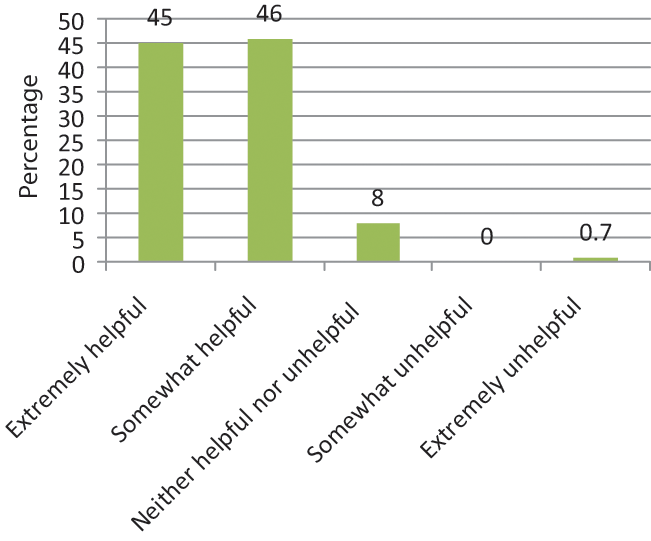
Percentage of students who found lesson helpful in learning about own and others’ consumption, combined classes B and C
Evidence of Increased Knowledge and Awareness of Hyperconsumerism
We also hoped the exercise would increase students’ knowledge and awareness of hyperconsumerism and overconsumption in the United States. In this section, we discuss overall results from all classes. In the following section, we report more detailed comparisons between students in class C who engaged in the actual NBI exercise and those who did not.
First, to test whether students became more knowledgeable about overconsumption after the project, we compared pre- and posttest responses (all class C) to the question, “To what extent do you agree or disagree that there are sufficient natural resources to support the typical American lifestyle for the next 50 years or so?” A much larger percentage of students in the posttest reported that there are “probably not” or “definitely not” enough resources to sustain the American lifestyle, compared to the pretest (82.7 percent and 56.3 percent, respectively) (see Figure 2). One of the largest shifts occurred in the definitely not category (21 percent at pretest chose this option vs. 44 percent at posttest). To compare the difference in scores from the pre- and posttests, a paired-samples t test was used and found significant at the p < .001 level.
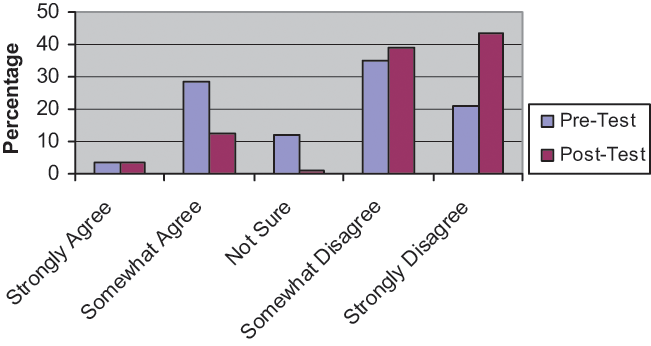
Percentage agreeing that there are sufficient natural resources
We also matched pre- and posttest responses by students on the question (“sufficient resources”) for all students in class C who completed both pre- and posttests (n = 94) and calculated a “difference” score to see how much shift occurred in a given student’s knowledge about resource availability. Zero would indicate no change, whereas a negative number would indicate decreased knowledge, and a positive number, increased awareness. The theoretical range was −4 to 4, but actual scores ranged from −3 to 3. That is, a student’s answers might shift three “values,” such as from “There are probably enough natural resources to support the typical American lifestyle” to “There definitely are not enough natural resources . . .” (This hypothetical student would be assigned a different score of 3.) We found that although 36 percent of students did not answer differently on pre- and posttests (in many cases, these were students who seemed aware that resources were limited at pretest and that did not change at posttest), only 12 percent (of total class) provided answers that suggested decreased knowledge (see Figure 3). Most students’ knowledge about the amount of resources available to sustain American lifestyle increased. This analysis was also conducted comparing the control and experimental groups and the results are presented in the following section.
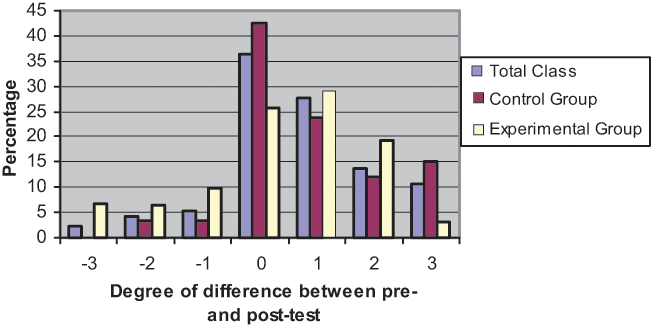
Changes in students’ knowledge about resource availability (−3 = decreased, 0 = no change, 3 = increased)
A measure of awareness was obtained by comparing pre- and posttest responses to the question, “How do you think your consumption habits differ from the typical American?” Responses ranged from (1) “I consume much less than the average American” to (5) “I consume much more than the average American.” Recall that typical college students (including our students) are likely to consume far less than the average American (U.S. Bureau of Labor Statistics 2011), so we expected their awareness of this fact to increase. If one compares just the aggregate difference between pretest and posttest, there is little difference (average was 2.37 at pretest and 2.23 at posttest). However, when matching individual scores from pre- to posttest and comparing these, the difference was significant (2.47 vs. 2.21, p < .001). Results from this analysis are presented in Figure 4. Closer examination of individual scores reveals that 59 percent did not change their answer, but 33 percent of students changed in the direction of recognizing that they consume less than the typical American. Of course, in some respects, this finding is concerning. If students believe it is others who are the problem, they may be less likely to modify their own behavior. We did examine at the individual level whether there was a correlation between consumption (measured by frequency of shopping for clothing and amount spent per month on clothing) and tendency to believe that one consumes less than the typical American. In fact, there was a strong, positive correlation (.387, p < .001). That is, those who report the lowest levels of shopping and spending were more likely to say that they consumed less than the typical American, which suggest that their shift in perceptions is grounded in actual (or perceived) consumption habits.
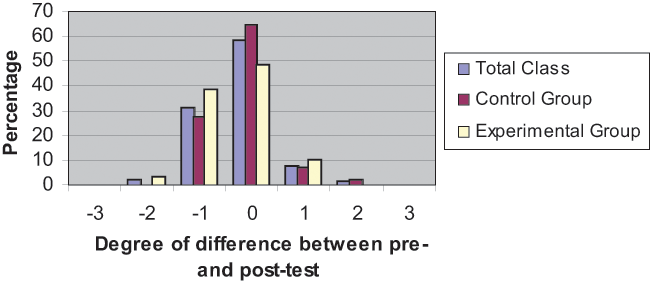
Changes in students’ perceptions of their consumption habits relative to the typical American (−3 = more accurate, 0 = no change, 3 = less accurate)
Students in class C were also asked, “Do you think Americans consume more (clothing, oil, food, etc.) than people in other parts of the world?” At both pre- and posttests, the vast majority of students (97 percent at both times) were aware that Americans overconsumed. Students mentioned such factors as availability of consumer goods, norms, and media as reasons Americans consume more. Thus, this quantitative measure of awareness was not particularly discerning. However, the qualitative analysis of students’ writings revealed a deeper understanding about overconsumption after students completed the module on consumption:
This exercise taught me that I am an over consumer . . . as I was engaged in this project I observed other people around me and noticed that most of Americans are over consumers and I think that while we are in “shopping mode” we do not realize how much we are consuming and wasting in the process.
Another student noted,
I always thought buying lunch from Subway, Qdoba, or Asian Chow was not consumerism, but merely a necessity . . . this exercise has taught me that overconsumption is not based on how much money is spent, but rather how the money is spent.
The student who wrote the following became aware of how media portrays overspending and also made the connection to her own behavior:
I watched many movies while doing the project. In these I saw so much spending. Every other scene was at a restaurant. The pretty, skinny people went ice-skating, carriage riding, stayed in hotels, or went shopping. If there wasn’t any shopping going on, you saw more expensive things like what they were wearing, the cell phones they were using, the cabs they were taking, or the cars they were driving. There was constant purchasing but I didn’t see much money going down. The payment wasn’t important, which I found very, very interesting. The activity is culturally desirable, and the money is not significant. I saw this reflected in my own activities.
Another student began to analyze advertising more critically:
Posters in Starbucks exclaiming, “Enjoy your day, have a cappuccino” or “Make your day better with a hot cup of soup” are almost saying “If you buy these products from us, your quality of life will be vastly improved. All you have to do is buy things.” All a latte is is steamed milk and some espresso. How is that supposed to actually make my day so much better as claimed? It shouldn’t.
Thus, in terms of cognitive knowledge gained, there appeared to be change in students understanding of Americans’ hyperconsumerism. Students did seem more aware that there are not enough natural resources to sustain American’s voracious appetite for “stuff.” They also seemed to understand that their current consumption habits are probably more limited than those of most Americans.
Evidence That the NBI Exercise Was Effective
We wanted to know whether the NBI exercise was effective, apart from other information (readings, film, discussion) students were provided, in raising awareness about overconsumption and enhancing their sociological imaginations. As seen in many of the quotations above, students made specific reference to the exercise as helping them to develop awareness and motivation. This was seen throughout students’ writings, for instance,
That day, and the following three thereafter, were eye openers for me. It seemed I had become used to casting a blind eye onto the wasteful consumption happening all around me, and by me every day of my life. Awareness of such unnecessary use of our precious resources was buried in my subconscious, quelled, but with the application of our consumption reduced lifestyle for four days, a serious reality check set in, with painful acuity.
Consider this next student, who reports forgetting about the assignment at first, then realizing it and changing her actions. It is unlikely that she would have done this had the lesson merely involved sharing of information:
I was sitting in the Starbucks drive-tru [sic] as I was sitting there thinking “Im [sic] running a little behind, I should just go” then it came to me, “I’m not supposed to be here.” So I pulled out of line . . . Once at school I found myself looking into the soda mechine [sic] trying to decide on which beverage when I began thinking, “I dont [sic] NEED that” you know I didnt [sic] even feel like I wanted it. Then why was I going to BUY it. Why do we pay for/buy things that we really dont [sic] even want? What possesses someone to do that? That was my major thought for the first day!!!
In class A, we asked students at the end of the semester to report any one thing that they will remember from the class or one thing they learned. Five of the 12 students mentioned the consumption project. As one student noted, “It really made a difference in my life, I have come to realize how much I really do consume and waste.”
We systematically compared responses to posttest questions from students who had completed the NBI project (Ce) and those who opted for the alternative assignment (Cc). The results were mixed. The students who completed the consumption project were more likely to say that the section on consumption was extremely valuable in helping them learn about their own and others’ consumption habits (49 percent vs. 39 percent), but average differences across groups were not statistically significant. We also compared students in class C who had engaged in the experiment to those who had not on a knowledge-based question (“enough resources to support American lifestyle”). At the posttest, the control group’s average score was 4.22 versus 3.76 for the experimental group, but these mean scores are not significantly different from one another. Concerning knowledge about resources, individual shifts (as determined by the difference scores shown in Figure 3) indicated less change among those conducting the NBI project compared to those who did not (.83 vs. .36, respectively), but this difference was also not significant. Within the control group, there was significantly more improvement on this one measure, perhaps because scores started at a lower level and had more “room” to grow, but no significant difference was found within the experimental group between pre- and posttest. Specifically, the difference for the control group alone was significant (p = .006) but not for the experimental group alone. These findings may suggest that the NBI project may have little to no effect on specific knowledge about sufficiency of resources to support Americans’ lifestyles. It is noteworthy that more students in the experimental group showed decreased knowledge about resources, and this may have affected overall magnitude of change in this measure. This finding is perplexing but we suspect that some of these students were responding to the question at posttest from a larger perspective. That is, they may have interpreted it to mean that if resources were conserved and if Americans reduced their seemingly insatiable need to consume—which were major points of classroom discussion—then our lifestyle could be sustained. Unfortunately, we do not have data to test this hypothesis, but it is worth considering
When both groups of students were asked about how their consumption habits compared to the typical American, and these answers were compared over time, both groups’ (Ce and Cc) scores declined significantly, suggesting greater awareness that they consumed less than the typical American (refer to Figure 4). The change was greater for those completing the NBI project than for others. For the NBI group, the average scores showed greater decline (from 2.48 to 2.19, p = .01) compared to 2.42 to 2.25 (p = .04) for those not doing the project. These differences were significant only within group; there was no significant difference between the average scores of the NBI group and those who did not complete the project on either the pre- or posttest. Unfortunately, we do not know whether students’ reference points were pre-, peri- or post-NBI. If very near the time students were doing the project, one would expect them to report reduced consumption.
Students in classes B and C were also asked to report which aspects of the lesson were most effective in helping to understand consumption. As seen in Table 2, students in class B rated the NBI exercise most helpful; students in group Ce did not rank it at the top, but about half (49 percent) considered it one of the “most helpful” components.
Self-reported Learning: Most Valuable Aspect of Lesson (Rank Ordered)
In summary, the qualitative and quantitative analyses suggest that all students gained insight into how their personal consumption habits are shaped by larger social forces. The NBI exercise, in particular, seemed to be important in shifting attitudes and in helping students accurately gauge their own compared to others’ consumption. However, the NBI exercise had mixed effects in terms of cognitive knowledge gained. The control group showed more growth in terms of understanding that there are insufficient resources available to support Americans’ lifestyles. This may be because the control group started at a slightly lower level at pretest than the experimental group. The NBI exercise did help students see more accurately how their own consumption compared to the typical American, however. Furthermore, almost half of the students from class A reported that the NBI exercise was the most memorable aspect of the class, and students in class B and the experimental group in class C ranked the exercise itself relatively high compared to other aspects of the lesson on consumption. Apart from the NBI exercise, these data suggest that even minimum (e.g., one week in this case) attention to consumption can raise students’ awareness about consumerism.
Class Variations and Limitations
We used the NBI project in three classes of varying size from small to very large and at honors and nonhonors levels. We adjusted the assignment to adapt to different course structure and size. For instance, in the small honors class, students read all of Levine’s (2006) book, engaged in the project for seven days, and wrote a lengthier paper. In the medium-sized class, students read two chapters, refrained from consuming for four days, and wrote a paper of approximately 500 words. In the large class, students read two chapters, refrained from buying for three days, and were instructed to write a paper approximately 300 words in length. We believe that students who engaged in the project for longer derived greater benefits, but we were also surprised by how engaged the students in the large class were. As one indicator, the average word length of papers and journals was 800. Although a few students provided the minimum (300 words) or less (one student wrote just 131 words), most went into considerable detail about their experience (one student wrote a nearly 2,000-word paper). Another student decided to continue with the exercise beyond the three days.
Some evidence suggests, however, that the large class found less value in the NBI project than previous classes did (on the basis of self-reported measure of the lesson’s value and our own observations of classroom dynamics). Perhaps this was because of the reduced length of time they were required to engage in the project and the small amount of credit received (2.5 percent of final grade), but more likely, it was attributable to not having the entire class engaged in the project and the fact that the large class afforded less opportunity to discuss the project in class and share experiences. In fact, the project was structured very similarly for students in classes B and C, but the classroom engagement in class B seemed much higher than that for class C. Ideally, we think the greatest benefits would derive from having students conduct the NBI project for a minimum of four days and have it be required and expected of all students. Small-group discussions in which students discuss the experience and struggles, as they did in our smaller classes (classes A and B), seem to build community and support for the challenges they face during the social experiment. Although it is possible to engage large classes in active learning (McKinney and Graham-Buxton 1993), in the context of this project, it would require significant coordination, since students are allowed to complete the project at different times (across a three-week period). Students would need to be grouped according to which stage they are at in the project, or we would need to condense the time frame within which students must complete the assignment, so that all students can share similar experiences. Indeed, in the future, we will narrow the window to about 10 days to encourage more sharing and camaraderie among students.
Application to Other Courses
Teaching about consumption in sociology courses offers instructors a primary means by which students can acquire a sociological imagination, reinforces key sociological principles, and links to broader goals within the discipline (McKinney et al. 2004; Wagenaar 1991). Depending on an instructor’s approach and coverage, hyperconsumerism can be easily linked to topics or integrated into courses on globalization, stratification, the body, identity, development, intersectionalities, the economy, environmental sociology, popular culture, and so on. For instance, we adapted this project for a Sociology of Gender course taught by the second author. Students completed the NBI project (for 10 days) and were asked also to consider how consumption is “gendered.” The exercise made topics that otherwise are abstract or removed (identity, exploitation of women in underdeveloped countries) concrete and visible.
Courses dealing with issues of stratification could modify the assignment by asking students to consider more specifically how consumption (e.g., where and what they eat, where they shop) conveys their social class standing and status. Seeing consumption as gendered, raced, and classed can also help students think about identity, impression management, and self (“I” and “me”) in interesting ways by helping students understand how important hyperconsumerism is to performance and how socialization also involves how to become a consumer (Ward 1974). Instructors teaching about globalization or the economy could ask students to analyze where products they do consume during the experiment are produced to explore issues of global inequalities, worker exploitation, and so on as well as to explore definitions of essential held by Americans versus citizens in most other parts of the world. We found that the students who refrained from buying products became particularly sensitive to media messages surrounding consumption, including advertisements and product placement, so courses dealing with media or popular culture could use this assignment to help students see more clearly the ways in which consumption is encouraged through media. Alternatively, the NBI assignment could be media specific, that is, students could refrain from consuming media for a set period. In short, we believe that the NBI component illuminates these and other sociological issues because it makes students so keenly aware of their own consumption that other types of understandings and connections are stimulated.
Conclusion
Our findings suggest that the experiential aspect of the NBI project—in which students refrain from buying anything except necessities—helps students see their own consumption in a new light. In particular, qualitative analysis and students’ self-reports suggest that the exercise was generally effective in enhancing their sociological imaginations. It seemed to “make real” to students how their own consumption habits are shaped by larger social forces and how Americans, including themselves, tend toward overconsumption. To a lesser extent, it may enhance cognitive knowledge, at least as measured here, although such knowledge did not seem dependent on doing the NBI project. Thus, the experiential exercise may be more effective at increasing awareness of consumption, and the sociological imagination generally, rather than cognitive knowledge. Other aspects of the lesson (e.g., lecture, documentaries) may be more effective in helping students gain cognitive understanding of consumption. Indeed, the NBI project would always be included as part of a larger lesson about consumption.
There is no question that students, indeed, all citizens, are in dire need of awareness and commitment to environmental reform. We believe the classroom is one of the most important sites where such change can occur. The NBI project is a start, and it does not require significant resources—a distinct advantage to other projects designed to enhance awareness about consumption. Planting the seed of conservation before students have the means to become major consumers can nurture greater understanding of the consequences of such future actions and the necessity of change at both individual and social levels.