Abstract
Sociologists and instructors who teach about community service share an affinity for understanding and addressing social problems. While many studies have demonstrated the benefits of incorporating community service into sociology courses, we examine the benefits of incorporating sociological content into community service classes. The authors supplemented a community service course at a large public university with sociological theories, concepts, and analyses. Our data suggest that this integration increased student understanding of the social structural factors that adversely affect the populations they served, sharpened student awareness of the various forms of prejudice and discrimination against these populations, enhanced student appreciation of their own privilege within the community service continuum, and facilitated student awareness of how understanding the plight of populations in need makes community servants more capable and humane. We argue that with the rapid growth of interest in community service across college campuses, sociologists are ideally situated to provide beneficial training outside the confines of their classrooms.
Keywords
The past 30 years have seen an explosion of community service at academic institutions across the country (Campus Compact 2013; Corporation for National and Community Service 2013). College faculty and administrators have discovered the educational benefits of transforming students from passive to active learners through community service (Astin and Sax 1998). Students appreciate the fact that they get hands-on experience, make occupational contacts, enhance their résumés, and make a difference in their community (for a review, see Eyler et al. 2013).
Service-learning courses, in particular, have become an especially popular way to engage students outside of the classroom (Watkins and Braun 2005). While the goal of community service is to improve the community by meeting the needs of others, the primary goal of service-learning is academic attainment (Cress 2005). Service-learning involves integration of course content and community service activities, with an emphasis on student reflection. The considerable increase in service-learning is part of a larger educational trend to increase curricular relevance and engage students in their local communities (Eyler and Giles 2001).
There is a large literature demonstrating the benefits of incorporating service-learning in the sociology classroom. For example, research demonstrates that service-learning helps students develop the sociological imagination in introductory (Hollis 2002), race and ethnicity (Marullo 1998), immigration (Huisman 2010), research methods (Potter, Caffrey, and Plante 2003), homelessness (Mobley 2007), inequality (Everett 1998), HIV/AIDS (Porter and Schwartz 1993), small-group dynamics (Rashotte 2002), hunger and poverty (Sullivan-Catlin 2002), and deviance (Nurse and Krain 2006) courses. Service-learning has also been promoted as an effective mechanism for reducing stereotypes of client populations (Mobley 2007) and decreasing “victim blaming” (Hollis 2002).
Another benefit of incorporating service-learning into the sociology classroom is increased student enthusiasm and participation. Students are more eager to learn when they can apply in-class instruction to real-life phenomena (Everett 1998; Porter and Schwartz 1993). Research also reveals that sociology students involved in service-learning show larger increases in civic responsibility than students not involved in community service (Myers-Lipton 1998). Student empathy also tends to increase when they interact with client populations (Everett 1998; Mobley 2007).
While there is significant evidence that introducing community service into sociology courses yields numerous benefits, scholars have not assessed whether there are benefits associated with introducing sociology into community service courses. This is an important question for three primary reasons. First, students who perform community service without sociological training may be less likely to understand the social structural explanations for the plight of client populations. By individualizing these explanations, students are more likely to “blame the victim” (Hollis 2002). Second, students without sociological training may revert to erroneous stereotypes when interpreting their experiences with client populations (Mobley 2007). These beliefs may reduce student interest in working with certain populations, create tension while providing service, and make students less effective in providing service. Third, with increased interest in community service and service-learning among academic institutions it is important that university faculty and administration are made aware of any pedagogy that may benefit students engaged in community service.
Methods
The University’s Community Service Learning Community
The students in this study comprised the Community Service Learning Community (CSLC), which is one of 17 learning communities at The University of Connecticut. Before the start of the academic year, many students self-selected into learning communities based on their academic majors or areas of interest. Examples of learning communities at the university pertain to community service, engineering, arts, leadership, chemistry, environmentalism, and the humanities. At The University of Connecticut, first-year students get first preference to sign up for learning communities so that they are able to integrate better into campus life.
Demographically, all of our students were in their late teens or early twenties. Slightly over half of the students were white, with most of them coming from middle- and upper-class families. As we discuss later, students’ socioeconomic backgrounds affected their learning experience. Of the 45 original first-year students in our CSLC, approximately two-thirds stated that they had performed community service at some point in their lives, while one-third had no such experience. 1
The goal of the CSLC is to integrate academic (class), experiential (community service), and residential (cohabitation) components into an enhanced learning experience grounded in community service. Our students lived in the same dormitory for the entire academic year. They also organized and participated in a variety of extracurricular events such as shopping trips, movie nights, arts and crafts gatherings, athletic events, and holiday parties. Although each student selected a community service agency to work with for most of the year, there were times when we performed service as a group. For example, we began the academic year with a weekend-long community service outing where all members helped clean and renovate a campground for youth with disabilities. Students also performed service together on special occasions such as Martin Luther King Jr. Day.
Although our students were not required to take the same cluster of courses together, as is the case for some learning communities, they were strongly encouraged to take our one-credit Community Service course in the fall and its one-credit continuation in the spring. The second author is the Associate Director for Community Outreach at the university and has team-taught the course with various graduate students and administrators since 2003. The other authors were social science graduate students serving as graduate assistants for the Office of Community Outreach. Because of the continual rotation of instructors, the course changes every year, reflecting pedagogical insights from previous semesters as well as the strengths of the new instructors.
Although enrollment in the Community Service courses was optional, all CSLC students were required to sign up for a one-credit field placement in both the fall and spring semesters. The field placement required students to complete a minimum of 35 hours of service each semester, although some students far surpassed this requirement. The university’s Office of Community Outreach offered several popular programs whereby students could work to improve the literacy and math levels of children in underfunded schools. The vast majority of our students chose to work with one of these programs, although several chose to work at soup kitchens and health care facilities.
Fall Semester
In the fall semester, 45 CSLC students enrolled in our Community Service course. Our primary objective with this course was to equip students with the knowledge and skills to be successful community servants. While sociological ideas were an important component of the course, we also offered instruction on a wide variety of topics intended to help students achieve success in academics, personal relationships, careers, and community service endeavors (see Appendix A). We structured the course so that the focus shifted from the student, to the local community, to societal and global issues. For example, in the fall semester we designed classes that focused on issues of personality assessment, self-awareness, balancing social roles, time management, and professional networking. Toward the end of the fall semester we discussed how social forces affect individual outcomes. To create a dynamic learning experience, we combined lectures with guest speakers, panel presentations, interactive activities, and movie clips. During this semester we introduced sociological concepts such as social stratification, role, role strain, identity, socialization, social inequality, stratification, and life chances.
Spring Semester
When students returned from winter break for the spring semester, they were well rested and excited to see their CSLC friends. Unfortunately, 16 of our original students did not sign up for the Community Service course in the spring. While most of these students could not sign up due to competing course schedules or work obligations, a few students stated that they did not sign up because they felt that two hours of weekly class time and numerous homework assignments were too demanding for a one-credit course.
We began the spring semester by introducing the concepts of social justice and human rights as a way to frame social issues discussed later in the semester. Students became familiar with the 30 articles of the Universal Declaration of Human Rights (United Nations General Assembly 1948). As the semester progressed, we discussed how social justice and human rights relate to issues of health care, education, gender, race/ethnicity, disability, and GLBTQ issues. Additionally, we discussed how community service can be used to address these issues. Like the fall semester, we used a variety of pedagogical approaches, including lectures, guest speakers, panel presentations, interactive activities, and movie clips. We introduced a variety of sociological concepts such as social structure, sociological imagination, marginalization, institutional discrimination, racism, sexism, heterosexism, ableism, and privilege.
Final Reflection Assignment
As part of their spring course grade, we required students to answer seven final reflection questions. Our primary objective with this assignment was to assess how well the students linked in-class instruction with their community service experiences. As seen in Appendix B, the seven questions required students to discuss the population they worked with, what type of community service they performed, how social structural factors affect the population they worked with, how that population experiences prejudice and discrimination, how students are privileged within the community service continuum, and how understanding the populations they serve makes students better community servants. Because this was only a one-credit course, and because students had already completed a variety of homework assignments during the spring semester, we instructed them to keep their final reflection papers relatively short (three to four double-spaced pages). We made the assignment worth 20 percent of their final grades for the spring semester with the hope that they would take the assignment seriously. After assessing students’ final reflection assignments, all three authors agreed that students took the assignment seriously.
None of the students in the CSLC had taken a sociology course in high school, and only two took an introductory sociology course at the university during the academic year. Because we wanted to assess the benefits of sociological instruction for students with no such prior instruction, we did not include data for the two students who took Introduction to Sociology during the academic year. Altogether, 27 of the original 45 students who signed up for the course in the fall were included in this study.
Although often a pretest is warranted to assess student learning, such a test was not possible because many students were uncertain about the population they would be regularly working with throughout the year. Indeed, a large number of students worked with a particular population one or two times, only to decide to work with another population later in the academic year. Therefore, assessing whether students gained a better understanding of a particular population throughout the year would have been problematic.
Assessment
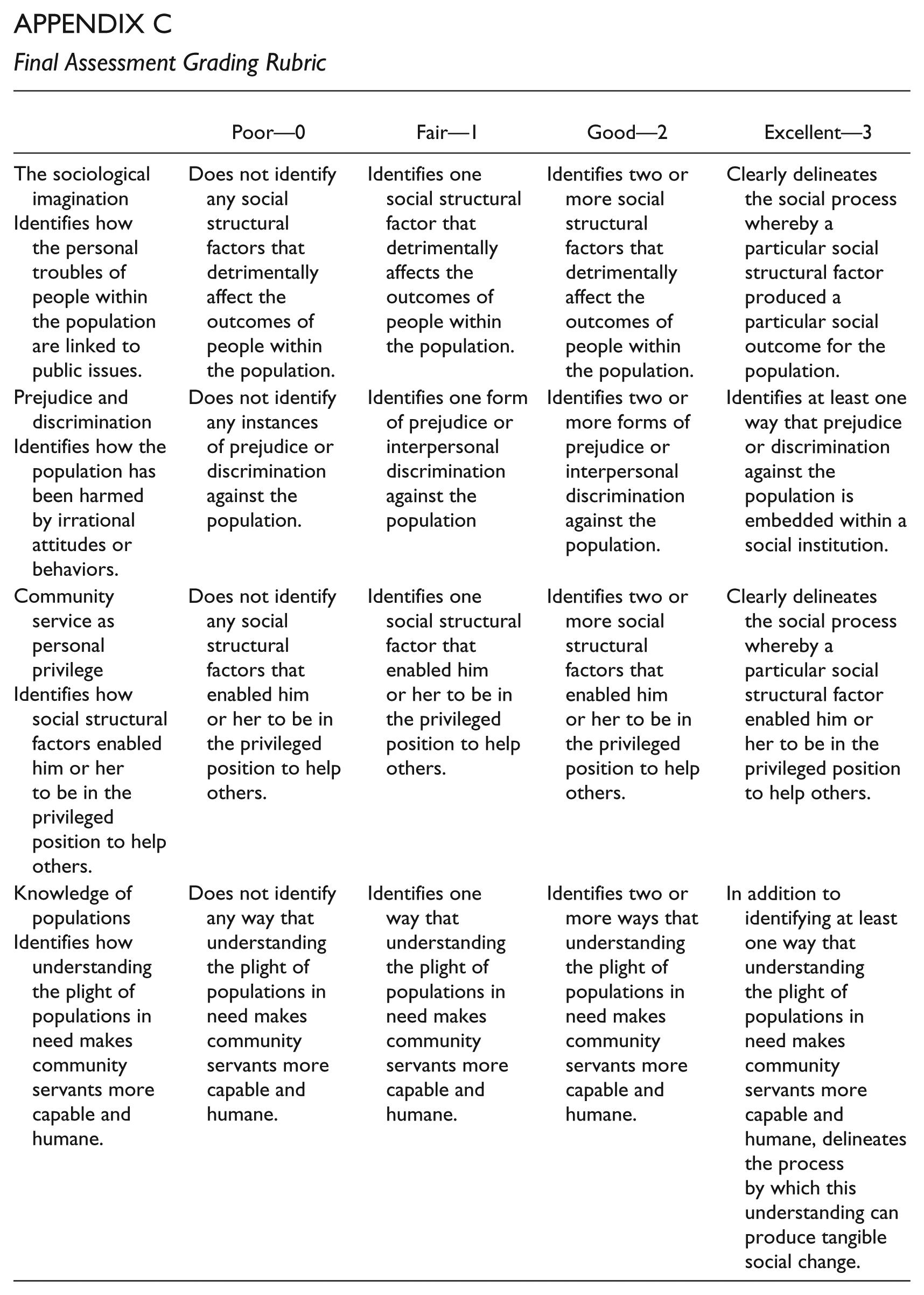
Based on the questions from the final reflection assignment, we created an assessment rubric to evaluate four primary sociological dimensions: (1) the sociological imagination, (2) prejudice and discrimination, (3) community service as personal privilege, and (4) knowledge of populations (see Appendix C). The final version of the rubric was the result of several meetings and draft versions.
For the sociological imagination dimension, we assessed whether students understood how social forces affected the outcomes of the individuals with whom they worked. For the prejudice and discrimination dimension, we ascertained whether students understood the difference between interpersonal types of prejudice and discrimination and prejudice and discrimination that is built into social institutions. For community service as personal privilege, we assessed whether students understood their own privilege within the community service continuum. Finally, for the knowledge of populations dimension, we ascertained whether students understood how having knowledge about a client population enhances the effectiveness of community servants. For each of the four dimensions, there were four possible evaluative outcomes: poor (0 points), fair (1 point), good (2 points), and excellent (3 points).
For the sociological imagination dimension, a poor score was characterized by a complete inability to discuss how social forces detrimentally affect the individuals the student worked with. For example, a student would have had to allude solely to individualistic explanations such as “laziness” or “unintelligence” to earn a poor mark. For fair and good scores, students had to identify social structural factors that detrimentally affected the outcomes of the population they worked with. A student who earned an excellent score clearly articulated the process by which social forces affected the lives of the population they worked with.
For the prejudice and discrimination dimension, a student who earned a poor mark was unable to articulate any ways that prejudice and discrimination detrimentally affect the population they worked with. For fair or good responses, students had to identify examples of either prejudice or interpersonal discrimination against the population. An excellent response was one that delineated how prejudice and discrimination are built into social institutions.
For the service as personal privilege dimension, a poor response was one where a student was unable to point to any social structural factors that enabled him or her to be in the position to help others. Fair and good responses were those where the student identified one or two of these factors. An excellent response was one where the student articulated the process by which a social structural factor enabled him or her to be in such a position. So, rather than simply listing social structural factors such as “wealthy parents” or “good school system,” students earning an excellent mark had to explain the process whereby wealthy parents or a good school system translated into the privileged position to help others.
Finally, for the knowledge of populations dimension, students were asked to explain how knowledge of client populations helps community servants be more capable and humane. In class we talked about how this type of knowledge can promote empathy for client populations and that empathy is likely to lead to enhanced service. We also discussed how knowledge of the population makes social interaction more comfortable while at the service site. Perhaps most importantly, we discussed how this knowledge allows community servants to better assess the needs of client populations. Poor responses were those whereby the student was unable to identify at least one way that knowledge of client populations makes community servants more capable and humane. Fair and good responses were those where the student was able to identify one or two ways that this knowledge allows community servants to be more effective. To earn an excellent mark, students had to delineate the process by which this knowledge translated into tangible social change.
Because of our numerous meetings to discuss our assessment criteria, the scores among the three raters were quite consistent. When there were disagreements about student scores, we reexamined the assessment rubric and reconsidered students’ analyses. Typically, the rater (or raters if two out of three agreed) who gave a student the higher score on a dimension would point to a particular passage that affected the assessment. This technique often, but not always, resulted in the lower rater (or raters) changing the assessments. While there are often questions of validity when coding open-ended qualitative responses (Neuman 2010), we believe that our thoroughness and reflectivity enabled us to stay true to the assessment rubric. As each of us used the rubric to assess student responses, we also circled passages that we thought epitomized excellent, good, fair, and poor categories. We were pleased to find that we also agreed on a majority of these passages.
Results
We now present the quantitative and qualitative data for each of the four dimensions. For each dimension, we present the mean student score based on our assessment rubric. Then, we provide student excerpts indicative of excellent, good, fair, and poor responses. Due to space limitations, we only provide excerpts from students’ broader responses. Because students performed well overall, we include a greater proportion of excellent responses.
The Sociological Imagination
For the first dimension, the sociological imagination, the mean student score was 2.41 (out of 3). In other words, the average student score was between good and excellent. Of the four dimensions, this was the highest mean score. We believe that the primary reason our students excelled with this dimension is that many of them chose to work as volunteers in low-income elementary school settings and were eager to grasp how social forces affected the educational outcomes of the students with whom they worked. Our reading and discussion of an excerpt from Kozol’s (1991) Savage Inequalities provided an effective framework for our discussion of institutional inequalities in the U.S. education system.
In line with our class discussion and reading, many students wrote about how tax policies often are designed so that schools in areas with a low tax base are at an economic disadvantage compared to schools in affluent areas. For example, Dave (mechanical engineering major) provided an excellent analysis of how a lack of school funding results in limited life chances:
2
There are several social structural factors that create the needs of the Hispanic lower-class children that [sic] I served. The town’s property taxes pay for the school system, so a deficit of regional income means less tax money distributed to the public school system, resulting in poor education. Individual families are unable to avoid this poor schooling because they cannot pay to send their children to a private school. The poor education creates a destructive social cycle: poor parents are forced to send their kids to poor schools, where their children are not educated well and, consequently, do not get good jobs. Thus, these kids grow up to be poor, in the same situation as their parents were. With a lack of money and low life chances, many subjected to these conditions turn to violence and crime.
While many students discussed discrepancies in school funding, Julissa (English major) focused on how ethnicity and language barriers affect the life chances of families where she performs community service:
I believe that a social factor that is harming families in Windham has to do with ethnicity. Most of the children I work with come from a Hispanic background. Many of them, along with their parents, even have trouble speaking English. I think this has an effect with their problems because it might be harder for a person who barely knows English to find a job that can help support their families. If they cannot find well-paying jobs, the parents will have more and more trouble providing food for their family. The parents might have to settle with buying cheap, unhealthy foods for the kids. The families could get more and more unhealthy, and if the parents get sick from the unhealthy food, it makes it more difficult for the parents to make more money to support the family.
Although most of our CSLC students demonstrated a solid understanding of how social forces affect individual outcomes, several struggled to discuss this in a concrete way. A few students had difficulty using social structure properly in a sentence. For example, one student stated, “Social structural factors that created the needs I listed above consist of four items: institutional discrimination, life chances, socialization, and social privilege.” A couple of students reverted to blaming individuals or their families for their social outcomes. One student stated, “Most of the children in our [service] program are from lower middle class families. I feel their parents do not care about their behavior at school and they do not have any expectations for their children.” Despite these exceptions, most students demonstrated a good or excellent understanding of the sociological imagination.
Prejudice and Discrimination
For our second dimension, prejudice and discrimination, the mean score was 2.34. Although slightly lower than the previous dimension, we were still pleased that most of our students recognized how prejudice and discrimination are embedded within social institutions. Student responses reflected our class discussions, which emphasized institutionalized forms of discrimination to a greater degree than interpersonal types. Heather (English major) provided an excellent analysis of how the predominantly Hispanic low-income children she works with are discriminated against by the policies of educational administrators:
The [city] Public School District is definitely a target for prejudice and discrimination. Since the students have been continuously receiving low scores on the standardized tests, the schools are at a disadvantage for resources, materials, and other important school items. Many of the children in my tutoring programs do not play sports because they cannot afford to. The schools have lost funding for the teams, and the recreational leagues cost too much money for the families. Also, many families cannot or will not be able to afford college tuition when the students are of age. The life chances for these children should not be any different from other children in different backgrounds and hometowns.
Although Marissa (undecided major) did not go into as much depth, she also earned an excellent mark by distinguishing how educational curriculum can favor one group over another:
In the school system, non-white children are often discriminated against because of their ethnic background. As youths immerse in the dominant white culture, children are taught that it is better to be white either through history classes, or other types of classes.
Most student responses reflected our class discussions. However, several students extrapolated on unique lines of thought. Sarah (undecided major) worked at a homeless shelter throughout the year. She made the following insight about institutionalized discrimination against individuals who are homeless:
The homeless are definitely marginalized in our society. Despite the fact that most homeless are just “down on their luck,” they tend to be confined to a lower social status than other members of society. People won’t listen to those who are homeless because they might think that since homeless people are poor, or have no jobs, or don’t have any money they don’t deserve a say in things like politics and education. Because of this, most homeless people often have decisions made for them, rather than having a say in policies that affect them. Also, because the homeless don’t vote or take part in politics, politicians don’t feel like they have to address the issues that affect the homeless. The homeless are truly marginalized and treated like second-class citizens.
Although most students were able to discuss institutionalized forms of prejudice and discrimination, a few had difficulty discussing this aspect. For example, Sandra (animal science major) earned a poor mark because she did not recognize that the predominantly Hispanic students in her underfunded elementary school were discriminated against: 3 “The population that I served isn’t necessarily the target of prejudice or discrimination right now because of their age, but in the future people may look at them differently because they didn’t have the same economic standing as others and people that come from poorer or lower economic classes are often looked down on.” Despite several exceptions, most students demonstrated a good or excellent understanding of how prejudice and discrimination are embedded within social institutions.
Community Service as Personal Privilege
For our third dimension, community service as personal privilege, the mean score is 2.07. Although this score falls between good and excellent, it is the lowest mean score of the four dimensions. We agreed that many students had difficulty articulating how social forces in their lives put them in the privileged position to be able to help others. Based on a year of academic assessment and social interaction with our students, we believe that many of them had a difficult time comprehending the privileges they have enjoyed in life and how those privileges translate into socioeconomic opportunities. Further, despite a class discussion of white privilege, many of our white students had difficulty articulating how whiteness translated into increased life chances.
Approximately half of the students pointed broadly to their family’s wealth as an indicator of personal privilege. While some of these students failed to delineate clearly how their family’s wealth translated into privilege, most could provide at least a basic explanation. For example, Tim (psychology major) provided a fair response: “The most important social structural factor that allows me to volunteer is, to put it bluntly, my family’s wealth. Without this, I do not believe I would have the time to volunteer, as I would be too concerned with working.” Bob (computer science major), an Asian American, provided a good analysis of how his family’s wealth and the good education he received increased his life chances:
One social structural factor that has allowed me to be a community servant is my family’s socio-economic status. As I grew up, my family had moved several times. All of these times, I was the minority. But each time we moved, we moved to an area more dominantly white with a better education system. This alone was enough to make a difference. Because we had some money, my family was able to move us to better locations for a better education, which allowed my sister and I to attend college at well-known universities. If it were not for these factors increasing my life chances, perhaps I would be the one asking for help rather than the one trying to help.
We were pleased that like Bob, many students were able to apply sociological concepts, such as life chances, in their analyses.
Barbara (psychology major) provided an excellent analysis of how her personal privilege allowed her to log a remarkable 300 hours of service during the academic year:
Looking back at my life, few things have held me back from being a successful community servant. My family has almost always had two incomes for us to spend on both the basic life essentials and the extra things in life. There were always books in our house, nutritious food in the refrigerator, and insurance for health, house, and automobiles. My parents were easily accepted into social groups (after all, they are heterosexual, white, and married) and were therefore involved with my schooling (i.e., PTA). When we had enough money, we moved to a town that has some of the best-ranked public schools in the state, affording me a future I may not have otherwise had. Now, here I am at UConn, fortunate enough to be able to live on campus and not have to work a job while I go to school full-time. Because of my privilege, I have a laptop, a television, and I get the newspaper every morning. I have the ability to see a need in the community, spend the 300 hours it takes to help meet that need, and get free transportation the entire time. I have the privilege to help the children I work with become privileged, and hopefully they will do the same.
Although Barbara and several others provided nuanced accounts of how personal privilege enabled them to be more effective community servants, several students had difficulty articulating any advantages they had experienced in life. Instead, many students discussed how they became community servants because it was a family or religious tradition. For example, Julia (animal science major) stated, “I guess a factor that enabled me to be a community servant would be my religion. As a Christian I feel that it is important to help those in need and to not be selfish.” Amy (biological sciences major) was unable to identify how this affluence translated into personal privilege. Instead, she discussed how the “need for good teachers” and a “lack of educators” in her school district enabled her to be a community servant at the local schools.
Knowledge of Populations
For the final dimension, knowledge of populations, the mean score was 2.29. Students did well in explaining how knowledge of the people they worked with promotes empathy, makes social interaction more comfortable, and allows service providers to better assess the need of client populations. For example, Blake (undecided major) discussed the importance of being empathetic:
I feel that the greatest reward that we can receive from understanding populations is the ability to provide them with empathy and emotional support. By understanding about the difficulties of the people we serve, we can show them that we truly do care about them and want to help them.
While Michael (mechanical engineering major) acknowledged the importance of being empathetic, our class discussions of power and privilege helped him understand the importance of being respectful toward client populations:
I have learned that when performing service, I must never act in such a way that I appear to be looking down on these groups. While I do not feel as though I have looked down on them, I now know that my actions could easily be misread as arrogance, as pity, rather than respectful if I am not careful.
Although most students discussed the importance of having empathy for client populations, many discussed how knowledge about these populations helps to better assess their needs. Gary (biological sciences major) stated the following: “By understanding more about the population we are serving, it allows community servants to help in areas that the population actually needs. As much as we like to help others, if we do not know what the specific needs are, we will not be able to effectively solve or alleviate social, economic, nor educational problems.”
We were pleased that Stephanie (history major) extrapolated from class discussions to make an excellent point about how knowledge of the population makes community servants better at recruiting others for the cause:
I can more effectively serve the population I work with, for I will have a better understanding of the needs of the population, and the areas in which help is needed. Through my knowledge of the population I’m working with, I can use advocacy to educate others on the social, political, and educational issues the population faces, and hopefully recruit others to help serve the population.
A couple of students earned poor marks because they could not give specific reasons why knowledge of client populations makes community servants more capable and humane. For example, one student provided the following broad assessment: “A better understanding of the populations that we serve would amplify and maximize the effect and benefits of service.” However, most students earned good or excellent marks.
Discussion
Our analysis reveals a variety of benefits associated with incorporating sociological theories and concepts into community service classes. Of primary importance is that our students became more aware of the broad social forces that affect the populations they worked with. For example, when asked for her general assessment of the Community Service course, Heather (education major) stated “Last year, I probably would not have thought about all the external factors that come into play when working with the students we serve.” Matt (mechanical engineering major) said, “Prior to taking this course, while I understood that certain groups were in greater need than others, the course has significantly increased my understanding of ‘why.’ I now understand that to remedy the socio-economic inequalities, changes need to be made on a structural level.” While our data provide preliminary evidence that a greater sociological understanding of client populations also leads to enhanced service, future research should address this important research question.
Because courses with a strong focus on community service are taught under various names in a variety of academic departments, it is difficult to assess how many “community service” courses are taught in any given semester. While the authors are aware of dozens of such courses taking place across the United States, typing community service courses or community service classes into Internet search engines reveals dozens more. Additionally, many “first-year experience” courses make community service a central part of the curriculum. Augmenting these courses with full-time instruction or guest lectures from on-campus sociologists would be highly beneficial for these students, universities, and local communities.
Additionally, many learning communities throughout the United States make community service a significant component of students’ learning experiences. For example, many “health” and “nursing” learning communities require students to complete a certain number of hours of community service in a health-related setting. We believe that instruction from a sociologist about social factors affecting health outcomes would benefit these students. Whether the learning community focuses on health, education, business, environmentalism, engineering, the humanities, or the arts, all of these students would benefit from understanding how broad social forces affect their field.
While we recognize that many sociologists, like other academics, are feeling the strain of increased class sizes, bigger advising loads, greater expectations to publish, and increased service, we also believe that sociologists can provide a valuable service to students, sociology departments, universities, and local communities by disseminating sociological knowledge outside of the sociology classroom. Indeed, many sociology departments would accept this type of instruction as “university service” toward promotion and tenure. Furthermore, this type of instructional service can take place conveniently on campus. We believe that this instruction will improve the quality of community service provided by academic institutions, make sociology relevant to non-sociology majors, increase student interest in a sociology major or minor, and expand sociological instruction outside the parameters of a sociology classroom.
Footnotes
Appendix
Final Assessment Grading Rubric
| Poor—0 | Fair—1 | Good—2 | Excellent—3 | |
|---|---|---|---|---|
| The sociological imagination | Does not identify any social structural factors that detrimentally affect the outcomes of people within the population. | Identifies one social structural factor that detrimentally affects the outcomes of people within the population. | Identifies two or more social structural factors that detrimentally affect the outcomes of people within the population. | Clearly delineates the social process whereby a particular social structural factor produced a particular social outcome for the population. |
| Identifies how the personal troubles of people within the population are linked to public issues. | ||||
| Prejudice and discrimination | Does not identify any instances of prejudice or discrimination against the population. | Identifies one form of prejudice or interpersonal discrimination against the population | Identifies two or more forms of prejudice or interpersonal discrimination against the population. | Identifies at least one way that prejudice or discrimination against the population is embedded within a social institution. |
| Identifies how the population has been harmed by irrational attitudes or behaviors. | ||||
| Community service as personal privilege | Does not identify any social structural factors that enabled him or her to be in the privileged position to help others. | Identifies one social structural factor that enabled him or her to be in the privileged position to help others. | Identifies two or more social structural factors that enabled him or her to be in the privileged position to help others. | Clearly delineates the social process whereby a particular social structural factor enabled him or her to be in the privileged position to help others. |
| Identifies how social structural factors enabled him or her to be in the privileged position to help others. | ||||
| Knowledge of populations | Does not identify any way that understanding the plight of populations in need makes community servants more capable and humane. | Identifies one way that understanding the plight of populations in need makes community servants more capable and humane. | Identifies two or more ways that understanding the plight of populations in need makes community servants more capable and humane. | In addition to identifying at least one way that understanding the plight of populations in need makes community servants more capable and humane, delineates the process by which this understanding can produce tangible social change. |
| Identifies how understanding the plight of populations in need makes community servants more capable and humane. |