







Abstract
In this study we explore how absence from sociology classes is understood by undergraduate students at University College Dublin. The authors use Scott and Lyman’s (1968) concept of accounts to explore absence sociologically. Drawing on data generated via focus groups, an open-ended questionnaire, and an online survey with students, we outline the different excuses and justifications for missing classes used by students and present their understanding of attendance at classes as an optional feature of student life. Individual students’ attendance differed across courses, throwing doubt on the usefulness of individual-level frameworks for understanding attendance. We argue that decisions to attend are influenced by a variety of contextual issues, including knowledge of legitimate accounts for the setting, pedagogic approaches in use, and students’ perceptions of the usefulness of classes. We conclude that to counter the trend of declining attendance and enhance student learning, it is important to better understand how both local norms, values, curriculum design, and assessment practices combine to facilitate students’ absences. Focusing on accounts allows us to better understand student absence rather than accepting this as an inevitable feature of contemporary student behavior about which nothing much can be done.
Student attendance is a curious issue. On the one hand there is a clear message in the pedagogical literature that for learning to take place the most important student behavior is attending class (Howard 2005; Prince 2004). Chickering and Gamson (1987:2) argue that regular contact between students and their teachers is “the most important factor in student motivation and involvement” and also characterize good learning as a “collaborative and social” process, rather than something that individual students achieve on their own. However, despite this consensus about the importance of attendance, evidence suggests an international trend toward declining undergraduate attendance (see e.g., Crede, Roch, and Kieszczynka 2010; Gump 2004). Irish universities have not been exempt from this trend, and it is particularly an issue in programs with large undergraduate classes (Kelly 2012; Leufer and Cleary-Holdforth 2010; Moore, Armstrong, and Pearson 2008).
Although this is clearly a less than optimal situation, student absence from classes is not often part of the formal debate about teaching. Less precise terms like student engagement are often used in its place and it is usually only spoken about backstage, with trusted colleagues (Roxå and Mårtensson 2009). Low attendance is often experienced as demoralizing by faculty but is largely seen as a private concern or dismissed as an inevitable feature of contemporary student culture about which nothing can be done. This article seeks to challenge these framings of absence and argues that to counter the trend of declining attendance it is important to better understand student absence and, in particular, the contextual nature of undergraduate attendance behavior.
In this article, the authors draw on data from a larger case study of student attendance at undergraduate small group tutorials in the Department of Sociology, University College Dublin (UCD). In 2007, the department introduced a new system whereby students were awarded marks for attendance and participation at small group tutorials on compulsory undergraduate courses. The system ran for three years until 2010, when the department made the decision to no longer award marks for tutorial attendance and participation. We have reported the findings on student responses to this major change in class attendance policy elsewhere (see O’Sullivan et al. 2013). In this article, we focus on how absence from classes is understood and accounted for by students and consider what can be learned by paying attention to their accounts.
Literature Review
To date, student attendance has not been the focus of much sociological research (some notable exceptions include Kalab [1987] and Wyatt [1992]). Attendance has been researched at the classroom level by sociologists taking a scholarship of teaching and learning approach, with a view to using pedagogic innovations to improve attendance and student learning (see e.g., Mollborn and Hoekstra 2010; Wright and Ransom 2005; see also Kwenda 2011). A key finding from this work is that faculty can impact student attendance and student learning at the local level, albeit with time and effort.
Friedman, Rodriguez, and McComb (2001:130) argue that a variety of motivations for attendance are evident; students “attend small classes for the chance to be actively involved in class dialogue and because their presence is noticed and has an impact on their grade.” Students are more likely to attend classes that they find useful (Fjortoft 2005; Gump 2006), pointing to an instrumental motivation. They also report they are more likely to attend classes they like than classes they dislike (Wyatt 1992), pointing to an affective motivation. Fjortoft’s (2005) research indicates that students’ perceptions of teaching quality are also a factor. Finally several studies found that motivation can be influenced by whether or not attendance counts toward the final grade (e.g., Launius 1997; Moore et al. 2003). Such motivations point a cost benefit analysis of attendance (Gump 2006:40).
Overall, the literature frames attendance as an individual behavior that can be explained by factors such as motivations, personality traits, prior experience, and perceived quality of instruction. What tends to be overlooked is the contextual nature of attendance behaviors. In order to capture this key sociological dimension, this study draws on the theoretical work of C. Wright Mills (1940) and Scott and Lyman (1968). Their theoretical contributions allow the analysis to go beyond students’ reasons for not attending class to consider how they draw on a range of socially approved vocabularies to account for absence. The goal here is to better understand this phenomenon rather than accepting it as an inevitable feature of contemporary student behavior about which nothing much can be done.
Accounting for Nonattendance
According to Mills (1940:904), “the differing reasons men [sic] give for their actions are not themselves without reasons.” He argues that in formulating reasons, we draw on vocabularies of motive that are in common use in an institution or situation. These vocabularies of motives (VOMs) are learned by actors, along with rules and norms of action for various situations (Mills 1940). Applying this theory to a higher education context, it can be argued that alongside other elements of the “hidden curriculum,” incoming students learn the range of VOMs that operate and are effective in the context of their institution and their departments. Moreover, they become skilled at deploying them to facilitate behaviors that would otherwise be deemed inappropriate (in this context, nonattendance).
Scott and Lyman (1968:46) argue that accounts are employed to explain “unanticipated or untoward behavior” to others. They identify two general categories of accounts, excuses and justifications. Excuses attempt to alleviate or deny responsibility, for example using illness or accidents to account for behavior that may otherwise be considered deviant by others (Scott and Lyman 1968). In contrast, justifications involve accepting responsibility but make the claim that although an act is wrong in general, in this particular situation it is not (Scott and Lyman 1968). This strategy also allows negative judgments on behavior to be refuted and so protects the identity of those whose behavior is being questioned. In addition, these accounts provide an insight into the taken-for-granted ideas in operation as they must make sense and be acceptable in the setting.
A study of student absences by Kalab (1987) found that students, in notes to the instructor, often invoke both excuses and justifications for their absences. Excuses were the dominant form of account used (usually relating to crises or responsibilities to family or friends), and justifications were only used by a minority. Kalab (1987) argues that many of these reasons would not be considered valid if used in other settings, for example, to explain absence from paid employment. However, in this setting, notes allowed students to manage discrepancies between the norm in operation (that their attendance at class was expected by the instructor) and their nonconforming conduct (absenting themselves from class). The excuses and justifications “permitted the students to explain the negative act in a way designed to protect the self” (Kalab 1987:83). As Orbuch (1997) has noted, accounts involve both the presentation of the self and impression management.
This study seeks to extend the analysis presented in Kalab (1987) via two significant methodological changes. First, in the Kalab (1987) study the instructor was the audience for students’ accounts; by changing the audience from instructor to peers and researchers we explore whether different impression management concerns would be evident. Second, the current study compares particular accounts used by respondents to explain absences and attendance across a small number of courses. These comparative data capture important contextual factors.
Research highlights that the ready availability of excuses and justifications may facilitate behaviors that would otherwise be deemed unacceptable. In Scully and Marolla’s (1984) analysis of how convicted rapists explain their crimes, justifications rather than excuses predominated. Both types of accounts drew on broader cultural views of women as sexual objects, which they argue “trivializes, neutralizes, and, perhaps, facilitates rape” (Scully and Marolla 1984:542). In a similar vein, a study by Murphy (2004:129) on mothers and breastfeeding found “Mothers who had offered elaborate anticipatory accounts for abandoning breastfeeding were much more likely to do so than those who did not.” Therefore the availability of vocabularies of motive, along with their fit with broader cultural norms and values, may act to facilitate absences. In the discussion that follows, we explore the excuses and justifications used by sociology students at University College Dublin to account for absences.
Background and Context: Sociology at UCD
University College Dublin is the largest university in the Republic of Ireland and is a suburban commuter campus with approximately 25,000 students. Every year an average of 1,000 undergraduate students take sociology as part of their three-year bachelor of arts or bachelor of social science degrees. Arts students usually take between two and four courses in first year and between four and six courses in each of their second and third years, depending on the type of major they choose. Social science students take four courses in the first year, and the majority take a minimum of five courses in second and third years. The majority of UCD sociology courses are organized as two, one-hour lecture classes per week, supplemented by a one-hour small group tutorial run weekly or every second week. These small group tutorials are led by tutors or teaching assistants, who are usually PhD students in the department. The format involves active learning and student discussion. Class sizes are large; in 2010–2011 the average class was 196 students, with first year classes the largest (mean = 481) and final year the smallest (mean = 113).
Marks for small group tutorial attendance and participation had been introduced in 2007, for all compulsory courses, in response to decreasing attendance. This created an extrinsic motivation for student behavior and communicated the importance of attendance to students in a clear and unambiguous manner (see O’Sullivan 2011). In 2010 a decision was made to remove marks for attendance and participation for tutorials accompanying compulsory second- and third-year courses. The principal reason for this decision was that due to reduced administrative resources, the bureaucratic demands of administering attendance records for such large classes was no longer considered feasible. This decision was challenged, albeit unsuccessfully, by several faculty members, including the lead author, who pointed both to the success of the system to date and previous research findings, which strongly suggested that attendance would drop once this incentive was removed (Kooker 1976; Moore et al. 2003).
This major change presented an opportunity for a project exploring student attendance in a changing environment. The authors considered it likely that the removal of marks for attendance would lead to changes in student behavior, and so an investigation would have the potential to reveal the norms in operation around attendance.
Methods
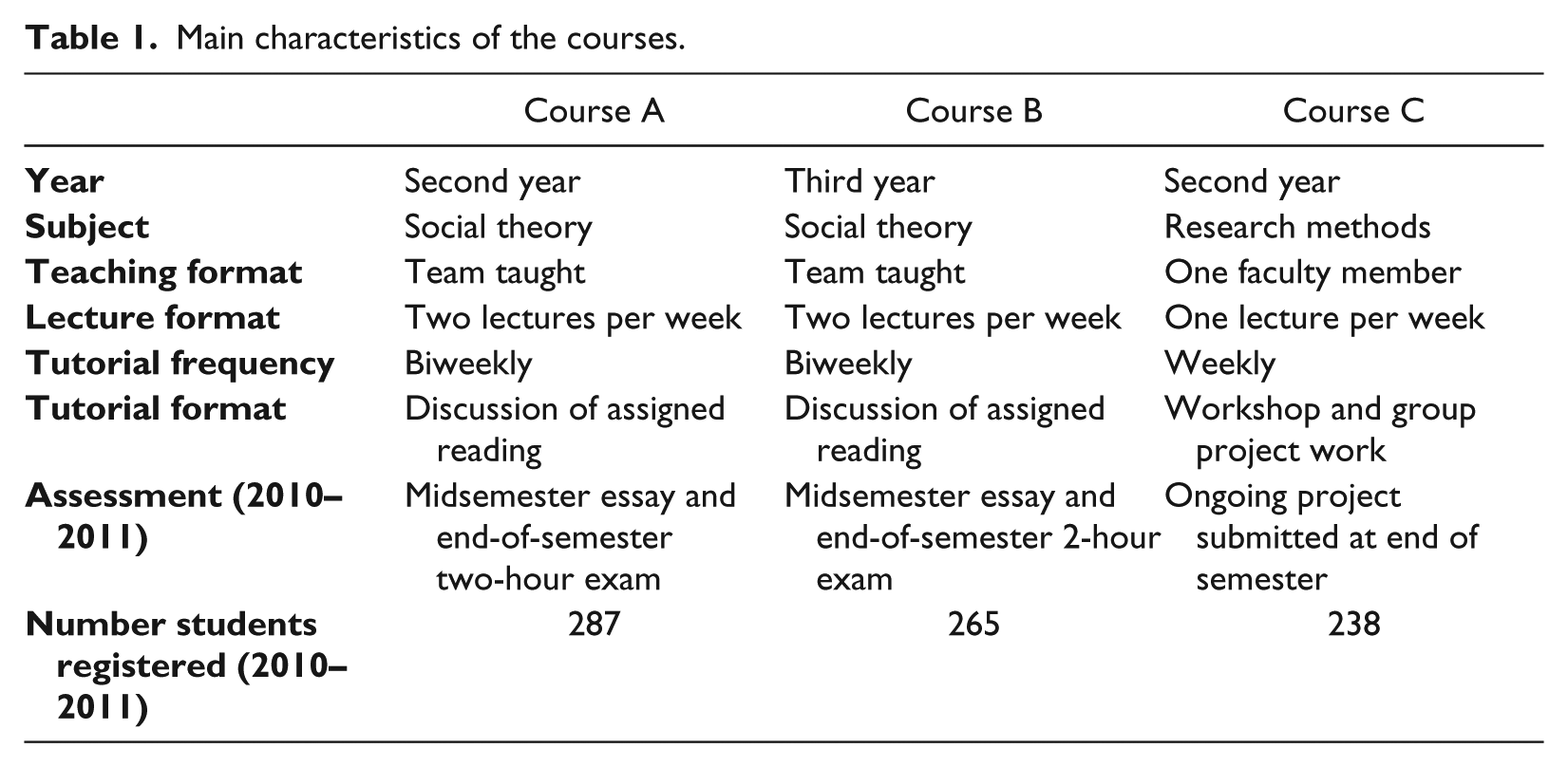
In the study we focused on three compulsory courses impacted by the decision to no longer award marks for small group tutorial attendance and participation (see Table 1 for an overview of these courses). Two of the courses were theory courses and one a methods course.
Main characteristics of the courses.
We employed a mixed-methods approach, combining quantitative analysis of UCD examination, registration, and attendance data (N = 2,790) and qualitative focus groups (N = 15), in-depth interviews (N = 3), open-ended questionnaires (N = 131), and an online survey (N = 5). We were granted an exemption by the institutional research ethics board, as the methodology fell under the category of exemption from ethical review. 1
One aim was to investigate the consequences of the decision to remove marks for attendance and participation for student learning (see O’Sullivan et al. 2013 for discussion of findings). However, in this article we focus, in the main, on the qualitative data relevant to two of the research questions:
Research Question 1: How is absence from small group tutorials perceived and understood by UCD sociology students?
Research Question 2: How do students account for absence?
The lead author conducted in-depth interviews with the three course tutors for Courses A and B. Four focus group discussions with 15 students who had taken these courses were moderated by a colleague working outside of the department. Despite considerable efforts, in the focus groups, students who are classified by the university as “mature students” (i.e., over 24 years of age on entry) predominated, and it proved difficult for us to recruit younger students and students who had not regularly attended tutorials. Therefore, to broaden the respondent pool, tutors administered an in-class, open-ended questionnaire to students attending Course C tutorials over one week at the end of semester two. The questionnaire allowed us to capture a more representative sample of sociology students; 45 percent of students taking Course C (N = 111) completed the questionnaire in class, a large majority of those in attendance that week. There was considerable overlap between students taking Courses A and C, as both were core second-year courses, and 75 percent of those who took Course C in semester two had also taken Course A in the previous semester. Questions also covered Course A attendance; two-thirds of those who completed the open-ended questionnaire had poorer attendance in Course A than C, which allowed us to capture variation in individual students’ attendance and their reflections. In the discussion of selective attendance and of excuses and justifications, we primarily draw on the latter data source; in the discussion of orientations we draw both on the focus group and the open-ended questionnaire data. We coded and analyzed all the qualitative data using a thematic approach. Taking account of constraints of space limitations, quotations used by the authors were selected to illustrate both different types of student accounts and the relevance of Scott and Lynam’s (1968) work to the study. The verbatim words, presented in the discussion of the findings, are examples chosen as they express an understanding or view that was also shared by other respondents.
In a final attempt to reach persistent nonattenders, at the end of the academic year we sent an online survey to 36 students who had missed 70 percent or more of the 12 weekly small group tutorials for Course C. The majority had also absented themselves from small group tutorials for Course A. Eighteen percent of persistent nonattenders we had identified completed the survey (N = 5).
Tutorial Attendance after the Removal of Marks for Attendance
Alongside the removal of marks for attendance and participation, the department made a decision to increase small group tutorial sizes. For Courses A and B mean tutorial size increased from 20 students to 34 (see Table 2). The rationale for the increase was an acceptance by both the department and the two course coordinators that attendance would decline as a result of the removal of marks for attendance. There were no changes made to the tutorial content or format. As is evident from Table 2, mean class sizes in Course C saw a smaller increase in size—from 19 to 23 students—a direct result of lobbying by the course coordinator against a large increase. It should also be noted that in contrast to Courses A and B, the course coordinator and tutors did not accept that attendance in the tutorials would inevitably decrease and strongly emphasized the importance of attendance regularly in classes. Nonattendance, rather than as being seen as inevitable, was presented as a risky and irrational behavior to students and this message was reinforced by faculty getting in touch with poor attenders as the semester progressed.
Seminar attendance patterns, and Pearson rho correlations (attendance and GPA) 2007–2010 and 2010–2011.
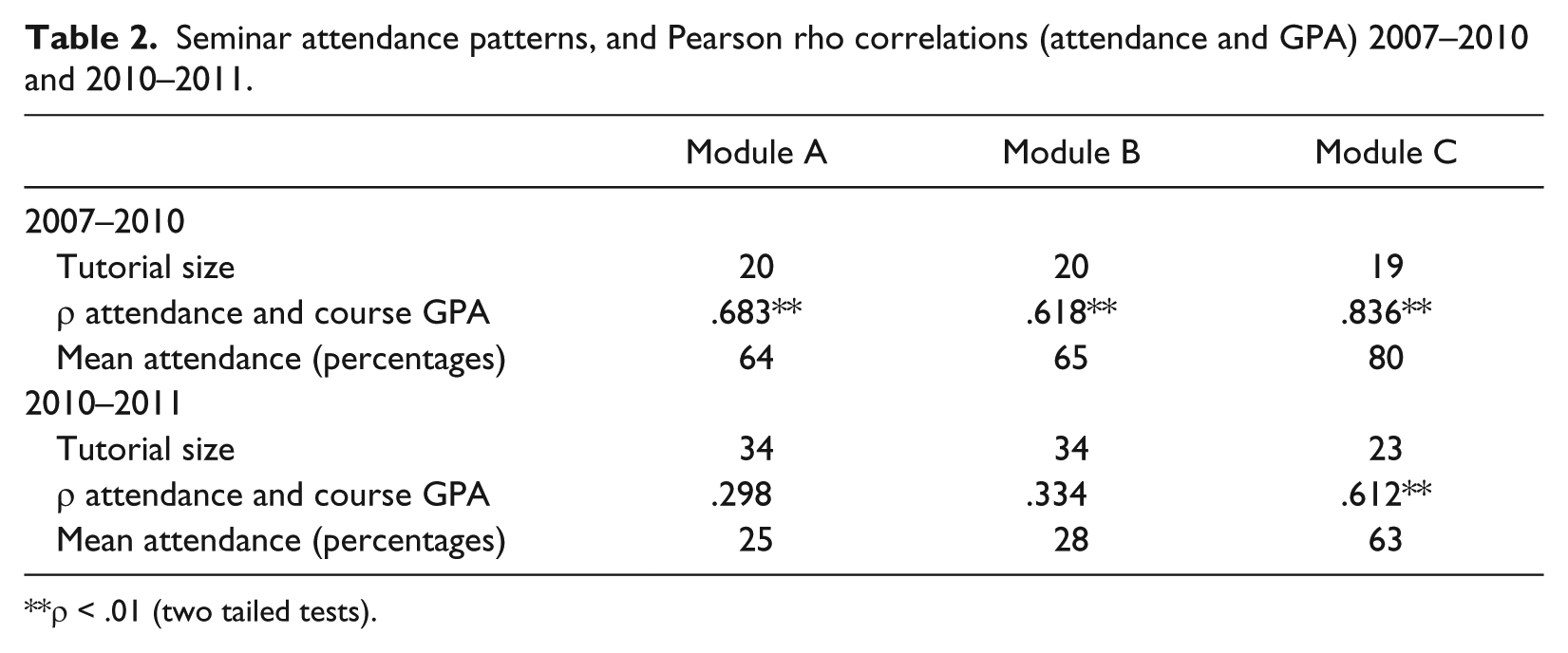
ρ < .01 (two tailed tests).
Following the removal of marks for attendance and participation, the average absence rate rose from 32 percent to 61 percent, in line with previous studies (see Launius 1997; Moore et al. 2003).
The increase in absences was strongest for Courses A and B. In contrast, the data for Course C do not indicate such a dramatic decline, with the majority of students attending small group tutorials both before and after the removal of marks. However, there was a decline evident and overall attendance declined from 80 percent from 2007–2010 to 63 percent in 2010–2011. Finally, as was already noted, 75 percent of those who took Course C had also taken Course A. The overall attendance pattern across the two courses was to skip largely tutorials for Course A but to attend tutorials for Course C. We argue that the pattern indicates that contextual factors, and not just grades, were playing a role in students’ decisions to attend classes. One background factor that should be mentioned was that Course C was a methods course and the other two were theory courses. There were major differences in content, pedagogy, and assessment strategies; as is common in a methods course, Course C was assessed by project work, closely aligned to the seminar activities. In addition, the methods course was perceived by students as less difficult than the theory courses, and overall, students achieved higher grades. Although other issues may have had an impact on behavior, for example, increased maturity as learners (students usually took Course C the semester after Course A) and poor grades received for Course A, no respondents mentioned these issues in either the questionnaire responses or the focus group discussions.
Orientations to Attendance
Only a minority of UCD sociology students attended small group tutorials regularly, irrespective of format, content, perceived quality of teaching, or incentives. For regular attenders, tutorial attendance is understood as crucial to their performance of the student role and part of their role obligation as students. Some attended regularly because of a lack of self-confidence as learners and a belief that they learned a lot in tutorials, for example, “I would have been in big trouble, more trouble than I am now (laughs) with the whole course had I not attended my [small group tutorials]” (Focus Group 1: Regular Attender, Course A). Many respondents also spoke about the pleasures of learning through group discussion in these classes. In particular, enjoyment of Course C was mentioned by half of those who had attended those tutorials regularly.
There was a second minority group, where the default behavior was consistent absence from small group tutorials. Some of these students justified their nonattendance explaining that they were unable to attend, for a variety of reasons, including commitments outside of university. Others expressed a very strong dislike of active participation in tutorials and reported deliberately absenting themselves from tutorials where they perceived they would be required to participate. A third subgroup expressed a preference for working on their own and did not regard tutorials as essential to learning. These respondents were not out of touch with the course; they reported regular attendance at lectures, studying, and reading and regarded these as more important activities for their learning than tutorial attendance. So, although they were not conforming to faculty expectations that “good” students attend small group tutorials regularly, these students did not believe that absence had a negative effect on their learning. For them, avoiding tutorials was an effective use of the limited time they spent on academic work. In contrast, a small number of students had a preference for minimal effort, including not attending tutorials, for example, as one explained, “I’d rather cram a day or two in advance [than attend tutorials during the semester].”
For the majority, the prevailing norm was selective and (at least) occasional attendance. For selective attenders, being a good student involves avoiding risk by keeping in touch with a course, staying on top of work, and not missing important information. These students largely skipped small group tutorials for Courses A and B but largely attended tutorials for Course C. Small group tutorials for Course C were deemed “more compulsory,” you “had to attend” if you wanted to do well in the course. Attendance was incentivized by both the format and content of the tutorials and the assessment. As in many other methods courses, there was an explicit focus on skill development over the semester and so students perceived there were real consequences for being absent. One respondent put it as, “I don’t see how anybody could afford to miss them.” Many selective attenders were focused on assessment and grades; for example, one respondent explained, “I really wanted to do well” and attendance was seen as important “to help me get a good grade.” In fact, the perception was largely correct; Pearson’s rho was used to measure the association between the two variables and revealed a far stronger correlation between course GPA and tutorial attendance for Course C, both before (ρ = 0.836) and after (ρ = 0.612) the removal of marks for attendance (see Table 2). Nevertheless, the norm was occasional absence, a finding that lends support to Arum and Roska’s (2011) characterization of the student experience of higher education as one often involving limited student application and effort.
Alongside respondents’ rational cost benefit analysis, many felt a sense of obligation toward their peers because of the group work that was central to the assessment work in Course C. In contrast, attendance in Courses A and B was seen as a personal preference rather than an obligation. Selective attenders also spoke about their liking or disliking of classes and tutors, and an emotive response provided another justification for absence. The tutorials for Course C were seen as interesting, interactive, enjoyable, and engaging; in contrast, the tutorials for Courses A and B were seen as boring, difficult, and too rigid. The contrast between theory and methods course content and format can be argued to be playing a role here.
Overall the authors found that these different orientations to attendance were associated with different attendance behavior across the courses in the study. They also impacted on the ways respondents explained their own and others’ absence from small group tutorials.
Accounting for Absence
Respondents drew on a range of excuses and justifications to account for absence from tutorials. In the students’ accounts, absence was presented as appropriate behavior. Where absences were excused, respondents admitted their behavior was wrong and sought forgiveness for it by invoking circumstances beyond their control. In contrast, where absences were justified, no forgiveness was seen as necessary as the absence was presented as the correct behavior in the circumstances. Both accounts allowed each respondent to preserve his or her sense of self as a good student.
Excusing Absences: I Should Have Attended but . . .
Overall, we found that excuses were used to account for occasional absences (see also Friedman et al. 2001). Excuses were given by the majority of questionnaire respondents when asked for a reason to explain the last time they missed a small group tutorial for Course C (58 percent, N = 65). Respondents gave similar kinds of excuses irrespective of whether they tended to attend these tutorials regularly or selectively. Illness was the most frequently given excuse, used by 37 percent of respondents (N = 41). Regular attenders were more likely to use illness than any other excuse. Other excuses given were appointments, family obligations, being away, and last minute changes in paid employment schedules. All of these were seen as entirely legitimate reasons for absence, as the circumstances were outside of respondents’ control. Respondents reported that absences from Course C small group tutorials were usually compensated for with a group meeting to catch up on missed work before the next class. A number of respondents also reported emailing the Course C tutors to explain their absence from class. Following Kalab (1987), it is evident that the use of excuses to explain absences indicated that absence from Course C small group tutorials was seen as inappropriate because of the explicit link to assessment.
Justifying Absences: I Should Not Have Attended, Because . . .
More frequent absences were justified rather than excused and these tended to be accounted for at greater length. Justifying was more frequently used to account for absences from Courses A and B. In the questionnaire those respondents who presented justifications (78 percent, N = 86) usually presented more than one justification and the average given was 2.3 (range, 1–7). All justifications positioned absence as a legitimate decision made following a cost benefit analysis of whether or not to attend a particular class on a particular day. Four justifications for missing sociology small group tutorials were drawn on most frequently by respondents, and we discuss each of these in the following.
Condemning the Condemners
Fifty-four percent of respondents (N = 60) used this neutralization technique and justified their absences by pointing to a number of ways the department was to blame, positioning themselves as not at fault. In addition, a key finding here was that small group tutorials for Courses A and B were presented as not worth attending. The consensus was that there was not a good return from attending, which provided a vocabulary of motive, or a shared set of reasons, that they felt was obvious in the setting; “when you go to the first one and you come out and you feel like you haven’t learned anything, that is kind of it then” (Focus Group 3: Selective Attender, Course B). For many, absence was justified by reference to a perceived lack of a clear link between the course assessment and the small group tutorials in the two theory courses, which meant there was no advantage evident to them from attending; “I found the Course C small group tutorials more useful to the assignments I had to do.” These respondents made a decision to avoid the small group tutorials and instead to do the “bare minimum to get by.”
In relation to Courses A and B, respondents were found to be resistant to an active learning approach. Respondents who had not prepared for class were looking for the challenging course material to be explained to them and were not open to actively engaging with and applying the concepts in discussions with their peers; “I found them very intimidating . . . we were put on the spot a lot . . . and the lectures were not explained.” Two of the three tutors explained it was a deliberate strategy not to resort to a mini-lecture; “the most helpful way of learning has been participation. So, and knowing that some of them haven’t done the reading . . . I want them to at least have something that they can work on. Without me giving them freebies [i.e., turning the small group tutorial into another lecture].”
In a context where large numbers of students do not attend classes, we argue that the prevailing student culture plays a role in creating consensus about the benefits of attending. One respondent vividly characterized the process, saying: “It just spread, that negativity thing about the course, like wildfire. . . . Everyone is talking negatively about it” (Focus Group 1: Regular Attender, Course A). The suggestion here is that in this case, the ready availability of VOMs did impact on behavior in relation to attendance at Course A and B small group tutorials in a similar way to that reported in the Murphy (2004) study. In contrast, there was a consensus about the use value of the small group tutorials for Course C, and in that case the availability of the VOM had limited impact on student behavior.
A similar type of justification was used by respondents who used scheduling to justify not attending classes regularly. Many said they found there was not a good fit between the lecture and small group tutorial schedule for Courses A and B. The biweekly format of Course A and B small group tutorials was also seen as not ideal. Finally respondents also mentioned that their small group tutorial timetable slot was inconvenient for them. In these cases the department is again being blamed for absences and the respondents present themselves as not at fault.
Denial of the Victim: Removal of Marks for Attendance at Small Group Tutorials
The removal of marks was presented as a self-evident justification for nonattendance by 30 percent of respondents (N = 33) and was used to justify absence irrespective of whether or not students had attended classes themselves. Absence was seen as permissible given the change in the assessment regime, and if there was an injury, it was seen as one the department had brought on itself. This rationale was invoked repeatedly by selective attenders in relation to nonattendance at small group tutorials for Courses A and B (which they largely “skipped”) but was drawn on to a lesser extent in relation to Course C (which they largely attended).
Those who attended regularly saw the removal of marks as an unwelcome change. They saw marks as necessary to others’ motivation. As one respondent explained, “I mean I know a fair few people who actually didn’t go to even one of them because of the fact that there was no grade” (Focus Group 2: Regular Attender, Course B). They also interpreted the removal of marks as a signal that attendance at small group tutorials was no longer considered important. For example, one respondent said, “if there is no mark, it doesn’t matter whether you attend or not” (Focus Group 3: Selective Attender, Course B). Others reported that the removal of marks decreased motivation and led to other courses taking precedence: “You were losing any kind of motivation really. I am very motivated. But I was under such pressure with other courses that I just left the sociology” (Focus Group 3: Selective Attender, Course B). It is evident here the extent to which motivation is a complex and contingent phenomenon. It is interesting to note that the tutors also alluded to a similar understanding in their discussion of absences from small group tutorials. As one tutor explained, “I think that it is because the culture has been that you go to tutorials to get marks. Suddenly you don’t get marks, so why would you go to the tutorial?” Although the introduction of marks for attendance had a positive effect on student attendance levels, a more negative consequence was that it also reinforced an instrumental orientation to attendance and an inclination toward making any activity count towards making the grade (Gump 2006; see also Friedman et al. 2001).
Without the “carrot” of awarding marks, respondents, particularly regular attenders, reported that students who did attend small group tutorials for Courses A and B often came without doing the required preparation work. The removal of marks was interpreted by students as a signal that preparation had also become optional. As a result, “The standard has completely decreased when grades are not present” (Focus Group 2: Regular Attender, Course B). While regular attenders reported a lack of preparation by their peers, many selective attenders reported that they themselves did not prepare for small group tutorials:
I didn’t do any of the readings because I didn’t have to do them. I didn’t do them because I was under pressure, huge pressure with other courses and it just happened that semester. So the small group tutorial work then went by the wayside. But if I did have to do it I would have done it. But it just meant then because people hadn’t done the reading, the tutor then had to kind of conduct a general discussion on the reading, so it wasn’t as effective. (Focus Group 3: Selective Attender, Course B)
Selective attenders attended sporadically in case they missed anything, but without expectation of a reward in terms of marks, they did not feel any obligation toward their peers (or the tutor) to be prepared for a discussion. Rather, they saw it as the tutor’s responsibility to deal with the situation and come up with an alternative class activity. Consequently, the fall-off in small group tutorial attendance did not just result in smaller class sizes, it also led to poorer quality small group tutorials, even for those students who did the preparatory work. As one student put it, “A tutorial without reading done by the participants is a pointless exercise” (student feedback, Course B). In sum, we argue that the removal of marks for small group tutorial attendance provided a powerful, readymade justification for students and made both absence and lack of preparation easy for students to account for.
Appeal to Loyalties: Commitments outside of University
Twenty-two percent of respondents (N = 24) justified their nonattendance by presenting themselves as unable to attend because of commitments outside of university. Here absence is presented as correct because they were either doing something important or doing something for someone important to them. In these accounts students invoke these commitments as a justification for missing some classes only, while for other classes they reported making alternative arrangements to ensure they can attend. These accounts are therefore quite different from absences that are excused. One respondent explained how this justification was used for some courses and not for others:
I missed two [Course A small group tutorials] through being otherwise engaged with voluntary work. However, had those . . . been in the same format as the Course C ones, I believe I would have made more of an effort to attend and missed some of the voluntary work.
Here, the respondent almost hedges her bets by first giving an excuse for not attending, which then turns into a justification.
Denial of Injury: Student Had an Assignment to Complete
For many selective attenders the limited time spent on academic work meant that when assignments were due, absence from class was the norm. As one respondent explained, “An essay was due in two days and I felt my time was better spent doing my essay than going to the [Course C small group tutorial].” The absence is presented as one that did not injure anyone and is therefore trivial (Scott and Lyman 1968). It is interesting to note that the justification, used by 19 percent of respondents (N = 21), fits with what “everybody knows” about student life, that is that students have too many assignments. However, it was not a justification used by regular attenders, who saw the time available for academic work as a more elastic resource. For them, the work toward assignments was carefully scheduled over the semester and not left until the due date was looming.
Conclusion
In this study of student attendance at small group tutorials across UCD sociology courses we aim to advance the discussion of student attendance. We avoid framing absence as a student problem and seek instead to understand how students account for absence and what these accounts reveal about dominant norms and values in operation. The study allows us to make a contribution to understanding student absence and attendance by moving beyond the dominant framing, which tends to reduce attendance to individual student characteristics. We argue that such a framing hinders understanding of a complex phenomenon as it tends to reify absence and attendance, seeing them as linked to stable characteristics students possess rather than constructed in the social setting.
From the analysis we highlight a number of key issues. We argue that attendance behavior is not static but changes according to cues given by peers, the institution, and faculty. For the majority, attendance behavior is selective and fluid, with students attending some classes regularly and others sporadically or not at all. The pattern leads us to suggest that absence is often facilitated by curriculum and assessment structures. We argue that this finding has implications for faculty and administrators at UCD who have a leadership role to play in developing what Arum and Roksa (2011:127) have termed a “culture of learning,” including attendance at classes across the institution.
We also argue that the range of routine justifications in operation in the setting meant absences were very easy for students to account for. There was broad acceptance of absence within UCD student culture. Attendance at small group tutorials was perceived as “optional,” and a broad range of excuses and justifications were available for students to draw on to explain absence. The majority of respondents saw themselves as free to pick and choose which classes they would attend, an understanding that did not impact on attendance in a uniform way. After the removal of attendance marks, attendance (and preparation) for Courses A and B small group tutorials declined, but students continued to attend (and prepare for) Course C small group tutorials.
Overall, we identify a number of characteristics of undergraduate student attendance behavior. Students’ decisions to attend classes were found to be influenced by the pedagogic approach in use, the course content, and their and their peers’ assessments of the usefulness of the small group tutorials to their learning experience. The rationales used by individual students to account for absence varied across courses, rather than individual students sticking to set ones in a consistent manner. We argue that attendance should not be understood solely as an individual behavior but also has collective and contextual elements that are important to understand. The accounts are suggestive of a consensus in UCD student culture about acceptable reasons for absence from class.
What is also evident is the commonsense knowledge in operation and the skillful way students draw on this to interpret, navigate, and challenge institutional norms, in this case that being a good student involves attending classes regularly. To return to Mills (1940), we argue that it is important not to take the justifications presented to account for absence at face value but to instead consider the reasons they are effective in the specific context. Two key issues emerge. First, respondents had anticipated the consequences of absence and, where absence was judged to be consequential for their success in a course and their identity as good students, had attended classes. However, where no consequences were anticipated, absence was the norm and was seen as a rational response. Second, respondents’ accounts highlighted that absence is often facilitated by curriculum and assessment structures that allow students to “get away with” absenting themselves. Similar to the argument made by Arum and Roksa (2011), this behavior can be seen to serve the interests of the principal stakeholders. Students are free to spend their time as they see fit, either on study, paid employment, or leisure. It also frees up faculty to spend more time on research and publishing, often a more valued activity than teaching.
The literature suggests regular attendance is important for student learning. However, this study has found that for some classes attendance is perceived as more important than for others. Where students vote with their feet and absent themselves, given the implications for student engagement and learning, these signals should be taken seriously by faculty and administrators. In particular, we argue that where students justify absences rather than excuse them, this suggests that the classes are not perceived as valuable, albeit that this judgment may not be based on firsthand experience. The study reaffirms that faculty do have a certain amount of control over students’ definition of the situation and can use a range of strategies to encourage attendance. In addition, we suggest that student definitions of attendance as optional are something that should be more robustly challenged at departmental and institutional levels. Excuses and justifications offered by students could be challenged rather than accepted as legitimate, as they would be in other settings, such as the workplace. Such an initiative would challenge the current status quo, whereby, although low attendance is widespread across Irish universities, it remains under the radar as a policy issue in the higher education field. Finally the picture that emerges from this study is more complex than a simple tale of declining attendance and challenges the idea that where classes are large and resources tight, poor attendance is the inevitable result.
Footnotes
Acknowledgements
First, we would like to thank all the UCD sociology students who participated in the fieldwork. We would also like to thank our colleagues in the School of Sociology for supporting this project, particularly the three course coordinators, and Paul Surgenor in UCD Teaching and Learning for facilitating the focus groups.