







Abstract
This article presents the development of a new simulation activity, the Game of Social Life. The activity introduces students to concepts of social stratification based on multiple dimensions of poverty, including inequalities related to housing, education, occupational status, social power, and health outcomes. The game was administered to students enrolled in a social psychology course at a small, private, liberal arts university located in the midwestern United States. Qualitative analysis of 25 students’ written reactions revealed that the game was engaging and successful in motivating students to adopt a new perspective, acknowledge inequality and explanations for poverty, self-reflect about privilege and oppression, and consider solutions to these problems. The activity was also assessed as a training exercise with 16 staff members at a nonprofit agency located in an urban area in southeastern Canada. These assessments indicate that the activity can be used in a variety of contexts.
Understanding structural factors in social life is one of the top learning goals of a course in sociology (Persell 2010). Still, asking students to reflect on structural explanations for poverty requires that students (especially those who are privileged) consider that their own successes in life may be due, in part, to privilege rather than to hard work (Platt 2013). Given this, it is not surprising that students often have negative reactions to these types of discussions (Davis 1992; Watt 2007). The purpose of the current article is to present the development and evaluation of the Game of Social Life, a poverty simulation designed to help students reflect on inequality and explanations for poverty, the role of privilege and oppression in maintaining systems of inequality, and possible solutions to the problems (Johnson 2005; Persell 2010; Platt 2013).
Simulation activities provide an ideal tool for achieving these goals as they allow students the opportunity to experience aspects of a phenomenon for themselves prior to examining underlying explanations (Dorn 1989; Kolb 1984). These activities reduce prejudice, promote perspective taking, and increase self-reflection (Beelman and Heinemann 2014; Dorn 1989; Kolb 1984; Patrick and Connolly 2013). This internalization of students’ reactions can be made even stronger if students’ own grades are linked to outcomes in the simulation (Norris 2013). For example, Brislen and Peoples (2005) note that easy parallels can be made between a class activity with an unequal grade distribution (where few students in the class earn As but several students earn Fs) and the unequal distribution of wealth in the United States (where only a few people are wealthy but many live in poverty).
A number of simulation activities exist (for reviews, see Carreiro and Kapitulik 2010; Davis 1992; Dorn 1989). Still, there tends to be a tradeoff between complexity and time efficiency. For example, budget exercises and board games tend to be short and easy to implement in class (see Abelev, Vincent, and Haney 2008; Coghlan and Huggins 2004; Fisher 2008; Garoutte and Bobbitt-Zeher 2011; Jessup 2001). But, these activities tend to focus primarily on the economic aspects of stratification (Norris 2013). In reality, poverty affects many areas of life, including housing, education, occupational status, social power, and health outcomes (Alkire 2013). Activities that fail to place poverty into a broader context risk trivializing these issues and alienating students who have lived experience with poverty (Carreiro and Kapitulik 2010; Dorn 1989; Norris 2013).
Other simulation activities are more complex (Dundes and Harlow 2005; Patrick and Connolly 2013; Simpson and Elias 2011; Steck et al. 2011; Vandsburger and Duncan-Daston 2010). For example, Simpson and Elias (2011) have students create characters and then use in-class and out-of-class assignments to make situational and financial choices for their characters across a variety of domains. These types of activities are more effective at highlighting the complexities of poverty; however, they often span multiple weeks of a course, require out of class preparation, or require investment in resource materials (Dundes and Harlow 2005; Patrick and Connolly 2013; Simpson and Elias 2011; Steck et al. 2011; Vandsburger and Duncan-Daston 2010). Instructors may not have the time or resources available to devote to such activities.
The current simulation activity, the Game of Social Life, was designed to be complex enough to capture multiple dimensions of poverty but simple enough that it could be completed from start to finish in three hours of class time, corresponding with the one-week timeframe for which most faculty devote to a singular unit in sociology (McCammon 1999). The Game of Social Life combines the benefits of a budget exercise with the benefits of a social stratification board game (see Abelev et al. 2008; Coghlan and Huggins 2004; Fisher 2008; Garoutte and Bobbitt-Zeher 2011; Jessup 2001). Unlike previous budget exercises and board games, however, the Game of Social Life focuses on multiple dimensions of poverty.
As Alkire (2013:44) notes, “Poverty has many dimensions. It is not just a question of money, but also of a complex range of deprivations in areas such as work, health, nutrition, education, services, housing and assets, among others.” A broad focus on these other dimensions could help to make poverty simulations more relatable to students. Indeed, Brislen and Peoples (2005:75) note that many undergraduate students struggle to relate to discussions of social stratification based on inequalities in income, as many of these students have never held a full-time, permanent work position. In contrast, almost all students have the experience needed to reflect on educational achievement. A focus on educational disparities could be a means to increase the relatability of poverty simulations for students (Boysen 2011). In addition, many students taking courses in sociology have interests in health-related professions, such as social work, counseling, nursing, or special education. Expanding poverty simulations to focus on the health aspects of poverty could make poverty simulations more relatable to a broader range of students (Irby-Shasanmi, Oberlin, and Saunders 2012).
The Game of Social Life is a simulation activity designed to introduce students to multiple dimensions of poverty that affect a person across the life span. These factors include disparities in housing, education, occupational status, social power, and health outcomes. The elements of the activity include a (1) character profile, (2) budget exercise, (3) experiential board game, and (4) directed discussion. In the next section we provide an overview of each element of the activity. We then discuss the results of an assessment that examined if the activity motivated students to (1) actively engage in the topic and adopt a new perspective, (2) reflect on inequality and explanations for poverty, (3) be self-reflective about privilege and oppression, and (4) consider solutions to the problems. In the conclusions section, we briefly present the results of an additional assessment and discuss the potential applicability of the game to multiple contexts.
The Game of Social Life
The Game of Social Life was created by the first author for an undergraduate course in social psychology offered through the social sciences department at a liberal arts university located in the midwestern United States. Resource materials for the Game of Social Life are currently under review for Teaching Resources and Innovations Library for Sociology (TRAILS). Detailed instructions for game play and needed materials are also available on the Teaching Sociology website. Of the 28 students enrolled in the course, 80 percent were female, 85 percent were white, 20 percent were second-year students, 50 percent were third-year students, and 30 percent were fourth- or fifth-year students. (The average age of enrollment for first-year students at the university is 18.4 years of age.) The students were a mix of majors, including 25 percent from sociology, 50 percent from other social science majors (psychology, criminology, or organizational leadership), and 25 percent from majors in business, education, or health professions.
The activity took a total of three hours distributed over three class periods: class one, 30 minutes, character profile and budget exercise; class two, 75 minutes, interactive board game; and class three, 75 minutes, directed discussion. To increase motivation and relevance, students believed that their performance on the activity would determine their participation grade for that unit (less than 2 percent of their total course grade; for a similar set-up, see Norris 2013). In the next sections we describe the four elements of the game: (1) character profiles, (2) budget exercise, (3) interactive board game, and (4) directed discussion.
Character Profiles
Students created a character by drawing, at random, four cards. First, students drew an income from a selection stratified to match the distribution of incomes in the United States for families making less than $250,000 per year (U.S. Census Bureau 2010). About half of the incomes came with employee subsidized health insurance (see the Kaiser Family Foundation 2012). Then, students drew a card that described the size of their family and the baseline expenses associated with a family of that size. These costs represented the typical baseline costs associated with food, clothing, child care, personal care, transportation, utilities, residence upkeep, and taxes for families of varying sizes (Glasmeier 2012).
Students also drew cards representing starting educational aptitude (1 = below average to 10 = above average) and health (1 = poor health to 5 = good health). The inclusion of starting educational aptitude and health was important for counteracting individualistic explanations for poverty that assume that people are poor because they have fewer skills, aptitude, or ability. Because these elements were independently drawn within the Game of Social Life, students could see firsthand that even when a person started out with a great deal of educational aptitude or good health, poverty could present significant barriers to success and wellness. Students could also see the numerous ways that economic privilege could be used to compensate for lower educational aptitude or poorer health but could have compounding and devastating effects for those without that privilege. See Table 1 for the starting distribution.
The Distribution of Starting Income, Expenses, Educational Aptitude, and Health; Ending Occupation and Class Points; and Reflection Essay Word Lengths.

Note: The numbers printed in the columns for Reflection A and B indicate the word length of the reflection.
Individuals who received government assistance when their baseline expenses exceeded their starting income.
Individuals who received employee subsidized health insurance.
Budget Exercise
Based on their monthly income and baseline family expenses, students completed a budget exercise to determine lifestyle choices, medical insurance, housing, and schooling. Seven of the students in the class did not draw an income large enough to cover their baseline expenses, so these individuals received aid, representing U.S. government programs such as Temporary Assistance for Needy Families (TANF), Supplemental Nutrition Assistance Program (SNAP), earned income credit, Housing Choice Voucher Program (Section 8), Children’s Insurance Program (CHIP), and Medicaid.
Students were cautioned that decisions made in the budget exercise would impact the health and educational opportunities of their character. For example, students could choose an economical lifestyle and cheaper and smaller housing to keep expenses low, but in doing so they put their health and education at risk. Opting into more comprehensive health insurance plans, healthier lifestyles, better housing, and better schools maximized students’ education and health opportunities but increased expenses. Like other budget exercises, this exercise was designed to highlight the tradeoffs and sacrifices that those living in poverty must make relative to their wealthier peers (Abelev et al. 2008; Garoutte and Bobbitt-Zeher 2011).
Interactive Board Game
The board game was played during the next class period, which met in a conference room on campus equipped with large round tables; 27 students were present to play the game. Upon arrival, each student received a packet with (1) play money representing the amount of discretionary funds remaining from the budget exercise; (2) education tokens representing the character’s starting educational aptitude plus any education credits that came with the character’s school choice; (3) health tokens representing the character’s starting health, plus or minus any health benefits or risks that came with housing and lifestyle choices; and (4) a health insurance card, if applicable. Figures 1, 2, and 3 display sample elements of the game play.
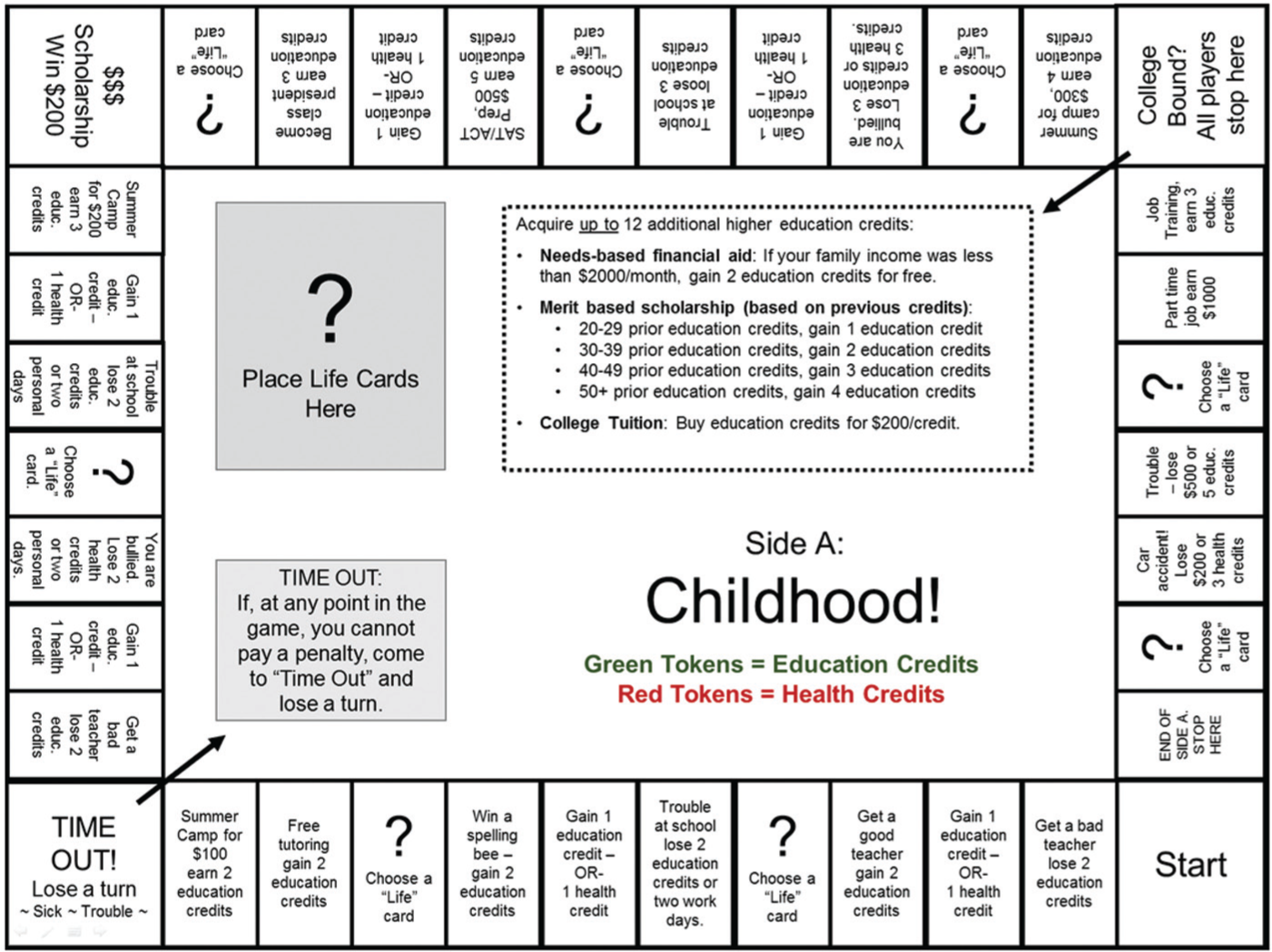
The game board (Side A).
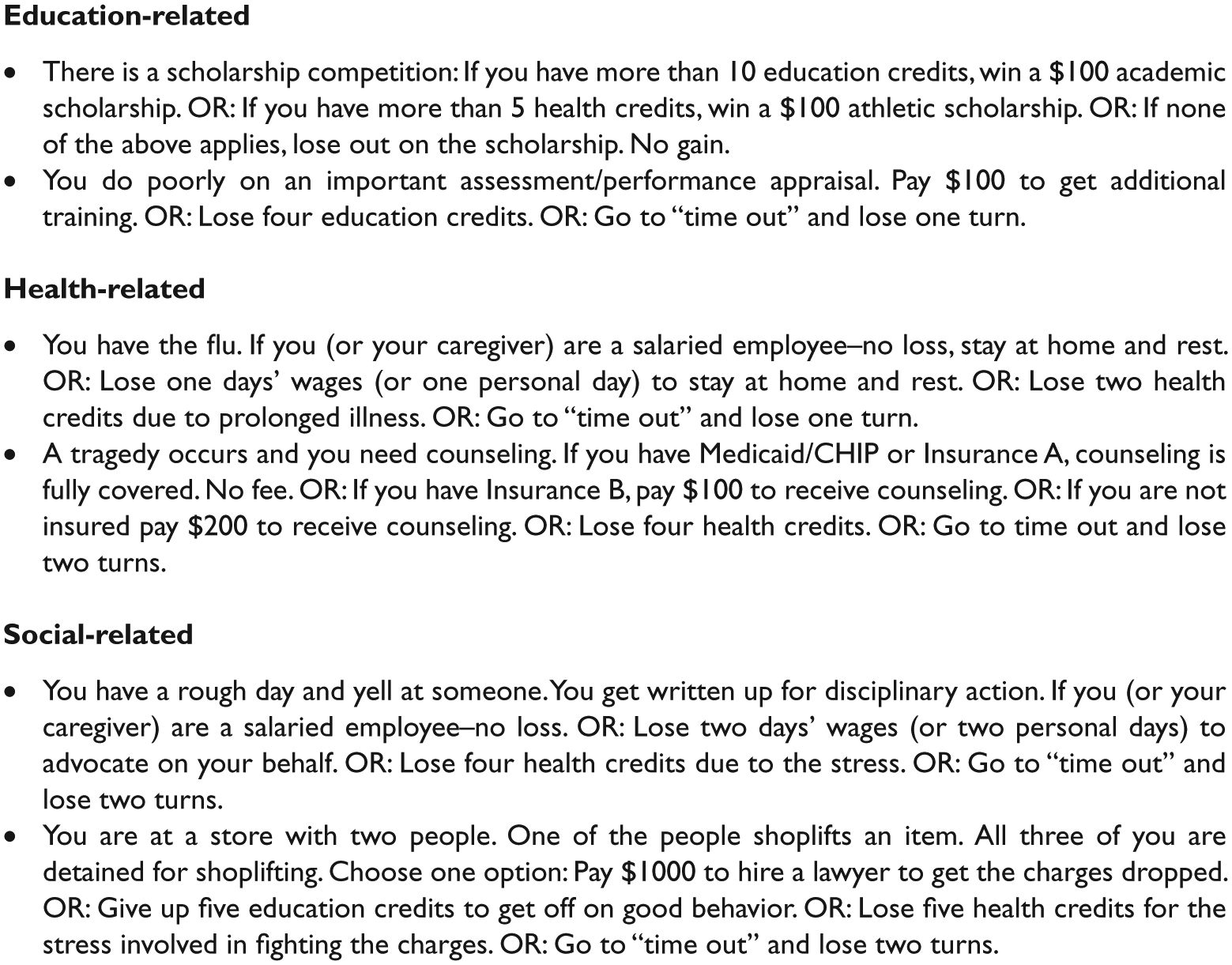
Sample “life” cards.
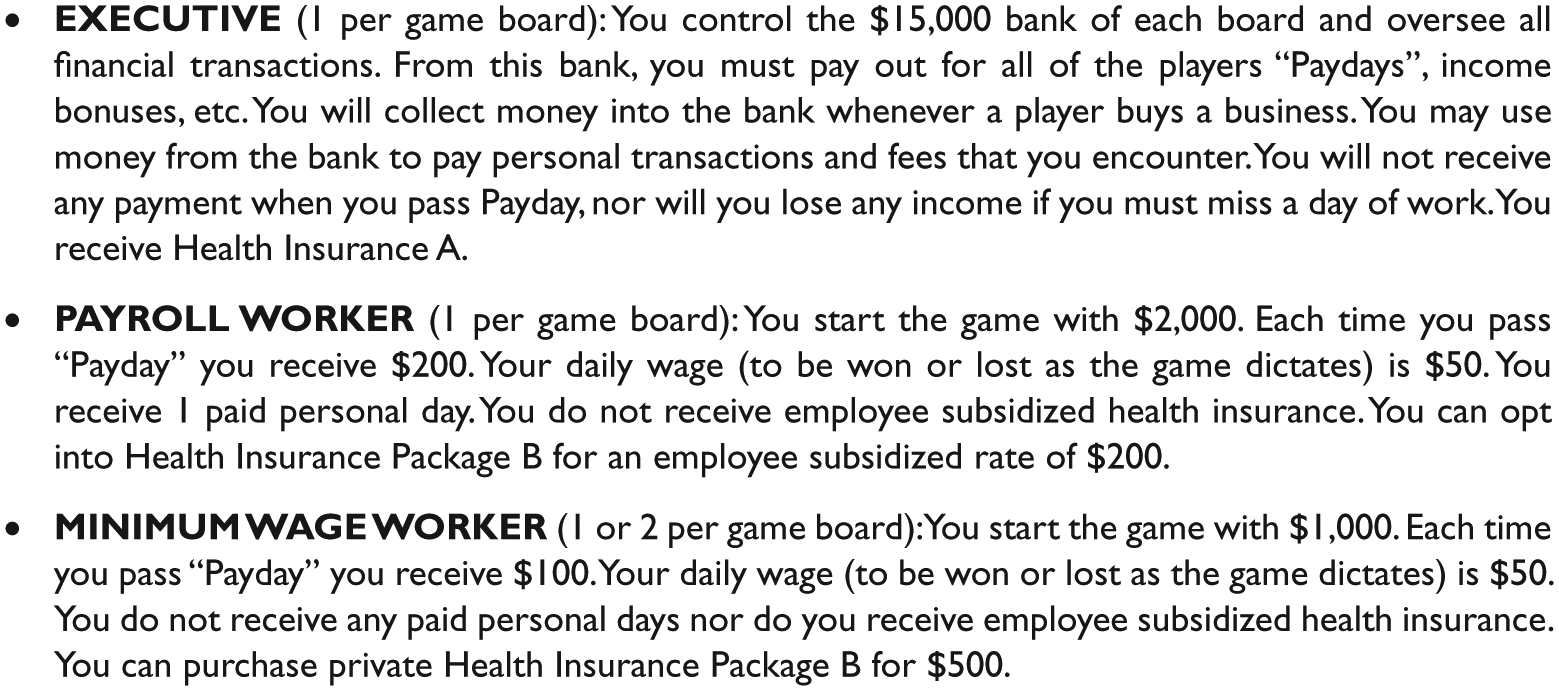
Sample occupations.
Students sat in groups of five or six people around each table. Each table had a two-sided board game that was created by the first author using poster board. Side A represented childhood and Side B represented adulthood. All of the players started the game on Side A. Players rolled two dice to advance their character on the game board. Spaces on the game board represented gains (win a $200 scholarship), losses (get a bad teacher, lose 2 education credits), or free choice (study to earn 2 education credits OR relax to earn 2 health credits OR work to earn $200). Other game spaces involved students choosing a “life” card and then making a decision that resulted in gains or losses in money, education, and health for their character. Together, the game spaces and life cards were meant to highlight the gains that come with privilege and the cumulative stress and losses that come with poverty (Ancis and Szymanski 2001; Irby-Shasanmi et al. 2012; McIntosh 1988).
At the end of Side A, students graduated to Side B of the board game. Prior to playing Side B, students used their education credits to choose an occupation from a set number of job openings representing executives, doctors, managers, payroll workers, and minimum wage workers. Each occupation was associated with a different amount of status, income, and social power. Students with the highest number of education credits chose their occupations first. Those with the fewest education credits chose last. In addition, students were able to keep any money, education, or health credits that they had accumulated during the first part of the game.
Game play for Side B was similar to Side A, in that game spaces involved gains, losses, or choosing a “life” card. In addition, students could buy and collect investment properties. In this regard, Side B of the Game of Social Life was similar to other simulations that build off of the familiar board game of Monopoly to teach about social stratification (Coghlan and Huggins 2004; Fisher 2008; Jessup 2001). Unlike these other games, however, the investment properties in the Game of Social Life represented grocery stores, clothing stores, restaurants, movie theatres, and so on. In this way, the expenses in the game better represented the ongoing financial stresses experienced by those living in poverty while highlighting how the rich keep getting richer.
Grade Distribution and Post-game Reflection
At the end of the game, students’ health, education, money, and investment properties were converted into a percentage that students believed represented their participation grade for that unit (less than 2 percent of their final course grade). The choice was made to link performance in the game to students’ grades (ostensibly) in order to better personalize the issue for students and to give students a common currency in which to discuss unequal distributions of wealth (Brislen and Peoples 2005; Norris 2013). Indeed, the grade distribution in the class ranged from a low of 15 percent to a high of 261 percent and was skewed similarly to the distribution of incomes in the United States, with only a few people in the class holding most of the percentage points and most people in the class near the middle or bottom of the distribution (see Table 1).
Game play took almost an entire class period. As such, it became necessary to split the playing of the game and the discussion of the game across two class periods. In an effort to keep students from feeling too anxious about their grades in the interim time period, at the end of the board game the instructor announced that grades on the activity would be discussed in the next class period and students would have the opportunity to earn back any points that they had lost during the game. Students were then asked to write a reflection paper answering the question, “What were your general impressions of the activity?” The students submitted their reflections electronically prior to the next class. The content of the reflection was not graded, but each unit in the course was associated with a reflection assignment, so its submission counted toward the students’ overall participation grade for the course.
Class Discussion and Post-discussion Reflection
In the next class period, students discussed their impressions of the activity and the distribution of grades. Class discussion was used to introduce and reinforce course concepts and theories related to social stratification, meritocracy, dimensions of poverty, economic capital, social capital, cultural capital, and individualistic versus structural explanations for poverty. Class time was also used to make a list of factors that serve as barriers to success, including parent characteristics, neighborhoods, schools, health care, social services, class, race/ethnicity, gender, and ability. This discussion raised important questions related to structural barriers to success, intersecting identities, privilege, oppression, racism, sexism, prejudice, and social dominance theory and introduced concepts related to neighborhood and intergenerational effects of poverty. We also discussed ideas for the redistribution of points, including distributing the points equally across all of the class members (equality), distributing the points based on merit (equity), or allowing those with the greatest number of points to determine how and where to distribute their own points (charity). This discussion tied back to course concepts on distributive justice and equity theory and raised important issues regarding collective responsibility for generating solutions to poverty.
At the end of the class period, students were debriefed on the purpose of the game and it was announced that all of the students in the class would receive full credit for their participation. To ensure that the debriefing was effective, especially in regards to mitigating concerns about students’ grades, students were asked to write a reflection about their impressions of the activity and the discussion and to submit that reflection electronically prior to the next class period. Because each unit in the course was associated with only one reflection assignment, completion of this second reflection was optional and did not count toward students’ participation grade.
Assessment
As part of a larger study approved by the Institutional Review Board, students in the class consented for course assessments to be used as data for teaching, evaluation, and research purposes. Of the 27 students present for the game, 25 gave their consent to be part of the larger study. All 25 of these students completed at least one reflection (24 completed the post-game reflection and 17 completed the post-discussion reflection). We qualitatively analyzed the data by identifying illustrative text related to four themes: (1) evidence of student engagement and perspective taking, (2) reflection on inequality and explanations for poverty, (3) self-reflection about privilege and oppression, and (4) reflection on solutions to the problems.
In the following section, we present the results. Unless otherwise noted, all percentages are calculated out of the 25 students included in the assessment. To illustrate various points, we include excerpts from students’ reflections. The participant ID number included in parentheses can be cross-referenced with the participant IDs presented in Table 1. Participant IDs are rank-ordered based on the characters’ starting salaries. Thus, comments from a participant with a low ID number (e.g., 1, 2, or 3) represent comments from students who played the most disadvantaged characters. Comments from a participant with a high ID number (e.g., 23, 24, or 25) represent comments from students who played the most advantaged characters. The letter indicates whether the excerpt came from the post-game (A) or the post-discussion (B) reflection.
Engagement and Perspective Taking
Students liked the game and were overall very engaged in the task. Indeed, 76 percent of the students described the task using words such as “genius,” “eye opening,” “utterly fascinating,” “interesting,” “fun,” “effective,” “entertaining,” “creative,” “informative,” “hands-on,” “well thought out,” and “a great learning experience.” Eighty percent of the students also found the game to be realistic, describing it as “mimicking true life,” “portraying our society,” “how society really is,” and “eerily realistic.” Importantly, 88 percent of the students expressed that the game helped them to adopt a new perspective or gain empathy for others. “This game was able to let me step into their shoes and understand how these individuals feel on a day-to-day basis” (1A). “This game helped shed some light on these issues and made them relevant to my life” (12A). In addition, in their end-of-course survey, completed nearly two months after playing the game, 28 percent of the students explicitly mentioned the Game of Social Life as the aspect of the course that they liked best.
Inequality and Explanations for Poverty
Although students liked the game, in their postgame reflections (prior to the class discussion), 64 percent of students found it unfair to link game performance to grades, using language such as “unfair,” “frustrated,” “unreasonable,” “quite upset,” “nervous,” and “awful.” Importantly, however, by the post-discussion reflection, 84 percent of students connected these inequalities in the game with real-life inequality, Our discussion on Tuesday really got me thinking. In the moment, when playing the game, those points and my grade in the class seemed so important, but after talking it through, I’m not sure that matters at all. I had no idea that the poverty level was set so low. No one can possibly live off of that kind of income, or even ten grand more than that. (17B)
In the process, 44 percent of the students recognized structural explanations for social inequality.
I feel that life is constantly throwing curve balls and how individuals deal with hurdles depends on economic status, health and academic opportunities. Life is very dependent on money and when the elite in society control the majority of money, those in middle and lower classes are dependent on others which may lead to resentful feelings. (1A) If you began the game poor, there was no chance in becoming rich. The people who started out rich and just kept all their money, intelligence, and health ended up ending the game in the same state. (6A) As we saw in the game, a lot of those who accumulated more wealth had done so more out of luck than hard work. . . . That’s not to say that they didn’t earn the wealth, but they could have just as easily not done nearly as well if the circumstances were a little different. (11B) This game goes to prove that the rich have almost endless opportunity, while the poorer are virtually stuck in the same status quo and even if they wanted to progress, they would face a plethora of obstacles in their way. (18A) The fortuitous circumstances I was born with in the game translated into equally golden prospects. I was privileged enough to buy all the education in the world, and it allowed me to further my career to its pinnacle. Others started off poor, and ended poor. They had no health insurance when they got sick, no money to pay the doctor, no money for groceries, and certainly no money to buy property or stock. Instead, they were left subject to the consequences of chance. (21A)
As evidenced by the fact that these comments came from students who played characters who were very poor (1), working poor (6), working class (11), middle class (18), and wealthy (21), the game seemed effective at generating reflection about poverty and inequality, regardless of the type of character played.
It should be noted, however, that for two of the students, social mobility in the game seemed to have a counterproductive effect, as this mobility appeared to reinforce the students’ individualistic attitudes. “I proved that you could come from a low income family and more unfortunate circumstances, and still make it to the top” (4A). “I had to work up to the point at which I ended . . . I worked for it and someone else should not be able to come in and tell me what I have to do with it” (10B). Interestingly, one of these students (4) attributed the character’s success entirely to the student’s own efforts, even though the character received government assistance at the beginning of the game. Thus, the student failed to see how structural factors contributed to the character’s success. Both of these students (4 and 10) also failed to notice that others in the class did not experience upward mobility and some even experienced downward mobility. These results suggest a need to devote more of the classroom discussion talking about the structural factors that contribute to social mobility, including access to government assistance, quality public education, and fair access to health care.
Self-reflection about Privilege and Oppression
The game and discussion also motivated students to engage in self-reflection, as 48 percent of the students discussed connections with their own lives. “Prior to the game I would say I had a negative perception for government assistance. . . . By being placed in a family that utilizes welfare though I was able to see that some families do need it to meet their basic physical needs” (3A). In this process, 36 percent of the students self-reflected about their own sources of privilege. “By playing the game I was able to see the privileged life that I lead” (7B). “It made me realize how incredibly blessed I am . . . there are certain advantages that you cannot deny” (17B).
The game also encouraged two students to self-reflect on their own experiences of poverty and oppression, “My lottery assigned family did mirror my own family’s circumstance (working poor and disadvantaged) and as I progressed through game it became more apparent that change is hard” (5A). “Although in the game I did well, I know what it’s like to have a bad ‘hand’ in reality. . . . No matter how hard you try sometimes, you may still be struggling just to stay afloat” (19A). Importantly, these two students found the game and discussion to be positive experiences, suggesting that the Game of Social Life may be effective for engaging privileged and nonprivileged students in discussions about social inequality (see Carreiro and Kapitulik 2010).
Solutions to the Problems
Importantly, 60 percent of the students also considered solutions to the problems. The most commonly offered solutions focused on the creation of ameliorative supports: The government needs to provide better schools for those kids; with qualified teachers who can help them succeed as an adult and more accessibility to them. The health care they provide needs to actually provide for them: if they are spending all of their money on health related issues then they can’t afford basic needs like clothes, shelter, and food. (24B)
Students also focused on efforts to redistribute wealth, often through taxation: Though I see the points of both sides of the argument, I do lean a bit more towards the argument in favor of wealth distribution. . . . Is it more important to let the rich keep an excessive amount of wealth because they have “earned” it, or is it more important to help the families who are struggling to feed their families and stay off the streets? I don’t think we should evenly divide out all of the wealth in America . . . but shouldn’t the wealthy be willing to pay slightly higher taxes at least for the sake of the greater good? (11B)
Within this process, 20 percent of students expressed a sense of personal responsibility to contribute to these solutions. “I hope to empower and encourage the disadvantaged and underrepresented in all that I do; mentorship, support, and advocacy” (5B). “What’s important is that I acknowledge the tremendous advantage that I have, and that I make efforts toward giving back, toward reducing the imbalanced distribution of wealth and educational resources, toward leveling the playing field for all” (21A).
It is important to note, however, that in their search for solutions, most of the students struggled with the complexities involved in fixing these problems.
I played the game true to my life and while I desperately wanted to advance in terms of affluence and capital, I did not want to do so at the expense of others. However, as one of the other players fell into bankruptcy I sat weighting the possibility of giving her some of my own assets to help her out, but I decided against this not wanting to risk my own financial security (and ultimately my grade). I wonder if most middle class families live in this way, in fear of declining financially and joining the working class/poor. (5A) One major question of debate is how to deal with this problem. This is a sticky situation because the rich people feel that they earned their money and should not have to give up their money in order to benefit the poorer people. Although some are sympathetic to the cause of the poor people throughout the world, money is such a priority and held with such importance in our world that it is hard to give it up. (9B)
Johnson (2005) notes that pessimism is a common reaction to discussions of structural inequality, as people do not know how they can contribute to solving such a large issue. The current results suggest the need for future class discussions to focus more on helping students develop a sense of efficacy in being able to contribute to structural solutions (Johnson 2005).
Conclusions
The Game of Social Life was designed to help students reflect on multiple dimensions of poverty that occur across the course of a life span, including inequalities related to housing, education, occupational status, social power, and health outcomes. The analysis suggested that students (1) engaged in the topic and adopted a new perspective, (2) reflected on inequality and explanations for poverty, (3) were self-reflective about privilege and oppression, and (4) considered solutions to the problems. The first author can also add that the discussion that followed the game was one of the most active, engaging, and higher level discussions that she has ever had with students about social inequality. The discussion was passionate and productive, and students seemed highly motivated to consider the material from multiple perspectives.
Importantly, the simulation activity seemed to be effective for engaging privileged and nonprivileged students in discussions about social inequality (see Carreiro and Kapitulik 2010). Likewise, students engaged in the topic regardless of whether they played a character that was advantaged or disadvantaged. Indeed, most students in the class reflected not only on their own experiences within the game but also on the experiences of their classmates. The opportunity to exchange ideas and consider the multiple perspectives of others is a key advantage of simulation activities (Carreiro and Kapitulik 2010; Davis 1992; Dorn 1989). In addition, although the game focused on the relationship between poverty, education, and health, during the discussion, the class considered the role of race/ethnicity, gender, ability, and sexual orientation as additional factors that contribute to poverty (Black and Stone 2005; McIntosh 2012; Robinson 1999). In future adaptations of the game, it may be worthwhile to more explicitly incorporate these demographic characteristics as part of the game.
An important consideration in the implementation of the game is the use of students’ own grades to illustrate stratification principles. Ostensibly linking students’ grades to stratification activities can be an effective means for personalizing the activity and giving students a common currency in which to discuss the unequal distribution of wealth (Brislen and Peoples 2005; Norris 2013). Still, prior to the class discussion students reacted strongly to the implication that their performance in the game would impact their own grades. The reflection activity, class discussion, and debriefing seemed particularly important for helping students process these emotions and connect the sense of inequality with real-life inequalities. Based on these findings, we recommend that instructors link game performance to students’ grades only in low-stakes situations involving a very small amount of points and only if the instructor has time to engage in a thorough discussion and debriefing of the activity. In the event that the game and discussion cannot occur in a single setting (as was the case in our current assessment), instructors should include a short debriefing immediately after the game to inform students that their game performance will not actually be linked to their grades.
Since the initial development of the game, the Game of Social Life has been adapted for use in other contexts, including as a staff training exercise for a nonprofit organization located in a major urban area in southeastern Canada. After the workshop, the 16 staff members completed a short assessment survey (with Research Ethics Board approval). On a rating scale of 1 (not at all) to 6 (very), the board game was perceived as engaging (M = 5.50), realistic (M = 5.12), effective (M = 5.19), worth the time (M = 5.44), worthy of recommendation (M = 5.56), and successful in getting people to reflect on themselves (M = 4.19) and others (M = 5.31). Staff members also described the game as “excellent,” “highly effective,” “well done,” “interesting,” “thought provoking,” and a “good exercise to change and expand thinking patterns.”
In general, the game is designed for use in small group interactions (5 to 30 players, with 5 or 6 players per board game). Facilitating up to 30 students was manageable with one instructor, but additional facilitators may be required if an instructor wishes to introduce the game in larger settings. We have also had some initial success in adapting aspects of the game for use in large lecture courses. Because the use of game boards is not feasible in a large lecture course, we displayed a subset of the decision scenarios on a PowerPoint presentation and then had students record their decisions, and corresponding resources, on individual game sheets. This adaptation to the game was not as interactive, but we did find that it successfully engaged students in an active follow-up discussion of the topics. Therefore, even though the game is still in its initial stages of development and assessment, the existing trials have indicated that the activity has use in a variety of contexts. In general, we believe that the Game of Social Life provides an important addition to the growing collection of activities that engage students in discussions of social stratification.
Footnotes
Funding
The author(s) disclosed receipt of the following financial support for the research, authorship, and/or publication of this article: Data analysis for this project was supported, in part, by a grant from the Teaching about Diversity Fund through the Learning and Teaching Office at Ryerson University, Toronto, Ontario, Canada.
Notes
Author Biographies
References
Supplementary Material
Please find the following supplemental material available below.
For Open Access articles published under a Creative Commons License, all supplemental material carries the same license as the article it is associated with.
For non-Open Access articles published, all supplemental material carries a non-exclusive license, and permission requests for re-use of supplemental material or any part of supplemental material shall be sent directly to the copyright owner as specified in the copyright notice associated with the article.
